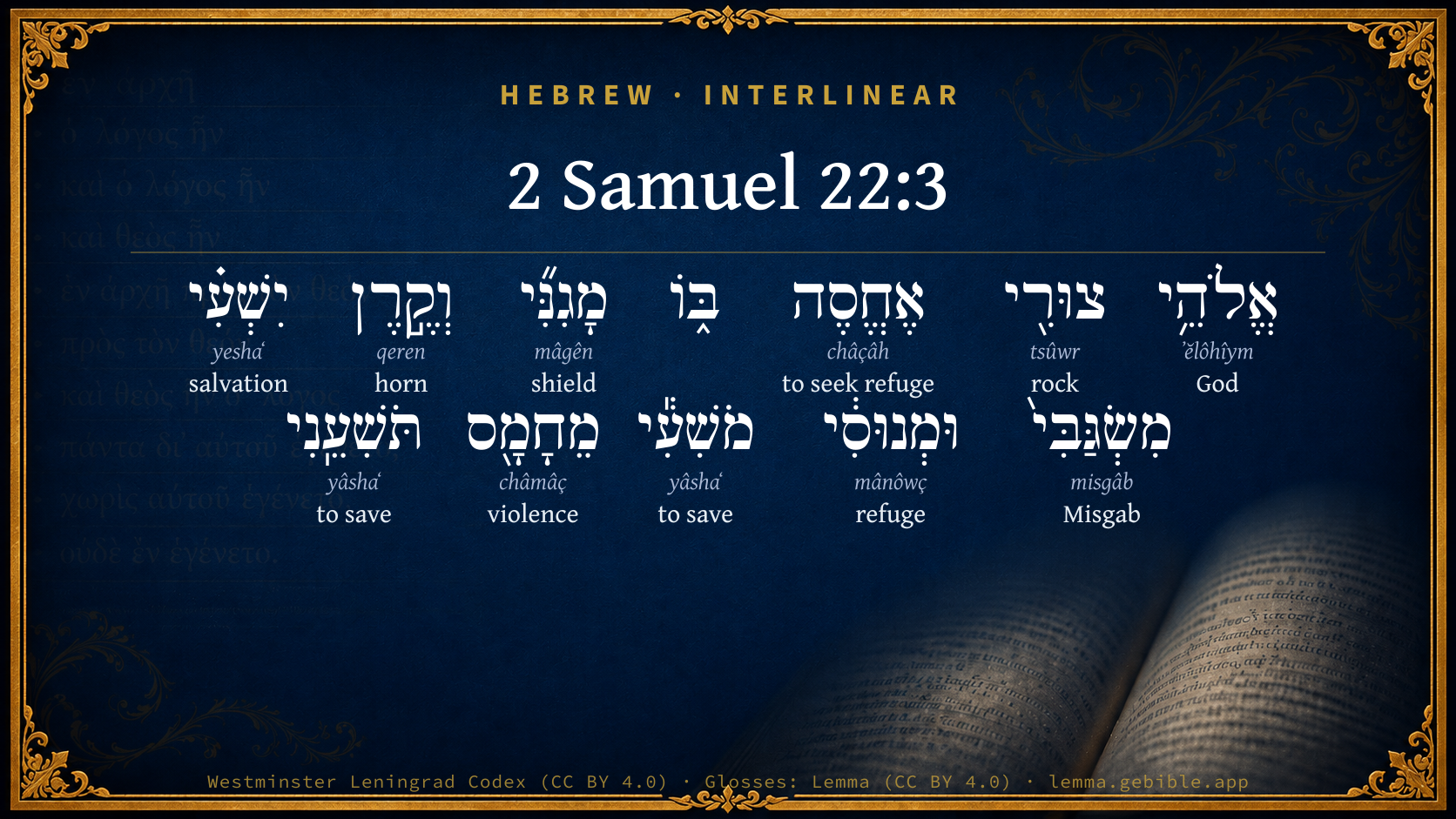
2 Samuel 22:3

Hebrew (Westminster Leningrad Codex) 2 Samuel 22:3 appears in the Hebrew Old Testament. The text above is from the Westminster Leningrad Codex. Each word links to its Strong’s number, a concise gloss, and parsing drawn from the Open Scriptures Hebrew Bible morphology. Click any word for its full Brown-Driver-Briggs (BDB) entry.
Download image
Cite this verse

2 Samuel 22:3 (World English Bible). Public Domain. Lemma interlinear Bible study tool, https://lemma.gebible.app/v/2-samuel/22/3.

Show BibTeX & RIS
BibTeX
RIS
English Translation
God, my rock, in him will I take refuge; My shield, and the horn of my salvation, my high tower, and my refuge; My savior, you save me from violence.
World English Bible · Public Domain
Highlights
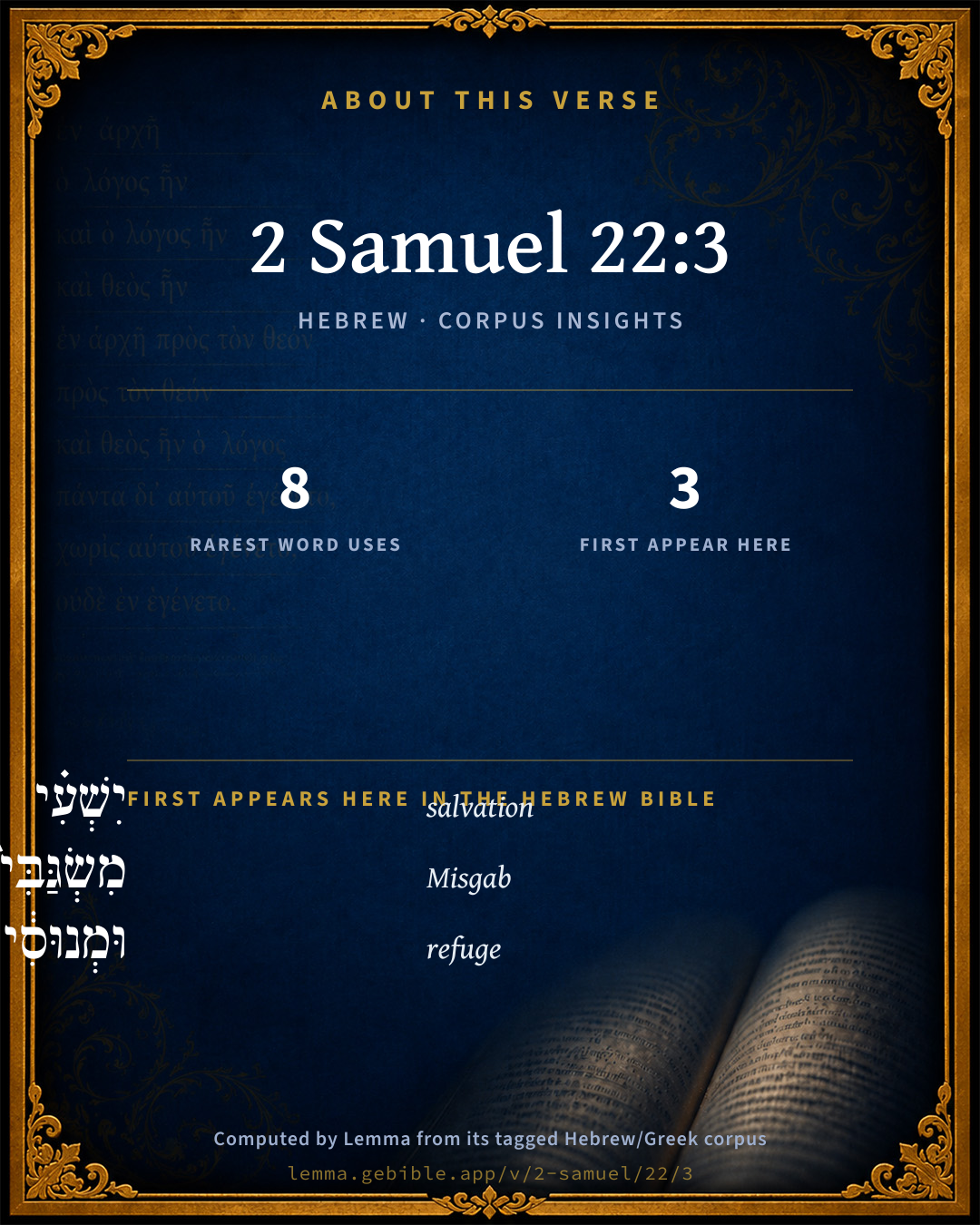
  • 3 first appearances in the Hebrew Bible
Full analysis ↓
Download a study sheet

One document with this verse’s original text, its word-by-word gloss line, the meaning frame, cross-references with their text, attributed commentary, and full source and license credits — printable, and it pastes into notes with its structure intact.

This verse Autodidact and up

Study sheet (.html) Plain text (.txt)

A passage Seminary Student

Up to 50 verses in one chapter. A passage sheet keeps up to 6 commentary sources and 12 cross-references per verse, in the order this page ranks them, and says so on the sheet whenever that leaves anything out. Ask for a single verse and you get the Autodidact verse sheet above.

Everything on this page stays free to read, with no account — the sheet is a download of what is already on screen, not access to it.

Want to remove ads? Support Godless Engineer
Compare translations 3

The same verse in 3 English versions, stacked beneath the original-language interlinear above. Click any original word for its lexicon entry.

Each is an independent rendering of the whole verse — the interlinear is not word-aligned to these translations.

Highlighted words mark where these versions differ — a whole-verse word diff, not a word-by-word alignment.

  • World English Bible Public Domain
    God, my rock, in him will I take refuge; My shield, and the horn of my salvation, my high tower, and my refuge; My savior, you save me from violence.
  • King James Version Public Domain
    The God of my rock; in him will I trust: he is my shield, and the horn of my salvation, my high tower, and my refuge, my saviour; thou savest me from violence.
  • unfoldingWord Literal Text CC BY-SA 4.0
    God of my rock, I take refuge in him, my shield and the horn of my salvation, my stronghold and my refuge, my savior, you save me from violence.

unfoldingWord Literal Text — © unfoldingWord, licensed CC BY-SA 4.0. Word-aligned USFM3 via Door43 (git.door43.org/unfoldingWord/en_ult).

Versions to compare (up to 4)

3 of 4 selected

Show all 18 translations

Every available English version of this verse, each an independent rendering of the whole verse.

  • World English Bible Public Domain
    God, my rock, in him will I take refuge; My shield, and the horn of my salvation, my high tower, and my refuge; My savior, you save me from violence.
  • Berean Standard Bible Public Domain
    My God is my rock, in whom I take refuge, my shield, and the horn of my salvation. My stronghold, my refuge, and my Savior, You save me from violence.
  • Majority Standard Bible Public Domain
    My God is my rock, in whom I take refuge, my shield, and the horn of my salvation. My stronghold, my refuge, and my Savior, You save me from violence.
  • King James Version Public Domain
    The God of my rock; in him will I trust: he is my shield, and the horn of my salvation, my high tower, and my refuge, my saviour; thou savest me from violence.
  • American Standard Version (1901) Public Domain
    God, my rock, in him will I take refuge; My shield, and the horn of my salvation, my high tower, and my refuge; My saviour, thou savest me from violence.
  • Revised Version (1885) Public Domain
    The God of my rock, in him will I trust; my shield and the horn of my salvation, my high tower, and my refuge; my saviour, thou savest me from violence.
  • Geneva Bible (1599) Public Domain
    God is my strength, in him will I trust: my shielde, and the horne of my saluation, my hie tower and my refuge: my Sauiour, thou hast saued me from violence.
  • Douay-Rheims (1899) Public Domain
    God is my strong one, in him will I trust: my shield, and the horn of my salvation: he lifteth me up, and is my refuge: my saviour, thou wilt deliver me from iniquity.
  • Young's Literal Translation Public Domain
    My God `is' my rock -- I take refuge in Him; My shield, and the horn of my salvation, My high tower, and my refuge! My Saviour, from violence Thou savest me!
  • Literal Standard Version CC BY-SA 4.0
    My God [is] my rock—I take refuge in Him; My shield, and the horn of my salvation, || My high tower, and my refuge! My Savior, You save me from violence!
  • Unlocked Literal Bible CC BY-SA 4.0
    God is my rock. I take refuge in him. He is my shield, the horn of my salvation, my stronghold, and my refuge, the one who saves me from violence.
  • unfoldingWord Literal Text CC BY-SA 4.0
    God of my rock, I take refuge in him, my shield and the horn of my salvation, my stronghold and my refuge, my savior, you save me from violence.
  • Darby Bible Public Domain
    God is my rock, in him will I trust -- My shield, and the horn of my salvation, My high tower, and my refuge, My saviour: thou wilt save me from violence.
  • World Messianic Bible Public Domain
    God is my rock in whom I take refuge; my shield, and the horn of my salvation, my high tower, and my refuge. My savior, you save me from violence.
  • Webster's Bible Public Domain
    The God of my rock; in him will I trust: he is my shield, and the horn of my salvation, my high tower, and my refuge, my preserver; thou savest me from violence.
  • Free Bible Version CC BY-SA 4.0
    He is my God, my rock who protects me. He shields me from harm, his power saves me, he keeps me safe. He is my protector; he is my savior; he saves me from violence.
  • Bible in Basic English Public Domain
    My God, my Rock, in him will I put my faith; my breastplate, and the horn of my salvation, my high tower, and my safe place; my saviour, who keeps me safe from the violent man.
  • JPS Tanakh (1917) Public Domain
    The God who is my rock, in Him I take refuge; my shield, and my horn of salvation, my high tower, and my refuge; my saviour, Thou savest me from violence.

Literal Standard Version (2020), Covenant Press — licensed CC BY-SA 4.0. Text via the HelloAO Bible API (eBible.org). Unlocked Literal Bible (unfoldingWord) — licensed CC BY-SA 4.0. Text via the HelloAO Bible API (eBible.org). unfoldingWord Literal Text — © unfoldingWord, licensed CC BY-SA 4.0. Word-aligned USFM3 via Door43 (git.door43.org/unfoldingWord/en_ult). Free Bible Version, Dr. Jonathan Gallagher — licensed CC BY-SA 4.0. Text via the HelloAO Bible API (eBible.org).

Word by word

More ways to search: Search by grammar → Find every occurrence → Compare this word →

Practice this passage: Drill this verse → Learn its vocabulary →

וּמְנוּסִ֔י
mânôwç
H4498
“and · refuge · my”
Conjunction + Noun, Common, Masculine, Singular, Construct + Suffix, Personal, 1st Person, Common, Singular
Part of Speech
Conjunction + Noun
Type
Common
Gender
Masculine
Number
Singular
State
Construct
Full BDB Definition

Origin: from H5127

TWOT: 1327a

flight, refuge, place of escape - flight - refuge, place of escape
  1. אֱלֹהֵ֥י ʼĕlôhîym H430 “God(s) of” Noun, Common, Masculine, Plural, Construct
  2. צוּרִ֖י tsûwr H6697 “rock · my” Noun, Common, Masculine, Singular, Construct + Suffix, Personal, 1st Person, Common, Singular
  3. אֶחֱסֶה châçâh H2620 “to seek refuge” Verb, Qal, Imperfect, 1st Person, Common, Singular
  4. מָגִנִּ֞י mâgên H4043 “shield · my” Noun, Common, Both, Singular, Construct + Suffix, Personal, 1st Person, Common, Singular
  5. וְקֶ֣רֶן qeren H7161 “and · horn of” Conjunction + Noun, Common, Both, Singular, Construct
  6. יִשְׁעִ֗י yeshaʻ H3468 “salvation · my” Noun, Common, Masculine, Singular, Construct + Suffix, Personal, 1st Person, Common, Singular
  7. מִשְׂגַּבִּי֙ misgâb H4869 “Misgab · my” Noun, Common, Masculine, Singular, Construct + Suffix, Personal, 1st Person, Common, Singular
  8. מֹשִׁעִ֕י yâshaʻ H3467 “saving · me” Verb, Hiphil, Participle Active, Masculine, Singular, Construct + Suffix, Personal, 1st Person, Common, Singular
  9. מֵחָמָ֖ס châmâç H2555 “from · violence” Preposition + Noun, Common, Masculine, Singular, Absolute
  10. תֹּשִׁעֵֽנִי yâshaʻ H3467 “to save · me” Verb, Hiphil, Imperfect, 2nd Person, Masculine, Singular + Suffix, Personal, 1st Person, Common, Singular

About this verse

These counts appear in no published source. They are computed here, from the morphology-tagged text and Lemma’s own curated glosses. What Lemma adds →

12
words
10
distinct lemmas
Historical
section

Notable vocabulary

The rarest word here is וּמְנוּסִ֔י refuge H4498 — appearing just 8 times in the whole Hebrew Bible.

First appearance in Scripture

These words make their first canonical appearance in the Hebrew Bible here:

  • יִשְׁעִ֗י salvation H3468
  • מִשְׂגַּבִּי֙ Misgab H4869
  • וּמְנוּסִ֔י refuge H4498

Shared distinctive vocabulary

וּמְנוּסִ֔י refuge H4498 occurs in 8 verses of the Hebrew Bible. Also found in:

Grammatical profile

  • 3 verbs
  • 8 nouns
  • 1 preposition

Verb forms

  • אֶחֱסֶה Qal · Imperfect
  • מֹשִׁעִ֕י Hiphil · Participle Active
  • תֹּשִׁעֵֽנִי Hiphil · Imperfect

Repetition

A word recurs within this verse — often emphatic in Hebrew:

  • מֹשִׁעִ֕י to save H3467 ×2

Hebrew & Septuagint length

In English translation the verse runs 30 words from the Hebrew and 38 from the Septuagint (LXX English) — closely comparable.

A rough comparison of the two English renderings, which tokenize alike — not a word-level alignment.

Word counts can differ between the Hebrew and the Greek without any difference in meaning — e.g. the Hebrew direct-object marker אֵת has no separate Greek word, and Greek often adds the article ὁ.

Cross-references

43

Topical passages linked to 2 Samuel 22:3 in the Treasury of Scripture Knowledge — connected by theme and wording, ordered by reader-vote popularity; previews shown in the World English Bible.

  • Psalms 9:9 Yahweh will also be a high tower for the oppressed; A high tower in times of trouble.
  • Isaiah 12:2 Behold, God is my salvation. I will trust, and will not be afraid; for Yah, Yahweh, is my strength and song; and he has become my salvation."
  • Proverbs 18:10 The name of Yahweh is a strong tower: The righteous run to him, and are safe.
  • Psalms 18:2 Yahweh is my rock, my fortress, and my deliverer; My God, my rock, in whom I take refuge; My shield, and the horn of my salvation, my high tower.
  • Proverbs 30:5 "Every word of God is flawless. He is a shield to those who take refuge in him.
  • Genesis 15:1 After these things the word of Yahweh came to Abram in a vision, saying, "Don't be afraid, Abram. I am your shield, your exceedingly great reward."
  • Deuteronomy 33:29 Happy are you, Israel: Who is like you, a people saved by Yahweh, The shield of your help, The sword of your excellency! Your enemies shall submit themselves to you; You shall tread on their high places.
  • Psalms 46:11 Yahweh of Hosts is with us. The God of Jacob is our refuge. Selah.
  • Psalms 115:9–11 Israel, trust in Yahweh! He is their help and their shield.
  • Psalms 144:2 My loving kindness, my fortress, My high tower, my deliverer, My shield, and he in whom I take refuge; Who subdues my people under me.
  • Psalms 14:6 You frustrate the plan of the poor, Because Yahweh is his refuge.
  • Psalms 59:16 But I will sing of your strength. Yes, I will sing aloud of your loving kindness in the morning. For you have been my high tower, A refuge in the day of my distress.
  • Luke 1:69 And has raised up a horn of salvation for us in the house of his servant David
  • Hebrews 2:13 Again, "I will put my trust in him." Again, "Behold, here am I and the children whom God has given me."
  • Psalms 46:7 Yahweh of Hosts is with us. The God of Jacob is our refuge. Selah.
  • Psalms 55:9 Confuse them, Lord, and confound their language, For I have seen violence and strife in the city.
  • Psalms 86:14 God, the proud have risen up against me. A company of violent men have sought after my soul, And they don't hold regard for you before them.
  • Psalms 140:4 Yahweh, keep me from the hands of the wicked. Preserve me from the violent men who have determined to trip my feet.
  • Isaiah 32:2 A man shall be as a hiding-place from the wind, and a covert from the tempest, as streams of water in a dry place, as the shade of a great rock in a weary land.
  • Jeremiah 16:19 Yahweh, my strength, and my stronghold, and my refuge in the day of affliction, to you shall the nations come from the ends of the earth, and shall say, Our fathers have inherited nothing but lies, [even] vanity and things in which there is no profit.
  • Deuteronomy 32:37 He will say, Where are their gods, The rock in which they took refuge;
  • 1 Samuel 2:1 Hannah prayed, and said: My heart exults in Yahweh; My horn is exalted in Yahweh; My mouth is enlarged over my enemies; Because I rejoice in your salvation.
  • 2 Samuel 22:49 Who brings me forth from my enemies: Yes, you lift me up above those who rise up against me; You deliver me from the violent man.
  • 2 Samuel 22:51 Great deliverance gives he to his king, Shows loving kindness to his anointed, To David and to his seed, forevermore.
  • Psalms 3:3 But you, Yahweh, are a shield around me, My glory, and the one who lifts up my head.
  • Psalms 5:12 For you will bless the righteous. Yahweh, you will surround him with favor as with a shield.
  • Psalms 27:5 For in the day of trouble he will keep me secretly in his pavilion. In the covert of his tent he will hide me. He will lift me up on a rock.
  • Psalms 28:7 Yahweh is my strength and my shield. My heart has trusted in him, and I am helped. Therefore my heart greatly rejoices. With my song I will thank him.
  • Psalms 46:1 God is our refuge and strength, A very present help in trouble.
  • Psalms 61:3 For you have been a refuge for me, A strong tower from the enemy.
  • Psalms 71:7 I am a marvel to many, But you are my strong refuge.
  • Psalms 72:14 He will redeem their soul from oppression and violence. Their blood will be precious in his sight.
  • Psalms 84:9 Behold, God our shield, Look at the face of your anointed.
  • Psalms 84:11 For Yahweh God is a sun and a shield. Yahweh will give grace and glory. He withholds no good thing from those who walk blamelessly.
  • Psalms 140:1 Deliver me, Yahweh, from the evil man. Preserve me from the violent man;
  • Psalms 140:11 An evil speaker won't be established in the earth. Evil will hunt the violent man to overthrow him.
  • Luke 1:71 Salvation from our enemies, and from the hand of all who hate us;
  • Psalms 32:7 You are my hiding place. You will preserve me from trouble. You will surround me with songs of deliverance. Selah.
  • Isaiah 45:21 Declare you, and bring [it] forth; yes, let them take counsel together: who has shown this from ancient time? who has declared it of old? Haven't I, Yahweh? and there is no God else besides me, a just God and a Savior; there is no one besides me.
  • Jeremiah 16:9 For thus says Yahweh of Hosts, the God of Israel: Behold, I will cause to cease out of this place, before your eyes and in your days, the voice of mirth and the voice of gladness, the voice of the bridegroom and the voice of the bride.
  • Luke 1:47 My spirit has rejoiced in God my Savior,
  • Titus 3:4 But when the kindness of God our Savior and his love toward mankind appeared,
  • Titus 3:6 which he poured out on us richly, through Jesus Christ our Savior;

Cross-references courtesy of OpenBible.info (CC BY 4.0).

Hebrew and Greek witnesses Masoretic Hebrew ↔ Greek Septuagint

The same verse in the two great witnesses to the Old Testament, shown verse-for-verse.

These are two independent witnesses, not word-aligned to each other, and the Septuagint is shown in lemma (dictionary) form.

Hebrew 2 Samuel 22:3 Masoretic · Westminster Leningrad Codex

אֱלֹהֵ֥י צוּרִ֖י אֶחֱסֶה בּ֑וֹ מָגִנִּ֞י וְקֶ֣רֶן יִשְׁעִ֗י מִשְׂגַּבִּי֙ וּמְנוּסִ֔י מֹשִׁעִ֕י מֵחָמָ֖ס תֹּשִׁעֵֽנִי

God, my rock, in him will I take refuge; My shield, and the horn of my salvation, my high tower, and my refuge; My savior, you save me from violence.

World English Bible · Public Domain

Greek LXX 2 Samuel 22:3 Septuagint · lemma form

ὁ θεός ἐγώ φύλαξ εἰμί ἐγώ πείθω εἰμί ἐπί αὐτός ὑπερασπιστής ἐγώ καί κέρας σωτηρία ἐγώ ἀντιλήπτωρ ἐγώ καί καταφυγή ἐγώ σωτηρία ἐγώ ἐκ ἄδικος σώζω ἐγώ

my God; he shall be to me my guard, I will trust in him: he is my protector, and the horn of my salvation, my helper, and my sure refuge; you shall save me from the unjust man.

LXX2012 (modern English Septuagint) · Public Domain

Hebrew: Westminster Leningrad Codex (CC BY 4.0). Greek: Septuagint (public domain); English from LXX2012 (modern English Septuagint) (Public Domain). How the Septuagint differs from the Hebrew →

Targum (Aramaic paraphrase)

1

The Targum is the ancient Jewish Aramaic paraphrase of the Hebrew Scriptures — an interpretive translation, not the Hebrew text itself. Onkelos (literal) and Pseudo-Jonathan (expansive) render the Torah, and Jonathan the Prophets. Coverage is partial: where no permissively-licensed English translation exists for a verse, only the Aramaic is shown. This is verse-level text, not a word-by-word alignment to the Hebrew.

  1. Targum Jonathan Prophets (Joshua–Malachi)
    אֱלָהִי דְאִתְרְעֵי בִי קָרֵבְנִי לִדְחַלְתֵּיהּ תּוּקְפֵי דְמִן קֳדָמוֹהִי מִתְיְהַב לִי תְּקוֹף וּפוּרְקָן לְאִתְגַבָּרָא עַל בַּעֲלֵי דְבָבִי רוֹחֲצַנִי דְעַל מֵימְרֵיהּ אֲנָא רָחִיץ בְּעִדַן עָקָא מֵגִין עָלַי מִבַּעֲלֵי דְבָבִי וַאֲמַר לַאֲרָמָא קַרְנִי בְּפוּרְקָנֵיהּ סוּמְכָנִי דַהֲוָה מֵימְרֵיהּ סְמַךְ לִי כַּד הֲוֵיתִי עָרִיק מִן קֳדָם רָדְפַי פּוּרְקָנִי מִבַּעֲלֵי דְבָבִי וְאַף מִיַד כָּל חֲטוֹפִין שֵׁיזִיב יָתִי:

    (no public-domain English translation for this verse)

    Targum Jonathan — Aramaic: “Mikraot Gedolot” (public domain). English: “Sefaria Community Translation” (CC0 1.0 (public-domain dedication)); “London "Chaldee Paraphrase," 1871” (public domain). Text via Sefaria.

Commentary

Notes on 2 Samuel 22:3 from classic Christian and Jewish commentators (each source and its license shown beneath its notes). The classic Christian expositions comment on the surrounding passage and are grouped to its opening verse, so a note may address several verses; the Jewish commentaries on the Tanakh (Rashi and others) are per-verse, so they appear only where the commentator wrote on this verse.

Lemma curates 59 commentaries, every one of them public domain or Creative Commons licensed, each selected and text-cleaned for this edition rather than reprinted as found. About our sources →

Tyndale Open Study Notes

Tyndale Open Resources

22:3 The phrase the power that saves me (literally the horn that has saved me) is similar to Hannah’s “the Lord has made me strong!,” (literally the Lord has exalted my horn, 1 Sam 2:1).

Tyndale Open Study Notes — © Tyndale Open Resources, licensed CC BY-SA 4.0. Text via the HelloAO Bible API.

Geneva Bible (1599)

Geneva Bible translators

Or, rock.

Geneva Bible (1599) marginal notes — public domain. Text via Bolls.life.

Ellicott's Commentary for English Readers

(3) The God of my rock.—In the psalm, “My God, my rock” (margin). The two expressions of the psalm are here united in one, and the recurrence of the similar expression in 2Sa_22:47 (but not in the psalm) indicates that this was intentional.

And my refuge, my saviour; thou savest me from violence.—These words are omitted from the psalm, being compensated in part by the opening line there.

A Bible Commentary for English Readers, edited by Charles John Ellicott (1878–1897) — public domain. Text from a community e-Sword module.

The Cambridge Bible for Schools and Colleges

gen. ed. J. J. S. Perowne

3. The God of my rock] = my strong God: but it is better to alter the vowel points and read as in the Ps., “my God, my Rock.” The title Rock is frequently used to describe the strength, faithfulness, and unchangeableness of God. See Deu_32:4; Deu_32:37; 1Sa_2:2; Psa_28:1, &c.

in him will I trust] Better, in whom I take refuge: carrying on the metaphor of a hiding-place in the rocks. Quoted in Heb_2:13; cp. Psa_94:22.

my shield] Compare God’s promise to Abram (Gen_15:1); and Deu_33:29.

the horn of my salvation] The Power which saves and delivers me. The figure of the horn, as a symbol of victorious strength, is derived from horned animals. Cp. Deu_33:17; Luk_1:69.

and my refuge, &c.] The words, “and my retreat, my saviour, thou savest me from violence,” are omitted in Psalms 18.

The Cambridge Bible for Schools and Colleges (gen. ed. J. J. S. Perowne; Cambridge University Press, 1878–1918) — public domain. Text from a community e-Sword module.

John Gill's Exposition

I will call on the Lord, who is worthy to be praised: so shall I be saved from mine enemies. See Gill on Psa 18:3.

.

2 Samuel 22:5

sa2 22:5

sa2 22:5

sa2 22:5When the waves of death compassed me, the floods of ungodly men made me afraid. See Gill on Psa 18:4.

John Gill's Exposition of the Whole Bible (1746–1763) — public domain (CC PDM 1.0). Text via the HelloAO Bible API.

Whedon's Commentary on the Bible

Daniel D. Whedon

3. God of my rock — My rock, God; that is, God, who is to me a rock of defence and security.

Horn of my salvation — An allusion to the power of those animals whose horn is their great weapon of defence. So both shield and horn represent Jehovah as the mighty Defender. Compare the imagery of Hannah’s song. 1Sa_2:1-2.

Daniel D. Whedon (gen. ed.), Commentary on the Old and New Testaments (1874–1909) — public domain. Text from a community e-Sword module.

Scofield Reference Notes

C. I. Scofield

trust

(See Scofield "Psa 2:12").

The Scofield Reference Bible (1917 edition), notes by C. I. Scofield — public domain. Text from a community e-Sword module.

unfoldingWord translationNotes

Door43 World Missions Community

General Information:

David's song to Yahweh continues. He uses parallelism to emphasize what he is saying. (See: Parallelism)

God is my rock ... He is my shield, the horn of my salvation, my stronghold

All of these metaphors are symbols of God's strength and power. They emphasize God's ability to protect and save his people. (See: Metaphor)

who is worthy to be praised

This can be stated in active form. AT: "who is worthy to receive praise" (See: Active or Passive)

I will be saved from my enemies

This can be stated in active form. AT: "he will save me from my enemies" (See: Active or Passive)

translationWords

God

refuge

shield

horn

save

stronghold

save

call

worthy

praise

unfoldingWord translationNotes — © Distant Shores Media and the Door43 World Missions Community, licensed CC BY-SA 4.0. Source: git.door43.org/Door43/en_tn.

Rashi

Rabbi Shlomo Yitzchaki (Rashi)

My Rock. Language denoting a rock because a rock protects passerby from the rain and from the winds. Abriments in O.F.

I take refuge. Language denoting a covering that I was able to be protectively covered.

My Stronghold. He supported me.

My Refuge. I would run to him for protection.

Rashi on the Tanakh — English translations: “The Judaica Press complete Tanach with Rashi, translated by A. J. Rosenberg” (CC BY 4.0); “Pentateuch with Rashi's commentary by M. Rosenbaum and A.M. Silbermann, 1929-1934” (public domain); “The Metsudah Tanach series, Lakewood, N.J” (CC BY 4.0); and “The Book of Joshua, Metsudah Publications, 1997” (CC BY 4.0). Text via Sefaria.

Lesson kit

Teaching starters — assembled from the data on this page, not authored interpretation. Every prompt links to the verse data it draws on. Edit before teaching.

2 Samuel, in the Historical, opens this verse with 12 words (10 distinct Hebrew lemmas). Its most distinctive word is mânôwç (“refuge”). A historical commentator’s framing appears above. Read the whole chapter for the surrounding context.

Discussion questions

  1. The word mânôwç carries the sense “refuge.” How does it shape the verse?
  2. 3 words here appear for the first time in Scripture. What is being introduced at this debut?
  3. Job 11:20 shares the word «refuge» with this verse. How do the two illuminate each other?
  4. “to save” occurs 2× in this one verse. What is the effect of the repetition?
  5. The translations on this page render this verse differently — a whole-verse word diff, not a word-by-word alignment. What might account for the different wordings?
  6. The verb «אֶחֱסֶה» is Qal Imperfect. How does its form color the action?
  7. Reading how Tyndale Open Study Notes and Geneva Bible (1599) read this verse, where do the two commentators agree and where do they part?

Things to notice

  • 3 words make their first canonical appearance in Scripture here.
  • These translations choose different wording for 11 words in this verse.
  • “to save” occurs 2× in this single verse.
  • 10 distinct Hebrew lemmas span 12 words in this verse.

Reading settings

Reading text

Shown beneath each verse's original-language words.

Old Testament
Old Testament edition

Read the OT as the Masoretic Hebrew (MT) or the Greek Septuagint (LXX).

English shown for the Greek Septuagint (in the Hebrew ↔ Greek comparison).

Comparing translations? Open the Compare panel on any verse page to stack up to four side by side.