
Hosea 14:3

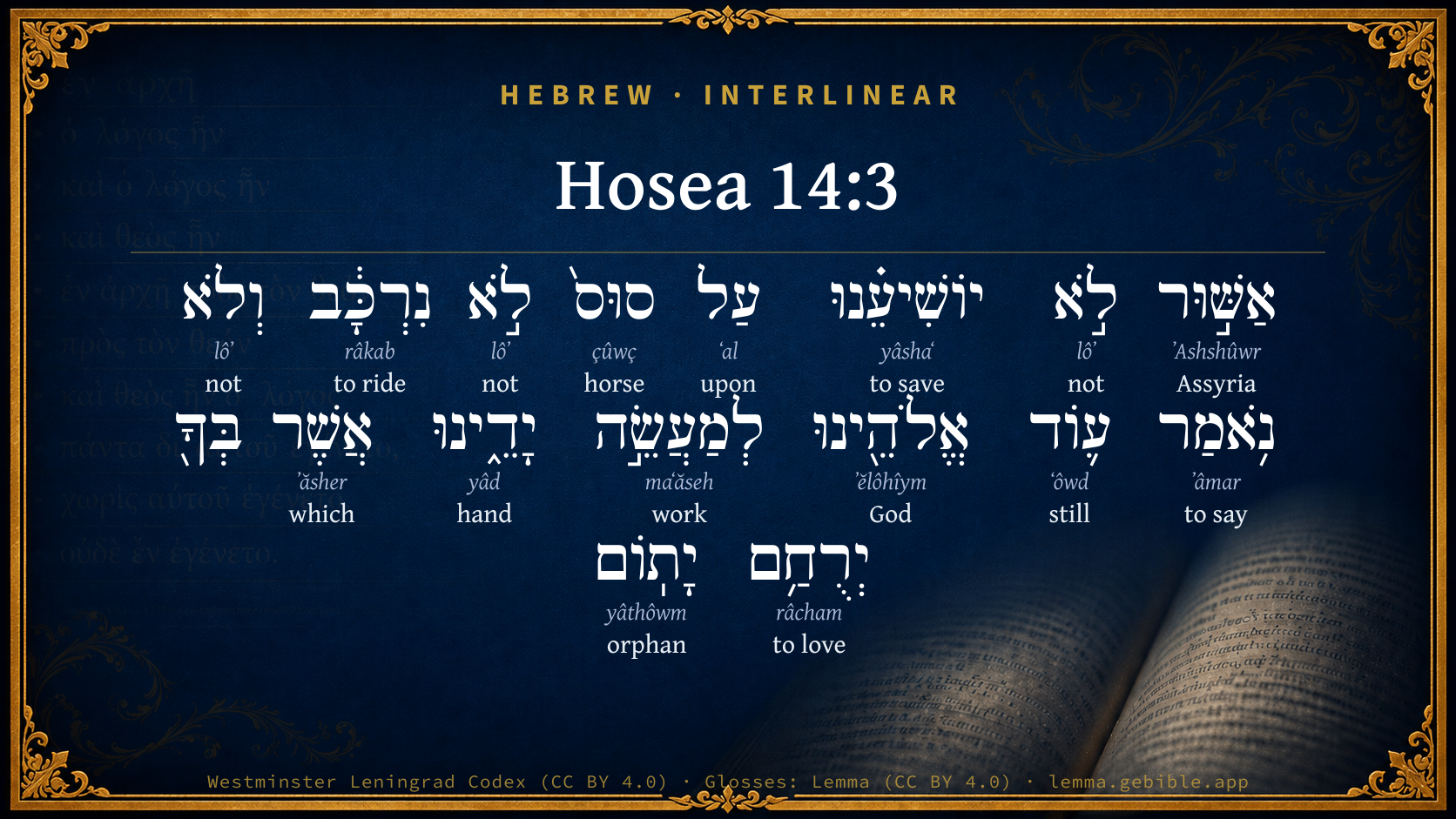
Hebrew (Westminster Leningrad Codex) Hosea 14:3 appears in the Hebrew Old Testament. The text above is from the Westminster Leningrad Codex. Each word links to its Strong’s number, a concise gloss, and parsing drawn from the Open Scriptures Hebrew Bible morphology. Click any word for its full Brown-Driver-Briggs (BDB) entry.
Download image
Cite this verse

Hosea 14:3 (World English Bible). Public Domain. Lemma interlinear Bible study tool, https://lemma.gebible.app/v/hosea/14/3.

Show BibTeX & RIS
BibTeX
RIS
English Translation
Assyria can't save us. We won't ride on horses; Neither will we say any more to the work of our hands, 'Our gods!' For in you the fatherless finds mercy."
World English Bible · Public Domain
Download a study sheet

One document with this verse’s original text, its word-by-word gloss line, the meaning frame, cross-references with their text, attributed commentary, and full source and license credits — printable, and it pastes into notes with its structure intact.

This verse Autodidact and up

Study sheet (.html) Plain text (.txt)

A passage Seminary Student

Up to 50 verses in one chapter. A passage sheet keeps up to 6 commentary sources and 12 cross-references per verse, in the order this page ranks them, and says so on the sheet whenever that leaves anything out. Ask for a single verse and you get the Autodidact verse sheet above.

Everything on this page stays free to read, with no account — the sheet is a download of what is already on screen, not access to it.

Want to remove ads? Support Godless Engineer
Compare translations 3

The same verse in 3 English versions, stacked beneath the original-language interlinear above. Click any original word for its lexicon entry.

Each is an independent rendering of the whole verse — the interlinear is not word-aligned to these translations.

Highlighted words mark where these versions differ — a whole-verse word diff, not a word-by-word alignment.

  • World English Bible Public Domain
    Assyria can't save us. We won't ride on horses; Neither will we say any more to the work of our hands, 'Our gods!' For in you the fatherless finds mercy."
  • King James Version Public Domain
    Asshur shall not save us; we will not ride upon horses: neither will we say any more to the work of our hands, Ye are our gods: for in thee the fatherless findeth mercy.
  • unfoldingWord Literal Text CC BY-SA 4.0
    Assyria will not save us; we will not ride on a horse. And we will not say anymore, ‘Our God,’ to the work of our hands, who by you the fatherless is shown compassion.”

unfoldingWord Literal Text — © unfoldingWord, licensed CC BY-SA 4.0. Word-aligned USFM3 via Door43 (git.door43.org/unfoldingWord/en_ult).

Versions to compare (up to 4)

3 of 4 selected

Show all 18 translations

Every available English version of this verse, each an independent rendering of the whole verse.

  • World English Bible Public Domain
    Assyria can't save us. We won't ride on horses; Neither will we say any more to the work of our hands, 'Our gods!' For in you the fatherless finds mercy."
  • Berean Standard Bible Public Domain
    Assyria will not save us, nor will we ride on horses. We will never again say, ‘Our gods!’ to the work of our own hands. For in You the fatherless find compassion.”
  • Majority Standard Bible Public Domain
    Assyria will not save us, nor will we ride on horses. We will never again say, ‘Our gods!’ to the work of our own hands. For in You the fatherless find compassion.”
  • King James Version Public Domain
    Asshur shall not save us; we will not ride upon horses: neither will we say any more to the work of our hands, Ye are our gods: for in thee the fatherless findeth mercy.
  • American Standard Version (1901) Public Domain
    Assyria shall not save us; we will not ride upon horses; neither will we say any more to the work of our hands, `Ye are' our gods; for in thee the fatherless findeth mercy.
  • Revised Version (1885) Public Domain
    Asshur shall not save us; we will not ride upon horses: neither will we say any more to the work of our hands, Ye are our gods: for in thee the fatherless findeth mercy.
  • Geneva Bible (1599) Public Domain
    Take vnto you words, and turne to the Lord, and say vnto him, Take away all iniquitie, and receiue vs graciously: so wil we render the calues of our lippes.
  • Douay-Rheims (1899) Public Domain
    Take with you words, and return to the Lord, and say to him: Take away all iniquity, and receive the good: and we will render the calves of our lips.
  • Young's Literal Translation Public Domain
    Asshur doth not save us, on a horse we ride not, Nor do we say any more, Our God, to the work of our hands, For in Thee find mercy doth the fatherless.'
  • Literal Standard Version CC BY-SA 4.0
    Asshur does not save us, we do not ride on a horse, || Nor do we say anymore, Our god, to the work of our hands, || For in You the fatherless find mercy.
  • Unlocked Literal Bible CC BY-SA 4.0
    Assyria will not save us; we will not ride on horses to war. Neither will we say anymore to the work of our hands, 'You are our gods,' for in you the fatherless person finds compassion.”
  • unfoldingWord Literal Text CC BY-SA 4.0
    Assyria will not save us; we will not ride on a horse. And we will not say anymore, ‘Our God,’ to the work of our hands, who by you the fatherless is shown compassion.”
  • Darby Bible Public Domain
    Assyria shall not save us; we will not ride upon horses: neither will we say any more to the work of our hands, [Thou art] our God; because in thee the fatherless findeth mercy.
  • World Messianic Bible Public Domain
    Assyria can’t save us. We won’t ride on horses; neither will we say any more to the work of our hands, ‘Our gods!’ for in you the fatherless finds mercy.”
  • Webster's Bible Public Domain
    \\14:2\\Take with you words, and turn to the LORD: say to him, Take away all iniquity, and receive us graciously: so will we render the calves of our lips.
  • Free Bible Version CC BY-SA 4.0
    Assyria can't save us; we will not ride our warhorses; we will never again say, ‘You are our gods’ to the idols we have made. For in you orphans find mercy.”
  • Bible in Basic English Public Domain
    Take with you words, and come back to the Lord; say to him, Let there be forgiveness for all wrongdoing, so that we may take what is good, and give in payment the fruit of our lips.
  • JPS Tanakh (1917) Public Domain
    (14-4) Asshur shall not save us; we will not ride upon horses; neither will we call any more the work of our hands our gods; for in Thee the fatherless findeth mercy.'

Literal Standard Version (2020), Covenant Press — licensed CC BY-SA 4.0. Text via the HelloAO Bible API (eBible.org). Unlocked Literal Bible (unfoldingWord) — licensed CC BY-SA 4.0. Text via the HelloAO Bible API (eBible.org). unfoldingWord Literal Text — © unfoldingWord, licensed CC BY-SA 4.0. Word-aligned USFM3 via Door43 (git.door43.org/unfoldingWord/en_ult). Free Bible Version, Dr. Jonathan Gallagher — licensed CC BY-SA 4.0. Text via the HelloAO Bible API (eBible.org).

Word by word

More ways to search: Search by grammar → Find every occurrence → Compare this word →

Practice this passage: Drill this verse → Learn its vocabulary →

יָתֽוֹם
yâthôwm
H3490
“orphan”
Noun, Common, Masculine, Singular, Absolute
Part of Speech
Noun
Type
Common
Gender
Masculine
Number
Singular
State
Absolute
Full BDB Definition

Origin: from an unused root meaning to be lonely

TWOT: 934a

an orphan, fatherless
  1. אַשּׁ֣וּר ʼAshshûwr H804 “Assyria” Noun, Proper
  2. לֹ֣א lôʼ H3808 “not” Particle, Negative
  3. יוֹשִׁיעֵ֗נוּ yâshaʻ H3467 “to save · us” Verb, Hiphil, Imperfect, 3rd Person, Masculine, Singular + Suffix, Personal, 1st Person, Common, Plural
  4. עַל ʻal H5921 “upon” Preposition
  5. סוּס֙ çûwç H5483 “horse” Noun, Common, Masculine, Singular, Absolute
  6. לֹ֣א lôʼ H3808 “not” Particle, Negative
  7. נִרְכָּ֔ב râkab H7392 “to ride” Verb, Qal, Imperfect, 1st Person, Common, Plural
  8. וְלֹא lôʼ H3808 “and · not” Conjunction + Particle, Negative
  9. נֹ֥אמַר ʼâmar H559 “to say” Verb, Qal, Imperfect, 1st Person, Common, Plural
  10. ע֛וֹד ʻôwd H5750 “still” Adverb
  11. אֱלֹהֵ֖ינוּ ʼĕlôhîym H430 “God(s) · our” Noun, Common, Masculine, Plural, Construct + Suffix, Personal, 1st Person, Common, Plural
  12. לְמַעֲשֵׂ֣ה maʻăseh H4639 “to/for · work of” Preposition + Noun, Common, Masculine, Singular, Construct
  13. יָדֵ֑ינוּ yâd H3027 “hands · our” Noun, Common, Both, Dual, Construct + Suffix, Personal, 1st Person, Common, Plural
  14. אֲשֶׁר ʼăsher H834 “which” Particle, Relative
  15. יְרֻחַ֥ם râcham H7355 “to love” Verb, Pual, Imperfect, 3rd Person, Masculine, Singular

About this verse

These counts appear in no published source. They are computed here, from the morphology-tagged text and Lemma’s own curated glosses. What Lemma adds →

17
words
14
distinct lemmas
Prophets
section

Shared distinctive vocabulary

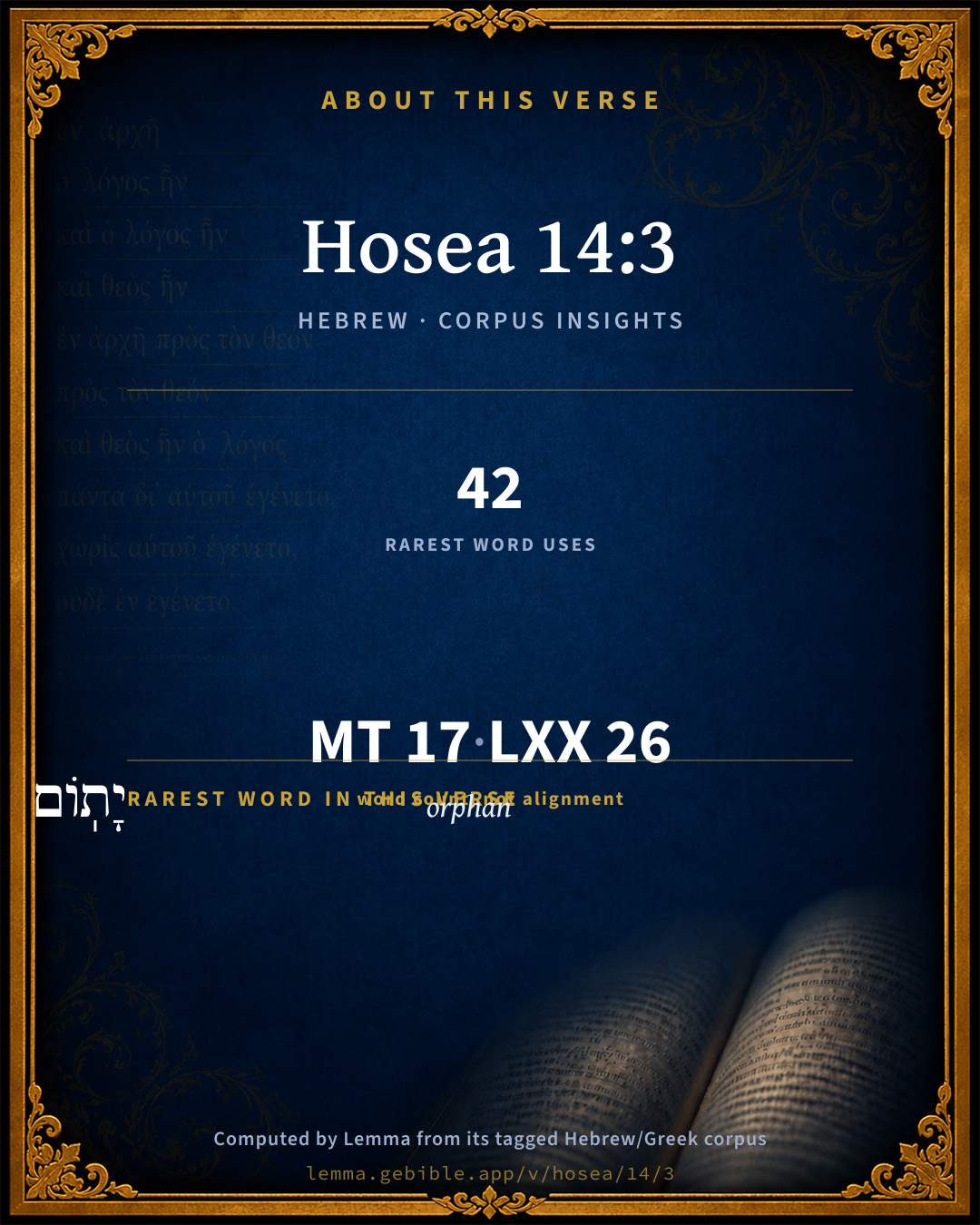
יָתֽוֹם orphan H3490 occurs in 42 verses of the Hebrew Bible. Also found in:

Grammatical profile

  • 4 verbs
  • 6 nouns
  • 2 prepositions
  • 1 adverb
  • 4 particles

Verb forms

  • יוֹשִׁיעֵ֗נוּ Hiphil · Imperfect
  • נִרְכָּ֔ב Qal · Imperfect
  • נֹ֥אמַר Qal · Imperfect
  • יְרֻחַ֥ם Pual · Imperfect

Repetition

A word recurs within this verse — often emphatic in Hebrew:

Hebrew & Septuagint length

In English translation the verse runs 30 words from the Hebrew and 41 from the Septuagint (LXX English) — closely comparable.

A rough comparison of the two English renderings, which tokenize alike — not a word-level alignment.

Word counts can differ between the Hebrew and the Greek without any difference in meaning — e.g. the Hebrew direct-object marker אֵת has no separate Greek word, and Greek often adds the article ὁ.

In the original languages it is 17 Hebrew tokens and 26 Greek tokens — but the two are counted differently (Hebrew bundles its prefixes and suffixes into one token; the Greek is in lemma form), so that isn’t a like-for-like length.

Cross-references

32

Topical passages linked to Hosea 14:3 in the Treasury of Scripture Knowledge — connected by theme and wording, ordered by reader-vote popularity; previews shown in the World English Bible.

  • Psalms 10:14 But you do see trouble and grief; You consider it to take it into your hand. You help the victim and the fatherless.
  • Psalms 68:5 A father of the fatherless, and a defender of the widows, Is God in his holy habitation.
  • Psalms 33:17 A horse is a vain thing for safety, Neither does he deliver any by his great power.
  • Isaiah 30:16 but you said, No, for we will flee on horses; therefore shall you flee: and, We will ride on the swift; therefore shall those who pursue you be swift.
  • Isaiah 31:1 Woe to those who go down to Egypt for help, and rely on horses, and trust in chariots because they are many, and in horsemen because they are very strong, but they don't look to the Holy One of Israel, neither seek Yahweh!
  • Hosea 2:17 For I will take away the names of the Baals out of her mouth, And they will no more be mentioned by their name.
  • Hosea 5:13 When Ephraim saw his sickness, And Judah his wound, Then Ephraim went to Assyria, And sent to king Jareb: But he is not able to heal you, Neither will he cure you of your wound.
  • Hosea 14:8 Ephraim, what have I to do any more with idols? I answer, and will take care of him. I am like a green fir tree; From me your fruit is found."
  • John 14:18 I will not leave you orphans. I will come to you.
  • Exodus 22:22–24 "You shall not take advantage of any widow or fatherless child.
  • Deuteronomy 17:16 Only he shall not multiply horses to himself, nor cause the people to return to Egypt, to the end that he may multiply horses; because Yahweh has said to you, You shall henceforth return no more that way.
  • 2 Chronicles 16:7 At that time Hanani the seer came to Asa king of Judah, and said to him, Because you have relied on the king of Syria, and have not relied on Yahweh your God, therefore is the host of the king of Syria escaped out of your hand.
  • Psalms 20:7–8 Some trust in chariots, and some in horses, But we trust the name of Yahweh our God.
  • Psalms 146:3 Don't put your trust in princes, Each a son of man in whom there is no help.
  • Psalms 146:9 Yahweh preserves the foreigners. He upholds the fatherless and widow, But the way of the wicked he turns upside down.
  • Proverbs 23:10–11 Don't move the ancient boundary stone. Don't encroach on the fields of the fatherless:
  • Isaiah 1:29 For they shall be ashamed of the oaks which you have desired, And you shall be confounded for the gardens that you have chosen.
  • Isaiah 2:20 In that day, men shall cast away their idols of silver, And their idols of gold, Which have been made for themselves to worship, To the moles and to the bats;
  • Isaiah 27:9 Therefore by this shall the iniquity of Jacob be forgiven, and this is all the fruit of taking away his sin: that he makes all the stones of the altar as chalk stones that are beaten in sunder, [so that] the Asherim and the sun-images shall rise no more.
  • Isaiah 30:2 that set out to go down into Egypt, and have not asked at my mouth; to strengthen themselves in the strength of Pharaoh, and to take refuge in the shadow of Egypt!
  • Isaiah 31:3 Now the Egyptians are men, and not God; and their horses flesh, and not spirit: and when Yahweh shall stretch out his hand, both he who helps shall stumble, and he who is helped shall fall, and they all shall be consumed together.
  • Isaiah 36:8 Now therefore, please give pledges to my master the king of Assyria, and I will give you two thousand horses, if you are able on your part to set riders on them.
  • Jeremiah 31:18–22 I have surely heard Ephraim bemoaning himself [thus], You have chastised me, and I was chastised, as a calf unaccustomed [to the yoke]: turn you me, and I shall be turned; for you are Yahweh my God.
  • Ezekiel 36:25 I will sprinkle clean water on you, and you shall be clean: from all your filthiness, and from all your idols, will I cleanse you.
  • Ezekiel 37:23 neither shall they defile themselves any more with their idols, nor with their detestable things, nor with any of their transgressions; but I will save them out of all their dwelling-places, in which they have sinned, and will cleanse them: so shall they be my people, and I will be their God.
  • Ezekiel 43:7–9 He said to me, Son of man, [this is] the place of my throne, and the place of the soles of my feet, where I will dwell in the midst of the children of Israel forever. The house of Israel shall no more defile my holy name, neither they, nor their kings, by their prostitution, and by the dead bodies of their kings [in] their high places;
  • Hosea 7:11 "Ephraim is like an easily deceived dove, without understanding. They call to Egypt. They go to Assyria.
  • Hosea 8:6 For this is even from Israel! The workman made it, and it is no God; Indeed, the calf of Samaria shall be broken in pieces.
  • Hosea 8:9 For they have gone up to Assyria, Like a wild donkey wandering alone. Ephraim has hired lovers for himself.
  • Hosea 12:1 Ephraim feeds on wind, And chases the east wind. He continually multiplies lies and desolation. They make a covenant with Assyria, And oil is carried into Egypt.
  • Micah 5:10–14 "It will happen in that day," says Yahweh, "That I will cut off your horses out of the midst of you, And will destroy your chariots.
  • Zechariah 13:2 It will come to pass in that day, says Yahweh of Hosts, that I will cut off the names of the idols out of the land, and they will no more be remembered; and also I will cause the prophets and the spirit of impurity to pass out of the land.

Cross-references courtesy of OpenBible.info (CC BY 4.0).

Hebrew and Greek witnesses Masoretic Hebrew ↔ Greek Septuagint

The same verse in the two great witnesses to the Old Testament, shown verse-for-verse.

These are two independent witnesses, not word-aligned to each other, and the Septuagint is shown in lemma (dictionary) form.

Hebrew Hosea 14:3 Masoretic · Westminster Leningrad Codex

אַשּׁ֣וּר לֹ֣א יוֹשִׁיעֵ֗נוּ עַל סוּס֙ לֹ֣א נִרְכָּ֔ב וְלֹא נֹ֥אמַר ע֛וֹד אֱלֹהֵ֖ינוּ לְמַעֲשֵׂ֣ה יָדֵ֑ינוּ אֲשֶׁר בְּךָ֖ יְרֻחַ֥ם יָתֽוֹם

Assyria can't save us. We won't ride on horses; Neither will we say any more to the work of our hands, 'Our gods!' For in you the fatherless finds mercy."

World English Bible · Public Domain

Greek LXX Hosea 14:3 Septuagint · lemma form

λαμβάνω μετά ἑαυτοῦ λόγος καί ἐπιστρέφω πρός κύριος ὁ θεός σύ εἶπον αὐτός ὅπως μή λαμβάνω ἀδικία καί λαμβάνω ἀγαθός καί ἀντι ἀποδίδωμι καρπός χεῖλος ἐγώ

Take with you words, and turn to the Lord your God: speak to him, that you⌃ may not receive the reward of unrighteousness, but that you⌃ may receive good things: and we will render in return the fruit of our lips.

LXX2012 (modern English Septuagint) · Public Domain

On this verse, Haydock's Catholic Bible Commentary discusses the Septuagint’s reading. Read the note in Commentary ↓

Hebrew: Westminster Leningrad Codex (CC BY 4.0). Greek: Septuagint (public domain); English from LXX2012 (modern English Septuagint) (Public Domain). How the Septuagint differs from the Hebrew →

Targum (Aramaic paraphrase)

1

The Targum is the ancient Jewish Aramaic paraphrase of the Hebrew Scriptures — an interpretive translation, not the Hebrew text itself. Onkelos (literal) and Pseudo-Jonathan (expansive) render the Torah, and Jonathan the Prophets. Coverage is partial: where no permissively-licensed English translation exists for a verse, only the Aramaic is shown. This is verse-level text, not a word-by-word alignment to the Hebrew.

  1. Targum Jonathan Prophets (Joshua–Malachi)
    קְרִיבוּ עִמְכוֹן פִּתְגָמִין דְאִתּוֹדָאָה וְתוּבוּ לְפוּלְחָנָא דַייָ אֲמָרוּ קָדָמוֹהִי קָרִיב קֳדָמָךְ לְמִשְׁבַּק עַל עִוְיָן וְנִתְקַבֵּל דָא כְּטָבִין וִיהֶוְיָן מִילֵי סִפְוָתָנָא מִתְקַבְלִין קֳדָמָךְ כְּתוֹרִין לְרַעֲוָא עַל מַדְבָּחָא:

    (no public-domain English translation for this verse)

    Targum Jonathan — Aramaic: “Mikraot Gedolot” (public domain). English: “Sefaria Community Translation” (CC0 1.0 (public-domain dedication)); “London "Chaldee Paraphrase," 1871” (public domain). Text via Sefaria.

Commentary

Notes on Hosea 14:3 from classic Christian and Jewish commentators (each source and its license shown beneath its notes). The classic Christian expositions comment on the surrounding passage and are grouped to its opening verse, so a note may address several verses; the Jewish commentaries on the Tanakh (Rashi and others) are per-verse, so they appear only where the commentator wrote on this verse.

Lemma curates 59 commentaries, every one of them public domain or Creative Commons licensed, each selected and text-cleaned for this edition rather than reprinted as found. About our sources →

Trapp's Complete Commentary

John Trapp

Hos 14:3 Asshur shall not save us; we will not ride upon horses: neither will we say any more to the work of our hands, [Ye are] our gods: for in thee the fatherless findeth mercy.

Ver. 3. Asshur shall not save us, &c.] q.d. He cannot if he would; he shall not if he could. The two great sins of this people were creature confidence and idolatry; both these they do here renounce and abandon. The best repentance, saith Luther, is a reformed life. It is true, say they, we have gone to the Assyrian (wherein we have dealt as the silly bird flying to the snare, or as fishes, which, to avoid the pole wherewith the water is troubled, swim into the net); we have taken our horses instead of our prayers, and gone about to find out good; have been so foolish as to think that dumb idols, that cannot help themselves, should help us. But now we are otherwise resolved, experientia edocti et poenitentia ducti; we find at length (that which we should have believed sooner, without trying conclusions) that men of high degree are but a lie, that horses are but a vanity, that an idol is nothing, and can give nothing: that power belongeth unto thee, none else can do it; that mercy belongeth unto thee, none else will do it: therefore since in thee only the fatherless, that is, the friendless and shiftless, find mercy, O be thou pleased to do us good.

For in thee the fatherless findeth mercy] The poor pupil, the forlorn orphan, that is left to the wide world, and lost in himself, cries out, Lord, I am hell, but thou art heaven, &c. I am an abject, oh make me an object of thy pity. Jer 39:17, "Because they call thee an outcast, saying, This is Zion, whom no man seeketh after, therefore I will restore health unto thee." Miseria res digna misericordia (Ruperti Imp. symb.). The proud Assyrian, and other enemies, would be apt to insult over Israel, as afterwards Cicero did; the Jewish nation, saith he, show how God regards them, that have been so often overcome by Pompey, Crassus, &c. But let God’s people be but fatherless enough, let them withdraw their confidence from men and means, and cast it wholly upon God, making him their tutor and protector, and they shall be both preserved and provided for. Deo confisi nunquam confusi. Have confidence in God and you will never be disappointed, I will not leave you orphans, saith Christ, Joh 14:18. Hence the Church resteth on God, in the fail of other comforts, Psa 10:14; Psa 10:17-18; Psa 27:10 Hab 3:17 Psa 102:13. The prayer of the destitute he regards. The Hebrew word signifieth a poor worthless shrub in the wilderness, trod upon by beasts, unregarded.

John Trapp, A Commentary or Exposition upon All the Books of the Old and New Testament (1647–1656) — public domain. Text from a community e-Sword module.

The Biblical Illustrator

Joseph S. Exell

Hos_14:3

Asshur shall not save us.

Giving up our vain confidences

It is a great point of wisdom to take advantages with the stream of our temper to praise God. It is one branch of redeeming the time, to observe what state and temper of soul we are in, and to take advantage from thence. Add some encouragements to incite us to praise God. We honor God by it. It is a gainful trading with God. It is a most noble act of religion. We have more cause to praise God than to pray; having many things to praise Him for, which we never prayed for. Praise being a larger sacrifice than prayer, we ought to be abundant in it. If we be much in praising God, we shall be much in joy, which easeth misery. How shall we know that God accepts these sacrifices of praise? Under the old law God witnessed by fire from heaven. If we find our hearts warmed, cheered, and encouraged with joy, peace, and comfort in praising God, this is as it were a witness by fire from heaven, that our sacrifices are accepted. Here is also a promise of new obedience, which hath two branches.

1. A renunciation of the ill courses they took before. Asshur shall not save us. The people of God, in any distress, had recourse for help to the Assyrians or the Egyptians, as if God had not been sufficient to be their rock and shield.

Learn--

1. That man naturally is prone to put confidence in the creature.

2. That the creature is insufficient and unable to yield us this prop to uphold our confidence.

3. That Gods people when they are endowed with light supernatural, to discern and be convinced hereof, are of that mind to say, Asshur shall not save us. As a preparative for the treatment of these points, notice that reformation of life must be joined with prayer and praise; and that true repentance is of the particular sin which we are most addicted to and most guilty of. The particular sin of this people was their confidence in Assyria, horses, and idols. Naturally we are apt and prone to confidence in outward helps and present things. Because having lost communion with God, somewhat we must have to stay the soul. Because Satan joins with our sense and fancy, by which we are naturally prone to live, esteeming of things not by faith and by deeper grounds, but by fancy. These outward things cannot help us, and so are not to be relied on. Asshur shall not save us. He is but a creature. He is an enemy. He is an idolater. A horse is a vain thing for safety. When God alters and changes and moulds anew the heart of a man to repentance, He altereth his confidence in the creature. In Thee the fatherless findeth mercy. When a man hath once repented, there is a closing between God and him, and he seeth an all-sufficiency in God to satisfy all his desires. Therefore he will use all other things as helps, and as far as it may stand with His favour. How shall we know whether we exceed in confidence in the creature, or not? We may know it by adventuring on ill courses and causes. When there is such confidence in the creature, as for us to outdare God, then there is too much trust in the creature; and that trust will end in confusion. By security and resting the soul in meaner things; never seeking to Divine and religious helps, when we are supplied with those that are outward. Let us take heed of carnal confidence. All is but vanity. Things do not yield that which we expect they should yield. There is a falsehood in the things; they promise this and that in shows, but when we possess them they yield it not; as they have no strength in deed, so they deceive. Then there is mutability in them. And they are snares and baits to us, to draw us away from God, by reason of the vanity of our nature. Let this be the end of all, touching this carnal confidence, to beware that we do not fasten our affections too much upon any earthly thing, at home or abroad, within or without ourselves: for God will destroy the wisdom of the wise. Let us use all outward helps, yet so as to rely upon God for His blessing in the use of all. (R. Sibbes, D. D.)

Penitence

We have here the true portrait of real penitents.

1. Here is a renunciation of all help and succour in all creatures, and all dependence for salvation on anything inherent. It is good to observe here that we have all the initials of true Gospel sorrow and godly grief for sin, with all contained in that repentance which is unto, and belongs unto, everlasting life. Turning to the Lord; acknowledging our case; deploring our sinfulness; praying for the Lords gracious acceptation of us, a declaration of our future acknowledgment of these gratuitous acts of the Lord towards us; and then a full renunciation of ourselves, with the sole ascription to the free grace of Father, Son, and Holy Spirit; this involves and includes all contained in godly sorrow for sin. It was one of the national sins of Israel to trust in the Assyrians for help and succour, when in trouble and distress they looked to them. So Asshur shall not save us, means, we will no longer seek relief in human means. It is a very important effect of our truly turning to the Lord to renounce ourselves wholly and altogether.

2. A declaration of having no more to do with any works of their hands. The terms used are very expressive of the rejection of idols and idolatrous worship.

3. The reason which is assigned for this. In Thee the fatherless findeth mercy. Mercy is in the Lord. It is inherent in Him. It is a perfection of His glorious nature. In the display and manifestation of it He takes delight. (Samuel Eyles Pierce.)

For in Thee the fatherless findeth mercy.

God merciful to the fatherless

And it is well that they do find mercy there, for very often they find little mercy among men. The text contains a statement of facts with reference to former dispensations, and a promise of blessing in the future.

I. THE VALUABLE BLESSING HERE BESTOWED--MERCY. Not riches, not honour. Mercy is the Divine perfection, by which God is inclined to pity and succour such as are in distress. It relates only to the miserable; there can be no manifestation of mercy without misery. But though misery was in the world and mercy was the character of God, there existed a strong impediment to the exercise of that mercy. That impediment was justice. That justice has been satisfied. God can be a God of mercy through the merits of His own Son. Why should this blessing of mercy be singled out as given to orphans?

1. It is a comprehensive blessing. It pardons all sin. It prevents evil. It supports in danger. It supplies all wants. It guides in doubt. It heals all diseases. It sustains in death. It comforts in sorrow. It delivers in difficulty. It saves the soul. You cannot think of mercy without thinking of a train of mercies following it.

2. It sweetens all other blessings. Health, property, social comfort, the fireside, are mercies, but to have all these sweetened by the mercy of God, flowing from Him through Christ,--that gives sweetness to all other mercies. Mercy sweetens even the Divine attributes. Mercy sweetens every affliction. Mercy paints a rainbow on the darkest clouds of affliction and distress. There is mercy put into every cup, and this makes it ever delightful to the sinking spirits. Mercy prepares individuals for contentment in every situation.

3. It is a fruitful blessing. What clusters of fruit gather on the tree of mercy! The first-fruit will be an humbled spirit. It will break down the pride of the heart. So sure as mercy is manifested to the soul, the soul will love in return. It creates a spirit of thank fulness.

4. It is an enduring mercy. One psalm is entirely devoted to this blessing (Psa_136:1-26.). What a comfort it is that amid all the changing things of time there is one thing that endureth.

II. The encouragement presented in the character of God.

1. It is part of Gods character to be merciful.

2. What assurances there are that we shall find mercy if we seek it.

3. See that orphans especially are required, and even entreated, to have this mercy.

Seeing what a choice blessing this mercy must be, both to spiritual orphans and to those who are literally so, let us all seek to possess it. But remember that nothing provokes the Divine anger so much as abusing His mercy, or slighting His love. (James Sherman.)

The Church as fatherless

1. It is the Churchs lot to be very desolate and orphan-like in the world.

2. Gods compassion and the sweet manifestation thereof are especially reserved for His peoples low condition and their greatest need.

3. The confidence of Gods respect to His humble people, would be cherished by the needy and penitent, to encourage them to come to Him and call upon Him.

4. Such as do apprehend and believe the mercy of God toward His needy people will renounce all carnal and sinful confidences. (George Hutcheson.)

The fatherless finding mercy in God

I. The distressed case here supposed. The word fatherless is sometimes used in its natural sense; and sometimes in a figurative sense, for afflicted and destitute persons in general. Our text supposeth that the case of orphans is truly pitiable, and that, above all others, they stand in need of assistance and mercy from God.

II. Gods kind regard to the fatherless.

1. God has commanded others not to injure, but to assist them. He made provision in the law of Moses that they should not be wronged.

2. He hath expressly declared Himself their friend and guardian. He is their reliever, helper, judge, redeemer, and father.

3. He hath in the course of His providence often shown mercy to them. In cases of families deprived of their heads, we have known how remarkably providence has taken care of them and raised them up friends.

Application.

1. How amiable a view doth this give us of the blessed God, and of His wonderful condescension.

2. Let us imitate God in showing mercy to the fatherless.

3. Let parents take encouragement to commit their children to the care of God.

4. Let the fatherless and orphans seek mercy from God, and humbly commit themselves to Him. (J. Orten.)

The Biblical Illustrator, edited by Joseph S. Exell (c. 1880s–1900s) — public domain. Text from a community e-Sword module.

Joseph Benson's Commentary

Hos 14:3. Asshur shall not save us — We will not rely on Assyria for protection and help. The Israelites frequently sought the alliance of the Assyrians, and are often reproved by the prophets for so doing. We will not ride upon horses — We will not implore the help of Egypt, as we did formerly, nor depend on horses brought thence, or on any of our military preparations. It was chiefly on account of their cavalry that the Jews and Israelites courted the help of Egypt, having no cavalry of their own. This is the first part of the people’s repentance. It consists in their renouncing all dependance on foreign alliances, and on every arm of flesh. The second is, their renouncing every species of idolatry and image-worship, expressed in the next clause, Neither will we say, &c., to the work of our hands, Ye are our gods — This is often spoken of in the prophets, as an introduction to that state of the church which is to commence from the time of the conversion of the Jews: see notes on Hos 2:17; and Isa 1:29. For in thee the fatherless findeth mercy — Thou art the helper of the weak and friendless; of us, who are unable to help ourselves, and are exposed to the injuries of others, having none to defend us. Observe, reader, God never fails to be the helper of all that are destitute of strength in themselves, and destitute of help from others: and who, being sensible of their helpless condition, look for it from God, who hath sufficient power, mercy, and wisdom to help.

Joseph Benson's Commentary on the Old and New Testaments (1811–1818) — public domain. Text from a community e-Sword module.

Tyndale Open Study Notes

Tyndale Open Resources

14:3 The Israelites must renounce their dependence upon idols, foreign alliances, and their own military strength. Although they were God’s own children (11:1), they made themselves orphans through their rebellion. When they sincerely and completely repented, they could again find mercy.

Tyndale Open Study Notes — © Tyndale Open Resources, licensed CC BY-SA 4.0. Text via the HelloAO Bible API.

Geneva Bible (1599)

Geneva Bible translators

Declaring that this is the true sacrifice, that the faithful can offer, even thanks and praise, Heb. 13:15.

He showeth them how they ought to confess their sins.

Geneva Bible (1599) marginal notes — public domain. Text via Bolls.life.

Jamieson, Fausset & Brown

Robert Jamieson, A. R. Fausset & David Brown

Three besetting sins of Israel are here renounced, trust in Assyria, application to Egypt for its cavalry (forbidden, Deu 17:16; compare Hos 7:11; Hos 11:5; Hos 12:1; Kg2 17:4; Psa 33:17; Isa 30:2, Isa 30:16; Isa 31:1), and idolatry.

fatherless--descriptive of the destitute state of Israel, when severed from God, their true Father. We shall henceforth trust in none but Thee, the only Father of the fatherless, and Helper of the destitute (Psa 10:14; Psa 68:5); our nation has experienced Thee such in our helpless state in Egypt, and now in a like state again our only hope is Thy goodness.

Jamieson, Fausset & Brown — Commentary Critical and Explanatory on the Whole Bible (1871) — public domain (CC PDM 1.0). Text via the HelloAO Bible API.

John Calvin's Commentaries

This verse ought to be joined with the last, as the Israelites show here more clearly and fully in what they had sinned, and, at the same time, give proof of their repentance; for when they say, The Assyrian shall not save us, we shall not mount on horses, we shall not say to the work of hands, Our gods, it is to be understood as a confession, that they had in these various ways roused against themselves the vengeance of God; for they had hoped for safety from the Assyrians, ran here and there, and had thus alienated themselves from God; they had also fled to statues and idols, and had transferred to dumb images the honour due to the only true God. We hence see, that though the faithful speak of future time, they yet indirectly confess that they had grievously sinned, had forsaken the only true God, and transferred their hopes to others, either to the Assyrians or to fictitious gods. But at the same time, they promise to be different in future; as though he said, that they would not only be grateful to God in celebrating his praises, but that their way of living would be also new, so as not to abuse the goodness of God. This is the substance of what is here said.

By saying, The Assyrian shall not save us, they doubtless condemned, as I have already stated, the false confidence with which they were before deluded, when they sought deliverance by means of the Assyrians. There is, indeed, no doubt, but that the Israelites were ever wont to pretend to trust in the name of God; but in thinking themselves lost without the succour of the Assyrians, they most certainly defrauded God of his just honour, and adorned men with spoils taken from him. For except we be convinced that God alone is sufficient for us, even when all earthly aids fail us, we do not place in him our hope of salvation; but, on the contrary, transfer to mortals what belongs alone to him. For this sacrilege the Israelites therefore condemn themselves, and, at the same time, show that the fruit of their repentance would be, to set their minds on God, so as not to be drawn here and there as before, or to think that they could be preserved through the help of men. Let us hence learn, that men turn not to God, except when they bid adieu to all creatures, and no longer fix their hopes on them. This is one thing.

What follows, On a horse we shall not mount, may be explained in two ways; — as though they said, that they would no longer be so mad as to be proud of their own power, or consider themselves safe because they were well furnished with horses and chariots; — but the clause may be more simply explained, as meaning, that they would not as before wander here and there to procure for themselves auxiliaries; We shall not then mount a horse, but continue quiet in our country; and this sense seems more appropriate. I do not then think that the Prophet brings forward any new idea, but I read the two sentences conjointly, The Assyrian shall not save us, we shall not then mount on a horse, that is, that we may ride in haste; for they had wearied themselves before with long journeys: as soon as any danger was at hand, they went away afar off into Assyria to seek help, when God commanded them to remain quiet.

The meaning of this will be better understood by referring to other passages, which correspond with what is here said. God says by Isaiah, ‘On horses mount not; but ye said, We will mount: then mount,’ says he, (Isaiah 30:16.) Here is a striking intimation, that the Jews against God’s will rode and hastened to seek aids. “I see you,” he says, “to be very prompt and swift: then mount, but it shall be for the purpose of fleeing.” We see what was the design of this reproof of the Prophet; it was to show that the Jews, who ought to have remained still and quiet, fled here and there for the sake of seeking assistance. So also in this place, when they would show the fruit of their repentance, they say, “We will not hereafter mount a horse, for the Lord, who promises to be our aid, is not to be sought as one far off: we will not then any more fatigue ourselves in vain.” It seems to me that this is what is meant by the Prophet.

Then he adds, And we shall not say, Our gods, to the work of our hands. As they had spoken of the false trust they placed in men, so now they condemn their own superstition. And these are the two pests which are wont to bring destruction on men; for nothing is more ruinous than to transfer our hope from God; and this is done in two ways, either when men trust in their own strength, or pride themselves on human aids and despise God, as if they can be safe without him, — or when they give up themselves to false superstitions. Both these diseases ever prevail in the world, when men entangle themselves in their own superstitions, and form for themselves new gods, from whom they expect safety; as we see to be the case with those under the Papacy. God is almost of no account with them, Christ is not sufficient. For how comes it that they contrive so many patrons for themselves, that they devise so many guardianships, except that they despise the help of God, or so extenuate it, that they dare not to hope for salvation from him? We hence see that superstition draws men away from God, and becomes thus the cause of the worst destruction. But there are some, who are not thus given up to superstitions, but who derive a hope from their own valour or wisdom; for the children of this world are inflated with their own strength; and when princes have their armies prepared, when they have fortified cities, when they possess abundance of money, when they are strengthened by many compacts, they are blinded with false confidence. So then this verse teaches us, that these are two destructive pests, which commonly draw men away from real safety; and if then we would repent sincerely from the heart, we must purge our minds from these two evils, so that we may not ascribe any thing to our own strength or to earthly helps, nor form any idols to be in the place of God, but feel assured that God alone is a sufficient help to us.

But it follows, For in thee will the fatherless find mercy. Here the Israelites show that it is necessary for us to be depressed that we may remain dependent on God alone; for those are compared to the fatherless who are so humbled, that they cast away all vain hopes, and, conscious of their nakedness and want, recumb on God alone. Hence, that God’s mercy may find a way open to come to us, we must become fatherless. Now what this metaphor means is well known to us. The fatherless, we know, are, first, destitute of aid, and, secondly, of wisdom; and they are also without strength. They are then dependent on the aid of another, and stand in need of direction; in short, their safety depends on the assistance of others. Thus, also, we are really fatherless, when we rely not on our own prudence, nor recumb on our own strength, nor think that we can be safe through the aids which come from the earth, but cast all our hopes and cares on God alone. This is one thing. The fatherless then shall find mercy in thee; that is, “When thou, Lord, dost so afflict us, that we become wholly cast down, then we shall find mercy in thee; and this mercy will be sufficient for us, so that we shall no more wander and be drawn aside by false devices, as it has hitherto been the case with us.” When, therefore, they say, in God will the fatherless find mercy, they mean that the grace offered by the Lord will be sufficient, so that there will be no need any more of seeking aid from any other. We now understand what the Prophet means in this verse. It follows —

John Calvin's Commentaries (1540-1563) — public domain. Text from the Calvin Translation Society English edition (1840s-50s) via the Christian Classics Ethereal Library (ccel.org). Calvin's coverage is partial (roughly two-thirds of the Bible); uncommented books and verses are honest gaps, never fabricated. The 19th-century editor's footnotes and remarks are omitted so the notes are faithfully Calvin's own voice.

Ellicott's Commentary for English Readers

(3) The three crying sins of Israel are here recounted: (1) Expected salvation from Assyria; (2) dependence on the world-power of Egypt, famed for war-horses and chariots; (3) ascription of Divine names and homage to wrought images of the Divine glory. God’s paternal love to the orphan, peculiarly applicable to Israel now, cast on a cold and fatherless world.

A Bible Commentary for English Readers, edited by Charles John Ellicott (1878–1897) — public domain. Text from a community e-Sword module.

The Cambridge Bible for Schools and Colleges

gen. ed. J. J. S. Perowne

3. Israel here renounces those sins against the theocracy of which Jehovah’s prophet had specially accused him, viz. trust in Assyria (Hos_5:13, Hos_7:11, Hos_8:9) and reliance on horses and chariots (Hos_1:7, Hos_10:13, alluding no doubt to the Egyptian alliance, comp. Isa_30:16; Isa_31:1), and idolatry (Hos_4:17, Hos_8:4).

to the work of our hands] An early anticipation of the splendid morsels of irony, in which a later prophet lashes idolatry (see Isa_42:17; Isa_54:17).

the fatherless] Israel’s condition is compared to that of an orphan (comp. the exquisite ὀρφανούς of Joh_14:18).

The Cambridge Bible for Schools and Colleges (gen. ed. J. J. S. Perowne; Cambridge University Press, 1878–1918) — public domain. Text from a community e-Sword module.

John Gill's Exposition

Ashur shall not save us,.... This is still a continuation of the words repenting and returning Israel are directed to make use of before the Lord, declaring they would not do any more as they had done; to Assyria, or the kings of Assyria, as the Targum, for help, and desire assistance, and expect deliverance and salvation from thence; see Hos 5:13;

we will not ride upon horses; to seek for help elsewhere; or go to Egypt for them, as they had done; or put their trust in them for safety, in a time of war; or think to make their escape by them when in danger; see Psa 20:8;

neither will we say any more to the work of our hands, ye are our gods; that is, say so to, or concerning, their idols, which were made by their hands, or by their orders, as they had formerly done to the golden calf in the wilderness, and to the calves at Dan and Bethel; see Exo 32:4; now, by all these expressions is meant, that they would determine not to put any confidence in any creature, or in any creature performance; that they would not trust in their own merits, but in the mercy of God through Christ for the of their sins; nor in any works of righteousness for their justification before God, and acceptance with him; nor expect salvation in any other way than by the free grace of God, and his abundant mercy in Christ:

for in thee the fatherless findeth mercy; and in thee only; hereby declaring that the Lord was the only Saviour; that there was salvation in Christ, and in no other; and that they would have no other saviour but him; that they would look to the mercy of God proclaimed in him, and communicated from and through him, the mercy seat, and to his mercy alone for eternal life; in whom the most destitute persons, as the fatherless, who are destitute of friends, of help and assistance, of counsel and advice, find favour, kindness, and mercy, even such as are most hopeless and helpless; which is a great encouragement to look to the Lord, to trust in him, and hope in his mercy.

John Gill's Exposition of the Whole Bible (1746–1763) — public domain (CC PDM 1.0). Text via the HelloAO Bible API.

Albert Barnes' Notes on the Bible

Asshur shall not save us - After prayer for pardon and for acceptance of themselves, and thanksgiving for acceptance, comes the promise not to fall back into their former sins. Trust in man, in their own strength, in their idols, had been their besetting sins. Now, one by one, they disavow them.

First, they disclaim trust in man, and making “flesh their arm” Jer 17:5. Their disclaimer of the help of the Assyrian, to whom they had so often betaken themselves against the will of God, contains, at once, that best earnest of true repentance, the renewal of the confession of past sins, and the promise to rely no more on any princes of this world, of whom he was then chief. The horse, in like way, is the symbol of any warlike strength of their own. As the Psalmist says, “Some put their trust in chariots and some in horses, but we will remember the name of the Lord our God” Psa 20:7; and, “a horse is a vain thing for safety, neither shall he deliver any by his great strength” Psa 33:17; and Solomon, “The horse is prepared for the day of battle but salvation is of the Lord” Pro 21:31. War was almost the only end for which the horse was used among the Jews. If otherwise, it was a matter of great and royal pomp. It was part of a standing army. Their kings were especially forbidden to “multiply horses” Deu 17:16 to themselves. Solomon, indeed, in his prosperity, broke this, as well as other commands of God. The pious king Hezekiah, although possessed at one time of large treasure, so kept that command as to furnish matter of mockery to Rabshakeh, the blaspheming envoy of Assyria, that he had neither horses nor horsemen 2Ki 18:23. The horses being procured from Egypt 1Ki 10:28, the commerce gave fresh occasion for idolatry.

Neither will we say anymore to the work of our hands, ye are our gods - This is the third disavowal. Since it was folly and sin to trust in the creatures which God had made, apart from God, how much more, to trust in things which they themselves had made, instead of God, and offensive to God!

For in Thee the fatherless findeth mercy - (or, O Thou, in whom). He is indeed fatherless who hath not God for his Father. They confess then, that they were and deserved to be thus “fatherless” and helpless, a prey to every oppressor; but they appeal to God by the title which He had taken, “the Father of the fatherless” Psa 68:5, that He would have mercy on them, who had no help but in Him. : “We promise this, they say, hoping in the help of Thy mercy, since it belongeth to Thee and is for Thy Glory to have mercy on the people which believeth in Thee, and to stretch forth Thine Hand, that they may be able to leave their wonted ills and amend their former ways.”

Albert Barnes' Notes on the Bible (1834–1885) — public domain. Text from a community e-Sword/MySword module.

Haydock's Catholic Bible Commentary

Words. In captivity, legal victims cannot be offered. (Calmet) --- But a contrite heart is always acceptable, Psalm l. --- Good. While engaged in sin, (Haydock) "we can offer thee nothing good." --- Calves: victims of praise. (St. Jerome) --- Hebrew parim. Septuagint omit m, (Haydock) and render fruit. They are followed by the Arabic and Syriac as well as by the apostle, Hebrews xiii. 15. (Calmet) --- We will offer what victims we please. (Estius) (Psalms lxix. 23., and lxv. 13.)

George Leo Haydock (1774–1849), Haydock's Catholic Family Bible and Commentary, 1859 edition — public domain. Excludes Psalms (Douay-Rheims chapter numbering differs from Protestant) and Deuterocanonical books (Catholic canon only).

Matthew Poole's English Annotations

Asshur shall not save us: it had been one great sin of Israel that they did trust to an arm of flesh; Asshur is particularly named, for that he was the last with whom they made a covenant fairly, or above-board, but any other foreign aids and friendships may be here understood. God promised his peculiar protection, and would have continued it if they had not cast him off, and trusted to man. We will not ride upon horses: another fault of theirs was, they multiplied horses, and trusted to their strength, which God forbade; this includes their home strength, and provision of all sorts.

Neither will we say any more to the work of our hands, Ye are our gods: they had most brutishly thought their idols would be gods to help them; this is the particular confession of their great comprehensive sins, which brought on many others with them; now they renounce as well as confess them, and such renouncing is necessary, and grounded on hope of finding mercy, as appears by the reason they give of their renouncing these sins, and vain confidences in God, to whom they return, in him only there is help to be had.

The fatherless; all that are destitute of strength in themselves, and destitute of help from others; all that, being sensible of their own helpless condition, look for it from God, who hath power, mercy, and wisdom to hell) and relieve.

Findeth, obtaineth as often as he does rightly sue for,

mercy; both fountain and streams of goodness too, free grace and rich bounty.

Matthew Poole's English Annotations on the Holy Bible (1683–1685) — public domain. Text from a community e-Sword/MySword module.

Whedon's Commentary on the Bible

Daniel D. Whedon

3. Israel promises also to abstain from the very sins condemned so strongly and persistently by Hosea: (1) Trust in Assyria (Hos_5:13; Hos_7:11; Hos_8:9; Hos_12:1); (2) reliance upon horses — Human defenses (Hos_1:7; Hos_10:13). There may be implied a promise to cease trusting in Egypt, since Egypt furnished horses to Israel (1Ki_10:28; Eze_17:15; compare Isa_30:16; Isa_31:1).

The work of our hands — Idols (Hos_8:4). These they will no longer regard as gods (compare Hos_13:2). Cheyne sees in the expression “the work of our hands” “an early anticipation of the splendid morsels of irony in which a later prophet lashes idolatry” (Isa_42:17; Isa_44:9 ff.).

In thee the fatherless findeth mercy — Is to be connected with all the clauses, but especially with the last one.

Neither foreign alliances, nor human defenses, nor man-made idols can help. Jehovah alone is always willing and able to show mercy and loving-kindness.

Daniel D. Whedon (gen. ed.), Commentary on the Old and New Testaments (1874–1909) — public domain. Text from a community e-Sword module.

The Pulpit Commentary

Asshur shall not save us: we will not ride upon horses: neither will we say any more to the work of our hands, Ye are our gods: for in thee the fatherless findeth mercy. This was the practical side of Israel"s repentance; this was bringing forth fruits meet for repentance. Here was a renunciation of all hope of safety from the world-powers both Assyria and Egypt. They would never again have recourse to Assyria for help, nor to Egypt for horses; nor confide in their own unaided power or prowess; while this renunciation of worldly power and carnal confidences implied, as its opposite, unfaltering faith in the protecting power and saving strength of Jehovah. All thin was much, and yet more was required; next to such renunciation of merely human aid, as indicated, and its contrary, the recognition of Divine assistance, comes the absolute and complete abandonment of their national and besetting sin of idolatry. They have so far come to themselves and received the right use of reason as to confess that the manufacture of man"s hands cannot be man"s god, thus giving up with feelings of contempt and disgust the groveling sin of idolatry with its attendant vices. Still more, they are penetrated with the conviction that man without God is a poor fatherless creature, in no better, if not in a worse, condition than that of a weak orphan child. They have the consolation at the same time that for all such, on their return to him, the father of the fatherless and the God of the orphan has bowels of tenderest compassion. To the presumed prayer of the penitent an answer overflowing with mercy is promised at once, and by God himself in the next section, consisting of

"The fatherless findeth mercy.

The sorrows of human life are many, and some of them are, by us, largely inexplicable. The relation of father and son is an obvious provision of Divine wisdom and goodness, and beautifully symbolizes the relation between God and his dependent children. Yet there are the fatherless, deprived of the care and protection so urgently needed. Why should it be permitted that any should be placed in a position so painful and pitiable? We cannot tell. Still the case of such furnishes an opportunity for the intervention of him who is the Father of the fatherless.

I WHAT THE FATHERLESS NEED. To understand this we must consider:

1. Of what they are deprived. They are without a father"s kindness, wisdom, and bounty.

2. To what they are exposed. How many are the ills which befall the orphan! He is exposed to neglect; poverty may prevent his enjoyment of a suitable nurture and education. He is exposed to injustice and wrong. If he has property, he is liable to the cupidity of a selfish guardian, tie is exposed to actual ill treatment. The cruel may take advantage of his defenseless position to treat him with violence for which there is little or no redress.

II WHAT THE FATHERLESS FIND. They may look for help to man, and look in vain. But in God the fatherless findeth mercy. That which is denied by earth is accorded by Heaven.

1. God raises up friends who, to some extent, take the father"s place. Pity leads Christians to adopt orphans into their own families, or to found asylums where they can enjoy the blessings of kind supervision and liberal education.

2. God, in his providence: opens up before the fatherless careers of usefulness and honor in life. How many orphans have occupied distinguished and serviceable positions in society! It is by the mercy of God that what, from a human point of view, seemed so unlikely, has come to pass.

3. God, by his Word and his Spirit, often reveals to the fatherless the riches of his own fatherly love. In him are compassion and affection deeper and vaster than a human heart can know. He dries the orphan"s tears, supplies the orphan"s wants, and enriches the orphan"s nature with the treasures of his grace and love. T.

The Pulpit Commentary (1880–1919), ed. H.D.M. Spence-Jones & Joseph S. Exell — public domain. Text from a community e-Sword module.

John Wesley's Explanatory Notes

The fatherless - All that are destitute of strength in themselves, and destitute of help from others; all that being sensible of their own helpless condition, look for it from God, who hath power, mercy, and wisdom to help. Mercy - Both the fountain and streams of goodness too, free grace, and rich bounty.

John Wesley, Explanatory Notes Upon the Whole Bible (1754–1765) — public domain. Text via the GEBible commentary corpus.

unfoldingWord translationNotes

Door43 World Missions Community

General Information:

Hosea is speaking

to the work of our hands

Here people are represented by their "hands" to refer to the people making things. AT: "to the idols we made" (See: Synecdoche)

the fatherless person

This expression stands perhaps for the entire nation. It indicates God's enormous compassion for his people.

finds compassion

Here the act of God having compassion is spoken of as if it were an object that someone experiencing that compassion had found. The abstract noun "compassion" can be translated with an adjective. AT: "finds one who is compassionate" (See: Abstract Nouns)

translationWords

Assyria

save

horse

works

hand

false god

compassion

unfoldingWord translationNotes — © Distant Shores Media and the Door43 World Missions Community, licensed CC BY-SA 4.0. Source: git.door43.org/Door43/en_tn.

Rashi

Rabbi Shlomo Yitzchaki (Rashi)

You shall forgive all iniquity Heb. כָּל-תִּשָׂא עָוֹן. Forgive all our iniquities.

and teach [us the] good [way] Heb. וְקַח-טוֹב. And teach us the good way. Another explanation: The few good deeds in our hands take in Your hand and judge us accordingly. And so does David say (Psalms 17:2): “Let my sentence come forth from before You, may Your eyes behold the right.” Another explanation: And accept good And accept confession from us, as it is said (Psalms 92:2): “It is good to confess to the Lord.”

and let us render [for] bulls that we should have sacrificed before you, let us render them with the placation of the words of our lips.

Rashi on the Tanakh — English translations: “The Judaica Press complete Tanach with Rashi, translated by A. J. Rosenberg” (CC BY 4.0); “Pentateuch with Rashi's commentary by M. Rosenbaum and A.M. Silbermann, 1929-1934” (public domain); “The Metsudah Tanach series, Lakewood, N.J” (CC BY 4.0); and “The Book of Joshua, Metsudah Publications, 1997” (CC BY 4.0). Text via Sefaria.

Lesson kit

Teaching starters — assembled from the data on this page, not authored interpretation. Every prompt links to the verse data it draws on. Edit before teaching.

Hosea, in the Prophets, opens this verse with 17 words (14 distinct Hebrew lemmas). Its most distinctive word is yâthôwm (“orphan”). A historical commentator’s framing appears above. Read the whole chapter for the surrounding context.

Discussion questions

  1. The word yâthôwm carries the sense “orphan.” How does it shape the verse?
  2. Exodus 22:22 shares the word «orphan» with this verse. How do the two illuminate each other?
  3. “not” occurs 3× in this one verse. What is the effect of the repetition?
  4. These translations render this verse differently; the difference is in the English rendering, not the original. What questions does that raise?
  5. The verb «יוֹשִׁיעֵ֗נוּ» is Hiphil Imperfect. How does its form color the action?
  6. Reading how Trapp's Complete Commentary and The Biblical Illustrator read this verse, where do the two commentators agree and where do they part?

Things to notice

Reading settings

Reading text

Shown beneath each verse's original-language words.

Old Testament
Old Testament edition

Read the OT as the Masoretic Hebrew (MT) or the Greek Septuagint (LXX).

English shown for the Greek Septuagint (in the Hebrew ↔ Greek comparison).

Comparing translations? Open the Compare panel on any verse page to stack up to four side by side.