
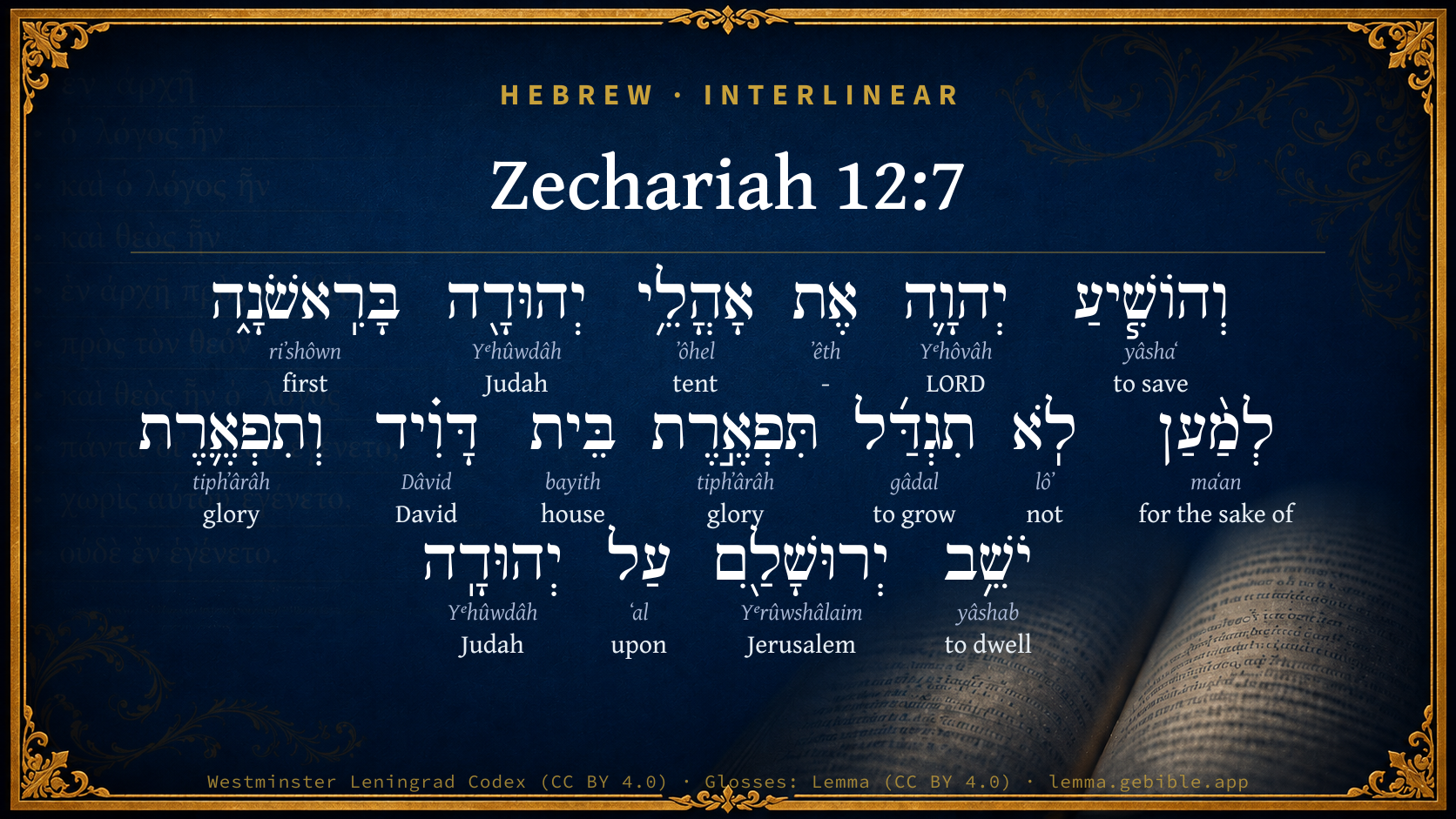
Zechariah 12:7

Hebrew (Westminster Leningrad Codex) Zechariah 12:7 appears in the Hebrew Old Testament. The text above is from the Westminster Leningrad Codex. Each word links to its Strong’s number, a concise gloss, and parsing drawn from the Open Scriptures Hebrew Bible morphology. Click any word for its full Brown-Driver-Briggs (BDB) entry.
Download image
Cite this verse

Zechariah 12:7 (World English Bible). Public Domain. Lemma interlinear Bible study tool, https://lemma.gebible.app/v/zechariah/12/7.

Show BibTeX & RIS
BibTeX
RIS
English Translation
Yahweh also will save the tents of Judah first, that the glory of the house of David and the glory of the inhabitants of Jerusalem not be magnified above Judah.
World English Bible · Public Domain
Download a study sheet

One document with this verse’s original text, its word-by-word gloss line, the meaning frame, cross-references with their text, attributed commentary, and full source and license credits — printable, and it pastes into notes with its structure intact.

This verse Autodidact and up

Study sheet (.html) Plain text (.txt)

A passage Seminary Student

Up to 50 verses in one chapter. A passage sheet keeps up to 6 commentary sources and 12 cross-references per verse, in the order this page ranks them, and says so on the sheet whenever that leaves anything out. Ask for a single verse and you get the Autodidact verse sheet above.

Everything on this page stays free to read, with no account — the sheet is a download of what is already on screen, not access to it.

Want to remove ads? Support Godless Engineer
Compare translations 3

The same verse in 3 English versions, stacked beneath the original-language interlinear above. Click any original word for its lexicon entry.

Each is an independent rendering of the whole verse — the interlinear is not word-aligned to these translations.

Highlighted words mark where these versions differ — a whole-verse word diff, not a word-by-word alignment.

  • World English Bible Public Domain
    Yahweh also will save the tents of Judah first, that the glory of the house of David and the glory of the inhabitants of Jerusalem not be magnified above Judah.
  • King James Version Public Domain
    The LORD also shall save the tents of Judah first, that the glory of the house of David and the glory of the inhabitants of Jerusalem do not magnify themselves against Judah.
  • unfoldingWord Literal Text CC BY-SA 4.0
    Yahweh will save the tents of Judah first, so that the honor of the house of David and the honor of those who live in Jerusalem may not be greater than the rest of Judah.

unfoldingWord Literal Text — © unfoldingWord, licensed CC BY-SA 4.0. Word-aligned USFM3 via Door43 (git.door43.org/unfoldingWord/en_ult).

Versions to compare (up to 4)

3 of 4 selected

Show all 18 translations

Every available English version of this verse, each an independent rendering of the whole verse.

  • World English Bible Public Domain
    Yahweh also will save the tents of Judah first, that the glory of the house of David and the glory of the inhabitants of Jerusalem not be magnified above Judah.
  • Berean Standard Bible Public Domain
    The LORD will save the tents of Judah first, so that the glory of the house of David and of the people of Jerusalem may not be greater than that of Judah.
  • Majority Standard Bible Public Domain
    The LORD will save the tents of Judah first, so that the glory of the house of David and of the people of Jerusalem may not be greater than that of Judah.
  • King James Version Public Domain
    The LORD also shall save the tents of Judah first, that the glory of the house of David and the glory of the inhabitants of Jerusalem do not magnify themselves against Judah.
  • American Standard Version (1901) Public Domain
    Jehovah also shall save the tents of Judah first, that the glory of the house of David and the glory of the inhabitants of Jerusalem be not magnified above Judah.
  • Revised Version (1885) Public Domain
    The LORD also shall save the tents of Judah first, that the glory of the house of David and the glory of the inhabitants of Jerusalem be not magnified above Judah.
  • Geneva Bible (1599) Public Domain
    The Lord also shall preserue the tents of Iudah, as afore time: therefore the glorie of the house of Dauid shall not boast, nor the glorie of the inhabitants of Ierusalem against Iudah.
  • Douay-Rheims (1899) Public Domain
    And the Lord shall save the tabernacles of Juda, as in the beginning: that the house of David, and the glory of the inhabitants of Jerusalem, may not boast and magnify themselves against Juda.
  • Young's Literal Translation Public Domain
    And saved hath Jehovah the tents of Judah first, So that become not great against Judah Doth the beauty of the house of David, And the beauty of the inhabitant of Jerusalem.
  • Literal Standard Version CC BY-SA 4.0
    And YHWH has saved the tents of Judah first, || So that the beauty of the house of David does not become great against Judah, || And the beauty of the inhabitant of Jerusalem.
  • Unlocked Literal Bible CC BY-SA 4.0
    Yahweh will save the tents of Judah first, so that the honor of the house of David and the honor of those who live in Jerusalem may not be greater than the rest of Judah.
  • unfoldingWord Literal Text CC BY-SA 4.0
    Yahweh will save the tents of Judah first, so that the honor of the house of David and the honor of those who live in Jerusalem may not be greater than the rest of Judah.
  • Darby Bible Public Domain
    And Jehovah shall save the tents of Judah first, that the glory of the house of David and the glory of the inhabitants of Jerusalem be not magnified over Judah.
  • World Messianic Bible Public Domain
    The LORD also will save the tents of Judah first, that the glory of David’s house and the glory of the inhabitants of Jerusalem not be magnified above Judah.
  • Webster's Bible Public Domain
    The LORD also will save the tents of Judah first, that the glory of the house of David and the glory of the inhabitants of Jerusalem may not magnify themselves against Judah.
  • Free Bible Version CC BY-SA 4.0
    The Lord will give the victory to the soldiers of Judah first so that the glory of the house of David and the glory of the inhabitants of Jerusalem shall not be greater than that of Judah.
  • Bible in Basic English Public Domain
    And the Lord will give salvation to the tents of Judah first, so that the glory of the family of David and the glory of the people of Jerusalem may not be greater than that of Judah.
  • JPS Tanakh (1917) Public Domain
    The LORD also shall save the tents of Judah first, that the glory of the house of David and the glory of the inhabitants of Jerusalem be not magnified above Judah.

Literal Standard Version (2020), Covenant Press — licensed CC BY-SA 4.0. Text via the HelloAO Bible API (eBible.org). Unlocked Literal Bible (unfoldingWord) — licensed CC BY-SA 4.0. Text via the HelloAO Bible API (eBible.org). unfoldingWord Literal Text — © unfoldingWord, licensed CC BY-SA 4.0. Word-aligned USFM3 via Door43 (git.door43.org/unfoldingWord/en_ult). Free Bible Version, Dr. Jonathan Gallagher — licensed CC BY-SA 4.0. Text via the HelloAO Bible API (eBible.org).

Word by word

More ways to search: Search by grammar → Find every occurrence → Compare this word →

Practice this passage: Drill this verse → Learn its vocabulary →

תִּפְאֶ֣רֶת
tiphʼârâh
H8597
“glory of”
Noun, Common, Feminine, Singular, Construct
Part of Speech
Noun
Type
Common
Gender
Feminine
Number
Singular
State
Construct
Full BDB Definition

Origin: from H6286

TWOT: 1726b

beauty, splendour, glory - beauty, finery (of garments, jewels) - glory - of rank, renown - as attribute of God - honour (or nation Israel) - glorying, boasting (of individual)
  1. וְהוֹשִׁ֧יעַ yâshaʻ H3467 “and · to save” Conjunction + Verb, Hiphil, Sequential Perfect, 3rd Person, Masculine, Singular
  2. יְהוָ֛ה Yᵉhôvâh H3068 “LORD” Noun, Proper
  3. אֶת ʼêth H853 “-” Particle, Direct Object
  4. אָהֳלֵ֥י ʼôhel H168 “tents of” Noun, Common, Masculine, Plural, Construct
  5. יְהוּדָ֖ה Yᵉhûwdâh H3063 “Judah” Noun, Proper
  6. בָּרִֽאשֹׁנָ֑ה riʼshôwn H7223 “in/at the · first” Preposition, Determined + Adjective, Adjective, Feminine, Singular, Absolute
  7. לְמַ֨עַן maʻan H4616 “for the sake of” Preposition
  8. לֹֽא lôʼ H3808 “not” Particle, Negative
  9. תִגְדַּ֜ל gâdal H1431 “to grow” Verb, Qal, Imperfect, 3rd Person, Feminine, Singular
  10. בֵּית bayith H1004 “house of” Noun, Common, Masculine, Singular, Construct
  11. דָּוִ֗יד Dâvid H1732 “David” Noun, Proper
  12. וְתִפְאֶ֛רֶת tiphʼârâh H8597 “and · glory of” Conjunction + Noun, Common, Feminine, Singular, Construct
  13. יֹשֵׁ֥ב yâshab H3427 “dwelling” Verb, Qal, Participle Active, Masculine, Singular, Construct
  14. יְרוּשָׁלִַ֖ם Yᵉrûwshâlaim H3389 “Jerusalem” Noun, Proper
  15. עַל ʻal H5921 “upon” Preposition
  16. יְהוּדָֽה Yᵉhûwdâh H3063 “Judah” Noun, Proper

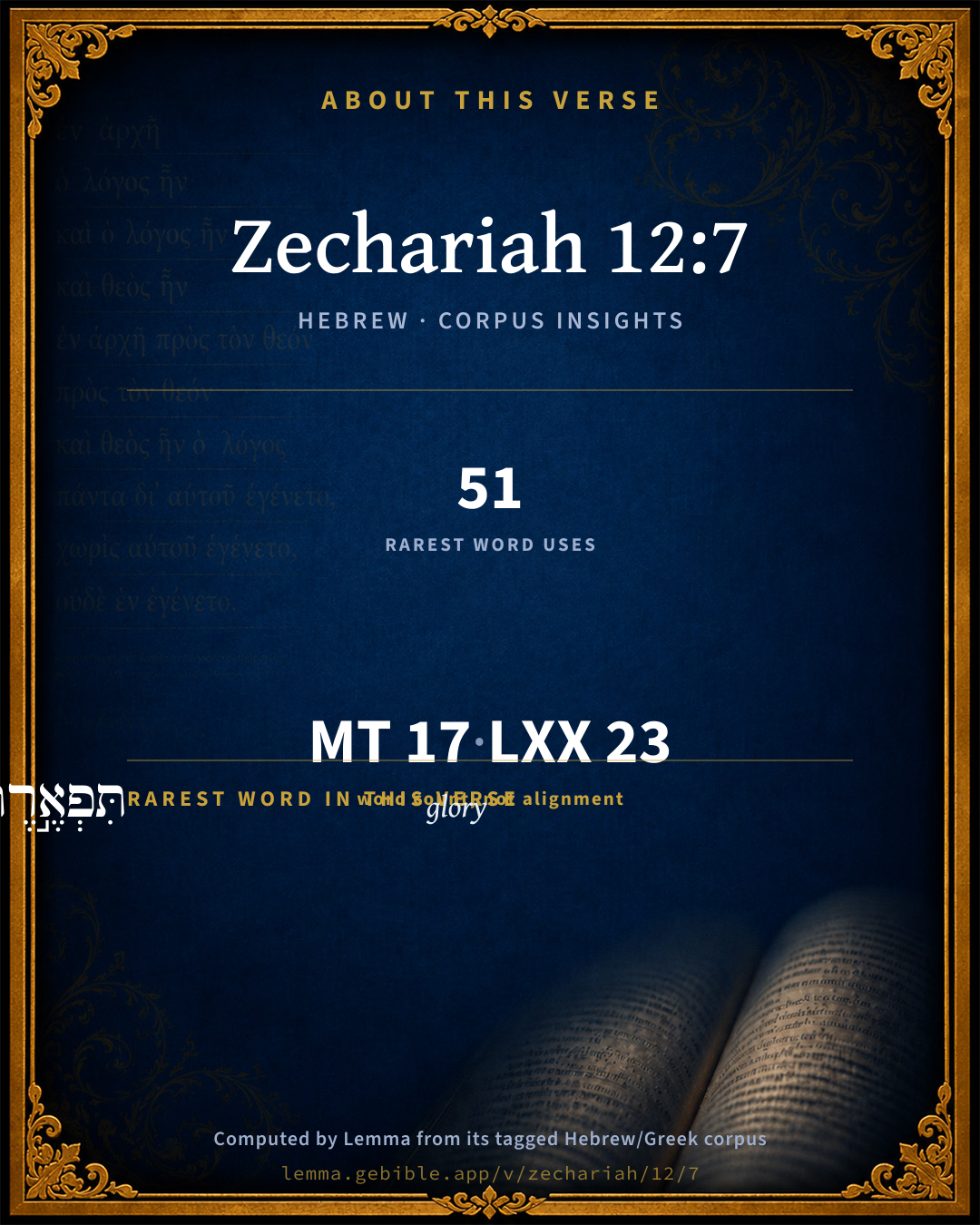
About this verse

These counts appear in no published source. They are computed here, from the morphology-tagged text and Lemma’s own curated glosses. What Lemma adds →

17
words
15
distinct lemmas
Prophets
section

Shared distinctive vocabulary

תִּפְאֶ֣רֶת glory H8597 occurs in 50 verses of the Hebrew Bible. Also found in:

Grammatical profile

  • 3 verbs
  • 9 nouns
  • 1 adjective
  • 2 prepositions
  • 2 particles

Verb forms

  • וְהוֹשִׁ֧יעַ Hiphil · Sequential Perfect
  • תִגְדַּ֜ל Qal · Imperfect
  • יֹשֵׁ֥ב Qal · Participle Active

Repetition

Words recur within this verse — often emphatic in Hebrew:

  • יְהוּדָ֖ה Judah H3063 ×2
  • תִּפְאֶ֣רֶת glory H8597 ×2

Hebrew & Septuagint length

In English translation the verse runs 30 words from the Hebrew and 35 from the Septuagint (LXX English) — closely comparable.

A rough comparison of the two English renderings, which tokenize alike — not a word-level alignment.

Word counts can differ between the Hebrew and the Greek without any difference in meaning — e.g. the Hebrew direct-object marker אֵת has no separate Greek word, and Greek often adds the article ὁ.

In the original languages it is 17 Hebrew tokens and 23 Greek tokens — but the two are counted differently (Hebrew bundles its prefixes and suffixes into one token; the Greek is in lemma form), so that isn’t a like-for-like length.

Cross-references

20

Topical passages linked to Zechariah 12:7 in the Treasury of Scripture Knowledge — connected by theme and wording, ordered by reader-vote popularity; previews shown in the World English Bible.

  • Jeremiah 30:18 Thus says Yahweh: Behold, I will turn again the captivity of Jacob's tents, and have compassion on his dwelling-places; and the city shall be built on its own hill, and the palace shall be inhabited after its own manner.
  • Psalms 35:26 Let them be disappointed and confounded together who rejoice at my calamity. Let them be clothed with shame and dishonor who magnify themselves against me.
  • Psalms 55:12 For it was not an enemy who insulted me, Then I could have endured it. Neither was it he who hated me who raised himself up against me, Then I would have hid myself from him.
  • Amos 9:11 In that day I will raise up the tent of David who is fallen, and close up its breaches, and I will raise up its ruins, and I will build it as in the days of old;
  • Romans 3:27 Where then is the boasting? It is excluded. By what manner of law? Of works? No, but by a law of faith.
  • Job 19:5 If indeed you will magnify yourselves against me, And plead against me my reproach;
  • Psalms 38:16 For I said, "Don't let them gloat over me, Or exalt themselves over me when my foot slips."
  • Isaiah 2:11–17 The lofty looks of man will be brought low, The haughtiness of men will be bowed down, And Yahweh alone will be exalted in that day.
  • Isaiah 23:9 Yahweh of hosts has purposed it, to stain the pride of all glory, to bring into contempt all the honorable of the earth.
  • Jeremiah 9:23–24 Thus says Yahweh, Don't let the wise man glory in his wisdom, neither let the mighty man glory in his might, don't let the rich man glory in his riches;
  • Zechariah 4:6 Then he answered and spoke to me, saying, "This is the word of Yahweh to Zerubbabel, saying, 'Not by might, nor by power, but by my Spirit,' says Yahweh of Hosts.
  • Zechariah 11:11 It was broken in that day; and thus the poor of the flock that listened to me knew that it was the word of Yahweh.
  • Matthew 11:25–26 At that time, Jesus answered, "I thank you, Father, Lord of heaven and earth, that you hid these things from the wise and understanding, and revealed them to infants.
  • Luke 1:51–53 He has shown strength with his arm. He has scattered the proud in the imagination of their heart.
  • Luke 10:21 In that same hour Jesus rejoiced in the Holy Spirit, and said, "I thank you, O Father, Lord of heaven and earth, that you have hidden these things from the wise and understanding, and revealed them to little children. Yes, Father, for so it was well-pleasing in your sight."
  • John 7:47–49 The Pharisees therefore answered them, "You aren't also led astray, are you?
  • James 2:5 Listen, my beloved brothers. Didn't God choose those who are poor in this world to be rich in faith, and heirs of the Kingdom which he promised to those who love him?
  • James 4:6 But he gives more grace. Therefore it says, "God resists the proud, but gives grace to the humble."
  • 1 Corinthians 1:26–31 For you see your calling, brothers, that not many are wise according to the flesh, not many mighty, and not many noble;
  • 2 Corinthians 4:7–12 But we have this treasure in clay vessels, that the exceeding greatness of the power may be of God, and not from ourselves.

Cross-references courtesy of OpenBible.info (CC BY 4.0).

Hebrew and Greek witnesses Masoretic Hebrew ↔ Greek Septuagint

The same verse in the two great witnesses to the Old Testament, shown verse-for-verse.

These are two independent witnesses, not word-aligned to each other, and the Septuagint is shown in lemma (dictionary) form.

Hebrew Zechariah 12:7 Masoretic · Westminster Leningrad Codex

וְהוֹשִׁ֧יעַ יְהוָ֛ה אֶת אָהֳלֵ֥י יְהוּדָ֖ה בָּרִֽאשֹׁנָ֑ה לְמַ֨עַן לֹֽא תִגְדַּ֜ל תִּפְאֶ֣רֶת בֵּית דָּוִ֗יד וְתִפְאֶ֛רֶת יֹשֵׁ֥ב יְרוּשָׁלִַ֖ם עַל יְהוּדָֽה

Yahweh also will save the tents of Judah first, that the glory of the house of David and the glory of the inhabitants of Jerusalem not be magnified above Judah.

World English Bible · Public Domain

Greek LXX Zechariah 12:7 Septuagint · lemma form

καί σώζω κύριος ὁ σκήνωμα ιουδα καθώς ἀπό ἀρχή ὅπως μή μεγαλύνω καύχημα οἶκος δαυίδ καί ἔπαρσις ὁ καταοἰκέω ἰερουσαλήμ ἐπί ὁ ἰούδας

And the Lord shall save the tabernacles of Juda as at the beginning, that the boast of the house of David, and the pride of the inhabitants of Jerusalem, may not magnify themselves against Juda.

LXX2012 (modern English Septuagint) · Public Domain

On this verse, Ellicott's Commentary for English Readers discusses the Septuagint’s reading. Read the note in Commentary ↓

Hebrew: Westminster Leningrad Codex (CC BY 4.0). Greek: Septuagint (public domain); English from LXX2012 (modern English Septuagint) (Public Domain). How the Septuagint differs from the Hebrew →

Targum (Aramaic paraphrase)

1

The Targum is the ancient Jewish Aramaic paraphrase of the Hebrew Scriptures — an interpretive translation, not the Hebrew text itself. Onkelos (literal) and Pseudo-Jonathan (expansive) render the Torah, and Jonathan the Prophets. Coverage is partial: where no permissively-licensed English translation exists for a verse, only the Aramaic is shown. This is verse-level text, not a word-by-word alignment to the Hebrew.

  1. Targum Jonathan Prophets (Joshua–Malachi)
    וְיִפְרוֹק יְיָ יַת קִרְוַיָא דְבֵית יְהוּדָה בְּקַדְמֵיתָא בְּדִיל דְלָא תִסְגֵי אִתְרַבְרְבוּת בֵּית דָוִיד וְאִיתְרַבְרְבוּת יַתְבֵי יְרוּשְׁלֵם עַל דְבֵית יְהוּדָה:

    (no public-domain English translation for this verse)

    Targum Jonathan — Aramaic: “Mikraot Gedolot” (public domain). English: “Sefaria Community Translation” (CC0 1.0 (public-domain dedication)); “London "Chaldee Paraphrase," 1871” (public domain). Text via Sefaria.

Commentary

Notes on Zechariah 12:7 from classic Christian and Jewish commentators (each source and its license shown beneath its notes). The classic Christian expositions comment on the surrounding passage and are grouped to its opening verse, so a note may address several verses; the Jewish commentaries on the Tanakh (Rashi and others) are per-verse, so they appear only where the commentator wrote on this verse.

Lemma curates 59 commentaries, every one of them public domain or Creative Commons licensed, each selected and text-cleaned for this edition rather than reprinted as found. About our sources →

The Cambridge Bible for Schools and Colleges

gen. ed. J. J. S. Perowne

7. the tents of Judah first] The meaning seems to be that when the besiegers shall reel back like drunken men from the walls of Jerusalem (Zec_12:2), smitten with panic by God (Zec_12:4), the first to fall upon them and put them to the sword shall be, not the inhabitants of the besieged city by sallying forth from their walls, though they by their gallant and successful defence had rightly been regarded as the bulwark of the whole land (Zec_12:5), but the inhabitants of the open country, who shall have the honour of consuming their adversaries (Zec_12:6), and so of saving first themselves and then the capital, which as the result of their prowess shall be completely delivered.

that the glory, &c.] The human agents are to have each their due share of honour. (Comp. Zec_12:5.) But to God alone the glory really belongs. “I will make,” Zec_12:2-3; Zec_12:6; “I will smite,” Zec_12:4; “Jehovah shall save,” Zec_12:7. Compare “my strength in Jehovah of hosts, their God,” Zec_12:5. “Sensus est, gloriam victi hostis non penes Hierosolymitanos futuram, quippe post superatum demum hostem ex urbe exituros, sed penes Judam, qui supra Zec_12:6 dicebatur ignis instar hostes circumquaque absumturus; aut penes ipsum potius Jovam, qui hostes amentia et cæcitate percusserit (Zec_12:4), Judam vero robore induerit ad hostes jamjam confusos ulterius debellandos.” Rosenm.

do not magnify themselves] be not magnified, R. V.

The Cambridge Bible for Schools and Colleges (gen. ed. J. J. S. Perowne; Cambridge University Press, 1878–1918) — public domain. Text from a community e-Sword module.

Trapp's Complete Commentary

John Trapp

Zec 12:7 The LORD also shall save the tents of Judah first, that the glory of the house of David and the glory of the inhabitants of Jerusalem do not magnify [themselves] against Judah.

Ver. 7. The Lord also shall save the tents of Judah first] Or, as at first, sc. when they came out of Egypt, and had no strongholds to take to for their defence. "Lord" (saith Moses), "thou hast been our dwelling-place in all generations," Psa 90:1. He was so of old, and ever will be; the faith whereof made the fathers well content to dwell in tents, Heb 11:13, and those holy Rochabites, Jer 35:7-8, till Nebuchadnezzar came up into the land, Zec 12:11. But here God promiseth to deliver those Jews that dwelt in the open fields, without the city; and then afterwards to deliver Jerusalem itself from the rage of the Antiochi: and so he did (1 Maccab.) in a wonderful manner; they were helped indeed with a little help, Dan 11:34, to take away boasting; as it followeth.

That the glory of the house of David, &c.] That is, the glorious house of David, and the glorious inhabitants of Jerusalem, by an hypallage. {a} Non est gloriosior populus sub caelo, quam Iudaicus. There is not a more vain glorious people under heaven than the Jews are, saith Alsted. They were so of old, Joh 8:33 Mat 3:9. Spaniards are said to be impudent braggers, and extremely proud in the lowest ebb of fortune; so are the Jews. But God will teach them better things, and make him that glorieth glory in the Lord, 1Co 1:31.

{a} A figure of speech in which there is an interchange of two elements of a proposition, the natural relations of these being reversed. ŒD

John Trapp, A Commentary or Exposition upon All the Books of the Old and New Testament (1647–1656) — public domain. Text from a community e-Sword module.

Joseph Benson's Commentary

Zec 12:7. The Lord shall save the tents of Judah first — Some MSS. and versions read כראשׁנה, as at the first; “but the meaning here is, that God would save the tents of Judah first, or previously to any other; and for this the reason immediately follows, that the house of David and the inhabitants of Jerusalem might not be tempted to value themselves too highly on the preference given to them (supposing that had been the case) above the rest of Judah.” — Blayney. As the house of David were wont to glory in the honour of their being descended from him, and the inhabitants of Jerusalem to value themselves above their brethren, because their city was the place of God’s peculiar residence, and the seat of the royal family; therefore, to take away all occasion of any such glorying and emulation, God here promises that he would first appear in behalf of those Jews that should live in the open country, in cottages or tents, in places unfortified. He will first save the weaker and despised, and then the stronger and more honourable. But this promise, which evidently looks forward to gospel times, seems principally to imply, that the conversion of the nation to Christianity will begin among the more poor, low, and obscure Jews, and not among the rich, great, and learned; lest the latter should glory over the others, as if the change among the people had been effected by their power, wisdom, or influence; or should assume any improper ascendency over their inferiors: in other words, that the wise man might not glory in his wisdom, neither the mighty man in his might, nor the rich man in his riches; and that no flesh might glory in God’s presence, but that he that should glory might glory only in the Lord, Jer 9:23.

Joseph Benson's Commentary on the Old and New Testaments (1811–1818) — public domain. Text from a community e-Sword module.

Geneva Bible (1599)

Geneva Bible translators

The people which are now as it were dispersed by the fields, and lie open to their enemies, shall be no less preserved by my power, than if they were under their kings (which is meant by the house of David) or in their defensed cities.

Geneva Bible (1599) marginal notes — public domain. Text via Bolls.life.

Jamieson, Fausset & Brown

Robert Jamieson, A. R. Fausset & David Brown

Judah is to be "first saved," because of her meek acknowledgment of dependence on Jerusalem, subordinate to Jehovah's aid.

tents--shifting and insecure, as contrasted with the solid fortifications of Judah. But God chooses the weak to confound the mighty, that all human glorying may be set aside.

Jamieson, Fausset & Brown — Commentary Critical and Explanatory on the Whole Bible (1871) — public domain (CC PDM 1.0). Text via the HelloAO Bible API.

Adam Clarke's Commentary

Verse 7. The Lord also shall save the tents of Judah first] This, I suppose, refers to the same thing. The Gospel of Christ shall go from the least to the greatest. Eminent men are not the first that are called; the poor have the Gospel preached to them. And this is done in the wise providence of God, that the "glory of the house of David," c., that secular influence may appear to have no hand in the matter and that God does not send his Gospel to a great man, because he is such.

Adam Clarke's Commentary on the Bible (1810–1826) — public domain. Text from a community e-Sword/MySword module.

John Calvin's Commentaries

The Prophet teaches us again, — that there is no need of helps when God stretches forth his hand to preserve his people; for he is alone abundantly sufficient. And the design of the verse is to show, that the Jews were to learn to acquiesce in God alone, though they might find themselves destitute of every earthly assistance; for when God purposes to save, he needs no help, as we have said; nor does he borrow any, as he by himself is fully sufficient.

But by the word, Tabernacles, the Prophet means, as I think, sheds, such as afforded but partial protection. It is indeed true that tents are called סחות, sachut, in Hebrew; but the same is often meant by the אעלים, aelim, tents, which afforded a temporary accommodation; for they were not strongly built, as it is evident from many passages. I allow that all houses without any difference are sometimes called tabernacles, אהלים, aelim; but the word properly signifies a tent, built as a temporary convenience; for it is said that the fathers dwelt in tents, when they had no fixed habitation.

Let us now see why the Prophet speaks of tents. He may have alluded to their dwelling in the wilderness; but as this may seem too remote, I consider that he simply refers to the tents in which the Jews dwelt when they had entered the land, after their deliverance from Egypt; for they must have been wonderfully protected by the hand of God, inasmuch as they had provoked all their neighbors and kindled the hatred of all against themselves. There were indeed some fortified cities; but for the most part they lived in villages, and the greatest part of the people were no doubt satisfied with their tents or sheds. Hence as the Israelites then had no defense, the Prophet now reminds them, that they were then protected by God alone, in order that they might believe that they should in future be safe and secure, as God would defend them to the end. There is then here an implied comparison between tents and fortified cities; and the Prophet bids them to consider what their fathers had formerly experienced, for God faithfully defended them, even when they were unprotected and exposed to the attacks of their enemies.

He says first, Jehovah will save the tents, etc.; as though he had said, “Know that your fathers were formerly defended by the hand of God, when they did not, as to the greater part of them, dwell in cities, but lived scattered in villages: since God then had been the preserver of his people many ages before a king was made, believe that he will be the same to you hereafter.” But we must yet remember what we said yesterday, — that the Jews who had returned to their country had a promise of God’s help, in order that the Israelites, who were retained by their own sloth in Babylon, might know that they were justly suffering punishment for their ingratitude, because they had not given glory to God, as they ought to have done, by committing themselves to his protection, and thus relying on his defense, so as not to seek other helps from the world: he will then save them, he says, as at the beginning; for as, the particle of similitude, is to be understood here.

He then adds, And hence boast shall not the honor of the house of David and the honor of the citizen of Jerusalem over Judah. This latter clause is added, I think, by way of explanation; and this is evident from the subject itself for God declares, that he would be the protector of the helpless, so that they would be no less victorious than if they possessed many armed soldiers, and were furnished with money and other necessaries to carry on war. For by comparing here the house of David and the inhabitants of Jerusalem with Judah, he has no doubt a regard to this, — that though there was no kingdom and no fortified cities, there would yet be sufficient protection in him alone, so that he could by himself defend the people, though unarmed, and having no swords, nor power, nor any other requisite means. Boast then shall not the house of David: and this seems to have been mentioned designedly, for while they trusted in their own wealth and power, they did not rest on God as they ought to have done.

As then the Jews had been elated with vain pride, while the dignity of the kingdom remained, and while they possessed wealth and warlike instruments, God here reproves this false confidence; for the Jews had thus obscured his gratuitous favor. For however great might have been the treasures collected by David and Solomon, and however formidable they might have been to their enemies and the neighboring nations, they ought yet to have relied on the protection of God alone. Since then earthly helps had inflated their minds, God now reproves their vain conceit, and shows that the condition of the people would be no less happy, when no king sat on the throne, and no aids enlisted for the protection of the people; and therefore he declares, that though exposed to all evils, they should yet be safe and secure, for God would defend them. This is the reason why the Prophet says, that the royal posterity would not glory against Judah, though dwelling in tents, nor the citizens of Jerusalem, who were then as it were the courtiers: for as the royal seat was at Jerusalem, a sort of vain boasting was made by all the citizens. As then all of them despised the inhabitants of the country, when the condition of the city was illustrious, the Prophet says, the posterity of David and Jerusalem shall not hereafter glory against the people of Judah, scattered in the open fields. It then follows —

John Calvin's Commentaries (1540-1563) — public domain. Text from the Calvin Translation Society English edition (1840s-50s) via the Christian Classics Ethereal Library (ccel.org). Calvin's coverage is partial (roughly two-thirds of the Bible); uncommented books and verses are honest gaps, never fabricated. The 19th-century editor's footnotes and remarks are omitted so the notes are faithfully Calvin's own voice.

Ellicott's Commentary for English Readers

(7) First.—There is another reading, supported by the LXX. and a few MSS., as in former times. This variant does not materially alter the sense, for in any case the deliverance of Judah is made to take precedence (in importance, if not in time) of that of Jerusalem. “Judah” seems here to denote the rest of the people, in contradistinction to the inhabitants of Jerusalem and the princes of the house of David. The Maccabees were deliverers raised up from the people—viz., Levi (see Macc. 2:1)—not from the royal house.

A Bible Commentary for English Readers, edited by Charles John Ellicott (1878–1897) — public domain. Text from a community e-Sword module.

John Gill's Exposition

The Lord also shall save the tents of Judah first,.... That is, the Jews, who will be in other parts of the land encamped in tents, to defend themselves against their enemies; these will be saved out of the hands of them, before the inhabitants of Jerusalem will be saved; and in such a manner, that it will evidently appear that their salvation is of the Lord: and his end in so doing will be,

that the glory of the house of David, and the glory of the inhabitants of Jerusalem, do not magnify themselves against Judah; lest the chief of the family of David, and the principal inhabitants of Jerusalem, should glory over their brethren in other parts of Judea; and say it was owing to them that they were saved and delivered out of the hands of their enemies.

John Gill's Exposition of the Whole Bible (1746–1763) — public domain (CC PDM 1.0). Text via the HelloAO Bible API.

Albert Barnes' Notes on the Bible

The Lord also shall save the tents of Judah first - Still it is, ‘the Lord shall save.’ We have, on the one side, the ‘siege,’ the gathering of all the peoples of the earth ‘against Jerusalem, the horse and his rider.’ On the other, no human strength; not, as before, in the prophecy of the Maccabees, the bow, the arrow, and the sword, though in the hand of God Zec 9:13. It is thrice, ‘I will make’ Zec 9:2-3,; ‘I will smite’ (Zec 9:4 bis); and now, ‘The Lord shall save.’ By ‘the tents,’ he probably indicates their defenselessness. God would ‘save’ them first; that ‘the glory of the house of David - ‘be not great against’ or ‘over Judah,’ may not overshadow it; but all may be as one; for all is the free gift of God, the mere grace of God, that ‘he that glorieth may glory in the Lord’ Jer 9:24; 1Co 1:31; 2Co 10:17, and both “may own that, in both, the victory is the Lord’s” (Jerome).

Lap.: “In Christ Jesus is neither Jew nor Greek; neither bond nor free, neither rich nor poor” Gal 3:28; “but all are one,” namely a new creation; yea in Christendom the poor are the highest, both because Christ “preached to the poor” Luk 4:18, and pronounced the “poor blessed” Luk 6:20, and He made the Apostles, being poor, nobles in His kingdom, through whom He converted kings and princes, as is written, “ye see your calling, brethren, that not many wise men after the flesh, not many mighty, not many noble are called, but God hath chosen the foolish things of the world to confound the wise, and the weak things of the would to confound the things which fire mighty ...” 1Co 1:26; and, “Hath not God called the poor in this world, rich in faith, and heirs of the kingdom, which God has promised to them that love Him?” Jam 2:5. The rich and noble have greater hindrances to humility and Christian virtues, than the poor. For honors puff up, wealth and delights weaken the mind; wherefore they need greater grace of Christ to burst their bonds than the poor. Wherefore, for the greater grace shown them, they are bound to give greater thanks unto Christ.”

Albert Barnes' Notes on the Bible (1834–1885) — public domain. Text from a community e-Sword/MySword module.

Haydock's Catholic Bible Commentary

David. The Machabees were not of this family, but Levites, born at Modin, in Ephraim. (Calmet)

George Leo Haydock (1774–1849), Haydock's Catholic Family Bible and Commentary, 1859 edition — public domain. Excludes Psalms (Douay-Rheims chapter numbering differs from Protestant) and Deuterocanonical books (Catholic canon only).

Matthew Poole's English Annotations

Shall save; rescue from the power and rage of the Antiochuses, nay, subdue their armies, and put them to flight before the Jews.

The tents; the unfenced places, the open country, the shepherd-like cottages or tents of Judah.

Of Judah first; before he saveth Jerusalem, before he put Jerusalem into arms, or bring her inhabitants into the field, to fight, and help the country and its inhabitants; first the weaker are saved, next the stronger.

That the glory of the house of David, that the illustrious house of David, and so the glorious citizens of Jerusalem,

do not magnify themselves against Judah; boast of their power, policy, courage, and forwardness, and how much Judah owed to these for their deliverance: this would exasperate Judah, and provoke God, who would do all this: so that all might magnify their God, none think greatly of themselves.

Matthew Poole's English Annotations on the Holy Bible (1683–1685) — public domain. Text from a community e-Sword/MySword module.

Whedon's Commentary on the Bible

Daniel D. Whedon

7. Jehovah also shall save the tents of Judah first — Though the open country is not defended by strong walls, though its villages may be likened to defenseless tents, the outburst of courage to which attention is called in Zec_12:5-6 will result in the freeing of the country from enemies, even before the mighty city is delivered. And this is in accord with the divine purpose, for it will prevent boasting on the part of the city over the country. There may have been at this time a tendency among the inhabitants of the capital to despise the country population; if so, this utterance may be meant to counteract this tendency. Instead of first some Hebrew manuscripts and the most important ancient versions read “as in former days,” which presupposes a change of only one consonant. If this reading is adopted the verse affirms that the deliverance of the future will resemble the wonderful deliverances of the past.

The house of David — A phrase used ordinarily to denote the dynasty of David. If so here, it points to a time when a descendant of David occupied a position of prominence in the government. However, it is not impossible that the phrase is used in the more general sense of ruling family or government.

Glory — The martial glory bestowed upon the victor.

Daniel D. Whedon (gen. ed.), Commentary on the Old and New Testaments (1874–1909) — public domain. Text from a community e-Sword module.

The Pulpit Commentary

Shall save the tents of Judah first. Instead of "first," a preferable reading, supported by the Greek, Latin, and Syriac Versions, is "as in the beginning," or "as in former days." The prophet declares that the open towns and villages of Judah, which can offer no effectual resistance to an enemy like the fortified city Jerusalem, shall be saved by the aid of God, as so often has happened in old time. If "first" be the genuine reading, the meaning is that the country people shall first be saved in order to prevent Jerusalem glorifying herself at their expense. That the glory...do not magnify themselves against (be not magnified above) Judah. God will save the chosen nation in such a manner that each part shall have its share in the glory and honour. The leaders, represented by "the house of David" and "the inhabitants of Jerusalem," as the sanctuary of Cod and a strongly fortified city, shall not be able to exalt themselves as more favoured than the rest of the people. By God"s help alone is the victory won, and all alike share in this. The expressions in this verse could not have been written, as some assert, while the dynasty of David reigned.

The Pulpit Commentary (1880–1919), ed. H.D.M. Spence-Jones & Joseph S. Exell — public domain. Text from a community e-Sword module.

John Wesley's Explanatory Notes

The tents - The unfenced places, the open country, the cottages, or tents. First - First the weaker are saved, next the stronger. The glory - That the illustrious house of David, and the glorious citizens of Jerusalem may not boast of their power, policy and courage.

John Wesley, Explanatory Notes Upon the Whole Bible (1754–1765) — public domain. Text via the GEBible commentary corpus.

unfoldingWord translationNotes

Door43 World Missions Community

General Information:

These verses continue telling about the coming attack against Jerusalem and how God will rescue the city.

the tents of Judah

Here "tents" represents homes, and homes represent the people who live in them. AT: "the people of Judah" (See: Metonymy)

the house of David

Possible meanings are 1) the descendants of David or 2) the ruling class of people. (See: Metonymy)

those who are weak among them will be like David

This simile means those who are weak will be strong. AT: "those who are weak will be strong like David" (See: Simile)

the angel of Yahweh

This is an angel sent by Yahweh to protect the people.

translationWords

Yahweh

tent

kingdom of Judah

honor

house of David

Jerusalem

angel

nation

unfoldingWord translationNotes — © Distant Shores Media and the Door43 World Missions Community, licensed CC BY-SA 4.0. Source: git.door43.org/Door43/en_tn.

Rashi

Rabbi Shlomo Yitzchaki (Rashi)

And the Lord shall first save the tents of Judah Before the inhabitants of Jerusalem come out of the city, they shall have a salvation - to return to their tents and to their homes - and afterwards the salvation shall come to the inhabitants of the city. That is the salvation concerning which it is stated (14:3): “And the Lord shall go forth and wage war.”

so that the boasting of, etc., shall not increase to boast over them and to say, “You were saved only because of us.”

Rashi on the Tanakh — English translations: “The Judaica Press complete Tanach with Rashi, translated by A. J. Rosenberg” (CC BY 4.0); “Pentateuch with Rashi's commentary by M. Rosenbaum and A.M. Silbermann, 1929-1934” (public domain); “The Metsudah Tanach series, Lakewood, N.J” (CC BY 4.0); and “The Book of Joshua, Metsudah Publications, 1997” (CC BY 4.0). Text via Sefaria.

Lesson kit

Teaching starters — assembled from the data on this page, not authored interpretation. Every prompt links to the verse data it draws on. Edit before teaching.

Zechariah, in the Prophets, opens this verse with 17 words (15 distinct Hebrew lemmas). Its most distinctive word is tiphʼârâh (“glory”). A historical commentator’s framing appears above. Read the whole chapter for the surrounding context.

Discussion questions

  1. How does “glory” (tiphʼârâh) shape what this verse is saying?
  2. How does Exodus 28:2, which shares the word «glory», read alongside this verse?
  3. What does the repetition of “Judah” (2× in this one verse) do in this verse?
  4. These translations render this verse differently; the difference is in the English rendering, not the original. What questions does that raise?
  5. «וְהוֹשִׁ֧יעַ» is a Hiphil Sequential Perfect verb. How does that grammatical form shape the action described?
  6. Compare how The Cambridge Bible for Schools and Colleges and Trapp's Complete Commentary read this verse. Where do they agree or differ?

Things to notice

Reading settings

Reading text

Shown beneath each verse's original-language words.

Old Testament
Old Testament edition

Read the OT as the Masoretic Hebrew (MT) or the Greek Septuagint (LXX).

English shown for the Greek Septuagint (in the Hebrew ↔ Greek comparison).

Comparing translations? Open the Compare panel on any verse page to stack up to four side by side.