
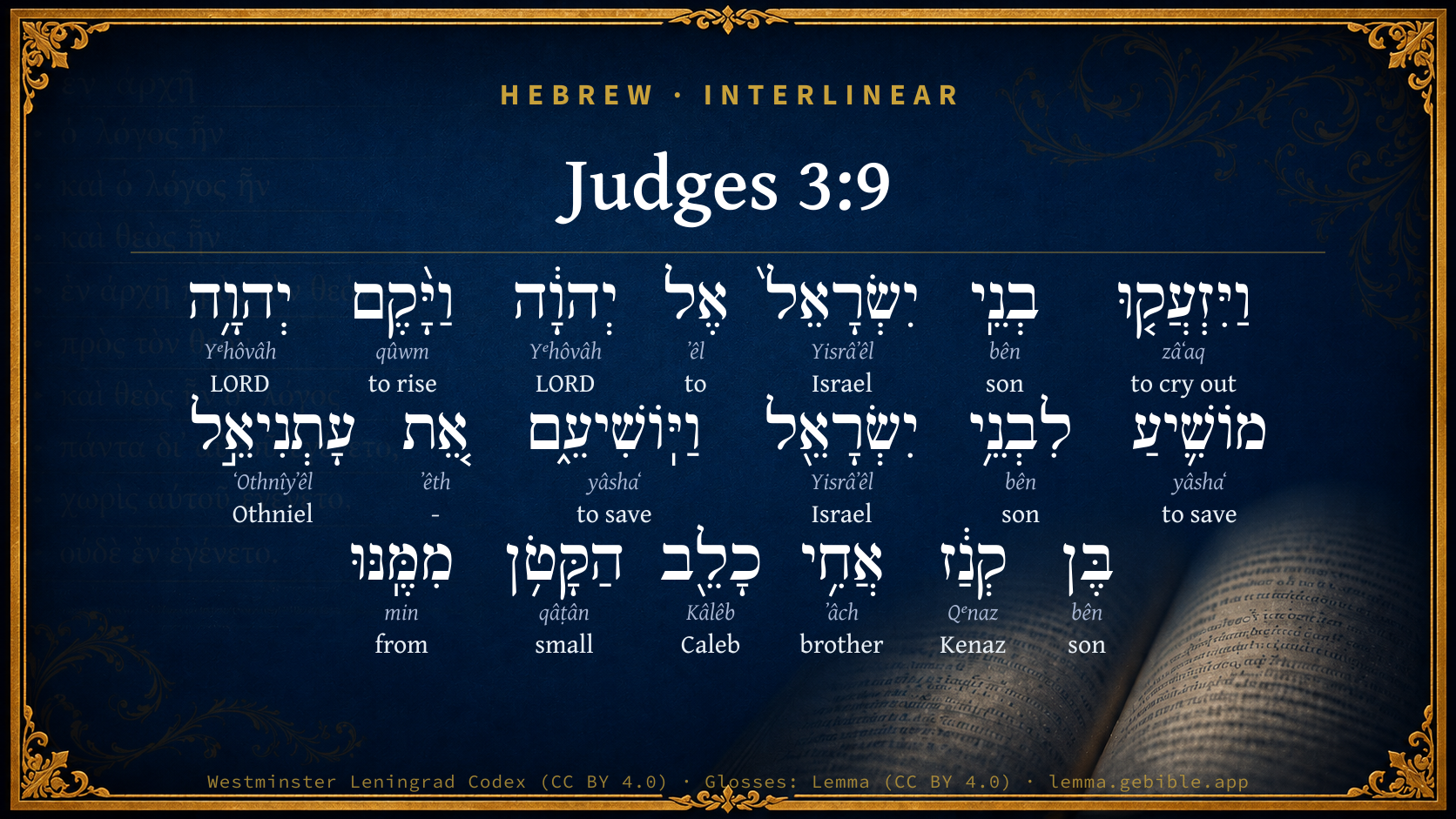
Judges 3:9

Hebrew (Westminster Leningrad Codex) Judges 3:9 appears in the Hebrew Old Testament. The text above is from the Westminster Leningrad Codex. Each word links to its Strong’s number, a concise gloss, and parsing drawn from the Open Scriptures Hebrew Bible morphology. Click any word for its full Brown-Driver-Briggs (BDB) entry.
Download image
Cite this verse

Judges 3:9 (World English Bible). Public Domain. Lemma interlinear Bible study tool, https://lemma.gebible.app/v/judges/3/9.

Show BibTeX & RIS
BibTeX
RIS
English Translation
When the children of Israel cried to Yahweh, Yahweh raised up a savior to the children of Israel, who saved them, even Othniel the son of Kenaz, Caleb's younger brother.
World English Bible · Public Domain
Download a study sheet

One document with this verse’s original text, its word-by-word gloss line, the meaning frame, cross-references with their text, attributed commentary, and full source and license credits — printable, and it pastes into notes with its structure intact.

This verse Autodidact and up

Study sheet (.html) Plain text (.txt)

A passage Seminary Student

Up to 50 verses in one chapter. A passage sheet keeps up to 6 commentary sources and 12 cross-references per verse, in the order this page ranks them, and says so on the sheet whenever that leaves anything out. Ask for a single verse and you get the Autodidact verse sheet above.

Everything on this page stays free to read, with no account — the sheet is a download of what is already on screen, not access to it.

Want to remove ads? Support Godless Engineer
Compare translations 3

The same verse in 3 English versions, stacked beneath the original-language interlinear above. Click any original word for its lexicon entry.

Each is an independent rendering of the whole verse — the interlinear is not word-aligned to these translations.

Highlighted words mark where these versions differ — a whole-verse word diff, not a word-by-word alignment.

  • World English Bible Public Domain
    When the children of Israel cried to Yahweh, Yahweh raised up a savior to the children of Israel, who saved them, even Othniel the son of Kenaz, Caleb's younger brother.
  • King James Version Public Domain
    And when the children of Israel cried unto the LORD, the LORD raised up a deliverer to the children of Israel, who delivered them, even Othniel the son of Kenaz, Caleb's younger brother.
  • unfoldingWord Literal Text CC BY-SA 4.0
    Then the sons of Israel cried out to Yahweh, and Yahweh raised up a savior for the sons of Israel, and he saved them: Othniel, the son of Kenaz, the brother of Caleb, the younger than him.

unfoldingWord Literal Text — © unfoldingWord, licensed CC BY-SA 4.0. Word-aligned USFM3 via Door43 (git.door43.org/unfoldingWord/en_ult).

Versions to compare (up to 4)

3 of 4 selected

Show all 18 translations

Every available English version of this verse, each an independent rendering of the whole verse.

  • World English Bible Public Domain
    When the children of Israel cried to Yahweh, Yahweh raised up a savior to the children of Israel, who saved them, even Othniel the son of Kenaz, Caleb's younger brother.
  • Berean Standard Bible Public Domain
    But when the Israelites cried out to the LORD, He raised up Othniel son of Caleb’s younger brother Kenaz as a deliverer to save them.
  • Majority Standard Bible Public Domain
    But when the Israelites cried out to the LORD, He raised up Othniel son of Caleb’s younger brother Kenaz as a deliverer to save them.
  • King James Version Public Domain
    And when the children of Israel cried unto the LORD, the LORD raised up a deliverer to the children of Israel, who delivered them, even Othniel the son of Kenaz, Caleb's younger brother.
  • American Standard Version (1901) Public Domain
    And when the children of Israel cried unto Jehovah, Jehovah raised up a saviour to the children of Israel, who saved them, even Othniel the son of Kenaz, Caleb's younger brother.
  • Revised Version (1885) Public Domain
    And when the children of Israel cried unto the LORD, the LORD raised up a saviour to the children of Israel, who saved them, even Othniel the son of Kenaz, Caleb’s younger brother.
  • Geneva Bible (1599) Public Domain
    And when the children of Israel cryed vnto the Lord, the Lord stirred vp a sauiour to ye children of Israel, and he saued them, euen Othniel the sonne of Kenaz, Calebs yonger brother.
  • Douay-Rheims (1899) Public Domain
    And they cried to the Lord, who raised them up a saviour, and delivered them, to wit, Othoniel the son of Cenez, the younger brother of Caleb:
  • Young's Literal Translation Public Domain
    and the sons of Israel cry unto Jehovah, and Jehovah raiseth a saviour to the sons of Israel, and he saveth them -- Othniel son of Kenaz, Caleb's younger brother;
  • Literal Standard Version CC BY-SA 4.0
    and the sons of Israel cry to YHWH, and YHWH raises a savior to the sons of Israel, and he saves them—Othniel son of Kenaz, Caleb’s younger brother;
  • Unlocked Literal Bible CC BY-SA 4.0
    When the people of Israel called out to Yahweh, Yahweh raised up someone who would come to help the people of Israel, and who would rescue them: Othniel son of Kenaz (Caleb's younger brother).
  • unfoldingWord Literal Text CC BY-SA 4.0
    Then the sons of Israel cried out to Yahweh, and Yahweh raised up a savior for the sons of Israel, and he saved them: Othniel, the son of Kenaz, the brother of Caleb, the younger than him.
  • Darby Bible Public Domain
    But when the people of Israel cried to the LORD, the LORD raised up a deliverer for the people of Israel, who delivered them, Oth'ni-el the son of Kenaz, Caleb's younger brother.
  • World Messianic Bible Public Domain
    When the children of Israel cried to the LORD, the LORD raised up a savior to the children of Israel, who saved them, even Othniel the son of Kenaz, Caleb’s younger brother.
  • Webster's Bible Public Domain
    And when the children of Israel cried to the LORD, the LORD raised up a deliverer to the children of Israel, who delivered them, even Othniel the son of Kenaz, Caleb's younger brother.
  • Free Bible Version CC BY-SA 4.0
    But when the Israelites cried out to the Lord to help them, he provided someone to rescue them, Othniel, son of Kenaz, Caleb's younger brother, and he saved them.
  • Bible in Basic English Public Domain
    And when the children of Israel made prayer to the Lord, he gave them a saviour, Othniel, the son of Kenaz, Caleb's younger brother.
  • JPS Tanakh (1917) Public Domain
    And when the children of Israel cried unto the LORD, the LORD raised up a saviour to the children of Israel, who saved them, even Othniel the son of Kenaz, Caleb's younger brother.

Literal Standard Version (2020), Covenant Press — licensed CC BY-SA 4.0. Text via the HelloAO Bible API (eBible.org). Unlocked Literal Bible (unfoldingWord) — licensed CC BY-SA 4.0. Text via the HelloAO Bible API (eBible.org). unfoldingWord Literal Text — © unfoldingWord, licensed CC BY-SA 4.0. Word-aligned USFM3 via Door43 (git.door43.org/unfoldingWord/en_ult). Free Bible Version, Dr. Jonathan Gallagher — licensed CC BY-SA 4.0. Text via the HelloAO Bible API (eBible.org).

Word by word

More ways to search: Search by grammar → Find every occurrence → Compare this word →

Practice this passage: Drill this verse → Learn its vocabulary →

עָתְנִיאֵ֣ל
ʻOthnîyʼêl
H6274
“Othniel”
Noun, Proper
Part of Speech
Noun
Type
Proper
Full BDB Definition

Origin: from the same as H6273 and H410

TWOT: None

Othniel = "lion of God" - son of Kenaz, younger brother of Caleb, and husband of Achsah the daughter of Caleb and his own niece; first judge of Israel, who after the death of Joshua, delivered the Israelites from the oppression of Chushanrishathaim
  1. וַיִּזְעֲק֤וּ zâʻaq H2199 “and · to cry out” Conjunction + Verb, Qal, Sequential Imperfect, 3rd Person, Masculine, Plural
  2. בְנֵֽי bên H1121 “sons of” Noun, Common, Masculine, Plural, Construct
  3. יִשְׂרָאֵל֙ Yisrâʼêl H3478 “Israel” Noun, Proper
  4. אֶל ʼêl H413 “to” Preposition
  5. יְהוָ֔ה Yᵉhôvâh H3068 “LORD” Noun, Proper
  6. וַיָּ֨קֶם qûwm H6965 “and · to rise” Conjunction + Verb, Hiphil, Sequential Imperfect, 3rd Person, Masculine, Singular
  7. יְהוָ֥ה Yᵉhôvâh H3068 “LORD” Noun, Proper
  8. מוֹשִׁ֛יעַ yâshaʻ H3467 “saving” Verb, Hiphil, Participle Active, Masculine, Singular, Absolute
  9. לִבְנֵ֥י bên H1121 “to/for · sons of” Preposition + Noun, Common, Masculine, Plural, Construct
  10. יִשְׂרָאֵ֖ל Yisrâʼêl H3478 “Israel” Noun, Proper
  11. וַיּֽוֹשִׁיעֵ֑ם yâshaʻ H3467 “and · to save · them” Conjunction + Verb, Hiphil, Sequential Imperfect, 3rd Person, Masculine, Singular + Suffix, Personal, 3rd Person, Masculine, Plural
  12. אֵ֚ת ʼêth H853 “-” Particle, Direct Object
  13. בֶּן bên H1121 “son of” Noun, Common, Masculine, Singular, Construct
  14. קְנַ֔ז Qᵉnaz H7073 “Kenaz” Noun, Proper
  15. אֲחִ֥י ʼâch H251 “brother of” Noun, Common, Masculine, Singular, Construct
  16. כָלֵ֖ב Kâlêb H3612 “Caleb” Noun, Proper
  17. הַקָּטֹ֥ן qâṭân H6996 “the · small” Particle, Definite Article + Adjective, Adjective, Masculine, Singular, Absolute
  18. מִמֶּֽנּוּ min H4480 “from · him” Preposition + Suffix, Personal, 3rd Person, Masculine, Singular

About this verse

These counts appear in no published source. They are computed here, from the morphology-tagged text and Lemma’s own curated glosses. What Lemma adds →

19
words
14
distinct lemmas
Historical
section

Notable vocabulary

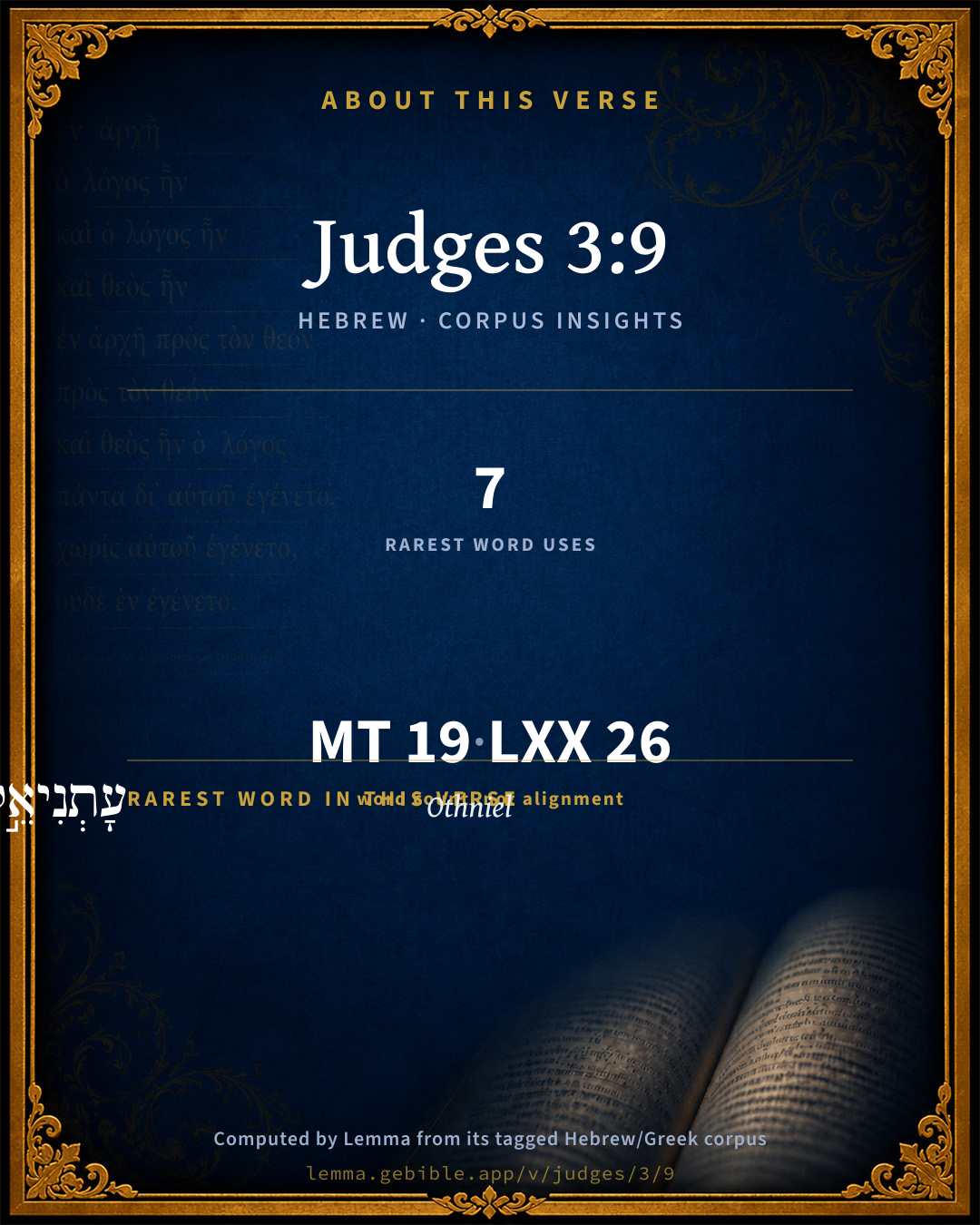
The rarest word here is עָתְנִיאֵ֣ל Othniel H6274 — appearing just 7 times in the whole Hebrew Bible.

Shared distinctive vocabulary

עָתְנִיאֵ֣ל Othniel H6274 occurs in 6 verses of the Hebrew Bible. Also found in:

Grammatical profile

  • 4 verbs
  • 11 nouns
  • 1 adjective
  • 2 prepositions
  • 1 particle

Verb forms

  • וַיִּזְעֲק֤וּ Qal · Sequential Imperfect
  • וַיָּ֨קֶם Hiphil · Sequential Imperfect
  • מוֹשִׁ֛יעַ Hiphil · Participle Active
  • וַיּֽוֹשִׁיעֵ֑ם Hiphil · Sequential Imperfect

Repetition

Words recur within this verse — often emphatic in Hebrew:

  • בְנֵֽי son H1121 ×3
  • יִשְׂרָאֵל֙ Israel H3478 ×2
  • יְהוָ֔ה LORD H3068 ×2
  • מוֹשִׁ֛יעַ to save H3467 ×2

Hebrew & Septuagint length

In English translation the verse runs 30 words from the Hebrew and 34 from the Septuagint (LXX English) — closely comparable.

A rough comparison of the two English renderings, which tokenize alike — not a word-level alignment.

Word counts can differ between the Hebrew and the Greek without any difference in meaning — e.g. the Hebrew direct-object marker אֵת has no separate Greek word, and Greek often adds the article ὁ.

In the original languages it is 19 Hebrew tokens and 26 Greek tokens — but the two are counted differently (Hebrew bundles its prefixes and suffixes into one token; the Greek is in lemma form), so that isn’t a like-for-like length.

Cross-references

12

Topical passages linked to Judges 3:9 in the Treasury of Scripture Knowledge — connected by theme and wording, ordered by reader-vote popularity; previews shown in the World English Bible.

  • Judges 3:15 But when the children of Israel cried to Yahweh, Yahweh raised them up a savior, Ehud the son of Gera, the Benjamite, a man left-handed. The children of Israel sent tribute by him to Eglon the king of Moab.
  • Judges 1:13 Othniel the son of Kenaz, Caleb's younger brother, took it: and he gave him Achsah his daughter as wife.
  • Psalms 22:5 They cried to you, and were delivered. They trusted in you, and were not disappointed.
  • Judges 6:7 It happened, when the children of Israel cried to Yahweh because of Midian,
  • Judges 10:10 The children of Israel cried to Yahweh, saying, We have sinned against you, even because we have forsaken our God, and have served the Baals.
  • Judges 2:16 Yahweh raised up judges, who saved them out of the hand of those who despoiled them.
  • Judges 4:3 The children of Israel cried to Yahweh: for he had nine hundred chariots of iron; and twenty years he mightily oppressed the children of Israel.
  • Psalms 107:13–19 Then they cried to Yahweh in their trouble, And he saved them out of their distresses.
  • 1 Samuel 12:10 They cried to Yahweh, and said, We have sinned, because we have forsaken Yahweh, and have served the Baals and the Ashtaroth: but now deliver us out of the hand of our enemies, and we will serve you.
  • Nehemiah 9:27 Therefore you delivered them into the hand of their adversaries, who distressed them: and in the time of their trouble, when they cried to you, you heard from heaven; and according to your manifold mercies you gave them saviors who saved them out of the hand of their adversaries.
  • Psalms 78:34 When he killed them, then they inquired after him. They returned and sought God earnestly.
  • Psalms 106:41–44 He gave them into the hand of the nations. Those who hated them ruled over them.

Cross-references courtesy of OpenBible.info (CC BY 4.0).

Hebrew and Greek witnesses Masoretic Hebrew ↔ Greek Septuagint

The same verse in the two great witnesses to the Old Testament, shown verse-for-verse.

These are two independent witnesses, not word-aligned to each other, and the Septuagint is shown in lemma (dictionary) form.

Hebrew Judges 3:9 Masoretic · Westminster Leningrad Codex

וַיִּזְעֲק֤וּ בְנֵֽי יִשְׂרָאֵל֙ אֶל יְהוָ֔ה וַיָּ֨קֶם יְהוָ֥ה מוֹשִׁ֛יעַ לִבְנֵ֥י יִשְׂרָאֵ֖ל וַיּֽוֹשִׁיעֵ֑ם אֵ֚ת עָתְנִיאֵ֣ל בֶּן קְנַ֔ז אֲחִ֥י כָלֵ֖ב הַקָּטֹ֥ן מִמֶּֽנּוּ

When the children of Israel cried to Yahweh, Yahweh raised up a savior to the children of Israel, who saved them, even Othniel the son of Kenaz, Caleb's younger brother.

World English Bible · Public Domain

Greek LXX Judges 3:9 Septuagint · lemma form

καί κράζω ὁ υἱός ἰσραήλ πρός κύριος καί ἀγείρω κύριος σωτήρ ὁ ἰσραήλ καί σώζω αὐτός ὁ γοθονιηλ υἱός κενεζ ἀδελφός χαλεβ ὁ νέος ὑπέρ αὐτός

And the children of Israel cried to the Lord; and the Lord raised up a savior to Israel, and he saved them, Gothoniel the son of Kenez, the brother of Chaleb younger than himself.

LXX2012 (modern English Septuagint) · Public Domain

On this verse, Ellicott's Commentary for English Readers discusses the Septuagint’s reading. Read the note in Commentary ↓

Hebrew: Westminster Leningrad Codex (CC BY 4.0). Greek: Septuagint (public domain); English from LXX2012 (modern English Septuagint) (Public Domain). How the Septuagint differs from the Hebrew →

Targum (Aramaic paraphrase)

1

The Targum is the ancient Jewish Aramaic paraphrase of the Hebrew Scriptures — an interpretive translation, not the Hebrew text itself. Onkelos (literal) and Pseudo-Jonathan (expansive) render the Torah, and Jonathan the Prophets. Coverage is partial: where no permissively-licensed English translation exists for a verse, only the Aramaic is shown. This is verse-level text, not a word-by-word alignment to the Hebrew.

  1. Targum Jonathan Prophets (Joshua–Malachi)
    וּזְעִיקוּ בְּנֵי יִשְׂרָאֵל קֳדָם יְיָ וְאֲקֵים יְיָ פָרִיק לִבְנֵי יִשְׂרָאֵל וּפַרְקִינוּן יַת עָתְנִיאֵל בַּר קְנַז אֲחוּהִי דְכָלֵב דִזְעֵיר מִנֵיהּ:

    (no public-domain English translation for this verse)

    Targum Jonathan — Aramaic: “Mikraot Gedolot” (public domain). English: “Sefaria Community Translation” (CC0 1.0 (public-domain dedication)); “London "Chaldee Paraphrase," 1871” (public domain). Text via Sefaria.

Commentary

Notes on Judges 3:9 from classic Christian and Jewish commentators (each source and its license shown beneath its notes). The classic Christian expositions comment on the surrounding passage and are grouped to its opening verse, so a note may address several verses; the Jewish commentaries on the Tanakh (Rashi and others) are per-verse, so they appear only where the commentator wrote on this verse.

Lemma curates 59 commentaries, every one of them public domain or Creative Commons licensed, each selected and text-cleaned for this edition rather than reprinted as found. About our sources →

Trapp's Complete Commentary

John Trapp

Jdg 3:9 And when the children of Israel cried unto the LORD, the LORD raised up a deliverer to the children of Israel, who delivered them, [even] Othniel the son of Kenaz, Caleb’s younger brother.

Ver. 9. And the Lord raised up a deliverer.] Heb., A saviour. A word so emphatical, that other tongues can hardly find a fit word to express it, as Cicero observeth of the Greek word σωτηρ.

John Trapp, A Commentary or Exposition upon All the Books of the Old and New Testament (1647–1656) — public domain. Text from a community e-Sword module.

The Biblical Illustrator

Joseph S. Exell

Jdg_3:9-11

Othniel the son of Kenaz . . . and the Spirit of the Lord came upon him.

The controlling man

It is the personal soul that is the basis of all action. Your machinery is soulless, and the true driver, after all, is the man with his hand on the throttle. You invent, and you multiply motions, and actions, and skilled operations; but you never can dispense with the brain and mind and heart of the controlling man. In the same way, all movements on this earth need to head up into personal souls. God sets a man in charge of the machinery, and as the stars and suns revolve in their cycles, as the events of the human race happen and are run off the reel, they get their explanation only from the personal souls that have been in the movements. When the time of the Reformation was at hand, Luther shakes himself in yonder cell and comes forth. When the thick mists of Popish darkness were to be rolled away from Scotland, John Knox appeared. It is the same all down the ages: men, personal souls, are called forth to lead events to their God-destination and God-purpose. Events need men. So with God! When the time came, God found the Person who would undertake this great purpose of redeeming love, who would atone for man, and suffer on the Cross. (John Robertson.)

Othniel

Othniel, the first of the judges, seems one of the best. He is not a man of mere rude strength and dashing enterprise; nor is he one who runs the risk of sudden elevation of power, which few can stand. A person of acknowledged honour and sagacity, he sees the problem of the time and does his best to solve it. He is almost unique in this, that he appears without offence, without shame. And his judgeship is honourable to Israel. It points to a higher level of thought and greater seriousness among the tribes than in the century when Jephthah and Samson were the acknowledged heroes. The nation had not lost its reverence for the great names and hopes of the Exodus when it obeyed Othniel and followed him to battle. (R. A. Watson, M. A.)

Political leadership

In modern times there would seem to be scarcely any understanding of the fact that no man can do real service as a political leader unless he is a fearer of God, one who loves righteousness more than country, and serves the Eternal before any constituency. Sometimes a nation low enough in morality has been so far awake to its need and danger as to give the helm, at least for a time, to a servant of truth and righteousness and to follow where he leads. But more commonly is it the case that political leaders are chosen anywhere rather than from the ranks of the spiritually earnest. It is oratorical dash now, and now the cleverness of the intriguer, or the power of rank and wealth, that catches popular favour and exalts a man in the State. Members of parliament, cabinet ministers, high officials need have no devoutness, no spiritual seriousness or insight. A nation generally seeks no such character in its legislators, and is often content with less than decent morality. Is it then any wonder that politics are arid and governments a series of errors? We need men who have the true idea of liberty and will set nations nominally Christian on the way of fulfilling their mission to the world. When the people want a spiritual leader he will appear; when they are ready to follow one of high and pure temper he will arise and show the way. But the plain truth is that our chiefs in the State, in society and business must be the men who represent the general opinion, the general aim. While we are in the main a worldly people, the best guides, those of spiritual mind, will never be allowed to carry their plans. And so we come back to the main lesson of the whole history, that only as each citizen is thoughtful of God and of duty, redeemed from selfishness and the world, can there be a true commonwealth, honourable government, beneficent civilisation. (R. A. Watson, M. A.)

Prayer helpful to leadership

You may be as unlike a warrior, as unlike one of the Lord Jesus Christs Ironsides as unlike can be, yet you have a great deal to do with the making and shaping and sending of them. Can you feel the woes of Israel? Can you shed tears over her? Have you a large, sympathetic heart? And, summing it all up in one word, can you cry? can you pray? When the children of Israel cried unto the Lord, the Lord sent this mighty Othniel, upon whom the Spirit of the Lord came Ah! I think we are weak there. We would have more great preachers, we would have more revival movements, in the large meaning of the word revival--not only the ingathering of sinners, but the up-building and brightening of saints--if we had more people who sigh and cry for the sad condition of Gods inheritance. Ye that make mention of the Lord, keep not silence. Tossing often on a bed of sickness, or weakness, or pain, do you sigh and cry? Then will God be getting ready His Othniels, and Ehuds, and Shamgars. (John McNeill.)

The gift of the Spirit of the Lord

This clearly teaches us that all gifts of the Spirit, and all excellent effects thereof, they are none of ours--they are the Lords; He giveth and distributeth them at His pleasure, as we see here that it was the Spirit of the Lord that came upon Othniel, whereby he brought to pass the great things that he did. And whatsoever is of any note in man for price and excellency it is all of God, and cometh from His mere bounty. Alas! there is no bird stripped of her feathers more bare and naked than man in himself is void of goodness; for what hath he that he hath not received? Insomuch as all that he hath to glory of is his sin--a most holy and approved truth, which giveth God His due, and layeth out man in his colours, that he is nothing else, if he rob not God of His honour, and prank not up himself in his gifts, he is nothing else but naked, poor, and a mirror of misery: (R. Rogers.)

Judgment, then deliverance

Judgment and then deliverance; judgment of the mistakes and sins men have committed, thereby bringing themselves into trouble; conviction of sin and righteousness; thereafter guidance and help that their feet may be set on a rock and their goings established--this is the right sequence. That God should help the proud, the self-sufficient out of their troubles in order that they may go on in pride and vain glory, or that He should save the vicious from the consequences of their vice and leave them to persist in their iniquity, would be no Divine work. The new mind and the right spirit must be put in men, they must bear their condemnation, lay it to heart and repent, there must be a revival of holy purpose and aspiration first. Then the oppressors will be driven from the land, the weight of trouble lifted from the soul. (R. A. Watson, M. A.)

The making of a hero

This is a book of heroes, of strong men, and strong women too, who, in a time of storm and stress, saved their own souls and the souls of those around them also. It will brace you up, invigorate, and inspire you. It is said of Pitt that he breathed his own lofty spirit into his country. No man, said a soldier of the time, ever entered Mr. Pitts room who did not feel himself a braver man when he came out than when he went in. And no man can read this book sympathetically without being moved to emulation of the mighty souls that move across its pages. It tells us very briefly, but suggestively, the story of twelve people who helped to make Israel, and of these the first, and in some respects the best also, is Othniel, the son of Kenaz. Many of these saviours, as they are called, were far from being perfect characters. But in Othniels life, as we have it, there is no hint of anything that offends either the taste or the conscience. His name means Gods Lion; and throughout he seems to have been a brave, pure, noble man. And yet the age in which he lived was a very corrupt one. His surroundings were very unfavourable to the growth of character. There was no king or leader in Israel--every man did that which was right in his own eyes. Idolatry and licentiousness abounded. And the task set before you, young men and women, is not so very unlike that which faced Othniel. You must first save yourselves--you must, by Gods help, save your own souls. You must also help God to save the world. This is your task and your privilege--both to be saved and to be saviours. But how did Othniel become a hero and a saviour of his people?

I. Caleb said He that smiteth Kiriath-sepher and taketh it, to him will I give Achsah my daughter to wife. And Othniel the son of Kenaz took it. That is the first fact given us from Othniels life, and that is all that is said about it--Othniel took it--took the stronghold of the mighty sons of Anak--the oracle city of idolatry before which even Caleb quailed. Othniel took it. But many things go to the making of such a deed as that.

1. First, of course, comes courage. It was an undertaking full of desperate difficulties. What was needed was not so much physical as moral courage. The courage to follow is common enough; it is the courage to lead that is rare. Othniel had this soul-quality. He led the way and took the city. Well, if you young people are bent upon saving yourselves from the evil that is in the world, you too must have and must exercise this soul-courage. It often needs more courage to handle the yard-wand than the sword--to be a business-man than to be a soldier. Daily life, all hum-drum as it looks, has its Marathons, its Waterloos, and its Minas; its Six Hundreds that ride into the jaws of death.

2. But courage, what is it? How does any one get courage? Well, if we take another look at Othniel we shall see that the lion in him was not born on the day Debir was taken. It was already strong, matured, full grown. Born long before this in the desert, it had been nourished by daily deeds of unrewarded valour. Acts such as this take years to grow. All his life he had been unconsciously preparing for this. Yes, that is the story of all courage. God gives it to us as He gives all things in seed form. Every heart is full of germs--courage-germs among them. If we cultivate any germ it grows and bears fruit; if we neglect it it dies. If you want courage you must grow it from a seed--that is you must practise the little you have.

3. Once more: This deed of Othniels lays bare to us the central secret of all true power--faith. You are familiar with great facts of which Othniel never even dreamt. But your salvation does not depend on how many beliefs you carry about with you, but on how much do you believe any of them. Any truth becomes a saving truth to the soul that trusts it and through it trusts God. Thus this little sentence, unpromising as it looks, gives us three things that go to the making of a hero: courage, habit, faith, and the greatest of these is faith.

II. And he (Caleb) gave him Achsah his daughter to wife: and it came to pass when she came unto him that she moved him to ask of her father a field. This, the second of the three facts of Othniels history, introduces us into a very different set of circumstances, a different climate of life in fact.

1. Debir is taken; Caleb has kept his word; the bride is coming to her new home. Applause is not much for a young pair to live on; so, amid the excitement and the joy, this fair daughter of the wilderness kept her eyes open and her wits about her. She noted the situation in which her new home lay. It was south land. It had no water. She moved her husband to ask for the field that had the springs of water. But Othniel is better at fighting than asking. Her humour, her sense, and her exquisite tact carried all before them. Caleb gave her the upper springs and the nether springs.

2. But what has this to do with the making of a hero? Much in every way. Othniel was brave enough but he had a great deal to learn. He had taken Debir with his sword, but here at his own door he is confronted with a situation in which his sword is useless. Evidently he must learn the use of other weapons. He must master the art of gracious speech. He must acquire tact. There are knots which it avails not to cut, they must be patiently untied by skilful fingers. He is to help in making a people who shall never become formidable as a military power--never produce an Alexander or a Caesar--who shall ultimately lose all their swords, lose every inch of their territory and every stone of their citadels, and yet shall overcome their enemies through sheer force of character. That he may do this God sent him to the home-school and the farm-school to learn those homely virtues of common sense, patience, and tact, without which strength and courage were of little avail.

3. Well, you too, young people, must not despise these.

III. The children of Israel did that which was evil in the sight of the Lord . . . the children of Israel served Cashan-rishathaim eight years . . . the children of Israel cried unto the Lord. Many years--forty, perhaps, or even more--have passed since Othniel and Achsah took possession of their new home, and we are confronted with a new and painful situation. The Lords people forgat the Lord and served the Baalim--that was their sin! They served Cushan, King of Mesopotamia--that was their punishment Egypt and Pharaoh were not so far away as they thought. Egypt, the land of bondage, is wherever sin is, and Pharaoh follows iniquity as the night the day. And the Lord raised up a saviour . . . even Othniel, and the Spirit of the Lord came upon him. He raised him to this glorious height of manhood by breathing into him His own breath of love and life. There were many reasons why Othniel should do nothing. The chief, perhaps, was that apparently he could do nothing. Perhaps Achsah was another--and the farm a third. Yes, depend upon it there were many voices both within and without that bade Othniel beware of meddling with things beyond his power. But the still small voice called. He put himself, all that he was, all that he had, upon the altar, and he judged Israel. He called the erring people back to truth and duty. Led by Gods spirit he began there, with the peoples own sin first. Then he went out to war . . . and his hand prevailed against Cushan, and the land had rest forty years. Thus Othniel, even Othniel, became a saviour of his people, and the lion-like man of war, under the influence of Gods spirit, was changed into a living prophecy of the Lamb of God, the Saviour of the world. And Othniel, the son of Kenaz, died, having in a rude, hard age, nobly sustained the character of the Happy Warrior. The phase Othniel--a saviour, is at once his epitaph and his eulogy. Well, even so are noble lives still made. Faith, patience, wisdom, and the breath of God are the great life-building powers. Saviourhood is the end of all the ways of God in a soul. He makes some men strong in order that they may help the weak. He gives wisdom to some that they may thereby guide the foolish. He makes men holy in order that they may turn the unholy from the error of their way. Now, young people, will you be made strong in the Lord and in the strength of His might? Around you, in numbers that Othniel never dreamed of, are men that serve the Baalim and serve Cushan, that sin, and suffer for their sin in mind, body, and estate. Will you help to save these? (J. M. Gibbon.)

The Biblical Illustrator, edited by Joseph S. Exell (c. 1880s–1900s) — public domain. Text from a community e-Sword module.

Joseph Benson's Commentary

Jdg 3:9-10. When the children of Israel cried unto the Lord — When they returned to him in repentance, acknowledged him to be their only Protector and Saviour, and prayed fervently for pardon and deliverance; the Lord raised up a deliverer — Qualified a person for, and called him to, the great work of delivering them. The Spirit of the Lord came upon him — With extraordinary influence, endowing him with singular wisdom and courage, and stirring him up to this great undertaking. Judged Israel — That is, pleaded and avenged the cause of Israel against their oppressors. And went out to war — The sacred historian gives us no further account of this war than that Othniel obtained a victory over the king of Mesopotamia, and a peace which lasted forty years. This victory and deliverance of Israel, it seems, happened about thirty-eight years after the death of Joshua.

Joseph Benson's Commentary on the Old and New Testaments (1811–1818) — public domain. Text from a community e-Sword module.

Jamieson, Fausset & Brown

Robert Jamieson, A. R. Fausset & David Brown

when the children of Israel cried unto the Lord--In their distress they had recourse to earnest prayer, accompanied by humble and penitent confession of their errors.

Othniel--(See on Jos 15:16; Jdg 1:13). His military experience qualified him for the work, while the gallant exploits he was known to have performed, gained him the full confidence of his countrymen in his ability as a leader.

Jamieson, Fausset & Brown — Commentary Critical and Explanatory on the Whole Bible (1871) — public domain (CC PDM 1.0). Text via the HelloAO Bible API.

Adam Clarke's Commentary

Verse 9. Raised up - Othniel, the son of Kenaz] This noble Hebrew was of the tribe of Judah, and nephew and son-in-law to Caleb, whose praise stands without abatement in the sacred records. Othniel had already signalized his valour in taking Kirjath-sepher, which appears to have been a very hazardous exploit. By his natural valour, experience in war, and the peculiar influence of the Divine Spirit, he was well qualified to inspire his countrymen with courage, and to lead them successfully against their oppressors.

Adam Clarke's Commentary on the Bible (1810–1826) — public domain. Text from a community e-Sword/MySword module.

Ellicott's Commentary for English Readers

(9) Cried unto the Lord.—“In the time of their trouble, when they cried unto Thee, Thou heardest them from heaven; and according to Thy manifold mercies Thou gavest them saviours” (Neh_9:27). “Then they cried unto the Lord in their trouble, and He saved them out of their distresses” (Psa_107:13; see, too, Psa_26:5; Psa_78:34; Psa_106:44).

A deliverer.—Heb., moshia; LXX., “a saviour.” (Comp. Luk_1:69; Act_13:23.) The same word as is used for the judges in Heb_9:27.

Othniel.—The name means “lion of God.” St. Jerome makes it mean “my time of God,” and spells it Athaniel

The son of Kenaz.—(See Jdg_1:13.) Josephus, to escape the apparent improbability of a brother of Caleb being young enough to marry Caleb’s daughter, when Caleb was past eighty-five, calls him “a person of the tribe of Judah.” He rightly regards the events of Judges 17-21 as preceding the judgeship of Othniel; but they can hardly have happened during the oppression of Cushan-Rishathaim.

A Bible Commentary for English Readers, edited by Charles John Ellicott (1878–1897) — public domain. Text from a community e-Sword module.

The Cambridge Bible for Schools and Colleges

gen. ed. J. J. S. Perowne

9. The verse is composed of the standing phrases of the Dtc. compiler: cried unto the Lord Jdg_3:15, Jdg_4:3, Jdg_6:6-7, Jdg_10:10; raised up … saved Jdg_3:15, see Jdg_2:16 n.

Othniel] See Jdg_1:13 n.

The Cambridge Bible for Schools and Colleges (gen. ed. J. J. S. Perowne; Cambridge University Press, 1878–1918) — public domain. Text from a community e-Sword module.

John Gill's Exposition

And when the children of Israel cried unto the Lord,.... Towards the close of the eight years' bondage, as it may be supposed, groaning under the oppressive taxes laid upon them, and the bondage they were brought into: and

the Lord raised up a deliverer to the children of Israel; he heard their cry, and sent them a saviour, whose spirit he stirred up, and whom he qualified for this service:

who delivered them; out of the hands of the king of Mesopotamia, and freed them from his oppressions:

even Othniel, the son of Kenaz, Caleb's younger brother; the same that took Debir, and married Achsah, the daughter of Caleb, Jdg 1:12; who now very probably was a man in years.

John Gill's Exposition of the Whole Bible (1746–1763) — public domain (CC PDM 1.0). Text via the HelloAO Bible API.

Albert Barnes' Notes on the Bible

Othniel was already distinguished in Joshua’s lifetime as a brave and successful leader. See Jos 15:16-17.

Albert Barnes' Notes on the Bible (1834–1885) — public domain. Text from a community e-Sword/MySword module.

Haydock's Catholic Bible Commentary

Saviour. "We must remark, that the man by whom God grants us safety, is styled a saviour," (St. Augustine, q. 18,) though Christ is the proper and principal Saviour. (Worthington) --- Caleb. Septuagint, "the younger son of Cenez, who was the brother of Caleb." (Haydock) --- Othoniel was one of the ancients. If he could not prevent the people from falling into idolatry, he rescued them from it. (Calmet)

George Leo Haydock (1774–1849), Haydock's Catholic Family Bible and Commentary, 1859 edition — public domain. Excludes Psalms (Douay-Rheims chapter numbering differs from Protestant) and Deuterocanonical books (Catholic canon only).

Matthew Poole's English Annotations

Cried unto the Lord, i.e. prayed fervently for deliverance.

Caleb’s younger brother; of which see Poole "Jdg 1:13".

Matthew Poole's English Annotations on the Holy Bible (1683–1685) — public domain. Text from a community e-Sword/MySword module.

Whedon's Commentary on the Bible

Daniel D. Whedon

9. When the children of Israel cried unto the Lord — Here is a sudden revival of memory. Adversity banishes that forgetfulness of God which prosperity has produced.

The Lord raised up a deliverer — There is an adage among the Jews that “when the tale of bricks is increased, Moses comes forth.” Every nation has had its national saviour, who has stepped to the front of its decimated armies, and lifted up its drooping banner, and inspired it with his own indomitable courage and sublime faith. Not only true piety but true philosophy must regard such men at such times as the gift of the God of nations.

Othniel — See on Jos_15:17. The fact that Othniel, whether he were brother or nephew of Caleb, was the first judge of Israel, shows that Chushan’s oppression came not long after the death of Joshua.

Daniel D. Whedon (gen. ed.), Commentary on the Old and New Testaments (1874–1909) — public domain. Text from a community e-Sword module.

The Pulpit Commentary

A deliverer. Hebrew, Saviour, as ver. 15. (see Neh_9:27) Othniel, etc. Mentioned Jud_1:13Jo 15:17, and 1Ch_4:13, where he is placed under "the sons of Kenaz," and seems to be the father of Hathath and Meonothai. According to RAPC Jdt 6:15, he had a descendant, Chabris, living in the time of Holofernes. The Hebrew, though grammatically it favours the view that Othniel was the brother of Caleb, does not absolutely exclude the rendering that Kenaz was his brother, and so Othniel his nephew. Compare Jer_32:7, wherethe words "thine uncle" apply to Shallum, not to Hanameel, as is clear from ver. 8. And as the chronology seems to make it impossible that Othniel should be Caleb"s brother, since Caleb was eighty-five years old at the time of Othniel"s marriage, and Othniel therefore could not be less than fifty-five, an improbable age for his marriage; and since, again, Othniel could not well have been less than eighty at Joshua"s death, which, allowing only ten years for the elders, and reckoning the eight years for Chushan"s dominion, would make him ninety-eight when he was raised up to deliver Israel, it is a lesser difficulty to take Othniel as the nephew of Caleb, by understanding the words, Calebs younger brother, to apply to Kenaz. But perhaps the least objectionable escape from the difficulty is to take the phrase in its most natural grammatical sense, but to understand the word brother in its wider and very common sense of kinsman or fellow-tribesman. They were both sons of Kenaz, or Kenizzites. Caleb was the head of the tribe, and Othniel was next to him in tribal dignity, and his junior in age, but probably succeeded to the chieftainship on Caleb"s death. This would leave the exact relationship between Caleb and Othniel uncertain.

Vers. 9, 10. True deliverance must ever come from God.

It is a curious fact in the history of Israel that it is never until they have acknowledged God as the source of salvation that they achieve any permanent success. It is as if this people were to learn that only by supernatural means is it ever to fulfil its destiny.

I HE INSPIRES TRUE HEROISM. Of Othniel we have already heard; he stands as a representative of early Israelitish chivalry. But on the occasion on which he distinguished himself formerly, the inspiration was hardly so lofty as to mark him out as especially the servant of God. He is, however, on the threshold of the great life of self-denial and generous self-sacrifice which characterised the judge of Israel. He is a vessel chosen of God for better service. Of the particular influences which marked him out for the high office to which he was called we are not informed. All that we know is, that the Spirit of the Lord came upon him. That he was well qualified otherwise for warlike exploits we know; but the merely human traits of character which he has displayed are nothing without this distinctive inspiration. God finds the man for the hour.

II THE MORAL AUTHORITY IS DIVINELY CREATED. Israel gravitates towards Othniel as its moral centre. By a kind of moral necessity he becomes its judge, and there is no one to dispute his ascendancy. The prestige which he gains in his magistracy is not injured by military failures. We are to look upon all this as proof that God was with him. preserving and increasing his reputation, and developing the powers which he possessed. When it is said, (Jud_1:2:18) "And when the Lord raised them up judges, then the Lord was with the judge, and delivered them out of the hand of their enemies all the days of the judge," we are invited to behold no series of merely human successes, but that which is directly due to his presence and help. And so with all Whom he inspires for special service; he will make their moral influence his care, sustain their strength, and secure uninterrupted success if they put their trust in him. M.

Natural advantages and endowments perfected and crowned by consecration.

I THE BEST CHANNEL FOR OTHNIEL"S ABILITIES WAS THAT INDICATED BY THE DIVINE CALL.

II IN OBEDIENCE OF GOD"S SPIRIT HE SECURED THE MOST COMMANDING INFLUENCE.

III AS SERVANT OF JEHOVAH HE ATTAINED ENDURING RENOWN. M.

HOMILIES BY W.F. ADENEY Vers. 9, 10. Great men.

The Book of Judges brings before us the heroic age of Israel. The multitude of the people are in a condition of moral and political degradation, but great men appear from time to time whose individual heroism secures the salvation of their nation. Othniel, the first of the judges, may serve as a type of the rest. The characters and mission of these men may throw some light upon the function of great men in the economy of Providence.

I GREAT MEN OWE THEIR GREATNESS TO GOD. Many of the judges sprang from obscure families; they were not hereditary rulers, but men sent of God with individual vocations. Othniel belonged to the honourable family of Caleb, and shared in the fame of that family, perhaps, partly in virtue of hereditary qualities. But even he is described as owing his greatness to God.

1. Great men are sent by God. When the people cried unto the Lord, the Lord raised up a deliverer." There are men who are born heroes men whose great qualities are owing to their nature, not to their culture or their conduct. He who believes in providence will recognise that such men are raised up" by God.

2. Great men derive their highest powers directly from God. The Spirit of the Lord came upon Othniel. The military and political ability of Othniel as warrior and judge are ascribed to a Divine inspiration. All truly great men are inspired by God. Not only ore they originally formed and sent by God, but they owe their powers to the constant influence of God within them. Bad men of genius receive their genius from God, and are therefore guilty of prostituting the noblest Divine gift to evil purposes. Such men attain to no more than an earthly greatness. In the sight of God their low aims destroy the character of heroism which their abilities rendered possible. On the other hand, all Christians may attain to a measure of greatness in proportion as they receive the Spirit of God; yet we must distinguish between the graces of the Spirit, which are for all Christians, and the gifts of the Spirit, which are special, and bestowed on individual men.

II GREAT MEN HAVE A MISSION TO THEIR FELLOW-MEN.

1. Great men are intrusted with great talents for the benefit of others. To devote these to selfish ends of ambition or pleasure is a mark of gross unfaithfulness. We are members one of another; and that member which has the highest capacities will produce the largest amount of harm if it refuses to perform its functions in promoting the welfare of the whole body.

2. Great men are needed by the world. The heroic age has passed, and there is now more power in the general thought and life of men than in primitive times. The work of individual men has often been overrated when compared with the deep, silent strength of public opinion, and the slow, steady movement of national progress. Yet it is real and large. Christianity would have lived if Paul had never been converted; the Reformation would have come without Luther. But these movements would have taken a different form, and probably would have made much slower progress without the help of their leading spirits. Great inventors, legislators, reformers have left a distinct individual stamp on the history of our race. Christianity is not a product of the spirit of its age; it owes its origin to the life of the greatest of men.

III THE MISSION OF GREAT MEN VARIES ACCORDING TO THE NEEDS OFF THEIR AGE. In the heroic age of Israel the great men are warriors who deliver the people from the yoke of invaders; later they appear as kings who lay the foundations of constitutional government, e.g. David and Solomon; later as prophets, etc. Perhaps the gifts for all varieties of excellence exist in every age, but a natural selection brings to light only those which are suitable for each particular age. But possibly there is a providential economy which shapes the great man according to the needs of his age. In either case it is clear that there is a breadth and variety of Divine inspiration, so that we cannot limit it to any one form of manifestation, nor deny that it may be found in some novel and startling shape as the requirements of the world assume new features. A.

The Pulpit Commentary (1880–1919), ed. H.D.M. Spence-Jones & Joseph S. Exell — public domain. Text from a community e-Sword module.

John Wesley's Explanatory Notes

Cried - That is, prayed fervently for deliverance.

John Wesley, Explanatory Notes Upon the Whole Bible (1754–1765) — public domain. Text via the GEBible commentary corpus.

unfoldingWord translationNotes

Door43 World Missions Community

Yahweh raised up someone

Yahweh appointing someone to do a special work for him is spoken of as if Yahweh raised or lifted up the person. (See: Metaphor)

Othniel ... Kenaz

See how you translated these men's names in Judges 1:13.

empowered him

This phrase means that Yahweh helped Othniel to have and develop the qualities he needed to be a great leader.

he judged Israel

Here "judged" means he led the people of Israel.

he went out to war

Here "he" refers to Othniel who represents himself and the army of Israel. AT: "Othniel and the Israelite soldiers went to fight against the army of Cushan-Rishathaim" (See: Synecdoche)

Yahweh gave him victory over Cushan-Rishathaim king of Aram

Here "Cushan-Rishathaim" represents his army. AT: "Yahweh helped the Israelite army defeat the army of Cushan-Rishathaim king of Aram" (See: Synecdoche)

The hand of Othniel

Here "hand" is a metonym for army. AT: "The army of Othniel" (See: Metonymy)

The land had peace

"The land" is used to refer to the people who lived in the land. AT: "The people lived peacefully" (See: Metonymy)

forty years

"40 years" (See: Numbers)

translationWords

call

Caleb

Holy Spirit

judge, judges

Aram

power

year

unfoldingWord translationNotes — © Distant Shores Media and the Door43 World Missions Community, licensed CC BY-SA 4.0. Source: git.door43.org/Door43/en_tn.

Lesson kit

Teaching starters — assembled from the data on this page, not authored interpretation. Every prompt links to the verse data it draws on. Edit before teaching.

Judges, in the Historical, opens this verse with 19 words (14 distinct Hebrew lemmas). Its most distinctive word is ʻOthnîyʼêl (“Othniel”). A historical commentator’s framing appears above. Read the whole chapter for the surrounding context.

Discussion questions

  1. The word ʻOthnîyʼêl carries the sense “Othniel.” How does it shape the verse?
  2. Joshua 15:17 shares the word «Othniel» with this verse. How do the two illuminate each other?
  3. “son” occurs 3× in this one verse. What is the effect of the repetition?
  4. These translations render this verse differently; the difference is in the English rendering, not the original. What questions does that raise?
  5. The verb «וַיִּזְעֲק֤וּ» is Qal Sequential Imperfect. How does its form color the action?
  6. Reading how Trapp's Complete Commentary and The Biblical Illustrator read this verse, where do the two commentators agree and where do they part?

Things to notice

Reading settings

Reading text

Shown beneath each verse's original-language words.

Old Testament
Old Testament edition

Read the OT as the Masoretic Hebrew (MT) or the Greek Septuagint (LXX).

English shown for the Greek Septuagint (in the Hebrew ↔ Greek comparison).

Comparing translations? Open the Compare panel on any verse page to stack up to four side by side.