2 Kings 6:26

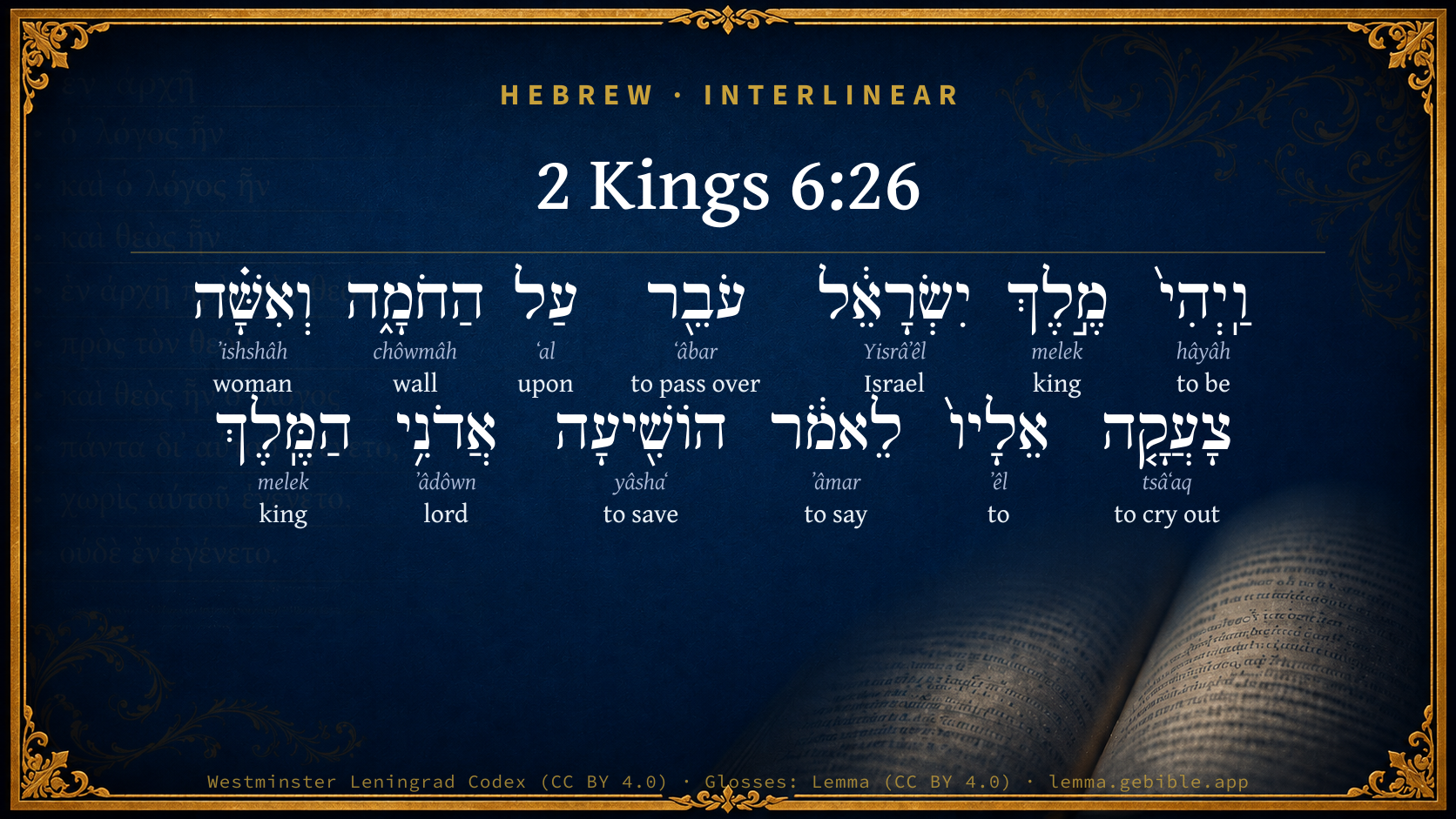
Hebrew (Westminster Leningrad Codex) 2 Kings 6:26 appears in the Hebrew Old Testament. The text above is from the Westminster Leningrad Codex. Each word links to its Strong’s number, a concise gloss, and parsing drawn from the Open Scriptures Hebrew Bible morphology. Click any word for its full Brown-Driver-Briggs (BDB) entry.
Download image
Cite this verse

2 Kings 6:26 (World English Bible). Public Domain. Lemma interlinear Bible study tool, https://lemma.gebible.app/v/2-kings/6/26.

Show BibTeX & RIS
BibTeX
RIS
English Translation
As the king of Israel was passing by on the wall, there cried a woman to him, saying, Help, my lord, O king.
World English Bible · Public Domain
Download a study sheet

One document with this verse’s original text, its word-by-word gloss line, the meaning frame, cross-references with their text, attributed commentary, and full source and license credits — printable, and it pastes into notes with its structure intact.

This verse Autodidact and up

Study sheet (.html) Plain text (.txt)

A passage Seminary Student

Up to 50 verses in one chapter. A passage sheet keeps up to 6 commentary sources and 12 cross-references per verse, in the order this page ranks them, and says so on the sheet whenever that leaves anything out. Ask for a single verse and you get the Autodidact verse sheet above.

Everything on this page stays free to read, with no account — the sheet is a download of what is already on screen, not access to it.

Want to remove ads? Support Godless Engineer
Compare translations 3

The same verse in 3 English versions, stacked beneath the original-language interlinear above. Click any original word for its lexicon entry.

Each is an independent rendering of the whole verse — the interlinear is not word-aligned to these translations.

Highlighted words mark where these versions differ — a whole-verse word diff, not a word-by-word alignment.

  • World English Bible Public Domain
    As the king of Israel was passing by on the wall, there cried a woman to him, saying, Help, my lord, O king.
  • King James Version Public Domain
    And as the king of Israel was passing by upon the wall, there cried a woman unto him, saying, Help, my lord, O king.
  • unfoldingWord Literal Text CC BY-SA 4.0
    And it happened, the king of Israel was passing by on the wall, and a woman cried out to him, saying, “Save, my lord the king!”

unfoldingWord Literal Text — © unfoldingWord, licensed CC BY-SA 4.0. Word-aligned USFM3 via Door43 (git.door43.org/unfoldingWord/en_ult).

Versions to compare (up to 4)

3 of 4 selected

Show all 18 translations

Every available English version of this verse, each an independent rendering of the whole verse.

  • World English Bible Public Domain
    As the king of Israel was passing by on the wall, there cried a woman to him, saying, Help, my lord, O king.
  • Berean Standard Bible Public Domain
    As the king of Israel was passing by on the wall, a woman cried out to him, “Help me, my lord the king!”
  • Majority Standard Bible Public Domain
    As the king of Israel was passing by on the wall, a woman cried out to him, “Help me, my lord the king!”
  • King James Version Public Domain
    And as the king of Israel was passing by upon the wall, there cried a woman unto him, saying, Help, my lord, O king.
  • American Standard Version (1901) Public Domain
    And as the king of Israel was passing by upon the wall, there cried a woman unto him, saying, Help, my lord, O king.
  • Revised Version (1885) Public Domain
    And as the king of Israel was passing by upon the wall, there cried a woman unto him, saying, Help, my lord, O king.
  • Geneva Bible (1599) Public Domain
    And as the King of Israel was going vpon the wall, there cryed a woman vnto him, saying, Helpe, my lord, O King.
  • Douay-Rheims (1899) Public Domain
    And as the king of Israel was passing by the wall, a certain woman cried out to him, saying: Save me, my lord O king.
  • Young's Literal Translation Public Domain
    And it cometh to pass, the king of Israel is passing by on the wall, and a woman hath cried unto him, saying, `Save, my lord, O king.'
  • Literal Standard Version CC BY-SA 4.0
    And it comes to pass, the king of Israel is passing by on the wall, and a woman has cried to him, saying, “Save, my lord, O king.”
  • Unlocked Literal Bible CC BY-SA 4.0
    As the king of Israel was passing by on the wall, a woman cried to him, saying, “Help, my master, king.”
  • unfoldingWord Literal Text CC BY-SA 4.0
    And it happened, the king of Israel was passing by on the wall, and a woman cried out to him, saying, “Save, my lord the king!”
  • Darby Bible Public Domain
    And it came to pass as the king of Israel was passing by upon the wall, there cried a woman to him saying, Help, my lord O king!
  • World Messianic Bible Public Domain
    As the king of Israel was passing by on the wall, a woman cried to him, saying, “Help, my lord, O king!”
  • Webster's Bible Public Domain
    And as the king of Israel was passing by upon the wall, there cried a woman to him, saying, Help, my lord, O king.
  • Free Bible Version CC BY-SA 4.0
    As the king of Israel was walking by on the city wall, a woman called out to him, “Help me, my lord the king!”
  • Bible in Basic English Public Domain
    And when the king of Israel was going by on the wall, a woman came crying out to him, and said, Help! my lord king.
  • JPS Tanakh (1917) Public Domain
    And as the king of Israel was passing by upon the wall, there cried a woman unto him, saying: 'Help, my lord, O king.'

Literal Standard Version (2020), Covenant Press — licensed CC BY-SA 4.0. Text via the HelloAO Bible API (eBible.org). Unlocked Literal Bible (unfoldingWord) — licensed CC BY-SA 4.0. Text via the HelloAO Bible API (eBible.org). unfoldingWord Literal Text — © unfoldingWord, licensed CC BY-SA 4.0. Word-aligned USFM3 via Door43 (git.door43.org/unfoldingWord/en_ult). Free Bible Version, Dr. Jonathan Gallagher — licensed CC BY-SA 4.0. Text via the HelloAO Bible API (eBible.org).

Word by word

More ways to search: Search by grammar → Find every occurrence → Compare this word →

Practice this passage: Drill this verse → Learn its vocabulary →

צָעֲקָ֤ה
tsâʻaq
H6817
“to cry out”
Verb, Qal, Perfect, 3rd Person, Feminine, Singular
Part of Speech
Verb
Stem
Qal
Form
Perfect
Person
3rd Person
Gender
Feminine
Number
Singular
Full BDB Definition

Origin: a primitive root

TWOT: 1947

to cry, cry out, call, cry for help - (Qal) - to cry, cry out (for help) - to cry, cry out (in distress or need) - to make outcry, clamour - (Niphal) to be summoned - (Piel) to cry aloud (in grief) - (Hiphil) to call together
  1. וַֽיְהִי֙ hâyâh H1961 “and · to be” Conjunction + Verb, Qal, Sequential Imperfect, 3rd Person, Masculine, Singular
  2. מֶ֣לֶךְ melek H4428 “king of” Noun, Common, Masculine, Singular, Construct
  3. יִשְׂרָאֵ֔ל Yisrâʼêl H3478 “Israel” Noun, Proper
  4. עֹבֵ֖ר ʻâbar H5674 “passing over” Verb, Qal, Participle Active, Masculine, Singular, Absolute
  5. עַל ʻal H5921 “upon” Preposition
  6. הַחֹמָ֑ה chôwmâh H2346 “the · wall” Particle, Definite Article + Noun, Common, Feminine, Singular, Absolute
  7. וְאִשָּׁ֗ה ʼishshâh H802 “and · woman” Conjunction + Noun, Common, Feminine, Singular, Absolute
  8. אֵלָיו֙ ʼêl H413 “to · him” Preposition + Suffix, Personal, 3rd Person, Masculine, Singular
  9. לֵאמֹ֔ר ʼâmar H559 “to say” Preposition + Verb, Qal, Infinitive Construct
  10. הוֹשִׁ֖יעָה yâshaʻ H3467 “save” Verb, Hiphil, Imperative, 2nd Person, Masculine, Singular + Suffix, h
  11. אֲדֹנִ֥י ʼâdôwn H113 “lord · my” Noun, Common, Masculine, Singular, Construct + Suffix, Personal, 1st Person, Common, Singular
  12. הַמֶּֽלֶךְ melek H4428 “the · king” Particle, Definite Article + Noun, Common, Masculine, Singular, Absolute

About this verse

These counts appear in no published source. They are computed here, from the morphology-tagged text and Lemma’s own curated glosses. What Lemma adds →

13
words
12
distinct lemmas
Historical
section

Shared distinctive vocabulary

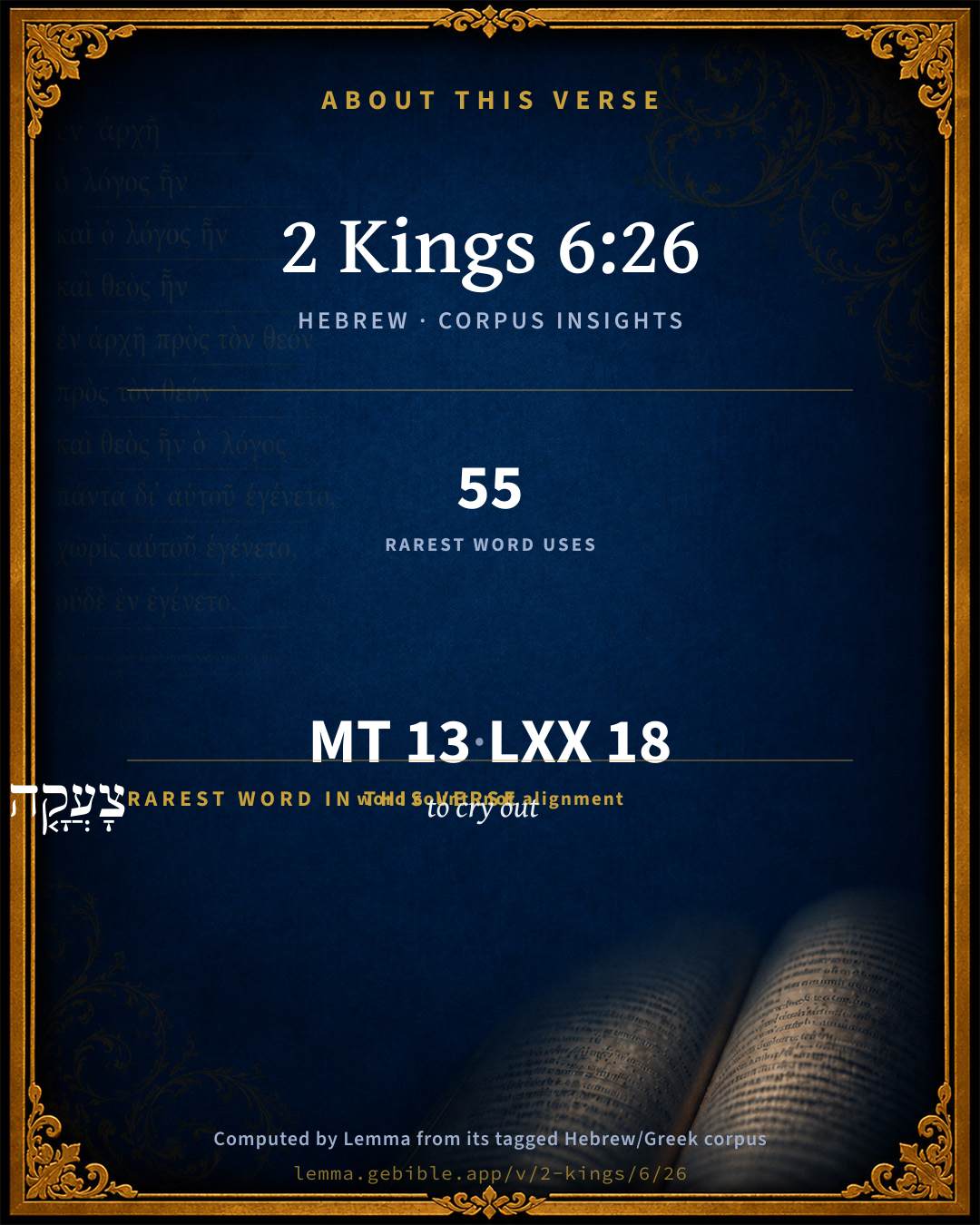
צָעֲקָ֤ה to cry out H6817 occurs in 53 verses of the Hebrew Bible. Also found in:

Grammatical profile

  • 5 verbs
  • 6 nouns
  • 2 prepositions

Verb forms

  • וַֽיְהִי֙ Qal · Sequential Imperfect
  • עֹבֵ֖ר Qal · Participle Active
  • צָעֲקָ֤ה Qal · Perfect
  • לֵאמֹ֔ר Qal · Infinitive Construct
  • הוֹשִׁ֖יעָה Hiphil · Imperative

Repetition

A word recurs within this verse — often emphatic in Hebrew:

  • מֶ֣לֶךְ king H4428 ×2

Hebrew & Septuagint length

In English translation the verse runs 23 words from the Hebrew and 23 from the Septuagint (LXX English) — the same length.

A rough comparison of the two English renderings, which tokenize alike — not a word-level alignment.

Word counts can differ between the Hebrew and the Greek without any difference in meaning — e.g. the Hebrew direct-object marker אֵת has no separate Greek word, and Greek often adds the article ὁ.

In the original languages it is 13 Hebrew tokens and 18 Greek tokens — but the two are counted differently (Hebrew bundles its prefixes and suffixes into one token; the Greek is in lemma form), so that isn’t a like-for-like length.

Cross-references

4

Topical passages linked to 2 Kings 6:26 in the Treasury of Scripture Knowledge — connected by theme and wording, ordered by reader-vote popularity; previews shown in the World English Bible.

  • 2 Samuel 14:4 When the woman of Tekoa spoke to the king, she fell on her face to the ground, and did obeisance, and said, Help, O king.
  • Isaiah 10:3 What will you do in the day of visitation, and in the desolation which shall come from far? to whom will you flee for help? and where will you leave your glory?
  • Luke 18:3 A widow was in that city, and she often came to him, saying, 'Defend me from my adversary!'
  • Acts 21:28 crying out, "Men of Israel, help! This is the man who teaches all men everywhere against the people, and the law, and this place. Moreover, he also brought Greeks into the temple, and has defiled this holy place!"

Cross-references courtesy of OpenBible.info (CC BY 4.0).

Hebrew and Greek witnesses Masoretic Hebrew ↔ Greek Septuagint

The same verse in the two great witnesses to the Old Testament, shown verse-for-verse.

These are two independent witnesses, not word-aligned to each other, and the Septuagint is shown in lemma (dictionary) form.

Hebrew 2 Kings 6:26 Masoretic · Westminster Leningrad Codex

וַֽיְהִי֙ מֶ֣לֶךְ יִשְׂרָאֵ֔ל עֹבֵ֖ר עַל הַחֹמָ֑ה וְאִשָּׁ֗ה צָעֲקָ֤ה אֵלָיו֙ לֵאמֹ֔ר הוֹשִׁ֖יעָה אֲדֹנִ֥י הַמֶּֽלֶךְ

As the king of Israel was passing by on the wall, there cried a woman to him, saying, Help, my lord, O king.

World English Bible · Public Domain

Greek LXX 2 Kings 6:26 Septuagint · lemma form

καί εἰμί ὁ βασιλεύς ἰσραήλ διαπορεύομαι ἐπί ὁ τεῖχος καί γυνή βοάω πρός αὐτός λέγω σώζω κύριος βασιλεύς

And the king of Israel was passing by on the wall, and a woman cried to him, saying, Help, my lord, O king.

LXX2012 (modern English Septuagint) · Public Domain

Hebrew: Westminster Leningrad Codex (CC BY 4.0). Greek: Septuagint (public domain); English from LXX2012 (modern English Septuagint) (Public Domain). How the Septuagint differs from the Hebrew →

Targum (Aramaic paraphrase)

1

The Targum is the ancient Jewish Aramaic paraphrase of the Hebrew Scriptures — an interpretive translation, not the Hebrew text itself. Onkelos (literal) and Pseudo-Jonathan (expansive) render the Torah, and Jonathan the Prophets. Coverage is partial: where no permissively-licensed English translation exists for a verse, only the Aramaic is shown. This is verse-level text, not a word-by-word alignment to the Hebrew.

  1. Targum Jonathan Prophets (Joshua–Malachi)
    וַהֲוָה מַלְכָּא דְיִשְׂרָאֵל עֲבַר עַל שׁוּרָא וְאִתְּתָא קַבְלָא קֳדָמוֹהִי לְמֵימַר פְּרֵיק רִבּוֹנִי מַלְכָּא:

    (no public-domain English translation for this verse)

    Targum Jonathan — Aramaic: “Mikraot Gedolot” (public domain). English: “Sefaria Community Translation” (CC0 1.0 (public-domain dedication)); “London "Chaldee Paraphrase," 1871” (public domain). Text via Sefaria.

Commentary

Notes on 2 Kings 6:26 from classic Christian and Jewish commentators (each source and its license shown beneath its notes). The classic Christian expositions comment on the surrounding passage and are grouped to its opening verse, so a note may address several verses; the Jewish commentaries on the Tanakh (Rashi and others) are per-verse, so they appear only where the commentator wrote on this verse.

Lemma curates 59 commentaries, every one of them public domain or Creative Commons licensed, each selected and text-cleaned for this edition rather than reprinted as found. About our sources →

Trapp's Complete Commentary

John Trapp

2Ki 6:26 And as the king of Israel was passing by upon the wall, there cried a woman unto him, saying, Help, my lord, O king.

Ver. 26. Passing by.] To see all things well carried.

John Trapp, A Commentary or Exposition upon All the Books of the Old and New Testament (1647–1656) — public domain. Text from a community e-Sword module.

Joseph Benson's Commentary

2Ki 6:26-27. The king of Israel was passing on the wall — To give necessary directions for the defence of the city against assault; to see if the several guards were watchful and diligent, and if his orders were executed, and to observe the motions of the enemy. There cried a woman unto him, Help, my lord, O king — For whither should the subject, in distress, go for help, but to the prince, who is by office the protector of right, and the avenger of wrong? He said, If the Lord do not help thee, whence shall I help thee? — Dost thou ask of me corn or wine, which I want for myself? If God do not help thee, I cannot. Or his words may be considered as the language of passion or desperation, and rendered, The Lord will not, and I cannot help thee.

Joseph Benson's Commentary on the Old and New Testaments (1811–1818) — public domain. Text from a community e-Sword module.

Tyndale Open Study Notes

Tyndale Open Resources

6:26-29 Cannibalism under severe conditions was part of God’s curse for unfaithfulness and disobedience (Deut 28:53, 57). It also occurred during the siege that brought about the fall of Jerusalem (Lam 4:9-10).

Tyndale Open Study Notes — © Tyndale Open Resources, licensed CC BY-SA 4.0. Text via the HelloAO Bible API.

Jamieson, Fausset & Brown

Robert Jamieson, A. R. Fausset & David Brown

as the king was passing--to look at the defenses, or to give some necessary orders for manning the walls.

Jamieson, Fausset & Brown — Commentary Critical and Explanatory on the Whole Bible (1871) — public domain (CC PDM 1.0). Text via the HelloAO Bible API.

Ellicott's Commentary for English Readers

(26) The king . . . was passing by upon the wall.—On the broad rampart of the city, which was like that which we see at such old places as Chester. The king went round to encourage the garrison and to superintend the defence. A woman in the street below, or perhaps on a housetop near the rampart, appeals to him for justice against her neighbour.

A Bible Commentary for English Readers, edited by Charles John Ellicott (1878–1897) — public domain. Text from a community e-Sword module.

The Cambridge Bible for Schools and Colleges

gen. ed. J. J. S. Perowne

26. the king of Israel was passing by upon the wall] Making the necessary rounds to see that the watch was kept up, and everything done that could be done for the security of the city. Josephus says he was afraid lest some one should let in the enemy. The wall must have been furnished with a breast-work so that the inhabitants could pass along without being in much danger, and it would be open on the inner side. Hence any one within could see and speak to those who were passing along, as this woman did. In some cases dwelling-houses were built into the wall, and must have had a passage through them.

The Cambridge Bible for Schools and Colleges (gen. ed. J. J. S. Perowne; Cambridge University Press, 1878–1918) — public domain. Text from a community e-Sword module.

John Gill's Exposition

And the king said unto her, what aileth thee?.... His passion subsiding, or pitying her as in distress, and supposing that there might be something particular and pressing in her case:

and she answered:

this woman said unto me; who was now with her, and to whom she pointed:

give thy son, that we may eat him today, and we will eat my son tomorrow; and this was agreed to between them, that first one should be eaten, and then the other, and that they should feed upon one as long as it would last, and then on the other; for it is not to be limited precisely to a day and tomorrow.

John Gill's Exposition of the Whole Bible (1746–1763) — public domain (CC PDM 1.0). Text via the HelloAO Bible API.

Albert Barnes' Notes on the Bible

The walls of fortified towns had a broad space at the top, protected toward the exterior by battlements, along which the bulk of the defenders were disposed, and from which they hurled their missiles and shot their arrows. The king seems to have been going his rounds, to inspect the state of the garrison and the defenses.

Albert Barnes' Notes on the Bible (1834–1885) — public domain. Text from a community e-Sword/MySword module.

Matthew Poole's English Annotations

Passing by upon the wall, to give necessary order for the defence of the city against assaults, and to see if the several guards were watchful and diligent, and if his directions were executed, and to observe the motions of the enemy.

Matthew Poole's English Annotations on the Holy Bible (1683–1685) — public domain. Text from a community e-Sword/MySword module.

The Pulpit Commentary

And as the King of Israel was passing by upon the wall. The wall of Babylon is said to have been so broad at the top that a four-horse chariot could turn round on it (Herod., 1:179). All ancient cities had walls upon which a great part of the garrison stood, and from which they shot their arrows and worked their engines against the assailants. From time to time the commandant of the place the king himself, in this instance would mount upon the wall to visit the posts, and inspect the state of the garrison, or observe the movements of the enemy. There cried a woman unto him. Houses sometimes abutted on the wall of a town (see Jos_2:15; 1Sa_19:12, etc.) and women sometimes took part in their defense, (Jud_1:9:53) so that in visiting the posts acommandant might be brought into contact with women. Saying, Help, my lord, O king; rather, save, i.e. "preserve me from perishing of hunger."

The Pulpit Commentary (1880–1919), ed. H.D.M. Spence-Jones & Joseph S. Exell — public domain. Text from a community e-Sword module.

Rashi

Rabbi Shlomo Yitzchaki (Rashi)

“Save me, my master, the king!” He thought that she was asking for food.

Rashi on the Tanakh — English translations: “The Judaica Press complete Tanach with Rashi, translated by A. J. Rosenberg” (CC BY 4.0); “Pentateuch with Rashi's commentary by M. Rosenbaum and A.M. Silbermann, 1929-1934” (public domain); “The Metsudah Tanach series, Lakewood, N.J” (CC BY 4.0); and “The Book of Joshua, Metsudah Publications, 1997” (CC BY 4.0). Text via Sefaria.

Lesson kit

Teaching starters — assembled from the data on this page, not authored interpretation. Every prompt links to the verse data it draws on. Edit before teaching.

2 Kings, in the Historical, opens this verse with 13 words (12 distinct Hebrew lemmas). Its most distinctive word is tsâʻaq (“to cry out”). A historical commentator’s framing appears above. Read the whole chapter for the surrounding context.

Discussion questions

  1. What does “to cry out” (tsâʻaq) contribute to the verse as a whole?
  2. Genesis 4:10 shares the word «to cry out» with this verse. How do the two illuminate each other?
  3. “king” occurs 2× in this one verse. What is the effect of the repetition?
  4. The translations on this page render this verse differently — a whole-verse word diff, not a word-by-word alignment. What might account for the different wordings?
  5. The verb «וַֽיְהִי֙» is Qal Sequential Imperfect. How does its form color the action?
  6. Reading how Trapp's Complete Commentary and Joseph Benson's Commentary read this verse, where do the two commentators agree and where do they part?

Things to notice

Reading settings

Reading text

Shown beneath each verse's original-language words.

Old Testament
Old Testament edition

Read the OT as the Masoretic Hebrew (MT) or the Greek Septuagint (LXX).

English shown for the Greek Septuagint (in the Hebrew ↔ Greek comparison).

Comparing translations? Open the Compare panel on any verse page to stack up to four side by side.