Jeremiah 33:16

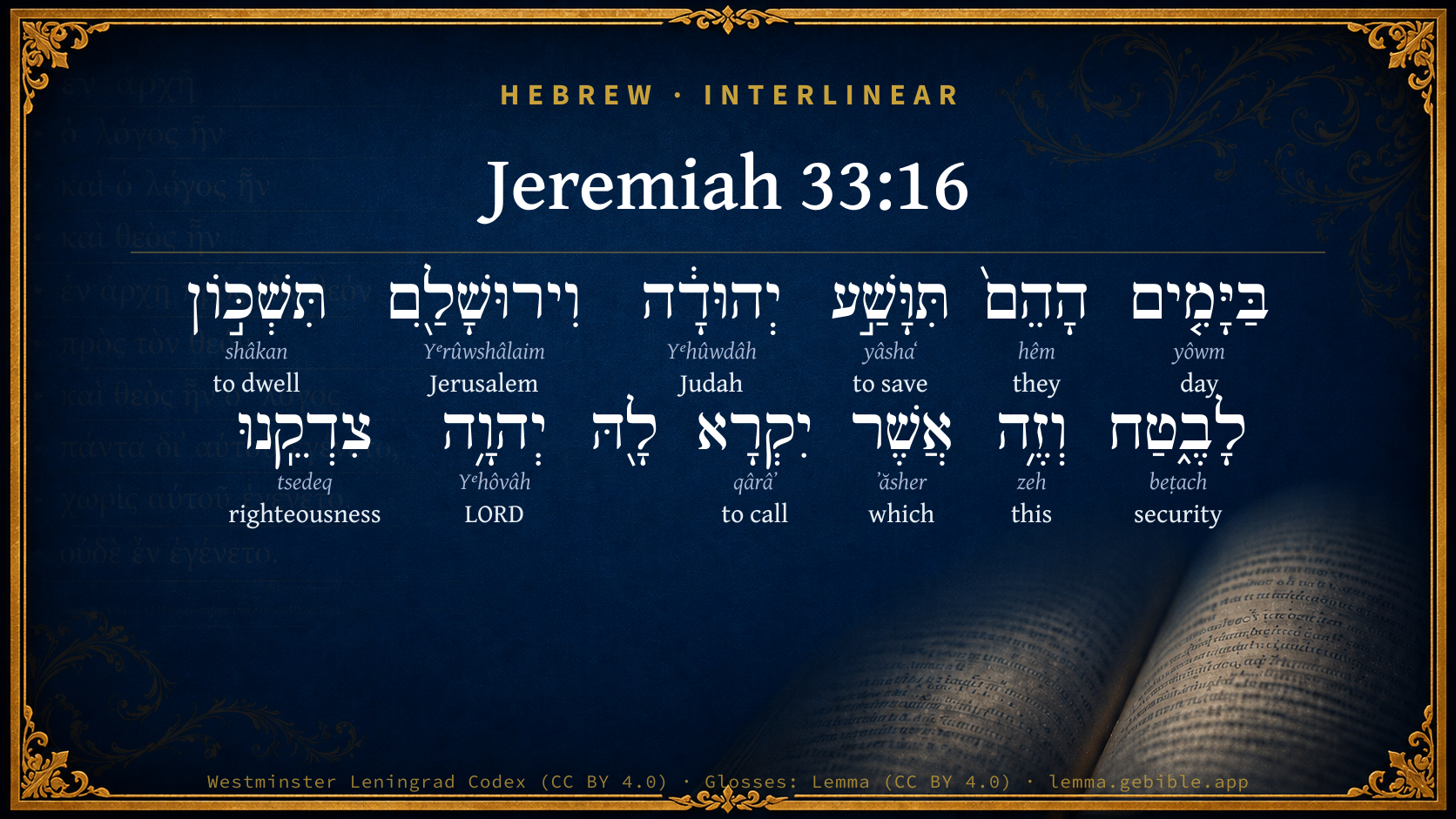
Hebrew (Westminster Leningrad Codex) Jeremiah 33:16 appears in the Hebrew Old Testament. The text above is from the Westminster Leningrad Codex. Each word links to its Strong’s number, a concise gloss, and parsing drawn from the Open Scriptures Hebrew Bible morphology. Click any word for its full Brown-Driver-Briggs (BDB) entry.
Download image
Cite this verse

Jeremiah 33:16 (World English Bible). Public Domain. Lemma interlinear Bible study tool, https://lemma.gebible.app/v/jeremiah/33/16.

Show BibTeX & RIS
BibTeX
RIS
English Translation
In those days shall Judah be saved, and Jerusalem shall dwell safely; and this is [the name] by which she shall be called: Yahweh our righteousness.
World English Bible · Public Domain
Download a study sheet

One document with this verse’s original text, its word-by-word gloss line, the meaning frame, cross-references with their text, attributed commentary, and full source and license credits — printable, and it pastes into notes with its structure intact.

This verse Autodidact and up

Study sheet (.html) Plain text (.txt)

A passage Seminary Student

Up to 50 verses in one chapter. A passage sheet keeps up to 6 commentary sources and 12 cross-references per verse, in the order this page ranks them, and says so on the sheet whenever that leaves anything out. Ask for a single verse and you get the Autodidact verse sheet above.

Everything on this page stays free to read, with no account — the sheet is a download of what is already on screen, not access to it.

Want to remove ads? Support Godless Engineer
Compare translations 3

The same verse in 3 English versions, stacked beneath the original-language interlinear above. Click any original word for its lexicon entry.

Each is an independent rendering of the whole verse — the interlinear is not word-aligned to these translations.

Highlighted words mark where these versions differ — a whole-verse word diff, not a word-by-word alignment.

  • World English Bible Public Domain
    In those days shall Judah be saved, and Jerusalem shall dwell safely; and this is [the name] by which she shall be called: Yahweh our righteousness.
  • King James Version Public Domain
    In those days shall Judah be saved, and Jerusalem shall dwell safely: and this is the name wherewith she shall be called, The LORD our righteousness.
  • unfoldingWord Literal Text CC BY-SA 4.0
    In those days Judah will be saved, and Jerusalem will live in security, for this is what she will be called, “Yahweh is our righteousness.”’

unfoldingWord Literal Text — © unfoldingWord, licensed CC BY-SA 4.0. Word-aligned USFM3 via Door43 (git.door43.org/unfoldingWord/en_ult).

Versions to compare (up to 4)

3 of 4 selected

Show all 18 translations

Every available English version of this verse, each an independent rendering of the whole verse.

  • World English Bible Public Domain
    In those days shall Judah be saved, and Jerusalem shall dwell safely; and this is [the name] by which she shall be called: Yahweh our righteousness.
  • Berean Standard Bible Public Domain
    In those days Judah will be saved, and Jerusalem will dwell securely, and this is the name by which it will be called: The LORD Our Righteousness.
  • Majority Standard Bible Public Domain
    In those days Judah will be saved, and Jerusalem will dwell securely, and this is the name by which it will be called: The LORD Our Righteousness.
  • King James Version Public Domain
    In those days shall Judah be saved, and Jerusalem shall dwell safely: and this is the name wherewith she shall be called, The LORD our righteousness.
  • American Standard Version (1901) Public Domain
    In those days shall Judah be saved, and Jerusalem shall dwell safely; and this is `the name' whereby she shall be called: Jehovah our righteousness.
  • Revised Version (1885) Public Domain
    In those days shall Judah be saved, and Jerusalem shall dwell safely: and this is the name whereby she shall be called, The LORD is our righteousness.
  • Geneva Bible (1599) Public Domain
    In those dayes shall Iudah be saued, and Ierusalem shall dwell safely, and hee that shall call her, is the Lord our righteousnesse.
  • Douay-Rheims (1899) Public Domain
    In those days shall Juda be saved, and Jerusalem shall dwell securely: and this is the name that they shall call him, The Lord our just one.
  • Young's Literal Translation Public Domain
    In those days is Judah saved, And Jerusalem doth dwell confidently, And this `is' he whom Jehovah proclaimeth to her: `Our Righteousness.'
  • Literal Standard Version CC BY-SA 4.0
    In those days Judah is saved, || And Jerusalem dwells confidently, || And this [is] what she is called: YHWH [is] Our Righteousness.”
  • Unlocked Literal Bible CC BY-SA 4.0
    In those days Judah will be saved, and Jerusalem will live in security, for this is what she will be called, “Yahweh is our righteousness.”'
  • unfoldingWord Literal Text CC BY-SA 4.0
    In those days Judah will be saved, and Jerusalem will live in security, for this is what she will be called, “Yahweh is our righteousness.”’
  • Darby Bible Public Domain
    In those days shall Judah be saved, and Jerusalem shall dwell in safety. And this is the name wherewith she shall be called: Jehovah our Righteousness.
  • World Messianic Bible Public Domain
    In those days Judah will be saved, and Jerusalem will dwell safely. This is the name by which she will be called: The LORD our righteousness.”
  • Webster's Bible Public Domain
    In those days shall Judah be saved, and Jerusalem shall dwell in safety: and this is the name by which she shall be called, JEHOVAH our righteousness.
  • Free Bible Version CC BY-SA 4.0
    This is when Judah will be saved, and the people of Jerusalem will live in safety. This is the name he will be called: The Lord Who Makes Us Right.
  • Bible in Basic English Public Domain
    In those days, Judah will have salvation and Jerusalem will be safe: and this is the name which will be given to her: The Lord is our righteousness.
  • JPS Tanakh (1917) Public Domain
    In those days shall Judah be saved, and Jerusalem shall dwell safely; and this is the name whereby she shall be called, the LORD is our righteousness.

Literal Standard Version (2020), Covenant Press — licensed CC BY-SA 4.0. Text via the HelloAO Bible API (eBible.org). Unlocked Literal Bible (unfoldingWord) — licensed CC BY-SA 4.0. Text via the HelloAO Bible API (eBible.org). unfoldingWord Literal Text — © unfoldingWord, licensed CC BY-SA 4.0. Word-aligned USFM3 via Door43 (git.door43.org/unfoldingWord/en_ult). Free Bible Version, Dr. Jonathan Gallagher — licensed CC BY-SA 4.0. Text via the HelloAO Bible API (eBible.org).

Word by word

More ways to search: Search by grammar → Find every occurrence → Compare this word →

Practice this passage: Drill this verse → Learn its vocabulary →

לָבֶ֑טַח
beṭach
H983
“to/for · security”
Preposition + Noun, Common, Masculine, Singular, Absolute
Part of Speech
Preposition + Noun
Type
Common
Gender
Masculine
Number
Singular
State
Absolute
Full BDB Definition

Origin: from H982

TWOT: 233a

security, safety - securely
  1. בַּיָּמִ֤ים yôwm H3117 “in/at the · days” Preposition, Determined + Noun, Common, Masculine, Plural, Absolute
  2. הָהֵם֙ hêm H1992 “the · they” Particle, Definite Article + Pronoun, Personal, 3rd Person, Masculine, Plural
  3. תִּוָּשַׁ֣ע yâshaʻ H3467 “to save” Verb, Niphal, Imperfect, 3rd Person, Feminine, Singular
  4. יְהוּדָ֔ה Yᵉhûwdâh H3063 “Judah” Noun, Proper
  5. וִירוּשָׁלִַ֖ם Yᵉrûwshâlaim H3389 “and · Jerusalem” Conjunction + Noun, Proper
  6. תִּשְׁכּ֣וֹן shâkan H7931 “to dwell” Verb, Qal, Imperfect, 3rd Person, Feminine, Singular
  7. וְזֶ֥ה zeh H2088 “and · this” Conjunction + Pronoun, Demonstrative, Masculine, Singular
  8. אֲשֶׁר ʼăsher H834 “which” Particle, Relative
  9. יִקְרָא qârâʼ H7121 “to call” Verb, Qal, Imperfect, 3rd Person, Masculine, Singular
  10. יְהוָ֥ה Yᵉhôvâh H3068 “LORD” Noun, Proper
  11. צִדְקֵֽנוּ tsedeq H6664 “righteousness · our” Noun, Common, Masculine, Singular, Construct + Suffix, Personal, 1st Person, Common, Plural

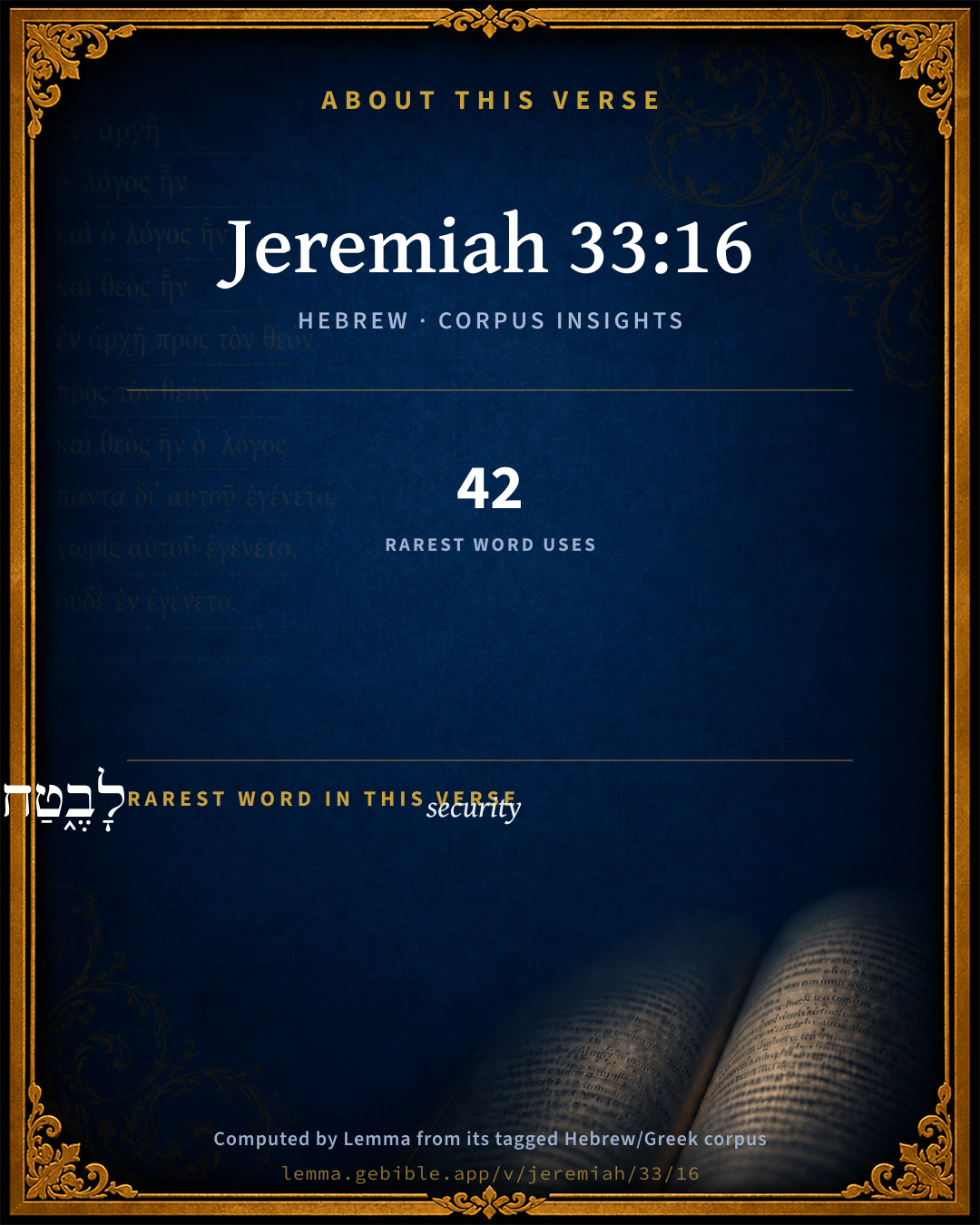
About this verse

These counts appear in no published source. They are computed here, from the morphology-tagged text and Lemma’s own curated glosses. What Lemma adds →

13
words
12
distinct lemmas
Prophets
section

Shared distinctive vocabulary

לָבֶ֑טַח security H983 occurs in 41 verses of the Hebrew Bible. Also found in:

Grammatical profile

  • 3 verbs
  • 6 nouns
  • 2 pronouns
  • 1 preposition
  • 1 particle

Verb forms

  • תִּוָּשַׁ֣ע Niphal · Imperfect
  • תִּשְׁכּ֣וֹן Qal · Imperfect
  • יִקְרָא Qal · Imperfect

Cross-references

15

Topical passages linked to Jeremiah 33:16 in the Treasury of Scripture Knowledge — connected by theme and wording, ordered by reader-vote popularity; previews shown in the World English Bible.

  • Jeremiah 23:6 In his days Judah shall be saved, and Israel shall dwell safely; and this is his name by which he shall be called: Yahweh our righteousness.
  • 1 Corinthians 1:30 But of him, you are in Christ Jesus, who was made to us wisdom from God, and righteousness and sanctification, and redemption:
  • Isaiah 45:17 [But] Israel shall be saved by Yahweh with an everlasting salvation: you shall not be disappointed nor confounded world without end.
  • 2 Corinthians 5:21 For him who knew no sin he made to be sin on our behalf; so that in him we might become the righteousness of God.
  • Philippians 3:9 and be found in him, not having a righteousness of my own, that which is of the law, but that which is through faith in Christ, the righteousness which is from God by faith;
  • Romans 11:26 and so all Israel will be saved. Even as it is written, "There will come out of Zion the Deliverer, And he will turn away ungodliness from Jacob.
  • Isaiah 45:22 Look to me, and be you saved, all the ends of the earth; for I am God, and there is none else.
  • Isaiah 45:24–25 Only in Yahweh, it is said of me, is righteousness and strength; even to him shall men come; and all those who were incensed against him shall be disappointed.
  • 2 Peter 1:1 Simon Peter, a servant and apostle of Jesus Christ, to those who have obtained a like precious faith with us in the righteousness of our God and Savior, Jesus Christ:
  • Deuteronomy 33:12 Of Benjamin he said, The beloved of Yahweh shall dwell in safety by him; He covers him all the day long, He dwells between his shoulders.
  • Deuteronomy 33:28 Israel dwells in safety, The fountain of Jacob alone, In a land of grain and new wine; Yes, his heavens drop down dew.
  • Jeremiah 32:37 Behold, I will gather them out of all the countries, where I have driven them in my anger, and in my wrath, and in great indignation; and I will bring them again to this place, and I will cause them to dwell safely:
  • Ezekiel 28:26 They shall dwell securely therein; yes, they shall build houses, and plant vineyards, and shall dwell securely, when I have executed judgments on all those who do them despite round about them; and they shall know that I am Yahweh their God.
  • Ezekiel 34:25–28 I will make with them a covenant of peace, and will cause evil animals to cease out of the land; and they shall dwell securely in the wilderness, and sleep in the woods.
  • Ezekiel 38:8 After many days you shall be visited: in the latter years you shall come into the land that is brought back from the sword, that is gathered out of many peoples, on the mountains of Israel, which have been a continual waste; but it is brought forth out of the peoples, and they shall dwell securely, all of them.

Cross-references courtesy of OpenBible.info (CC BY 4.0).

Hebrew and Greek witnesses Masoretic Hebrew ↔ Greek Septuagint

The same verse in the two great witnesses to the Old Testament, shown verse-for-verse.

These are two independent witnesses, not word-aligned to each other, and the Septuagint is shown in lemma (dictionary) form.

Hebrew Jeremiah 33:16 Masoretic · Westminster Leningrad Codex

בַּיָּמִ֤ים הָהֵם֙ תִּוָּשַׁ֣ע יְהוּדָ֔ה וִירוּשָׁלִַ֖ם תִּשְׁכּ֣וֹן לָבֶ֑טַח וְזֶ֥ה אֲשֶׁר יִקְרָא לָ֖הּ יְהוָ֥ה צִדְקֵֽנוּ

In those days shall Judah be saved, and Jerusalem shall dwell safely; and this is [the name] by which she shall be called: Yahweh our righteousness.

World English Bible · Public Domain

Greek LXX Structure differs

In the Septuagint, Jeremiah is about an eighth shorter than the Hebrew and arranges its material differently — the Oracles Against the Nations (Hebrew chapters 46–51) appear in the middle of the Greek book, after 25:13. Because the chapter and verse boundaries do not line up, a verse-for-verse comparison with the Hebrew is not shown.

A verse-for-verse comparison isn’t shown here because the chapters and verses don’t line up. Switch to the LXX edition with the MT / LXX toggle above to read the Greek directly.

On this verse, Haydock's Catholic Bible Commentary discusses the Septuagint’s reading. Read the note in Commentary ↓

Hebrew: Westminster Leningrad Codex (CC BY 4.0). Greek: Septuagint (public domain); English from a public-domain English Septuagint. How the Septuagint differs from the Hebrew →

Targum (Aramaic paraphrase)

1

The Targum is the ancient Jewish Aramaic paraphrase of the Hebrew Scriptures — an interpretive translation, not the Hebrew text itself. Onkelos (literal) and Pseudo-Jonathan (expansive) render the Torah, and Jonathan the Prophets. Coverage is partial: where no permissively-licensed English translation exists for a verse, only the Aramaic is shown. This is verse-level text, not a word-by-word alignment to the Hebrew.

  1. Targum Jonathan Prophets (Joshua–Malachi)
    בְּיוֹמַיָא הָאִינוּן יִתְפָּרְקָן דְבֵית יְהוּדָה וִירוּשְׁלֵם תִּשְׁרֵי לְרוֹחֲצָן וְדֵין שְׁמָהּ דִיהוֹן קָרָן לָהּ יִתְעַבְּדָן לָנָא זַכְוָן מִן קֳדָם יְיָ בְּגַוָהּ:

    (no public-domain English translation for this verse)

    Targum Jonathan — Aramaic: “Mikraot Gedolot” (public domain). English: “Sefaria Community Translation” (CC0 1.0 (public-domain dedication)); “London "Chaldee Paraphrase," 1871” (public domain). Text via Sefaria.

Commentary

Notes on Jeremiah 33:16 from classic Christian and Jewish commentators (each source and its license shown beneath its notes). The classic Christian expositions comment on the surrounding passage and are grouped to its opening verse, so a note may address several verses; the Jewish commentaries on the Tanakh (Rashi and others) are per-verse, so they appear only where the commentator wrote on this verse.

Lemma curates 59 commentaries, every one of them public domain or Creative Commons licensed, each selected and text-cleaned for this edition rather than reprinted as found. About our sources →

Trapp's Complete Commentary

John Trapp

Jer 33:16 In those days shall Judah be saved, and Jerusalem shall dwell safely: and this [is the name] wherewith she shall be called, The LORD our righteousness.

Ver. 16. And this is the name wherewith she shall be called, The Lord is our righteousness.] Heb., This is that he shall call her, Jehovah our righteousness; called the Church shall be by Christ’s own name, which is a very high honour, as being his spouse, and making up one mystical body with him. Hence she is called "Christ," {1Co 12:12} and "the fulness of him who filleth all in all." {Eph 1:23} See Jer 23:6, with Eze 48:35.

John Trapp, A Commentary or Exposition upon All the Books of the Old and New Testament (1647–1656) — public domain. Text from a community e-Sword module.

Tyndale Open Study Notes

Tyndale Open Resources

33:16 The Lord Is Our Righteousness: Hebrew Yahweh Tsidqenu; see 23:5-6, where this title is given to the Messiah. This name was a reversal of Zedekiah’s name (Tsidqiyyahu, “Righteous is the Lord”). Zedekiah did not live up to his name, but the Messiah would do so.

Tyndale Open Study Notes — © Tyndale Open Resources, licensed CC BY-SA 4.0. Text via the HelloAO Bible API.

Geneva Bible (1599)

Geneva Bible translators

To wit, Christ that shall call his Church.

That is, Christ is our Lord God, our righteousness, sanctification, and redemption, 1 Cor. 1:30.

Geneva Bible (1599) marginal notes — public domain. Text via Bolls.life.

Jamieson, Fausset & Brown

Robert Jamieson, A. R. Fausset & David Brown

Jerusalem--In Jer 23:6, instead of this, it is "Israel." "The name" in the Hebrew has here to be supplied from that passage; and for "he" (Messiah, the antitypical "Israel"), the antecedent there (Isa 49:3), we have "she" here, that is, Jerusalem. She is called by the same name as Messiah, "The Lord Our Righteousness," by virtue of the mystical oneness between her (as the literal representative of the spiritual Church) and her Lord and Husband. Thus, whatever belongs to the Head belongs also to the members (Eph 5:30, Eph 5:32). Hence, the Church is called "Christ" (Rom 16:7; Co1 12:12). The Church hereby professes to draw all her righteousness from Christ (Isa 45:24-25). It is for the sake of Jerusalem, literal and spiritual, that God the Father gives this name (Jehovah, Tsidkenu, "The Lord our Righteousness") to Christ.

Jamieson, Fausset & Brown — Commentary Critical and Explanatory on the Whole Bible (1871) — public domain (CC PDM 1.0). Text via the HelloAO Bible API.

Adam Clarke's Commentary

Verse 16. And this is the name wherewith she shall be called, The Lord our Righteousness.] See what has been said on Jer 23:6, (See Clarke on Jer 23:6,) which is generally supposed to be a strictly parallel passage: but they are very different, and I doubt whether they mean exactly the same thing. As to our translation here, it is ignorant, and almost impious; it says that Jerusalem, for that is the antecedent, shall be called The Lord our Righteousness. The pronoun לה lah, which is translated her, is the masculine affix, in the Chaldaic form, which frequently occurs; and Dr. Blayney translates, "And this is He whom Jehovah shall call our righteousness," or Justification. Perhaps there is a sense which these words will bear far more congenial to the scope of the place. I will give the original, as before: וזה אשר יקרא לה יהוה צדקנו vezeh asher yikra lah, Yehovah tsidkenu, "And this one who shall call to her is the Lord our Justification;" that is, the salvation of the Jews shall take place when Jesus Christ is proclaimed to them as their Justifier, and they receive him as such.

Instead of לה lah, her or him, Chaldaice, the Vulgate, Chaldee, and Syriac have read לו lo, him, less ambiguously; and this reading is supported by one or two MSS. This emendation renders the passage here more conformable to that in Jer 23:6; but if the translation above be admitted, all embarrassment is gone.

One of my own MSS. has לה loh, with the masculine points, and no mappik on the ה he; and for tsidkenu has צדקינו tsidkeynu, the contracted plural form, our righteousness: but this may be a mistake. The passages in this and the twenty-third chapter were not, I am satisfied, intended to express the same thing. I suppose that above refers to the preaching or proclaiming Christ crucified to the Jews, when the time shall arrive in which they shall be incorporated with the Gentile Church. Dahler translates this as he did that in Jer 23:6, which is a perfect oversight: but paraphrastic renderings are too often introduced by this learned foreigner.

Adam Clarke's Commentary on the Bible (1810–1826) — public domain. Text from a community e-Sword/MySword module.

John Calvin's Commentaries

Here the Prophet extends the benefits of the kingdom to all the Jews, and shews how much was to be expected fromthat kingdom which he had promised; for in it would be found perfect happiness and safety. Had not this been added, what we have heard of the righteous king would have appeared cold and uninteresting; for it sometimes happens, that however much the king may exercise justice and judgment, yet the people continue still miserable. But the Prophet testifies here that the people would be in every way blessed and happy, when governed by the King promised to come. Hence he says, In those days Judah shall be saved He promises salvation to the Jews, though under that name are included also, as it is often the case, the ten tribes. He adds Jerusalem, but in a similar sense, Jerusalem shall dwell safely, that is, shall be in a peaceable state. This mode of speaking is taken from Moses; for the Prophets, whenever they spoke of God’s blessings, are wont to borrow their doctrine from that fountain. He then says, that the people would be saved, and then that they would be in peace and quietness.

It may now be proper to repeat what I have already touched upon, — that the salvation mentioned here belongs to the kingdom of Christ. Had he been speaking of some earthly or temporal government, the salvation must also have been temporal. But as the spiritual and celestial kingdom of Christ is the object of the promise, the salvation mentioned must reach to the very heavens. Hence its limits are far wider than the whole world. In short, the salvation of which Jeremiah now prophesies, is not to be confined to the boundaries of a fading life, nor is it to be sought in this world, where it has no standing; but if we wish to know what it is, we must learn to raise our thoughts upwards, and above the world and everything that exists here. It is an eternal salvation. In the meantime, Christ gives us some foretaste of this salvation in this life, according to what is said,

“godliness has the promises of the present as well as of the future life.” (1 Timothy 4:8)

But as this promise ought to be applied to the kingdom of Christ, there is no doubt but it is perpetual, and ought to raise up our thoughts to heaven itself.

To salvation is added safety; for were the faithful ever to fear and tremble, where would be their salvation? And we know that the happiness brought to us by Christ cannot be otherwise received, except through peace, according to what Scripture so often teaches us:

“Having been justified,” says Paul, “we have peace with God.” (Romans 5:1.)

And then when he speaks in the fourteenth chapter of the same Epistle of the kingdom of God, he says that it consists in joy and peace; and in another place he says,

“May the peace of God, which surpasses all conception, obtain the victory in your hearts.” (Philippians 4:7)

Hence these things are connected together, salvation and peace, not that we enjoy this joyful and peaceful state in the world; for they greatly deceive themselves who dream of such a quiet state here, as we have to engage in a perpetual warfare, until God at length gathers us to the fruition of a blessed rest. We must, therefore, contend and fight in this world. Thus the faithful shall ever be exposed to many troubles; and hence Christ reminds his disciples, “In me ye have peace; but in theworld” — what? Sorrows and troubles. (John 16:33)

We now, then, see why the Prophet joined safety or security to salvation, even because we cannot otherwise know that we shall be saved, except we be fully persuaded that God so cares for our salvation as to protect us by his power, and that his aid will be always ready whenever needed.

He in the last place adds, And this is the name by which they shall call her, Jehovah our righteousness In chapter 23 (Jeremiah 23) this name is given to Christ, and to him alone it properly belongs; but it is here transferred to the Church, for whatever belongs to the head, is made common to all the members. For we indeed know that Christ has nothing as his own, for as he is made righteousness, it belongs to us, according to what Paul says,

“He is made to us righteousness, and redemption, and sanctification, and wisdom.” (1 Corinthians 1:30)

As, then, the Father conferred righteousness on his own Son for our sake, it is no wonder that what is in his power is transferred to us. What, then, we found in the twenty-third chapter was rightly declared, for it belongs peculiarly to Christ, that he is God our righteousness. But as we partake of this righteousness, when he admits us into a participation of all the blessings by which he is adorned and enriched by the Father, it hence follows, that this also belongs to the whole Church, even that God is its righteousness. Hence it is wisely said by the Prophet, that this would be the name of the whole Church, which could not be, except it had put on Christ, so that God might reign there in righteousness, for the righteousness of Christ extends to all the faithful; and Christ also dwells in them, so that they are not only the temples of Christ, but, as it were, a part of him; and even the Church itself is by Paul called Christ,

“As there are,” he says, “many members in the human body, so is Christ.” (1 Corinthians 12:12)

This cannot be applied to Christ personally, but he thus calls the Church by a metonymy, on account of that participation which I have mentioned.

John Calvin's Commentaries (1540-1563) — public domain. Text from the Calvin Translation Society English edition (1840s-50s) via the Christian Classics Ethereal Library (ccel.org). Calvin's coverage is partial (roughly two-thirds of the Bible); uncommented books and verses are honest gaps, never fabricated. The 19th-century editor's footnotes and remarks are omitted so the notes are faithfully Calvin's own voice.

Ellicott's Commentary for English Readers

(16) This is the name wherewith she shall be called, The Lord our righteousness.—It will be noticed that, while this reproduces the language of Jer_23:6, it does so with a remarkable difference. There the title, “The Lord our Righteousness,” is given to the future King, and the passage has accordingly been used as a proof of the full divinity of the Christ, who is that King. Here it is given to the city, and, so given, can only mean that that name will be, as it were, the motto and watchword of her being. She will be a city marked by a righteousness which will be the gift of Jehovah; He will inscribe that name on her banners, and. grave it on her portals. It is obvious that this throws light on the meaning of the title as applied to the King.

A Bible Commentary for English Readers, edited by Charles John Ellicott (1878–1897) — public domain. Text from a community e-Sword module.

John Gill's Exposition

In those days shall Judah be saved,.... The elect of God among the Jews; and all such who are Jews inwardly, who truly believe in Christ, and confess his name, and praise him, and give him the glory or salvation. Judah signifies one that confesses or praises the Lord; such shall be saved from sin, Satan, the law, wrath, hell, and damnation, by the Branch of righteousness, the Messiah; who was raised up and sent to be a Saviour; came into the world for this purpose; has obtained salvation for his people; is the Captain and author of it; nor is it in any other; hence his name is called Jesus; and this salvation is to be had from him at all times; as in those days in which it was first wrought out, so throughout the whole Gospel dispensation: for "now is the day of salvation", Co2 6:2; and indeed this is to be understood, not as exclusive of the Old Testament dispensation, when believers were saved by the same Lord Jesus as we are; only this is expressive of the impetration of this salvation by the incarnate Saviour; and of the more clear discovery and revelation of it; and of the application of it to a greater number of persons; and which is sure to all the spiritual seed of Christ, whether Jews or Gentiles, who "shall be saved" with an everlasting salvation: it is not said they "may" be saved, but they "shall" be saved; not may be saved if they will; or, however, this is not left on such a precarious footing; but they are made willing to be saved by Christ in the day of his power, yea, they are already saved:

and Jerusalem shall dwell safely; the inhabitants of it; such who are come to Mount Zion, the city of the living God, the heavenly Jerusalem; these being saved by Christ, are in the utmost safety; they have nothing to fear from the justice of God, that is satisfied; nor from the law, that is fulfilled; nor from their enemies, they are conquered and destroyed; God is pacified towards them; is the God of peace with them; and they have peace with him, and enjoy great serenity and tranquillity of mind; and must needs dwell safely, since Jehovah is around them as the mountains around Jerusalem; Christ is their strong hold, into which they run and are safe; the Holy Spirit within them is greater and mightier than their enemies in the world; angels encamp about them, and salvation is walls and bulwarks to them:

and this is the name wherewith she shall be called, the Lord our righteousness; the same with the Messiah's name, Jer 23:6; he is Jehovah; and he is our righteousness; the author of it, by his obedience, sufferings, and death; and which becomes ours by being wrought out for us, bestowed on us, imputed and applied to us. The Targum renders it here, as in the other place,

"this is the name wherewith they shall call him;''

and so the Vulgate Latin version; but this is contrary to the Hebrew text, which has "her", and not "him". R. Joseph Kimchi reads it, "and this who calls her is the Lord our righteousness"; which is followed by some Christian writers (y). Some interpret it, who calls her by his Gospel to the salvation promised and performed; others, who calls her to dwell safely; others render it, "this is the name with which he the Lord shall call him, for her", for the sake of the church, the Lord our righteousness (z); but David Kimchi and Ben Melech take the sense to be this,

"the holy blessed God shall call Jerusalem the Lord our righteousness;''

and certain it is that this is the name imposed on the church here meant, as Hephzibah and Beulah, in Isa 62:4; and why may she not be as well called "Jehovah Tzidhenu", the Lord our righteousness, as "Jehovah Shammah", the Lord is there? Eze 48:35. She is called "Jehovah", not as deified by him, but as united to him; and our "righteousness", as justified by him. Christ and his church are one, as head and members are; and therefore are called by the same name: hence the church is called Christ, Co1 12:12; they are in a marriage relation; Christ is the husband, and the church is his spouse; and as husband and wife bear the same name, so do Christ and his church; moreover, not only Christ is made righteousness to his people, but they are made the righteousness of God in him; his righteousness is put upon them, and imputed to them, so that they are righteous as he is righteous, Co1 1:30.

(y) "et iste qui vocabit eam est Dominus nostra justitia", Pagninus, Montanus, Vatablus; "hic est ille qui vocabit eam, ad se, Jehova justitia nostra", Gussetius. (z) "Et hoc est nomen quo vocabit eum ille, Jehovah nostra justitia". So some in Vatablus.

John Gill's Exposition of the Whole Bible (1746–1763) — public domain (CC PDM 1.0). Text via the HelloAO Bible API.

Haydock's Catholic Bible Commentary

Him. (Septuagint, Chaldean, &c.) The Hebrew has "her" Jerusalem, or the Church, which receives all its beauty from Christ. (Calmet) --- See chap. xxiii. 5., where all read him. (Haydock)

George Leo Haydock (1774–1849), Haydock's Catholic Family Bible and Commentary, 1859 edition — public domain. Excludes Psalms (Douay-Rheims chapter numbering differs from Protestant) and Deuterocanonical books (Catholic canon only).

Matthew Poole's English Annotations

In those days shall Judah be saved, and Jerusalem shall dwell safely: it is the opinion of some that a spiritual salvation and security is promised under these expressions, but the most and best interpreters rather understand it of a temporal salvation as primarily intended, though typical of that spiritual and eternal salvation which is often promised to the true Israel of God; as their rest in Canaan typified that rest which remaineth for the people of God.

And this is the name wherewith she shall be called, The Lord our righteousness: our translation of this phrase is something strange, the words in the Hebrew are וזה אשר־ יקרא־ לה יהוה צדקנו Pagnine translateth them, and he who shall call it the Lord our righteousness, supplying the verb substantive, is: He who shall call it is the Lord our righteousness. We translate it, this is the name wherewith it shall be called, &c.; that which causes the difficulty is, that the pronoun הוא which signifieth he, is applied both to persons and things, and translated he or it, and the relative אשר is of all cases, so may be translated who, or which, or with which; those words which our translators have supplied, is the name, are not in the Hebrew. This hath made a great doubt amongst interpreters, whether The Lord our righteousness be the name of Christ, or the name of the city. I do incline to their opinion who think that it is here mentioned as the name of Christ. In that sense there is nothing to be understood but the verb substantive, is, which is ordinarily understood; so the words are thus, and he who shall call it, is, the Lord our righteousness. The context seemeth to favour this, Christ being that Ruler mentioned Jer 33:15, as he who shall execute justice and judgment in the land; besides that, there is no such name any where given, either to the Jewish or Christian church, as the Lord our righteousness, but the full import of that name is spoken of Christ, Isa 45:23, which text is applied to Christ, Rom 14:11; Phi 2:10; he is called the just King, Zec 9:9, and our righteousness, 1Co 1:30.

Matthew Poole's English Annotations on the Holy Bible (1683–1685) — public domain. Text from a community e-Sword/MySword module.

The Pulpit Commentary

Wherewith she shall be called; viz. Jerusalem; in Jer_23:6, the parallel passage, the subject is "Israel," unless there is a corruption of the text. The Lord our righteousness; rather, The Lord (is) our righteousness.

See on Jer_23:6.

"The Lord our Righteousness.

Cf. homily on Jer_23:6. C.

The Pulpit Commentary (1880–1919), ed. H.D.M. Spence-Jones & Joseph S. Exell — public domain. Text from a community e-Sword module.

John Wesley's Explanatory Notes

Saved - It is the opinion of some that a spiritual salvation and security is promised under these expressions, but by the most and best interpreters, a temporal salvation. This was typical of that spiritual and eternal salvation which is promised to the true Israel of God; as their rest in Canaan typified that rest which remaineth for the people of God. The Lord our righteousness - There is no such name any where given, either to the Jewish or Christian church, as the Lord our righteousness, but the full import of that name is spoken of Christ, Isaiah xlv, 23, which text is applied to Christ, Rom. xiv, 11 Phil ii, 10.

John Wesley, Explanatory Notes Upon the Whole Bible (1754–1765) — public domain. Text via the GEBible commentary corpus.

Lesson kit

Teaching starters — assembled from the data on this page, not authored interpretation. Every prompt links to the verse data it draws on. Edit before teaching.

Jeremiah, in the Prophets, opens this verse with 13 words (12 distinct Hebrew lemmas). Its most distinctive word is beṭach (“security”). A historical commentator’s framing appears above. Read the whole chapter for the surrounding context.

Discussion questions

  1. How does “security” (beṭach) shape what this verse is saying?
  2. Genesis 34:25 shares the word «security» with this verse. How do the two illuminate each other?
  3. The translations on this page render this verse differently — a whole-verse word diff, not a word-by-word alignment. What might account for the different wordings?
  4. The verb «תִּוָּשַׁ֣ע» is Niphal Imperfect. How does its form color the action?
  5. Reading how Trapp's Complete Commentary and Tyndale Open Study Notes read this verse, where do the two commentators agree and where do they part?

Things to notice

Reading settings

Reading text

Shown beneath each verse's original-language words.

Old Testament
Old Testament edition

Read the OT as the Masoretic Hebrew (MT) or the Greek Septuagint (LXX).

English shown for the Greek Septuagint (in the Hebrew ↔ Greek comparison).

Comparing translations? Open the Compare panel on any verse page to stack up to four side by side.