Isaiah 37:20

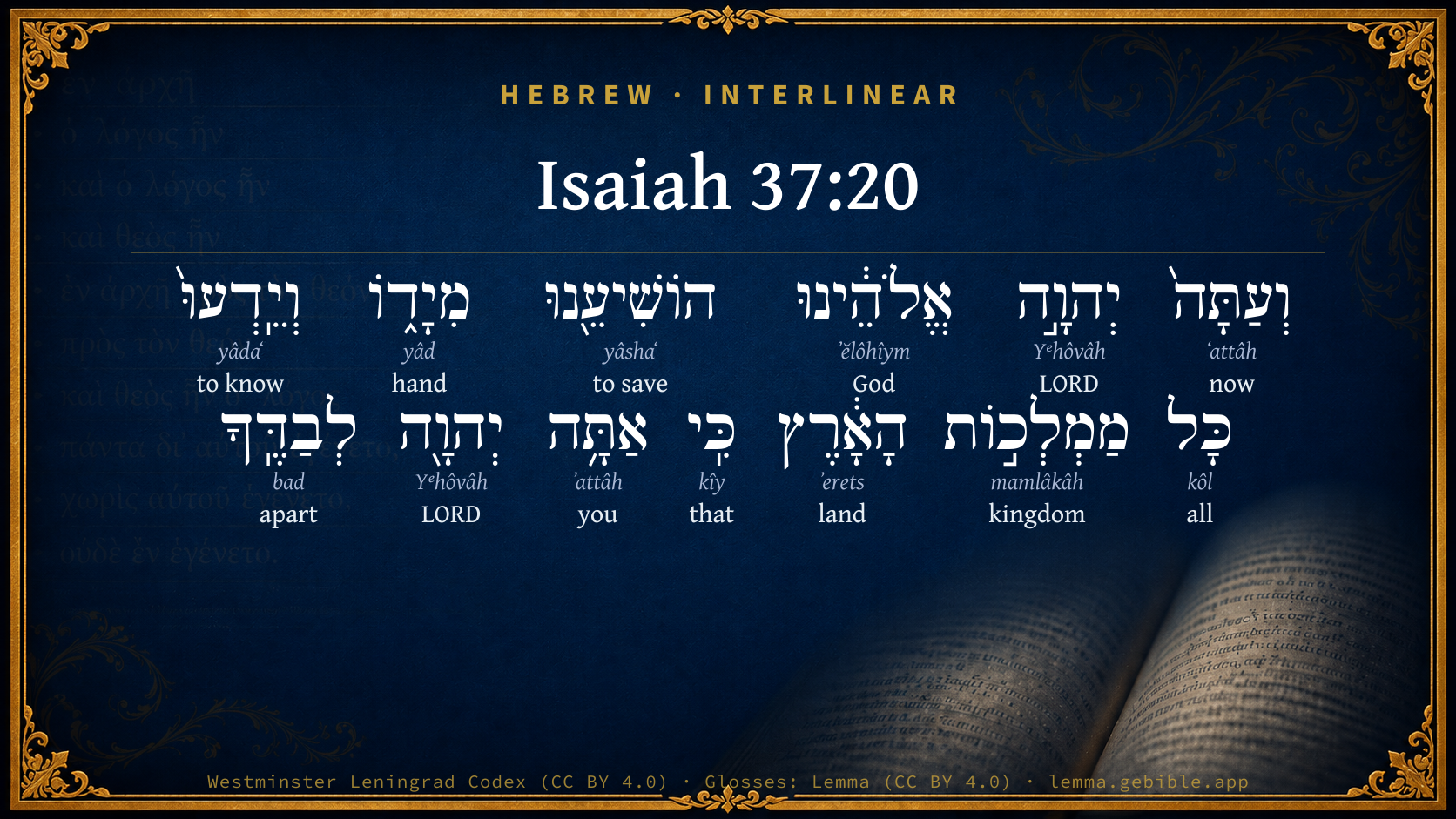
Hebrew (Westminster Leningrad Codex) Isaiah 37:20 appears in the Hebrew Old Testament. The text above is from the Westminster Leningrad Codex. Each word links to its Strong’s number, a concise gloss, and parsing drawn from the Open Scriptures Hebrew Bible morphology. Click any word for its full Brown-Driver-Briggs (BDB) entry.
Download image
Cite this verse

Isaiah 37:20 (World English Bible). Public Domain. Lemma interlinear Bible study tool, https://lemma.gebible.app/v/isaiah/37/20.

Show BibTeX & RIS
BibTeX
RIS
English Translation
Now therefore, Yahweh our God, save us from his hand, that all the kingdoms of the earth may know that you are Yahweh, even you only.
World English Bible · Public Domain
Download a study sheet

One document with this verse’s original text, its word-by-word gloss line, the meaning frame, cross-references with their text, attributed commentary, and full source and license credits — printable, and it pastes into notes with its structure intact.

This verse Autodidact and up

Study sheet (.html) Plain text (.txt)

A passage Seminary Student

Up to 50 verses in one chapter. A passage sheet keeps up to 6 commentary sources and 12 cross-references per verse, in the order this page ranks them, and says so on the sheet whenever that leaves anything out. Ask for a single verse and you get the Autodidact verse sheet above.

Everything on this page stays free to read, with no account — the sheet is a download of what is already on screen, not access to it.

Want to remove ads? Support Godless Engineer
Compare translations 3

The same verse in 3 English versions, stacked beneath the original-language interlinear above. Click any original word for its lexicon entry.

Each is an independent rendering of the whole verse — the interlinear is not word-aligned to these translations.

Highlighted words mark where these versions differ — a whole-verse word diff, not a word-by-word alignment.

  • World English Bible Public Domain
    Now therefore, Yahweh our God, save us from his hand, that all the kingdoms of the earth may know that you are Yahweh, even you only.
  • King James Version Public Domain
    Now therefore, O LORD our God, save us from his hand, that all the kingdoms of the earth may know that thou art the LORD, even thou only.
  • unfoldingWord Literal Text CC BY-SA 4.0
    And now, Yahweh our God, save us from his hand, so that all of the kingdoms of the earth will know that you Yahweh, you alone.”

unfoldingWord Literal Text — © unfoldingWord, licensed CC BY-SA 4.0. Word-aligned USFM3 via Door43 (git.door43.org/unfoldingWord/en_ult).

Versions to compare (up to 4)

3 of 4 selected

Show all 18 translations

Every available English version of this verse, each an independent rendering of the whole verse.

  • World English Bible Public Domain
    Now therefore, Yahweh our God, save us from his hand, that all the kingdoms of the earth may know that you are Yahweh, even you only.
  • Berean Standard Bible Public Domain
    And now, O LORD our God, save us from his hand, so that all the kingdoms of the earth may know that You alone, O LORD, are God.”
  • Majority Standard Bible Public Domain
    And now, O LORD our God, save us from his hand, so that all the kingdoms of the earth may know that You alone, O LORD, are God.”
  • King James Version Public Domain
    Now therefore, O LORD our God, save us from his hand, that all the kingdoms of the earth may know that thou art the LORD, even thou only.
  • American Standard Version (1901) Public Domain
    Now therefore, O Jehovah our God, save us from his hand, that all the kingdoms of the earth may know that thou art Jehovah, even thou only.
  • Revised Version (1885) Public Domain
    Now therefore, O LORD our God, save us from his hand, that all the kingdoms of the earth may know that thou art the LORD, even thou only.
  • Geneva Bible (1599) Public Domain
    Nowe therefore, O Lord our God, saue thou vs out of his hand, that all the kingdomes of the earth may knowe, that thou onely art the Lord.
  • Douay-Rheims (1899) Public Domain
    And now, O Lord our God, save us out of his hand: and let all the kingdoms of the earth know, that thou only art the Lord.
  • Young's Literal Translation Public Domain
    And now, Jehovah our God, save us from his hand, and all kingdoms of the earth do know that Thou `art' Jehovah, Thyself alone.'
  • Literal Standard Version CC BY-SA 4.0
    And now, our God YHWH, save us from his hand, and all kingdoms of the earth know that You [are] YHWH, You alone.”
  • Unlocked Literal Bible CC BY-SA 4.0
    So now, Yahweh our God, save us from his power, so that all the kingdoms of the earth may know that you are Yahweh alone.”
  • unfoldingWord Literal Text CC BY-SA 4.0
    And now, Yahweh our God, save us from his hand, so that all of the kingdoms of the earth will know that you Yahweh, you alone.”
  • Darby Bible Public Domain
    And now, Jehovah our God, save us out of his hand, that all the kingdoms of the earth may know that thou art Jehovah, thou only.
  • World Messianic Bible Public Domain
    Now therefore, LORD our God, save us from his hand, that all the kingdoms of the earth may know that you are the LORD, even you only.”
  • Webster's Bible Public Domain
    Now therefore, O LORD our God, save us from his hand, that all the kingdoms of the earth may know that thou art the LORD, even thou only.
  • Free Bible Version CC BY-SA 4.0
    Now, Lord our God, please save us from him, in order that all the kingdoms of the earth may know that only you, Lord, are God.”
  • Bible in Basic English Public Domain
    But now, O Lord our God, give us salvation from his hand, so that it may be clear to all the kingdoms of the earth that you, and you only, are the Lord.
  • JPS Tanakh (1917) Public Domain
    Now therefore, O LORD our God, save us from his hand, that all the kingdoms of the earth may know that Thou art the LORD, even Thou only.'

Literal Standard Version (2020), Covenant Press — licensed CC BY-SA 4.0. Text via the HelloAO Bible API (eBible.org). Unlocked Literal Bible (unfoldingWord) — licensed CC BY-SA 4.0. Text via the HelloAO Bible API (eBible.org). unfoldingWord Literal Text — © unfoldingWord, licensed CC BY-SA 4.0. Word-aligned USFM3 via Door43 (git.door43.org/unfoldingWord/en_ult). Free Bible Version, Dr. Jonathan Gallagher — licensed CC BY-SA 4.0. Text via the HelloAO Bible API (eBible.org).

Word by word

More ways to search: Search by grammar → Find every occurrence → Compare this word →

Practice this passage: Drill this verse → Learn its vocabulary →

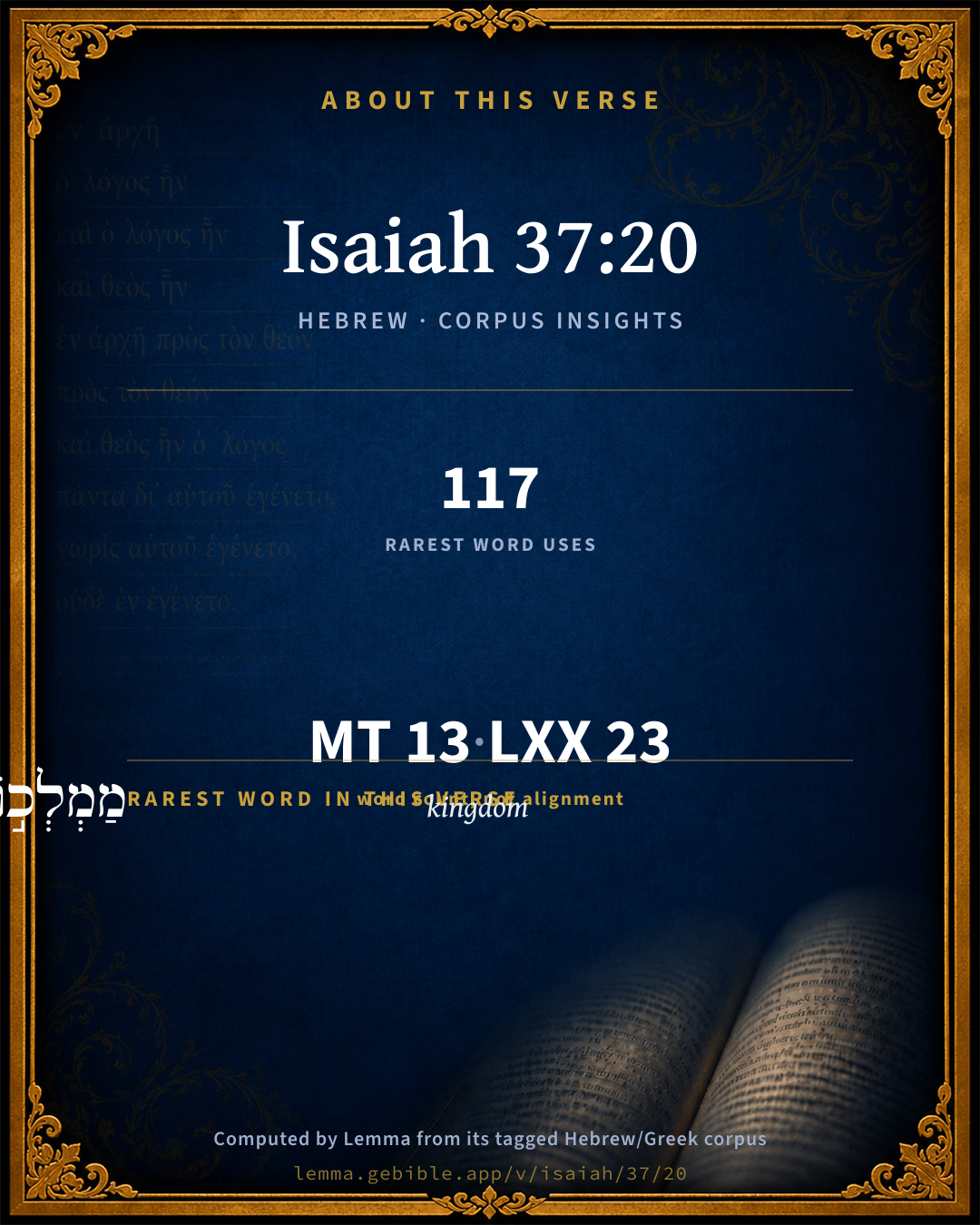
מַמְלְכ֣וֹת
mamlâkâh
H4467
“kingdoms of”
Noun, Common, Feminine, Plural, Construct
Part of Speech
Noun
Type
Common
Gender
Feminine
Number
Plural
State
Construct
Full BDB Definition

Origin: from H4427

TWOT: 1199f

kingdom, dominion, reign, sovereignty - kingdom, realm - sovereignty, dominion - reign
  1. וְעַתָּה֙ ʻattâh H6258 “and · now” Conjunction + Adverb
  2. יְהוָ֣ה Yᵉhôvâh H3068 “LORD” Noun, Proper
  3. אֱלֹהֵ֔ינוּ ʼĕlôhîym H430 “God(s) · our” Noun, Common, Masculine, Plural, Construct + Suffix, Personal, 1st Person, Common, Plural
  4. הוֹשִׁיעֵ֖נוּ yâshaʻ H3467 “save · us” Verb, Hiphil, Imperative, 2nd Person, Masculine, Singular + Suffix, Personal, 1st Person, Common, Plural
  5. מִיָד֑וֹ yâd H3027 “from · hand · his” Preposition + Noun, Common, Both, Singular, Construct + Suffix, Personal, 3rd Person, Masculine, Singular
  6. וְיֵֽדְעוּ֙ yâdaʻ H3045 “and · to know” Conjunction + Verb, Qal, Imperfect, 3rd Person, Masculine, Plural
  7. כָּל kôl H3605 “all of” Noun, Common, Masculine, Singular, Construct
  8. הָאָ֔רֶץ ʼerets H776 “the · land” Particle, Definite Article + Noun, Common, Both, Singular, Absolute
  9. כִּֽי kîy H3588 “that” Conjunction
  10. אַתָּ֥ה ʼattâh H859 “you” Pronoun, Personal, 2nd Person, Masculine, Singular
  11. יְהוָ֖ה Yᵉhôvâh H3068 “LORD” Noun, Proper
  12. לְבַדֶּֽךָ bad H905 “to/for · apart · your” Preposition + Noun, Common, Masculine, Singular, Construct + Suffix, Personal, 2nd Person, Masculine, Singular

About this verse

These counts appear in no published source. They are computed here, from the morphology-tagged text and Lemma’s own curated glosses. What Lemma adds →

13
words
12
distinct lemmas
Prophets
section

Grammatical profile

  • 2 verbs
  • 8 nouns
  • 1 pronoun
  • 1 conjunction
  • 1 adverb

Verb forms

  • הוֹשִׁיעֵ֖נוּ Hiphil · Imperative
  • וְיֵֽדְעוּ֙ Qal · Imperfect

Repetition

A word recurs within this verse — often emphatic in Hebrew:

  • יְהוָ֣ה LORD H3068 ×2

Hebrew & Septuagint length

In English translation the verse runs 26 words from the Hebrew and 24 from the Septuagint (LXX English) — closely comparable.

A rough comparison of the two English renderings, which tokenize alike — not a word-level alignment.

Word counts can differ between the Hebrew and the Greek without any difference in meaning — e.g. the Hebrew direct-object marker אֵת has no separate Greek word, and Greek often adds the article ὁ.

In the original languages it is 13 Hebrew tokens and 23 Greek tokens — but the two are counted differently (Hebrew bundles its prefixes and suffixes into one token; the Greek is in lemma form), so that isn’t a like-for-like length.

Cross-references

12

Topical passages linked to Isaiah 37:20 in the Treasury of Scripture Knowledge — connected by theme and wording, ordered by reader-vote popularity; previews shown in the World English Bible.

  • Psalms 46:10 "Be still, and know that I am God. I will be exalted among the nations. I will be exalted in the earth."
  • 1 Kings 18:36–37 It happened at the time of the offering of the [evening] offering, that Elijah the prophet came near, and said, Yahweh, the God of Abraham, of Isaac, and of Israel, let it be known this day that you are God in Israel, and that I am your servant, and that I have done all these things at your word.
  • Psalms 83:17–18 Let them be disappointed and dismayed forever. Yes, let them be confounded and perish;
  • Psalms 67:1–2 May God be merciful to us, bless us, And cause his face to shine on us. Selah.
  • Isaiah 42:8 I am Yahweh, that is my name; and my glory will I not give to another, neither my praise to engraved images.
  • Ezekiel 36:23 I will sanctify my great name, which has been profaned among the nations, which you have profaned in the midst of them; and the nations shall know that I am Yahweh, says the Lord Yahweh, when I shall be sanctified in you before their eyes.
  • Malachi 1:11 For from the rising of the sun even to the going down of the same, my name is great among the nations, and in every place incense will be offered to my name, and a pure offering: for my name is great among the nations," says Yahweh of Hosts.
  • Exodus 9:15–16 For now I would have put forth my hand, and struck you and your people with pestilence, and you would have been cut off from the earth;
  • Joshua 7:8–9 Oh, Lord, what shall I say, after that Israel has turned their backs before their enemies!
  • 1 Samuel 17:45–47 Then said David to the Philistine, You come to me with a sword, and with a spear, and with a javelin: but I come to you in the name of Yahweh of hosts, the God of the armies of Israel, whom you have defied.
  • 1 Kings 8:43 hear in heaven, your dwelling-place, and do according to all that the foreigner calls to you for; that all the peoples of the earth may know your name, to fear you, as does your people Israel, and that they may know that this house which I have built is called by my name.
  • Psalms 59:13 Consume them in wrath. Consume them, and they will be no more. Let them know that God rules in Jacob, To the ends of the earth. Selah.

Cross-references courtesy of OpenBible.info (CC BY 4.0).

Hebrew and Greek witnesses Masoretic Hebrew ↔ Greek Septuagint

The same verse in the two great witnesses to the Old Testament, shown verse-for-verse.

These are two independent witnesses, not word-aligned to each other, and the Septuagint is shown in lemma (dictionary) form.

Hebrew Isaiah 37:20 Masoretic · Westminster Leningrad Codex

וְעַתָּה֙ יְהוָ֣ה אֱלֹהֵ֔ינוּ הוֹשִׁיעֵ֖נוּ מִיָד֑וֹ וְיֵֽדְעוּ֙ כָּל מַמְלְכ֣וֹת הָאָ֔רֶץ כִּֽי אַתָּ֥ה יְהוָ֖ה לְבַדֶּֽךָ

Now therefore, Yahweh our God, save us from his hand, that all the kingdoms of the earth may know that you are Yahweh, even you only.

World English Bible · Public Domain

Greek LXX Isaiah 37:20 Septuagint · lemma form

σύ δέ κύριος ὁ θεός ἐγώ σώζω ἐγώ ἐκ χείρ αὐτός ἵνα γιγνώσκω πᾶς βασιλεία ὁ γῆ ὅτι σύ εἰμί ὁ θεός μόνος

But now, O Lord our God, deliver us from his hands, that every kingdom of the earth may know that you are God alone.

LXX2012 (modern English Septuagint) · Public Domain

On this verse, Adam Clarke's Commentary discusses the Septuagint’s reading. Read the note in Commentary ↓

Hebrew: Westminster Leningrad Codex (CC BY 4.0). Greek: Septuagint (public domain); English from LXX2012 (modern English Septuagint) (Public Domain). How the Septuagint differs from the Hebrew →

Targum (Aramaic paraphrase)

1

The Targum is the ancient Jewish Aramaic paraphrase of the Hebrew Scriptures — an interpretive translation, not the Hebrew text itself. Onkelos (literal) and Pseudo-Jonathan (expansive) render the Torah, and Jonathan the Prophets. Coverage is partial: where no permissively-licensed English translation exists for a verse, only the Aramaic is shown. This is verse-level text, not a word-by-word alignment to the Hebrew.

  1. Targum Jonathan Prophets (Joshua–Malachi)
    וּכְעַן יְיָ אֱלָהָנָא פְּרוּקְנָא מִן יְדֵהּ וְיֵדְעוּן כָּל מַלְכְּוַת אַרְעָא אֲרֵי אַתְּ יְיָ לֵית בַּר מִנָךְ:

    And now, O Lord our God, save us from his hand, that all the kingdoms of the earth may know that Thou art the Lord; there is none besides Thee.

    Targum Jonathan — Aramaic: “Mikraot Gedolot” (public domain). English: “Sefaria Community Translation” (CC0 1.0 (public-domain dedication)); “London "Chaldee Paraphrase," 1871” (public domain). Text via Sefaria.

Commentary

Notes on Isaiah 37:20 from classic Christian and Jewish commentators (each source and its license shown beneath its notes). The classic Christian expositions comment on the surrounding passage and are grouped to its opening verse, so a note may address several verses; the Jewish commentaries on the Tanakh (Rashi and others) are per-verse, so they appear only where the commentator wrote on this verse.

Lemma curates 59 commentaries, every one of them public domain or Creative Commons licensed, each selected and text-cleaned for this edition rather than reprinted as found. About our sources →

The Preacher's Complete Homiletical Commentary

Joseph S. Exell (gen. ed.)

A CHRISTIAN PRAYER

Isa_37:20. Now, therefore, O Lord our God, save us, &c.

The conclusion of Hezekiah’s prayer. Sennacherib had accomplished the conquest of several countries, notwithstanding the protection of their gods. He declared that the God whom Hezekiah trusted would also be unable to deliver him. What could the king do better than spread the letter before the Lord, cry for help, and make the reproach of the Almighty’s power the principal plea? God’s honour was at stake. If Jerusalem was saved, it would be a demonstration of God’s exclusive divinity to all the nations around. The result was that the angel of the Lord destroyed the Assyrian camp, so that Sennacherib returned to Nineveh. It is one of the most remarkable answers to prayer.

This is pre-eminently a Christian prayer—that all the kingdoms of the earth may know that the Lord is God alone. It is the end toward which all Christian desire and effort is directed. We will consider it in this view, and notice—

I. THE CONSUMMATION WHICH IS DESIRED.

It is that all mankind may believe in the one true God. Most of the nations of ancient times believed in a multiplicity of divinities, as the inhabitants of India do now. But many of these peoples were devoted to some one god in particular, who was supposed to take their country under his protection. The gods were local. They did not exclude each other. In time of war the question, so far as the gods were concerned, was not which nation was protected by the true God, but which god was the strongest.

The spirit of Judaism was entirely antagonistic to this. The unity of God was its great doctrine. It was not missionary; it was a silent protest. So far as they were faithful to the teaching they had received, the belief of the Jewish people was, that while the Divine Being stood in special covenant relations to them, He was the exclusive Divine Being; that until the nations should become acquainted with Him they had no God at all.

Christianity occupies a similar position, only the position is extended. When it commenced its career, it made itself felt, not as a silent protest, but as an active aggressive agency which aimed at the overthrow of all idolatry. It assumed the position that all the religions of the earth are false, while it is the only religion for man. From that position it has not descended. To do so would be to efface itself, therefore it cannot accept the modern paganism. It cannot take its place as one of the many forms, perhaps the most enlightened, in which the religious sentiment is expressed. It cannot accept the courtesies of “thoughtful men” on these terms. It must be all or nothing. It is the channel through which the one God has revealed Himself as the redeeming God. The consummation desiderated by the Christian Church is that all the nations of the earth may be brought to the knowledge of Him as thus revealed.

II. THE REASON WHY IT IS DESIRED.

1. Because it is essential to the Divine honour. God is not regardless of His glory. He might have remained alone; but He chose to call into existence creatures able to contemplate His glory. Before them He has set His works. He wishes to live in their thoughts and affections, not merely as a distant object of awful contemplation, but as one enshrined in their heart’s love. He desires to be so real to them as that they shall connect Him with all the events of history and all the experience of life. But this cannot be, if He is unknown or regarded as one of many. The honour of the sovereign cannot be divided; neither can the honour of God. It is something by itself. He is jealous of it. So are His people. They are anxious that He receive His proper honour from all the world.

2. Because it is necessary to religious worship. Some religious worship enters into the life of mankind everywhere. But it cannot be indifferent whether it shall be offered to the only Being capable of receiving it, or to nothing. The notion entertained of the object of worship regulates the nature of worship. Contrast heathen with Christian worship. An unknown God cannot be satisfactorily worshipped. The God of Christianity can be the object of a worship that is real so far as the worshipper is concerned, and acceptable to Him to whom it is presented.

3. Because it affects the experience of life. A man’s thoughts respecting God must affect his life at every point. He may not believe in any. He may believe in many. He may believe in one. He will be influenced in relation to the duties, the trials, and the difficulties of life. Is not the ideal of possible excellence for humanity higher under the influence of the Christian than under any other form of belief or unbelief respecting God? In the inevitable sorrows of life, is it not a very different thing to be ignorant of God from what it is to know Him as one who sympathises with the sufferer, and whose hand will remove the suffering when it has accomplished its appointed work? The knowledge of God is the most practical of all knowledge. It moulds our life, character, experience, conduct, at every point.

4. Because it secures the salvation of the soul (Joh_17:3). There must be an experimental acquaintance with Him. It is realised in the friendship with Him that comes through faith in Christ. It is an abiding spiritual life, gradually unfolding into eternal life.

III. THE MEANS BY WHICH IT WILL BE REALISED.

The prayer contemplates Divine action as evidence. “Save us from His hand.” According to the reasoning of the time this would be the proof. Reasoning from facts still the most satisfactory. Thus we may reason—

1. From creation. The wisdom and power displayed are the wisdom and power of One.

2. From redemption. God has interposed for many. He has actually saved many. Every conversion strengthens this argument.

3. From the preservation of the living Church. In spite of persecution, infidelity, lapse of time.

We may therefore make it a plea for the bestowment of saving blessings, as Hezekiah did.

Do you believe in Him? Live as you believe. Think what would be the effect if all did so. Tell it to the heathen. Pray for them in praying for yourself.—J. Rawlinson.

The Preacher's Complete Homiletical Commentary (gen. ed. Joseph S. Exell; Funk & Wagnalls, c. 1892) — public domain (pre-1929). A full-Bible homiletical/sermon-outline anthology covering 65 of 66 books (2 John is absent from the source module). Text from a community e-Sword module.

Tyndale Open Study Notes

Tyndale Open Resources

37:20 you alone, O Lord, are God: Hezekiah was concerned for the Lord’s reputation, which Sennacherib had impugned. Hezekiah recognized that if the Lord defeated the Assyrians and their gods, his holy name would be glorified among all the nations of the world (cp. Exod 9:16; 14:4, 17-18; Josh 2:9-11; 1 Sam 4:7-8).

Tyndale Open Study Notes — © Tyndale Open Resources, licensed CC BY-SA 4.0. Text via the HelloAO Bible API.

Geneva Bible (1599)

Geneva Bible translators

He declareth for what cause he prayed, that they might be delivered: to wit, that God might be glorified thereby through all the world.

Geneva Bible (1599) marginal notes — public domain. Text via Bolls.life.

Jamieson, Fausset & Brown

Robert Jamieson, A. R. Fausset & David Brown

The strongest argument to plead before God in prayer, the honor of God (Exo 32:12-14; Psa 83:18; Dan 9:18-19).

Jamieson, Fausset & Brown — Commentary Critical and Explanatory on the Whole Bible (1871) — public domain (CC PDM 1.0). Text via the HelloAO Bible API.

Adam Clarke's Commentary

Verse 20. Save us - "Save us, we beseech thee"] The supplicating particle, נא na, is supplied here from eighteen MSS., three ancient, of Dr. Kennicott, and ten of De Rossi, and from the other copy; 2Kg 19:19.

That thou art the Lord, even thou only - "That thou JEHOVAH art the only God."] The word אלהים Elohim, "God," is lost here in the Hebrew text, but preserved in the other copy; 2Kg 19:19. The Syriac and Septuagint seem here to have had in their copies אלהים Elohim, instead of יהוה Yehovah.

Adam Clarke's Commentary on the Bible (1810–1826) — public domain. Text from a community e-Sword/MySword module.

The Cambridge Bible for Schools and Colleges

gen. ed. J. J. S. Perowne

20. Therefore let Jehovah shew, in this crisis of religion, that He alone possesses true Godhead.

that thou art the Lord, even thou only] Lit. “that thou art Jehovah alone,” cf. Deu_6:4. But the easier, and perhaps the original, reading is given by 2 Kings “that thou Jehovah art God alone” (see Isa_37:16).

The Cambridge Bible for Schools and Colleges (gen. ed. J. J. S. Perowne; Cambridge University Press, 1878–1918) — public domain. Text from a community e-Sword module.

John Gill's Exposition

This is the word which the Lord hath spoken concerning him,.... The sentence he has pronounced upon him, the punishment he has determined to inflict on him, in answer to Hezekiah's prayer against him:

the virgin, the daughter of Zion; hath despised thee; and laughed thee to scorn; that, is the inhabitants of Zion, particularly of the fort of Zion, called a "virgin", because it had never been forced, or taken and to show that it was a vain thing in Sennacherib to attempt it, as well as it would have been an injurious one, could he have accomplished it; since God, the Father of this virgin, would carefully keep her from such a rape; and he who was her husband to whom she was espoused as a chaste virgin, would defend and protect her; and the whole is designed to show the impotent malice of the king of Assyria; otherwise, at the time when these words were spoken, the daughter of Zion was in a fearful and trembling condition, and not in a laughing frame; but this declares what she might do now, and would do hereafter, for anything that he could do against her. The Targum paraphrases it,

"the kingdom of the congregation of Zion;''

the whole nation. Some restrain this to the inhabitants of the upper part of the city of Jerusalem, as what follows to those of the lower part:

the daughter of Jerusalem hath shaken her head at thee; or "after thee (o)"; by way of scorn and derision; that is when he fled; which shows, that though these things are spoken as if they were past, after the manner of the prophets, yet were to come, and would be when Sennacherib fled, upon the destruction of his army. Of this phrase, as expressive of scorn, see Psa 22:7. The Targum is, "the people that dwell in Jerusalem", &c.

(o) "post te", V. L. Pagninus, Montanus Junius & Tremellius, Piscator.

John Gill's Exposition of the Whole Bible (1746–1763) — public domain (CC PDM 1.0). Text via the HelloAO Bible API.

Albert Barnes' Notes on the Bible

That all the kingdoms of the earth may know - Since he has been able to subdue all others; and since Judea alone, the land under the protection of Yahweh, would be saved, all the nations would know that it could not be by the power of an idol. The desire of Hezckiah, therefore, was not primarily that of his own personal safely or the safety of his kingdom. It was that Yahweh might vindicate his great and holy name from reproach, and that the world might know that he was the only true God. A supreme regard to the glory of God influenced this pious monarch in his prayers, and we have here a beautiful model of the object which we should have in view when we come before God. It is not primarily that we may be saved; it is not, as the leading motive, that our friends or that the world may be saved; it is that the name of God may be honored. This motive of prayer is one that is with great frequency presented in the Bible (compare Isa 42:8; Isa 43:10, Isa 43:13, Isa 43:25; Deu 32:39; Psa 46:10; Psa 83:18; Neh 9:6; Dan 9:18-19).

Perhaps there could have been furnished no more striking proof that Yahweh was the true God, than would be by the defeat of Sennacherib. No other nation had been able to resist the Assyrian arms. The great power of that empire was now concentrated in the single army of Sennacherib. He was coming with great confidence of success. He was approaching the city devoted to Yahweh - the city where the temple was, and the city and people that were everywhere understood to be under his protection. The affairs of the world had arrived at a crisis; and the time had come wheu the great Yahweh could strike a blow which would be felt on all nations, and carry the terror of his name, and the report of his power throughout the earth. Perhaps this was one of the main motives of the destruction of that mighty army. God intended that his power should be felt, and that monarchs and people that arrayed themselves against him, and blasphemed him, should have a striking demonstration that be was God, and that none of the devices of his enemies could succeed.

Albert Barnes' Notes on the Bible (1834–1885) — public domain. Text from a community e-Sword/MySword module.

The Pulpit Commentary

Save us... that all the kingdoms... may know, etc. God"s true servants desire deliverance and triumph over enemies, not alone for their own sakes, not even for the sake of the country or people whose fate is bound up with their own, but for the glory of God, that his honour may be vindicated in the sight of the world at large. It is a large part of the satisfaction of Moses at the passage of the Red Sea, that "the peoples would hear... the dukes of Edom be amazed... the mighty men of Moab tremble," etc. (Exo_15:14, Exo_15:15) David would have his foes consumed" in order that they might know that "God ruled in Jacob, and unto the cads of the earth", (Psa_59:13) and again, in order "that men may know that thou, whose Name alone is Jehovah, art the Most High over all the earth". (Psa_83:18) It has been well said that "the object of all the judgments which the true prophet desires is to bring all nations into subjection to God."

The Pulpit Commentary (1880–1919), ed. H.D.M. Spence-Jones & Joseph S. Exell — public domain. Text from a community e-Sword module.

J. A. Alexander on Isaiah

Joseph Addison Alexander

“And now, oh Jehovah our God, save us from his hand, and all the kingdoms of the earth shall know, that Thou Jehovah art alone (or that Thou alone art Jehovah).” The adverb now is here used both in a temporal and logical sense, as equivalent, not only to at length, or before it is too late, but also to therefore, or since these things are so. The fact that Sennacherib had destroyed other nations, is urged as a reason why the Lord should interpose to rescue His own people from a like destruction; and the fact that He had really triumphed over other gods, as a reason why he should be taught to know the difference between them and Jehovah. The construction of the verb as an optative (let all the kingdoms of the earth know), or a subjunctive (that all the kingdoms of the earth may know), although admissible, ought not to be preferred to the future proper, where the latter yields a sense so good in itself and so well suited to the context. The last words of the verse may either mean, that Thou Jehovah art the only one (i.e., as appears from the connection, the only true God), or, that Thou alone art Jehovah, with particular allusion to the proper import of that name as signifying absolute, eternal, independent existence. The first is recommended by its more exact agreement with the masoretic accents. These questions of construction do not affect the general sense, which is, that the deliverance of His people from Sennacherib would prove Jehovah to be infinitely more than the gods of the nations whom he gloried in destroying.

Joseph Addison Alexander, The Prophecies of Isaiah (1846–1847; New York: Scribner, 1870–1878) — public domain. Text from a community e-Sword module.

Lesson kit

Teaching starters — assembled from the data on this page, not authored interpretation. Every prompt links to the verse data it draws on. Edit before teaching.

Isaiah, in the Prophets, opens this verse with 13 words (12 distinct Hebrew lemmas). Its most distinctive word is mamlâkâh (“kingdom”). A historical commentator’s framing appears above. Read the whole chapter for the surrounding context.

Discussion questions

  1. What does “kingdom” (mamlâkâh) contribute to the verse as a whole?
  2. How does Psalms 46:10, which shares this passage’s theme, read alongside this verse?
  3. What does the repetition of “LORD” (2× in this one verse) do in this verse?
  4. The translations on this page render this verse differently — a whole-verse word diff, not a word-by-word alignment. What might account for the different wordings?
  5. «הוֹשִׁיעֵ֖נוּ» is a Hiphil Imperative verb. How does that grammatical form shape the action described?
  6. Compare how The Preacher's Complete Homiletical Commentary and Tyndale Open Study Notes read this verse. Where do they agree or differ?

Things to notice

Reading settings

Reading text

Shown beneath each verse's original-language words.

Old Testament
Old Testament edition

Read the OT as the Masoretic Hebrew (MT) or the Greek Septuagint (LXX).

English shown for the Greek Septuagint (in the Hebrew ↔ Greek comparison).

Comparing translations? Open the Compare panel on any verse page to stack up to four side by side.