
Jeremiah 42:11

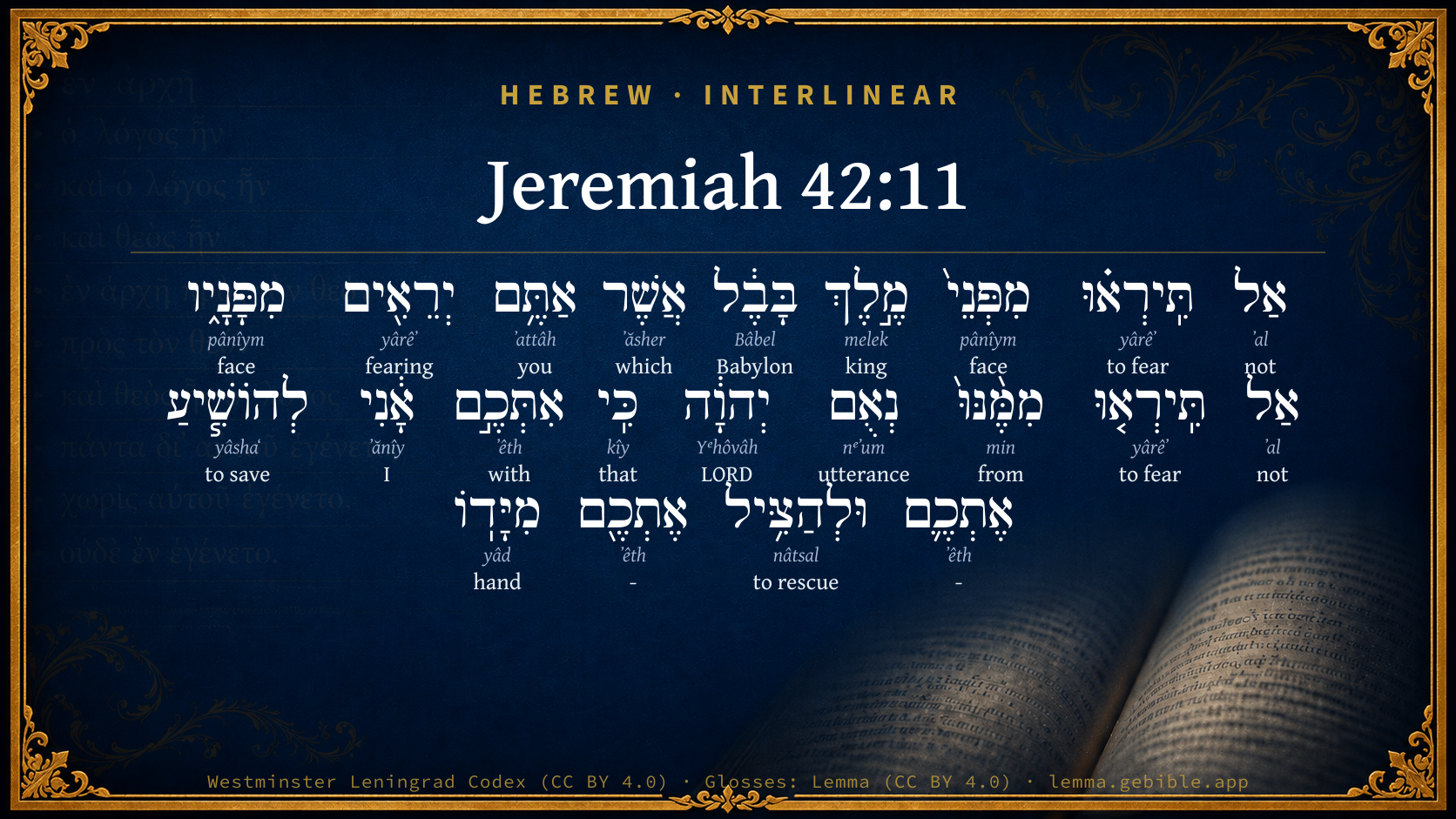
Hebrew (Westminster Leningrad Codex) Jeremiah 42:11 appears in the Hebrew Old Testament. The text above is from the Westminster Leningrad Codex. Each word links to its Strong’s number, a concise gloss, and parsing drawn from the Open Scriptures Hebrew Bible morphology. Click any word for its full Brown-Driver-Briggs (BDB) entry.
Download image
Cite this verse

Jeremiah 42:11 (World English Bible). Public Domain. Lemma interlinear Bible study tool, https://lemma.gebible.app/v/jeremiah/42/11.

Show BibTeX & RIS
BibTeX
RIS
English Translation
Don't be afraid of the king of Babylon, of whom you are afraid; don't be afraid of him, says Yahweh: for I am with you to save you, and to deliver you from his hand.
World English Bible · Public Domain
Download a study sheet

One document with this verse’s original text, its word-by-word gloss line, the meaning frame, cross-references with their text, attributed commentary, and full source and license credits — printable, and it pastes into notes with its structure intact.

This verse Autodidact and up

Study sheet (.html) Plain text (.txt)

A passage Seminary Student

Up to 50 verses in one chapter. A passage sheet keeps up to 6 commentary sources and 12 cross-references per verse, in the order this page ranks them, and says so on the sheet whenever that leaves anything out. Ask for a single verse and you get the Autodidact verse sheet above.

Everything on this page stays free to read, with no account — the sheet is a download of what is already on screen, not access to it.

Want to remove ads? Support Godless Engineer
Compare translations 3

The same verse in 3 English versions, stacked beneath the original-language interlinear above. Click any original word for its lexicon entry.

Each is an independent rendering of the whole verse — the interlinear is not word-aligned to these translations.

Highlighted words mark where these versions differ — a whole-verse word diff, not a word-by-word alignment.

  • World English Bible Public Domain
    Don't be afraid of the king of Babylon, of whom you are afraid; don't be afraid of him, says Yahweh: for I am with you to save you, and to deliver you from his hand.
  • King James Version Public Domain
    Be not afraid of the king of Babylon, of whom ye are afraid; be not afraid of him, saith the LORD: for I am with you to save you, and to deliver you from his hand.
  • unfoldingWord Literal Text CC BY-SA 4.0
    Do not fear the king of Babylon, whom you are fearing. Do not fear him—this is Yahweh’s declaration—since I am with you to save you and rescue you from his hand.

unfoldingWord Literal Text — © unfoldingWord, licensed CC BY-SA 4.0. Word-aligned USFM3 via Door43 (git.door43.org/unfoldingWord/en_ult).

Versions to compare (up to 4)

3 of 4 selected

Show all 18 translations

Every available English version of this verse, each an independent rendering of the whole verse.

  • World English Bible Public Domain
    Don't be afraid of the king of Babylon, of whom you are afraid; don't be afraid of him, says Yahweh: for I am with you to save you, and to deliver you from his hand.
  • Berean Standard Bible Public Domain
    Do not be afraid of the king of Babylon, whom you now fear; do not be afraid of him, declares the LORD, for I am with you to save you and deliver you from him.
  • Majority Standard Bible Public Domain
    Do not be afraid of the king of Babylon, whom you now fear; do not be afraid of him, declares the LORD, for I am with you to save you and deliver you from him.
  • King James Version Public Domain
    Be not afraid of the king of Babylon, of whom ye are afraid; be not afraid of him, saith the LORD: for I am with you to save you, and to deliver you from his hand.
  • American Standard Version (1901) Public Domain
    Be not afraid of the king of Babylon, of whom ye are afraid; be not afraid of him, saith Jehovah: for I am with you to save you, and to deliver you from his hand.
  • Revised Version (1885) Public Domain
    Be not afraid of the king of Babylon, of whom ye are afraid; be not afraid of him, saith the LORD: for I am with you to save you, and to deliver you from his hand.
  • Geneva Bible (1599) Public Domain
    Feare not for the King of Babel, of whom ye are afraide: be not afraid of him, saith the Lord: for I am with you, to saue you, and to deliuer you from his hand,
  • Douay-Rheims (1899) Public Domain
    Fear not because of the king of Babylon, of whom you are greatly afraid: fear him not, saith the Lord: for I am with you, to save you, and to deliver you from his hand.
  • Young's Literal Translation Public Domain
    Be not afraid of the king of Babylon, whom ye are afraid of; be not afraid of him -- an affirmation of Jehovah -- for with you `am' I, to save you, and to deliver you from his hand.
  • Literal Standard Version CC BY-SA 4.0
    Do not be afraid of the king of Babylon, whom you are afraid of; do not be afraid of him—a declaration of YHWH—for I [am] with you, to save you, and to deliver you from his hand.
  • Unlocked Literal Bible CC BY-SA 4.0
    Do not fear the king of Babylon, whom you are fearing. Do not fear him—this is Yahweh's declaration—since I am with you to save you and rescue you from his hand.
  • unfoldingWord Literal Text CC BY-SA 4.0
    Do not fear the king of Babylon, whom you are fearing. Do not fear him—this is Yahweh’s declaration—since I am with you to save you and rescue you from his hand.
  • Darby Bible Public Domain
    Be not afraid of the king of Babylon, of whom ye are afraid: be not afraid of him, saith Jehovah; for I will be with you to save you, and to deliver you from his hand.
  • World Messianic Bible Public Domain
    Don’t be afraid of the king of Babylon, of whom you are afraid. Don’t be afraid of him,’ says the LORD, ‘for I am with you to save you, and to deliver you from his hand.
  • Webster's Bible Public Domain
    Be not afraid of the king of Babylon, of whom ye are afraid; be not afraid of him, saith the LORD; for I am with you, to save you, and to deliver you from his hand.
  • Free Bible Version CC BY-SA 4.0
    I know you fear the king of Babylon, but you don't need to be afraid of him, declares the Lord. I am with you to save you and rescue you from him.
  • Bible in Basic English Public Domain
    Have no fear of the king of Babylon, of whom you are now in fear; have no fear of him, says the Lord: for I am with you to keep you safe and to give you salvation from his hands.
  • JPS Tanakh (1917) Public Domain
    Be not afraid of the king of Babylon, of whom ye are afraid; be not afraid of him, saith the LORD; for I am with you to save you, and to deliver you from his hand.

Literal Standard Version (2020), Covenant Press — licensed CC BY-SA 4.0. Text via the HelloAO Bible API (eBible.org). Unlocked Literal Bible (unfoldingWord) — licensed CC BY-SA 4.0. Text via the HelloAO Bible API (eBible.org). unfoldingWord Literal Text — © unfoldingWord, licensed CC BY-SA 4.0. Word-aligned USFM3 via Door43 (git.door43.org/unfoldingWord/en_ult). Free Bible Version, Dr. Jonathan Gallagher — licensed CC BY-SA 4.0. Text via the HelloAO Bible API (eBible.org).

Word by word

More ways to search: Search by grammar → Find every occurrence → Compare this word →

Practice this passage: Drill this verse → Learn its vocabulary →

יְרֵאִ֖ים
yârêʼ
H3373
“fearing”
Adjective, Adjective, Masculine, Plural, Absolute
Part of Speech
Adjective
Type
Adjective
Gender
Masculine
Number
Plural
State
Absolute
Full BDB Definition

Origin: from H3372

TWOT: 907a

fearing, reverent, afraid
  1. אַל ʼal H408 “not” Particle, Negative
  2. תִּֽירְא֗וּ yârêʼ H3372 “to fear” Verb, Qal, Jussive, 2nd Person, Masculine, Plural
  3. מִפְּנֵי֙ pânîym H6440 “from · face(s) of” Preposition + Noun, Common, Both, Plural, Construct
  4. מֶ֣לֶךְ melek H4428 “king of” Noun, Common, Masculine, Singular, Construct
  5. בָּבֶ֔ל Bâbel H894 “Babylon” Noun, Proper
  6. אֲשֶׁר ʼăsher H834 “which” Particle, Relative
  7. אַתֶּ֥ם ʼattâh H859 “you” Pronoun, Personal, 2nd Person, Masculine, Plural
  8. מִפָּנָ֑יו pânîym H6440 “from · face(s) · his” Preposition + Noun, Common, Both, Plural, Construct + Suffix, Personal, 3rd Person, Masculine, Singular
  9. אַל ʼal H408 “not” Particle, Negative
  10. תִּֽירְא֤וּ yârêʼ H3372 “to fear” Verb, Qal, Jussive, 2nd Person, Masculine, Plural
  11. מִמֶּ֨נּוּ֙ min H4480 “from · us” Preposition + Suffix, Personal, 1st Person, Common, Plural
  12. נְאֻם nᵉʼum H5002 “utterance of” Noun, Common, Masculine, Singular, Construct
  13. יְהוָ֔ה Yᵉhôvâh H3068 “LORD” Noun, Proper
  14. כִּֽי kîy H3588 “that” Conjunction
  15. אִתְּכֶ֣ם ʼêth H854 “with · you” Preposition + Suffix, Personal, 2nd Person, Masculine, Plural
  16. אָ֔נִי ʼănîy H589 “I” Pronoun, Personal, 1st Person, Common, Singular
  17. לְהוֹשִׁ֧יעַ yâshaʻ H3467 “to save” Preposition + Verb, Hiphil, Infinitive Construct
  18. אֶתְכֶ֛ם ʼêth H853 “- · you” Particle, Direct Object + Suffix, Personal, 2nd Person, Masculine, Plural
  19. וּלְהַצִּ֥יל nâtsal H5337 “and · to rescue” Conjunction + Preposition + Verb, Hiphil, Infinitive Construct
  20. אֶתְכֶ֖ם ʼêth H853 “- · you” Particle, Direct Object + Suffix, Personal, 2nd Person, Masculine, Plural
  21. מִיָּדֽוֹ yâd H3027 “from · hand · his” Preposition + Noun, Common, Both, Singular, Construct + Suffix, Personal, 3rd Person, Masculine, Singular

About this verse

These counts appear in no published source. They are computed here, from the morphology-tagged text and Lemma’s own curated glosses. What Lemma adds →

22
words
18
distinct lemmas
Prophets
section

Shared distinctive vocabulary

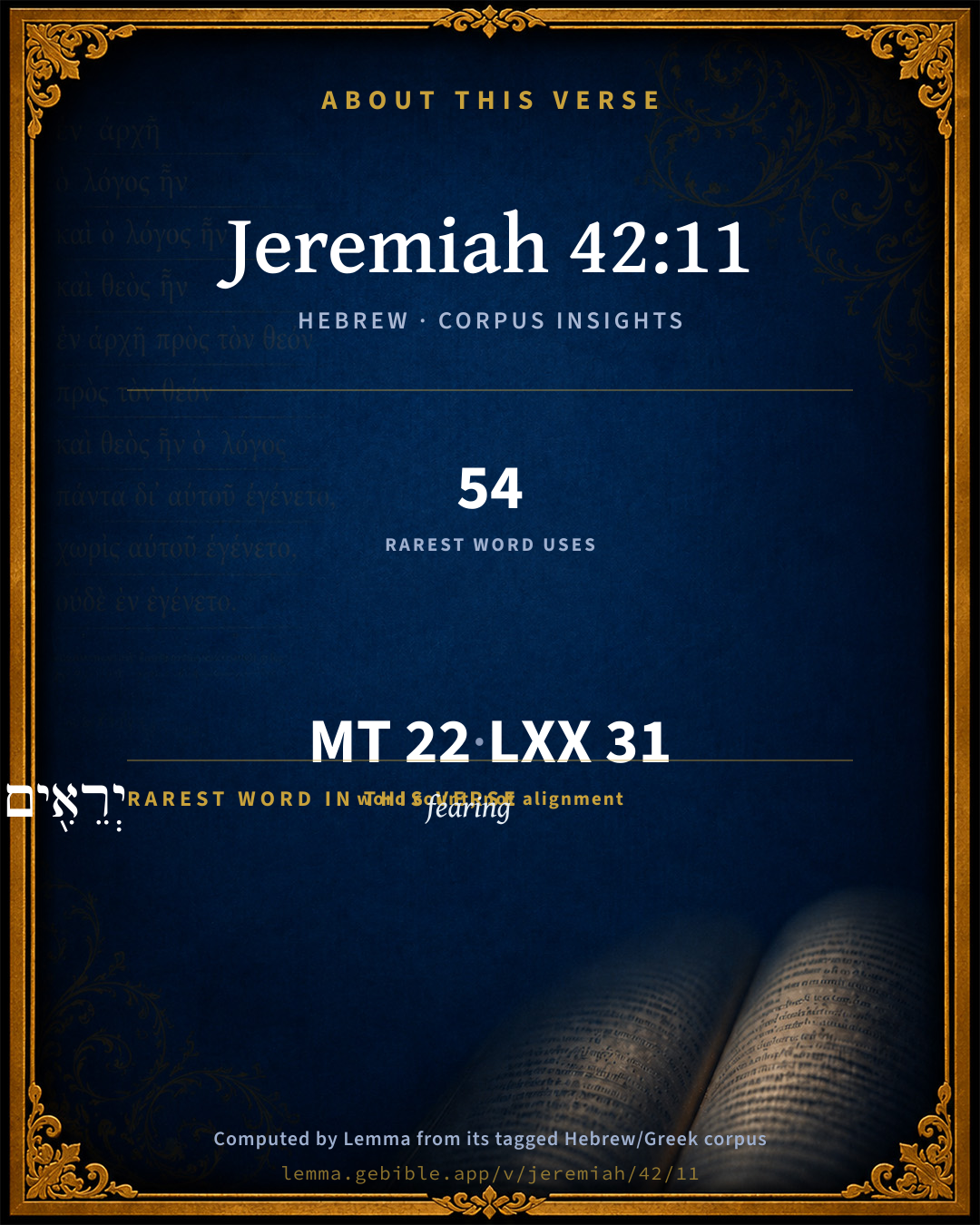
יְרֵאִ֖ים fearing H3373 occurs in 54 verses of the Hebrew Bible. Also found in:

Grammatical profile

  • 4 verbs
  • 7 nouns
  • 1 adjective
  • 2 pronouns
  • 2 prepositions
  • 1 conjunction
  • 5 particles

Verb forms

  • תִּֽירְא֗וּ Qal · Jussive
  • תִּֽירְא֤וּ Qal · Jussive
  • לְהוֹשִׁ֧יעַ Hiphil · Infinitive Construct
  • וּלְהַצִּ֥יל Hiphil · Infinitive Construct

Repetition

Words recur within this verse — often emphatic in Hebrew:

  • תִּֽירְא֗וּ to fear H3372 ×2
  • מִפְּנֵי֙ face H6440 ×2
  • אַל not H408 ×2

Hebrew & Septuagint length

In the original languages it is 22 Hebrew tokens and 31 Greek tokens — but the two are counted differently (Hebrew bundles its prefixes and suffixes into one token; the Greek is in lemma form), so that isn’t a like-for-like length.

Cross-references

23

Topical passages linked to Jeremiah 42:11 in the Treasury of Scripture Knowledge — connected by theme and wording, ordered by reader-vote popularity; previews shown in the World English Bible.

  • Romans 8:31 What then shall we say about these things? If God is for us, who can be against us?
  • Isaiah 43:2 When you pass through the waters, I will be with you; and through the rivers, they shall not overflow you: when you walk through the fire, you shall not be burned, neither shall the flame kindle on you.
  • Jeremiah 1:8 Don't be afraid because of them; for I am with you to deliver you, says Yahweh.
  • Jeremiah 1:19 They shall fight against you; but they shall not prevail against you: for I am with you, says Yahweh, to deliver you.
  • 2 Chronicles 32:7–8 Be strong and of good courage, don't be afraid nor dismayed for the king of Assyria, nor for all the multitude who is with him; for there is a greater with us than with him:
  • Isaiah 43:5 Don't be afraid; for I am with you: I will bring your seed from the east, and gather you from the west;
  • Numbers 14:9 Only don't rebel against Yahweh, neither fear the people of the land; for they are bread for us: their defense is removed from over them, and Yahweh is with us: don't fear them.
  • Deuteronomy 20:4 for Yahweh your God is he who goes with you, to fight for you against your enemies, to save you.
  • Joshua 1:5 There shall not any man be able to stand before you all the days of your life. As I was with Moses, so I will be with you; I will not fail you, nor forsake you.
  • Joshua 1:9 Haven't I commanded you? Be strong and of good courage; don't be afraid, neither be dismayed: for Yahweh your God is with you wherever you go.
  • Psalms 46:11 Yahweh of Hosts is with us. The God of Jacob is our refuge. Selah.
  • Isaiah 41:10 Don't you be afraid, for I am with you; don't be dismayed, for I am your God; I will strengthen you; yes, I will help you; yes, I will uphold you with the right hand of my righteousness.
  • Jeremiah 15:20 I will make you to this people a fortified brazen wall; and they shall fight against you, but they shall not prevail against you; for I am with you to save you and to deliver you, says Yahweh.
  • Jeremiah 27:17 Don't listen to them; serve the king of Babylon, and live: why should this city become a desolation?
  • Jeremiah 41:18 because of the Chaldeans; for they were afraid of them, because Ishmael the son of Nethaniah had killed Gedaliah the son of Ahikam, whom the king of Babylon made governor over the land.
  • 2 Timothy 4:17 But the Lord stood by me, and strengthened me, that through me the message might be fully proclaimed, and that all the Gentiles might hear; and I was delivered out of the mouth of the lion.
  • Matthew 10:28 Don't be afraid of those who kill the body, but are not able to kill the soul. Rather, fear him who is able to destroy both soul and body in Gehenna.
  • Matthew 28:20 teaching them to observe all things that I commanded you. Behold, I am with you always, even to the end of the age." Amen.
  • Acts 18:10 for I am with you, and no one will attack you to harm you, for I have many people in this city."
  • Psalms 46:7 Yahweh of Hosts is with us. The God of Jacob is our refuge. Selah.
  • Isaiah 8:8–10 and it shall sweep onward into Judah; it shall overflow and pass through; it shall reach even to the neck; and the stretching out of its wings shall fill the breadth of your land, Immanuel.
  • Jeremiah 27:12 I spoke to Zedekiah king of Judah according to all these words, saying, Bring your necks under the yoke of the king of Babylon, and serve him and his people, and live.
  • 2 Kings 25:26 All the people, both small and great, and the captains of the forces, arose, and came to Egypt; for they were afraid of the Chaldeans.

Cross-references courtesy of OpenBible.info (CC BY 4.0).

Hebrew and Greek witnesses Masoretic Hebrew ↔ Greek Septuagint

The same verse in the two great witnesses to the Old Testament, shown verse-for-verse.

These are two independent witnesses, not word-aligned to each other, and the Septuagint is shown in lemma (dictionary) form.

Hebrew Jeremiah 42:11 Masoretic · Westminster Leningrad Codex

אַל תִּֽירְא֗וּ מִפְּנֵי֙ מֶ֣לֶךְ בָּבֶ֔ל אֲשֶׁר אַתֶּ֥ם יְרֵאִ֖ים מִפָּנָ֑יו אַל תִּֽירְא֤וּ מִמֶּ֨נּוּ֙ נְאֻם יְהוָ֔ה כִּֽי אִתְּכֶ֣ם אָ֔נִי לְהוֹשִׁ֧יעַ אֶתְכֶ֛ם וּלְהַצִּ֥יל אֶתְכֶ֖ם מִיָּדֽוֹ

Don't be afraid of the king of Babylon, of whom you are afraid; don't be afraid of him, says Yahweh: for I am with you to save you, and to deliver you from his hand.

World English Bible · Public Domain

Greek LXX Structure differs

In the Septuagint, Jeremiah is about an eighth shorter than the Hebrew and arranges its material differently — the Oracles Against the Nations (Hebrew chapters 46–51) appear in the middle of the Greek book, after 25:13. Because the chapter and verse boundaries do not line up, a verse-for-verse comparison with the Hebrew is not shown.

A verse-for-verse comparison isn’t shown here because the chapters and verses don’t line up. Switch to the LXX edition with the MT / LXX toggle above to read the Greek directly.

Hebrew: Westminster Leningrad Codex (CC BY 4.0). Greek: Septuagint (public domain); English from a public-domain English Septuagint. How the Septuagint differs from the Hebrew →

Targum (Aramaic paraphrase)

1

The Targum is the ancient Jewish Aramaic paraphrase of the Hebrew Scriptures — an interpretive translation, not the Hebrew text itself. Onkelos (literal) and Pseudo-Jonathan (expansive) render the Torah, and Jonathan the Prophets. Coverage is partial: where no permissively-licensed English translation exists for a verse, only the Aramaic is shown. This is verse-level text, not a word-by-word alignment to the Hebrew.

  1. Targum Jonathan Prophets (Joshua–Malachi)
    לָא תִדַחֲלוּן מִן קֳדָם מַלְכָּא דְבָבֶל דִי אַתּוּן דַחֲלִין מִן קֳדָמוֹהִי לָא תִדַחֲלוּן מִנֵיהּ אֲמַר יְיָ אֲרֵי בְסַעְדְכוֹן מֵימְרִי לְמִפְרַק יַתְכוֹן וּלְשֵׁיזָבָא יַתְכוֹן מִן יְדֵיהּ:

    (no public-domain English translation for this verse)

    Targum Jonathan — Aramaic: “Mikraot Gedolot” (public domain). English: “Sefaria Community Translation” (CC0 1.0 (public-domain dedication)); “London "Chaldee Paraphrase," 1871” (public domain). Text via Sefaria.

Commentary

Notes on Jeremiah 42:11 from classic Christian and Jewish commentators (each source and its license shown beneath its notes). The classic Christian expositions comment on the surrounding passage and are grouped to its opening verse, so a note may address several verses; the Jewish commentaries on the Tanakh (Rashi and others) are per-verse, so they appear only where the commentator wrote on this verse.

Lemma curates 59 commentaries, every one of them public domain or Creative Commons licensed, each selected and text-cleaned for this edition rather than reprinted as found. About our sources →

Trapp's Complete Commentary

John Trapp

Jer 42:11 Be not afraid of the king of Babylon, of whom ye are afraid; be not afraid of him, saith the LORD: for I [am] with you to save you, and to deliver you from his hand.

Ver. 11. Fear not the king of Babylon.] See on Jer 41:18.

For I am with you to save you.] Not only to protect you from the Babylonian, but also to incline his heart to clemency toward you. {Jer 42:12}

John Trapp, A Commentary or Exposition upon All the Books of the Old and New Testament (1647–1656) — public domain. Text from a community e-Sword module.

Joseph Benson's Commentary

Jer 42:11-12. Be not afraid of the king of Babylon — As if he had said, I know what you are afraid of; you fear lest the king of Babylon should send a force against you and utterly root you out, because one of your nation hath murdered his viceroy Gedaliah; but suffer not your passion of fear to rise too high on this account, and make you flee into Egypt. For I am with you to save you — For you shall have my presence with you, to deliver and preserve you, so that Nebuchadnezzar shall have neither inclination nor power to do you any harm. I will show mercies unto you that he may have mercy, &c. — We are beholden to God for all the compassion and kindness which we meet with from men; though we may receive good from their hands, it is God who inclines their hearts to do it. And cause you to return to your own land — The mercy which God here promises these men is, that the king of Babylon should give them liberty to go every one to his own inheritance; for at present they were banished by their own fears from their own houses and estates, though not from their own country.

Joseph Benson's Commentary on the Old and New Testaments (1811–1818) — public domain. Text from a community e-Sword module.

Geneva Bible (1599)

Geneva Bible translators

Because all kings’ hearts and ways are in his hands, he can turn them and dispose them as it pleaseth him, and therefore they need not to fear man, but only obey God, Prov. 21:1.

Geneva Bible (1599) marginal notes — public domain. Text via Bolls.life.

John Calvin's Commentaries

The Prophet obviates the doubt which might have grieved or agitated the minds of the people. They ought, indeed, to have recumbed on God’s promise alone; but it was difficult to be without doubts in a state of things so uncertain and confused; for the king of Babylon, as it has been stated, was grievously offended when the governor of the land was slain. The king had received wrong from the people, and the heat of war since the late victory had not cooled. They then justly feared, being conscious of the evil that had been done; and then they had to do with a proud and cruel enemy. God therefore removed from them this doubt; and thus he confirmed the paternal care which he had shewn towards them by kindly freeing them from every fear, and taking away every ground of terror.

Though Nebuchadnezzar had been offended, and might avenge the wrong done to him, yet God promised to prevent this, and declared that he would not suffer him to do any evil to the Jews. “Ye fear,” he says, “Nebuchadnezzar, but cease to do so; let this fear be dismissed, for he will not hurt you.” And the reason is added, Because I am with you to save you, and to deliver you from his hand Here he bade the Jews to entertain good hope, because, while relying on his protection they would be safe: for there is no more any reason for doubting, when God declares that he will stand on our side. For if he is ours, we may be confident, as David was, when he said,

“I will not fear what man may do to me; for thou, God,” he says, “art with me;”

and also,

“I will not fear though hosts surrounded me oft every side.” (Psalm 23:4; Psalm 27:3)

We ought then to feel wholly assured, that the help of God is above that of all creatures. Thus were the whole world to rise up against us, we might as from a secure and safe place look down with indifference on all attempts, forces, and preparations. This is then the sum of what is here said; and it is according to what Christ says,

“My Father, who has given you to me, is greater than all.” (John 10:29)

Had there then been a grain of faith in the Jews, they would have laid hold on this promise; and then had they tenaciously held it, as though it were a plank in a shipwreck, it would have led them safe to the harbor. It ought then to be sufficient to shake off all cares, to drive away all fears, and to put to flight every diffidence, when God promises to stand on our side. I am, he says, with you to save you, and he adds, to deliver you He expresses the way and manner of saving them; for they might still have objected and said, “What will be this salvation? for Nebuchadnezzar is like a furious lion; how then can we be saved, since we cannot think otherwise than that he will be enraged against us?” To this God answers, by pointing out the manner, for he would deliver them from his hand.

John Calvin's Commentaries (1540-1563) — public domain. Text from the Calvin Translation Society English edition (1840s-50s) via the Christian Classics Ethereal Library (ccel.org). Calvin's coverage is partial (roughly two-thirds of the Bible); uncommented books and verses are honest gaps, never fabricated. The 19th-century editor's footnotes and remarks are omitted so the notes are faithfully Calvin's own voice.

The Cambridge Bible for Schools and Colleges

gen. ed. J. J. S. Perowne

11. of whom ye are afraid] They may well have feared that the king’s vengeance for the murder of Gedaliah would involve innocent and guilty alike.

The Cambridge Bible for Schools and Colleges (gen. ed. J. J. S. Perowne; Cambridge University Press, 1878–1918) — public domain. Text from a community e-Sword module.

John Gill's Exposition

And I will show mercies unto you,.... Bestow blessings of goodness upon them, out of pure mercy and compassion to them, and not according to their merits; or I will cause others to show mercy to them, even the king of Babylon, as follows: God shows mercy to men when he stirs up the compassion of others towards them:

that he may have mercy upon you; and not avenge the death of Gedaliah, or any way cruelly oppress them, but show them all the favour they could wish for or expect under such a government, and in such circumstances; giving them vineyards and fields, and allowing them to gather the fruits of them, and enjoy them:

and cause you to return to your own land: this is said, not of the captives in Babylon, as Kimchi and Abarbinel, since these were not to return till seventy years were ended; and when they did, it was not by the order and direction of the king of Babylon, but of the king of Persia: this is said of those who, from the time that Jerusalem had been besieged, had deserted their houses and fields, but should have liberty to return to them; or of those who more lately had been carried captive by Ishmael, from the places where they had settled, but should be returned to them again, and live peaceably and comfortably there under the government and protection of the king of Babylon.

John Gill's Exposition of the Whole Bible (1746–1763) — public domain (CC PDM 1.0). Text via the HelloAO Bible API.

Matthew Poole's English Annotations

I know whom you are afraid of; you fear that the king of Babylon will come and utterly root you out, because one of your nation hath murdered his viceroy Gedaliah: suffer not your passion of fear to rise too high in this case, and to make you flee into Egypt; for you shall have my presence with you, to preserve and deliver you from his power, it shall not be in his power to do you any harm.

Matthew Poole's English Annotations on the Holy Bible (1683–1685) — public domain. Text from a community e-Sword/MySword module.

Whedon's Commentary on the Bible

Daniel D. Whedon

11. Be not afraid of the king of Babylon — For his power to harm you comes from me, and I will say to him, “Hitherto, but no farther.”

Daniel D. Whedon (gen. ed.), Commentary on the Old and New Testaments (1874–1909) — public domain. Text from a community e-Sword module.

unfoldingWord translationNotes

Door43 World Missions Community

this is Yahweh's declaration

Yahweh speaks of himself by name to express the certainty of what he is declaring. See how you translated this in Jeremiah 1:8. AT: "this is what Yahweh has declared" or "this is what I, Yahweh, have declared" (See: First, Second, or Third Person)

to save you and rescue you

The words "save" and "rescue" mean the same thing and emphasize that Yahweh will, indeed, save. AT: "to save you completely" (See: Doublet)

rescue you from his hand

Here the word "hand" refers to power and authority. AT: "rescue you from his power" or "rescue you from him" (See: Metonymy)

translationWords

fear

Babylon

declare

save

hand

mercy

compassion

unfoldingWord translationNotes — © Distant Shores Media and the Door43 World Missions Community, licensed CC BY-SA 4.0. Source: git.door43.org/Door43/en_tn.

Lesson kit

Teaching starters — assembled from the data on this page, not authored interpretation. Every prompt links to the verse data it draws on. Edit before teaching.

Jeremiah, in the Prophets, opens this verse with 22 words (18 distinct Hebrew lemmas). Its most distinctive word is yârêʼ (“fearing”). A historical commentator’s framing appears above. Read the whole chapter for the surrounding context.

Discussion questions

  1. What does “fearing” (yârêʼ) contribute to the verse as a whole?
  2. How does Genesis 22:12, which shares the word «fearing», read alongside this verse?
  3. What does the repetition of “to fear” (2× in this one verse) do in this verse?
  4. These translations render this verse differently; the difference is in the English rendering, not the original. What questions does that raise?
  5. «תִּֽירְא֗וּ» is a Qal Jussive verb. How does that grammatical form shape the action described?
  6. Compare how Trapp's Complete Commentary and Joseph Benson's Commentary read this verse. Where do they agree or differ?

Things to notice

Reading settings

Reading text

Shown beneath each verse's original-language words.

Old Testament
Old Testament edition

Read the OT as the Masoretic Hebrew (MT) or the Greek Septuagint (LXX).

English shown for the Greek Septuagint (in the Hebrew ↔ Greek comparison).

Comparing translations? Open the Compare panel on any verse page to stack up to four side by side.