
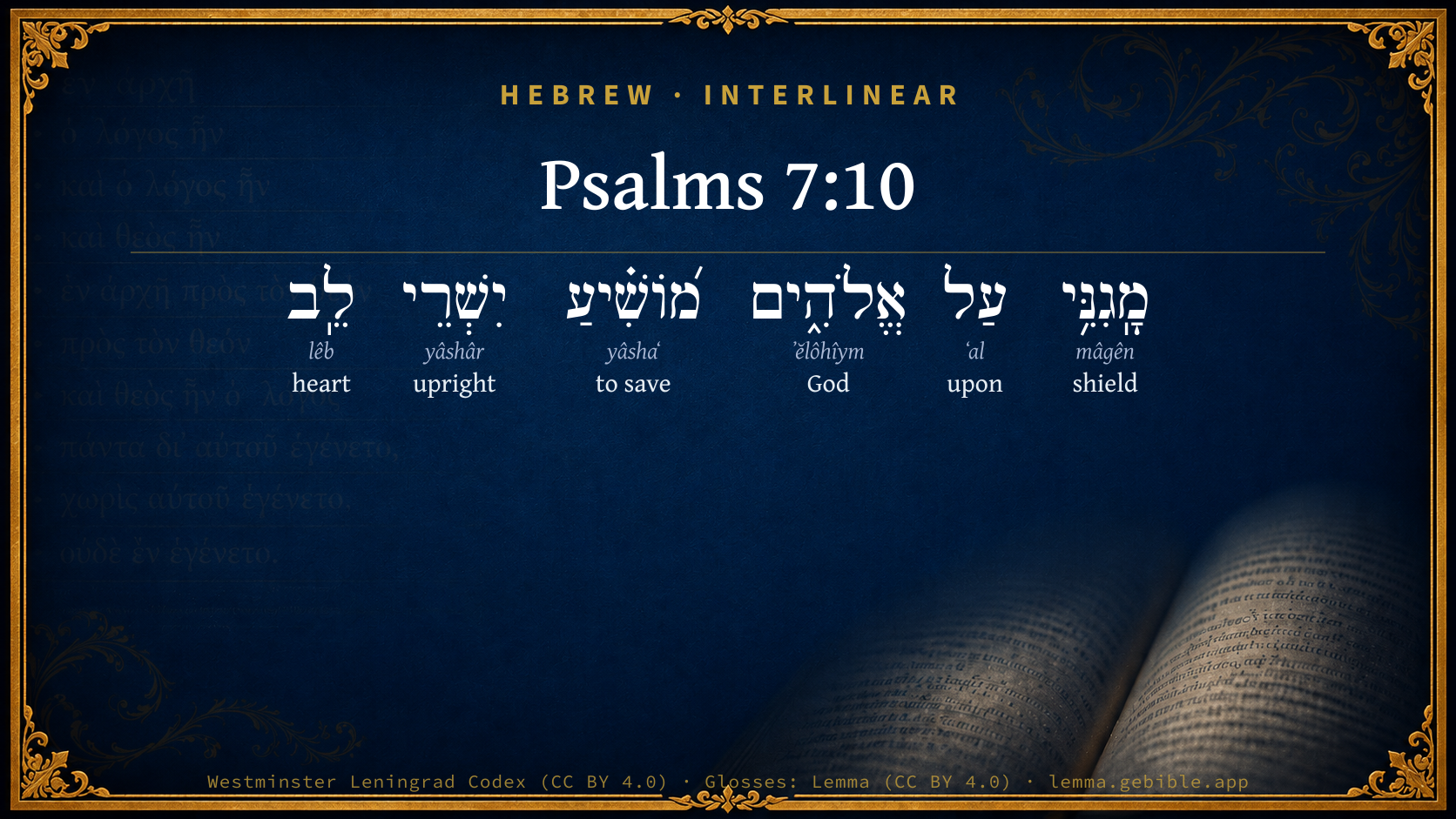
Psalms 7:10

Hebrew (Westminster Leningrad Codex) Psalms 7:10 appears in the Hebrew Old Testament. The text above is from the Westminster Leningrad Codex. Each word links to its Strong’s number, a concise gloss, and parsing drawn from the Open Scriptures Hebrew Bible morphology. Click any word for its full Brown-Driver-Briggs (BDB) entry.
Download image
Cite this verse

Psalms 7:10 (World English Bible). Public Domain. Lemma interlinear Bible study tool, https://lemma.gebible.app/v/psalms/7/10.

Show BibTeX & RIS
BibTeX
RIS
English Translation
My shield is with God, Who saves the upright in heart.
World English Bible · Public Domain
Download a study sheet

One document with this verse’s original text, its word-by-word gloss line, the meaning frame, cross-references with their text, attributed commentary, and full source and license credits — printable, and it pastes into notes with its structure intact.

This verse Autodidact and up

Study sheet (.html) Plain text (.txt)

A passage Seminary Student

Up to 50 verses in one chapter. A passage sheet keeps up to 6 commentary sources and 12 cross-references per verse, in the order this page ranks them, and says so on the sheet whenever that leaves anything out. Ask for a single verse and you get the Autodidact verse sheet above.

Everything on this page stays free to read, with no account — the sheet is a download of what is already on screen, not access to it.

Want to remove ads? Support Godless Engineer
Compare translations 3

The same verse in 3 English versions, stacked beneath the original-language interlinear above. Click any original word for its lexicon entry.

Each is an independent rendering of the whole verse — the interlinear is not word-aligned to these translations.

Highlighted words mark where these versions differ — a whole-verse word diff, not a word-by-word alignment.

  • World English Bible Public Domain
    My shield is with God, Who saves the upright in heart.
  • King James Version Public Domain
    My defence is of God, which saveth the upright in heart.
  • unfoldingWord Literal Text CC BY-SA 4.0
    My shield is with God, the savior of the upright of heart.

unfoldingWord Literal Text — © unfoldingWord, licensed CC BY-SA 4.0. Word-aligned USFM3 via Door43 (git.door43.org/unfoldingWord/en_ult).

Versions to compare (up to 4)

3 of 4 selected

Show all 18 translations

Every available English version of this verse, each an independent rendering of the whole verse.

  • World English Bible Public Domain
    My shield is with God, Who saves the upright in heart.
  • Berean Standard Bible Public Domain
    My shield is with God, who saves the upright in heart.
  • Majority Standard Bible Public Domain
    My shield is with God, who saves the upright in heart.
  • King James Version Public Domain
    My defence is of God, which saveth the upright in heart.
  • American Standard Version (1901) Public Domain
    My shield is with God, Who saveth the upright in heart.
  • Revised Version (1885) Public Domain
    My shield is with God, which saveth the upright in heart.
  • Geneva Bible (1599) Public Domain
    My defence is in God, who preserueth the vpright in heart.
  • Douay-Rheims (1899) Public Domain
    The wickedness of sinners shall be brought to nought: and thou shalt direct the just: the searcher of hearts and reins is God.
  • Young's Literal Translation Public Domain
    My shield `is' on God, Saviour of the upright in heart!
  • Literal Standard Version CC BY-SA 4.0
    My shield [is] on God, || Savior of the upright in heart!
  • Unlocked Literal Bible CC BY-SA 4.0
    My shield comes from God, the one who saves the upright in heart.
  • unfoldingWord Literal Text CC BY-SA 4.0
    My shield is with God, the savior of the upright of heart.
  • Darby Bible Public Domain
    My shield is with God, who saveth the upright in heart.
  • World Messianic Bible Public Domain
    My shield is with God, who saves the upright in heart.
  • Webster's Bible Public Domain
    \\7:9\\Oh let the wickedness of the wicked come to an end; but establish the just: for the righteous God trieth the hearts and reins.
  • Free Bible Version CC BY-SA 4.0
    The Most High God is my defense, the one who saves those who live right.
  • Bible in Basic English Public Domain
    God, who is the saviour of the upright in heart, is my breastplate.
  • JPS Tanakh (1917) Public Domain
    (7-11) My shield is with God, who saveth the upright in heart.

Literal Standard Version (2020), Covenant Press — licensed CC BY-SA 4.0. Text via the HelloAO Bible API (eBible.org). Unlocked Literal Bible (unfoldingWord) — licensed CC BY-SA 4.0. Text via the HelloAO Bible API (eBible.org). unfoldingWord Literal Text — © unfoldingWord, licensed CC BY-SA 4.0. Word-aligned USFM3 via Door43 (git.door43.org/unfoldingWord/en_ult). Free Bible Version, Dr. Jonathan Gallagher — licensed CC BY-SA 4.0. Text via the HelloAO Bible API (eBible.org).

Word by word

More ways to search: Search by grammar → Find every occurrence → Compare this word →

Practice this passage: Drill this verse → Learn its vocabulary →

About this verse

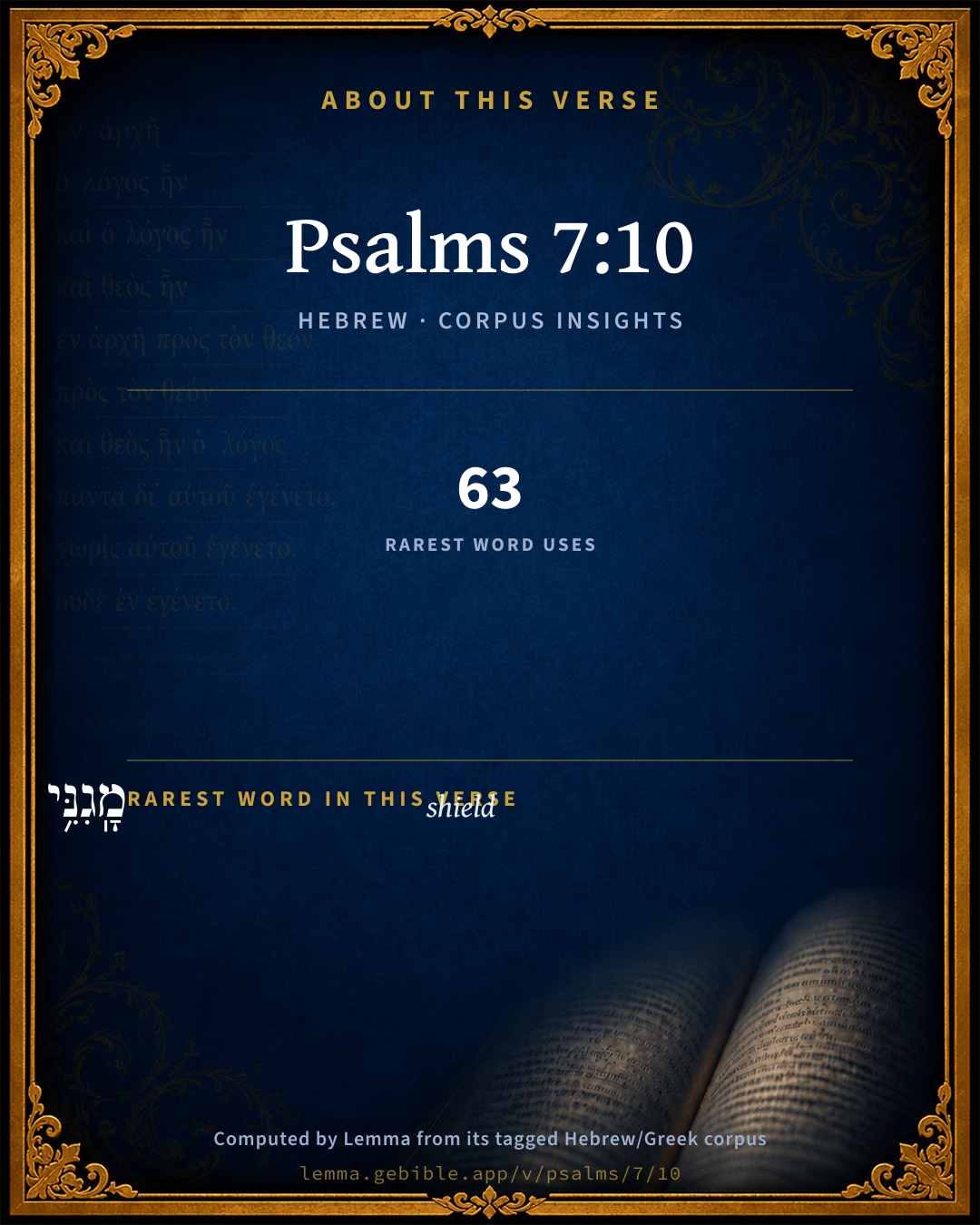
These counts appear in no published source. They are computed here, from the morphology-tagged text and Lemma’s own curated glosses. What Lemma adds →

6
words
6
distinct lemmas
Wisdom
section

Grammatical profile

  • 1 verb
  • 3 nouns
  • 1 adjective
  • 1 preposition

Verb forms

  • מ֝וֹשִׁ֗יעַ Hiphil · Participle Active

Hebrew & Septuagint length

In English translation the verse runs 11 words from the Hebrew and 13 from the Septuagint (LXX English) — closely comparable.

A rough comparison of the two English renderings, which tokenize alike — not a word-level alignment.

Word counts can differ between the Hebrew and the Greek without any difference in meaning — e.g. the Hebrew direct-object marker אֵת has no separate Greek word, and Greek often adds the article ὁ.

Cross-references

11

Topical passages linked to Psalms 7:10 in the Treasury of Scripture Knowledge — connected by theme and wording, ordered by reader-vote popularity; previews shown in the World English Bible.

  • Genesis 15:1 After these things the word of Yahweh came to Abram in a vision, saying, "Don't be afraid, Abram. I am your shield, your exceedingly great reward."
  • Psalms 84:11 For Yahweh God is a sun and a shield. Yahweh will give grace and glory. He withholds no good thing from those who walk blamelessly.
  • Psalms 125:4 Do good, Yahweh, to those who are good, To those who are upright in their hearts.
  • Proverbs 28:18 Whoever walks blamelessly is kept safe; But one with perverse ways will fall suddenly.
  • Job 8:6 If you were pure and upright, Surely now he would awaken for you, And make the habitation of your righteousness prosperous.
  • Proverbs 2:21 For the upright will dwell in the land. The perfect will remain in it.
  • Proverbs 11:20 Those who are perverse in heart are an abomination to Yahweh, But those whose ways are blameless are his delight.
  • Psalms 3:3 But you, Yahweh, are a shield around me, My glory, and the one who lifts up my head.
  • Psalms 18:1–2 I love you, Yahweh, my strength.
  • Psalms 89:18 For our shield belongs to Yahweh; Our king to the Holy One of Israel.
  • Psalms 112:2 His seed will be mighty in the land. The generation of the upright will be blessed.

Cross-references courtesy of OpenBible.info (CC BY 4.0).

Hebrew and Greek witnesses Masoretic Hebrew ↔ Greek Septuagint

The same verse in the two great witnesses to the Old Testament, shown verse-for-verse.

You’re reading Greek Psalm 7 (Hebrew Psalm 7). The Septuagint counts the superscription, so verse numbers can differ from the Hebrew — chapter-level alignment, not verse-by-verse. Numbering follows Rahlfs.

These are two independent witnesses, not word-aligned to each other, and the Septuagint is shown in lemma (dictionary) form.

Hebrew Psalms 7:10 Masoretic · Westminster Leningrad Codex

מָֽגִנִּ֥י עַל אֱלֹהִ֑ים מ֝וֹשִׁ֗יעַ יִשְׁרֵי לֵֽב

My shield is with God, Who saves the upright in heart.

World English Bible · Public Domain

Greek LXX Greek Psalm 7:10 Septuagint · lemma form

συντελέω δή πονηρία ἁμαρτωλός καί καταεὐθύνω δίκαιος ἐτάζω καρδία καί νεφρός ὁ θεός

My help is righteous, coming from God who saves the upright in heart.

LXX2012 (modern English Septuagint) · Public Domain

Hebrew: Westminster Leningrad Codex (CC BY 4.0). Greek: Septuagint (public domain); English from LXX2012 (modern English Septuagint) (Public Domain). How the Septuagint differs from the Hebrew →

Commentary

Notes on Psalms 7:10 from classic Christian and Jewish commentators (each source and its license shown beneath its notes). The classic Christian expositions comment on the surrounding passage and are grouped to its opening verse, so a note may address several verses; the Jewish commentaries on the Tanakh (Rashi and others) are per-verse, so they appear only where the commentator wrote on this verse.

Lemma curates 59 commentaries, every one of them public domain or Creative Commons licensed, each selected and text-cleaned for this edition rather than reprinted as found. About our sources →

Matthew Henry's Commentary

David having lodged his appeal with God by prayer and a solemn profession of his integrity, in the former part of the psalm, in this latter part does, as it were, take out judgment upon the appeal, by faith in the word of God, and the assurance it gives of the happiness and safety of the righteous and the certain destruction of wicked people that continue impenitent.

I. David is confident that he shall find God his powerful protector and Saviour, and the patron of his oppressed innocency (Psa 7:10): "My defence is of God. Not only, God is my defender, and I shall find him so; but I look for defence and safety in no other; my hope for shelter in a time of danger is placed in God alone; if I have defence, it must be of God." My shield is upon God (so some read it); there is that in God which gives an assurance of protection to all that are his. His name is a strong tower, Pro 18:10. Two things David builds this confidence upon: - 1. The particular favour God has for all that are sincere: He saves the upright in heart, saves them with an everlasting salvation, and therefore will preserve them to his heavenly kingdom; he saves them out of their present troubles, as far as is good for them; their integrity and uprightness will preserve them. The upright in heart are safe, and ought to think themselves so, under the divine protection. 2. The general respect he has for justice and equity: God judgeth the righteous; he owns every righteous cause, and will maintain it in every righteous man, and will protect him. God is a righteous Judge (so some read it), who not only doeth righteousness himself, but will take care that righteousness be done by the children of men and will avenge and punish all unrighteousness.

II. He is no less confident of the destruction of all his persecutors, even as many of them as would not repent, to give glory to God. He reads their doom here, for their good, if possible, that they might cease from their enmity, or, however, for his own comfort, that he might not be afraid of them nor aggrieved at their prosperity and success for a time. He goes into the sanctuary of God, and there understands,

1. That they are children of wrath. They are not to be envied, for God is angry with them, is angry with the wicked every day. They are every day doing that which is provoking to him, and he resents it, and treasures it up against the day of wrath. As his mercies are new every morning towards his people, so his anger is new every morning against the wicked, upon the fresh occasions given for it by their renewed transgressions. God is angry with the wicked even in the merriest and most prosperous of their days, even in the days of their devotion; for, if they be suffered to prosper, it is in wrath; if they pray, their very prayers are an abomination. The wrath of God abides upon them (Joh 3:36) and continual additions are made to it.

2. That they are children of death, as all the children of wrath are, sons of perdition, marked out for ruin. See their destruction.

(1.) God will destroy them. The destruction they are reserved for is destruction from the Almighty, which ought to be a terror to every one of us, for it comes from the wrath of God, Psa 7:13, Psa 7:14. It is here intimated, [1.] That the destruction of sinners may be prevented by their conversion, for it is threatened with that proviso: If he turn not from his evil way, if he do not let fall his enmity against the people of God, then let him expect it will be his ruin; but, if he turn, it is implied that his sin shall be pardoned and all shall be well. Thus even the threatenings of wrath are introduced with a gracious implication of mercy, enough to justify God for ever in the destruction of those that perish; they might have turned and lived, but they chose rather to go on and die and their blood is therefore upon their own heads. [2.] That, if it be not thus prevented by the conversion of the sinner, it will be prepared for him by the justice of God. In general (Psa 7:13), He has prepared for him the instruments of death, of all that death which is the wages of sin. If God will slay, he will not want instruments of death for any creature; even the least and weakest may be made so when he pleases. First, Here is variety of instruments, all which breathe threatenings and slaughter. Here is a sword, which wounds and kills at hand, a bow and arrows, which wound and kill at a distance those who think to get out of the reach of God's vindictive justice. If the sinner flees from the iron weapon, yet the bow of steel shall strike him through, Job 20:24. Secondly, These instruments of death are all said to be made ready. God has them not to seek, but always at hand. Judgments are prepared for scorners. Tophet is prepared of old. Thirdly, While God is preparing his instruments of death, he gives the sinners timely warning of their danger, and space to repent and prevent it. He is slow to punish, and long-suffering to us-ward, not willing that any should perish. Fourthly, The longer the destruction is delayed, to give time for repentance, the sorer will it be and the heavier will it fall and lie for ever if that time be not so improved; while God is waiting the sword is in the whetting and the bow in the drawing. Fifthly, The destruction of impenitent sinners, though it come slowly, yet comes surely; for it is ordained, they are of old ordained to it. Sixthly, Of all sinners persecutors are set up as the fairest marks of divine wrath; against them, more than any other, God has ordained his arrows. They set God at defiance, but cannot set themselves out of the reach of his judgments.

(2.) They will destroy themselves, Psa 7:14-16. The sinner is here described as taking a great deal of pains to ruin himself, more pains to damn his soul than, if directed aright, would save it. His conduct is described, [1.] By the pains of a labouring woman that brings forth a false conception, Psa 7:14. The sinner's head with its politics conceives mischief, contrives it with a great deal of art, lays the plot deep, and keeps it close; the sinner's heart with its passions travails with iniquity, and is in pain to be delivered of the malicious projects it is hatching against the people of God. But what does it come to when it comes to the birth? It is falsehood; it is a cheat upon himself; it is a lie in his right hand. He cannot compass what he intended, nor, if he gain his point, will he gain the satisfaction he promised himself. He brings forth wind (Isa 26:18), stubble (Isa 33:11), death (Jam 1:15), that is, falsehood. [2.] By the pains of a labouring man that works hard to dig a pit, and then falls into it and perishes in it. First, This is true, in a sense of all sinners. They prepare destruction for themselves by preparing themselves for destruction, loading themselves with guilt and submitting themselves to their corruptions. Secondly, It is often remarkably true of those who contrive mischief against the people of God or against their neighbours; by the righteous hand of God it is made to return upon their own heads. What they designed for the shame and destruction of others proves to be their own confusion.

- Nec lex est jusitior ulla

Quam necis artifices arte perire sua -

There is not a juster law than that the author

of a murderous contrivance shall perish by it.

Some apply it to Saul, who fell upon his sword.

In singing this psalm we must do as David here does (Psa 7:17), praise the Lord according to his righteousness, that is, give him the glory of that gracious protection under which he takes his afflicted people and of that just vengeance with which he will pursue those that afflict them. Thus we must sing to the praise of the Lord most high, who, when his enemies deal proudly, shows that he is above them.

Matthew Henry's Commentary on the Whole Bible (1708–1710) — public domain (CC PDM 1.0). Text via the HelloAO Bible API.

Trapp's Complete Commentary

John Trapp

Psa 7:10 My defence [is] of God, which saveth the upright in heart.

Ver. 10. My defence is of God] Heb. My buckler is upon God. {See Trapp on "Psa 3:3"}

Which saveth the upright in heart] Of which number I know myself to he one; and do, therefore, look for his salvation.

John Trapp, A Commentary or Exposition upon All the Books of the Old and New Testament (1647–1656) — public domain. Text from a community e-Sword module.

The Biblical Illustrator

Joseph S. Exell

Psa_7:10

My defence is of God, which sayeth the upright in heart.

God, the shield bearer of the upright

Lit.: God is my shield bearer. Fig.: I hang my shield upon God. The idea is that of going to war, and having God as the carrier, the bearer, of our shield, so that before we can be struck down, God Himself must be wounded and overpowered. My defence is of God. There are times when we need great defences. There arise m life crises, points of agony, when we can only be silent, having first said to God, Undertake for me. There are times when it seems to us but a small thing, or a course quite natural, to claim all heaven as our defence. These are supreme moments. The bulk of life is commonplace, lived on an ordinary level, requiring the discharge of common duties. There are times when the whole heaven is no longer a defence, but an accusation. These are the terrible moments of life. Where, then, is mans defence? Let man in such moments look within; let him trace the course of his own spirit and action; and if he can find in that action reasons for self-condemnation, then let him be penitent and broken-hearted; let him find God through his tears. The tears must not be selfish: no man must make an investment of his broken-heartedness. Repentance must be perfect, vital, sincere, all-inclusive. He does not repent who cries simply because the consequences are painful. Contrition has nothing to do with consequences. God may be both accuser and defender. He prefers the accusation with the reluctance of wounded love; through the accusation He causes to shine the light of the prepared defence: His mercy endureth forever. He is the defender of the sinner, when the offender falls down in contrition and self-examination. The Psalmist falls back upon the vital element of character. Saveth the upright in heart. Is God, then, only the defender of the righteous, who have never sinned? No such meaning is here. The upright in heart may not always be the upright in conduct. Men cannot go beyond conduct; God goes into motive, purpose, secret thought. May there, then, be broken conduct and yet a heart truly upright before God? There may be, and that is our hope. God does not look upon us as we are, but upon what we would be if we could. Where there is this integrity or uprightness of heart, all the rest will be well. When you have the upright heart all needful consistency will be guaranteed. A growing life is never a literally consistent one. Many a man is mechanically consistent who is spiritually self-contradictory. Do we want to be upright in heart? There is but one gospel way. The grace of God alone can make the heart true and new and beautiful. We cannot give ourselves uprightness of heart. It is not in man to make himself clean. (Joseph Parker, D. D.)

The upright in heart

I. A character described. The upright in heart. Now it includes inward principle as the wheel which puts the whole machine in action; and outward conduct is the result of it. Take as example--

1. Nathaniel. He was a man whose outward character corresponded with the promptings of his heart.

2. Remember there may be uprightness of heart with many failings. God looks at the intents of the heart. Only they must be sincere.

II. The privilege of this character.

1. Gods defence. We see how God defends the tender plants from winters cold and summers heat. But yet more does He protect His children. For His love is deeper, stronger, and more lasting than that of a mother.

2. Gods salvation. God raiseth the upright in heart. But our salvation is in Christ, there is none out of Him. (W. D. Howard.)

The Biblical Illustrator, edited by Joseph S. Exell (c. 1880s–1900s) — public domain. Text from a community e-Sword module.

Joseph Benson's Commentary

Psa 7:10-11. My defence is of God — Hebrew, מגני על אלהים, maginni gnal Elohim, my shield is upon God. He, as it were, carries my shield before me: see 1Sa 17:7. He does and will protect me against all mine enemies. Which saveth the upright in heart — And therefore will save me whom he knows to be sincere and upright in my conduct toward him and toward Saul. God judgeth the righteous — That is, defendeth, or avengeth, or delivereth, as this word is often used. To judge is properly to give sentence; which, because it may be done either by absolving and acquitting from punishment, or by condemning and giving up to punishment, therefore, it is sometimes used for the one and sometimes for the other, as the circumstances of the place determine. God is angry with the wicked every day — Even then when his providence seems to favour them, and they are most secure and confident.

Joseph Benson's Commentary on the Old and New Testaments (1811–1818) — public domain. Text from a community e-Sword module.

J. A. Alexander on Psalms

Joseph Addison Alexander

11. (Psa 7:10). My shield (is) upon God. My protection or defence depends on him alone. The figure is the same as in Psa 7:4 (3) and Psa 7:13 (12). Here again the hope of personal deliverance is founded on a general truth, as to the course of the divine administration. My shield (is) upon God, saving, or who saves, the Saviour of the upright, straightforward, or sincere in heart. This is a new indirect assertion of his own integrity and innocence.

Joseph Addison Alexander, The Psalms Translated and Explained (1850) — public domain. Text from a community e-Sword module.

Tyndale Open Study Notes

Tyndale Open Resources

7:10-13 The psalmist moves from his own situation (7:1-9) to speak for all the godly who long for redemption (7:10-16). He depicts God as the righteous King who vindicates his subjects when they cry out for rescue.

Tyndale Open Study Notes — © Tyndale Open Resources, licensed CC BY-SA 4.0. Text via the HelloAO Bible API.

Jamieson, Fausset & Brown

Robert Jamieson, A. R. Fausset & David Brown

defence--literally, "shield" (Psa 5:12).

Jamieson, Fausset & Brown — Commentary Critical and Explanatory on the Whole Bible (1871) — public domain (CC PDM 1.0). Text via the HelloAO Bible API.

Adam Clarke's Commentary

Verse 10. My defence is of God] I now leave my cause in the hands of my Judge. I have no uneasy or fearful apprehensions, because I know God will save the upright in heart.

Adam Clarke's Commentary on the Bible (1810–1826) — public domain. Text from a community e-Sword/MySword module.

John Calvin's Commentaries

10. My shield It is not wonderful that David often mingles meditations with his prayers, thereby to inspire himself with true confidence. We may go to God in prayer with great alacrity; but our fervour, if it does not gather new strength, either immediately fails or begins to languish. David, therefore, in order to continue in prayer with the same ardour of devotion and affection with which he commenced, brings to his recollection some of the most common truths of religion, and by this means fosters and invigorates his faith. He declares, that as God saves the upright in heart, he is perfectly safe under his protection. Whence it follows, that he had the testimony of an approving conscience. And, as he does not simply say the righteous, but the upright in heart, he appears to have an eye to that inward searching of the heart and reins mentioned in the preceding verse.

John Calvin's Commentaries (1540-1563) — public domain. Text from the Calvin Translation Society English edition (1840s-50s) via the Christian Classics Ethereal Library (ccel.org). Calvin's coverage is partial (roughly two-thirds of the Bible); uncommented books and verses are honest gaps, never fabricated. The 19th-century editor's footnotes and remarks are omitted so the notes are faithfully Calvin's own voice.

Ellicott's Commentary for English Readers

(10) My defence.—Literally, as in margin, my shield is upon God. (Comp. Psa_62:7, “In God is my salvation,” where the Hebrew is as here, “God is my shield-bearer.”) Another explanation appears in Milton’s translation—

“On God is cast

My defence, and in Him lies,

In Him who both just and wise,

Saves the upright at heart at last.”

A Bible Commentary for English Readers, edited by Charles John Ellicott (1878–1897) — public domain. Text from a community e-Sword module.

The Cambridge Bible for Schools and Colleges

gen. ed. J. J. S. Perowne

10. My defence is of God] R.V., my shield is with God. Lit. my shield is upon God; it rests with God to defend me. Cp. Psa_62:7.

The Cambridge Bible for Schools and Colleges (gen. ed. J. J. S. Perowne; Cambridge University Press, 1878–1918) — public domain. Text from a community e-Sword module.

John Gill's Exposition

My defence is of God,.... Or "my shield is in" or "of God" (e); God was his shield, his protector and defender; see Psa 3:3; or "my shield is with God"; that is, Christ, who was the shield his faith made use of against every spiritual enemy, was with God; he was with him as the Word and Son of God from all eternity, and as the living Redeemer of his people before his incarnation; and he is now with him as their intercessor and advocate, who pleads in defence of them, and opposes himself, his blood and righteousness, to all the charges and accusations of Satan;

which saveth the upright in heart: who have the truth of grace in them, wisdom in the hidden part; who are sincere in their affections, purposes, and designs, in their faith, hope, and love; and act from real principles of truth and love, in the integrity of their souls; for these light and gladness are sown, to them grace and glory are given, and no good thing is withheld from them; they are saved by God from sin, Satan, the world, death, and hell, and every enemy, with a spiritual and everlasting salvation.

(e) "in Deo", Musculus, Tigurine version, Junius & Tremellius, Muis, Ainsworth; "apud Deum", Lutherus, Piscator, Gejerus, Cocceius, Michaelis.

John Gill's Exposition of the Whole Bible (1746–1763) — public domain (CC PDM 1.0). Text via the HelloAO Bible API.

Albert Barnes' Notes on the Bible

My defense is of God - The meaning here is, that God was his protector, and that in his troubles he confided in him. The original word here, as in Psa 3:3, note; Psa 5:12, note; is “shield.” See the notes at thoses verses.

Which saveth the upright in heart - whom he that searches the heart Psa 7:9 sees to be upright; or to be sincere, truthful, just. The writer says that it is a characteristic of God that he saves or protects all such; and, conscious of his innocence of the charges against himself, he here appeals to him on that ground, and confides in his protection because he sees that in this respect he was blameless.

Albert Barnes' Notes on the Bible (1834–1885) — public domain. Text from a community e-Sword/MySword module.

Matthew Poole's English Annotations

My defence is of God, Heb. My shield is upon God; he doth as it were carry my shield before me. See 1Sa 17:7. He doth and will protect me against all mine enemies.

Which saveth the upright in heart; and therefore me, whom he knoweth to be sincere and honest in my carriage toward him and toward Saul.

Matthew Poole's English Annotations on the Holy Bible (1683–1685) — public domain. Text from a community e-Sword/MySword module.

The Treasury of David

Charles H. Spurgeon

Ver. 10. The judge has heard the cause, has cleared the guiltless, and uttered his voice against the persecutors. Let us draw near, and learn the results of the great assize. Yonder is the slandered one with his harp in hand, hymning the justice of his Lord, and rejoicing aloud in his own deliverance.

My defense is of God, which saveth the upright in heart. Oh, how good to have a true and upright heart. Crooked sinners, with all their craftiness, are foiled by the upright in heart. God defends the right. Filth will not long abide on the pure white garments of the saints, but shall be brushed off by divine providence, to the vexation of the men by whose base hands it was thrown upon the godly. When God shall try our cause, our sun has risen, and the sun of the wicked is set for ever. Truth, like oil, is ever above, no power of our enemies can drown it; we shall refute their slanders in the day when the trumpet wakes the dead, and we shall shine in honour when lying lips are put to silence. O believer, fear not all that thy foes can do or say against thee, for the tree which God plants no winds can hurt.

Ver. 10. My defense is of God. Literally, "My shield is upon God," like Ps 62:8, "My salvation is upon God." The idea may be taken from the armour-bearer, ever ready at hand to give the needed weapon to the warrior. Andrew A. Bonar.

Ver. 10. Upright in heart. Explain the character.

Ver. 10. The believer's trust in God, and God's care over him. Show the action of faith in procuring defence and protection, and of that defence upon our faith by strengthening it, etc.

Charles H. Spurgeon's The Treasury of David (1869–1885) — public domain. Psalms only. Text from a community e-Sword/MySword module.

The Pulpit Commentary

My defense is of God; literally, my shield is on God; i.e. "rests on him" (Kay) is upheld by him. Which sayeth the upright in heart. (comp. Psa_125:4)

The Pulpit Commentary (1880–1919), ed. H.D.M. Spence-Jones & Joseph S. Exell — public domain. Text from a community e-Sword module.

unfoldingWord translationNotes

Door43 World Missions Community

My shield comes from God

The word "shield" represents God's protection. (See: Metaphor)

a God who is indignant each day

Who God is angry with can be stated explicitly. AT: "a God who is angry with the wicked every day" (See: Assumed Knowledge and Implicit Information)

translationWords

save

righteous

unfoldingWord translationNotes — © Distant Shores Media and the Door43 World Missions Community, licensed CC BY-SA 4.0. Source: git.door43.org/Door43/en_tn.

Rashi

Rabbi Shlomo Yitzchaki (Rashi)

destroy Heb. יגמר, lit. finish. An expression of destruction, and so did Menachem (p. 57) interpret: (77:9), “destroyed (גמר) His word”; (12:2), “a pious man has perished (גמר),” and so all of them. (This does not appear in certain editions.)

and may You establish the righteous...tests the hearts You know who is the righteous man that You may establish him.

the righteous God That is Your name.

Rashi on the Tanakh — English translations: “The Judaica Press complete Tanach with Rashi, translated by A. J. Rosenberg” (CC BY 4.0); “Pentateuch with Rashi's commentary by M. Rosenbaum and A.M. Silbermann, 1929-1934” (public domain); “The Metsudah Tanach series, Lakewood, N.J” (CC BY 4.0); and “The Book of Joshua, Metsudah Publications, 1997” (CC BY 4.0). Text via Sefaria.

Radak

Rabbi David Kimhi (Radak)

Oh let the wickedness of the wicked bring to an end: – He says: the wickedness which the wicked plan and do, may it bring them to an end and destroy them.

but establish Thou (the) righteous: – And the righteous Thou wilt establish his way and his plan, and support him. And he says this of himself and of the righteous who were in Israel.

For it is the righteous God who trieth the hearts and reins: – He who tries the hearts and knows the thoughts of man knows the righteous and the wicked; for many of the sons of men make a show of being good when they are not so. And He is a righteous God – he means One who judges with equity, and assigns to everyone according to his ways and his thoughts, for He knows all.

Radak on the Tanakh — English translations: “Sefaria Community Translation” (CC0 1.0 (public-domain dedication)); “Eliyahu Munk, HaChut Hameshulash” (CC BY 4.0); “Rabbi Mike Feuer, Jerusalem Anthology” (CC BY 4.0); and “R. David Kimhi on the first book of Psalms, Translated by R.G. Finch, London, 1919” (public domain). Text via Sefaria.

Lesson kit

Teaching starters — assembled from the data on this page, not authored interpretation. Every prompt links to the verse data it draws on. Edit before teaching.

Psalms, in the Wisdom, opens this verse with 6 words (6 distinct Hebrew lemmas). Its most distinctive word is mâgên (“shield”). A historical commentator’s framing appears above. Read the whole chapter for the surrounding context.

Discussion questions

  1. How does “shield” (mâgên) shape what this verse is saying?
  2. Genesis 15:1 shares this passage’s theme. How do the two illuminate each other?
  3. These translations render this verse differently; the difference is in the English rendering, not the original. What questions does that raise?
  4. The verb «מ֝וֹשִׁ֗יעַ» is Hiphil Participle Active. How does its form color the action?
  5. Reading how Matthew Henry's Commentary and Trapp's Complete Commentary read this verse, where do the two commentators agree and where do they part?

Things to notice

Reading settings

Reading text

Shown beneath each verse's original-language words.

Old Testament
Old Testament edition

Read the OT as the Masoretic Hebrew (MT) or the Greek Septuagint (LXX).

English shown for the Greek Septuagint (in the Hebrew ↔ Greek comparison).

Comparing translations? Open the Compare panel on any verse page to stack up to four side by side.