
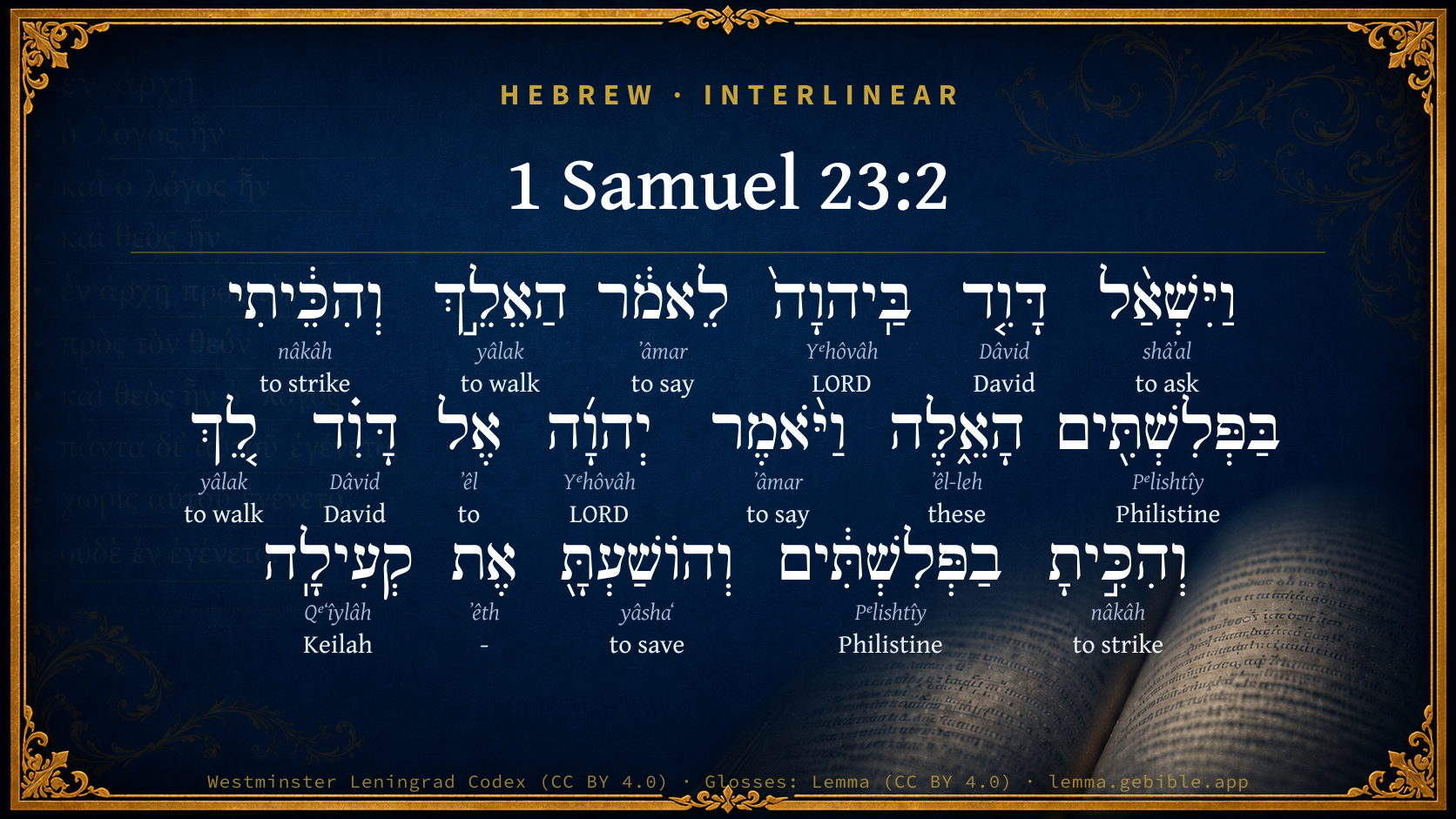
1 Samuel 23:2

Hebrew (Westminster Leningrad Codex) 1 Samuel 23:2 appears in the Hebrew Old Testament. The text above is from the Westminster Leningrad Codex. Each word links to its Strong’s number, a concise gloss, and parsing drawn from the Open Scriptures Hebrew Bible morphology. Click any word for its full Brown-Driver-Briggs (BDB) entry.
Download image
Cite this verse

1 Samuel 23:2 (World English Bible). Public Domain. Lemma interlinear Bible study tool, https://lemma.gebible.app/v/1-samuel/23/2.

Show BibTeX & RIS
BibTeX
RIS
English Translation
Therefore David inquired of Yahweh, saying, Shall I go and strike these Philistines? Yahweh said to David, Go, and strike the Philistines, and save Keilah.
World English Bible · Public Domain
Download a study sheet

One document with this verse’s original text, its word-by-word gloss line, the meaning frame, cross-references with their text, attributed commentary, and full source and license credits — printable, and it pastes into notes with its structure intact.

This verse Autodidact and up

Study sheet (.html) Plain text (.txt)

A passage Seminary Student

Up to 50 verses in one chapter. A passage sheet keeps up to 6 commentary sources and 12 cross-references per verse, in the order this page ranks them, and says so on the sheet whenever that leaves anything out. Ask for a single verse and you get the Autodidact verse sheet above.

Everything on this page stays free to read, with no account — the sheet is a download of what is already on screen, not access to it.

Want to remove ads? Support Godless Engineer
Compare translations 3

The same verse in 3 English versions, stacked beneath the original-language interlinear above. Click any original word for its lexicon entry.

Each is an independent rendering of the whole verse — the interlinear is not word-aligned to these translations.

Highlighted words mark where these versions differ — a whole-verse word diff, not a word-by-word alignment.

  • World English Bible Public Domain
    Therefore David inquired of Yahweh, saying, Shall I go and strike these Philistines? Yahweh said to David, Go, and strike the Philistines, and save Keilah.
  • King James Version Public Domain
    Therefore David inquired of the LORD, saying, Shall I go and smite these Philistines? And the LORD said unto David, Go, and smite the Philistines, and save Keilah.
  • unfoldingWord Literal Text CC BY-SA 4.0
    And David inquired of Yahweh, saying, “Shall I go and strike these Philistines?” And Yahweh said to David, “Go and strike the Philistines and save Keilah.”

unfoldingWord Literal Text — © unfoldingWord, licensed CC BY-SA 4.0. Word-aligned USFM3 via Door43 (git.door43.org/unfoldingWord/en_ult).

Versions to compare (up to 4)

3 of 4 selected

Show all 18 translations

Every available English version of this verse, each an independent rendering of the whole verse.

  • World English Bible Public Domain
    Therefore David inquired of Yahweh, saying, Shall I go and strike these Philistines? Yahweh said to David, Go, and strike the Philistines, and save Keilah.
  • Berean Standard Bible Public Domain
    So David inquired of the LORD, “Should I go and attack these Philistines?” And the LORD said to David, “Go and attack the Philistines and save Keilah.”
  • Majority Standard Bible Public Domain
    So David inquired of the LORD, “Should I go and attack these Philistines?” And the LORD said to David, “Go and attack the Philistines and save Keilah.”
  • King James Version Public Domain
    Therefore David inquired of the LORD, saying, Shall I go and smite these Philistines? And the LORD said unto David, Go, and smite the Philistines, and save Keilah.
  • American Standard Version (1901) Public Domain
    Therefore David inquired of Jehovah, saying, Shall I go and smite these Philistines? And Jehovah said unto David, Go, and smite the Philistines, and save Keilah.
  • Revised Version (1885) Public Domain
    Therefore David inquired of the LORD, saying, Shall I go and smite these Philistines? And the LORD said unto David, Go, and smite the Philistines, and save Keilah.
  • Geneva Bible (1599) Public Domain
    Therfore Dauid asked counsel of the Lord, saying, Shal I goe and smite these Philistims? And the Lord answered Dauid, Go and smite the Philistims, and saue Keilah.
  • Douay-Rheims (1899) Public Domain
    Therefore David consulted the Lord, saying: Shall I go and smite these Philistines? And the Lord said to David: Go, and thou shalt smite the Philistines, and shalt save Ceila.
  • Young's Literal Translation Public Domain
    And David asketh at Jehovah, saying, `Do I go? -- and have I smitten among these Philistines?' And Jehovah saith unto David, `Go, and thou hast smitten among the Philistines, and saved Keilah.'
  • Literal Standard Version CC BY-SA 4.0
    And David inquires of YHWH, saying, “Do I go? And have I struck among these Philistines?” And YHWH says to David, “Go, and you have struck among the Philistines, and saved Keilah.”
  • Unlocked Literal Bible CC BY-SA 4.0
    So David prayed to Yahweh for help and asked him, “Should I go and attack these Philistines?” Yahweh said to David, “Go and attack the Philistines and save Keilah.”
  • unfoldingWord Literal Text CC BY-SA 4.0
    And David inquired of Yahweh, saying, “Shall I go and strike these Philistines?” And Yahweh said to David, “Go and strike the Philistines and save Keilah.”
  • Darby Bible Public Domain
    And David inquired of Jehovah, saying, Shall I go and smite these Philistines? And Jehovah said to David, Go and smite the Philistines, and save Keilah.
  • World Messianic Bible Public Domain
    Therefore David inquired of the LORD, saying, “Shall I go and strike these Philistines?” The LORD said to David, “Go strike the Philistines, and save Keilah.”
  • Webster's Bible Public Domain
    Therefore David inquired of the LORD, saying, Shall I go and smite these Philistines? And the LORD said to David, Go, and smite the Philistines, and save Keilah.
  • Free Bible Version CC BY-SA 4.0
    So he asked advice from the Lord, “Should I go and attack these Philistines?” The Lord told David, “Go and attack the Philistines and save Keilah.”
  • Bible in Basic English Public Domain
    So David, questioning the Lord, said, Am I to go and make an attack on these Philistines? And the Lord said to David, Go and make an attack on the Philistines so that Keilah may be kept from falling into their hands.
  • JPS Tanakh (1917) Public Domain
    Therefore David inquired of the LORD, saying: 'Shall I go and smite these Philistines?' And the LORD said unto David: 'Go, and smite the Philistines, and save Keilah.'

Literal Standard Version (2020), Covenant Press — licensed CC BY-SA 4.0. Text via the HelloAO Bible API (eBible.org). Unlocked Literal Bible (unfoldingWord) — licensed CC BY-SA 4.0. Text via the HelloAO Bible API (eBible.org). unfoldingWord Literal Text — © unfoldingWord, licensed CC BY-SA 4.0. Word-aligned USFM3 via Door43 (git.door43.org/unfoldingWord/en_ult). Free Bible Version, Dr. Jonathan Gallagher — licensed CC BY-SA 4.0. Text via the HelloAO Bible API (eBible.org).

Word by word

More ways to search: Search by grammar → Find every occurrence → Compare this word →

Practice this passage: Drill this verse → Learn its vocabulary →

קְעִילָֽה
Qᵉʻîylâh
H7084
“Keilah”
Noun, Proper
Part of Speech
Noun
Type
Proper
Full BDB Definition

Origin: perhaps from H7049 in the sense of inclosing

TWOT: None

Keilah = "fortress" - a city in the lowlands of Judah northwest of Hebron
  1. וַיִּשְׁאַ֨ל shâʼal H7592 “and · to ask” Conjunction + Verb, Qal, Sequential Imperfect, 3rd Person, Masculine, Singular
  2. דָּוִ֤ד Dâvid H1732 “David” Noun, Proper
  3. בַּֽיהוָה֙ Yᵉhôvâh H3068 “in/at · LORD” Preposition + Noun, Proper
  4. לֵאמֹ֔ר ʼâmar H559 “to say” Preposition + Verb, Qal, Infinitive Construct
  5. הַאֵלֵ֣ךְ yâlak H3212 “to walk” Particle, Interrogative + Verb, Qal, Imperfect, 1st Person, Common, Singular
  6. וְהִכֵּ֔יתִי nâkâh H5221 “and · to strike” Conjunction + Verb, Hiphil, Sequential Perfect, 1st Person, Common, Singular
  7. בַּפְּלִשְׁתִּ֖ים Pᵉlishtîy H6430 “in/at the · Philistines” Preposition, Determined + Noun, Gentilic, Masculine, Plural, Absolute
  8. הָאֵ֑לֶּה ʼêl-leh H428 “the · these” Particle, Definite Article + Pronoun, Demonstrative, Common, Plural
  9. וַיֹּ֨אמֶר ʼâmar H559 “and · to say” Conjunction + Verb, Qal, Sequential Imperfect, 3rd Person, Masculine, Singular
  10. יְהוָ֜ה Yᵉhôvâh H3068 “LORD” Noun, Proper
  11. אֶל ʼêl H413 “to” Preposition
  12. דָּוִ֗ד Dâvid H1732 “David” Noun, Proper
  13. לֵ֚ךְ yâlak H3212 “walk” Verb, Qal, Imperative, 2nd Person, Masculine, Singular
  14. וְהִכִּ֣יתָ nâkâh H5221 “and · to strike” Conjunction + Verb, Hiphil, Sequential Perfect, 2nd Person, Masculine, Singular
  15. בַפְּלִשְׁתִּ֔ים Pᵉlishtîy H6430 “in/at the · Philistines” Preposition, Determined + Noun, Gentilic, Masculine, Plural, Absolute
  16. וְהוֹשַׁעְתָּ֖ yâshaʻ H3467 “and · to save” Conjunction + Verb, Hiphil, Sequential Perfect, 2nd Person, Masculine, Singular
  17. אֶת ʼêth H853 “-” Particle, Direct Object

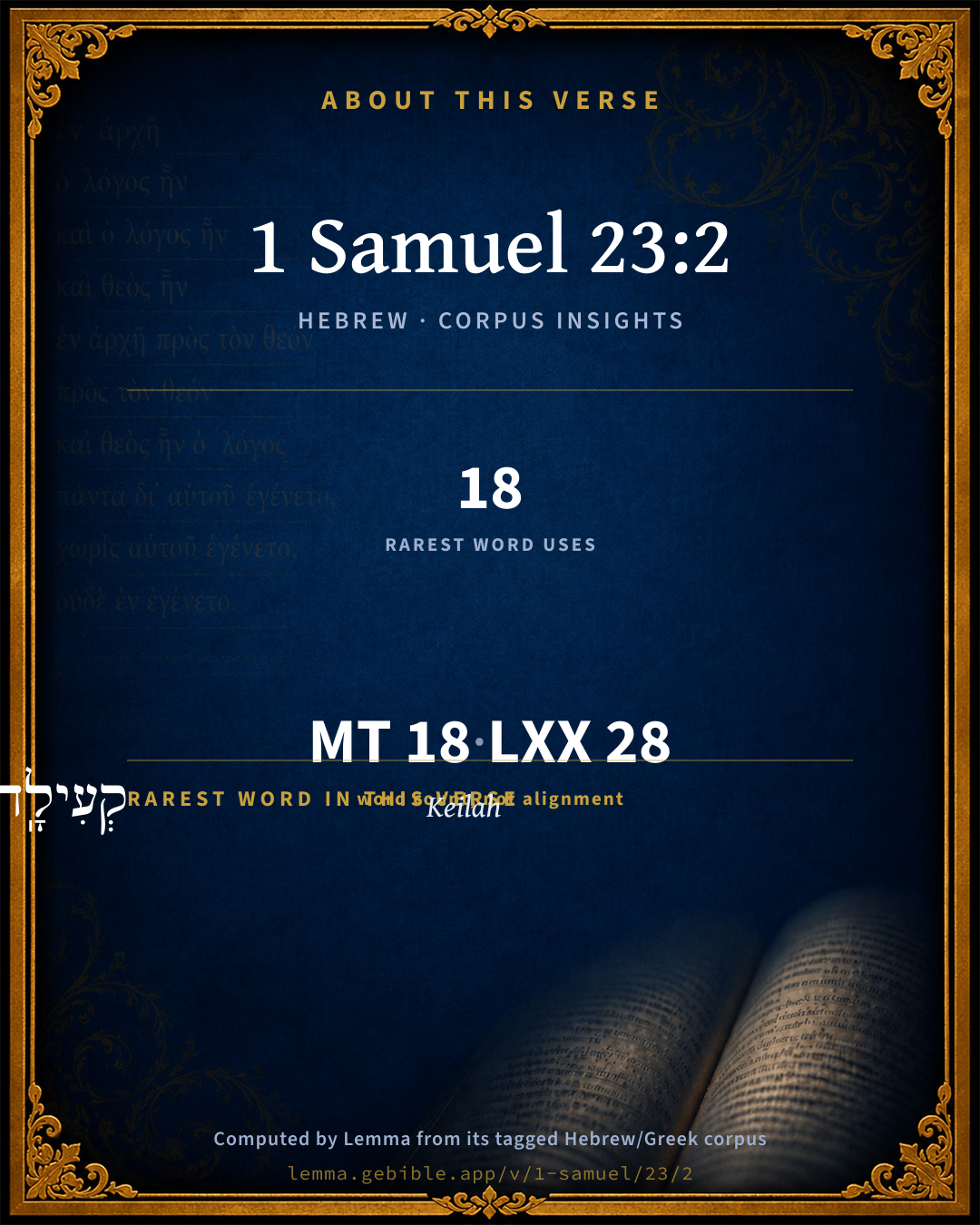
About this verse

These counts appear in no published source. They are computed here, from the morphology-tagged text and Lemma’s own curated glosses. What Lemma adds →

18
words
12
distinct lemmas
Historical
section

Notable vocabulary

The rarest word here is קְעִילָֽה Keilah H7084 — appearing just 18 times in the whole Hebrew Bible.

Shared distinctive vocabulary

קְעִילָֽה Keilah H7084 occurs in 16 verses of the Hebrew Bible. Also found in:

Grammatical profile

  • 8 verbs
  • 7 nouns
  • 1 pronoun
  • 1 preposition
  • 1 particle

Verb forms

  • וַיִּשְׁאַ֨ל Qal · Sequential Imperfect
  • לֵאמֹ֔ר Qal · Infinitive Construct
  • הַאֵלֵ֣ךְ Qal · Imperfect
  • וְהִכֵּ֔יתִי Hiphil · Sequential Perfect
  • וַיֹּ֨אמֶר Qal · Sequential Imperfect
  • לֵ֚ךְ Qal · Imperative
  • וְהִכִּ֣יתָ Hiphil · Sequential Perfect
  • וְהוֹשַׁעְתָּ֖ Hiphil · Sequential Perfect

Repetition

Words recur within this verse — often emphatic in Hebrew:

  • דָּוִ֤ד David H1732 ×2
  • בַּֽיהוָה֙ LORD H3068 ×2
  • לֵאמֹ֔ר to say H559 ×2
  • הַאֵלֵ֣ךְ to walk H3212 ×2
  • וְהִכֵּ֔יתִי to strike H5221 ×2
  • בַּפְּלִשְׁתִּ֖ים Philistine H6430 ×2

Hebrew & Septuagint length

In English translation the verse runs 25 words from the Hebrew and 29 from the Septuagint (LXX English) — closely comparable.

A rough comparison of the two English renderings, which tokenize alike — not a word-level alignment.

Word counts can differ between the Hebrew and the Greek without any difference in meaning — e.g. the Hebrew direct-object marker אֵת has no separate Greek word, and Greek often adds the article ὁ.

In the original languages it is 18 Hebrew tokens and 28 Greek tokens — but the two are counted differently (Hebrew bundles its prefixes and suffixes into one token; the Greek is in lemma form), so that isn’t a like-for-like length.

Cross-references

13

Topical passages linked to 1 Samuel 23:2 in the Treasury of Scripture Knowledge — connected by theme and wording, ordered by reader-vote popularity; previews shown in the World English Bible.

  • 1 Samuel 23:4 Then David inquired of Yahweh yet again. Yahweh answered him, and said, Arise, go down to Keilah; for I will deliver the Philistines into your hand.
  • 2 Samuel 5:19 David inquired of Yahweh, saying, Shall I go up against the Philistines? will you deliver them into my hand? Yahweh said to David, Go up; for I will certainly deliver the Philistines into your hand.
  • 2 Samuel 5:23 When David inquired of Yahweh, he said, You shall not go up: make a circuit behind them, and come on them over against the mulberry trees.
  • Joshua 9:14 The men took of their provision, and didn't ask counsel at the mouth of Yahweh.
  • 1 Samuel 23:6 It happened, when Abiathar the son of Ahimelech fled to David to Keilah, that he came down with an ephod in his hand.
  • 1 Samuel 23:9–12 David knew that Saul was devising mischief against him; and he said to Abiathar the priest, Bring here the ephod.
  • 1 Samuel 30:8 David inquired of Yahweh, saying, If I pursue after this troop, shall I overtake them? He answered him, Pursue; for you shall surely overtake [them], and shall without fail recover [all].
  • Jeremiah 10:23 Yahweh, I know that the way of man is not in himself: it is not in man who walks to direct his steps.
  • Numbers 27:21 He shall stand before Eleazar the priest, who shall inquire for him by the judgment of the Urim before Yahweh: at his word shall they go out, and at his word they shall come in, both he, and all the children of Israel with him, even all the congregation.
  • Judges 1:1 It happened after the death of Joshua, the children of Israel asked of Yahweh, saying, Who shall go up for us first against the Canaanites, to fight against them?
  • 1 Chronicles 14:10 David inquired of God, saying, Shall I go up against the Philistines? and will you deliver them into my hand? Yahweh said to him, Go up; for I will deliver them into your hand.
  • Psalms 32:8 I will instruct you and teach you in the way which you shall go. I will counsel you with my eye on you.
  • Proverbs 3:5–6 Trust in Yahweh with all your heart, And don't lean on your own understanding.

Cross-references courtesy of OpenBible.info (CC BY 4.0).

Hebrew and Greek witnesses Masoretic Hebrew ↔ Greek Septuagint

The same verse in the two great witnesses to the Old Testament, shown verse-for-verse.

These are two independent witnesses, not word-aligned to each other, and the Septuagint is shown in lemma (dictionary) form.

Hebrew 1 Samuel 23:2 Masoretic · Westminster Leningrad Codex

וַיִּשְׁאַ֨ל דָּוִ֤ד בַּֽיהוָה֙ לֵאמֹ֔ר הַאֵלֵ֣ךְ וְהִכֵּ֔יתִי בַּפְּלִשְׁתִּ֖ים הָאֵ֑לֶּה וַיֹּ֨אמֶר יְהוָ֜ה אֶל דָּוִ֗ד לֵ֚ךְ וְהִכִּ֣יתָ בַפְּלִשְׁתִּ֔ים וְהוֹשַׁעְתָּ֖ אֶת קְעִילָֽה

Therefore David inquired of Yahweh, saying, Shall I go and strike these Philistines? Yahweh said to David, Go, and strike the Philistines, and save Keilah.

World English Bible · Public Domain

Greek LXX 1 Samuel 23:2 Septuagint · lemma form

καί ἐπιἐρωτάω δαυίδ διά ὁ κύριος λέγω εἰ πορεύομαι καί πατάσσω ὁ ἀλλόφυλος οὗτος καί εἶπον κύριος πορεύομαι καί πατάσσω ἐν ὁ ἀλλόφυλος οὗτος καί σώζω ὁ κεϊλα

And David enquired of the Lord, saying, Shall I go and strike these Philistines? And the Lord said, Go, and you shall strike these Philistines, and shall save Keila.

LXX2012 (modern English Septuagint) · Public Domain

Hebrew: Westminster Leningrad Codex (CC BY 4.0). Greek: Septuagint (public domain); English from LXX2012 (modern English Septuagint) (Public Domain). How the Septuagint differs from the Hebrew →

Targum (Aramaic paraphrase)

1

The Targum is the ancient Jewish Aramaic paraphrase of the Hebrew Scriptures — an interpretive translation, not the Hebrew text itself. Onkelos (literal) and Pseudo-Jonathan (expansive) render the Torah, and Jonathan the Prophets. Coverage is partial: where no permissively-licensed English translation exists for a verse, only the Aramaic is shown. This is verse-level text, not a word-by-word alignment to the Hebrew.

  1. Targum Jonathan Prophets (Joshua–Malachi)
    וְשָׁאִיל דָוִד בְּמֵימְרָא דַייָ לְמֵימָר הַאֵזִיל וְאֶקְטוֹל בִּפְלִשְׁתָּאֵי הָאִלֵין וַאֲמַר יְיָ לְדָוִד אֱזֵיל וְתִקְטוֹל בִּפְלִשְׁתָּאֵי וְתִפְרוֹק יַת יַתְבֵי קְעִילָה:

    (no public-domain English translation for this verse)

    Targum Jonathan — Aramaic: “Mikraot Gedolot” (public domain). English: “Sefaria Community Translation” (CC0 1.0 (public-domain dedication)); “London "Chaldee Paraphrase," 1871” (public domain). Text via Sefaria.

Commentary

Notes on 1 Samuel 23:2 from classic Christian and Jewish commentators (each source and its license shown beneath its notes). The classic Christian expositions comment on the surrounding passage and are grouped to its opening verse, so a note may address several verses; the Jewish commentaries on the Tanakh (Rashi and others) are per-verse, so they appear only where the commentator wrote on this verse.

Lemma curates 59 commentaries, every one of them public domain or Creative Commons licensed, each selected and text-cleaned for this edition rather than reprinted as found. About our sources →

Trapp's Complete Commentary

John Trapp

1Sa 23:2 Therefore David enquired of the LORD, saying, Shall I go and smite these Philistines? And the LORD said unto David, Go, and smite the Philistines, and save Keilah.

Ver. 2. Therefore David inquired of the Lord.] By his prophet Gad, say most interpreters; for Abiathar was not yet come unto him, {1Sa 23:6} and that which is read of him in 1Sa 22:20 is spoken by way of anticipation. War is to be made by wise counsel, saith Solomon, {Pro 24:6} and, long after him, Salust, a heathen historian: surely it is fit that God be consulted - viz., by prayer and searching the Scriptures - ere war be waged; since it is matter of so great weight, and the issue thereof so uncertain. Herein Josiah was too short, and died for it.

John Trapp, A Commentary or Exposition upon All the Books of the Old and New Testament (1647–1656) — public domain. Text from a community e-Sword module.

Albert Barnes' Notes on the Bible

If Gad was with David at the forest of Hareth 1Sa 22:5, and there inquired for him of the Lord 1Sa 23:2,1Sa 23:4, but did not accompany him to Keilah, and if Abiathar’s flight occurred at the time of David’s being at Keilah, we have an additional striking instance of God’s watchful providential care of David in thus sending Abiathar to supply the place of Gad at so critical a moment.

Albert Barnes' Notes on the Bible (1834–1885) — public domain. Text from a community e-Sword/MySword module.

The Biblical Illustrator

Joseph S. Exell

1Sa_23:2

Shall I go?

The leadings of Providence

David lived under the Mosaic dispensation. Now, that dispensation, as it was remarkable for many extraordinary circumstances, was so more especially for the particular revelation which God was pleased to make in it of Himself to mankind upon special occasions. The will of the Lord appears to have been made known in five several ways:

(1) By voice, as when God conversed with Moses by an audible voice; and with Samuel, when he was yet a child.

(2) By dreams.

(3) By visions, in which a prophet in an ecstasy, without being asleep, saw some striking parabolic representation of what was about to take place.

(4) By special revelation, in which was communicated to a prophet, probably by some remarkable impression on his mind, which clearly discovered its Divine origin, the will of God, or the notification of some future event. And

(5) By Urim and Thummim. When the primitive Church had been some time established in the world, a practice prevailed amongst some of its members of consulting the Scriptures as a directory of conduct,--the Bible was opened at random, and the passage which first presented itself was considered as indicating the Divine will. By degrees this practice came to be generally disused, and men were contented to remain in ignorance concerning events before them, trusting only in the general superintendence of Providence. Another way by which many persons have in all ages endeavoured to discover the direction of God respecting their conduct, has been by observing what they have termed the landings of Providence; that is, by attentively considering those impressions on the mind, or those extraordinary circumstances, by which they suppose God may point out His will that they should act in this or that way. But it will be asked, Are not promises of direction and guidance given to us in Scripture? Are we not told that the steps of a good man are ordered by the Lord, and are we not bidden to acknowledge God in all our ways, and assured that He will then direct our paths?

For our guide in temporal things, God has given us our understanding.

1. Let our first rule be, that we are chiefly solicitous to discharge Duty.

2. Beware of mistaking your own inclinations for the suggestions of Provident.

3. It may be laid down as a maxim that Providence never sanctions the neglect of any duty to point out other courses of action. There is a beautiful uniformity in the conduct which God prescribes for us. No duties over clash with each other.

4. We ought to beware of seeking for other directions than those which Providence has been pleased to appoint. Do not expect revelations where God has not promised them.

5. Let me also caution you against a partial use of the means which Providence has afforded us for our direction. You pray, perhaps, very sincerely; but do you also listen to the suggestions of prudence; do you take the advice of wise and faithful friends? (John Venn.)

The Biblical Illustrator, edited by Joseph S. Exell (c. 1880s–1900s) — public domain. Text from a community e-Sword module.

Joseph Benson's Commentary

1Sa 23:2. David inquired of the Lord — In what way he made inquiry is not certain, as it seems from 1Sa 23:6 that Abiathar had not yet brought to David the sacred ephod, with all things belonging to it that were made use of in consulting God. Shall I go and smite these Philistines? — We have here a remarkable instance of David’s love to his country; unto which he did not become an enemy when he was banished from it. On the contrary, he hasted to its assistance unsolicited. This action of David’s, in going to the relief of Keilah, is one of the most extraordinary ones recorded in history. “Another man, in David’s place, would have rejoiced at this invasion, and perhaps encouraged it; and this both from self-preservation and policy; first, because he had nothing to fear for himself, while Saul had such an enemy upon his hands; and secondly, because the distress of his country was the likeliest means to bring Saul to reason, and force him to recall, and be reconciled to, his best champion. But David was governed by other than these narrow views; nor safety nor honour was desirable to him, purchased by the distress of his country and his friends. His bosom beat with an eager desire to relieve Keilah; but it was not an adventure to be unadvisedly undertaken; and therefore he inquired of God, saying, Shall I go and smite these Philistines? This is one of those passages of Scripture that give evidence of their own truth. None but a hero could put the question; and none but God could resolve it: And the Lord said unto David. Go, and smite the Philistines, and save Keilah.” — Delaney.

Joseph Benson's Commentary on the Old and New Testaments (1811–1818) — public domain. Text from a community e-Sword module.

Jamieson, Fausset & Brown

Robert Jamieson, A. R. Fausset & David Brown

David inquired of the Lord--most probably through Gad (Sa2 24:11; Ch1 21:9), who was present in David's camp (Sa1 22:5), probably by the recommendation of Samuel. To repel unprovoked assaults on unoffending people who were engaged in their harvest operations, was a humane and benevolent service. But it was doubtful how far it was David's duty to go against a public enemy without the royal commission; and on that account he asked, and obtained, the divine counsel. A demur on the part of his men led David to renew the consultation for their satisfaction; after which, being fully assured of his duty, he encountered the aggressors and, by a signal victory, delivered the people of Keilah from further molestation.

Jamieson, Fausset & Brown — Commentary Critical and Explanatory on the Whole Bible (1871) — public domain (CC PDM 1.0). Text via the HelloAO Bible API.

Adam Clarke's Commentary

Verse 2. Therefore David inquired of the Lord] In what way David made this inquiry we are not told, but it was probably by means of Abiathar; and therefore I think, with Houbigant that the sixth verse should be read immediately after the first. The adventure mentioned here was truly noble. Had not David loved his country, and been above all motives of private and personal revenge, he would have rejoiced in this invasion of Judah as producing a strong diversion in his favour, and embroiling his inveterate enemy. In most cases a man with David's wrongs would have joined with the enemies of his country, and avenged himself on the author of his adversities; but he thinks of nothing but succouring Keilah, and using his power and influence in behalf of his brethren! This is a rare instance of disinterested heroism.

The Lord said - Go and smite] He might now go with confidence, being assured of success. When God promises success, who need be afraid of the face of any enemy?

Adam Clarke's Commentary on the Bible (1810–1826) — public domain. Text from a community e-Sword/MySword module.

Ellicott's Commentary for English Readers

(2) David enquired of the Lord.—The enquiry was not made of the priest wearing the ephod, by means of the Urim and Thummim, for, according to 1Sa_23:6, Abiathar, the high priest who succeeded the murdered Ahimelech, only joined David at Keilah, the citizens of which place were then asking for his aid against their foes. But Gad the prophet was with David, and the enquiry was made, no doubt, through him. We know that such enquiries were made through prophets, for we possess a detailed account of such an enquiry being made by Jehoshaphat of the prophet Micaiah (1Ki_22:5; 1Ki_22:7-8), in which passage the same formula is used as in this case. The Talmud too, when discussing the enquiries made through the Urim and Thummim, whilst dwelling on the greater weight of the decision pronounced by the sacred stones, assumes that questions were also asked through the prophets. “The decree pronounced by a prophet is revocable, but the decision of the Urim and Thummim is irrevocable.”—Treatise Yoma, fol. 73 Colossians 1.

A Bible Commentary for English Readers, edited by Charles John Ellicott (1878–1897) — public domain. Text from a community e-Sword module.

The Cambridge Bible for Schools and Colleges

gen. ed. J. J. S. Perowne

2. inquired of the Lord] Through the high-priest Abiathar. See on 1Sa_23:6.

The Cambridge Bible for Schools and Colleges (gen. ed. J. J. S. Perowne; Cambridge University Press, 1878–1918) — public domain. Text from a community e-Sword module.

John Gill's Exposition

Therefore David inquired of the Lord, saying, shall I go and smite these Philistines?.... For though David was well disposed to serve his country, and was desirous of freeing them from their enemies the Philistines, he might have some doubts in his mind whether it would be right for him to engage with them now; partly because he could not act under a commission from his prince, Saul the king; and partly because he had such a small number of forces with him, that it might be hazardous for him to attack the armies of the Philistines with them, and attempt to raise the siege of Keilah; and therefore he thought it advisable, as doubtless it was, to inquire of the Lord what was his mind and will in this matter: how and by what means he inquired it is not said, very probably it was by the prophet Gad, who was with him, Sa1 22:5; for as for Abiathar, he was not yet come with the ephod, the Urim and Thummim, to inquire by them, Sa1 23:6; though some think that is observed there to show in what way David did inquire, namely, by Urim and Thummim; and so Kimchi and Abarbinel understand it; and it is supposed that he came to David when he was about Keilah, and near unto it, and so before he came thither, and time enough for him to inquire by him whether he should go thither or not:

and the Lord said unto David, go, and smite the Philistines, and save Keilah; which was not only giving him leave to go, and signifying it was his mind and will he should; but that he should be successful, and rout the Philistines, and raise the siege of Keilah, and save the city from falling into their hands.

John Gill's Exposition of the Whole Bible (1746–1763) — public domain (CC PDM 1.0). Text via the HelloAO Bible API.

Haydock's Catholic Bible Commentary

Lord, by the prophet Gad, (Salien; ver. 6.; Menochius) or by Abiathar, who brought the ephod along with him. David undertakes nothing without his advice.

George Leo Haydock (1774–1849), Haydock's Catholic Family Bible and Commentary, 1859 edition — public domain. Excludes Psalms (Douay-Rheims chapter numbering differs from Protestant) and Deuterocanonical books (Catholic canon only).

Matthew Poole's English Annotations

David inquired of the Lord; either by Abiathar; or rather, by Gad, who was a prophet, 2Sa 24:11, and David’s seer, 1Ch 21:9, and was now with David, 1Sa 22:5; for Abiathar was not yet come to him, 1Sa 23:6.

Shall I go and smite these Philistines? for the case was both doubtful and new, he having not yet made any attempt upon the Philistines, but by Saul’s commission; and dangerous, because of the small number of his forces.

Matthew Poole's English Annotations on the Holy Bible (1683–1685) — public domain. Text from a community e-Sword/MySword module.

Whedon's Commentary on the Bible

Daniel D. Whedon

2. David inquired of the Lord — Through the urim and thummin of the priest Abiathar.

Daniel D. Whedon (gen. ed.), Commentary on the Old and New Testaments (1874–1909) — public domain. Text from a community e-Sword module.

The Pulpit Commentary

Vers. 2-5. David enquired of Jehovah. This seems to show that Abiathar was already with David, as the prophet Gad had no ephod, and at this time, and for a considerable period subsequently, the usual way of consulting God was by the Urim and Thummim (see ver. 6). Though the answer was a command to go, yet David"s men hesitated; not that they had any doubt of the immediate result, but, regarding Saul as their most dangerous enemy, they were unwilling to embroil themselves also with the Philistines. They argue, We be afraid here in Judah: why then should we close the Philistine territory against us by attacking their armies! Hebrew, "ranks," men disciplined and drawn up in array. (see 1Sa_17:22) In order to remove these prudential doubts, David again consults God, and being a second time encouraged to undertake the rescue of Keilah, proceeds thither with his men. This attack, being unexpected, was entirely successful. The Philistines were driven back with great slaughter, and David brought away their cattle. The word signifies "small cattle," such as sheep and goats. Besides robbing the threshing floors, the Philistines apparently had been driving off the flocks from the neighbouring pastures. Both Hareth, where David and his men had lain hid in the thickets, (1Sa_22:5) and Keilah were in the tribe of Judah, in the southern portion of the Shephelah. (Jos_15:44)

The Pulpit Commentary (1880–1919), ed. H.D.M. Spence-Jones & Joseph S. Exell — public domain. Text from a community e-Sword module.

Lesson kit

Teaching starters — assembled from the data on this page, not authored interpretation. Every prompt links to the verse data it draws on. Edit before teaching.

1 Samuel, in the Historical, opens this verse with 18 words (12 distinct Hebrew lemmas). Its most distinctive word is Qᵉʻîylâh (“Keilah”). A historical commentator’s framing appears above. Read the whole chapter for the surrounding context.

Discussion questions

  1. What does “Keilah” (Qᵉʻîylâh) contribute to the verse as a whole?
  2. How does Joshua 15:44, which shares the word «Keilah», read alongside this verse?
  3. What does the repetition of “David” (2× in this one verse) do in this verse?
  4. These translations render this verse differently; the difference is in the English rendering, not the original. What questions does that raise?
  5. «וַיִּשְׁאַ֨ל» is a Qal Sequential Imperfect verb. How does that grammatical form shape the action described?
  6. Compare how Trapp's Complete Commentary and Albert Barnes' Notes on the Bible read this verse. Where do they agree or differ?

Things to notice

Reading settings

Reading text

Shown beneath each verse's original-language words.

Old Testament
Old Testament edition

Read the OT as the Masoretic Hebrew (MT) or the Greek Septuagint (LXX).

English shown for the Greek Septuagint (in the Hebrew ↔ Greek comparison).

Comparing translations? Open the Compare panel on any verse page to stack up to four side by side.