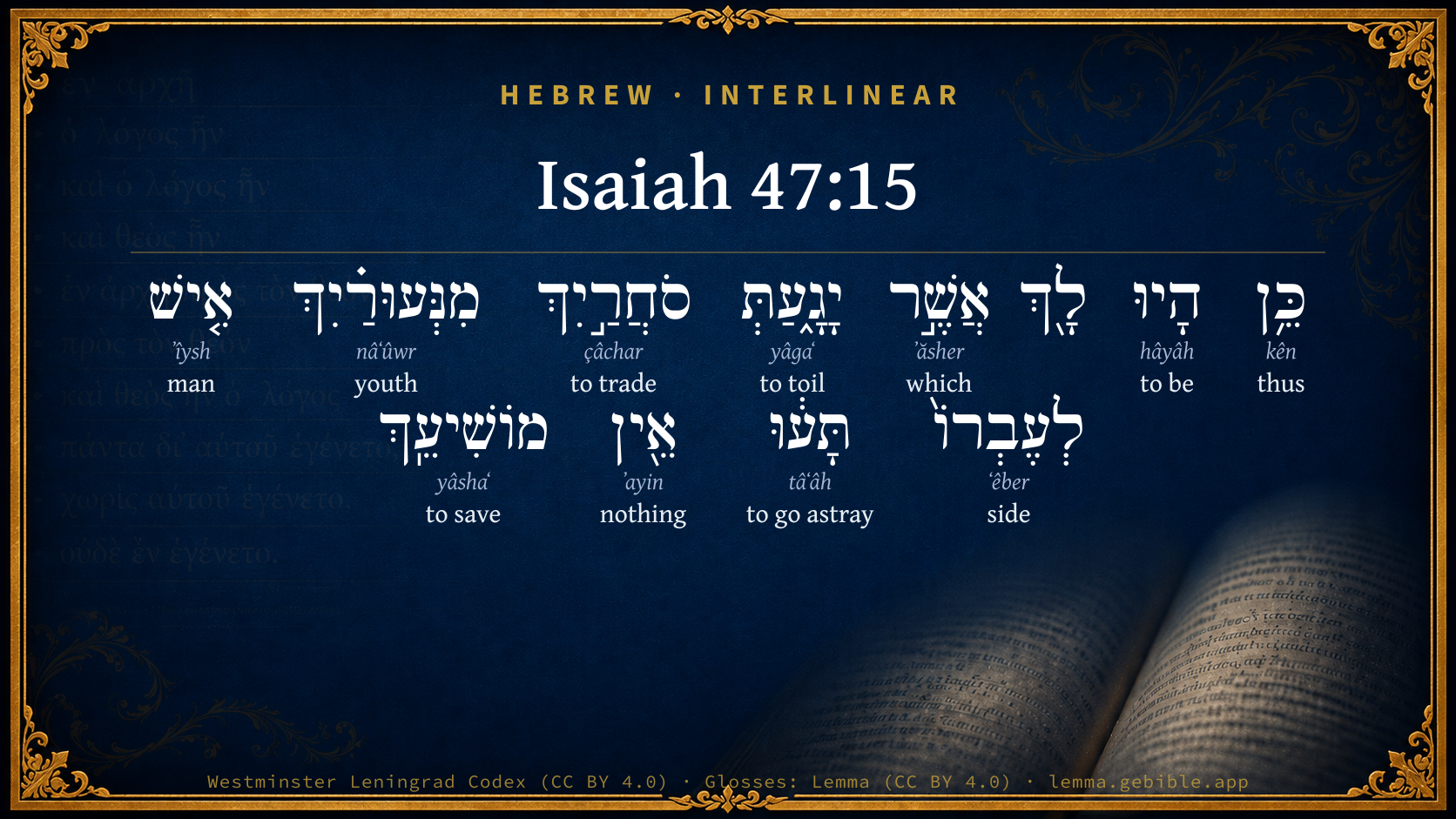
Isaiah 47:15

Hebrew (Westminster Leningrad Codex) Isaiah 47:15 appears in the Hebrew Old Testament. The text above is from the Westminster Leningrad Codex. Each word links to its Strong’s number, a concise gloss, and parsing drawn from the Open Scriptures Hebrew Bible morphology. Click any word for its full Brown-Driver-Briggs (BDB) entry.
Download image
Cite this verse

Isaiah 47:15 (World English Bible). Public Domain. Lemma interlinear Bible study tool, https://lemma.gebible.app/v/isaiah/47/15.

Show BibTeX & RIS
BibTeX
RIS
English Translation
Thus shall the things be to you in which you have labored: those who have trafficked with you from your youth shall wander everyone to his quarter; there shall be none to save you.
World English Bible · Public Domain
Download a study sheet

One document with this verse’s original text, its word-by-word gloss line, the meaning frame, cross-references with their text, attributed commentary, and full source and license credits — printable, and it pastes into notes with its structure intact.

This verse Autodidact and up

Study sheet (.html) Plain text (.txt)

A passage Seminary Student

Up to 50 verses in one chapter. A passage sheet keeps up to 6 commentary sources and 12 cross-references per verse, in the order this page ranks them, and says so on the sheet whenever that leaves anything out. Ask for a single verse and you get the Autodidact verse sheet above.

Everything on this page stays free to read, with no account — the sheet is a download of what is already on screen, not access to it.

Want to remove ads? Support Godless Engineer
Compare translations 3

The same verse in 3 English versions, stacked beneath the original-language interlinear above. Click any original word for its lexicon entry.

Each is an independent rendering of the whole verse — the interlinear is not word-aligned to these translations.

Highlighted words mark where these versions differ — a whole-verse word diff, not a word-by-word alignment.

  • World English Bible Public Domain
    Thus shall the things be to you in which you have labored: those who have trafficked with you from your youth shall wander everyone to his quarter; there shall be none to save you.
  • King James Version Public Domain
    Thus shall they be unto thee with whom thou hast laboured, even thy merchants, from thy youth: they shall wander every one to his quarter; none shall save thee.
  • unfoldingWord Literal Text CC BY-SA 4.0
    Thus they will become for you, whom you labored, your merchants from your youth. A man to his side they will wander; no one will be saving you.”

unfoldingWord Literal Text — © unfoldingWord, licensed CC BY-SA 4.0. Word-aligned USFM3 via Door43 (git.door43.org/unfoldingWord/en_ult).

Versions to compare (up to 4)

3 of 4 selected

Show all 18 translations

Every available English version of this verse, each an independent rendering of the whole verse.

  • World English Bible Public Domain
    Thus shall the things be to you in which you have labored: those who have trafficked with you from your youth shall wander everyone to his quarter; there shall be none to save you.
  • Berean Standard Bible Public Domain
    This is what they are to you—those with whom you have labored and traded from youth—each one strays in his own direction; not one of them can save you.
  • Majority Standard Bible Public Domain
    This is what they are to you—those with whom you have labored and traded from youth—each one strays in his own direction; not one of them can save you.
  • King James Version Public Domain
    Thus shall they be unto thee with whom thou hast laboured, even thy merchants, from thy youth: they shall wander every one to his quarter; none shall save thee.
  • American Standard Version (1901) Public Domain
    Thus shall the things be unto thee wherein thou hast labored: they that have trafficked with thee from thy youth shall wander every one to his quarter; there shall be none to save thee.
  • Revised Version (1885) Public Domain
    Thus shall the things be unto thee wherein thou hast laboured: they that have trafficked with thee from thy youth shall wander every one to his quarter; there shall be none to save thee.
  • Geneva Bible (1599) Public Domain
    Thus shall they serue thee, with whom thou hast wearied thee, euen thy marchants from thy youth: euery one shall wander to his owne quarter: none shall saue thee.
  • Douay-Rheims (1899) Public Domain
    Such are all the things become to thee, in which thou best laboured: thy merchants from thy youth, every one hath erred in his own way, there is none that can save thee.
  • Young's Literal Translation Public Domain
    So have they been to thee with whom thou hast laboured, Thy merchants from thy youth, Each to his passage they have wandered, Thy saviour is not!
  • Literal Standard Version CC BY-SA 4.0
    So they have been to you with whom you have labored, || Your merchants from your youth, || They have each wandered to his passage, || None is saving you!”
  • Unlocked Literal Bible CC BY-SA 4.0
    This is what they have become to you— those with whom you have worked, and you have bought and sold with them since your youth— they wandered about each one in his own direction; there is no one who can rescue you.”
  • unfoldingWord Literal Text CC BY-SA 4.0
    Thus they will become for you, whom you labored, your merchants from your youth. A man to his side they will wander; no one will be saving you.”
  • Darby Bible Public Domain
    Thus shall they be unto thee with whom thou hast laboured, they that trafficked with thee from thy youth: they shall wander every one to his own quarter; there is none to save thee.
  • World Messianic Bible Public Domain
    The things that you labored in will be like this: those who have trafficked with you from your youth will each wander in his own way. There will be no one to save you.
  • Webster's Bible Public Domain
    Thus shall they be to thee with whom thou hast labored, even thy merchants, from thy youth: they shall wander every one to his quarter; none shall save thee.
  • Free Bible Version CC BY-SA 4.0
    All those people you've worked with, all those you've traded with from when you were young—they will all go their own way, nobody will come and save you.
  • Bible in Basic English Public Domain
    Small profit have you had from those who, from your earliest days, got great profit out of you; they have gone in flight, every one straight before him, and you have no saviour.
  • JPS Tanakh (1917) Public Domain
    Thus shall they be unto thee with whom thou hast laboured; they that have trafficked with thee from thy youth shall wander every one to his quarter; there shall be none to save thee.

Literal Standard Version (2020), Covenant Press — licensed CC BY-SA 4.0. Text via the HelloAO Bible API (eBible.org). Unlocked Literal Bible (unfoldingWord) — licensed CC BY-SA 4.0. Text via the HelloAO Bible API (eBible.org). unfoldingWord Literal Text — © unfoldingWord, licensed CC BY-SA 4.0. Word-aligned USFM3 via Door43 (git.door43.org/unfoldingWord/en_ult). Free Bible Version, Dr. Jonathan Gallagher — licensed CC BY-SA 4.0. Text via the HelloAO Bible API (eBible.org).

Word by word

More ways to search: Search by grammar → Find every occurrence → Compare this word →

Practice this passage: Drill this verse → Learn its vocabulary →

סֹחֲרַ֣יִךְ
çâchar
H5503
“trading · you”
Verb, Qal, Participle Active, Masculine, Plural, Construct + Suffix, Personal, 2nd Person, Feminine, Singular
Part of Speech
Verb
Stem
Qal
Form
Participle Active
Gender
Masculine
Number
Plural
State
Construct
Full BDB Definition

Origin: a primitive root

TWOT: 1486

to go around, go about, travel about in, go about in trade - (Qal) - to go about to and fro (in business) - trader, trafficker (participle) - (Pilpel) to palpitate
  1. כֵּ֥ן kên H3651 “thus” Particle, Demonstrative
  2. הָיוּ hâyâh H1961 “to be” Verb, Qal, Perfect, 3rd Person, Common, Plural
  3. אֲשֶׁ֣ר ʼăsher H834 “which” Particle, Relative
  4. יָגָ֑עַתְּ yâgaʻ H3021 “to toil” Verb, Qal, Perfect, 2nd Person, Feminine, Singular
  5. מִנְּעוּרַ֗יִךְ nâʻûwr H5271 “from · youth · your” Preposition + Noun, Common, Both, Plural, Construct + Suffix, Personal, 2nd Person, Feminine, Singular
  6. אִ֤ישׁ ʼîysh H376 “man” Noun, Common, Masculine, Singular, Absolute
  7. לְעֶבְרוֹ֙ ʻêber H5676 “to/for · side · his” Preposition + Noun, Common, Masculine, Singular, Construct + Suffix, Personal, 3rd Person, Masculine, Singular
  8. תָּע֔וּ tâʻâh H8582 “to go astray” Verb, Qal, Perfect, 3rd Person, Common, Plural
  9. אֵ֖ין ʼayin H369 “nothing” Particle, Negative
  10. מוֹשִׁיעֵֽךְ yâshaʻ H3467 “saving · you” Verb, Hiphil, Participle Active, Masculine, Singular, Construct + Suffix, Personal, 2nd Person, Feminine, Singular

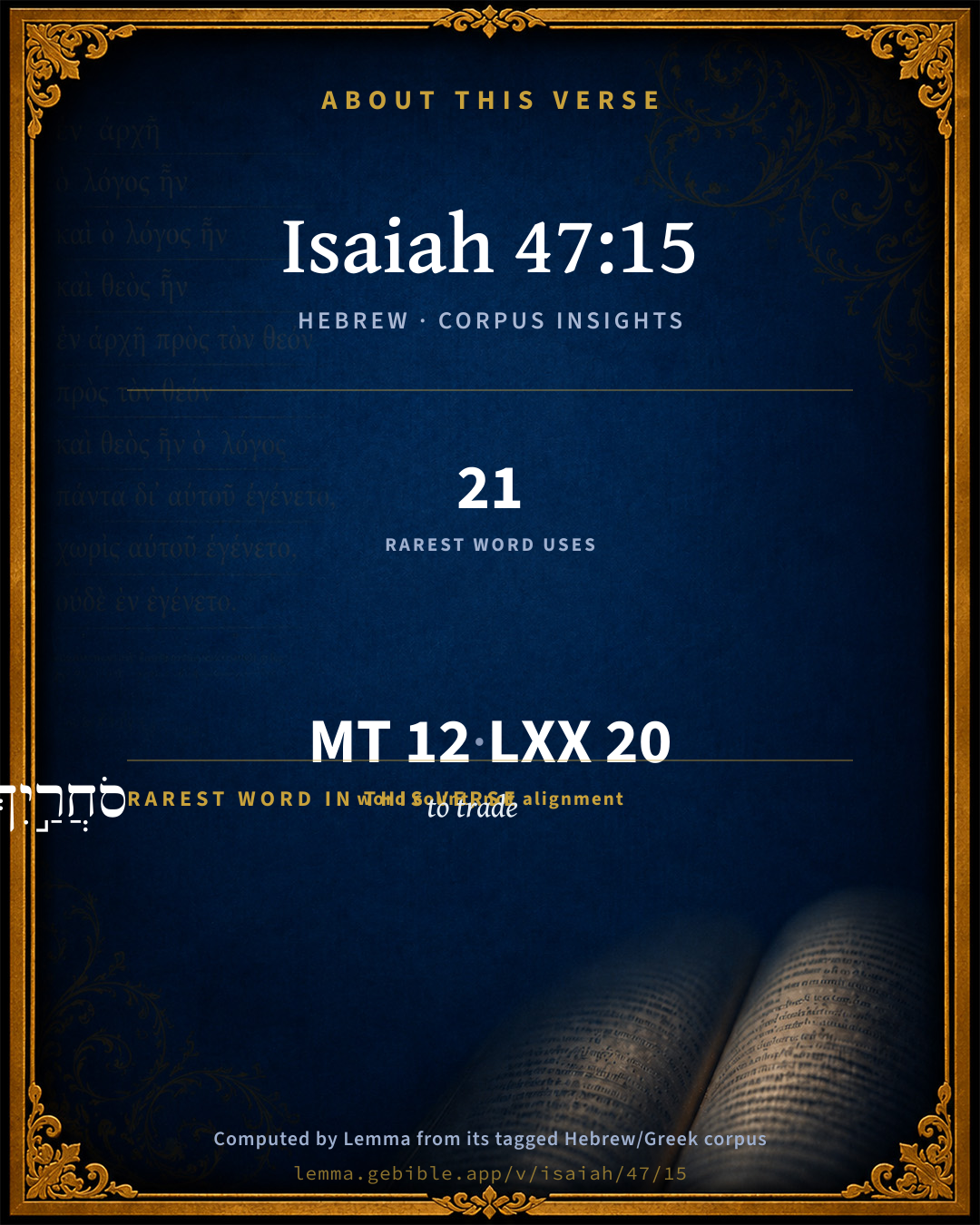
About this verse

These counts appear in no published source. They are computed here, from the morphology-tagged text and Lemma’s own curated glosses. What Lemma adds →

12
words
11
distinct lemmas
Prophets
section

Notable vocabulary

The rarest word here is סֹחֲרַ֣יִךְ to trade H5503 — appearing just 21 times in the whole Hebrew Bible.

Shared distinctive vocabulary

סֹחֲרַ֣יִךְ to trade H5503 occurs in 20 verses of the Hebrew Bible. Also found in:

Grammatical profile

  • 5 verbs
  • 3 nouns
  • 1 preposition
  • 3 particles

Verb forms

  • הָיוּ Qal · Perfect
  • יָגָ֑עַתְּ Qal · Perfect
  • סֹחֲרַ֣יִךְ Qal · Participle Active
  • תָּע֔וּ Qal · Perfect
  • מוֹשִׁיעֵֽךְ Hiphil · Participle Active

Hebrew & Septuagint length

In English translation the verse runs 34 words from the Hebrew and 28 from the Septuagint (LXX English) — closely comparable.

A rough comparison of the two English renderings, which tokenize alike — not a word-level alignment.

Word counts can differ between the Hebrew and the Greek without any difference in meaning — e.g. the Hebrew direct-object marker אֵת has no separate Greek word, and Greek often adds the article ὁ.

In the original languages it is 12 Hebrew tokens and 20 Greek tokens — but the two are counted differently (Hebrew bundles its prefixes and suffixes into one token; the Greek is in lemma form), so that isn’t a like-for-like length.

Cross-references

4

Topical passages linked to Isaiah 47:15 in the Treasury of Scripture Knowledge — connected by theme and wording, ordered by reader-vote popularity; previews shown in the World English Bible.

  • Isaiah 56:11 Yes, the dogs are greedy, they can never have enough; and these are shepherds who can't understand: they have all turned to their own way, each one to his gain, from every quarter.
  • Jeremiah 51:6–9 Flee out of the midst of Babylon, and save every man his life; don't be cut off in her iniquity: for it is the time of Yahweh's vengeance; he will render to her a recompense.
  • Ezekiel 27:12–25 Tarshish was your merchant by reason of the multitude of all kinds of riches; with silver, iron, tin, and lead, they traded for your wares.
  • Revelation 18:11–19 The merchants of the earth weep and mourn over her, for no one buys their merchandise any more;

Cross-references courtesy of OpenBible.info (CC BY 4.0).

Hebrew and Greek witnesses Masoretic Hebrew ↔ Greek Septuagint

The same verse in the two great witnesses to the Old Testament, shown verse-for-verse.

These are two independent witnesses, not word-aligned to each other, and the Septuagint is shown in lemma (dictionary) form.

Hebrew Isaiah 47:15 Masoretic · Westminster Leningrad Codex

כֵּ֥ן הָיוּ לָ֖ךְ אֲשֶׁ֣ר יָגָ֑עַתְּ סֹחֲרַ֣יִךְ מִנְּעוּרַ֗יִךְ אִ֤ישׁ לְעֶבְרוֹ֙ תָּע֔וּ אֵ֖ין מוֹשִׁיעֵֽךְ

Thus shall the things be to you in which you have labored: those who have trafficked with you from your youth shall wander everyone to his quarter; there shall be none to save you.

World English Bible · Public Domain

Greek LXX Isaiah 47:15 Septuagint · lemma form

οὗτος εἰμί σύ βοήθεια κοπιάω ἐν ὁ μεταβολή σύ ἐκ νεότης ἄνθρωπος κατά ἑαυτοῦ πλανάω σύ δέ οὐ εἰμί σωτηρία

these shall be your help. You have wearied yourself with traffic from your youth: every man has wandered to his own home, but you shall have no deliverance.

LXX2012 (modern English Septuagint) · Public Domain

Hebrew: Westminster Leningrad Codex (CC BY 4.0). Greek: Septuagint (public domain); English from LXX2012 (modern English Septuagint) (Public Domain). How the Septuagint differs from the Hebrew →

Targum (Aramaic paraphrase)

1

The Targum is the ancient Jewish Aramaic paraphrase of the Hebrew Scriptures — an interpretive translation, not the Hebrew text itself. Onkelos (literal) and Pseudo-Jonathan (expansive) render the Torah, and Jonathan the Prophets. Coverage is partial: where no permissively-licensed English translation exists for a verse, only the Aramaic is shown. This is verse-level text, not a word-by-word alignment to the Hebrew.

  1. Targum Jonathan Prophets (Joshua–Malachi)
    כֵּן הֲווֹ בִיךְ עוֹבָדֵי שְׁקָרַיִךְ דַהֲוֵית מִתְעַסְקָא בְּהוֹן מִיַנְקוּתִיךְ שִׁלְטוֹנַי תּוּקְפִיךְ גְבַר לָקֳבֵיל אַפּוֹהִי גְלוּ לֵית דְפָרִיק לִיךְ:

    Thus shall the workers of thy lies be in thee, with whom thou wast occupied from thy youth; the princes of thy power, shall go into captivity; each one straight before his face,: none shall save thee.

    Targum Jonathan — Aramaic: “Mikraot Gedolot” (public domain). English: “Sefaria Community Translation” (CC0 1.0 (public-domain dedication)); “London "Chaldee Paraphrase," 1871” (public domain). Text via Sefaria.

Commentary

Notes on Isaiah 47:15 from classic Christian and Jewish commentators (each source and its license shown beneath its notes). The classic Christian expositions comment on the surrounding passage and are grouped to its opening verse, so a note may address several verses; the Jewish commentaries on the Tanakh (Rashi and others) are per-verse, so they appear only where the commentator wrote on this verse.

Lemma curates 59 commentaries, every one of them public domain or Creative Commons licensed, each selected and text-cleaned for this edition rather than reprinted as found. About our sources →

Trapp's Complete Commentary

John Trapp

Isa 47:15 Thus shall they be unto thee with whom thou hast laboured, [even] thy merchants, from thy youth: they shall wander every one to his quarter; none shall save thee.

Ver. 15. Thus shall they be unto thee with whom thou hast laboured.] But all in vain; viz., with thy wizards and diviners, those deceivers of the people, concerning whom Cato once said, Potest Augur Augurem videre et non ridere? {a} Can those fellows look one on another and not laugh, when they consider how they deceive people, and cheat them of their moneys? Hence they are called merchants also in the next words, as some think, qui non tam coeli rationem quam coelati argenti ducunt. {b} Such money merchants hath mystical Babylon also not a few. {Rev 18:11} Non desunt Antichristo sui Augures et malifici, saith Oecolampadius; Antichrist hath those abroad that trade with him and for him; these shall be "cast alive with him into the burning lake," {Rev 19:20} and though they wander, yet not so wide as to miss hell.

{a} Cic. De Divinat., lib. ii.

{b} Cic. orat. iv. in Ver.

John Trapp, A Commentary or Exposition upon All the Books of the Old and New Testament (1647–1656) — public domain. Text from a community e-Sword module.

Geneva Bible (1599)

Geneva Bible translators

They shall flee everyone to that place, which he thought by his speculations to be most sure: but that shall deceive them.

Geneva Bible (1599) marginal notes — public domain. Text via Bolls.life.

Jamieson, Fausset & Brown

Robert Jamieson, A. R. Fausset & David Brown

Thus, &c.--Such shall be the fate of those astrologers who cost thee such an amount of trouble and money.

thy merchants, from thy youth--that is, with whom thou hast trafficked from thy earliest history, the foreigners sojourning in Babylon for the sake of commerce (Isa 13:14; Jer 51:6, Jer 51:9; Nah 3:16-17) [BARNES]. Rather, the astrologers, with whom Babylon had so many dealings (Isa 47:12-14) [HORSLEY].

to his quarter--literally, "straight before him" (Eze 1:9, Jer 50:16).

Next: Isaiah Chapter 48

Jamieson, Fausset & Brown — Commentary Critical and Explanatory on the Whole Bible (1871) — public domain (CC PDM 1.0). Text via the HelloAO Bible API.

Adam Clarke's Commentary

Verse 15. To his quarter - "To his own business"] לעברו leebro. Expositors give no very good account of this word in this place. In a MS. it was at first לעבדו leabdo, to his servant or work, which is probably the true reading. The sense however is pretty much the same with the common interpretation: "Every one shall turn aside to his own business; none shall deliver thee."

Adam Clarke's Commentary on the Bible (1810–1826) — public domain. Text from a community e-Sword/MySword module.

Ellicott's Commentary for English Readers

(15) Thy merchants, from thy youth . . .—The commerce of Babylon is specially prominent in all descriptions. (Comp. Herod. i. 194-196; Eze_17:4.) The time was coming when those who had thronged her markets would desert her and leave her to her desolation.

A Bible Commentary for English Readers, edited by Charles John Ellicott (1878–1897) — public domain. Text from a community e-Sword module.

The Cambridge Bible for Schools and Colleges

gen. ed. J. J. S. Perowne

15. with whom thou hast laboured] See on Isa_47:12.

thy merchants] Cf. Nah_3:16 f., and see on ch. Isa_13:14. The abrupt introduction of merchants here is somewhat perplexing, especially after the adverb “so”; but the word never means anything else in Hebrew; and the context requires that some new persons should be understood, since the astrologers have perished in the fire, while these make their escape. It may however be used in a wide sense, of nations that trafficked with Babylon.

every one to his quarter] Rather: each straight before him; cf. Eze_1:9 (the cherubim went “everyone straight forward.”).

The Cambridge Bible for Schools and Colleges (gen. ed. J. J. S. Perowne; Cambridge University Press, 1878–1918) — public domain. Text from a community e-Sword module.

John Gill's Exposition

Thus shall they be unto thee with whom thou hast laboured,.... In training them up in those arts, and in consulting with them in cases of difficulty; in which they were of no service, and now in time of danger as useless as stubble, or a blaze of straw:

even thy merchants from thy youth; either the above astrologers and diviners, who had been with them from the beginning of their state; and who had made merchandise of them, and were become rich as merchants by telling fortunes, and predicting things to come by the stars; which sense our version leads to by supplying the word "even"; or rather merchants in a literal sense, which Babylon abounded with from the first building of it; it being the metropolis of the empire, and the mart of nations: these, upon the destruction of the city,

shall wander everyone to his quarter, or "passage" (y); to the country from whence they came, and to the passage in that part of the city which led unto it; or to the passage over the river Euphrates, which ran through the city; or to the next port, from whence they might have a passage by shipping to their own land: it denotes the fright and fugitive state in which merchants, from other countries, should be in, when this calamity should come upon Babylon; that they should leave their effects, flee for their lives, and wander about till they got a passage over to their native place, and be of no service to the Chaldeans, as follows:

none shall save thee: neither astrologers nor merchants; so the merchants of mystical Babylon will get without the city, and stand afar off, and lament her sad case, but will not be able to help her, Rev 18:15.

(y) "ad vel in transitum suum", Tigurine version.

Next: Isaiah Chapter 48

John Gill's Exposition of the Whole Bible (1746–1763) — public domain (CC PDM 1.0). Text via the HelloAO Bible API.

Albert Barnes' Notes on the Bible

With whom thou hast labored - The multitude of diviners, astrologers, and merchants, with whom thou hast been connected and employed. The idea is, that Babylon had been the mart where all of them had been assembled.

Even thy merchants from thy youth - Babylon was favorably situated for traffic; and was distinguished for it. Foreigners and strangers had resorted there, and it was filled with those who had come there for purposes of trade. The sense here is, that the same destruction which would come upon the diviners, would come on all who had been engaged there in traffic and merchandise. It does not mean that the individuals who were thus engaged would be destroyed, but that destruction would come upon the business; it would come in spite of all the efforts of the astrologers, and in spite of all the mercantile advantages of the place. The destruction would be as entire as if a fire should pass over stubble, and leave not a coal or a spark. What a striking description of the total ruin of the commercial advantages of Babylon!

From thy youth - From the very foundation of the city.

They shall wander every one to his own quarter - All shall leave Babylon, and it shall be utterly forsaken as a place of commerce, and all who have been engaged in mercantile transactions there shall go to other places. The phrase, ‘his own quarter’ (לעברו le‛eberô), means, “to his own way;” they shall be driven from Babylon, and wander to other places. They shall flee from the danger; and if they practice their arts, or engage in commerce, it shall be done in other places besides Babylon.

None shall save thee - How truly this was fulfilled need not here be stated. All its arts of astrology, its wealth, its mercantile advantages, the strength of its walls and gates, were insufficient to save it, and now it lies a wide waste - a scene of vast and doleful ruin (see the notes at Isa. 13; 14) So certainly will all the predictions of God be accomplished; so vain are the arts and devices of man, the strength of fortifications, and the advantages for commerce, when God purposes to inflict his vengeance on a guilty nation. The skill of astrology, the advantages of science, accumulated treasures, brass gates and massive walls, and commercial advantages, the influx of foreigners, and a fertile soil, cannot save it. All these things are in the hands of God; and he can withdraw them when he pleases. Babylon once had advantages for commerce equal to most of the celebrated marts now of Europe and America. So had Palmyra, and Tyre, and Baalbec, and Petra, and Alexandria, and Antioch. Babylon was in the midst of a country as fertile by nature as most parts of the United States. She had as little prospect of losing the commerce of the world, and of ceasing to be a place of wealth and power, as Paris, or London, or Liverpool, or New York. Yet how easy was it for God, in the accomplishment of his plans, to turn away the tide of her prosperity, and reduce her to ruins.

How easy, in the arrangements of his providence, to spread desolation over all the once fertile plains of Chaldea, and to make those plains pools of water. And so with equal ease, if he pleases, and by causes as little known as were those which destroyed Babylon, can he take away the commercial advantages of any city now on earth. Tyre has lost all its commercial importance; the richly-laden caravan has ceascd to pause at Petra; Tadmor lies waste. Baalbec is known only by the far-strewed ruins, and Nineveh and Babylon are stripped of all. that ever made them great, and can rise no more. God has taken away the importance and the power of Rome, once, like Babylon, the mistress of the world, by suffering the malaria to desolate all the region in her vicinity; and so with equal truth, all that contributes to the commercial importance of New York, Philadelphia, Boston, London, or Paris, are under the control of God. By some secret causes he could make these cities a wide scene of ruins; and they may be, if they are like Babylon and Tyre and Tadmor in their character, yet like them in their doom. They should feel that the sources of their prosperity and their preservation are not in themselves, but in the favor and protection of God. Virtue, justice, and piety, will better preserve them than wealth; and without these they must be, in spite of their commercial advantages, what the once celebrated cities of antiquity now are.

Albert Barnes' Notes on the Bible (1834–1885) — public domain. Text from a community e-Sword/MySword module.

Haydock's Catholic Bible Commentary

Merchants. The city was well situated for trade, chap. xiii. 20. (Diodorus ii.)

George Leo Haydock (1774–1849), Haydock's Catholic Family Bible and Commentary, 1859 edition — public domain. Excludes Psalms (Douay-Rheims chapter numbering differs from Protestant) and Deuterocanonical books (Catholic canon only).

Matthew Poole's English Annotations

Thus, such comfortless and helpless creatures, shall they be; either,

1. Thy merchants, as it follows, with whom thou hast trafficked. Or,

2. Thy sorcerers, astrologers, &c., with whom they are said to have laboured, both here and Isa 47:12, who also may possibly be called their merchants, because they traded so much with them, and because of their deceitful practices; for which Ephraim is called a merchant, Hos 12:7. And so the following clause may be rendered, who have been

thy merchants from thy youth. Or the last clause may be understood of merchants, properly so called, who came from several countries to trade with Babylon, as is noted in Scripture, and by other authors; and the verse may be thus rendered; Thus (vain and unprofitable) shall they (thy sorcerers, &c.) with whom thou hast laboured be unto thee: (so here is only a transposition of words, than which nothing is more usual in Scripture. Then follows another matter in the next clause:) also

thy merchants, or they with whom thou hast traded from thy youth, shall wander every one to his own quarter. None shall save thee; they shall all leave thee, and flee away with all possible speed to their several countries and habitations.

Matthew Poole's English Annotations on the Holy Bible (1683–1685) — public domain. Text from a community e-Sword/MySword module.

Whedon's Commentary on the Bible

Daniel D. Whedon

15. None shall save thee — Babylon was well situated for traffic with the north, northwest, east, and south. But all her diviners, her arts of astrology, her science, her foreigners and commerce and fertile soil, her massive walls and brazen gates — not all these combined can save her. Her cup is full, and Nemesis awaits her destruction. She never recovered her ancient greatness.

Daniel D. Whedon (gen. ed.), Commentary on the Old and New Testaments (1874–1909) — public domain. Text from a community e-Sword module.

The Pulpit Commentary

Thus shall they be unto thee with whom thou hast laboured. The foreigners who have participated in the toils and labours of Babylon shall share in her punishment. The flame of judgment shall not spare even them. Even thy merchants. Babylonian commerce is the subject of an important chapter in Heeren"s "Asiatic Nations" (vol. 2, pp. 190-260), and is discussed also in the present writer"s "Egypt and Babylon" (ch. 8, pp. 127-144). It was carried on both by land and sea, and was very extensive, including both a large import and a large export trade. Her merchants were, in part natives, in part foreigners. It is the latter who are here specially intended. Seeing the gradual closing in upon Babylon of the Persian armies, and anticipating the worst, they fly in haste from the doomed city, each one making for his own country, and having no thought of interposing to save the people which have so long encouraged and protected them. Probably the greater number of these foreign merchants were either Phoenicians or Arabians. They shall wander every one to his quarter. Not his own quarter of the town, but his own quarter of the earth; i.e. his own country. (comp. Isa_13:14, "They shall every man turn to his own people, and flee every one into his own land.

The Pulpit Commentary (1880–1919), ed. H.D.M. Spence-Jones & Joseph S. Exell — public domain. Text from a community e-Sword module.

John Wesley's Explanatory Notes

Thus - Such comfortless and helpless creatures. They - Merchants who came from several countries to trade with Babylon. And the verse may be thus rendered; Thus (vain and unprofitable) shall they (thy sorcerers) with whom thou hast laboured be unto thee: (So here is only a transposition of words, than which nothing is more usual in scripture. Then follows another matter:) also thy merchants, or they with whom thou hast traded from thy youth, shall wander every one to his own quarter.

John Wesley, Explanatory Notes Upon the Whole Bible (1754–1765) — public domain. Text via the GEBible commentary corpus.

J. A. Alexander on Isaiah

Joseph Addison Alexander

“Thus are they to thee,” (i.e., such is their fate, you see what has become of them). The words ‘to thee’ suggest the additional idea that the person addressed was interested in them and a witness of their ruin. With respect to ‘whom thou hast labored’. This may either mean with whom or for whom; or both may be included in the general idea that these had been the object and occasion of her labors. “Thy dealers (or traders) from thy youth.” This is commonly regarded as explanatory of the foregoing clause. Thus the English Version, ‘they with whom thou hast labored, even thy merchants etc.’ It then becomes a question whether these are called traders in the literal and ordinary sense, or at least in that of national allies and negotiators; or whether the epithet is given in contempt to the astrologers and wise men of the foregoing context, as trafficking or dealing in imposture. According to another arrangement we are not to read ‘and so are thy dealers’, or even ‘thy dealers’, but ‘thy dealers from thy youth wander each his own way’. We have then two classes introduced, and two distinct events predicted. As if he had said, ‘thy astrologers etc. are utterly destroyed, and as for thy dealers, they wander home etc.’ widely different in fate, but both alike in this, that they leave thee defenseless in the hour of extremity. Thy traders may then be taken either in its strict sense as denoting foreign merchants, or in its wider sense as comprehending all, whether states or individuals, with whom she had intercourse, commercial or political. Each to his own quarter, side, direction, substantially synonymous with the expression in Eze 1:9; Eze 1:12, and other phrases all meaning ‘straight before him, without turning to the right hand or the left.’, “They wander (or have wandered)”, a term implying not only flight but confusion. “There is no one helping thee,” or still more strongly, saving thee, thou hast no savior, with particular reference to those just mentioned, who, instead of thinking upon her or bringing her assistance, would be wholly engrossed by a sense of their own danger and the effort to escape it.

Joseph Addison Alexander, The Prophecies of Isaiah (1846–1847; New York: Scribner, 1870–1878) — public domain. Text from a community e-Sword module.

Rashi

Rabbi Shlomo Yitzchaki (Rashi)

each one strayed to his side each one to his way, to the side of his face [i.e., each one wandered away in the direction he was facing].

Rashi on the Tanakh — English translations: “The Judaica Press complete Tanach with Rashi, translated by A. J. Rosenberg” (CC BY 4.0); “Pentateuch with Rashi's commentary by M. Rosenbaum and A.M. Silbermann, 1929-1934” (public domain); “The Metsudah Tanach series, Lakewood, N.J” (CC BY 4.0); and “The Book of Joshua, Metsudah Publications, 1997” (CC BY 4.0). Text via Sefaria.

Ibn Ezra

Rabbi Abraham ibn Ezra

Thus were they, those wise men.

With whom thou hast laboured. To whom thou hast given money.

Even thy merchants, which were not from thy land, but had been thy friends.—When thy fall cometh, they all forsake thee.

Ibn Ezra on the Tanakh — English translations: “Sefaria Community Translation” (CC0 1.0 (public-domain dedication)); “Yalkut, Sifsei Chachomim Chumash, Metsudah Publications, 2009” (CC BY 4.0); and “Commentary of Ibn Ezra on Isaiah - trans. by M. Friedlander, 1873” (public domain). Text via Sefaria.

Lesson kit

Teaching starters — assembled from the data on this page, not authored interpretation. Every prompt links to the verse data it draws on. Edit before teaching.

Isaiah, in the Prophets, opens this verse with 12 words (11 distinct Hebrew lemmas). Its most distinctive word is çâchar (“to trade”). A historical commentator’s framing appears above. Read the whole chapter for the surrounding context.

Discussion questions

  1. What does “to trade” (çâchar) contribute to the verse as a whole?
  2. Genesis 23:16 shares the word «to trade» with this verse. How do the two illuminate each other?
  3. The translations on this page render this verse differently — a whole-verse word diff, not a word-by-word alignment. What might account for the different wordings?
  4. The verb «הָיוּ» is Qal Perfect. How does its form color the action?
  5. Reading how Trapp's Complete Commentary and Geneva Bible (1599) read this verse, where do the two commentators agree and where do they part?

Things to notice

Reading settings

Reading text

Shown beneath each verse's original-language words.

Old Testament
Old Testament edition

Read the OT as the Masoretic Hebrew (MT) or the Greek Septuagint (LXX).

English shown for the Greek Septuagint (in the Hebrew ↔ Greek comparison).

Comparing translations? Open the Compare panel on any verse page to stack up to four side by side.