
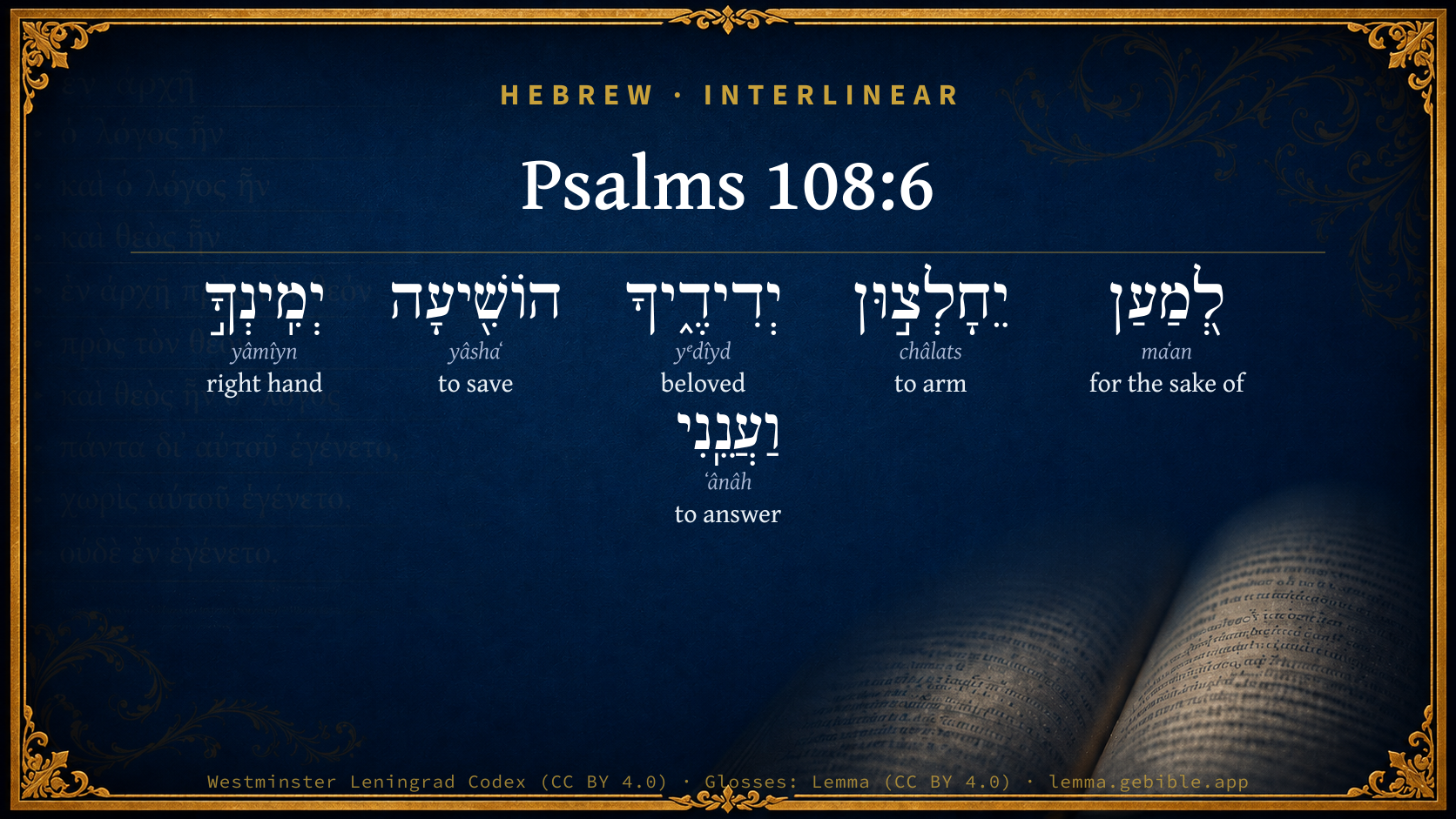
Psalms 108:6

Hebrew (Westminster Leningrad Codex) Psalms 108:6 appears in the Hebrew Old Testament. The text above is from the Westminster Leningrad Codex. Each word links to its Strong’s number, a concise gloss, and parsing drawn from the Open Scriptures Hebrew Bible morphology. Click any word for its full Brown-Driver-Briggs (BDB) entry.
Download image
Cite this verse

Psalms 108:6 (World English Bible). Public Domain. Lemma interlinear Bible study tool, https://lemma.gebible.app/v/psalms/108/6.

Show BibTeX & RIS
BibTeX
RIS
English Translation
That your beloved may be delivered, Save with your right hand, and answer us.
World English Bible · Public Domain
Download a study sheet

One document with this verse’s original text, its word-by-word gloss line, the meaning frame, cross-references with their text, attributed commentary, and full source and license credits — printable, and it pastes into notes with its structure intact.

This verse Autodidact and up

Study sheet (.html) Plain text (.txt)

A passage Seminary Student

Up to 50 verses in one chapter. A passage sheet keeps up to 6 commentary sources and 12 cross-references per verse, in the order this page ranks them, and says so on the sheet whenever that leaves anything out. Ask for a single verse and you get the Autodidact verse sheet above.

Everything on this page stays free to read, with no account — the sheet is a download of what is already on screen, not access to it.

Want to remove ads? Support Godless Engineer
Compare translations 3

The same verse in 3 English versions, stacked beneath the original-language interlinear above. Click any original word for its lexicon entry.

Each is an independent rendering of the whole verse — the interlinear is not word-aligned to these translations.

Highlighted words mark where these versions differ — a whole-verse word diff, not a word-by-word alignment.

  • World English Bible Public Domain
    That your beloved may be delivered, Save with your right hand, and answer us.
  • King James Version Public Domain
    That thy beloved may be delivered: save with thy right hand, and answer me.
  • unfoldingWord Literal Text CC BY-SA 4.0
    So that your beloved ones may be rescued, save your right hand and answer me.

unfoldingWord Literal Text — © unfoldingWord, licensed CC BY-SA 4.0. Word-aligned USFM3 via Door43 (git.door43.org/unfoldingWord/en_ult).

Versions to compare (up to 4)

3 of 4 selected

Show all 18 translations

Every available English version of this verse, each an independent rendering of the whole verse.

  • World English Bible Public Domain
    That your beloved may be delivered, Save with your right hand, and answer us.
  • Berean Standard Bible Public Domain
    Respond and save us with Your right hand, that Your beloved may be delivered.
  • Majority Standard Bible Public Domain
    Respond and save us with Your right hand, that Your beloved may be delivered.
  • King James Version Public Domain
    That thy beloved may be delivered: save with thy right hand, and answer me.
  • American Standard Version (1901) Public Domain
    That thy beloved may be delivered, Save with thy right hand, and answer us.
  • Revised Version (1885) Public Domain
    That thy beloved may be delivered, save with thy right hand, and answer us.
  • Geneva Bible (1599) Public Domain
    That thy beloued may be deliuered: helpe with thy right hand and heare me.
  • Douay-Rheims (1899) Public Domain
    Be thou exalted, O God, above the heavens, and thy glory over all the earth:
  • Young's Literal Translation Public Domain
    That Thy beloved ones may be delivered, Save `with' Thy right hand, and answer us.
  • Literal Standard Version CC BY-SA 4.0
    That Your beloved ones may be delivered, || Save [with] Your right hand, and answer us.
  • Unlocked Literal Bible CC BY-SA 4.0
    So that those you love may be rescued, rescue us with your right hand and answer me.
  • unfoldingWord Literal Text CC BY-SA 4.0
    So that your beloved ones may be rescued, save your right hand and answer me.
  • Darby Bible Public Domain
    That thy beloved ones may be delivered: save with thy right hand, and answer me.
  • World Messianic Bible Public Domain
    That your beloved may be delivered, save with your right hand, and answer us.
  • Webster's Bible Public Domain
    \\108:5\\Be thou exalted, O God, above the heavens: and thy glory above all the earth;
  • Free Bible Version CC BY-SA 4.0
    Rescue those you love! Answer us, and save us by your power!
  • Bible in Basic English Public Domain
    Let your right hand be stretched out for salvation, and give me an answer, so that your loved ones may be safe from danger.
  • JPS Tanakh (1917) Public Domain
    (108-7) That Thy beloved may be delivered, save with Thy right hand, and answer me.

Literal Standard Version (2020), Covenant Press — licensed CC BY-SA 4.0. Text via the HelloAO Bible API (eBible.org). Unlocked Literal Bible (unfoldingWord) — licensed CC BY-SA 4.0. Text via the HelloAO Bible API (eBible.org). unfoldingWord Literal Text — © unfoldingWord, licensed CC BY-SA 4.0. Word-aligned USFM3 via Door43 (git.door43.org/unfoldingWord/en_ult). Free Bible Version, Dr. Jonathan Gallagher — licensed CC BY-SA 4.0. Text via the HelloAO Bible API (eBible.org).

Word by word

More ways to search: Search by grammar → Find every occurrence → Compare this word →

Practice this passage: Drill this verse → Learn its vocabulary →

About this verse

These counts appear in no published source. They are computed here, from the morphology-tagged text and Lemma’s own curated glosses. What Lemma adds →

6
words
6
distinct lemmas
Wisdom
section

Notable vocabulary

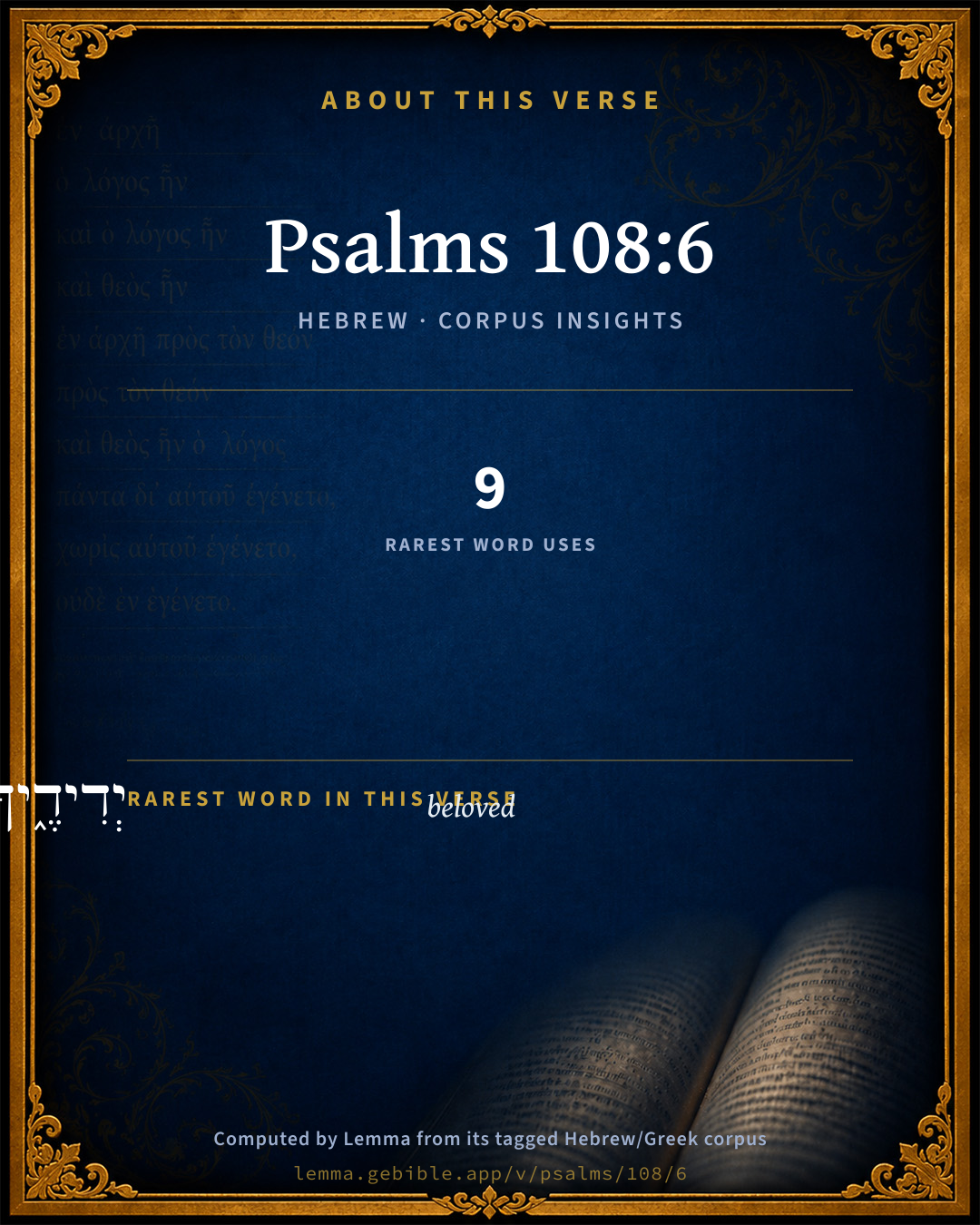
The rarest word here is יְדִידֶ֑יךָ beloved H3039 — appearing just 9 times in the whole Hebrew Bible.

Shared distinctive vocabulary

יְדִידֶ֑יךָ beloved H3039 occurs in 8 verses of the Hebrew Bible. Also found in:

Grammatical profile

  • 3 verbs
  • 1 noun
  • 1 adjective
  • 1 preposition

Verb forms

  • יֵחָלְצ֣וּן Niphal · Imperfect
  • הוֹשִׁ֖יעָה Hiphil · Imperative
  • וַעֲנֵֽנִי Qal · Imperative

Hebrew & Septuagint length

In English translation the verse runs 14 words from the Hebrew and 21 from the Septuagint (LXX English) — closely comparable.

A rough comparison of the two English renderings, which tokenize alike — not a word-level alignment.

Word counts can differ between the Hebrew and the Greek without any difference in meaning — e.g. the Hebrew direct-object marker אֵת has no separate Greek word, and Greek often adds the article ὁ.

Cross-references

21

Topical passages linked to Psalms 108:6 in the Treasury of Scripture Knowledge — connected by theme and wording, ordered by reader-vote popularity; previews shown in the World English Bible.

  • 2 Chronicles 32:20–22 Hezekiah the king, and Isaiah the prophet the son of Amoz, prayed because of this, and cried to heaven.
  • Psalms 60:5–12 So that your beloved may be delivered, Save with your right hand, and answer us.
  • Deuteronomy 33:12 Of Benjamin he said, The beloved of Yahweh shall dwell in safety by him; He covers him all the day long, He dwells between his shoulders.
  • Colossians 3:12 Put on therefore, as God's chosen ones, holy and beloved, a heart of compassion, kindness, lowliness, humility, and perseverance;
  • Psalms 35:1–3 Contend, Yahweh, with those who contend with me. Fight against those who fight against me.
  • Ephesians 1:6 to the praise of the glory of his grace, by which he freely bestowed favor on us in the Beloved,
  • 1 Kings 18:24 You call on the name of your god, and I will call on the name of Yahweh; and the God who answers by fire, let him be God." All the people answered, "It is well said."
  • 1 Kings 18:29 It was so, when midday was past, that they prophesied until the time of the offering of the [evening] offering; but there was neither voice, nor any to answer, nor any who regarded.
  • 1 Kings 18:36–37 It happened at the time of the offering of the [evening] offering, that Elijah the prophet came near, and said, Yahweh, the God of Abraham, of Isaac, and of Israel, let it be known this day that you are God in Israel, and that I am your servant, and that I have done all these things at your word.
  • Psalms 54:1 Save me, God, by your name. Vindicate me in your might.
  • Psalms 144:5–7 Part your heavens, Yahweh, and come down. Touch the mountains, and they will smoke.
  • Isaiah 51:2–11 Look to Abraham your father, and to Sarah who bore you; for when he was but one I called him, and I blessed him, and made him many.
  • Isaiah 65:24 It shall happen that, before they call, I will answer; and while they are yet speaking, I will hear.
  • Jeremiah 33:3 Call to me, and I will answer you, and will show you great things, and difficult, which you don't know.
  • Matthew 3:17 Behold, a voice out of the heavens said, "This is my beloved Son, with whom I am well pleased."
  • Matthew 17:5 While he was still speaking, behold, a bright cloud overshadowed them. Behold, a voice came out of the cloud, saying, "This is my beloved Son, in whom I am well pleased. Listen to him."
  • Romans 1:7 to all who are in Rome, beloved of God, called to be saints: Grace to you and peace from God our Father and the Lord Jesus Christ.
  • Exodus 15:6 Your right hand, Yahweh, is glorious in power, Your right hand, Yahweh, dashes the enemy in pieces.
  • 2 Samuel 12:25 and he sent by the hand of Nathan the prophet; and he named him Jedidiah, for Yahweh's sake.
  • 1 Kings 18:26 They took the bull which was given them, and they dressed it, and called on the name of Baal from morning even until noon, saying, Baal, hear us. But there was no voice, nor any who answered. They leaped about the altar which was made.
  • Psalms 98:1–2 Sing to Yahweh a new song, For he has done marvelous things! His right hand, and his holy arm, have worked salvation for him.

Cross-references courtesy of OpenBible.info (CC BY 4.0).

Hebrew and Greek witnesses Masoretic Hebrew ↔ Greek Septuagint

The same verse in the two great witnesses to the Old Testament, shown verse-for-verse.

You’re reading Greek Psalm 107 (Hebrew Psalm 108). The Septuagint counts the superscription, so verse numbers can differ from the Hebrew — chapter-level alignment, not verse-by-verse. Numbering follows Rahlfs.

These are two independent witnesses, not word-aligned to each other, and the Septuagint is shown in lemma (dictionary) form.

Hebrew Psalms 108:6 Masoretic · Westminster Leningrad Codex

לְ֭מַעַן יֵחָלְצ֣וּן יְדִידֶ֑יךָ הוֹשִׁ֖יעָה יְמִֽינְךָ֣ וַעֲנֵֽנִי

That your beloved may be delivered, Save with your right hand, and answer us.

World English Bible · Public Domain

Greek LXX Greek Psalm 107:6 Septuagint · lemma form

ὑψόω ἐπί ὁ οὐρανός ὁ θεός καί ἐπί πᾶς ὁ γῆ ὁ δόξα σύ

That your beloved ones may be delivered, save with your right hand, and hear me. God has spoken in his sanctuary;

LXX2012 (modern English Septuagint) · Public Domain

Hebrew: Westminster Leningrad Codex (CC BY 4.0). Greek: Septuagint (public domain); English from LXX2012 (modern English Septuagint) (Public Domain). How the Septuagint differs from the Hebrew →

Commentary

Notes on Psalms 108:6 from classic Christian and Jewish commentators (each source and its license shown beneath its notes). The classic Christian expositions comment on the surrounding passage and are grouped to its opening verse, so a note may address several verses; the Jewish commentaries on the Tanakh (Rashi and others) are per-verse, so they appear only where the commentator wrote on this verse.

Lemma curates 59 commentaries, every one of them public domain or Creative Commons licensed, each selected and text-cleaned for this edition rather than reprinted as found. About our sources →

Matthew Henry's Commentary

We may here learn how to pray as well as praise. 1. We must be public-spirited in prayer, and bear upon our hearts, at the throne of grace, the concerns of the church of God, Psa 108:6. It is God's beloved, and therefore must be ours; and therefore we must pray for its deliverance, and reckon that we are answered if God grant what we ask for his church, though he delay to give us what we ask for ourselves. "Save thy church, and thou answerest me; I have what I would have." Let the earth be filled with God's glory, and the prayers of David are ended (Psa 72:19, Psa 72:20); he desires no more. 2. We must, in prayer, act faith upon the power and promise of God - upon his power (Save with thy right hand, which is mighty to save), and upon his promise: God has spoken in his holiness, in his holy word, to which he has sworn by his holiness, and therefore I will rejoice, Psa 108:7. What he has promised he will perform, for it is the word both of his truth and of his power. An active faith can rejoice in what God has said, though it be not yet done; for with him saying and doing are not two things, whatever they are with us. 3. We must, in prayer, take the comfort of what God has secured to us and settled upon us, though we are not yet put in possession of it. God had promised David to give him, (1.) The hearts of his subjects; and therefore he surveys the several parts of the country as his own already: "Shechem and Succoth, Gilead and Manasseh, Ephraim and Judah, are all my own," Psa 108:8. With such assurance as this we may speak of the performance of what God has promised to the Son of David; he will, without fail, give him the heathen for his inheritance and the utmost parts of the earth for his possession, for so has he spoken in his holiness; nay, of all the particular persons that were given him he will lose none; he also, as David, shall have the hearts of his subjects, Joh 6:37. And, (2.) The necks of his enemies. These are promised, and therefore David looks upon Moab, and Edom, and Philistia, as his own already (Psa 108:9): Over Philistia will I triumph, which explains Psa 60:8, Philistia, triumph thou because of me, which some think should be read, O my soul! triumph thou over Philistia. Thus the exalted Redeemer is set down at God's right hand, in a full assurance that all his enemies shall in due time be made his footstool, though all things are not yet put under him, Heb 2:8. 4. We must take encouragement from the beginnings of mercy to pray and hope for the perfecting of it (Psa 108:10, Psa 108:11): "Who will bring me into the strong cities that are yet unconquered? Who will make me master of the country of Edom, which is yet unsubdued?" The question was probably to be debated in his privy council, or a council of war, what methods they should take to subdue the Edomites and to reduce that country; but he brings it into his prayers, and leaves it in God's hands: Wilt not thou, O God? Certainly thou wilt. It is probable that he spoke with the more assurance concerning the conquest of Edom because of the ancient oracle concerning Jacob and Esau, that the elder should serve the younger, and the blessing of Jacob, by which he was made Esau's lord, Gen 27:37. 5. We must not be discouraged in prayer, nor beaten off from our hold of God, though Providence has in some instances frowned upon us: "Though thou hast cast us off, yet thou wilt now go forth with our hosts, Psa 108:11. Thou wilt comfort us again after the time that thou hast afflicted us." Adverse events are sometimes intended for the trial of the constancy of our faith and prayer, which we ought to persevere in whatever difficulties we meet with, and not to faint. 6. We must seek help from God, renouncing all confidence in the creature (Psa 108:12): "Lord, give us help from trouble, prosper our designs, and defeat the designs of our enemies against us." It is not unseasonable to talk of trouble at the same time that we talk of triumphs, especially when it is to quicken prayer for help from heaven; and it is a good plea, Vain is the help of man. "It is really so, and therefore we are undone if thou do not help us; we apprehend it to be so, and therefore depend upon thee for help and have the more reason to expect it." 7. We must depend entirely upon the favour and grace of God, both for strength and success in our work and warfare, Psa 108:13. (1.) We must do our part, but we can do nothing of ourselves; it is only through God that we shall do valiantly. Blessed Paul will own that even he can do nothing, nothing to purpose, but through Christ strengthening him, Phi 4:13. (2.) When we have acquitted ourselves ever so well, yet we cannot speed by any merit or might of our own; it is God himself that treads down our enemies, else we with all our valour cannot do it. Whatever we do, whatever we gain, God must have all the glory.

Matthew Henry's Commentary on the Whole Bible (1708–1710) — public domain (CC PDM 1.0). Text via the HelloAO Bible API.

The Treasury of David

Charles H. Spurgeon

Ver. 6. That thy beloved may be delivered: save with thy right hand, and answer me. Let my prayer avail for all the beloved ones. Sometimes a nation seems to hang upon the petitions of one man. With what ardour should such an one pour out his soul! David does so here. It is easy praying for the Lord's beloved, for we feel sure of a favourable answer, since the Lord's heart is already set upon doing them good: yet it is solemn work to plead when we feel that the condition of a whole beloved nation depends upon what the Lord means to do with us whom he has placed in a representative position. "Answer me, that thy many beloved ones may be delivered": it is an urgent prayer. David felt that the case demanded the right hand of God, his wisest, speediest, and most efficient interposition, and he feels sure of obtaining it for himself, since his cause involved the safety of the chosen people. Will the Lord fail to use his right hand of power on behalf of those whom he has set at his right hand of favour? Shall not the beloved be delivered by him who loves them? When our suit is not a selfish one, but is bound up with the cause of God, we may be very bold about it.

Ver. 6. That thy beloved may be delivered, etc. The church is the Lord's "beloved", or the incorporation, more loved than anything else in the world, therefore here called, "Thy beloved." Because the church is God's beloved, the care of it should be most in our mind, and the love of the preservation of it should draw forth our prayer most in favour of it. "That thy beloved may be delivered: save." David Dickson.

Ver. 6. God being thus exalted according to the majesty of his truth, the special plea of the Spirit of Jesus, founded on the mercy which has throned itself above the heavens, is next urged (Ps 108:6) on behalf of the nation of his ancient love. That thy beloved (ones) may be delivered, save with thy right hand and answer me. It is the Spirit of Immanuel that thus makes intercession for his well remembered people according to God. His land should be rid in due time of those who had burdened it with wickedness. For God had spoken in his holiness concerning the portion of his anointed. Arthur Pridham.

Ver. 6. The prayer of a representative man. There are times when to answer me is to deliver the churchat such times I have a powerful plea.

Psalms 108:7*

Charles H. Spurgeon's The Treasury of David (1869–1885) — public domain. Psalms only. Text from a community e-Sword/MySword module.

J. A. Alexander on Psalms

Joseph Addison Alexander

7. (Psa 108:6) In order that thy beloved (ones) may be delivered, save with thy right hand, and hear (or answer) us. See above, on Psa 60:5, with which this verse agrees in all points, not excepting the keri or various reading in the last word. (me for us).

Joseph Addison Alexander, The Psalms Translated and Explained (1850) — public domain. Text from a community e-Sword module.

Scofield Reference Notes

C. I. Scofield

Psa 108:6-13 are identical with Psa 60:5-12.

The Scofield Reference Bible (1917 edition), notes by C. I. Scofield — public domain. Text from a community e-Sword module.

Geneva Bible (1599)

Geneva Bible translators

When God by his benefits maketh us partakers of his mercies, he admonisheth us to be earnest in prayer, to desire him to continue and finish his graces.

Geneva Bible (1599) marginal notes — public domain. Text via Bolls.life.

The Cambridge Bible for Schools and Colleges

gen. ed. J. J. S. Perowne

6. The A.V. places a semicolon at the end of Psa_108:5, but here, as in Psa_60:5, it is best to take the clause That thy beloved ones may be delivered as dependent on the next clause Save &c. Thy beloved ones are the Israelites. Cp. Deu_33:12; Jer_11:15.

save with thy right hand] Give victory. Cp. Psa_108:12 b; Psa_44:3.

answer me] So the best text here, supported by all the Versions. This reading suits the singular of Psa_108:1-5 better than save us, which is found in some MSS and adopted by R.V.

6–13. Prayer for help, based upon God’s promise to give Israel possession of Canaan, and supremacy over the surrounding nations (6–9): with an expression of confidence that God, Who alone can help, will surely give His people the victory (10–13).

The Cambridge Bible for Schools and Colleges (gen. ed. J. J. S. Perowne; Cambridge University Press, 1878–1918) — public domain. Text from a community e-Sword module.

John Gill's Exposition

Over Philistia will I triumph,.... In Psa 60:8, it is, "Philistia, triumph thou because of me"; See Gill on Psa 60:8.

Psalms 108:11

John Gill's Exposition of the Whole Bible (1746–1763) — public domain (CC PDM 1.0). Text via the HelloAO Bible API.

Albert Barnes' Notes on the Bible

That thy beloved may be delivered - The word rendered “beloved,” and the verb rendered “may be delivered,” are both in the plural number, showing that it is not an individual that is referred to, but that the people of God are intended. This is taken without any alteration from Psa 60:5. In that psalm the prayer for deliverance is grounded on the afflictions of the people, and the fact that God had given them “a banner that it might be displayed because of the truth,” - or, in the cause of truth. See the notes at that psalm. In the psalm before us, while the prayer for deliverance is the same, the reason for that prayer is different. It is that God is exalted; that his mercy is above the heavens; that his glory is above all the earth, and that he is thus exalted that he may interpose and save his people.

Save with thy right hand, and answer me - The Hebrew here is the same as in Psa 60:5, where it is rendered “and hear me.”

Albert Barnes' Notes on the Bible (1834–1885) — public domain. Text from a community e-Sword/MySword module.

The Pulpit Commentary

That thy beloved (or, thy beloved ones) may be delivered: save with thy right hand, and answer me. Absolutely identical with Psa_60:5; but with a change in the connection which give the words a somewhat different bearing.

Hope and prayer inspired by praise.

In this verse we trace the influence which the spirit and utterance of praise has upon the psalmist. It leads to prayer, and gives him confidence in prayer.

I PRAISING GOD BRINGS HOME TO US GOD"S RELATIONS TO US, AND OUR RELATIONS TO GOD. Praising God for what he has done convinces us of his kindly feeling toward us and interest in us, so that we may even think and speak of ourselves as God"s beloved. This may be regarded as David"s way of thinking of himself; but a similar appropriation of the Divine love we may make. It is the realization of our Father"s personal love to us that fills us with hope, and gives us confidence to pray. We never think of putting God under any constraint of prayer. We pray as children make their requests of parents who love them.

II PRAISING GOD BECOMES AN INSPIRATION TO PRAYER FOR FURTHER BLESSINGS.

1. It gives us argument. For we only praise because we know that God has answered our prayers. It is really for those answers that we offer prayer. Once let it be established in our hearts that God is the prayer-hearing and prayer-answering God, and we have the all-sufficing ground on which to seek him in every form of new distress and need. Praise is only possible when we fully recognize reasons for praise.

2. It gives us the feeling that makes us long to pray, and so gain yet more reason to praise. Praise and prayer are indissolubly linked together. No man will pray long who gives up praising, and no man will keep up his praise who neglects his praying. If we find ourselves hesitating about praying for what we newly need, the best thing to do is to set about praising for the blessings we have received. Just as it was with the psalmist, so it will be with us. Let praise do its work, and it will be sure to lead in prayer. R.T.

The Pulpit Commentary (1880–1919), ed. H.D.M. Spence-Jones & Joseph S. Exell — public domain. Text from a community e-Sword module.

Keil & Delitzsch

C. F. Keil & F. Delitzsch

Ps. 60:7-14 forms this second half. The clause expressing the purpose with למען, as in its original, has the following הושׁיעה for its principal clause upon which it depends. Instead of ועננוּ, which one might have expected, the expression used here is וענני without any interchange of the mode of writing and of reading it; many printed copies have ועננו here also; Baer, following Norzi, correctly has וענני. Instead of ולי...לי, Psa 60:9, we here read לי...לי, which is less soaring. And instead of Cry aloud concerning me, O Philistia do I shout for joy (the triumphant cry of the victor); in accordance with which Hupfeld wishes to take התרועעי in the former as infinitive: "over (עלי instead of עלי) Philistia is my shouting for joy" (התרועעי instead of התרועעי, since the infinitive does not admit of this pausal form of the imperative). For עיר מצור we have here the more usual form of expression עיר מבצר. Psa 108:12 is weakened by the omission of the אתּה (הלא).

Keil & Delitzsch — Biblical Commentary on the Old Testament (1861–1891) — public domain (CC PDM 1.0). Text via the HelloAO Bible API. (Old Testament only.)

Lesson kit

Teaching starters — assembled from the data on this page, not authored interpretation. Every prompt links to the verse data it draws on. Edit before teaching.

Psalms, in the Wisdom, opens this verse with 6 words (6 distinct Hebrew lemmas). Its most distinctive word is yᵉdîyd (“beloved”). A historical commentator’s framing appears above. Read the whole chapter for the surrounding context.

Discussion questions

  1. What does “beloved” (yᵉdîyd) contribute to the verse as a whole?
  2. How does Deuteronomy 33:12, which shares the word «beloved», read alongside this verse?
  3. These translations render this verse differently; the difference is in the English rendering, not the original. What questions does that raise?
  4. «יֵחָלְצ֣וּן» is a Niphal Imperfect verb. How does that grammatical form shape the action described?
  5. Compare how Matthew Henry's Commentary and The Treasury of David read this verse. Where do they agree or differ?

Things to notice

Reading settings

Reading text

Shown beneath each verse's original-language words.

Old Testament
Old Testament edition

Read the OT as the Masoretic Hebrew (MT) or the Greek Septuagint (LXX).

English shown for the Greek Septuagint (in the Hebrew ↔ Greek comparison).

Comparing translations? Open the Compare panel on any verse page to stack up to four side by side.