
Psalms 72:4

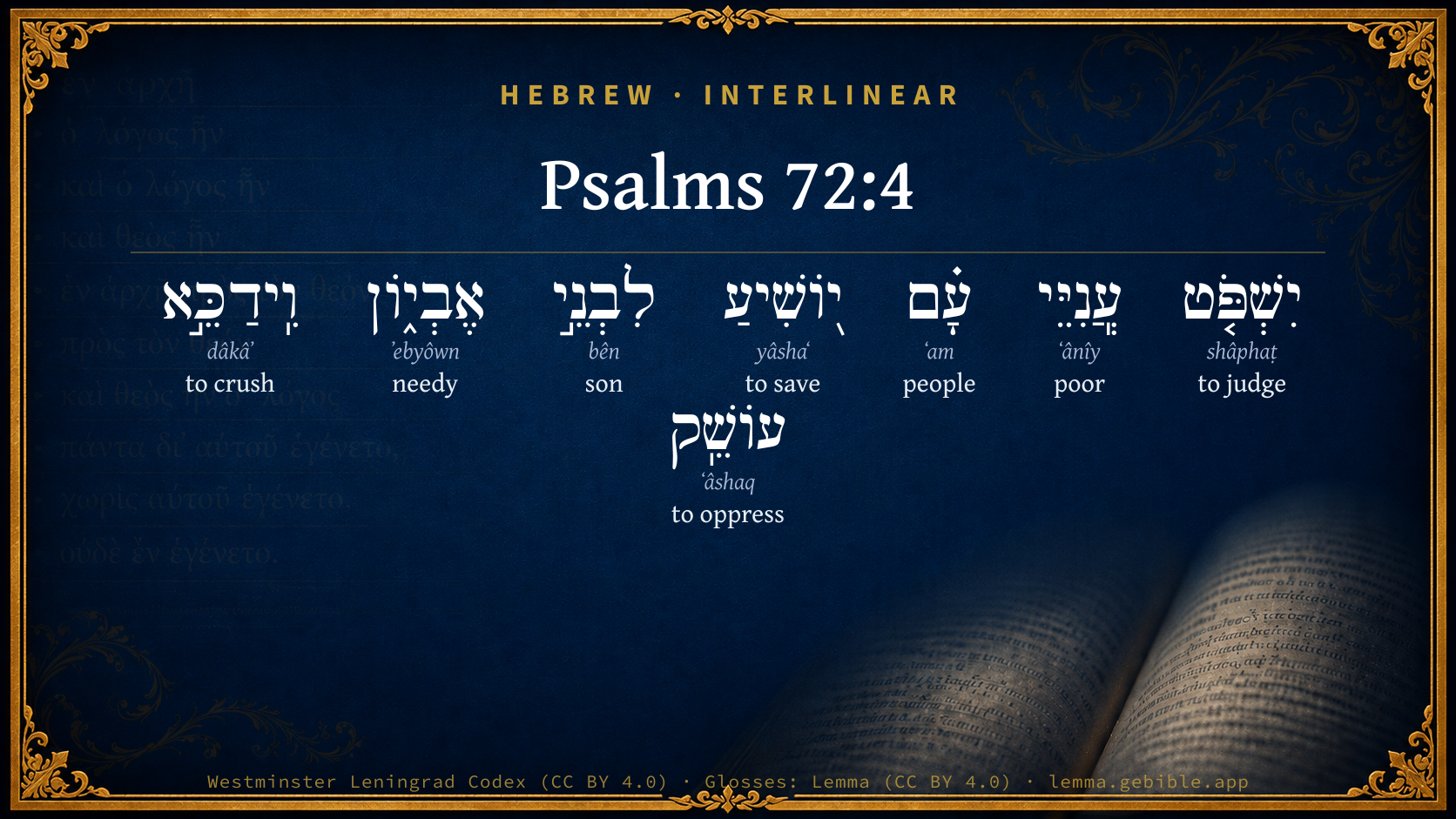
Hebrew (Westminster Leningrad Codex) Psalms 72:4 appears in the Hebrew Old Testament. The text above is from the Westminster Leningrad Codex. Each word links to its Strong’s number, a concise gloss, and parsing drawn from the Open Scriptures Hebrew Bible morphology. Click any word for its full Brown-Driver-Briggs (BDB) entry.
Download image
Cite this verse

Psalms 72:4 (World English Bible). Public Domain. Lemma interlinear Bible study tool, https://lemma.gebible.app/v/psalms/72/4.

Show BibTeX & RIS
BibTeX
RIS
English Translation
He will judge the poor of the people. He will save the children of the needy, And will break the oppressor in pieces.
World English Bible · Public Domain
Download a study sheet

One document with this verse’s original text, its word-by-word gloss line, the meaning frame, cross-references with their text, attributed commentary, and full source and license credits — printable, and it pastes into notes with its structure intact.

This verse Autodidact and up

Study sheet (.html) Plain text (.txt)

A passage Seminary Student

Up to 50 verses in one chapter. A passage sheet keeps up to 6 commentary sources and 12 cross-references per verse, in the order this page ranks them, and says so on the sheet whenever that leaves anything out. Ask for a single verse and you get the Autodidact verse sheet above.

Everything on this page stays free to read, with no account — the sheet is a download of what is already on screen, not access to it.

Want to remove ads? Support Godless Engineer
Compare translations 3

The same verse in 3 English versions, stacked beneath the original-language interlinear above. Click any original word for its lexicon entry.

Each is an independent rendering of the whole verse — the interlinear is not word-aligned to these translations.

Highlighted words mark where these versions differ — a whole-verse word diff, not a word-by-word alignment.

  • World English Bible Public Domain
    He will judge the poor of the people. He will save the children of the needy, And will break the oppressor in pieces.
  • King James Version Public Domain
    He shall judge the poor of the people, he shall save the children of the needy, and shall break in pieces the oppressor.
  • unfoldingWord Literal Text CC BY-SA 4.0
    May he judge the poor of the people; may he save the sons of the needy, and may he crush the oppressor.

unfoldingWord Literal Text — © unfoldingWord, licensed CC BY-SA 4.0. Word-aligned USFM3 via Door43 (git.door43.org/unfoldingWord/en_ult).

Versions to compare (up to 4)

3 of 4 selected

Show all 18 translations

Every available English version of this verse, each an independent rendering of the whole verse.

  • World English Bible Public Domain
    He will judge the poor of the people. He will save the children of the needy, And will break the oppressor in pieces.
  • Berean Standard Bible Public Domain
    May he vindicate the afflicted among the people; may he save the children of the needy and crush the oppressor.
  • Majority Standard Bible Public Domain
    May he vindicate the afflicted among the people; may he save the children of the needy and crush the oppressor.
  • King James Version Public Domain
    He shall judge the poor of the people, he shall save the children of the needy, and shall break in pieces the oppressor.
  • American Standard Version (1901) Public Domain
    He will judge the poor of the people, He will save the children of the needy, And will break in pieces the oppressor.
  • Revised Version (1885) Public Domain
    He shall judge the poor of the people, he shall save the children of the needy, and shall break in pieces the oppressor.
  • Geneva Bible (1599) Public Domain
    He shall iudge the poore of the people: he shall saue the children of the needie, and shall subdue the oppressor.
  • Douay-Rheims (1899) Public Domain
    He shall judge the poor of the people, and he shall save the children of the poor: and he shall humble the oppressor.
  • Young's Literal Translation Public Domain
    He judgeth the poor of the people, Giveth deliverance to the sons of the needy, And bruiseth the oppressor.
  • Literal Standard Version CC BY-SA 4.0
    He judges the poor of the people, || Gives deliverance to the sons of the needy, || And bruises the oppressor.
  • Unlocked Literal Bible CC BY-SA 4.0
    May he judge the poor of the people; may he save the children of the needy and break in pieces the oppressor.
  • unfoldingWord Literal Text CC BY-SA 4.0
    May he judge the poor of the people; may he save the sons of the needy, and may he crush the oppressor.
  • Darby Bible Public Domain
    He will do justice to the afflicted of the people; he will save the children of the needy, and will break in pieces the oppressor.
  • World Messianic Bible Public Domain
    He will judge the poor of the people. He will save the children of the needy, and will break the oppressor in pieces.
  • Webster's Bible Public Domain
    He shall judge the poor of the people, he shall save the children of the needy, and shall break in pieces the oppressor.
  • Free Bible Version CC BY-SA 4.0
    May he defend the poor and save their children, may he crush those who oppress them.
  • Bible in Basic English Public Domain
    May he be a judge of the poor among the people, may he give salvation to the children of those who are in need; by him let the violent be crushed.
  • JPS Tanakh (1917) Public Domain
    May he judge the poor of the people, and save the children of the needy, and crush the oppressor.

Literal Standard Version (2020), Covenant Press — licensed CC BY-SA 4.0. Text via the HelloAO Bible API (eBible.org). Unlocked Literal Bible (unfoldingWord) — licensed CC BY-SA 4.0. Text via the HelloAO Bible API (eBible.org). unfoldingWord Literal Text — © unfoldingWord, licensed CC BY-SA 4.0. Word-aligned USFM3 via Door43 (git.door43.org/unfoldingWord/en_ult). Free Bible Version, Dr. Jonathan Gallagher — licensed CC BY-SA 4.0. Text via the HelloAO Bible API (eBible.org).

Word by word

More ways to search: Search by grammar → Find every occurrence → Compare this word →

Practice this passage: Drill this verse → Learn its vocabulary →

וִֽידַכֵּ֣א
dâkâʼ
H1792
“and · to crush”
Conjunction + Verb, Piel, Imperfect, 3rd Person, Masculine, Singular
Part of Speech
Conjunction + Verb
Stem
Piel
Form
Imperfect
Person
3rd Person
Gender
Masculine
Number
Singular
Full BDB Definition

Origin: a primitive root (compare H1794 )

TWOT: 427

to crush, be crushed, be contrite, be broken - (Niphal) - to be crushed - to be contrite (figuratively) - (Piel) to crush - (Pual) - to be crushed, be shattered - to be made contrite - (Hithpael) to allow oneself to be crushed
  1. יִשְׁפֹּ֤ט shâphaṭ H8199 “to judge” Verb, Qal, Imperfect, 3rd Person, Masculine, Singular
  2. עֲֽנִיֵּי ʻânîy H6041 “poor of” Adjective, Adjective, Masculine, Plural, Construct
  3. עָ֗ם ʻam H5971 “people” Noun, Common, Masculine, Singular, Absolute
  4. י֭וֹשִׁיעַ yâshaʻ H3467 “to save” Verb, Hiphil, Imperfect, 3rd Person, Masculine, Singular
  5. לִבְנֵ֣י bên H1121 “to/for · sons of” Preposition + Noun, Common, Masculine, Plural, Construct
  6. אֶבְי֑וֹן ʼebyôwn H34 “needy” Adjective, Adjective, Masculine, Singular, Absolute
  7. עוֹשֵֽׁק ʻâshaq H6231 “oppressing” Verb, Qal, Participle Active, Masculine, Singular, Absolute

About this verse

These counts appear in no published source. They are computed here, from the morphology-tagged text and Lemma’s own curated glosses. What Lemma adds →

8
words
8
distinct lemmas
Wisdom
section

Notable vocabulary

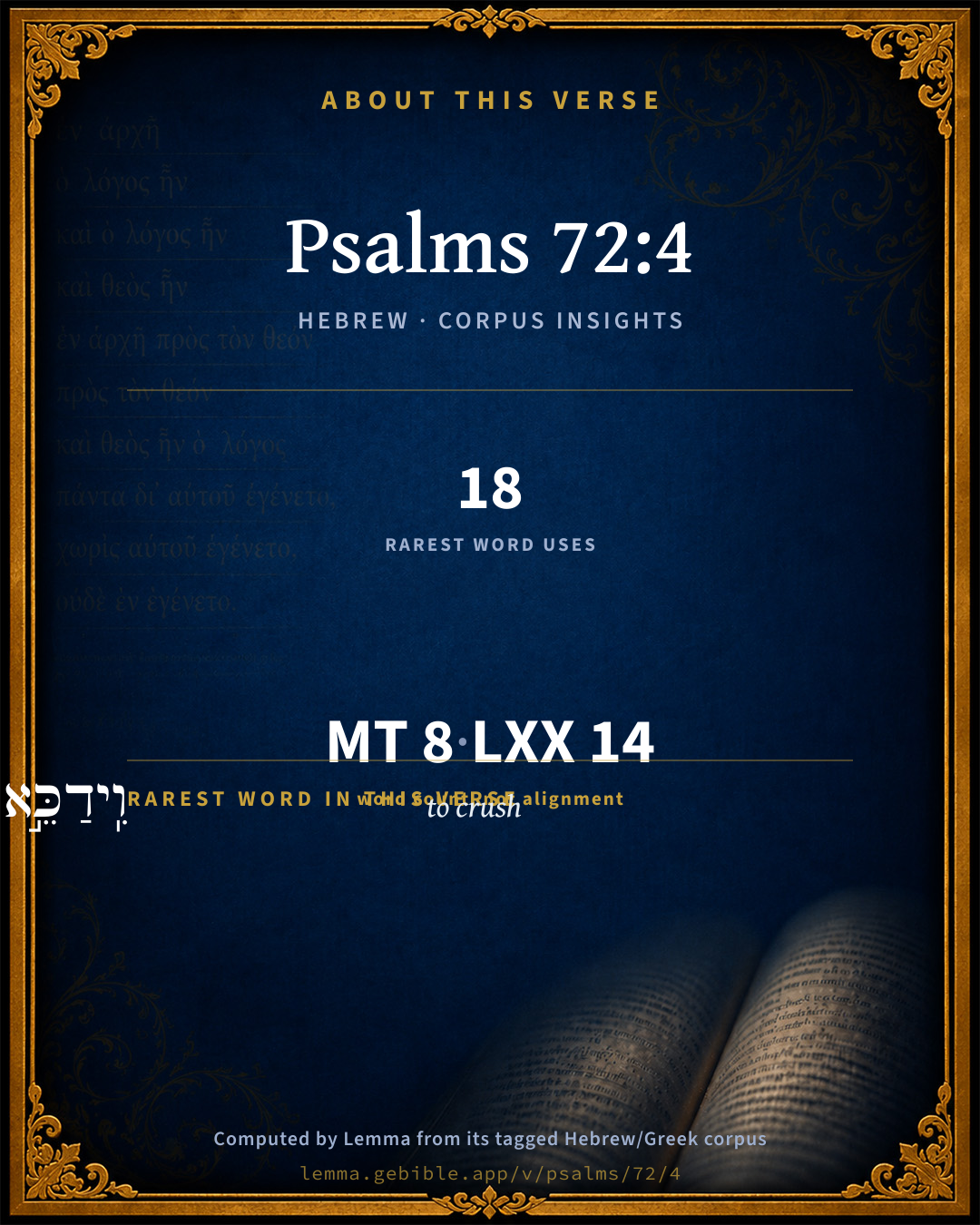
The rarest word here is וִֽידַכֵּ֣א to crush H1792 — appearing just 18 times in the whole Hebrew Bible.

Shared distinctive vocabulary

וִֽידַכֵּ֣א to crush H1792 occurs in 18 verses of the Hebrew Bible. Also found in:

Grammatical profile

  • 4 verbs
  • 2 nouns
  • 2 adjectives

Verb forms

  • יִשְׁפֹּ֤ט Qal · Imperfect
  • י֭וֹשִׁיעַ Hiphil · Imperfect
  • וִֽידַכֵּ֣א Piel · Imperfect
  • עוֹשֵֽׁק Qal · Participle Active

Hebrew & Septuagint length

In English translation the verse runs 23 words from the Hebrew and 24 from the Septuagint (LXX English) — closely comparable.

A rough comparison of the two English renderings, which tokenize alike — not a word-level alignment.

Word counts can differ between the Hebrew and the Greek without any difference in meaning — e.g. the Hebrew direct-object marker אֵת has no separate Greek word, and Greek often adds the article ὁ.

In the original languages it is 8 Hebrew tokens and 14 Greek tokens — but the two are counted differently (Hebrew bundles its prefixes and suffixes into one token; the Greek is in lemma form), so that isn’t a like-for-like length.

Cross-references

21

Topical passages linked to Psalms 72:4 in the Treasury of Scripture Knowledge — connected by theme and wording, ordered by reader-vote popularity; previews shown in the World English Bible.

  • Isaiah 11:4 but with righteousness shall he judge the poor, and decide with equity for the humble of the earth; and he shall strike the earth with the rod of his mouth; and with the breath of his lips shall he kill the wicked.
  • Ezekiel 34:15–16 I myself will be the shepherd of my sheep, and I will cause them to lie down, says the Lord Yahweh.
  • Psalms 109:31 For he will stand at the right hand of the needy, To save him from those who judge his soul.
  • Zechariah 9:8–10 I will encamp around my house against the army, That none pass through or return; And no oppressor will pass through them any more: For now I have seen with my eyes.
  • Job 34:24 He breaks in pieces mighty men in ways past finding out, And sets others in their place.
  • Psalms 2:9 You shall break them with a rod of iron. You shall dash them in pieces like a potter's vessel."
  • Psalms 72:12–14 For he will deliver the needy when he cries; The poor, who has no helper.
  • Psalms 94:5 They break your people in pieces, Yahweh, And afflict your heritage.
  • Proverbs 20:26 A wise king winnows out the wicked, And drives the threshing wheel over them.
  • Isaiah 9:4 For the yoke of his burden, and the staff of his shoulder, the rod of his oppressor, you have broken as in the day of Midian.
  • Daniel 2:34–35 You saw until a stone was cut out without hands, which struck the image on its feet that were of iron and clay, and broke them in pieces.
  • Zechariah 11:7 So I fed the flock of slaughter, especially the oppressed of the flock. I took for myself two staffs. The one I called "Favor," and the other I called "Union," and I fed the flock.
  • Matthew 11:5 the blind receive their sight, the lame walk, the lepers are cleansed, the deaf hear, the dead are raised up, and the poor have good news preached to them.
  • Revelation 18:6–8 Return to her just as she returned, and repay her double as she did, and according to her works. In the cup which she mixed, mix to her double.
  • Revelation 18:20 Rejoice over her, O heaven, you saints, apostles, and prophets; for God has judged your judgment on her."
  • Revelation 18:24 In her was found the blood of prophets and of saints, and of all who have been slain on the earth."
  • Revelation 19:2 for true and righteous are his judgments. For he has judged the great prostitute, who corrupted the earth with her sexual immorality, and he has avenged the blood of his servants at her hand."
  • Job 19:2 "How long will you torment me, And crush me with words?
  • Isaiah 51:12–13 I, even I, am he who comforts you: who are you, that you are afraid of man who shall die, and of the son of man who shall be made as grass;
  • Jeremiah 51:20–23 You are my battle-axe and weapons of war: and with you will I break in pieces the nations; and with you will I destroy kingdoms;
  • Zechariah 11:11 It was broken in that day; and thus the poor of the flock that listened to me knew that it was the word of Yahweh.

Cross-references courtesy of OpenBible.info (CC BY 4.0).

Hebrew and Greek witnesses Masoretic Hebrew ↔ Greek Septuagint

The same verse in the two great witnesses to the Old Testament, shown verse-for-verse.

You’re reading Greek Psalm 71 (Hebrew Psalm 72). The Septuagint counts the superscription, so verse numbers can differ from the Hebrew — chapter-level alignment, not verse-by-verse. Numbering follows Rahlfs.

These are two independent witnesses, not word-aligned to each other, and the Septuagint is shown in lemma (dictionary) form.

Hebrew Psalms 72:4 Masoretic · Westminster Leningrad Codex

יִשְׁפֹּ֤ט עֲֽנִיֵּי עָ֗ם י֭וֹשִׁיעַ לִבְנֵ֣י אֶבְי֑וֹן וִֽידַכֵּ֣א עוֹשֵֽׁק

He will judge the poor of the people. He will save the children of the needy, And will break the oppressor in pieces.

World English Bible · Public Domain

Greek LXX Greek Psalm 71:4 Septuagint · lemma form

κρίνω ὁ πτωχός ὁ λαός καί σώζω ὁ υἱός ὁ πένης καί ταπείνωσις συκοφάντης

he shall judge the poor of the people in righteousness, and save the children of the needy; and shall bring low the false accuser.

LXX2012 (modern English Septuagint) · Public Domain

Hebrew: Westminster Leningrad Codex (CC BY 4.0). Greek: Septuagint (public domain); English from LXX2012 (modern English Septuagint) (Public Domain). How the Septuagint differs from the Hebrew →

Commentary

Notes on Psalms 72:4 from classic Christian and Jewish commentators (each source and its license shown beneath its notes). The classic Christian expositions comment on the surrounding passage and are grouped to its opening verse, so a note may address several verses; the Jewish commentaries on the Tanakh (Rashi and others) are per-verse, so they appear only where the commentator wrote on this verse.

Lemma curates 59 commentaries, every one of them public domain or Creative Commons licensed, each selected and text-cleaned for this edition rather than reprinted as found. About our sources →

Trapp's Complete Commentary

John Trapp

Psa 72:4 He shall judge the poor of the people, he shall save the children of the needy, and shall break in pieces the oppressor.

Ver. 4. He shall judge the poor of the people] Indeed all, indifferently, without respect of persons; but a poor man’s tale shall be heard, and his cause judged, as well as a rich man’s. Under Christ’s government it shall be so howsoever; "I know thy poverty, but thou art rich," saith he, Rev 3:9. Amongst men, both in suits of love and of law, money maketh mastery; not so here.

And shall break in pieces the oppressor] The tale berarer, saith the Greek; the slanderer, saith the Latin; the devil, say some. Over these he shall turn the wheel.

John Trapp, A Commentary or Exposition upon All the Books of the Old and New Testament (1647–1656) — public domain. Text from a community e-Sword module.

The Biblical Illustrator

Joseph S. Exell

Psa_72:4

He shall judge the poor of the people, He shall save the children of the needy, and shall break in pieces the oppressor.

On the education of the children of the poor

I. Look to the present situation of the children of the needy, and compassion will urge you to befriend them. Look especially to the moral disadvantages and trials to which it subjects them; and you will think it little to relieve their bodily wants, while you leave the mind and the soul in bondage.

II. Consider the destiny which awaits these children of the needy;--and the relief which before was prompted by compassion, will be felt as the dictate of imperious duty.

1. Let not the prosperous man despise the children of the needy. They in many ways minister towards the supply of his wants. Their labour furnishes the indulgence of his luxury. Their courage defends the interests of his country. They reside, perhaps, under his own roof. His property must be under their charge. His reputation must be in their keeping.

2. The children of the needy are destined for immortality. As surely as the lineaments of the human countenance are found in them, so surely may be found in them also the traces of a mind which thinks, not only for time but for eternity;--the traces of a soul which feels, not only for time but for eternity. (A. Brunton, D. D.)

Gods care for the poor

God represents Himself to us as having a peculiar and tender care of the poor. It is not the robust, but delicate, child of the family around whom a fathers and mothers affections cluster thickest. The boy or girl whom feebleness of body or mind makes least fit to bear the worlds rough usage, and most dependent on others kindness, is like those tendrils that, winding themselves around the tree they spangle with flowers, bind it more closely in their embraces, and bury their pliant arms deep in its bark. And what a blessed and beautiful arrangement of Providence it is that they who cost most care and lie with greatest weight on parents arms and hearts are commonly most loved. (J. Guthrie, D. D.)

The Biblical Illustrator, edited by Joseph S. Exell (c. 1880s–1900s) — public domain. Text from a community e-Sword module.

J. A. Alexander on Psalms

Joseph Addison Alexander

Psa 72:4. He shall judge the afflicted of the people; he shall save (or bring salvation) to the sons of the needy, and shall crush (or break in pieces) the oppressor. To judge them is to do them justice, to redress their wrongs and vindicate their rights. The afflicted of the people, those who suffer among the chosen people. The needy or the poor man is an ideal person, representing the whole class, whose individual members are described as his sons or children.

Joseph Addison Alexander, The Psalms Translated and Explained (1850) — public domain. Text from a community e-Sword module.

Tyndale Open Study Notes

Tyndale Open Resources

72:4 A just ruler will defend the poor against injustice, rescue them from violence, and bring their oppressors to account for their wrongdoing.

Tyndale Open Study Notes — © Tyndale Open Resources, licensed CC BY-SA 4.0. Text via the HelloAO Bible API.

Geneva Bible (1599)

Geneva Bible translators

He showeth wherefore the sword is committed to Kings: to wit, to defend the innocent, and suppress the wicked.

Geneva Bible (1599) marginal notes — public domain. Text via Bolls.life.

John Calvin's Commentaries

4. He shall judge the poor of the people. The poet continues his description of the end and fruit of a righteous government, and unfolds at greater length what he had briefly touched upon concerning the afflicted among the people. But it is a truth which ought to be borne in mind, that kings can keep themselves within the bounds of justice and equity only by the grace of God; for when they are not governed by the Spirit of righteousness proceeding from heaven, their government is converted into a system of tyranny and robbery. As God had promised to extend his care to the poor and afflicted among his people, David, as an argument to enforce the prayer which he presents in behalf of the king, shows that the granting of it will tend to the comfort of the poor. God is indeed no respecter of persons; but it is not without cause that God takes a more special care of the poor than of others, since they are most exposed to injuries and violence. Let laws and the administration of justice be taken away, and the consequence will be, that the more powerful a man is, he will be the more able to oppress his poor brethren. David, therefore, particularly mentions that the king will be the defender of those who can only be safe under the protection of the magistrate, and declares that he will be their avenger when they are made the victims of injustice and wrong. The phrase, The children of the afflicted, is put for the afflicted, an idiom quite common in Hebrew, and a similar form of expression is sometimes used by the Greeks, as when they say υἱους ἰατρων, the sons of physicians, for physicians. But as the king cannot discharge the duty of succouring and defending the poor which David imposes upon him, unless he curb the wicked by authority and the power of the sword, it is very justly added in the end of the verse, that when righteousness reigns, oppressors or extortioners will be broken in pieces. It would be foolish to wait till they should give place of their own accord. They must be repressed by the sword, that their audacity and wickedness may be prevented from proceeding to greater lengths. It is therefore requisite for a king to be a man of wisdom, and resolutely prepared effectually to restrain the violent and injurious, that the rights of the meek and orderly may be preserved unimpaired. Thus none will be fit for governing a people but he who has learned to be rigorous when the case requires. Licentiousness must necessarily prevail under an effeminate and inactive sovereign, or even under one who is of a disposition too gentle and forbearing. There is much truth in the old saying, that it is worse to live under a prince through whose lenity everything is lawful, than under a tyrant where there is no liberty at all.

John Calvin's Commentaries (1540-1563) — public domain. Text from the Calvin Translation Society English edition (1840s-50s) via the Christian Classics Ethereal Library (ccel.org). Calvin's coverage is partial (roughly two-thirds of the Bible); uncommented books and verses are honest gaps, never fabricated. The 19th-century editor's footnotes and remarks are omitted so the notes are faithfully Calvin's own voice.

The Cambridge Bible for Schools and Colleges

gen. ed. J. J. S. Perowne

4. An expansion of Psa_72:2. The oppressed and defenceless are the special care of the true king, “whose glory is, redressing human wrong.” He does justice to ‘the afflicted of the people’; he is the preserver of ‘the children of the needy,’ words which are best understood literally, not merely of those born poor, or as a periphrasis, according to a common idiom, for ‘the needy,’ but of children, especially orphans, at once innocent and helpless, and therefore calling for special protection (see Isa_10:2; Mic_2:9, for the dangers to which they were exposed): while he crushes the merciless oppressor, treating him as he had treated his victims (Psa_94:5; Pro_22:22-23; Isa_3:15; Jas_2:13).

The Cambridge Bible for Schools and Colleges (gen. ed. J. J. S. Perowne; Cambridge University Press, 1878–1918) — public domain. Text from a community e-Sword module.

John Gill's Exposition

He shall judge the poor of the people,.... Of the people of God, whether among Jews or Gentiles; See Gill on Psa 72:2;

he shall save the children of the needy; whose parents being needy, they are so too, in a spiritual sense, and in distressed circumstances. Such Christ saves from their sins; from the curses and condemnation of the law: from, wrath to come, and out of the hands of all their enemies;

and shall break in pieces the oppressor; the tyrant Satan, the god of this world; that has usurped a power over it; who works in the children of disobedience, and leads captive the people of God in their unregenerate state: the "calumniator", as some render the word; the accuser of the brethren: "the defrauder" (q), as others: who beguiled our first parents, and deceives mankind. Now it was foretold of Christ that he should break his head; and he was manifested in the flesh to destroy his works; and him himself; and he has broke him and all his schemes in pieces, and spoiled all his principalities and powers: The Syriac Version reads, "tyrants" or "oppressors", in the plural number; and it may include the Jews, who were the persecutors and oppressors of the first Christians; and Rome, Pagan and Papal; antichrist, and all the antichristian states, which have been, or will be, broken to pieces by Christ; who will rule them with a rod of iron, and break them in pieces as a potter's vessel, Rev 2:27.

(q) "calumniatorem", Pagninus, Tigurine version, Vatablus, Musculus; "fraudatorem", Muis, Cocceius.

John Gill's Exposition of the Whole Bible (1746–1763) — public domain (CC PDM 1.0). Text via the HelloAO Bible API.

Albert Barnes' Notes on the Bible

He shall judge the poor of the people - The afflicted; the down-trodden; the needy. He would vindicate their cause against their oppressors; his reign would be one of impartial justice, under which the rights of the poor as well as of the rich would be respected. See the notes at Isa 11:4.

He shall save the children of the needy - Those in humble life; those most likely to be oppressed by others; those who have no natural protectors.

And shall break in pieces the oppressor - Shall subdue, or destroy, those who live to oppress others. See the notes at Psa 12:5.

Albert Barnes' Notes on the Bible (1834–1885) — public domain. Text from a community e-Sword/MySword module.

Matthew Poole's English Annotations

Judge, i.e. vindicate them from their potent oppressors, as judging is used, Psa 43:1, and oft elsewhere.

The children of the needy; whom the rich peradventure did seize upon for bondmen, upon some pretence or other.

Matthew Poole's English Annotations on the Holy Bible (1683–1685) — public domain. Text from a community e-Sword/MySword module.

The Treasury of David

Charles H. Spurgeon

Ver. 4. He shall judge the poor of the people. He will do them justice, yea, and blessed be his name, more than justice, for he will delight to do them good.

He shall save the children of the needy. Poor, helpless things, they were packhorses for others, and paupers themselves, but their King would be their protector. Happy are God's poor and needy ones; they are safe under the wing of the Prince of Peace, for he will save them from all their enemies.

And shall break in pieces the oppressor. He is strong to smite the foes of his people. Oppressors have been great breakers, but their time of retribution shall come, and they shall be broken themselves. Sin, Satan, and all our enemies must be crushed by the iron rod of King Jesus. We have, therefore, no cause to fear; but abundant reason to sing--

"All hail the power of Jesus' name!

Let angels prostrate fall,

Bring forth the royal diadem,

And crown him lord of all."

It is much better to be poor than to be an oppressor; for both the needy and their children find an advocate in the heavenly Solomon, who aims all his blows at haughty ones, and rests not till they are utterly destroyed.

Ver. 4. The children of the needy. The phrase, the children of the afflicted, is put for the afflicted, an idiom quite common in Hebrew; and a similar from of expression is sometimes used by the Greeks, as when they say uiouv iatrwn, the sons of physicians for physicians. John Calvin.

Ver. 4. The poor man's King, or the benefits derived by the poor from the reign of Jesus.

Psalms 72:5*

Charles H. Spurgeon's The Treasury of David (1869–1885) — public domain. Psalms only. Text from a community e-Sword/MySword module.

Whedon's Commentary on the Bible

Daniel D. Whedon

4. Children of the needy—The phrase specially signifies those who are born to poverty, and is an intensive advance in the sense of poor, in the former line of the verse. In the absolute monarchies of the East these were treated as though they had little claim to justice and protection—a horrible sin in the sight of God! Jer_5:28-29; Amo_4:1; Amo_8:4; Amo_8:6. Compare, under Messiah’s government, Mat_5:3; Mat_11:4-5

Daniel D. Whedon (gen. ed.), Commentary on the Old and New Testaments (1874–1909) — public domain. Text from a community e-Sword module.

The Pulpit Commentary

He shall judge the poor of the people. Not exclusively, but especially. The unjust rulers and judges of Israel neglected this duty. "They judge not the fatherless... and the right of the needy do they not judge". (Jer_5:28; see also Isa_1:23 Zec_7:10) He shall save the children of the needy. He shall preserve them, i.e. , from oppression and wrong. And shall break in pieces the oppressor. (On God"s hatred of oppression and oppressors, see Exo_3:9 Lev_25:14 Job_27:13 Psa_12:5 Isa_16:14, etc.)

The Pulpit Commentary (1880–1919), ed. H.D.M. Spence-Jones & Joseph S. Exell — public domain. Text from a community e-Sword module.

John Wesley's Explanatory Notes

Judge - Vindicate them from their oppressors.

John Wesley, Explanatory Notes Upon the Whole Bible (1754–1765) — public domain. Text via the GEBible commentary corpus.

unfoldingWord translationNotes

Door43 World Missions Community

he ... he

These refer to the one who will "judge" (Psalms 72:2).

break in pieces the oppressor

The writer speaks of the king defeating or punishing people who oppress others as if those people were objects that the king would break into pieces. AT: "punish the person who oppresses others" (See: Metaphor)

while the sun endures, and as long as the moon lasts

The sun and the moon are metonyms for the day and the night, which together are a merism for all time. AT: "forever, and without ending" (See: Metonymy and Merism)

translationWords

judge

save

children

oppress

honor

endure

generation

unfoldingWord translationNotes — © Distant Shores Media and the Door43 World Missions Community, licensed CC BY-SA 4.0. Source: git.door43.org/Door43/en_tn.

Lesson kit

Teaching starters — assembled from the data on this page, not authored interpretation. Every prompt links to the verse data it draws on. Edit before teaching.

Psalms, in the Wisdom, opens this verse with 8 words (8 distinct Hebrew lemmas). Its most distinctive word is dâkâʼ (“to crush”). A historical commentator’s framing appears above. Read the whole chapter for the surrounding context.

Discussion questions

  1. The word dâkâʼ carries the sense “to crush.” How does it shape the verse?
  2. How does Job 4:19, which shares the word «to crush», read alongside this verse?
  3. These translations render this verse differently; the difference is in the English rendering, not the original. What questions does that raise?
  4. «יִשְׁפֹּ֤ט» is a Qal Imperfect verb. How does that grammatical form shape the action described?
  5. Compare how Trapp's Complete Commentary and The Biblical Illustrator read this verse. Where do they agree or differ?

Things to notice

Reading settings

Reading text

Shown beneath each verse's original-language words.

Old Testament
Old Testament edition

Read the OT as the Masoretic Hebrew (MT) or the Greek Septuagint (LXX).

English shown for the Greek Septuagint (in the Hebrew ↔ Greek comparison).

Comparing translations? Open the Compare panel on any verse page to stack up to four side by side.