Isaiah 59:16

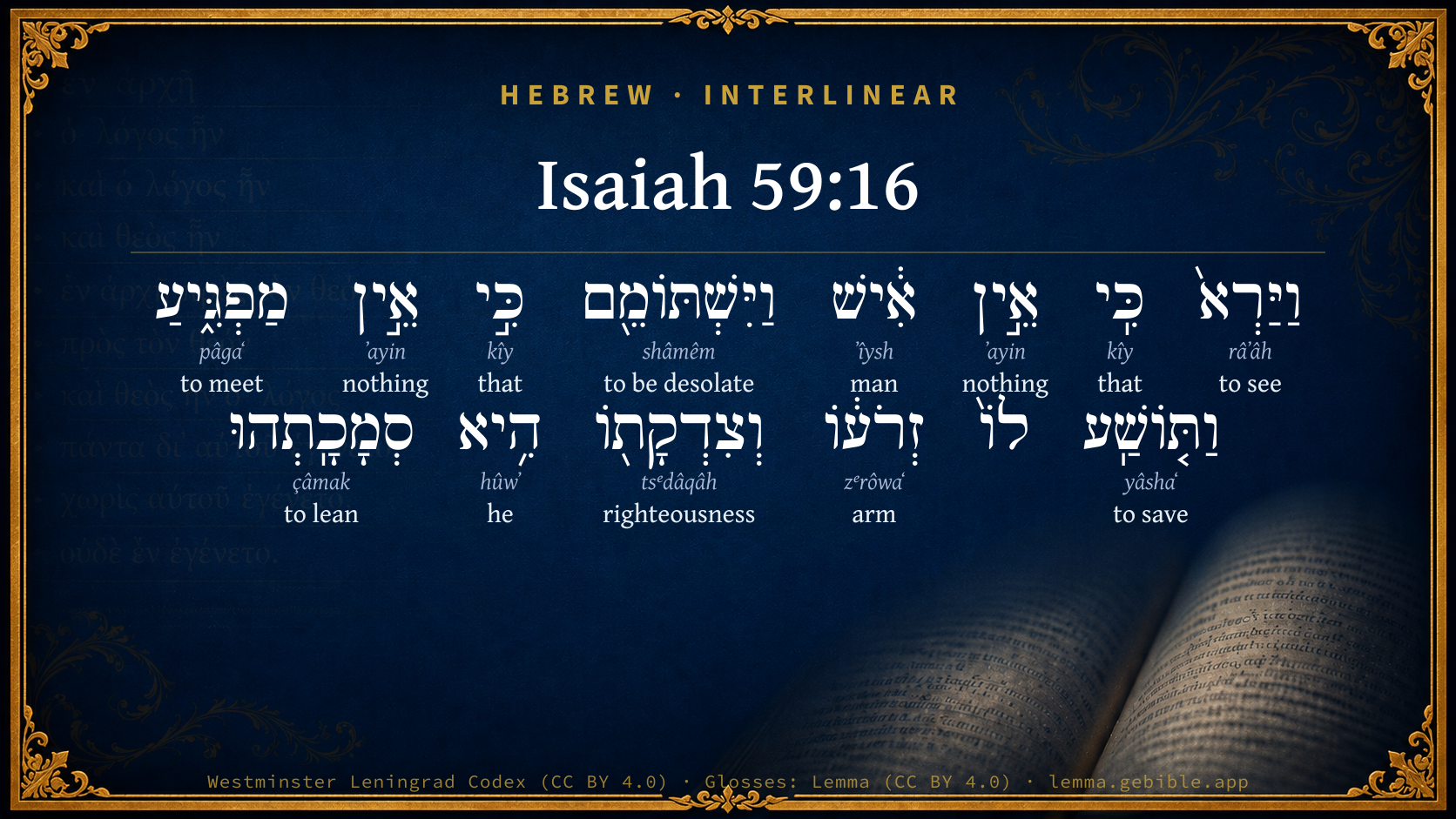
Hebrew (Westminster Leningrad Codex) Isaiah 59:16 appears in the Hebrew Old Testament. The text above is from the Westminster Leningrad Codex. Each word links to its Strong’s number, a concise gloss, and parsing drawn from the Open Scriptures Hebrew Bible morphology. Click any word for its full Brown-Driver-Briggs (BDB) entry.
Download image
Cite this verse

Isaiah 59:16 (World English Bible). Public Domain. Lemma interlinear Bible study tool, https://lemma.gebible.app/v/isaiah/59/16.

Show BibTeX & RIS
BibTeX
RIS
English Translation
He saw that there was no man, and wondered that there was no intercessor: therefore his own arm brought salvation to him; and his righteousness, it upheld him.
World English Bible · Public Domain
Download a study sheet

One document with this verse’s original text, its word-by-word gloss line, the meaning frame, cross-references with their text, attributed commentary, and full source and license credits — printable, and it pastes into notes with its structure intact.

This verse Autodidact and up

Study sheet (.html) Plain text (.txt)

A passage Seminary Student

Up to 50 verses in one chapter. A passage sheet keeps up to 6 commentary sources and 12 cross-references per verse, in the order this page ranks them, and says so on the sheet whenever that leaves anything out. Ask for a single verse and you get the Autodidact verse sheet above.

Everything on this page stays free to read, with no account — the sheet is a download of what is already on screen, not access to it.

Want to remove ads? Support Godless Engineer
Compare translations 3

The same verse in 3 English versions, stacked beneath the original-language interlinear above. Click any original word for its lexicon entry.

Each is an independent rendering of the whole verse — the interlinear is not word-aligned to these translations.

Highlighted words mark where these versions differ — a whole-verse word diff, not a word-by-word alignment.

  • World English Bible Public Domain
    He saw that there was no man, and wondered that there was no intercessor: therefore his own arm brought salvation to him; and his righteousness, it upheld him.
  • King James Version Public Domain
    And he saw that there was no man, and wondered that there was no intercessor: therefore his arm brought salvation unto him; and his righteousness, it sustained him.
  • unfoldingWord Literal Text CC BY-SA 4.0
    And he saw that there was no man, and he was desolated that there was no intercessor. So his arm saved for him, and his righteousness, it, it supported him.

unfoldingWord Literal Text — © unfoldingWord, licensed CC BY-SA 4.0. Word-aligned USFM3 via Door43 (git.door43.org/unfoldingWord/en_ult).

Versions to compare (up to 4)

3 of 4 selected

Show all 18 translations

Every available English version of this verse, each an independent rendering of the whole verse.

  • World English Bible Public Domain
    He saw that there was no man, and wondered that there was no intercessor: therefore his own arm brought salvation to him; and his righteousness, it upheld him.
  • Berean Standard Bible Public Domain
    He saw that there was no man; He was amazed that there was no one to intercede. So His own arm brought salvation, and His own righteousness sustained Him.
  • Majority Standard Bible Public Domain
    He saw that there was no man; He was amazed that there was no one to intercede. So His own arm brought salvation, and His own righteousness sustained Him.
  • King James Version Public Domain
    And he saw that there was no man, and wondered that there was no intercessor: therefore his arm brought salvation unto him; and his righteousness, it sustained him.
  • American Standard Version (1901) Public Domain
    And he saw that there was no man, and wondered that there was no intercessor: therefore his own arm brought salvation unto him; and his righteousness, it upheld him.
  • Revised Version (1885) Public Domain
    And he saw that there was no man, and wondered that there was no intercessor: therefore his own arm brought salvation unto him; and his righteousness, it upheld him.
  • Geneva Bible (1599) Public Domain
    And when he sawe that there was no man, hee wondered that none woulde offer him selfe. Therefore his arme did saue it, and his righteousnes it selfe did sustaine it.
  • Douay-Rheims (1899) Public Domain
    And he saw that there is not a man: and he stood astonished, because there is none to oppose himself: and his own arm brought salvation to him, and his own justice supported him.
  • Young's Literal Translation Public Domain
    And He seeth that there is no man, And is astonished that there is no intercessor, And His own arm giveth salvation to Him, And His righteousness -- it sustained Him.
  • Literal Standard Version CC BY-SA 4.0
    And He sees that there is no man, || And is astonished that there is no intercessor, || And His own arm gives salvation to Him, || And His righteousness—it sustained Him.
  • Unlocked Literal Bible CC BY-SA 4.0
    He saw that there was no man, and wondered that there was no one to intervene. Therefore his own arm brought salvation for him, and his righteousness sustained him.
  • unfoldingWord Literal Text CC BY-SA 4.0
    And he saw that there was no man, and he was desolated that there was no intercessor. So his arm saved for him, and his righteousness, it, it supported him.
  • Darby Bible Public Domain
    And he saw that there was no man, and he wondered that there was no intercessor; and his arm brought him salvation, and his righteousness, it sustained him.
  • World Messianic Bible Public Domain
    He saw that there was no man, and wondered that there was no intercessor. Therefore his own arm brought salvation to him; and his righteousness sustained him.
  • Webster's Bible Public Domain
    And he saw that there was no man, and wondered that there was no intercessor: therefore his arm brought salvation to him; and his righteousness, it sustained him.
  • Free Bible Version CC BY-SA 4.0
    He looked around, and he was appalled to find there was no one who would do anything about it, so he intervened himself, and his sense of what was right kept him going.
  • Bible in Basic English Public Domain
    And he saw that there was no man, and was surprised that there was no one to take up their cause: so his arm gave salvation, and he made righteousness his support.
  • JPS Tanakh (1917) Public Domain
    And He saw that there was no man, and was astonished that there was no intercessor; therefore His own arm brought salvation unto Him; and His righteousness, it sustained Him;

Literal Standard Version (2020), Covenant Press — licensed CC BY-SA 4.0. Text via the HelloAO Bible API (eBible.org). Unlocked Literal Bible (unfoldingWord) — licensed CC BY-SA 4.0. Text via the HelloAO Bible API (eBible.org). unfoldingWord Literal Text — © unfoldingWord, licensed CC BY-SA 4.0. Word-aligned USFM3 via Door43 (git.door43.org/unfoldingWord/en_ult). Free Bible Version, Dr. Jonathan Gallagher — licensed CC BY-SA 4.0. Text via the HelloAO Bible API (eBible.org).

Word by word

More ways to search: Search by grammar → Find every occurrence → Compare this word →

Practice this passage: Drill this verse → Learn its vocabulary →

מַפְגִּ֑יעַ
pâgaʻ
H6293
“meeting”
Verb, Hiphil, Participle Active, Masculine, Singular, Absolute
Part of Speech
Verb
Stem
Hiphil
Form
Participle Active
Gender
Masculine
Number
Singular
State
Absolute
Full BDB Definition

Origin: a primitive root

TWOT: 1731

to encounter, meet, reach, entreat, make intercession - (Qal) - to meet, light upon, join - to meet (of kindness) - to encounter, fall upon (of hostility) - to encounter, entreat (of request) - to strike, touch (of boundary) - (Hiphil) - to cause to light upon - to cause to entreat - to make entreaty, interpose - to make attack - to reach the mark
  1. וַיַּרְא֙ râʼâh H7200 “and · to see” Conjunction + Verb, Qal, Sequential Imperfect, 3rd Person, Masculine, Singular
  2. כִּֽי kîy H3588 “that” Conjunction
  3. אֵ֣ין ʼayin H369 “nothing” Particle, Negative
  4. אִ֔ישׁ ʼîysh H376 “man” Noun, Common, Masculine, Singular, Absolute
  5. וַיִּשְׁתּוֹמֵ֖ם shâmêm H8074 “and · to be desolate” Conjunction + Verb, Hithpolel, Sequential Imperfect, 3rd Person, Masculine, Singular
  6. כִּ֣י kîy H3588 “that” Conjunction
  7. אֵ֣ין ʼayin H369 “nothing” Particle, Negative
  8. וַתּ֤וֹשַֽׁע yâshaʻ H3467 “and · to save” Conjunction + Verb, Hiphil, Sequential Imperfect, 3rd Person, Feminine, Singular
  9. זְרֹע֔וֹ zᵉrôwaʻ H2220 “arm · his” Noun, Common, Both, Singular, Construct + Suffix, Personal, 3rd Person, Masculine, Singular
  10. וְצִדְקָת֖וֹ tsᵉdâqâh H6666 “and · righteousness · his” Conjunction + Noun, Common, Feminine, Singular, Construct + Suffix, Personal, 3rd Person, Masculine, Singular
  11. הִ֥יא hûwʼ H1931 “he” Pronoun, Personal, 3rd Person, Feminine, Singular
  12. סְמָכָֽתְהוּ çâmak H5564 “to lean · him” Verb, Qal, Perfect, 3rd Person, Feminine, Singular + Suffix, Personal, 3rd Person, Masculine, Singular

About this verse

These counts appear in no published source. They are computed here, from the morphology-tagged text and Lemma’s own curated glosses. What Lemma adds →

14
words
11
distinct lemmas
Prophets
section

Shared distinctive vocabulary

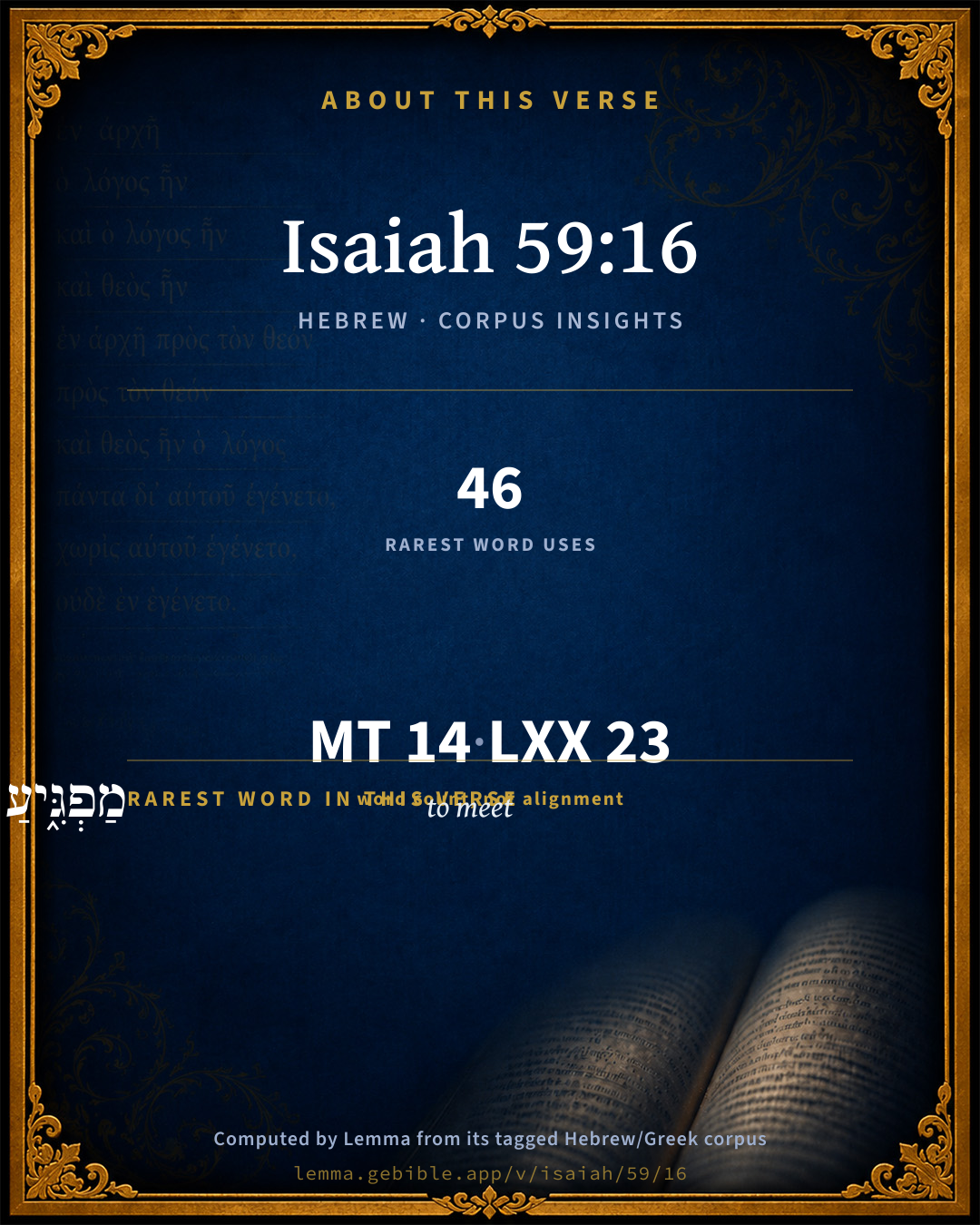
מַפְגִּ֑יעַ to meet H6293 occurs in 43 verses of the Hebrew Bible. Also found in:

Grammatical profile

  • 5 verbs
  • 3 nouns
  • 1 pronoun
  • 1 preposition
  • 2 conjunctions
  • 2 particles

Verb forms

  • וַיַּרְא֙ Qal · Sequential Imperfect
  • וַיִּשְׁתּוֹמֵ֖ם Hithpolel · Sequential Imperfect
  • מַפְגִּ֑יעַ Hiphil · Participle Active
  • וַתּ֤וֹשַֽׁע Hiphil · Sequential Imperfect
  • סְמָכָֽתְהוּ Qal · Perfect

Repetition

Words recur within this verse — often emphatic in Hebrew:

  • אֵ֣ין nothing H369 ×2
  • כִּֽי that H3588 ×2

Hebrew & Septuagint length

In English translation the verse runs 28 words from the Hebrew and 30 from the Septuagint (LXX English) — closely comparable.

A rough comparison of the two English renderings, which tokenize alike — not a word-level alignment.

Word counts can differ between the Hebrew and the Greek without any difference in meaning — e.g. the Hebrew direct-object marker אֵת has no separate Greek word, and Greek often adds the article ὁ.

In the original languages it is 14 Hebrew tokens and 23 Greek tokens — but the two are counted differently (Hebrew bundles its prefixes and suffixes into one token; the Greek is in lemma form), so that isn’t a like-for-like length.

Cross-references

11

Topical passages linked to Isaiah 59:16 in the Treasury of Scripture Knowledge — connected by theme and wording, ordered by reader-vote popularity; previews shown in the World English Bible.

  • Ezekiel 22:30 I sought for a man among them, who should build up the wall, and stand in the gap before me for the land, that I should not destroy it; but I found none.
  • Psalms 98:1 Sing to Yahweh a new song, For he has done marvelous things! His right hand, and his holy arm, have worked salvation for him.
  • Psalms 106:23 Therefore he said that he would destroy them, Had Moses, his chosen, not stood before him in the breach, To turn away his wrath, so that he wouldn't destroy them.
  • Isaiah 64:7 There is none who calls on your name, who stirs up himself to take hold of you; for you have hid your face from us, and have consumed us by means of our iniquities.
  • Isaiah 41:28 When I look, there is no man: even among them there is no counselor who, when I ask of them, can answer a word.
  • Isaiah 52:10 Yahweh has made bare his holy arm in the eyes of all the nations; and all the ends of the earth have seen the salvation of our God.
  • Isaiah 63:3–5 I have trodden the winepress alone; and of the peoples there was no man with me: yes, I trod them in my anger, and trampled them in my wrath; and their lifeblood is sprinkled on my garments, and I have stained all my clothing.
  • Mark 6:6 He marveled because of their unbelief. He went around the villages teaching.
  • Genesis 18:23–32 Abraham drew near, and said, "Will you consume the righteous with the wicked?
  • Isaiah 50:2 Why, when I came, was there no man? when I called, was there none to answer? Is my hand shortened at all, that it can't redeem? or have I no power to deliver? Behold, at my rebuke I dry up the sea, I make the rivers a wilderness: their fish stink, because there is no water, and die for thirst.
  • Jeremiah 5:1 Run you back and forth through the streets of Jerusalem, and see now, and know, and seek in the broad places of it, if you can find a man, if there are any who does justly, who seeks truth; and I will pardon her.

Cross-references courtesy of OpenBible.info (CC BY 4.0).

Hebrew and Greek witnesses Masoretic Hebrew ↔ Greek Septuagint

The same verse in the two great witnesses to the Old Testament, shown verse-for-verse.

These are two independent witnesses, not word-aligned to each other, and the Septuagint is shown in lemma (dictionary) form.

Hebrew Isaiah 59:16 Masoretic · Westminster Leningrad Codex

וַיַּרְא֙ כִּֽי אֵ֣ין אִ֔ישׁ וַיִּשְׁתּוֹמֵ֖ם כִּ֣י אֵ֣ין מַפְגִּ֑יעַ וַתּ֤וֹשַֽׁע לוֹ֙ זְרֹע֔וֹ וְצִדְקָת֖וֹ הִ֥יא סְמָכָֽתְהוּ

He saw that there was no man, and wondered that there was no intercessor: therefore his own arm brought salvation to him; and his righteousness, it upheld him.

World English Bible · Public Domain

Greek LXX Isaiah 59:16 Septuagint · lemma form

καί ὁράω καί οὐ εἰμί ἀνήρ καί κατανοέω καί οὐ εἰμί ὁ ἀντιλαμβάνω καί ἀμύω αὐτός ὁ βραχίων αὐτός καί ὁ ἐλεημοσύνη στηρίζω

And he looked, and there was no man, and he observed, and there was none to help: so he defended them with his arm, and established them with his mercy.

LXX2012 (modern English Septuagint) · Public Domain

On this verse, Matthew Henry's Commentary discusses the Septuagint’s reading. Read the note in Commentary ↓

Hebrew: Westminster Leningrad Codex (CC BY 4.0). Greek: Septuagint (public domain); English from LXX2012 (modern English Septuagint) (Public Domain). How the Septuagint differs from the Hebrew →

Targum (Aramaic paraphrase)

1

The Targum is the ancient Jewish Aramaic paraphrase of the Hebrew Scriptures — an interpretive translation, not the Hebrew text itself. Onkelos (literal) and Pseudo-Jonathan (expansive) render the Torah, and Jonathan the Prophets. Coverage is partial: where no permissively-licensed English translation exists for a verse, only the Aramaic is shown. This is verse-level text, not a word-by-word alignment to the Hebrew.

  1. Targum Jonathan Prophets (Joshua–Malachi)
    וּגְלֵי קֳדָמוֹהִי דְלֵית גְבַר דְלֵיהּ עוֹבָדִין טָבִין וִידִיעַ קֳדָמוֹהִי וְלֵית אֱנַשׁ דִיקוּם וְיִבְעֵי עֲלֵיהוֹן וּפַרְקִינוּן בִּדְרַע תּוּקְפֵהּ וּבְמֵימָר רְעוּתִי סַעְדִינוּן:

    And it is revealed in His sight that there is no man who hath good works, and it is known to Him that there is no man, who would arise and seek after them: therefore He will redeem them by the arm of His strength, and by the WORD of His delight He will help them.

    Targum Jonathan — Aramaic: “Mikraot Gedolot” (public domain). English: “Sefaria Community Translation” (CC0 1.0 (public-domain dedication)); “London "Chaldee Paraphrase," 1871” (public domain). Text via Sefaria.

Commentary

Notes on Isaiah 59:16 from classic Christian and Jewish commentators (each source and its license shown beneath its notes). The classic Christian expositions comment on the surrounding passage and are grouped to its opening verse, so a note may address several verses; the Jewish commentaries on the Tanakh (Rashi and others) are per-verse, so they appear only where the commentator wrote on this verse.

Lemma curates 59 commentaries, every one of them public domain or Creative Commons licensed, each selected and text-cleaned for this edition rather than reprinted as found. About our sources →

Trapp's Complete Commentary

John Trapp

Isa 59:16 And he saw that [there was] no man, and wondered that [there was] no intercessor: therefore his arm brought salvation unto him; and his righteousness, it sustained him.

Ver. 16. And wondered.] The Vulgate hath it, Aporiatus est.

That there was no intercessor.] No interposer {as Job 36:31} that would stickle for truth and right, as did Nehemiah, Athanasius, Luther, &c.

Therefore his arm brought salvation … and his righteousness,] i.e., Christ, the power of God, and the wisdom of God {a} {1Co 1:24; 1Co 1:30}

{a} Jun.

John Trapp, A Commentary or Exposition upon All the Books of the Old and New Testament (1647–1656) — public domain. Text from a community e-Sword module.

The Biblical Illustrator

Joseph S. Exell

Isa_59:16-19

And He saw that there was no man

God, mans great Redeemer

Do not let us suppose this is mere poetry.

Conceive what inspires it,--the great truth that in the Infinite there is a heart to throb for men, and a will to strike for them. This is what the writer desires to proclaim, and what we believe the Spirit of God moved his poor human lips to give their own shape to,--the simple truth that there is One, however hidden He may be to mens eyes, who feels for men, who feels hotly for men, and whose will is quick and urgent to save them. (Prof. G. A. Smith, D. D.)

He wondered that there was no intercessor

He stood aghast that there was no one interposing. The common version (wondered), though substantially correct, is too weak to express the full force of the Hebrew word, which strictly means to be desolate, and is used in reference to persons for the purpose of expressing an extreme degree of horror and astonishment. (J. A. Alexander.)

Prophetic certainty

That the whole description refers to a future event can hardly be questioned. The perfects in this verse (Isa_59:16) and the next are those of prophetic certainty. (Prof. J. Skinner, D. D.)

The Biblical Illustrator, edited by Joseph S. Exell (c. 1880s–1900s) — public domain. Text from a community e-Sword module.

Joseph Benson's Commentary

Isa 59:16. And he saw there was no man — Namely, to intercede, which is understood from the following words; or no man to help in such a case, and to appear in the behalf of equity. See Eze 22:30. And wondered — Hebrew, וישׁתומם, was amazed, or astonished, an expression which denotes both God’s solicitude about their condition, and their stupidity, in not laying it to heart themselves, especially considering that they had been a people well instructed, and yet, when under the guilt of such gross sins, should be no more solicitous to obtain pardon. Therefore, or, yet, his arm brought salvation unto him — That is, to his people; and his righteousness it sustained him — His justice; seeing there could be no justice found among them, he would avenge the innocent himself. Since magistrates and societies for the reformation of manners fail of doing their part, the one will not do justice, nor the other call for it, God will let them know he can effect it without them, and thus prepare his people for mercy. And then the work of deliverance shall be wrought by the immediate influence of the divine grace on men’s spirits, and of the divine providence on their affairs. When God stirred up the spirit of Cyrus, and brought his people out of Babylon, not by human wisdom nor power, but by the Spirit of the Lord, then his own arm brought salvation to them, which arm is not shortened now.

Joseph Benson's Commentary on the Old and New Testaments (1811–1818) — public domain. Text from a community e-Sword module.

Lange's Commentary on the Holy Scriptures

b) The Prophet promises Jehovah’s intervention and is encouraged to further announcements of salvation

Isa_59:15-21

15b          And the Lord saw it,

And 15it displeased him that there was no judgment.

16     And he saw that there was no man,

And 16wondered that there was no intercessor:

Therefore his arm brought salvation unto him;

And his righteousness, it sustained him.

17     For he put on righteousness as a 17breastplate,

And an helmet of salvation upon his head;

And he put on the garments of vengeance for clothing,

And was clad with zeal as a cloak.

18     According to their 18deeds, accordingly he will repay,

Fury to his adversaries, recompence to his enemies;

To the islands he will repay recompence.

19     So shall they fear the name of the Lord from the west,

And his glory from the rising of the sun.

19When the enemy shall come in like a flood,

The spirit of the Lord shall 20lift up a standard against him.

20     And the Redeemer shall come to Zion,

And unto them that turn from transgression in Jacob, saith the Lord.

21     As for me, this is my covenant with them, saith the Lord;

My spirit that is upon thee,

And my words which I have put in thy mouth,

Shall not depart out of thy mouth,

Nor out of the mouth of thy seed,

Nor out of the mouth of thy seed’s seed, saith the Lord,

From henceforth and forever.

TEXTUAL AND GRAMMATICAL

Isa_59:18. כְּעל...כְּעַל (comp. Isa_63:7) is a mixture of preposition and adverb, and in the context a confusio duarum constructionum. That is to say, the two modes of expression are mixed up, viz., כִּגְמֻלוֹת כֵּן יְשַׁלֵּם (instead of כִּגְמֻלוֹת כְּשִׁלֻם, because, may be, the substantives from שָׁלֵם that mean retributio, שִׁלּוּמָה ,שִׁלֻּם ,שׁלֵּם ,שֶׁאֶם are all of them very rarely used) and עַל־גְמֻלוֹת יְשׁלֵּם.

Isa_59:19. יִ‍ֽרְאוּ and not יִרְאוּ as Knobel would have. For although the latter = videbunt would also give a good meaning, still the former is the critically approved reading. See Delitzsch.—The words רוח י׳ נוססה נו recall Isa_40:7, where it reads רוח י׳ נשׁבה בו. Evidently these words hovered before the Prophet. Bat there vegetation is spoken of, which the breath of the Lord (conceived of as a hot wind) dries up. Here it speaks of a stream which the breath of the Lord does not dry up, but can only drive onwards. Hence the Prophet must choose another word than נשׁבה. But he would choose one of like sound, for which נוססה offered. This Pilel from נוּם does not elsewhere occur, indeed. But neither does the would-be Poel formed from נֵם occur. There is only a Hithp. הִתְנוֹסֵם (Zec_9:16; Psa_60:6, passages that themselves present great difficulty). But this Prophet, so mighty in language, could and dared to form a Pilel נוֹסֵם and in taking it in a causative sense (=to produce flight, haste), and making בוֹ dependent on it, he proceeds quite in the spirit of the Hebrew language.—It seems to me beyond doubt that צַר (in pause צָר) is to be taken as=coarctatus. But it is not to be derived from צוּר (“onpressing stream,” Ewald, Knobel, Seinecke, Rohling) but from צָרַר. There are in Hebrew many verbs in which the transitive and intransitive force are still together unseparated. צרר is one of them. Comp. צַר לִי Psa_31:10. etc.; מָקוֹם צַר Num_22:26; Isa_49:20 : כֹּחַ צַר Pro_24:10, etc.—Against the explanation of כַּנָּהָר צַר that, with Gesenius, Maurer, Umbreit, Delitzsch, I hold to be correct, it may be objected from a grammatical point of view, that the disjunctive Pashta on נָהָר calls for a substantive meaning for צַר, and that צר as an attribute of הנהר must also have the article. But the accent is only the Masoretic construction, and the omission of the article forms no very rare exception, which appears to me to be prompted in cases where the subject is rendered definite already by the comparison (comp., e.g., Isa_11:9).

Isa_59:21. The use of אוֹתָם for אִתָּם, which we find in Jeremiah very much developed, is in Isaiah still in its beginnings. For in him both forms occur harshly together: Isa_54:15.

EXEGETICAL AND CRITICAL

1. The Lord can only reply to Israel’s sincere confession of sin by the assurance of His grace. Therefore the Prophet declares that the Lord recognizes the complaint, that its right (Isa_59:9) has escaped from it, to be well founded (ver.15b, 16a), and that He has prepared to help them to it. Therefore recompense will be given to the enemies of Israel (Isa_59:18). East and west shall be witnesses of the mighty displays of Jehovah’s power, when He will come on like a stream that bursts its dams and is driven by a tempest beside, in order to bring deliverance to penitent Israel (Isa_59:19-20). This promise of outward manifestation of salvation is followed by another more inward, and also comforting and encouraging for the Prophet himself, that the covenant of the Lord with Israel will be realized by the spirit that the Lord has laid on the Prophet continuing to operate forever in Israel.(Isa_59:21).

2. And the Lord saw it—saith the Lord.

Isa_59:15 b–20. According to the prospect the Prophet held out, Isa_58:9, so it comes to pass. There it says: if Israel will bring proper fruits of repentance, then it will call and the Lord will answer it; it will cry, and the Lord will say: here am I. In Isa_59:12-15 a Israel has made so hearty a confession, that the fruits of repentance demanded, Isa_58:6 sqq., are to be expected with certainty. Instantly the Lord hears, and now also actually answers. He investigates the situation and owns with displeasure (ירע בע׳, comp. Gen_21:11, etc., only here in Isa.) that Israel really has not its theocratic right. משׁפט Isa_59:15 b is thus to be construed as in Isa_59:9. Moreover, the Lord sees with dismay (ישׁתומם, comp. Isa_63:5) that no one is there. To the expression, אין אישׁ, corresponds in parallism אין מפניע. The former must therefore have a meaning analogous to and preparatory for the latter. We must therefore supply after אישׁ the thought: “who is able to mediate such a thing, to bring it to rights”. Comp. Isa_41:28; Isa_63:5. מפניע is intercessor, comp. Isa_53:12; Isa_47:3.

Upon the knowledge of what is wanting follows instantly the actual intervention. It is successful, for the arm of the LORD (symbol of His omnipotence, Isa_33:2; Isa_40:10; Isa_48:14, see List) affords him help, and the sure support of His purpose is the righteousness of his cause and of His will. Isa_59:16 b is related to what follows. as a summary statement of the contents. Isa_59:17 follows with specification in figurative expressions. Here Jehovah is portrayed arousing the several attributes and activities He needs in order to help His people to their right; and the awaking of the powers resident in Him is represented by the figure of His laying on the several pieces of military equipment. Comp. the application of our passage in Eph_6:14; Eph_6:17, and the Doct. and Eth., p. 644, § 10. Thus the righteousness just designated as the guaranty of success is compared to the coat of mail from which all darts of the enemy rebound. שִׁרְיָן only here in lsa.; comp. 1Ki_22:34; 2Ch_18:33. The helmet, the defensive armor, that protects the head, the noblest and most prominent part of the body, guarantees therefore very properly the chief concern: deliverance, salvation, victory (יְשׁוּעַה, comp. Hab_3:8). The garments must denote that He means vengeance, and the מְעִיל (the long, woolen under garment, comp. Isa_61:10) must represent the deep earnestness, the glowing zeal that animates Him. Isa_59:18. Thus equipped, the Lord advances to the conflict. The object of it is righteous recompense to the enemies of Israel. The rage with which they have oppressed Israel, in general all that they have done to it (גְּמוּל, vocab. anceps, comp. Isa_3:11; Isa_66:6) shall be recompensed to them, especially to “the isles”, the representatives of the heathen world. But they will fear the name of the LORD,i.e., His appearance, revelation, in the west and his glory in the east. מִן before מערב and מזרח of course designates to the Hebrew way of speaking the terminus a quo, whereas we must, in our manner of representing it, substitute the term. in quo. For the Hebrew would not say that they will fear the Lord from east and west hither, as if the appearance of the Lord were to be regarded as standing in the middle between east and west. But the Prophet stands in the middle, and he would only say that both those that present themselves to him from the east and those that meet his gaze from the west, from whatever side they come, will fear the Lord. On this well-known Hebrew mode of expression comp. Isa_17:13; Isa_22:3; Isa_40:15, etc. The expression, “fear the name of the Lord,” is found, Deu_28:58, and on the ground of that passage in Psa_86:11; Neh_1:11; probably also Mic_6:5, where יִרְאָה שְׁמֶךָ is to be read, instead of יִרְאֶה שׁ׳; then, too, Psa_102:16, which is evidently a citation of our text, and confirms the reading יִ‍ֽרְאוּ; and Psa_61:6; Mal. 3:20.—And how should not the heathen fear the name of the Lord, seeing He comes as a compressed river! (On צר see Text and Gram). What better image could the Prophet use to signify Jehovah’s might, that for a time restrained itself to the point of apparent injustice toward Israel, only to break forth with the greater energy? He compares it to a stream which the dikes for a while crowd together, but which, when it makes a crevasse in the dikes, breaks away with so much the greater power, and irresistibly carries all before it, especially when its own weight is augmented by a driving wind. In this he expresses the thought that also underlies Isa_40:7, that the Spirit of the Lord, that also in the wind has one of its forms of manifestation, will exercise the activity suited to it, at the destruction of the world, as it did at the creation (Gen_1:2; comp. Isa_4:4; Isa_28:6).—In Isa_59:20 the distinction between “Zion” and “the converted in Jacob” is due to the parallelism, and therefore we must not attach to this merely rhetorical distinction the weight of a logical distinction. On שׁבי כּשׁע comp. Isa_1:7; Isa_1:27; Isa_5:13; Isa_28:1.

3. As for me—forever, Isa_59:21. When we compare chap, 58. with 60, we find in the former a very prosaic, practical, severe homily, which can only have been made for a (relative or absolute) present occasion. But in chap. 60. we again find the Prophet in a lofty flight, announcing the remote future. Chap. 59. forms the bridge to this in the manner designated above (comp. also in Doct. and Ethic., p. 644, § 11) When now 59. concludes with a declaration that promises to the Prophet the continuance of the charismatic gifts of the Spirit heretofore imparted to him, we will be right in regarding this declaration of our verse as the direct transition to the loftier style of prophecy that again begins in chap. 60. Still, of course, Isa_59:21 cannot be referred only to this assurance given to the Prophet; for the sound of the words of the verse shows that the Lord at the game time would crown the promise given to the people Israel from Isa_59:15 a and on. Thus this verse has a double character. This appears from the plural suffix in אוֹתָם on the one hand, and on the other from the address to the Prophet. At the same time it is to be remarked, that Isa_59:21, in relation to what precedes, has a positive and inward character. Positive, because nothing more is said of the evil to be done to the enemies, but only the good to be to Israel is spoken of; inward, because what is said is not concerning victory and outward salvation, but concerning inward impartation of the Spirit. ואני is not=but I. For nothing is said before of what another would have done. Therefore it means “and I,” but the emphasis is on the “I,” and this is made prominent because something is to be promised that only God can do. At the same time there is in these words a reminder of the words spoken to Abraham, Gen_17:4 : “As for me, behold, my covenant is with thee.” But the covenant that the Lord here holds up to view is no longer one that promises great increase by means of a numerous posterity, as in that covenant with Abraham. This new covenant refers to the spiritual life, to a new spiritual communion with the Lord, to the worship of God in spirit and in truth.

One would not comprehend in what follows why the Lord does not say directly: I will put my Spirit upon them, etc., but says: My Spirit that is upon thee, and my words which I have put in thy mouth (Isa_51:16), shall not depart out of thy mouth, etc., if there were not just that double object indicated above. But would the Lord have promised to the Prophet so numerous a posterity, would he have declared the prophetic gift to be a matter of inheritance in his family? Certainly not. In contrast with Gen_17:4 sqq., that also has much to say of “a seed after thee,” but only in the sense of a numerous corporeal posterity, it is here promised to the Prophet that he should have many spiritual descendants; that therefore Israel, to the remotest generations, shall be a people filled with the Spirit, and people of God in the most exalted sense. The spirit-replenished posterity of the Prophet, and of the people Israel, generally merge together in one. From chap. 60. onwards it is evidenced at once that the Prophet has become no mere preacher of repentance, as might seem to be the case from chapts. 52, 53, 59. 1–8, but that the high prophetic gift is still in him that is able to behold with enraptured eye the glory of the remote future, and to proclaim it with eloquent tongue.

[On Isa_59:21Delitzsch says: “The following prophecy is addressed to Israel, the ‘servant of Jehovah,’ which has been hitherto partially faithful and partially unfaithful, but which has now returned to fidelity, viz., the ‘remnant of Israel,’ which has been rescued through the medium of a general judgment upon the nations, and to which the great body of all who fear God, from east to west, attach themselves.” Clark’sFor. Th.L. J. A. Alexander interprets it in the same way. He says: “The only natural antecedent of the pronoun them is the converts of apostacy in Jacob, to whom the promise in Isa_59:20 is limited. These, then, are suddenly addressed, or rather the discourse is turned to Israel himself as the progenitor, or as the ideal representative of his descendants, not considered merely as a nation, but as a church, and therefore including proselytes as well as natives, Gentiles as well as Jews, nay, believing Gentiles to the exclusion of the unbelieving Jews. This idea of the Israel of God, and of the prophecies, is too clearly stated in the Epistle to the Romans to be misapprehended or denied by any who admit the authority of the apostle. This interpretation is moreover not a mere incidental application of Old Testament expressions to another subject, but a protracted and repeated exposition of the mutual relations of the old and new economy, and of the natural and spiritual Israel. To this great body, considered as the Israel of God, the promise now before us is addressed, a promise of continued spiritual influence, exerted through the word and giving it effect. The phrase upon thee, here as elsewhere, implies influence from above, and has respect to the figure of the Spirit’s descending and abiding on the object. The particular mention of the mouth cannot be explained as having reference merely to the reception of the word, in which case the ear would have been more appropriate. The true explanation seems to be that Israel is here, as in many other parts of this great prophecy, regarded not merely as a receiver, but as a dispenser of the truth.” The Author’s effort to include a personal address to the Prophet as well as to the spiritual Israel seems to have no more valuable effect than to prepare a transition to the lofty prophetic flight that begins with chap. 60. We can better dispense with the transition than accept the ideas brought in by that interpretation.—Tr.]

Footnotes:

[15]Heb. it was evil in his eyes.

[16]was horrified.

[17]coat of mail.

[18]Heb. recompences.

[19]For he will come asapent up stream, which the breath of Jehovah drives.

[20]Or, put him to flight.

DOCTRINAL AND ETHICAL

1. On Isa_58:2-3. There are also to-day many men that hold up their good works to God (Luk_18:11 sqq.), and who, out aloud or silently, reproach Him for not adequately rewarding them for them. But one can distinguish here two classes: those that boast of having done works of undoubted moral worth; and such as found their pretensions essentially on works that are morally indifferent, as ceremonies of worship and the like. Of course there is a difference between these, for the former can, under some circumstances, really deserve praise; whereas the latter under all circumstances accomplish something more or less morally worthless, yea, possibly, as miserable hypocrites, directly provoke the wrath of God. But never has the creature the right to accuse God. It may be debated whether such accusation is more folly or wickedness. It is tinder all circumstances a presumptuous judgment. For, as long as we live, results are not assured, and we lack ability to see all. Only the day will make it clear what is the relation between God’s doing and ours, and that He has not let the just recompense be wanting (Isa_1:18; Isa_43:26).

2. On Isa_58:4 sqq. The Prophet finds fault with the fasting of the Jews in two respects. First, because they combined them with works of unrighteousness. Second, because they held the “bodily exercise” to be the chief thing. Perhaps in the Sermon on the mount our Lord had our text in mind when He said: “When ye fast, be not as the hypocrites of a sad countenance.” Mat_6:11. He makes prominent one particular that probably hovered before our Prophet also. For it is possible that he saw in the “hanging the head” an artificial, affected, and so hypocritical expression of a piety that did not exist inwardly; although it is not absolutely necessary that this letting the head hang and making one’s bed in sand and ashes took place with hypocritical intent. But our Lord expressly demands that one do not let appear the harassed, sickly look, that was the perhaps quite natural consequence of fasting. He says (Mat_6:17): “but thou, when thou fastest, anoint thy head and wash thy face, that thou appear not unto men to fast, but unto thy Father, which is in secret.” One sees, therefore, that in the Sermon on the mount the Lord by no means rejects corporeal fasting. He only shows abhorrence of men’s hypocritically abusing fasting for the gratification of pride. But the Prophet also does not reject fasting. But he would have corporeal fasting be the faithful expression of a simultaneous moral doing of penitent self-denial and compassionating love.

3. On Isa_58:6-9. As the apostle James pressingly urges against dead works, that even Abraham’s faith was in itself a grand moral act, so here, too, the Prophet insists on right works as opposed to false works. But neither declares essentially anything concerning the true ground and origin of the works that they mean, because the context of their discourses does not call for it. We are to supply this from passages that professedly speak to this point, which they silently take for granted, according to the measure of intelligence given to them. For even Isaiah knows right well that that which satisfies and strengthens is not to be obtained by one’s own labor and effort (55).

4. On Isa_58:7. “Flesh denotes here in this context something more still, which J. von Mueller has remarked: “The remembrance of universal brotherhood, and how we are all exposed to like things”—as ἅνθρωποι ὁμοιοπαθεῖς. Verily flesh has need of covering. When therefore thou seest the naked, then see and feel therein the need of thine own flesh, and do not, proudly selfish, conceal or cover only thyself with thy garment that belongs to the other as also being thy flesh.” Stier.

5. On Isa_58:7. Concerning the expression כָּרֹם לֶחֶם see Doctrinal and Ethical on Jer_16:7.

6. [On Isa_58:13-14. “From the closing portion of this chapter we may derive the following important inferences respecting the Sabbath. (1) It is to be of perpetual obligation. The whole chapter occurs in the midst of statements that relate to the times of the Messiah. There is no intimation that the Sabbath was to be abolished, but it is fairly implied that its observance was to be attended with most happy results in those future times.... (2) We may see the manner in which the Sabbath is to be observed. In no place in the Bible is there a more full account of the proper mode of keeping that holy day. We are to refrain from ordinary travelling and employments; we are not to engage in doing our own pleasure; we are to regard it with delight, and to esteem it a day worthy to be honored. And we are to show respect to it by not performing our own ordinary works, or pursuing pleasures, or engaging in the common topics of conversation. In this description there occurs nothing of peculiar Jewish ceremony, and nothing which indicates that it is not to be observed in this manner at all times. Under the gospel assuredly, it is as proper to celebrate the Sabbath in this way as it was in the times of Isaiah, and God doubtless intended that it should be perpetually observed in this manner. (3) Important benefits result from the right observance of the Sabbath. In the passage before us these are said to be, that they who thus observed it would find pleasure in Jehovah, and would be signally prospered and be safe. But those benefits are by no means confined to the Jewish people. It is as true now as it was then, and they who observe the Sabbath in a proper manner find happiness in the Lord—in His existence, perfections, promises, law, and in communion with Him—which is to be found no where else... And it is as true that the proper observance of the Sabbath contributes to the prosperity and safety of a nation now as it ever did among the Jewish people. It is not merely from the fact that God promises to bless the people who keep His holy day—though this is of more value to a nation than all its armies and fleets; but it is that there is in the institution itself much that tends to the welfare and prosperity of a country.... Any one may be convinced of this who will be at the pains to compare a neighborhood, a village, or a city where the Sabbath is not observed with one where it is; and the difference will convince him at once that society owes more to the Sabbath than to any single institution beside.” Barnes.]

7. On Isa_59:2. “Quia quotidie apud nos crescit culpa, cur non et simul crescat poena?” Augustine. “The public sins are compared to a thick cloud, that sets itself between heaven and earth, and as it were hinders prayers from passing through (Lam_3:44).” Starke. “There is great power in sin, for it separates God and us from one another.” Cramer. “There are times when the hand of the Lord lies long and heavy on His children. One feels that God has withdrawn from him and hidden His countenance. But one does not sufficiently investigate the cause. One seeks it in God, and it lies in us, who, by sins unacknowledged and not repented of, make it impossible to God to turn to us in grace.” Weber.

8. On Isa_59:3-8. The register of sins that Isaiah here holds up to the Jews is a mirror in which many a Christian, many a nation, many a time may recognize its own image. The Prophet declares here very plainly the poison nature, the serpent origin of sin. Sin is the poison that the old serpent knew how to bring into our nature. He that has stolen a taste of a product of this poison, as Eve did of the tree of knowledge, supposing that he will thereby receive some good, will go to ruin by it. But he that would be no lover of sin, but would stand forth as its opponent, may count upon it that the reptile will press its malignant fang in his heel, as was even held in prospect to the great trampler of the serpent’s head Himself (Gen_3:15).

9. On Isa_59:9-15 a. Here is for once an honest and thorough confession of sins. Nothing is palliated here, nothing excused. It is freely confessed that Israel is itself to blame for all its wretchedness, and this guilt is acknowledged to be the consequence of the apostacy from Jehovah and of the workings of a depraved heart, whose malignant fruits have become manifest in words and works. Comp. Jer_3:21 sqq.—Here therefore is given a model for all who would know wherein true repentance must consist.

10. On Isa_59:15 b sqq. “Si tu recordaberis peccatorum tuorum, Dominus non recordabitur.” Augustine. “God wonders that men let sin become so great and His righteousness so small.” Oetinger in Stier.—It is a divine privilege to need no helper. With God there is no difference between willing and being able. With Him the being able follows the willing ad nutum. And there is nothing to which God, when He wills, has not also the right. We men, when we have the will and the power, are often without the right, and this takes the foundation from under our feet.

Isa_59:17. This is the original source of the Apostle Paul’s extended description of the spiritual armor, Eph_6:14; Eph_6:17. Also in 1Th_5:8 there underlies the same representation of the equipment required by Christians. On the other hand God is conceived of as an equipped warrior, e.g., Psa_7:13-14; Psa_35:2-3. In Exo_15:4 He is directly called “a man of war.”

11. On Isa_59:18-20. Regarding the time of the fulfilment of this prophecy, the honorable and thorough confession of sin in Isa_59:9-15 a, assumes the conclusion of the judgments against Israel and the conversion of the Gentiles. So Paul understood our passage, who cites it, Rom_11:26, to prove that only then will the Jews partake of the salvation when the fulness of the Gentiles shall have come in. Therefore the Prophet distinguishes three great periods of time. The first comprehends all the stages of time in which Israel will be impenitent, and hence deprived of its theocratic rights. This period will conclude with a condition wherein Israel’s scale, as too light, hurries upwards to the highest elevation, while the scale of the Gentiles, by reason of its weight, will sink deep down. Just this situation will bring about the turning of the scale. Israel will repent; but those Gentiles and those Israelites that will not have repented will be overtaken by the judgment (Isa_59:18; Isa_59:20 שׁבי כשׁע ביעקב). For neither the “fulness of the Gentiles,” nor “all Israel” excludes there being still unconverted Gentiles and Jews. The third period is then the period of salvation, when the Goel [“Redeemer”] will come to Zion and raise up the covenant (Isa_59:21).

12. On Isa_59:21 “Does the Spirit of God remain, then does also His word; does the word remain, then preachers also remain; do preachers remain, then also hearers do; do hearers remain, then there remain also believers, and therefore the Christian church remains also, to which ever some still will be gathered out of the Jews (Rom_11:26).”—“Although in general God has promised that His word and Spirit shall not depart from the church of God, still no one must become so secure about that (comp. Jer_18:18) as if it were impossible that this or that particular church (and even the Romish church is nothing more) could err.” Cramer.

HOMILETICAL HINTS

1. On Isa_58:1. Penitential Sermon. The text teaches us two things: 1) What one ought to preach on a day of repentance [fast-day]; viz., hold up to the people their sins. 2) How one should preach: a. boldly, b. without sparing, loud as a trumpet.

2. On Isa_58:2-9 This text contains the outlines of a popular theodicy. First we hear, Isa_58:2-3 a, the popular complaint that the divine Providence that guides the affairs of the world is unjust, and that He is not fair to the claims of reward that each individual fancies he has. Then in Isa_58:3 b–9, we hear the divine justification. It consists of two parts. In the first part God shows that the claims of men are unfounded in two respects. First for this reason, because they do not do good purely, but along with the good have still room in their hearts for evil, consequently imagine that they can serve two masters (Isa_58:3 a., 4). Second, their claims are unfounded, because founded in the illusion that it is sufficient to fulfil the divine commands in a rude, outward manner. Thus men suppose, e.g., that they can satisfy the divine command to fast by harassing the body by hunger, and lying on sack-cloth and ashes (Isa_58:5). In the second part God shows what must be the nature of the performances that would satisfy the demand of His holiness, and give a claim on His righteousness for reward. That is to say, men must first of all, by practical repentance, make restoration for all injustice done by them, and make manifest by works of mercy their love to God and their neighbor (Isa_58:7). Then divine salvation and divine blessing will be constantly with them, and in every necessity their prayer for help will find certain hearing (Isa_58:8-9 a).

3. [On Isa_58:3. “Having gone about to put a cheat on God by their external services, here they go about to pick a quarrel with God for not being pleased with their services, as if He had not done justly or fairly by them.” M. Henry.]

4. [On Isa_58:4. “Behold, you fast for strife and debate. When they proclaimed a fast to deprecate God’s judgments, they pretended to search for those sins that provoked God to threaten them with His judgments, and under that pretence, perhaps, particular persons were falsely accused, as Naboth in the day of Jezebel’s fast, 1Ki_21:12. Or the contending parties among them upon those occasions were bitter and severe in their reflections one upon another, one side crying out, ‘It is owing to you,’ and the other, “It is owing to you, that our deliverance is not wrought.’ Thus, instead of judging themselves, which is the proper work of a fast-day, they condemned one another.” M. Henry.]

5. [On Isa_58:5; Isa_58:7. “Plain instructions given concerning the true nature of a religious fast. 1. In general a fast is intended: (1) For the honoring and pleasing of God (Isa_58:5, a fast that I have chosen, an acceptable day to the Lord). (2) For the humbling and abasing of ourselves, Lev_16:29. That must be done on a fast-day which is a real affliction to the soul, as far as it is unregenerate and unsanctified, though a real pleasure and advantage to the soul as far as it is itself. II. What will be acceptable to God and afflict our corrupt nature to its mortification. (1) Negatively, what does neither of these, a. To look demure, put on a melancholy aspect and bow the head like a bulrush, Mat_6:16. Though that were well enough so far, Luk_18:13. b. It is not enough to mortify the body a little, while the body of sin is untouched. (2) Positively, a. That we be just to those with whom we have dealt hardly (Isa_58:6). b. That we be charitable to those that stand in need of charity (Isa_58:7).” After M. Henry.]

6. On Isa_58:7. The compassionate love of the Samaritan. 1) What does it give? a. food, b. housing, c. clothing. 2) To whom does it give? To its flesh, i. e., to its neighbor in the sense of Luk_10:29 sqq.

7. On Isa_58:9. “What if the Lord were to make us priests, and if He were to give us the light and righteousness that Aaron bore on his heart as often as he went in unto the Lord, and by which the Lord gave him answer when He inquired,—if He were to give all of us that in our hearts, who are priests of the new covenant? And assuredly I believe that He will also do this. What He has already promised by the Prophets, He will much more fulfil in us: Thou shalt call, and the Lord shall answer thee; when thou shalt cry, He will say: here I am.” Tholuck.

8. On Isa_58:7-9. “O God, our great, sore, horrible blindness, that we so disregard such a glorious promise! To whom are we harsh, when we do not help poor people? Are they not our flesh and blood? As in heaven and earth there is no creature so nearly related to us, it ought to be our way: what we would that men should do to us in like case, that let us do to others. But there that detestable Satan holds our eyes, so that we withdraw from our own flesh and become tyrants and blood-hounds to our neighbors. But what do we accomplish by that? What do we enjoy? We load ourselves with God’s disfavor, curse and all misfortune, who might otherwise have temporal and eternal blessing. For he that takes on him the distress of his neighbor, his light shall break forth like the morning dawn, i.e., he shall find consolation and help in time of need. His recovery shall progress rapidly, i.e., God will again bless him, and replace what he has given away. His righteousness shall go before him, i.e., he shall not only have a good name with every one, but God will shelter him from evil, and ward off from him temporal misfortune, as one may see that God wonderfully protects His own when common punishments go about. And the glory of the Lord will take him to itself, i. e., God will interest Himself for him, [as follows Isa_58:9]. Lo, of such great mercy as this does greed rob us, when we do not gladly and kindly help the poor!” Veit Dietrich.

9. [On Isa_58:12. Thou shalt be called (and it shall be to thy honor) the repairer of the breach, the breach made by the enemy in the wall of a besieged city, which whoso has courage and dexterity to make up, or make good, gains great applause. Happy are those who make up the breach at which virtue is running out, and judgments are breaking in. M. Henry].

10. On Isa_59:1-2. It is often in human life as if heaven were shut up. No prayer seems to penetrate through to it. To all our cries, no answer. Then people murmur (Isa_8:21 sq.; Lam_3:39) and accuse God, as if He were lame or deaf. But they ought rather to seek the blame in themselves. There still exists a wall of partition between them and God, a guilt unatoned for, the sight of which still continuously provokes the anger of God, and hinders the appearance of His mercy (Isa_1:15 sqq.; Isa_64:5 sqq.; Dan_9:5 sqq.: Pro_1:24 sqq.). Hence Christians must be pointed to what they must guard against in seasons of long-continued visitation and what they should strive after at such times before all things. As they would avoid great harm to soul and body, they must beware of laying any blame on God, as if He were wanting in willingness or ability. Rather, by sincere repentance, their endeavor should be that heaven may be pure and clear, that their guilt may be forgiven for Christ’s sake, and that, as children of God, with the testimony of the Holy Spirit (Rom_8:16) in their hearts, they may have free access to the heart of their heavenly Father.

11. On Isa_59:3-8. The description the Prophet gives here of the depraved moral condition of Israel is also a description of human sinfulness generally. And the Apostle Paul has adopted parts of it in the portrait he gives of the condition of the natural man (comp. Isa_59:7 with Rom_3:15). Therefore, where one would draw the picture of the natural man, he may make good use of this text.

12. [On Isa_59:13. Conceiving and uttering from the heart words of falsehood. “They were words of falsehood, and yet they were said to be uttered from the heart, because though they differed from the real sentiments of the heart, and therefore were words of falsehood, yet they agreed with the malice and wickedness of the heart, and were the natural language of that; it was a double heart, Psa_12:2.” M. Henry.]

13. On Isa_59:15 b–21. One may preach on this text in times of great distress and conflict for the Church. The Lord the protection of His Church. 1) The distress of the Church does not remain concealed from Him, for He sees: a. that the Church encounters injustice (Isa_59:15 b), b. that no one on earth takes its part (Isa_59:16) 2) He stirs Himself (Isa_59:16 b; Isa_59:17 a, Isa_59:19 b): a. to judgment against the enemy (Isa_59:17 b, Isa_59:18), b. to salvation for the Church (Isa_59:17 helmet of salvation): a. with reference to its deliverance from outward distress (Isa_59:20), β. with reference to inward preservation and quickening of the Church (Isa_59:20 b, 21), c. to rescue the honor of His own name (Isa_59:19 a), because the Church is even His kingdom, the theatre for the realization of His decrees of salvation. Comp. Homil. Hints on Isa_49:1-6.

14. [On Isa_59:16 sqq. “How sin abounded we have read, to our great amazement, in the former part of the chapter; how grace does much more abound we read in these verses. And as sin took occasion from the commandment to become more exceedingly sinful, so grace took occasion from the transgression to appear more exceedingly gracious.” M. Henry.]

Lange's Commentary on the Holy Scriptures (Critical, Doctrinal, and Homiletical), ed. John Peter Lange, English translation edited by Philip Schaff (1864–1880) — public domain. Text from a community e-Sword module.

Geneva Bible (1599)

Geneva Bible translators

Meaning, to do justice, and to remedy the things that were so far out of order.

That is, his Church or his arm did help itself, and did not seek aid of any other.

Geneva Bible (1599) marginal notes — public domain. Text via Bolls.life.

Matthew Henry's Commentary

How sin abounded we have read, to our great amazement, in the former part of the chapter; how grace does much more abound we read in these verses. And, as sin took occasion from the commandment to become more exceedingly sinful, so grace took occasion from the transgression of the commandment to appear more exceedingly gracious. Observe,

I. Why God wrought salvation for this provoking people, notwithstanding their provocations. It was purely for his own name's sake; because there was nothing in them either to bring it about, or to induce him to bring it about for them, no merit to deserve it, no might to effect it, he would do it himself, would be exalted in his own strength, for his own glory.

1. He took notice of their weakness and wickedness: He saw that there was no man that would do any thing for the support of the bleeding cause of religion and virtue among them, not a man that would execute judgment (Jer 5:1), that would bestir himself in a work of reformation; those that complained of the badness of the times had not zeal and courage enough to appear and act against it; there was a universal corruption of manners, and nothing done to stem the tide; most were wicked, and those that were not so were yet weak, and durst not attempt any thing in opposition to the wickedness of the wicked. There was no intercessor, either none to intercede with God, to stand in the gap by prayer to turn away his wrath (it would have pleased him to be thus met, and he wondered that he was not), or, rather, none to interpose for the support of justice and truth, which were trampled upon and run down (Isa 59:14), no advocate to speak a good word for those who were made a prey of because they kept their integrity, Isa 59:15. They complained that God did not appear for them (Isa 58:3); but God with much more reason complains that they did nothing for themselves, intimating how ready he would have been to do them good if he had found among them the least motion towards a reformation.

2. He engaged his own strength and righteousness for them. They shall be saved, notwithstanding all this; and, (1.) Because they have no strength of their own, nor any active men that will set to it in good earnest to redress the grievances either of their iniquities or of their calamities, therefore his own arm shall bring salvation to him, to his people, or to him whom he would raise up to be the deliverer, Christ, the power of God and arm of the Lord, that man of his right hand whom he made strong for himself. The work of reformation (that is the first and principal article of the salvation) shall be wrought by the immediate influences of the divine grace on men's consciences. Since magistrates and societies for reformation fail of doing their part, one will not do justice nor the other call for it, God will let them know that he can do it without them when his time shall come thus to prepare his people for mercy, and then the work of deliverance shall be wrought by the immediate operations of the divine Providence on men's affections and affairs. When God stirred up the spirit of Cyrus, and brought his people out of Babylon, not by might, nor by power, but by the Spirit of the Lord of hosts, then his own arm, which is never shortened, brought salvation. (2.) Because they have no righteousness of their own to merit these favours, and to which God might have an eye in working for them, therefore his own righteousness sustained him and bore him out in it. Divine justice, which by their sins they had armed against them, through grace appears for them. Though they can expect no favour as due to them, yet he will be just to himself, to his own purpose and promise, and covenant with his people: he will, in righteousness, punish the enemies of his people; see Deu 9:5. Not for thy righteousness, but for the wickedness of these nations they are driven out. In our redemption by Christ, since we had no righteousness of our own to produce, on which God might proceed in favour to us, he brought in a righteousness by the merit and meditation of his own Son (it is called the righteousness which is of God by faith, Phi 3:9), and this righteousness sustained him, and bore him out in all his favours to us, notwithstanding our provocations. He put on righteousness as a breast-plate, securing his own honour, as a breast-plate does the vitals, in all his proceedings, by the justice and equity of them; and then he put a helmet of salvation upon his head; so sure is he to effect the salvation he intends that he takes salvation itself for his helmet, which therefore must needs be impenetrable, and in which he appears very illustrious, formidable in the eyes of his enemies and amiable in the eyes of his friends. When righteousness is his coat of arms, salvation is his crest. In allusion to this, among the pieces of a Christian's armour we find the breast-plate of righteousness, and for a helmet the hope of salvation (Eph 6:14-17; Th1 5:8), and it is called the armour of God, because he wore it first and so fitted it for us. (3.) Because they have no spirit or zeal to do any thing for themselves, God will put on the garments of vengeance for clothing, and clothe himself with zeal as a cloak; he will make his justice upon the enemies of his church and people, and his jealousy for his own glory and the honour of religion and virtue among men, to appear evident and conspicuous in the eye of the world; and in these he will show himself great, as a man shows himself in his rich attire or in the distinguishing habit of his office. If men be not zealous against sin, God will, and will take vengeance on it for all the injury it has done to his honour and his people's welfare; and this was the business of Christ in the world, to take away sin and be revenged on it.

II. What the salvation is that shall be wrought out by the righteousness and strength of God himself.

1. There shall be a present temporal salvation wrought out for the Jews in Babylon, or elsewhere in distress and captivity. This is promised (Isa 59:18, Isa 59:19) as a type of something further. When God's time shall come he will do his own work, though those fail that should forward it. It is here promised, (1.) That God will reckon with his enemies and will render to them according to their deeds, to the enemies of his people abroad, that have oppressed them, to the enemies of justice and truth at home, that have oppressed them, for they also are God's enemies; and, when the day of vengeance shall have come, he will deal with both as they have deserved, according to retribution (so the word is), the law of retributions (Rev 13:10), or according to former retributions; as he has rendered to his enemies formerly, accordingly he will now repay, fury to his adversaries, recompence to his enemies; his fury shall not exceed the rules of justice, as men's fury commonly does. Even to the islands, that lie most remote, if they have appeared against him, he will repay recompence; for his hand shall find out all his enemies (Psa 21:8), and his arrows reach them. Though God's people have behaved so ill that they do not deserve to be delivered, yet his enemies behave so much worse that they do deserve to be destroyed. (2.) That, whatever attempts the enemies of God's people may afterwards make upon them to disturb their peace, they shall be baffled and brought to nought: When the enemy shall come in like a flood, like a high spring-tide, or a land-flood, which threaten to bear down all before them without control, then the Spirit of the Lord by some secret undiscerned power shall lift up a standard against him, and so (as the margin reads it) put him to flight. He that has delivered will still deliver. When God's people are weak and helpless, and have no standard to lift up against the invading power, God will give a banner to those that fear him (Psa 60:4), will by his Spirit lift up a standard, which will draw multitudes together to appear on the church's behalf. Some read it, He shall come (the name of the Lord, and his glory, before foreseen of the Messiah promised) like a straight river, the Spirit of the Lord lifting him up for an ensign. Christ by the preaching of his gospel shall cover the earth with the knowledge of God as with the waters of a flood, the Spirit of the Lord setting up Christ as a standard to the Gentiles, Isa 11:10. (3.) That all this should redound to the glory of God and the advancement of religion in the world (Isa 59:19): So shall they fear the name of the Lord and his glory in all nations that lie eastward or westward. The deliverance of the Jews out of captivity, and the destruction brought on their oppressors, would awaken multitudes to enquire concerning the God of Israel, and induce them to serve and worship him and enlist themselves under the standard which the Spirit of the Lord shall lift up. God's appearances for his church shall occasion the accession of many to it. This had its full accomplishment in gospel times, when many came from the east and west, to fill up the places of the children of the kingdom that were cast out, when there were set up eastern and western churches, Mat 8:11.

2. There shall be a more glorious salvation wrought out by the Messiah in the fulness of time, which salvation all the prophets, upon all occasions, had in view. We have here the two great promises relating to that salvation: -

(1.) That the Son of God shall come to us to be our Redeemer (Isa 59:20): Thy Redeemer shall come; it is applied to Christ, Rom 9:26. There shall come the deliverer. The coming of Christ as the Redeemer is the summary of all the promises both of the Old and New Testament, and this was the redemption in Jerusalem which the believing Jews looked for, Luk 2:38. Christ is our Goel, our next kinsman, that redeems both the person and the estate of the poor debtor. Observe, [1.] The place where this Redeemer shall appear: He shall come to Zion, for there, on that holy hill, the Lord would set him up as his King, Psa 2:6. In Zion the chief corner-stone was to be laid, Pe1 2:6. He came to his temple there, Mal 3:1. There salvation was to be placed (Isa 46:13), for thence the law was to go forth, Isa 2:3. Zion was a type of the gospel church, for which the Redeemer acts in all his appearances: The Redeemer shall come for the sake of Zion; so the Septuagint reads it. [2.] The persons that shall have the comfort of the Redeemer's coming, that shall then lift up their heads, knowing that their redemption draws nigh. He shall come to those that turn from the ungodliness in Jacob, to those that are in Jacob, to the praying seed of Jacob, in answer to their prayers; yet not to all that are in Jacob, that are within the pale of the visible church, but to those only that turn from transgression, that repent, and reform, and forsake those sins which Christ came to redeem them from. The sinners in Zion will fare never the better for the Redeemer's coming to Zion if they go on still in their trespasses.

(2.) That the Spirit of God shall come to us to be our sanctifier, Isa 59:21. In the Redeemer there was a new covenant made with us a covenant of promises; and this is the great and comprehensive promise of that covenant, that God will give and continue his word and Spirit to his church and people throughout all generations. God's giving the Spirit to those that ask him includes the giving of them all good things, Luk 11:13; Mat 7:11. This covenant is here said to be made with them, that is, with those that turn from transgression; for those that cease to do evil shall be taught to do well. But the promise is made to a single person - My Spirit that is upon thee, being directed either, [1.] To Christ as the head of the church, who received that he might give. The Spirit promised to the church was first upon him, and from his head that precious ointment descended to the skirts of his garments; and the word of the gospel was first put into his mouth; for it began to be spoken by the Lord. And all believers are his seed, in whom he prolongs his days, Isa 53:10. Or, [2.] To the church; and so it is a promise of the continuance and perpetuity of the church in the world to the end of time, parallel to those promises that the throne and seed of Christ shall endure for ever, Psa 89:29, Psa 89:36; Psa 22:30. Observe, First, How the church shall be kept up, in a succession, as the world of mankind is kept up, by the seed and the seed's seed. As one generation passes away another generation shall come. Instead of the fathers shall be the children. Secondly, How long it shall be kept up - henceforth and for ever, always, even unto the end of the world; for, the world being left to stand for the sake of the church, we may be sure that as long as it does stand Christ will have a church in it, though no always visible. Thirdly, By what means it shall be kept up; by the constant residence of the word and Spirit in it. 1. The Spirit that was upon Christ shall always continue in the hearts of the faithful; there shall be some in every age on whom he shall work, and in whom he shall dwell, and thus the Comforter shall abide with the church for ever, Joh 14:16. 2. The word of Christ shall always continue in the mouths of the faithful; there shall be some in every age who, believing with the heart unto righteousness, shall with the tongue make confession unto salvation. The word shall never depart out of the mouth of the church; for there shall still be a seed to speak Christ's holy language and profess his holy religion. Observe, The Spirit and the word go together, and by them the church is kept up. For the word in the mouths of our ministers, nay, the word in our own mouths, will not profit us, unless the Spirit work with the word, and give us an understanding. But the Spirit does his work by the word and in concurrence with it; and whatever is pretended to be a dictate of the Spirit must be tried by the scriptures. On these foundations the church is built, stands firmly, and shall stand for ever, Christ himself being the chief corner-stone.

Matthew Henry's Commentary on the Whole Bible (1708–1710) — public domain (CC PDM 1.0). Text via the HelloAO Bible API.

Jamieson, Fausset & Brown

Robert Jamieson, A. R. Fausset & David Brown

no man--namely, to atone by his righteousness for the unrighteousness of the people. "Man" is emphatic, as in Kg1 2:2; no representative man able to retrieve the cause of fallen men (Isa 41:28; Isa 63:5-6; Jer 5:1; Eze 22:30).

no intercessor--no one to interpose, "to help . . . uphold" (Isa 63:5).

his arm-- (Isa 40:10; Isa 51:5). Not man's arm, but His alone (Psa 98:1; Psa 44:3).

his righteousness--the "arm" of Messiah. He won the victory for us, not by mere might as God, but by His invincible righteousness, as man having "the Spirit without measure" (Isa 11:5; Isa 42:6, Isa 42:21; Isa 51:8; Isa 53:11; Jo1 2:1).

Jamieson, Fausset & Brown — Commentary Critical and Explanatory on the Whole Bible (1871) — public domain (CC PDM 1.0). Text via the HelloAO Bible API.

Adam Clarke's Commentary

Verse 16. And wondered that there was no intercessor] This and the following verses some of the most eminent rabbins understand as spoken of the Messiah. Kimchi says that Rabbi Joshua ben Levi proposes this objection: "It is written, 'Behold, he will come in the clouds of heaven as the son of man,' Da 7:13; and elsewhere it is written, 'He cometh lowly, and riding upon an ass,' Zec 9:9. How can these texts be reconciled? Thus: If the Jews have merit, he will come unto them in the clouds of heaven; but if they be destitute of merit, he will come unto them riding upon an ass." Now out of their own mouth they may be condemned. They were truly destitute of all merit when Jesus Christ came into Jerusalem riding upon an ass, according to the letter of the above prophecy; and they neither acknowledged nor received him. And that they were destitute of merit their destruction by the Romans, which shortly followed their rejection of him, sufficiently proves.

Adam Clarke's Commentary on the Bible (1810–1826) — public domain. Text from a community e-Sword/MySword module.

Ellicott's Commentary for English Readers

(16) He saw that there was no man . . .—If the words mean no “righteous man,” we have a parallel in Jer_5:1, and the “intercessor” points to action like that of Aaron (Num_16:48) or Phinehas (Num_25:7). On the interpretation here adopted, “no man” is equivalent to “no champion.”

A Bible Commentary for English Readers, edited by Charles John Ellicott (1878–1897) — public domain. Text from a community e-Sword module.

The Cambridge Bible for Schools and Colleges

gen. ed. J. J. S. Perowne

16. Comp. the closely parallel passage, ch. Isa_63:5.

there was no man] See on ch. Isa_50:2.

no intercessor] Better none to interpose, i.e. on behalf of truth and right (cf. Eze_22:30). Duhm finds in these expressions an allusion to the absence of any human hero to play the rôle assigned to Cyrus in the earlier part of the book. This is perhaps to strain the prophet’s language unduly; but see on Isa_63:5.

therefore his arm &c.] Jehovah’s only allies in this conflict with wickedness are His own attributes.

brought salvation unto him] “wrought deliverance for Him.” Cf. Jdg_7:2.

That the whole description refers to a future event can hardly be questioned. The perfects in this verse and the next are those of prophetic certainty.

The Cambridge Bible for Schools and Colleges (gen. ed. J. J. S. Perowne; Cambridge University Press, 1878–1918) — public domain. Text from a community e-Sword module.

John Gill's Exposition

And he saw that there was no man,.... Whose works are good, as the Targum adds; no good man, or faithful and righteous one, that had any regard to truth and justice; that was an advocate for truth, and opposed error, and set on foot a reformation; or was concerned for any of these things, and mourned over the general corruption; not that it must be thought there was not one individual person, but very few, comparatively none; since mention is made before of some that departed from evil, and made themselves a prey:

and wondered that there was no intercessor; to stand up, and pray for them, as the Targum; so it seems a spirit of prayer and supplication will be greatly wanting in the times of latter day darkness, and before latter day glory breaks out: or, "that there was no interposer" (h); none to appear on the side of truth and justice, and on the behalf of those that become a prey to others. "Wonder" is here ascribed to God by an anthropopathy, after the manner of men, as being a marvellous and surprising thing, and almost incredible, that none could be found in so good a cause, and taking the part of injured truth and righteousness; and it expresses the general corruption and defect of religion in those times; and shows that it is not for the goodness of men, or their merits, that the Lord will do what is next said he did:

therefore his arm brought salvation to him; either to himself, and which redounded to his own honour and glory; or to his people, those that became a prey to their enemies; these he rescued out of their hands, and by his own arm of power saved them; or he himself alone wrought out salvation for them, and delivered them from the insults, reproach, and persecution of men, under whatsoever name; so when antichrist, and antichristianism in every form, shall be destroyed, salvation will be ascribed to God alone, Rev 19:1,

and his righteousness, it sustained him; his righteousness, in taking vengeance on his and his people's enemies; and his faithfulness, in the performance of his promises, will support him in, and carry him through, his work, though attended with difficulties that may seem insuperable to men: this may be understood of Christ, as well as what follows. The Jews (i) interpret this of the Messiah, who should come in an age in which are none but wicked men, as is here said.

(h) "nullum interventorem", Junius & Tremellius. (i) T. Bab. Sanhedrin, fol. 98. 1.

John Gill's Exposition of the Whole Bible (1746–1763) — public domain (CC PDM 1.0). Text via the HelloAO Bible API.

Albert Barnes' Notes on the Bible

And he saw that there was no man - That is, no wise and prudent man qualified to govern the affairs of the people. Or, that there was no man qualified to interpose and put an end to these evils; no one qualified to effect a reformation, and to save the nation from the calamities which their sins deserved. The reason why God provided a Redeemer was, that such was the extent and nature of human depravity, that no one on earth could arrest it, and save the world. A similar expression occurs in Isa 41:28.

And wondered - This is language adapted to the mode of speaking among men. It cannot be taken literally, as if God was amazed by suddenly coming to the knowledge of this fact. It is designed to express, with great emphasis, the truth, that there was no one to intercede, and that the wicked world was lying in a helpless condition.

That there was no intercessor - On the meaning of the word here rendered ‘intercessor,’ see the notes at Isa 53:6. The Chaldee renders it, ‘There was no man who could stand and pray for them.’ In Isa 63:5, Isaiah expresses the idea in the following language: I looked, and there was none to help; and I wondered that there was none to uphold.’

Therefore his arm - On the meaning of this phrase, see the notes at Isa 40:10 (compare Isa 51:5; Isa 63:5). The idea is, that salvation was to be traced to God alone. It did not originate with man, and it was not accomplished by his agency or help.

And his righteousness, it sustained him - Sustained by the consciousness that he was doing right, he went forward against all opposition, and executed his plan. This is language derived from the mode of speaking among people, and it means that as a man who is engaged in a righteous cause is sustained amidst much opposition by the consciousness of integrity, so it is with God. The cause of redemption is the great cause of righteousness on earth. In this cause the Redeemer was sustained by the consciousness that he was engaged in that which was designed to vindicate the interests of truth and justice, and to promote righteousness throughout the universe.

Albert Barnes' Notes on the Bible (1834–1885) — public domain. Text from a community e-Sword/MySword module.

Haydock's Catholic Bible Commentary

Himself, to arrest his arm, stretched out to chastise his son; or to second him. There is nothing in man to stop God’s vengeance. He therefore pardons out of his own goodness, chap. lix. 2., and lxiii. 4. (Calmet) --- He became man to redeem us, as no pure mortal could do it. (Worthington)

George Leo Haydock (1774–1849), Haydock's Catholic Family Bible and Commentary, 1859 edition — public domain. Excludes Psalms (Douay-Rheims chapter numbering differs from Protestant) and Deuterocanonical books (Catholic canon only).

Matthew Poole's English Annotations

No man, viz. to intercede, which is supplied from the following words; or no man to help in such a case, to show himself and appear in such a corrupt state in the behalf of equity, as Isa 59:4; the like circumstances we have Eze 22:29,30; or none fit to intercede.

Wondered, Heb. iistomen, was amazed, astonished, as it were, not knowing what to do. This notes both God’s solicitousness about their condition, and their hypocrisy, as if God took no notice of them, together with their dulness and blockishness, in not concerning themselves about it, especially considering they had been a people so well instructed, and yet under the guilt of such gross sins should be no more solicitous about pardon, which God would readily have granted, if any such could have been found, Jer 5:1.

Therefore; or, yet, as it is used, Isa 7:14; 51:21.

His arm brought salvation unto him: this may relate,

1. To the parties thus oppressed. Or,

2. To God, as that either,

1. He would do his work without help from any other, Isa 59:5. Or,

2. He would avenge himself, his own honour; thus the word is used 1Sa 25:26; and this may and seems to be the meaning of the next clause. Or,

3. He had made provision for the maintaining his own righteous cause and people’s interest: this sense, that phrase, so like this, favours, Isa 53:5, Salvation unto me. His righteousness, viz. his justice: q.d. Seeing there could be no justice found among them, he would avenge the innocent himself, which agrees with Isa 59:8, and is justified by Isa 63:5, where speaking of the destruction of the Idumeans, you have the same words, only the word fury changed for righteousness. The literal meaning is, God’s taking vengeance on the Chaldeans for the people’s sake; the mystical is, Christ’s making use of his own righteousness for the redemption of lest man, being destitute of all other.

Matthew Poole's English Annotations on the Holy Bible (1683–1685) — public domain. Text from a community e-Sword/MySword module.

The Pulpit Commentary

He saw that there was no man, and wondered that there was no intercessor; i.e. God looked for some champion of the oppressed to arise; it was to be expected under the circumstances. But, alas! "there was no man." None stood up to resist the unrighteous and protect the innocent; much less did any stand up to deliver Israel from its heathen adversaries. When it is said that God wondered" at no champion appearing, we must understand the expression as an anthropomorphism Therefore his arm brought salvation unto him. As them was no human champion, it became necessary that God should arise in his own Person, and show himself. "His arm" and "his righteousness" were enough; no human aid was needed, or could have added anything to the resistless strength of his might. (comp. Isa_63:5)

Salvation not in man.

"And he saw that there was no man, and wondered that there was no intercessor." It seemed a dark hour for the world. Evidently a dead nation cannot arise of itself, any more than a dead man. It is a time of wonderment. Great men often arise for great occasions; but there is no man, that is, no mere man, equal to this occasion. But

I "GOD IS HIS OWN INTERPRETER." He makes plain his own mysteries alike in providence and in redemption. There is silence everywhere, that he himself may be heard, There is no other hand, that his own may be made bare before the nations.

II GOD IS THE WORLD"S ONLY SAVIOUR AND INTERCESSOR. in the Person of his Son, he fulfils all the evangelic strains of Isaiah. "God was in Christ reconciling the world unto himself.

1. It is still wonderful. "Lo! I come to do thy will, O God!" "Behold the Lamb of God!" Angels cannot see into the depths of such a mystery as this.

2. It is true as wonderful. "His arm brought salvation." Look and see. Christianity can be tested as a history as well as a prophecy. When we see that dark degraded Roman world, with its lust and licence, its cruelties and pageantries, its very worship turned to aids to vice, and then read, "Such were some of you: but ye are washed, but ye are sanctified, but ye are justified," we exclaim, "What hath God wrought? W.M.S.

The Pulpit Commentary (1880–1919), ed. H.D.M. Spence-Jones & Joseph S. Exell — public domain. Text from a community e-Sword module.

John Wesley's Explanatory Notes

No man - To appear in the behalf of equity. His arm - He would do his work without help from any other. Righteousness - His justice; seeing there could be no justice found among them, he would avenge the innocent himself.

John Wesley, Explanatory Notes Upon the Whole Bible (1754–1765) — public domain. Text via the GEBible commentary corpus.

J. A. Alexander on Isaiah

Joseph Addison Alexander

“And He saw that there was no man, and He stood aghast that there was no one interposing; and His own arm saved for Him, and His own righteousness, it upheld Him.” The repetition of the words ‘and he saw’ connects this verse in the closest manner with the one before it. What was wanting was not merely a qualified man, but any man whatever, to maintain the cause of Israel and Jehovah. A like absolute expression is employed in 2Ki 14:26, where it is said that Jehovah saw the affliction of Israel, that it was very bitter, and that there was no helper for Israel, not merely no sufficient one, but none at all. The desperate nature of the case is then described in terms still stronger and only applicable to Jehovah by the boldest figure. The common version (wondered), though substantially correct, is too weak to express the full force of the Hebrew word, which strictly means to be desolate, and is used in reference to persons for the purpose of expressing an extreme degree of horror and astonishment. (See Psa 143:4, and compare the colloquial use of desole in French). As applied to God, the term may be considered simply anthropopathic, or as intended to imply a certain sympathetic union with humanity, arising from the mode in which this great intervention was to be accomplished. ‘Maphgiya’ (intercessor) strictly denotes ‘causing to meet or come together, bringing into contact’. Hence it is applied to intercessory prayer, and this sense is expressed here by the Chaldee paraphrase. But the context, etymology and usage, all combine to recommend the wider sense of intervention, interposition, both in word and deed. (See above, on Isa 53:12). The full force of the last clause can be given in English only by the use of the emphatic form ‘His own’, which is implied but cannot be distinctly expressed in the original except by a periphrasis. To do anything with one’s own hand or arm, is an expression frequently used elsewhere to denote entire independence of all foreign aid. {See Jdg 7:2; 1Sa 25:26; Psa 44:3; Psa 98:1). The simple and exact translation of the whole clause is, ‘His arm saved for Him,’ leaving the object to be gathered from the context, namely, Israel or his people. This same idea is expressed in the last words of the verse, where ‘His righteousness sustained Him’ means that He relied or depended upon it exclusively. By righteousness in this case we are not to understand a simple consciousness of doing right, nor the possession of a righteous cause, nor a right to do what He did, all which are modifications of the same essential meaning, nor a zealous love of justice. It is far more satisfactory to give the word its strict and proper sense as denoting an attribute of God, here joined with His power, to show that what are commonly distinguished as His moral and His natural perfections are alike pledged to this great work, and constitute His only reliance for its execution. The extraordinary character of this description, and the very violence which it seems to offer to our ordinary notions of the divine nature, unavoidably prepare the mind for something higher than the restoration of the Jews from exile, or the destruction of Jerusalem by the Romans.

Joseph Addison Alexander, The Prophecies of Isaiah (1846–1847; New York: Scribner, 1870–1878) — public domain. Text from a community e-Sword module.

Kretzmann's Popular Commentary

Paul E. Kretzmann

The Lord Making Ready for Judgment and Redemption

v. 15. b. And the Lord saw it, namely, the desperate condition of His people, and It displeased Him that there was no judgment, that no one interfered to punish and to deliver.

v. 16. And He saw that there was no man, no hero, no champion to work deliverance, and wondered that there was no intercessor, none to interpose in behalf of the oppressed people; therefore His arm brought salvation unto him, to Israel, and His righteousness, it sustained him, He gave evidence of His zeal for the salvation of them whom He had chosen for His own, for He is the Redeemer of His Church. The Lord called upon His omnipotence and His mercy, as the expression of His covenant faithfulness, in bringing salvation to His faithful people.

v. 17. For He put on righteousness, the mercy promised to His people, as a breastplate and an helmet of salvation upon His head, with which He intended to hearten Himself in His struggle for the redemption of mankind; and He put on the garments of vengeance for clothing and was clad with zeal as a cloak, His wrath upon His enemies causing Him to attack them in fury, to let His judgment go forth upon them.

v. 18. According to their deeds, as they had richly deserved, accordingly He will repay: fury to His adversaries, by which they would be consumed, recompense to His enemies; to the islands, the heathen nations of the shores and islands of the Mediterranean, He will repay recompense, making them the object of His avenging fury.

v. 19. So shall they, men in every part of the world, fear the name of the Lord, with the reverence of true faith, from the West and His glory from the rising of the sun, many heathen being filled with the knowledge of the merciful redemption of the Lord. When the enemy shall come in like a flood, the Spirit of the Lord shall lift up a standard against him, literally, "For He will come like an enclosed stream whom the breath of Jehovah drives. " The Lord, who is coming, is the rushing stream, and He is urged forward by the Spirit of revenge and of salvation, bringing destruction to His enemies and salvation to those who accept Him in faith.

v. 20. And the Redeemer shall come to Zion, the promised Messiah making His appearance in the fullness of time, and unto them that turn from transgression in Jacob, such as had left the covenant faithfulness, but had turned back to the Lord with a repentant heart, saith the Lord. Although, under the circumstances, the redemption of Jacob seems almost unbelievable, yet the promise of the Lord is there to assure this deliverance; for whosoever turns to Him in true repentance will become partaker of the salvation gained for the whole world.

v. 21. As for Me, this is My covenant with them, saith the Lord, this explains why He had not rejected the entire nation outright: My Spirit that is upon thee, upon Israel, especially in its representative leaders and prophets, and My words which I have put in thy mouth, shall not depart out of thy mouth, the Word of salvation remaining with His Church forever, nor out of the mouth of thy seed, the spiritual seed of Israel, nor out of the mouth of thy seed’s seed, saith the Lord, from henceforth and forever. The Lord kept His covenant faithfulness to the end, the entire history of the Church, both before and after the coming of the Messiah being proof of that fact. His mercy includes not only all the true descendants of the patriarchs in Israel, but embraces heathen from every nation in the world as well.

Paul E. Kretzmann, Popular Commentary of the Bible (1921–1924) — public domain. Text from a community e-Sword module.

unfoldingWord translationNotes

Door43 World Missions Community

General Information:

Isaiah continues speaking.

He saw that there was no man, and wondered that there was no one to intervene.

"Yahweh was appalled that no one came to help those who were suffering." or "Yahweh was astonished that no one came to help those who were suffering."

Therefore his own arm brought salvation for him

Yahweh's "arm" represents his ability and power. AT: "Yahweh used his own power to save the people" (See: Metonymy)

his righteousness sustained him

"Righteousness" here is a quality that acts like a person. The word can be translated as an adjective. AT: "he did right as he always would do" (See: Personification and Abstract Nouns)

translationWords

save

righteous

unfoldingWord translationNotes — © Distant Shores Media and the Door43 World Missions Community, licensed CC BY-SA 4.0. Source: git.door43.org/Door43/en_tn.

Rashi

Rabbi Shlomo Yitzchaki (Rashi)

And He saw that there was no man And now, when He repents of the evil to His people, He sees that there is no righteous man to stand in the breach.

and He was astounded He was silent to see whether there was an intercessor, and there was no intercessor. וַיִּשְׁתּוֹמֵם is an expression of a man who stands and wonders and remains silent in his wonder, and the ‘tav’ of וַיִּשְׁתּוֹמֵם is like the ‘tav’ of מִשְׁתּוֹלֵל, and both of them serve here as the reflexive, and this is the procedure of the word whose first radical is a ‘shin’ or a ‘samech,’ that when it is converted into the form of מִתְפָּעֵל, the present reflexive, נִתְפָּעֵל, the past reflexive, or יִתְפָּעֵל, the future reflexive, the ‘tav’ comes in the middle of the letters of the radical. The result is that וַיִּשְׁתּוֹמֵם is an expression from the same root as (Jer. 2:12) “Be admonished (שֹׁמּוּ), O ye heavens”; (Ezekiel 3:15) “appalled (מַשְׁמִים) among them”; (Job 18:20) “the later ones will be astonished (נָשַׁמּוּ),” an expression of wonder.

and His arm saved for Him and He will take revenge from His enemies.

and His righteousness, that supported Him to entice Him and to strengthen His hands in His revenge, although we are not worthy of being saved.

Rashi on the Tanakh — English translations: “The Judaica Press complete Tanach with Rashi, translated by A. J. Rosenberg” (CC BY 4.0); “Pentateuch with Rashi's commentary by M. Rosenbaum and A.M. Silbermann, 1929-1934” (public domain); “The Metsudah Tanach series, Lakewood, N.J” (CC BY 4.0); and “The Book of Joshua, Metsudah Publications, 1997” (CC BY 4.0). Text via Sefaria.

Ibn Ezra

Rabbi Abraham ibn Ezra

וישתומם And wondered. Comp. שממה desolation (1:7). Rabbi Menahem connects it with שתום (Num. 24:3); but he is wrong; it is improper to form וישבורר from שבר, with reduplication of the third radical.

ותשע לו זרעו Therefore His arm helped him. This is an anthropomorphism, for, in fact, God helps, but does not require the assistance of others. The meaning of the phrase is, His glory helped Him to show His power.

מפגיע Intercessor. Comp. יפגיע made intercession (53:12)

Ibn Ezra on the Tanakh — English translations: “Sefaria Community Translation” (CC0 1.0 (public-domain dedication)); “Yalkut, Sifsei Chachomim Chumash, Metsudah Publications, 2009” (CC BY 4.0); and “Commentary of Ibn Ezra on Isaiah - trans. by M. Friedlander, 1873” (public domain). Text via Sefaria.

Lesson kit

Teaching starters — assembled from the data on this page, not authored interpretation. Every prompt links to the verse data it draws on. Edit before teaching.

Isaiah, in the Prophets, opens this verse with 14 words (11 distinct Hebrew lemmas). Its most distinctive word is pâgaʻ (“to meet”). A historical commentator’s framing appears above. Read the whole chapter for the surrounding context.

Discussion questions

  1. What does “to meet” (pâgaʻ) contribute to the verse as a whole?
  2. Genesis 23:8 shares the word «to meet» with this verse. How do the two illuminate each other?
  3. “nothing” occurs 2× in this one verse. What is the effect of the repetition?
  4. These translations render this verse differently; the difference is in the English rendering, not the original. What questions does that raise?
  5. The verb «וַיַּרְא֙» is Qal Sequential Imperfect. How does its form color the action?
  6. Reading how Trapp's Complete Commentary and The Biblical Illustrator read this verse, where do the two commentators agree and where do they part?

Things to notice

Reading settings

Reading text

Shown beneath each verse's original-language words.

Old Testament
Old Testament edition

Read the OT as the Masoretic Hebrew (MT) or the Greek Septuagint (LXX).

English shown for the Greek Septuagint (in the Hebrew ↔ Greek comparison).

Comparing translations? Open the Compare panel on any verse page to stack up to four side by side.