
Zechariah 8:13

Hebrew (Westminster Leningrad Codex) Zechariah 8:13 appears in the Hebrew Old Testament. The text above is from the Westminster Leningrad Codex. Each word links to its Strong’s number, a concise gloss, and parsing drawn from the Open Scriptures Hebrew Bible morphology. Click any word for its full Brown-Driver-Briggs (BDB) entry.
Download image
Cite this verse

Zechariah 8:13 (World English Bible). Public Domain. Lemma interlinear Bible study tool, https://lemma.gebible.app/v/zechariah/8/13.

Show BibTeX & RIS
BibTeX
RIS
English Translation
It shall come to pass that, as you were a curse among the nations, house of Judah and house of Israel, so will I save you, and you shall be a blessing. Don't be afraid. Let your hands be strong."
World English Bible · Public Domain
Download a study sheet

One document with this verse’s original text, its word-by-word gloss line, the meaning frame, cross-references with their text, attributed commentary, and full source and license credits — printable, and it pastes into notes with its structure intact.

This verse Autodidact and up

Study sheet (.html) Plain text (.txt)

A passage Seminary Student

Up to 50 verses in one chapter. A passage sheet keeps up to 6 commentary sources and 12 cross-references per verse, in the order this page ranks them, and says so on the sheet whenever that leaves anything out. Ask for a single verse and you get the Autodidact verse sheet above.

Everything on this page stays free to read, with no account — the sheet is a download of what is already on screen, not access to it.

Want to remove ads? Support Godless Engineer
Compare translations 3

The same verse in 3 English versions, stacked beneath the original-language interlinear above. Click any original word for its lexicon entry.

Each is an independent rendering of the whole verse — the interlinear is not word-aligned to these translations.

Highlighted words mark where these versions differ — a whole-verse word diff, not a word-by-word alignment.

  • World English Bible Public Domain
    It shall come to pass that, as you were a curse among the nations, house of Judah and house of Israel, so will I save you, and you shall be a blessing. Don't be afraid. Let your hands be strong."
  • King James Version Public Domain
    And it shall come to pass, that as ye were a curse among the heathen, O house of Judah, and house of Israel; so will I save you, and ye shall be a blessing: fear not, but let your hands be strong.
  • unfoldingWord Literal Text CC BY-SA 4.0
    You were an example to the other nations of a curse, house of Judah and house of Israel. So I will rescue you and you will be a blessing. Do not be afraid; let your hands be strong!

unfoldingWord Literal Text — © unfoldingWord, licensed CC BY-SA 4.0. Word-aligned USFM3 via Door43 (git.door43.org/unfoldingWord/en_ult).

Versions to compare (up to 4)

3 of 4 selected

Show all 18 translations

Every available English version of this verse, each an independent rendering of the whole verse.

  • World English Bible Public Domain
    It shall come to pass that, as you were a curse among the nations, house of Judah and house of Israel, so will I save you, and you shall be a blessing. Don't be afraid. Let your hands be strong."
  • Berean Standard Bible Public Domain
    As you have been a curse among the nations, O house of Judah and house of Israel, so I will save you, and you will be a blessing. Do not be afraid; let your hands be strong.”
  • Majority Standard Bible Public Domain
    As you have been a curse among the nations, O house of Judah and house of Israel, so I will save you, and you will be a blessing. Do not be afraid; let your hands be strong.”
  • King James Version Public Domain
    And it shall come to pass, that as ye were a curse among the heathen, O house of Judah, and house of Israel; so will I save you, and ye shall be a blessing: fear not, but let your hands be strong.
  • American Standard Version (1901) Public Domain
    And it shall come to pass that, as ye were a curse among the nations, O house of Judah and house of Israel, so will I save you, and ye shall be a blessing. Fear not, `but' let your hands be strong.
  • Revised Version (1885) Public Domain
    And it shall come to pass that, as ye were a curse among the nations, O house of Judah and house of Israel, so will I save you, and ye shall be a blessing: fear not, but let your hands be strong.
  • Geneva Bible (1599) Public Domain
    And it shall come to passe, that as ye were a curse among the heathen, O house of Iudah, and house of Israel, so wil I deliuer you, and ye shalbe a blessing: feare not, but let your hands be strong.
  • Douay-Rheims (1899) Public Domain
    And it shall come to pass, that as you were a curse among the Gentiles, O house of Juda, and house of Israel: so will I save you, and you shall be a blessing: fear not, let your hands be strengthened.
  • Young's Literal Translation Public Domain
    And it hath come to pass, As ye have been a reviling among nations, O house of Judah, and house of Israel, So I save you, and ye have been a blessing, Do not fear, let your hands be strong.
  • Literal Standard Version CC BY-SA 4.0
    And it has come to pass, || As you have been a reviling among nations, || O house of Judah, and house of Israel, || So I save you, and you have been a blessing, || Do not fear, let your hands be strong.
  • Unlocked Literal Bible CC BY-SA 4.0
    You were an example to the other nations of a curse, house of Judah and house of Israel. So I will rescue you and you will be a blessing. Do not be afraid; let your hands be strong!
  • unfoldingWord Literal Text CC BY-SA 4.0
    You were an example to the other nations of a curse, house of Judah and house of Israel. So I will rescue you and you will be a blessing. Do not be afraid; let your hands be strong!
  • Darby Bible Public Domain
    And it shall come to pass, like as ye were a curse among the nations, O house of Judah and house of Israel, so will I save you, and ye shall be a blessing: fear ye not, let your hands be strong.
  • World Messianic Bible Public Domain
    It shall come to pass that, as you were a curse among the nations, house of Judah and house of Israel, so I will save you, and you shall be a blessing. Don’t be afraid. Let your hands be strong.”
  • Webster's Bible Public Domain
    And it shall come to pass, that as ye were a curse among the heathen, O house of Judah, and house of Israel; so will I save you, and ye shall be a blessing: fear not, let your hands be strong.
  • Free Bible Version CC BY-SA 4.0
    People of Judah and Israel: just as you were considered a curse among the nations, so I will save you and you will become a blessing. Don't be afraid! Be strong!
  • Bible in Basic English Public Domain
    And it will come about that, as you were a curse among the nations, O children of Judah and children of Israel, so I will give you salvation and you will be a blessing: have no fear and let your hands be strong.
  • JPS Tanakh (1917) Public Domain
    And it shall come to pass that, as ye were a curse among the nations, O house of Judah and house of Israel, so will I save you, and ye shall be a blessing; fear not, but let your hands be strong.

Literal Standard Version (2020), Covenant Press — licensed CC BY-SA 4.0. Text via the HelloAO Bible API (eBible.org). Unlocked Literal Bible (unfoldingWord) — licensed CC BY-SA 4.0. Text via the HelloAO Bible API (eBible.org). unfoldingWord Literal Text — © unfoldingWord, licensed CC BY-SA 4.0. Word-aligned USFM3 via Door43 (git.door43.org/unfoldingWord/en_ult). Free Bible Version, Dr. Jonathan Gallagher — licensed CC BY-SA 4.0. Text via the HelloAO Bible API (eBible.org).

Word by word

More ways to search: Search by grammar → Find every occurrence → Compare this word →

Practice this passage: Drill this verse → Learn its vocabulary →

קְלָלָ֜ה
qᵉlâlâh
H7045
“curse”
Noun, Common, Feminine, Singular, Absolute
Part of Speech
Noun
Type
Common
Gender
Feminine
Number
Singular
State
Absolute
Full BDB Definition

Origin: from H7043

TWOT: 2028d

curse, vilification, execration
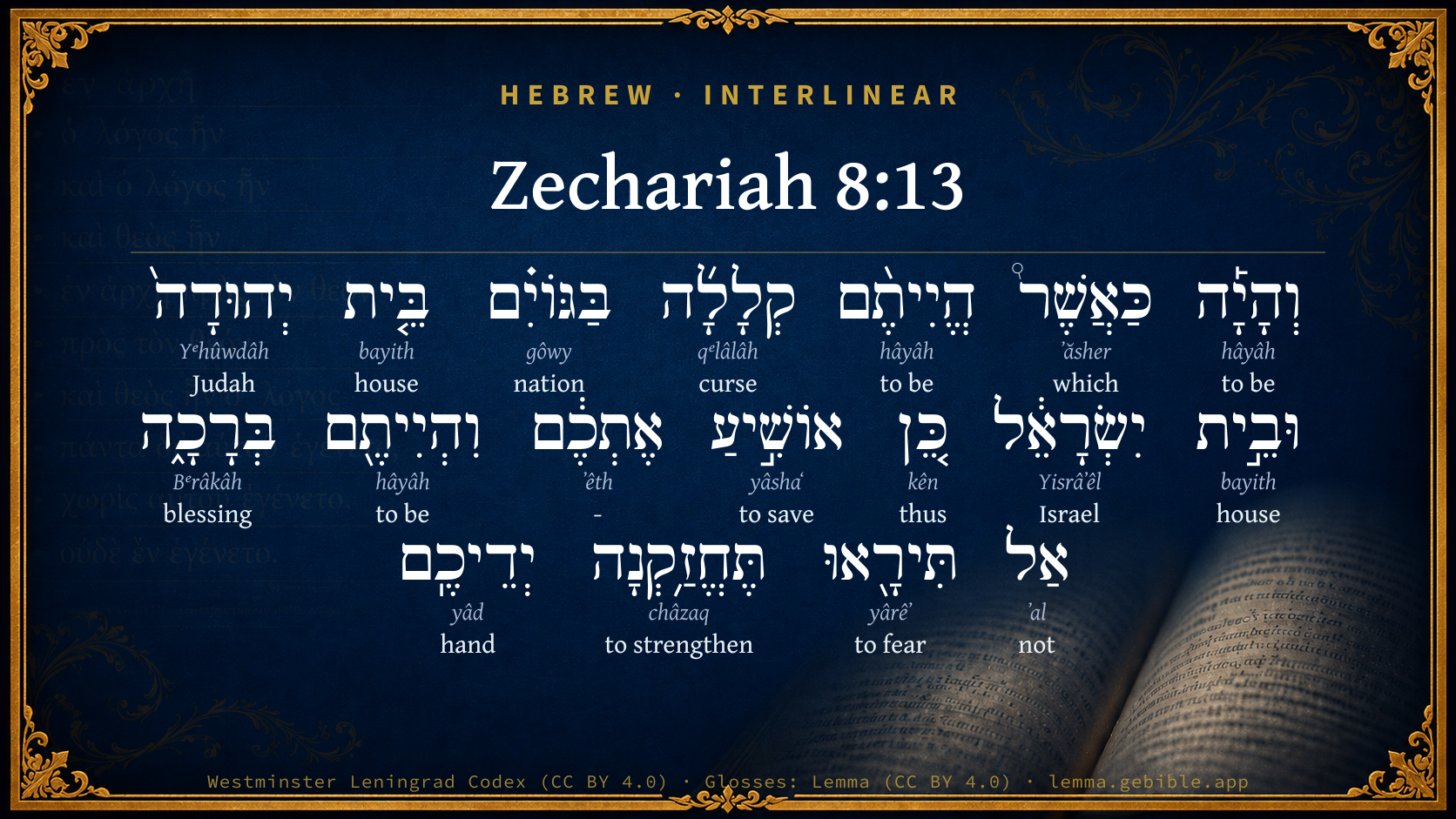
  1. וְהָיָ֡ה hâyâh H1961 “and · to be” Conjunction + Verb, Qal, Perfect, 3rd Person, Masculine, Singular
  2. כַּאֲשֶׁר֩ ʼăsher H834 “like/as · which” Preposition + Particle, Relative
  3. הֱיִיתֶ֨ם hâyâh H1961 “to be” Verb, Qal, Perfect, 2nd Person, Masculine, Plural
  4. בַּגּוֹיִ֗ם gôwy H1471 “in/at the · nations” Preposition, Determined + Noun, Common, Masculine, Plural, Absolute
  5. בֵּ֤ית bayith H1004 “house of” Noun, Common, Masculine, Singular, Construct
  6. יְהוּדָה֙ Yᵉhûwdâh H3063 “Judah” Noun, Proper
  7. וּבֵ֣ית bayith H1004 “and · house of” Conjunction + Noun, Common, Masculine, Singular, Construct
  8. יִשְׂרָאֵ֔ל Yisrâʼêl H3478 “Israel” Noun, Proper
  9. כֵּ֚ן kên H3651 “thus” Particle, Demonstrative
  10. אוֹשִׁ֣יעַ yâshaʻ H3467 “to save” Verb, Hiphil, Imperfect, 1st Person, Common, Singular
  11. אֶתְכֶ֔ם ʼêth H853 “- · you” Particle, Direct Object + Suffix, Personal, 2nd Person, Masculine, Plural
  12. וִהְיִיתֶ֖ם hâyâh H1961 “and · to be” Conjunction + Verb, Qal, Perfect, 2nd Person, Masculine, Plural
  13. בְּרָכָ֑ה Bᵉrâkâh H1293 “blessing” Noun, Common, Feminine, Singular, Absolute
  14. אַל ʼal H408 “not” Particle, Negative
  15. תִּירָ֖אוּ yârêʼ H3372 “to fear” Verb, Qal, Jussive, 2nd Person, Masculine, Plural
  16. תֶּחֱזַ֥קְנָה châzaq H2388 “to strengthen” Verb, Qal, Imperfect, 3rd Person, Feminine, Plural
  17. יְדֵיכֶֽם yâd H3027 “hands · your” Noun, Common, Both, Dual, Construct + Suffix, Personal, 2nd Person, Masculine, Plural

About this verse

These counts appear in no published source. They are computed here, from the morphology-tagged text and Lemma’s own curated glosses. What Lemma adds →

18
words
15
distinct lemmas
Prophets
section

Shared distinctive vocabulary

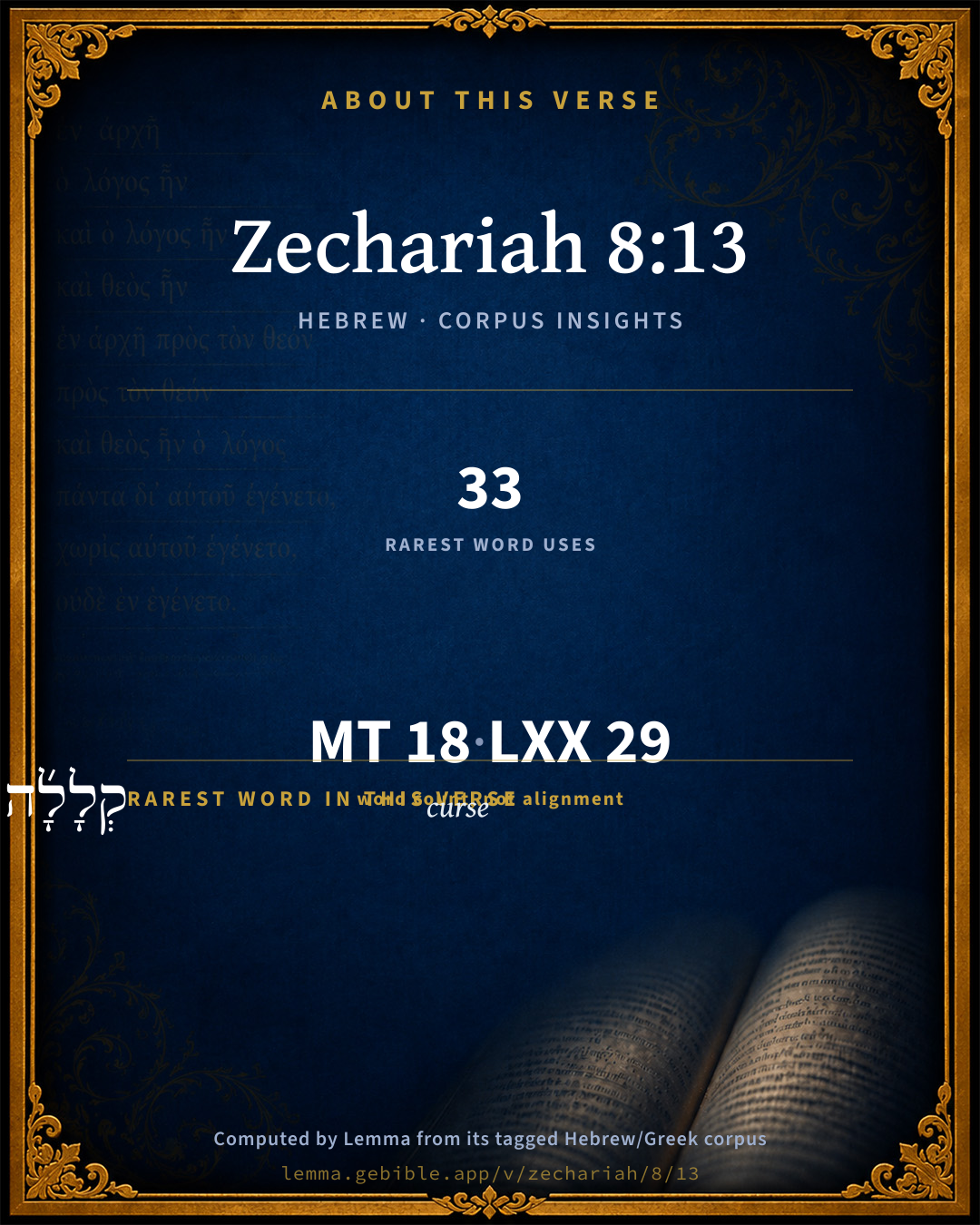
קְלָלָ֜ה curse H7045 occurs in 33 verses of the Hebrew Bible. Also found in:

Grammatical profile

  • 6 verbs
  • 8 nouns
  • 4 particles

Verb forms

  • וְהָיָ֡ה Qal · Perfect
  • הֱיִיתֶ֨ם Qal · Perfect
  • אוֹשִׁ֣יעַ Hiphil · Imperfect
  • וִהְיִיתֶ֖ם Qal · Perfect
  • תִּירָ֖אוּ Qal · Jussive
  • תֶּחֱזַ֥קְנָה Qal · Imperfect

Repetition

Words recur within this verse — often emphatic in Hebrew:

  • וְהָיָ֡ה to be H1961 ×3
  • בֵּ֤ית house H1004 ×2

Hebrew & Septuagint length

In English translation the verse runs 40 words from the Hebrew and 41 from the Septuagint (LXX English) — closely comparable.

A rough comparison of the two English renderings, which tokenize alike — not a word-level alignment.

Word counts can differ between the Hebrew and the Greek without any difference in meaning — e.g. the Hebrew direct-object marker אֵת has no separate Greek word, and Greek often adds the article ὁ.

In the original languages it is 18 Hebrew tokens and 29 Greek tokens — but the two are counted differently (Hebrew bundles its prefixes and suffixes into one token; the Greek is in lemma form), so that isn’t a like-for-like length.

Cross-references

43

Topical passages linked to Zechariah 8:13 in the Treasury of Scripture Knowledge — connected by theme and wording, ordered by reader-vote popularity; previews shown in the World English Bible.

  • Genesis 12:2–3 I will make of you a great nation. I will bless you, and make your name great. You will be a blessing.
  • Psalms 72:17 His name endures forever. His name continues as long as the sun. Men shall be blessed by him. All nations will call him blessed.
  • Zephaniah 3:20 At that time will I bring you in, and at that time will I gather you; for I will give you honor and praise among all the peoples of the earth, when I bring back your captivity before your eyes, says Yahweh.
  • Zechariah 8:9 Thus says Yahweh of Hosts: "Let your hands be strong, you who hear in these days these words from the mouth of the prophets who were in the day that the foundation of the house of Yahweh of Hosts was laid, even the temple, that it might be built.
  • 1 Corinthians 16:13 Watch! Stand firm in the faith! Be courageous! Be strong!
  • Ruth 4:11–12 All the people who were in the gate, and the elders, said, We are witnesses. Yahweh make the woman who has come into your house like Rachel and like Leah, which two built the house of Israel: and do you worthily in Ephrathah, and be famous in Bethlehem:
  • Ezekiel 5:15 So it shall be a reproach and a taunt, an instruction and an astonishment, to the nations that are round about you, when I shall execute judgments on you in anger and in wrath, and in wrathful rebukes; (I, Yahweh, have spoken it;)
  • Jeremiah 29:18 I will pursue after them with the sword, with the famine, and with the pestilence, and will deliver them to be tossed back and forth among all the kingdoms of the earth, to be an object of horror, and an astonishment, and a hissing, and a reproach, among all the nations where I have driven them;
  • Zechariah 10:6–9 "I will strengthen the house of Judah, And I will save the house of Joseph, And I will bring them back; For I have mercy on them; And they will be as though I had not cast them off: For I am Yahweh their God, and I will hear them.
  • Galatians 3:28–29 There is neither Jew nor Greek, there is neither slave nor free man, there is neither male nor female; for you are all one in Christ Jesus.
  • Genesis 26:4 I will multiply your seed as the stars of the sky, and will give to your seed all these lands. In your seed will all the nations of the earth be blessed,
  • Psalms 44:13–14 You make us a reproach to our neighbors, A scoffing and a derision to those who are around us.
  • Isaiah 19:24–25 In that day shall Israel be the third with Egypt and with Assyria, a blessing in the midst of the earth;
  • Isaiah 35:3–4 Strengthen you the weak hands, and confirm the feeble knees.
  • Jeremiah 24:9 I will even give them up to be tossed back and forth among all the kingdoms of the earth for evil; to be a reproach and a proverb, a taunt and a curse, in all places where I shall drive them.
  • Daniel 9:11 Yes, all Israel have transgressed your law, even turning aside, that they should not obey your voice: therefore has the curse been poured out on us, and the oath that is written in the law of Moses the servant of God; for we have sinned against him.
  • Haggai 2:19 Is the seed yet in the barn? Yes, the vine, the fig tree, the pomegranate, and the olive tree haven't brought forth. From this day will I bless you.'"
  • 2 Chronicles 7:20–22 then will I pluck them up by the roots out of my land which I have given them; and this house, which I have made holy for my name, will I cast out of my sight, and I will make it a proverb and a byword among all peoples.
  • Psalms 79:4 We have become a reproach to our neighbors, A scoffing and derision to those who are around us.
  • Jeremiah 42:18 For thus says Yahweh of Hosts, the God of Israel: As my anger and my wrath has been poured forth on the inhabitants of Jerusalem, so shall my wrath be poured forth on you, when you shall enter into Egypt; and you shall be an object of horror, and an astonishment, and a curse, and a reproach; and you shall see this place no more.
  • Zechariah 8:20–23 Thus says Yahweh of Hosts: "Many peoples, and the inhabitants of many cities will yet come;
  • Deuteronomy 28:37 You shall become an astonishment, a proverb, and a byword, among all the peoples where Yahweh shall lead you away.
  • Deuteronomy 29:23–28 [and that] the whole land of it is sulfur, and salt, [and] a burning, [that] it is not sown, nor bears, nor any grass grows therein, like the overthrow of Sodom and Gomorrah, Admah and Zeboiim, which Yahweh overthrew in his anger, and in his wrath:
  • Psalms 44:16 At the taunt of one who reproaches and verbally abuses, Because of the enemy and the avenger.
  • Isaiah 41:10–16 Don't you be afraid, for I am with you; don't be dismayed, for I am your God; I will strengthen you; yes, I will help you; yes, I will uphold you with the right hand of my righteousness.
  • Isaiah 65:15–16 You shall leave your name for a curse to my chosen; and the Lord Yahweh will kill you; and he will call his servants by another name:
  • Lamentations 2:15–16 All that pass by clap their hands at you; They hiss and wag their head at the daughter of Jerusalem, [saying], Is this the city that men called The perfection of beauty, The joy of the whole earth?
  • Ezekiel 37:11 Then he said to me, Son of man, these bones are the whole house of Israel: behold, they say, Our bones are dried up, and our hope is lost; we are clean cut off.
  • 1 Kings 9:7–8 then will I cut off Israel out of the land which I have given them; and this house, which I have made holy for my name, will I cast out of my sight; and Israel shall be a proverb and a byword among all peoples.
  • 2 Kings 17:18–20 Therefore Yahweh was very angry with Israel, and removed them out of his sight: there was none left but the tribe of Judah only.
  • Isaiah 9:20–21 One shall snatch on the right hand, and be hungry; and he shall eat on the left hand, and they shall not be satisfied: they shall eat every man the flesh of his own arm:
  • Jeremiah 25:18 [to wit], Jerusalem, and the cities of Judah, and the kings of it, and the princes of it, to make them a desolation, an astonishment, a hissing, and a curse, as it is this day;
  • Jeremiah 26:6 then will I make this house like Shiloh, and will make this city a curse to all the nations of the earth.
  • Jeremiah 32:30–32 For the children of Israel and the children of Judah have done only that which was evil in my sight from their youth; for the children of Israel have only provoked me to anger with the work of their hands, says Yahweh.
  • Jeremiah 33:24 Don't you consider what this people has spoken, saying, The two families which Yahweh did choose, he has cast them off? thus do they despise my people, that they should be no more a nation before them.
  • Jeremiah 44:12 I will take the remnant of Judah, that have set their faces to go into the land of Egypt to sojourn there, and they shall all be consumed; in the land of Egypt shall they fall; they shall be consumed by the sword and by the famine; they shall die, from the least even to the greatest, by the sword and by the famine; and they shall be an object of horror, [and] an astonishment, and a curse, and a reproach.
  • Jeremiah 44:22 so that Yahweh could no longer bear, because of the evil of your doings, and because of the abominations which you have committed; therefore is your land become a desolation, and an astonishment, and a curse, without inhabitant, as it is this day.
  • Lamentations 4:15 Depart you, they cried to them, Unclean! depart, depart, don't touch! When they fled away and wandered, men said among the nations, They shall no more sojourn [here].
  • Ezekiel 37:16–19 You, son of man, take one stick, and write on it, For Judah, and for the children of Israel his companions: then take another stick, and write on it, For Joseph, the stick of Ephraim, and [for] all the house of Israel his companions:
  • Micah 5:7 The remnant of Jacob will be in the midst of many peoples, Like dew from Yahweh, Like showers on the grass, That don't wait for man, Nor wait for the sons of men.
  • Zechariah 1:19 I asked the angel who talked with me, "What are these?" He answered me, "These are the horns which have scattered Judah, Israel, and Jerusalem."
  • Zechariah 9:13 For indeed I bend Judah as a bow for me. I have filled the bow with Ephraim; And I will stir up your sons, Zion, Against your sons, Greece, And will make you like the sword of a mighty man.
  • Galatians 3:14 that the blessing of Abraham might come on the Gentiles through Christ Jesus; that we might receive the promise of the Spirit through faith.

Cross-references courtesy of OpenBible.info (CC BY 4.0).

Hebrew and Greek witnesses Masoretic Hebrew ↔ Greek Septuagint

The same verse in the two great witnesses to the Old Testament, shown verse-for-verse.

These are two independent witnesses, not word-aligned to each other, and the Septuagint is shown in lemma (dictionary) form.

Hebrew Zechariah 8:13 Masoretic · Westminster Leningrad Codex

וְהָיָ֡ה כַּאֲשֶׁר֩ הֱיִיתֶ֨ם קְלָלָ֜ה בַּגּוֹיִ֗ם בֵּ֤ית יְהוּדָה֙ וּבֵ֣ית יִשְׂרָאֵ֔ל כֵּ֚ן אוֹשִׁ֣יעַ אֶתְכֶ֔ם וִהְיִיתֶ֖ם בְּרָכָ֑ה אַל תִּירָ֖אוּ תֶּחֱזַ֥קְנָה יְדֵיכֶֽם

It shall come to pass that, as you were a curse among the nations, house of Judah and house of Israel, so will I save you, and you shall be a blessing. Don't be afraid. Let your hands be strong."

World English Bible · Public Domain

Greek LXX Zechariah 8:13 Septuagint · lemma form

καί εἰμί ὅς τρόπος εἰμί ἐν κατάρα ἐν ὁ ἔθνος οἶκος ιουδα καί οἶκος ἰσραήλ οὕτως διασώζω σύ καί εἰμί ἐν εὐλογία θαρρέω καί καταἰσχύω ἐν ὁ χείρ σύ

And it shall come to pass, as you⌃ were a curse among the nations, O house of Juda, and house of Israel; so will I save you, and you⌃ shall be a blessing: be of good courage, and strengthen your hands.

LXX2012 (modern English Septuagint) · Public Domain

On this verse, The Pulpit Commentary discusses the Septuagint’s reading. Read the note in Commentary ↓

Hebrew: Westminster Leningrad Codex (CC BY 4.0). Greek: Septuagint (public domain); English from LXX2012 (modern English Septuagint) (Public Domain). How the Septuagint differs from the Hebrew →

Targum (Aramaic paraphrase)

1

The Targum is the ancient Jewish Aramaic paraphrase of the Hebrew Scriptures — an interpretive translation, not the Hebrew text itself. Onkelos (literal) and Pseudo-Jonathan (expansive) render the Torah, and Jonathan the Prophets. Coverage is partial: where no permissively-licensed English translation exists for a verse, only the Aramaic is shown. This is verse-level text, not a word-by-word alignment to the Hebrew.

  1. Targum Jonathan Prophets (Joshua–Malachi)
    וִיהֵי כְּמָא דַהֲוֵיתוּן לְוָטָא בְּעַמְמַיָא בֵּית יְהוּדָה וּבֵית יִשְׂרָאֵל כֵּן אֶפְרוֹק יַתְכוֹן וּתְהוֹן מְבָרְכִין לָא תִדְחֲלוּן יִתְקְפָן יְדֵיכוֹן:

    (no public-domain English translation for this verse)

    Targum Jonathan — Aramaic: “Mikraot Gedolot” (public domain). English: “Sefaria Community Translation” (CC0 1.0 (public-domain dedication)); “London "Chaldee Paraphrase," 1871” (public domain). Text via Sefaria.

Commentary

Notes on Zechariah 8:13 from classic Christian and Jewish commentators (each source and its license shown beneath its notes). The classic Christian expositions comment on the surrounding passage and are grouped to its opening verse, so a note may address several verses; the Jewish commentaries on the Tanakh (Rashi and others) are per-verse, so they appear only where the commentator wrote on this verse.

Lemma curates 59 commentaries, every one of them public domain or Creative Commons licensed, each selected and text-cleaned for this edition rather than reprinted as found. About our sources →

Trapp's Complete Commentary

John Trapp

Zec 8:13 And it shall come to pass, [that] as ye were a curse among the heathen, O house of Judah, and house of Israel; so will I save you, and ye shall be a blessing: fear not, [but] let your hands be strong.

Ver. 13. As ye were a curse among the heathen] The people of God’s wrath, and of his curse, Isa 34:5, abhorred and accursed by all nations, Jer 24:9; lastly, a proverb and a pattern for any fearful imprecation, Eze 14:8, as those that had the bloody weals of God’s visible vengeance on their backs, and, Cain-like, had his manifest mark upon their persons and proceedings. The Turks at this day so hate the Jews for crucifying Christ, that they use to say, in detestation of a thing, I would I might die a Jew, then; Let me be a Jew if I defraud thee, &c. Such a taunt and a curse this wretched people are still. As they curse Christ and his followers continually every day, so it comes into their heart like water, and like oil into their bones, Psa 109:18.

O house of Judah, and house of Israel] i.e. Besides the two tribes of Judah and Benjamin, many of the ten tribes that revolted, for religion’s sake, unto Judah were carried captive with them, and afterwards returned out of captivity also in their company. To them, therefore, as well as to the house of Judah, is made the promise. Twelve thousand of these ten tribes returning are found by computation in that summa totalis set down Ezr 2:64, as the Jewish doctors have concluded. There are those who understand the words of the general conversion of all the Jews in the time of the gospel; and this may very well be, for aught that I see to the contrary.

So will I save you] Lest you should say, in the language of Ashdod, It is a chance, I will do it, saith God, 1Sa 6:9.

And ye shall be a blessing] Not only a name and a praise, as Zep 3:20, but a form to be used in blessing of others; such as was that, Rth 4:11-12. And not altogether unlike is that prayer of David, Psa 119:132 "Look thou upon me, and be merciful unto me, as thou usest to do unto those that love thy name."

Fear not, but let your hands be strong] Be not diffident, but diligent in well doing: in due season you shall reap, if you faint not, Gal 6:9. {See Trapp on "Zec 8:9"} Base fear expectorates and unmans us; banish it, therefore, or ye will be betrayed by it.

John Trapp, A Commentary or Exposition upon All the Books of the Old and New Testament (1647–1656) — public domain. Text from a community e-Sword module.

The Biblical Illustrator

Joseph S. Exell

Zec_8:13

So I will save you

Mans need and Gods provision

I.

Man in the natural and fallen state. As ye were a curse among the heathen. Sinners are under the curse of God. Mankind in general, as transgressors, all whose sins are unpardoned, are under the curse of God. Those who are in their natural and carnal state are a curse to themselves. The dispositions which they cherish, the practices which they adopt, injure their health, blast their reputation, often ruin their circumstances, and lead to sorrow and wretchedness and death. And sinners are a curse to others. They diffuse evil, they propagate mischief, they are corruptors.

II. The gracious purpose of God in reference to man, as made known in the Gospel. So will I save you, and ye shall be a blessing. This salvation has been procured for man by the atonement and intercession of Christ. This salvation is free to all, without any exception, without any limitation. This salvation can only be experienced by those who exercise repentance toward God, and faith toward our Lord Jesus Christ.

III. The gracious and delightful result of this design in connection with the children of men. Ye shall be a blessing. Those who are saved inherit the blessing of God. Those who are saved are a blessing to themselves. (J. H. Bumby.)

The Biblical Illustrator, edited by Joseph S. Exell (c. 1880s–1900s) — public domain. Text from a community e-Sword module.

Keil & Delitzsch

C. F. Keil & F. Delitzsch

The whole blessing is finally summed up in one expression in Zac 8:13 : "And it will come to pass, as ye were a curse among the nations, O house of Judah and house of Israel, so will I endow you with salvation, that ye may be a blessing. Fear not, let your hands be strong." The formula, to be a curse among the nations, is to be interpreted according to Jer 24:9; Jer 25:9; Jer 42:18; Kg2 22:19, as equivalent to being the object of a curse, i.e., so smitten by God as to serve as the object of curses. In harmony with this, the phrase to "become a blessing" is equivalent to being so blessed as to be used as a benedictory formula (cf. Gen 48:22; Jer 29:22). This promise is made to the remnant of Judah and Israel, and therefore of all the twelve tribes, who are to become partakers of the future salvation in undivided unity (cf. Zac 9:10, Zac 9:13; Zac 10:6; Zac 11:14). Israel is therefore to look forward to the future without alarm.

Keil & Delitzsch — Biblical Commentary on the Old Testament (1861–1891) — public domain (CC PDM 1.0). Text via the HelloAO Bible API. (Old Testament only.)

Jamieson, Fausset & Brown

Robert Jamieson, A. R. Fausset & David Brown

a curse--As the heathen have made you another name for "a curse," wishing to their foes as bad a lot as yours (Jer 24:9; Jer 29:18); so your name shall be a formula of blessing, so that men shall say to their friend, May thy lot be as happy as that of Judah (Gen 48:20). Including also the idea of the Jews being a source of blessing to the Gentile nations (Mic 5:7; Zep 3:20). The distinct mention of "Judah" and "Israel" proves that the prophecy has not yet had its full accomplishment, as Israel (the ten tribes) has never yet been restored, though individuals of Israel returned with Judah.

Jamieson, Fausset & Brown — Commentary Critical and Explanatory on the Whole Bible (1871) — public domain (CC PDM 1.0). Text via the HelloAO Bible API.

Adam Clarke's Commentary

Verse 13. As ye were a curse] Instead of being execrated among the people, ye shall be blessed; instead of being reproached, ye shall be commended. Ye shall be a blessing to all the nations round about. All these promises we may expect to be completely fulfilled when the Jews acknowledge their Messiah.

O house of Judah, and house of Israel] The restoration shall be complete, when both Israel and Judah are brought back.

Adam Clarke's Commentary on the Bible (1810–1826) — public domain. Text from a community e-Sword/MySword module.

John Calvin's Commentaries

He goes on with the same subject, and in this verse he states two contrary things, in order to render more clear what he teaches here — that while God was angry the earth was barren, and all things went on unhappily with the Jews; but that when God had begun to be reconciled, the earth had as it were changed its nature, and brought forth plentifully, and that they were in every way made blessed.

Hence he says, As ye have been a curse, etc. Here again he mentions and reminds them how miserable they were while they minded only their private interest, and by neglecting the temple manifested their impiety and ingratitude; for what ought they to have been more ready to do when they returned to their country than to build the temple, and to offer there sacrifices to God, in order to avow him as the author of their deliverance? But the temple was neglected; and the Prophet concludes that they must have been extremely forgetful, if they did not consider what their condition was as long as they had no care for the temple; and he says that they had been a curse among the nations; that is, that they were an example of a curse, according to the threatening of the law. For it is a mode of speaking frequent in Scripture, that the people were a curse; and the common formula of cursing was — “Let the Lord curse thee as he does the Jews.” Zechariah then says that the Jews had been a curse, that they had not only been smitten by God’s hand, but that they had been given up to calamities, in order that they might become to all detestable, and bear in a manner signs of God’s wrath imprinted on them. Whoever then at that time looked on a Jew, he might see that he had the appearance of bearing a curse. In short, Zechariah means that the Jews had been punished in a manner not common or usual, but that God had executed on them dreadful judgments, which made it evident to all that he was grievously offended with them. Ye have been then a curse among all nations

He then adds, So I will save you, as ye shall be a blessing. The word save is introduced that God might more clearly set forth his favor, lest the Jews should think that the change had been effected by fortuitous change; for we know that men’s thoughts soon change, and they feign this or that cause that they may obscure God’s providence. God then, before he promises that they should be a blessing, says that he would save them. What it is to be a blessing may be easily learnt from the opposite clause. They are then said to be a blessing who bear evident tokens of God’s favor and kindness. So the Prophet means, that when people wished to be prayed for, or when they wished well to one another, this would be the common form of their requests — “May God bless us as he blesses his chosen people: as the Jews are dear to God, so may he favor us with the same or similar kindness.” Thus then we see that the Jews were a curse, when exposed to extreme reproaches; and that they became a blessing when God manifested towards them tokens of favor, and showed in reality, or by the effect, that he was pacified towards them.

He says, in the last place, Fear ye not; strengthened be your hands. He exhorts them to entertain hope, for fear stands opposed to confidence; and fear, proceeding from unbelief, cannot be otherwise dissipated but by God’s promises made to us, which chase away all doubts. Rightly then does the Prophet teach us that the Jews had no reason to fear, for he declares that God was propitious to them. We indeed know that all fear cannot be wholly driven away from the hearts of men; for it would be necessary to deprive us of every feeling before we could regard dangers without fears. But though fear is natural to us, and occasions of fear ever occur to us, yet the fear of unbelief may be dispelled by faith; and hence it is no wonder that God condemns fear, when he promises salvation to his elect. But as I have said, we ought to observe that there is here a contrast between condemnable fear and that confidence which relies on God’s word. We must also add, that the confidence of God’s children is never so complete that they are free from all fear, even the fear of unbelief; but still we ought to struggle against it, so as not to be hindered in the course of our calling. And this we learn more fully from the end of the verse.

Strengthened be your hands. But why does the Prophet forbid the Jews to fear? even for this purpose, — that they might arouse themselves for the work which the Lord had allotted to them, and not allow fear to retard them or to prevent them to persevere.

We now then perceive how the faithful become prepared and ready to render service to God: sloth must first be shaken off — but how? even by having fear removed. What is the remedy for healing fear? even to recomb on the promises of God; for when our minds are composed, the hands and the feet and all the members will be ready to do their office. Alacrity both of mind and heart and of all the members follows, when fear is shaken off, and when men begin so to rely on God’s word, as to know that his help is enough for them against all dangers, and to dread nothing, being convinced that the Lord will by his power remove all hindrances.

John Calvin's Commentaries (1540-1563) — public domain. Text from the Calvin Translation Society English edition (1840s-50s) via the Christian Classics Ethereal Library (ccel.org). Calvin's coverage is partial (roughly two-thirds of the Bible); uncommented books and verses are honest gaps, never fabricated. The 19th-century editor's footnotes and remarks are omitted so the notes are faithfully Calvin's own voice.

Ellicott's Commentary for English Readers

(13) Comp. Isa_46:9 with Jer_24:9. The contents of this verse is the converse of that of Jos_23:15.

A Bible Commentary for English Readers, edited by Charles John Ellicott (1878–1897) — public domain. Text from a community e-Sword module.

The Cambridge Bible for Schools and Colleges

gen. ed. J. J. S. Perowne

13. a curse … a blessing] Either, the object of cursing and blessing, as men cursed you before so now they shall bless you (Jer_22:9); or a formula of imprecation or benediction, God make thee like them (Jer_29:22; Gen_48:20; Rth_4:11-12).

heathen] nations, R. V.

house of Judah, and house of Israel] Not only the two tribes but the ten. This has never yet been fulfilled.

The Cambridge Bible for Schools and Colleges (gen. ed. J. J. S. Perowne; Cambridge University Press, 1878–1918) — public domain. Text from a community e-Sword module.

John Gill's Exposition

For thus saith the Lord of hosts,.... In order to assure them of the truth of what he promised, he observes the fulfilment of what he had threatened, he being as true and faithful in the one as in the other:

As I thought to punish you: determined to do it, by suffering them to be carried captive:

when your fathers provoked me to wrath, saith the Lord of hosts; by their immorality, idolatry, and contempt of his prophets:

and I repented not; the Targum adds, "of my word"; of the resolution he had taken up in his heart, and of the declaration of it by his prophets, that he would punish them; this he did not repent of, revoke, change, and alter, but steadily abode by it, and executed it.

John Gill's Exposition of the Whole Bible (1746–1763) — public domain (CC PDM 1.0). Text via the HelloAO Bible API.

Albert Barnes' Notes on the Bible

As ye were a curse among the nations, O house of Judah and house of Israel, so I will save you - The ten tribes bore the name of Israel, in contrast with the two tribes with the name of Judah, not only in the history but in the prophets; as Hosea says, “I will no more have mercy upon the house of Israel, and on the house of Judah I will have mercy” Hos 1:6-7. Here he unites both; both, in the time of their captivity, were a curse, were held to be a thing accursed, as it is said, “He that is hanged is the curse of God” Deu 21:23, that is, a thing accursed by Him; and God foretold of Judah, that they should be “a desolation and a curse” 2Ki 22:10, and by Jeremiah, “I will deliver them to be removed into all the kingdoms of the earth for hurt, a reproach and a proverb, a taunt and a curse in all places whither I shall drive them” ; and in deed, when it was so, “therefore is your land a desolation and an astonishment and a curse without an inhabitant, as at this day” Jer 44:22.

Now the sentence was to be reversed as to both. “As ye were a curse, among the nations, naming each, so I will save you.” There would have been no proportion between the curse and the blessing, unless both had been included under the blessing, as they were under the curse. But Israel had no share in the temporal blessing, not returning from captivity, as Zechariah knew they were not returned hitherto. Therefore the blessings promised must be spiritual. Even a Jewish commentator saw this. “It is possible, that this may have been spoken of the second temple, on condition that they should keep the commandments of the Lord; or, it is still future, referring to the days of the Messiah: and this is proved by the following verse which says, ‘O house of Judah and house of Israel.’ During the second temple the house of Israel did not return.”

And ye shall be a blessing - This is a revival and an application of the original promise to Abraham, “thou shalt be a blessing” Gen 12:2; which was continued to Jacob, “God give thee the blessing of Abraham, to thee and to thy seed with thee” Gen 28:4. And of the future king, of whom it is said, “Thou gavest him length of days forever and ever,” David says, “Thou hast made him blessings forever” Psa 21:4, Psa 21:6, and again, “They shall be blessed in Him” Psa 72:17). So Isaiah had said of the days of Christ, “In that day shall Israel be the third with Egypt and with Assyria, a blessing in the midst of the land;” Isa 19:24; and symbolically of the cluster of grapes, “Destroy it not: for a blessing is in it” Isa 65:8; and Ezekiel, “I will make them and the places round about My hill a blessing” Eze 34:26. They were this; for of them, “according to the flesh, Christ came, who is over all, God blessed forever” Rom 9:5; of them were the Apostles and Evangelists, of them every writer of God’s word, of them those who carried the Gospel throughout the world. Osorius: “Was this fulfilled, when the Jews were under the Persians? or when they paid tribute to the Greeks? or when they trembled, hour by hour, at the mention of the Roman name? Do not all count those who rule much happier than those oppressed by the rule of others? The prediction then was fulfilled, not then, but when Christ, the Sun of Righteousness, shone on the earth, and He chose from the Hebrews lights, through whom to dissipate darkness and illumine the minds of people who were in that darkness. The Jews, when restored from the captivity, seemed born to slavery.” They were reputed to be of slaves the most despised. “But when they had through Christ been put in possession of that most sure liberty, they overthrew, through their empire, the power and tyranny of the evil spirits.”

Albert Barnes' Notes on the Bible (1834–1885) — public domain. Text from a community e-Sword/MySword module.

Haydock's Catholic Bible Commentary

CHAPTER VIII.

Blessing. As the nations could wish no greater curse than what you have experienced, so you shall now be regarded as a most happy people.

George Leo Haydock (1774–1849), Haydock's Catholic Family Bible and Commentary, 1859 edition — public domain. Excludes Psalms (Douay-Rheims chapter numbering differs from Protestant) and Deuterocanonical books (Catholic canon only).

Matthew Poole's English Annotations

As ye were a curse; as threatened Deu 28:37; Jer 24:9; 29:18, all which came upon them in this seventy years’ captivity, and the miseries that preceded.

Among the heathen; nations who knew the misery which they heaped on the Jews, nations among whom they were scattered.

House of Judah; two tribes.

House of Israel; ten tribes, or rather some of them which escaped Shalmaneser’s hand, and adhered to Judah; or some that from the division of the tribes did keep close to the house of David, and the temple worship.

So will I save you; in such a manner will I save you. so wonderfully, so graciously.

Ye shall be a blessing; a form or model of blessing, as Zep 3:19,20.

Fear not, but let your hands be strong; be not discouraged, neither slack your hands, in the building of the temple, and restoring the worship of God, for God will be with you, and finish all by and for you.

Matthew Poole's English Annotations on the Holy Bible (1683–1685) — public domain. Text from a community e-Sword/MySword module.

The Pulpit Commentary

As ye were a curse among the heathen. As your fate was used as a formula of imprecation among the heathen; e.g. "May your fate be that of the Jews". (see examples of this, 2Ki_22:19 Isa_65:15 Jer_24:9 Jer_29:22) The other way of taking the expression as meaning the object of curse (i.e. as the heathen once used to curse you), is not so suitable. Judah... Israel. This expression includes the twelve tribes, of all of which some members had returned, and continued to return, from the Captivity. They were united now and formed one nation. (see note on Zec_9:10) So will I save you. In as open and significant a manner will I show that I am delivering and favouring you. Ye shall be a blessing. This must be taken correspondingly to the former phrase, being a "curse;" ye shall be used as a formula for blessing; e.g. "God make thee as Ephraim and as Manasseh". (Gen_48:20; comp. Rth_4:11, Rth_4:12) Fear not. (Zep_3:16) "If God be for us, who can be against us?" (Rom_8:31; comp. Num_14:9) Let your hands be strong (see note on ver. 9). The LXX takes the paragraph differently and erroneously: "And it shall be that in like manner as ye were a curse among the nations, O house of Judah and house of Israel, so will I save you, and ye shall be a blessing," i.e. a cause of blessing, Hte en katara ... esesye en eulogia .

The Pulpit Commentary (1880–1919), ed. H.D.M. Spence-Jones & Joseph S. Exell — public domain. Text from a community e-Sword module.

unfoldingWord translationNotes

Door43 World Missions Community

You were an example to the other nations of a curse

The implied information is that the way Yahweh had allowed the temple to be destroyed and his people to be exiled had been used by other nations as an example of what it meant to be cursed by Yahweh. AT: "When I punished you, the other nations learned what happens when I curse a people" (See: Assumed Knowledge and Implicit Information)

house of Judah and house of Israel

The word "house" is a metonym for the family that lives in the house. In this case it refers to the people in the kingdoms of Judah and Israel. AT: "people of Judah and Israel" (See: Metonymy)

you will be a blessing

Possible meanings are 1) the implied information is that the people of Judah and Israel would be a blessing to the nations around them. AT: "you will be a blessing to the surrounding nations" or 2) the implied information is that the nations around them would see what it meant to be blessed by Yahweh. AT: when I bless you, the other nations will learn what happens when I bless a people" or 3) Yahweh will bless the people of Judah and Israel. AT: "I will give you many good things" (See: Assumed Knowledge and Implicit Information)

let your hands be strong

This is an idiom that means to be courageous for the work. AT: "be strong and courageous" (See: Idiom)

do harm to you

"punish you"

provoked my anger

"angered me"

did not relent

"did not decide to punish them less"

Jerusalem

This is a metonym for the people of Jerusalem. AT: "the people of Jerusalem" (See: Metonymy)

house of Judah and house of Israel

The word "house" is a metonym for the family that lives in the house. In this case it refers to the people in the kingdom of Judah. AT: "people of Judah" (See: Metonymy)

translationWords

nation

curse

Judah

house

bless

anger

Jerusalem

fear

unfoldingWord translationNotes — © Distant Shores Media and the Door43 World Missions Community, licensed CC BY-SA 4.0. Source: git.door43.org/Door43/en_tn.

Lesson kit

Teaching starters — assembled from the data on this page, not authored interpretation. Every prompt links to the verse data it draws on. Edit before teaching.

Zechariah, in the Prophets, opens this verse with 18 words (15 distinct Hebrew lemmas). Its most distinctive word is qᵉlâlâh (“curse”). A historical commentator’s framing appears above. Read the whole chapter for the surrounding context.

Discussion questions

  1. The word qᵉlâlâh carries the sense “curse.” How does it shape the verse?
  2. How does Genesis 27:12, which shares the word «curse», read alongside this verse?
  3. What does the repetition of “to be” (3× in this one verse) do in this verse?
  4. These translations render this verse differently. What is at stake in choosing one wording over another?
  5. «וְהָיָ֡ה» is a Qal Perfect verb. How does that grammatical form shape the action described?
  6. Compare how Trapp's Complete Commentary and The Biblical Illustrator read this verse. Where do they agree or differ?

Things to notice

Reading settings

Reading text

Shown beneath each verse's original-language words.

Old Testament
Old Testament edition

Read the OT as the Masoretic Hebrew (MT) or the Greek Septuagint (LXX).

English shown for the Greek Septuagint (in the Hebrew ↔ Greek comparison).

Comparing translations? Open the Compare panel on any verse page to stack up to four side by side.