
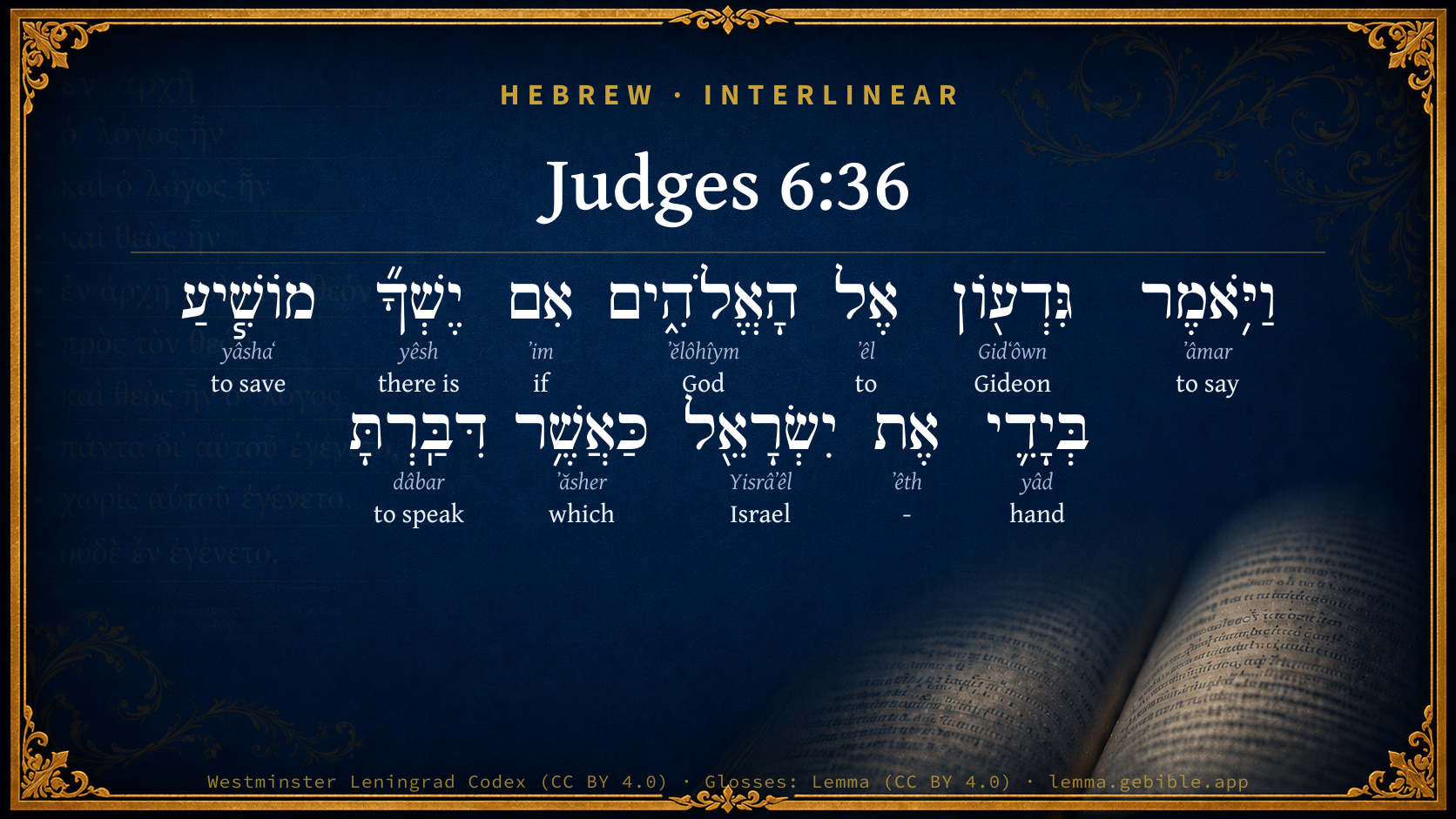
Judges 6:36

Hebrew (Westminster Leningrad Codex) Judges 6:36 appears in the Hebrew Old Testament. The text above is from the Westminster Leningrad Codex. Each word links to its Strong’s number, a concise gloss, and parsing drawn from the Open Scriptures Hebrew Bible morphology. Click any word for its full Brown-Driver-Briggs (BDB) entry.
Download image
Cite this verse

Judges 6:36 (World English Bible). Public Domain. Lemma interlinear Bible study tool, https://lemma.gebible.app/v/judges/6/36.

Show BibTeX & RIS
BibTeX
RIS
English Translation
Gideon said to God, If you will save Israel by my hand, as you have spoken,
World English Bible · Public Domain
Download a study sheet

One document with this verse’s original text, its word-by-word gloss line, the meaning frame, cross-references with their text, attributed commentary, and full source and license credits — printable, and it pastes into notes with its structure intact.

This verse Autodidact and up

Study sheet (.html) Plain text (.txt)

A passage Seminary Student

Up to 50 verses in one chapter. A passage sheet keeps up to 6 commentary sources and 12 cross-references per verse, in the order this page ranks them, and says so on the sheet whenever that leaves anything out. Ask for a single verse and you get the Autodidact verse sheet above.

Everything on this page stays free to read, with no account — the sheet is a download of what is already on screen, not access to it.

Want to remove ads? Support Godless Engineer
Compare translations 3

The same verse in 3 English versions, stacked beneath the original-language interlinear above. Click any original word for its lexicon entry.

Each is an independent rendering of the whole verse — the interlinear is not word-aligned to these translations.

Highlighted words mark where these versions differ — a whole-verse word diff, not a word-by-word alignment.

  • World English Bible Public Domain
    Gideon said to God, If you will save Israel by my hand, as you have spoken,
  • King James Version Public Domain
    And Gideon said unto God, If thou wilt save Israel by mine hand, as thou hast said,
  • unfoldingWord Literal Text CC BY-SA 4.0
    Then Gideon said to God, “If you are saving Israel by my hand just as you have spoken,

unfoldingWord Literal Text — © unfoldingWord, licensed CC BY-SA 4.0. Word-aligned USFM3 via Door43 (git.door43.org/unfoldingWord/en_ult).

Versions to compare (up to 4)

3 of 4 selected

Show all 18 translations

Every available English version of this verse, each an independent rendering of the whole verse.

  • World English Bible Public Domain
    Gideon said to God, If you will save Israel by my hand, as you have spoken,
  • Berean Standard Bible Public Domain
    Then Gideon said to God, “If You are going to save Israel by my hand, as You have said,
  • Majority Standard Bible Public Domain
    Then Gideon said to God, “If You are going to save Israel by my hand, as You have said,
  • King James Version Public Domain
    And Gideon said unto God, If thou wilt save Israel by mine hand, as thou hast said,
  • American Standard Version (1901) Public Domain
    And Gideon said unto God, If thou wilt save Israel by my hand, as thou hast spoken,
  • Revised Version (1885) Public Domain
    And Gideon said unto God, If thou wilt save Israel by mine hand, as thou hast spoken,
  • Geneva Bible (1599) Public Domain
    Then Gideon said vnto God, If thou wilt saue Israel by mine hand, as thou hast sayd,
  • Douay-Rheims (1899) Public Domain
    And he sent messengers into all Manasses, and they also followed him: and other messengers into Aser and Zabulon and Nephtali, and they came to meet him.
  • Young's Literal Translation Public Domain
    And Gideon saith unto God, `If Thou art Saviour of Israel by my hand, as Thou hast spoken,
  • Literal Standard Version CC BY-SA 4.0
    And Gideon says to God, “If You are Savior of Israel by my hand, as You have spoken,
  • Unlocked Literal Bible CC BY-SA 4.0
    Gideon said to God, “If you intend to use me to save Israel, as you have said—
  • unfoldingWord Literal Text CC BY-SA 4.0
    Then Gideon said to God, “If you are saving Israel by my hand just as you have spoken,
  • Darby Bible Public Domain
    Then Gideon said to God, "If thou wilt deliver Israel by my hand, as thou hast said,
  • World Messianic Bible Public Domain
    Gideon said to God, “If you will save Israel by my hand, as you have spoken,
  • Webster's Bible Public Domain
    And Gideon said to God, If thou wilt save Israel by my hand, as thou hast said,
  • Free Bible Version CC BY-SA 4.0
    Gideon said to God, “If you will save Israel through me as you promised,
  • Bible in Basic English Public Domain
    Then Gideon said to God, If you are going to give Israel salvation by my hand, as you have said,
  • JPS Tanakh (1917) Public Domain
    And Gideon said unto God: 'If Thou wilt save Israel by my hand, as Thou hast spoken,

Literal Standard Version (2020), Covenant Press — licensed CC BY-SA 4.0. Text via the HelloAO Bible API (eBible.org). Unlocked Literal Bible (unfoldingWord) — licensed CC BY-SA 4.0. Text via the HelloAO Bible API (eBible.org). unfoldingWord Literal Text — © unfoldingWord, licensed CC BY-SA 4.0. Word-aligned USFM3 via Door43 (git.door43.org/unfoldingWord/en_ult). Free Bible Version, Dr. Jonathan Gallagher — licensed CC BY-SA 4.0. Text via the HelloAO Bible API (eBible.org).

Word by word

More ways to search: Search by grammar → Find every occurrence → Compare this word →

Practice this passage: Drill this verse → Learn its vocabulary →

גִּדְע֖וֹן
Gidʻôwn
H1439
“Gideon”
Noun, Proper
Part of Speech
Noun
Type
Proper
Full BDB Definition

Origin: from H1438

TWOT: 316a

Gideon = "hewer" - youngest son of Joash of the Abiezrites, fifth judge of Israel who led the Israelites against the Midianites
  1. וַיֹּ֥אמֶר ʼâmar H559 “and · to say” Conjunction + Verb, Qal, Sequential Imperfect, 3rd Person, Masculine, Singular
  2. אֶל ʼêl H413 “to” Preposition
  3. הָאֱלֹהִ֑ים ʼĕlôhîym H430 “the · God(s)” Particle, Definite Article + Noun, Common, Masculine, Plural, Absolute
  4. אִם ʼim H518 “if” Conjunction
  5. יֶשְׁךָ֞ yêsh H3426 “there is · you” Particle, Demonstrative + Suffix, Personal, 2nd Person, Masculine, Singular
  6. מוֹשִׁ֧יעַ yâshaʻ H3467 “saving” Verb, Hiphil, Participle Active, Masculine, Singular, Absolute
  7. בְּיָדִ֛י yâd H3027 “in/at · hand · my” Preposition + Noun, Common, Both, Singular, Construct + Suffix, Personal, 1st Person, Common, Singular
  8. אֶת ʼêth H853 “-” Particle, Direct Object
  9. יִשְׂרָאֵ֖ל Yisrâʼêl H3478 “Israel” Noun, Proper
  10. כַּאֲשֶׁ֥ר ʼăsher H834 “like/as · which” Preposition + Particle, Relative
  11. דִּבַּֽרְתָּ dâbar H1696 “to speak” Verb, Piel, Perfect, 2nd Person, Masculine, Singular

About this verse

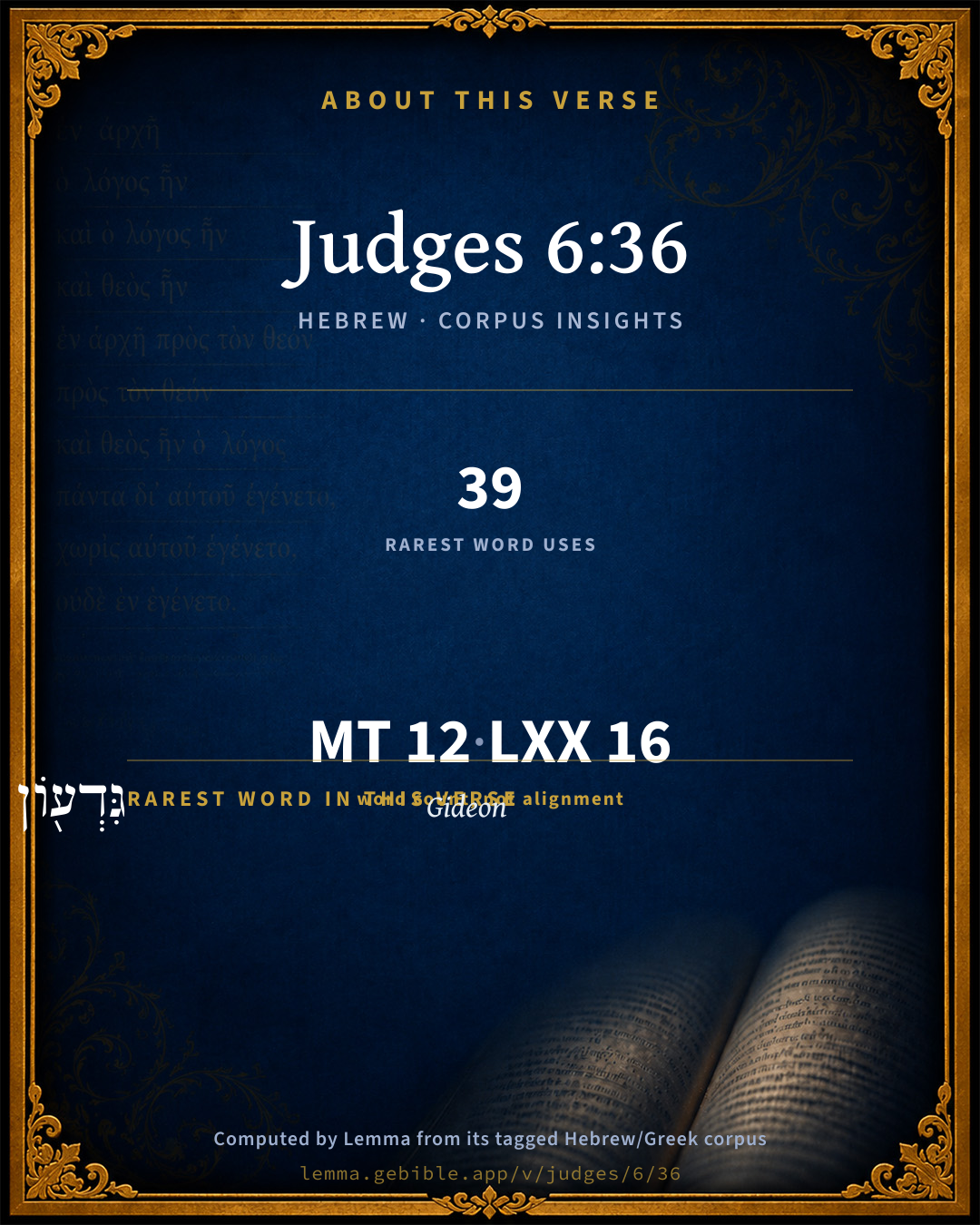
These counts appear in no published source. They are computed here, from the morphology-tagged text and Lemma’s own curated glosses. What Lemma adds →

12
words
12
distinct lemmas
Historical
section

Shared distinctive vocabulary

גִּדְע֖וֹן Gideon H1439 occurs in 37 verses of the Hebrew Bible. Also found in:

Grammatical profile

  • 3 verbs
  • 4 nouns
  • 1 preposition
  • 1 conjunction
  • 3 particles

Verb forms

  • וַיֹּ֥אמֶר Qal · Sequential Imperfect
  • מוֹשִׁ֧יעַ Hiphil · Participle Active
  • דִּבַּֽרְתָּ Piel · Perfect

Hebrew & Septuagint length

In English translation the verse runs 16 words from the Hebrew and 17 from the Septuagint (LXX English) — closely comparable.

A rough comparison of the two English renderings, which tokenize alike — not a word-level alignment.

Word counts can differ between the Hebrew and the Greek without any difference in meaning — e.g. the Hebrew direct-object marker אֵת has no separate Greek word, and Greek often adds the article ὁ.

In the original languages it is 12 Hebrew tokens and 16 Greek tokens — but the two are counted differently (Hebrew bundles its prefixes and suffixes into one token; the Greek is in lemma form), so that isn’t a like-for-like length.

Cross-references

6

Topical passages linked to Judges 6:36 in the Treasury of Scripture Knowledge — connected by theme and wording, ordered by reader-vote popularity; previews shown in the World English Bible.

  • Judges 6:14 Yahweh looked at him, and said, Go in this your might, and save Israel from the hand of Midian: have not I sent you?
  • Matthew 16:1 The Pharisees and Sadducees came, and testing him, asked him to show them a sign from heaven.
  • 2 Kings 20:9 Isaiah said, This shall be the sign to you from Yahweh, that Yahweh will do the thing that he has spoken: shall the shadow go forward ten steps, or go back ten steps?
  • Psalms 103:13–14 Like a father has compassion on his children, So Yahweh has compassion on those who fear him.
  • Exodus 4:1–9 Moses answered, "But, behold, they will not believe me, nor listen to my voice; for they will say, 'Yahweh has not appeared to you.'"
  • Judges 6:17–20 He said to him, If now I have found favor in your sight, then show me a sign that it is you who talk with me.

Cross-references courtesy of OpenBible.info (CC BY 4.0).

Hebrew and Greek witnesses Masoretic Hebrew ↔ Greek Septuagint

The same verse in the two great witnesses to the Old Testament, shown verse-for-verse.

These are two independent witnesses, not word-aligned to each other, and the Septuagint is shown in lemma (dictionary) form.

Hebrew Judges 6:36 Masoretic · Westminster Leningrad Codex

וַיֹּ֥אמֶר גִּדְע֖וֹן אֶל הָאֱלֹהִ֑ים אִם יֶשְׁךָ֞ מוֹשִׁ֧יעַ בְּיָדִ֛י אֶת יִשְׂרָאֵ֖ל כַּאֲשֶׁ֥ר דִּבַּֽרְתָּ

Gideon said to God, If you will save Israel by my hand, as you have spoken,

World English Bible · Public Domain

Greek LXX Judges 6:36 Septuagint · lemma form

καί εἶπον γεδεων πρός ὁ θεός εἰ σύ σώζω ἐν χείρ ἐγώ ὁ ἰσραήλ καθώς λαλέω

And Gedeon said to God, If you will save Israel by my hand, as you have said,

LXX2012 (modern English Septuagint) · Public Domain

Hebrew: Westminster Leningrad Codex (CC BY 4.0). Greek: Septuagint (public domain); English from LXX2012 (modern English Septuagint) (Public Domain). How the Septuagint differs from the Hebrew →

Targum (Aramaic paraphrase)

1

The Targum is the ancient Jewish Aramaic paraphrase of the Hebrew Scriptures — an interpretive translation, not the Hebrew text itself. Onkelos (literal) and Pseudo-Jonathan (expansive) render the Torah, and Jonathan the Prophets. Coverage is partial: where no permissively-licensed English translation exists for a verse, only the Aramaic is shown. This is verse-level text, not a word-by-word alignment to the Hebrew.

  1. Targum Jonathan Prophets (Joshua–Malachi)
    וַאֲמַר גִדְעוֹן קֳדָם יְיָ אִם אִיתָךְ פָּרִיק בִּידִי יַת יִשְׂרָאֵל כְּמָא דְמַלֵילְתָּא:

    (no public-domain English translation for this verse)

    Targum Jonathan — Aramaic: “Mikraot Gedolot” (public domain). English: “Sefaria Community Translation” (CC0 1.0 (public-domain dedication)); “London "Chaldee Paraphrase," 1871” (public domain). Text via Sefaria.

Commentary

Notes on Judges 6:36 from classic Christian and Jewish commentators (each source and its license shown beneath its notes). The classic Christian expositions comment on the surrounding passage and are grouped to its opening verse, so a note may address several verses; the Jewish commentaries on the Tanakh (Rashi and others) are per-verse, so they appear only where the commentator wrote on this verse.

Lemma curates 59 commentaries, every one of them public domain or Creative Commons licensed, each selected and text-cleaned for this edition rather than reprinted as found. About our sources →

Trapp's Complete Commentary

John Trapp

Jdg 6:36 And Gideon said unto God, If thou wilt save Israel by mine hand, as thou hast said,

Ver. 36. And Gideon said unto God.] These signs he desired of God, not out of infidelity, but in all humility, for his further confirmation in faith and obedience.

John Trapp, A Commentary or Exposition upon All the Books of the Old and New Testament (1647–1656) — public domain. Text from a community e-Sword module.

The Biblical Illustrator

Joseph S. Exell

Jdg_6:36-40

I will put a fleece of wool in the floor.

Gideons request

1. Impossible though it may be to acquit Gideon of unreasonableness, in demanding farther proofs of the certainty wherewith he might rely on the presence and blessing of the Lord on his perilous undertaking, we cannot deny that he displayed at the same time a becoming and praiseworthy concern lest he should be deserted of Him.

2. Again, in the kind and condescending manner in which it pleased the Lord to accommodate Himself to Gideons infirmity, and to allow him to put Him to the proof, may we not recognise a pleasing evidence that such concern as that to which we have referred--such solicitude and nervous apprehension lest there be some mistake on his part--is far from being displeasing to Him. Oh, what a tender, sympathising, long-suffering, easy-to-be-entreated High Priest is He with whom we have to do! Instead of upbraiding Gideon with his unbelief in spite of all that had passed, He bears with him (oh, with what marvellous condescension, and slowness of wrath!) and at once yields His assent to the proposal. Well says good Bishop Hall, in his meditations on this passage: What tasks is God content to be set by our infirmity!

3. From this incident in the life of Gideon we may also learn this lesson: that every believer needs fresh supplies of grace and strength for every new turn in the affairs of his soul, and for every new phase in the spiritual conflict. Whoever thinks of finding fault with a man, on the ground of a defect in faith, because he goes so often to the throne of grace, or because he comes boldly to obtain mercy to pardon, and grace to help? Nay, rather would he not justly expose himself to the charge of ignorance and presumption, if, on the pretext or plea that he has already received the promise, as thy days, so shall thy strength be, he should go forth to do battle with his spiritual adversaries without repairing afresh to the fountain of all spiritual blessing, and asking as Gideon asked? (W. W. Duncan, M. A.)

The miracle of the dew and the fleece

The state of Gideons mind, if we may judge from these words, seems to have been that of the man who cried, Lord I believe; help Thou mine unbelief. He had already experienced the power of God to be on his side, by the touching of the rock and the consuming of the sacrifice. He had been already assured of the favour of God towards him, by the declaration of the angel--The Lord is with thee. Yet he seeks further assurance. We must, not, however, too hastily condemn Gideon in this matter. The assurances which he had before received had given him strength equal to his day. In that strength he had already thrown down the altar of Baal, and cut down the grove that was by it, and this at the risk of his life. But here he is called to new duties; we cannot, therefore, wonder at his seeking new assurances. So fights the soldier of the Cross the good fight of faith, against the world, the flesh, and the devil, under the banner of the Captain of his salvation. The world wonders to see him so continually going to his God in prayer, for fresh tokens of His favour; but they do not know as he does the necessity for such renewed applications. Many a shameful defeat would be spared Israel if they were more careful to assure themselves of Gods presence and blessing in what they undertake, even if they sought again and again for the tokens. It would prevent many mistakes, for instance, with regard to what are termed providences. How apt are we to interpret them in such a manner as to suit the secret inclinations of our own minds! The Christian finds, frequently, that a deceived heart hath turned him aside in this matter. Such a circumstance, he says, is certainly an opening in providence; when, if the truth were known, it is an opening which he has himself made to gratify his wishes, and not an opening made by God in the course of His providence. Let me prove, I pray thee, yet once more with the fleece. In pursuing our subject we may notice--

1. The condescension of God in the performance of this twofold miracle. Gideons doubts and fears prevail, and he goes to God for courage and confirmation, and he obtains them. He asks still further, and he still obtains. What doctrine does it teach? It tells us that The Lord is merciful and gracious, slow to anger and of great goodness. The bruised reed He will not break, and the smoking flax He will not quench.

2. Some spiritual uses to which this miracle maybe applied.

(1) We may learn from this emblem that God is a sovereign God, and giveth none account of His matters. We behold some nations scourged with famine, pestilence, and the sword, while others are enjoying plenty, health, and peace. We see vast parts of the globe in an unenlightened state, as it respects the knowledge of salvation; while others, like our own favoured land, are living in the full blaze of gospel day. What shall we say to these things? Why is there dew on one nation and drought on another? Are we better than they? No, in no wise. God is showing that He will do whatsoever it pleaseth Him. Just and true are all Thy ways, O God, Thou King of saints!

(2) We may view the miracle, in the next place, as an emblem of the state of the Jewish nation. The contrast between the wet fleece and the dry was not more striking than the contrast between Israel in her state of national prosperity under the favour of God and in her after-state of degradation when that favour was withdrawn. And how awfully striking when the same contrast is marked in her spiritual state! The miracle sets before our minds the time when the nations were lying in the darkness of idolatry, and dry, as it respected any knowledge of God, like the earth round Gideons fleece.

(3) But, in order to make some practical use of the subject, we will consider it as an emblem of a congregation under the preaching of the gospel. It need hardly be observed that the Divine blessing upon the ordinances is often compared to the dew of heaven. Thus, speaking of the quickening and enlivening effect of His Word upon the heart when blessed by the Holy Ghost, the Lord says, in Deu_32:1-52, My doctrine shall drop as the rain; My speech shall distil as the dew. The metaphor is simple and sublime. As the dew distils silently, and almost imperceptibly, into the plants on which it falls, so shall Gods Word and doctrine, under the Spirits influence, descend upon the soul. As the dew insinuates itself into the plant, giving it fresh life and vigour, so shall Gods Word accomplish the thing whereunto He sends it, giving renewed life to the soul. This figure will appear still more apt, and strong, and beautiful, if you consider that in eastern countries, where the rain is scarce, the dew, as the only substitute, is invaluable. With these ideas attached to the Word, take our text as setting forth an emblem of the state of a congregation, sitting under the sound of the gospel. Is this the house of God? Are we at this moment preaching to you the truth as it is in Jesus? Then the dew is now falling, and it is indeed a time of refreshing. Will it fall upon that careless soul that is as unconcerned about salvation as if none were necessary? Will it fall upon the soul of him who actually disregards the offer of salvation through a righteousness not his own? Will it fall on the soul of the poor thoughtless trifler? Miracle of grace! but not too great to expect from almighty power, nor from almighty love. And therefore we will pause, and secretly pray the God of power and mercy to do this now; that while the dew is descending some drops may fall on these sinners, carrying conviction to their consciences and conversion to their hearts. But we ask, also, where is the dry and empty fleece? Oh, how quickly may we find it in any congregation! We may find it in those seats where there has been no prayer, but only the form of prayer; we may find it in those pews where there is no attention to the preached Word nor any desire after the salvation which it holds forth. In short, wherever carelessness and indifference prevail, there we shall find the dry and empty fleece. Oh, let not this opportunity pass without a prayer for grace. It is said respecting the answer to Gideons prayer, The Lord did it that night. Ask, then, and it shall be given you; seek, and ye shall find; knock, and it shall be opened unto you. (F. Elwin.)

Dewy and dry fleeces

I. The circumstance recorded is highly honourable to the character of Gideon. It shows that there was in him that caution and waiting, for the want of which how many a man has mistaken his mission, and instead of doing the work of the Lord, has made a wreck both of himself and his own work! If Thou wilt save Israel by my hand. A full consciousness that Israel needs saving; but an indisposition to feel that such an honour could be conferred on him; such is a good index to the character of a man--a disposition to test ourselves. Am I fit? Am I capable? Can God use me? Am I he whom God will choose to do this work? Yes, I think we do well to apply tests to ourselves and to our position; to our religious life, and to our relation to God by our religious life. Do you not believe that there is an influence that covers a man with blessings? Do you not believe that there is a conduct which attracts to itself blessing? Hence the image is constantly occurring in Scripture between moisture and drought (Jer_17:5-8; Psa_1:3). He shall be like a tree. There is the test--a tree, moistened by unseen springs, whose leaves are green even in the parched land and not inhabited. See David in the court of Saul. A dewy fleece in the midst of a land of drought. See Daniel at the courts of Nebuchadnezzar and Belshazzar. While all the uproar goes on, there the blasphemy, and the tokens of a coming doom; Daniel and his companions are in waiting on the Lord; without wine they are brave; their spirits are fresh, and they are ready for the service of God--a dewy fleece in a dry place. Who are the happy? I do not ask who are the successful, because I find often the happy are the unsuccessful. Setting all the worlds calculations on one side, Behold, says James, we call them happy which endure. Whence, then, is the spring supplied which will never dry? The calm, the contented, and the hallowed blessedness of the holy heart. How often we find wealth is a dry fleece, while poverty is a dewy one! True, there is nothing in wealth to curse especially, but then there is nothing in wealth to bless especially; because of wealth, it is not that the dew refuses to fall, but the dew will not fall because wealth is there--only proving that wealth needs something more before it can be regarded as really a blessing; and poverty must be forgotten of God, and cut off from the dew before that state can be regarded as a curse.

II. Thus, then, we justify the Gideon test. Upon the heart and the home the dew will fall and remain. Thou askest, Am I a child of God? You shall know by the dew. Have I religion? You shall know by the dew. Walk forth in the morning--the sweet morning, when the bright drops sparkle on the hedgerows, and behold the twinkling thorn, the rose, the tree, the floor of grass, such shall be your words, and such your mind, your action--the dew shall be on your fleece!

III. I shall attempt to illustrate this a little further. For I say the world will insist on applying its test to us; the world will watch for the dew on our fleece. When I was a boy it was my privilege to know a very holy man. He had been in the beginning of things a poor man; but how sacredly, how steadily, he served God! He worked in a shop where proverbially all were Sabbath-breakers. He would not break the Sabbath. The master could do as he liked with all his men--it was a kind of old-world tyranny. He would not break the Sabbath. He led a sweet, sacred, holy life. His master was a swearer in the midst of a gang of unholy men. His conversation became the gospel of Christ. By a steady course he was able to provide for his widowed mother; he was able to provide for his sister. And he died, but his work lasted; the dew has not all evaporated yet; the shop is in ruins; his master was long since a bankrupt, and his whole family is in ruins too. The name of the one man is fragrant, all else is gone--it was a dewy fleece in a land of drought. Thus gratitude in the heart, thus holiness in the life, are dew. You shall know them by the dew upon the fleece. (E. Paxton Hood.)

Natures laws

Gideon owned the sovereignty and the power of God. So must we. In the matter of salvation we deal with Omnipotence. The God of grace is the Sovereign Ruler of the universe, Gideon believed in the omnipotence of God. He rested upon His promises. But he wanted a confirmation of his faith in these promises. He seemed to cast his eyes to heaven, and say in language which has often found response in the hearts of tried believers, Shew me a token for good; that they which hate me may see it, and be ashamed; because Thou, Lord, hast holpen me, and comforted me. Or, like one struggling to master his doubts and fears, on finding that he could not overcome the natural infidelity of his depraved heart, he turned to the stronghold whence alone help could come, and prayed, Lord, I believe, help Thou mine unbelief. The Lord did help his unbelief, by granting him the twofold miracle for which he prayed. It was a fine instance of childlike confidence in this mighty man of valour that as soon as his faith began to waver he at once told the Lord. Half of our difficulties in the Christian course would be got over, and got over quickly too, if we would but unbosom our souls to the Lord, and tell Him our difficulties as soon as they arise. Now, the token vouchsafed to Gideon was peculiar in its nature. He was led, doubtless acting under the influence of the Holy Spirit, to ask of God a sign, and to choose a sign himself. In infinite condescension, God was pleased to accede to his petition. He suspended the ordinary laws of nature, and whether the fleece of wool was to be wet or dry, according to the prayer of this man of God, we are told, God did so that night. The grand doctrine to be deduced from this narrative is, that in confirmation of His promises, and in appearing on behalf of His people, the Lord suspended the ordinary laws of nature.

I. Observe, first, that it was none other than the Lord Jesus Christ Himself who thus answered Gideons prayer. God, to whom Gideon prayed in Jdg_6:36, is the same who looked upon him, and spake to him in verse14. He was the angel of the covenant, who said, Go in this thy might, and thou shalt save Israel from the hand of the Midianites: have not I sent thee? Gideon prayed to this same Lord, that He would grant him a sign that He would save Israel by his hand, As He had said. The answer to Gideons prayer--the twofold miracle which was wrought--proved the proper Deity of Christ. It proved that the government of all things was indeed upon His shoulder.

II. now, it is over the laws of nature that Christ reigneth, for the good of His Church in all ages. We know not how little, nor how much, other worlds are affected by the redemption of Christs people in this world. It may be that inhabitants of other spheres and of other systems are learning the wisdom and the goodness and the love of God in the book of mans salvation. Angels study it, the highest orders of intelligence make it their theme of praise, and why not beings in untold worlds which fill up the immensity of space? But be this as it may, all the laws of the universe are under the rule of the Lord Jesus for the good of His people. There is no law but the will of God. To deify law is to undeify God. So to enthrone nature as to make her reign is to dethrone Jehovah, who alone does reign God over all, blessed for evermore. Time would fail us to dwell upon the many instances of the suspension of the laws of nature recorded in the Word of God. We will adduce but a few remarkable examples.

1. Observe the suspension of the laws of physical nature for the good of the people of God. Although heaven and earth should seem to oppose the fulfilment of His Word, although physical impossibilities may raise up a barrier the top of which no eye of sense can scale, yet the eye of faith soars above all nature, up to natures God, and rests calmly and peaceably upon His enthroned promise (Isa_43:2).

2. We might go on and educe instances of the like suspension of the laws of animal nature, in carrying out the purposes of Jehovah on behalf of His people. Birds of the air, the fish of the sea, and the beasts of the earth, have all obeyed other influences than the laws of their nature, in doing the will of their Creator. The instinct which they possess, is just that law which God sustains in them. Unclean and carnivorous birds forget their own natures, and spread their wings, and, as angels of mercy, visit the prophet in the wilderness, and daily spread his table. The fish devours not Jonah, but, at the word of the Lord, safely lands him on dry ground. The lions, too, become the harmless and the friendly companions of Daniel, and not a hair of his head is injured in their den.

1. Gideons need of a confirmation of his faith. The only question with this mighty man of valour was, Is the Lord indeed with me? Is He on my side? Can I possibly have made any mistake? I do not doubt the Lords power. If He will, He can save Israel by my hand. But am I certain that I have not put too favourable an interpretation upon His promises? I will ask a sign of the Lord. He did so, and you know with what result. Are you as anxious as was Gideon to learn the Lords will, and to insure His blessing in your undertakings? Do you make your daily callings a matter of prayer? Do you pause in your worldly business, and inquire with deep anxiety, Is the Lord with me?

2. You see the nature of that proof which the Lord gave to Gideon that His promises were sure: the dew was given and withheld according to the sign proposed. We may regard the dew as a striking and beautiful emblem of the Holy Spirit. (G. A. Rogers, M. A.)

Gideons signs

Like other Israelites, he is strongly persuaded that God appears and speaks to men through nature; and he craves a sign in the natural world which is of Gods making and upholding. Now, to us the sign Gideon asked may appear rude, uncouth, and without any moral significance. A fleece which is to be wet one morning while the threshing-floor is dry, and dry next morning while the threshing-floor is wet, supplies the means of testing the Divine presence and approval. Further, it may be alleged that the phenonema admit of natural explanation. But this is the meaning: Gideon providing the fleece, indentifies himself with it. It is his fleece, and if Gods dew drenches it, that will imply that Gods power shall enter Gideons soul and abide in it, even though Israel be dry as the dusty floor. The thought is at once simple and profound, childlike and Hebrew-like, and carefully we must observe that it is a nature-sign, not a mere portent, Gideon looks for. It is not whether God can do a certain seemingly impossible thing. That would not help Gideon. But the dew represents to his mind the vigour he needs, the vigour Israel needs if he should fail; and in reversing the sign, Let the dew be on the ground and the fleece be dry, he seems to provide a hope even in prospect of his own failure or death. Gideons appeal is for a revelation of the Divine in the same sphere as the lightning, storm and rain, in which Deborah found a triumphant proof of Jehovahs presence; yet there is a notable contrast. We are reminded of the still small voice Elijah heard as he stood in the cave-mouth after the rending wind and the earthquake and the lightning. We remember also the image of Hosea, I will be as the dew unto Israel. There is a question in the Book of Job--Hath the rain a father, or who hath begotten the drops of dew? The faith of Gideon makes answer, Thou, O Most High, dost give the dews of heaven. The silent distillation of the dew is profoundly symbolic of the spiritual economy and those energies that are not of this noisy world, but silent and Divine. (R. A. Watson, M. A.)

The dew and the fleece

1. Just before the occurrence of the facts narrated in this passage Gideon had received his call from God. Former judges, Othniel, Ehud, and Barak, had been moved by the Spirit of God to their work of delivering Israel from the oppressor. But to Gideon alone a theophany was vouchsafed in order to intimate that the God, who had visibly manifested Himself to the patriarchs, was the same Jehovah ready to save their descendants if only they would penitently return to the covenant.

2. God permitted His people to be brought so low in order that affliction might drive them to prayer, and that thus their extremity might become His opportunity. Such was the result in the gracious ways of His providence.

3. Next, God called Gideon by two revelations. The first, by a visible manifestation of the angel of Jehovah. Next, in a dream of the night, Jehovah commanded him to throw down his fathers altar to Baal.

4. As in the first manifestation Jehovah acknowledged Gideon, so in this second one He required Gideon to acknowledge Jehovah. Gideon accordingly, with ten men of his servants, overthrew Baals altar, and cut down the Asherah pillar by it in the night; for he durst not do it by day through fear of his fathers household and the men of the city. But God does not reject the first sincere efforts of His children to do His will, though attended with timidity (Joh_3:2; Joh_19:38). Gideon did not by secrecy effect his purpose of escaping detection.

5. Then followed the gathering together of the enemy to the plain of Jezreel: And the Spirit of Jehovah clothed Gideon as with a coat of mail. At his trumpet-call his own clan, recognising the champion and deliverer of Israel in him who, as an iconoclast, braved Baals revenge with impunity, was the first to rally around him. The neighbouring tribes, Manasseh, Zebulun, and Naphtali, next obeyed his summons by heralds. But still there were renmants of doubt and fear in Gideon, though he was very different in respect to faith from what be was when the Angel of Jehovah first appeared to him.

6. But before setting out on his perilous enterprise with the assembled army, Gideon desired a further sign from God to assure him of success. His prayer for a sign did not betoken want of faith, but weakness of faith. The flesh strove against the willing spirit, and so created misgivings and fears. The sign which Gideon asked, and which the Lord vouchsafed, was one especially significant. The dew was in the Holy Land a leading source of fertility (Gen_27:28; Deu_33:13). Thus dew naturally became the image of spiritual influences. The type may be viewed in a threefold relation.

I. the dew in relation to Gideons enterprise. To Gideon in his fears the filling of the fleece with dew from heaven whilst the earth around was dry, intimated that, whereas Israel was heretofore, through apostasy, as dry spiritually as the heathen around (comp. the dry places, Mat_12:43), Jehovah was now about to fill Gideon and His nation with His reviving grace. The reversing of the sign at Gideons request, and the dryness of the fleece whilst the dew rested on the earth around, assured him that Jehovah could, and would, manifest His power even amidst the weakness and helplessness of His people in the face of the nations which were flourishing all around. The army was reduced to three hundred. The poor and weak one should overturn the rich and mighty.

II. The dew in relation to Israel past, present, and future. The type has a deeply interesting relation to Israel, the elect nation.

1. First, in the past, the fleece filled with dew whilst the ground around was utterly dry, answers to Israel filled with heavenly blessings from the Lord, whilst the Gentile world was a moral wilderness, dry and unwatered by the dews of His grace. It was not because of Israels merits, but because of Gods gratuitous choice, that the nation was singled out to be the Paradise of Jehovah cut off from the spiritual waste: just as the dew is not of mans procuring, but of Gods bestowing. Had Abraham, the forefather of the nation, been left to himself he would have continued an idolater like all his neighbhours in Ur of the Chaldees, a city dedicated to moon-worship (Jos_24:2-3). There was much imperfection in him, and Isaac, and Jacob. Jacobs sons, excepting Joseph and perhaps Benjamin, were far worse. Yet God remembered His own covenant of grace, and preserved Israel in Egypt as a separate people unto Himself in the land of Goshen, like a fleece full of heavenly dew in the midst of a dry and parched land.

2. The dew representing the present state of Israel. The fleece remaining dry, whilst all the ground around was saturated with the refreshing dew, represents Israel in a state forming a sad contrast to the former image and what it represents. Israel has now for ages been spiritually dry, without any of the dews of heavenly blessing which descends from Jehovah, the God of the covenant. And what makes her case the sadder is, she is singular in her state. For the gospel of the grace of God in Christ Jesus is making many a spiritual desert throughout the Gentile world to become a garden of the Lord, blooming with the life-giving dews of the Spirit poured down from on high.

3. The dew representing the future of Israel. The relation of the type to the future of Israel. As the fleece was full of dew at first, and all the earth dry: and next, the fleece was dry, and all the earth wet; so the blessed time is coming when the fleece shall be again full of dew, and all the earth, through its instrumentality, shall be filled with the dew of the Lord (Mic_5:7; Jer_3:17; Psa_72:6; Psa_72:8).

III. The dew in relation to the Church of Christ and its professing members. Lastly, the type has a profitable lesson to teach us in its relation to the Christian Church and its professing members.

1. The fleece represents not only Israel, but Israels Antitype, Jesus; and secondarily, His people who are one with Him. Originally He had from everlasting the fulness of the Godhead (Col_1:19). The fleece was full, but the ground around had no dew from heaven. Then at His crucifixion the Church might say, Our bones are dried, and our hope is lost (Eze_37:11); just as the fleece was dried whilst the earth around was saturated with dew. But at His resurrection not only did He live again, but becomes the Lord of life to us. Meantime the effect of Christs presence as a dew in the soul is He shall grow as the lily, and cast forth His roots as Lebanon (Hos_14:5). Prayer will fill the fleece with the heavenly dew. Moreover, there is great danger of losing the dew.

2. The dry place amidst the dew-covered ground is a symbol of the sad state of many a one who remains spiritually dead and lifeless, whilst dews of heavenly blessing are descending on every side. (A. R. Fausset, M. A.)

.

The Biblical Illustrator, edited by Joseph S. Exell (c. 1880s–1900s) — public domain. Text from a community e-Sword module.

Whedon's Commentary on the Bible

Daniel D. Whedon

THE SIGN OF THE FLEECE, Jdg_6:36-40.

Having assembled the thousands of Manasseh, Asher, Zebulun, and Naphtali, Gideon prays for one more sign from heaven, not so much for strengthening his own faith, (though that may have wavered again when he saw the vast host of the enemy in the plains below,) as for inspiring with confidence and holy heroism the hearts of those who rallied to his standard.

Daniel D. Whedon (gen. ed.), Commentary on the Old and New Testaments (1874–1909) — public domain. Text from a community e-Sword module.

Geneva Bible (1599)

Geneva Bible translators

This request proceeded not of infidelity, but that he might be confirmed in his vocation.

Geneva Bible (1599) marginal notes — public domain. Text via Bolls.life.

Adam Clarke's Commentary

Verse 36. If thou wilt save Israel] Gideon was very bold, and God was very condescending. But probably the request itself was suggested by the Divine Spirit.

ON the miracle of the fleece, dew, and dry ground, Origen, in his eighth homily on the book of Judges, has many curious and interesting thoughts, I shall insert the substance of the whole: -

The fleece is the Jewish nation. The fleece covered with dew, while all around is dry, the Jewish nation favoured with the law and the prophets. The fleece dry, the Jewish nation cast off for rejecting the Gospel. All around watered, the Gospel preached to the Gentiles. and they converted to God. The fleece on the threshing-floor, the Jewish people in the land of Judea, winnowed, purged, and fanned by the Gospel. The dew wrung out into the bowl, the doctrines of Christianity, extracted from the Jewish writings, shadowed forth by Christ's pouring water into a basin, and washing the disciples' feet. The pious father concludes that he has now wrung this water out of the fleece of the book of Judges, as he hopes by and by to do out of the fleece of the book of Kings, and out of the fleece of the book of Isaiah or Jeremiah; and he has received it into the basin of his heart, and there conceived its true sense; and is desirous to wash the feet of his brethren, that they may be able to walk in the way of the preparation of the Gospel of peace. - ORIGEN, Op. vol. ii., p. 475, edit. Benedict.

All this to some will doubtless appear trifling; but it is not too much to say that scarcely any pious mind can consider the homily of this excellent man without drinking into a measure of the same spirit, so much sincerity, deep piety, and unction, appear throughout the whole: yet as I do not follow such practices, I cannot recommend them. Of dealers in such small wares, we have many that imitate Benjamin Keach, but few that come nigh to Origen.

Adam Clarke's Commentary on the Bible (1810–1826) — public domain. Text from a community e-Sword/MySword module.

Ellicott's Commentary for English Readers

(36) If thou wilt save Israel.—This diffidence and hesitation show the seriousness of the crisis. Gideon saw that by human strength alone he would be utterly helpless to repel the countless hosts of the marauders. He had already shown his faith, but now he needed fresh encouragement in his dangerous task.

A Bible Commentary for English Readers, edited by Charles John Ellicott (1878–1897) — public domain. Text from a community e-Sword module.

The Cambridge Bible for Schools and Colleges

gen. ed. J. J. S. Perowne

36. as thou hast spoken] The words are meant to refer to Jdg_6:14-16.

36–40. The divine impulse has seized Gideon, he has called out his men, he is ready to attack; but here he seems to be still at home, hesitating and waiting to be convinced. In order of time these verses are parallel, not subsequent, to Jdg_6:11-24; and indeed, after the revelation of the Angel, it is strange that Gideon should have demanded a second sign. Instead of ‘Jehovah’ and ‘the Angel of Jehovah’ the name ‘Elohim’ (God) is used here; the narrative from which these verses come was a work of the Elohist school; to the same narrative we may assign Jdg_6:7-10; Jdg_6:25-33; Jdg_6:35 a (?) in this ch.

The Cambridge Bible for Schools and Colleges (gen. ed. J. J. S. Perowne; Cambridge University Press, 1878–1918) — public domain. Text from a community e-Sword module.

John Gill's Exposition

Behold, I will put a fleece of wool on the floor,.... On the floor where he was threshing, where the angel first appeared to him, and which lay exposed to the open air, so that the dew might easily fall upon it:

and if the dew be on the fleece only; the dew that falls from heaven in the night, when he proposed it should lie on the floor till morning:

and it be dry upon all the earth beside; meaning not upon all the world, nor even upon all the land of Israel, but upon all the floor about the fleece: then shall I know that thou wilt save Israel by my hand, as thou hast said; for the dew being a token of divine favour, see Hos 14:5 it would show that Gideon would partake of it, while his enemies would be dry and desolate, and ruin and destruction would be their portion.

John Gill's Exposition of the Whole Bible (1746–1763) — public domain (CC PDM 1.0). Text via the HelloAO Bible API.

Albert Barnes' Notes on the Bible

The caution of Gideon, desirous of being assured that he really had a promise from God, does not imply doubts as to God’s faithfulness or power to fulfill His promise. Of such doubts there is not a trace in Gideon’s character. He is a worthy example of faith Heb 11:32.

Albert Barnes' Notes on the Bible (1834–1885) — public domain. Text from a community e-Sword/MySword module.

Matthew Poole's English Annotations

Gideon said this in way of humble supplication, partly for the strengthening of his own faith, and partly for the greater encouragement of his soldiers in this great and strange attempt.

Matthew Poole's English Annotations on the Holy Bible (1683–1685) — public domain. Text from a community e-Sword/MySword module.

The Pulpit Commentary

If thou wilt save, etc. There is something touching in Gideon"s diffidence of himself, even now that he found himself at the head of a large force. The thought that he was "the least in his father"s house" seems still to possess him, and he can hardly believe it possible that he is to save Israel. In his humility he craves a sign that he is indeed chosen and called.

The Pulpit Commentary (1880–1919), ed. H.D.M. Spence-Jones & Joseph S. Exell — public domain. Text from a community e-Sword module.

John Wesley's Explanatory Notes

Gideon said - In a way of humble supplication, for the strengthening his own faith, and for the greater encouragement of his soldiers in this great attempt.

John Wesley, Explanatory Notes Upon the Whole Bible (1754–1765) — public domain. Text via the GEBible commentary corpus.

unfoldingWord translationNotes

Door43 World Missions Community

woolen fleece

the woolly coat of a sheep

dew

water that forms on plants during the night

then I will know that you will

The full meaning of this statement can be made explicit. AT: "this will be a sign from you, and then I will know that you will" (See: Assumed Knowledge and Implicit Information)

translationWords

Gideon

God

save

Israel

thresh

unfoldingWord translationNotes — © Distant Shores Media and the Door43 World Missions Community, licensed CC BY-SA 4.0. Source: git.door43.org/Door43/en_tn.

Lesson kit

Teaching starters — assembled from the data on this page, not authored interpretation. Every prompt links to the verse data it draws on. Edit before teaching.

Judges, in the Historical, opens this verse with 12 words (12 distinct Hebrew lemmas). Its most distinctive word is Gidʻôwn (“Gideon”). A historical commentator’s framing appears above. Read the whole chapter for the surrounding context.

Discussion questions

  1. The word Gidʻôwn carries the sense “Gideon.” How does it shape the verse?
  2. How does Judges 6:11, which shares the word «Gideon», read alongside this verse?
  3. These translations render this verse differently. What is at stake in choosing one wording over another?
  4. «וַיֹּ֥אמֶר» is a Qal Sequential Imperfect verb. How does that grammatical form shape the action described?
  5. Compare how Trapp's Complete Commentary and The Biblical Illustrator read this verse. Where do they agree or differ?

Things to notice

Reading settings

Reading text

Shown beneath each verse's original-language words.

Old Testament
Old Testament edition

Read the OT as the Masoretic Hebrew (MT) or the Greek Septuagint (LXX).

English shown for the Greek Septuagint (in the Hebrew ↔ Greek comparison).

Comparing translations? Open the Compare panel on any verse page to stack up to four side by side.