Zechariah 8:7

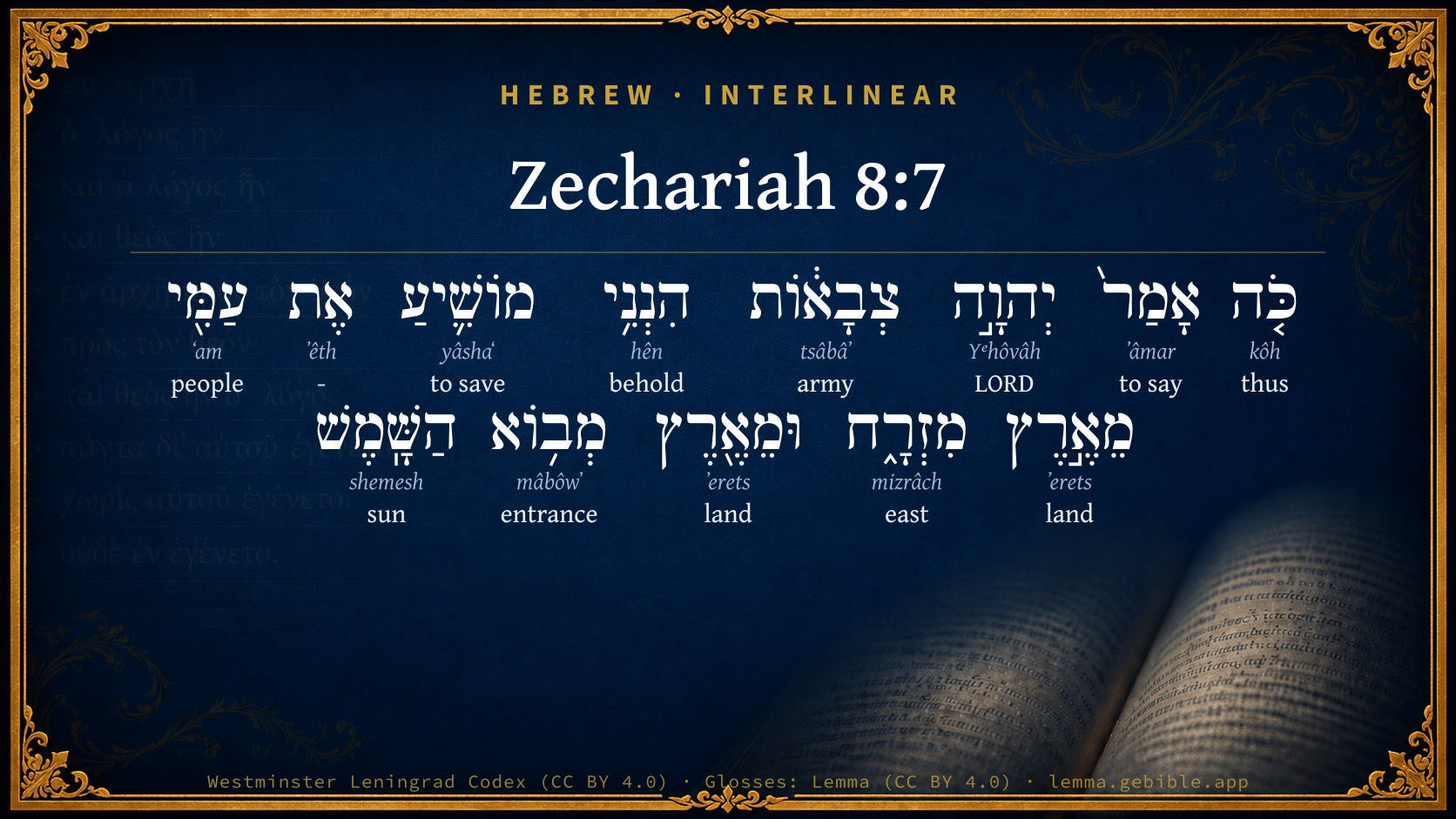
Hebrew (Westminster Leningrad Codex) Zechariah 8:7 appears in the Hebrew Old Testament. The text above is from the Westminster Leningrad Codex. Each word links to its Strong’s number, a concise gloss, and parsing drawn from the Open Scriptures Hebrew Bible morphology. Click any word for its full Brown-Driver-Briggs (BDB) entry.
Download image
Cite this verse

Zechariah 8:7 (World English Bible). Public Domain. Lemma interlinear Bible study tool, https://lemma.gebible.app/v/zechariah/8/7.

Show BibTeX & RIS
BibTeX
RIS
English Translation
Thus says Yahweh of Hosts: "Behold, I will save my people from the east country, and from the west country;
World English Bible · Public Domain
Download a study sheet

One document with this verse’s original text, its word-by-word gloss line, the meaning frame, cross-references with their text, attributed commentary, and full source and license credits — printable, and it pastes into notes with its structure intact.

This verse Autodidact and up

Study sheet (.html) Plain text (.txt)

A passage Seminary Student

Up to 50 verses in one chapter. A passage sheet keeps up to 6 commentary sources and 12 cross-references per verse, in the order this page ranks them, and says so on the sheet whenever that leaves anything out. Ask for a single verse and you get the Autodidact verse sheet above.

Everything on this page stays free to read, with no account — the sheet is a download of what is already on screen, not access to it.

Want to remove ads? Support Godless Engineer
Compare translations 3

The same verse in 3 English versions, stacked beneath the original-language interlinear above. Click any original word for its lexicon entry.

Each is an independent rendering of the whole verse — the interlinear is not word-aligned to these translations.

Highlighted words mark where these versions differ — a whole-verse word diff, not a word-by-word alignment.

  • World English Bible Public Domain
    Thus says Yahweh of Hosts: "Behold, I will save my people from the east country, and from the west country;
  • King James Version Public Domain
    Thus saith the LORD of hosts; Behold, I will save my people from the east country, and from the west country;
  • unfoldingWord Literal Text CC BY-SA 4.0
    Yahweh of hosts says this: Behold, I am about to rescue my people from the land of the sunrise and from the land of the setting sun!

unfoldingWord Literal Text — © unfoldingWord, licensed CC BY-SA 4.0. Word-aligned USFM3 via Door43 (git.door43.org/unfoldingWord/en_ult).

Versions to compare (up to 4)

3 of 4 selected

Show all 18 translations

Every available English version of this verse, each an independent rendering of the whole verse.

  • World English Bible Public Domain
    Thus says Yahweh of Hosts: "Behold, I will save my people from the east country, and from the west country;
  • Berean Standard Bible Public Domain
    This is what the LORD of Hosts says: “I will save My people from the land of the east and from the land of the west.
  • Majority Standard Bible Public Domain
    This is what the LORD of Hosts says: “I will save My people from the land of the east and from the land of the west.
  • King James Version Public Domain
    Thus saith the LORD of hosts; Behold, I will save my people from the east country, and from the west country;
  • American Standard Version (1901) Public Domain
    Thus saith Jehovah of hosts: Behold, I will save my people from the east country, and from the west country;
  • Revised Version (1885) Public Domain
    Thus saith the LORD of hosts: Behold, I will save my people from the east country, and from the west country:
  • Geneva Bible (1599) Public Domain
    Thus sayth the Lord of hostes, Beholde, I will deliuer my people from the East countrey, and from the West countrey.
  • Douay-Rheims (1899) Public Domain
    Thus saith the Lord of hosts: Behold I will save my people from the land of the east, and from the land of the going down of the sun.
  • Young's Literal Translation Public Domain
    Thus said Jehovah of Hosts: Lo, I am saving My people from the land of the rising, And from the land of the going in, of the sun,
  • Literal Standard Version CC BY-SA 4.0
    Thus said YHWH of Hosts: Behold, I am saving My people from the land of the rising, || And from the land of the going in, of the sun,
  • Unlocked Literal Bible CC BY-SA 4.0
    Yahweh of hosts says this: Behold, I am about to rescue my people from the land of the sunrise and from the land of the setting sun!
  • unfoldingWord Literal Text CC BY-SA 4.0
    Yahweh of hosts says this: Behold, I am about to rescue my people from the land of the sunrise and from the land of the setting sun!
  • Darby Bible Public Domain
    Thus saith Jehovah of hosts: Behold, I will save my people from the east country and from the west country;
  • World Messianic Bible Public Domain
    The LORD of Hosts says: “Behold, I will save my people from the east country and from the west country.
  • Webster's Bible Public Domain
    Thus saith the LORD of hosts; Behold, I will save my people from the east country, and from the west country;
  • Free Bible Version CC BY-SA 4.0
    This is what the Lord Almighty says. I will save my people from the countries to the east and to the west.
  • Bible in Basic English Public Domain
    This is what the Lord of armies has said: See, I will be the saviour of my people from the east country, and from the west country;
  • JPS Tanakh (1917) Public Domain
    Thus saith the LORD of hosts: Behold, I will save My people from the east country, and from the west country;

Literal Standard Version (2020), Covenant Press — licensed CC BY-SA 4.0. Text via the HelloAO Bible API (eBible.org). Unlocked Literal Bible (unfoldingWord) — licensed CC BY-SA 4.0. Text via the HelloAO Bible API (eBible.org). unfoldingWord Literal Text — © unfoldingWord, licensed CC BY-SA 4.0. Word-aligned USFM3 via Door43 (git.door43.org/unfoldingWord/en_ult). Free Bible Version, Dr. Jonathan Gallagher — licensed CC BY-SA 4.0. Text via the HelloAO Bible API (eBible.org).

Word by word

More ways to search: Search by grammar → Find every occurrence → Compare this word →

Practice this passage: Drill this verse → Learn its vocabulary →

מְב֥וֹא
mâbôwʼ
H3996
“entrance of”
Noun, Common, Masculine, Singular, Construct
Part of Speech
Noun
Type
Common
Gender
Masculine
Number
Singular
State
Construct
Full BDB Definition

Origin: from H935

TWOT: 212b

entrance, a coming in, entering - sunset - sunset - sunset, west
  1. כֹּ֤ה kôh H3541 “thus” Adverb
  2. אָמַר֙ ʼâmar H559 “to say” Verb, Qal, Perfect, 3rd Person, Masculine, Singular
  3. יְהוָ֣ה Yᵉhôvâh H3068 “LORD” Noun, Proper
  4. צְבָא֔וֹת tsâbâʼ H6635 “armies” Noun, Common, Both, Plural, Absolute
  5. הִנְנִ֥י hên H2005 “behold · me” Particle, Demonstrative + Suffix, Personal, 1st Person, Common, Singular
  6. מוֹשִׁ֛יעַ yâshaʻ H3467 “saving” Verb, Hiphil, Participle Active, Masculine, Singular, Absolute
  7. אֶת ʼêth H853 “-” Particle, Direct Object
  8. עַמִּ֖י ʻam H5971 “people · my” Noun, Common, Masculine, Singular, Construct + Suffix, Personal, 1st Person, Common, Singular
  9. מֵאֶ֣רֶץ ʼerets H776 “from · land of” Preposition + Noun, Common, Both, Singular, Construct
  10. מִזְרָ֑ח mizrâch H4217 “east” Noun, Common, Masculine, Singular, Absolute
  11. וּמֵאֶ֖רֶץ ʼerets H776 “and · from · land of” Conjunction + Preposition + Noun, Common, Both, Singular, Construct
  12. הַשָּֽׁמֶשׁ shemesh H8121 “the · sun” Particle, Definite Article + Noun, Common, Both, Singular, Absolute

About this verse

These counts appear in no published source. They are computed here, from the morphology-tagged text and Lemma’s own curated glosses. What Lemma adds →

13
words
12
distinct lemmas
Prophets
section

Notable vocabulary

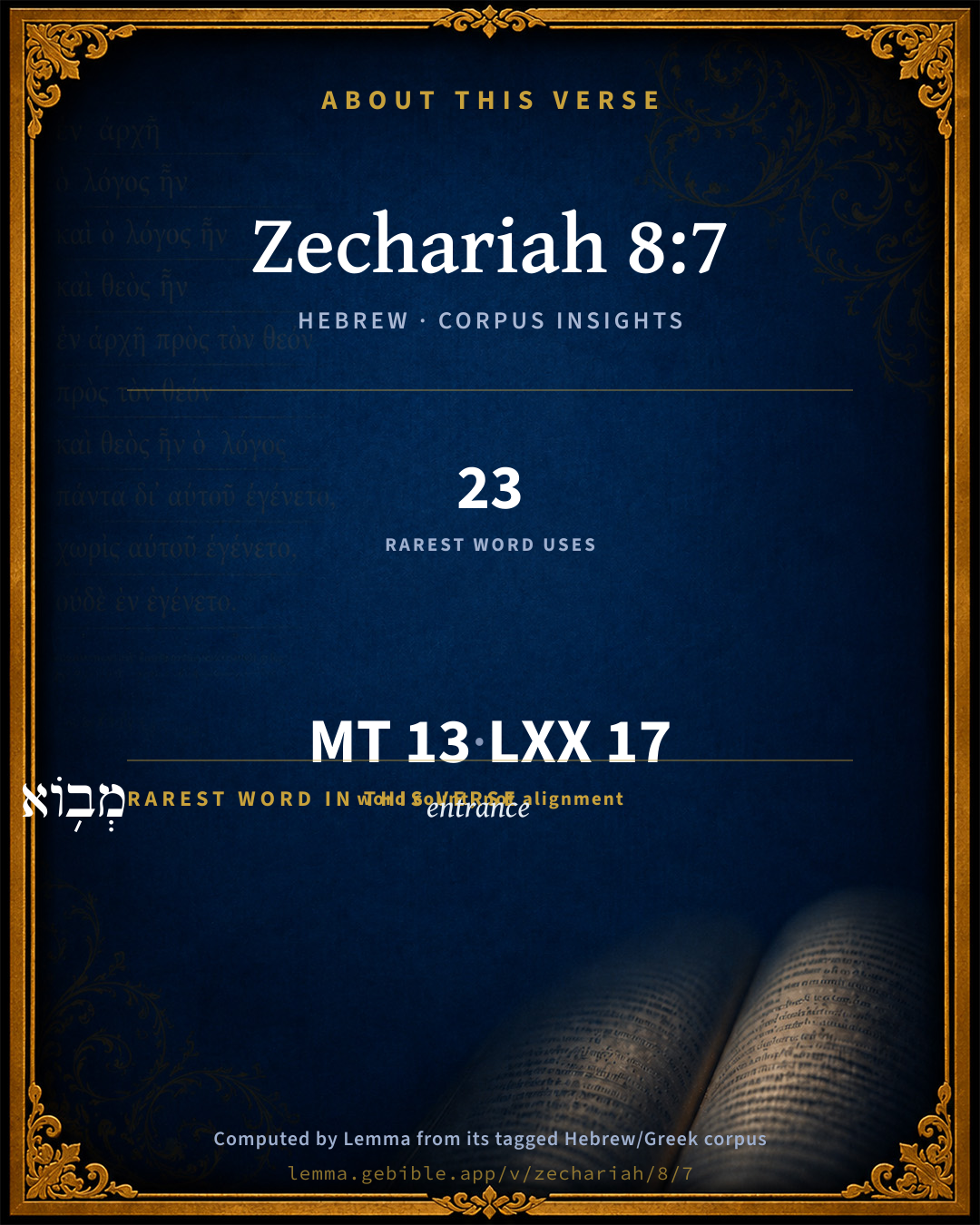
The rarest word here is מְב֥וֹא entrance H3996 — appearing just 23 times in the whole Hebrew Bible.

Shared distinctive vocabulary

מְב֥וֹא entrance H3996 occurs in 23 verses of the Hebrew Bible. Also found in:

Grammatical profile

  • 2 verbs
  • 8 nouns
  • 1 adverb
  • 2 particles

Verb forms

  • אָמַר֙ Qal · Perfect
  • מוֹשִׁ֛יעַ Hiphil · Participle Active

Repetition

A word recurs within this verse — often emphatic in Hebrew:

  • מֵאֶ֣רֶץ land H776 ×2

Hebrew & Septuagint length

In English translation the verse runs 20 words from the Hebrew and 19 from the Septuagint (LXX English) — closely comparable.

A rough comparison of the two English renderings, which tokenize alike — not a word-level alignment.

Word counts can differ between the Hebrew and the Greek without any difference in meaning — e.g. the Hebrew direct-object marker אֵת has no separate Greek word, and Greek often adds the article ὁ.

In the original languages it is 13 Hebrew tokens and 17 Greek tokens — but the two are counted differently (Hebrew bundles its prefixes and suffixes into one token; the Greek is in lemma form), so that isn’t a like-for-like length.

Cross-references

15

Topical passages linked to Zechariah 8:7 in the Treasury of Scripture Knowledge — connected by theme and wording, ordered by reader-vote popularity; previews shown in the World English Bible.

  • Jeremiah 31:8 Behold, I will bring them from the north country, and gather them from the uttermost parts of the earth, [and] with them the blind and the lame, the woman with child and her who travails with child together: a great company shall they return here.
  • Isaiah 27:12–13 It shall happen in that day, that Yahweh will beat off [his fruit] from the flood of the River to the brook of Egypt; and you shall be gathered one by one, you children of Israel.
  • Isaiah 43:5–6 Don't be afraid; for I am with you: I will bring your seed from the east, and gather you from the west;
  • Isaiah 49:12 Behold, these shall come from far; and, behold, these from the north and from the west; and these from the land of Sinim.
  • Amos 9:14–15 I will bring back the captivity of my people Israel, And they will rebuild the ruined cities, and inhabit them; and they will plant vineyards, and drink wine from them. They shall also make gardens, And eat the fruit of them.
  • Malachi 1:11 For from the rising of the sun even to the going down of the same, my name is great among the nations, and in every place incense will be offered to my name, and a pure offering: for my name is great among the nations," says Yahweh of Hosts.
  • Psalms 50:1 The Mighty One, God, Yahweh, speaks, And calls the earth from sunrise to sunset.
  • Psalms 107:2–3 Let the redeemed by Yahweh say so, Whom he has redeemed from the hand of the adversary,
  • Psalms 113:3 From the rising of the sun to the going down of the same, Yahweh's name is to be praised.
  • Isaiah 11:11–16 It shall happen in that day, that the Lord will set his hand again the second time to recover the remnant of his people, who shall remain, from Assyria, and from Egypt, and from Pathros, and from Cush, and from Elam, and from Shinar, and from Hamath, and from the islands of the sea.
  • Isaiah 59:19 So shall they fear the name of Yahweh from the west, and his glory from the rising of the sun; for he will come as a rushing stream, which the breath of Yahweh drives.
  • Isaiah 66:19–20 I will set a sign among them, and I will send such as escape of them to the nations, to Tarshish, Pul, and Lud, who draw the bow, to Tubal and Javan, to the isles afar off, who have not heard my fame, neither have seen my glory; and they shall declare my glory among the nations.
  • Ezekiel 37:19–25 tell them, Thus says the Lord Yahweh: Behold, I will take the stick of Joseph, which is in the hand of Ephraim, and the tribes of Israel his companions; and I will put them with it, [even] with the stick of Judah, and make them one stick, and they shall be one in my hand.
  • Hosea 11:10–11 They will walk after Yahweh, Who will roar like a lion; For he will roar, and the children will come trembling from the west.
  • Romans 11:25–27 For I don't desire, brothers, to have you ignorant of this mystery, so that you won't be wise in your own conceits, that a partial hardening has happened to Israel, until the fullness of the Gentiles has come in,

Cross-references courtesy of OpenBible.info (CC BY 4.0).

Hebrew and Greek witnesses Masoretic Hebrew ↔ Greek Septuagint

The same verse in the two great witnesses to the Old Testament, shown verse-for-verse.

These are two independent witnesses, not word-aligned to each other, and the Septuagint is shown in lemma (dictionary) form.

Hebrew Zechariah 8:7 Masoretic · Westminster Leningrad Codex

כֹּ֤ה אָמַר֙ יְהוָ֣ה צְבָא֔וֹת הִנְנִ֥י מוֹשִׁ֛יעַ אֶת עַמִּ֖י מֵאֶ֣רֶץ מִזְרָ֑ח וּמֵאֶ֖רֶץ מְב֥וֹא הַשָּֽׁמֶשׁ

Thus says Yahweh of Hosts: "Behold, I will save my people from the east country, and from the west country;

World English Bible · Public Domain

Greek LXX Zechariah 8:7 Septuagint · lemma form

ὅδε λέγω κύριος παντοκράτωρ ἰδού ἐγώ ἀνασώζω ὁ λαός ἐγώ ἀπό γῆ ἀνατολή καί ἀπό γῆ δυσμή

Thus says the Lord Almighty; Behold, I will save my people from the east country, and the west country;

LXX2012 (modern English Septuagint) · Public Domain

Hebrew: Westminster Leningrad Codex (CC BY 4.0). Greek: Septuagint (public domain); English from LXX2012 (modern English Septuagint) (Public Domain). How the Septuagint differs from the Hebrew →

Targum (Aramaic paraphrase)

1

The Targum is the ancient Jewish Aramaic paraphrase of the Hebrew Scriptures — an interpretive translation, not the Hebrew text itself. Onkelos (literal) and Pseudo-Jonathan (expansive) render the Torah, and Jonathan the Prophets. Coverage is partial: where no permissively-licensed English translation exists for a verse, only the Aramaic is shown. This is verse-level text, not a word-by-word alignment to the Hebrew.

  1. Targum Jonathan Prophets (Joshua–Malachi)
    כִּדְנַן אֲמַר יְיָ צְבָאוֹת הָא אֲנָא פָּרֵיק יַת עַמִי מֵאַרְעָא מַדִינְחָא וּמֵאַרְעָא מַעֲלָנֵי שִׁמְשָׁא:

    (no public-domain English translation for this verse)

    Targum Jonathan — Aramaic: “Mikraot Gedolot” (public domain). English: “Sefaria Community Translation” (CC0 1.0 (public-domain dedication)); “London "Chaldee Paraphrase," 1871” (public domain). Text via Sefaria.

Commentary

Notes on Zechariah 8:7 from classic Christian and Jewish commentators (each source and its license shown beneath its notes). The classic Christian expositions comment on the surrounding passage and are grouped to its opening verse, so a note may address several verses; the Jewish commentaries on the Tanakh (Rashi and others) are per-verse, so they appear only where the commentator wrote on this verse.

Lemma curates 59 commentaries, every one of them public domain or Creative Commons licensed, each selected and text-cleaned for this edition rather than reprinted as found. About our sources →

Trapp's Complete Commentary

John Trapp

Zec 8:7 Thus saith the LORD of hosts; Behold, I will save my people from the east country, and from the west country;

Ver. 7. Behold, I will save my people from the east] This was in part, no doubt, literally meant to be the scattered Jews; and fulfilled also in those 500 years’ time between the captivity and Christ, though stories tell us not when and how; and shall be much more at their much desired conversion. For this is laid down for a general rule, that all evangelical promises made to the Jews, seeing they neither at first received the gospel, nor ever hitherto enjoyed that peace, plenty, and prosperity which these and such like promises do purport, cannot but aim at somewhat that is yet to come. Albeit it cannot be denied but that the great and glorious things which in the height and excellence thereof are spoken particularly to them, do in their measure and degree appertain in common to all the faithful; and so in the New Testament are ordinarily applied.

John Trapp, A Commentary or Exposition upon All the Books of the Old and New Testament (1647–1656) — public domain. Text from a community e-Sword module.

The Biblical Illustrator

Joseph S. Exell

Zec_8:7-8

I will save My people from the East country, and from the West country

A two-fold Divine restoration

I.

A Divine temporal restoration. The reference here is to those Jews who had been scattered abroad over various countries through the Babylonian Captivity and other disastrous causes. The point is, that the restoration here promised is a temporal restoration to their own land and country. God is constantly restoring His people to those temporal blessings they have lost. He restores often--

1. To lost health;

2. To lost property;

3. To lost social status.

In all His peoples distresses He bids them look to Him.

II. A Divine spiritual restoration. This may mean, I will become their God in good faith or in reality, both on their side and on Mine. This is incomparably the most important restoration.

1. Man may lose his God, and be without God in the world.

2. The loss of God is the greatest loss. A man separated from God is like a branch separated from the root, a river from the fountain, a planet from the sun.

3. Restoration to God is the transcendent good. He who can say, The Lord is my portion, possesseth all things. This restoration the Almighty is effecting now in the world. He is in Christ reconciling the world unto Himself. (Homilist.)

And I will bring them, and they shall dwell in the midst of Jerusalem--

The future of the Jews

The terms of this prediction carry us beyond any facts at that time existing, and refer to events then future. It predicts a return of the Jews from the West as well as the East, whilst at this time the only dispersion existing was toward the East in Babylon. Hence an universal dispersion is implied in this universal restoration, the terms, from East to West, being inclusive of the entire earth. This general dispersion did not occur until the final fall of Jerusalem, since which there has been no general restoration of the Jews, either in a literal or a figurative sense. Hence the main facts predicted are yet future. That they include a literal restoration of the Jews to their own land is probable, but that this is the main purport of the prophecy is just as improbable. There is something more than a mere political restoration required by the general drift of the prophecy, which is spiritual, not temporal, and which therefore demands a spiritual reunion to the spiritual theocracy, or the blood-bought and blood-washed Church of God. And this is particularly demanded by the covenant formula of Zec_8:8, They shall be My people, and I will be their God, which is always the exponent of spiritual blessings, and the fact is put beyond all question by the explanatory addendum, in truth and righteousness, which expressly affirms that this restoration and union are not to be outward, visible, and temporal, but inward, invisible, and spiritual. They will be a sincere and justified people, as He will be a true and pardoning God. (T. V. Moore, D. D.)

The Biblical Illustrator, edited by Joseph S. Exell (c. 1880s–1900s) — public domain. Text from a community e-Sword module.

Keil & Delitzsch

C. F. Keil & F. Delitzsch

Zac 8:7. "Thus saith Jehovah of hosts, Behold, I save my people out of the land of the rising and out of the land of the setting of the sun. Zac 8:8. And I bring them hither, and they will dwell in the midst of Jerusalem, and will be my people, and I shall be their God, in truth and righteousness." The deliverance of the people of God out of the heathen lands did indeed commence with the return of a body of exiles from Babylon under the guidance of Zerubbabel, but their deliverance out of all the countries of the earth is still in the future. Instead of all countries, the land of the rising (the east) and the land of the setting (the west) are individualized (cf. Psa 50:1; Psa 113:3; Isa 59:19; Mal 1:11). This deliverance is first effected through the Messiah. This is indisputably evident from the words, "I bring them to Jerusalem," by which of course we cannot understand the earthly Jerusalem, since that would not furnish space enough for the Jews scattered throughout all the world, but the open and enlarged Jerusalem mentioned in Zac 2:8, i.e., the Messianic kingdom of God. Then will those who have been gathered together out of all the countries of the earth become in truth God's nation. Israel was the nation of Jehovah, and Jehovah was also Israel's God from the time of the establishment of the old covenant at Sinai (Exodus 24). This relation is to be restored in the future, "in truth and righteousness." This is the new feature by which the future is to be distinguished from the present and the past. The words "in truth and righteousness" belong to the two clauses, "they shall be" and "I will be." For the fact itself, compare Hos 2:21-22; and for the expression, Isa 48:1 and Kg1 3:6.

Keil & Delitzsch — Biblical Commentary on the Old Testament (1861–1891) — public domain (CC PDM 1.0). Text via the HelloAO Bible API. (Old Testament only.)

Tyndale Open Study Notes

Tyndale Open Resources

8:7 from the east and from the west: This is an idiom meaning from all the regions to which the Hebrews were dispersed (compare Isa 43:5-6).

Tyndale Open Study Notes — © Tyndale Open Resources, licensed CC BY-SA 4.0. Text via the HelloAO Bible API.

Jamieson, Fausset & Brown

Robert Jamieson, A. R. Fausset & David Brown

save my people from . . . east . . . west--that is, from every region (compare Psa 50:1; the "West" is literally, "the going down of the sun") to which they are scattered; they are now found especially in countries west of Jerusalem. The dispersion under Nebuchadnezzar was only to the east, namely, to Babylonia. The restoration, including a spiritual return to God (Zac 8:8), here foretold, must therefore be still future (Isa 11:11-12; Isa 43:5-6; Eze 37:21; Amo 9:14-15; also Zac 13:9; Jer 30:22; Jer 31:1, Jer 31:33).

Jamieson, Fausset & Brown — Commentary Critical and Explanatory on the Whole Bible (1871) — public domain (CC PDM 1.0). Text via the HelloAO Bible API.

Adam Clarke's Commentary

Verse 7. I will save my people from the east country, and from the west] From every land in which any of them may be found. But these promises principally regard the Christian Church, or the bringing in the Jews with the fulness of the Gentiles.

Adam Clarke's Commentary on the Bible (1810–1826) — public domain. Text from a community e-Sword/MySword module.

John Calvin's Commentaries

He pursues the same subject, and introduces a preface, very necessary in so confused a state of things; for it was very difficult to raise up desponding minds and to inspire them with confidence, when pressed down with fear and trembling. This is the reason why Zechariah repeats so often, that he declared nothing but God’s commands only.

Behold, he says, I will save, or deliver my people. As dispersion took away hope, the Prophet restores it, and says, that it would not be difficult to gather the people from all parts of the world, when God stretched forth his hand; and emphatical is the expression, I will deliver my people. God then does here exalt himself, that we may learn to exalt his power, and not to judge of it according to our own comprehension. I will deliver my people, he says, from the rising as well as from the setting of the sun. This sentence then is connected with the preceding, in which the Prophet briefly shows that the Jews erred and acted perversely, when they ascribed no more to God than what the judgment of their own flesh dictated, or what seemed probable according to the course of nature. As then he had taught them that great wrong is done to God except he is separated from men, and shines eminent above the whole world, he now adds, that God, with whom nothing is wonderful or difficult, had resolved to gather his people, and from their dispersion to restore them again to Jerusalem. The Prophet then says here nothing new, but rightly applies what he had just said of God’s infinite and incomprehensible power, which men absurdly attempt to inclose in their own brains, and to attach to earthly instrumentalities.

John Calvin's Commentaries (1540-1563) — public domain. Text from the Calvin Translation Society English edition (1840s-50s) via the Christian Classics Ethereal Library (ccel.org). Calvin's coverage is partial (roughly two-thirds of the Bible); uncommented books and verses are honest gaps, never fabricated. The 19th-century editor's footnotes and remarks are omitted so the notes are faithfully Calvin's own voice.

Ellicott's Commentary for English Readers

(7) From the east . . . and from the west.—There were Jews in exile in the west as well as in the east (Joe_3:6); and, indeed, a very general dispersion may be almost implied from Isa_43:5-6.

A Bible Commentary for English Readers, edited by Charles John Ellicott (1878–1897) — public domain. Text from a community e-Sword module.

The Cambridge Bible for Schools and Colleges

gen. ed. J. J. S. Perowne

7. from the east country, and from the west country] Comp. Isa_43:5-6. The promise is larger than has yet been fulfilled.

The Cambridge Bible for Schools and Colleges (gen. ed. J. J. S. Perowne; Cambridge University Press, 1878–1918) — public domain. Text from a community e-Sword module.

John Gill's Exposition

And l will bring them,.... To Zion, into the church of God, the Gospel fold, where Christ has engaged to bring his other sheep, that there may be one fold for Jew and Gentile, Jer 3:14 Joh 10:16,

and they shall dwell in the midst of Jerusalem: the Gospel church; and be no more foreigners and strangers, but of the household of God, enjoying all the immunities and privileges of the Jerusalem that is above, the mother of us all:

and they shall be my people; appear to be so by effectual calling; which makes those manifest to be the people of God, to be in the covenant of his grace, who before were not known to be so, either by themselves or others, Pe1 2:10,

and I will be their God, in truth, and in righteousness; according to the covenant of his grace, which will now in a very open manner be truly and faithfully fulfilled; and they, in consequence of the grace bestowed on them, will worship God in sincerity and truth, being justified by the righteousness of Christ, and so will have no dependence on their own for their acceptance with God; see Hos 2:19.

John Gill's Exposition of the Whole Bible (1746–1763) — public domain (CC PDM 1.0). Text via the HelloAO Bible API.

Albert Barnes' Notes on the Bible

I will save My people from the East country and from the West country - Dionysius: “that is, the whole world; for Israel had been scattered in every part of the world.” God had said to Israel, “I will bring thy seed from the east and gather thee from the west; I will say to the north, Give up, and to the south, Keep not back” Isa 43:5-6. The two tribes had been carried to Babylon and had been dispersed, or had been allowed to migrate to the various provinces of the Babylonian or Persian empire. But these were in the East, though commonly called the north, because they invaded Israel from the north. Those who had migrated to Egypt were in the south. As yet none were in the West. The dispersion, as well as the gathering, was still future. When our Lord came, they had migrated westward. Greece, Italy, Asia minor, were full of them; and from all they were gathered. All Paul’s Epistles written to named Churches, were written to Churches formed from converts in the West. In all these countries God would gather His one people, His Church, not of “the Jews only, but also of the Gentiles” Rom 9:24, grafted into them, as our Lord said, “I say unto you, that many shall come from the east and from the west, and shall sit down with Abraham, and Isaac, and Jacob, in the kingdom of heaven; but the children of the kingdom (the unbelieving Jews, who were not the remnant) shall be cast out into outer darkness” Mat 8:11-12.

Albert Barnes' Notes on the Bible (1834–1885) — public domain. Text from a community e-Sword/MySword module.

Haydock's Catholic Bible Commentary

Sun, from Chaldea and the islands. This chiefly regards the Christian Church. (Calmet) --- Assyria and Chaldea lay to the north. The promises are too great for the synagogue. (Worthington)

George Leo Haydock (1774–1849), Haydock's Catholic Family Bible and Commentary, 1859 edition — public domain. Excludes Psalms (Douay-Rheims chapter numbering differs from Protestant) and Deuterocanonical books (Catholic canon only).

Matthew Poole's English Annotations

Thus saith the Lord of hosts: here again God engageth his almighty power to make good his promise.

Behold; consider well what power is to do this.

I will save my people, bring them safe,

from the east country; Persia and Media, which lay east from Jerusalem, and, being now masters of Babylon and the captive Jews, they are said to be brought out of the east, though otherwhiles they are brought out of the north; both very consistent.

And from the west country: no doubt some of the Jews were carried westward; the trade of selling men was known in those days, and Tyre is noted and threatened for it by Ezekiel, Eze 27:13, beside other sea-towns west of Canaan, which would be ready to buy captive Jews, and convey them westward. But if this promise should look to the Roman empire, and secure the Jews a return from that captivity, it is plain how their empire lay west from the Jews. Or perhaps it is a synecdoche, these two parts of the world mentioned, but all parts intended, as Psa 1:1; 113:3; Mal 1:11.

Matthew Poole's English Annotations on the Holy Bible (1683–1685) — public domain. Text from a community e-Sword/MySword module.

Whedon's Commentary on the Bible

Daniel D. Whedon

7, 8. There will be a restoration more extensive than the return of 537.

My people — The Jews still in exile (compare Zec_2:6 ff.; Isa_43:5-6; Jer_30:10).

East… west — Literally, rising and setting of the sun. Only two points of the compass are mentioned, though the prophet expects a return from all quarters of the globe (compare Psa_50:1; Mal_1:11). All the returning exiles will flock to Jerusalem, the dwelling place of Jehovah, there to worship him as their God (see on Mic_4:1-4; Hos_2:23). The restoration to fellowship will be sealed with a new covenant (Jer_30:22).

In truth and in righteousness — See on Hos_2:19-20.

Message of encouragement and admonition, 9-17.

After picturing the future in such glowing colors the prophet turns with words of encouragement to his contemporaries, who might be tempted to lose heart. True, they have suffered much, but now Jehovah is thinking “to do good unto Jerusalem and to Judah” (9-15), if they will keep his commandments (16, 17).

Daniel D. Whedon (gen. ed.), Commentary on the Old and New Testaments (1874–1909) — public domain. Text from a community e-Sword module.

The Pulpit Commentary

God promises to bring his dispersed people home again a promise only yet partially fulfilled. My people. A title of honour. (comp. Hos_2:23) From the east country, and from the west country. Two regions are named, symbols of the whole world. (comp. Psa_50:1 Mal_1:11) The return of the captives from Babylon was a prelude of the future restoration of the dispersed, when all Israel shall be saved. (Rom_11:26) (See a similar promise, Isa_43:5, 6 Joh_11:52)

Vers. 7, 8. A twofold Divine restoration.

"Thus saith the Lord of hosts; Behold, I will save my people "out of the land of the rising and the land of the setting" (Keil) from the cast country, and from the west country; and I will bring them, and they shall dwell in the midst of Jerusalem: and they shall be my people, and I will be their God, in truth and in righteousness." "The east and the west are here put as parts for the whole. The meaning is, "I will deliver my people from regions whither they have been scattered." Were there any reason to believe that the prophecy has respect to a restoration of the Jews yet future, there would be a singular propriety in the use of awObm vmVh, "the setting of the sun," the Jews being now, for the most part, found in countries to the west of Jerusalem; but there is every reason to conclude that it has an exclusive reference to what was to take place soon after it was delivered. Vast numbers were carried away captive after the time of Alexander. Not fewer than a hundred thousand were carried by Ptolemy, and were settled in Alexandria and Cyrene" (Henderson). We shall use these words as suggesting a twofold Divine restoration temporal and spiritual.

I HERE IS A DIVINE TEMPORAL RESTORATION. "And I will bring them, and they shall dwell in the midst of Jerusalem." There is no sound reason for believing that the people here mentioned as those that were brought "from the east country and from the west" refer to the Jews in the far future, who, some suppose, will be restored to Jerusalem at last. I know of no authority lop supposing that such a restoration will ever be effected. Nor does the passage point, I think, to the universal conversion of the Jews to Christianity in the last times. The reference is manifestly to those Jews who had been scattered abroad over various countries through the Babylonian Captivity, and other disastrous causes. The point is that the restoration here promised is a temporal restoration to their own land and city. They had been exiled for many long years, and deeply did they deplore in a foreign land their expatriation. "By the rivers of Babylon we sat down," etc. The Almighty by Cyrus restored them. And he is constantly restoring his people to those temporal blessings they have lost. He restores often

(1) to lost health;

(2) to lost property;

(3) to lost social status.

He is the temporal Restorer of his people. In all their distresses he bids them look to him. "Call upon me in the day of trouble," etc.

II HERE IS A DIVINE SPIRITUAL RESTORATION, "And they shall be my people, and I will be their God, in truth and in righteousness." This may mean, "I will become their God in good faith, or in reality, both on their side and mine." This is incomparably the most important restoration. In truth, all temporal restorations are of no permanent value without this. Observe:

1. Man may lose his God. He may be without "God in the world." Indeed, the millions are in this state. "They feel after him, if haply they may find him.

2. The loss of God is the greatest toss. A man separated from God is like a branch separated from the root, a river from the fountain, a planet from the sun.

3. Restoration to God is the transcendent good. He who can say, "The Lord is my Portion" possesseth all things. This restoration the Almighty is effecting now in the world. "He is in Christ reconciling the world unto himself. D.T.

The Pulpit Commentary (1880–1919), ed. H.D.M. Spence-Jones & Joseph S. Exell — public domain. Text from a community e-Sword module.

John Wesley's Explanatory Notes

The east-country - Persia and Media, which lay east from Jerusalem, and were now masters of Babylon.

John Wesley, Explanatory Notes Upon the Whole Bible (1754–1765) — public domain. Text via the GEBible commentary corpus.

Lesson kit

Teaching starters — assembled from the data on this page, not authored interpretation. Every prompt links to the verse data it draws on. Edit before teaching.

Zechariah, in the Prophets, opens this verse with 13 words (12 distinct Hebrew lemmas). Its most distinctive word is mâbôwʼ (“entrance”). A historical commentator’s framing appears above. Read the whole chapter for the surrounding context.

Discussion questions

  1. The word mâbôwʼ carries the sense “entrance.” How does it shape the verse?
  2. Deuteronomy 11:30 shares the word «entrance» with this verse. How do the two illuminate each other?
  3. “land” occurs 2× in this one verse. What is the effect of the repetition?
  4. These translations render this verse differently; the difference is in the English rendering, not the original. What questions does that raise?
  5. The verb «אָמַר֙» is Qal Perfect. How does its form color the action?
  6. Reading how Trapp's Complete Commentary and The Biblical Illustrator read this verse, where do the two commentators agree and where do they part?

Things to notice

Reading settings

Reading text

Shown beneath each verse's original-language words.

Old Testament
Old Testament edition

Read the OT as the Masoretic Hebrew (MT) or the Greek Septuagint (LXX).

English shown for the Greek Septuagint (in the Hebrew ↔ Greek comparison).

Comparing translations? Open the Compare panel on any verse page to stack up to four side by side.