
Hosea 1:7

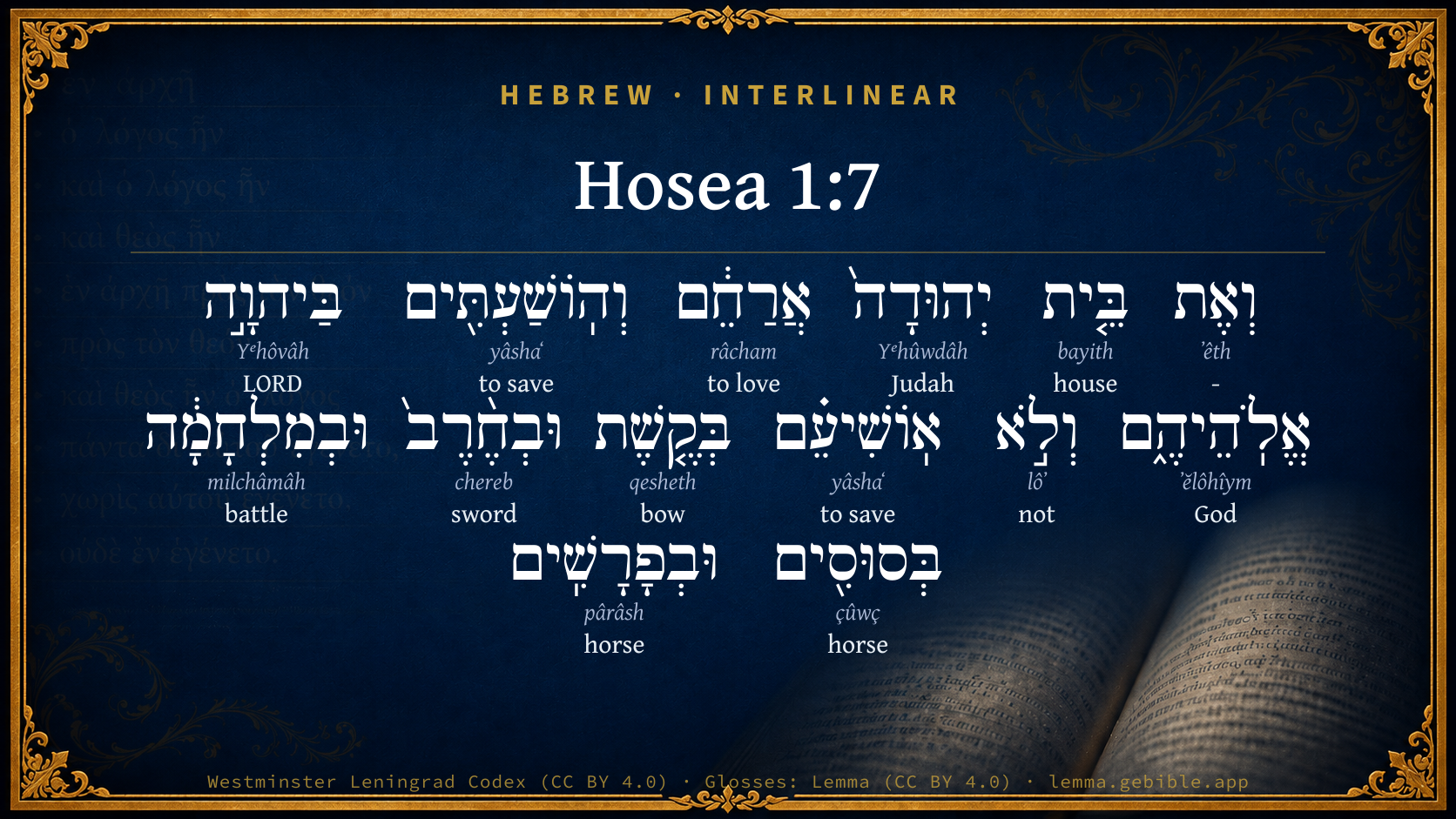
Hebrew (Westminster Leningrad Codex) Hosea 1:7 appears in the Hebrew Old Testament. The text above is from the Westminster Leningrad Codex. Each word links to its Strong’s number, a concise gloss, and parsing drawn from the Open Scriptures Hebrew Bible morphology. Click any word for its full Brown-Driver-Briggs (BDB) entry.
Download image
Cite this verse

Hosea 1:7 (World English Bible). Public Domain. Lemma interlinear Bible study tool, https://lemma.gebible.app/v/hosea/1/7.

Show BibTeX & RIS
BibTeX
RIS
English Translation
But I will have mercy on the house of Judah, and will save them by Yahweh their God, and will not save them by bow, nor by sword, nor by battle, by horses, nor by horsemen."
World English Bible · Public Domain
Download a study sheet

One document with this verse’s original text, its word-by-word gloss line, the meaning frame, cross-references with their text, attributed commentary, and full source and license credits — printable, and it pastes into notes with its structure intact.

This verse Autodidact and up

Study sheet (.html) Plain text (.txt)

A passage Seminary Student

Up to 50 verses in one chapter. A passage sheet keeps up to 6 commentary sources and 12 cross-references per verse, in the order this page ranks them, and says so on the sheet whenever that leaves anything out. Ask for a single verse and you get the Autodidact verse sheet above.

Everything on this page stays free to read, with no account — the sheet is a download of what is already on screen, not access to it.

Want to remove ads? Support Godless Engineer
Compare translations 3

The same verse in 3 English versions, stacked beneath the original-language interlinear above. Click any original word for its lexicon entry.

Each is an independent rendering of the whole verse — the interlinear is not word-aligned to these translations.

Highlighted words mark where these versions differ — a whole-verse word diff, not a word-by-word alignment.

  • World English Bible Public Domain
    But I will have mercy on the house of Judah, and will save them by Yahweh their God, and will not save them by bow, nor by sword, nor by battle, by horses, nor by horsemen."
  • King James Version Public Domain
    But I will have mercy upon the house of Judah, and will save them by the LORD their God, and will not save them by bow, nor by sword, nor by battle, by horses, nor by horsemen.
  • unfoldingWord Literal Text CC BY-SA 4.0
    But the house of Judah I will have compassion on, and I will save them by Yahweh their God. And I will not save them by bow and by sword and by battle, by horses, and by horsemen.”

unfoldingWord Literal Text — © unfoldingWord, licensed CC BY-SA 4.0. Word-aligned USFM3 via Door43 (git.door43.org/unfoldingWord/en_ult).

Versions to compare (up to 4)

3 of 4 selected

Show all 18 translations

Every available English version of this verse, each an independent rendering of the whole verse.

  • World English Bible Public Domain
    But I will have mercy on the house of Judah, and will save them by Yahweh their God, and will not save them by bow, nor by sword, nor by battle, by horses, nor by horsemen."
  • Berean Standard Bible Public Domain
    Yet I will have compassion on the house of Judah, and I will save them—not by bow or sword or war, not by horses and cavalry, but by the LORD their God.”
  • Majority Standard Bible Public Domain
    Yet I will have compassion on the house of Judah, and I will save them—not by bow or sword or war, not by horses and cavalry, but by the LORD their God.”
  • King James Version Public Domain
    But I will have mercy upon the house of Judah, and will save them by the LORD their God, and will not save them by bow, nor by sword, nor by battle, by horses, nor by horsemen.
  • American Standard Version (1901) Public Domain
    But I will have mercy upon the house of Judah, and will save them by Jehovah their God, and will not save them by bow, nor by sword, nor by battle, by horses, nor by horsemen.
  • Revised Version (1885) Public Domain
    But I will have mercy upon the house of Judah, and will save them by the LORD their God, and will not save them by bow, nor by sword, nor by battle, by horses, nor by horsemen.
  • Geneva Bible (1599) Public Domain
    Yet I will haue mercie vpon the house of Iudah, and wil saue them by the Lord their God, and wil not saue them by bow, nor by sword nor by battell, by horses, nor by horsemen.
  • Douay-Rheims (1899) Public Domain
    And I will have mercy on the house of Juda, and I will save them by the Lord their God: and Iwill not save them by bow, nor by sword, nor by battle, nor by horses, nor by horsemen.
  • Young's Literal Translation Public Domain
    and the house of Judah I pity, and have saved them by Jehovah their God, and do not save them by bow, and by sword, and by battle, by horses, and by horsemen.'
  • Literal Standard Version CC BY-SA 4.0
    and I pity the house of Judah, and have saved them by their God YHWH, and do not save them by bow, and by sword, and by battle, by horses, and by horsemen.”
  • Unlocked Literal Bible CC BY-SA 4.0
    Yet I will have mercy on the house of Judah, and I will save them by myself, Yahweh their God. I will not save them by bow, sword, battle, horses, or horsemen.”
  • unfoldingWord Literal Text CC BY-SA 4.0
    But the house of Judah I will have compassion on, and I will save them by Yahweh their God. And I will not save them by bow and by sword and by battle, by horses, and by horsemen.”
  • Darby Bible Public Domain
    But I will have mercy upon the house of Judah, and will save them by Jehovah their God; and I will not save them by bow, or by sword, or by battle, [or] by horses, or by horsemen.
  • World Messianic Bible Public Domain
    But I will have mercy on the house of Judah, and will save them by the LORD their God, and will not save them by bow, sword, battle, horses, or horsemen.”
  • Webster's Bible Public Domain
    But I will have mercy upon the house of Judah, and will save them by the LORD their God, and will not save them by bow, nor by sword, nor by battle, by horses, nor by horsemen.
  • Free Bible Version CC BY-SA 4.0
    But I will have pity on the house of Judah, and I will save them—but I will not save them by bow or sword or war or horses and riders.”
  • Bible in Basic English Public Domain
    But I will have mercy on Judah and will give them salvation by the Lord their God, but not by the bow or the sword or by fighting or by horses or horsemen.
  • JPS Tanakh (1917) Public Domain
    But I will have compassion upon the house of Judah, and will save them by the LORD their God, and will not save them by bow, nor by sword, nor by battle, nor by horses, nor by horsemen.'

Literal Standard Version (2020), Covenant Press — licensed CC BY-SA 4.0. Text via the HelloAO Bible API (eBible.org). Unlocked Literal Bible (unfoldingWord) — licensed CC BY-SA 4.0. Text via the HelloAO Bible API (eBible.org). unfoldingWord Literal Text — © unfoldingWord, licensed CC BY-SA 4.0. Word-aligned USFM3 via Door43 (git.door43.org/unfoldingWord/en_ult). Free Bible Version, Dr. Jonathan Gallagher — licensed CC BY-SA 4.0. Text via the HelloAO Bible API (eBible.org).

Word by word

More ways to search: Search by grammar → Find every occurrence → Compare this word →

Practice this passage: Drill this verse → Learn its vocabulary →

אֲרַחֵ֔ם
râcham
H7355
“to love”
Verb, Piel, Imperfect, 1st Person, Common, Singular
Part of Speech
Verb
Stem
Piel
Form
Imperfect
Person
1st Person
Gender
Common
Number
Singular
Full BDB Definition

Origin: a primitive root

TWOT: 2146

to love, love deeply, have mercy, be compassionate, have tender affection, have compassion - (Qal) to love - (Piel) - to have compassion, be compassionate - of God, man - (Pual) to be shown compassion, be compassionate
  1. וְאֶת ʼêth H853 “and · -” Conjunction + Particle, Direct Object
  2. בֵּ֤ית bayith H1004 “house of” Noun, Common, Masculine, Singular, Construct
  3. יְהוּדָה֙ Yᵉhûwdâh H3063 “Judah” Noun, Proper
  4. וְהֽוֹשַׁעְתִּ֖ים yâshaʻ H3467 “and · to save · them” Conjunction + Verb, Hiphil, Sequential Perfect, 1st Person, Common, Singular + Suffix, Personal, 3rd Person, Masculine, Plural
  5. בַּיהוָ֣ה Yᵉhôvâh H3068 “in/at · LORD” Preposition + Noun, Proper
  6. אֱלֹֽהֵיהֶ֑ם ʼĕlôhîym H430 “God(s) · their” Noun, Common, Masculine, Plural, Construct + Suffix, Personal, 3rd Person, Masculine, Plural
  7. וְלֹ֣א lôʼ H3808 “and · not” Conjunction + Particle, Negative
  8. אֽוֹשִׁיעֵ֗ם yâshaʻ H3467 “to save · them” Verb, Hiphil, Imperfect, 1st Person, Common, Singular + Suffix, Personal, 3rd Person, Masculine, Plural
  9. בְּקֶ֤שֶׁת qesheth H7198 “in/at · bow” Preposition + Noun, Common, Feminine, Singular, Absolute
  10. וּבְחֶ֨רֶב֙ chereb H2719 “and · in/at · sword” Conjunction + Preposition + Noun, Common, Feminine, Singular, Absolute
  11. וּבְמִלְחָמָ֔ה milchâmâh H4421 “and · in/at · battle” Conjunction + Preposition + Noun, Common, Feminine, Singular, Absolute
  12. בְּסוּסִ֖ים çûwç H5483 “in/at · horses” Preposition + Noun, Common, Masculine, Plural, Absolute
  13. וּבְפָרָשִֽׁים pârâsh H6571 “and · in/at · horses” Conjunction + Preposition + Noun, Common, Masculine, Plural, Absolute

About this verse

These counts appear in no published source. They are computed here, from the morphology-tagged text and Lemma’s own curated glosses. What Lemma adds →

14
words
13
distinct lemmas
Prophets
section

Shared distinctive vocabulary

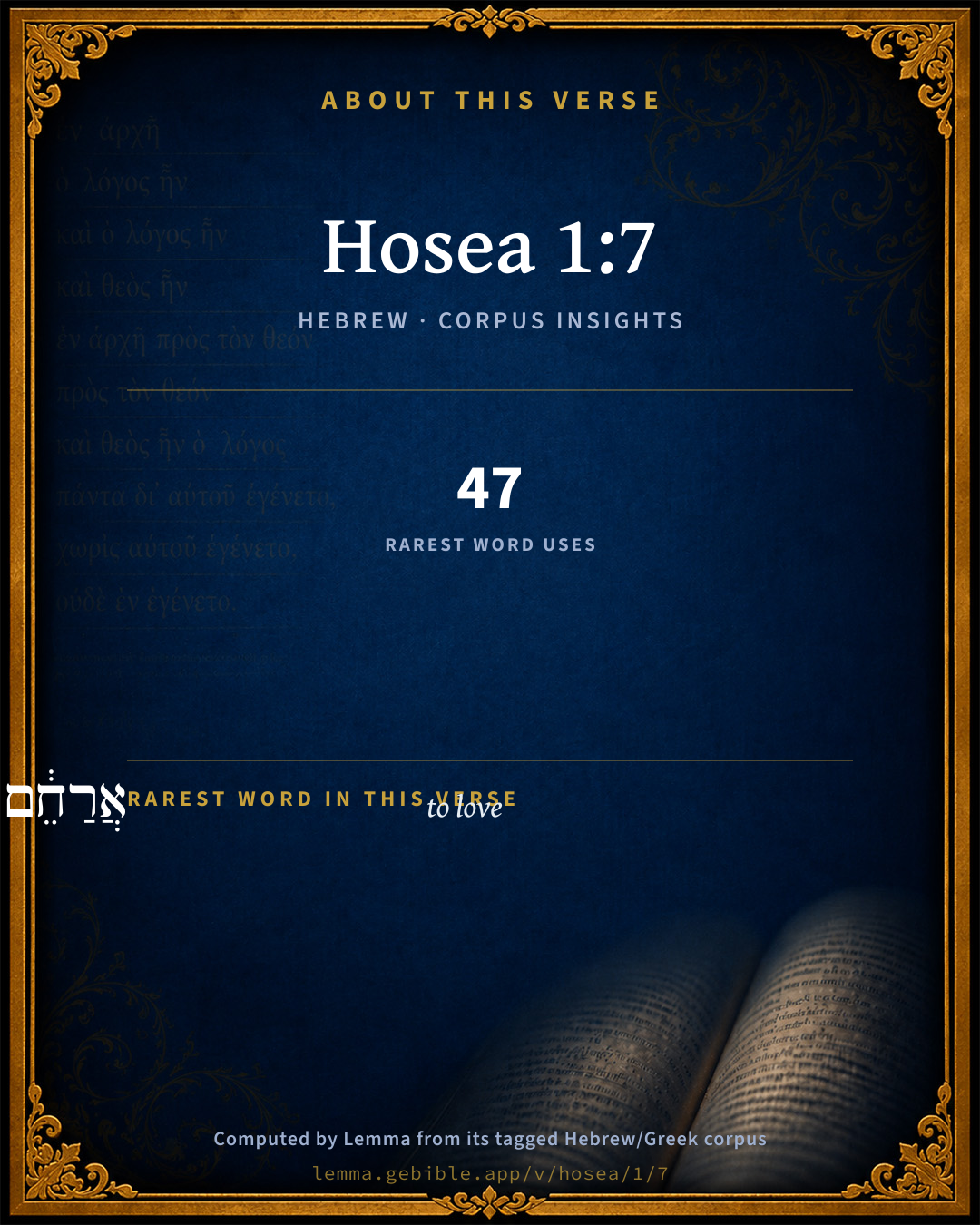
אֲרַחֵ֔ם to love H7355 occurs in 43 verses of the Hebrew Bible. Also found in:

Grammatical profile

  • 3 verbs
  • 9 nouns
  • 2 particles

Verb forms

  • אֲרַחֵ֔ם Piel · Imperfect
  • וְהֽוֹשַׁעְתִּ֖ים Hiphil · Sequential Perfect
  • אֽוֹשִׁיעֵ֗ם Hiphil · Imperfect

Repetition

A word recurs within this verse — often emphatic in Hebrew:

  • וְהֽוֹשַׁעְתִּ֖ים to save H3467 ×2

Hebrew & Septuagint length

In English translation the verse runs 36 words from the Hebrew and 38 from the Septuagint (LXX English) — closely comparable.

A rough comparison of the two English renderings, which tokenize alike — not a word-level alignment.

Word counts can differ between the Hebrew and the Greek without any difference in meaning — e.g. the Hebrew direct-object marker אֵת has no separate Greek word, and Greek often adds the article ὁ.

Cross-references

14

Topical passages linked to Hosea 1:7 in the Treasury of Scripture Knowledge — connected by theme and wording, ordered by reader-vote popularity; previews shown in the World English Bible.

  • Zechariah 4:6 Then he answered and spoke to me, saying, "This is the word of Yahweh to Zerubbabel, saying, 'Not by might, nor by power, but by my Spirit,' says Yahweh of Hosts.
  • Isaiah 12:2 Behold, God is my salvation. I will trust, and will not be afraid; for Yah, Yahweh, is my strength and song; and he has become my salvation."
  • 2 Kings 19:35 It happened that night, that the angel of Yahweh went forth, and struck in the camp of the Assyrians one hundred eighty-five thousand: and when men arose early in the morning, behold, these were all dead bodies.
  • Psalms 44:3–6 For they didn't get the land in possession by their own sword, Neither did their own arm save them; But your right hand, and your arm, and the light of your face, Because you were favorable to them.
  • Isaiah 7:14 Therefore the Lord himself will give you a sign. Behold, the virgin will conceive, and bear a son, and shall call his name Immanuel.
  • Hosea 11:12 Ephraim surrounds me with falsehood, And the house of Israel with deceit; And Judah still us unruly with God, And is unfaithful to the Holy One.
  • Zechariah 2:6–11 Come! Come! Flee from the land of the north,' says Yahweh; 'for I have spread you abroad as the four winds of the sky,' says Yahweh.
  • Jeremiah 23:5–6 Behold, the days come, says Yahweh, that I will raise to David a righteous Branch, and he shall reign as king and deal wisely, and shall execute justice and righteousness in the land.
  • Zechariah 9:9–10 Rejoice greatly, daughter of Zion! Shout, daughter of Jerusalem! Behold, your king comes to you! He is righteous, and having salvation; Lowly, and riding on a donkey, Even on a colt, the foal of a donkey.
  • Matthew 1:21–23 She shall bring forth a son. You shall call his name Jesus, for it is he who shall save his people from their sins."
  • Titus 3:4–6 But when the kindness of God our Savior and his love toward mankind appeared,
  • Psalms 33:16 There is no king saved by the multitude of a host. A mighty man is not delivered by great strength.
  • Isaiah 36:1–22 Now it happened in the fourteenth year of king Hezekiah, that Sennacherib king of Assyria came up against all the fortified cities of Judah, and took them.
  • Isaiah 49:6 yes, he says, It is too light a thing that you should be my servant to raise up the tribes of Jacob, and to restore the preserved of Israel: I will also give you for a light to the Gentiles, that you may be my salvation to the end of the earth.

Cross-references courtesy of OpenBible.info (CC BY 4.0).

Hebrew and Greek witnesses Masoretic Hebrew ↔ Greek Septuagint

The same verse in the two great witnesses to the Old Testament, shown verse-for-verse.

These are two independent witnesses, not word-aligned to each other, and the Septuagint is shown in lemma (dictionary) form.

Hebrew Hosea 1:7 Masoretic · Westminster Leningrad Codex

וְאֶת בֵּ֤ית יְהוּדָה֙ אֲרַחֵ֔ם וְהֽוֹשַׁעְתִּ֖ים בַּיהוָ֣ה אֱלֹֽהֵיהֶ֑ם וְלֹ֣א אֽוֹשִׁיעֵ֗ם בְּקֶ֤שֶׁת וּבְחֶ֨רֶב֙ וּבְמִלְחָמָ֔ה בְּסוּסִ֖ים וּבְפָרָשִֽׁים

But I will have mercy on the house of Judah, and will save them by Yahweh their God, and will not save them by bow, nor by sword, nor by battle, by horses, nor by horsemen."

World English Bible · Public Domain

Greek LXX Hosea 1:7 Septuagint · lemma form

ὁ δέ υἱός ιουδα ἐλεέω καί σώζω αὐτός ἐν κύριος θεός αὐτός καί οὐ σώζω αὐτός ἐν τόξον οὐδέ ἐν ῥομφαία οὐδέ ἐν πόλεμος οὐδέ ἐν ἅρμα οὐδέ ἐν ἵππος οὐδέ ἐν ἱππεύς

But I will have mercy on the house of Juda, and will save them by the Lord their God, and will not save them with bow, nor with sword, nor by war, nor by horses, nor by horsemen.

LXX2012 (modern English Septuagint) · Public Domain

Hebrew: Westminster Leningrad Codex (CC BY 4.0). Greek: Septuagint (public domain); English from LXX2012 (modern English Septuagint) (Public Domain). How the Septuagint differs from the Hebrew →

Targum (Aramaic paraphrase)

1

The Targum is the ancient Jewish Aramaic paraphrase of the Hebrew Scriptures — an interpretive translation, not the Hebrew text itself. Onkelos (literal) and Pseudo-Jonathan (expansive) render the Torah, and Jonathan the Prophets. Coverage is partial: where no permissively-licensed English translation exists for a verse, only the Aramaic is shown. This is verse-level text, not a word-by-word alignment to the Hebrew.

  1. Targum Jonathan Prophets (Joshua–Malachi)
    וְעַל דְבֵית יְהוּדָה אֲרַחֵם וְאַפְרְקִינוּן בְּמֵימְרָא דַייָ אֱלָהָהוֹן וְלָא יִתְפָּרְקוּן בְּקַשְׁתָּא וּבְחַרְבָּא וּבְעַבְדֵי קְרָבָא בְּסוּסְוָן וּבְפָרָשִׁין:

    (no public-domain English translation for this verse)

    Targum Jonathan — Aramaic: “Mikraot Gedolot” (public domain). English: “Sefaria Community Translation” (CC0 1.0 (public-domain dedication)); “London "Chaldee Paraphrase," 1871” (public domain). Text via Sefaria.

Commentary

Notes on Hosea 1:7 from classic Christian and Jewish commentators (each source and its license shown beneath its notes). The classic Christian expositions comment on the surrounding passage and are grouped to its opening verse, so a note may address several verses; the Jewish commentaries on the Tanakh (Rashi and others) are per-verse, so they appear only where the commentator wrote on this verse.

Lemma curates 59 commentaries, every one of them public domain or Creative Commons licensed, each selected and text-cleaned for this edition rather than reprinted as found. About our sources →

Trapp's Complete Commentary

John Trapp

Hos 1:7 But I will have mercy upon the house of Judah, and will save them by the LORD their God, and will not save them by bow, nor by sword, nor by battle, by horses, nor by horsemen.

Ver. 7. But I will have mercy upon the house of Judah] The ark and the mercy seat were never separated. Judah had not utterly cast off God, as Israel had; but worshipped God in the temple (how. corruptly soever), therefore they shall have mercy, because they kept the right way of worship. See the Church’s plea for mercy to this purpose, Jer 14:9. Again, Judah was now in a very great strait, having been lately beaten and plundered by Israel, 2Ki 14:12, therefore they shall have mercy. God heard Hagar’s affliction and relieved her. "I have seen, I have seen the sufferings of my people in Egypt, saith God, and am come to ease them," Exo 3:7. "Because they have called thee an outcast, saying, This is Zion, whom no man looketh after, therefore I will restore health unto thee, and I will heal thee of thy wounds, saith the Lord," Jer 30:17. He will repent for his people when he seeth their power is gone, Deu 32:36, when there is dignus vindice nodus, an extremity fit for Divine power to interpose. He knows that mercy is never so seasonable and sweet as when misery weighs down, and nothing but mercy turns the scale; therefore Judah shall have mercy, when Israel shall have none. True it is, that Judah was not at this time much better than Israel, Aholibah than Aholah: they were scarce free from sodomy and many such like foul abominations. But what of that? if God come with a non obstante, as Psa 106:8, "Nevertheless he saved them for his name’s sake," &c., who shall gainstand him? if he will show mercy for his name’s sake, what people is there so wicked whom he may not save? See Isa 57:17 Eze 20:8; Eze 20:14; Eze 20:22; Eze 20:44. Add hereunto that Israel and Syria were confederate against Judah, and thought to have made but a breakfast of them, Isa 7:5; but God here promiseth Judah mercy; and lets them know, to their comfort, that there is more mercy for them in heaven than there can be misery in earth or malice in hell against them. True it is, that even after this gracious promise made to Judah, it went very hard with them. See 2Ch 28:6, there 120,000 of them were slain in one battle, and 200,000 of them carried captive: yea, and all this by these Israelites here rejected from that mercy that Judah is promised; besides abundance more misery that befell them by Edomites, 2Ch 28:17, Philistines, 2Ch 28:18, Assyrians, 2Ch 28:20 &c. Ecclesia haeres Crucis, saith Luther, The Church, as she is heir of the promises, so is she of the cross: and the promises are always to be understood with condition of the cross. The palsy man in the Gospel, healed by our Saviour, heard, "Son, be of good cheer, thy sins are forgiven thee," and yet he was not presently freed of his disease, till, after a dispute held with the Pharisees (which must needs take up some time) and the case cleared, Jesus said, "Arise, take up thy bed and walk," and so show thyself a sound man. But to go on: Judah shall be saved, and not Israel, that envied Judah and maliciously sought their ruin. David looketh upon it as a sweet mercy, that God had spread him a table in the presence, and maugre the malice, of his enemies, Psa 23:4. And the children of the kingdom (so the Jews are called) shall gnash their teeth, and be even ready to eat their nails at the reception of the Gentiles, Mat 8:11. This was that which put the men of Nazareth into an anger, and our Saviour into a danger, Luk 4:25; Luk 4:29.

By the Lord their God] That is, by the Lord Christ, by Messiah their Prince, by the word of the Lord their God, saith the Chaldee here, that Word essential, Joh 1:1, that true Zaphnath Paaneah (that is, Saviour of the world, as Jerome interprets it), whereof Joseph was but a type. This horn of salvation, or mighty Saviour (able to save them to the uttermost, εις το παντελες, that come unto God by him, Heb 7:25), God raised up for these unworthy Jews, and even thrust him upon them, whether they would or no, Isa 7:13-14, that all might appear to be of free grace. Well might God say, "I will have mercy upon the house of Judah": matchless mercy indeed! mercy that rejoiced against judgment. Man’s perverseness breaketh not off the course of God’s goodness; Judah shall be saved by the Lord their God, who is Alius from his Father, but not Aliud, a distinct person, not a distinct thing. This angel of God’s presence saved them, in his love and in his pity he redeemed them, &c., Isa 63:9, even the angel that had redeemed their father Jacob from all evil, Gen 48:16; and that, soon after this prophecy, destroyed so many thousands in Sennacherib’s army, "Not by bow nor by battle," &c., but by his own bare hand immediately and miraculously, 2Ki 19:35; where we may see that when Sennacherib (after the example of his father Salmaneser, who had captivated the ten tribes) came up against Judah, having already devoured Jerusalem in his hopes, and thinking to cut them off at a blow, as if they had all had but one neck, they were saved by Jehovah their God: the virgin daughter of Zion knew well the worth and valour of Christ her champion, and that made her so confident, Isa 37:22. She knew whom she had trusted, not with her outward condition only, but with her inward and everlasting, with her precious soul, saying with David, "I am thine, save me; for I have sought thy precepts," Psa 119:94. "I will not trust in my bow, neither shall mine arm save me: but thy right hand, and thine arm, and the light of thy countenance, for thou hast a favour unto me," Psa 44:3; Psa 44:5. {See Trapp on "Zec 4:6"} {See Trapp on "Zec 14:3"} {See Trapp on "Zec 14:5"} That is an excellent passage, Psa 21:13, "Be thou exalted, O Lord, in thine own strength: so will we sing and praise thy power."

John Trapp, A Commentary or Exposition upon All the Books of the Old and New Testament (1647–1656) — public domain. Text from a community e-Sword module.

The Biblical Illustrator

Joseph S. Exell

Hos_1:7

But I will have mercy upon the house of Judah, and will save them by the Lord their God, and I will not save them by bow, nor by sword, nor by battle, by horses, nor by horsemen.

The vanity of the positive philosophy

The first three chapters are symbolic, and directed chiefly against the Ten Tribes, whom Hosea addresses as Israel and Ephraim. Hosea condemned their departure from the Almighty, as being a sort of spiritual adultery. One sign was an undue reliance upon material and temporal helps in times of emergency. Against this characteristic of a corrupt religion, and a declining national life, the text is directed.

I. All human and material succours are alone and by them selves inadequate. In their better days the people of Israel reposed all their confidence in Jehovah. Now they had lapsed into idolatry. Their spiritual vision had by degrees narrowed itself down to merely material views of things. They lost spiritual insight, and saw only the seen. They trusted in their military strength, and in political alliance with the great powers. From the human stand point this conduct was not unreasonable. In our own age this error prevails. It is reserved to our time to systematise these views into a philosophy, which, calling itself positive, excludes from its domain the least element of the super natural. It is found that there is a constancy in the operations of nature. Law has been discovered, where it was thought that there was but fortuity. So we are bidden to turn to science, where once we turned to God. Instead of praying, we are to study, and to adjust ourselves to ever-operating laws. If we would remain prosperous as a nation, say the positivists, we must have recourse to material helps, practise political economy, reform our social administration, and push to their farthest limits the practical application of scientific principles. But all this trust to science and scientific helps against the evils and emergencies of human life, is miserably and woefully mistaken. There is no incompatibility between true science and true religion. But a mere trust in means, or secondary causes, is vain and presumptuous. The shrewdest anticipations of man are constantly disappointed. Material succours--those helps which arise out of an observation, classification, and adaptation of secondary causes merely, are by themselves utterly unworthy.

II. Help from God is alone sufficient. God is the disposer of all events. At any moment this Supreme Power may, by a volition of His creative will, disappoint the cleverest calculation of the cleverest sociologist. God deigns to employ human and material agencies in the execution of His purposes; but because He works in a regular and orderly manner, we are not to think only of the mere means and instruments, and forget that Divine omnipresent agency, without which the mere instrumentality would be as the body without life, or as the machine without motive-power. It is then God, and God alone, who is worthy of trust. The means are with us, the issues are with the Lord. God can work with means, and He can also work without them. Man may calculate and scheme for results, but in vain, except as God may succeed his efforts. If we would make the best of both worlds, we must most distinctly remember that our only reliable help is to be found in the Lord, and in Him alone.

III. In all cases it is our duty to trust only in God. Hero we see the practical bearing of the truth enforced by the prophecy. The lesson of the text is, that we are not to trust to any use of means for the result or results which we may desire. Secondary causes are only efficient as they are so made by the informing agency of God. (D. Clark, M. A.)

Saved by Jehovah

Salvation is here set in opposition to the destruction which the prophet mentioned in the last verse. But Hosea shows that salvation depends not in the least either on arms, or on any of the intervenients, as they say, of this world; but has its foundation only on Gods favour. The connection ought to be carefully noticed. Where the Lords favour is, there is life. Hence the prophet here connects salvation with Gods gratuitous favour, for we cannot continue safe, but as long as God is propitious to us. But he says, By Jehovah their God. An antithesis is to be understood here between the false gods and Jehovah, who was the God of the house of Judah. It is the same as though the prophet said, Ye indeed profess the name of God, but ye worship the devil and not God; for ye have nothing to do with Jehovah, with the God who is the Creator and Maker of heaven and earth; for He dwells in His own temple; He pledged His faith to David, when He commanded him to build a temple for Him on Mount Zion; He dwells there between the cherubim, but the true God has become exiled from you, Israelites. (John Calvin.)

God the Deliverer

England has often shown her Christian character in acknowledging the hand of God. After the glorious deliverance from her enemies, by the destruction of the Spanish Armada, Queen Elizabeth ordered a medal to be struck, having on it, Afflavit Deus, et dissipantur--God blew on them, and they were scattered.

The Biblical Illustrator, edited by Joseph S. Exell (c. 1880s–1900s) — public domain. Text from a community e-Sword module.

Joseph Benson's Commentary

Hos 1:7. But I will have mercy upon the house of Judah — Including Benjamin, and such of the Levites as adhered to God’s law and worship, and as many of the other tribes as renounced the calves, Baal, and all idolatrous worship, and worshipped God alone as he required. On Judah, including all these, God had mercy in various respects, in which he had not mercy on Israel, prolonging that kingdom 132 years after Israel ceased to be a kingdom, preserving them from the combined powers of the king of Syria and the king of Israel, who united to destroy them, raising them up to greatness and glory in the reign of Hezekiah, in whose days the house of Judah was saved, by a wonderful miracle, from the power of Sennacherib the Assyrian king. Add to this, that Judah’s captivity was only for seventy years, whereas Israel’s continues to this day; Judah was restored to their own land, but Israel was not. By this, as the prophet would debase the pride of Israel, so possibly he intended to direct the well-disposed among them whither to go to find mercy. And will save them by the Lord their God, and not by bow, nor by sword, &c. — “These expressions,” Bishop Horsley thinks, “are too magnificent to be understood of any thing but the final rescue of the Jews from the power of antichrist in the latter ages, by the incarnate God destroying the enemy with the brightness of his coming, (2Th 2:8,) of which the destruction of Sennacherib’s army in the days of Hezekiah might be a type, but it was nothing more.”

Joseph Benson's Commentary on the Old and New Testaments (1811–1818) — public domain. Text from a community e-Sword module.

Whedon's Commentary on the Bible

Daniel D. Whedon

7. While Jehovah will not interfere in behalf of Israel, he will have mercy upon the southern kingdom.

Judah — The prophet seems to think that Judah is in better religious and moral condition than Israel (Hos_4:15). In reality, judging from the messages of Isaiah and Micah, the two eighth century prophets of Judah, there was little difference between the conditions in the two kingdoms. And if the references to Judah in Hos_5:5; Hos_5:10; Hos_5:12-14; Hos_6:4; Hos_6:11; Hos_8:14; Hos_10:11; Hos_11:12 (margin); Hos_12:2, are from Hosea himself, this prophet seems to agree with the two Judean prophets. The explanation that Hos_1:7; Hos_4:15, come from an earlier period, before Hosea had become properly acquainted with conditions in Judah, is not considered satisfactory by most commentators, since the time elapsed between the delivery of Hos_4:15, and chapter 5, cannot have been very long. It is not without reason, therefore, that many commentators regard Hos_1:7 as a later interpolation, reflecting the experiences of Judah in 701 (2Ki_19:35 ff; Isa_37:36 ff.). An additional objection is raised on the ground that the thought of Hos_1:7 is foreign to the rest of the chapter, in which the prophet narrates his own domestic life, and sets forth its significance as illustrating the relation of Israel to Jehovah.

By Jehovah their God — For the sake of emphasis, instead of by me; describes very aptly the deliverance of 701, as a reading of the account in 2 Kings will show. It is the constant teaching of the prophets that Jehovah, and not human defenses, is the salvation of his people (Hos_14:3; Isa_7:1-17; Isa_31:8; compare Hos_2:7).

Daniel D. Whedon (gen. ed.), Commentary on the Old and New Testaments (1874–1909) — public domain. Text from a community e-Sword module.

Tyndale Open Study Notes

Tyndale Open Resources

1:7 For many years, the kingdom of Israel had depended upon its armies and horses and charioteers for security, but its confidence was completely misplaced. Safety and security are only to be found in God’s power as the Lord.

Tyndale Open Study Notes — © Tyndale Open Resources, licensed CC BY-SA 4.0. Text via the HelloAO Bible API.

Geneva Bible (1599)

Geneva Bible translators

For after their captivity he restored him miraculously by the means of Cyrus, Ezra 1:1.

Geneva Bible (1599) marginal notes — public domain. Text via Bolls.life.

Jamieson, Fausset & Brown

Robert Jamieson, A. R. Fausset & David Brown

Judah is only incidentally mentioned to form a contrast to Israel.

by the Lord their God--more emphatic than "by Myself"; by that Jehovah (Me) whom they worship as their God, whereas ye despise Him.

not . . . by bow--on which ye Israelites rely (Hos 1:5, "the bow of Israel"); Jeroboam II was famous as a warrior (Kg2 14:25). Yet it was not by their warlike power Jehovah would save Judah (Sa1 17:47; Psa 20:7). The deliverance of Jerusalem from Sennacherib (Kg2 19:35), and the restoration from Babylon, are herein predicted.

Jamieson, Fausset & Brown — Commentary Critical and Explanatory on the Whole Bible (1871) — public domain (CC PDM 1.0). Text via the HelloAO Bible API.

Adam Clarke's Commentary

Verse 7. But I will have mercy upon the house of Judah] I will spare them as a kingdom after Israel has been carried away into captivity by the Assyrians.

And will save them by the Lord their God] Remarkably fulfilled in the supernatural defeat of the army of the Assyrians, see 2Kg 19:35; and so they were saved not by bow, nor by sword, nor by battle, nor by horses, nor by horsemen. The former expression may mean, not in war by horses, i.e., yoked to war chariots, nor by horsemen-nor by cavalry, however efficient such troops might have then been deemed.

Adam Clarke's Commentary on the Bible (1810–1826) — public domain. Text from a community e-Sword/MySword module.

John Calvin's Commentaries

This verse sufficiently proves what I said yesterday, that the Prophet was specifically appointed to the kingdom of Israel; for he seems here to speak favourably of the Jews, who yet, we know, had been severely and deservedly reproved by their own teachers. For what does Isaiah say, after having spoken of the dreadful corruptions which then prevailed in the kingdom of Israel? ‘Come,’ he says, ‘into the house of Judah, they at least continue as yet pure: there,’ he says, ‘all the tables are full of vomiting; they are drunken; there reigns also the contempt of God and all impiety,’ (Isaiah 28:8.) We see then that the Jews were not a virtuous people, of whom the Prophet has spoken so honourably. For though the exterior worship of God continued at Jerusalem, and the temple, at least under Uzziah and Jotham, was free from every superstition, and also under king Hezekiah; yet the morals of the people, we know, were very corrupt. Avarice, and cruelty, and every kind of fraud, reigned there, and also filthy lusts. The conduct, then, of that people was nothing better than that of the Israelites. Why, then, does the Prophet dignify them with so great an honour as to exempt them from God’s vengeance? Because he had an eye to the people to whom he was appointed a Prophet. He therefore institutes a comparison. He interferes not with the Jews, for he knew that they had faithful pastors who reproved their sins; but he continued among his own hearers. But this comparison served, in an especial manner, to touch the hearts of the people of Israel; for the Prophet, we know, made this reference particularly for this end, to condemn fictitious worship. He now sets the worship at Jerusalem in opposition to all those superstitions which Jeroboam first introduced, which Ahab increased, and all their posterity followed. Hence he says, “I will show favour” to the house of Judah.

That we may better understand the mind of the Prophet, it may be well to repeat what we said yesterday: — The kingdom of Judah was then miserably wasted. The kingdom of Israel had ten tribes, the kingdom of Judah only one and a half, and it was also diminished by many slaughters; yea, the Israelites had spoiled the temple of the Lord, and had taken all the gold and silver they found there. The Jews, then, had been reduced to a very low state, they hardly dared to mutter; but the Israelites, as our Prophet will hereafter tell us, were like beasts well fed. Since, then, they despised the Jews, who seemed despicable in the eyes of the world, the Prophet beats down this vain confidence, and says, With mercy will I follow the house of Judah “The house of Judah seems now to be almost nothing, for they are few in number, nor are they very strong, and wealth abounds not among them as among you; but with them shall dwell my favour, and I will take it away from you.”

It afterwards follows, And I will save them by Jehovah their God. Salvation is here set in opposition to the destruction which the Prophet mentioned in the last verse. But Hosea shows that salvation depends not in the least either on arms or on any of the intervenients , as they say, of this world; but has its foundation only on God’s favour. I will save them, he says — why? because my favour will I show them This connection ought to be carefully noticed. Where the Lord’s favour is, there is life. ‘Thou art our God, then we shall never perish,’ as it is written in the first chapter of Habakkuk. Hence the Prophet here connects salvation with God’s gratuitous favour; for we cannot continue safe, but as long as God is propitious to us. He has, on the other hand, declared that it would be all over with the Israelites as soon as God would take away from them his favour.

But he says, By Jehovah their God. An antithesis is to be understood here between the false gods and Jehovah, who was the God of the house of Judah. It is the same as though the Prophet said, “Ye indeed profess the name of God, but ye worship the devil and not God: for ye have nothing to do with Jehovah, with the God who is the creator and maker of heaven and earth; for he dwells in his own temple; he pledged his faith to David, when he commanded him to build a temple for him on mount Zion; he dwells there between the cherubim, as the Prophets invariably declare: but the true God is become exiled from you.” We hence see how he condemns here all the worship which the Israelites then so highly valued. Why did he do so? Because it was not acceptable to God.

And this passage deserves to be noticed, for we see how stupid men are in this respect. When once they are persuaded that they worship God, they are seized by some fascination of Satan so as to become delighted with all their own dotages, as we see to be the case at this day with the Papists, who are not only insane, but doubly frantic. If any one reproves them and says, that they worship not the true God, they are instantly on fire — “What! does not God accept our worship?” But the Prophet here shows by one word that Jehovah is not in any place, except where he is rightly worshipped according to the rule of his word. I will save them, he says — How? By Jehovah their God; and God himself speaks: He might have said, “I will save them by myself;” but it was not without reason that he used this circuitous mode of speaking; it was to show the Israelites that they had no reason to think that God would be propitious to them. How so? Because God had chosen an habitation for himself on mount Zion and in Jerusalem. A fuller declaration afterwards follows, I will save them neither by the bow, nor by the sword, nor by war, nor by horses, nor by horsemen But this clause, by God’s favour, I will explain tomorrow.

John Calvin's Commentaries (1540-1563) — public domain. Text from the Calvin Translation Society English edition (1840s-50s) via the Christian Classics Ethereal Library (ccel.org). Calvin's coverage is partial (roughly two-thirds of the Bible); uncommented books and verses are honest gaps, never fabricated. The 19th-century editor's footnotes and remarks are omitted so the notes are faithfully Calvin's own voice.

Ellicott's Commentary for English Readers

(7) Will save them . . .—We may consider this verse to have been literally fulfilled in the destruction of Sennacherib’s army. The prophetic outlook anticipates the fact that when Judah is captive and exiled, her restoration by the divine hand would take the form of mercy and forgiveness. (Comp. Psalms 76, Isa_40:1-2.)

A Bible Commentary for English Readers, edited by Charles John Ellicott (1878–1897) — public domain. Text from a community e-Sword module.

The Cambridge Bible for Schools and Colleges

gen. ed. J. J. S. Perowne

7. But I will have mercy upon the house of Judah] Grave as are the charges brought against Judah by the prophets, it appears to have been some degrees better off religiously than Israel; probably, as it was a poorer country, its nature-worship was less extravagantly sensuous than that of the north. Hosea elsewhere counsels Judah not to offend to the same extent as Israel (Hos_4:15), and later on accuses Judah rather of inconstancy than of absolute rebellion (Hos_11:12).

by the Lord their God] Tautologically, as Gen_19:24. Or, ‘as Jehovah their God’ (i.e ‘in the character of’ &c., comp. Exo_6:3 ‘as El Shaddai’, Psa_68:4 ‘his name is, essentially, in Jah’). Observe Hosea recognizes Judah’s higher religious ideal.

not … by bow] Judah, then, was in danger of trusting in warlike equipments, as Isaiah afterwards describes it as doing (Isa_2:7). And yet, if Israel, with all its natural strength, could not resist the Assyrian attack, it was clear that the weaker kingdom could only do so by supernatural aid. Comp. Isa_31:8; Isa_37:33. ‘Battle’ should be equipment of war.

The Cambridge Bible for Schools and Colleges (gen. ed. J. J. S. Perowne; Cambridge University Press, 1878–1918) — public domain. Text from a community e-Sword module.

John Gill's Exposition

But I will have mercy on the house of Judah,.... The two tribes of Judah and Benjamin, which retained the true worship of God among them; see Hos 11:12 and though they often sinned against the Lord, he showed them mercy, and spared them longer than the ten tribes; and though he suffered them to be carried captive into Babylon, he returned them again after seventy years: this is mentioned as an aggravation of the punishment of Israel, that Judah was spared, when they were not; and to show that God will have a people to seek and serve him, and, when he rejects some, he will make a reserve of others:

and will save them by the Lord their God; by his own arm and power, and not theirs, or any creature's; nor by any warlike means or instruments whatever, as follows:

and will not save them by bow, nor by sword, nor by battle, by horses, nor by horsemen: which may respect either the deliverance of the Jews from the invasion and siege of Sennacherib's army; which was done without shooting an arrow, or drawing the sword, or engaging in a pitched battle, or by a cavalry rushing into his camp, discomfiting his army, and pursuing them; but by an angel sent from heaven, which in one night destroyed a hundred and fourscore and five thousand, Kg2 19:35 or else refers to Cyrus being stirred up by the Lord to issue forth a proclamation, giving liberty to the Jewish captives to go free, without price or reward; and so was brought about, not by the might and power of man, but by the Spirit of the Lord; see Ezr 1:1 though a greater salvation is pointed at, or at least shadowed forth, by this, even the spiritual and eternal salvation of God's elect by Christ; which is the fruit of mercy, and not the effect of the merits of men; is obtained not by human power, or by man's righteousness; but by the Lord Jesus Christ, who is Jehovah our righteousness, the Lord God of his people; who stands in a relation to them prior to his being the Saviour of them; to which work and office he is equal, being the eternal Jehovah, and the true and living God. So the Targum,

"and I will save them by the Word of the Lord their God;''

the eternal Word, that was with God, is God, and became incarnate, God in our nature.

John Gill's Exposition of the Whole Bible (1746–1763) — public domain (CC PDM 1.0). Text via the HelloAO Bible API.

Albert Barnes' Notes on the Bible

I will have mercy on the house of Judah - For to them the promises were made in David, and of them, according to the flesh, Christ was to come. Israel, moreover, as being founded in rebellion and apostasy, had gone on from bad to worse. All their kings clave to the sin of Jeroboam; not one did right in the sight of God; not one repented or hearkened to God. Whereas Judah, having the true Worship of God, and the reading of the law, and the typical sacrifices, through which it looked on to the great Sacrifice for sin, was on the whole, a witness to the truth of God (see the note at Hos 11:12).

And will save them by the Lord their God, not by bow ... - Shortly after this, God did, in the reign of Hezekiah, save them by Himself from Sennacherib, when the Angel of the Lord smote in one night 185,000 in the camp of the Assyrians. “Neither in that night, nor when they were freed from the captivity at Babylon, did they bend bow or draw sword against their enemies or their captors. While they slept, the Angel of the Lord smote the camp of the Assyrians. At the prayers of David and the prophets and holy men, yea, and of the angels Zec 1:12 too, the Lord stirred up the spirit of Cyrus king of Persia, to set them free “to go up to Jerusalem, and build the temple of the Lord God of Israel” Ezr 1:3. But much more, this is the special promise of the Gospel, that God would deliver, not outwardly, but inwardly; not by human wars, but in peace; not by man, but by Himself. “By the Lord their God,” by Himself who is speaking, or, The Father by the Son, (in like way as it is said, “The Lord rained upon Sodom fire from the Lord” Gen 19:24).

They were saved in Christ, the Lord and God of all, not by carnal weapons of warfare, but by the might of Him who saved them, and shook thrones and dominions, and who by His own Cross triumpheth over the hosts of the adversaries, and overthroweth the powers of evil, and giveth to those who love Him, “to tread on serpents and scorpions and all the power of the enemy.” They were saved, not for any merits of their own, nor for anything in themselves. But when human means, and man’s works, such as he could do of his own free-will, and the power of his understanding, and the natural impulses of his affections, had proved unavailing, then he redeemed them by His Blood, and bestowed on them gifts and graces above nature, and filled them with His Spirit, and gave them “to will and to do of His good pleasure.” But this promise also was, and is, to the true Judah, i. e., to those who, as the name means, “confess and praise” God, and who, receiving Christ, who, as Man, was of the tribe of Judah, became His children, being re-born by His Spirit.”

Albert Barnes' Notes on the Bible (1834–1885) — public domain. Text from a community e-Sword/MySword module.

Haydock's Catholic Bible Commentary

Horsemen. Sennacherib was miraculously disconcerted. Juda returned form captivity and became more flourishing, giving birth to the Messias. (Calmet)

George Leo Haydock (1774–1849), Haydock's Catholic Family Bible and Commentary, 1859 edition — public domain. Excludes Psalms (Douay-Rheims chapter numbering differs from Protestant) and Deuterocanonical books (Catholic canon only).

Matthew Poole's English Annotations

But, or And, or Yet.

I; the Lord, who threateneth Israel, proud, flourishing, secure, and sinful Israel: he promiseth mercy to poor, oppressed, and impoverished Judah.

Will have mercy on the house of Judah; prolonging that kingdom one hundred and thirty-two years after Israel ceased to be a kingdom; preserving them from the combined powers of the king of Syria and the king of Israel, who combine to destroy them; raising them up to greatness and glory in the reign of Hezekiah, in whose days the house of Judah was saved by a miracle: beside all these, Judah’s captivity was for seventy years, Israel’s for ever; Judah returned to their own land, Israel never did. By this, as the prophet would abate the pride of Israel, so possibly he would secretly direct the best among Israel whither to go to find mercy. Judah; including Benjamin, and such of the Levites as adhered constant to God’s law and worship, and as many of the other tribes as renounced the calves, Baal, and all idolatrous worship, and worship God alone as he required, all these, in this case, are included in Judah, and so we find many such returning with Judah.

And will save them; preserve, that violence do not swallow them up, nor length of captivity wear them out; and this preserved remnant shall return and be planted in their own land, and there kept in safety. This promise does seem to point out such temporal salvation, but as a type of a far better and more glorious salvation.

By the Lord their God; either by Messiah, who is the Lord and their God, or by God himself, as their God, whom they did not, as Israel, forsake utterly. This passage bids us look to that extraordinary miraculous deliverance of Hezekiah and Jerusalem: see Isa 37:36; 2Ki 18:13; 2Ch 32:1.

Will not save them by bow, & c.: here God removeth all force and might, whether their own or their allies’, all that might eclipse the glory of God in this salvation. Now this was very fully performed in Hezekiah’s time, when Sennacherib’s army was cut off in one night by an angel, Isa 37:35,36; and in Cyrus’s time and Darius’s the captive Jews saw it was not by power nor by might, but the Lord saved them; so should it be here, as Psa 44:5,6; Isa 43:7,15; Zec 4:6.

Matthew Poole's English Annotations on the Holy Bible (1683–1685) — public domain. Text from a community e-Sword/MySword module.

The Pulpit Commentary

But I will have mercy upon the house of Judah, and will save them by the Lord their God. Thus the contrast expressed in this verse increases the painful feelings with which the threatened abandonment and consequent destruction of Israel would be regarded. The promised mercy to the house of Judah is emphasized by the peculiar form of the expression. Instead of the pronoun, the proper name of Jehovah is employed; instead of saying, "I will save them by myself," he says in a specially emphatic manner, "I will save them by Jehovah," adding at the same time the important adjunct of "thy God," to remind them of that relationship to himself in virtue of which he interposes thus personally and powerfully on their behalf. An expression somewhat similar in form occurs Gen_19:24, "Then the Lord Jehovah rained upon Sodom and upon Gomorrah brimstone and fire from the Lord Jehovah out of heaven." And will not save them by bow, nor by sword, nor by battle (literally, war), by horses, nor by horsemen. This enumeration is quite in accordance with the prophet"s style, as may be seen at a glance by comparing Hos_2:5, Hos_2:11, 22 3:4; and Hos_4:13. The manner of this deliverance is very peculiar and unusual; while prominence is given to the absence of those means of defense or deliverance on which the northern kingdom so much relied. The deliverance would be accomplished without the ordinary weapons of war bow and sword, in the use of the former of which Israel was so celebrated; also without war, that is, without its appliances and material of whatever kind skilful commanders, brave soldiers, and numerous troops; likewise without horses and horsemen, a great source of strength in those days (parashim, equivalent to "riders on horses," as distinguished from rokebhim, riders on camels). This deliverance, in fact, was to be entirely independent of all human resources. All this points plainly and positively to the deliverance of Judah from Sennacherib in the days of Hezekiah, when in one night the angel of the Lord smote a hundred and eighty-five thousand of the flower of the Assyrian host, and Jehovah thus by himself delivered Judah. Thus, too, Judah is saved from that power before which Israel had previously and entirely succumbed. (Compare, on this miraculous deliverance, 2Ki 19 and Isa 37)

Divine deliverance.

"But I will have mercy upon the house of Judah, and will save them by the Lord their God, and will not save them by bow, nor by sword, nor by battle, by horses, nor by horsemen." The contrast between the kingdoms of Judah and of Israel, in their nature and destiny, is here expressly declared. For Israel there was no hope; although pardon awaited any man amongst that people who turned unto the Lord, for no nation has been so godless, no family so vicious, but that every penitent in it may come with confidence to God. As for the kingdom, however, it was founded in rebellion against David"s house, and therefore against the Divine purpose. Its distinguishing mark was idolatry; the calves at Bethel and Dan indicated its limits, and the counsels of God, through his prophets, had been ostentatiously rejected. Hence the time had come when the people should be given over to the heathen whose worship they had chosen, and the words of the preceding verse announced their irrevocable doom. "I will no more have mercy upon the house of Israel, but I will utterly take them away." Very different was the position of the house of Judah. With all their imperfections and sins, the Jews still frequented the sacred temple, and there by appointed worship bore witness to the existence and unity of the living and true God. Judah was, therefore, still to be God"s ark, borne down the stream of time amidst the debris of fallen empires, until he should come forth from it who was the King of Judah, the Son of David, the Redeemer of the world. The Jews were to be humiliated and punished for sin, yet they should not as a people be destroyed; and so they were cheered by the promise, "I will have mercy upon the house of Judah, and will save them by the Lord their God." The earlier fulfillment of these words is recorded in 2Ki 19, where we read of the deliverance of Jerusalem, not by brave defense, nor by bribes, nor by auxiliaries, but by the unseen pestilence which slew a hundred and eighty-five thousand in the crowded camp of the Assyrians. Nor was the promise exhausted then, but was again fulfilled when the Jews of the Captivity, to their own amazement, were restored, not by revolt or stratagem, but by the free offer of the magnanimous Cyrus. (Ezr_1:2, Ezr_1:3) Our text, however, has more than a local and temporary interest. The principle of Divine deliverance, through other than human means, perpetually asserts itself in Old Testament history. It was the first lesson the Israelites were taught after leaving Egypt, when at the Red Sea Moses said, Stand still, and see the salvation of the Lord! He shall fight for you, and ye shall hold your peace." And this lesson, emphasized in the wilderness, was repeated immediately Canaan was entered, when the walls of Jericho fell before the strength of an army which lifted up no weapon against it. In elucidating this principle of Divine deliverance we observe

I THAT IT IS MAN"S NATURAL TENDENCY TO TRY TO DO WITHOUT GOD, to trust the bow, and the chariots of human providing. The story of the prodigal is repeated constantly. Every man says in effect, "Father, give me my portion; let me see how I can do for myself without thee." It is only by-and-by, when he finds that there are worse friends than the Father, and wearier places than the home, that, clothed in rags, with failing heart and many a tear, he says, "I will arise, and go to my Father.

1. Israel showed this tendency. They confided in their bravery and patriotism and in the strength of Egypt, believing that unitedly they could construct a dam against which this great sea of Assyria, surging in so ominously, would break in vain. It was not an unreasonable expectation from the human point of view; for it seems still accepted as an axiom that "Providence is on the side of big battalions," and that the destinies of peoples are decided by their material resources. Hosea would be rebuked as a prating preacher who was going beyond his province, when he urged that righteousness and godliness were elements which demanded consideration; by the lowest subaltern and by the highest general his counsels would be laughed to scorn, though events showed that he was right.

2. Temptations to this were never stronger than now. In proportion as our powers develop, our liability to trust to them, and not to him who gave them, increases. In our day physical sciences have grown, and the principles so educed have been swiftly and boldly applied to our necessities. We are pointed to evidences in every direction of the constancy of law and the absence of fortuity. Indeed, the religious fallacy of Judah has been formulated into the philosophy of Positivism, which recognizes nothing but that which the intellect can prove, and excludes everything spiritual and supernatural. It points out that in human distresses we should turn to science, not to God; and that the study of political economy and natural science may fairly supersede the preaching of righteousness as a means of salvation to a people. We do not disparage scientific discoveries, but rather rejoice that they are made so frequently and fearlessly. We only ask men to recognize that there is another sphere not discoverable by the intellect, which underlies and impinges upon the sphere of sensuous life, and. that, while things seen are temporal, there are things unseen which are eternal. Well may one of the characters in "The New Republic" be represented as saying to such teachers, "Your mind is so occupied with subduing matter, that it is entirely forgetful of subduing itself a thing, trust me, that is far more important." But the disappointment of men"s shrewdest anticipations proves that the race is not always to the swift, nor the battle to the strong. "The shields of the earth" (the means of defense, temporal and spiritual) "belong to the Lord.

II THAT THE DISCIPLINE OF LIFE IS INTENDED TO ERADICATE THIS TENDENCY TO FORGETFULNESS OF GOD. God rarely disappoints expectations which are founded on a study of natural law; for to act in accordance with natural law is to put ourselves in harmony with the Divine will, law being the expression of will. Yet there should be no idolatry of law, because it works in an orderly way. Law without God is a body without life, a machine without motive power. To bring about a belief in this, "time and chance happen to all;" in other words, things occur which are not expected and could not have been foreseen.

1. In history we see that God has often baffled man. He has defied probabilities, and chosen things which were weak to confound things which were mighty. Take as an example the destinies of Assyria and Judah, which were utterly unlike what man would have predicted. Assyria, in Hosea"s time, was the strongest creation of military force, and political genius. In the magnificence of her wealth, and the splendor of her palaces, she rose before men"s thoughts gloriously as the image Daniel saw in his vision. But no politician would have expected what the prophet foresaw that a stone cut without hands would come from the mountain and smite that gigantic fabric to the dust; that those richly peopled plains would become the haunts of the bittern and owl, and the lair of wild beasts. Meantime Judah, a little despised kingdom, tossed helplessly between the opposing forces of Egypt and Assyria, like a piece of seaweed between two enormous waves, was to be "saved by the Lord her God." And thence, in the fullness of time, there came forth One whom men recognized as possessing the highest power, and amidst the ruins of a greater empire than Assyria herself, Christ, the true Ruler, founded a kingdom which never shall be moved. The world"s expectations were set at naught.

2. Have not our previsions often been falsified, and our best plans frustrated, so that the old adage has reasserted itself, "Man proposes, God disposes"? Happy is it if, amidst the ruins of our enterprises, we can say, "it is the Lord: let him do what seemeth him good.

III THAT MORAL VICTORIES ARE PREPARED FOR BY QUIET WAITING. God appoints quiet times for the recuperation of all life. The winter prepares for the spring. Sleep makes us ready for toil, and without it the world would go mad. So in the moral world. Work has been done most bravely and successfully by those who have had seasons of trust and waiting. Elijah had to learn that there was more power in the "still small voice" than in wind, or earthquake, or fire. Saul of Tarsus had to rein in his fiery spirit, and for three years was learning God"s answer to his question," Lord, what wilt thou have me to do?" Neither Luther in the Wartburg nor Bunyan in the prison was wasting time, but gaining strength. Let us learn to wait as well as to work; and instead of being careful and troubled about many things, sit at Jesus" feet to hear his word, and "in quietness and confidence will be our strength." It is not by our subtle reasoning that we shall conquer our doubts, nor by our doings that we shall win salvation, nor by our efforts of speech that we shall save souls; for "the weapons of our warfare are not carnal, but mighty through God." He has mercy upon the house of Judah, and will save them neither by bow, nor sword, but by the Lord their God.

IV THAT ITS HIGHEST EXEMPLIFICATION IS SEEN IN CHRIST"S REDEMPTION OF THE WOULD. Had he come in manifested glory, the skeptic would have been silenced and the wrongdoer abashed; but he was made lower than the angels, that he might suffer death upon the cross. Born in a stable, he was nursed by the poor, depended on the wages of a carpenter for his food, and played with the common children in Nazareth. Having begun his ministry, he called to himself none of the leaders in the ecclesiastical, or intellectual, or social life of his age; but appointed Galilean fishermen as his representatives. Then he let his foes do their worst. No angelic forces hurled back his assailants, no trumpet-peal startled the court during the mockery of his trial; but he was taken "by wicked hands, crucified and slain." And when he had passed away from earth, his disciples, without human advantages, won the world"s attention and established the kingdom of the Lord amongst all peoples. "It pleased God through the foolishness of preaching to save those who believed." Consider:

1. The principle which underlies our text has its application in the experience of every Christian life. We are justified, not by the works of the Law, but by faith in the Lord Jesus Christ. We conquer our easily besetting sins, not by strenuous resolve or Christian association, but by him who, working through these, says, "Without me ye can do nothing." We are saved from the fret of care, not because we are strong and brave to bear it, but because we have learnt to cast all our care upon him. We obtain rest from mental difficulties, not by reasoning, but by trusting, and leaving much contentedly to God"s future revelation. And in our last conflict salvation will be ours, not through the memory of past service, nor through our clear perception of what awaits us in the unseen world, but through the realized presence of him who came to receive us to himself and to give us the victory.

2. And finally let us apply the principle to the accomplishment of Christian work. The foes of Christ are still around his Church, and they will be conquered, not by the bow of intellectual, or social, or civil power, but by the Lord our God. You will never conquer skepticism by logical demonstrations; nor cast out heresy by persecution or the thunders of excommunication; nor put down vices by civil law; nor compel the heathen to submit at the Feint of the sword. But against these evils they will prevail who trust, not in men, but in God; who, conscious of human helplessness, look beyond all that is seen as those who can re-echo the psalmist"s words, "I will lift up mine eyes unto the hills, from whence cometh my help." For beyond the reach of mortal weakness and transient power he reigns who of old uttered this promise, "I will have mercy upon the house of Judah, and will save them by the Lord their God, and will not save them by bow, nor by sword, nor by battle, by horses, nor by horsemen. A. R.

Salvation, not of man, but of God.

It may well be that there was in this verse a prediction of one certain definite interposition of the Lord on behalf of Judah. Whilst the northern kingdom should be forsaken, and consequently conquered and desolated, Judah, it was foretold, should experience a very signal instance of Divine delivering mercy. The destruction of the host of Sennacherib, when The angel of death spread his wings on the blast, And breath"d in the face of the foe as he pass"d, exactly corresponds with the language of this verse. Human power and bravery were not the means of the deliverance of Jerusalem; this was due to the intervention of a Divine and omnipotent hand. It is well that pious minds should recognize the wisdom and the power of God in every work of deliverance, and especially in the unparalleled interposition wrought on behalf of our humanity by Jesus Christ our Savior.

I MAN"S SALVATION IS NOT WROUGHT BY HUMAN MIGHT.

1. History records the insufficiency, the vanity, of all human endeavors to effect the deliverance of man from sin. Rulers by legislation, warriors by arms, philosophers by systems of thought, poets by emotion and imagination, have all essayed the reformation, the moral elevation, of the race; and all who have tried have failed. The wisdom of the world has been proved folly, and its strength weakness.

2. The explanation of this failure is not far to seek. All human means are powerless in affecting the government of God; whatever is to affect that must of necessity originate with the Divine Governor himself. And all human means fail to reach the root of the mischief in man"s spiritual nature. They deal with the surface, but do not penetrate to the center; they do not reach the heart of the individual; they do not, consequently, prove able to reconstitute society.

II SALVATION IS FROM THE LORD OUR GOD, AND FROM HIM ONLY.

1. It might be presumed that such is the case, from the infinity of the Divine resources. God is not buffed in the execution of his purposes, as men constantly are, by insufficient power. On the one hand, the nature of his creatures is accessible to him, and is known perfectly by him; on the other hand, the means of affecting that nature are all at his disposal.

2. We observe the supreme proof of this in the gospel of Jesus Christ.

(1) The Savior himself was from God.

(2) The Spirit, who effects the internal change, is the Spirit of God.

(3) The gospel itself is "the glorious gospel of the blessed God." Thus it is apparent that the whole provision for man"s redemption and recovery is nothing less than Divine.

APPLICATION. This declaration is especially encouraging to those who feel pro-roundly at once their own need of salvation and the insufficiency of all human provision; a Divine interposition satisfies all the conditions and necessities of the sinner"s case. T.

The Pulpit Commentary (1880–1919), ed. H.D.M. Spence-Jones & Joseph S. Exell — public domain. Text from a community e-Sword module.

John Wesley's Explanatory Notes

Save them - I will preserve them, that violence do not swallow them up, nor length of captivity wear them out; and this preserved remnant shall return and be planted in their own land, and there kept in safety. By the Lord - Particularly in that extraordinary deliverance of Hezekiah and Jerusalem, from Sennacherib.

John Wesley, Explanatory Notes Upon the Whole Bible (1754–1765) — public domain. Text via the GEBible commentary corpus.

Keil & Delitzsch

C. F. Keil & F. Delitzsch

"And I will favour the house of Judah, and save them through Jehovah their God; and I will not save them through bow, and sword, and war, through horses and through horsemen." By a reference to the opposite lot awaiting Judah, all false trust in the mercy of God is taken away from the Israelites. From the fact that deliverance is promised to the kingdom of Judah through Jehovah its God, Israel is to learn that Jehovah is no longer its own God, but that He has dissolved His covenant with the idolatrous race. The expression, "through Jehovah their God," instead of the pronoun "through me" (as, for example, in Gen 19:24), is introduced with special emphasis, to show that Jehovah only extends His almighty help to those who acknowledge and worship Him as their God.

(Note: "The antithesis is to be preserved here between false gods and Jehovah, who was the God of the house of Judah. For it is just as if the prophet had said: Ye do indeed put forward the name of God; but ye worship the devil, and not God. For ye have no part in Jehovah, i.e., in that God who is the Creator of heaven and earth. For He dwells in His temple; He has bound up His faith with David," etc. - Calvin.)

And what follows, viz., "I will not save them by bow," etc., also serves to sharpen the punishment with which the Israelites are threatened; for it not only implies that the Lord does not stand in need of weapons of war and military force, in order to help and save, but that these earthly resources, on which Israel relied (Hos 10:13), could afford no defence or deliverance from the enemies who would come upon it. Milchâmâh, "war," in connection with bow and sword, does not stand for weapons of war, but "embraces everything belonging to war - the skill of the commanders, the bravery of heroes, the strength of the army itself, and so forth" (Hengstenberg). Horses and horsemen are specially mentioned, because they constituted the main strength of an army at that time. Lastly, whilst the threat against Israel, and the promise made to Judah, refer primarily, as Hos 2:1-3 clearly show, to the time immediately approaching, when the judgment was to burst upon the kingdom of the ten tribes, that is to say, to that attack upon Israel and Judah on the part of the imperial power of Assyria, to which Israel succumbed, whilst Judah was miraculously delivered (2 Kings 19; Isa 37:1); it has also a meaning which applies to all times, namely, that whoever forsakes the living God, will fall into destruction, and cannot reckon upon the mercy of God in the time of need.

Keil & Delitzsch — Biblical Commentary on the Old Testament (1861–1891) — public domain (CC PDM 1.0). Text via the HelloAO Bible API. (Old Testament only.)

Rashi

Rabbi Shlomo Yitzchaki (Rashi)

But to the house of Judah will I grant clemency after I terminate the kingdom of Israel, for after the ten tribes were exiled, the house of Judah was the object of clemency from Hezekiah until Zedakiah.

Rashi on the Tanakh — English translations: “The Judaica Press complete Tanach with Rashi, translated by A. J. Rosenberg” (CC BY 4.0); “Pentateuch with Rashi's commentary by M. Rosenbaum and A.M. Silbermann, 1929-1934” (public domain); “The Metsudah Tanach series, Lakewood, N.J” (CC BY 4.0); and “The Book of Joshua, Metsudah Publications, 1997” (CC BY 4.0). Text via Sefaria.

Lesson kit

Teaching starters — assembled from the data on this page, not authored interpretation. Every prompt links to the verse data it draws on. Edit before teaching.

Hosea, in the Prophets, opens this verse with 14 words (13 distinct Hebrew lemmas). Its most distinctive word is râcham (“to love”). A historical commentator’s framing appears above. Read the whole chapter for the surrounding context.

Discussion questions

  1. What does “to love” (râcham) contribute to the verse as a whole?
  2. Exodus 33:19 shares the word «to love» with this verse. How do the two illuminate each other?
  3. “to save” occurs 2× in this one verse. What is the effect of the repetition?
  4. These translations render this verse differently. What is at stake in choosing one wording over another?
  5. The verb «אֲרַחֵ֔ם» is Piel Imperfect. How does its form color the action?
  6. Reading how Trapp's Complete Commentary and The Biblical Illustrator read this verse, where do the two commentators agree and where do they part?

Things to notice

Reading settings

Reading text

Shown beneath each verse's original-language words.

Old Testament
Old Testament edition

Read the OT as the Masoretic Hebrew (MT) or the Greek Septuagint (LXX).

English shown for the Greek Septuagint (in the Hebrew ↔ Greek comparison).

Comparing translations? Open the Compare panel on any verse page to stack up to four side by side.