
Isaiah 35:4

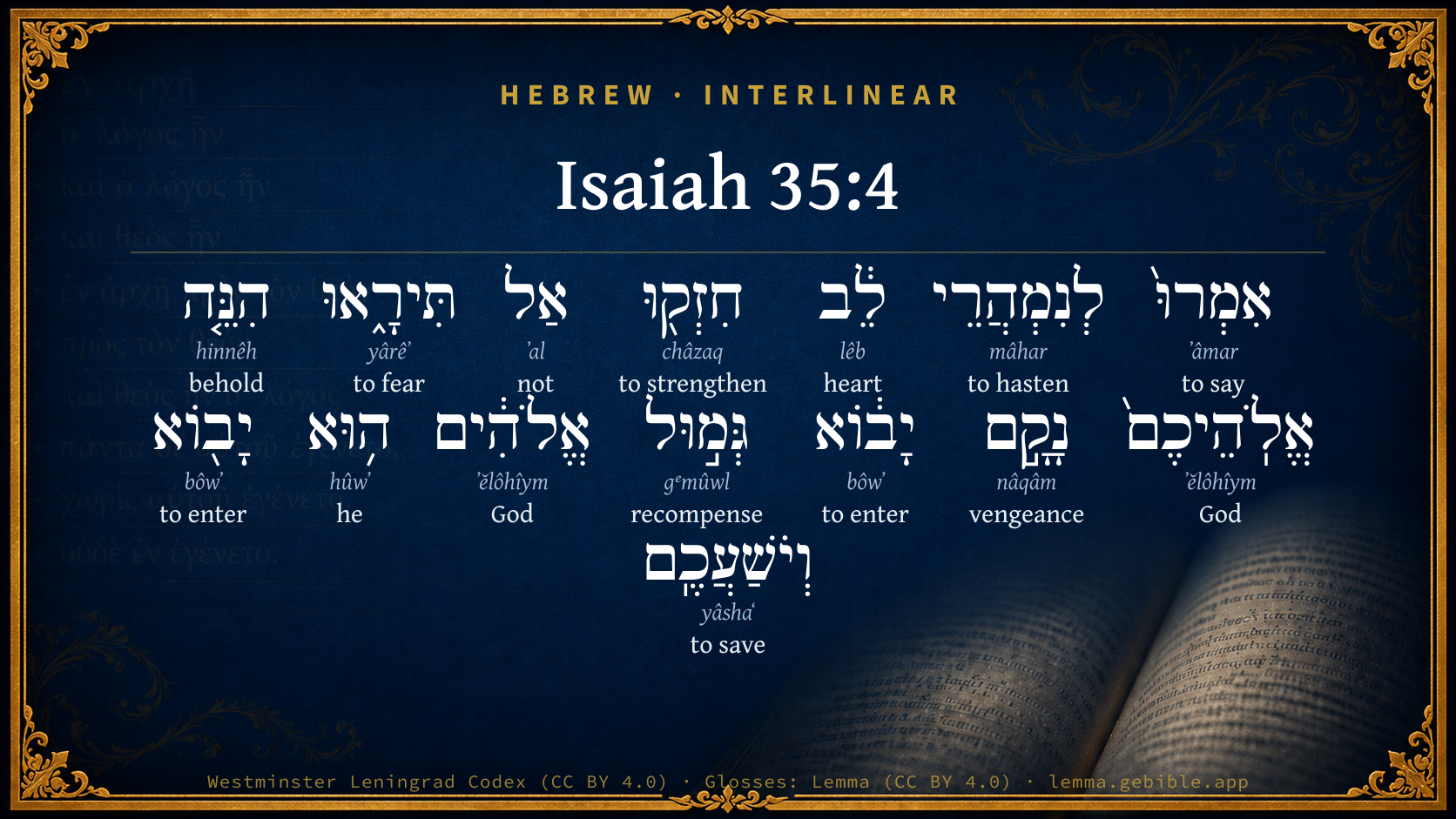
Hebrew (Westminster Leningrad Codex) Isaiah 35:4 appears in the Hebrew Old Testament. The text above is from the Westminster Leningrad Codex. Each word links to its Strong’s number, a concise gloss, and parsing drawn from the Open Scriptures Hebrew Bible morphology. Click any word for its full Brown-Driver-Briggs (BDB) entry.
Download image
Cite this verse

Isaiah 35:4 (World English Bible). Public Domain. Lemma interlinear Bible study tool, https://lemma.gebible.app/v/isaiah/35/4.

Show BibTeX & RIS
BibTeX
RIS
English Translation
Tell those who are of a fearful heart, Be strong, don't be afraid: behold, your God will come [with] vengeance, [with] the recompense of God; he will come and save you.
World English Bible · Public Domain
Download a study sheet

One document with this verse’s original text, its word-by-word gloss line, the meaning frame, cross-references with their text, attributed commentary, and full source and license credits — printable, and it pastes into notes with its structure intact.

This verse Autodidact and up

Study sheet (.html) Plain text (.txt)

A passage Seminary Student

Up to 50 verses in one chapter. A passage sheet keeps up to 6 commentary sources and 12 cross-references per verse, in the order this page ranks them, and says so on the sheet whenever that leaves anything out. Ask for a single verse and you get the Autodidact verse sheet above.

Everything on this page stays free to read, with no account — the sheet is a download of what is already on screen, not access to it.

Want to remove ads? Support Godless Engineer
Compare translations 3

The same verse in 3 English versions, stacked beneath the original-language interlinear above. Click any original word for its lexicon entry.

Each is an independent rendering of the whole verse — the interlinear is not word-aligned to these translations.

Highlighted words mark where these versions differ — a whole-verse word diff, not a word-by-word alignment.

  • World English Bible Public Domain
    Tell those who are of a fearful heart, Be strong, don't be afraid: behold, your God will come [with] vengeance, [with] the recompense of God; he will come and save you.
  • King James Version Public Domain
    Say to them that are of a fearful heart, Be strong, fear not: behold, your God will come with vengeance, even God with a recompence; he will come and save you.
  • unfoldingWord Literal Text CC BY-SA 4.0
    Say to the hastening of heart, “Be strong, do not fear! Behold, your God will come vengeance, the recompense of God. He, he will come, and he will save you.” q1

unfoldingWord Literal Text — © unfoldingWord, licensed CC BY-SA 4.0. Word-aligned USFM3 via Door43 (git.door43.org/unfoldingWord/en_ult).

Versions to compare (up to 4)

3 of 4 selected

Show all 18 translations

Every available English version of this verse, each an independent rendering of the whole verse.

  • World English Bible Public Domain
    Tell those who are of a fearful heart, Be strong, don't be afraid: behold, your God will come [with] vengeance, [with] the recompense of God; he will come and save you.
  • Berean Standard Bible Public Domain
    Say to those with anxious hearts: “Be strong, do not fear! Behold, your God will come with vengeance. With divine retribution He will come to save you.”
  • Majority Standard Bible Public Domain
    Say to those with anxious hearts: “Be strong, do not fear! Behold, your God will come with vengeance. With divine retribution He will come to save you.”
  • King James Version Public Domain
    Say to them that are of a fearful heart, Be strong, fear not: behold, your God will come with vengeance, even God with a recompence; he will come and save you.
  • American Standard Version (1901) Public Domain
    Say to them that are of a fearful heart, Be strong, fear not: behold, your God will come `with' vengeance, `with' the recompense of God; he will come and save you.
  • Revised Version (1885) Public Domain
    Say to them that are of a fearful heart, Be strong, fear not: behold, your God will come with vengeance, with the recompence of God; he will come and save you.
  • Geneva Bible (1599) Public Domain
    Say vnto them that are fearefull, Bee you strong, feare not: beholde, your God commeth with vengeance: euen God with a recompense, he will come and saue you.
  • Douay-Rheims (1899) Public Domain
    Say to the fainthearted: Take courage, and fear not: behold your God will bring the revenge of recompense: God himself will come and will save you.
  • Young's Literal Translation Public Domain
    Say to the hastened of heart, `Be strong, Fear not, lo, your God; vengeance cometh, The recompence of God, He Himself doth come and save you.'
  • Literal Standard Version CC BY-SA 4.0
    Say to the hurried of heart, “Be strong, || Do not fear, behold, your God; vengeance comes, || The repayment of God, || He Himself comes and saves you.”
  • Unlocked Literal Bible CC BY-SA 4.0
    Say to those with a fearful heart, “Be strong, do not fear! Look, your God will come with vengeance, with the recompense of God. He will come and save you.”
  • unfoldingWord Literal Text CC BY-SA 4.0
    Say to the hastening of heart, “Be strong, do not fear! Behold, your God will come vengeance, the recompense of God. He, he will come, and he will save you.” q1
  • Darby Bible Public Domain
    Say to them that are of a timid heart, Be strong, fear not; behold your God: vengeance cometh, the recompense of God! He will come himself, and save you.
  • World Messianic Bible Public Domain
    Tell those who have a fearful heart, “Be strong! Don’t be afraid! Behold, your God will come with vengeance, God’s retribution. He will come and save you.
  • Webster's Bible Public Domain
    Say to them that are of a fearful heart, Be strong, fear not: behold, your God will come with vengeance, even God with a recompense; he will come and save you.
  • Free Bible Version CC BY-SA 4.0
    Tell those who are frightened, “Be strong! Don't be afraid! Look, your God is coming to punish his enemies, with divine retribution he will come to save you.”
  • Bible in Basic English Public Domain
    Say to those who are full of fear, Be strong and take heart: see, your God will give punishment; the reward of God will come; he himself will come to be your saviour.
  • JPS Tanakh (1917) Public Domain
    Say to them that are of a fearful heart: 'Be strong, fear not'; behold, your God will come with vengeance, with the recompense of God He will come and save you.

Literal Standard Version (2020), Covenant Press — licensed CC BY-SA 4.0. Text via the HelloAO Bible API (eBible.org). Unlocked Literal Bible (unfoldingWord) — licensed CC BY-SA 4.0. Text via the HelloAO Bible API (eBible.org). unfoldingWord Literal Text — © unfoldingWord, licensed CC BY-SA 4.0. Word-aligned USFM3 via Door43 (git.door43.org/unfoldingWord/en_ult). Free Bible Version, Dr. Jonathan Gallagher — licensed CC BY-SA 4.0. Text via the HelloAO Bible API (eBible.org).

Word by word

More ways to search: Search by grammar → Find every occurrence → Compare this word →

Practice this passage: Drill this verse → Learn its vocabulary →

נָקָ֣ם
nâqâm
H5359
“vengeance”
Noun, Common, Masculine, Singular, Absolute
Part of Speech
Noun
Type
Common
Gender
Masculine
Number
Singular
State
Absolute
Full BDB Definition

Origin: from H5358

TWOT: 1413a

vengeance - vengeance (by God, by Samson, by enemies of Judah)
  1. אִמְרוּ֙ ʼâmar H559 “say” Verb, Qal, Imperative, 2nd Person, Masculine, Plural
  2. לְנִמְהֲרֵי mâhar H4116 “to/for · hastening” Preposition + Verb, Niphal, Participle Active, Masculine, Plural, Construct
  3. לֵ֔ב lêb H3820 “heart” Noun, Common, Masculine, Singular, Absolute
  4. חִזְק֖וּ châzaq H2388 “strengthen” Verb, Qal, Imperative, 2nd Person, Masculine, Plural
  5. אַל ʼal H408 “not” Particle, Negative
  6. תִּירָ֑אוּ yârêʼ H3372 “to fear” Verb, Qal, Jussive, 2nd Person, Masculine, Plural
  7. הִנֵּ֤ה hinnêh H2009 “behold” Particle, Demonstrative
  8. אֱלֹֽהֵיכֶם֙ ʼĕlôhîym H430 “God(s) · your” Noun, Common, Masculine, Plural, Construct + Suffix, Personal, 2nd Person, Masculine, Plural
  9. יָב֔וֹא bôwʼ H935 “to enter” Verb, Qal, Imperfect, 3rd Person, Masculine, Singular
  10. גְּמ֣וּל gᵉmûwl H1576 “recompense of” Noun, Common, Masculine, Singular, Construct
  11. אֱלֹהִ֔ים ʼĕlôhîym H430 “God(s)” Noun, Common, Masculine, Plural, Absolute
  12. ה֥וּא hûwʼ H1931 “he” Pronoun, Personal, 3rd Person, Masculine, Singular
  13. יָב֖וֹא bôwʼ H935 “to enter” Verb, Qal, Imperfect, 3rd Person, Masculine, Singular
  14. וְיֹשַׁעֲכֶֽם yâshaʻ H3467 “and · to save · you” Conjunction + Verb, Hiphil, Imperfect, 3rd Person, Masculine, Singular + Suffix, Personal, 2nd Person, Masculine, Plural

About this verse

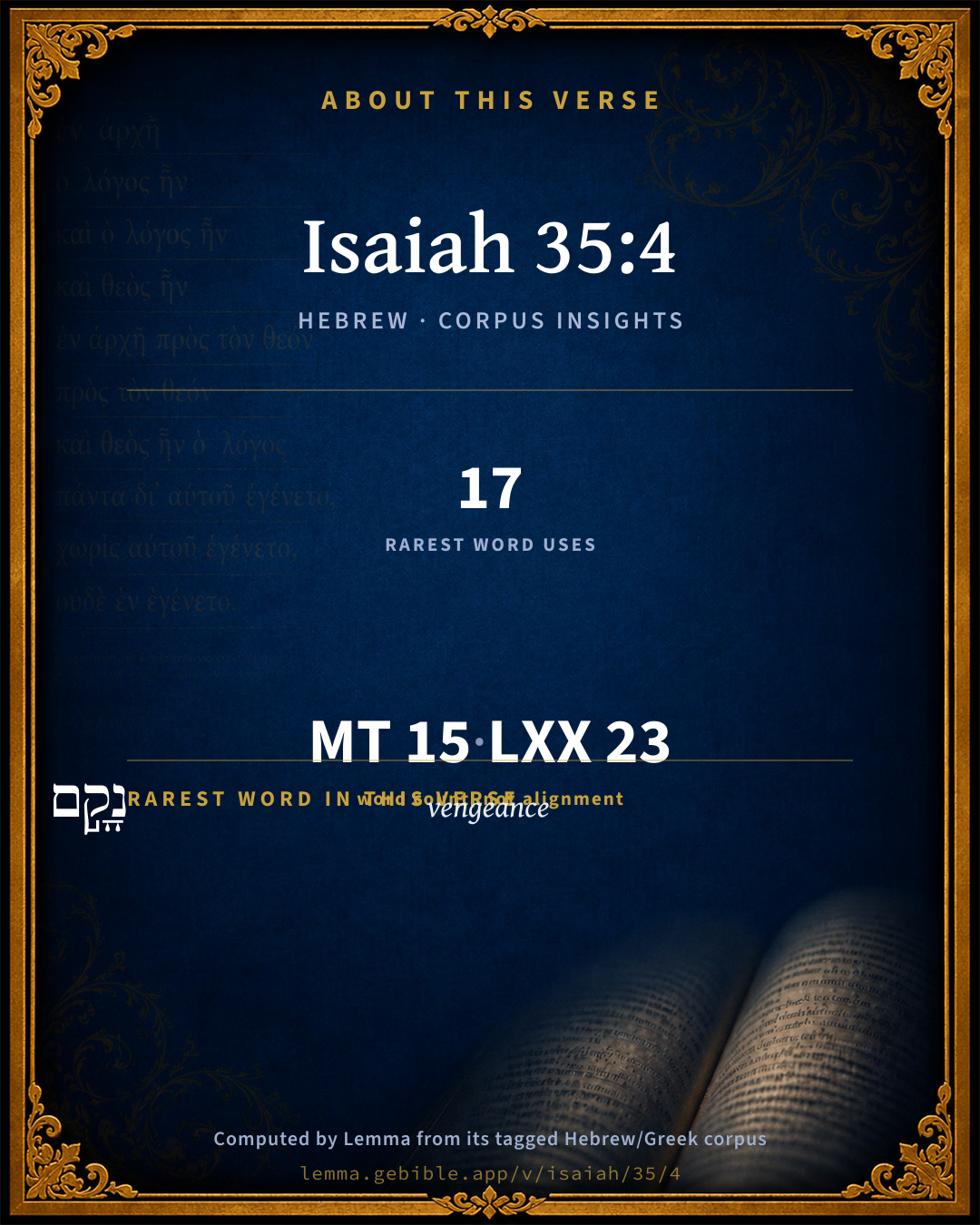
These counts appear in no published source. They are computed here, from the morphology-tagged text and Lemma’s own curated glosses. What Lemma adds →

15
words
13
distinct lemmas
Prophets
section

Notable vocabulary

The rarest word here is נָקָ֣ם vengeance H5359 — appearing just 17 times in the whole Hebrew Bible.

Shared distinctive vocabulary

נָקָ֣ם vengeance H5359 occurs in 17 verses of the Hebrew Bible. Also found in:

Grammatical profile

  • 7 verbs
  • 5 nouns
  • 1 pronoun
  • 2 particles

Verb forms

  • אִמְרוּ֙ Qal · Imperative
  • לְנִמְהֲרֵי Niphal · Participle Active
  • חִזְק֖וּ Qal · Imperative
  • תִּירָ֑אוּ Qal · Jussive
  • יָב֔וֹא Qal · Imperfect
  • יָב֖וֹא Qal · Imperfect
  • וְיֹשַׁעֲכֶֽם Hiphil · Imperfect

Repetition

Words recur within this verse — often emphatic in Hebrew:

  • אֱלֹֽהֵיכֶם֙ God H430 ×2
  • יָב֔וֹא to enter H935 ×2

Hebrew & Septuagint length

In English translation the verse runs 31 words from the Hebrew and 25 from the Septuagint (LXX English) — closely comparable.

A rough comparison of the two English renderings, which tokenize alike — not a word-level alignment.

Word counts can differ between the Hebrew and the Greek without any difference in meaning — e.g. the Hebrew direct-object marker אֵת has no separate Greek word, and Greek often adds the article ὁ.

In the original languages it is 15 Hebrew tokens and 23 Greek tokens — but the two are counted differently (Hebrew bundles its prefixes and suffixes into one token; the Greek is in lemma form), so that isn’t a like-for-like length.

Cross-references

37

Topical passages linked to Isaiah 35:4 in the Treasury of Scripture Knowledge — connected by theme and wording, ordered by reader-vote popularity; previews shown in the World English Bible.

  • James 5:7–9 Be patient therefore, brothers, until the coming of the Lord. Behold, the farmer waits for the precious fruit of the earth, being patient over it, until it receives the early and late rain.
  • Isaiah 41:10–14 Don't you be afraid, for I am with you; don't be dismayed, for I am your God; I will strengthen you; yes, I will help you; yes, I will uphold you with the right hand of my righteousness.
  • Zephaniah 3:16–17 In that day, it will be said to Jerusalem, "Don't be afraid, Zion. Don't let your hands be slack."
  • Isaiah 34:8 For Yahweh has a day of vengeance, a year of recompense for the cause of Zion.
  • Haggai 2:4 Yet now be strong, Zerubbabel,' says Yahweh. 'Be strong, Joshua, son of Jehozadak, the high priest. Be strong, all you people of the land,' says Yahweh, 'and work, for I am with you,' says Yahweh of Hosts.
  • Ephesians 6:10 Finally, be strong in the Lord, and in the strength of his might.
  • 1 Chronicles 28:20 David said to Solomon his son, Be strong and of good courage, and do it: don't be afraid, nor be dismayed; for Yahweh God, even my God, is with you; he will not fail you, nor forsake you, until all the work for the service of the house of Yahweh is finished.
  • Isaiah 33:22 For Yahweh is our judge, Yahweh is our lawgiver, Yahweh is our king; he will save us.
  • Isaiah 61:2 to proclaim the year of Yahweh's favor, and the day of vengeance of our God; to comfort all who mourn;
  • Isaiah 25:9 It shall be said in that day, Behold, this is our God; we have waited for him, and he will save us: this is Yahweh; we have waited for him, we will be glad and rejoice in his salvation.
  • Isaiah 52:7–10 How beautiful on the mountains are the feet of him who brings good news, who publishes peace, who brings good news of good, who publishes salvation, who says to Zion, Your God reigns!
  • Luke 21:28 But when these things begin to happen, look up, and lift up your heads, because your redemption is near."
  • Isaiah 44:2 Thus says Yahweh who made you, and formed you from the womb, who will help you: Don't be afraid, Jacob my servant; and you, Jeshurun, whom I have chosen.
  • Daniel 10:19 He said, "Greatly beloved man, don't be afraid: peace be to you, be strong, yes, be strong." When he spoke to me, I was strengthened, and said, "Let my lord speak; for you have strengthened me."
  • Zechariah 2:8–10 For thus says Yahweh of hosts: 'For honor he has sent me to the nations which plundered you; for he who touches you touches the apple of his eye.
  • Deuteronomy 32:35–43 Vengeance is mine, and recompense, At the time when their foot shall slide: For the day of their calamity is at hand, The things that are to come on them shall make haste.
  • Isaiah 32:4 The heart of the rash shall understand knowledge, and the tongue of the stammerers shall be ready to speak plainly.
  • Isaiah 40:9–11 You who tell good news to Zion, go up on a high mountain; you who tell good news to Jerusalem, lift up your voice with strength; lift it up, don't be afraid; say to the cities of Judah, Behold, your God!
  • Hebrews 10:37–38 "In a very little while, He who comes will come, and will not wait.
  • Revelation 2:10 Don't be afraid of the things which you are about to suffer. Behold, the devil is about to throw some of you into prison, that you may be tested; and you will have oppression for ten days. Be faithful to death, and I will give you the crown of life.
  • Revelation 22:20 He who testifies these things says, "Yes, I come quickly." Amen! Yes, come, Lord Jesus.
  • Joshua 1:6–7 Be strong and of good courage; for you shall cause this people to inherit the land which I swore to their fathers to give them.
  • Isaiah 28:16 therefore thus says the Lord Yahweh, Behold, I lay in Zion for a foundation a stone, a tried stone, a precious corner -[stone] of sure foundation: he who believes shall not be in haste.
  • Isaiah 54:4–5 Don't be afraid; for you shall not be ashamed: neither be confounded; for you shall not be disappointed: for you shall forget the shame of your youth; and the reproach of your widowhood shall you remember no more.
  • Isaiah 66:15 For, behold, Yahweh will come with fire, and his chariots shall be like the whirlwind; to render his anger with fierceness, and his rebuke with flames of fire.
  • Hosea 1:7 But I will have mercy on the house of Judah, and will save them by Yahweh their God, and will not save them by bow, nor by sword, nor by battle, by horses, nor by horsemen."
  • Matthew 1:21–23 She shall bring forth a son. You shall call his name Jesus, for it is he who shall save his people from their sins."
  • 2 Timothy 2:1 You therefore, my child, be strengthened in the grace that is in Christ Jesus.
  • Hebrews 9:28 so Christ also, having been once offered to bear the sins of many, will appear a second time, without sin, to those who are eagerly waiting for him for salvation.
  • Revelation 1:7 Behold, he is coming with the clouds, and every eye will see him, including those who pierced him. All the tribes of the earth will mourn over him. Even so, Amen.
  • Psalms 50:3 Our God comes, and does not keep silent. A fire devours before him. It is very tempestuous around him.
  • Psalms 116:11 I said in my haste, "All men are liars."
  • Isaiah 26:20–21 Come, my people, enter you into your chambers, and shut your doors about you: hide yourself for a little moment, until the indignation be past.
  • Habakkuk 2:3 For the vision is yet for the appointed time, and it hurries toward the end, and won't prove false. Though it takes time, wait for it; because it will surely come. It won't delay.
  • Malachi 3:1 "Behold, I send my messenger, and he will prepare the way before me; and the Lord, whom you seek, will suddenly come to his temple; and the messenger of the covenant, whom you desire, behold, he comes!" says Yahweh of hosts.
  • Isaiah 1:24 Therefore the Lord, Yahweh of Hosts, The Mighty One of Israel, says: "Ah, I will get relief from my adversaries, And avenge myself of my enemies;
  • Isaiah 43:1–6 But now thus says Yahweh who created you, Jacob, and he who formed you, Israel: Don't be afraid, for I have redeemed you; I have called you by your name, you are mine.

Cross-references courtesy of OpenBible.info (CC BY 4.0).

Hebrew and Greek witnesses Masoretic Hebrew ↔ Greek Septuagint

The same verse in the two great witnesses to the Old Testament, shown verse-for-verse.

These are two independent witnesses, not word-aligned to each other, and the Septuagint is shown in lemma (dictionary) form.

Hebrew Isaiah 35:4 Masoretic · Westminster Leningrad Codex

אִמְרוּ֙ לְנִמְהֲרֵי לֵ֔ב חִזְק֖וּ אַל תִּירָ֑אוּ הִנֵּ֤ה אֱלֹֽהֵיכֶם֙ נָקָ֣ם יָב֔וֹא גְּמ֣וּל אֱלֹהִ֔ים ה֥וּא יָב֖וֹא וְיֹשַׁעֲכֶֽם

Tell those who are of a fearful heart, Be strong, don't be afraid: behold, your God will come [with] vengeance, [with] the recompense of God; he will come and save you.

World English Bible · Public Domain

Greek LXX Isaiah 35:4 Septuagint · lemma form

παρακαλέω ὁ ὀλιγόψυχος ὁ διάνοια ἰσχύω μή φοβέω ἰδού ὁ θεός ἐγώ κρίσις ἀντι ἀποδίδωμι καί ἀντι ἀποδίδωμι αὐτός ἥκω καί σώζω ἐγώ

Comfort one another, you⌃ faint-hearted; be strong, fear not; behold, our God renders judgment, and he will render it; he will come and save us.

LXX2012 (modern English Septuagint) · Public Domain

Hebrew: Westminster Leningrad Codex (CC BY 4.0). Greek: Septuagint (public domain); English from LXX2012 (modern English Septuagint) (Public Domain). How the Septuagint differs from the Hebrew →

Targum (Aramaic paraphrase)

1

The Targum is the ancient Jewish Aramaic paraphrase of the Hebrew Scriptures — an interpretive translation, not the Hebrew text itself. Onkelos (literal) and Pseudo-Jonathan (expansive) render the Torah, and Jonathan the Prophets. Coverage is partial: where no permissively-licensed English translation exists for a verse, only the Aramaic is shown. This is verse-level text, not a word-by-word alignment to the Hebrew.

  1. Targum Jonathan Prophets (Joshua–Malachi)
    אֲמַרוּ לְדָמוֹחָן בְּלִבְּהוֹן לְמֶעְבַּד אוֹרַיְתָא תְּקָפוּ וְלָא תִדַחֲלוּן הָא אֶלָהָכוֹן לְמֶעְבַּד פּוּרְעֲנוּת דִין אִתְגְלֵי מָרֵי גְמַלְיָא יְיָ הִיא יִתְגְלֵי וְיִפְרְקִינְכוֹן:

    Say ye to the fearful of heart that they may keep the law, Be ye strong, and fear ye not: behold, your God shall be revealed to take vengeance of judgment: the Lord of retributions, the Lord shall be revealed, and He shall save you.

    Targum Jonathan — Aramaic: “Mikraot Gedolot” (public domain). English: “Sefaria Community Translation” (CC0 1.0 (public-domain dedication)); “London "Chaldee Paraphrase," 1871” (public domain). Text via Sefaria.

Commentary

Notes on Isaiah 35:4 from classic Christian and Jewish commentators (each source and its license shown beneath its notes). The classic Christian expositions comment on the surrounding passage and are grouped to its opening verse, so a note may address several verses; the Jewish commentaries on the Tanakh (Rashi and others) are per-verse, so they appear only where the commentator wrote on this verse.

Lemma curates 59 commentaries, every one of them public domain or Creative Commons licensed, each selected and text-cleaned for this edition rather than reprinted as found. About our sources →

Trapp's Complete Commentary

John Trapp

Isa 35:4 Say to them [that are] of a fearful heart, Be strong, fear not: behold, your God will come [with] vengeance, [even] God [with] a recompence; he will come and save you.

Ver. 4. Say to them that are of a fearful heart,] Inconsideratis; to them that consider not the promises, but "forget the consolations," {παρακλησις, Heb 12:5} so poring upon their sins, that they see not their Saviour.

Behold, your God will come with vengeance.] He will tread Satan under your feet shortly. {Rom 16:20}

Even your God with a recompense.] Diabolo par pari retribuet Christus, saith Jerome: Christ will be even with the devil. He had got one of Christ’s disciples - Judas; and, to cry quittance, Christ got one of his - Paul. Cyprian was wont thus to comfort his hearers, Veniet Antichristus, sed superveniet Christus, Antichrist will come, but Christ will not be long behind him.

John Trapp, A Commentary or Exposition upon All the Books of the Old and New Testament (1647–1656) — public domain. Text from a community e-Sword module.

The Biblical Illustrator

Joseph S. Exell

Isa_35:4

Say to them that are of a fearful heart, Be strong, fear not

Comfort for the fearful

Presumption and fear are the Scylla and Charybdis of the Christian life, and it requires Divine guidance, together with all our own watchfulness, to steer safely between them.

My object is, to suit the case of those who are well entitled to hope for the Divine mercy through Christ Jesus, but are disquieting themselves, or are disquieted by the enemy with needless fears.

1. I cannot indulge the hope that I am a Christian, one will say, because I have never passed through the same religious exercises and experiences that others profess to have felt and enjoyed; have known no such deep convictions; have no such clear assurance of my acceptance with God. God has brought many sons to glory, but I do not suppose that any two of them have been led thither in precisely the same way, or have been exercised with precisely the same feelings. If in the main, our experiences correspond with the Word of God, in the great points of faith and love, it need not disquiet us though we never heard of another case exactly like our own.

2. But another desponding one says, If I were truly a child of God, sin would not prevail against me as I find it does. So long as there is determined war against sin, there is ground for hope.

3. Still one may be ready to reply, I find that sin not only prevails against me, but I seem to be worse than when I first strove against it; my heart appears to grow more wicked; my corruptions, stronger, and my strength to resist to be less. To perceive more of our sin than usual, does not always prove that we are more sinful, but often the reverse; just as when one cleanses a room, though the air is filled with dust floating in the sunbeams, there is no more of it actually there than before, and there will soon be less of it as the operation goes on. We do not know the strength of our evil passions until we begin to oppose them. When one is making a special effort to lead a Christian life, then he is especially tempted and hindered.

4. Another class of disquieted ones affirm that they cannot hope they are true Christians, because they seem to love everything else more than God; If this were really true, we should have no encouragement to offer, for if God be not loved supremely we cannot be His children. But, in estimating our love to God, compared with our love to earthly things, we are not to conclude that we love that most which most excites our affections. It has well been remarked, that a man may be more moved when he sees a friend that has long been absent, and seem to regard him more for the moment than he does his own wife and children, and yet none would think that the friend was loved the most; so neither must we conclude, because when we are abroad in the world we find our affections vehemently stirred towards its various objects, that therefore they are supreme in our hearts. We should judge of our comparative affection by asking ourselves soberly, which of the two objects we should prefer to part withy

5. Again, it is urged by some that there is great danger of self-deception; that a person may, in appearance, be like a Christian, and yet be really destitute of any true piety, and they fear lest they should fall into the same error. The fear is usually the best remedy against the thing feared, and none are farther from the danger of making a false profession than those who are most afraid of it.

6. Some, again, have fears that they are not true Christians, because they come so far short of the attainments of some eminent Christians of their acquaintance. We reply, that the worst part of the character of those exalted saints may not be known to us, or they may not have our hindrances, or they may have been long in growing up to that state, while we are only babes in Christ.

7. Another class may say, that they cannot think any real Christian ever was so tempted and distressed with evil thoughts as they are. We reply, Job was tempted to curse God, and Christ Himself to worship Satan. We may have very wicked thoughts entering our minds, but if we do not delight in them, if we strive against them, and they are painful to us, they are no evidence against us. The very fact that they grieve us and we resist them, is in our favour.

8. Another class of the discouraged and fearful say, that they have doctrinal difficulties, that certain things in the Bible do not appear clear to them, and they fear to make any public confession of Christ till these are made plain. The best way to solve doctrinal difficulties is to engage in practical duties. But it would be endless to recount all the ways in which doubts and fears assail us. Their name is Legion, and our prayer should be that Christ would command them to come out of the man who is troubled with them, and to enter no more into him. Many seem to think that they show a commendable spirit by cherishing such fears. But there is no humility in doubting Gods promises. (W. H. Lewis, D. D.)

The ministry of consolation

Let us consider the text--

I. AS A DISSUASIVE AGAINST OUR SECRET FEARS. Say to them that are of a fearful heart, Fear not. The language is not uncommon as addressed to Gods children. Fear not, Abram, I am thy shield and thine exceeding great reward. Thus saith the Lord that created thee, O Jacob, and He that formed thee, O Israel, fear not. Fear not, for I am with thee; be not dismayed, for I am thy God. The language seems to intimate that those who are truly seeking Christ are yet liable to be oppressed by many fears. But the Lord says, you are not to be thus afraid.

1. Fear not on account of the greatness of your sins. Fathomless as are the depths of your iniquity, there is one depth,, which is deeper still. Where sin abounded, grace did much more abound.

2. Fear not on account of remaining infirmities and indwelling tendencies to evil. How many are deterred from taking any decisive step in religion because they have not attained to a certain point of spiritual advancement; forgetting that the act of taking the step is to be one of the means for attaining to this point.

3. Be not of a fearful heart through anything adverse or disquieting in your spiritual experience. Many form rash conclusions on this subject from unsound and unworthy premises, and from only partial views of Scripture.

II. AS AN ENCOURAGEMENT TO LAY HOLD UPON THE STRENGTH OF GOD. Be strong. The advice is of frequent occurrence in Scripture. But what are we to be strong in?. Why., strong in the Lord, strong in His strength, safe through His holding up. Again, by the exhortation, Be strong, we must understand an injunction to seek and pray for the strengthening aids of God the Holy Spirit.

1. There is the strength of preventing grace in the hour of temptation, when not permitted to come upon us; when some power we know not of keeps us out of harms way; when the dominion of our besetting sin appears for the time to be got under, and without a struggle or a blow we conquer in the might of God.

2. Then, there is the strength of supporting grace when the struggle does come, when we have to do battle with hard thoughts in adversity, or rebellious thoughts in disappointment, with sinful thoughts in solitude, with proud and envious thoughts in the world, with unbelief and impatience, and a little willingness for prayer, and we cannot shake off these things.

3. And then there is the strength of enlightening and sanctifying grace. We grow in grace and in the knowledge of our Lord and Saviour Jesus Christ at the same time; and all this is through the imparted strength of the Comforter.

4. But I must not omit to notice the chief thing we are to be strong in, that which gave the prayer of Jacob power to prevail with God, namely, that we be as Jacob was, strong in faith, giving glory to God. Guard against all confused and imperfect notions of the offering of the Gospel plan, or of the power and willingness of Christ to save. Remember there is virtue enough in His blood, power enough in His arm, and grace enough at His disposal to sanctify and save a whole world of sinners. Apply to Him by faith and prayer. Place no limits where God has placed none. The blood of Jesus Christ cleanseth from all sin, and if from all, why not yours? (D. Moore, M. A.)

An old malady and an old remedy

I. A COMMON TROUBLE. A fearful heart. Think of some of the causes.

1. Life itself is a cause. A little child does not fear. But the little child has not yet reached into the consciousness of its own personality--has not been awed by the mystery of its own existence. Wrapped in such consciousness there is always a certain fear.

2. Sin is another source of a fearful heart. The ideal relation between God and the soul is that of utmost intimacy, but sin breaks this relation.

3. The sad things emerging in life are causes of a fearful heart.

4. The difficulties of duty.

5. The monotony of duty. Sometimes when dreary stretches of duty, the same thing day in, day out, fill the vision, a real fear comes lest one fail in duty because of its uninteresting routine.

6. The revelation of mans own nature under some great surprise or disappointment is a cause of a fearful heart. The strength one fancied himself to have, turns out under some great strain to be but weakness after all. The heart in Scripture stands for the whole man--intellect, affection, will. The thing needed is that a man see clearly, love wisely, will strongly; but when fear wraps one about with mists, this is the outcome; a weak heart--no strength for doing; feeble knees--no power of purpose.

II. THE OLD AND YET NEW REMEDY for this common trouble.

1. A personal God. Behold your God.

2. A God appropriated--your God.

3. A God active. He will come. God is not an inert passiveness, having no hand in things. Our Scripture is prophecy; God has come in the Incarnation.

4. A God for your help. He will come and save you.

5. A rewarding God. He will come with recompense. Think more of God than of the causes of your fearfulness, and also appropriate God. (Homiletic Review.)

Fears

1. These words brings before us very delightful thoughts concerning Gods nature and purposes. We gather from them His compassion He graciously sends the message unsolicited. His mercy. He does not desire His people to suffer needless trouble or anxiety. His power and care, for He is able to save them from danger and so guarantee the needlessness of their fear.

2. But they remind us of a very painful condition of man, which is his tendency to fear amid the discouragements of life. These consist in many things.

I. FEARS WITH RELATION TO EXTERNAL CIRCUMSTANCES.

1. Men dread that which is greater or more powerful than themselves. Hence they fear the material forces of nature, the mighty convulsions of creation, the strength of their fellow-man, and the power of God.

2. Men dread that which to them is mysterious and unknown. Thus there is an innate fear of darkness, of death, of the future.

3. Men dread that which is more evil than themselves. Evil men, evil combinations of men, evil spirits, and the machinations of Satan.

4. Men dread those circumstances which can adversely affect their interests. That which can bring them material loss, that which checks their external advancement, that which spoils their amusement or gratification.

II. FEARS WITH REGARD TO INTERNAL CIRCUMSTANCES.

1. There is our relationship to God. As an all seeing observer, as a just Judge, as an avenging King. We stand before Him as an Almighty Jehovah, who knows our thoughts, sins, and desires.

2. There is our future state of existence. Guilt makes cowards of us all.

3. There are our domestic relationships. The broken cord of affection, the ruptured friendship, and the lost treasures.

4. There is the mental, moral, and bodily anguish and suffering. Great and terrible do they appear as they enshroud our existence and threaten our future.

Now, as these things brood over the soul, and darken the horizon of life, there is heard speaking to the soul of the faithful, earnest believer in Christ the trumpet word of our text--Fear not. There are many reasons why we should not fear.

1. There is the fact of our Fathers love. He does not willingly afflict the children of men.

2. There is the fact of our Fathers power. He is able to support and to overrule all adverse circumstances.

3. There is the fact of our Fathers presence. He is always near. The true antidote to fear is faith. (Homilist.)

He will come and save you

It is no abstract salvation that we hope and wait for, but a Saviour--a Saviour before whom no enemy can stand. His coming will be the deliverance. Danger, bondage, weakness, and sorrow shall be done away, and in the consciousness of the grand release, The eyes of the blind shall be opened, &c. (W. Hubbard.)

The Biblical Illustrator, edited by Joseph S. Exell (c. 1880s–1900s) — public domain. Text from a community e-Sword module.

Tyndale Open Study Notes

Tyndale Open Resources

35:4 do not fear: The Lord here assures his people of his presence and purpose (see also 7:4; 10:24; 40:9; 43:1; 44:2; 54:4). • The essence of the good news is that God is coming to save his people (see also 40:9; 52:7; 62:11). God’s coming brings spiritual transformation as well as rescue from enemies.

Tyndale Open Study Notes — © Tyndale Open Resources, licensed CC BY-SA 4.0. Text via the HelloAO Bible API.

Geneva Bible (1599)

Geneva Bible translators

To destroy your enemies.

Geneva Bible (1599) marginal notes — public domain. Text via Bolls.life.

Jamieson, Fausset & Brown

Robert Jamieson, A. R. Fausset & David Brown

fearful--"hasty," Margin; that is, with a heart fluttered with agitation.

with--the Hebrew is more forcible than the English Version: "God will come, vengeance! even God, a recompense!" The sense is the same.

Jamieson, Fausset & Brown — Commentary Critical and Explanatory on the Whole Bible (1871) — public domain (CC PDM 1.0). Text via the HelloAO Bible API.

Ellicott's Commentary for English Readers

(4) Be strong, fear not: . . .—The words are, of course, wide and general enough, but looking to the probable date of this section, we may perhaps connect them with the tone of Hezekiah’s speech in 2Ch_32:7. Both king and prophet had the same words of comfort for the feeble and faint-hearted, and the ground of comfort is that the government of God is essentially a righteous government, punishing the oppressor, and saving the oppressed. (Comp. Jos_1:6-7.)

A Bible Commentary for English Readers, edited by Charles John Ellicott (1878–1897) — public domain. Text from a community e-Sword module.

The Cambridge Bible for Schools and Colleges

gen. ed. J. J. S. Perowne

4. Cf. Isa_40:9-10. them that are of a fearful heart] Lit. “the hasty of heart.” The phrase occurs with a different sense in ch. Isa_32:4.

behold, your God … recompence] Better (as R.V. marg.): behold your God! vengeance cometh, the recompence of God; He Himself, &c.

5, 6 a. The removal of bodily infirmities. How far the language is to be taken figuratively it may be difficult to say. Comp. ch. Isa_29:18, Isa_32:3-4.

6 b, 7. The transformation of the desert. Cf. ch. Isa_43:19-20, Isa_48:21, Isa_49:10.

The Cambridge Bible for Schools and Colleges (gen. ed. J. J. S. Perowne; Cambridge University Press, 1878–1918) — public domain. Text from a community e-Sword module.

John Gill's Exposition

Say to them that are of a fearful heart,.... Or, "hasty of heart" (w); are at once for flying from the enemy; "hasty" in drawing black conclusions upon themselves and their state; "inconsiderate" of the promises made unto them; ready to doubt of, and call in question, the performance of the above things, respecting the fruitful and flourishing estate of the church: wherefore it must be said to them,

Be strong, fear not; be strong in faith, fear not the enemy, nor doubt of the fulfilment of divine promises, relating to their ruin and your safety:

behold, your God will come with vengeance; Christ, who is God in our nature, God manifest in the flesh, and who came by the assumption of human nature; and when he first came, he came with vengeance, and took vengeance on Satan and his works; on him, and his principalities, and powers, whom he spoiled and destroyed, as well as made an end of sin and abolished death; see Isa 61:2 so likewise he came in his kingdom and power, and took vengeance on the Jewish nation, for their disbelief and rejection of him; and which time is expressly called the days of vengeance, Luk 21:22 and at the time of his spiritual coming he will destroy antichrist with the brightness of it, and avenge the blood of his servants, Rev 18:20 and at his personal coming he will take vengeance on them that know not God, and obey not his Gospel, Th2 1:8 and the words are so expressed as to take in the several times of his coming: and since he has already come, and taken vengeance in some instances, this may serve to encourage, and perhaps the design of it is to encourage, the faith of God's people, with respect to his future coming, and the end and issue of it:

even God with a recompence: or, "the God of recompence" (x); and so the Targum,

"the Lord of recompences;''

both to the wicked a just recompence of reward or punishment for their sins, it being just with him to recompense tribulation to them that trouble his people; and to the saints, the time of his spiritual reign being the time, as to destroy them that destroy the earth, so to give a reward to his servants the prophets, and to the saints, and to them that fear his name, Rev 11:18,

he will come and save you; the end of his first coming was to save his people from sin, the curse and condemnation of the law, from hell, wrath, ruin, and destruction; and the end of his spiritual coming, at the latter day, will be to save his people from their antichristian enemies, from idolatry, superstition, and slavery.

(w) "festinis corde", Vatablus; "praecipitantibus corde", Cocceius; "inconsideratis", Junius & Tremellius, Piscator. (x) "praemiator Deus ipse veniet", Castalio.

John Gill's Exposition of the Whole Bible (1746–1763) — public domain (CC PDM 1.0). Text via the HelloAO Bible API.

Albert Barnes' Notes on the Bible

Say to them - This is still an address to the ministers of religion, to make use of all the consolations which these truths and predictions furnish to confirm and strengthen the people of God.

Of a fearful heart - Of a timid, pusillanimous heart; those who tremble before their enemies. The Hebrew is, as in the Margin, ‘Of a hasty heart;’ that is, of those who are disposed to flee before their enemies (see the note at Isa 30:16).

Behold, your God will come with vengeance - That is, in the manner described in the previous chapter; and, generally, he will take vengeance on all the enemies of his people, and they shall be punished. The language in this chapter is, in part, derived from the captivity at Babylon Isa 35:10, and the general idea is, that God would take vengeance on all their enemies, and would bring them complete and final deliverance. This does not mean that when the Messiah should come he would be disposed to take vengeance; nor do the words ‘your God’ here refer to the Messiah; but it is meant that their God, Yahweh, would certainly come and destroy all their enemies, and prepare the way thus for the coming of the Prince of peace. The general promise is, that however many enemies might attack them, or however much they might fear them, yet that Yahweh would be their protector, and would completely humble and prostrate all their foes. The Hebrew will admit of a somewhat different translation, which I give in accordance with that proposed by Lowth. The sense is not materially varied.

Say ye to the faint-hearted, Be ye strong; fear ye not; behold your God!

Vengeance will come; the retribution of God:

He himself will come, and will deliver you.

Albert Barnes' Notes on the Bible (1834–1885) — public domain. Text from a community e-Sword/MySword module.

Haydock's Catholic Bible Commentary

Recompense. Christ will satisfy the justice of his Father. (Haydock) --- He will redeem the world, and refute the false interpretations of the Bible. (Calmet) --- He will bring the devil into subjection. (Menochius)

George Leo Haydock (1774–1849), Haydock's Catholic Family Bible and Commentary, 1859 edition — public domain. Excludes Psalms (Douay-Rheims chapter numbering differs from Protestant) and Deuterocanonical books (Catholic canon only).

Matthew Poole's English Annotations

Your God will come; though he seem to be absent, and departed from you, he will come to you, and abide with you. He will shortly come in the flesh. For although this and the following promises may be metaphorically taken, concerning the temporal deliverance of his people from Babylonian and other oppressors; yet they are much more emphatically and literally understood concerning the redemption of God’s people by Jesus Christ, as is sufficiently manifest, both from the words and phrases themselves, and from divers places of the New Testament, where they are so expounded by Christ and the apostles.

With vengeance; to execute vengeance upon the enemies of God, and of his people; which also was verified in Christ, who was set for the fall as well as for the rising of many in Israel, Luk 2:34, and who did accordingly inflict most dreadful judgments, both temporal and spiritual, upon the unbelieving and apostate Jews, who were the great persecutors of Christ and, of his people.

Matthew Poole's English Annotations on the Holy Bible (1683–1685) — public domain. Text from a community e-Sword/MySword module.

The Pulpit Commentary

Say to them that are of a fearful heart. There will be fearful and trembling hearts always, even among the saints of God. These are to be encouraged and assured that God Will come to their aid, will avenge them of their spiritual enemies, reward their efforts to serve him, and in the end "save" them. He will come and save you; rather, he will come himself to save yon. There is One alone who can save, and he must do it himself, and, to do it, he must "come" to us. The words were at once an announcement of the Incarnation, and a promise to every trembling, doubting heart a promise of direct Divine assistance, of the presence of God within us, of help potent to save. The predominant thought of the prophet appears to have been Messianic, and hence the burst of glorious prophecy which follows a burst of prophecy most inadequately expounded of the time of the return from the Captivity.

Tremor of spirit.

"Say to them that are of a fearful heart." This implies that fear will be a necessary element in our life. All depends on the heart. Fear increases with experience.

I THY GOD REIGNETH TO SALVATION. His power is in this direction. He is God. He is thy God the God of thy salvation.

1. It is an empire over sin. All its agencies and influences.

2. It is an empire over hearts. Because it is connected with the cross!

3. It is an empire over enemies. There is no Manichean universe of equally divided forces. The Lord is King.

II THY GOD REIGNETH TO CONSOLATION. He is human as well as Divine.

1. He is Lord of circumstance.

2. He is Lord of condition. He can and does extend his pity to the weak and the poor.

3. He is Lord of dissolution. For death is in his hands.

III THY GOD REIGNETH TO GLORIFICATION. All things make manifest:

1. His praise.

2. His perfections.

3. His permanence. "Thy kingdom is an everlasting kingdom.

IV THY GOD REIGNETH TO SUBJUGATION. All enemies under his feet.

1. Power to control.

2. Power to educe good out of evil.

3. Power to raise and to cast down.

V THY GOD REIGNETH TO ADORATION. His kingship will evoke the worshipping homage of all creation.

1. Angels adore him.

2. Saints adore him.

Heaven shall ring with the glad acclaim of a great multitude that no man can number. Blessing, and honor, and glory, and power, be unto him that sitteth upon the throne, and unto the Lamb forever. W.M.S.

The Pulpit Commentary (1880–1919), ed. H.D.M. Spence-Jones & Joseph S. Exell — public domain. Text from a community e-Sword module.

John Wesley's Explanatory Notes

Your God - Tho' he seems to be departed, he will come to you, and abide with you. He will shortly come in the flesh, to execute vengeance upon the enemies of God.

John Wesley, Explanatory Notes Upon the Whole Bible (1754–1765) — public domain. Text via the GEBible commentary corpus.

J. A. Alexander on Isaiah

Joseph Addison Alexander

“Say ye to the, hasty of heart (i.e., the impatient, those who cannot wait for the fulfillment of God’s promise), Be firm, fear not; behold your God (as if already present or in sight); vengeance is coming, the retribution of God; He (Himself) is coming, and will save you.” The connecting link between His vengeance and their safety is the destruction of their enemies. (Seeing it is a righteous thing with God to recompense tribulation to them that trouble you (2Th 1:6)). This verse shows how the command in the One before it, is to be obeyed, by suggesting, as topics of mutual encouragement, the vindicatory justice of God, and His certain interposition in behalf of His people. ‘Hasty,’ (i.e., impatient of delay in the execution of God’s promises), includes the ideas of despondency and unbelieving fear. Compare the analogous expression in Isa 28:16, ‘he that believeth will not make haste or be impatient.’ The words are really a promise of deliverance to God’s people, and include, as the most important part of their contents, the unspeakable gift of Christ and His salvation.

Joseph Addison Alexander, The Prophecies of Isaiah (1846–1847; New York: Scribner, 1870–1878) — public domain. Text from a community e-Sword module.

Rashi

Rabbi Shlomo Yitzchaki (Rashi)

to the hasty of heart Who hurry the redemption and are troubled by its delay.

[with] vengeance He shall come (lit., vengeance He shall come,) with vengeance He shall come.

the recompense of God Upon the wicked ([mss.] upon your enemies) He shall come and save you.

Rashi on the Tanakh — English translations: “The Judaica Press complete Tanach with Rashi, translated by A. J. Rosenberg” (CC BY 4.0); “Pentateuch with Rashi's commentary by M. Rosenbaum and A.M. Silbermann, 1929-1934” (public domain); “The Metsudah Tanach series, Lakewood, N.J” (CC BY 4.0); and “The Book of Joshua, Metsudah Publications, 1997” (CC BY 4.0). Text via Sefaria.

Ibn Ezra

Rabbi Abraham ibn Ezra

To them that are of a fearful heart. To those that do not believe that such a miracle could happen. With vengeance against Edom or Assyria.

Ibn Ezra on the Tanakh — English translations: “Sefaria Community Translation” (CC0 1.0 (public-domain dedication)); “Yalkut, Sifsei Chachomim Chumash, Metsudah Publications, 2009” (CC BY 4.0); and “Commentary of Ibn Ezra on Isaiah - trans. by M. Friedlander, 1873” (public domain). Text via Sefaria.

Lesson kit

Teaching starters — assembled from the data on this page, not authored interpretation. Every prompt links to the verse data it draws on. Edit before teaching.

Isaiah, in the Prophets, opens this verse with 15 words (13 distinct Hebrew lemmas). Its most distinctive word is nâqâm (“vengeance”). A historical commentator’s framing appears above. Read the whole chapter for the surrounding context.

Discussion questions

  1. The word nâqâm carries the sense “vengeance.” How does it shape the verse?
  2. How does Leviticus 26:25, which shares the word «vengeance», read alongside this verse?
  3. What does the repetition of “God” (2× in this one verse) do in this verse?
  4. These translations render this verse differently; the difference is in the English rendering, not the original. What questions does that raise?
  5. «אִמְרוּ֙» is a Qal Imperative verb. How does that grammatical form shape the action described?
  6. Compare how Trapp's Complete Commentary and The Biblical Illustrator read this verse. Where do they agree or differ?

Things to notice

Reading settings

Reading text

Shown beneath each verse's original-language words.

Old Testament
Old Testament edition

Read the OT as the Masoretic Hebrew (MT) or the Greek Septuagint (LXX).

English shown for the Greek Septuagint (in the Hebrew ↔ Greek comparison).

Comparing translations? Open the Compare panel on any verse page to stack up to four side by side.