

Psalms 17:7

Hebrew (Westminster Leningrad Codex) Psalms 17:7 appears in the Hebrew Old Testament. The text above is from the Westminster Leningrad Codex. Each word links to its Strong’s number, a concise gloss, and parsing drawn from the Open Scriptures Hebrew Bible morphology. Click any word for its full Brown-Driver-Briggs (BDB) entry.
Download image
Cite this verse

Psalms 17:7 (World English Bible). Public Domain. Lemma interlinear Bible study tool, https://lemma.gebible.app/v/psalms/17/7.

Show BibTeX & RIS
BibTeX
RIS
English Translation
Show your marvelous loving kindness, You who save those who take refuge by your right hand from their enemies.
World English Bible · Public Domain
Download a study sheet

One document with this verse’s original text, its word-by-word gloss line, the meaning frame, cross-references with their text, attributed commentary, and full source and license credits — printable, and it pastes into notes with its structure intact.

This verse Autodidact and up

Study sheet (.html) Plain text (.txt)

A passage Seminary Student

Up to 50 verses in one chapter. A passage sheet keeps up to 6 commentary sources and 12 cross-references per verse, in the order this page ranks them, and says so on the sheet whenever that leaves anything out. Ask for a single verse and you get the Autodidact verse sheet above.

Everything on this page stays free to read, with no account — the sheet is a download of what is already on screen, not access to it.

Want to remove ads? Support Godless Engineer
Compare translations 3

The same verse in 3 English versions, stacked beneath the original-language interlinear above. Click any original word for its lexicon entry.

Each is an independent rendering of the whole verse — the interlinear is not word-aligned to these translations.

Highlighted words mark where these versions differ — a whole-verse word diff, not a word-by-word alignment.

  • World English Bible Public Domain
    Show your marvelous loving kindness, You who save those who take refuge by your right hand from their enemies.
  • King James Version Public Domain
    Shew thy marvellous lovingkindness, O thou that savest by thy right hand them which put their trust in thee from those that rise up against them.
  • unfoldingWord Literal Text CC BY-SA 4.0
    Set apart your covenant faithfulness, you, the one saving by your right hand the ones seeking refuge from those rising up!

unfoldingWord Literal Text — © unfoldingWord, licensed CC BY-SA 4.0. Word-aligned USFM3 via Door43 (git.door43.org/unfoldingWord/en_ult).

Versions to compare (up to 4)

3 of 4 selected

Show all 18 translations

Every available English version of this verse, each an independent rendering of the whole verse.

  • World English Bible Public Domain
    Show your marvelous loving kindness, You who save those who take refuge by your right hand from their enemies.
  • Berean Standard Bible Public Domain
    Show the wonders of Your loving devotion, You who save by Your right hand those who seek refuge from their foes.
  • Majority Standard Bible Public Domain
    Show the wonders of Your loving devotion, You who save by Your right hand those who seek refuge from their foes.
  • King James Version Public Domain
    Shew thy marvellous lovingkindness, O thou that savest by thy right hand them which put their trust in thee from those that rise up against them.
  • American Standard Version (1901) Public Domain
    Show thy marvellous lovingkindness, O thou that savest by thy right hand them that take refuge `in thee 'From those that rise up `against them'.
  • Revised Version (1885) Public Domain
    Shew thy marvelous lovingkindness, O thou that savest them which put their trust in thee from those that rise up against them, by thy right hand.
  • Geneva Bible (1599) Public Domain
    Shewe thy marueilous mercies, thou that art the Sauiour of them that trust in thee, from such as resist thy right hand.
  • Douay-Rheims (1899) Public Domain
    Shew forth thy wonderful mercies; thou who savest them that trust in thee.
  • Young's Literal Translation Public Domain
    Separate wonderfully Thy kindness, O Saviour of the confiding, By Thy right hand, from withstanders.
  • Literal Standard Version CC BY-SA 4.0
    Separate Your kindness wonderfully, O Savior of the confiding, || By Your right hand, from withstanders.
  • Unlocked Literal Bible CC BY-SA 4.0
    Show your covenant faithfulness in a wonderful way, you who save by your right hand those who take refuge in you from their enemies!
  • unfoldingWord Literal Text CC BY-SA 4.0
    Set apart your covenant faithfulness, you, the one saving by your right hand the ones seeking refuge from those rising up!
  • Darby Bible Public Domain
    Shew wondrously thy loving-kindnesses, O thou that savest by thy right hand them that trust [in thee] from those that rise up [against them].
  • World Messianic Bible Public Domain
    Show your marvelous loving kindness, you who save those who take refuge by your right hand from their enemies.
  • Webster's Bible Public Domain
    Show thy wonderful loving-kindness, O thou that savest by thy right hand them who put their trust in thee from those that rise up against them.
  • Free Bible Version CC BY-SA 4.0
    Show me how wonderful your trustworthy love really is, Savior of those who come to you for protection against their enemies!
  • Bible in Basic English Public Domain
    Make clear the wonder of your mercy, O saviour of those who put their faith in your right hand, from those who come out against them.
  • JPS Tanakh (1917) Public Domain
    Make passing great Thy mercies, O Thou that savest by Thy right hand from assailants them that take refuge in Thee.

Literal Standard Version (2020), Covenant Press — licensed CC BY-SA 4.0. Text via the HelloAO Bible API (eBible.org). Unlocked Literal Bible (unfoldingWord) — licensed CC BY-SA 4.0. Text via the HelloAO Bible API (eBible.org). unfoldingWord Literal Text — © unfoldingWord, licensed CC BY-SA 4.0. Word-aligned USFM3 via Door43 (git.door43.org/unfoldingWord/en_ult). Free Bible Version, Dr. Jonathan Gallagher — licensed CC BY-SA 4.0. Text via the HelloAO Bible API (eBible.org).

Word by word

More ways to search: Search by grammar → Find every occurrence → Compare this word →

Practice this passage: Drill this verse → Learn its vocabulary →

About this verse

These counts appear in no published source. They are computed here, from the morphology-tagged text and Lemma’s own curated glosses. What Lemma adds →

6
words
6
distinct lemmas
Wisdom
section

Notable vocabulary

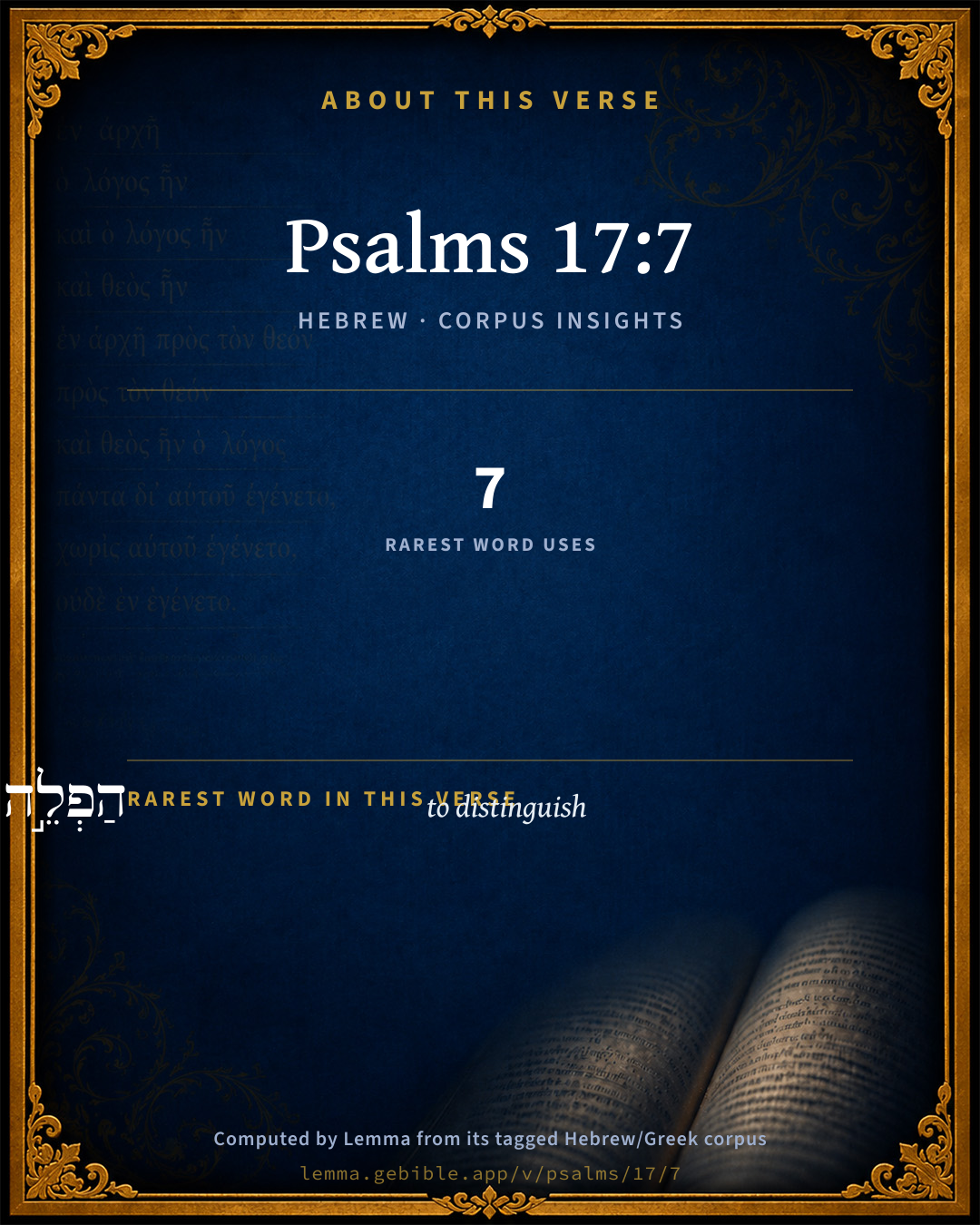
The rarest word here is הַפְלֵ֣ה to distinguish H6395 — appearing just 7 times in the whole Hebrew Bible.

Shared distinctive vocabulary

הַפְלֵ֣ה to distinguish H6395 occurs in 7 verses of the Hebrew Bible. Also found in:

Grammatical profile

  • 4 verbs
  • 2 nouns

Verb forms

  • הַפְלֵ֣ה Hiphil · Imperative
  • מוֹשִׁ֣יעַ Hiphil · Participle Active
  • חוֹסִ֑ים Qal · Participle Active
  • מִ֝מִּתְקוֹמְמִ֗ים Hithpolel · Participle Active

Hebrew & Septuagint length

In English translation the verse runs 19 words from the Hebrew and 14 from the Septuagint (LXX English) — closely comparable.

A rough comparison of the two English renderings, which tokenize alike — not a word-level alignment.

Word counts can differ between the Hebrew and the Greek without any difference in meaning — e.g. the Hebrew direct-object marker אֵת has no separate Greek word, and Greek often adds the article ὁ.

Cross-references

17

Topical passages linked to Psalms 17:7 in the Treasury of Scripture Knowledge — connected by theme and wording, ordered by reader-vote popularity; previews shown in the World English Bible.

  • Psalms 60:5 So that your beloved may be delivered, Save with your right hand, and answer us.
  • Psalms 5:11–12 But let all those who take refuge in you rejoice, Let them always shout for joy, because you defend them. Let them also who love your name be joyful in you.
  • Psalms 20:6 Now I know that Yahweh saves his anointed. He will answer him from his holy heaven, With the saving strength of his right hand.
  • Psalms 31:21 Praise be to Yahweh, For he has shown me his marvelous loving kindness in a strong city.
  • Isaiah 41:10 Don't you be afraid, for I am with you; don't be dismayed, for I am your God; I will strengthen you; yes, I will help you; yes, I will uphold you with the right hand of my righteousness.
  • Exodus 15:6 Your right hand, Yahweh, is glorious in power, Your right hand, Yahweh, dashes the enemy in pieces.
  • 1 Samuel 17:45–57 Then said David to the Philistine, You come to me with a sword, and with a spear, and with a javelin: but I come to you in the name of Yahweh of hosts, the God of the armies of Israel, whom you have defied.
  • 2 Kings 19:34 For I will defend this city to save it, for my own sake, and for my servant David's sake.
  • 2 Chronicles 16:9 For the eyes of Yahweh run back and forth throughout the whole earth, to show himself strong in the behalf of them whose heart is perfect toward him. Herein you have done foolishly; for from henceforth you shall have wars.
  • Psalms 10:12–16 Arise, Yahweh! God, lift up your hand! Don't forget the helpless.
  • Psalms 44:3 For they didn't get the land in possession by their own sword, Neither did their own arm save them; But your right hand, and your arm, and the light of your face, Because you were favorable to them.
  • Romans 5:20–21 The law came in besides, that the trespass might abound; but where sin abounded, grace did abound more exceedingly;
  • Acts 2:33 Being therefore exalted by the right hand of God, and having received from the Father the promise of the Holy Spirit, he has poured out this, which you now see and hear.
  • 1 Samuel 25:28–29 Please forgive the trespass of your handmaid: for Yahweh will certainly make my lord a sure house, because my lord fights the battles of Yahweh; and evil shall not be found in you all your days.
  • 2 Kings 19:22 Whom have you defied and blasphemed? and against whom have you exalted your voice and lifted up your eyes on high? [even] against the Holy One of Israel.
  • Psalms 78:12 He did marvelous things in the sight of their fathers, In the land of Egypt, in the field of Zoan.
  • Revelation 15:3 They sang the song of Moses, the servant of God, and the song of the Lamb, saying, "Great and marvelous are your works, Lord God, the Almighty; Righteous and true are your ways, you King of the nations.

Cross-references courtesy of OpenBible.info (CC BY 4.0).

Hebrew and Greek witnesses Masoretic Hebrew ↔ Greek Septuagint

The same verse in the two great witnesses to the Old Testament, shown verse-for-verse.

You’re reading Greek Psalm 16 (Hebrew Psalm 17). The Septuagint counts the superscription, so verse numbers can differ from the Hebrew — chapter-level alignment, not verse-by-verse. Numbering follows Rahlfs.

These are two independent witnesses, not word-aligned to each other, and the Septuagint is shown in lemma (dictionary) form.

Hebrew Psalms 17:7 Masoretic · Westminster Leningrad Codex

הַפְלֵ֣ה חֲ֭סָדֶיךָ מוֹשִׁ֣יעַ חוֹסִ֑ים מִ֝מִּתְקוֹמְמִ֗ים בִּֽימִינֶֽךָ

Show your marvelous loving kindness, You who save those who take refuge by your right hand from their enemies.

World English Bible · Public Domain

Greek LXX Greek Psalm 16:7 Septuagint · lemma form

θαυμαστόω ὁ ἔλεος σύ ὁ σώζω ὁ ἐλπίζω ἐπί σύ ἐκ ὁ ἀντιἵστημι ὁ δεξιός σύ

Show the marvels of your mercies, you that save them that hope in you.

LXX2012 (modern English Septuagint) · Public Domain

On this verse, Adam Clarke's Commentary discusses the Septuagint’s reading. Read the note in Commentary ↓

Hebrew: Westminster Leningrad Codex (CC BY 4.0). Greek: Septuagint (public domain); English from LXX2012 (modern English Septuagint) (Public Domain). How the Septuagint differs from the Hebrew →

Commentary

Notes on Psalms 17:7 from classic Christian and Jewish commentators (each source and its license shown beneath its notes). The classic Christian expositions comment on the surrounding passage and are grouped to its opening verse, so a note may address several verses; the Jewish commentaries on the Tanakh (Rashi and others) are per-verse, so they appear only where the commentator wrote on this verse.

Lemma curates 59 commentaries, every one of them public domain or Creative Commons licensed, each selected and text-cleaned for this edition rather than reprinted as found. About our sources →

Trapp's Complete Commentary

John Trapp

Psa 17:7 Shew thy marvellous lovingkindness, O thou that savest by thy right hand them which put their trust [in thee] from those that rise up [against them].

Ver. 7. Show thy marvellous lovingkindness, &c] Mirificas benignitates tuas; less than a marvellous mercifulness will not serve David’s turn, he was so hardly bestead; ut nisi mirabiliter feceris, pereo. We now alive have lived in an age of miracles; and God hath dealt with our land, not according to his ordinary course, but according to his prerogative; by a miracle of his mercy have we hitherto subsisted, and by a prop of his extraordinary patience.

O thou that savest, &c.] Servator sperantium. Choice must be made in prayer of fit titles and attributes of God; such as may strengthen faith and quicken affection.

From those that rise up against them] Or, against thy right hand. The saints are at Christ’s right hand, Psa 45:9, as Christ is at the Father’s; and he puts his holy hand between them and harm.

John Trapp, A Commentary or Exposition upon All the Books of the Old and New Testament (1647–1656) — public domain. Text from a community e-Sword module.

Joseph Benson's Commentary

Psa 17:7. Show thy marvellous loving-kindness — Namely, in preserving and delivering me: which, if thou dost, I must ever acknowledge it to be an act of kindness, or free grace and mercy, yea, and of marvellous kindness, because of my extreme and pressing dangers, out of which nothing but a miracle of divine mercy and power can save me; O thou that savest by thy right hand — By thy great power, and needest not the agency of any other; them which put their trust in thee — Or, in it, namely, thy right hand, as was now expressed; from those that rise up against them — Hebrew,

ממתקוממים, me-mithkomemim, from, or, because of, those that exalt themselves, not only against me, but also against thee, who hast engaged and declared thyself for me. But the latter clause of this verse is differently translated in the margin, and, as many eminent interpreters, both ancient and modern, think, more agreeably to the Hebrew text. The reader, therefore, will please to attend to it, and to observe, that rising up against God’s right hand, a sin which, according to that translation, David charges upon his enemies, signifies opposing God’s power, or counsels, whether respecting the exaltation of David, and the Messiah his seed, or any other of his dispensations.

Joseph Benson's Commentary on the Old and New Testaments (1811–1818) — public domain. Text from a community e-Sword module.

J. A. Alexander on Psalms

Joseph Addison Alexander

7. (Psa 17:7) Distinguish thy mercies, (O thou) saving those trusting, from those rising up, with thy right hand. The first verb is the same that occurs in Psa 4:4 (3.) Here, as there, it means to set apart, or single out, but with particular reference to extraordinary favours, implying an unusual necessity. Such mercy is described as perfectly in keeping with the divine mode of action in such cases.—Trusting, seeking refuge, i.e. in God. See above, on Psa 16:1. The same ellipsis may be assumed after rising up, or we may supply against them.—With thy right hand, as the instrument of deliverance. Compare Psa 16:11. These words must be connected in construction with saving.

Joseph Addison Alexander, The Psalms Translated and Explained (1850) — public domain. Text from a community e-Sword module.

Geneva Bible (1599)

Geneva Bible translators

For all rebel against thee, which trouble thy Church.

Geneva Bible (1599) marginal notes — public domain. Text via Bolls.life.

Jamieson, Fausset & Brown

Robert Jamieson, A. R. Fausset & David Brown

Show--set apart as special and eminent (Exo 8:18; Psa 4:3).

thy right hand--for Thy power.

Jamieson, Fausset & Brown — Commentary Critical and Explanatory on the Whole Bible (1871) — public domain (CC PDM 1.0). Text via the HelloAO Bible API.

Adam Clarke's Commentary

Verse 7. Show thy marvellous lovingkindness] David was now exposed to imminent danger; common interpositions of Providence could not save him; if God did not work miracles for him, he must fall by the hand of Saul. Yet he lays no claim to such miraculous interpositions; he expects all from God's lovingkindness.

The common reading here is הפלה חסדיך haphleh chasadeycha, "distinguish thy holy ones;" but הפלא haple, "do wonders," is the reading of about seventy MSS., some ancient editions, with the Septuagint, Vulgate, Chaldee, Syriac, and Arabic. The marginal reading of this verse is nearer the original than that of the text.

Adam Clarke's Commentary on the Bible (1810–1826) — public domain. Text from a community e-Sword/MySword module.

John Calvin's Commentaries

7. Make marvellous thy mercies. As the word הפלה, haphleh, signifies sometimes to make wonderful, or remarkable, and sometimes to separate and set apart, both these senses will be very suitable to this passage. In Psalm 31:19, the “goodness” of God is said to be “laid up” in store as a peculiar treasure “for them that fear him,” that he may bring it forth at the proper season, even when they are brought to an extremity, and when all things seem to be desperate. If, then, the translation, separate and set apart thy mercy, is preferred, the words are a prayer that God would display towards his servant David the special grace which he communicates to none but his chosen ones. While God involves both the good and the bad in danger indiscriminately, he at length shows, by the different issue of things, in regard to the two classes, that he does not confusedly mingle the chaff and the wheat together, seeing he gathers his own people into a company by themselves, (Matthew 3:12, and Matthew 25:32.) I, however, prefer following another exposition. David, in my judgment, perceiving that he could only be delivered from the perilous circumstances in which he was placed by singular and extraordinary means, betakes himself to the wonderful or miraculous power of God. Those who think he desires God to withhold his grace from his persecutors do too great violence to the scope of the passage. By this circumstance there is expressed the extreme danger to which David was exposed; for otherwise it would have been enough for him to have been succoured in the ordinary and common way in which God is accustomed daily to favor and to aid his own people. The grievousness of his distress, therefore, constrained him to beseech God to work miraculously for his deliverance. The title with which he here honors God, O thou preserver of those who trust [in thee,] serves to confirm him in the certain hope of obtaining his requests. As God takes upon him the charge of saving all who confide in him, David being one of their number, could upon good ground assure himself of safety and deliverance. Whenever, therefore, we approach God, let the first thought impressed on our minds be, that as he is not in vain called the preserver of those who trust in him, we have no reason whatever to be afraid of his not being ready to succor us, provided our faith continue firmly to rely upon his grace. And if every way of deliverance is shut up, let us also at the same time remember that he is possessed of wonderful and inconceivable means of succouring us, which serve so much the more conspicuously to magnify and manifest his power. But as the participle trusting, or hoping, is put without any additional word expressing the object of this trust or hope, Poole observes, that the Hebrew phrase for “them which trust,” might be properly rendered without any supplement, “believers.”

Calvin’s rendering is the same as that of the Septuagint, Vulgate, and Syriac versions

John Calvin's Commentaries (1540-1563) — public domain. Text from the Calvin Translation Society English edition (1840s-50s) via the Christian Classics Ethereal Library (ccel.org). Calvin's coverage is partial (roughly two-thirds of the Bible); uncommented books and verses are honest gaps, never fabricated. The 19th-century editor's footnotes and remarks are omitted so the notes are faithfully Calvin's own voice.

Ellicott's Commentary for English Readers

(7) Shew.—Literally, Separate; but (comp. Psa_4:3), from its use to express God’s providential care of Israel in distinction to other nations, acquires in addition the idea of wonder and miracle (Exo_8:22; Exo_9:4; Exo_11:7, &c). The LXX. and Vulgate, “make thy mercies appear wonderful.”

A Bible Commentary for English Readers, edited by Charles John Ellicott (1878–1897) — public domain. Text from a community e-Sword module.

The Cambridge Bible for Schools and Colleges

gen. ed. J. J. S. Perowne

7. Shew thy marvellous lovingkindness] Lit., Make marvellous thy lovingkindnesses: Vulg. mirifica misericordias tuas. Cp. Psa_31:21, and note on Psa_9:1. The word implies a signal intervention on his behalf. The need is great, but God’s power is greater.

Parallel passages decide in favour of connecting O thou that savest by thy right hand (Psa_60:5; Psa_20:6). R.V. follows the original in transferring by thy right hand to the end of the verse for emphasis. But the balanced brevity of the Hebrew (the whole verse contains but six words) defies translation. For put their trust, cp. Psa_16:1; for those that rise up against thee, cp. Psa_59:1, Psa_18:48. Grammatically possible, but unsupported by analogy, is the rendering of R.V. marg., from those that rise up against thy right hand; cp. P.B.V., from such as resist thy right hand, which follows the LXX, Vulg., and Jer. (a resistentibus dexterae tuae).

The Cambridge Bible for Schools and Colleges (gen. ed. J. J. S. Perowne; Cambridge University Press, 1878–1918) — public domain. Text from a community e-Sword module.

John Gill's Exposition

Show thy marvellous loving kindness,.... Such is the lovingkindness of God to his people in Christ; which is sovereign, free, special, distinguishing, everlasting, and unchangeable; it is better than life, and passes knowledge; and which is set upon men and not angels, some and not all, and these many of them the worst and vilest of men, and all of them by nature children of wrath as others; and which has appeared in choosing them in Christ, putting them into his hand, and making a covenant with him for them; in sending him into the world to suffer and die for them; in regenerating, adopting, justifying, pardoning, and saving them with an everlasting salvation; all which is marvellous in their eyes, and will be the wonder of men and angels to all eternity: this sometimes is hidden from the objects of it, as it might be from the psalmist, and therefore he desires a manifestation of it to him; or else his sense is, that God would show to others in what a marvellous manner he loved him, by the help, deliverance, and salvation he would give him. Such a petition will agree with Christ; see Psa 40:10. Some render the words (b), "separate thy lovingkindness", or cause it to pass "from them that rise up on" or "against thy right hand"; but these were never the objects of it; and there is no separation of them from it, nor of that from them who are interested in it, Rom 8:38; much better may it be rendered, "separate" or "distinguish thy lovingkindness" (c); that is, let it appear that I have special interest in thy lovingkindness, distinct from others; distinguish me by thy lovingkindness, remember me with that which thou bearest to a peculiar people, Psa 106:4;

O thou that savest by thy right hand; either by his power, or by the man of his right hand, his own son;

them which put their trust in thee; not in men, not in an arm of flesh, not in themselves, in their own power, wisdom, riches, and righteousness; but in the Lord their God, who is the Saviour of all men, but especially of them that believe, Ti1 4:10; for these he saves both in a temporal and in a spiritual manner;

from those that rise up against them; from all their spiritual enemies, sin and Satan; and from all outward ones, from the men of the world, oppressors and violent persecutors, who are afterwards described: the phrase, "by thy right hand", is by some, as Aben Ezra, connected with the word trust, and rendered, "them which trust in thy right hand" (d); either in the grace, mercy, and favour of God, dispensed by his right hand; or in his strength, and the mighty power of his arm; and by others it is joined to the last clause, and so it stands in the original text, and rendered, "from those that rise up against thy right hand" (e); and so the words describe such persons who in a bold and presumptuous manner set themselves against God, and strengthen themselves against the Almighty; who resist his counsel and will, oppose themselves to the Lord and his Anointed, the man of his right hand, made strong for himself; and to his saints, who are as dear to him as his right hand, and who are preserved by him in the hollow of his hand.

(b) Kimchi & Ben Melech. (c) "separa", Junius & Tremellius; "segrega", Montanus; so some in Vatablus; see Ainsworth. (d) "eos qui fidunt in dextera tua", so some in Vatablus, Castalio, Ainsworth; "recipentes se ad dexteram suam", Junius & Tremellius. (e) "ob insurgentes in dexteram tuam", Pagninus, Montanus, Cocceius; so Michaelis, Gejerus, Musculus.

John Gill's Exposition of the Whole Bible (1746–1763) — public domain (CC PDM 1.0). Text via the HelloAO Bible API.

Albert Barnes' Notes on the Bible

Show thy marvelous loving-kindness - The literal translation of the original here would be, “distinguish thy favors.” The Hebrew word used means properly “to separate; to distinguish;” then, “to make distinguished or great.” The prayer is, that God would separate his mercies on this occasion from his ordinary mercies by the manifestation of greater powers, or by showing him special favor. The ordinary or common mercies which he was receiving at the hand of God would not meet the present case. His dangers were much greater than ordinary, his wants were more pressing than usual; and he asked for an interposition of mercy corresponding with his circumstances and condition. Such a prayer it is obviously proper to present before God; that is, it is right to ask him to suit his mercies to our special necessities; and when special dangers surround us, when we are assailed with especially strong temptations, when we have unusually arduous duties to perform, when we are pressed down with especially severe trials, it is right and proper to ask God to bestow favors upon us which will correspond with our special circumstances. His ability and his willingness to aid us are not measured by our ordinary requirements, but are equal to any of the necessities which can ever occur in our lives.

O thou that savest by thy right hand - Margin, “that savest those that trust in thee from those that rise up against thy right hand.” The Hebrew will admit of either construction, though that in the text is the more correct. It is, literally, “Saving those trusting, from those that rise up, with thy right hand. The idea is, that it was a characteristic of God, or that it was what he usually did, to save by his own power those that trusted him from those who rose up against them. That is, God might be appealed to to do this now, on the ground that he was accustomed to do it; and that, so to speak, he would be acting “in character” in doing it. In other words, we may ask God to do what he is accustomed to do; we may go to him in reference to his well-known attributes and character, and ask him to act in a manner which will be but the regular and proper manifestation of his nature. We could not ask him to do what was contrary to his nature; we cannot ask him to act in a way which would be out of character. What he has always done for people, we may ask him to do for us; what is entirely consistent with his perfections, we may ask him to do in our own case.

By thy right hand - By thy power. The right hand is that by which we execute our purposes, or put forth our power; and the psalmist asks God to put forth his power in defending him. See Isa 41:10; Job 40:14; Psa 89:13.

From those that rise up against them - From their enemies.

Albert Barnes' Notes on the Bible (1834–1885) — public domain. Text from a community e-Sword/MySword module.

Matthew Poole's English Annotations

Thy marvellous loving-kindness, to wit, in preserving and delivering me; which, if thou dost, I must ever acknowledge it to be an act of kindness, or free grace, or undeserved bounty, yea, and of marvellous kindness, because of my extreme and pressing dangers, out of which nothing but a wonder of God’s mercy and power can save me.

By thy right hand, i. e. by thy great power.

In thee, or, in it, i.e. in thy right hand, as was now expressed.

From those that rise up against them; or, because of (as the Hebrew prefix mem oft signifies, as Psa 12:6, and elsewhere) those exalt themselves, (as this word signifies, Job 20:27; 27:7; Psa 49:1) not only against me, but against thee, who hast engaged and declared thyself for me. So this prayer is like that Psa 66:7, Let not the rebellious exalt themselves. But this place is otherwise translated in the margin of our Bibles, with which divers others, both ancient and later interpreters, agree, and that more agreeably to the order of the words in the Hebrew text,

O thou that savest (or usest to save)

them which trust in thee (or, as the Hebrew word may be properly rendered without any supplement, believers) from those that rise up against thy right hand, i.e. either against thy mighty power, which thou hast already showed in my wonderful preservation; or against thy counsel (which is called God’s hand, Act 4:28) and revealed will concerning my advancement to the kingdom, which divers of these men did knowingly oppose, as may be gathered from 2Sa 3:9,10. Or, against the man (which word is oft understood, whereof examples have been given, and more we shall have in this book) of thy right hand, as David is called, Psa 80:17. According to this translation his prayer is enforced with a double motive, to wit, his trust in God, and his enemies’ opposition against God.

Matthew Poole's English Annotations on the Holy Bible (1683–1685) — public domain. Text from a community e-Sword/MySword module.

The Treasury of David

Charles H. Spurgeon

Ver. 7. Shew thy marvellous lovingkindness. Marvellous in its antiquity, its distinguishing character, its faithfulness, its immutability, and above all, marvellous in the wonders which it works. That marvellous grace which has redeemed us with the precious blood of God's only begotten, is here invoked to come to the rescue. That grace is sometimes hidden; the text says, "Shew it." Present enjoyments of divine love are matchless cordials to support fainting hearts. Believer, what a prayer is this! Consider it well. O Lord, shew thy marvellous lovingkindness; shew it to my intellect, and remove my ignorance; shew it to my heart, and revive my gratitude; shew it to my faith, and renew my confidence; shew it to my experience, and deliver me from all my fears. The original word here used is the same which in Ps 4:3 is rendered set apart,and it has the force of, Distinguish thy mercies, set them out, and set apart the choicest to be bestowed upon me in this hour of my severest affliction.

O thou that savest by thy right hand them which put their trust in thee from those that rise up against them. The title here given to our gracious God is eminently consolatory. He is the God of salvation; it is his present and perpetual habit to save believers; he puts forth his best and most glorious strength, using his right hand of wisdom and might, to save all those, of whatsoever rank or class, who trust themselves with him. Happy faith thus to secure the omnipotent protection of heaven! Blessed God, to be thus gracious to unworthy mortals, when they have but grace to rely upon thee! The right hand of God is interposed between the saints and all harm; God is never at a loss for means; his own bare hand is enough. He works without tools as well as with them.

None.

Ver. 7. (first sentence). See Exposition. A view of divine lovingkindness desired.

Ver. 7. O thou, etc. God, the Saviour of believers.

Psalms 17:8*

Charles H. Spurgeon's The Treasury of David (1869–1885) — public domain. Psalms only. Text from a community e-Sword/MySword module.

Whedon's Commentary on the Bible

Daniel D. Whedon

7. Show thy marvellous loving-kindness—Literally, Set apart, distinguish, make honourable, thy loving kindness; work in an extraordinary manner. He would seem to call for some special miracle, but all God’s acts of deliverance are special and wonderful. See Exo_33:16 and Psa_4:3, where “separated” and “set apart” mean, to be made honourable.

Daniel D. Whedon (gen. ed.), Commentary on the Old and New Testaments (1874–1909) — public domain. Text from a community e-Sword module.

The Pulpit Commentary

Show thy marvellous loving kindness, O thou that savest by thy right hand them which put their trust in thee from those that rise up against them. It is uncertain to which clause of the sentence the word belongs. Its position seems to attach it rather to those who resist God than to those who trust in him. See the marginal version, which has, O thou that savest them which trust in thee from those that rise up against thy right hand. But the rendering in the text of the Authorized Version is preferred by most writers.

The Pulpit Commentary (1880–1919), ed. H.D.M. Spence-Jones & Joseph S. Exell — public domain. Text from a community e-Sword module.

John Wesley's Explanatory Notes

By - By thy great power.

John Wesley, Explanatory Notes Upon the Whole Bible (1754–1765) — public domain. Text via the GEBible commentary corpus.

Scofield Reference Notes

C. I. Scofield

trust

(See Scofield "Psa 2:12").

The Scofield Reference Bible (1917 edition), notes by C. I. Scofield — public domain. Text from a community e-Sword module.

Rashi

Rabbi Shlomo Yitzchaki (Rashi)

Distinguish Your kind acts Heb. הפלה, esevre in Old French, to separate, as (in Exod. 33:16): “and I and my people will be distinguished (ונפלינו).” With Your right hand You save those who take refuge in You from those who rise up against them. (This does not appear in manuscripts or in most early editions.) [The literal meaning is:] Distinguish Your kind acts, You Who save those who take refuge, etc. This is a transposed verse, meaning: Distinguish Your kind acts to save with Your right hand those who take refuge, etc.

Rashi on the Tanakh — English translations: “The Judaica Press complete Tanach with Rashi, translated by A. J. Rosenberg” (CC BY 4.0); “Pentateuch with Rashi's commentary by M. Rosenbaum and A.M. Silbermann, 1929-1934” (public domain); “The Metsudah Tanach series, Lakewood, N.J” (CC BY 4.0); and “The Book of Joshua, Metsudah Publications, 1997” (CC BY 4.0). Text via Sefaria.

Radak

Rabbi David Kimhi (Radak)

Make signal: – make distinct, as, “and I will divide (make distinct) in that day” (Exod. 8:18); “and we be separated (made distinct), I and Thy people, from all the people” (ibid, 33:16).

Thy loving-kindnesses, O Thou that savest them that put their trust (in Thee): – He says: Thou, who art a Saviour of them that trust, separate and cause Thy loving-kindnesses to pass

From those that rise up at Thy right hand: – from those men who rise up against Thy right hand, for all know the sovereignty is mine from Thee, and those who are rebelling against me rebel against Thee.

Radak on the Tanakh — English translations: “Sefaria Community Translation” (CC0 1.0 (public-domain dedication)); “Eliyahu Munk, HaChut Hameshulash” (CC BY 4.0); “Rabbi Mike Feuer, Jerusalem Anthology” (CC BY 4.0); and “R. David Kimhi on the first book of Psalms, Translated by R.G. Finch, London, 1919” (public domain). Text via Sefaria.

Lesson kit

Teaching starters — assembled from the data on this page, not authored interpretation. Every prompt links to the verse data it draws on. Edit before teaching.

Psalms, in the Wisdom, opens this verse with 6 words (6 distinct Hebrew lemmas). Its most distinctive word is pâlâh (“to distinguish”). A historical commentator’s framing appears above. Read the whole chapter for the surrounding context.

Discussion questions

  1. The word pâlâh carries the sense “to distinguish.” How does it shape the verse?
  2. How does Exodus 8:22, which shares the word «to distinguish», read alongside this verse?
  3. These translations render this verse differently; the difference is in the English rendering, not the original. What questions does that raise?
  4. «הַפְלֵ֣ה» is a Hiphil Imperative verb. How does that grammatical form shape the action described?
  5. Compare how Trapp's Complete Commentary and Joseph Benson's Commentary read this verse. Where do they agree or differ?

Things to notice

Reading settings

Reading text

Shown beneath each verse's original-language words.

Old Testament
Old Testament edition

Read the OT as the Masoretic Hebrew (MT) or the Greek Septuagint (LXX).

English shown for the Greek Septuagint (in the Hebrew ↔ Greek comparison).

Comparing translations? Open the Compare panel on any verse page to stack up to four side by side.