
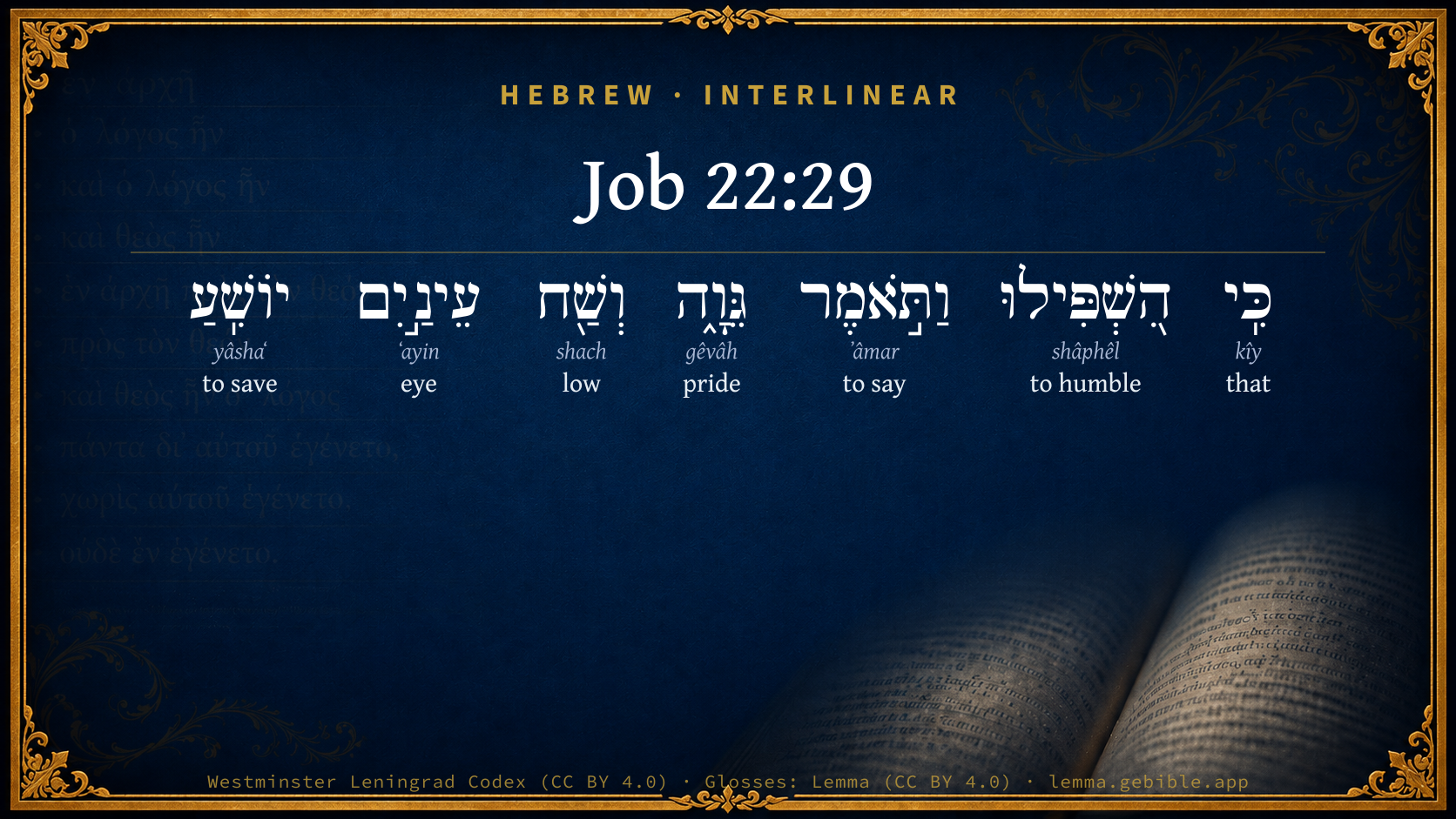
Job 22:29

Hebrew (Westminster Leningrad Codex) Job 22:29 appears in the Hebrew Old Testament. The text above is from the Westminster Leningrad Codex. Each word links to its Strong’s number, a concise gloss, and parsing drawn from the Open Scriptures Hebrew Bible morphology. Click any word for its full Brown-Driver-Briggs (BDB) entry.
Download image
Cite this verse

Job 22:29 (World English Bible). Public Domain. Lemma interlinear Bible study tool, https://lemma.gebible.app/v/job/22/29.

Show BibTeX & RIS
BibTeX
RIS
English Translation
When they cast down, you shall say, 'be lifted up.' He will save the humble person.
World English Bible · Public Domain
Highlights Full analysis ↓
Download a study sheet

One document with this verse’s original text, its word-by-word gloss line, the meaning frame, cross-references with their text, attributed commentary, and full source and license credits — printable, and it pastes into notes with its structure intact.

This verse Autodidact and up

Study sheet (.html) Plain text (.txt)

A passage Seminary Student

Up to 50 verses in one chapter. A passage sheet keeps up to 6 commentary sources and 12 cross-references per verse, in the order this page ranks them, and says so on the sheet whenever that leaves anything out. Ask for a single verse and you get the Autodidact verse sheet above.

Everything on this page stays free to read, with no account — the sheet is a download of what is already on screen, not access to it.

Want to remove ads? Support Godless Engineer
Compare translations 3

The same verse in 3 English versions, stacked beneath the original-language interlinear above. Click any original word for its lexicon entry.

Each is an independent rendering of the whole verse — the interlinear is not word-aligned to these translations.

Highlighted words mark where these versions differ — a whole-verse word diff, not a word-by-word alignment.

  • World English Bible Public Domain
    When they cast down, you shall say, 'be lifted up.' He will save the humble person.
  • King James Version Public Domain
    When men are cast down, then thou shalt say, There is lifting up; and he shall save the humble person.
  • unfoldingWord Literal Text CC BY-SA 4.0
    When they cast down and you say, ‘Lifting up!’ then he will save the lowered of eyes.

unfoldingWord Literal Text — © unfoldingWord, licensed CC BY-SA 4.0. Word-aligned USFM3 via Door43 (git.door43.org/unfoldingWord/en_ult).

Versions to compare (up to 4)

3 of 4 selected

Show all 18 translations

Every available English version of this verse, each an independent rendering of the whole verse.

  • World English Bible Public Domain
    When they cast down, you shall say, 'be lifted up.' He will save the humble person.
  • Berean Standard Bible Public Domain
    When men are brought low and you say, ‘Lift them up!’ then He will save the lowly.
  • Majority Standard Bible Public Domain
    When men are brought low and you say, ‘Lift them up!’ then He will save the lowly.
  • King James Version Public Domain
    When men are cast down, then thou shalt say, There is lifting up; and he shall save the humble person.
  • American Standard Version (1901) Public Domain
    When they cast `thee' down, thou shalt say, `There is' lifting up; And the humble person he will save.
  • Revised Version (1885) Public Domain
    When they cast thee down, thou shalt say, There is lifting up; and the humble person he shall save.
  • Geneva Bible (1599) Public Domain
    When others are cast downe, then shalt thou say, I am lifted vp: and God shall saue the humble person.
  • Douay-Rheims (1899) Public Domain
    For he that hath been humbled, shall be in glory: and he that shall bow down his eyes, he shall be saved.
  • Young's Literal Translation Public Domain
    For they have made low, And thou sayest, `Lift up.' And the bowed down of eyes he saveth.
  • Literal Standard Version CC BY-SA 4.0
    For they have made low, || And you say, Lift up. And He saves the bowed down of eyes.
  • Unlocked Literal Bible CC BY-SA 4.0
    God humbles a proud man, and he saves the one with lowered eyes.
  • unfoldingWord Literal Text CC BY-SA 4.0
    When they cast down and you say, ‘Lifting up!’ then he will save the lowered of eyes.
  • Darby Bible Public Domain
    When they are made low, then thou shalt say, Rise up! and he shall save him that is of downcast eyes.
  • World Messianic Bible Public Domain
    When they cast down, you will say, ‘be lifted up.’ He will save the humble person.
  • Webster's Bible Public Domain
    When men are cast down, then thou shalt say, There is exaltation; and he shall save the humble person.
  • Free Bible Version CC BY-SA 4.0
    When others are humbled, and you say, ‘please help them,’ God will save them.
  • Bible in Basic English Public Domain
    For God makes low those whose hearts are lifted up, but he is a saviour to the poor in spirit.
  • JPS Tanakh (1917) Public Domain
    When they cast thee down, thou shalt say: 'There is lifting up'; for the humble person He saveth.

Literal Standard Version (2020), Covenant Press — licensed CC BY-SA 4.0. Text via the HelloAO Bible API (eBible.org). Unlocked Literal Bible (unfoldingWord) — licensed CC BY-SA 4.0. Text via the HelloAO Bible API (eBible.org). unfoldingWord Literal Text — © unfoldingWord, licensed CC BY-SA 4.0. Word-aligned USFM3 via Door43 (git.door43.org/unfoldingWord/en_ult). Free Bible Version, Dr. Jonathan Gallagher — licensed CC BY-SA 4.0. Text via the HelloAO Bible API (eBible.org).

Word by word

More ways to search: Search by grammar → Find every occurrence → Compare this word →

Practice this passage: Drill this verse → Learn its vocabulary →

About this verse

These counts appear in no published source. They are computed here, from the morphology-tagged text and Lemma’s own curated glosses. What Lemma adds →

7
words
7
distinct lemmas
Wisdom
section

Notable vocabulary

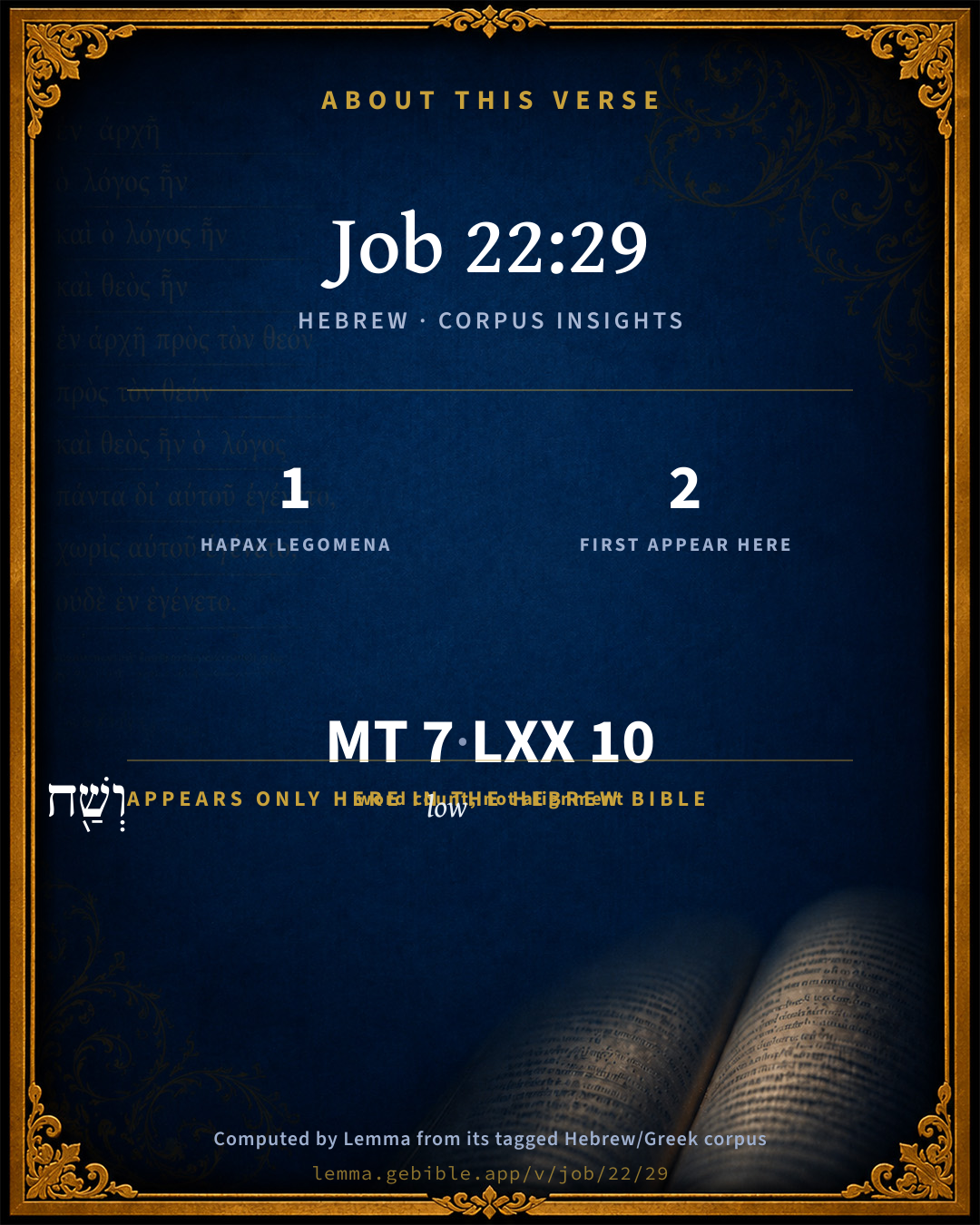
1 hapax legomenon — a word that appears only here in the entire Hebrew Bible:

  • וְשַׁ֖ח low H7807

First appearance in Scripture

These words make their first canonical appearance in the Hebrew Bible here:

  • גֵּוָ֑ה pride H1466
  • וְשַׁ֖ח low H7807

Shared distinctive vocabulary

גֵּוָ֑ה pride H1466 occurs in 3 verses of the Hebrew Bible. Also found in:

Grammatical profile

  • 3 verbs
  • 2 nouns
  • 1 adjective
  • 1 conjunction

Verb forms

  • הִ֭שְׁפִּילוּ Hiphil · Perfect
  • וַתֹּ֣אמֶר Qal · Sequential Imperfect
  • יוֹשִֽׁעַ Hiphil · Imperfect

Hebrew & Septuagint length

In English translation the verse runs 16 words from the Hebrew and 23 from the Septuagint (LXX English) — the Septuagint runs noticeably longer here. See the side-by-side →

A rough comparison of the two English renderings, which tokenize alike — not a word-level alignment.

Word counts can differ between the Hebrew and the Greek without any difference in meaning — e.g. the Hebrew direct-object marker אֵת has no separate Greek word, and Greek often adds the article ὁ.

In the original languages it is 7 Hebrew tokens and 10 Greek tokens — but the two are counted differently (Hebrew bundles its prefixes and suffixes into one token; the Greek is in lemma form), so that isn’t a like-for-like length.

Cross-references

14

Topical passages linked to Job 22:29 in the Treasury of Scripture Knowledge — connected by theme and wording, ordered by reader-vote popularity; previews shown in the World English Bible.

  • Job 5:19–27 He will deliver you in six troubles; Yes, in seven there shall no evil touch you.
  • James 4:6 But he gives more grace. Therefore it says, "God resists the proud, but gives grace to the humble."
  • Luke 1:52 He has put down princes from their thrones. And has exalted the lowly.
  • 1 Peter 5:5 Likewise, you younger ones, be subject to the elder. Yes, all of you gird yourselves with humility, to subject yourselves to one another; for "God resists the proud, but gives grace to the humble."
  • Matthew 23:12 Whoever exalts himself will be humbled, and whoever humbles himself will be exalted.
  • Psalms 91:14–16 "Because he has set his love on me, therefore I will deliver him. I will set him on high, because he has known my name.
  • Psalms 92:9–11 For, behold, your enemies, Yahweh, For, behold, your enemies shall perish. All the evil-doers will be scattered.
  • Isaiah 66:2 For all these things has my hand made, and [so] all these things came to be, says Yahweh: but to this man will I look, even to him who is poor and of a contrite spirit, and who trembles at my word.
  • Luke 18:9–14 He spoke also this parable to certain people who were convinced of their own righteousness, and who despised all others.
  • Proverbs 29:23 A man's pride brings him low, But one of lowly spirit gains honor.
  • Isaiah 57:15 For thus says the high and lofty One who inhabits eternity, whose name is Holy: I dwell in the high and holy place, with him also who is of a contrite and humble spirit, to revive the spirit of the humble, and to revive the heart of the contrite.
  • Luke 14:11 For everyone who exalts himself will be humbled, and whoever humbles himself will be exalted."
  • Psalms 9:2–3 I will be glad and rejoice in you. I will sing praise to your name, O Most High.
  • Psalms 138:6 For though Yahweh is high, yet he looks after the lowly; But the proud, he knows from afar.

Cross-references courtesy of OpenBible.info (CC BY 4.0).

Hebrew and Greek witnesses Masoretic Hebrew ↔ Greek Septuagint

The same verse in the two great witnesses to the Old Testament, shown verse-for-verse.

Here the Septuagint runs noticeably longer than the Hebrew — LXX2012 (modern English Septuagint) 23 words vs World English Bible 16. A rough length comparison of the two English translations, not a word-level alignment — read both below.

These are two independent witnesses, not word-aligned to each other, and the Septuagint is shown in lemma (dictionary) form.

Hebrew Job 22:29 Masoretic · Westminster Leningrad Codex

כִּֽי הִ֭שְׁפִּילוּ וַתֹּ֣אמֶר גֵּוָ֑ה וְשַׁ֖ח עֵינַ֣יִם יוֹשִֽׁעַ

When they cast down, you shall say, 'be lifted up.' He will save the humble person.

World English Bible · Public Domain

Greek LXX Job 22:29 Septuagint · lemma form

ὅτι ταπεινόω αὐτός καί εἶπον ὑπερηφανεύω καί κύφω ὀφθαλμός σώζω

Because you have humbled yourself; and you shall say, Man has behaved proudly, but he shall save him that is of lowly eyes.

LXX2012 (modern English Septuagint) · Public Domain

Hebrew: Westminster Leningrad Codex (CC BY 4.0). Greek: Septuagint (public domain); English from LXX2012 (modern English Septuagint) (Public Domain). How the Septuagint differs from the Hebrew →

Commentary

Notes on Job 22:29 from classic Christian and Jewish commentators (each source and its license shown beneath its notes). The classic Christian expositions comment on the surrounding passage and are grouped to its opening verse, so a note may address several verses; the Jewish commentaries on the Tanakh (Rashi and others) are per-verse, so they appear only where the commentator wrote on this verse.

Lemma curates 59 commentaries, every one of them public domain or Creative Commons licensed, each selected and text-cleaned for this edition rather than reprinted as found. About our sources →

Trapp's Complete Commentary

John Trapp

Job 22:29 When [men] are cast down, then thou shalt say, [There is] lifting up; and he shall save the humble person.

Ver. 29. When men are cast down, then thou shalt say, There is lifting up] And that by the force of thy faith, the nature whereof is to gather one contrary out of another (as life out of death, assurance of deliverance out of deepest distresses, Deu 32:36), and to believe God upon his bare word, and that against sense in things invisible, and against reason in things incredible. Because they are humbled, thou shalt say, Exaltation: and saving of him that boweth his eyes down; whereof some make this to be the sense: Job, attaining to such a blessed change, shall be able out of his own experience to comfort others in misery, who likewise humble themselves. Junius rendereth it and the following verse thus: When men shall have cast down any one, and thou shalt think of his lifting up; then will God save the low of eyes, or him that is low in his own eyes: he will deliver that guilty person, and he shall be delivered by the purity of thy hands; that is, saith he, So great shall his love be to thee, and his blessing upon thee, that for thy sake he shall show mercy to others, though they be none of the best, according to the promise made to Abraham, Gen 12:3; Gen 18:24. And hence Job’s intercession is joined with that of Noah and Daniel, Eze 14:14.

And he shall save the humble person] Heb. Him that is low of eyes, as was Job at this time; and the publican, Luk 18:13. "A high look and a proud heart" go together, Psa 101:5. And as God resisteth such, Jas 4:4 1Pe 5:5, so he giveth grace to the humble; and not grace only, but glory too, as here; safety here, and salvation hereafter.

John Trapp, A Commentary or Exposition upon All the Books of the Old and New Testament (1647–1656) — public domain. Text from a community e-Sword module.

The Biblical Illustrator

Joseph S. Exell

Job_22:29

When men are cast down, then thou shalt say, There is lifting up; and He shall save the humble person.

The humble soul the peculiar favourite of heaven

I. Some account of lowliness and humility. Lowliness being a relative grace, we must consider it in a threefold view.

1. With respect to ourselves. It implies low and underrating thoughts of ourselves. It has in it even a self-abhorrence; but a singleness of heart in the discharge of duty, without vainglory, or pharisaical ostentation.

2. With respect unto others. This has in it a preferring of others above or before ourselves. A looking upon the gifts and graces of others without a grudge. And an affable, courteous carriage toward all.

3. With reference to God. It implies high and admiring thoughts of the majesty of God. When God discovers Himself, the man sinks into nothing in his own esteem. A holy fear and dread of God always on his spirit, especially in his immediate approaches unto the pretence of God, in the duties of worship. An admiring of every expression of the! Divine bounty, and goodness toward men in general, and toward himself in particular. A giving God the glory of all that we are helped to do in His service. A silent resignation unto the will of God, and an acquiescence in the disposals of His providence, let dispensations be never so cross to the inclinations of flesh and blood. The very soul and essence of Gospel humiliation lies in the souls renouncing of itself, going out of itself, and going into and accepting the Lord Jesus Christ as its everlasting all.

II. The humble soul is the peculiar favourite of Heaven. This is evident if we consider--

1. That when the Son of God was here in our nature, He shewed a particular regard unto such.

2. God has such respect unto the humble soul because it is a fruit of His own Spirit inhabiting the soul.

3. This is a disposition that makes the soul like Christ, and the liker that a person be to Christ, God loves Him aye the better.

III. Some marks by which you may try whether you be among the humble and lowly.

1. The lowly soul is one that is many times ashamed to look up to heaven under a sense of his own vileness and unworthiness. He is one that is many times put to wonder that God hath not destroyed him.

2. He is one that is most abased under the receipt of the greatest mercies and sweetest manifestations.

3. He is one that renounces the law as a covenant, and disclaims all pretensions to righteousness from that airth.

4. He is one that has high, raised, and admiring thoughts of Christ, and of His law-abiding righteousness. The humble soul is one that looks on sin as the greatest burden: that values himself of least, when others value him most; that is not puffed up with the falls of others: that is thankful for little, and content and desirous to know Gods will, that he may do it.

IV. Some motives to press and recommend this lowliness and humility of spirit. It assimilates the soul to Christ. It is the distinguishing character of a Christian. Consider how reasonable this lowliness and humility of soul is--whether we look to ourselves in particular or the evils of the land or day wherein we live. (E. Erskine.)

The ministry of fellow helpfulness

Poverty, anxieties, pain, suffering, oppressions, errors, sins, sadnesses, we move among these day by day. Be we high born or lowly, live we in palace or hut, these experiences greet us, and make their appeal to us. What is to be our bearing in relation to all this? How are We to conduct ourselves amid such surroundings? There are two courses open to us--the selfish and the sympathetic. We may shut ourselves up in a spirit of selfish isolation and say, Other peoples affairs are nothing to me. We have the power so to choose and act. Of course we take the consequences such conduct involves. That we cannot escape. There is, however, the truer, manlier, Christlier course of brotherly sympathy, kindly feeling, sympathetic helpfulness. Going among men cast down by their surroundings and tendencies, their sins and their sorrows, we may say even to those lowest down, There is lifting up for you. Such a bearing as this is in keeping with all the noblest instincts of our nature. A selfish, unsympathetic man is unnatural. He has got a twist. But we love the unselfish, the sympathetic, the helpful. This spirit and bearing religion ever enforces and promotes. It is a vital part of religion. A selfish Christian is a contradiction. The godly man should be an embodied Gospel of hope wherever he goes. The mission of the Lord Jesus lay along this line. He came to men as the great hope bringer. He has made the world transcendently richer by the hope inspirations that pervaded His teaching. Down through the ages, under the same inspiration, Christly men have moved among their follows as hope bringers. (Ralph M. Spoor.)

Delight in the Lord

These words describe the sacred pleasures of piety.

I. The sublimity of its nature. The saints delight--

1. In the saving knowledge of God.

2. In the present enjoyment of God.

3. In the future anticipation of God.

II. The Divinity of its origin. In the Almighty.

1. The Almighty is suited to our capacities.

2. The Almighty is adequate to our necessities.

3. The Almighty is durable as our existence.

III. The tendency of its influence. Thou shalt lift up thy face unto God. The effects which accompany spiritual joy, distinguish it from mere enthusiastic delusion, and demonstrate both the genuineness and efficacy of experimental religion in them that believe.

1. They exercise confidence in God.

2. They enjoy communion with God.

3. They maintain obedience to God. (Sketches of Four Hundred Sermons.)

.

The Biblical Illustrator, edited by Joseph S. Exell (c. 1880s–1900s) — public domain. Text from a community e-Sword module.

Tyndale Open Study Notes

Tyndale Open Resources

22:29 This difficult text probably conveys the effectiveness of a righteous man’s prayer. The principle (Pss 34:15, 17; 145:18; Prov 15:8, 29; Jas 5:16) is illustrated throughout Scripture (see, e.g., Gen 18:23-32; 19:29; 20:7, 17; 32:28; Exod 9:28-32; 17:11; 32:10-14; Rom 5:19).

Tyndale Open Study Notes — © Tyndale Open Resources, licensed CC BY-SA 4.0. Text via the HelloAO Bible API.

Geneva Bible (1599)

Geneva Bible translators

God will deliver his when the wicked are destroyed round about them, as in the flood and in Sodom.

Geneva Bible (1599) marginal notes — public domain. Text via Bolls.life.

Jamieson, Fausset & Brown

Robert Jamieson, A. R. Fausset & David Brown

Rather, When (thy ways; from Job 22:28) are cast down (for a time), thou shalt (soon again have joyful cause to) say, There is lifting up (prosperity returns back to me) [MAURER].

he--God.

humble--Hebrew, "him that is of low eyes." Eliphaz implies that Job is not so now in his affliction; therefore it continues: with this he contrasts the blessed effect of being humble under it (Jam 4:6; Pe1 5:5 probably quote this passage). Therefore it is better, I think, to take the first clause as referred to by "God resisteth the proud." When (men) are cast down, thou shalt say (behold the effects of) pride. Eliphaz hereby justifies himself for attributing Job's calamities to his pride. "Giveth grace to the humble," answers to the second clause.

Jamieson, Fausset & Brown — Commentary Critical and Explanatory on the Whole Bible (1871) — public domain (CC PDM 1.0). Text via the HelloAO Bible API.

Adam Clarke's Commentary

Verse 29. When men are cast down] There is a great difficulty in this verse; the sense, however, is tolerably evident, and the following is nearly a literal version: When they shall humble themselves, thou shalt say, Be exalted, or, there is exaltation: for the down-cast of eye he will save. The same sentiment as that of our Lord, "He that exalteth himself shall be abased; but he that humbleth himself shall be exalted."

Adam Clarke's Commentary on the Bible (1810–1826) — public domain. Text from a community e-Sword/MySword module.

Ellicott's Commentary for English Readers

(29) There is lifting up.—This may be its meaning, but some understand it in a bad sense: “When men are cast down, then thou shalt say, It was pride that caused their fall.”

A Bible Commentary for English Readers, edited by Charles John Ellicott (1878–1897) — public domain. Text from a community e-Sword module.

The Cambridge Bible for Schools and Colleges

gen. ed. J. J. S. Perowne

29. When men are cast down] The words must mean either: when they (i. e. thy ways, Job_22:28) go downwards, when decline or misfortune befalls thee; or, when men cast thee down.

there is lifting up] The word “lifting up” or simply, “Up!” is that which Job shall utter in prayer. The “humble person,” lit. him that is lowly of eyes, is of course Job himself.

The Cambridge Bible for Schools and Colleges (gen. ed. J. J. S. Perowne; Cambridge University Press, 1878–1918) — public domain. Text from a community e-Sword module.

John Gill's Exposition

He shall deliver the island of the innocent,.... But where is there such an island, an island of innocent persons? it seems to be better rendered by others, "the innocent shall deliver the island" (s): good men are sometimes, by their counsel and advice, and especially by their prayers, the means of delivering an island or country from ruin and destruction: but the word rendered "island" is a negative particle, as in Sa1 4:21; and signifies "not"; and so in the Targum; which is

"a man that is not innocent shall be delivered:''

in like manner Jarchi interprets it, and so do Noldius (t) and others (u); and the sense is, that Job, for he is the person spoken of, as appears from the following clause, should not only be beneficial by his prayers, to humble and good men, but even to the wicked, such as were not innocent and free from fault and punishment, but guilty, and obnoxious to wrath and ruin; and yet such should escape it, at least for the present, through the prayers and intercession of Job; or God should do this for Job's sake and his prayers:

and it is, or "he is"

delivered by the pureness of thine hands; either by his good works, setting a good example, which, being followed, would be the means of the prevention of present ruin; or by his lifting up pure and holy hands in prayer to God for a sinful people; which God often attends to and hears, and so delivers them from destruction; as the Israelites were delivered through the prayer of Moses, when they had made the golden calf, and worshipped it; see Psa 106:19; though sometimes God will not admit of an intercessor for such persons, Eze 14:20.

(s) "innocens insulam liberabit", Montanus; so Pagninus, Vatablus. (t) Concordant. Ebr. Part. p. 25. No. 135. (u) "non innocentem", Drusius, Piscator, Michaelis; "non insontem", Schultens; to the same sense Beza, Mercerus, Codurcus, Junius, & Tremellius.

Next: Job Chapter 23

John Gill's Exposition of the Whole Bible (1746–1763) — public domain (CC PDM 1.0). Text via the HelloAO Bible API.

Albert Barnes' Notes on the Bible

When men are cast down - The meaning of this is, probably, when people are usually cast down, or in the times of trial and calamity, which prostrate others, you shall find support. You shall then be enabled to say, “there is lifting up, or there is support.” Or, more probably still, it may mean, “in times when others are cast down and afflicted, thou shalt be able to raise them up, or to aid them. Thou shalt be able to go to them and say, ‘Be of good cheer. Do not be cast down. There is consolation.’ And thou shalt be able to procure important blessings for them by thy counsels and prayers;” see the notes at Job 22:30.

And he shall save the humble person - That is, either, “Thou shalt save the humble person,” by a change from the second person to the third, which is not uncommon in Hebrew; or, “thou shalt be able from thine own experience to say, “He,” that is, “God,” will save the humble person, or the one that is cast down.” Margin, “him that hath low eyes.” The Hebrew is like the margin. In affliction the eyes are cast upon the ground; and so, also, a casting the eyes to the ground is indicative of dejection, of humility, or of modesty. It refers here to one who experiences trials; and Eliphaz says that Job would be able to save such an one; that is, to support him in his afflictions, and furnish the helps necessary to restore him again to comfort.

Albert Barnes' Notes on the Bible (1834–1885) — public domain. Text from a community e-Sword/MySword module.

Haydock's Catholic Bible Commentary

Glory, as the gospel declares, Matthew xxiii. 12. The Hebrew is more perplexed. "When men are cast down, then thou shalt say, there is lifting up;" (Protestants; Haydock) or "when thy eyes shall be cast down, they shall say to thee, Arise." (Calmet)

George Leo Haydock (1774–1849), Haydock's Catholic Family Bible and Commentary, 1859 edition — public domain. Excludes Psalms (Douay-Rheims chapter numbering differs from Protestant) and Deuterocanonical books (Catholic canon only).

Matthew Poole's English Annotations

When men are cast down, Heb. When they (i.e. they who do this work. It is an indefinite and impersonal speech, which is very common in the Hebrew language) shall cast down or overthrow; either,

1. Proud and wicked men, as may be guessed by the opposition of the humble and innocent, who should be saved, whilst these were destroyed. So the sense is, When there shall come a general calamity, which shall sweep away all the wicked round about them. Or,

2. Thee, or thine; which pronoun is oft understood. So the sense is, When through God’s permission thou shalt be brought into some trouble, which God sees fit for thee.

Thou shalt say within thyself, with good assurance and confidence.

There is lifting up; or, There shall be lifting up, either,

1. For them; if they repent and humble themselves, they shall be preserved or restored. And this thou wilt assure them of from thy own experience. Or,

2. For thee and thine; God will deliver thee, when others are crushed and destroyed. And; or, for; this particle being oft put causally, as hath been formerly noted. So the following words contain a reason why he might confidently say, that there would be such a lifting up for a person so humbled.

He, i.e. God, unto whom only salvation belongeth, Psa 3:8.

Shall save; either,

1. Eternally; or,

2. Temporally, to wit, from the evils here mentioned.

The humble person, Heb. him that hath low or cast-down eyes; which phrase may here note, either,

1. Humility and lowliness of mind and disposition, as pride is oft expressed by high or lofty looks, as Psa 18:27; 101:5; 131:1; Pro 6:17. And so this is a tacit admonition and reproof for Job, whom for his confident justification of himself, and his contemptuous expressions and censures concerning them, they judged to Job guilty of intolerable pride of heart. Or,

2. Lowness of estate or condition, as Jam 1:10. So it notes him whose eyes and countenance are dejected by reason of his great troubles and miseries; as, on the contrary, prosperity makes persons lift up their eyes and faces.

Matthew Poole's English Annotations on the Holy Bible (1683–1685) — public domain. Text from a community e-Sword/MySword module.

Whedon's Commentary on the Bible

Daniel D. Whedon

29. Lifting up — Words of cheer; “upwards,” “forwards,” or, as Gesenius has it: “Thou commandest lifting up.” Omit there is. The words of the man of God are words of consolation and of power. The sorrowful are lifted up, and God. saves “the humble person” — literally, the meek of eye.

Daniel D. Whedon (gen. ed.), Commentary on the Old and New Testaments (1874–1909) — public domain. Text from a community e-Sword module.

The Pulpit Commentary

When men are cast down, then thou shalt say, There is lifting up; rather, when men cast downand thou shalt say, Let there be lifting up; i.e. when oppressors have cast a man down, and thou appealest to God, and prayest for his lifting up, then he (i.e. God) shall save the humble person. God shall hear thy, prayer, and the oppressed person shall be rescued and saved.

Uplifting the fallen.

Accepting that rendering of the verse which takes the reference to the cast-down as not applying to Job himself or his affairs, but to other people and their troubles, we have here a fine turn given to the description of the happy estate of the returned and restored penitent. He is not only full of gladness, and enjoying many blessings by himself; he turns to others in their need and uplifts them.

I THE DUTY AND JOY OF UPLIFTING THE FALLEN.

1. The duty. We are by nature members of one family, because our descent from a common parentage makes us all brothers and sisters. But Christianity has strengthened the ties of nature. There is no Christian duty so obligatory as that of following our Lord in his greatest work that of seeking and saving the lost. Whether it be sin or sorrow that has east one of our brothers down, his very distress, apart from all questions of merit or attraction, calls upon us to aid him.

(1) Now this aid must be practical. We must do what we can to lift the cast-down.

(2) It must be encouraging. The helper is represented as crying, "Up!" A cheering word may go far to give courage and hope. We have to help people to help themselves. Depressing preaching does little good. There are plenty of things to discourage. People want hopeful encouragement.

2. The joy. This action of lifting up those who are cast down appears as part of the blessedness of the restored servant of God. It is not a heavy penance for the sinner; it is a happy occupation for the saint. It cannot but involve toil and pain, and often disappointment. Yet it is really a much happier work than self indulgent pleasure-seeking. It contains the very joy of God, who is blessed in giving and loving.

II THE EXPERIENCE WHICH ENABLES US TO LIFT UP THE FALLEN. The glorious and Christ-like work of saving the fallen is promised to a man who is himself restored.

1. Experience of misery. He who has been cast down knows what it is to be cast down. The lessons of adversity teach sympathy. Thus we may explain some of the mystery of sorrow. It is a school for the training of sympathy. Even the experience of sin may be turned to good in this way. It must always be best not to have fallen. Still, though original innocence cannot be recovered, God may mitigate the sad consequences of sin in the penitent by making him a helper to the tempted and the fallen, whose condition his own terrible experience enables him to understand.

2. Experience of recovery. While suffering with others we may sympathize with them, but we cannot do much to aid them. While ourselves living in sin we can only exert a baleful influence on others. Therefore the first step is to be ourselves restored to God and the life of Christian holiness. Then the joyous consciousness of redemption is an inspiration for seeking to bring to others the same privilege. Thus Christians can preach the gospel with a force that no unfallen angel can command. The greatest argument for urging man to accept it is that what God has done for one, he can and will do for another. The greatest motive for sacrificing ourselves to save our brother-men is that Christ gave his life to save us. W.F.A.

The Pulpit Commentary (1880–1919), ed. H.D.M. Spence-Jones & Joseph S. Exell — public domain. Text from a community e-Sword module.

John Wesley's Explanatory Notes

Cast down - All round about thee, in a time of general calamity. There is - God will deliver thee. He - God.

John Wesley, Explanatory Notes Upon the Whole Bible (1754–1765) — public domain. Text via the GEBible commentary corpus.

unfoldingWord translationNotes

Door43 World Missions Community

Connecting Statement:

This concludes Eliphaz's speech to Job.

the one with lowered eyes

Here "lowered eyes" refers to humility. AT: "the humble person" (See: Idiom)

He will rescue even the man who is not innocent; who will be rescued through the cleanness of your hands

Job being innocent is spoken of as if his hands were physically clean. The phrase "who will be rescued" can be stated in active form. AT: "Yahweh will rescue even the person who is not innocent because you do what is right" (See: Metaphor and Active or Passive)

He will rescue even the man who is not innocent; who will be rescued through the cleanness of your hands

Some versions of the Bible read, "He rescues the innocent person; so he will rescue you when your hands are clean"

translationWords

humble

proud

save

innocent

clean

hand

unfoldingWord translationNotes — © Distant Shores Media and the Door43 World Missions Community, licensed CC BY-SA 4.0. Source: git.door43.org/Door43/en_tn.

Rashi

Rabbi Shlomo Yitzchaki (Rashi)

If they are humble If you see your generation humble, pledge that it be uplifted, and it will be uplifted.

a humble person [One who is humbled] by the trouble that befalls [him] because of his iniquity,

God will save through your hands and through your prayer.

Rashi on the Tanakh — English translations: “The Judaica Press complete Tanach with Rashi, translated by A. J. Rosenberg” (CC BY 4.0); “Pentateuch with Rashi's commentary by M. Rosenbaum and A.M. Silbermann, 1929-1934” (public domain); “The Metsudah Tanach series, Lakewood, N.J” (CC BY 4.0); and “The Book of Joshua, Metsudah Publications, 1997” (CC BY 4.0). Text via Sefaria.

Lesson kit

Teaching starters — assembled from the data on this page, not authored interpretation. Every prompt links to the verse data it draws on. Edit before teaching.

Job, in the Wisdom, opens this verse with 7 words (7 distinct Hebrew lemmas). Its most distinctive word is shach (“low”). The Greek Septuagint runs longer here. A historical commentator’s framing appears above. Read the whole chapter for the surrounding context.

Discussion questions

  1. What does “low” (shach) contribute to the verse as a whole?
  2. This verse holds 1 word here found nowhere else in the Hebrew Bible. What might the rare word draw attention to?
  3. 2 words here appear for the first time in Scripture. What is being introduced at this debut?
  4. Job 33:17 shares the word «pride» with this verse. How do the two illuminate each other?
  5. Compared with the Hebrew, the Septuagint runs longer here. What questions does that raise?
  6. The translations on this page render this verse differently — a whole-verse word diff, not a word-by-word alignment. What might account for the different wordings?
  7. The verb «הִ֭שְׁפִּילוּ» is Hiphil Perfect. How does its form color the action?
  8. Reading how Trapp's Complete Commentary and The Biblical Illustrator read this verse, where do the two commentators agree and where do they part?

Things to notice

Reading settings

Reading text

Shown beneath each verse's original-language words.

Old Testament
Old Testament edition

Read the OT as the Masoretic Hebrew (MT) or the Greek Septuagint (LXX).

English shown for the Greek Septuagint (in the Hebrew ↔ Greek comparison).

Comparing translations? Open the Compare panel on any verse page to stack up to four side by side.