
Isaiah 46:7

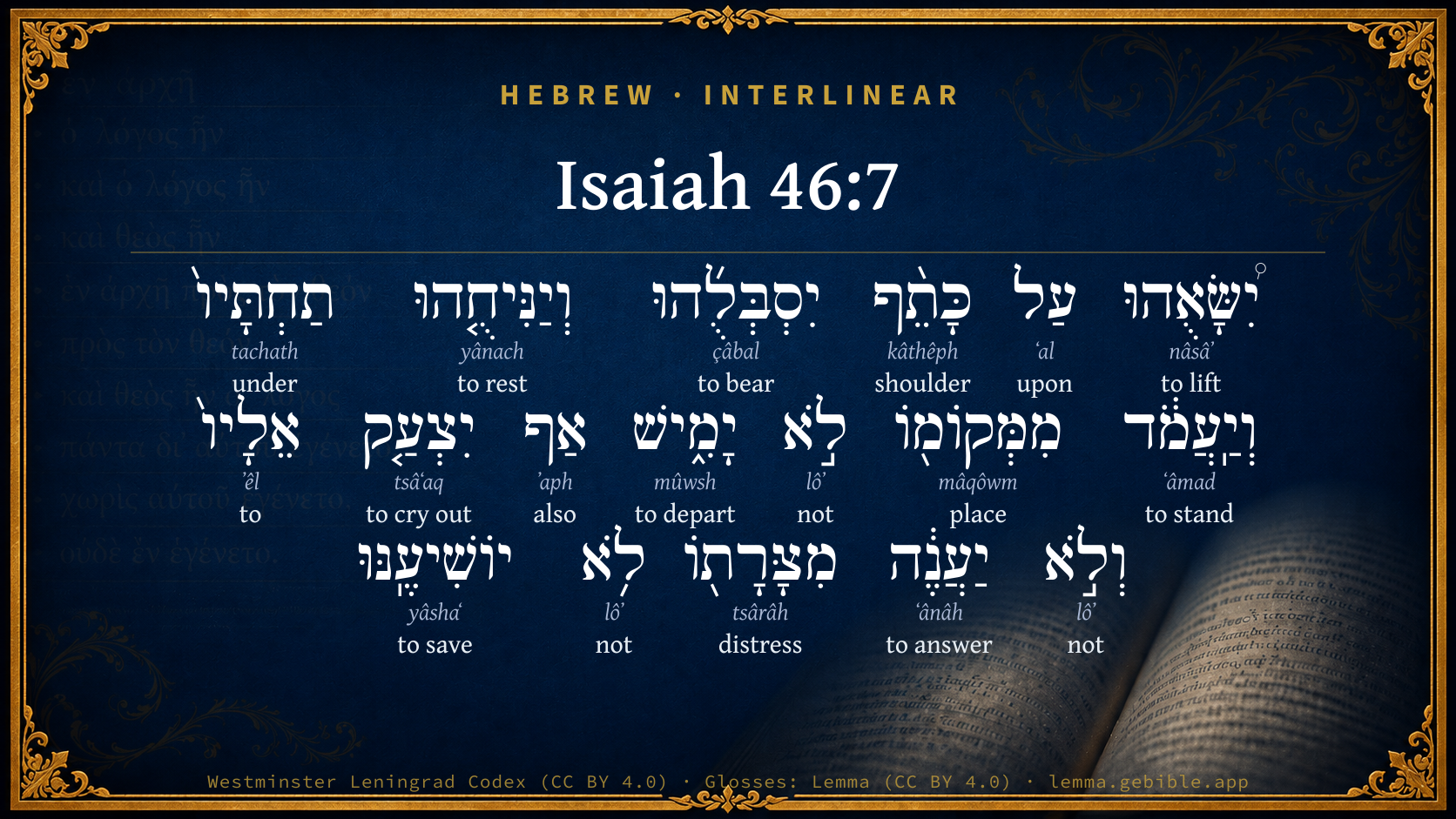
Hebrew (Westminster Leningrad Codex) Isaiah 46:7 appears in the Hebrew Old Testament. The text above is from the Westminster Leningrad Codex. Each word links to its Strong’s number, a concise gloss, and parsing drawn from the Open Scriptures Hebrew Bible morphology. Click any word for its full Brown-Driver-Briggs (BDB) entry.
Download image
Cite this verse

Isaiah 46:7 (World English Bible). Public Domain. Lemma interlinear Bible study tool, https://lemma.gebible.app/v/isaiah/46/7.

Show BibTeX & RIS
BibTeX
RIS
English Translation
They bear it on the shoulder, they carry it, and set it in its place, and it stands, from its place it shall not move: yes, one may cry to it, yet it can not answer, nor save him out of his trouble.
World English Bible · Public Domain
Download a study sheet

One document with this verse’s original text, its word-by-word gloss line, the meaning frame, cross-references with their text, attributed commentary, and full source and license credits — printable, and it pastes into notes with its structure intact.

This verse Autodidact and up

Study sheet (.html) Plain text (.txt)

A passage Seminary Student

Up to 50 verses in one chapter. A passage sheet keeps up to 6 commentary sources and 12 cross-references per verse, in the order this page ranks them, and says so on the sheet whenever that leaves anything out. Ask for a single verse and you get the Autodidact verse sheet above.

Everything on this page stays free to read, with no account — the sheet is a download of what is already on screen, not access to it.

Want to remove ads? Support Godless Engineer
Compare translations 3

The same verse in 3 English versions, stacked beneath the original-language interlinear above. Click any original word for its lexicon entry.

Each is an independent rendering of the whole verse — the interlinear is not word-aligned to these translations.

Highlighted words mark where these versions differ — a whole-verse word diff, not a word-by-word alignment.

  • World English Bible Public Domain
    They bear it on the shoulder, they carry it, and set it in its place, and it stands, from its place it shall not move: yes, one may cry to it, yet it can not answer, nor save him out of his trouble.
  • King James Version Public Domain
    They bear him upon the shoulder, they carry him, and set him in his place, and he standeth; from his place shall he not remove: yea, one shall cry unto him, yet can he not answer, nor save him out of his trouble.
  • unfoldingWord Literal Text CC BY-SA 4.0
    They lift it onto a shoulder, they bear it, and they put it under itself, and it stands; it does not depart from its place. Indeed, one cries out to it, but it does not answer; it does not save him from his trouble. q1

unfoldingWord Literal Text — © unfoldingWord, licensed CC BY-SA 4.0. Word-aligned USFM3 via Door43 (git.door43.org/unfoldingWord/en_ult).

Versions to compare (up to 4)

3 of 4 selected

Show all 18 translations

Every available English version of this verse, each an independent rendering of the whole verse.

  • World English Bible Public Domain
    They bear it on the shoulder, they carry it, and set it in its place, and it stands, from its place it shall not move: yes, one may cry to it, yet it can not answer, nor save him out of his trouble.
  • Berean Standard Bible Public Domain
    They lift it to their shoulder and carry it along; they set it in its place, and there it stands, not budging from that spot. They cry out to it, but it does not answer; it saves no one from his troubles.
  • Majority Standard Bible Public Domain
    They lift it to their shoulder and carry it along; they set it in its place, and there it stands, not budging from that spot. They cry out to it, but it does not answer; it saves no one from his troubles.
  • King James Version Public Domain
    They bear him upon the shoulder, they carry him, and set him in his place, and he standeth; from his place shall he not remove: yea, one shall cry unto him, yet can he not answer, nor save him out of his trouble.
  • American Standard Version (1901) Public Domain
    They bear it upon the shoulder, they carry it, and set it in its place, and it standeth, from its place shall it not remove: yea, one may cry unto it, yet can it not answer, nor save him out of his trouble.
  • Revised Version (1885) Public Domain
    They bear him upon the shoulder, they carry him, and set him in his place, and he standeth; from his place shall he not remove: yea, one shall cry unto him, yet can he not answer, nor save him out of his trouble.
  • Geneva Bible (1599) Public Domain
    They beare it vpon the shoulders: they carie him and set him in his place: so doeth he stand, and cannot remoue from his place. Though one crie vnto him, yet can he not answere, nor deliuer him out of his tribulation.
  • Douay-Rheims (1899) Public Domain
    They bear him on their shoulders and carry him, and set him in his piece, and he shall stand, and shall not stir out of his place. Yea, when they shall cry also unto him, he shall not hear: he shall not save them from tribulation.
  • Young's Literal Translation Public Domain
    They lift him up on the shoulder, They carry him, and cause him to rest in his place, And he standeth, from his place he moveth not, Yea, one crieth unto him, and he answereth not, From his adversity he saveth him not.
  • Literal Standard Version CC BY-SA 4.0
    They lift him up on the shoulder, || They carry him, and cause him to rest in his place, || And he stands, he does not move from his place, || Indeed, one cries to him, and he does not answer, || He does not save him from his adversity.
  • Unlocked Literal Bible CC BY-SA 4.0
    They lift it on their shoulder and carry it; they set it in its place, and it stands in its place and does not move from it. They cry out to it, but it cannot answer nor save anyone from his trouble.
  • unfoldingWord Literal Text CC BY-SA 4.0
    They lift it onto a shoulder, they bear it, and they put it under itself, and it stands; it does not depart from its place. Indeed, one cries out to it, but it does not answer; it does not save him from his trouble. q1
  • Darby Bible Public Domain
    They bear him on the shoulder, they carry him, and set him in his place; there he standeth, he doth not remove from his place: yea, one crieth unto him, and he answereth not; he saveth him not out of his trouble.
  • World Messianic Bible Public Domain
    They bear it on their shoulder. They carry it, and set it in its place, and it stands there. It cannot move from its place. Yes, one may cry to it, yet it can not answer. It cannot save him out of his trouble.
  • Webster's Bible Public Domain
    They bear him upon the shoulder, they carry him, and set him in his place, and he standeth; from his place shall he not remove: yes, one shall cry to him, yet he cannot answer, nor save him out of his trouble.
  • Free Bible Version CC BY-SA 4.0
    They lift the idol onto their shoulders, carry it along, and then put it in place. It stays there and doesn't move. Even when people cry out to it for help, it doesn't answer—it can't save them from their troubles.
  • Bible in Basic English Public Domain
    They put him on their backs, and take him up, and put him in his fixed place, from which he may not be moved; if a man gives a cry for help to him, he is unable to give an answer, or get him out of his trouble.
  • JPS Tanakh (1917) Public Domain
    He is borne upon the shoulder, he is carried, and set in his place, and he standeth, from his place he doth not remove; yea, though one cry unto him, he cannot answer, nor save him out of his trouble.

Literal Standard Version (2020), Covenant Press — licensed CC BY-SA 4.0. Text via the HelloAO Bible API (eBible.org). Unlocked Literal Bible (unfoldingWord) — licensed CC BY-SA 4.0. Text via the HelloAO Bible API (eBible.org). unfoldingWord Literal Text — © unfoldingWord, licensed CC BY-SA 4.0. Word-aligned USFM3 via Door43 (git.door43.org/unfoldingWord/en_ult). Free Bible Version, Dr. Jonathan Gallagher — licensed CC BY-SA 4.0. Text via the HelloAO Bible API (eBible.org).

Word by word

More ways to search: Search by grammar → Find every occurrence → Compare this word →

Practice this passage: Drill this verse → Learn its vocabulary →

יִסְבְּלֻ֜הוּ
çâbal
H5445
“to bear · him”
Verb, Qal, Imperfect, 3rd Person, Masculine, Plural + Suffix, Personal, 3rd Person, Masculine, Singular
Part of Speech
Verb
Stem
Qal
Form
Imperfect
Person
3rd Person
Gender
Masculine
Number
Plural
Full BDB Definition

Origin: a primitive root

TWOT: 1458

to bear, bear a load, drag oneself along - (Qal) to bear (a load) - (Pual) laden (participle) - (Hithpael) to make oneself a burden, drag oneself along
  1. יִ֠שָּׂאֻהוּ nâsâʼ H5375 “to lift · him” Verb, Qal, Imperfect, 3rd Person, Masculine, Plural + Suffix, Personal, 3rd Person, Masculine, Singular
  2. עַל ʻal H5921 “upon” Preposition
  3. כָּתֵ֨ף kâthêph H3802 “shoulder” Noun, Common, Feminine, Singular, Absolute
  4. וְיַנִּיחֻ֤הוּ yânach H3240 “and · to rest · him” Conjunction + Verb, Hiphil, Imperfect, 3rd Person, Masculine, Plural + Suffix, Personal, 3rd Person, Masculine, Singular
  5. תַחְתָּיו֙ tachath H8478 “under · him” Preposition + Suffix, Personal, 3rd Person, Masculine, Singular
  6. וְיַֽעֲמֹ֔ד ʻâmad H5975 “and · to stand” Conjunction + Verb, Qal, Imperfect, 3rd Person, Masculine, Singular
  7. מִמְּקוֹמ֖וֹ mâqôwm H4725 “from · place · his” Preposition + Noun, Common, Masculine, Singular, Construct + Suffix, Personal, 3rd Person, Masculine, Singular
  8. לֹ֣א lôʼ H3808 “not” Particle, Negative
  9. יָמִ֑ישׁ mûwsh H4185 “to depart” Verb, Qal, Imperfect, 3rd Person, Masculine, Singular
  10. אַף ʼaph H637 “also” Particle, Accusative
  11. יִצְעַ֤ק tsâʻaq H6817 “to cry out” Verb, Qal, Imperfect, 3rd Person, Masculine, Singular
  12. אֵלָיו֙ ʼêl H413 “to · him” Preposition + Suffix, Personal, 3rd Person, Masculine, Singular
  13. וְלֹ֣א lôʼ H3808 “and · not” Conjunction + Particle, Negative
  14. יַעֲנֶ֔ה ʻânâh H6030 “to answer” Verb, Qal, Imperfect, 3rd Person, Masculine, Singular
  15. מִצָּרָת֖וֹ tsârâh H6869 “from · distress · his” Preposition + Noun, Common, Feminine, Singular, Construct + Suffix, Personal, 3rd Person, Masculine, Singular
  16. לֹ֥א lôʼ H3808 “not” Particle, Negative
  17. יוֹשִׁיעֶֽנּוּ yâshaʻ H3467 “to save · him” Verb, Hiphil, Imperfect, 3rd Person, Masculine, Singular + Suffix, Personal, 3rd Person, Masculine, Singular

About this verse

These counts appear in no published source. They are computed here, from the morphology-tagged text and Lemma’s own curated glosses. What Lemma adds →

18
words
16
distinct lemmas
Prophets
section

Notable vocabulary

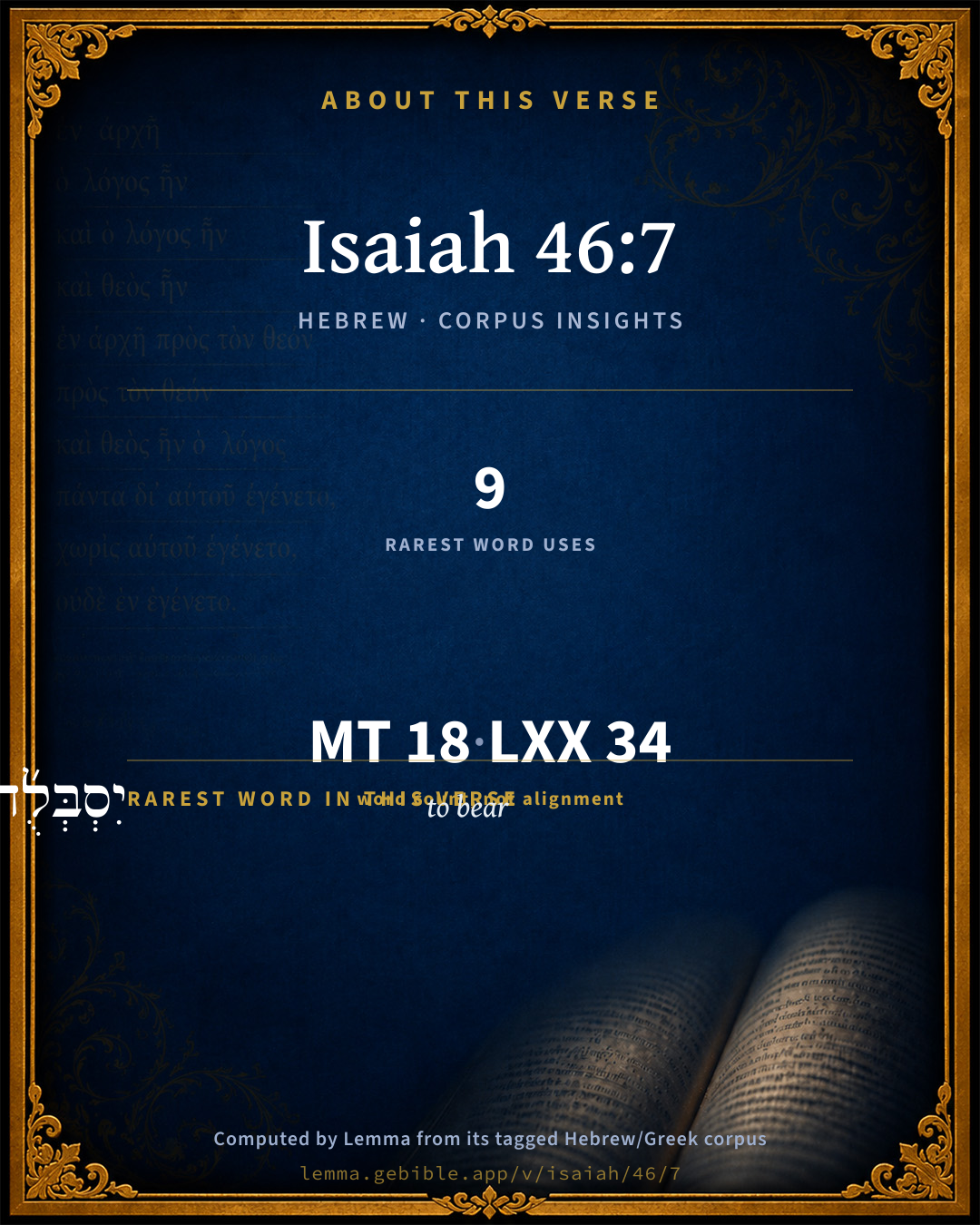
The rarest word here is יִסְבְּלֻ֜הוּ to bear H5445 — appearing just 9 times in the whole Hebrew Bible.

Shared distinctive vocabulary

יִסְבְּלֻ֜הוּ to bear H5445 occurs in 8 verses of the Hebrew Bible. Also found in:

Grammatical profile

  • 8 verbs
  • 3 nouns
  • 3 prepositions
  • 4 particles

Verb forms

  • יִ֠שָּׂאֻהוּ Qal · Imperfect
  • יִסְבְּלֻ֜הוּ Qal · Imperfect
  • וְיַנִּיחֻ֤הוּ Hiphil · Imperfect
  • וְיַֽעֲמֹ֔ד Qal · Imperfect
  • יָמִ֑ישׁ Qal · Imperfect
  • יִצְעַ֤ק Qal · Imperfect
  • יַעֲנֶ֔ה Qal · Imperfect
  • יוֹשִׁיעֶֽנּוּ Hiphil · Imperfect

Repetition

A word recurs within this verse — often emphatic in Hebrew:

Hebrew & Septuagint length

In English translation the verse runs 43 words from the Hebrew and 36 from the Septuagint (LXX English) — closely comparable.

A rough comparison of the two English renderings, which tokenize alike — not a word-level alignment.

Word counts can differ between the Hebrew and the Greek without any difference in meaning — e.g. the Hebrew direct-object marker אֵת has no separate Greek word, and Greek often adds the article ὁ.

In the original languages it is 18 Hebrew tokens and 34 Greek tokens — but the two are counted differently (Hebrew bundles its prefixes and suffixes into one token; the Greek is in lemma form), so that isn’t a like-for-like length.

Cross-references

12

Topical passages linked to Isaiah 46:7 in the Treasury of Scripture Knowledge — connected by theme and wording, ordered by reader-vote popularity; previews shown in the World English Bible.

  • Isaiah 45:20 Assemble yourselves and come; draw near together, you who have escaped from the nations: they have no knowledge who carry the wood of their engraved image, and pray to a god that can't save.
  • Jeremiah 10:5 They are like a palm tree, of turned work, and don't speak: they must be carried, because they can't go. Don't be afraid of them; for they can't do evil, neither is it in them to do good."
  • 1 Samuel 5:3 When they of Ashdod arose early on the next day, behold, Dagon was fallen on his face to the ground before the ark of Yahweh. They took Dagon, and set him in his place again.
  • Isaiah 46:1 Bel bows down, Nebo stoops; their idols are on the animals, and on the cattle: the things that you carried about are made a load, a burden to the weary [animal].
  • Judges 10:12–14 The Sidonians also, and the Amalekites, and the Maonites, did oppress you; and you cried to me, and I saved you out of their hand.
  • 1 Kings 18:26 They took the bull which was given them, and they dressed it, and called on the name of Baal from morning even until noon, saying, Baal, hear us. But there was no voice, nor any who answered. They leaped about the altar which was made.
  • 1 Kings 18:40 and Elijah said to them, Take the prophets of Baal; don't let one of them escape. They took them; and Elijah brought them down to the brook Kishon, and killed them there.
  • Jeremiah 2:28 But where are your gods that you have made you? let them arise, if they can save you in the time of your trouble: for according to the number of your cities are your gods, Judah.
  • Daniel 3:1 Nebuchadnezzar the king made an image of gold, whose height was sixty cubits, and the breadth of it six cubits: he set it up in the plain of Dura, in the province of Babylon.
  • Jonah 1:5 Then the mariners were afraid, and cried every man to his god. They threw the cargo that was in the ship into the sea, to lighten it. But Jonah had gone down into the innermost parts of the ship, and he was laying down, and was fast asleep.
  • Jonah 1:14–16 Therefore they cried to Yahweh, and said, "We beg you, Yahweh, we beg you, let us not perish for this man's life, and don't lay on us innocent blood; for you, Yahweh, have done as it pleased you."
  • Isaiah 37:38 It happened, as he was worshipping in the house of Nisroch his god, that Adrammelech and Sharezer his sons struck him with the sword; and they escaped into the land of Ararat. Esar Haddon his son reigned in his place.

Cross-references courtesy of OpenBible.info (CC BY 4.0).

Hebrew and Greek witnesses Masoretic Hebrew ↔ Greek Septuagint

The same verse in the two great witnesses to the Old Testament, shown verse-for-verse.

These are two independent witnesses, not word-aligned to each other, and the Septuagint is shown in lemma (dictionary) form.

Hebrew Isaiah 46:7 Masoretic · Westminster Leningrad Codex

יִ֠שָּׂאֻהוּ עַל כָּתֵ֨ף יִסְבְּלֻ֜הוּ וְיַנִּיחֻ֤הוּ תַחְתָּיו֙ וְיַֽעֲמֹ֔ד מִמְּקוֹמ֖וֹ לֹ֣א יָמִ֑ישׁ אַף יִצְעַ֤ק אֵלָיו֙ וְלֹ֣א יַעֲנֶ֔ה מִצָּרָת֖וֹ לֹ֥א יוֹשִׁיעֶֽנּוּ

They bear it on the shoulder, they carry it, and set it in its place, and it stands, from its place it shall not move: yes, one may cry to it, yet it can not answer, nor save him out of his trouble.

World English Bible · Public Domain

Greek LXX Isaiah 46:7 Septuagint · lemma form

αἴρω αὐτός ἐπί ὁ ὦμος καί πορεύομαι ἐάν δέ τίθημι αὐτός ἐπί ὁ τόπος αὐτός μένω οὐ μή κινέω καί ὅς ἄν βοάω πρός αὐτός οὐ μή εἰςἀκούω ἀπό κακός οὐ μή σώζω αὐτός

They bear it upon the shoulder, and go; and if they put it upon its place, it remains, it can’t move: and whoever shall cry to it, it can’t hear; it can’t save him from trouble.

LXX2012 (modern English Septuagint) · Public Domain

Hebrew: Westminster Leningrad Codex (CC BY 4.0). Greek: Septuagint (public domain); English from LXX2012 (modern English Septuagint) (Public Domain). How the Septuagint differs from the Hebrew →

Targum (Aramaic paraphrase)

1

The Targum is the ancient Jewish Aramaic paraphrase of the Hebrew Scriptures — an interpretive translation, not the Hebrew text itself. Onkelos (literal) and Pseudo-Jonathan (expansive) render the Torah, and Jonathan the Prophets. Coverage is partial: where no permissively-licensed English translation exists for a verse, only the Aramaic is shown. This is verse-level text, not a word-by-word alignment to the Hebrew.

  1. Targum Jonathan Prophets (Joshua–Malachi)
    נַטְלִין לֵיהּ עַל כַּתְפֵּיהוֹן סַבְלִין לֵיהּ מַחֲתִין לֵהּ בְּאַתְרֵהּ וְקָאֵים מֵאַתְרֵהּ לָא אֶפְשַׁר לֵיהּ דִינוּד אַף יִבְעֵי מִנֵהּ לָא יְתִיבִינֵהּ מַעַקְתֵהּ לָא יִפְרְקִנֵהּ:

    They bear him upon the shoulder, they carry him and set him in his place, and he abideth; it is not possible for him to move from his place; yea, one supplicates to him; but he does not answer him, nor save him out of his distress.

    Targum Jonathan — Aramaic: “Mikraot Gedolot” (public domain). English: “Sefaria Community Translation” (CC0 1.0 (public-domain dedication)); “London "Chaldee Paraphrase," 1871” (public domain). Text via Sefaria.

Commentary

Notes on Isaiah 46:7 from classic Christian and Jewish commentators (each source and its license shown beneath its notes). The classic Christian expositions comment on the surrounding passage and are grouped to its opening verse, so a note may address several verses; the Jewish commentaries on the Tanakh (Rashi and others) are per-verse, so they appear only where the commentator wrote on this verse.

Lemma curates 59 commentaries, every one of them public domain or Creative Commons licensed, each selected and text-cleaned for this edition rather than reprinted as found. About our sources →

Trapp's Complete Commentary

John Trapp

Isa 46:7 They bear him upon the shoulder, they carry him, and set him in his place, and he standeth; from his place shall he not remove: yea, [one] shall cry unto him, yet can he not answer, nor save him out of his trouble.

Ver. 7. They bear him upon their shoulders.] As the Papists’ breaden god, furfuraceum illud numen, is, at this day, borne about to be adored; whereas the true God "beareth up all things by the word of his power." {Heb 1:3}

Yea, one shall cry unto him.] As they did to Baal in Elijah’s days; and the Cretans to their Jupiter, whom they therefore pictured without ears.

John Trapp, A Commentary or Exposition upon All the Books of the Old and New Testament (1647–1656) — public domain. Text from a community e-Sword module.

Jamieson, Fausset & Brown

Robert Jamieson, A. R. Fausset & David Brown

cry . . . can . . . not . . . save-- (Isa 45:20, with which contrast Isa 45:19).

Jamieson, Fausset & Brown — Commentary Critical and Explanatory on the Whole Bible (1871) — public domain (CC PDM 1.0). Text via the HelloAO Bible API.

Adam Clarke's Commentary

Verse 7. They bear him upon the shoulder - and set him in his place] This is the way in which the Hindoos carry their gods; and indeed so exact a picture is this of the idolatrous procession of this people, that the prophet might almost be supposed to have been sitting among the Hindoos when he delivered this prophecy. - WARD'S Customs.

Pindar has treated with a just and very elegant ridicule the work of the statuary even in comparison with his own poetry, from this circumstance of its being fixed to a certain station. "The friends of Pytheas," says the Scholiast, "came to the poet, desiring him to write an ode on his victory. Pindar demanded three drachms, (minae, I suppose it should be,) for the ode. No, say they, we can have a brazen statue for that money, which will be better than a poem. However, changing their minds afterwards, they came and offered him what he had demanded." This gave him the hint of the following ingenious esordium of his ode: -

Ουκ ανδριαντοποιος ειμ'

Ὡστ' ελινυσσοντα μ' εργαζε -

σθαι αγαλματ' επ' αυτας βαθμιδος

Ἑσταοτ.Αλλ' επι πασας

Ὁλκαδος εν τ' ακατῳ γλυκει' αοιδα

Στειχ' απ' Αιγινας διαγγελ -

lois' ὁτι Λαμπωνος ὑιος

Πυθεας ευρυσθενης

Νικῃ Νεμειοις παγκρατιου στεφανον. Nem. v.

Thus elegantly translated by Mr. Francis in a note to Hor. Carm. iv. 2. 19.

"It is not mine with forming hand

To bid a lifeless image stand

For ever on its base:

But fly, my verses, and proclaim

To distant realms, with deathless fame,

That Pytheas conquered in the rapid race."

Jeremiah, Jer 10:3-5, seems to be indebted to Isaiah for most of the following passage: -

"The practices of the people are altogether vanity:

For they cut down a tree from the forest;

The work of the artificer's hand with the axe;

With silver and with gold it is adorned;

With nails and with hammers it is fastened, that it may

not totter.

Like the palm-tree they stand stiff, and cannot speak;

They are carried about, for they cannot go:

Fear them not, for they cannot do harm;

Neither is it in them to do good."

Adam Clarke's Commentary on the Bible (1810–1826) — public domain. Text from a community e-Sword/MySword module.

The Cambridge Bible for Schools and Colleges

gen. ed. J. J. S. Perowne

7. They bear him &c.] the newly made idol, to his appointed place, from which he is powerless to move. How vain, therefore, is it to cry to him for help! He is a “god that cannot save” (Isa_45:20).

The Cambridge Bible for Schools and Colleges (gen. ed. J. J. S. Perowne; Cambridge University Press, 1878–1918) — public domain. Text from a community e-Sword module.

John Gill's Exposition

They bear him upon the shoulder, they carry him,.... That is, the idol; men carry him upon their shoulders in procession, and expose him to the view and veneration of the people, just as the host is carried in procession by the Papists; or the idol being made, the workman or his men lift it up, for it cannot lift up itself, and take it upon their shoulders, and carry it home to the proprietor:

and set him in his place; in his house, if an household god: or in the temple, church, or place of public worship, if designed for that:

or cause him to rest under him (p), or "in his place"; under the roof of his house or temple; a jeer upon him, as if he was weary of his long journey, though carried. Here again the idols are distinguished from the true God, and he from them; they are on men's shoulders, and set in a certain place, but he carries all his people, and is not limited to, or included in any place:

and he standeth, and from his place he shall not remove; the idol being set in his place stands fast, being nailed; he stands upright as a palm tree, and can never stir from the place where he is, to help any of his worshippers, in whatsoever distress they may be; nor can he get out of the way of any danger to which he may be exposed; if the temple or house, in which he is, is on fire, or overflowed with water, or broke into by thieves, he cannot move out of his place, and escape the danger; a fine deity to be worshipped indeed! see Isa 44:13.

Yea, one shall cry unto him, yet can he not answer; as Baal's priests and worshippers cried to him, but no voice was heard, nor answer returned, Kg1 18:26 for though they have ears, they hear not, and mouths, yet they speak not, Psa 115:5.

nor save him out of his trouble; that is, the idol cannot save the idolatrous worshipper out of his distress, which has caused him to cry unto him; see Isa 45:20.

(p) "et quiescere eum faciunt suo loco", Musculus.

John Gill's Exposition of the Whole Bible (1746–1763) — public domain (CC PDM 1.0). Text via the HelloAO Bible API.

Albert Barnes' Notes on the Bible

They bear him upon the shoulder - They carry the idol which they have made on their shoulder to the temple, or place where it is to be fixed. This circumstance, with the others, is doubtless introduced to show how ridiculous and absurd it was to offer divine homage to a god whom they could thus carry about on the shoulder.

And set him in his place - Fix the idol on its basis or pedestal, in its proper niche, or place in the temple. The whole design of this verse is to contrast the idol with Yahweh. Yahweh is uncreated and eternal; the idol, on the contrary, is made by human beings, is borne about, is fixed in its place, has no power to move, remains there until it is taken down, and has no ability either to hear or save those who worship it.

Albert Barnes' Notes on the Bible (1834–1885) — public domain. Text from a community e-Sword/MySword module.

Matthew Poole's English Annotations

They carry him; either,

1. In pomp upon solemn occasions; or,

2. From that place where he is made, unto that place where they intend to set him up, as it is expressed in the following words.

Shall he not remove; or rather, he cannot remove. He can stir neither hand nor foot to help his people.

Matthew Poole's English Annotations on the Holy Bible (1683–1685) — public domain. Text from a community e-Sword/MySword module.

The Pulpit Commentary

They bear him upon the shoulder. (see the comment on Isa_45:20) Here, however, it is not the carrying in procession that is spoken of, but the conveyance of the imago by the workman from his own workshop to the temple where it is to be set up. The carrying of heavy burdens upon the shoulder is mentioned by Herodotus (2:35), and frequently represented on ancient monuments (see "Ancient Monarchies," vol. 1. pp. 402, 475; "Herodotus," vol. 2. pl. opp. p. 177; etc.). From his place shall he net remove; i.e. he (the god) will have no power of moving an inch from the spot on which he is set up. There he will stand motionless, till some one comes and pushes him or pulls him from his place.

The Pulpit Commentary (1880–1919), ed. H.D.M. Spence-Jones & Joseph S. Exell — public domain. Text from a community e-Sword module.

John Wesley's Explanatory Notes

Remove - He can stir neither hand nor foot to help his people.

John Wesley, Explanatory Notes Upon the Whole Bible (1754–1765) — public domain. Text via the GEBible commentary corpus.

J. A. Alexander on Isaiah

Joseph Addison Alexander

“They will lift him on the shoulder, they will carry him, they will set him in his place, and he will stand (there), from his place he will not move; yes, one will cry to him, and he will not answer; from his distress he will (or can) not save him.” The idol is not only the work of man’s hands, but entirely dependent on him for the slightest motion. No wonder therefore that he cannot hear the prayers of his worshippers, much less grant them the deliverance and protection which they need.

Joseph Addison Alexander, The Prophecies of Isaiah (1846–1847; New York: Scribner, 1870–1878) — public domain. Text from a community e-Sword module.

unfoldingWord translationNotes

Door43 World Missions Community

They lift it

"They" refers to the people who make idols and "it" refers to the idol that they have created.

translationWords

save

unfoldingWord translationNotes — © Distant Shores Media and the Door43 World Missions Community, licensed CC BY-SA 4.0. Source: git.door43.org/Door43/en_tn.

Ibn Ezra

Rabbi Abraham ibn Ezra

תחתיו In his place.

לא ימיש It shall not move itself. ימיש is a transitive verb. It may also be explained to be a neuter verb meaning it shall move, but the former explanation is better.

The word יצעק One shall cry is to be repeated after ומצרתו and out of his trouble.

Ibn Ezra on the Tanakh — English translations: “Sefaria Community Translation” (CC0 1.0 (public-domain dedication)); “Yalkut, Sifsei Chachomim Chumash, Metsudah Publications, 2009” (CC BY 4.0); and “Commentary of Ibn Ezra on Isaiah - trans. by M. Friedlander, 1873” (public domain). Text via Sefaria.

Lesson kit

Teaching starters — assembled from the data on this page, not authored interpretation. Every prompt links to the verse data it draws on. Edit before teaching.

Isaiah, in the Prophets, opens this verse with 18 words (16 distinct Hebrew lemmas). Its most distinctive word is çâbal (“to bear”). A historical commentator’s framing appears above. Read the whole chapter for the surrounding context.

Discussion questions

  1. The word çâbal carries the sense “to bear.” How does it shape the verse?
  2. Genesis 49:15 shares the word «to bear» with this verse. How do the two illuminate each other?
  3. “not” occurs 3× in this one verse. What is the effect of the repetition?
  4. These translations render this verse differently. What is at stake in choosing one wording over another?
  5. The verb «יִ֠שָּׂאֻהוּ» is Qal Imperfect. How does its form color the action?
  6. Reading how Trapp's Complete Commentary and Jamieson, Fausset & Brown read this verse, where do the two commentators agree and where do they part?

Things to notice

Reading settings

Reading text

Shown beneath each verse's original-language words.

Old Testament
Old Testament edition

Read the OT as the Masoretic Hebrew (MT) or the Greek Septuagint (LXX).

English shown for the Greek Septuagint (in the Hebrew ↔ Greek comparison).

Comparing translations? Open the Compare panel on any verse page to stack up to four side by side.