
Jeremiah 30:11

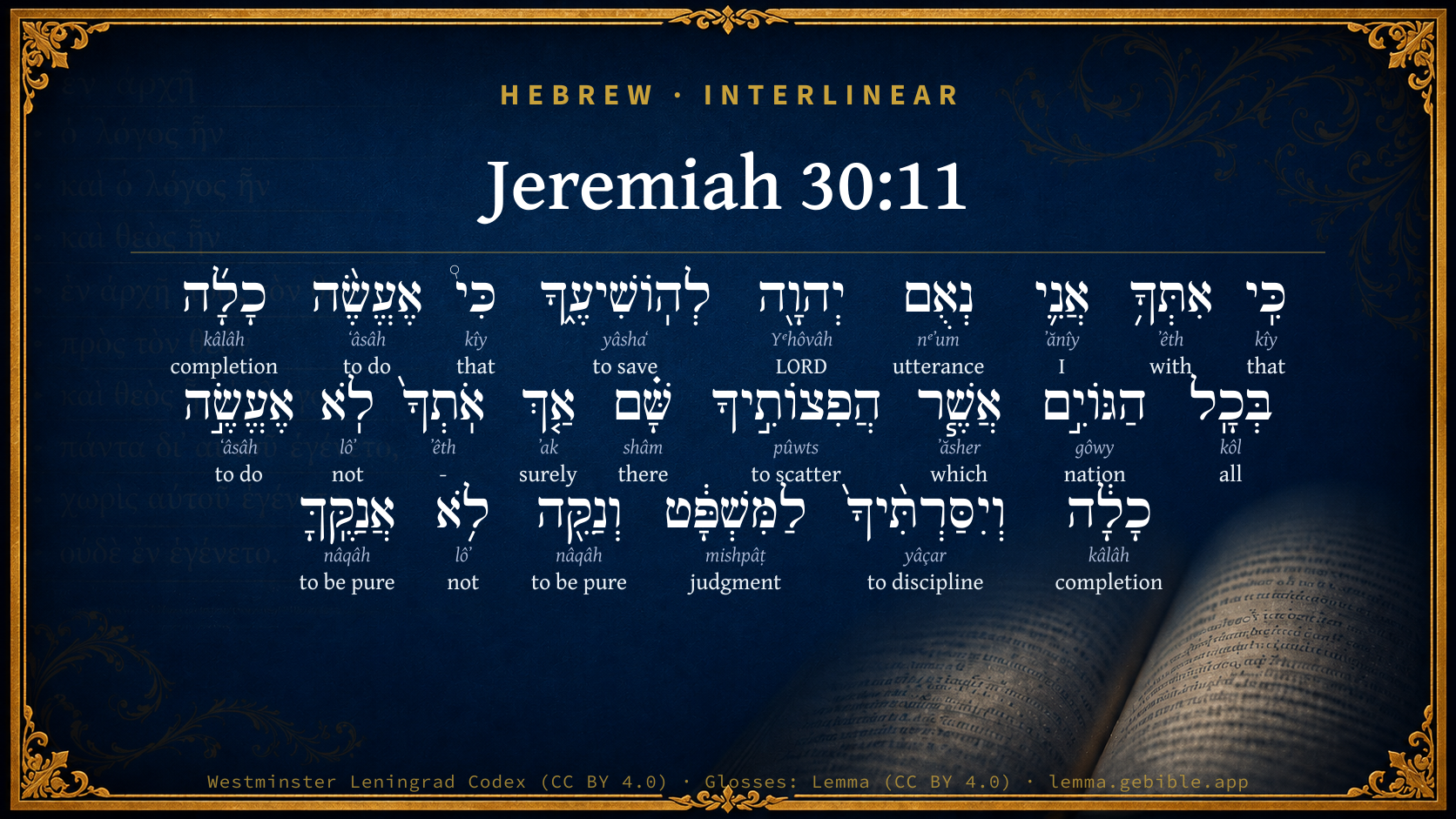
Hebrew (Westminster Leningrad Codex) Jeremiah 30:11 appears in the Hebrew Old Testament. The text above is from the Westminster Leningrad Codex. Each word links to its Strong’s number, a concise gloss, and parsing drawn from the Open Scriptures Hebrew Bible morphology. Click any word for its full Brown-Driver-Briggs (BDB) entry.
Download image
Cite this verse

Jeremiah 30:11 (World English Bible). Public Domain. Lemma interlinear Bible study tool, https://lemma.gebible.app/v/jeremiah/30/11.

Show BibTeX & RIS
BibTeX
RIS
English Translation
For I am with you, says Yahweh, to save you: for I will make a full end of all the nations where I have scattered you, but I will not make a full end of you; but I will correct you in measure, and will in no way leave you unpunished.
World English Bible · Public Domain
Download a study sheet

One document with this verse’s original text, its word-by-word gloss line, the meaning frame, cross-references with their text, attributed commentary, and full source and license credits — printable, and it pastes into notes with its structure intact.

This verse Autodidact and up

Study sheet (.html) Plain text (.txt)

A passage Seminary Student

Up to 50 verses in one chapter. A passage sheet keeps up to 6 commentary sources and 12 cross-references per verse, in the order this page ranks them, and says so on the sheet whenever that leaves anything out. Ask for a single verse and you get the Autodidact verse sheet above.

Everything on this page stays free to read, with no account — the sheet is a download of what is already on screen, not access to it.

Want to remove ads? Support Godless Engineer
Compare translations 3

The same verse in 3 English versions, stacked beneath the original-language interlinear above. Click any original word for its lexicon entry.

Each is an independent rendering of the whole verse — the interlinear is not word-aligned to these translations.

Highlighted words mark where these versions differ — a whole-verse word diff, not a word-by-word alignment.

  • World English Bible Public Domain
    For I am with you, says Yahweh, to save you: for I will make a full end of all the nations where I have scattered you, but I will not make a full end of you; but I will correct you in measure, and will in no way leave you unpunished.
  • King James Version Public Domain
    For I am with thee, saith the LORD, to save thee: though I make a full end of all nations whither I have scattered thee, yet I will not make a full end of thee: but I will correct thee in measure, and will not leave thee altogether unpunished.
  • unfoldingWord Literal Text CC BY-SA 4.0
    For I am with you—this is Yahweh’s declaration—to save you. Then I will bring a complete end to all the nations where I have scattered you. But I will certainly not put an end to you, though I discipline you justly and will certainly not leave you unpunished.’

unfoldingWord Literal Text — © unfoldingWord, licensed CC BY-SA 4.0. Word-aligned USFM3 via Door43 (git.door43.org/unfoldingWord/en_ult).

Versions to compare (up to 4)

3 of 4 selected

Show all 18 translations

Every available English version of this verse, each an independent rendering of the whole verse.

  • World English Bible Public Domain
    For I am with you, says Yahweh, to save you: for I will make a full end of all the nations where I have scattered you, but I will not make a full end of you; but I will correct you in measure, and will in no way leave you unpunished.
  • Berean Standard Bible Public Domain
    For I am with you to save you, declares the LORD. Though I will completely destroy all the nations to which I have scattered you, I will not completely destroy you. Yet I will discipline you justly, and will by no means leave you unpunished.”
  • Majority Standard Bible Public Domain
    For I am with you to save you, declares the LORD. Though I will completely destroy all the nations to which I have scattered you, I will not completely destroy you. Yet I will discipline you justly, and will by no means leave you unpunished.”
  • King James Version Public Domain
    For I am with thee, saith the LORD, to save thee: though I make a full end of all nations whither I have scattered thee, yet I will not make a full end of thee: but I will correct thee in measure, and will not leave thee altogether unpunished.
  • American Standard Version (1901) Public Domain
    For I am with thee, saith Jehovah, to save thee: for I will make a full end of all the nations whither I have scattered thee, but I will not make a full end of thee; but I will correct thee in measure, and will in no wise leave thee unpunished.
  • Revised Version (1885) Public Domain
    For I am with thee, saith the LORD, to save thee: for I will make a full end of all the nations whither I have scattered thee, but I will not make a full end of thee; but I will correct thee with judgment, and will in no wise leave thee unpunished.
  • Geneva Bible (1599) Public Domain
    For I am with thee, sayth the Lord, to saue thee: though I vtterly destroy all the nations where I haue scattered thee, yet will I not vtterly destroy thee, but I will correct thee by iudgement, and not vtterly cut thee off.
  • Douay-Rheims (1899) Public Domain
    For I am with thee, saith the Lord, to save thee: for I will utterly consume all the nations, among which I have scattered thee: but I will not utterly consume thee: but I will chastise thee in judgment, that thou mayst not seem to thyself innocent.
  • Young's Literal Translation Public Domain
    For with thee `am' I, An affirmation of Jehovah -- to save thee, For I make an end of all the nations Whither I have scattered thee, Only, of thee I do not make an end, And I have chastised thee in judgment, And do not entirely acquit thee.
  • Literal Standard Version CC BY-SA 4.0
    For I [am] with you,” || A declaration of YHWH, || “To save you, || For I make an end of all the nations || To where I have scattered you, || Only, I do not make an end of you, || And I have disciplined you in judgment, || And do not entirely acquit you.”
  • Unlocked Literal Bible CC BY-SA 4.0
    For I am with you—this is Yahweh's declaration—to save you. Then I will bring a complete end to all the nations where I have scattered you. But I will certainly not put an end to you, though I discipline you justly and will certainly not leave you unpunished.'
  • unfoldingWord Literal Text CC BY-SA 4.0
    For I am with you—this is Yahweh’s declaration—to save you. Then I will bring a complete end to all the nations where I have scattered you. But I will certainly not put an end to you, though I discipline you justly and will certainly not leave you unpunished.’
  • Darby Bible Public Domain
    For I am with thee, saith Jehovah, to save thee: for I will make a full end of all the nations whither I have scattered thee; yet of thee will I not make a full end, but I will correct thee with judgment, and will not hold thee altogether guiltless.
  • World Messianic Bible Public Domain
    For I am with you, says the LORD, to save you; for I will make a full end of all the nations where I have scattered you, but I will not make a full end of you; but I will correct you in measure, and will in no way leave you unpunished.”
  • Webster's Bible Public Domain
    For I am with thee, saith the LORD, to save thee: though I make a full end of all nations whither I have scattered thee, yet will I not make a full end of thee: but I will correct thee in measure, and will not leave thee altogether unpunished.
  • Free Bible Version CC BY-SA 4.0
    I am with you and I will save you, declares the Lord. Even though I'm going to completely destroy all the nations where I scattered you, I won't completely destroy you. However, I will discipline you as you deserve, and you can be sure I won't leave you unpunished.
  • Bible in Basic English Public Domain
    For I am with you, says the Lord, to be your saviour: for I will put an end to all the nations where I have sent you wandering, but I will not put an end to you completely: though with wise purpose I will put right your errors, and will not let you go quite without punishment.
  • JPS Tanakh (1917) Public Domain
    For I am with thee, saith the LORD, to save thee; for I will make a full end of all the nations whither I have scattered thee, but I will not make a full end of thee; for I will correct thee in measure, and will not utterly destroy thee.

Literal Standard Version (2020), Covenant Press — licensed CC BY-SA 4.0. Text via the HelloAO Bible API (eBible.org). Unlocked Literal Bible (unfoldingWord) — licensed CC BY-SA 4.0. Text via the HelloAO Bible API (eBible.org). unfoldingWord Literal Text — © unfoldingWord, licensed CC BY-SA 4.0. Word-aligned USFM3 via Door43 (git.door43.org/unfoldingWord/en_ult). Free Bible Version, Dr. Jonathan Gallagher — licensed CC BY-SA 4.0. Text via the HelloAO Bible API (eBible.org).

Word by word

More ways to search: Search by grammar → Find every occurrence → Compare this word →

Practice this passage: Drill this verse → Learn its vocabulary →

כָלָ֜ה
kâlâh
H3617
“completion”
Noun, Common, Feminine, Singular, Absolute
Part of Speech
Noun
Type
Common
Gender
Feminine
Number
Singular
State
Absolute
Full BDB Definition

Origin: from H3615

TWOT: 982a

completion, termination, full end, complete destruction, consumption, annihilation - completion - completely, altogether (adverb) - complete destruction, consumption, annihilation
  1. כִּֽי kîy H3588 “that” Conjunction
  2. אִתְּךָ֥ ʼêth H854 “with · you” Preposition + Suffix, Personal, 2nd Person, Masculine, Singular
  3. אֲנִ֛י ʼănîy H589 “I” Pronoun, Personal, 1st Person, Common, Singular
  4. נְאֻם nᵉʼum H5002 “utterance of” Noun, Common, Masculine, Singular, Construct
  5. יְהוָ֖ה Yᵉhôvâh H3068 “LORD” Noun, Proper
  6. לְהֽוֹשִׁיעֶ֑ךָ yâshaʻ H3467 “to save · you” Preposition + Verb, Hiphil, Infinitive Construct + Suffix, Personal, 2nd Person, Masculine, Singular
  7. כִּי֩ kîy H3588 “that” Conjunction
  8. אֶעֱשֶׂ֨ה ʻâsâh H6213 “to do” Verb, Qal, Imperfect, 1st Person, Common, Singular
  9. בְּכָֽל kôl H3605 “in/at · all of” Preposition + Noun, Common, Masculine, Singular, Construct
  10. הַגּוֹיִ֣ם gôwy H1471 “the · nations” Particle, Definite Article + Noun, Common, Masculine, Plural, Absolute
  11. אֲשֶׁ֧ר ʼăsher H834 “which” Particle, Relative
  12. הֲפִצוֹתִ֣יךָ pûwts H6327 “to scatter · you” Verb, Hiphil, Perfect, 1st Person, Common, Singular + Suffix, Personal, 2nd Person, Masculine, Singular
  13. שָּׁ֗ם shâm H8033 “there” Adverb
  14. אַ֤ךְ ʼak H389 “surely” Particle, Accusative
  15. אֹֽתְךָ֙ ʼêth H853 “- · you” Particle, Direct Object + Suffix, Personal, 2nd Person, Masculine, Singular
  16. לֹֽא lôʼ H3808 “not” Particle, Negative
  17. אֶעֱשֶׂ֣ה ʻâsâh H6213 “to do” Verb, Qal, Imperfect, 1st Person, Common, Singular
  18. כָלָ֔ה kâlâh H3617 “completion” Noun, Common, Feminine, Singular, Absolute
  19. וְיִסַּרְתִּ֨יךָ֙ yâçar H3256 “and · to discipline · you” Conjunction + Verb, Piel, Sequential Perfect, 1st Person, Common, Singular + Suffix, Personal, 2nd Person, Masculine, Singular
  20. לַמִּשְׁפָּ֔ט mishpâṭ H4941 “to/for the · judgment” Preposition, Determined + Noun, Common, Masculine, Singular, Absolute
  21. וְנַקֵּ֖ה nâqâh H5352 “and · to be pure” Conjunction + Verb, Piel, Infinitive Absolute
  22. לֹ֥א lôʼ H3808 “not” Particle, Negative
  23. אֲנַקֶּֽךָּ nâqâh H5352 “to be pure · you” Verb, Piel, Imperfect, 1st Person, Common, Singular + Suffix, Personal, 2nd Person, Masculine, Singular

About this verse

These counts appear in no published source. They are computed here, from the morphology-tagged text and Lemma’s own curated glosses. What Lemma adds →

24
words
19
distinct lemmas
Prophets
section

Notable vocabulary

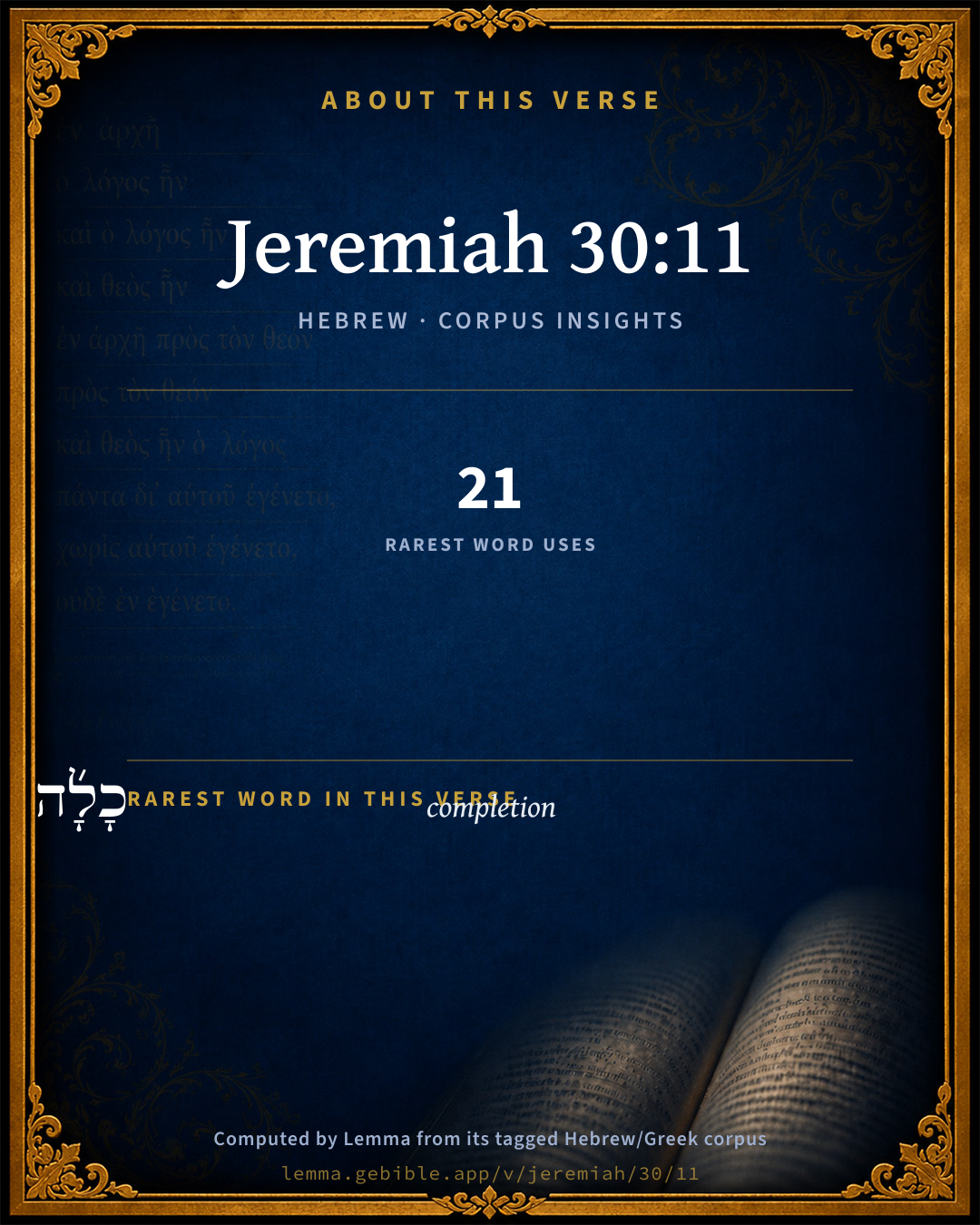
The rarest word here is כָלָ֜ה completion H3617 — appearing just 21 times in the whole Hebrew Bible.

Shared distinctive vocabulary

כָלָ֜ה completion H3617 occurs in 19 verses of the Hebrew Bible. Also found in:

Grammatical profile

  • 7 verbs
  • 7 nouns
  • 1 pronoun
  • 1 preposition
  • 2 conjunctions
  • 1 adverb
  • 5 particles

Verb forms

  • לְהֽוֹשִׁיעֶ֑ךָ Hiphil · Infinitive Construct
  • אֶעֱשֶׂ֨ה Qal · Imperfect
  • הֲפִצוֹתִ֣יךָ Hiphil · Perfect
  • אֶעֱשֶׂ֣ה Qal · Imperfect
  • וְיִסַּרְתִּ֨יךָ֙ Piel · Sequential Perfect
  • וְנַקֵּ֖ה Piel · Infinitive Absolute
  • אֲנַקֶּֽךָּ Piel · Imperfect

Repetition

Words recur within this verse — often emphatic in Hebrew:

  • אֶעֱשֶׂ֨ה to do H6213 ×2
  • כָלָ֜ה completion H3617 ×2
  • וְנַקֵּ֖ה to be pure H5352 ×2
  • כִּֽי that H3588 ×2
  • לֹֽא not H3808 ×2

Cross-references

22

Topical passages linked to Jeremiah 30:11 in the Treasury of Scripture Knowledge — connected by theme and wording, ordered by reader-vote popularity; previews shown in the World English Bible.

  • Jeremiah 1:19 They shall fight against you; but they shall not prevail against you: for I am with you, says Yahweh, to deliver you.
  • Jeremiah 10:24 Yahweh, correct me, but in measure: not in your anger, lest you bring me to nothing.
  • Isaiah 8:10 Take counsel together, and it shall be brought to nothing; speak the word, and it shall not stand: for God is with us.
  • Jeremiah 1:8 Don't be afraid because of them; for I am with you to deliver you, says Yahweh.
  • Jeremiah 4:27 For thus says Yahweh, The whole land shall be a desolation; yet will I not make a full end.
  • Psalms 6:1 Yahweh, don't rebuke me in your anger, Neither discipline me in your wrath.
  • Jeremiah 5:10 Go up on her walls, and destroy; but don't make a full end: take away her branches; for they are not Yahweh's.
  • Jeremiah 5:18 But even in those days, says Yahweh, I will not make a full end with you.
  • Jeremiah 15:20 I will make you to this people a fortified brazen wall; and they shall fight against you, but they shall not prevail against you; for I am with you to save you and to deliver you, says Yahweh.
  • Ezekiel 11:16–17 Therefore say, Thus says the Lord Yahweh: Whereas I have removed them far off among the nations, and whereas I have scattered them among the countries, yet will I be to them a sanctuary for a little while in the countries where they are come.
  • Matthew 28:20 teaching them to observe all things that I commanded you. Behold, I am with you always, even to the end of the age." Amen.
  • Acts 18:10 for I am with you, and no one will attack you to harm you, for I have many people in this city."
  • 2 Timothy 4:17–18 But the Lord stood by me, and strengthened me, that through me the message might be fully proclaimed, and that all the Gentiles might hear; and I was delivered out of the mouth of the lion.
  • 2 Timothy 4:22 The Lord Jesus Christ be with your spirit. Grace be with you. Amen.
  • Isaiah 27:7–8 Has he struck them as he struck those who struck them? or are they slain according to the slaughter of those who were slain by them?
  • Isaiah 43:25 I, even I, am he who blots out your transgressions for my own sake; and I will not remember your sins.
  • Jeremiah 46:27–28 But don't be afraid you, Jacob my servant, neither be dismayed, Israel: for, behold, I will save you from afar, and your seed from the land of their captivity; and Jacob shall return, and shall be quiet and at ease, and none shall make him afraid.
  • Ezekiel 11:13 It happened, when I prophesied, that Pelatiah the son of Benaiah died. Then fell I down on my face, and cried with a loud voice, and said, Ah Lord Yahweh! will you make a full end of the remnant of Israel?
  • Matthew 1:23 "Behold, the virgin shall be with child, And shall bring forth a son. They shall call his name Immanuel;" Which is, being interpreted, "God with us."
  • Romans 9:27–29 Isaiah cries concerning Israel, "If the number of the children of Israel are as the sand of the sea, It is the remnant who will be saved;
  • Romans 11:5–7 Even so then at this present time also there is a remnant according to the election of grace.
  • Amos 9:8–9 Behold, the eyes of the Lord Yahweh are on the sinful kingdom, and I will destroy it from off the surface of the earth; except that I will not utterly destroy the house of Jacob," says Yahweh.

Cross-references courtesy of OpenBible.info (CC BY 4.0).

Hebrew and Greek witnesses Masoretic Hebrew ↔ Greek Septuagint

The same verse in the two great witnesses to the Old Testament, shown verse-for-verse.

These are two independent witnesses, not word-aligned to each other, and the Septuagint is shown in lemma (dictionary) form.

Hebrew Jeremiah 30:11 Masoretic · Westminster Leningrad Codex

כִּֽי אִתְּךָ֥ אֲנִ֛י נְאֻם יְהוָ֖ה לְהֽוֹשִׁיעֶ֑ךָ כִּי֩ אֶעֱשֶׂ֨ה כָלָ֜ה בְּכָֽל הַגּוֹיִ֣ם אֲשֶׁ֧ר הֲפִצוֹתִ֣יךָ שָּׁ֗ם אַ֤ךְ אֹֽתְךָ֙ לֹֽא אֶעֱשֶׂ֣ה כָלָ֔ה וְיִסַּרְתִּ֨יךָ֙ לַמִּשְׁפָּ֔ט וְנַקֵּ֖ה לֹ֥א אֲנַקֶּֽךָּ

For I am with you, says Yahweh, to save you: for I will make a full end of all the nations where I have scattered you, but I will not make a full end of you; but I will correct you in measure, and will in no way leave you unpunished.

World English Bible · Public Domain

Greek LXX Structure differs

In the Septuagint, Jeremiah is about an eighth shorter than the Hebrew and arranges its material differently — the Oracles Against the Nations (Hebrew chapters 46–51) appear in the middle of the Greek book, after 25:13. Because the chapter and verse boundaries do not line up, a verse-for-verse comparison with the Hebrew is not shown.

A verse-for-verse comparison isn’t shown here because the chapters and verses don’t line up. Switch to the LXX edition with the MT / LXX toggle above to read the Greek directly.

Hebrew: Westminster Leningrad Codex (CC BY 4.0). Greek: Septuagint (public domain); English from a public-domain English Septuagint. How the Septuagint differs from the Hebrew →

Targum (Aramaic paraphrase)

1

The Targum is the ancient Jewish Aramaic paraphrase of the Hebrew Scriptures — an interpretive translation, not the Hebrew text itself. Onkelos (literal) and Pseudo-Jonathan (expansive) render the Torah, and Jonathan the Prophets. Coverage is partial: where no permissively-licensed English translation exists for a verse, only the Aramaic is shown. This is verse-level text, not a word-by-word alignment to the Hebrew.

  1. Targum Jonathan Prophets (Joshua–Malachi)
    אֲרֵי בְסַעְדָךְ מֵימְרִי אֲמַר יְיָ לְמִפְרְקָךְ אֲרֵי אַעְבֵּיד גְמִירָא בְּכָל עַמְמַיָא דִבְדַרְתָּךְ לְתַמָן בְּרַם עִמָךְ לָא אַעְבֵּיד גְמִירָא וְאַיְתִי עֲלָךְ יְסוּרִין לְאַלְפוּתָךְ בְּרַם בְּדִין חֲסוּךְ וְשֵׁיצָאָה לָא אֱשֵׁיצִינָךְ:

    (no public-domain English translation for this verse)

    Targum Jonathan — Aramaic: “Mikraot Gedolot” (public domain). English: “Sefaria Community Translation” (CC0 1.0 (public-domain dedication)); “London "Chaldee Paraphrase," 1871” (public domain). Text via Sefaria.

Commentary

Notes on Jeremiah 30:11 from classic Christian and Jewish commentators (each source and its license shown beneath its notes). The classic Christian expositions comment on the surrounding passage and are grouped to its opening verse, so a note may address several verses; the Jewish commentaries on the Tanakh (Rashi and others) are per-verse, so they appear only where the commentator wrote on this verse.

Lemma curates 59 commentaries, every one of them public domain or Creative Commons licensed, each selected and text-cleaned for this edition rather than reprinted as found. About our sources →

Trapp's Complete Commentary

John Trapp

Jer 30:11 For I [am] with thee, saith the LORD, to save thee: though I make a full end of all nations whither I have scattered thee, yet will I not make a full end of thee: but I will correct thee in measure, and will not leave thee altogether unpunished.

Ver. 11. For I am with thee.] To preserve thee, and to provide for thee; to support thee, and to supply thee.

Though I make a full end of all nations.] See Isa 27:7-8. {See Trapp on "Isa 27:7"} {See Trapp on "Isa 27:8"} Jer 5:10; Jer 5:18.

But I will correct thee in measure.] Heb., According to judgment, not summo iure et rigida iustitia; not as I might, but in mercy and with moderation.

And will not leave thee altogether unpunished.] Heb., Et innocentando non innocentabo te; in very faithfulness I will afflict thee, that I may be true to thy soul, and not cruel to thy body. {a}

{a} Aliqui reddunt mundando non mundabo te, id est, non excoquam te exacte ad purum putum.

John Trapp, A Commentary or Exposition upon All the Books of the Old and New Testament (1647–1656) — public domain. Text from a community e-Sword module.

The Biblical Illustrator

Joseph S. Exell

Jer_30:11

I will correct thee in measure.

Correction in measure

I. The text gives us Gods law of correction; and remember, first of all, that it is a law. It is not a passion; it is not a surprise on the part of the Ruler Himself: it is part of His very goodness; it is quiet, solemn, inexorable, everlasting. The steadfast law of the universe is, that though hand join in hand, the wicked shall not go unpunished. This is s law, it is not a caprice; it is a necessity of goodness, and not a burst of passion. All things fight for God; they are very loyal to Him. The stars in their courses utter His testimony; the winds as they fly are vocal with His name; the earth will open her mouth with eager gladness to swallow up the populations that lift their hands against Him. Let us begin with things known, with the patent and indisputable facts of life,--and amongst those facts you will find the hell which follows broken law, the earth that casts out the sour that is not holy,--and thence proceed step by step into the holy place where the altar is, and the speaking blood, and the Father, and the strange light of eternity. There is but one true line of progress: it begins with Moses, it ends with the Lamb--Moses and the Lamb: Law and Grace; and in the last eternal song we shall find in one grand line, Moses and the Lamb, a marvellous harmonisation, the up-gathering and reconciliation of all things; the old ark built again; the law within, the mercy-lid covering it. Law and Mercy--Moses and the Lamb--these combine the whole purpose of the movement of the Divine mind and love.

II. So far we have looked at the stern fact of law: we now come to what is said about it. It is a law of measured correction: I will correct thee in measure. At this point grace gets hold of law and keeps it back. Law can never stop of itself. The law is the same at the end as at the beginning. It cannot palter, it cannot compromise, it cannot make terms; it grinds, bruises, destroys. If a sinful world were left absolutely to the operation of law, it would be crushed out of existence. But the law is under mercy. We are spared by grace, by grace we are saved. The grace was accomplished before the sinner was created. The atonement is not the device of an afterthought: the Lamb was slain from before the foundation of the world. Have we penetrated the gracious meaning of that astounding mystery? Before we can understand anything of the atonement, we must destroy the very basis and the relations of understanding, as it is too narrowly interpreted; we must think ourselves back of time, of space, of foundations, worlds, sinners. Great is the mystery of godliness--God manifest in the flesh. Correction in measure is Gods law now. May the time not come when the measure will be withdrawn and the correction will take its unlimited course? That will be hell, that will be destruction.

III. What is the meaning of this measure? It is the Gospel. There is a higher law than the law of death. The law of life is not changed: it is enlarged over all the sins and shortcomings and crimes of life. Where sin abounds, grace doth much more abound. Grace says, There has been great sin: now for my enlargement. And she enlarges her offers of mercy, and her signs of pity, and her opportunities of return, until the sin flee away--that which is great becomes little. Life is more than death, as the heaven is high above the earth. Death is only a partial law; the universal law is life, and it is for God to set that infinite law in motion. Here we enter upon the mysteries of Deity; here we touch the altar of the atonement. I will accept my chastening; I deserve it. This is my sweet, great faith--that no punishment ever overtakes me that is not a sign of Gods watchfulness, and of Gods care over my life. I have never suffered lose, social dishonour, inward compunction, without being able to say, This is the Lords doing, and not mans. The man did not know what he was doing to me; he was seized by God and set to do this work for my punishment--my education. Let us have no whining, no complaining, no retaliation. The man that smote you was sent to smite you. Avenge yourself by deeper confession, by larger, loftier prayer. (J. Parker, D. D.)

The Biblical Illustrator, edited by Joseph S. Exell (c. 1880s–1900s) — public domain. Text from a community e-Sword module.

Tyndale Open Study Notes

Tyndale Open Resources

30:11 The Lord could make these promises because he was with his people and had the power to save them. He promised to destroy vicious nations and preserve his people. Still, the Lord would discipline his people if they sinned.

Tyndale Open Study Notes — © Tyndale Open Resources, licensed CC BY-SA 4.0. Text via the HelloAO Bible API.

Jamieson, Fausset & Brown

Robert Jamieson, A. R. Fausset & David Brown

though . . . full end of all nations . . . yet . . . not . . . of thee-- (Amo 9:8). The punishment of reprobates is final and fatal; that of God's people temporary and corrective. Babylon was utterly destroyed: Israel after chastisement was delivered.

in measure--literally, "with judgment," that is, moderation, not in the full rigor of justice (Jer 10:24; Jer 46:28; Psa 6:1; Isa 27:8).

not . . . altogether unpunished-- (Exo 34:7).

Jamieson, Fausset & Brown — Commentary Critical and Explanatory on the Whole Bible (1871) — public domain (CC PDM 1.0). Text via the HelloAO Bible API.

Adam Clarke's Commentary

Verse 11. Though I make a full end of all nations] Though the Persians destroy the nations whom they vanquish, yet they shall not destroy thee.

Adam Clarke's Commentary on the Bible (1810–1826) — public domain. Text from a community e-Sword/MySword module.

John Calvin's Commentaries

He repeats in other words what we have already stated, but for the purpose of giving fuller support to trembling and wavering minds. God then promises that he would be present with his people to save them. Now as this could not easily be believed, and as the Jews looking only on their state at that time could not but despair, the Prophet added this comparison between them and the Gentiles. The Chaldeans and the Assyrians flourished seventy years in every kind of wealth, in luxuries, in honor — in short, they possessed every thing necessary for an earthly happiness. What, then, could the Jews have thought, but that unbelievers and God’s enemies were happy, but that they were miserable, being oppressed by hard servitude and loaded with many reproaches, and living also in poverty, and counted as sheep destined for the slaughter? When, therefore, all these things were plain before their eyes, what but despair must have laid hold on their minds? Therefore God obviates this evil;

And he says that he would make a consummation among the nations, as though he had said, “When I begin to punish the Gentile nations, I will destroy them with an utter destruction, no hope will remain for them. But as to thee, I will not make a consummation.” Thus he makes a difference between the punishment inflicted on the reprobate and ungodly and that by which he would chastise the sins of his people; for the punishment he would inflict on the wicked would be fatal, while the punishment by which he would chastise his Church would be only for a time; it would therefore be to it for medicine and salvation.

We now, then, perceive what the Prophet had in view: he mitigated the bitterness of grief as to the faithful, for God would not wholly cast them away. And he shews that their scourges ought to be patiently borne, because they were to hope for an end of them; but that it would be different when he visited the reprobate, because he would leave them without any hope. In short, he says, that he would be a severe judge to the last degree as to the unbelieving, but that he would chastise his own people as a Father.

Other passages seem, however, to militate against this view; for God declares that he would make a consummation as to his chosen people, as in Isaiah 10:23, and in other places. But the explanation is obvious; for there he refers to the whole body of the people, which were alienated from him; but here his word is addressed to the faithful,

“the remnant of grace,”

as Paul calls them, (Romans 11:5) We ought, therefore, ever to consider who those are whom the Prophets address; for at one time they refer to the promiscuous mass, and at another time they address apart the faithful, and promise them salvation. Thus, then, we have before seen that God would make a consummation as to his people, that is, the reprobate; but the Prophet here turns his discourse to the Church and the seed which God would preserve in safety among a people apparently cut off and lost. Whenever, therefore, the devil would drive us to despair, whenever we are harassed in our minds when God deals with us more severely than we expect, let this consolation be remembered, that God will not make a consummation with us; for what is here said of the Church may and ought to be applied to every individual believer. God, indeed, handles them often roughly when he sees it necessary for them, but he never wholly consumes them.

I will not make, he says, a consummation with thee, but I will chastise thee in judgment Here the copulative ought to be taken as an adversative particle, and “judgment” has the sense of moderation, as we have seen in Jeremiah 10:24,

“Chastise me, O Lord, but not in thy wrath;”

he had mentioned “judgment” before. In this sense is judgment used here, that is, for that moderation which God adopts towards his chosen, for he is ever mindful of his mercy, and regards not what they deserve, but what they can bear. When, therefore, God withholds his hand and gently chastises his people, he is said to punish them in judgment, that is, moderately. For judgment is not to be taken here for rectitude, because God never exceeds due limits so as to be subject to the charge of cruelty; judgment is also opposed to just rigor, and it is often opposed to injustice; but in this place we are to understand that the contrast is between judgment and the just rigor of God. Then judgment is nothing else but the mitigation of wrath.

At last he adds, By cleansing I will not cleanse thee, or, “by cutting down I will not cut thee down.” The verb, נקה, nuke, means sometimes to cleanse, or to render innocent; and it means also intransitively to be pure and harmless; but it is to be taken here transitively. It cannot, then, be rendered otherwise than “by cleansing I will not cleanse thee,” or, “I will not cut thee down;” for it has also this meaning, and either of the two senses is suitable. If we read, “I will not cut thee down,” it is the continuation of the same subject; “I will chastise thee in judgment, and I will not therefore cut thee down,” that is, I will not make a consummation. It would then be, as it is evident, a very suitable connection, and it would run smoothly were we to read, “I will not cut thee down.” But the other version is also appropriate, though it may admit of a twofold meaning; some take it adversatively, “Though I shall not make thee innocent;” that is, though I shall not spare thee, but chastise thee moderately; and this intimation was very seasonable; for the flesh ever seeks impunity. Now God sees that it is not good for us to escape unpunished when we offend; it is then necessary to bear in mind this doctrine, that though God will not allow us to be exempt from punishment, nor indulge us, but smite us with his rods, he is yet moderate in his judgment towards us. But others refer to this passage in Isaiah,

“I made thee to pass through the furnace and refined thee, but not as silver, otherwise thou wouldest have been consumed.” (Isaiah 48:10)

God then tries his people, or cleanses them with chastisements; but how? or, how long? — not as silver and gold, for that would wholly consume them. For when silver is purged from its dross, and also gold, the purer and clearer portion remains; but men, as there is nothing in them but vanity, would be wholly consumed, were God to try them as silver and gold. But as this interpretation is too refined, I am more disposed to adopt one of the two first, that is, that God would not wholly cut them down, though he would chastise them, or, that though he would not count or regard them wholly innocent, nor so indulge them as to let them go unpunished, he would yet be merciful and propitious to them, as he would connect judgment with his chastisements, that they might not be immoderate.

John Calvin's Commentaries (1540-1563) — public domain. Text from the Calvin Translation Society English edition (1840s-50s) via the Christian Classics Ethereal Library (ccel.org). Calvin's coverage is partial (roughly two-thirds of the Bible); uncommented books and verses are honest gaps, never fabricated. The 19th-century editor's footnotes and remarks are omitted so the notes are faithfully Calvin's own voice.

Ellicott's Commentary for English Readers

(11) Though I make a full end of all nations.—On the phrase, see Notes on Jer_4:27; Jer_5:10; Jer_5:18. It is eminently characteristic of the prophets of Jeremiah’s time (Eze_11:13; Eze_20:17; Nah_1:8-9). Here the thought, implied elsewhere, and reproduced in Jer_46:28, is expressed more fully than before, that while the destruction of the national life of the heathen nations on whom judgment was to fall should be complete and irreversible, so that Moab, Ammon, Edom, should no more have a place in the history of the world, the punishment of Israel should be remedial as well as retributive, working out, in due time, a complete restitution. In “correcting in measure” we trace an echo of Psa_6:1 (see Note on Jer_10:24). That thought sustains the prophet in his contemplation of the captivity and apparent ruin of his people. To be left “altogether unpunished” would be, as in the “let him alone “of Hos_4:17, the most terrible of all punishments.

A Bible Commentary for English Readers, edited by Charles John Ellicott (1878–1897) — public domain. Text from a community e-Sword module.

The Cambridge Bible for Schools and Colleges

gen. ed. J. J. S. Perowne

11. I will correct thee with Judgement] See on Jer_10:24.

The Cambridge Bible for Schools and Colleges (gen. ed. J. J. S. Perowne; Cambridge University Press, 1878–1918) — public domain. Text from a community e-Sword module.

John Gill's Exposition

For I am with thee, saith the Lord, to save thee,.... Not only from temporal enemies, but from spiritual ones, sin, Satan, and the world; and to save them with a spiritual and everlasting salvation, which the presence and power of God, through his rich grace, will bring all his people to:

though I will make a full end of all nations whither I have scattered thee, yet will I not make a full end of thee; a full end has been made of the Assyrians, Chaldeans, and Egyptians; these people and their names are no more; and of Rome Pagan, which, upon the opening of the sixth seal, departed as a scroll that is rolled together; and so will all the antichristian states be made a full end of, when the vials of God's wrath are poured out upon them; and yet the people of the Jews, a poor, mean, and despicable people, have been continued a distinct people, notwithstanding their dispersion so many hundreds of years; and will continue so until they are called and converted:

but I will correct thee in measure; or "in", or "according to judgment" (u); as in Jer 10:24; wisely, moderately, and with clemency; which the Targum paraphrases "judgment remitted"; which is not strict and rigorous, but is abated of its rigour, and is mixed with mercy:

and will not leave thee altogether unpunished; or, "let thee go free"; from correction and chastisement in a merciful way. The Targum is,

"in destroying I will not destroy thee;''

or utterly destroy thee. And Kimchi and Ben Melech interpret it of cutting off, from the use of the word in Zac 5:3.

(u) "in judicio", Pagninus, Montanus; "secundum, vel juxta judicium", Piscator, Schmidt.

John Gill's Exposition of the Whole Bible (1746–1763) — public domain (CC PDM 1.0). Text via the HelloAO Bible API.

Haydock's Catholic Bible Commentary

Nations, which are now no more. Grabe supplies ver. 10, 11, 15., and 22. (Haydock) --- Judgment, like a father, (Calmet) though the chastisement may seem cruel, ver. 14. (Haydock) --- Hebrew, "with justice, but I will not deny thee for ever." Chaldean, "utterly." (Calmet) --- Only the Church is preserved continually. All other kingdoms change. (Worthington)

George Leo Haydock (1774–1849), Haydock's Catholic Family Bible and Commentary, 1859 edition — public domain. Excludes Psalms (Douay-Rheims chapter numbering differs from Protestant) and Deuterocanonical books (Catholic canon only).

Matthew Poole's English Annotations

To save thee with a temporal salvation and deliverance, and those of thee who are Israelites indeed with a spiritual and eternal salvation; but the first is what is here principally intended. God puts a difference betwixt the chastisements of his people, and the punishments of their enemies; the latter he destroyeth with an utter and total destruction, to make an end of them; but he chastens his people like a father for their profit, and will not bring them to utter ruin. He corrects them

in measure; the Hebrew word signifieth, in judgment; that is, not in equity only, but in wisdom, or with moderation, whereas he is said to punish his enemies in fury. There are many texts of Scripture that mention this difference which God puts betwixt his punishing his people and his punishing their enemies, Isa 26:14,19; 27:7,8. But yet God will not let his own people go altogether unpunished, that by it they may be reclaimed, and the world may take notice that God is of purer eyes than that he can, in any persons, behold iniquity.

Matthew Poole's English Annotations on the Holy Bible (1683–1685) — public domain. Text from a community e-Sword/MySword module.

Whedon's Commentary on the Bible

Daniel D. Whedon

11. Yet… not make a full end of thee — See Jer_4:27; Jer_5:18. The calamities of God’s people are not for their destruction, but their correction. “Whom the Lord loveth he chasteneth.” So, in a broader sense, all physical evil is in the interest of the kingdom of God. Pain and sorrow, sickness and death, are all sent on an evangelical mission.

Daniel D. Whedon (gen. ed.), Commentary on the Old and New Testaments (1874–1909) — public domain. Text from a community e-Sword module.

The Pulpit Commentary

In measure; rather, according to what is just; i.e. not capriciously, to satisfy a feeling of revenge such as the untaught mind is apt to ascribe to God. (see on Jer_10:24) And will not, etc.; rather, for I cannot.

The Pulpit Commentary (1880–1919), ed. H.D.M. Spence-Jones & Joseph S. Exell — public domain. Text from a community e-Sword module.

John Wesley's Explanatory Notes

In measure - Not in equity only, but with moderation. Unpunished - But yet God will not let his own people go unpunished, that by it they may be reclaimed, and the world may take notice that God is of purer eyes than that he can, in any persons, behold iniquity.

John Wesley, Explanatory Notes Upon the Whole Bible (1754–1765) — public domain. Text via the GEBible commentary corpus.

Rashi

Rabbi Shlomo Yitzchaki (Rashi)

but I will chasten you in measure according to the law of the Torah.

and I will not completely destroy you an expression of a sweeping destruction.

Rashi on the Tanakh — English translations: “The Judaica Press complete Tanach with Rashi, translated by A. J. Rosenberg” (CC BY 4.0); “Pentateuch with Rashi's commentary by M. Rosenbaum and A.M. Silbermann, 1929-1934” (public domain); “The Metsudah Tanach series, Lakewood, N.J” (CC BY 4.0); and “The Book of Joshua, Metsudah Publications, 1997” (CC BY 4.0). Text via Sefaria.

Lesson kit

Teaching starters — assembled from the data on this page, not authored interpretation. Every prompt links to the verse data it draws on. Edit before teaching.

Jeremiah, in the Prophets, opens this verse with 24 words (19 distinct Hebrew lemmas). Its most distinctive word is kâlâh (“completion”). A historical commentator’s framing appears above. Read the whole chapter for the surrounding context.

Discussion questions

  1. The word kâlâh carries the sense “completion.” How does it shape the verse?
  2. Genesis 18:21 shares the word «completion» with this verse. How do the two illuminate each other?
  3. “to do” occurs 2× in this one verse. What is the effect of the repetition?
  4. These translations render this verse differently; the difference is in the English rendering, not the original. What questions does that raise?
  5. The verb «לְהֽוֹשִׁיעֶ֑ךָ» is Hiphil Infinitive Construct. How does its form color the action?
  6. Reading how Trapp's Complete Commentary and The Biblical Illustrator read this verse, where do the two commentators agree and where do they part?

Things to notice

Reading settings

Reading text

Shown beneath each verse's original-language words.

Old Testament
Old Testament edition

Read the OT as the Masoretic Hebrew (MT) or the Greek Septuagint (LXX).

English shown for the Greek Septuagint (in the Hebrew ↔ Greek comparison).

Comparing translations? Open the Compare panel on any verse page to stack up to four side by side.