Habakkuk 1:2

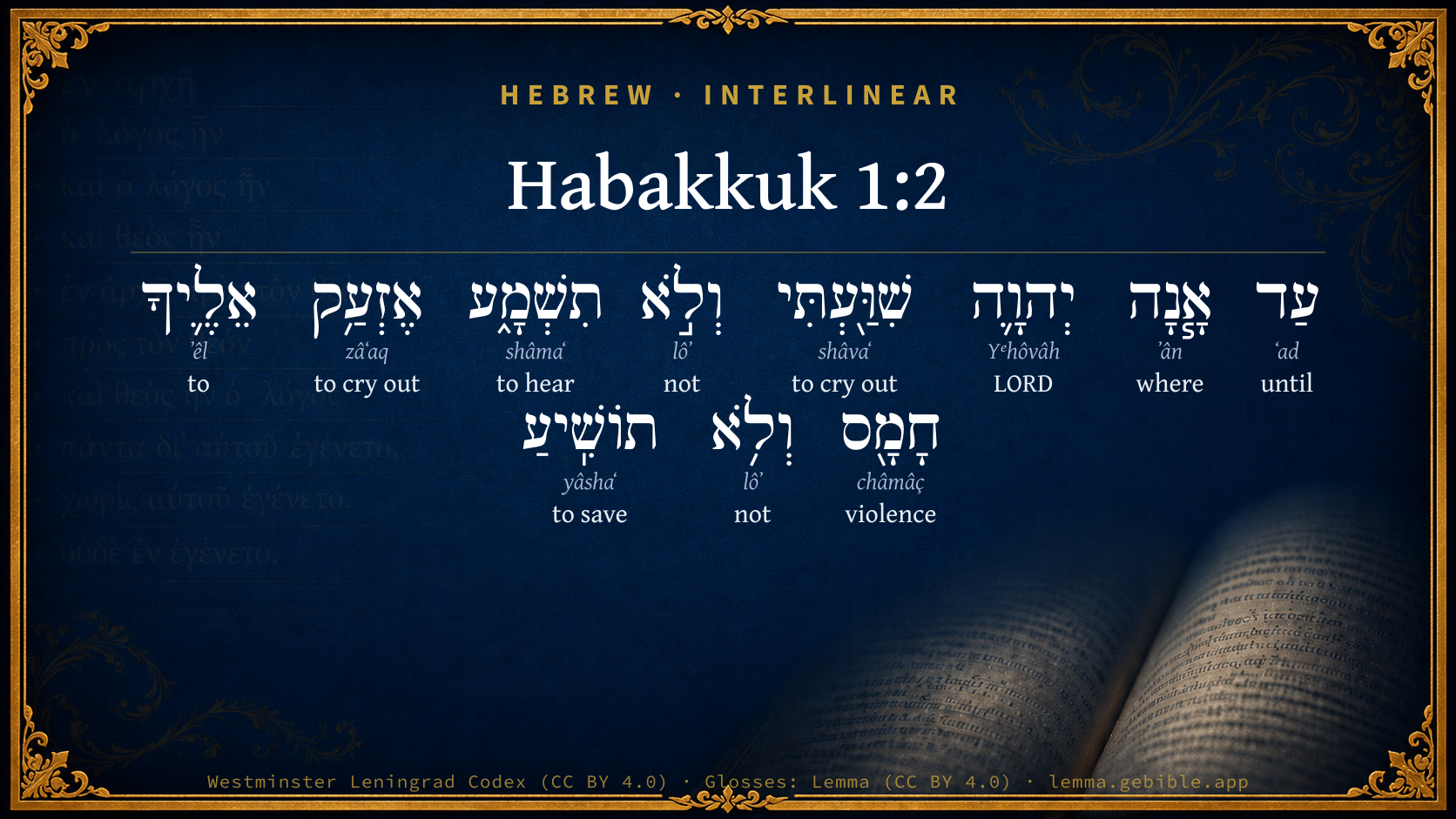
Hebrew (Westminster Leningrad Codex) Habakkuk 1:2 appears in the Hebrew Old Testament. The text above is from the Westminster Leningrad Codex. Each word links to its Strong’s number, a concise gloss, and parsing drawn from the Open Scriptures Hebrew Bible morphology. Click any word for its full Brown-Driver-Briggs (BDB) entry.
Download image
Cite this verse

Habakkuk 1:2 (World English Bible). Public Domain. Lemma interlinear Bible study tool, https://lemma.gebible.app/v/habakkuk/1/2.

Show BibTeX & RIS
BibTeX
RIS
English Translation
Yahweh, how long will I cry, and you will not hear? I cry out to you "Violence!" and will you not save?
World English Bible · Public Domain
Download a study sheet

One document with this verse’s original text, its word-by-word gloss line, the meaning frame, cross-references with their text, attributed commentary, and full source and license credits — printable, and it pastes into notes with its structure intact.

This verse Autodidact and up

Study sheet (.html) Plain text (.txt)

A passage Seminary Student

Up to 50 verses in one chapter. A passage sheet keeps up to 6 commentary sources and 12 cross-references per verse, in the order this page ranks them, and says so on the sheet whenever that leaves anything out. Ask for a single verse and you get the Autodidact verse sheet above.

Everything on this page stays free to read, with no account — the sheet is a download of what is already on screen, not access to it.

Want to remove ads? Support Godless Engineer
Compare translations 3

The same verse in 3 English versions, stacked beneath the original-language interlinear above. Click any original word for its lexicon entry.

Each is an independent rendering of the whole verse — the interlinear is not word-aligned to these translations.

Highlighted words mark where these versions differ — a whole-verse word diff, not a word-by-word alignment.

  • World English Bible Public Domain
    Yahweh, how long will I cry, and you will not hear? I cry out to you "Violence!" and will you not save?
  • King James Version Public Domain
    O LORD, how long shall I cry, and thou wilt not hear! even cry out unto thee of violence, and thou wilt not save!
  • unfoldingWord Literal Text CC BY-SA 4.0
    “Until when, Yahweh, will I cry aloud, but you will not listen? I cry out to you ‘Violence!’ but you do not save.

unfoldingWord Literal Text — © unfoldingWord, licensed CC BY-SA 4.0. Word-aligned USFM3 via Door43 (git.door43.org/unfoldingWord/en_ult).

Versions to compare (up to 4)

3 of 4 selected

Show all 18 translations

Every available English version of this verse, each an independent rendering of the whole verse.

  • World English Bible Public Domain
    Yahweh, how long will I cry, and you will not hear? I cry out to you "Violence!" and will you not save?
  • Berean Standard Bible Public Domain
    How long, O LORD, must I call for help but You do not hear, or cry out to You, “Violence!” but You do not save?
  • Majority Standard Bible Public Domain
    How long, O LORD, must I call for help but You do not hear, or cry out to You, “Violence!” but You do not save?
  • King James Version Public Domain
    O LORD, how long shall I cry, and thou wilt not hear! even cry out unto thee of violence, and thou wilt not save!
  • American Standard Version (1901) Public Domain
    O Jehovah, how long shall I cry, and thou wilt not hear? I cry out unto thee of violence, and thou wilt not save.
  • Revised Version (1885) Public Domain
    O LORD, how long shall I cry, and thou wilt not hear? I cry out unto thee of violence, and thou wilt not save.
  • Geneva Bible (1599) Public Domain
    O Lord, howe long shall I crye, and thou wilt not heare! euen crye out vnto thee for violence, and thou wilt not helpe!
  • Douay-Rheims (1899) Public Domain
    How long, O Lord, shall I cry, and thou wilt not hear? shall I cry out to thee suffering violence, and thou wilt not save?
  • Young's Literal Translation Public Domain
    Till when, O Jehovah, have I cried, And Thou dost not hear? I cry unto Thee -- `Violence,' and Thou dost not save.
  • Literal Standard Version CC BY-SA 4.0
    Until when, O YHWH, have I cried, || And You do not hear? I cry to You, “Violence!” And You do not save.
  • Unlocked Literal Bible CC BY-SA 4.0
    “Yahweh, how long will I cry for help, and you will not hear? I cry out to you, 'Violence!' but you will not save.
  • unfoldingWord Literal Text CC BY-SA 4.0
    “Until when, Yahweh, will I cry aloud, but you will not listen? I cry out to you ‘Violence!’ but you do not save.
  • Darby Bible Public Domain
    Jehovah, how long shall I cry and thou wilt not hear? I cry out unto thee, Violence! and thou dost not save.
  • World Messianic Bible Public Domain
    LORD, how long will I cry, and you will not hear? I cry out to you “Violence!” and will you not save?
  • Webster's Bible Public Domain
    O LORD, how long shall I cry, and thou wilt not hear! even cry out to thee of violence, and thou wilt not save!
  • Free Bible Version CC BY-SA 4.0
    Lord, how long do I have to cry out for help and you don't listen? I cry out, “Violence!” but you don't save us from it.
  • Bible in Basic English Public Domain
    How long, O Lord, will your ears be shut to my voice? I make an outcry to you about violent behaviour, but you do not send salvation.
  • JPS Tanakh (1917) Public Domain
    How long, O LORD, shall I cry, and Thou wilt not hear? I cry out unto Thee of violence, and Thou wilt not save.

Literal Standard Version (2020), Covenant Press — licensed CC BY-SA 4.0. Text via the HelloAO Bible API (eBible.org). Unlocked Literal Bible (unfoldingWord) — licensed CC BY-SA 4.0. Text via the HelloAO Bible API (eBible.org). unfoldingWord Literal Text — © unfoldingWord, licensed CC BY-SA 4.0. Word-aligned USFM3 via Door43 (git.door43.org/unfoldingWord/en_ult). Free Bible Version, Dr. Jonathan Gallagher — licensed CC BY-SA 4.0. Text via the HelloAO Bible API (eBible.org).

Word by word

More ways to search: Search by grammar → Find every occurrence → Compare this word →

Practice this passage: Drill this verse → Learn its vocabulary →

About this verse

These counts appear in no published source. They are computed here, from the morphology-tagged text and Lemma’s own curated glosses. What Lemma adds →

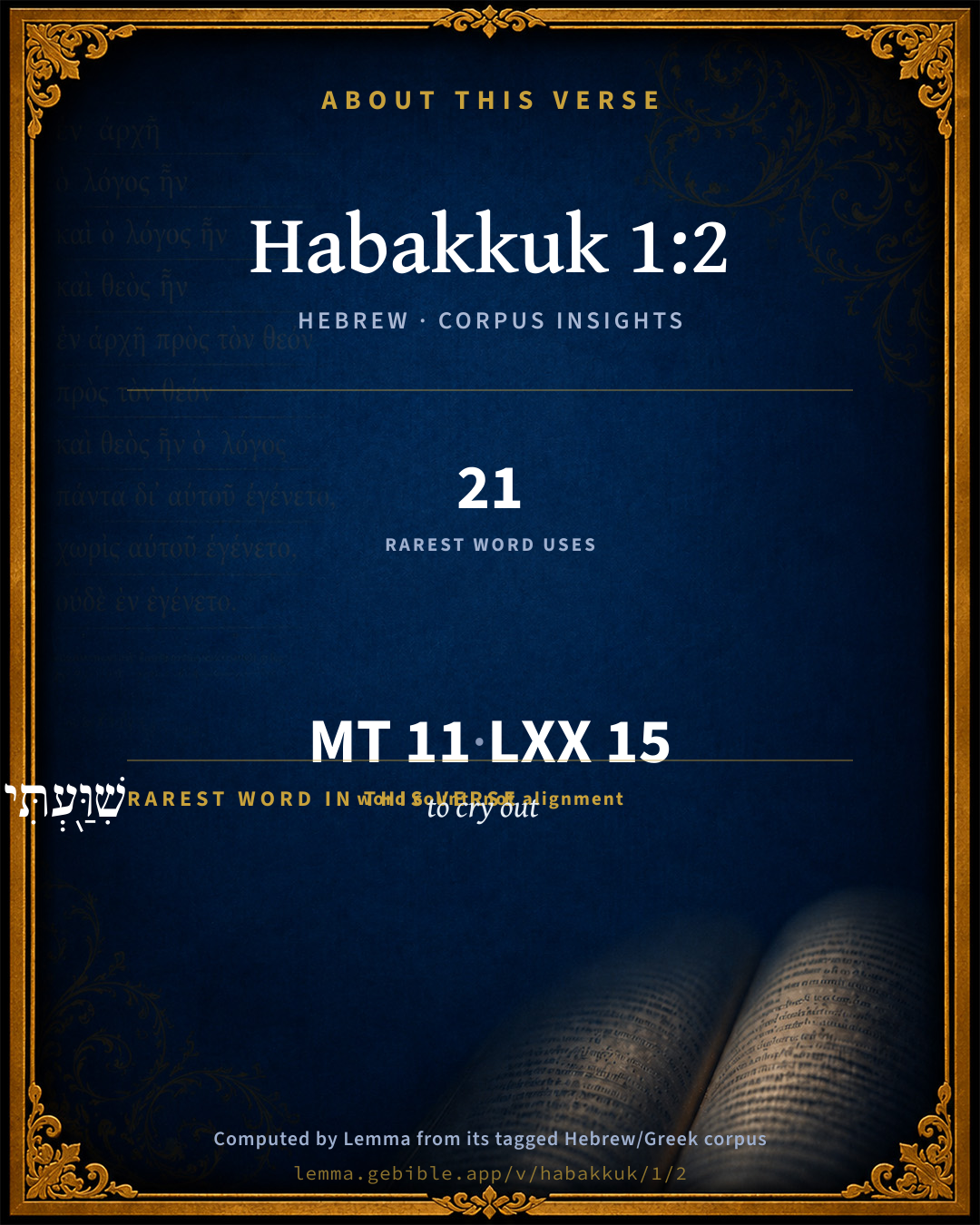
11
words
10
distinct lemmas
Prophets
section

Notable vocabulary

The rarest word here is שִׁוַּ֖עְתִּי to cry out H7768 — appearing just 21 times in the whole Hebrew Bible.

Shared distinctive vocabulary

שִׁוַּ֖עְתִּי to cry out H7768 occurs in 21 verses of the Hebrew Bible. Also found in:

Grammatical profile

  • 4 verbs
  • 2 nouns
  • 2 prepositions
  • 1 adverb
  • 2 particles

Verb forms

  • שִׁוַּ֖עְתִּי Piel · Perfect
  • תִשְׁמָ֑ע Qal · Imperfect
  • אֶזְעַ֥ק Qal · Imperfect
  • תוֹשִֽׁיעַ Hiphil · Imperfect

Repetition

A word recurs within this verse — often emphatic in Hebrew:

  • וְלֹ֣א not H3808 ×2

Hebrew & Septuagint length

In English translation the verse runs 22 words from the Hebrew and 28 from the Septuagint (LXX English) — closely comparable.

A rough comparison of the two English renderings, which tokenize alike — not a word-level alignment.

Word counts can differ between the Hebrew and the Greek without any difference in meaning — e.g. the Hebrew direct-object marker אֵת has no separate Greek word, and Greek often adds the article ὁ.

In the original languages it is 11 Hebrew tokens and 15 Greek tokens — but the two are counted differently (Hebrew bundles its prefixes and suffixes into one token; the Greek is in lemma form), so that isn’t a like-for-like length.

Cross-references

7

Topical passages linked to Habakkuk 1:2 in the Treasury of Scripture Knowledge — connected by theme and wording, ordered by reader-vote popularity; previews shown in the World English Bible.

  • Psalms 22:1–2 My God, my God, why have you forsaken me? Why are you so far from helping me, and from the words of my groaning?
  • Psalms 13:1–2 How long, Yahweh? Will you forget me forever? How long will you hide your face from me?
  • Lamentations 3:8 Yes, when I cry, and call for help, he shuts out my prayer.
  • Jeremiah 14:9 Why should you be like a scared man, as a mighty man who can't save? yet you, Yahweh, are in the midst of us, and we are called by your name; don't leave us.
  • Psalms 94:3 Yahweh, how long will the wicked, How long will the wicked triumph?
  • Revelation 6:10 They cried with a loud voice, saying, "How long, Master, the holy and true, until you judge and avenge our blood on those who dwell on the earth?"
  • Psalms 74:9–10 We see no miraculous signs. There is no longer any prophet, Neither is there among us anyone who knows how long.

Cross-references courtesy of OpenBible.info (CC BY 4.0).

Hebrew and Greek witnesses Masoretic Hebrew ↔ Greek Septuagint

The same verse in the two great witnesses to the Old Testament, shown verse-for-verse.

These are two independent witnesses, not word-aligned to each other, and the Septuagint is shown in lemma (dictionary) form.

Hebrew Habakkuk 1:2 Masoretic · Westminster Leningrad Codex

עַד אָ֧נָה יְהוָ֛ה שִׁוַּ֖עְתִּי וְלֹ֣א תִשְׁמָ֑ע אֶזְעַ֥ק אֵלֶ֛יךָ חָמָ֖ס וְלֹ֥א תוֹשִֽׁיעַ

Yahweh, how long will I cry, and you will not hear? I cry out to you "Violence!" and will you not save?

World English Bible · Public Domain

Greek LXX Habakkuk 1:2 Septuagint · lemma form

ἕως τίς κύριος κράζω καί οὐ μή εἰςἀκούω βοάω πρός σύ ἀδικέω καί οὐ σώζω

How long, O Lord, shall I cry out, and you will not listen? how long shall I cry out to you being injured, and you will not save?

LXX2012 (modern English Septuagint) · Public Domain

On this verse, The Pulpit Commentary discusses the Septuagint’s reading. Read the note in Commentary ↓

Hebrew: Westminster Leningrad Codex (CC BY 4.0). Greek: Septuagint (public domain); English from LXX2012 (modern English Septuagint) (Public Domain). How the Septuagint differs from the Hebrew →

Targum (Aramaic paraphrase)

1

The Targum is the ancient Jewish Aramaic paraphrase of the Hebrew Scriptures — an interpretive translation, not the Hebrew text itself. Onkelos (literal) and Pseudo-Jonathan (expansive) render the Torah, and Jonathan the Prophets. Coverage is partial: where no permissively-licensed English translation exists for a verse, only the Aramaic is shown. This is verse-level text, not a word-by-word alignment to the Hebrew.

  1. Targum Jonathan Prophets (Joshua–Malachi)
    עַד אֵימָתַי יְיָ אֲנָא מְצַלֵי הֲלָא גְלֵי קֳדָמָךְ קָבֵילְנָא קֳדָמָךְ עַל חֲטוֹפִין הֲלָא יוּכְלָא קֳדָמָךְ לְמִפְרַק:

    (no public-domain English translation for this verse)

    Targum Jonathan — Aramaic: “Mikraot Gedolot” (public domain). English: “Sefaria Community Translation” (CC0 1.0 (public-domain dedication)); “London "Chaldee Paraphrase," 1871” (public domain). Text via Sefaria.

Commentary

Notes on Habakkuk 1:2 from classic Christian and Jewish commentators (each source and its license shown beneath its notes). The classic Christian expositions comment on the surrounding passage and are grouped to its opening verse, so a note may address several verses; the Jewish commentaries on the Tanakh (Rashi and others) are per-verse, so they appear only where the commentator wrote on this verse.

Lemma curates 59 commentaries, every one of them public domain or Creative Commons licensed, each selected and text-cleaned for this edition rather than reprinted as found. About our sources →

Trapp's Complete Commentary

John Trapp

Hab 1:2 O LORD, how long shall I cry, and thou wilt not hear! [even] cry out unto thee [of] violence, and thou wilt not save!

Ver. 2. O Lord, how long shall I cry, and thou wilt not hear?] Lo, this is the confidence of a good conscience towards God, 1Pe 3:21, when it is parleying with him by prayers and bold intercessions (εντευξεις), 1Ti 2:1, it dare plead, as Jer 12:1, and interrogate, as Rom 8:33-35 Isa 63:15, and expostulate, as David often: when God seems to be asleep, he wakes him; when to delay, he quickens him; when to have lost his wonted kindness, he finds it for him; so doth Habakkuk here; for he knew he might do it. See his holy boldness beneath, Hab 1:12, and learn to continue instant in prayer, Rom 12:12, crying, Quousque Domine? How long, Lord? This was Mr Calvin’s motto, ever in his mouth, as Deo gratias grace to God, was in Austin’s.

Even cry out unto thee of violence] i.e. Of all sorts of heinous sins, which I have long cried out upon, and sought by preaching and prayer to redress, but cannot; so incorrigibly flagitious are they grown, that I have now no other way left, but to turn them over to thee, with a Non convertentur, They will not be converted. Shall they still "escape by iniquity? in thine anger cast down the people, O God," Psa 56:7, and let them feel the power of thy wrath that will not submit to the sceptre of thy kingdom. Thus the holy prophet {Elijah-like, Rom 11:2} maketh intercession to God against Israel (when once incorrigible, uncurable), for whose souls’ health he would have spent and been spent, Impendam et expendar.

John Trapp, A Commentary or Exposition upon All the Books of the Old and New Testament (1647–1656) — public domain. Text from a community e-Sword module.

The Biblical Illustrator

Joseph S. Exell

Hab_1:2

O Lord! how long shall I cry, and Thou wilt not hear?

The crisis of prayer

The question to be answered is this: How long will God suffer His people to pray, and still neglect to hear? Answer--

1. Till they see the plague of their own hearts--till each one sees his own individual iniquities, and lies in the dust before God.

2. Till the Church feels that she stands in the gap between God and a sin destroyed world.

3. Till they are willing to do whatever of duty He requires, in addition to praying.

4. Till they move the stumbling-blocks out of the way of a revival of His work.

5. If God sees in His people any disposition to withhold from Him the glory of the work He does. We see from this subject--

(1) Why so many prayers seem to be offered in vain.

(2) We see some of the causes of spiritual declension in the Church.

(3) The subject shows how we should set about raising the Church from her low estate.

(4) We see the duty of every Christian to search well his own heart. The hindrances to revivals are the sins of individuals. Each Christian, therefore, must search and purify himself.

(5) How fearful is the Churchs responsibility; and how great should be her watchfulness, lest by her apathy, her selfishness, or her unbelief, she hinder the work of the Lord. (National Preacher.)

The cry of a good man under the perplexing procedure of God

I. Gods apparent disregard to his earnest prayer. Under the pressure of that burden which was resting on his heart, namely, the moral corruption and the coming doom of his country; it would seem that he had often cried unto the Almighty and implored His interposition; but no answer had come. Why are not the prayers of good men immediately answered? In reply to this question three undoubted facts should be borne in mind.

1. That importunity of soul is necessary to qualify for the appreciation of the mercies sought. It is not until a man is made to feel the deep necessity of a thing that he values it when it comes. How long shall I cry? Until the sense of need is so intensified as to qualify for the reception and due appreciation of the blessing. Another fact that should be borne in mind is--

2. That the exercise of true prayer is in itself the best means of spiritual culture. Conscious contact with God is essential to moral excellence. You must bring the sunbeam to the seed you have sown, if you would have the seed quickened and developed; and you must bring God into conscious contact with your powers, if you would have them vivified and brought forth into strength and perfection. True prayer does this; it is the soul realising itself in the presence of Him who quickeneth all things.

3. That prayers are answered where there is no bestowment of the blessing invoked. Not my will, but Thine be done. This is all we want. Acquiescence in the Divine will is the moral perfection, dignity, and blessedness of all creatures in the universe. With these facts let us not be anxious about the apparent disregard of God to our prayers.

II. Gods apparent disregard to the moral condition of society. Why dost Thou show me iniquity, and cause me to behold grievance? for spoiling and violence are before me: and there are that raise up strife and contention. Therefore the law is slacked, and judgment doth never go forth: for the wicked cloth compass about the righteous; therefore wrong judgment proceedeth. The substance of this is the old complaint, Wherefore doth the way of the wicked prosper? Two facts should be set against this complaint.

1. The good have the best of it, even in this life.

2. The evil will have the worst of it in the next life. (Homilist.)

The expostulation of faith

The prophet is deeply afflicted, for there is little religion in the land, and as little of the true service of God. The one in reality is the measure of the other, although there may often seem more religion than righteousness. He does not, however, begin with attacking vice and irreligion and sin. He knows better than to do this. He carries his complaint to God, and in this way he would find some relief from his perplexity. The prophet expostulates with his God. His work seems almost hopeless, but he is a godly man, and he turns instinctively from man to God. Assuredly there is an expostulation of faith as well as of presumption. It may be good for the prophet, and for those in like circumstances, that at times God is silent. It is not that the prophet distrusts the justice or the mercy of God; it is rather, that in his impatience he would set times and seasons for His working. The times in which the prophet lived were times of ungodliness, of violence, and of misrule. Every one did that which was right in his own eyes. To correct this, the merely human sense of right is powerless. In such times, righteous men, such as wished to lead a tranquil and quiet life in all godliness and gravity, must go to the wall. Even thus they cannot escape injustice and violence, scorn and oppression, from the many who have no belief in the Unseen, and who act accordingly. And so they are compassed about with wickedness. The mercy of God may be compassing them about, but for the time they can hardly see any evidences of it, and they are almost in despair. They are tempted to think that all the foundations of the earth are moved, and to say, God hath forsaken the earth. (P. Barclay, M. A.)

Freedom allowed in prayer

The prophet does not here teach the Jews, but prepares them for a coming judgment, as they could not but see that they were justly condemned, since they were proved guilty by the cry and complaints made by all the godly. Now this passage teaches us that all who really serve and love God, ought, according to the prophet s example, to burn with holy indignation whenever they see wickedness reigning without restraint among men, and especially in the Church of God. There is indeed nothing which ought to cause us more grief than to see men raging with profane contempt for God, and aa regard had for His law and for Divine truth, and all order trodden under foot. When therefore such a confusion appears to us, we must feel roused, if we have in us any spark of religion. If it be objected that the prophet exceeded moderation, the obvious answer is this,--that though he freely pours forth his feelings, there was nothing wrong in this before God, at least nothing wrong is imputed to him: for wherefore do we pray, but that each of us may unburden his cares, his griefs, and anxieties, by pouring them into me bosom of God? Since then God allows us to deal so familiarly with Him, nothing wrong ought to be ascribed to our prayers, when we thus freely pour forth our feelings, provided the bridle of obedience keeps us always within due limits, as was the case with the prophet; for it is certain that he was retained under the influence of real kindness. Our prophet here undertakes the defence of justice; for he could not endure the law of God to be made a sport, and men to allow themselves every liberty in sinning. He can be justly excused, though he expostulates here with God, for God does not condemn this freedom in our prayers. The end of praying is, that every one of us pour forth his heart before God. (John Calvin.)

The deeper plan in human events

In listening to a great organ, played by the hand of a master, there is often an undertone that controls the whole piece. Sometimes it is scarcely audible, and a careless listener would miss it altogether. The lighter play goes on, ebbing and flowing, rising and sinking, now softly gliding on the gentler stops, and now swelling out to the full power of the great organ. But amid all the changes and transpositions this undertone may be heard, steadily pursuing its own thought. The careless listener thinks the lighter play the main thing; but he that can appreciate musical ideas, as well as sounds, follows the quiet undertone of the piece, and finds in it the leading thought of the artist. So men see the outward events of life, the actions, the words, the wars, famines, sins; but underneath all God is carrying out His own plans, and compelling all outward things to aid the music He would make in this world. (Christian Age.)

The Biblical Illustrator, edited by Joseph S. Exell (c. 1880s–1900s) — public domain. Text from a community e-Sword module.

Joseph Benson's Commentary

Hab 1:2-4. O Lord, how long shall I cry, &c. — How long shall I complain unto thee of might overcoming right, and thou wilt not save or prevent it? The prophet here proposes the common objection against Providence, taken from the prosperity of the wicked, and their oppression of the righteous, which has often been a stumbling-block even to good men: see Jer 12:1; Job 12:6; and Job 21:7; Psalm 37., 73. Why dost thou show me iniquity? — Why hast thou caused me to live in such times of iniquity? for I see nothing but scenes of rapine, and the most unjust oppression. And there are that raise up strife, &c. — Or, there is strife, and contention carries it. There is much cause for complaining, but those best skilled in the arts of contention carry the cause. Therefore the law is slacked — The divine law, given us for the regulation of our conduct, hath lost its force. And judgment doth never go forth — Causes remain undetermined, and justice is not duly administered. For the wicked, &c. — For the wicked, by their deceitful arts, prevail against the righteous, and overpower them; therefore [rather, moreover] wrong judgment proceedeth — Not only judgment is delayed, but, what is still worse, unjust judgment is given, and causes are evidently decided in a manner quite contrary to what is equitable and just.

Joseph Benson's Commentary on the Old and New Testaments (1811–1818) — public domain. Text from a community e-Sword module.

Whedon's Commentary on the Bible

Daniel D. Whedon

THE PROPHET’S PERPLEXITY, Hab_1:2-4.

For a long time the prophet had watched the wickedness of his people. Surely they deserved severe punishment, but none came. He found it difficult to reconcile this apparent indifference on the part of Jehovah with his conception of the divine holiness. In his perplexity he cries out to Jehovah.

2. How long shall I cry — Literally, have I cried. The Hebrew verb implies the idea “for help,” that is, to bring about a change in the terrible condition in which the prophet finds himself.

Cry out unto thee of violence — A further description of the prophet’s cry; literally, I cry unto thee violence. The substance of his cry is the violence of his countrymen; the noun denotes wrongdoing and injury of every kind (Job_19:7; Jer_20:8). Though the prophet, has cried again and again, Jehovah has paid no attention.

Hear… save — The fact that Jehovah did not interfere in behalf of the oppressed seemed conclusive evidence that he did not hear the prophet’s cry. It is not to be supposed that the prophet was the only one in Judah who still cried to Jehovah; but because of his intimate fellowship with Jehovah he felt the unrighteousness most keenly; besides, like his contemporary Jeremiah, he may have had to suffer in his own person from the ungodly. The cry uttered by him must have found an echo in the hearts of all who remained loyal to Jehovah.

The prophet’s perplexity finds further expression in Hab_1:3.

Why dost thou show me iniquity — The Hebrew word translated “iniquity” is used sometimes with the meaning “affliction,” but more frequently, as here, of moral evil and wickedness (compare Num_23:21). This moral evil the prophet is compelled to look upon, but he is convinced that Jehovah has power to stop it, and since he takes no steps toward this he is responsible for its presence. But how can a holy God remain silent in the presence of evil? A serious problem indeed (see on Amo_3:6; Amo_4:6-11; compare Job_23:16-17).

Grievance — R.V., “perverseness.” Primarily, labor, toil; in a secondary sense, trouble or distress experienced as a result of oppression or injustice. Here the distress caused by the “violent” and suffered by the oppressed (Isa_10:1).

Spoiling — R.V., “destruction.” Violent treatment resulting in destruction.

Violence — Malicious conduct to injure another. The two words are frequently combined (Amo_3:10; Jer_6:7; Jer_20:8).

Strife and contention — Among the members of the Jewish nation; the result of violent and wicked conduct.

The consequence of all this is a state of anarchy, described in Hab_1:4.

Therefore — Because Jehovah has allowed wickedness to proceed unhindered.

The law — See on Hos_4:6. Here the term includes the revealed will of Jehovah concerning life and conduct, whatever the method of making it known, or the form in which it existed.

Is slacked — Literally, has become numb; has lost its vitality and efficiency.

Judgment — The word means sometimes a legal decision; if so here, a legal decision to put an end to wickedness and injustice. It might be rendered also, with R.V., “justice,” that is, a righteous and equitable state of things in the civic and political life.

Doth never go forth — An obscure expression. Margin R.V. offers as an alternative, “goeth not forth unto victory.” This rendering is based upon the explanation of the word translated “forever” (“never” minus the negative) in the sense of truth, with which translation may be compared Isa_42:3, “justice in truth,” reproduced in Mat_12:20, “judgment unto victory.” It is better, however, to retain the ordinary rendering “not forever” or “never.” The thought of the clause seems to be: In the present hopeless condition there is no prospect that order, or civic and political righteousness, will ever manifest itself again.

Instead of a causal clause 4b might be understood (G.-K., 148d) as an exclamation, “Indeed, the wicked doth compass about the righteous!” In a hostile sense (Job_3:23; not as in Psa_142:7). The two nouns are used in a collective sense of two classes within the nation (see Introduction, p. 467; Isa_3:10-11; Isa_5:23; Zep_1:3). In later times it became customary to refer to heathen oppressors as the wicked in distinction from the righteous Israel. The godless in Israel encompassed the righteous to destroy them.

Wrong judgment proceedeth — R.V., “justice goeth forth perverted.” It is the constant complaint of the prophets that under the guise of law rankest injustice was done (Amo_5:7; Isa_1:23; Jer_22:16-17, etc.).

Daniel D. Whedon (gen. ed.), Commentary on the Old and New Testaments (1874–1909) — public domain. Text from a community e-Sword module.

Keil & Delitzsch

C. F. Keil & F. Delitzsch

The prophet's lamentation. Hab 1:2. "How long, Jehovah, have I cried, and Thou hearest not? I cry to Thee, Violence; and Thou helpest not! Hab 1:3. Why dost Thou let me see mischief, and Thou lookest upon distress? devastation and violence are before me: there arises strife, and contention lifts itself up. Hab 1:4. Therefore the law is benumbed, and justice comes not forth for ever: for sinners encircle the righteous man; therefore justice goes forth perverted." This complaint, which involves a petition for help, is not merely an expression of the prophet's personal desire for the removal of the prevailing unrighteousness; but the prophet laments, in the name of the righteous, i.e., the believers in the nation, who had to suffer under the oppression of the wicked; not, however, as Rosenmller and Ewald, with many of the Rabbins, suppose, over the acts of wickedness and violence which the Chaldaeans performed in the land, but over the wicked conduct of the ungodly of his own nation. For it is obvious that these verses refer to the moral depravity of Judah, from the fact that God announced His purpose to raise up the Chaldaeans to punish it (Hab 1:5.). It is true that, in Hab 1:9 and Hab 1:13, wickedness and violence are attributed to the Chaldaeans also; but all that can be inferred from this is, that "in the punishment of the Jewish people a divine talio prevails, which will eventually fall upon the Chaldaeans also" (Delitzsch). The calling for help (שׁוּע is described, in the second clause, as crying over wickedness. חמס is an accusative, denoting what he cries, as in Job 19:7 and Jer 20:8, viz., the evil that is done. Not hearing is equivalent to not helping. The question עד־אנה indicates that the wicked conduct has continued a long time, without God having put a stop to it. This appears irreconcilable with the holiness of God. Hence the question in Hab 1:3 : Wherefore dost Thou cause me to see mischief, and lookest upon it Thyself? which points to Num 23:21, viz., to the words of Balaam, "God hath not beheld iniquity ('âven) in Jacob, neither hath He seen perverseness (‛âmâl) in Israel." This word of God, in which Balaam expresses the holiness of Israel, which remains true to the idea of its divine election, is put before the Lord in the form of a question, not only to give prominence to the falling away of the people from their divine calling, and their degeneracy into the very opposite of what they ought to be, but chiefly to point to the contradiction involved in the fact, that God the Holy One does now behold the evil in Israel and leave it unpunished. God not only lets the prophet see iniquity, but even looks at Himself. This is at variance with His holiness. און, nothingness, then worthlessness, wickedness (cf. Isa 1:13). עמל, labour, then distress which a man experiences or causes to others (cf. Isa 10:1). הבּיט, to see, not to cause to see. Ewald has revoked the opinion, that we have here a fresh hiphil, derived from a hiphil. With שׁד וגו the address is continued in the form of a simple picture. Shōd vechâmâs are often connected (e.g., Amo 3:10; Jer 6:7; Jer 20:8; Eze 45:9). Shōd is violent treatment causing desolation. Châmâs is malicious conduct intended to injure another. ווהי, it comes to pass, there arises strife (rı̄bh) in consequence of the violent and wicked conduct. ישּׂא, to rise up, as in Hos 13:1; Psa 89:10. The consequences of this are relaxation of the law, etc. על־כּן, therefore, because God does not interpose to stop the wicked conduct. פּוּג, to relax, to stiffen, i.e., to lose one's vital strength, or energy. Tōrâh is "the revealed law in all its substance, which was meant to be the soul, the heart of political, religious, and domestic life" (Delitzsch). Right does not come forth, i.e., does not manifest itself, lânetsach, lit., for a permanence, i.e., for ever, as in many other passages, e.g., Psa 13:2; Isa 13:20. לנצח belongs to לא, not for ever, i.e., never more. Mishpât is not merely a righteous verdict, however; in which case the meaning would be: There is no more any righteous verdict given, but a righteous state of things, objective right in the civil and political life. For godless men (רשׁע, without an article, is used with indefinite generality or in a collective sense) encircle the righteous man, so that the righteous cannot cause right to prevail. Therefore right comes forth perverted. The second clause, commencing with על־כּן, completes the first, adding a positive assertion to the negative. The right, which does still come to the light, is מעקּל, twisted, perverted, the opposite of right. To this complaint Jehovah answers in Hab 1:5-11 that He will do a marvellous work, inflict a judgment corresponding in magnitude to the prevailing injustice.

Keil & Delitzsch — Biblical Commentary on the Old Testament (1861–1891) — public domain (CC PDM 1.0). Text via the HelloAO Bible API. (Old Testament only.)

The Expositor's Bible

THE BOOK OF HABAKKUK

As it has reached us, the Book of Habakkuk under the title "The Oracle which Habakkuk the prophet eceived by vision," consists of three chapters, which fall into three sections.

First: Hab_1:2-17; Hab_2:1-4 (or 8), a piece in dramatic form; the prophet lifts his voice to God against the wrong and violence of which his whole horizon is full, and God sends him answer.

Second: Hab_2:5 (or 9-20), a taunt-song in a series of Woes upon the wrong-doer.

Third: chapter 3, part psalm, part prayer, descriptive of a Theophany and expressive of Israels faith in their God.

Of these three sections no one doubts the authenticity of the first; opinion is divided about the second; about the third there is a growing agreement that it is not a genuine work of Habakkuk, but a poem from a period after the Exile.

William Robertson Nicoll, ed., The Expositor's Bible (London: Hodder & Stoughton, 1887–1910) — public domain. 65 of 66 books (1 Corinthians is not separately keyed, as that volume carries no machine-parseable verse references); section-level commentary keyed to the opening verse. Introductory and overview sections not keyed to a specific passage are excluded.

Tyndale Open Study Notes

Tyndale Open Resources

1:2-4 To Habakkuk, God seemed indifferent to the evil permeating society in Judah (1:3-4) and unresponsive to his complaints about it (1:2).

1:2 call for help? . . . do not listen! The call/answer motif in Scripture often demonstrates the speaker’s trust in God as a refuge or guide (see Ps 102:1-2) and indicates intimate communion between the believer and God (Ps 145:18; Isa 65:24).

Tyndale Open Study Notes — © Tyndale Open Resources, licensed CC BY-SA 4.0. Text via the HelloAO Bible API.

Geneva Bible (1599)

Geneva Bible translators

The Prophet complaineth unto God, and bewaileth that among the Jews is left none equity and brotherly love: but instead hereof reigneth cruelty, theft, contention and strife.

Geneva Bible (1599) marginal notes — public domain. Text via Bolls.life.

Jamieson, Fausset & Brown

Robert Jamieson, A. R. Fausset & David Brown

violence . . . Why dost thou show me iniquity?--Similar language is used of the Chaldeans (Hab 1:9, Hab 1:13), as here is used of the Jews: implying, that as the Jews sinned by violence and injustice, so they should be punished by violence and injustice (Pro 1:31). Jehoiakim's reign was marked by injustice, treachery, and bloodshed (Jer 22:3, Jer 22:13-17). Therefore the Chaldeans should be sent to deal with him and his nobles according to their dealings with others (Hab 1:6, Hab 1:10-11, Hab 1:17). Compare Jeremiah's expostulation with Jehovah, Jer 12:1; Jer 20:8; and Job 19:7-8.

Jamieson, Fausset & Brown — Commentary Critical and Explanatory on the Whole Bible (1871) — public domain (CC PDM 1.0). Text via the HelloAO Bible API.

Adam Clarke's Commentary

Verse 2. O Lord, how long shall I cry] The prophet feels himself strongly excited against the vices which he beheld; and which, it appears from this verse, he had often declaimed against, but in vain; the people continued in their vices, and God in his longsuffering.

Habakkuk begins his prophecy under a similar feeling, and nearly in similar words, as Juvenal did his Satires: -

Semper ego auditor tantum?

Nunquamne reponam?

Vexatus toties rauci Theseide Codri?

Sat. i. 1.

"Shall I always be a hearer only?

Shall I never reply?

So often vexed?"

Of violence] The most unlawful and outrageous acts.

Adam Clarke's Commentary on the Bible (1810–1826) — public domain. Text from a community e-Sword/MySword module.

John Calvin's Commentaries

As I have already reminded you, interpreters think that the Prophet speaks here of future things, as though he had in his view the calamity which he afterwards mentions; but this is too strained a meaning; I therefore doubt not but that the Prophet expostulates here with God for so patiently indulging a reprobate people. For though the Prophets felt a real concern for the safety of the people, there is yet no doubt but that they burned with zeal for the glory of God; and when they saw that they had to contend with refractory men, they were then inflamed with a holy displeasure, and undertook the cause of God; and they implored His aid to bring a remedy when the state of things had become desperate. I therefore consider that the Prophet here solicits God to visit these many sins in which the people had hardened themselves. And hence we conclude that he had previously exercised his office of a teacher; for it would have been otherwise improper for him to begin his work with such a complaint and expostulation. He had then by experience found that the people were extremely perverse. When he saw that there was no hope of amendment, and that the state of things was becoming daily worse, burning with zeal for God, he gave full vent to his feelings. Before, then, he threatens the people with the future vengeance of God, he withdraws himself, as it were, from intercourse with men, and in private addresses God himself.

We must bear this first in mind, that the Prophet relates here the secret colloquy he had with God: but it ought not to be ascribed to an unfeeling disposition, that in these words he wished to hasten God’s vengeance against his own kindred; for it behaved the Prophet not only to be solicitous for the salvation of the people, but also to feel a concern for the glory of God, yea, to burn with a holy zeal. As, then, he had in vain labored for a length of time, I doubt not but that, being as it were far removed from the presence of all witnesses, he here asks God, how long he purposed thus to bear with the wickedness of the people. We now apprehend the design of the Prophet and the import of his words.

But he says first, How long, Jehovah, shall I cry, and thou hearest not? How long shall I cry to thee for violence, that is, on account of violence, and thou savest not? We hence learn, that the Prophet had often prayed God to correct the people for their wickedness, or to contrive some means to prevent so much licentiousness in sinning. It is indeed probable that the Prophet had prayed as long as there was any hope; but when he saw that things were past recovery, he then prayed more earnestly that God would undertake the office of a judge, and chastise the people. For though the Prophet really condoled with those who perished, and was touched, as I have said, with a serious concern for their public safety, he yet preferred the glory of God: when, therefore, he saw that boldness in sin increased through impunity, and that the Jews in a manlier mocked God when they found that they could sin without being punished, he could not endure such unbridled wantonness. Besides, the Prophet may have spoken thus, not only as expressing his own feeling, but what he felt in common with all the godly; as though he had undertaken here a public duty, and utters a complaint common to all the faithful: for it is probable that all the godly, in so disordered a state of things, mourned alike. How long, then, shall I cry? How long, he says, shall I cry on account of violence? that is, When all things are in disorder, when there is now no regard for equity and justice, but men abandon themselves, as it were with loose reins, unto all kinds of wickedness, how long, Lord, wilt thou take no notice? But in these words the Prophet not only egresses his own feelings, but makes this kind of preface, that the Jews might better understand that the time of vengeance was come; for they were become not only altogether intolerable to God, but also to his servants. God indeed had suspended his judgement, though he had been often solicited to execute it by his Prophet. It hence appears, that their wickedness had made such advances that it would be no wonder if they were now severely chastised by the Lord; for they had by their sins not only provoked him against them, but also all the godly and the faithful.

John Calvin's Commentaries (1540-1563) — public domain. Text from the Calvin Translation Society English edition (1840s-50s) via the Christian Classics Ethereal Library (ccel.org). Calvin's coverage is partial (roughly two-thirds of the Bible); uncommented books and verses are honest gaps, never fabricated. The 19th-century editor's footnotes and remarks are omitted so the notes are faithfully Calvin's own voice.

Ellicott's Commentary for English Readers

(2) Even cry out.—The latter half of the verse is best rendered “Even cry unto thee ‘Violence!’ and thou wilt not save.” The single word “violence!” (châmâs) occurs elsewhere, as an appeal for assistance, used as we use the cry “murder!” “fire!” &c., among ourselves. (See Jer_20:8, Job_19:7.)

A Bible Commentary for English Readers, edited by Charles John Ellicott (1878–1897) — public domain. Text from a community e-Sword module.

The Cambridge Bible for Schools and Colleges

gen. ed. J. J. S. Perowne

2–4. The Prophet’s complaint that he has long cried out against evils unheard

2. how long shall I cry] lit. shall I have cried? Exo_10:3; Exo_16:28; Psa_80:4. The prophet’s cry extends back into the past. But though he has been long crying he has received no answer from Heaven; the evil proceeds unchecked, even unregarded of God (Hab_1:3).

wilt not hear] dost not hear.

even cry out unto thee of violence] I cry out unto thee of violence (or, Violence! this being the word which forms his cry). Job_19:7; Jer_20:8. The term “violence” is equivalent to wrong, injury, whether accompanied with force or not, Gen_16:5.

wilt not save] dost not save, or, give deliverance, Psa_18:41 (Heb. 42). The cry of wrong and injury though long continued has evoked no interposition of God, nor been met with any help. The prophet seems certainly to complain not only of injury which he sees around him, but which he suffers (Job_19:7; Jer_20:8). But it may be a question when he says “I” whether he does not make himself one with some class in Israel, namely, the godly, who are wronged by the wicked, or with Israel as a people, which suffers injury at the hands of a foreign oppressor.

The Cambridge Bible for Schools and Colleges (gen. ed. J. J. S. Perowne; Cambridge University Press, 1878–1918) — public domain. Text from a community e-Sword module.

Albert Barnes' Notes on the Bible

O Lord, how long shall I cry - Literally, “how long have I cried so intensely to Thee?” Because it is always the cry of the creature to the One who alone can hear or help - its God. Of this cry the Prophet expresses that it had already lasted long. In that long past he had cried out to God but no change had come. There is an undefined past, and this still continues.

How long - as Asaph cries, “how long hast Thou been,” and, it is implied, wilt Thou be “wroth against the prayer of Thy people?” as we should say,” how long shall Thy wrath continue?” The words which the prophet uses relate to domestic strife and wrong between man and man; violence, iniquity, strife, contention Hab 1:3, nor are any of them used only of the oppression of a foreign enemy. Also, Habakkuk complains of injustice too strong for the law, and the perversion of justice Hab 1:4. And upon this, the sentence is pronounced. The enemy is to be sent for judgment and correction Hab 1:12. They are then the sins of Judah which the prophet rehearses before God, in fellow-suffering with the oppressed. God answers that they shall be removed, but by the punishment of the sinners.

Punishment does not come without sin, nor does sin endure without punishment. It is one object of the Old Testament to exhibit the connection between sin and punishment. Other prophets, as commissioned by God, first denounced the sins and then foretold the punishment of the impenitent. Habakkuk appeals to God’s justice, as requiring its infliction. On this ground too this opening of the prophecy cannot be a complaint against the Chaldees, because their wrong would be no ground of the punishment which the prophet denounced, but the punishment itself, requiting wrong to man through human wrong.

Cyril: “The prophet considers the person of the oppressed, enduring the intolerable insolence and contumely of those accustomed to do wrong, and very skillfully doth he attest the unutterable lovingkindness of God, for he exhibits Him as very forbearing, though accustomed to hate wickedness, but that He doth not immediately bring judgment upon the offenders, he showed clearly, saying that so great is His silence and long-suffering, that there needeth a strong cry, in that some practice intolerable covetousness against others, and use an unbridled insolence against the weak, for his very complaints of God’s endurance of evil attest the immeasurable loving kindness of God.”

Cyril: “You may judge hence of the hatred of evil among the saints. For they speak of the woes of others as their own. So saith the most wise Paul 2Co 11:29, who is weak and I am not weak? who is offended, and I burn not? and bade us Rom 12:15 weep with those who weep, showing that sympathy and mutual love are especially becoming to the saints.”

The prophet, through sympathy or fellow-suffering with the sufferers, is as one of them. He cries for help, as himself needing it, and being in the misery, in behalf of which he prays. He says, “How long shall I cry?” standing, as it were, in the place of all, and gathering all their cries into one, and presenting them before God. It is the cry, in one, of all which is wronged to the God of Justice, of all suffering to the God of love. “When shall this scene of sin, and confusion, and wrong be at an end, and the harmony of God’s creation be restored? How long shall evil not exist only, but prevail?” It is the cry of the souls under the altar Rev 6:10, “How long, O Lord, Holy and True, dost Thou not judge and avenge our blood on them that dwell on the earth?” It is the voice of the oppressed against the oppressor; of the Church against the world; weary of hearing the Lord’s Name blasphemed, of seeing wrong set up on high, of holiness trampled underfoot. It is in its highest sense His Voice, who, to sanctify our longings for deliverance, said in the days of His Flesh Psa 22:2, “I cry in the daytime, but Thou hearest not.”

Even cry out - aloud (it is the cry of anguish) Dion.: “We cry the louder, the more we cry from the heart, even without words; for not the moving of the lips, but the love of the heart sounds in the ears of God.”

Even cry out unto Thee. - Whether as an exclamation or a continuance of the question, How long? The prophet gathered in one the prolonged cry of past and future. He had cried out; he should cry on, “Violence.” He speaks as if the one word, jerked out, as it were, wrung forth from his inmost soul, was, “Violence,” as if he said this one word to the God of justice and love.

Albert Barnes' Notes on the Bible (1834–1885) — public domain. Text from a community e-Sword/MySword module.

Haydock's Catholic Bible Commentary

Save. Some think that he expresses the sentiments of the weak, like David, (Psalms lxxii. 2.) or what he had formerly entertained. The language of the prophets is very bold, Exodus xxxii. 32., Job iii. 3., Jeremias xx. 14., and Jonas iv. 8. (Calmet)

George Leo Haydock (1774–1849), Haydock's Catholic Family Bible and Commentary, 1859 edition — public domain. Excludes Psalms (Douay-Rheims chapter numbering differs from Protestant) and Deuterocanonical books (Catholic canon only).

Matthew Poole's English Annotations

O Lord: unto God alone he makes his application, as only able to redress all grievances.

How long! it may be some years he had preached, and in preaching had complained and cried out against wickedness.

Shall I cry, unto men in thy name, and unto thee in prayer and supplication.

And thou wilt not hear; give answer by correcting or punishing the bad, and by rescuing and delivering the good; by appearing a just Arbitrator and Judge of both.

Cry out, with submission, not murmuring, not impatient, not distrusting the justice or mercy of God. Unto thee, who art more displeased than I or any one else can be disquieted with that I complain of, who art by office and word bound to restrain violence, &c.

Of violence; the unjust and wicked oppressions which I see, others feel, and all good people are endangered by.

And thou wilt not save; by changing the bad, or restraining them, or by overthrowing them, and setting up just and upright men in their room, both in Jerusalem and in Judea, and every where else.

Matthew Poole's English Annotations on the Holy Bible (1683–1685) — public domain. Text from a community e-Sword/MySword module.

The Pulpit Commentary

Vers. 2-4 2. The prophet complains to God of the iniquity of his own nation, and its consequence.

Shall I cry; Septuagint, kekraxomai. The Hebrew is taken to imply that the prophet had long been complaining of the moral depravity of Judah, and calling for help against it There is no reference here, as Ewald fancies, to acts of violence committed by the Chaldeans, who, in fact, are announced as coming to chastise the wickedness of the chosen people (ver. 6). And thou wilt not hear! The continuance of evil unchecked is an anomaly in the prophet"s eye; and, putting himself in the position of the righteous among the people, he asks how long this is to last. Even cry out unto thee of violence; better, I cry out unto thee, Violence. A similar construction is found in Job_19:7; somai Jer_20:8. "Violence"includes all manner of wrong done to one"s neighbour. Septuagint, Boh) prov semenov, "I will cry unto thee being wronged," as if the wrong was done to the prophet himself. So the Vulgate, Vociferabor ad te vim patiens. But Habakkuk doubtless speaks in the person of the righteous, grieved at the wickedness he sees around, and the more perplexed as the Law led him to look for temporal rewards and punishments, if in the case of individuals, much more in that of the chosen nation. (Le 26, passim)

The lamentation of a good man.

I OVER THE RELIGIOUS DEGENERACY OF HIS AGE. Not merely for himself, but as the representative of the godly remnant of Judah, Habakkuk expostulates with Jehovah concerning the wickedness of the times in which he lived. The picture he sets before Jehovah is one of deep national corruption, such as existed in the days of Jehoiakim. (Jer_20:8 Jer_22:3, Jer_22:13-17) A picture of wickedness.

1. Great.

(1) Violence was abroad, as it had been in the days before the Flood, (Gen_6:11) in the time of David, (Psa_55:9) and even later in the reigns of Jotham and Ahaz, (Mic_2:2 Mic_6:12) practising spoliation, causing distress, and producing devastation, as it did in the long past era of the patriarch of Uz, (Job_24:1-12) evoking strife and contention, perhaps partly through the natural resistance of good men defending their property, but just as likely through the spoliators quarrelling over their prey, leading to deceit and treachery in order to gain its unhallowed end, "the wicked compassing about the righteous," and "plotting against the just". (Psa_37:12)

(2) Iniquity abounded, and that amongst a people whose ideal vocation was holiness; (Num_23:21) immoralities whose source was a perverse heart; (Mat_15:19) such practices as were inconsistent with the professions and privileges of those who did them; iniquity, or that which was unequal, and therefore contrary to law and truth.

(3) The Law of God was fallen into disrespect. The Torah, or Divine, revealed Law, "which was meant to be the soul, the heart of political, religious, and domestic life" (Delitzsch), was slacked; it was benumbed or chilled, paralyzed through the moral and spiritual apathy of the nation, which gave it no response and yielded to it no obedience.

(4) Human justice was itself perverted. Just because men"s hearts had declined from the love of God, and had ceased to respect his Law, judgment seldom or never proceeded forth against evil doers; or, if it did, it went forth perverted. When criminals were brought to trial, they could always secure a verdict in their favour.

1. Public. It was not merely a degeneracy, eating its way secretly into the vitals of the nation; the disease had already come to the surface. Vice and irreligion were not practised in private. Iniquity flaunted its robes openly in the eyes of passers by. The prophet saw it, looked upon it, felt himself surrounded by it. Spoiling and violence were before him; and sinners of every description around him.

2. Presumptuous. It was wickedness perpetrated, not merely against God"s Law, but by God"s covenanted people, in the face of remonstrances from God"s prophets, and under the eye of God himself. The prophet states that Jehovah as well as he had beheld the wickedness complained of.

3. Inveterate. It was not a sudden outburst of moral and spiritual corruption, but a long continued and deeply rooted manifestation of national degeneracy, which had often sent the prophet to his knees, and caused him to cry for Divine interposition.

II OVER THE SEEMING INDIFFERENCE OF GOD.

1. A frequent phenomenon. During the long antediluvian period Jehovah, apparently without concern, allowed mankind to degenerate; though he saw that the Wickedness of man was great in the earth, (Gen_6:5) it was not till one man only remained righteous before him that he interposed with the judgment of a flood. From the era of the Flood downwards he "suffered all nations to walk in their own ways". (Act_14:16) Job (Job_34:12) observed this to be the method of the Divine procedure in his day, Asaph in his, (Ps 1) Habakkuk in his; and today nothing can be more apparent than that it is not a necessary part of Heaven"s plan that "sentence against an evil work" should be "executed speedily.

2. A perplexing mystery. That God cannot be indifferent to sin, to the wickedness of nations or to the transgressions of individuals, is self-evident; otherwise he could not be God. (Psa_11:7 Psa_111:9 Psa_145:17; Isa_57:15; 1Pe_1:15; Rev_4:8) But that, loving righteousness and hating iniquity, he should seem to make no effort to protect, vindicate, strengthen, and diffuse the one, or to punish, restrain, and overthrow the other, this is what occasions trouble to religious souls reflecting on the course of providence. (Job_21:7; Psa_73:2) The solution of the problem can only be that, on the one hand, he deems it better that righteousness should be purified, tested, and established by contact with evil, while, on the other hand, it seems preferable to his wisdom and love that wickedness should have free scope to reveal its true character, and ample opportunity either to change its mind or to justify its final overthrow (see homily on vers. 12-19).

III OVER THE MANIFEST FRUITLESSNESS OF HIS PRAYERS. An experience:

1. Strange. Habakkuk had cried long and earnestly to Jehovah about the wickedness of his countrymen. If rivers of waters ran not down his eyes because they kept not Jehovah"s Law, as the psalmist tells us was the case with him, (Psa_119:136) and Jeremiah (Jer_9:1) wished that it could have been with him, long processions of greenings ascended from his bosom to the throne of God on that very account. Doubtless, also, he expostulated with Jehovah about his seeming indifference, saying, "How long, O Lord, will this wickedness prevail? and how long wilt thou be silent?" Yet was there "no voice, nor any that answered him," any more than if he bad been a worshipper of Baal; (1Ki_18:26) and this although Jehovah was preeminently the Hearer of prayer, (Psa_65:2) and had invited his people to call upon him in the day of trouble. (Ps 1)

2. Common. It is not wicked men alone whose prayers are denied men like Saul, (1Sa_28:6) and the inhabitants of Judah in the days of Isaiah (Isa_1:15) and of Jeremiah, (Jer_11:14) but good men like Job (Job_30:20) and David (Psa_22:2) as well. As the Syro-Phoenician woman cried after Jesus, and was answered never a word, (Mat_15:23) so many prayers ascend from the hearts of God"s people to which, for a time at least, no response returns.

3. Valuable. Fitful to test the faith and sincerity of the petitioner, it is also admirably calculated to teach him the sovereignty of God in grace as well as in nature, to show him that, while God distinctly engages to answer prayer, he undertakes to do so only in his own time and way.

Learn:

1. That no good man can be utterly indifferent to the moral and spiritualcharacter of the age in which he lives.

2. That good men should bear the highest interests of their country beforeGod upon their hearts in prayer.

3. That good men should never lose faith in two things that God is onthe side of righteousness, even when iniquity appears to triumph; and that

God hears their prayers, even when he delays to answer or appears to deny them.

Vers. 2-4The elegy.

In this brief and plaintive strain we have

I AN EARNEST HEART REFLECTING UPON THE PREVAILING INIQUITY. Whatever may have been the exact date of this prophecy, it is clear that the writer stood connected with the close of the kingdom of Judah, the eve of the Captivity, and that he presents to us, in a few graphic touches, a vivid description of the depravity then prevailing in the land. He bitterly laments over:

1. The insecurity of property. "Spoiling and violence are before me" (ver. 3).

2. The strifes of parties and factions. "And there are that raise up strife and contention" (ver. 3).

3. Laxity in the administration of the Law. "The Law is slacked, and judgment doth never go forth" (ver. 4).

4. The good suffering unjustly at the hands of the evil. "The wicked doth compass about the righteous "( ver. 4).

5. The openness and audacity of wrong doers in this evil course. He speaks of all this iniquity as being patent to the observer. Sometimes, "vice, provoked to shame, borrows the colour of a virtuous deed;" but in this instance there Has no attempt at concealment or disguise, and no sense of shame. "Spoiling and violence are before me" (ver. 3).

II AS EARNEST HEART YEARNING FOR THE ESTABLISHMENT OF RIGHTEOUSNESS, AND IMPATIENT OF DELAY. The life of piety is undoubtedly the happy life. (Psa_1:1) Still, it is not always sunshine, even with the good. There are times in their experience when the sky becomes overcast, and when they become depressed and sad at heart. Although possessing "the firstfruits of the Spirit," the pledge and the earnest of the enjoyment at length of a fulness of blessing, they often "groan within themselves". (Rom_8:23) And a very large ingredient in the cup of sorrow the good have to drink is that occasioned by beholding the blighting effects of sin. As they witness men unprincipled in their dealings, impure in their speech, dishonourable in their transactions, and as they note the pernicious influence and effects of such conduct, their hearts are rendered sad, and they are constrained to long ardently for the time when sin shall be completely vanquished, when it shall be banished from this fair universe of God, and when there shall come in all its perfection the reign of truth and righteousness, peace and love. This spirit runs through the prophet"s mournful strain (vers. 2-4). We recognize it also in the words of David, "Oh let the wickedness of the wicked!" etc., (Psa_7:9) and of Jeremiah, (Jer_14:8, Jer_14:9) and impelled by it many are crying today, "Why is his chariot so long in coming? Why tarry the wheels of his chariot?

III AN EARNEST HEART DIRECTING ITS IMPASSIONED APPEAL TO GOD IN PRAYER. (Ver. 2.) The seer did not question the Divine rectitude, but his spirit was perturbed at the delay, and he yearned with a holy impatience for the vindication of the honour of his God. And under such conditions no course is so commendable as that of pouring our plaint into the ear of Infinite Love. Prayer at such seasons will be found helpful:

1. In tranquillizing the spirit, quieting and subduing agitation, and imparting a sense of restfulness and peace.

2. In linking our human weakness to God"s almighty strength, and thusfitting us for reviewed service to him. "Toil, pain, doubt, terror, difficulty, all retreat before the recognition of a great life purpose wrought out inentire dependence upon Heaven.

3. In causing light to shine through the dark cloud of mystery, helping us tounderstand the Divine plan, (Psa_73:16, etc.) and so preparing the way for our exchanging the mournful elegy for the rapturous melody of thankful and adoring praise. S.D.H.

The Pulpit Commentary (1880–1919), ed. H.D.M. Spence-Jones & Joseph S. Exell — public domain. Text from a community e-Sword module.

Rashi

Rabbi Shlomo Yitzchaki (Rashi)

O Lord! How long -He foresaw with the Holy Spirit that Nebuchadnezzar was destined to be the ruler of the world and to cause trouble for Israel, as the matter is stated in his prophecy (1:6): “For behold, I raise up the Chaldeans, etc.” He was complaining for this.

I cry out to You of violence I mention before You the violence committed against me, and You do not save me.

Rashi on the Tanakh — English translations: “The Judaica Press complete Tanach with Rashi, translated by A. J. Rosenberg” (CC BY 4.0); “Pentateuch with Rashi's commentary by M. Rosenbaum and A.M. Silbermann, 1929-1934” (public domain); “The Metsudah Tanach series, Lakewood, N.J” (CC BY 4.0); and “The Book of Joshua, Metsudah Publications, 1997” (CC BY 4.0). Text via Sefaria.

Lesson kit

Teaching starters — assembled from the data on this page, not authored interpretation. Every prompt links to the verse data it draws on. Edit before teaching.

Habakkuk, in the Prophets, opens this verse with 11 words (10 distinct Hebrew lemmas). Its most distinctive word is shâvaʻ (“to cry out”). A historical commentator’s framing appears above. Read the whole chapter for the surrounding context.

Discussion questions

  1. The word shâvaʻ carries the sense “to cry out.” How does it shape the verse?
  2. How does Job 19:7, which shares the word «to cry out», read alongside this verse?
  3. What does the repetition of “not” (2× in this one verse) do in this verse?
  4. The translations on this page render this verse differently — a whole-verse word diff, not a word-by-word alignment. What might account for the different wordings?
  5. «שִׁוַּ֖עְתִּי» is a Piel Perfect verb. How does that grammatical form shape the action described?
  6. Compare how Trapp's Complete Commentary and The Biblical Illustrator read this verse. Where do they agree or differ?

Things to notice

Reading settings

Reading text

Shown beneath each verse's original-language words.

Old Testament
Old Testament edition

Read the OT as the Masoretic Hebrew (MT) or the Greek Septuagint (LXX).

English shown for the Greek Septuagint (in the Hebrew ↔ Greek comparison).

Comparing translations? Open the Compare panel on any verse page to stack up to four side by side.