
Psalms 60:5

Hebrew (Westminster Leningrad Codex) Psalms 60:5 appears in the Hebrew Old Testament. The text above is from the Westminster Leningrad Codex. Each word links to its Strong’s number, a concise gloss, and parsing drawn from the Open Scriptures Hebrew Bible morphology. Click any word for its full Brown-Driver-Briggs (BDB) entry.
Download image
Cite this verse

Psalms 60:5 (World English Bible). Public Domain. Lemma interlinear Bible study tool, https://lemma.gebible.app/v/psalms/60/5.

Show BibTeX & RIS
BibTeX
RIS
English Translation
So that your beloved may be delivered, Save with your right hand, and answer us.
World English Bible · Public Domain
Highlights
  • 1 first appearance in the Hebrew Bible
Full analysis ↓
Download a study sheet

One document with this verse’s original text, its word-by-word gloss line, the meaning frame, cross-references with their text, attributed commentary, and full source and license credits — printable, and it pastes into notes with its structure intact.

This verse Autodidact and up

Study sheet (.html) Plain text (.txt)

A passage Seminary Student

Up to 50 verses in one chapter. A passage sheet keeps up to 6 commentary sources and 12 cross-references per verse, in the order this page ranks them, and says so on the sheet whenever that leaves anything out. Ask for a single verse and you get the Autodidact verse sheet above.

Everything on this page stays free to read, with no account — the sheet is a download of what is already on screen, not access to it.

Want to remove ads? Support Godless Engineer
Compare translations 3

The same verse in 3 English versions, stacked beneath the original-language interlinear above. Click any original word for its lexicon entry.

Each is an independent rendering of the whole verse — the interlinear is not word-aligned to these translations.

Highlighted words mark where these versions differ — a whole-verse word diff, not a word-by-word alignment.

  • World English Bible Public Domain
    So that your beloved may be delivered, Save with your right hand, and answer us.
  • King James Version Public Domain
    That thy beloved may be delivered; save with thy right hand, and hear me.
  • unfoldingWord Literal Text CC BY-SA 4.0
    So that your beloved may be delivered, save your right hand and answer me.

unfoldingWord Literal Text — © unfoldingWord, licensed CC BY-SA 4.0. Word-aligned USFM3 via Door43 (git.door43.org/unfoldingWord/en_ult).

Versions to compare (up to 4)

3 of 4 selected

Show all 18 translations

Every available English version of this verse, each an independent rendering of the whole verse.

  • World English Bible Public Domain
    So that your beloved may be delivered, Save with your right hand, and answer us.
  • Berean Standard Bible Public Domain
    Respond and save us with Your right hand, that Your beloved may be delivered.
  • Majority Standard Bible Public Domain
    Respond and save us with Your right hand, that Your beloved may be delivered.
  • King James Version Public Domain
    That thy beloved may be delivered; save with thy right hand, and hear me.
  • American Standard Version (1901) Public Domain
    That thy beloved may be delivered, Save with thy right hand, and answer us.
  • Revised Version (1885) Public Domain
    That thy beloved may be delivered, save with thy right hand, and answer us.
  • Geneva Bible (1599) Public Domain
    That thy beloued may be deliuered, helpe with thy right hand and heare me.
  • Douay-Rheims (1899) Public Domain
    Thou hast shewn thy people hard things; thou hast made us drink wine of sorrow.
  • Young's Literal Translation Public Domain
    That Thy beloved ones may be drawn out, Save `with' Thy right hand, and answer us.
  • Literal Standard Version CC BY-SA 4.0
    That Your beloved ones may be drawn out, || Save [with] Your right hand, and answer us.
  • Unlocked Literal Bible CC BY-SA 4.0
    So that those you love may be rescued, rescue us with your right hand and answer me.
  • unfoldingWord Literal Text CC BY-SA 4.0
    So that your beloved may be delivered, save your right hand and answer me.
  • Darby Bible Public Domain
    That thy beloved ones may be delivered. Save with thy right hand, and answer me.
  • World Messianic Bible Public Domain
    So that your beloved may be delivered, save with your right hand, and answer us.
  • Webster's Bible Public Domain
    \\60:3\\Thou hast shown thy people hard things: thou hast made us to drink the wine of astonishment.
  • Free Bible Version CC BY-SA 4.0
    Rescue those you love! Answer us, and save us by your power!
  • Bible in Basic English Public Domain
    So that your loved ones may be made safe, let your right hand be my salvation, and give me an answer.
  • JPS Tanakh (1917) Public Domain
    (60-7) That Thy beloved may be delivered, save with Thy right hand, and answer me.

Literal Standard Version (2020), Covenant Press — licensed CC BY-SA 4.0. Text via the HelloAO Bible API (eBible.org). Unlocked Literal Bible (unfoldingWord) — licensed CC BY-SA 4.0. Text via the HelloAO Bible API (eBible.org). unfoldingWord Literal Text — © unfoldingWord, licensed CC BY-SA 4.0. Word-aligned USFM3 via Door43 (git.door43.org/unfoldingWord/en_ult). Free Bible Version, Dr. Jonathan Gallagher — licensed CC BY-SA 4.0. Text via the HelloAO Bible API (eBible.org).

Word by word

More ways to search: Search by grammar → Find every occurrence → Compare this word →

Practice this passage: Drill this verse → Learn its vocabulary →

יְדִידֶ֑יךָ
yᵉdîyd
H3039
“beloved · your”
Adjective, Adjective, Masculine, Plural, Construct + Suffix, Personal, 2nd Person, Masculine, Singular
Part of Speech
Adjective
Type
Adjective
Gender
Masculine
Number
Plural
State
Construct
Full BDB Definition

Origin: from the same as H1730

TWOT: 846a

one beloved, beloved (noun masculine) - lovely (adjective)
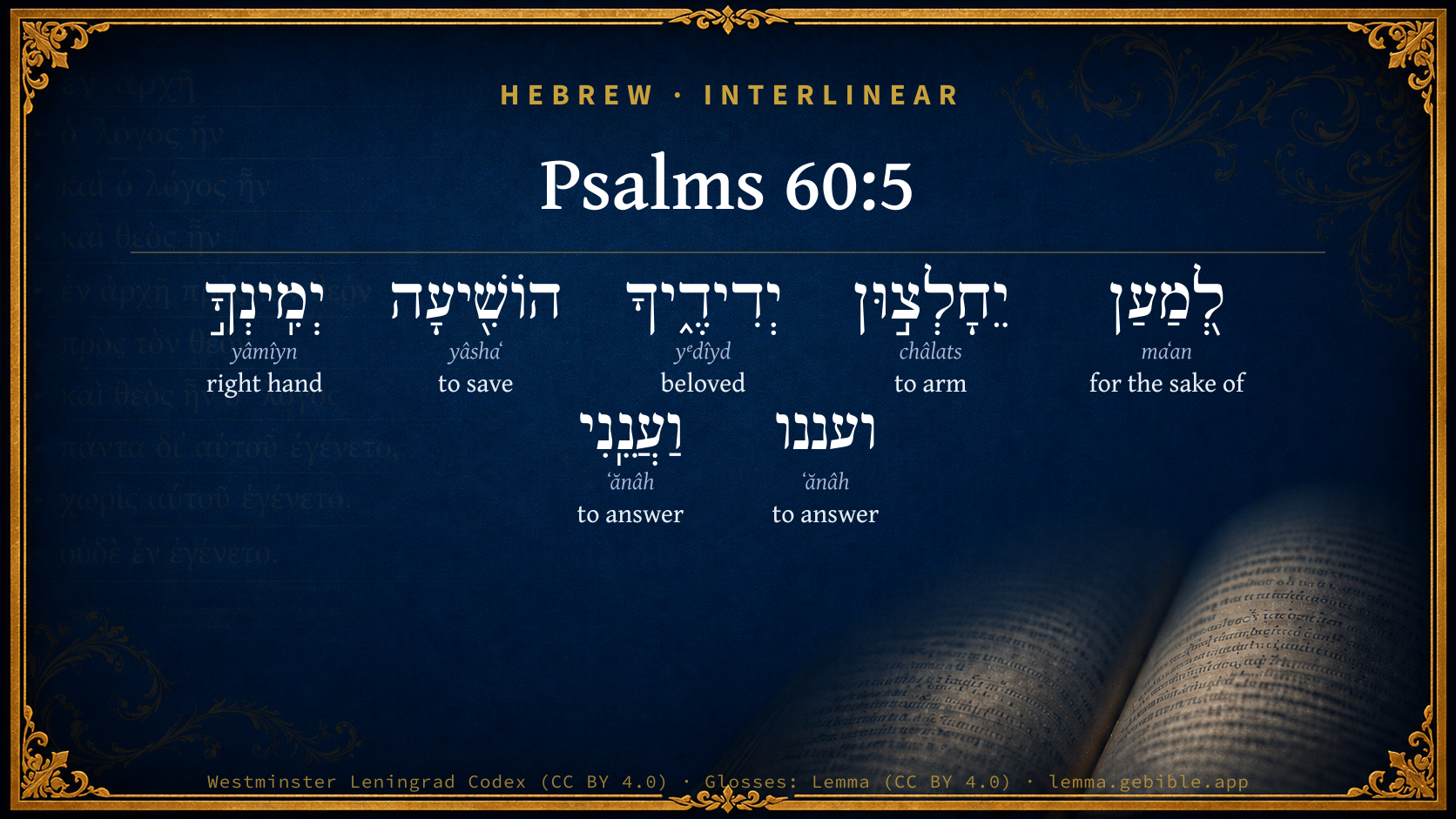
  1. לְ֭מַעַן maʻan H4616 “for the sake of” Preposition
  2. יֵחָלְצ֣וּן châlats H2502 “to arm” Verb, Niphal, Imperfect, 3rd Person, Masculine, Plural + Suffix, n
  3. הוֹשִׁ֖יעָה yâshaʻ H3467 “save” Verb, Hiphil, Imperative, 2nd Person, Masculine, Singular + Suffix, h
  4. יְמִֽינְךָ֣ yâmîyn H3225 “right hand · your” Noun, Common, Feminine, Singular, Construct + Suffix, Personal, 2nd Person, Masculine, Singular
  5. ועננו ʻănâh H6032 “and · answer · us” Conjunction + Verb, Qal, Imperative, 2nd Person, Masculine, Singular + Suffix, Personal, 1st Person, Common, Plural
  6. וַעֲנֵֽנִי ʻănâh H6032 “and · answer · me” Conjunction + Verb, Qal, Imperative, 2nd Person, Masculine, Singular + Suffix, Personal, 1st Person, Common, Singular

About this verse

These counts appear in no published source. They are computed here, from the morphology-tagged text and Lemma’s own curated glosses. What Lemma adds →

7
words
6
distinct lemmas
Wisdom
section

Notable vocabulary

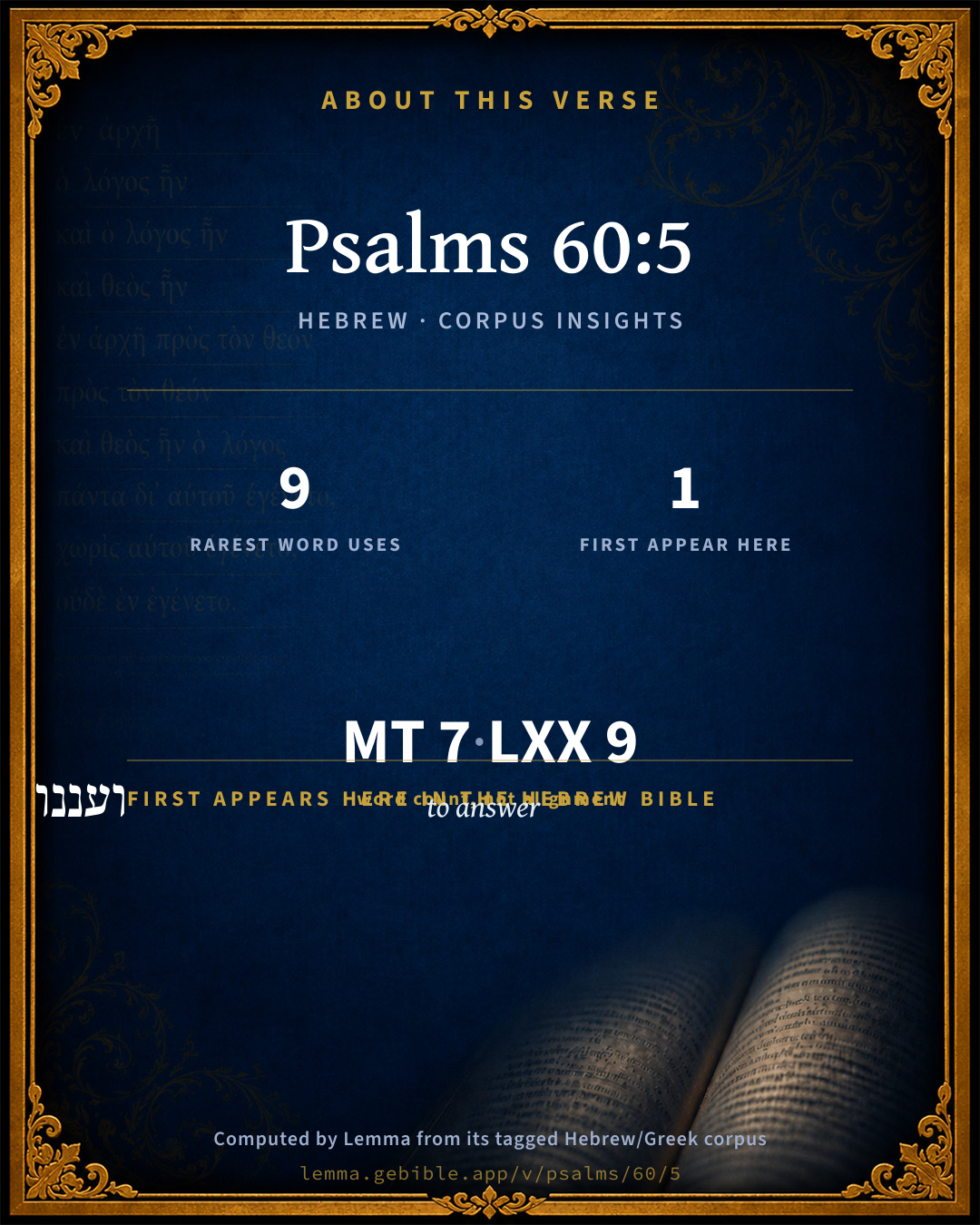
The rarest word here is יְדִידֶ֑יךָ beloved H3039 — appearing just 9 times in the whole Hebrew Bible.

First appearance in Scripture

This word makes its first canonical appearance in the Hebrew Bible here:

  • ועננו to answer H6032

Shared distinctive vocabulary

יְדִידֶ֑יךָ beloved H3039 occurs in 8 verses of the Hebrew Bible. Also found in:

Grammatical profile

  • 4 verbs
  • 1 noun
  • 1 adjective
  • 1 preposition

Verb forms

  • יֵחָלְצ֣וּן Niphal · Imperfect
  • הוֹשִׁ֖יעָה Hiphil · Imperative
  • ועננו Qal · Imperative
  • וַעֲנֵֽנִי Qal · Imperative

Repetition

A word recurs within this verse — often emphatic in Hebrew:

  • ועננו to answer H6032 ×2

Hebrew & Septuagint length

In English translation the verse runs 15 words from the Hebrew and 15 from the Septuagint (LXX English) — the same length.

A rough comparison of the two English renderings, which tokenize alike — not a word-level alignment.

Word counts can differ between the Hebrew and the Greek without any difference in meaning — e.g. the Hebrew direct-object marker אֵת has no separate Greek word, and Greek often adds the article ὁ.

In the original languages it is 7 Hebrew tokens and 9 Greek tokens — but the two are counted differently (Hebrew bundles its prefixes and suffixes into one token; the Greek is in lemma form), so that isn’t a like-for-like length.

Cross-references

16

Topical passages linked to Psalms 60:5 in the Treasury of Scripture Knowledge — connected by theme and wording, ordered by reader-vote popularity; previews shown in the World English Bible.

  • Isaiah 41:10 Don't you be afraid, for I am with you; don't be dismayed, for I am your God; I will strengthen you; yes, I will help you; yes, I will uphold you with the right hand of my righteousness.
  • Exodus 15:6 Your right hand, Yahweh, is glorious in power, Your right hand, Yahweh, dashes the enemy in pieces.
  • Psalms 17:7 Show your marvelous loving kindness, You who save those who take refuge by your right hand from their enemies.
  • Psalms 108:6–13 That your beloved may be delivered, Save with your right hand, and answer us.
  • Psalms 18:35 You have also given me the shield of your salvation. Your right hand sustains me. Your gentleness has made me great.
  • Psalms 60:12 Through God we shall do valiantly, For it is he who will tread down our adversaries.
  • Psalms 74:11 Why do you draw back your hand, even your right hand? Take it out of your pocket and consume them!
  • Matthew 17:5 While he was still speaking, behold, a bright cloud overshadowed them. Behold, a voice came out of the cloud, saying, "This is my beloved Son, in whom I am well pleased. Listen to him."
  • Deuteronomy 7:7–8 Yahweh didn't set his love on you, nor choose you, because you were more in number than any people; for you were the fewest of all peoples:
  • Deuteronomy 33:3 Yes, he loves the people; All his saints are in your hand: They sat down at your feet; [Everyone] shall receive of your words.
  • Deuteronomy 33:12 Of Benjamin he said, The beloved of Yahweh shall dwell in safety by him; He covers him all the day long, He dwells between his shoulders.
  • Psalms 20:6 Now I know that Yahweh saves his anointed. He will answer him from his holy heaven, With the saving strength of his right hand.
  • Psalms 22:8 "He trusts in Yahweh; Let him deliver him; Let him rescue him, since he delights in him."
  • Psalms 127:2 It is vain for you to rise up early, To stay up late, Eating the bread of toil; For he gives sleep to his loved ones.
  • Jeremiah 11:15 What has my beloved to do in my house, seeing she has worked lewdness [with] many, and the holy flesh is passed from you? when you do evil, then you rejoice.
  • Matthew 3:17 Behold, a voice out of the heavens said, "This is my beloved Son, with whom I am well pleased."

Cross-references courtesy of OpenBible.info (CC BY 4.0).

Hebrew and Greek witnesses Masoretic Hebrew ↔ Greek Septuagint

The same verse in the two great witnesses to the Old Testament, shown verse-for-verse.

You’re reading Greek Psalm 59 (Hebrew Psalm 60). The Septuagint counts the superscription, so verse numbers can differ from the Hebrew — chapter-level alignment, not verse-by-verse. Numbering follows Rahlfs.

These are two independent witnesses, not word-aligned to each other, and the Septuagint is shown in lemma (dictionary) form.

Hebrew Psalms 60:5 Masoretic · Westminster Leningrad Codex

לְ֭מַעַן יֵחָלְצ֣וּן יְדִידֶ֑יךָ הוֹשִׁ֖יעָה יְמִֽינְךָ֣ ועננו וַעֲנֵֽנִי

So that your beloved may be delivered, Save with your right hand, and answer us.

World English Bible · Public Domain

Greek LXX Greek Psalm 59:5 Septuagint · lemma form

δεικνύω ὁ λαός σύ σκληρός ποτίζω ἐγώ οἶνος κατάνυξις

That your beloved ones may be delivered; save with your right hand, and hear me.

LXX2012 (modern English Septuagint) · Public Domain

Hebrew: Westminster Leningrad Codex (CC BY 4.0). Greek: Septuagint (public domain); English from LXX2012 (modern English Septuagint) (Public Domain). How the Septuagint differs from the Hebrew →

Commentary

Notes on Psalms 60:5 from classic Christian and Jewish commentators (each source and its license shown beneath its notes). The classic Christian expositions comment on the surrounding passage and are grouped to its opening verse, so a note may address several verses; the Jewish commentaries on the Tanakh (Rashi and others) are per-verse, so they appear only where the commentator wrote on this verse.

Lemma curates 59 commentaries, every one of them public domain or Creative Commons licensed, each selected and text-cleaned for this edition rather than reprinted as found. About our sources →

Trapp's Complete Commentary

John Trapp

Psa 60:5 That thy beloved may be delivered; save [with] thy right hand, and hear me.

Ver. 5. That thy beloved may be delivered] Heb. thy darlings, those that fear thee, Psa 60:4, for, for their sakes it is that God doth good to a people; to all others he seemeth to say, as Elisha once did to Jehoram, that wicked king of Israel, What have I to do with thee? &c. Were it not that I regarded such and such people, I would not look toward thee, nor see thee, 2Ki 3:13-14.

Save with thy right hand] Heb. Save thy right hand, which seemeth to be afflicted together with us; because the enemies say, he cannot save us; thus Kimchi expoundeth it.

John Trapp, A Commentary or Exposition upon All the Books of the Old and New Testament (1647–1656) — public domain. Text from a community e-Sword module.

J. A. Alexander on Psalms

Joseph Addison Alexander

7. (Psa 60:5). In order that thy beloved ones may be delivered, save (with) thy right hand and hear (or answer) us. This is a prayer naturally prompted by the previous experience of God's favour, as recorded in the foregoing verse. Thy beloved, an epithet applied to Benjamin in Deu 33:12, and forming a part of Solomon's additional name Jedidiah, 2Sa 12:25. See also Psa 45:1. The common version of the last words (hear me) rests upon the marginal reading or Keri.

Joseph Addison Alexander, The Psalms Translated and Explained (1850) — public domain. Text from a community e-Sword module.

Scofield Reference Notes

C. I. Scofield

Psa 60:5-12 are identical with Psa 108:6-13.

The Scofield Reference Bible (1917 edition), notes by C. I. Scofield — public domain. Text from a community e-Sword module.

Tyndale Open Study Notes

Tyndale Open Resources

60:5-12 This section is repeated verbatim in 108:6-13.

60:5 The psalmist prays for rescue based on the special relationship between God and his people.

Tyndale Open Study Notes — © Tyndale Open Resources, licensed CC BY-SA 4.0. Text via the HelloAO Bible API.

Jamieson, Fausset & Brown

Robert Jamieson, A. R. Fausset & David Brown

hear me--or, "hear us."

Jamieson, Fausset & Brown — Commentary Critical and Explanatory on the Whole Bible (1871) — public domain (CC PDM 1.0). Text via the HelloAO Bible API.

Ellicott's Commentary for English Readers

(5) From this verse onward the psalm appears again, with some variations noticed there, in Psa_108:6-13.

(6, 7, 8) These three verses, forming the centre of the poem, are, plainly by their style, of different age and authorship from the beginning. Possibly, indeed, they formed an original poem by themselves, an ancient oracular saying descriptive of the relations of Israel to the tribes bordering on her territory, and were then employed by the compilers of this psalm and Psalms 108, to rouse the drooping spirits of the race in some less fortunate time. (See Introduction.) The speaker is God Himself, who, according to a familiar prophetic figure, appears in the character of a warrior, the captain of Israel, proclaiming the triumphs won through His might by their arms. (Comp. Isa_63:1-6.) Here, however, the picture is rather playful than terrible—rather ironic than majestic. The conqueror is returning, as in the passage of Isaiah referred to above, from the battle, but he is not painted “glorious in his apparel, travelling in the greatness of his strength.” The fury of the fight, the carnage, the bloodstained garments are all implied, not described. Instead of answering a challenge, as in Isaiah, by a description of the fight, here the champion simply proclaims the result of his victory as he proceeds to disarm and prepare for the bath—figures expressing the utmost contempt for the foe so easily subdued.

A Bible Commentary for English Readers, edited by Charles John Ellicott (1878–1897) — public domain. Text from a community e-Sword module.

The Cambridge Bible for Schools and Colleges

gen. ed. J. J. S. Perowne

5. thy beloved] Thy beloved ones (plur.) are Israel. Cp. Deu_33:12; Jer_11:15. God’s love for Israel is the counterpart to Israel’s fear of God.

save] i.e. give victory. Cp. Psa_60:11.

hear me] Answer me. The Kthîbh has us, which R.V. adopts; but the Qrç is me. This has the support of the Ancient Versions and is preferable. David is the speaker. Cp. Psa_60:9.

5–8. A prayer for deliverance and victory, based upon God’s promise to give Israel the possession of Canaan, and supremacy over the neighbouring nations.

The Cambridge Bible for Schools and Colleges (gen. ed. J. J. S. Perowne; Cambridge University Press, 1878–1918) — public domain. Text from a community e-Sword module.

John Gill's Exposition

That thy beloved may be delivered,.... Some think that these words express the effect or end of the banner being displayed; but because of the word "Selah" at the end of Psa 60:4, which makes so full a stop; rather they are to be considered in construction with the following clause. By the Lord's "beloved" ones are meant, not so much the people of Israel, who were loved and chosen by the Lord above all people on the face of the earth, as the elect of God, both among Jews and Gentiles, who are the chosen of God, and precious, and are loved of him with a free, sovereign, everlasting, and unchangeable love: these are the beloved of Father, Son, and Spirit; who, falling into a state of condemnation and death in Adam, and being under the power of sin, and involved in the guilt and faith of it; and being fallen into the hands of many enemies, sin, Satan, and the world; stood in need of deliverance out of all this, which they could not work out of themselves, nor any creature for them; wherefore, that they might be delivered, the following request is made;

save with thy right hand; from sin, the cause of damnation; from the law, which threatens with condemnation and death; from Satan, that would devour and destroy; and from all their enemies; from wrath to come, from hell and the second death; or from going down to the pit of corruption. The persons for whom this petition is put up are not only David himself, but all the beloved ones; and these God has appointed unto salvation; Christ is the Saviour of them, and to them salvation is applied in due time by the Spirit, and in a little while they will be in the full possession of it: and this is wrought out by the "right hand" of the Lord; either by his mighty power, the saving strength of his right hand, who is mighty to save; or by his Son, the man of his right hand, made strong for himself, who able to save to the uttermost; and by whom God has determined to save, and does save all his people; or the words may be rendered, "save thy right hand, thy Benjamins" (p) who are as near and dear to thee as thy right hand, being his mystical self, to whom salvation is brought by him, Isa 63:1;

and hear me; in so doing, he suggests he would hear and answer him his prayers would be ended and accomplished; this being the sum of them, his own salvation, and the salvation of the Lord's beloved ones. The "Cetib", or writing of this clause, is, "hear us"; the "Keri", or reading of it, "hear me".

(p) .

John Gill's Exposition of the Whole Bible (1746–1763) — public domain (CC PDM 1.0). Text via the HelloAO Bible API.

Albert Barnes' Notes on the Bible

That thy beloved may be delivered - The word beloved is in the plural number, and might be rendered beloved ones. It refers not merely to David as his servant and friend, but to those associated with him. The reference is to the calamities and dangers then existing, to which allusion has been made above. The prayer is, that the enemy might be driven back, and the land delivered from their invasion.

Save with thy right hand - The right hand is that by which the sword is handled, the spear hurled, the arrow drawn on the bow. The prayer is, that God would put forth his power and deliver his people.

And hear me - literally, Answer me. The answer which he desired was that God would lead his armies successfully into Edom, Psa 60:8-9.

Albert Barnes' Notes on the Bible (1834–1885) — public domain. Text from a community e-Sword/MySword module.

Matthew Poole's English Annotations

Thy beloved people, last mentioned.

Matthew Poole's English Annotations on the Holy Bible (1683–1685) — public domain. Text from a community e-Sword/MySword module.

The Treasury of David

Charles H. Spurgeon

Ver. 5. That thy beloved may be delivered. David was the Lord's beloved, his name signifies "dear, or beloved, "and there was in Israel a remnant according to the election of grace, who were the beloved of the Lord; for their sakes the Lord wrought great marvels, and he had an eye to them in all his mighty acts. God's beloved are the inner seed, for whose sake he preserves the entire nation, which acts as a husk to the vital part. This is the main design of providence, That thy beloved may be delivered; if it were not for their sakes he would neither give a banner nor send victory to it.

Save with thy right hand, and hear me. Save at once, before the prayer is over; the case is desperate unless there be immediate salvation. Tarry not, O Lord, till I have done pleading: save first and hear afterwards. The salvation must be a right royal and eminent one, such as only the omnipotent hand of God linked with his dexterous wisdom can achieve. Urgent distress puts men upon pressing and bold petitions such as this. We may by faith ask for and expect that our extremity will be God's opportunity; special and memorable deliverances will be wrought out when dire calamities appear to be imminent. Here is one suppliant for many, even as in the case of our Lord's intercession for his saints. He, the Lord's David, pleads for the rest of the beloved, beloved and accepted in him the Chief Beloved; he seeks salvation as though it were for himself, but his eye is ever upon all those who are one with him in the Father's love. When divine interposition is necessary for the rescue of the elect it must occur, for the first and greatest necessity of providence is the honour of God, and the salvation of his chosen. This is fixed fate, the centre of the immutable decree, the inmost thought of the unchangeable Jehovah.

None.

Ver. 5. The deliverance of the elect needs a saving God, a mighty God (right hand), and a prayer hearing God.

Ver. 5. (last clause). Save... and hear. The remarkable order of these words suggests that--

1. In the purpose of God.

2. In the first works of grace.

3. Often under trial.

4. And specially in fierce temptations, Gods saving precedes man's praying.

Psalms 60:6*

Charles H. Spurgeon's The Treasury of David (1869–1885) — public domain. Psalms only. Text from a community e-Sword/MySword module.

Whedon's Commentary on the Bible

Daniel D. Whedon

5. Thy beloved—The same word, radically, as Jedediah, the beloved of Jehovah, a title of endearment given to Benjamin and to Solomon. Deu_33:12; 2Sa_12:25. See Psa_108:6.

Right hand—As the emblem of most excellent strength, fidelity, and honour.

Daniel D. Whedon (gen. ed.), Commentary on the Old and New Testaments (1874–1909) — public domain. Text from a community e-Sword module.

The Pulpit Commentary

That thy beloved may be delivered; save with thy right hand, and hear me; rather, hear us. From complaint (vers. 1-4) the psalmist abruptly turns to prayer, thus closing the first strophe with a gleam of hope.

The Pulpit Commentary (1880–1919), ed. H.D.M. Spence-Jones & Joseph S. Exell — public domain. Text from a community e-Sword module.

John Wesley's Explanatory Notes

Beloved - Thy beloved people.

John Wesley, Explanatory Notes Upon the Whole Bible (1754–1765) — public domain. Text via the GEBible commentary corpus.

Rashi

Rabbi Shlomo Yitzchaki (Rashi)

wine of bewilderment Heb. תרעלה. [Wine] that stops up the heart and envelops it. רַעַל is an expression of envelopment, as (Nahum 2:4): “and the cypresses are enwrapped (הרעלו),” and the language of the Mishnah (Shab. 6:6): “Median women shawled (רעולות).”

Rashi on the Tanakh — English translations: “The Judaica Press complete Tanach with Rashi, translated by A. J. Rosenberg” (CC BY 4.0); “Pentateuch with Rashi's commentary by M. Rosenbaum and A.M. Silbermann, 1929-1934” (public domain); “The Metsudah Tanach series, Lakewood, N.J” (CC BY 4.0); and “The Book of Joshua, Metsudah Publications, 1997” (CC BY 4.0). Text via Sefaria.

Lesson kit

Teaching starters — assembled from the data on this page, not authored interpretation. Every prompt links to the verse data it draws on. Edit before teaching.

Psalms, in the Wisdom, opens this verse with 7 words (6 distinct Hebrew lemmas). Its most distinctive word is yᵉdîyd (“beloved”). A historical commentator’s framing appears above. Read the whole chapter for the surrounding context.

Discussion questions

  1. The word yᵉdîyd carries the sense “beloved.” How does it shape the verse?
  2. This is the first place “to answer” appears in Scripture (first appears here). What does its debut here establish?
  3. How does Deuteronomy 33:12, which shares the word «beloved», read alongside this verse?
  4. What does the repetition of “to answer” (2× in this one verse) do in this verse?
  5. The translations on this page render this verse differently — a whole-verse word diff, not a word-by-word alignment. What might account for the different wordings?
  6. «יֵחָלְצ֣וּן» is a Niphal Imperfect verb. How does that grammatical form shape the action described?
  7. Compare how Trapp's Complete Commentary and J. A. Alexander on Psalms read this verse. Where do they agree or differ?

Things to notice

Reading settings

Reading text

Shown beneath each verse's original-language words.

Old Testament
Old Testament edition

Read the OT as the Masoretic Hebrew (MT) or the Greek Septuagint (LXX).

English shown for the Greek Septuagint (in the Hebrew ↔ Greek comparison).

Comparing translations? Open the Compare panel on any verse page to stack up to four side by side.