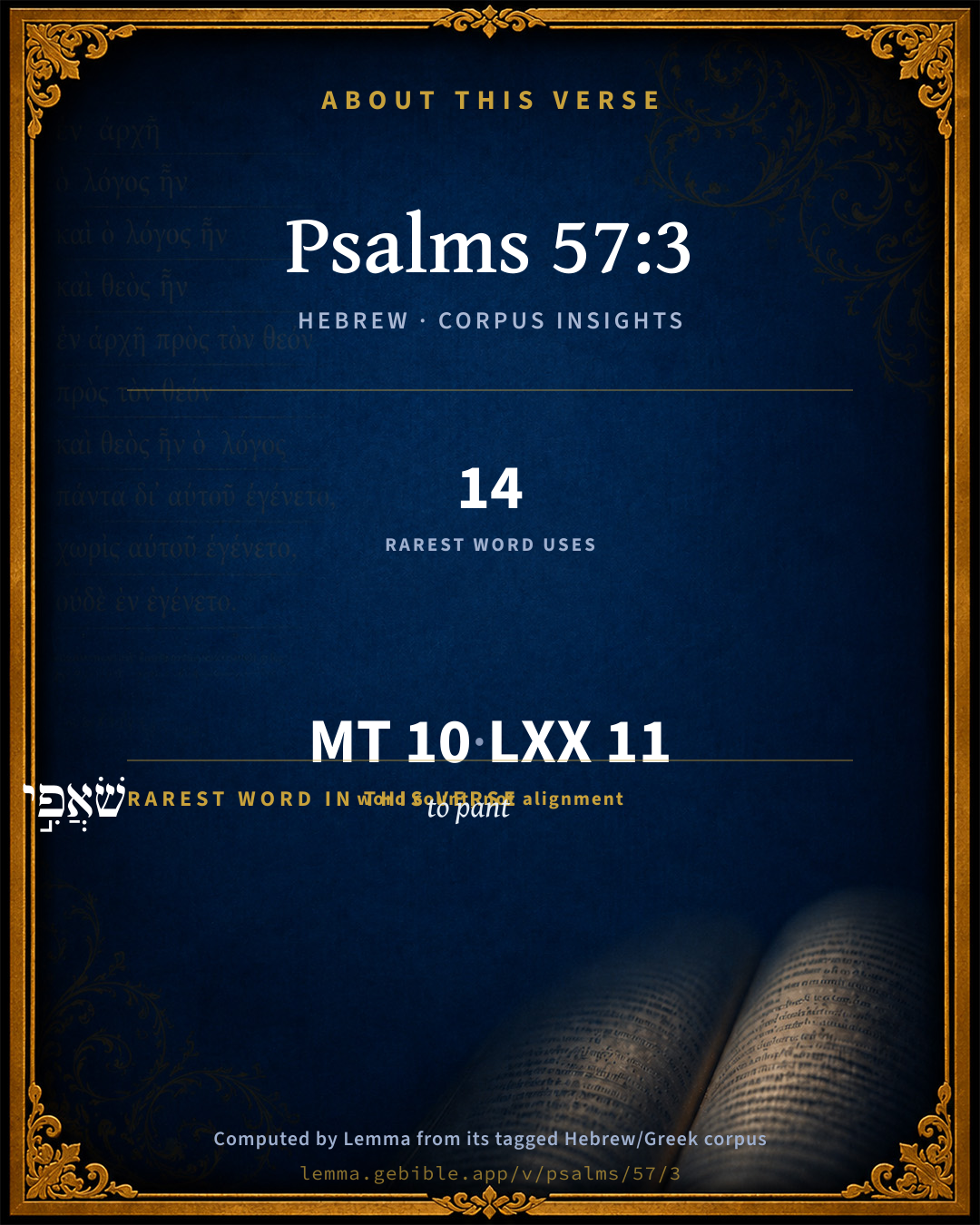
Psalms 57:3

Hebrew (Westminster Leningrad Codex) Psalms 57:3 appears in the Hebrew Old Testament. The text above is from the Westminster Leningrad Codex. Each word links to its Strong’s number, a concise gloss, and parsing drawn from the Open Scriptures Hebrew Bible morphology. Click any word for its full Brown-Driver-Briggs (BDB) entry.
Download image
Cite this verse

Psalms 57:3 (World English Bible). Public Domain. Lemma interlinear Bible study tool, https://lemma.gebible.app/v/psalms/57/3.

Show BibTeX & RIS
BibTeX
RIS
English Translation
He will send from heaven, and save me, He rebukes the one who is pursuing me. Selah. God will send out his loving kindness and his truth.
World English Bible · Public Domain
Download a study sheet

One document with this verse’s original text, its word-by-word gloss line, the meaning frame, cross-references with their text, attributed commentary, and full source and license credits — printable, and it pastes into notes with its structure intact.

This verse Autodidact and up

Study sheet (.html) Plain text (.txt)

A passage Seminary Student

Up to 50 verses in one chapter. A passage sheet keeps up to 6 commentary sources and 12 cross-references per verse, in the order this page ranks them, and says so on the sheet whenever that leaves anything out. Ask for a single verse and you get the Autodidact verse sheet above.

Everything on this page stays free to read, with no account — the sheet is a download of what is already on screen, not access to it.

Want to remove ads? Support Godless Engineer
Compare translations 3

The same verse in 3 English versions, stacked beneath the original-language interlinear above. Click any original word for its lexicon entry.

Each is an independent rendering of the whole verse — the interlinear is not word-aligned to these translations.

Highlighted words mark where these versions differ — a whole-verse word diff, not a word-by-word alignment.

  • World English Bible Public Domain
    He will send from heaven, and save me, He rebukes the one who is pursuing me. Selah. God will send out his loving kindness and his truth.
  • King James Version Public Domain
    He shall send from heaven, and save me from the reproach of him that would swallow me up. Selah. God shall send forth his mercy and his truth.
  • unfoldingWord Literal Text CC BY-SA 4.0
    May he send from the heavens and save me. May he reproach the one trampling me. Selah May God send his covenant faithfulness and his truth.

unfoldingWord Literal Text — © unfoldingWord, licensed CC BY-SA 4.0. Word-aligned USFM3 via Door43 (git.door43.org/unfoldingWord/en_ult).

Versions to compare (up to 4)

3 of 4 selected

Show all 18 translations

Every available English version of this verse, each an independent rendering of the whole verse.

  • World English Bible Public Domain
    He will send from heaven, and save me, He rebukes the one who is pursuing me. Selah. God will send out his loving kindness and his truth.
  • Berean Standard Bible Public Domain
    He reaches down from heaven and saves me; He rebukes those who trample me. Selah God sends forth His loving devotion and His truth.
  • Majority Standard Bible Public Domain
    He reaches down from heaven and saves me; He rebukes those who trample me. Selah God sends forth His loving devotion and His truth.
  • King James Version Public Domain
    He shall send from heaven, and save me from the reproach of him that would swallow me up. Selah. God shall send forth his mercy and his truth.
  • American Standard Version (1901) Public Domain
    He will send from heaven, and save me, `When' he that would swallow me up reproacheth; Selah God will send forth his lovingkindness and his truth.
  • Revised Version (1885) Public Domain
    He shall send from heaven, and save me, when he that would swallow me up reproacheth; Selah God shall send forth his mercy and his truth.
  • Geneva Bible (1599) Public Domain
    He will send from heauen, and saue me from the reproofe of him that would swallowe me. Selah. God wil send his mercy, and his trueth.
  • Douay-Rheims (1899) Public Domain
    I will cry to God the most High; to God who hath done good to me.
  • Young's Literal Translation Public Domain
    He sendeth from the heaven, and saveth me, He reproached -- who is panting after me. Selah. God sendeth forth His kindness and His truth.
  • Literal Standard Version CC BY-SA 4.0
    He sends from the heavens, and saves me, || He reproached [the one] who is panting after me. Selah. God sends forth His kindness and His truth.
  • Unlocked Literal Bible CC BY-SA 4.0
    He will send help from heaven and save me, he is angry with those who crush me. Selah God will send me his loving kindness and his faithfulness.
  • unfoldingWord Literal Text CC BY-SA 4.0
    May he send from the heavens and save me. May he reproach the one trampling me. Selah May God send his covenant faithfulness and his truth.
  • Darby Bible Public Domain
    He will send from the heavens and save me; he hath covered with reproach him that would swallow me up. Selah. God hath sent forth his loving-kindness and his truth.
  • World Messianic Bible Public Domain
    He will send from heaven, and save me, he rebukes the one who is pursuing me. Selah. God will send out his loving kindness and his truth.
  • Webster's Bible Public Domain
    \\57:2\\I will cry to God most high; to God that performeth all things for me.
  • Free Bible Version CC BY-SA 4.0
    From heaven he sends his help, and he saves me. He defeats those who persecute me. Selah. God sends me his unfailing love, showing he is completely trustworthy.
  • Bible in Basic English Public Domain
    He will send from heaven, and take me from the power of him whose desire is for my destruction. God will send out his mercy and his good faith.
  • JPS Tanakh (1917) Public Domain
    (57-4) He will send from heaven, and save me, when he that would swallow me up taunteth; Selah; God shall send forth His mercy and His truth.

Literal Standard Version (2020), Covenant Press — licensed CC BY-SA 4.0. Text via the HelloAO Bible API (eBible.org). Unlocked Literal Bible (unfoldingWord) — licensed CC BY-SA 4.0. Text via the HelloAO Bible API (eBible.org). unfoldingWord Literal Text — © unfoldingWord, licensed CC BY-SA 4.0. Word-aligned USFM3 via Door43 (git.door43.org/unfoldingWord/en_ult). Free Bible Version, Dr. Jonathan Gallagher — licensed CC BY-SA 4.0. Text via the HelloAO Bible API (eBible.org).

Word by word

More ways to search: Search by grammar → Find every occurrence → Compare this word →

Practice this passage: Drill this verse → Learn its vocabulary →

שֹׁאֲפִ֣י
shâʼaph
H7602
“panting · me”
Verb, Qal, Participle Active, Masculine, Singular, Construct + Suffix, Personal, 1st Person, Common, Singular
Part of Speech
Verb
Stem
Qal
Form
Participle Active
Gender
Masculine
Number
Singular
State
Construct
Full BDB Definition

Origin: a primitive root

TWOT: 2305 , 2306

to gasp, pant, pant after, long for, breathe heavily - (Qal) - to gasp, pant after, snuff up - to gasp or pant (with desire), pant after, be eager for - to thirst for one's blood (from actions of animals) (figuratively) - to crush, trample, trample upon - (Qal) to trample upon, crush
  1. יִשְׁלַ֤ח shâlach H7971 “to send” Verb, Qal, Imperfect, 3rd Person, Masculine, Singular
  2. מִשָּׁמַ֨יִם shâmayim H8064 “from · heaven(s)” Preposition + Noun, Common, Masculine, Plural, Absolute
  3. וְֽיוֹשִׁיעֵ֗נִי yâshaʻ H3467 “and · to save · me” Conjunction + Verb, Hiphil, Imperfect, 3rd Person, Masculine, Singular + Suffix, Personal, 1st Person, Common, Singular
  4. חֵרֵ֣ף châraph H2778 “to reproach” Verb, Piel, Perfect, 3rd Person, Masculine, Singular
  5. סֶ֑לָה çelâh H5542 “Selah” Particle, Interjection
  6. יִשְׁלַ֥ח shâlach H7971 “to send” Verb, Qal, Imperfect, 3rd Person, Masculine, Singular
  7. אֱ֝לֹהִ֗ים ʼĕlôhîym H430 “God(s)” Noun, Common, Masculine, Plural, Absolute
  8. חַסְדּ֥וֹ chêçêd H2617 “kindness · his” Noun, Common, Masculine, Singular, Construct + Suffix, Personal, 3rd Person, Masculine, Singular
  9. וַאֲמִתּֽוֹ ʼemeth H571 “and · faithfulness · his” Conjunction + Noun, Common, Feminine, Singular, Construct + Suffix, Personal, 3rd Person, Masculine, Singular

About this verse

These counts appear in no published source. They are computed here, from the morphology-tagged text and Lemma’s own curated glosses. What Lemma adds →

10
words
9
distinct lemmas
Wisdom
section

Notable vocabulary

The rarest word here is שֹׁאֲפִ֣י to pant H7602 — appearing just 14 times in the whole Hebrew Bible.

Shared distinctive vocabulary

שֹׁאֲפִ֣י to pant H7602 occurs in 14 verses of the Hebrew Bible. Also found in:

Grammatical profile

  • 5 verbs
  • 4 nouns
  • 1 particle

Verb forms

  • יִשְׁלַ֤ח Qal · Imperfect
  • וְֽיוֹשִׁיעֵ֗נִי Hiphil · Imperfect
  • חֵרֵ֣ף Piel · Perfect
  • שֹׁאֲפִ֣י Qal · Participle Active
  • יִשְׁלַ֥ח Qal · Imperfect

Repetition

A word recurs within this verse — often emphatic in Hebrew:

  • יִשְׁלַ֤ח to send H7971 ×2

Hebrew & Septuagint length

In English translation the verse runs 27 words from the Hebrew and 25 from the Septuagint (LXX English) — closely comparable.

A rough comparison of the two English renderings, which tokenize alike — not a word-level alignment.

Word counts can differ between the Hebrew and the Greek without any difference in meaning — e.g. the Hebrew direct-object marker אֵת has no separate Greek word, and Greek often adds the article ὁ.

In the original languages it is 10 Hebrew tokens and 11 Greek tokens — but the two are counted differently (Hebrew bundles its prefixes and suffixes into one token; the Greek is in lemma form), so that isn’t a like-for-like length.

Cross-references

12

Topical passages linked to Psalms 57:3 in the Treasury of Scripture Knowledge — connected by theme and wording, ordered by reader-vote popularity; previews shown in the World English Bible.

  • Psalms 40:11 Don't withhold your tender mercies from me, Yahweh. Let your loving kindness and your truth continually preserve me.
  • Psalms 43:3 Oh, send out your light and your truth. Let them lead me. Let them bring me to your holy hill, To your tents.
  • Acts 12:11 When Peter had come to himself, he said, "Now I truly know that the Lord has sent out his angel and delivered me out of the hand of Herod, and from everything the Jewish people were expecting."
  • Psalms 144:5–7 Part your heavens, Yahweh, and come down. Touch the mountains, and they will smoke.
  • Psalms 56:1–2 Be merciful to me, God, for man wants to swallow me up. All day long, he attacks and oppresses me.
  • Psalms 61:7 He shall be enthroned in God's presence forever. Appoint your loving kindness and truth, that they may preserve him.
  • Matthew 28:2–6 Behold, there was a great earthquake, for an angel of the Lord descended from the sky, and came and rolled away the stone from the door, and sat on it.
  • Numbers 23:24 Behold, the people rises up as a lioness, As a lion does he lift himself up: He shall not lie down until he eat of the prey, Drink the blood of the slain.
  • Psalms 18:6–50 In my distress I called on Yahweh, And cried to my God. He heard my voice out of his temple, My cry before him came into his ears.
  • Micah 3:2–3 You who hate the good, And love the evil; Who tear off their skin, And their flesh from off their bones;
  • John 1:17 For the law was given through Moses. Grace and truth came through Jesus Christ.
  • Job 31:31 If the men of my tent have not said, 'Who can find one who has not been filled with his meat?'

Cross-references courtesy of OpenBible.info (CC BY 4.0).

Hebrew and Greek witnesses Masoretic Hebrew ↔ Greek Septuagint

The same verse in the two great witnesses to the Old Testament, shown verse-for-verse.

You’re reading Greek Psalm 56 (Hebrew Psalm 57). The Septuagint counts the superscription, so verse numbers can differ from the Hebrew — chapter-level alignment, not verse-by-verse. Numbering follows Rahlfs.

These are two independent witnesses, not word-aligned to each other, and the Septuagint is shown in lemma (dictionary) form.

Hebrew Psalms 57:3 Masoretic · Westminster Leningrad Codex

יִשְׁלַ֤ח מִשָּׁמַ֨יִם וְֽיוֹשִׁיעֵ֗נִי חֵרֵ֣ף שֹׁאֲפִ֣י סֶ֑לָה יִשְׁלַ֥ח אֱ֝לֹהִ֗ים חַסְדּ֥וֹ וַאֲמִתּֽוֹ

He will send from heaven, and save me, He rebukes the one who is pursuing me. Selah. God will send out his loving kindness and his truth.

World English Bible · Public Domain

Greek LXX Greek Psalm 56:3 Septuagint · lemma form

κράζω πρός ὁ θεός ὁ ὕψιστος ὁ θεός ὁ εὐεργετέω ἐγώ

He sent from heaven and saved me; he gave to reproach them that trampled on me: God has sent forth his mercy and his truth;

LXX2012 (modern English Septuagint) · Public Domain

On this verse, Ellicott's Commentary for English Readers discusses the Septuagint’s reading. Read the note in Commentary ↓

Hebrew: Westminster Leningrad Codex (CC BY 4.0). Greek: Septuagint (public domain); English from LXX2012 (modern English Septuagint) (Public Domain). How the Septuagint differs from the Hebrew →

Commentary

Notes on Psalms 57:3 from classic Christian and Jewish commentators (each source and its license shown beneath its notes). The classic Christian expositions comment on the surrounding passage and are grouped to its opening verse, so a note may address several verses; the Jewish commentaries on the Tanakh (Rashi and others) are per-verse, so they appear only where the commentator wrote on this verse.

Lemma curates 59 commentaries, every one of them public domain or Creative Commons licensed, each selected and text-cleaned for this edition rather than reprinted as found. About our sources →

Trapp's Complete Commentary

John Trapp

Psa 57:3 He shall send from heaven, and save me [from] the reproach of him that would swallow me up. Selah. God shall send forth his mercy and his truth.

Ver. 3. He shall send from heaven and save me] Rather than fail, I shall have an angel to rescue me; for although the Lord usually worketh by means, yet he can work by miracles, and will do it if there be a just occasion; howsoever, his mercy and his truth he will be sure to send, and that is enough, He will be seen in the mount, he will repent for his servants when he seeth their power is gone, Deu 32:36, when there is dignus vindice nodus, an extremity fit for Divine power to interpose.

John Trapp, A Commentary or Exposition upon All the Books of the Old and New Testament (1647–1656) — public domain. Text from a community e-Sword module.

Joseph Benson's Commentary

Psa 57:3. He shall send from heaven — Either his angels, as Dan 3:28, or his power and help in some less extraordinary way. As if he had said, There are greater armies in heaven than those that here surround me; and rather than I should perish, he will send them for my deliverance; and save me from the reproach of him, &c. — From that shameful destruction which Saul designs to bring upon me. The Hebrew, however, חרŠ שׁאפי, cheereeph shoapi, may be properly rendered, as in the margin, he reproacheth, or hath reproached, that is, he will certainly put to shame, or reproach him that would swallow me up, by disappointing his expectation, and delivering me from his rage. God shall send forth his mercy and truth — Shall discover them by their proper fruits, namely, by affording his gracious help in pursuance of his promises. “The reader will observe, that mercy and truth are here poetically represented as ministers of God, standing in his presence, ready to execute his pleasure, and employed by him in the salvation of his people.” — Dodd.

Joseph Benson's Commentary on the Old and New Testaments (1811–1818) — public domain. Text from a community e-Sword module.

The Pulpit Commentary

He shall send from heaven, and save me from the reproach of him that would swallow me up. The two clauses stand unconnected in the original, which runs, "He shall send from heaven and save me my pursuer reproaches God shall send," etc. The second clause is really parenthetic, and, as Dr. Driver says ("Hebrew Verbs," "circumstantial," noting the circumstances under which God would take action. God shall send forth his mercy and his truth. His mercy, to relieve the psalmist; his truth, to confound the psalmist"s enemies.

"Mercy and truth.

I MARK GOD"S CHARACTER. When God proclaimed his Name to Moses, he put "mercy" in the forefront: "The Lord God merciful;" but "truth" had also its place, for it is added," abundant in truth". (Exo_34:6) The same order is observed in the Psalms. Thus it is said, (Psa_86:15) "Thou, O Lord, art a God full of compassion, and gracious, long suffering, and plenteous in mercy and truth". (cf. Psa_89:2)

II SHINE FORTH IN GOD"S JUDGMENTS. What God does shows what he is. His works express his character. "Mercy and truth" are, so to speak, the rails on which his judgments travel. (Psa_25:10 Psa_103:17)

III CHARACTERIZE GOD"S DEALINGS WITH HIS PEOPLE. They need "mercy; and unto the Lord "belongeth mercy". (Psa_62:12) They need "truth," and God is "the God of truth". (Psa_31:5) In the salvation which God has wrought, both are blended in beautiful harmony. (Psa_85:10) As has been quaintly said, "Mercy and truth are but the transverse arms of the cross of Christ. Righteousness and peace are but its upper and lower limbs. The one springs out of the earth, the other has looked down from heaven, and they have kissed each other, in token of God"s love and of his reconciliation with the sons of men.

IV FOUNDATION OF HOPE TO THE CHILDREN OF MEN. Mercy and truth are the two outspread wings of God. Under them there is sure shelter and peace. (Psa_36:7 Psa_61:1-4) Here there is hope for the sinner. (Psa_33:18, 22 78:7) Here there is comfort for the troubled in heart. (Psa_57:3-10) Here there is inspiration for all who are minded to serve God. (Psa_69:13 Psa_98:3 Psa_115:1) Here there is earnest and foreshadowing of the everlasting rest. W.F. (Psa_61:7 Psa_63:7 Psa_138:8)

The Pulpit Commentary (1880–1919), ed. H.D.M. Spence-Jones & Joseph S. Exell — public domain. Text from a community e-Sword module.

J. A. Alexander on Psalms

Joseph Addison Alexander

4. (Psa 57:3). He will send from heaven and save me—(when or whom) the devourer reviles, Selah!—God will send his mercy and his truth. The first verb may govern hand, as in Psa 144:7, or help, as in Psa 20:2, or be used absolutely, as in Psa 18:16. The devourer, literally the one gaping after me, snorting with rage against me, or panting for my destruction. See above, on Psa 56:1-2. Without supplying anything, this clause may be taken as a short independent proposition—the devourer has reviled—interposed between the two principal members of the sentence. See above, on Psa 27:8; Psa 45:5. In the last clause, Mercy and Truth seem to be personified, like Integrity and Uprightness in Psa 25:21, Violence and Strife in Psa 55:9. With this clause compare Psa 43:3.

Joseph Addison Alexander, The Psalms Translated and Explained (1850) — public domain. Text from a community e-Sword module.

Tyndale Open Study Notes

Tyndale Open Resources

57:3-4 These verses are a prayer for rescue from powerful enemies. The metaphor of fierce lions describes human enemies; the psalmist feels unable to escape them without God’s intervention (see also 35:11-21; 124:6).

Tyndale Open Study Notes — © Tyndale Open Resources, licensed CC BY-SA 4.0. Text via the HelloAO Bible API.

Geneva Bible (1599)

Geneva Bible translators

He would rather deliver me by a miracle, than that I should be overcome.

Geneva Bible (1599) marginal notes — public domain. Text via Bolls.life.

Jamieson, Fausset & Brown

Robert Jamieson, A. R. Fausset & David Brown

from . . . swallow me up--that pants in rage after me (Psa 56:2).

mercy and . . . truth-- (Psa 25:10; Psa 36:5), as messengers (Psa 43:3) sent to deliver him.

Jamieson, Fausset & Brown — Commentary Critical and Explanatory on the Whole Bible (1871) — public domain (CC PDM 1.0). Text via the HelloAO Bible API.

Adam Clarke's Commentary

Verse 3. He shall send from heaven, and save me] Were there no human agents or earthly means that he could employ, he would send his angels from heaven to rescue me from my enemies. Or, He will give his command from heaven that this may be done on earth.

Selah] I think this word should be at the end of the verse.

God shall send forth his mercy and his truth.] Here mercy and truth are personified. They are the messengers that God will send from heaven to save me. His mercy ever inclines him to help and save the distressed. This he has promised to do; and his truth binds him to fulfil the promises or engagements his mercy has made, both to saints and sinners.

Adam Clarke's Commentary on the Bible (1810–1826) — public domain. Text from a community e-Sword/MySword module.

John Calvin's Commentaries

3 He shall send from heaven, and save me. David, as I have repeatedly had occasion to observe, interlaces his prayers with holy meditations for the comfort of his own soul, in which he contemplates his hopes as already realised in the event. In the words before us, he glories in the divine help with as much assurance as if he had already seen the hand of God interposed in his behalf. When it is said, he shall send from heaven, some consider the expression as elliptical, meaning that he would send his angels; but it seems rather to be an indefinite form of speech, signifying that the deliverance which David expected was one not of a common, but a signal and miraculous description. The expression denotes the greatness of the interposition which he looked for, and heaven is opposed to earthly or natural means of deliverance. What follows admits of being rendered in two different ways. We may supply the Hebrew preposition מ, mem, and read, He shall save me from the reproach; or it might be better to understand the words appositively, He shall save me, to the reproach of him who swallows me up. The latter expression might be rendered, from him who waits for me. His enemies gaped upon him in their eagerness to accomplish his destruction, and insidiously watched their opportunity; but God would deliver him, to their disgrace. He is said to strike his enemies with shame and reproach, when he disappoints their expectations. The deliverance which David anticipated was signal and miraculous; and he adds, that he looked for it entirely from the mercy and truth of God, which he represents here as the hands, so to speak, by which his assistance is extended to his people.

John Calvin's Commentaries (1540-1563) — public domain. Text from the Calvin Translation Society English edition (1840s-50s) via the Christian Classics Ethereal Library (ccel.org). Calvin's coverage is partial (roughly two-thirds of the Bible); uncommented books and verses are honest gaps, never fabricated. The 19th-century editor's footnotes and remarks are omitted so the notes are faithfully Calvin's own voice.

Ellicott's Commentary for English Readers

(3) He shall send . . .—The selah in the middle of this verse is as much out of place as in Psa_55:19. The LXX. place it after Psa_57:2. The marginal correction of the second clause is decidedly to be adopted, the word “reproach” is here being used in the sense of “rebuke.” For the verb “send,” used absolutely, comp. Psa_18:16.

A Bible Commentary for English Readers, edited by Charles John Ellicott (1878–1897) — public domain. Text from a community e-Sword module.

The Cambridge Bible for Schools and Colleges

gen. ed. J. J. S. Perowne

3. He shall send from heaven] There is no need to supply an object to the verb here. The object is introduced when the verb is repeated according to the characteristic peculiarity of this Psalm. For the meaning cp. Psa_20:2, and perhaps Psa_18:16, though see note there.

from the reproach &c.] Better, (For) he that would swallow me up (or, crush me, Psa_56:1, note) hath reproached. The object of the verb may be God, Whom the enemy blasphemes in denying His willingness to help His servant (Isa_37:23-24); or the Psalmist, whom he taunts with being deserted by his God (Psa_42:10; Psa_55:12). The rendering of A.V. marg., he reproacheth him that would swallow me up, is contrary to usage, for the word is never used of God rebuking men.

Selah here is probably misplaced, cp. Psa_55:19. In the LXX it follows Psa_57:2.

God shall send forth &c.] God’s lovingkindness and truth (cp. Psa_42:8, Psa_43:3) are almost personified as “ministering spirits, sent forth to do service for the sake of them that shall inherit salvation.” It is in virtue of the lovingkindness which is the foundation of His covenant, and of the faithfulness which is an inalienable attribute of His nature, that God will send help to His servant.

The Cambridge Bible for Schools and Colleges (gen. ed. J. J. S. Perowne; Cambridge University Press, 1878–1918) — public domain. Text from a community e-Sword module.

John Gill's Exposition

He shall send from heaven, and save me,.... His angel, as the Targum adds; or his angels, as Kimchi; who are ministering spirits, sent forth by him, to encamp about his people, and guard them, as they did Jacob when in fear of Esau, Gen 32:1; or to deliver them out of trouble, as Peter when in prison, Act 12:7; or rather the sense may be, that David did not expect any help and deliverance in an human way, by means of men on earth; but he expected it from above, from heaven, from God above, and which he believed he should have; and he might have a further view to the mission of Christ from heaven to save him, and all the Lord's people; and which he may mention, both for his own comfort, and for the strengthening of the faith of others in that important article;

from the reproach of him that would swallow me up. Meaning Saul; see Psa 56:1. The Targum renders it,

"he hath reproached him that would swallow me up for ever;''

and to the same sense the Septuagint, Vulgate Latin, Ethiopic, Arabic, and Syriac versions; disappointed them, and filled them with reproach, shame, and confusion.

Selah; on this word; see Gill on Psa 3:2.

God shall send forth his mercy and his truth; shall manifest and display the glory of these his perfections, his mercy and grace, his truth and faithfulness, in his deliverance and salvation; and which are remarkably glorified in salvation by Christ Jesus; and who himself may be called "his grace and his truth" (n), as the words may be rendered; he being the Word of his grace, and truth itself, and full of both; and by whom, when sent forth, grace and truth came, Joh 1:14; it may also intend a constant supply of grace, whereby God would show forth the truth of his promises to him.

(n) "gratiam et veritatem suam", Cocceius, Gejerus, Michaelis.

John Gill's Exposition of the Whole Bible (1746–1763) — public domain (CC PDM 1.0). Text via the HelloAO Bible API.

Albert Barnes' Notes on the Bible

He shall send from heaven - That is, from himself; or, he will interpose to save me. The psalmist does not say “how” he expected this interposition - whether by an angel, by a miracle, by tempest or storm, but he felt that help was to come from God alone, and he was sure that it would come.

And save me from the reproach ... - This would be more correctly rendered, “He shall save me; he shall reproach him that would swallow me up.” So it is rendered in the margin. On the word rendered “would swallow me up,” see the notes at Psa 56:1. The idea here is, that God would “rebuke” or “reproach,” to wit, by overthrowing him that sought to devour or destroy him. God had interposed formerly in his behalf Psa 57:2, and he felt assured that he would do it again.

Selah - This seems here to be a mere musical pause. It has no connection with the sense. See the notes at Psa 3:2.

God shall send forth his mercy - In saving me. He will “manifest” his mercy.

And his truth - His fidelity to his promise; his faithfulness to those who put their trust in him. He will show himself “true” to all the promises which he has made. Compare Psa 40:11.

Albert Barnes' Notes on the Bible (1834–1885) — public domain. Text from a community e-Sword/MySword module.

Matthew Poole's English Annotations

He shall send, either,

1. His angels, as Dan 3:28. Or,

2. His help. Or,

3. His hand; which is understood after this verb, 2Sa 6:6, by comparing 1Ch 13:9, where it is expressed. Or rather,

4. His mercy and his truth as it here follows, where also this verb is repeated before those words. Save me from the reproach of him that would swallow me up, i.e. from that shameful destruction which they design to bring upon me. Or rather, as it is rendered in the margin of our Bible, and by many others, and as it is in the Hebrew, he hath reproached (i.e. he will certainly put to shame or reproach) him that would swallow me up, by disappointing his expectation, and delivering me from his rage.

Shall send forth his mercy and his truth, i.e. shall discover them by their proper fruits, to wit, by affording his gracious help in pursuance of his promises.

Matthew Poole's English Annotations on the Holy Bible (1683–1685) — public domain. Text from a community e-Sword/MySword module.

The Treasury of David

Charles H. Spurgeon

Ver. 3. He shall send from heaven. If there be no fit instruments on earth, heaven shall yield up its legions of angels for the succour of the saints. We may in times of great straits expect mercies of a remarkable kind; like the Israelites in the wilderness, we shall have our bread hot from heaven, new every morning; and for the overthrow of our enemies God shall open his celestial batteries, and put them to utter confusion. Wherever the battle is more fierce than ordinary, there shall come succours from headquarters, for the Commander in chief sees all.

And save me from the reproach of him that would swallow me up. He will be in time, not only to rescue his servants from being swallowed up, but even from being reproached. Not only shall they escape the flames, but not even the smell of fire shall pass upon them. O dog of hell, I am not only delivered from thy bite, but even from thy bark. Our foes shall not have the power to sneer at us, their cruel jests and taunting gibes shall be ended by the message from heaven, which shall for ever save us.

Selah. Such mercy may well make us pause to meditate and give thanks. Rest, singer, for God has given thee rest!

God shall send forth his mercy and his truth. He asked for mercy, and truth came with it. Thus evermore doth God give us more than we ask or think. His attributes, like angels on the wing, are ever ready to come to the rescue of his chosen.

Ver. 3. Him that would swallow me up. If I were to take you to my house, and say that I had an exquisite fat man, and wished you to join me in eating him, your indignation could be restrained by nothing. You would pronounce me to be crazy. There is not in New York a man so mean that he would not put down a man who should propose to have a banquet off from a fellow man, cutting steaks out of him, and eating them. And that is nothing but feasting on the human body, while they will all sit down, and take a man's soul, and look for the tender loins, and invite their neighbours in to partake of the little titbits. They will take a man's honour and name, and broil them over the coals of their indignation, and fill the whole room with the aroma thereof, and give their neighbour a piece, and watch him, and wink as he tastes it. You all eat men up... You eat the souls, the finest elements of men. You are more than glad if you can whisper a word that is derogatory to a neighbour, or his wife, or his daughter... The morsel is too exquisite to be lost. Here is the soul of a person, here is a person's hope for this world and the world to come, and you have it on your fork, and you cannot refrain from tasting it, and give it to some one else to taste. You are cannibals, eating men's honour and name and rejoicing in it--and that, too, when you do not always know that the things charged against them are true; when in ninety-nine cases out of a hundred the probabilities are that they are not true. Henry Ward Beecher, 1870.

Ver. 3. God shall send forth his mercy and his truth, viz., to save me. That is to say, God, to manifest his mercy, and vindicate the truth of his promises, will save me. The reader will observe, that mercy and truth are here poetically represented as ministers of God, standing in his presence, ready to execute his pleasure, and employed by him in the salvation of his people. Samuel Chandler.

Ver. 3. His mercy and his truth. He need not send down angels, he need send but mercy and truth down, which elsewhere it is said he prepares in the heavens. Ps 61:7. He prepares commissions for them, and sends them down with them for execution. Thomas Goodwin.

Ver. 3. The saints comfort in adversity.

I. All contingencies are provided for: He shall (or

will) send.

II. The highest resources are available: from

heaven.

III. The worst foes will be overcome in the end: him

that would swallow me up.

IV. By the holiest means: mercy and truth. R. A. G.

Ver. 3. The celestial messengers. What they are. The certainty of their being sent. Their efficient operation. The grateful receiver.

Ver. 3. (last clause). The harmony of the divine attributes in salvation. Mercy founded on truth, truth vindicating mercy. Mercy without injustice, justice honoured in mercy.

Psalms 57:4*

Charles H. Spurgeon's The Treasury of David (1869–1885) — public domain. Psalms only. Text from a community e-Sword/MySword module.

Whedon's Commentary on the Bible

Daniel D. Whedon

3. He shall send from heaven—David steadfastly refused to take vengeance into his own hands against Saul and his evil counsellors, but left the questions of his vindication and of his promised accession to the throne wholly with God.

The reproach—The slander of his enemies was the keenest edge of his sufferings.

Swallow me up—See on Psa_56:1-2.

Mercy and… truth—See on Psa_25:10, and compare “light and truth,” Psa_43:3-4. David asked and desired no mercy which was against truth; but in the triumph of these lay all his hope.

Daniel D. Whedon (gen. ed.), Commentary on the Old and New Testaments (1874–1909) — public domain. Text from a community e-Sword module.

John Wesley's Explanatory Notes

Send forth - Will discover them, by affording his gracious help in pursuance of his promises.

John Wesley, Explanatory Notes Upon the Whole Bible (1754–1765) — public domain. Text via the GEBible commentary corpus.

Lesson kit

Teaching starters — assembled from the data on this page, not authored interpretation. Every prompt links to the verse data it draws on. Edit before teaching.

Psalms, in the Wisdom, opens this verse with 10 words (9 distinct Hebrew lemmas). Its most distinctive word is shâʼaph (“to pant”). A historical commentator’s framing appears above. Read the whole chapter for the surrounding context.

Discussion questions

  1. What does “to pant” (shâʼaph) contribute to the verse as a whole?
  2. How does Job 5:5, which shares the word «to pant», read alongside this verse?
  3. What does the repetition of “to send” (2× in this one verse) do in this verse?
  4. These translations render this verse differently; the difference is in the English rendering, not the original. What questions does that raise?
  5. «יִשְׁלַ֤ח» is a Qal Imperfect verb. How does that grammatical form shape the action described?
  6. Compare how Trapp's Complete Commentary and Joseph Benson's Commentary read this verse. Where do they agree or differ?

Things to notice

Reading settings

Reading text

Shown beneath each verse's original-language words.

Old Testament
Old Testament edition

Read the OT as the Masoretic Hebrew (MT) or the Greek Septuagint (LXX).

English shown for the Greek Septuagint (in the Hebrew ↔ Greek comparison).

Comparing translations? Open the Compare panel on any verse page to stack up to four side by side.