Judges 6:14

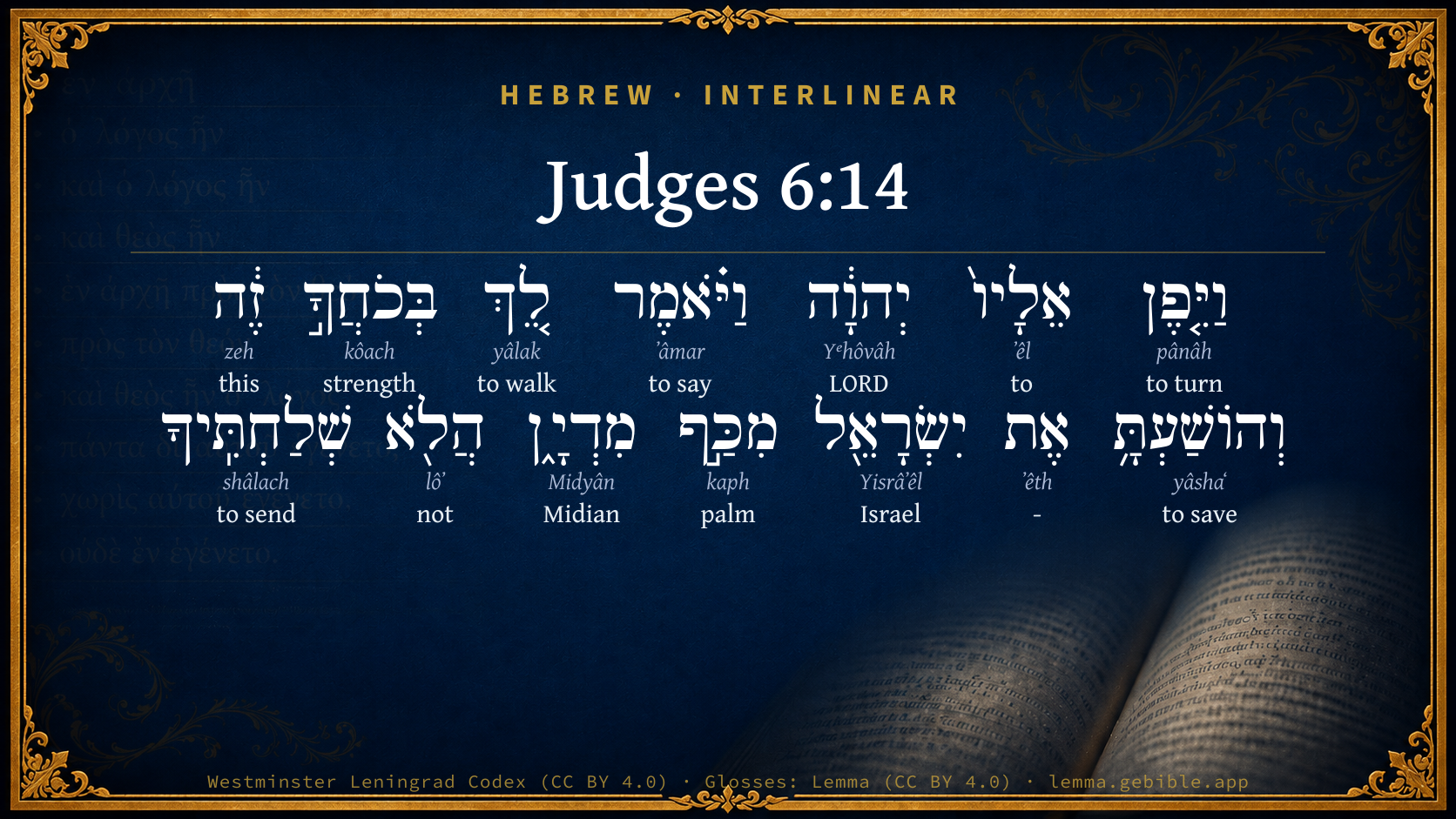
Hebrew (Westminster Leningrad Codex) Judges 6:14 appears in the Hebrew Old Testament. The text above is from the Westminster Leningrad Codex. Each word links to its Strong’s number, a concise gloss, and parsing drawn from the Open Scriptures Hebrew Bible morphology. Click any word for its full Brown-Driver-Briggs (BDB) entry.
Download image
Cite this verse

Judges 6:14 (World English Bible). Public Domain. Lemma interlinear Bible study tool, https://lemma.gebible.app/v/judges/6/14.

Show BibTeX & RIS
BibTeX
RIS
English Translation
Yahweh looked at him, and said, Go in this your might, and save Israel from the hand of Midian: have not I sent you?
World English Bible · Public Domain
Download a study sheet

One document with this verse’s original text, its word-by-word gloss line, the meaning frame, cross-references with their text, attributed commentary, and full source and license credits — printable, and it pastes into notes with its structure intact.

This verse Autodidact and up

Study sheet (.html) Plain text (.txt)

A passage Seminary Student

Up to 50 verses in one chapter. A passage sheet keeps up to 6 commentary sources and 12 cross-references per verse, in the order this page ranks them, and says so on the sheet whenever that leaves anything out. Ask for a single verse and you get the Autodidact verse sheet above.

Everything on this page stays free to read, with no account — the sheet is a download of what is already on screen, not access to it.

Want to remove ads? Support Godless Engineer
Compare translations 3

The same verse in 3 English versions, stacked beneath the original-language interlinear above. Click any original word for its lexicon entry.

Each is an independent rendering of the whole verse — the interlinear is not word-aligned to these translations.

Highlighted words mark where these versions differ — a whole-verse word diff, not a word-by-word alignment.

  • World English Bible Public Domain
    Yahweh looked at him, and said, Go in this your might, and save Israel from the hand of Midian: have not I sent you?
  • King James Version Public Domain
    And the LORD looked upon him, and said, Go in this thy might, and thou shalt save Israel from the hand of the Midianites: have not I sent thee?
  • unfoldingWord Literal Text CC BY-SA 4.0
    But Yahweh turned to him and said, “Go in this strength of yours, and you shall save Israel from the palm of Midian. Have I not sent you?”

unfoldingWord Literal Text — © unfoldingWord, licensed CC BY-SA 4.0. Word-aligned USFM3 via Door43 (git.door43.org/unfoldingWord/en_ult).

Versions to compare (up to 4)

3 of 4 selected

Show all 18 translations

Every available English version of this verse, each an independent rendering of the whole verse.

  • World English Bible Public Domain
    Yahweh looked at him, and said, Go in this your might, and save Israel from the hand of Midian: have not I sent you?
  • Berean Standard Bible Public Domain
    The LORD turned to him and said, “Go in the strength you have and save Israel from the hand of Midian. Am I not sending you?”
  • Majority Standard Bible Public Domain
    The LORD turned to him and said, “Go in the strength you have and save Israel from the hand of Midian. Am I not sending you?”
  • King James Version Public Domain
    And the LORD looked upon him, and said, Go in this thy might, and thou shalt save Israel from the hand of the Midianites: have not I sent thee?
  • American Standard Version (1901) Public Domain
    And Jehovah looked upon him, and said, Go in this thy might, and save Israel from the hand of Midian: have not I sent thee?
  • Revised Version (1885) Public Domain
    And the LORD looked upon him, and said, Go in this thy might, and save Israel from the hand of Midian: have not I sent thee?
  • Geneva Bible (1599) Public Domain
    And the Lord looked vpon him, and sayd, Goe in this thy might, and thou shalt saue Israel out of the handes of the Midianites: haue not I sent thee?
  • Douay-Rheims (1899) Public Domain
    And Gedeon said to him: I beseech thee, my lord, if the Lord be with us, why have these evils fallen upon us? Where are his miracles, which our fathers have told us of, saying: The Lord brought us Out of Egypt? but now the Lord hath forsaken us, and delivered us into the bands of Madian.
  • Young's Literal Translation Public Domain
    And Jehovah turneth unto him and saith, `Go in this -- thy power; and thou hast saved Israel out of the hand of Midian -- have not I sent thee.'
  • Literal Standard Version CC BY-SA 4.0
    And YHWH turns to him and says, “Go in this—your power; and you have saved Israel out of the hand of Midian—have I not sent you?”
  • Unlocked Literal Bible CC BY-SA 4.0
    Yahweh looked at him and said, “Go in the strength you already have. Deliver Israel from the hand of Midian. Have I not sent you?”
  • unfoldingWord Literal Text CC BY-SA 4.0
    But Yahweh turned to him and said, “Go in this strength of yours, and you shall save Israel from the palm of Midian. Have I not sent you?”
  • Darby Bible Public Domain
    And the LORD turned to him and said, "Go in this might of yours and deliver Israel from the hand of Mid'ian; do not I send you?"
  • World Messianic Bible Public Domain
    The LORD looked at him, and said, “Go in this your might, and save Israel from the hand of Midian. Haven’t I sent you?”
  • Webster's Bible Public Domain
    And the LORD looked upon him, and said, Go in this thy might, and thou shalt save Israel from the hand of the Midianites: have not I sent thee?
  • Free Bible Version CC BY-SA 4.0
    The Lord turned to him and said, “Go in the strength that you have and save Israel from the Midianites. Aren't I the one sending you?”
  • Bible in Basic English Public Domain
    And the Lord, turning to him, said, Go in the strength you have and be Israel's saviour from Midian: have I not sent you?
  • JPS Tanakh (1917) Public Domain
    And the LORD turned towards him, and said: 'Go in this thy might, and save Israel from the hand of Midian; have not I sent thee?'

Literal Standard Version (2020), Covenant Press — licensed CC BY-SA 4.0. Text via the HelloAO Bible API (eBible.org). Unlocked Literal Bible (unfoldingWord) — licensed CC BY-SA 4.0. Text via the HelloAO Bible API (eBible.org). unfoldingWord Literal Text — © unfoldingWord, licensed CC BY-SA 4.0. Word-aligned USFM3 via Door43 (git.door43.org/unfoldingWord/en_ult). Free Bible Version, Dr. Jonathan Gallagher — licensed CC BY-SA 4.0. Text via the HelloAO Bible API (eBible.org).

Word by word

More ways to search: Search by grammar → Find every occurrence → Compare this word →

Practice this passage: Drill this verse → Learn its vocabulary →

מִדְיָ֑ן
Midyân
H4080
“Midian”
Noun, Proper
Part of Speech
Noun
Type
Proper
Full BDB Definition

Origin: the same as H4079

TWOT: None

Midian or Midianite = "strife" - son of Abraham by Keturah and progenitor of the tribe of Midianites or Arabians (noun proper masculine) - the tribe descended from Midian (noun proper masculine) - the territory of the tribe descended from Midian; located principally in the desert north of the Arabian peninsula; land to which Moses went when he fled from Pharaoh (noun proper locative)
  1. וַיִּ֤פֶן pânâh H6437 “and · to turn” Conjunction + Verb, Qal, Sequential Imperfect, 3rd Person, Masculine, Singular
  2. אֵלָיו֙ ʼêl H413 “to · him” Preposition + Suffix, Personal, 3rd Person, Masculine, Singular
  3. יְהוָ֔ה Yᵉhôvâh H3068 “LORD” Noun, Proper
  4. וַיֹּ֗אמֶר ʼâmar H559 “and · to say” Conjunction + Verb, Qal, Sequential Imperfect, 3rd Person, Masculine, Singular
  5. לֵ֚ךְ yâlak H3212 “walk” Verb, Qal, Imperative, 2nd Person, Masculine, Singular
  6. בְּכֹחֲךָ֣ kôach H3581 “in/at · strength · your” Preposition + Noun, Common, Masculine, Singular, Construct + Suffix, Personal, 2nd Person, Masculine, Singular
  7. זֶ֔ה zeh H2088 “this” Pronoun, Demonstrative, Masculine, Singular
  8. וְהוֹשַׁעְתָּ֥ yâshaʻ H3467 “and · to save” Conjunction + Verb, Hiphil, Sequential Perfect, 2nd Person, Masculine, Singular
  9. אֶת ʼêth H853 “-” Particle, Direct Object
  10. יִשְׂרָאֵ֖ל Yisrâʼêl H3478 “Israel” Noun, Proper
  11. מִכַּ֣ף kaph H3709 “from · palm of” Preposition + Noun, Common, Feminine, Singular, Construct
  12. הֲלֹ֖א lôʼ H3808 “not” Particle, Interrogative + Particle, Negative
  13. שְׁלַחְתִּֽיךָ shâlach H7971 “to send · you” Verb, Qal, Perfect, 1st Person, Common, Singular + Suffix, Personal, 2nd Person, Masculine, Singular

About this verse

These counts appear in no published source. They are computed here, from the morphology-tagged text and Lemma’s own curated glosses. What Lemma adds →

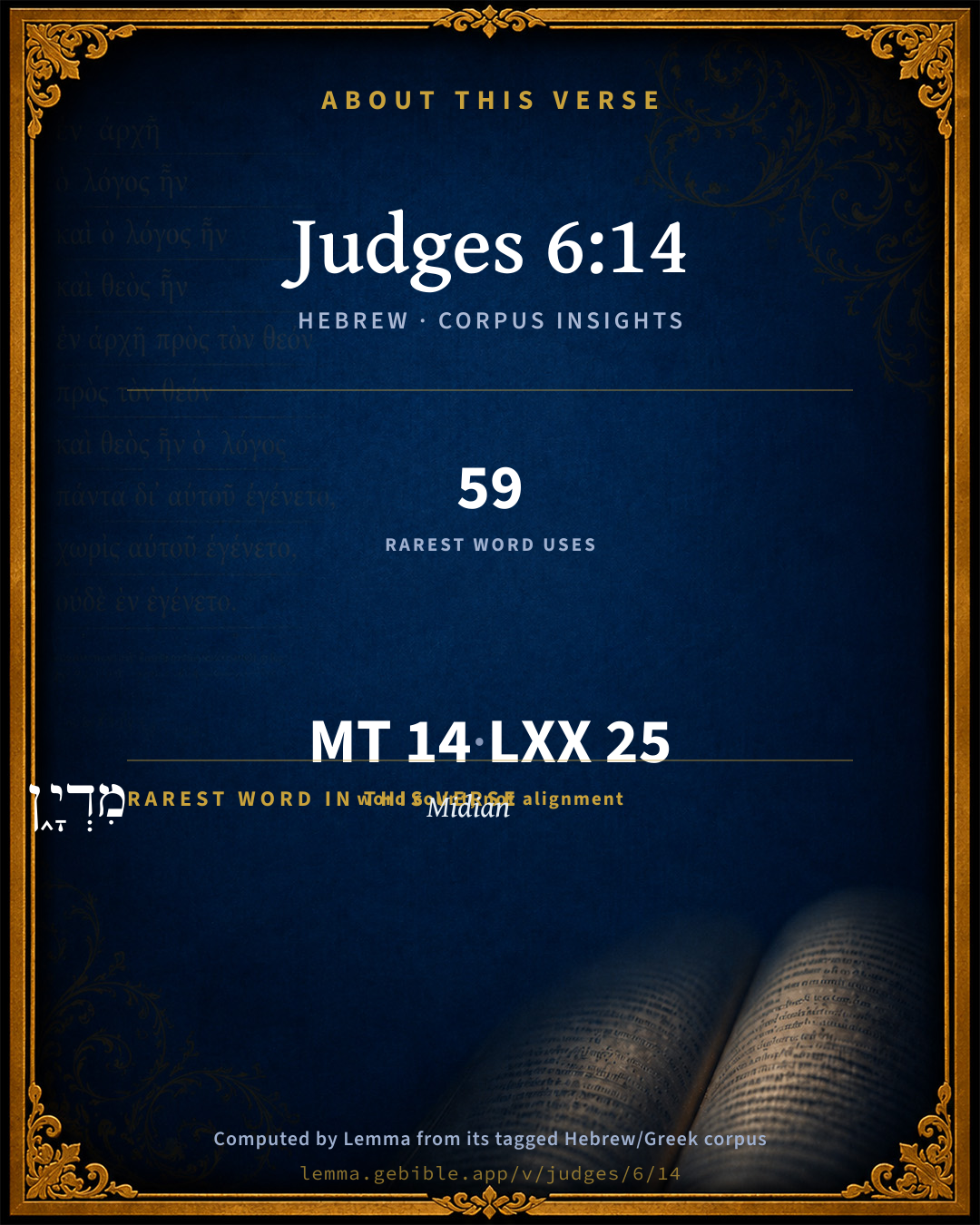
14
words
14
distinct lemmas
Historical
section

Shared distinctive vocabulary

מִדְיָ֑ן Midian H4080 occurs in 55 verses of the Hebrew Bible. Also found in:

Grammatical profile

  • 5 verbs
  • 5 nouns
  • 1 pronoun
  • 1 preposition
  • 2 particles

Verb forms

  • וַיִּ֤פֶן Qal · Sequential Imperfect
  • וַיֹּ֗אמֶר Qal · Sequential Imperfect
  • לֵ֚ךְ Qal · Imperative
  • וְהוֹשַׁעְתָּ֥ Hiphil · Sequential Perfect
  • שְׁלַחְתִּֽיךָ Qal · Perfect

Hebrew & Septuagint length

In English translation the verse runs 24 words from the Hebrew and 32 from the Septuagint (LXX English) — closely comparable.

A rough comparison of the two English renderings, which tokenize alike — not a word-level alignment.

Word counts can differ between the Hebrew and the Greek without any difference in meaning — e.g. the Hebrew direct-object marker אֵת has no separate Greek word, and Greek often adds the article ὁ.

In the original languages it is 14 Hebrew tokens and 25 Greek tokens — but the two are counted differently (Hebrew bundles its prefixes and suffixes into one token; the Greek is in lemma form), so that isn’t a like-for-like length.

Cross-references

6

Topical passages linked to Judges 6:14 in the Treasury of Scripture Knowledge — connected by theme and wording, ordered by reader-vote popularity; previews shown in the World English Bible.

  • Joshua 1:5–9 There shall not any man be able to stand before you all the days of your life. As I was with Moses, so I will be with you; I will not fail you, nor forsake you.
  • Hebrews 11:34 quenched the power of fire, escaped the edge of the sword, from weakness were made strong, grew mighty in war, and turned to flight armies of aliens.
  • 1 Samuel 12:11 Yahweh sent Jerubbaal, and Bedan, and Jephthah, and Samuel, and delivered you out of the hand of your enemies on every side; and you lived in safety.
  • Judges 4:6 She sent and called Barak the son of Abinoam out of Kedesh-naphtali, and said to him, Hasn't Yahweh, the God of Israel, commanded, [saying], Go and draw to Mount Tabor, and take with you ten thousand men of the children of Naphtali and of the children of Zebulun?
  • 1 Chronicles 14:9–10 Now the Philistines had come and made a raid in the valley of Rephaim.
  • Hebrews 11:32 What more shall I say? For the time would fail me if I told of Gideon, Barak, Samson, Jephthah, David, Samuel, and the prophets;

Cross-references courtesy of OpenBible.info (CC BY 4.0).

Hebrew and Greek witnesses Masoretic Hebrew ↔ Greek Septuagint

The same verse in the two great witnesses to the Old Testament, shown verse-for-verse.

These are two independent witnesses, not word-aligned to each other, and the Septuagint is shown in lemma (dictionary) form.

Hebrew Judges 6:14 Masoretic · Westminster Leningrad Codex

וַיִּ֤פֶן אֵלָיו֙ יְהוָ֔ה וַיֹּ֗אמֶר לֵ֚ךְ בְּכֹחֲךָ֣ זֶ֔ה וְהוֹשַׁעְתָּ֥ אֶת יִשְׂרָאֵ֖ל מִכַּ֣ף מִדְיָ֑ן הֲלֹ֖א שְׁלַחְתִּֽיךָ

Yahweh looked at him, and said, Go in this your might, and save Israel from the hand of Midian: have not I sent you?

World English Bible · Public Domain

Greek LXX Judges 6:14 Septuagint · lemma form

καί ἐπιστρέφω πρός αὐτός ὁ ἄγγελος κύριος καί εἶπον πορεύομαι ἐν ἰσχύς σύ οὗτος καί σώζω ὁ ἰσραήλ ἐκ χείρ μαδιαμ ἰδού ἐκ ἀποστέλλω σύ

And the angel of the Lord turned to him, and said, Go in this your strength, and you shall save Israel out of the hand of Madiam: behold, I have sent you.

LXX2012 (modern English Septuagint) · Public Domain

On this verse, Ellicott's Commentary for English Readers discusses the Septuagint’s reading. Read the note in Commentary ↓

Hebrew: Westminster Leningrad Codex (CC BY 4.0). Greek: Septuagint (public domain); English from LXX2012 (modern English Septuagint) (Public Domain). How the Septuagint differs from the Hebrew →

Targum (Aramaic paraphrase)

1

The Targum is the ancient Jewish Aramaic paraphrase of the Hebrew Scriptures — an interpretive translation, not the Hebrew text itself. Onkelos (literal) and Pseudo-Jonathan (expansive) render the Torah, and Jonathan the Prophets. Coverage is partial: where no permissively-licensed English translation exists for a verse, only the Aramaic is shown. This is verse-level text, not a word-by-word alignment to the Hebrew.

  1. Targum Jonathan Prophets (Joshua–Malachi)
    וְאִתְפְּנֵי לֵיהּ יְיָ וַאֲמַר אֱזִיל בְּחֵילָךְ דֵין וְתִפְרוֹק יַת יִשְׂרָאֵל מִידָא דְמִדְיָנָאֵי הֲלָא שְׁלַחְתִּיךְ:

    (no public-domain English translation for this verse)

    Targum Jonathan — Aramaic: “Mikraot Gedolot” (public domain). English: “Sefaria Community Translation” (CC0 1.0 (public-domain dedication)); “London "Chaldee Paraphrase," 1871” (public domain). Text via Sefaria.

Commentary

Notes on Judges 6:14 from classic Christian and Jewish commentators (each source and its license shown beneath its notes). The classic Christian expositions comment on the surrounding passage and are grouped to its opening verse, so a note may address several verses; the Jewish commentaries on the Tanakh (Rashi and others) are per-verse, so they appear only where the commentator wrote on this verse.

Lemma curates 59 commentaries, every one of them public domain or Creative Commons licensed, each selected and text-cleaned for this edition rather than reprinted as found. About our sources →

Trapp's Complete Commentary

John Trapp

Jdg 6:14 And the LORD looked upon him, and said, Go in this thy might, and thou shalt save Israel from the hand of the Midianites: have not I sent thee?

Ver. 14. And the Lord looked upon him.] As well liking his speech, for the main, and the publicness of his spirit, sensible of the common calamity.

Go in this thy might.] As thou now lustily belabourest the wheat thou art threshing out, so arise and thresh the mountains, the Midianites, another while. {Isa 41:15 Mic 4:13} Or, in this thy might, which I now give thee.

And thou shalt save Israel.] God could have saved them without Gideon, or any other instrument. But in most of his works he acteth, as I may so speak, in concert with the creature. It is seldom that he hath an immediate attingence with effects: he useth, and delighteth to use the service of men.

John Trapp, A Commentary or Exposition upon All the Books of the Old and New Testament (1647–1656) — public domain. Text from a community e-Sword module.

Joseph Benson's Commentary

Jdg 6:14. The Lord looked upon him — With a settled, pleasant, and animating countenance, as a testimony of his favour and readiness to help him. And said, Go in this thy might — In the power of this commission which I have now given thee; and in the strength which thou hast already received, and dost now further receive from me. Have not I sent thee? — Have not I hereby given thee a commission, a command to do this work? God’s fitting men for this work is a sure evidence of his calling them to it.

Joseph Benson's Commentary on the Old and New Testaments (1811–1818) — public domain. Text from a community e-Sword module.

Geneva Bible (1599)

Geneva Bible translators

That is, Christ appearing in visible form.

Which I have given thee.

Geneva Bible (1599) marginal notes — public domain. Text via Bolls.life.

Jamieson, Fausset & Brown

Robert Jamieson, A. R. Fausset & David Brown

the Lord looked upon him, and said, Go in this thy might . . . have not I sent thee?--The command and the promise made Gideon aware of the real character of his visitor; and yet like Moses, from a sense of humility, or a shrinking at the magnitude of the undertaking, he excused himself from entering on the enterprise. And even though assured that, with the divine aid, he would overcome the Midianites as easily as if they were but one man, he still hesitates and wishes to be better assured that the mission was really from God. He resembles Moses also in the desire for a sign; and in both cases it was the rarity of revelations in such periods of general corruption that made them so desirous of having the fullest conviction of being addressed by a heavenly messenger. The request was reasonable, and it was graciously granted [Jdg 6:18].

Jamieson, Fausset & Brown — Commentary Critical and Explanatory on the Whole Bible (1871) — public domain (CC PDM 1.0). Text via the HelloAO Bible API.

Adam Clarke's Commentary

Verse 14. Go in this thy might] What does the angel mean? He had just stated that Jehovah was with him; and he now says, Go in THIS thy might, i.e., in the might of Jehovah, who is with thee.

Adam Clarke's Commentary on the Bible (1810–1826) — public domain. Text from a community e-Sword/MySword module.

Ellicott's Commentary for English Readers

(14) The Lord looked upon him.—Here, as in Gen_18:13; Gen_18:17; Gen_18:20, the angel speaks as the Lord, and it has been hence inferred that this angel was no created angel, but “the angel of the covenant,” “the captain of the Lord’s host.” The only other possible conclusion is to say that the angel only speaks as the mouth of God (comp. Rev_21:15; Rev_22:6-7). No doubt the expression is here literal, but it involves the sense of favour and acceptance (Psa_25:6; Vulg., respexit). The look inspired him with fresh force. The reason why the LXX. retain the phrase “the angel of the Lord” throughout is because they had the true Alexandrian dislike for all anthropomorphic expressions—i.e., for all expressions which seemed to them to lower the invisible and unapproachable majesty of the Almighty.

Have not I sent thee?—See 1Sa_12:11 : “The Lord sent Jerubbaal.”

A Bible Commentary for English Readers, edited by Charles John Ellicott (1878–1897) — public domain. Text from a community e-Sword module.

The Cambridge Bible for Schools and Colleges

gen. ed. J. J. S. Perowne

14. the Lord turned towards him] The narrator lets us into the secret, though Gideon has not yet recognized who the Traveller is; LXX here and in Jdg_6:16 (cf. LXX Exo_4:24) reads ‘the angel of the Lord,’ an obvious way of introducing consistency.

Go in this thy might] See on Jdg_6:12. Gideon’s natural qualities were capable of being set to higher tasks. ‘God takes men as they are and makes them what they are not.’

have not I sent thee?] do not I send thee? The language of the speaker both here and in Jdg_6:16 seems to us to betray his real character; but Gideon does not see through the disguise till Jdg_6:22.

The Cambridge Bible for Schools and Colleges (gen. ed. J. J. S. Perowne; Cambridge University Press, 1878–1918) — public domain. Text from a community e-Sword module.

John Gill's Exposition

And he said unto him, oh my Lord,.... Whether he had yet suspected who he was, or took him still for some eminent person, is not certain; it is very probable he began to think he was some extraordinary person sent of God, and speaking in his name, and therefore expostulates with him about the work he put him upon:

wherewith shall I save Israel? in what way is it possible for me to do it, who had neither men nor money sufficient for such an undertaking?

behold, my family is poor in Manasseh; of which tribe he was, and the "thousand" in it, as the word (l) here used signifies, was the meanest of all the thousands in that tribe; some render it, "my father" (m):

and I am the least in my father's house; perhaps the youngest son; though some take him, and others his father, to be the Chiliarch, or head of the thousand; but by these words of his it does not seem as if either was true; not but that he was of some wealth and substance, power and authority, by having such a number of servants as to take "ten" of them with him, Jdg 6:27 however, this he says in great humility and modesty, having no high thoughts of himself and family, nor any dependence on his own strength, and on an arm of flesh.

(l) "chilias, mea", Montanus, Drusius; "mea millenaria", Tigurine version; "mille meum", Piscator. (m) "Pater meus", Pagninus; so some in Drusius.

John Gill's Exposition of the Whole Bible (1746–1763) — public domain (CC PDM 1.0). Text via the HelloAO Bible API.

Albert Barnes' Notes on the Bible

The Lord looked upon him - That gracious look conferred immediate strength (compare Eph 6:10; 2Co 12:9; Joh 20:22; Act 3:6) The change of phrase from “the angel of the Lord” to “the Lord” is remarkable. When messages are delivered by the Angel of the Lord, the form of the message is as if God Himself were speaking (compare Jdg 2:1).

The sending implied a valid commission and sufficient powers. Compare Exo 3:10; Isa 44:26; Eze 2:3; Zec 2:11; Mal 3:1; Luk 10:3; Joh 20:21; and the term APOSTLE, as applied to our Lord Heb 3:1 and to the Twelve.

Albert Barnes' Notes on the Bible (1834–1885) — public domain. Text from a community e-Sword/MySword module.

Haydock's Catholic Bible Commentary

Lord, Jehova. (Haydock) --- The Chaldean and Septuagint have, "the angel of the Lord," as the best interpreters understand it. (Calmet) --- Upon him, with benevolence and an air of authority, that he might know that he was speaking to some one more than man. (Haydock) --- Strength, with which I have endued thee. (Menochius) --- Though Gedeon was naturally brave, he was no more disposed to attack the Madianites than the rest of his dispirited countrymen; and, even after he was strengthened from above, he was so conscious of his own inability to effect so great a deliverance, that he stood in need of the most convincing miracles, to make him act as the judge of Israel. (Haydock)

George Leo Haydock (1774–1849), Haydock's Catholic Family Bible and Commentary, 1859 edition — public domain. Excludes Psalms (Douay-Rheims chapter numbering differs from Protestant) and Deuterocanonical books (Catholic canon only).

Matthew Poole's English Annotations

The Lord looked upon him, with a settled and pleasant countenance, as a testimony of his favour to him, and of his readiness to help him.

Go in this thy might; or, go now, or at this time, in thy might; the strength which thou hast already received, and dost now further receive from me, is sufficient with my help.

Have not I sent thee? I do hereby give thee command and commission for this work, and therefore am obliged in honour to assist thee in it.

Matthew Poole's English Annotations on the Holy Bible (1683–1685) — public domain. Text from a community e-Sword/MySword module.

Whedon's Commentary on the Bible

Daniel D. Whedon

14. The Lord looked upon him — This clearly shows that this Angel was the manifestation of Jehovah himself and this looking upon him was an impressive gaze which made him conscious of the Divine Presence, and imparted to him a divine power.

In this thy might — The might and strength which I herewith impart.

Have not I sent thee — Language of divine assurance. Compare marginal references.

Daniel D. Whedon (gen. ed.), Commentary on the Old and New Testaments (1874–1909) — public domain. Text from a community e-Sword module.

The Pulpit Commentary

The assuring thought of God"s servant.

"Have not I sent thee?" This is one of those words by which the saint has often been "strengthened with all might in the inner man." It lifted the heroes of Israel, the reformers, the men of the commonwealth of England, above the common weaknesses of their age and race. "A man, a woman, with a mission why not? Some careers are wholly explained by it; some simple achievement critical in history; and many unostentatious, secret services rendered in the Master" s name, under the influence of overpowering impulses, more or less transient or permanent.

I THE LIFE IS THEREBY CONSECRATED AND DIRECTED. A man is not at liberty to follow his own private aims when the heavenly voice speaks thus within him. A higher plane of life and action is thereby created. An unseen influence isolates and consecrates him. This usually imparts greater definiteness to his conduct. He does not "beat the air.

II THE MOST DIFFICULT DUTIES ARE IN THIS FAITH RENDERED PRACTICABLE. "If God be for us, who can be against us?" "All things are possible to them that believe." The fatalists of history Caesars and Napoleons have left their mark and proved the strength of a ruling idea. But this conviction is reasonable and of infinite power. The greatest changes the world has seen have been wrought under its influence apostolic mission, reformation, missionary enterprise at home andabroad, Sunday school origin and extension. And so in the things of the individual life and private sphere.

III THROUGH ITS INFLUENCE A PRESENT CONSOLATION AND AN ETERNAL REWARD ARE SECURED. Has God sent us? Then he will take note of our behaviour, and sustain our flagging strength. Has God sent us? our service cannot be for earthly gain. He is our Master; and as he sends no man "a warfare at his own charges," so the saint is sustained by the hope of the "crown of glory that fadeth not away. M.

The Pulpit Commentary (1880–1919), ed. H.D.M. Spence-Jones & Joseph S. Exell — public domain. Text from a community e-Sword module.

John Wesley's Explanatory Notes

Looked - With a settled and pleasant countenance, as a testimony of his favour, and readiness to help him. Go - Or, go now, in thy might: in the strength which thou hast already received, and dost now farther receive from me. Have not I sent thee - I do hereby give thee command and commission for this work. God's fitting men for his work, is a sure evidence of his calling them to it.

John Wesley, Explanatory Notes Upon the Whole Bible (1754–1765) — public domain. Text via the GEBible commentary corpus.

unfoldingWord translationNotes

Door43 World Missions Community

Yahweh looked at him

"Yahweh looked at Gideon"

from the hand

Here "hand" represents power or control. (See: Metonymy)

of Midian

Here "Midian" represents the people of Midian. AT: "of the Midianites" (See: Metonymy)

Have I not sent you?

Yahweh uses a question to ensure Gideon that he is sending him. Here "sent" means Yahweh has appointed Gideon with a specific task. AT: "I, Yahweh, am sending you!" (See: Rhetorical Question)

Please, Lord

Gideon now calls the person "Lord" instead of "my master" as in Judges 6:13. Here it seems Gideon either knows or suspects that he is speaking with Yahweh.

how can I deliver Israel?

Gideon uses a question to emphasize that he does not think he can rescue the Israelites. AT: "I cannot possibly rescue the Israelites!" (See: Rhetorical Question)

See, my family

"Look at my family and me and you will see that it"

in Manasseh

"in the tribe of Manasseh"

in my father's house

Here "house" represents a family. AT: "in my father's family" or "in my family" (See: Metonymy)

translationWords

Yahweh

strength

deliver

Israel

hand

Midian

send

Gideon

lord

family

Manasseh

ancestor

house

unfoldingWord translationNotes — © Distant Shores Media and the Door43 World Missions Community, licensed CC BY-SA 4.0. Source: git.door43.org/Door43/en_tn.

Rashi

Rabbi Shlomo Yitzchaki (Rashi)

Turned to him. The Holy One, blessed is He, Himself.

By this power of yours. By the power of the merit of your advocacy of my children. This is R' Tanchuma's explanation.

Rashi on the Tanakh — English translations: “The Judaica Press complete Tanach with Rashi, translated by A. J. Rosenberg” (CC BY 4.0); “Pentateuch with Rashi's commentary by M. Rosenbaum and A.M. Silbermann, 1929-1934” (public domain); “The Metsudah Tanach series, Lakewood, N.J” (CC BY 4.0); and “The Book of Joshua, Metsudah Publications, 1997” (CC BY 4.0). Text via Sefaria.

Lesson kit

Teaching starters — assembled from the data on this page, not authored interpretation. Every prompt links to the verse data it draws on. Edit before teaching.

Judges, in the Historical, opens this verse with 14 words (14 distinct Hebrew lemmas). Its most distinctive word is Midyân (“Midian”). A historical commentator’s framing appears above. Read the whole chapter for the surrounding context.

Discussion questions

  1. The word Midyân carries the sense “Midian.” How does it shape the verse?
  2. How does Genesis 25:2, which shares the word «Midian», read alongside this verse?
  3. The translations on this page render this verse differently — a whole-verse word diff, not a word-by-word alignment. What might account for the different wordings?
  4. «וַיִּ֤פֶן» is a Qal Sequential Imperfect verb. How does that grammatical form shape the action described?
  5. Compare how Trapp's Complete Commentary and Joseph Benson's Commentary read this verse. Where do they agree or differ?

Things to notice

Reading settings

Reading text

Shown beneath each verse's original-language words.

Old Testament
Old Testament edition

Read the OT as the Masoretic Hebrew (MT) or the Greek Septuagint (LXX).

English shown for the Greek Septuagint (in the Hebrew ↔ Greek comparison).

Comparing translations? Open the Compare panel on any verse page to stack up to four side by side.