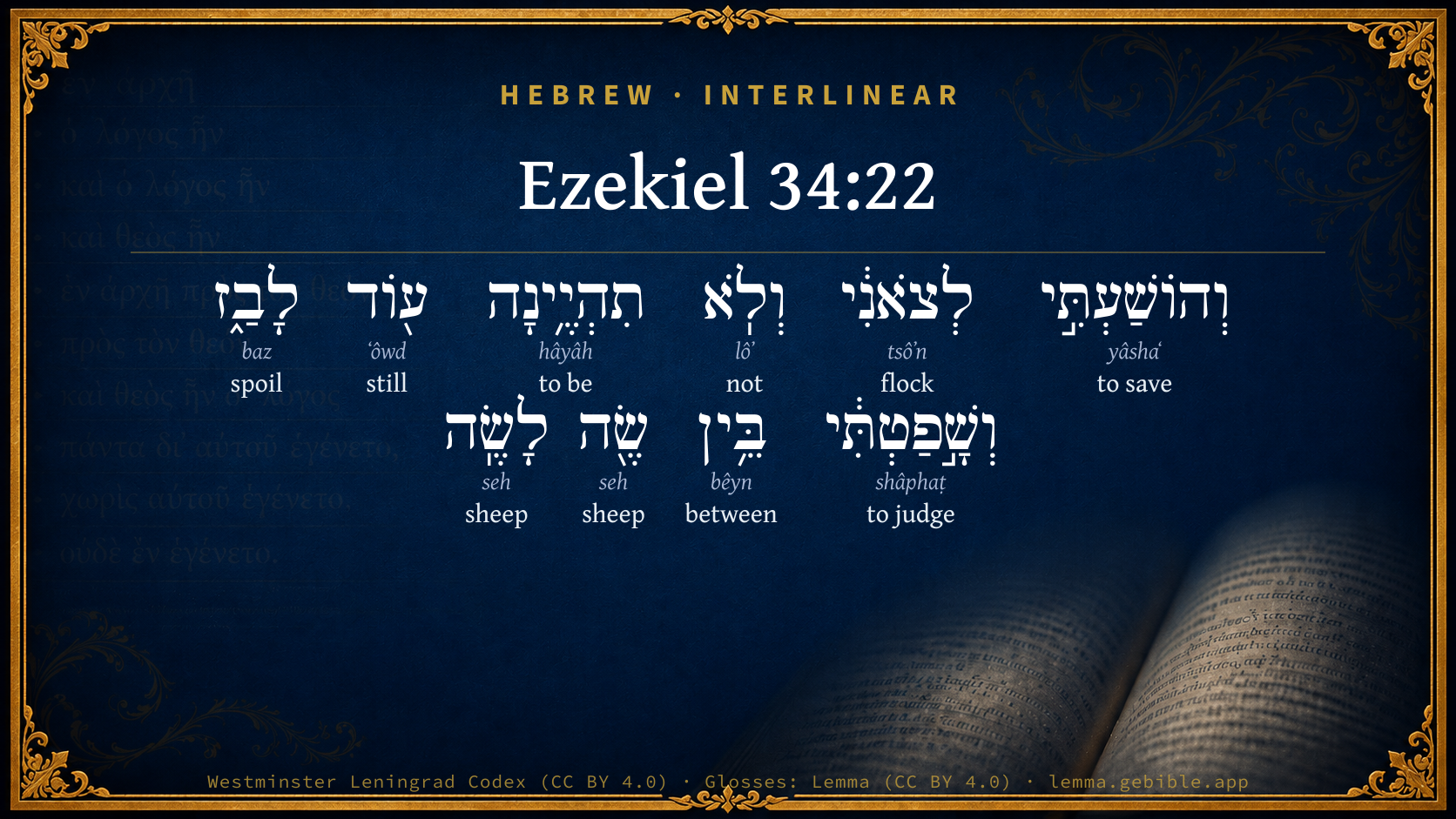
Ezekiel 34:22

Hebrew (Westminster Leningrad Codex) Ezekiel 34:22 appears in the Hebrew Old Testament. The text above is from the Westminster Leningrad Codex. Each word links to its Strong’s number, a concise gloss, and parsing drawn from the Open Scriptures Hebrew Bible morphology. Click any word for its full Brown-Driver-Briggs (BDB) entry.
Download image
Cite this verse

Ezekiel 34:22 (World English Bible). Public Domain. Lemma interlinear Bible study tool, https://lemma.gebible.app/v/ezekiel/34/22.

Show BibTeX & RIS
BibTeX
RIS
English Translation
therefore will I save my flock, and they shall no more be a prey; and I will judge between sheep and sheep.
World English Bible · Public Domain
Download a study sheet

One document with this verse’s original text, its word-by-word gloss line, the meaning frame, cross-references with their text, attributed commentary, and full source and license credits — printable, and it pastes into notes with its structure intact.

This verse Autodidact and up

Study sheet (.html) Plain text (.txt)

A passage Seminary Student

Up to 50 verses in one chapter. A passage sheet keeps up to 6 commentary sources and 12 cross-references per verse, in the order this page ranks them, and says so on the sheet whenever that leaves anything out. Ask for a single verse and you get the Autodidact verse sheet above.

Everything on this page stays free to read, with no account — the sheet is a download of what is already on screen, not access to it.

Want to remove ads? Support Godless Engineer
Compare translations 3

The same verse in 3 English versions, stacked beneath the original-language interlinear above. Click any original word for its lexicon entry.

Each is an independent rendering of the whole verse — the interlinear is not word-aligned to these translations.

Highlighted words mark where these versions differ — a whole-verse word diff, not a word-by-word alignment.

  • World English Bible Public Domain
    therefore will I save my flock, and they shall no more be a prey; and I will judge between sheep and sheep.
  • King James Version Public Domain
    Therefore will I save my flock, and they shall no more be a prey; and I will judge between cattle and cattle.
  • unfoldingWord Literal Text CC BY-SA 4.0
    I will save my flock and they will no longer be plunder, and I will judge between one sheep and another!

unfoldingWord Literal Text — © unfoldingWord, licensed CC BY-SA 4.0. Word-aligned USFM3 via Door43 (git.door43.org/unfoldingWord/en_ult).

Versions to compare (up to 4)

3 of 4 selected

Show all 18 translations

Every available English version of this verse, each an independent rendering of the whole verse.

  • World English Bible Public Domain
    therefore will I save my flock, and they shall no more be a prey; and I will judge between sheep and sheep.
  • Berean Standard Bible Public Domain
    I will save My flock, and they will no longer be prey. I will judge between one sheep and another.
  • Majority Standard Bible Public Domain
    I will save My flock, and they will no longer be prey. I will judge between one sheep and another.
  • King James Version Public Domain
    Therefore will I save my flock, and they shall no more be a prey; and I will judge between cattle and cattle.
  • American Standard Version (1901) Public Domain
    therefore will I save my flock, and they shall no more be a prey; and I will judge between sheep and sheep.
  • Revised Version (1885) Public Domain
    therefore will I save my flock, and they shall no more be a prey; and I will judge between cattle and cattle.
  • Geneva Bible (1599) Public Domain
    Therefore wil I helpe my sheepe, and they shall no more be spoyled, and I wil iudge betweene sheepe and sheepe.
  • Douay-Rheims (1899) Public Domain
    I will save my dock, and it shall be no more a spoil, and I will judge between cattle and cattle.
  • Young's Literal Translation Public Domain
    And I have given safety to My flock, And they are not any more for prey, And I have judged between sheep and sheep.
  • Literal Standard Version CC BY-SA 4.0
    Therefore I have given safety to My flock, || And they are not for prey anymore, || And I have judged between sheep and sheep.
  • Unlocked Literal Bible CC BY-SA 4.0
    I will save my flock and they will no longer be plunder, and I will judge between one sheep and another!
  • unfoldingWord Literal Text CC BY-SA 4.0
    I will save my flock and they will no longer be plunder, and I will judge between one sheep and another!
  • Darby Bible Public Domain
    -- I will save my flock, that they may no more be a prey; and I will judge between sheep and sheep.
  • World Messianic Bible Public Domain
    therefore I will save my flock, and they will no more be a prey. I will judge between sheep and sheep.
  • Webster's Bible Public Domain
    Therefore will I save my flock, and they shall no more be a prey; and I will judge between cattle and cattle.
  • Free Bible Version CC BY-SA 4.0
    I will rescue my flock, and they will no longer be your victims. I will judge between one sheep and the next.
  • Bible in Basic English Public Domain
    I will make my flock safe, and they will no longer be taken away, and I will be judge between sheep and sheep.
  • JPS Tanakh (1917) Public Domain
    therefore will I save My flock, and they shall no more be a prey; and I will judge between cattle and cattle.

Literal Standard Version (2020), Covenant Press — licensed CC BY-SA 4.0. Text via the HelloAO Bible API (eBible.org). Unlocked Literal Bible (unfoldingWord) — licensed CC BY-SA 4.0. Text via the HelloAO Bible API (eBible.org). unfoldingWord Literal Text — © unfoldingWord, licensed CC BY-SA 4.0. Word-aligned USFM3 via Door43 (git.door43.org/unfoldingWord/en_ult). Free Bible Version, Dr. Jonathan Gallagher — licensed CC BY-SA 4.0. Text via the HelloAO Bible API (eBible.org).

Word by word

More ways to search: Search by grammar → Find every occurrence → Compare this word →

Practice this passage: Drill this verse → Learn its vocabulary →

לָבַ֑ז
baz
H957
“to/for · spoil”
Preposition + Noun, Common, Masculine, Singular, Absolute
Part of Speech
Preposition + Noun
Type
Common
Gender
Masculine
Number
Singular
State
Absolute
Full BDB Definition

Origin: from H962

TWOT: 225a

spoil, booty, robbery, spoiling
  1. וְהוֹשַׁעְתִּ֣י yâshaʻ H3467 “and · to save” Conjunction + Verb, Hiphil, Sequential Perfect, 1st Person, Common, Singular
  2. לְצֹאנִ֔י tsôʼn H6629 “to/for · flock · my” Preposition + Noun, Common, Both, Singular, Construct + Suffix, Personal, 1st Person, Common, Singular
  3. וְלֹֽא lôʼ H3808 “and · not” Conjunction + Particle, Negative
  4. תִהְיֶ֥ינָה hâyâh H1961 “to be” Verb, Qal, Imperfect, 3rd Person, Feminine, Plural
  5. ע֖וֹד ʻôwd H5750 “still” Adverb
  6. וְשָׁ֣פַטְתִּ֔י shâphaṭ H8199 “and · to judge” Conjunction + Verb, Qal, Sequential Perfect, 1st Person, Common, Singular
  7. בֵּ֥ין bêyn H996 “between” Preposition
  8. שֶׂ֖ה seh H7716 “sheep” Noun, Common, Both, Singular, Absolute
  9. לָשֶֽׂה seh H7716 “to/for · sheep” Preposition + Noun, Common, Both, Singular, Absolute

About this verse

These counts appear in no published source. They are computed here, from the morphology-tagged text and Lemma’s own curated glosses. What Lemma adds →

10
words
9
distinct lemmas
Prophets
section

Notable vocabulary

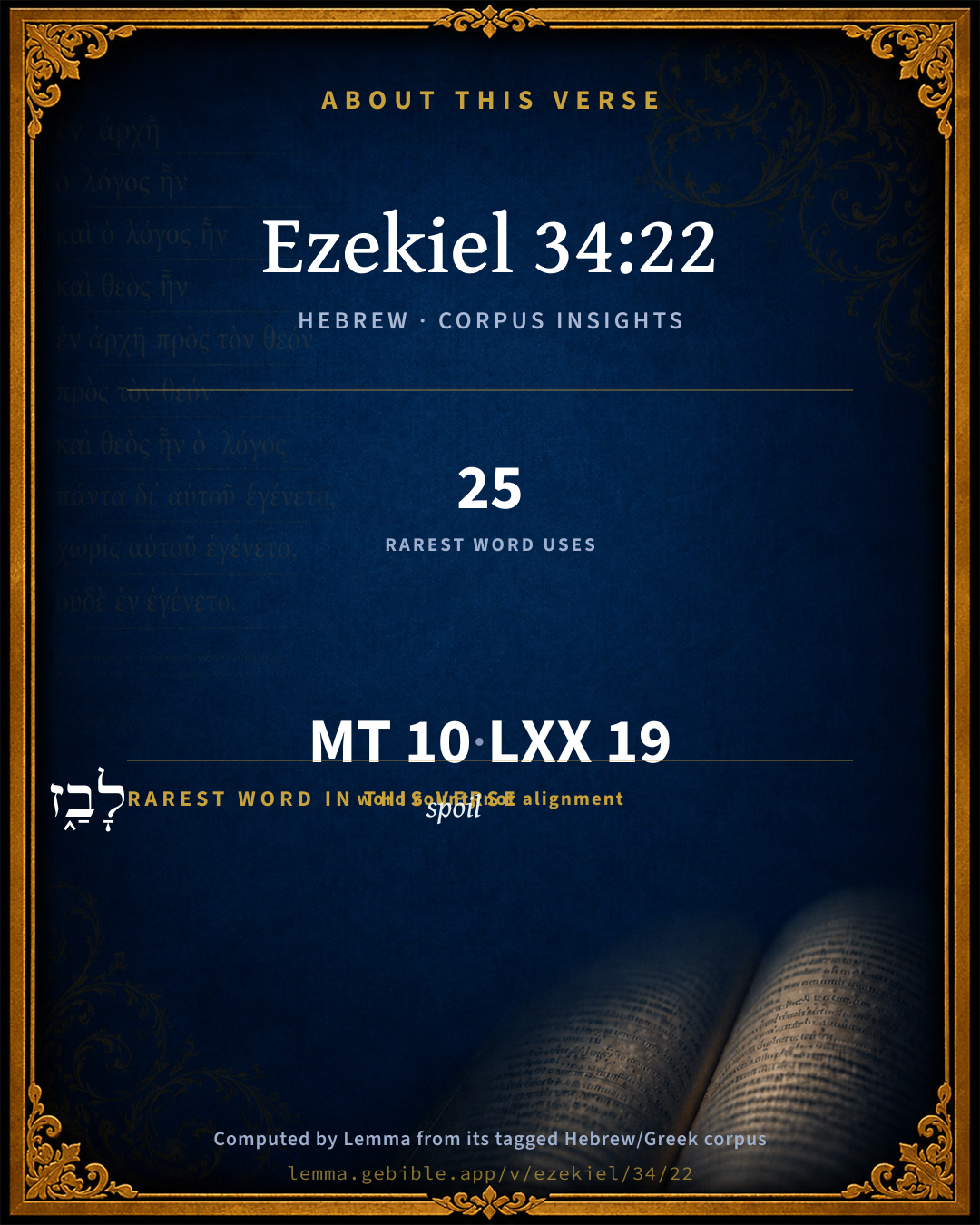
The rarest word here is לָבַ֑ז spoil H957 — appearing just 25 times in the whole Hebrew Bible.

Shared distinctive vocabulary

לָבַ֑ז spoil H957 occurs in 25 verses of the Hebrew Bible. Also found in:

Grammatical profile

  • 3 verbs
  • 4 nouns
  • 1 preposition
  • 1 adverb
  • 1 particle

Verb forms

  • וְהוֹשַׁעְתִּ֣י Hiphil · Sequential Perfect
  • תִהְיֶ֥ינָה Qal · Imperfect
  • וְשָׁ֣פַטְתִּ֔י Qal · Sequential Perfect

Repetition

A word recurs within this verse — often emphatic in Hebrew:

  • שֶׂ֖ה sheep H7716 ×2

Hebrew & Septuagint length

In English translation the verse runs 22 words from the Hebrew and 23 from the Septuagint (LXX English) — closely comparable.

A rough comparison of the two English renderings, which tokenize alike — not a word-level alignment.

Word counts can differ between the Hebrew and the Greek without any difference in meaning — e.g. the Hebrew direct-object marker אֵת has no separate Greek word, and Greek often adds the article ὁ.

In the original languages it is 10 Hebrew tokens and 19 Greek tokens — but the two are counted differently (Hebrew bundles its prefixes and suffixes into one token; the Greek is in lemma form), so that isn’t a like-for-like length.

Cross-references

4

Topical passages linked to Ezekiel 34:22 in the Treasury of Scripture Knowledge — connected by theme and wording, ordered by reader-vote popularity; previews shown in the World English Bible.

  • Psalms 72:12–14 For he will deliver the needy when he cries; The poor, who has no helper.
  • Jeremiah 23:2–3 Therefore thus says Yahweh, the God of Israel, against the shepherds who feed my people: You have scattered my flock, and driven them away, and have not visited them; behold, I will visit on you the evil of your doings, says Yahweh.
  • Ezekiel 34:10 Thus says the Lord Yahweh: Behold, I am against the shepherds; and I will require my sheep at their hand, and cause them to cease from feeding the sheep; neither shall the shepherds feed themselves any more; and I will deliver my sheep from their mouth, that they may not be food for them.
  • Zechariah 11:7–9 So I fed the flock of slaughter, especially the oppressed of the flock. I took for myself two staffs. The one I called "Favor," and the other I called "Union," and I fed the flock.

Cross-references courtesy of OpenBible.info (CC BY 4.0).

Hebrew and Greek witnesses Masoretic Hebrew ↔ Greek Septuagint

The same verse in the two great witnesses to the Old Testament, shown verse-for-verse.

These are two independent witnesses, not word-aligned to each other, and the Septuagint is shown in lemma (dictionary) form.

Hebrew Ezekiel 34:22 Masoretic · Westminster Leningrad Codex

וְהוֹשַׁעְתִּ֣י לְצֹאנִ֔י וְלֹֽא תִהְיֶ֥ינָה ע֖וֹד לָבַ֑ז וְשָׁ֣פַטְתִּ֔י בֵּ֥ין שֶׂ֖ה לָשֶֽׂה

therefore will I save my flock, and they shall no more be a prey; and I will judge between sheep and sheep.

World English Bible · Public Domain

Greek LXX Ezekiel 34:22 Septuagint · lemma form

καί σώζω ὁ πρόβατον ἐγώ καί οὐ μή εἰμί ἔτι εἰς προνομή καί κρίνω ἀνά μέσος κριός πρός κριός

Therefore I will save my sheep, and they shall not be any more for a prey; and will judge between ram and ram.

LXX2012 (modern English Septuagint) · Public Domain

Hebrew: Westminster Leningrad Codex (CC BY 4.0). Greek: Septuagint (public domain); English from LXX2012 (modern English Septuagint) (Public Domain). How the Septuagint differs from the Hebrew →

Targum (Aramaic paraphrase)

1

The Targum is the ancient Jewish Aramaic paraphrase of the Hebrew Scriptures — an interpretive translation, not the Hebrew text itself. Onkelos (literal) and Pseudo-Jonathan (expansive) render the Torah, and Jonathan the Prophets. Coverage is partial: where no permissively-licensed English translation exists for a verse, only the Aramaic is shown. This is verse-level text, not a word-by-word alignment to the Hebrew.

  1. Targum Jonathan Prophets (Joshua–Malachi)
    וְאֶפְרוֹק לְעַמִי וְלָא יִתְמַסְרוּן עוֹד לְבִזָא וְאֵידוּן בֵּין גְבַר לִגְבַר:

    (no public-domain English translation for this verse)

    Targum Jonathan — Aramaic: “Mikraot Gedolot” (public domain). English: “Sefaria Community Translation” (CC0 1.0 (public-domain dedication)); “London "Chaldee Paraphrase," 1871” (public domain). Text via Sefaria.

Commentary

Notes on Ezekiel 34:22 from classic Christian and Jewish commentators (each source and its license shown beneath its notes). The classic Christian expositions comment on the surrounding passage and are grouped to its opening verse, so a note may address several verses; the Jewish commentaries on the Tanakh (Rashi and others) are per-verse, so they appear only where the commentator wrote on this verse.

Lemma curates 59 commentaries, every one of them public domain or Creative Commons licensed, each selected and text-cleaned for this edition rather than reprinted as found. About our sources →

Trapp's Complete Commentary

John Trapp

Eze 34:22 Therefore will I save my flock, and they shall no more be a prey; and I will judge between cattle and cattle.

Ver. 22. Therefore will I save my flock,] viz., By Christ the true shepherd, who once found out him whom the Jews had unjustly excommunicated, {Joh 9:35} and gave him encouragement. He knows all his sheep by name, {as Exo 33:12; Exo 33:17} and hath promised them safety here, and salvation hereafter. {Joh 10:27} It is not with the saints, as Isa 31:4, or as Amo 3:12, but as Jer 31:10-12.

John Trapp, A Commentary or Exposition upon All the Books of the Old and New Testament (1647–1656) — public domain. Text from a community e-Sword module.

Jamieson, Fausset & Brown

Robert Jamieson, A. R. Fausset & David Brown

After the restoration from Babylon, the Jews were delivered in some degree from the oppression, not only of foreigners, but also of their own great people (Neh. 5:1-19). The full and final fulfilment of this prophecy is future.

Jamieson, Fausset & Brown — Commentary Critical and Explanatory on the Whole Bible (1871) — public domain (CC PDM 1.0). Text via the HelloAO Bible API.

John Gill's Exposition

And I will set up one shepherd over them,.... Or governor, as the Targum; an excellent one of a thousand, the only one; in comparison of whom others are not to be named; for though there are under shepherds, as magistrates and ministers of the word, he is the principal one; that is, Christ, called the good Shepherd, the great Shepherd, and the chief Shepherd, and the only one; and who became so by the constitution and appointment of Jehovah the Father; who chose him, called him, and intrusted him with all his sheep: who sent him to seek and save his lost sheep; for whom he died, rose again, and is accountable: he is more particularly called the one Shepherd, with respect to Jew and Gentile; see Joh 10:16,

and he shall feed them; the flock, even the poor of the flock, thrust at and pushed by others: he shall feed them by his ministers, as under shepherds in his churches, where his word is preached, and his ordinances are administered; he shall feed them with himself, the bread of life; with his flesh and blood, which are meat and drink indeed; with covenant grace, blessings, and promises; with the Gospel, and the doctrines of it; he feeds his babes with milk, his strong men with meat, and all with the wholesome words of faith and good doctrine, whereby he nourishes them up to everlasting life; and this he

shall do, not by force, but willingly: it denotes the certainty of it; it may be depended on:

even my servant David; not David himself literally; who though a shepherd, and the servant of the Lord, yet had been dead many years before this prophecy was delivered; nor Zerubbabel, who was of his seed; for though a servant of the Lord, and a prince or governor of Judah, yet not a king, and much less a king or prince for ever; as this person is said to be, Eze 37:24, but the Messiah, as is expressly owned by Kimchi; who says, this is the Messiah that shall arise from his seed in the time of salvation: he is called David because his name agrees with him, which signifies "beloved", he being beloved of God and man; and because the son of David, of his seed according to the flesh; and because David was an eminent type of him, in his person, offices, afflictions, wars, victories, and exaltation; and because he was David's Lord and representative, and in whom his everlasting kingdom is established. The same is called the servant of the Lord, as he often is in Scripture, being so in his office capacity as Mediator; and because he took upon him the form of a servant; did the work of one; and was of the Lord's choosing, calling, supporting, and glorifying:

he shall feed them, and he shall be their shepherd; which is repeated for the greater confirmation of it.

John Gill's Exposition of the Whole Bible (1746–1763) — public domain (CC PDM 1.0). Text via the HelloAO Bible API.

Matthew Poole's English Annotations

In the 21st verse these metaphors and allusions do express the unmercifulness, injustice, pride, cruelty, and wanton tyranny of the rulers in church and state against the meaner people, that as you see the greater cattle run against the lesser, and overturning, or laming, some way or other hurting them, by shouldering against them; or as horned cattle wound and tear the weaker, and make them run for it; so had these rulers used their power to the hurt and scattering of the people. Because I see they destroy who he should defend, I will interpose; they will not, but I will, be kind, just, and faithful to my people and promise; I will save from foreign violence and home oppressions. See Eze 34:2,5,10,17.

Matthew Poole's English Annotations on the Holy Bible (1683–1685) — public domain. Text from a community e-Sword/MySword module.

unfoldingWord translationNotes

Door43 World Missions Community

General Information:

Yahweh continues speaking of the people of Israel as if they were a flock of sheep and of himself as their shepherd. (See: Metaphor)

they will no longer be plunder

This can be stated in active form. AT: "I will not allow anyone to plunder them" or "I will not allow anyone to steal them" (See: Active or Passive)

will no longer be plunder

"will no longer be things that are stolen." The shepherds and wild animals have been stealing the sheep and the goats from Yahweh's flock.

I will set over them one shepherd

The phrase "set over" is an idiom that means to cause a person to rule someone else. AT: "I will assign one shepherd to be in charge of my sheep and the goats" (See: Idiom)

my servant David

Here "David" refers to a descendant of David. AT: "a descendant of my servant David" (See: Metonymy)

He will shepherd them

The descendant of David who will be king over the people of Israel is spoken of as if he would be their shepherd. (See: Metaphor)

will be a prince among them

"will be their ruler"

translationWords

save

flocks

shepherd

servant

David

Yahweh

God

prince

declare

unfoldingWord translationNotes — © Distant Shores Media and the Door43 World Missions Community, licensed CC BY-SA 4.0. Source: git.door43.org/Door43/en_tn.

Lesson kit

Teaching starters — assembled from the data on this page, not authored interpretation. Every prompt links to the verse data it draws on. Edit before teaching.

Ezekiel, in the Prophets, opens this verse with 10 words (9 distinct Hebrew lemmas). Its most distinctive word is baz (“spoil”). A historical commentator’s framing appears above. Read the whole chapter for the surrounding context.

Discussion questions

  1. How does “spoil” (baz) shape what this verse is saying?
  2. Numbers 14:3 shares the word «spoil» with this verse. How do the two illuminate each other?
  3. “sheep” occurs 2× in this one verse. What is the effect of the repetition?
  4. These translations render this verse differently; the difference is in the English rendering, not the original. What questions does that raise?
  5. The verb «וְהוֹשַׁעְתִּ֣י» is Hiphil Sequential Perfect. How does its form color the action?
  6. Reading how Trapp's Complete Commentary and Jamieson, Fausset & Brown read this verse, where do the two commentators agree and where do they part?

Things to notice

Reading settings

Reading text

Shown beneath each verse's original-language words.

Old Testament
Old Testament edition

Read the OT as the Masoretic Hebrew (MT) or the Greek Septuagint (LXX).

English shown for the Greek Septuagint (in the Hebrew ↔ Greek comparison).

Comparing translations? Open the Compare panel on any verse page to stack up to four side by side.