
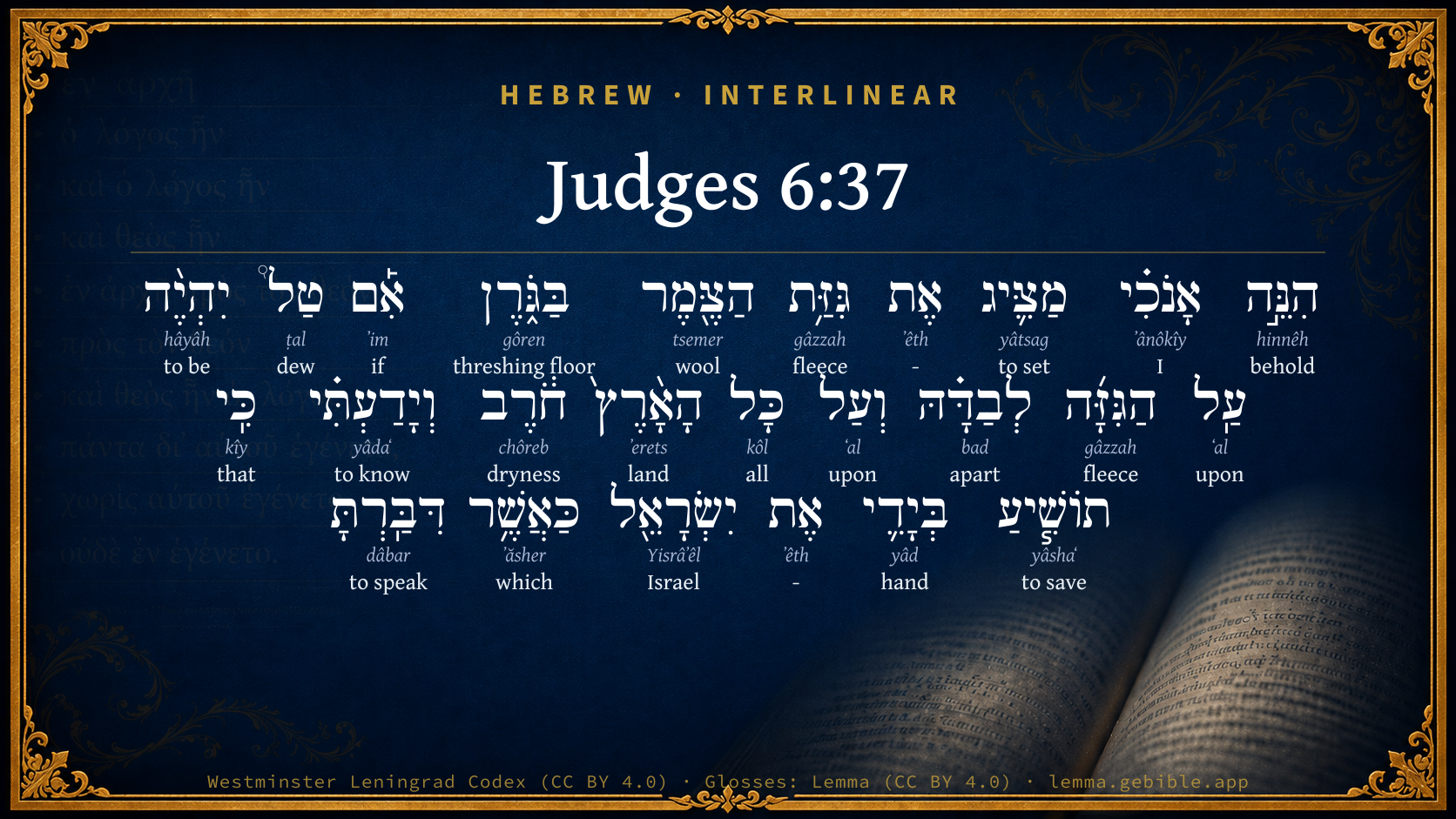
Judges 6:37

Hebrew (Westminster Leningrad Codex) Judges 6:37 appears in the Hebrew Old Testament. The text above is from the Westminster Leningrad Codex. Each word links to its Strong’s number, a concise gloss, and parsing drawn from the Open Scriptures Hebrew Bible morphology. Click any word for its full Brown-Driver-Briggs (BDB) entry.
Download image
Cite this verse

Judges 6:37 (World English Bible). Public Domain. Lemma interlinear Bible study tool, https://lemma.gebible.app/v/judges/6/37.

Show BibTeX & RIS
BibTeX
RIS
English Translation
behold, I will put a fleece of wool on the threshing floor; if there be dew on the fleece only, and it be dry on all the ground, then shall I know that you will save Israel by my hand, as you have spoken.
World English Bible · Public Domain
Highlights
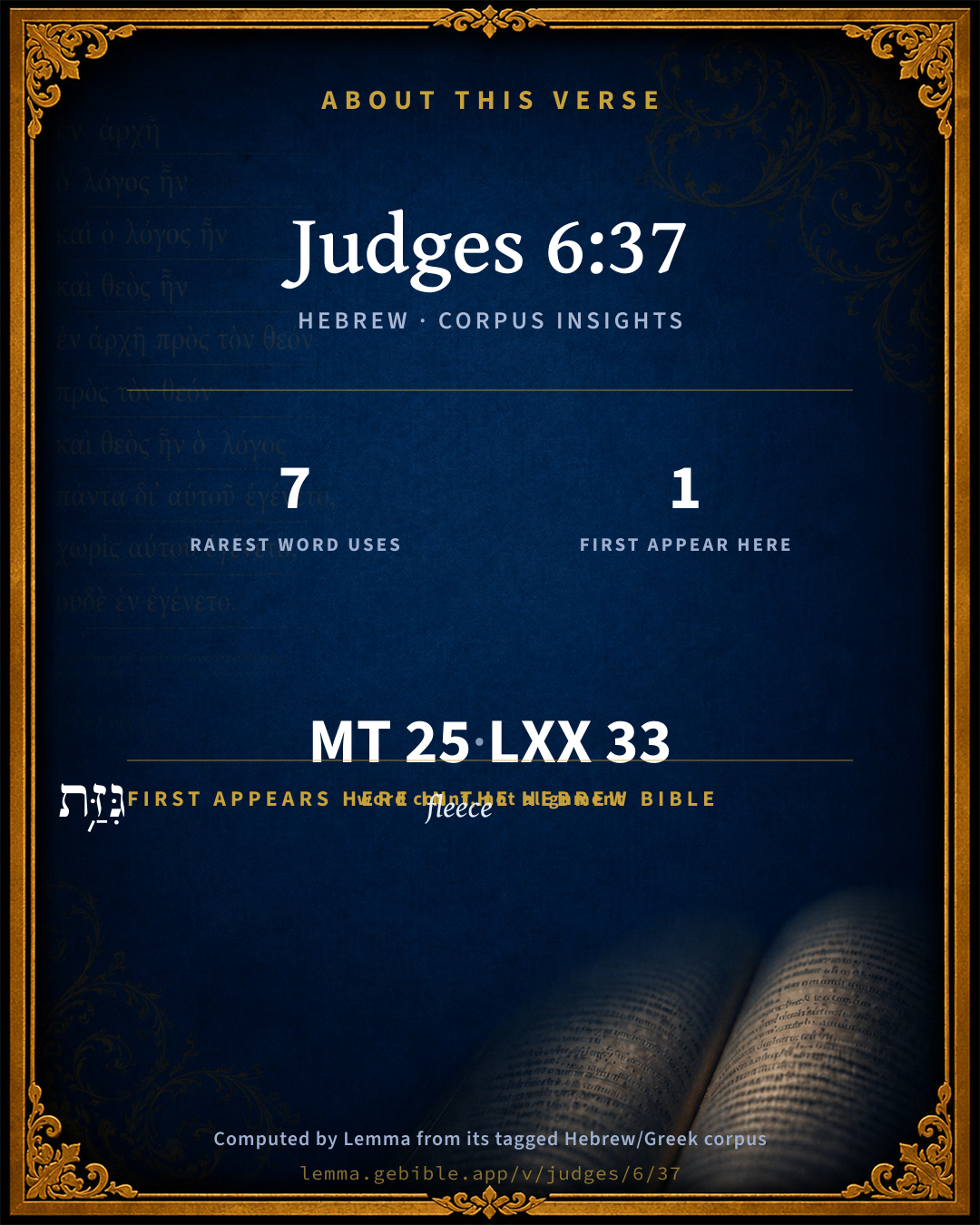
  • 1 first appearance in the Hebrew Bible
Full analysis ↓
Download a study sheet

One document with this verse’s original text, its word-by-word gloss line, the meaning frame, cross-references with their text, attributed commentary, and full source and license credits — printable, and it pastes into notes with its structure intact.

This verse Autodidact and up

Study sheet (.html) Plain text (.txt)

A passage Seminary Student

Up to 50 verses in one chapter. A passage sheet keeps up to 6 commentary sources and 12 cross-references per verse, in the order this page ranks them, and says so on the sheet whenever that leaves anything out. Ask for a single verse and you get the Autodidact verse sheet above.

Everything on this page stays free to read, with no account — the sheet is a download of what is already on screen, not access to it.

Want to remove ads? Support Godless Engineer
Compare translations 3

The same verse in 3 English versions, stacked beneath the original-language interlinear above. Click any original word for its lexicon entry.

Each is an independent rendering of the whole verse — the interlinear is not word-aligned to these translations.

Highlighted words mark where these versions differ — a whole-verse word diff, not a word-by-word alignment.

  • World English Bible Public Domain
    behold, I will put a fleece of wool on the threshing floor; if there be dew on the fleece only, and it be dry on all the ground, then shall I know that you will save Israel by my hand, as you have spoken.
  • King James Version Public Domain
    Behold, I will put a fleece of wool in the floor; and if the dew be on the fleece only, and it be dry upon all the earth beside, then shall I know that thou wilt save Israel by mine hand, as thou hast said.
  • unfoldingWord Literal Text CC BY-SA 4.0
    behold, I putting a fleece of wool on the threshing floor. If dew shall be upon the fleece alone, but on all of the ground dryness, then I will know that by my hand you will save Israel just as you have spoken.”

unfoldingWord Literal Text — © unfoldingWord, licensed CC BY-SA 4.0. Word-aligned USFM3 via Door43 (git.door43.org/unfoldingWord/en_ult).

Versions to compare (up to 4)

3 of 4 selected

Show all 18 translations

Every available English version of this verse, each an independent rendering of the whole verse.

  • World English Bible Public Domain
    behold, I will put a fleece of wool on the threshing floor; if there be dew on the fleece only, and it be dry on all the ground, then shall I know that you will save Israel by my hand, as you have spoken.
  • Berean Standard Bible Public Domain
    then behold, I will place a fleece of wool on the threshing floor. If there is dew only on the fleece and all the ground is dry, then I will know that You are going to save Israel by my hand, as You have said.”
  • Majority Standard Bible Public Domain
    then behold, I will place a fleece of wool on the threshing floor. If there is dew only on the fleece and all the ground is dry, then I will know that You are going to save Israel by my hand, as You have said.”
  • King James Version Public Domain
    Behold, I will put a fleece of wool in the floor; and if the dew be on the fleece only, and it be dry upon all the earth beside, then shall I know that thou wilt save Israel by mine hand, as thou hast said.
  • American Standard Version (1901) Public Domain
    behold, I will put a fleece of wool on the threshing-floor; if there be dew on the fleece only, and it be dry upon all the ground, then shall I know that thou wilt save Israel by my hand, as thou hast spoken.
  • Revised Version (1885) Public Domain
    behold, I will put a fleece of wool on the threshing-floor; if there be dew on the fleece only, and it be dry upon all the ground, then shall I know that thou wilt save Israel by mine hand, as thou hast spoken.
  • Geneva Bible (1599) Public Domain
    Beholde, I wil put a fleece of wooll in the threshing place: if the dewe come on the fleece onely, and it be drie vpon all the earth, then shall I be sure, that thou wilt saue Israel by mine hand, as thou hast said.
  • Douay-Rheims (1899) Public Domain
    And Gedeon said to God: If thou wilt save Israel by my hand, as thou hast said,
  • Young's Literal Translation Public Domain
    lo, I am placing the fleece of wool in the threshing-floor: if dew is on the fleece alone, and on all the earth drought -- then I have known that Thou dost save Israel by my hand, as Thou hast spoken;'
  • Literal Standard Version CC BY-SA 4.0
    behold, I am placing the fleece of wool in the threshing-floor: if dew is only on the fleece, and dryness on all the earth—then I have known that You save Israel by my hand, as You have spoken”;
  • Unlocked Literal Bible CC BY-SA 4.0
    Look, I am putting a woolen fleece on the threshing floor. If there is dew only on the fleece, and it is dry on all the ground, then I will know that you will use me to save Israel, as you said.”
  • unfoldingWord Literal Text CC BY-SA 4.0
    behold, I putting a fleece of wool on the threshing floor. If dew shall be upon the fleece alone, but on all of the ground dryness, then I will know that by my hand you will save Israel just as you have spoken.”
  • Darby Bible Public Domain
    behold, I am laying a fleece of wool on the threshing floor; if there is dew on the fleece alone, and it is dry on all the ground, then I shall know that thou wilt deliver Israel by my hand, as thou hast said."
  • World Messianic Bible Public Domain
    behold, I will put a fleece of wool on the threshing floor. If there is dew on the fleece only, and it is dry on all the ground, then I’ll know that you will save Israel by my hand, as you have spoken.”
  • Webster's Bible Public Domain
    Behold, I will put a fleece of wool on the floor; and if the dew shall be on the fleece only, and it shall be dry upon all the earth besides, then shall I know that thou wilt save Israel by my hand, as thou hast said.
  • Free Bible Version CC BY-SA 4.0
    then look—I will put a fleece of wool on the threshing floor. If the fleece is wet with dew but the ground is dry, then I will know that you are going to save Israel through me as you promised.”
  • Bible in Basic English Public Domain
    See, I will put the wool of a sheep on the grain-floor; if there is dew on the wool only, while all the earth is dry, then I will be certain that it is your purpose to give Israel salvation by my hand as you have said.
  • JPS Tanakh (1917) Public Domain
    behold, I will put a fleece of wool on the threshing-floor; if there be dew on the fleece only, and it be dry upon all the ground, then shall I know that Thou wilt save Israel by my hand, as Thou hast spoken.'

Literal Standard Version (2020), Covenant Press — licensed CC BY-SA 4.0. Text via the HelloAO Bible API (eBible.org). Unlocked Literal Bible (unfoldingWord) — licensed CC BY-SA 4.0. Text via the HelloAO Bible API (eBible.org). unfoldingWord Literal Text — © unfoldingWord, licensed CC BY-SA 4.0. Word-aligned USFM3 via Door43 (git.door43.org/unfoldingWord/en_ult). Free Bible Version, Dr. Jonathan Gallagher — licensed CC BY-SA 4.0. Text via the HelloAO Bible API (eBible.org).

Word by word

More ways to search: Search by grammar → Find every occurrence → Compare this word →

Practice this passage: Drill this verse → Learn its vocabulary →

גִּזַּ֥ת
gâzzah
H1492
“fleece of”
Noun, Common, Feminine, Singular, Construct
Part of Speech
Noun
Type
Common
Gender
Feminine
Number
Singular
State
Construct
Full BDB Definition

Origin: from H1494

TWOT: 336b

fleece
  1. הִנֵּ֣ה hinnêh H2009 “behold” Particle, Demonstrative
  2. אָנֹכִ֗י ʼânôkîy H595 “I” Pronoun, Personal, 1st Person, Common, Singular
  3. מַצִּ֛יג yâtsag H3322 “setting” Verb, Hiphil, Participle Active, Masculine, Singular, Absolute
  4. אֶת ʼêth H853 “-” Particle, Direct Object
  5. הַצֶּ֖מֶר tsemer H6785 “the · wool” Particle, Definite Article + Noun, Common, Masculine, Singular, Absolute
  6. בַּגֹּ֑רֶן gôren H1637 “in/at the · threshing floor” Preposition, Determined + Noun, Common, Both, Singular, Absolute
  7. אִ֡ם ʼim H518 “if” Conjunction
  8. טַל֩ ṭal H2919 “dew” Noun, Common, Masculine, Singular, Absolute
  9. יִהְיֶ֨ה hâyâh H1961 “to be” Verb, Qal, Imperfect, 3rd Person, Masculine, Singular
  10. עַֽל ʻal H5921 “upon” Preposition
  11. הַגִּזָּ֜ה gâzzah H1492 “the · fleece” Particle, Definite Article + Noun, Common, Feminine, Singular, Absolute
  12. לְבַדָּ֗הּ bad H905 “to/for · apart · her” Preposition + Noun, Common, Masculine, Singular, Construct + Suffix, Personal, 3rd Person, Feminine, Singular
  13. וְעַל ʻal H5921 “and · upon” Conjunction + Preposition
  14. כָּל kôl H3605 “all of” Noun, Common, Masculine, Singular, Construct
  15. הָאָ֨רֶץ֙ ʼerets H776 “the · land” Particle, Definite Article + Noun, Common, Both, Singular, Absolute
  16. חֹ֔רֶב chôreb H2721 “dryness” Noun, Common, Masculine, Singular, Absolute
  17. וְיָדַעְתִּ֗י yâdaʻ H3045 “and · to know” Conjunction + Verb, Qal, Sequential Perfect, 1st Person, Common, Singular
  18. כִּֽי kîy H3588 “that” Conjunction
  19. תוֹשִׁ֧יעַ yâshaʻ H3467 “to save” Verb, Hiphil, Imperfect, 2nd Person, Masculine, Singular
  20. בְּיָדִ֛י yâd H3027 “in/at · hand · my” Preposition + Noun, Common, Both, Singular, Construct + Suffix, Personal, 1st Person, Common, Singular
  21. אֶת ʼêth H853 “-” Particle, Direct Object
  22. יִשְׂרָאֵ֖ל Yisrâʼêl H3478 “Israel” Noun, Proper
  23. כַּאֲשֶׁ֥ר ʼăsher H834 “like/as · which” Preposition + Particle, Relative
  24. דִּבַּֽרְתָּ dâbar H1696 “to speak” Verb, Piel, Perfect, 2nd Person, Masculine, Singular

About this verse

These counts appear in no published source. They are computed here, from the morphology-tagged text and Lemma’s own curated glosses. What Lemma adds →

25
words
22
distinct lemmas
Historical
section

Notable vocabulary

The rarest word here is גִּזַּ֥ת fleece H1492 — appearing just 7 times in the whole Hebrew Bible.

First appearance in Scripture

This word makes its first canonical appearance in the Hebrew Bible here:

  • גִּזַּ֥ת fleece H1492

Shared distinctive vocabulary

גִּזַּ֥ת fleece H1492 occurs in 4 verses of the Hebrew Bible. Also found in:

Grammatical profile

  • 5 verbs
  • 11 nouns
  • 1 pronoun
  • 2 prepositions
  • 2 conjunctions
  • 4 particles

Verb forms

  • מַצִּ֛יג Hiphil · Participle Active
  • יִהְיֶ֨ה Qal · Imperfect
  • וְיָדַעְתִּ֗י Qal · Sequential Perfect
  • תוֹשִׁ֧יעַ Hiphil · Imperfect
  • דִּבַּֽרְתָּ Piel · Perfect

Repetition

Words recur within this verse — often emphatic in Hebrew:

  • גִּזַּ֥ת fleece H1492 ×2
  • עַֽל upon H5921 ×2

Hebrew & Septuagint length

In English translation the verse runs 44 words from the Hebrew and 40 from the Septuagint (LXX English) — closely comparable.

A rough comparison of the two English renderings, which tokenize alike — not a word-level alignment.

Word counts can differ between the Hebrew and the Greek without any difference in meaning — e.g. the Hebrew direct-object marker אֵת has no separate Greek word, and Greek often adds the article ὁ.

In the original languages it is 25 Hebrew tokens and 33 Greek tokens — but the two are counted differently (Hebrew bundles its prefixes and suffixes into one token; the Greek is in lemma form), so that isn’t a like-for-like length.

Cross-references

7

Topical passages linked to Judges 6:37 in the Treasury of Scripture Knowledge — connected by theme and wording, ordered by reader-vote popularity; previews shown in the World English Bible.

  • Hosea 14:5 I will be like the dew to Israel. He will blossom like the lily, And send down his roots like Lebanon.
  • Matthew 15:24 But he answered, "I wasn't sent to anyone but the lost sheep of the house of Israel."
  • Matthew 10:5–6 Jesus sent these twelve out, and charged them, saying, "Don't go among the Gentiles, and don't enter into any city of the Samaritans.
  • Psalms 72:6 He will come down like rain on the mown grass, As showers that water the earth.
  • Deuteronomy 32:2 My doctrine shall drop as the rain; My speech shall condense as the dew, As the small rain on the tender grass, As the showers on the herb.
  • Psalms 147:19–20 He shows his word to Jacob; His statutes and his ordinances to Israel.
  • Hosea 6:3–4 Let us acknowledge Yahweh. Let us press on to know Yahweh. As surely as the sun rises, Yahweh will appear. He will come to us like the rain, Like the spring rain that waters the earth."

Cross-references courtesy of OpenBible.info (CC BY 4.0).

Hebrew and Greek witnesses Masoretic Hebrew ↔ Greek Septuagint

The same verse in the two great witnesses to the Old Testament, shown verse-for-verse.

These are two independent witnesses, not word-aligned to each other, and the Septuagint is shown in lemma (dictionary) form.

Hebrew Judges 6:37 Masoretic · Westminster Leningrad Codex

הִנֵּ֣ה אָנֹכִ֗י מַצִּ֛יג אֶת גִּזַּ֥ת הַצֶּ֖מֶר בַּגֹּ֑רֶן אִ֡ם טַל֩ יִהְיֶ֨ה עַֽל הַגִּזָּ֜ה לְבַדָּ֗הּ וְעַל כָּל הָאָ֨רֶץ֙ חֹ֔רֶב וְיָדַעְתִּ֗י כִּֽי תוֹשִׁ֧יעַ בְּיָדִ֛י אֶת יִשְׂרָאֵ֖ל כַּאֲשֶׁ֥ר דִּבַּֽרְתָּ

behold, I will put a fleece of wool on the threshing floor; if there be dew on the fleece only, and it be dry on all the ground, then shall I know that you will save Israel by my hand, as you have spoken.

World English Bible · Public Domain

Greek LXX Judges 6:37 Septuagint · lemma form

ἰδού ἐγώ τίθημι ὁ πόκος ὁ ἔριον ἐν ὁ ἅλων ἐάν δρόσος γίγνομαι ἐπί ὁ πόκος μόνον καί ἐπί πᾶς ὁ γῆ ξηρασία γιγνώσκω ὅτι σώζω ἐν χείρ ἐγώ ὁ ἰσραήλ καθώς λαλέω

behold, I put the fleece of wool in the threshing floor: if there be dew on the fleece only, and drought on all the ground, I shall know that you will save Israel by my hand, as you have said.

LXX2012 (modern English Septuagint) · Public Domain

On this verse, Ellicott's Commentary for English Readers discusses the Septuagint’s reading. Read the note in Commentary ↓

Hebrew: Westminster Leningrad Codex (CC BY 4.0). Greek: Septuagint (public domain); English from LXX2012 (modern English Septuagint) (Public Domain). How the Septuagint differs from the Hebrew →

Targum (Aramaic paraphrase)

1

The Targum is the ancient Jewish Aramaic paraphrase of the Hebrew Scriptures — an interpretive translation, not the Hebrew text itself. Onkelos (literal) and Pseudo-Jonathan (expansive) render the Torah, and Jonathan the Prophets. Coverage is partial: where no permissively-licensed English translation exists for a verse, only the Aramaic is shown. This is verse-level text, not a word-by-word alignment to the Hebrew.

  1. Targum Jonathan Prophets (Joshua–Malachi)
    הָא אֲנָא מָחֵת יַת גִזְתָא דְעִמְרָא בְּבֵית אִדְרֵי אִם טַלָא יְהֵי עַל גִזְתָא בִּלְחוֹדָהּ וְעַל כָּל אַרְעָא יוּבְשָׁא וְאִדַע אֲרֵי תִפְרוֹק בִּידִי יַת יִשְׂרָאֵל כְּמָא דְמַלֵלְתָּא:

    (no public-domain English translation for this verse)

    Targum Jonathan — Aramaic: “Mikraot Gedolot” (public domain). English: “Sefaria Community Translation” (CC0 1.0 (public-domain dedication)); “London "Chaldee Paraphrase," 1871” (public domain). Text via Sefaria.

Commentary

Notes on Judges 6:37 from classic Christian and Jewish commentators (each source and its license shown beneath its notes). The classic Christian expositions comment on the surrounding passage and are grouped to its opening verse, so a note may address several verses; the Jewish commentaries on the Tanakh (Rashi and others) are per-verse, so they appear only where the commentator wrote on this verse.

Lemma curates 59 commentaries, every one of them public domain or Creative Commons licensed, each selected and text-cleaned for this edition rather than reprinted as found. About our sources →

MacLaren's Expositions of Holy Scripture

Alexander MacLaren

Judges

GIDEON’S FLEECE

Jdg 6:37.

The decisive moment had come when Gideon, with his hastily gathered raw levies, was about to plunge down to the plain to face immensely superior forces trained to warfare. No wonder that the equally untrained leader’s heart heat faster. Many a soldier, who will be steadfastly brave in the actual shock of battle, has tremors and throbbings on its eve. Gideon’s hand shook a little as he drew his sword.

I. Gideon’s request.

His petition for a sign was not the voice of unbelief or of doubt or of presumption, but in it spoke real, though struggling faith, seeking to be confirmed. Therefore it was not regarded by God as a sin. When a ‘wicked and adulterous generation asked for a sign,’ no sign was given it, but when faith asks for one to help it to grasp God’s hand, and to go on His warfare in His strength and as His instrument, it does not ask in vain.

Gideon’s prayer was wrapped, as it were, in an enfolding promise, for it is preceded and followed by the quotation of words of the Angel of the Lord who had ‘looked on him,’ and said, ‘Go in this thy might and save Israel from the hand of Midian: have not I sent thee?’ Prayers that begin and end with ‘as Thou hast spoken’ are not likely to be repulsed.

II. God’s answer.

God wonderfully allows Gideon to dictate the nature of the sign. He stoops to work it both ways, backwards and forwards, as it were. First the fleece is to be wet and the ground to be dry, then the fleece is to be dry and the ground wet. Miracle was a necessary accompaniment of revelation in those early days, as picture-books are of childhood. But, though we are far enough from being ‘men’ in Christ, yet we have not the same need for ‘childish things’ as Gideon and his contemporaries had. We have Christ and the Spirit, and so have a ‘word made more sure’ than to require signs. But still it is true that the same gracious willingness to help a tremulous faith, which carries its tremulousness to God in prayer, moves the Father’s heart to-day, and that to such petitions the answer is given even before they are offered: ‘Ask what ye will, and it shall be done unto you.’ No sign that eyes can see is given, but inward whispers speak assurance and communicate the assurance which they speak.

III. The meaning of the sign.

Many explanations have been offered. The main point is that the fleece is to be made different from the soil around it. It is to be a proof of God’s power to endow with characteristics not derived from, and resulting in qualities unlike, the surroundings.

Gideon had no thought of any significance beyond that. But we may allowably let the Scripture usage of the symbol of dew influence our reading into the symbol a deeper meaning than it bore to him.

God makes the fleece wet with dew, while all the threshing-floor is dry. Dew is the symbol of divine grace, of the silently formed moisture which, coming from no apparent source, freshens by night the wilted plants, and hangs in myriad drops, that twinkle into green and gold as the early sunshine strikes them, on the humblest twig. That grace is plainly not a natural product nor to be accounted for by environment. The dew of the Spirit, which God and God only, can give, can freshen our worn and drooping souls, can give joy in sorrow, can keep us from being touched by surrounding evils, and from being parched by surrounding drought, can silently ‘distil’ its supplies of strength according to our need into our else dry hearts.

The wet fleece on the dry ground was not only a revelation of God’s power, but may be taken as a pattern of what God’s soldiers must ever be. A prophet long after Gideon said: ‘The remnant of Jacob shall be in the midst of many peoples as dew from the Lord,’ bringing to others the grace which they have received that they may diffuse it, and turning the dry and thirsty land where no water is into fertility, and the ‘parched ground’ into a ‘pool.’

We have said that the main point of Gideon’s petition was that the fleece should be made unlike the threshing-floor, and that that unlikeness, which could obviously not be naturally brought about, was to be to him the sure token that God was at work to produce it. The strongest demonstration that the Church can give the world of its really being God’s Church is its unlikeness to the world. If it is wet with divine dew when all the threshing-floor is dry, and if, when all the floor is drenched with poisonous miasma, it is dry from the diffused and clinging malaria, the world will take knowledge of it, and some souls be set to ask how this unlikeness comes. When Haman has to say: ‘There is a certain people scattered abroad and dispersed among the peoples . . . and their laws are diverse from those of every people,’ he may meditate murder, but ‘many from among the people of the land’ will join their ranks. Gideon may or may not have thought of the fleece as a symbol of his little host, but we may learn from it the old lesson, ‘Be not conformed to this world, but be ye transformed by the renewing of your minds.’

Alexander MacLaren, Expositions of Holy Scripture (1904–1910) — public domain. Text from a community e-Sword module.

Ellicott's Commentary for English Readers

(37) A fleece of wool.—In works of art this is sometimes represented as an entire sheepskin, probably from an erroneous explanation of the Vulgate, Vellus lanae, and from Luther’s rendering, ein Fell mit der Wolle. But the English version is correct.

In the floor.—i.e., on the open threshing-floor. (See Note on Jdg_6:11, and comp. Psa_1:4; Hos_13:3.)

If the dew be on the fleece only.—The very fact that this circumstance might be a purely natural result only shows the simple truthfulness of the narrative. Gideon would hardly have asked for this sign if he had been aware that, taken alone, it would be no sign of supernatural guidance. Bishop Hervey quotes Lord Bacon, who says (Nat Hist.) that “Sailors have used every night to hang fleeces of wool on the sides of their ships towards the water, and they have crushed fresh water out of them in the morning.” Every one must have noticed flocks of wool on the hedges, sparkling with dewdrops long after the dew on the leaves around them has evaporated. In Psa_72:6 (Prayer Book), “He shall come down like the rain into a fleece of wool,” the Hebrew word is the same as here, and the ancient version takes it in the same sense (LXX., epi plokon; Vulg., in vellus); but perhaps the true sense is there “mown grass,” as in Amo_7:1 (mowings).

A Bible Commentary for English Readers, edited by Charles John Ellicott (1878–1897) — public domain. Text from a community e-Sword module.

The Cambridge Bible for Schools and Colleges

gen. ed. J. J. S. Perowne

37. a fleece of wool on the threshing-floor] We may think of Gideon sleeping out of doors on the airy threshing-floor near his home; it is a hot night in July, when the dews are heavy in Palestine; at any rate it is the harvest season, for the Midianites are in the land. Gideon has with him a fleece, perhaps his sheepskin cloak with the wool on it; he resolves to use it for the purposes of a ‘sign.’ No doubt he speaks with God in a dream.

The Cambridge Bible for Schools and Colleges (gen. ed. J. J. S. Perowne; Cambridge University Press, 1878–1918) — public domain. Text from a community e-Sword module.

John Gill's Exposition

And it was so,.... The Lord condescended to work this miracle for the confirmation of his faith, and for the encouragement of those that were with him; the fleece was wet with the dew of heaven, and all the ground about it dry:

for he rose up early in the morning; being eagerly desirous of knowing whether his request would be granted, and how it would be with the fleece:

and thrust the fleece together; to satisfy himself whether the dew had fallen on it, and there was any moisture in it, which by being squeezed together he would more easily perceive:

and wringed the dew out of the fleece, a bowl full of water; so that it appeared it had not only fallen on it, but it had taken in a large quantity of it; the word here used is the same as in Jdg 5:25; see Gill on Jdg 5:25; the Targum calls it a flagon.

John Gill's Exposition of the Whole Bible (1746–1763) — public domain (CC PDM 1.0). Text via the HelloAO Bible API.

Albert Barnes' Notes on the Bible

The threshing floors were and still are under the open air, and usually circular. The second sign Jdg 6:40, would be more convincing than the former, because it is the nature of fleeces to attract and retain moisture.

Albert Barnes' Notes on the Bible (1834–1885) — public domain. Text from a community e-Sword/MySword module.

Matthew Poole's English Annotations

Upon all the earth beside, i.e. upon all that spot of ground which adjoineth to and encompasseth the fleece.

Matthew Poole's English Annotations on the Holy Bible (1683–1685) — public domain. Text from a community e-Sword/MySword module.

Whedon's Commentary on the Bible

Daniel D. Whedon

37. A fleece of wool — A homely sign, indeed, but none the less natural and appropriate among a simple, nomadic people. Jehovah’s condescension in using a sign so simple, and yielding to this seemingly presumptuous request of Gideon, affords two lessons: 1. That he makes the weak things of the world confound the mighty, (1Co_1:27;) 2. That he never ignores the prayer of the humble.

The floor — The threshing floor, a small plot of ground in the open air, smoothed down and beaten hard. See on Rth_3:2.

Daniel D. Whedon (gen. ed.), Commentary on the Old and New Testaments (1874–1909) — public domain. Text from a community e-Sword module.

The Pulpit Commentary

Vers. 37-40. It is difficult to guess what led to this somewhat quaint sign which Gideon asked. Possibly the dews were usually heavy upon the hill of Gilead (Jud_1:7:3, note) where Gideon was encamped, as they seem to have been on Mount Gilboa (2Sa_1:21) and on Hermon, (Psa_133:3) and sheep-skins may have been a common protection against the cold nights, as in Afghanistan; and he may have noticed how often in the morning both the skin that covered him, and the ground around, was wet with the heavy dew. And this may have suggested the double test, by which his faith was, through God"s condescending mercy, confirmed and established.

The Pulpit Commentary (1880–1919), ed. H.D.M. Spence-Jones & Joseph S. Exell — public domain. Text from a community e-Sword module.

John Wesley's Explanatory Notes

On all the earth - That is, upon all that spot of ground which encompasses the fleece.

John Wesley, Explanatory Notes Upon the Whole Bible (1754–1765) — public domain. Text via the GEBible commentary corpus.

Lesson kit

Teaching starters — assembled from the data on this page, not authored interpretation. Every prompt links to the verse data it draws on. Edit before teaching.

Judges, in the Historical, opens this verse with 25 words (22 distinct Hebrew lemmas). Its most distinctive word is gâzzah (“fleece”). A historical commentator’s framing appears above. Read the whole chapter for the surrounding context.

Discussion questions

  1. The word gâzzah carries the sense “fleece.” How does it shape the verse?
  2. The word “fleece” first appears here in Scripture. What is being introduced at this debut?
  3. Judges 6:38 shares the word «fleece» with this verse. How do the two illuminate each other?
  4. “fleece” occurs 2× in this one verse. What is the effect of the repetition?
  5. These translations render this verse differently. What is at stake in choosing one wording over another?
  6. The verb «מַצִּ֛יג» is Hiphil Participle Active. How does its form color the action?
  7. Reading how MacLaren's Expositions of Holy Scripture and Ellicott's Commentary for English Readers read this verse, where do the two commentators agree and where do they part?

Things to notice

Reading settings

Reading text

Shown beneath each verse's original-language words.

Old Testament
Old Testament edition

Read the OT as the Masoretic Hebrew (MT) or the Greek Septuagint (LXX).

English shown for the Greek Septuagint (in the Hebrew ↔ Greek comparison).

Comparing translations? Open the Compare panel on any verse page to stack up to four side by side.