
Psalms 80:7

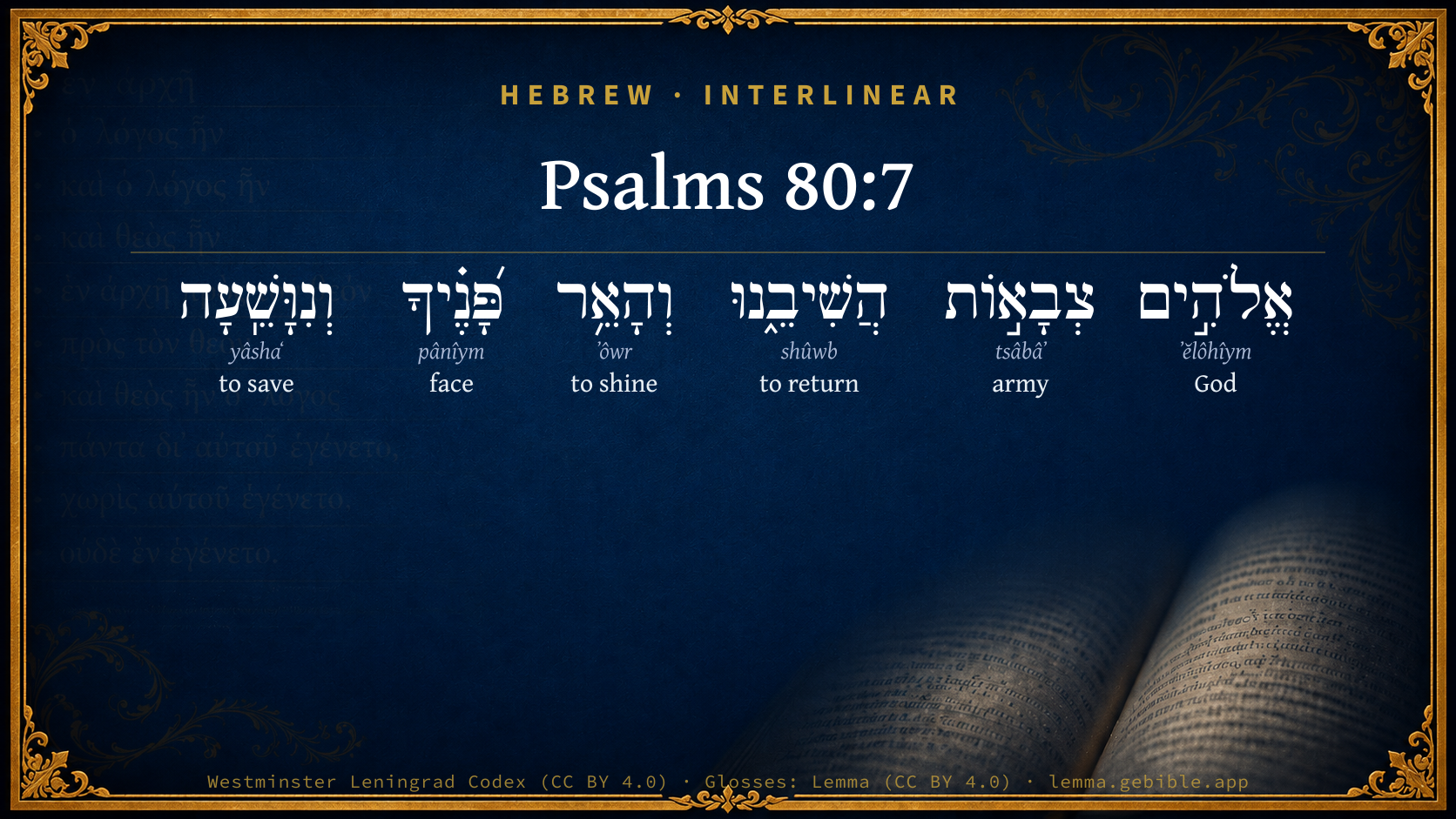
Hebrew (Westminster Leningrad Codex) Psalms 80:7 appears in the Hebrew Old Testament. The text above is from the Westminster Leningrad Codex. Each word links to its Strong’s number, a concise gloss, and parsing drawn from the Open Scriptures Hebrew Bible morphology. Click any word for its full Brown-Driver-Briggs (BDB) entry.
Download image
Cite this verse

Psalms 80:7 (World English Bible). Public Domain. Lemma interlinear Bible study tool, https://lemma.gebible.app/v/psalms/80/7.

Show BibTeX & RIS
BibTeX
RIS
English Translation
Turn us again, God of hosts. Cause your face to shine, And we will be saved.
World English Bible · Public Domain
Download a study sheet

One document with this verse’s original text, its word-by-word gloss line, the meaning frame, cross-references with their text, attributed commentary, and full source and license credits — printable, and it pastes into notes with its structure intact.

This verse Autodidact and up

Study sheet (.html) Plain text (.txt)

A passage Seminary Student

Up to 50 verses in one chapter. A passage sheet keeps up to 6 commentary sources and 12 cross-references per verse, in the order this page ranks them, and says so on the sheet whenever that leaves anything out. Ask for a single verse and you get the Autodidact verse sheet above.

Everything on this page stays free to read, with no account — the sheet is a download of what is already on screen, not access to it.

Want to remove ads? Support Godless Engineer
Compare translations 3

The same verse in 3 English versions, stacked beneath the original-language interlinear above. Click any original word for its lexicon entry.

Each is an independent rendering of the whole verse — the interlinear is not word-aligned to these translations.

Highlighted words mark where these versions differ — a whole-verse word diff, not a word-by-word alignment.

  • World English Bible Public Domain
    Turn us again, God of hosts. Cause your face to shine, And we will be saved.
  • King James Version Public Domain
    Turn us again, O God of hosts, and cause thy face to shine; and we shall be saved.
  • unfoldingWord Literal Text CC BY-SA 4.0
    God of armies, restore us, and make your face shine and let us be saved.

unfoldingWord Literal Text — © unfoldingWord, licensed CC BY-SA 4.0. Word-aligned USFM3 via Door43 (git.door43.org/unfoldingWord/en_ult).

Versions to compare (up to 4)

3 of 4 selected

Show all 18 translations

Every available English version of this verse, each an independent rendering of the whole verse.

  • World English Bible Public Domain
    Turn us again, God of hosts. Cause your face to shine, And we will be saved.
  • Berean Standard Bible Public Domain
    Restore us, O God of Hosts, and cause Your face to shine upon us, that we may be saved.
  • Majority Standard Bible Public Domain
    Restore us, O God of Hosts, and cause Your face to shine upon us, that we may be saved.
  • King James Version Public Domain
    Turn us again, O God of hosts, and cause thy face to shine; and we shall be saved.
  • American Standard Version (1901) Public Domain
    Turn us again, O God of hosts; And cause thy face to shine, and we shall be saved.
  • Revised Version (1885) Public Domain
    Turn us again, O God of hosts; and cause thy face to shine, and we shall be saved.
  • Geneva Bible (1599) Public Domain
    Turne vs againe, O God of hostes: cause thy face to shine, and we shalbe saued.
  • Douay-Rheims (1899) Public Domain
    Thou hast made us to be a contradiction to our neighbours: and our enemies have scoffed at us.
  • Young's Literal Translation Public Domain
    God of Hosts, turn us back, And cause Thy face to shine, and we are saved.
  • Literal Standard Version CC BY-SA 4.0
    God of Hosts, turn us back, || And cause Your face to shine, and we are saved.
  • Unlocked Literal Bible CC BY-SA 4.0
    God of hosts, restore us; make your face shine on us, and we will be saved.
  • unfoldingWord Literal Text CC BY-SA 4.0
    God of armies, restore us, and make your face shine and let us be saved.
  • Darby Bible Public Domain
    Restore us, O God of hosts; and cause thy face to shine, and we shall be saved.
  • World Messianic Bible Public Domain
    Turn us again, God of Hosts. Cause your face to shine, and we will be saved.
  • Webster's Bible Public Domain
    \\80:6\\Thou makest us a strife to our neighbors: and our enemies laugh among themselves.
  • Free Bible Version CC BY-SA 4.0
    God Almighty, please restore us! Let your face shine on us so we can be saved!
  • Bible in Basic English Public Domain
    Take us back again, O God of armies; let us see the shining of your face, and let us be safe.
  • JPS Tanakh (1917) Public Domain
    (80-8) O God of hosts, restore us; and cause Thy face to shine, and we shall be saved.

Literal Standard Version (2020), Covenant Press — licensed CC BY-SA 4.0. Text via the HelloAO Bible API (eBible.org). Unlocked Literal Bible (unfoldingWord) — licensed CC BY-SA 4.0. Text via the HelloAO Bible API (eBible.org). unfoldingWord Literal Text — © unfoldingWord, licensed CC BY-SA 4.0. Word-aligned USFM3 via Door43 (git.door43.org/unfoldingWord/en_ult). Free Bible Version, Dr. Jonathan Gallagher — licensed CC BY-SA 4.0. Text via the HelloAO Bible API (eBible.org).

Word by word

More ways to search: Search by grammar → Find every occurrence → Compare this word →

Practice this passage: Drill this verse → Learn its vocabulary →

וְהָאֵ֥ר
ʼôwr
H215
“and · shine”
Conjunction + Verb, Hiphil, Imperative, 2nd Person, Masculine, Singular
Part of Speech
Conjunction + Verb
Stem
Hiphil
Form
Imperative
Person
2nd Person
Gender
Masculine
Number
Singular
Full BDB Definition

Origin: a primitive root

TWOT: 52

to be or become light, shine - (Qal) - to become light (day) - to shine (of the sun) - to become bright - (Niphal) - to be illuminated - to become lighted up - (Hiphil) - to give light, shine (of sun, moon, and stars) - to illumine, light up, cause to shine, shine - to kindle, light (candle, wood) - lighten (of the eyes, his law, etc) - to make shine (of the face)
  1. אֱלֹהִ֣ים ʼĕlôhîym H430 “God(s)” Noun, Common, Masculine, Plural, Absolute
  2. צְבָא֣וֹת tsâbâʼ H6635 “armies” Noun, Common, Both, Plural, Absolute
  3. הֲשִׁיבֵ֑נוּ shûwb H7725 “return · us” Verb, Hiphil, Imperative, 2nd Person, Masculine, Singular + Suffix, Personal, 1st Person, Common, Plural
  4. פָּ֝נֶ֗יךָ pânîym H6440 “face(s) · your” Noun, Common, Both, Plural, Construct + Suffix, Personal, 2nd Person, Masculine, Singular
  5. וְנִוָּשֵֽׁעָה yâshaʻ H3467 “and · to save” Conjunction + Verb, Niphal, Cohortative, 1st Person, Common, Plural

About this verse

These counts appear in no published source. They are computed here, from the morphology-tagged text and Lemma’s own curated glosses. What Lemma adds →

6
words
6
distinct lemmas
Wisdom
section

Shared distinctive vocabulary

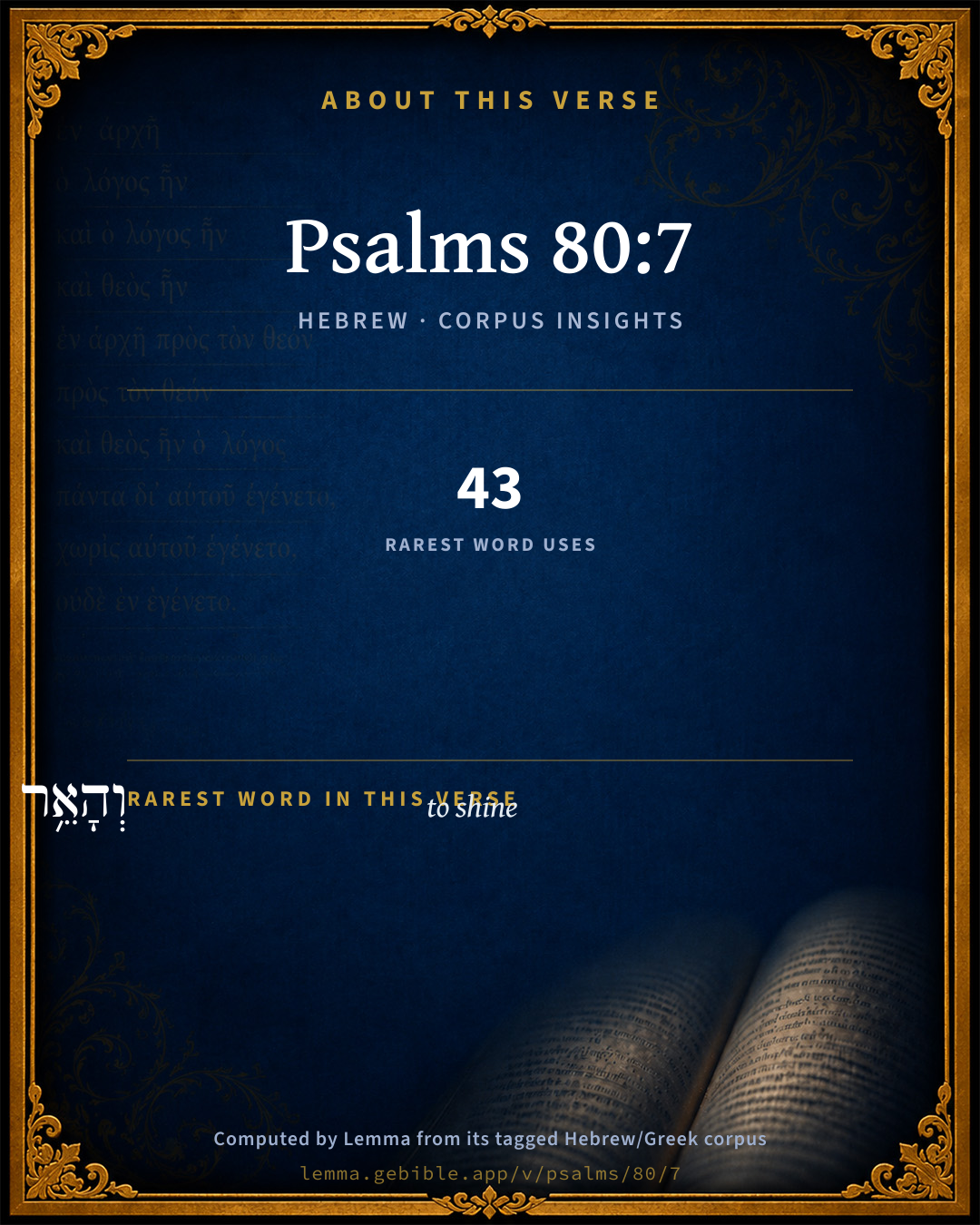
וְהָאֵ֥ר to shine H215 occurs in 43 verses of the Hebrew Bible. Also found in:

Grammatical profile

  • 3 verbs
  • 3 nouns

Verb forms

  • הֲשִׁיבֵ֑נוּ Hiphil · Imperative
  • וְהָאֵ֥ר Hiphil · Imperative
  • וְנִוָּשֵֽׁעָה Niphal · Cohortative

Hebrew & Septuagint length

In English translation the verse runs 16 words from the Hebrew and 19 from the Septuagint (LXX English) — closely comparable.

A rough comparison of the two English renderings, which tokenize alike — not a word-level alignment.

Word counts can differ between the Hebrew and the Greek without any difference in meaning — e.g. the Hebrew direct-object marker אֵת has no separate Greek word, and Greek often adds the article ὁ.

Cross-references

9

Topical passages linked to Psalms 80:7 in the Treasury of Scripture Knowledge — connected by theme and wording, ordered by reader-vote popularity; previews shown in the World English Bible.

  • Psalms 51:10 Create in me a clean heart, O God. Renew a right spirit within me.
  • Psalms 80:19 Turn us again, Yahweh God of hosts. Cause your face to shine, and we will be saved.
  • Isaiah 64:5 You meet him who rejoices and works righteousness, those who remember you in your ways: behold, you were angry, and we sinned: in them [have we been] of long time; and shall we be saved?
  • Jeremiah 4:14 Jerusalem, wash your heart from wickedness, that you may be saved. How long shall your evil thoughts lodge within you?
  • Psalms 80:3 Turn us again, God. Cause your face to shine, And we will be saved.
  • Isaiah 30:15 For thus said the Lord Yahweh, the Holy One of Israel, In returning and rest shall you be saved; in quietness and in confidence shall be your strength. You would not:
  • Mark 4:12 that 'seeing they may see, and not perceive; and hearing they may hear, and not understand; lest perhaps they should turn again, and their sins should be forgiven them.'"
  • 2 Timothy 2:25–26 in gentleness correcting those who oppose him: perhaps God may give them repentance leading to a full knowledge of the truth,
  • Luke 1:16 He will turn many of the children of Israel to the Lord, their God.

Cross-references courtesy of OpenBible.info (CC BY 4.0).

Hebrew and Greek witnesses Masoretic Hebrew ↔ Greek Septuagint

The same verse in the two great witnesses to the Old Testament, shown verse-for-verse.

You’re reading Greek Psalm 79 (Hebrew Psalm 80). The Septuagint counts the superscription, so verse numbers can differ from the Hebrew — chapter-level alignment, not verse-by-verse. Numbering follows Rahlfs.

These are two independent witnesses, not word-aligned to each other, and the Septuagint is shown in lemma (dictionary) form.

Hebrew Psalms 80:7 Masoretic · Westminster Leningrad Codex

אֱלֹהִ֣ים צְבָא֣וֹת הֲשִׁיבֵ֑נוּ וְהָאֵ֥ר פָּ֝נֶ֗יךָ וְנִוָּשֵֽׁעָה

Turn us again, God of hosts. Cause your face to shine, And we will be saved.

World English Bible · Public Domain

Greek LXX Greek Psalm 79:7 Septuagint · lemma form

τίθημι ἐγώ εἰς ἀντιλογία ὁ γείτων ἐγώ καί ὁ ἐχθρός ἐγώ μυκτηρίζω ἐγώ

Turn us, O Lord God of hosts, and cause your face to shine; and we shall be saved. Pause.

LXX2012 (modern English Septuagint) · Public Domain

Hebrew: Westminster Leningrad Codex (CC BY 4.0). Greek: Septuagint (public domain); English from LXX2012 (modern English Septuagint) (Public Domain). How the Septuagint differs from the Hebrew →

Commentary

Notes on Psalms 80:7 from classic Christian and Jewish commentators (each source and its license shown beneath its notes). The classic Christian expositions comment on the surrounding passage and are grouped to its opening verse, so a note may address several verses; the Jewish commentaries on the Tanakh (Rashi and others) are per-verse, so they appear only where the commentator wrote on this verse.

Lemma curates 59 commentaries, every one of them public domain or Creative Commons licensed, each selected and text-cleaned for this edition rather than reprinted as found. About our sources →

Trapp's Complete Commentary

John Trapp

Psa 80:7 Turn us again, O God of hosts, and cause thy face to shine; and we shall be saved.

Ver. 7. Turn us again, O God of hosts] See Psa 80:3, and observe that there it was only, "Turn us again, O God," here, "O God of hosts," and Psa 80:19, "O Lord God of hosts." As the bird by much waving gathereth wind under the wing, and mounteth higher; so doth faith in prayer, viresque acquirit eundo.

John Trapp, A Commentary or Exposition upon All the Books of the Old and New Testament (1647–1656) — public domain. Text from a community e-Sword module.

Whedon's Commentary on the Bible

Daniel D. Whedon

7. Turn us again, O God of hosts—Three times is this plaintive prayer repeated, and once, “Return, we beseech thee, O God!” occurring as refrains at head of strophes. (Psa_80:3; Psa_80:7-14; Psa_80:19.) In chanting, the effect must have been indescribably solemn.

Daniel D. Whedon (gen. ed.), Commentary on the Old and New Testaments (1874–1909) — public domain. Text from a community e-Sword module.

J. A. Alexander on Psalms

Joseph Addison Alexander

8. (Psa 80:7) O God, (God of) Hosts, restore us, and let thy face shine, and let us be saved! See above, on Psa 80:3. The only variation in the case before us is the addition of a second divine title, implying God's supremacy above the hosts of heaven, both material and spiritual, and thus indirectly urging a new argument for being heard and answered. See above, on Psa 80:4.

Joseph Addison Alexander, The Psalms Translated and Explained (1850) — public domain. Text from a community e-Sword module.

Geneva Bible (1599)

Geneva Bible translators

Because that repentance only cometh of God, they most instantly and ofttimes call to God for it as a means whereby they shall be saved.

Geneva Bible (1599) marginal notes — public domain. Text via Bolls.life.

John Gill's Exposition

Turn us again, O God of hosts,.... The same with Psa 80:3, only instead of God there, here it is "the God of hosts"; the repetition of these words shows what was uppermost on the minds of God's people; what they were longing for, and most desirous of, namely, the light of God's countenance.

, only instead of God there, here it is "the God of hosts"; the repetition of these words shows what was uppermost on the minds of God's people; what they were longing for, and most desirous of, namely, the light of God's countenance.

Psalms 80:8

psa 80:8

psa 80:8

psa 80:8Thou hast brought a vine out of Egypt,.... The house of Israel, who are like unto a vine, as the Targum paraphrases it; and to a vine or vineyard are they often compared; see Isa 5:1, Jer 2:21. These were in Egypt awhile, where they were grievously oppressed and trampled upon; and yet the more they were afflicted, the more they grew and multiplied; and from hence the Lord brought them in due time, with a mighty hand and outstretched arm;

he caused them to go out; the word (o) used fitly expresses their journeyings from thence, and through the wilderness; they were a type of the church of Christ, and special people of God, who also are frequently compared to vines and vineyards; see Sol 2:13 the vine tree is fruitful, and bears fruit in clusters but its wood is very useless and unprofitable, Eze 15:2 and it is a tree very weak, and cannot rise and support itself, it must be propped up; so believers in Christ, though fruitful through the grace of God, yet are unprofitable to him, and very weak in themselves, and are upheld by the right hand of his righteousness, on whom they lean and stay themselves; and these, in their natural state, are in worse than Egyptian bondage, darkness, and idolatry, out of which they are brought, in the effectual calling, into Gospel liberty, marvellous light, and the true worship and service of God; and out of the antichristian Egypt will all the Lord's people be brought one day; see Rev 11:8.

thou hast cast out the Heathen; the Targum adds, out of the land of Israel, that is, Canaan; it designs the expulsion of the seven nations from thence, to make way for the Israelites, Deu 7:1 and was an emblem of the ejection of Satan out of the Gentile world, and out of the souls of men, through the ministry of the word; and of sin, and the lusts of it, when the King of glory enters in, so as that they shall not any more have dominion; though as the Canaanites were left in the land to be pricks and thorns in the eyes and sides of the Israelites, so indwelling sin remains in God's people to the distress of their souls, and the trial of their graces. The Papists are sometimes called the Heathens and Gentiles; and there will be a time when they shall be cast out, and be no more in the land, Psa 10:16,

and planted it; the vine, the Israelites, in the land of Canaan; see Exo 15:17. So saints are planted not only in Christ, the true vine, of which they are branches; but in a Gospel church state, where they flourish and become fruitful and pleasant plants, plants of renown; and being of the Lord's planting, he is glorified by them, and they shall never be rooted up, nor wither, but prosper and thrive; see Psa 1:3.

(o) "fecisti proficisci", Paginus, Montanus, Vatablus.

John Gill's Exposition of the Whole Bible (1746–1763) — public domain (CC PDM 1.0). Text via the HelloAO Bible API.

Albert Barnes' Notes on the Bible

Turn us again, O God of hosts ... - This verse is the same as Psa 80:3, except that here the appeal is to the “God of hosts;” there, it is simply to “God.” This indicates greater earnestness; a deeper sense of the need of the interposition of God, indicated by the reference to his attribute as the leader of hosts or armies, and therefore able to save them.

Albert Barnes' Notes on the Bible (1834–1885) — public domain. Text from a community e-Sword/MySword module.

The Treasury of David

Charles H. Spurgeon

Ver. 7. "Turn us again, O God of hosts." The prayer rises in the form of its address to God. He is here the God of Hosts. The more we approach the Lord in prayer and contemplation the higher will our ideas of him become.

Ver. 7. "Turn us again, O God of hosts." See Ps 80:3 and observe that there it was only, "Turn us again, O God, "here "O God of hosts, "and Ps 80:19, "O Lord God of hosts." As the bird by much waving gathers wind under the wing, and mounts higher, so does faith in prayer: viresque acquirit eundo. John Trapp.

Ver. 7. Salvation may be certainly expected in God's order; and if we labour to be sure of our turning to God, and living in the sense of communion with him, we need not make question of salvation, for that shall follow infallibly on the former two. "Turn us again, O God of hosts, and cause thy face to shine; and we shall be saved." The last is not put up by way of prayer here, but promised to themselves, and put out of question, that it shall follow; "Turn us, so shall we be saved, "say they. David Dickson.

Ver. 7. Conversion, communion, confidence of salvation.

Psalms 80:8*

Charles H. Spurgeon's The Treasury of David (1869–1885) — public domain. Psalms only. Text from a community e-Sword/MySword module.

The Pulpit Commentary

Turn us again, O Goal of hosts, and cause thy face to shine; and we shall be saved. Here the refrain occurs for the second time, but with the slight variation or "O God of hosts" instead of "O God" simply (see the comment on ver. 19).

The Pulpit Commentary (1880–1919), ed. H.D.M. Spence-Jones & Joseph S. Exell — public domain. Text from a community e-Sword module.

unfoldingWord translationNotes

Door43 World Missions Community

General Information:

Asaph is speaking on behalf of the people of Israel. He begins in verse 8 to speak of the way God settled Israel in their land as if God were a man who cleared ground and planted a grapevine. The image of the grapevine continues through verse 16.

make your face shine on us

The writer speaks of Yahweh acting favorably towards them as if Yahweh's face shone a light on them. See how you translated this in Psalms 80:3. AT: "act favorably towards us" (See: Metaphor)

we will be saved

This can be stated in active form. AT: "you will save us" (See: Active or Passive)

You brought a vine out of Egypt

Asaph compares the nation of Israel to a vine made ready to transplant. AT: "You brought us, like a vine, out of Egypt" (See: Metaphor and Simile)

you drove out nations and transplanted it

The psalmist speaks of his people as if they were a plant that Yahweh was transplanting. AT: "you drove out nations from their land and gave it to us, the vine, and planted us there" (See: Metaphor)

you drove out nations

"you forced nations to leave"

translationWords

restore

face

vine

Egypt

nation

unfoldingWord translationNotes — © Distant Shores Media and the Door43 World Missions Community, licensed CC BY-SA 4.0. Source: git.door43.org/Door43/en_tn.

Rashi

Rabbi Shlomo Yitzchaki (Rashi)

You have made us the target of strife You have made us the target of strife to all our neighbors, for the Greeks have quarreled with us.

Rashi on the Tanakh — English translations: “The Judaica Press complete Tanach with Rashi, translated by A. J. Rosenberg” (CC BY 4.0); “Pentateuch with Rashi's commentary by M. Rosenbaum and A.M. Silbermann, 1929-1934” (public domain); “The Metsudah Tanach series, Lakewood, N.J” (CC BY 4.0); and “The Book of Joshua, Metsudah Publications, 1997” (CC BY 4.0). Text via Sefaria.

Lesson kit

Teaching starters — assembled from the data on this page, not authored interpretation. Every prompt links to the verse data it draws on. Edit before teaching.

Psalms, in the Wisdom, opens this verse with 6 words (6 distinct Hebrew lemmas). Its most distinctive word is ʼôwr (“to shine”). A historical commentator’s framing appears above. Read the whole chapter for the surrounding context.

Discussion questions

  1. The word ʼôwr carries the sense “to shine.” How does it shape the verse?
  2. How does Genesis 1:15, which shares the word «to shine», read alongside this verse?
  3. These translations render this verse differently; the difference is in the English rendering, not the original. What questions does that raise?
  4. «הֲשִׁיבֵ֑נוּ» is a Hiphil Imperative verb. How does that grammatical form shape the action described?
  5. Compare how Trapp's Complete Commentary and Whedon's Commentary on the Bible read this verse. Where do they agree or differ?

Things to notice

Reading settings

Reading text

Shown beneath each verse's original-language words.

Old Testament
Old Testament edition

Read the OT as the Masoretic Hebrew (MT) or the Greek Septuagint (LXX).

English shown for the Greek Septuagint (in the Hebrew ↔ Greek comparison).

Comparing translations? Open the Compare panel on any verse page to stack up to four side by side.