
Isaiah 45:20

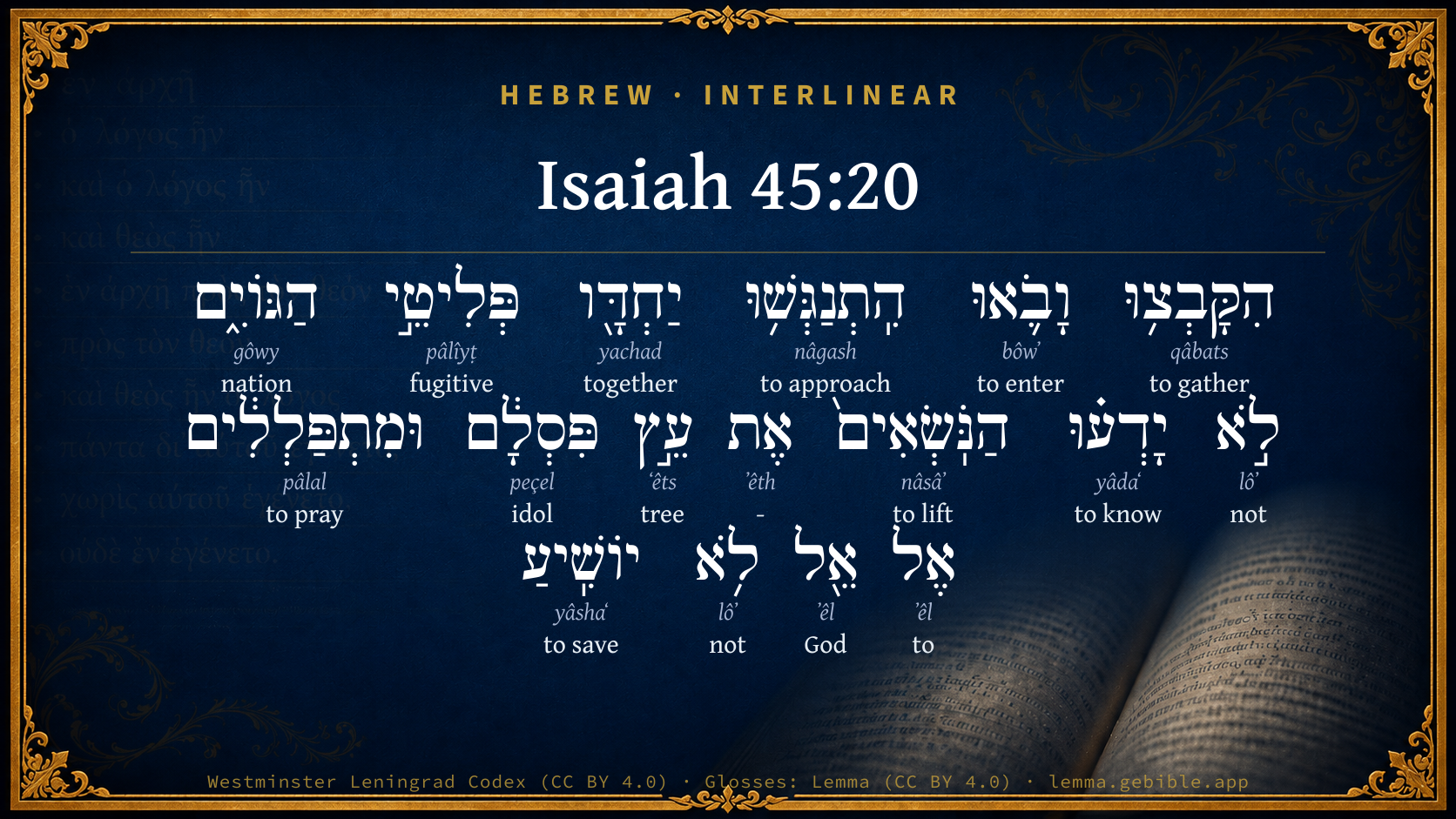
Hebrew (Westminster Leningrad Codex) Isaiah 45:20 appears in the Hebrew Old Testament. The text above is from the Westminster Leningrad Codex. Each word links to its Strong’s number, a concise gloss, and parsing drawn from the Open Scriptures Hebrew Bible morphology. Click any word for its full Brown-Driver-Briggs (BDB) entry.
Download image
Cite this verse

Isaiah 45:20 (World English Bible). Public Domain. Lemma interlinear Bible study tool, https://lemma.gebible.app/v/isaiah/45/20.

Show BibTeX & RIS
BibTeX
RIS
English Translation
Assemble yourselves and come; draw near together, you who have escaped from the nations: they have no knowledge who carry the wood of their engraved image, and pray to a god that can't save.
World English Bible · Public Domain
Download a study sheet

One document with this verse’s original text, its word-by-word gloss line, the meaning frame, cross-references with their text, attributed commentary, and full source and license credits — printable, and it pastes into notes with its structure intact.

This verse Autodidact and up

Study sheet (.html) Plain text (.txt)

A passage Seminary Student

Up to 50 verses in one chapter. A passage sheet keeps up to 6 commentary sources and 12 cross-references per verse, in the order this page ranks them, and says so on the sheet whenever that leaves anything out. Ask for a single verse and you get the Autodidact verse sheet above.

Everything on this page stays free to read, with no account — the sheet is a download of what is already on screen, not access to it.

Want to remove ads? Support Godless Engineer
Compare translations 3

The same verse in 3 English versions, stacked beneath the original-language interlinear above. Click any original word for its lexicon entry.

Each is an independent rendering of the whole verse — the interlinear is not word-aligned to these translations.

Highlighted words mark where these versions differ — a whole-verse word diff, not a word-by-word alignment.

  • World English Bible Public Domain
    Assemble yourselves and come; draw near together, you who have escaped from the nations: they have no knowledge who carry the wood of their engraved image, and pray to a god that can't save.
  • King James Version Public Domain
    Assemble yourselves and come; draw near together, ye that are escaped of the nations: they have no knowledge that set up the wood of their graven image, and pray unto a god that cannot save.
  • unfoldingWord Literal Text CC BY-SA 4.0
    Gather yourselves and come, draw yourselves near together, fugitives of the nations! They do not know, the ones carrying the wood of their idol and praying to a god not saving.

unfoldingWord Literal Text — © unfoldingWord, licensed CC BY-SA 4.0. Word-aligned USFM3 via Door43 (git.door43.org/unfoldingWord/en_ult).

Versions to compare (up to 4)

3 of 4 selected

Show all 18 translations

Every available English version of this verse, each an independent rendering of the whole verse.

  • World English Bible Public Domain
    Assemble yourselves and come; draw near together, you who have escaped from the nations: they have no knowledge who carry the wood of their engraved image, and pray to a god that can't save.
  • Berean Standard Bible Public Domain
    Come, gather together, and draw near, you fugitives from the nations. Ignorant are those who carry idols of wood and pray to a god that cannot save.
  • Majority Standard Bible Public Domain
    Come, gather together, and draw near, you fugitives from the nations. Ignorant are those who carry idols of wood and pray to a god that cannot save.
  • King James Version Public Domain
    Assemble yourselves and come; draw near together, ye that are escaped of the nations: they have no knowledge that set up the wood of their graven image, and pray unto a god that cannot save.
  • American Standard Version (1901) Public Domain
    Assemble yourselves and come; draw near together, ye that are escaped of the nations: they have no knowledge that carry the wood of their graven image, and pray unto a god that cannot save.
  • Revised Version (1885) Public Domain
    Assemble yourselves and come; draw near together, ye that are escaped of the nations: they have no knowledge that carry the wood of their graven image, and pray unto a god that cannot save.
  • Geneva Bible (1599) Public Domain
    Assemble your selues, and come: drawe neere together, ye abiect of the Gentiles: they haue no knowledge, that set vp the wood of their idole, and pray vnto a god, that cannot saue them.
  • Douay-Rheims (1899) Public Domain
    Assemble yourselves, and come, and draw near together, ye that are saved of the Gentiles: they have no knowledge that set up the wood of their graven work, and pray to a god that cannot save.
  • Young's Literal Translation Public Domain
    Be gathered, and come in, Come nigh together, ye escaped of the nations, They have not known, Who are lifting up the wood of their graven image, And praying unto a god `that' saveth not.
  • Literal Standard Version CC BY-SA 4.0
    Be gathered, and come in, || Come near together, you escaped of the nations, || They have not known, || Who are lifting up the wood of their carved image, || And praying to a god [that] does not save.
  • Unlocked Literal Bible CC BY-SA 4.0
    Assemble yourselves and come! Gather together, you refugees from among the nations! They have no knowledge, those who carry carved images and pray to gods that cannot save.
  • unfoldingWord Literal Text CC BY-SA 4.0
    Gather yourselves and come, draw yourselves near together, fugitives of the nations! They do not know, the ones carrying the wood of their idol and praying to a god not saving.
  • Darby Bible Public Domain
    Gather yourselves and come; draw near together, ye that are escaped of the nations. They have no knowledge that carry the wood of their graven image, and pray unto a ùgod that cannot save.
  • World Messianic Bible Public Domain
    “Assemble yourselves and come. Draw near together, you who have escaped from the nations. Those have no knowledge who carry the wood of their engraved image, and pray to a god that can’t save.
  • Webster's Bible Public Domain
    Assemble yourselves and come; draw near together, ye that have escaped of the nations: they have no knowledge that set up the wood of their graven image, and pray to a god that cannot save.
  • Free Bible Version CC BY-SA 4.0
    Gather yourselves together, and come, come close, you refugees of the nations. Aren't they stupid, these people who carry around their wooden idols, and who pray to a god that can't save them?
  • Bible in Basic English Public Domain
    Come together, even come near, you nations who are still living: they have no knowledge who take up their image of wood, and make prayer to a god in whom is no salvation.
  • JPS Tanakh (1917) Public Domain
    Assemble yourselves and come, draw near together, ye that are escaped of the nations; they have no knowledge that carry the wood of their graven image, and pray unto a god that cannot save.

Literal Standard Version (2020), Covenant Press — licensed CC BY-SA 4.0. Text via the HelloAO Bible API (eBible.org). Unlocked Literal Bible (unfoldingWord) — licensed CC BY-SA 4.0. Text via the HelloAO Bible API (eBible.org). unfoldingWord Literal Text — © unfoldingWord, licensed CC BY-SA 4.0. Word-aligned USFM3 via Door43 (git.door43.org/unfoldingWord/en_ult). Free Bible Version, Dr. Jonathan Gallagher — licensed CC BY-SA 4.0. Text via the HelloAO Bible API (eBible.org).

Word by word

More ways to search: Search by grammar → Find every occurrence → Compare this word →

Practice this passage: Drill this verse → Learn its vocabulary →

פְּלִיטֵ֣י
pâlîyṭ
H6412
“fugitives of”
Noun, Common, Masculine, Plural, Construct
Part of Speech
Noun
Type
Common
Gender
Masculine
Number
Plural
State
Construct
Full BDB Definition

Origin: from H6403

TWOT: 1774b , 1774c

refugee, fugitive, escaped one
  1. הִקָּבְצ֥וּ qâbats H6908 “gather” Verb, Niphal, Imperative, 2nd Person, Masculine, Plural
  2. וָבֹ֛אוּ bôwʼ H935 “and · enter” Conjunction + Verb, Qal, Imperative, 2nd Person, Masculine, Plural
  3. הִֽתְנַגְּשׁ֥וּ nâgash H5066 “approach” Verb, Hithpael, Imperative, 2nd Person, Masculine, Plural
  4. יַחְדָּ֖ו yachad H3162 “together” Adverb
  5. הַגּוֹיִ֑ם gôwy H1471 “the · nations” Particle, Definite Article + Noun, Common, Masculine, Plural, Absolute
  6. לֹ֣א lôʼ H3808 “not” Particle, Negative
  7. יָדְע֗וּ yâdaʻ H3045 “to know” Verb, Qal, Perfect, 3rd Person, Common, Plural
  8. הַנֹּֽשְׂאִים֙ nâsâʼ H5375 “the · lifting” Particle, Definite Article + Verb, Qal, Participle Active, Masculine, Plural, Absolute
  9. אֶת ʼêth H853 “-” Particle, Direct Object
  10. עֵ֣ץ ʻêts H6086 “tree of” Noun, Common, Masculine, Singular, Construct
  11. פִּסְלָ֔ם peçel H6459 “idol · their” Noun, Common, Masculine, Singular, Construct + Suffix, Personal, 3rd Person, Masculine, Plural
  12. וּמִתְפַּלְלִ֔ים pâlal H6419 “and · praying” Conjunction + Verb, Hithpael, Participle Active, Masculine, Plural, Absolute
  13. אֶל ʼêl H413 “to” Preposition
  14. אֵ֖ל ʼêl H410 “God” Noun, Common, Masculine, Singular, Absolute
  15. לֹ֥א lôʼ H3808 “not” Particle, Negative
  16. יוֹשִֽׁיעַ yâshaʻ H3467 “to save” Verb, Hiphil, Imperfect, 3rd Person, Masculine, Singular

About this verse

These counts appear in no published source. They are computed here, from the morphology-tagged text and Lemma’s own curated glosses. What Lemma adds →

17
words
16
distinct lemmas
Prophets
section

Notable vocabulary

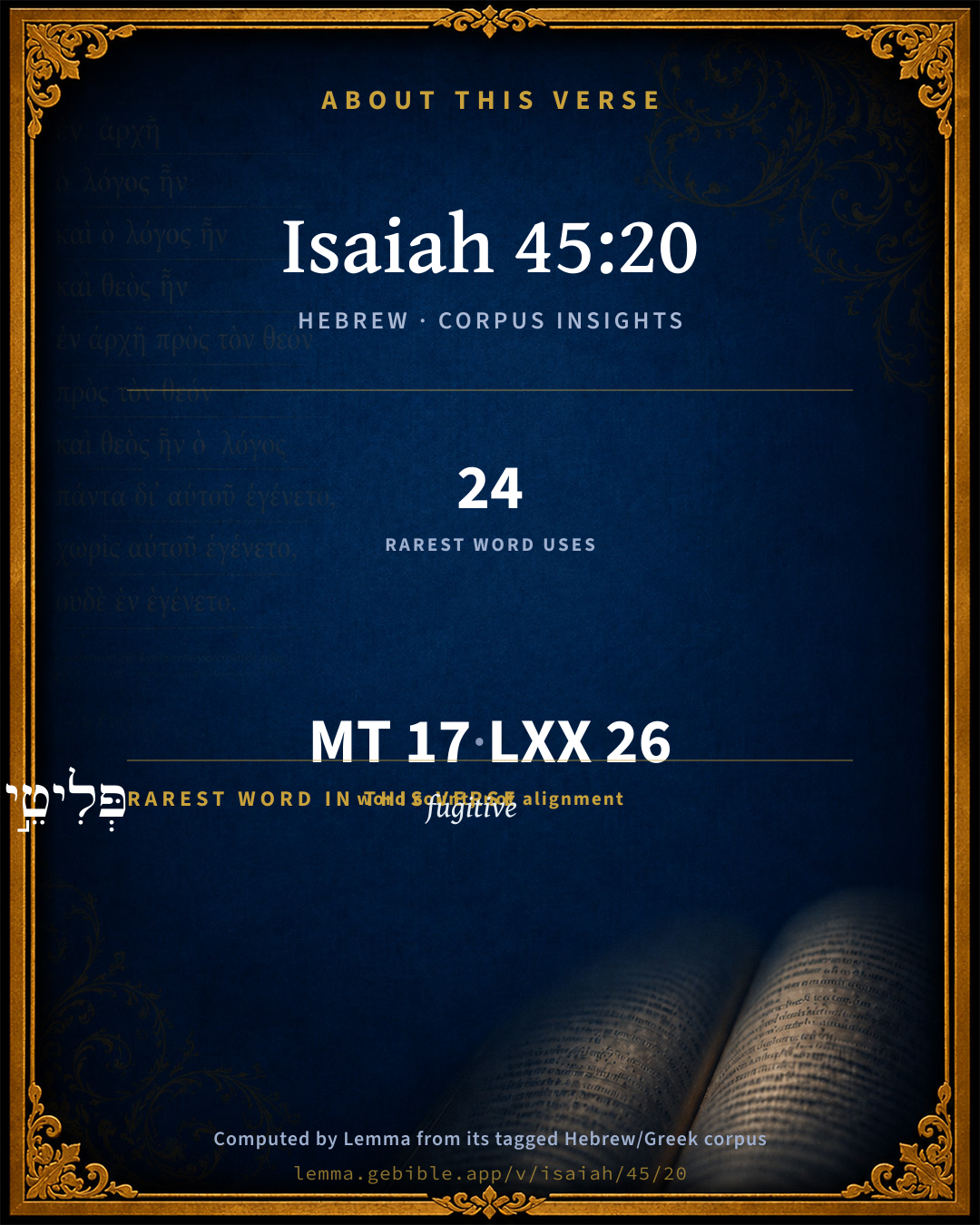
The rarest word here is פְּלִיטֵ֣י fugitive H6412 — appearing just 24 times in the whole Hebrew Bible.

Shared distinctive vocabulary

פְּלִיטֵ֣י fugitive H6412 occurs in 23 verses of the Hebrew Bible. Also found in:

Grammatical profile

  • 7 verbs
  • 5 nouns
  • 1 preposition
  • 1 adverb
  • 3 particles

Verb forms

  • הִקָּבְצ֥וּ Niphal · Imperative
  • וָבֹ֛אוּ Qal · Imperative
  • הִֽתְנַגְּשׁ֥וּ Hithpael · Imperative
  • יָדְע֗וּ Qal · Perfect
  • הַנֹּֽשְׂאִים֙ Qal · Participle Active
  • וּמִתְפַּלְלִ֔ים Hithpael · Participle Active
  • יוֹשִֽׁיעַ Hiphil · Imperfect

Repetition

A word recurs within this verse — often emphatic in Hebrew:

Hebrew & Septuagint length

In English translation the verse runs 34 words from the Hebrew and 35 from the Septuagint (LXX English) — closely comparable.

A rough comparison of the two English renderings, which tokenize alike — not a word-level alignment.

Word counts can differ between the Hebrew and the Greek without any difference in meaning — e.g. the Hebrew direct-object marker אֵת has no separate Greek word, and Greek often adds the article ὁ.

In the original languages it is 17 Hebrew tokens and 26 Greek tokens — but the two are counted differently (Hebrew bundles its prefixes and suffixes into one token; the Greek is in lemma form), so that isn’t a like-for-like length.

Cross-references

24

Topical passages linked to Isaiah 45:20 in the Treasury of Scripture Knowledge — connected by theme and wording, ordered by reader-vote popularity; previews shown in the World English Bible.

  • Isaiah 43:9 Let all the nations be gathered together, and let the peoples be assembled: who among them can declare this, and show us former things? let them bring their witnesses, that they may be justified; or let them hear, and say, It is truth.
  • Isaiah 44:17–20 The residue of it he makes a god, even his engraved image; he falls down to it and worships, and prays to it, and says, Deliver me; for you are my god.
  • Jeremiah 10:5 They are like a palm tree, of turned work, and don't speak: they must be carried, because they can't go. Don't be afraid of them; for they can't do evil, neither is it in them to do good."
  • Isaiah 4:2 In that day, Yahweh's branch will be beautiful and glorious, and the fruit of the land will be the beauty and glory of the survivors of Israel.
  • Isaiah 46:1 Bel bows down, Nebo stoops; their idols are on the animals, and on the cattle: the things that you carried about are made a load, a burden to the weary [animal].
  • Psalms 115:8 Those who make them will be like them; Yes, everyone who trusts in them.
  • 1 Kings 18:26–29 They took the bull which was given them, and they dressed it, and called on the name of Baal from morning even until noon, saying, Baal, hear us. But there was no voice, nor any who answered. They leaped about the altar which was made.
  • Isaiah 41:5–6 The isles have seen, and fear; the ends of the earth tremble; they draw near, and come.
  • Isaiah 41:21 Produce your cause, says Yahweh; bring forth your strong reasons, says the King of Jacob.
  • Isaiah 42:17–18 They shall be turned back, they shall be utterly disappointed, who trust in engraved images, who tell molten images, You are our gods.
  • Isaiah 46:6–7 Some pour out gold from the bag, and weigh silver in the balance. They hire a goldsmith, and he makes it a god. They fall down--yes, they worship.
  • Isaiah 48:5–7 therefore I have declared it to you from of old; before it came to pass I shown it you; lest you should say, My idol has done them, and my engraved image, and my molten image, has commanded them.
  • Jeremiah 2:27–28 who tell a stock, You are my father; and to a stone, You have brought me forth: for they have turned their back to me, and not their face; but in the time of their trouble they will say, Arise, and save us.
  • Jeremiah 10:8 But they are together brutish and foolish: the instruction of idols! it is but a stock.
  • Jeremiah 10:14 Every man is become brutish [and is] without knowledge; every goldsmith is disappointed by his engraved image; for his molten image is falsehood, and there is no breath in them.
  • Jeremiah 25:15–29 For thus says Yahweh, the God of Israel, to me: take this cup of the wine of wrath at my hand, and cause all the nations, to whom I send you, to drink it.
  • Jeremiah 50:28 The voice of those who flee and escape out of the land of Babylon, to declare in Zion the vengeance of Yahweh our God, the vengeance of his temple.
  • Jeremiah 51:6–9 Flee out of the midst of Babylon, and save every man his life; don't be cut off in her iniquity: for it is the time of Yahweh's vengeance; he will render to her a recompense.
  • Jeremiah 51:17–18 Every man is become brutish [and is] without knowledge; every goldsmith is disappointed by his image; for his molten image is falsehood, and there is no breath in them.
  • Habakkuk 2:18–20 "What value does the engraved image have, that its maker has engraved it; the molten image, even the teacher of lies, that he who fashions its form trusts in it, to make mute idols?
  • Romans 1:21–23 Because, knowing God, they didn't glorify him as God, neither gave thanks, but became vain in their reasoning, and their senseless heart was darkened.
  • Ephesians 2:12 that you were at that time separate from Christ, alienated from the commonwealth of Israel, and strangers from the covenants of the promise, having no hope and without God in the world.
  • Ephesians 2:16 and might reconcile them both in one body to God through the cross, having killed the hostility thereby.
  • Revelation 18:3–18 For all the nations have drunk of the wine of the wrath of her sexual immorality, the kings of the earth committed sexual immorality with her, and the merchants of the earth grew rich from the abundance of her luxury."

Cross-references courtesy of OpenBible.info (CC BY 4.0).

Hebrew and Greek witnesses Masoretic Hebrew ↔ Greek Septuagint

The same verse in the two great witnesses to the Old Testament, shown verse-for-verse.

These are two independent witnesses, not word-aligned to each other, and the Septuagint is shown in lemma (dictionary) form.

Hebrew Isaiah 45:20 Masoretic · Westminster Leningrad Codex

הִקָּבְצ֥וּ וָבֹ֛אוּ הִֽתְנַגְּשׁ֥וּ יַחְדָּ֖ו פְּלִיטֵ֣י הַגּוֹיִ֑ם לֹ֣א יָדְע֗וּ הַנֹּֽשְׂאִים֙ אֶת עֵ֣ץ פִּסְלָ֔ם וּמִתְפַּלְלִ֔ים אֶל אֵ֖ל לֹ֥א יוֹשִֽׁיעַ

Assemble yourselves and come; draw near together, you who have escaped from the nations: they have no knowledge who carry the wood of their engraved image, and pray to a god that can't save.

World English Bible · Public Domain

Greek LXX Isaiah 45:20 Septuagint · lemma form

συνἄγω καί ἥκω βουλεύω ἅμα ὁ σώζω ἀπό ὁ ἔθνος οὐ γιγνώσκω ὁ αἴρω ὁ ξύλον γλύμμα αὐτός καί προςεὔχομαι ὡς πρός θεός ὅς οὐ σώζω

Assemble yourselves and come; take counsel together, you⌃ that escape of the nations: they that set up wood, even their graven image, have no knowledge, nor they who pray to gods that do not save.

LXX2012 (modern English Septuagint) · Public Domain

Hebrew: Westminster Leningrad Codex (CC BY 4.0). Greek: Septuagint (public domain); English from LXX2012 (modern English Septuagint) (Public Domain). How the Septuagint differs from the Hebrew →

Targum (Aramaic paraphrase)

1

The Targum is the ancient Jewish Aramaic paraphrase of the Hebrew Scriptures — an interpretive translation, not the Hebrew text itself. Onkelos (literal) and Pseudo-Jonathan (expansive) render the Torah, and Jonathan the Prophets. Coverage is partial: where no permissively-licensed English translation exists for a verse, only the Aramaic is shown. This is verse-level text, not a word-by-word alignment to the Hebrew.

  1. Targum Jonathan Prophets (Joshua–Malachi)
    אִתְכְּנִישׁוּ וֶאֱתוּ אִתְקְרָבוּ כַחֲדָא מְשֵׁיזְבֵי עַמְמַיָא לָא יָדְעִין דְנָסְבִין יַת אָעֵי צַלְמֵיהוֹן וּבְעָן מִן דַחֲלָא דְלָא יִפְרוֹק:

    Assemble yourselves and come; draw near together, ye that are escaped of the nations: they know nothing that carry about their wooden images, and who pray unto a god who shall not save.

    Targum Jonathan — Aramaic: “Mikraot Gedolot” (public domain). English: “Sefaria Community Translation” (CC0 1.0 (public-domain dedication)); “London "Chaldee Paraphrase," 1871” (public domain). Text via Sefaria.

Commentary

Notes on Isaiah 45:20 from classic Christian and Jewish commentators (each source and its license shown beneath its notes). The classic Christian expositions comment on the surrounding passage and are grouped to its opening verse, so a note may address several verses; the Jewish commentaries on the Tanakh (Rashi and others) are per-verse, so they appear only where the commentator wrote on this verse.

Lemma curates 59 commentaries, every one of them public domain or Creative Commons licensed, each selected and text-cleaned for this edition rather than reprinted as found. About our sources →

Trapp's Complete Commentary

John Trapp

Isa 45:20 Assemble yourselves and come; draw near together, ye [that are] escaped of the nations: they have no knowledge that set up the wood of their graven image, and pray unto a god [that] cannot save.

Ver. 20. Ye that are escaped of the nations.] That have escaped the sword of Cyrus, and well proved how little your gods can do for you.

That set up the wood of their graven image.] Qui levant lignum, carrying them in pomp and procession upon their shoulders, as Papists now do their pictures, their breaden god especially, and crying to it, "Holy, holy, holy, Lord God of Sabbaoth!"

John Trapp, A Commentary or Exposition upon All the Books of the Old and New Testament (1647–1656) — public domain. Text from a community e-Sword module.

Joseph Benson's Commentary

Isa 45:20-22. Draw near together — To attend to what I have said, and am now about to say again, concerning the vanity of your idols; ye that are escaped of the nations — Ye that survive those many and great destructions which I am bringing upon heathen nations for their abominable idolatries and other wickedness. Let those dreadful judgments upon others, and God’s great mercy in sparing you, awaken you to a more impartial and serious consideration of this subject, and induce you to renounce those idols which have now manifested their inability to afford any help to those who serve and trust in them. They have no knowledge, &c. — See on Isa 44:9; Isa 44:17-18. Let them take counsel together — To maintain the cause of their idols. See on Isa 41:22; and Isa 43:9; and Isa 44:7. Look unto me, &c., all ye ends of the earth — Upon these considerations I call upon all people, from one end of the earth to the other, to cast away their idols, and to turn their eyes and hearts to me, expecting salvation from me, and from me only; and they shall not be disappointed. And this is not only an exhortation to the Gentiles to turn from idols to God, but a prediction that they shall turn to him, and look unto Christ, who is and will be the author of eternal salvation to all that obey him, whether Jews or Gentiles, which is confirmed by the following verse.

Joseph Benson's Commentary on the Old and New Testaments (1811–1818) — public domain. Text from a community e-Sword module.

Geneva Bible (1599)

Geneva Bible translators

All ye idolaters which though you seem to have never so much worldly dignity, yet in God’s sight you are vile and abject.

Geneva Bible (1599) marginal notes — public domain. Text via Bolls.life.

Matthew Henry's Commentary

What here is said is intended, as before,

I. For the conviction of idolators, to show them their folly in worshipping gods that cannot help them, and neglecting a God that can. Let all that have escaped of the nations, not only the people of the Jews, but those of other nations that were by Cyrus released out of captivity in Babylon, let them come, and hear what is to be said against the worshipping of idols, that they may be cured of it as well as the Jews, that Babylon, which had of old been the womb of idolatry, might now become the grave of it. Let the refugees assemble themselves and come together; God has something to say to them for their own good, and it is this, that idolatry is a foolish sottish thing, upon two accounts: -

1. It is setting up a refuge of lies for themselves: They set up the wood of their graven image; for that is the substratum. Though they overlay it with gold, deck it with ornaments, and make a god of it, yet still it is but wood. They pray to a god that cannot save; for he cannot hear, he cannot help, he can do nothing. How do those disparage themselves who give honour to that as a god which cannot, as a god, give good to them! How do those deceive themselves who pray for relief to that which is in no capacity at all to relieve them! Certainly those have no knowledge, or are brutish in their knowledge, who take so much pains, and do so much penance, in seeking the favour of a god that has no power.

2. It is setting up a rival with God, the only living and true God (Isa 45:21): "Summon them all; tell them that the great cause shall again be tried, though once adjudged, between God and Baal. Bring them near, and let them take counsel together what to say in defence of themselves and their idols. It shall, as before, be put upon this issue: let them show when any of their gods did with any certainty foretel future events, as the God of Israel has done, and it shall be acknowledged that they have some colour for their pretensions. But None of them ever did; their prophets were lying prophets; but I the Lord have told it from that time, long before it came to pass; therefore you must own thee is no other God besides me." (1.) None besides is fit to rule. He is a just God, and rules in justice, and will execute justice for those that are oppressed. (2.) None besides is able to help. As he is a just God, so he is the Saviour, who can save without the assistance of any, but without whom none can save. Those therefore have no sense of truth and falsehood, good and evil, no, nor of their own interest, that set up any in competition with him.

II. For the comfort and encouragement of all God's faithful worshippers, whoever they are, Isa 45:22. Those that worship idols pray to gods that cannot save; but the God of Israel says it to all the ends of the earth, to his people, though they are scattered into the utmost corners of the world and seem to be lost and forgotten in their dispersion, "Let them but look to me by faith and prayer, look above instruments and second causes, look off from all pretenders, and look up to me, and they shall be saved." It seems to refer further to the conversion of the Gentiles that live in the ends of the earth, the most distant nations, when the standard of the gospel is set up. To it shall the Gentiles seek. When Christ is lifted up from the earth, as the brazen serpent upon the pole, he shall draw the eyes of all men to him. They shall all be invited to look unto him, as the stung Israelites did to the brazen serpent; and so strong is the eye of faith that by divine grace it will reach the Saviour and fetch in salvation by him even from the ends of the earth; for he is God, and the is none else. Two things are here promised, for the abundant satisfaction of all that by faith look to the Saviour: -

1. That the glory of the God they serve shall be greatly advanced; and this will be good news to all the Lord's people, that, how much soever they and their names are depressed, God will be exalted, Isa 45:23. This is confirmed by an oath, that we might have strong consolation: I have sworn by myself (and God can swear by no greater, Heb 6:13); the word has gone out of my mouth, and shall neither be recalled nor return empty; it has gone forth in righteousness, for it is the most reasonable equitable thing in the world that he who made all should be Lord of all, that, since all beings are derived from him, they should all be devoted to him. He has said it, and it shall be made good, I will be exalted, Psa 46:10. He has assured us, (1.) That he will be universally submitted to, that the kingdoms of the world shall become his kingdom. They shall do him homage - Unto me every knee shall bow; and they shall bind themselves by an oath of allegiance to him - Unto me every tongue shall swear. This is applied to the dominion of our Lord Jesus, Rom 14:10, Rom 14:11. We shall all stand before the judgment-seat of Christ and give account to him, for it is written, As I live, saith the Lord, every knee shall bow to me and every tongue shall confess to God; and it seems to be referred to, Psa 2:9, Psa 2:10. If the heart be brought into obedience to Christ, and made willing in the day of his power, the knee will bow to him in humble adorations and addresses, and in cheerful obedience to his commands, submission to his disposals, and compliance with his will in both; and the tongue will swear to him, will lay a bond upon the soul to engage it for ever to him; for he that bears an honest mind never startles at assurances. (2.) That he will be universally sought unto, and application shall be made to him from all parts of the world: Unto him shall men of distant countries come, to implore his favour. Unto thee shall all flesh come with their request, Psa 65:2. And, when Christ was lifted up from the earth, he drew all men to him. (3.) That it will be to no purpose to make opposition to him. All that are incensed against him, that rage at his bonds and cords - the nations that are angry because he has taken to himself his great power and has reigned, that have been incensed at the strictness of his laws, the success of his gospel, and the spiritual nature of his kingdom - they shall be ashamed; some shall be brought to a penitential shame for it, others to a remediless ruin. One way or other, sooner or later, all that are uneasy at Christ's government and victories will be made ashamed of their folly and obstinacy. Blessed be God for the assurance here given us that, whatever becomes of us and our interests, the Lord will reign for ever!

2. That the welfare of the souls they are concerned for shall be effectually secured: Surely shall one say, and another shall learn by his example to say the same, so that all the seed of Israel, according to the Spirit, shall say, and stand to it, (1.) That God has a sufficiency for them and that in Christ there is enough to supply all their needs: In the Lord is all righteousness and strength (so the margin reads it); he is himself righteous and strong. He can do every thing, and yet will do nothing but what is unquestionably just and equitable. He has also wherewithal to supply the needs of those that seek to him and depend upon him, upon the equity of his providence and the treasures of his grace; nay, we may say, not only "He has it," but, "In him we have it," because he has said that he will be to us a God. In the Lord the captive Jews had righteousness (that is, grace both to sanctify their afflictions to them and to qualify them for deliverance) and strength for their support and escape. In the Lord Jesus we have righteousness to recommend us to the good-will of God towards us, and strength to begin and carry on the good work of God in us. He is the fountain of both, and on him we must depend for both, must go forth in his strength, and make mention of his righteousness, Psa 71:16. (2.) That they shall have an abundant bliss and satisfaction in this. [1.] The people of the Jews shall in the Lord be justified before men and openly glory in their God. The oppressors reproached them, loaded them with calumny, and boasted even of a right to oppress them, as abandoned by their God; but, when God shall work out their deliverance, that shall be their justification from these hard censures, and therefore they shall glory in it. [2.] All true Christians, that depend upon Christ for strength and righteousness, in him shall be justified and shall glory in that. Observe, First, All believers are the seed of Israel, an upright praying seed. Secondly, The great privilege they enjoy by Jesus Christ is that in him, and for his sake, they are justified before God, Christ being made of God to them righteousness. All that are justified will own it is in Christ that they are justified, nor could they be justified by any other; and those who are justified shall be glorified. And therefore, Thirdly, The great duty believers owe to Christ is to glory in him, and to make their boast of him. Therefore he is made all in all to us, that whose glories may glory in the Lord; and let us comply with this intention.

Matthew Henry's Commentary on the Whole Bible (1708–1710) — public domain (CC PDM 1.0). Text via the HelloAO Bible API.

Jamieson, Fausset & Brown

Robert Jamieson, A. R. Fausset & David Brown

escaped of the nations--those of the nations who shall have escaped the slaughter inflicted by Cyrus. Now, at last, ye shall see the folly of "praying to a god that cannot save" (Isa 45:16). Ultimately, those that shall be "left of all the nations which shall come against Jerusalem" are meant (Zac 14:16). They shall then all be converted to the Lord (Isa 66:23-24; Jer 3:17; Zac 8:20-23).

Jamieson, Fausset & Brown — Commentary Critical and Explanatory on the Whole Bible (1871) — public domain (CC PDM 1.0). Text via the HelloAO Bible API.

Ellicott's Commentary for English Readers

(20) Ye that are escaped of the nations.—Primarily, the words point to the survivors of the conquests of Cyrus, who are contemplated as acknowledging the God of Israel. Ultimately the words find their fulfilment in the conversion of the heathen to the true anointed of Jehovah, of whom Cyrus was a type. They will bear witness from their experience to the vanity of idols. They will learn that it does not avail to set up (or carry) their idols in religious processions (Jer_10:5; Amo_5:26; 1Sa_4:4).

A Bible Commentary for English Readers, edited by Charles John Ellicott (1878–1897) — public domain. Text from a community e-Sword module.

The Cambridge Bible for Schools and Colleges

gen. ed. J. J. S. Perowne

20. that set up the wood …] Render, with R.V., that carry, &c., in religious processions (Amo_5:26), or perhaps into battle (2Sa_5:21). That idols have to be carried is a sign of their powerlessness (Isa_46:1 f.; Jer_10:5).

a god that cannot save] The contrast in the end of Isa_45:21.

20, 21. The heathen are now summoned together that they may consider this attribute of Jehovah’s character, as illustrated by the prediction of the victories of Cyrus. The question submitted to them is the same as in Isa_41:1-4; Isa_41:21-29, Isa_43:9-13 : who has foretold these events? But this scene is imagined as taking place after the great crisis is over; hence those addressed are the escaped of the nations (cf. Jer_51:50), the survivors of a world-wide judgement, of which Cyrus is the instrument (see Isa_45:14).

The Cambridge Bible for Schools and Colleges (gen. ed. J. J. S. Perowne; Cambridge University Press, 1878–1918) — public domain. Text from a community e-Sword module.

John Gill's Exposition

Assemble yourselves, and come; draw near together, ye that are escaped of the nations,.... Not that escaped the sword of Cyrus's army, the Chaldeans; nor the Jews that escaped out of Babylon and other countries, by his means; but the remnant, according to the election of grace among the Gentiles; such who were called out of Heathenish darkness into the marvellous light of the Gospel, and escaped the idolatries that others continued in; these are called and summoned together, as to observe the grace of God to themselves, so to labour to convince others of their gross ignorance and stupidity in worshipping idols, and to judge and pass sentence on the obstinate among them:

they have no knowledge that set up the wood of their graven image; or that "lift up" or "carry the wood of their graven image" (d); the inside of whose graven image is wood, though covered with some metal which is graved; and for a man to carry such an image on his shoulders, either in procession or in order to fix it in some proper place for adoration, argues great ignorance and stupidity; such persons can have no knowledge of deity, that can believe that a log of wood, covered with gold or silver, graved by art and man's device, and which they are obliged to carry upon their shoulders, can be a god, or a fit object of worship:

and pray to a god that cannot save; itself, nor them; cannot hear their prayers, nor return an answer to them; cannot help and assist them in distress, nor deliver them out of their troubles; and therefore it must be the height of madness and folly to pray unto it.

(d) , Sept. "qui efferunt", Pagninus; "extollentes", Montanus; "qui gestant", Piscator; "gestantes lignum sculptilis sui", Junius & Tremellius; "qui portant", Cocceius, Vitringa.

John Gill's Exposition of the Whole Bible (1746–1763) — public domain (CC PDM 1.0). Text via the HelloAO Bible API.

Albert Barnes' Notes on the Bible

Assemble yourselves, and come - This, like the passage in Isa 41:1 ff, is a solemn appeal to the worshippers of idols, to come and produce the evidences of their being endowed with omniscience, and with almighty power, and of their having claims to the homage of their worshippers.

Ye that are escaped of the nations - This phrase has been very variously interpreted. Kimchi supposes that it means those who were distinguished among the nations, their chiefs, and rulers; Aben Ezra, that the Babylonians are meant especially; Vitringa, that the phrase denotes proselytes, as those who have escaped from the idolatry of the pagan, and have embraced the true religion; Grotius, that it denotes those who survived the slaughter which Cyrus inflicted on the nations. Rosenmuller coincides in opinion with Vitringa. The word used here (פליט pâlı̂yṭ) denotes properly one who has escaped by flight from battle, danger, or slaughter Gen 14:13; Jos 8:32. It is not used anywhere in the sense of a proselyte; and the idea here is, I think, that those who escaped from the slaughter which Gyrus would bring on the nations, were invited to come and declare what benefit they had derived from trusting in idol-gods. In Isa 45:16, God had said they should all be ashamed and confounded who thus put their trust in idols; and he here calls on them as living witnesses that it was so. Those who had put their confidence in idols, and who had seen Cyrus carry his arms over nations notwithstanding their vain confidence, could now testify that no reliance was to be placed on them, and could be adduced as witnesses to show the importance of putting their trust in Yahweh.

That set up the wood - The word ‘wood’ is used here to show the folly of worshipping an image thus made, and to show how utterly unable it was to save.

Albert Barnes' Notes on the Bible (1834–1885) — public domain. Text from a community e-Sword/MySword module.

Haydock's Catholic Bible Commentary

Gentiles: converts, (Haydock) or Jews, returning from Babylon.

George Leo Haydock (1774–1849), Haydock's Catholic Family Bible and Commentary, 1859 edition — public domain. Excludes Psalms (Douay-Rheims chapter numbering differs from Protestant) and Deuterocanonical books (Catholic canon only).

Matthew Poole's English Annotations

Assemble yourselves and come; draw near together; to debate the business with me concerning the divinity of your idols, and hear what I have said, and am now about to say again, in that matter.

Ye that are escaped of the nations; the remnant of the Gentiles, which shall survive those great and many destructions which I am bringing upon the heathen nations for their abominable idolatries and other wickedness. Let these dreadful judgments upon others, and God’s singular mercy in sparing you, awaken you to a more impartial and serious consideration of this point, and cast off those idols, which have now discovered their own vanity and inability to help those who serve them and trust in them.

They have no knowledge; they hereby discover their deep ignorance and stupidity.

That set up in a high place, where it may be seen and worshipped.

Matthew Poole's English Annotations on the Holy Bible (1683–1685) — public domain. Text from a community e-Sword/MySword module.

Whedon's Commentary on the Bible

Daniel D. Whedon

20. Assemble… and come — The challenge again (Isa_41:21; Isa_42:9)

to try him and prove that he is an Infinite Reality.

Escaped of the nations — The “escaped” are those who have survived the divine judgments which sweep over the idolatrous world.

Have no knowledge — Silly idolaters have none. With such, reason and conscience are perverted, truth and error exchange meanings, good sense goes for nothing. The “escaped” ones seem, in this verse, invited to a convocation for a somewhat different object from the one in Isa_41:1, namely, to test the question of prediction, to reason with those demented ones yet in favour of idols.

Daniel D. Whedon (gen. ed.), Commentary on the Old and New Testaments (1874–1909) — public domain. Text from a community e-Sword module.

The Pulpit Commentary

Assemble yourselves and come... ye... escaped of the nations. The prophet reverts to the main idea of the section, which is the conversion of the Gentiles, and calls on all "the escaped of the nationi.e. all who have survived the judgments of the time to "assemble and come," to consider the claims of Jehovah to be the only true God, to "look to him (ver. 22) and be saved." The great judgments through which the heathen will be brought to God have been frequently mentioned. (Isa_24:1-23 Isa_26:20, 21 27:1-7 30:27-33 34:1-10 40:24 41:11, 12, 25 42:13-15, etc.) They must not be regarded as limited to the time of Cyrus, but rather as continuing into the Messianic period, and indeed nearly to its close. (see especially Isa 34) . Each one of them constitutes a call to the nations, and is followed by a conversion to a greater or less extent. They have no knowledge that set up the wood of their graven image; rather, who lift up (or, carry) the wood of their graven image. (comp. Isa_46:7, "They bear him upon the shoulder," where the same verb is used) It was a practice of the idolatrous heathen to carry the images of their gods in processions, generally exposed to view upon their shoulders (Layard, "Nineveh and its Remains," vol. 2. opp. p. 451), but sometimes partially concealed in shrines, or "arks" (Rawlinson, "Herodotus," vol. 2. pp. 100, 101). There would be still among the "escaped" some who would so act.

The Pulpit Commentary (1880–1919), ed. H.D.M. Spence-Jones & Joseph S. Exell — public domain. Text from a community e-Sword module.

John Wesley's Explanatory Notes

Draw near - To hear what I have said, and am now about to say. Of the nations - The remnant of the Gentiles, who survive the many destructions, which I am bringing upon the Heathen nations.

John Wesley, Explanatory Notes Upon the Whole Bible (1754–1765) — public domain. Text via the GEBible commentary corpus.

Keil & Delitzsch

C. F. Keil & F. Delitzsch

The salvation of Israel, foretold and realized by Jehovah, becomes at the same time the salvation of the heathen world. "Assemble yourselves and come; draw near together, ye escaped of the heathen! Irrational are they who burden themselves with the wood of their idol, and pray to a god that bringeth no salvation. Make known, and cause to draw near; yea, let them take counsel together: Who has made such things known from the olden time, proclaimed it long ago? have not I, Jehovah? and there is no Deity beside me; a God just, and bringing salvation: there is not without me!" The fulness of the Gentiles, which enters into the kingdom of God, is a remnant of the whole mass of the heathen: for salvation comes through judgment; and it is in the midst of great calamities that the work of that heathen mission is accomplished, which is represented in these prophecies on the one hand as the mission of Cyrus, and on the other hand as the mission of Jehovah and His servant. Hence this summons to listen to the self-assertion of the God of revelation, is addressed to the escaped of the heathen, who are not therefore the converted, but those who are susceptible of salvation, and therefore spared. By "the heathen" (haggōyı̄m) Knobel understands the allies and auxiliaries of the Babylonians, whom Cyrus put to flight (according to the Cyropaedia) before his Lydian campaign. But this is only an example of that exaggerated desire to turn everything into history, which not only prevented his seeing the poetry of the form, but obscured the fact that prophecy is both human and divine. For the future was foreshortened to the telescopic glance of the prophet, so that he could not see it in all its length and breadth. He saw in one mass what history afterwards unrolled; and then behind the present he could just see as it were the summit of the end, although a long eventful way still lay between the two. Accordingly, our prophet here takes his stand not at the close of any particular victory of Cyrus, but at the close of all his victories; and, in his view, these terminate the whole series of catastrophes, which are outlived by a remnant of the heathen, who are converted to Jehovah, and thus complete the final glory of the restored people of God. Throughout the whole of these prophecies we see immediately behind the historical foreground this eschatological background lifting up its head. The heathen who have been preserved will assemble together; and from the fact that Jehovah proves Himself the sole foreteller of the events that are now unfolding themselves, they will be brought to the conviction that He is the only God. The hithpael hithnaggēsh does not occur anywhere else. On the absolute ידע לא, see at Isa 44:9 (cf., Isa 1:3). To the verb haggı̄shū we must supply, as in Isa 41:22, according to the same expression in Isa 45:21, עצּמתיכם (your proofs). "This" refers to the fall of Babylon and redemption of Israel - salvation breaking through judgment. On mē'âz, from the olden time, compare Isa 44:8. God is "a just God and a Saviour," as a being who acts most stringently according to the demands of His holiness, and wherever His wrath is not wickedly provoked, sets in motion His loving will, which is ever concerned to secure the salvation of men.

Keil & Delitzsch — Biblical Commentary on the Old Testament (1861–1891) — public domain (CC PDM 1.0). Text via the HelloAO Bible API. (Old Testament only.)

J. A. Alexander on Isaiah

Joseph Addison Alexander

“Gather yourselves and come, draw near together ye escaped of the nations. They know not, those carrying the wood, their graven image, and praying to a God (who) cannot save.” In the first clause the idolaters are addressed directly; in the second they are spoken of again in the third person. The challenge or summons at the beginning is precisely similar to that in Isa 41:21 and Isa 43:9. ‘Escaped of the nations’ has been variously explained to mean the Jews who had escaped from the oppression of the Gentiles, and the Gentiles who had escaped from the dominion of idolatry. But these last would scarcely have been summoned to a contest. On the whole, it seems most natural to understand the nations who survived the judgments sent by God upon them. The Hebrew phrase is in itself ambiguous. The explanation which agrees best with the whole connection is the one that supposes the idolaters still left (i.e., neither converted nor destroyed) to be the object of address. If there are any still absurd enough to carry about a wooden god and pray to one who cannot save, let them assemble and draw near. ‘They do not know’ is commonly explained to mean they have no knowledge; but it is more accordant with the usage of the language to supply a specific object. They do not know it, or, they do not know what they are doing, they are not conscious of their own impiety and folly. The verse contains two indirect reflections on the idols, first, that they are wooden, then, that they are lifeless and dependant on their worshippers for locomotion.

Joseph Addison Alexander, The Prophecies of Isaiah (1846–1847; New York: Scribner, 1870–1878) — public domain. Text from a community e-Sword module.

unfoldingWord translationNotes

Door43 World Missions Community

General Information:

Yahweh continues speaking

refugees

people who have fled from their homes so the enemy will not capture or kill them

translationWords

nation

know

image

pray

false god

save

unfoldingWord translationNotes — © Distant Shores Media and the Door43 World Missions Community, licensed CC BY-SA 4.0. Source: git.door43.org/Door43/en_tn.

Rashi

Rabbi Shlomo Yitzchaki (Rashi)

approach Heb. הִתְנַגְּשׁוּ, an expression of approaching (הַגָּשָׁה) and the ‘nun’ is attached to it, as one says “they were struck (הִתְנַגְּפוּ)”; “they will be struck (יִתְנַגְּפוּ).”

you survivors of the nations who survived the sword of Nebuchadnezzar.

who carry their graven wooden image...do not know to understand knowledge.

Rashi on the Tanakh — English translations: “The Judaica Press complete Tanach with Rashi, translated by A. J. Rosenberg” (CC BY 4.0); “Pentateuch with Rashi's commentary by M. Rosenbaum and A.M. Silbermann, 1929-1934” (public domain); “The Metsudah Tanach series, Lakewood, N.J” (CC BY 4.0); and “The Book of Joshua, Metsudah Publications, 1997” (CC BY 4.0). Text via Sefaria.

Ibn Ezra

Rabbi Abraham ibn Ezra

הקבצו ובאו התנגשו Assemble yourselves and come, draw near. These are imperatives.

Ye, that are escaped, etc. The Babylonians are addressed.—I called thus long ago, but they have, no knowledge that set up, etc.

Ibn Ezra on the Tanakh — English translations: “Sefaria Community Translation” (CC0 1.0 (public-domain dedication)); “Yalkut, Sifsei Chachomim Chumash, Metsudah Publications, 2009” (CC BY 4.0); and “Commentary of Ibn Ezra on Isaiah - trans. by M. Friedlander, 1873” (public domain). Text via Sefaria.

Lesson kit

Teaching starters — assembled from the data on this page, not authored interpretation. Every prompt links to the verse data it draws on. Edit before teaching.

Isaiah, in the Prophets, opens this verse with 17 words (16 distinct Hebrew lemmas). Its most distinctive word is pâlîyṭ (“fugitive”). A historical commentator’s framing appears above. Read the whole chapter for the surrounding context.

Discussion questions

  1. The word pâlîyṭ carries the sense “fugitive.” How does it shape the verse?
  2. Genesis 14:13 shares the word «fugitive» with this verse. How do the two illuminate each other?
  3. “not” occurs 2× in this one verse. What is the effect of the repetition?
  4. These translations render this verse differently. What is at stake in choosing one wording over another?
  5. The verb «הִקָּבְצ֥וּ» is Niphal Imperative. How does its form color the action?
  6. Reading how Trapp's Complete Commentary and Joseph Benson's Commentary read this verse, where do the two commentators agree and where do they part?

Things to notice

Reading settings

Reading text

Shown beneath each verse's original-language words.

Old Testament
Old Testament edition

Read the OT as the Masoretic Hebrew (MT) or the Greek Septuagint (LXX).

English shown for the Greek Septuagint (in the Hebrew ↔ Greek comparison).

Comparing translations? Open the Compare panel on any verse page to stack up to four side by side.