
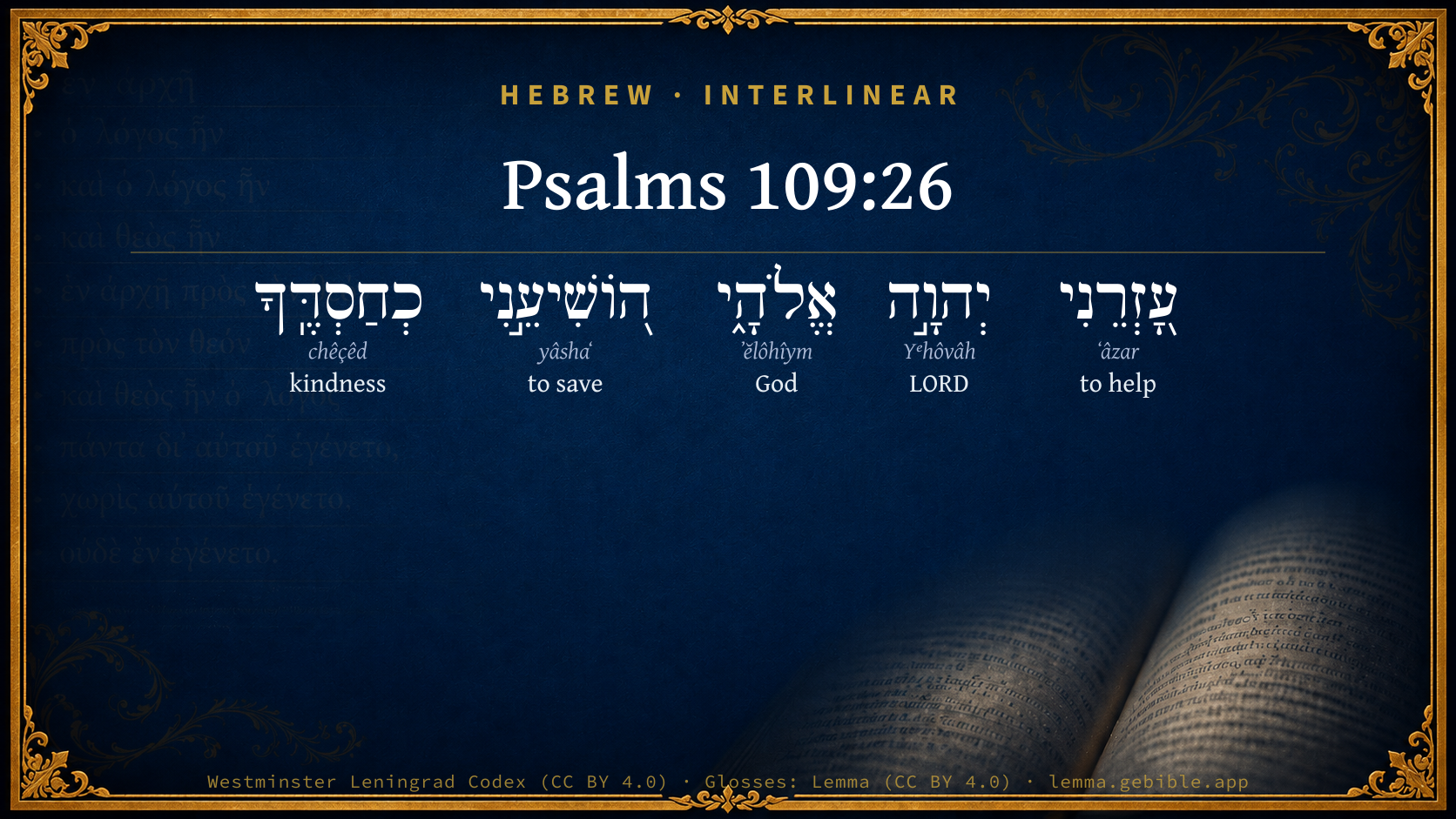
Psalms 109:26

Hebrew (Westminster Leningrad Codex) Psalms 109:26 appears in the Hebrew Old Testament. The text above is from the Westminster Leningrad Codex. Each word links to its Strong’s number, a concise gloss, and parsing drawn from the Open Scriptures Hebrew Bible morphology. Click any word for its full Brown-Driver-Briggs (BDB) entry.
Download image
Cite this verse

Psalms 109:26 (World English Bible). Public Domain. Lemma interlinear Bible study tool, https://lemma.gebible.app/v/psalms/109/26.

Show BibTeX & RIS
BibTeX
RIS
English Translation
Help me, Yahweh, my God. Save me according to your loving kindness;
World English Bible · Public Domain
Download a study sheet

One document with this verse’s original text, its word-by-word gloss line, the meaning frame, cross-references with their text, attributed commentary, and full source and license credits — printable, and it pastes into notes with its structure intact.

This verse Autodidact and up

Study sheet (.html) Plain text (.txt)

A passage Seminary Student

Up to 50 verses in one chapter. A passage sheet keeps up to 6 commentary sources and 12 cross-references per verse, in the order this page ranks them, and says so on the sheet whenever that leaves anything out. Ask for a single verse and you get the Autodidact verse sheet above.

Everything on this page stays free to read, with no account — the sheet is a download of what is already on screen, not access to it.

Want to remove ads? Support Godless Engineer
Compare translations 3

The same verse in 3 English versions, stacked beneath the original-language interlinear above. Click any original word for its lexicon entry.

Each is an independent rendering of the whole verse — the interlinear is not word-aligned to these translations.

Highlighted words mark where these versions differ — a whole-verse word diff, not a word-by-word alignment.

  • World English Bible Public Domain
    Help me, Yahweh, my God. Save me according to your loving kindness;
  • King James Version Public Domain
    Help me, O LORD my God: O save me according to thy mercy:
  • unfoldingWord Literal Text CC BY-SA 4.0
    Help me, Yahweh my God; save me according to your covenant faithfulness,

unfoldingWord Literal Text — © unfoldingWord, licensed CC BY-SA 4.0. Word-aligned USFM3 via Door43 (git.door43.org/unfoldingWord/en_ult).

Versions to compare (up to 4)

3 of 4 selected

Show all 18 translations

Every available English version of this verse, each an independent rendering of the whole verse.

  • World English Bible Public Domain
    Help me, Yahweh, my God. Save me according to your loving kindness;
  • Berean Standard Bible Public Domain
    Help me, O LORD my God; save me according to Your loving devotion.
  • Majority Standard Bible Public Domain
    Help me, O LORD my God; save me according to Your loving devotion.
  • King James Version Public Domain
    Help me, O LORD my God: O save me according to thy mercy:
  • American Standard Version (1901) Public Domain
    Help me, O Jehovah my God; Oh save me according to thy lovingkindness:
  • Revised Version (1885) Public Domain
    Help me, O LORD my God; O save me according to thy mercy:
  • Geneva Bible (1599) Public Domain
    Helpe me, O Lord my God: saue me according to thy mercie.
  • Douay-Rheims (1899) Public Domain
    Help me, O Lord my God; save me according to thy mercy.
  • Young's Literal Translation Public Domain
    Help me, O Jehovah my God, Save me, according to Thy kindness.
  • Literal Standard Version CC BY-SA 4.0
    Help me, O YHWH my God, || Save me, according to Your kindness.
  • Unlocked Literal Bible CC BY-SA 4.0
    Help me, Yahweh my God; save me by your covenant faithfulness.
  • unfoldingWord Literal Text CC BY-SA 4.0
    Help me, Yahweh my God; save me according to your covenant faithfulness,
  • Darby Bible Public Domain
    Help me, Jehovah my God; save me according to thy loving-kindness:
  • World Messianic Bible Public Domain
    Help me, LORD, my God. Save me according to your loving kindness;
  • Webster's Bible Public Domain
    Help me, O LORD my God: O save me according to thy mercy:
  • Free Bible Version CC BY-SA 4.0
    Help me, Lord my God; save me because of your trustworthy love.
  • Bible in Basic English Public Domain
    Give me help, O Lord my God; in your mercy be my saviour;
  • JPS Tanakh (1917) Public Domain
    Help me, O LORD my God; O save me according to Thy mercy;

Literal Standard Version (2020), Covenant Press — licensed CC BY-SA 4.0. Text via the HelloAO Bible API (eBible.org). Unlocked Literal Bible (unfoldingWord) — licensed CC BY-SA 4.0. Text via the HelloAO Bible API (eBible.org). unfoldingWord Literal Text — © unfoldingWord, licensed CC BY-SA 4.0. Word-aligned USFM3 via Door43 (git.door43.org/unfoldingWord/en_ult). Free Bible Version, Dr. Jonathan Gallagher — licensed CC BY-SA 4.0. Text via the HelloAO Bible API (eBible.org).

Word by word

More ways to search: Search by grammar → Find every occurrence → Compare this word →

Practice this passage: Drill this verse → Learn its vocabulary →

About this verse

These counts appear in no published source. They are computed here, from the morphology-tagged text and Lemma’s own curated glosses. What Lemma adds →

5
words
5
distinct lemmas
Wisdom
section

Grammatical profile

  • 2 verbs
  • 3 nouns

Verb forms

  • עָ֭זְרֵנִי Qal · Imperative
  • ה֭וֹשִׁיעֵ֣נִי Hiphil · Imperative

Hebrew & Septuagint length

In English translation the verse runs 12 words from the Hebrew and 13 from the Septuagint (LXX English) — closely comparable.

A rough comparison of the two English renderings, which tokenize alike — not a word-level alignment.

Word counts can differ between the Hebrew and the Greek without any difference in meaning — e.g. the Hebrew direct-object marker אֵת has no separate Greek word, and Greek often adds the article ὁ.

Cross-references

6

Topical passages linked to Psalms 109:26 in the Treasury of Scripture Knowledge — connected by theme and wording, ordered by reader-vote popularity; previews shown in the World English Bible.

  • Psalms 119:86 All of your commandments are faithful. They persecute me wrongfully. Help me!
  • Psalms 57:1 Be merciful to me, God, be merciful to me, For my soul takes refuge in you. Yes, in the shadow of your wings, I will take refuge, Until disaster has passed.
  • Psalms 69:13 But as for me, my prayer is to you, Yahweh, in an acceptable time. God, in the abundance of your loving kindness, answer me in the truth of your salvation.
  • Hebrews 5:7 He, in the days of his flesh, having offered up prayers and petitions with strong crying and tears to him who was able to save him from death, and having been heard for his godly fear,
  • Psalms 69:16 Answer me, Yahweh, for your loving kindness is good. According to the multitude of your tender mercies, turn to me.
  • Psalms 40:12 For innumerable evils have surrounded me. My iniquities have overtaken me, so that I am not able to look up. They are more than the hairs of my head. My heart has failed me.

Cross-references courtesy of OpenBible.info (CC BY 4.0).

Hebrew and Greek witnesses Masoretic Hebrew ↔ Greek Septuagint

The same verse in the two great witnesses to the Old Testament, shown verse-for-verse.

You’re reading Greek Psalm 108 (Hebrew Psalm 109). The Septuagint counts the superscription, so verse numbers can differ from the Hebrew — chapter-level alignment, not verse-by-verse. Numbering follows Rahlfs.

These are two independent witnesses, not word-aligned to each other, and the Septuagint is shown in lemma (dictionary) form.

Hebrew Psalms 109:26 Masoretic · Westminster Leningrad Codex

עָ֭זְרֵנִי יְהוָ֣ה אֱלֹהָ֑י ה֭וֹשִׁיעֵ֣נִי כְחַסְדֶּֽךָ

Help me, Yahweh, my God. Save me according to your loving kindness;

World English Bible · Public Domain

Greek LXX Greek Psalm 108:26 Septuagint · lemma form

βοηθέω ἐγώ κύριος ὁ θεός ἐγώ σώζω ἐγώ κατά ὁ ἔλεος σύ

Help me, O Lord my God; and save me according to your mercy.

LXX2012 (modern English Septuagint) · Public Domain

Hebrew: Westminster Leningrad Codex (CC BY 4.0). Greek: Septuagint (public domain); English from LXX2012 (modern English Septuagint) (Public Domain). How the Septuagint differs from the Hebrew →

Commentary

Notes on Psalms 109:26 from classic Christian and Jewish commentators (each source and its license shown beneath its notes). The classic Christian expositions comment on the surrounding passage and are grouped to its opening verse, so a note may address several verses; the Jewish commentaries on the Tanakh (Rashi and others) are per-verse, so they appear only where the commentator wrote on this verse.

Lemma curates 59 commentaries, every one of them public domain or Creative Commons licensed, each selected and text-cleaned for this edition rather than reprinted as found. About our sources →

Trapp's Complete Commentary

John Trapp

Psa 109:26 Help me, O LORD my God: O save me according to thy mercy:

Ver. 26. Help me, O Lord] Prayer, like those arrows of deliverance, must be multiplied, as our trouble is lengthened and lieth on.

John Trapp, A Commentary or Exposition upon All the Books of the Old and New Testament (1647–1656) — public domain. Text from a community e-Sword module.

Joseph Benson's Commentary

Psa 109:26-29. Help me, O Lord my God — But my hope is, that thou, my God, wilt seasonably interpose for my relief, and save me — Out of my troubles; according to thy mercy — That tender mercy which is wont to extend itself to those who have nothing else to depend upon. That they may know that this is thy hand — Being convinced of the eminence, singularity, and strangeness of the work. Let them curse, but bless thou — I can patiently bear their curses, as being causeless, and fully compensated by thy blessing. Or, rather, as the Hebrew, יקללו המה, jekalelu hemma, is literally rendered, They will curse; I expect nothing else from them; ואתה תברךְ, veatta tebareck, but thou wilt bless me, and all those that trust in thee; for, blessed is the man who trusteth in the Lord, and whose hope the Lord is. When they arise let them be ashamed — Hebrew, קמו ויבשׁו, kamu vajeboshu, they have arisen, namely, have taken active measures against me; they shall be ashamed — Disappointed of their wicked hopes and designs against me, and covered with their own confusion as with a mantle — For that unexpected destruction which they have brought upon themselves. Observe, reader, if God bless us, we need not care who curseth us; for how can they curse whom God hath not cursed? Nay, whom he hath blessed? Num 23:28. Men’s curses are impotent, God’s blessings are omnipotent. And those whom men unjustly curse, may in faith expect and pray for God’s blessing, his special blessing. When the Pharisees cast out the poor man for confessing Christ, Christ found him, Joh 9:35. When men, without cause, say all the ill they can of us, and wish all the ills they can to us, we may with comfort lift up our hearts to God in this petition: Let them curse, but bless thou.

Joseph Benson's Commentary on the Old and New Testaments (1811–1818) — public domain. Text from a community e-Sword module.

J. A. Alexander on Psalms

Joseph Addison Alexander

26. (Psa 109:26) Help me, Jehovah, my God, save me, according to thy mercy. The renewed description of his sufferings, in ver. 22-25, is followed by a renewed petition for deliverance, corresponding to that in Psa 109:21. According to thy mercy, i.e. in proportion to its greatness and the freeness with which it is exercised.

Joseph Addison Alexander, The Psalms Translated and Explained (1850) — public domain. Text from a community e-Sword module.

Tyndale Open Study Notes

Tyndale Open Resources

109:26-31 These verses form a prayer for God’s presence and for vindication. The psalmist wants everyone to see that he is vindicated by the Lord, not by any human agent.

Tyndale Open Study Notes — © Tyndale Open Resources, licensed CC BY-SA 4.0. Text via the HelloAO Bible API.

Geneva Bible (1599)

Geneva Bible translators

The more grievously Satan assailed him, the more earnest and instant was he in prayer.

Geneva Bible (1599) marginal notes — public domain. Text via Bolls.life.

John Calvin's Commentaries

26 Help me, O Jehovah! The prophet repeats his prayer, because the more we are assailed by the subtilty and deceit of Satan, the more necessary is it for us to strive more ardently, and display the greater boldness. We may, indeed, have the full assurance of God being propitious towards us, yet when he delays to manifest it, and when the ungodly slander us, it must be that various doubts which keep intruding themselves upon us arise in our minds. Hence, it is not without reason that David, in order that he might withstand such attacks, places himself under the protection of that God who, according to his mercy and goodness, helps his people in their time of need. He implores that deliverance may be extended to him, not by ordinary means, but by the peculiar and special display of God’s power, so that his enemies may stand abashed, and not dare to open their mouths; and we know that God sometimes secretly grants succor to his servants, while, at other times, he stretches out his hand in such a visible manner, that the ungodly, though they shut their eyes, are constrained to acknowledge that there is divine agency connected with their deliverance. For as his enemies had exalted themselves against God, so it was his desire, after they shall have been subdued, to exult over them in the name of God. In cherishing this desire, he has no wish to procure for himself the renown of being valiant in war, but that God’s power may be displayed, that no flesh may glory in his sight. The words may also be viewed as referring both to his deliverance from his enemies, and to his affliction; his desire being to attribute his deliverance mainly to the grace of God; because, in opposing the hand of God to fortune and to all human means of deliverance, it is plainly his intention that God should be recognised as the alone author of it. This deserves to be carefully considered by us, for however anxious we are to be delivered by the hand of God, yet there is scarcely one among a hundred who makes the manifestation of God’s glory his chief end; that glory for which we ought to have a greater regard than for our own safety, because it is far more excellent. Whosoever then is desirous that the ungodly may be constrained to acknowledge the power of God, ought the more carefully to take heed to the help of God which in his own case he experiences; for it would be most absurd to point out the hand of God to others, if our minds have not recognised it.

John Calvin's Commentaries (1540-1563) — public domain. Text from the Calvin Translation Society English edition (1840s-50s) via the Christian Classics Ethereal Library (ccel.org). Calvin's coverage is partial (roughly two-thirds of the Bible); uncommented books and verses are honest gaps, never fabricated. The 19th-century editor's footnotes and remarks are omitted so the notes are faithfully Calvin's own voice.

The Cambridge Bible for Schools and Colleges

gen. ed. J. J. S. Perowne

26. Cp. Psa_31:16.

26–31. Repeated prayers for help, ending with calm assurance that the end of suffering is at hand.

The Cambridge Bible for Schools and Colleges (gen. ed. J. J. S. Perowne; Cambridge University Press, 1878–1918) — public domain. Text from a community e-Sword module.

John Gill's Exposition

That they may know that this is thy hand,.... Which inflicted vengeance, and executed judgments on Judas and the Jews, as before imprecated: so the Targum,

"that they may know that this is thy stroke;''

or which was concerned in all the sorrows and sufferings of the Messiah, which could never have come upon him had it not been the will of God; it was his hand and council that determined it, or men could never have effected it; see Act 4:28, or which wrought deliverance and salvation as before prayed for; see Psa 118:21.

That thou, Lord, hast done it: one or other, or all the above things; the finger of God was to be seen in them; particularly in the sufferings of Christ, and in his exaltation; see Act 2:23.

John Gill's Exposition of the Whole Bible (1746–1763) — public domain (CC PDM 1.0). Text via the HelloAO Bible API.

Albert Barnes' Notes on the Bible

Help me, O Lord my God ... - Stand by me; interpose.

Albert Barnes' Notes on the Bible (1834–1885) — public domain. Text from a community e-Sword/MySword module.

The Treasury of David

Charles H. Spurgeon

Ver. 26. Help me, O LORD my God. Laying hold of Jehovah by the appropriating word my, he implores his aid both to help him to bear his heavy load and to enable him to rise superior to it. He has described his own weakness, and the strength and fury of his foes, and by these two arguments he urges his appeal with double force. This is a very rich, short, and suitable prayer for believers in any situation of peril, difficulty, or sorrow.

O save me according to thy mercy. As thy mercy is, so let thy salvation be. The measure is a great one, for the mercy of God is without bound. When man has no mercy it is comforting to fall back upon God's mercy. Justice to the wicked is often mercy to the righteous, and because God is merciful he will save his people by overthrowing their adversaries.

Ver. 26-27.

1. The Prayer.

2. The Believing Title: "O Lord my God."

3. The attribute relied upon.

4. The motive for the petition.

Psalms 109:27*

Charles H. Spurgeon's The Treasury of David (1869–1885) — public domain. Psalms only. Text from a community e-Sword/MySword module.

The Pulpit Commentary

Help me, O Lord my God. Connect with ver. 21. O save me according to thy mercy; i.e. "as thou art wont to show mercy, show mercy now to me."

The Pulpit Commentary (1880–1919), ed. H.D.M. Spence-Jones & Joseph S. Exell — public domain. Text from a community e-Sword module.

Keil & Delitzsch

C. F. Keil & F. Delitzsch

The cry for help is renewed in the closing strophe, and the Psalm draws to a close very similarly to Ps 69 and Ps 22, with a joyful prospect of the end of the affliction. In Psa 109:27 the hand of God stands in contrast to accident, the work of men, and his own efforts. All and each one will undeniably perceive, when God at length interposes, that it is His hand which here does that which was impossible in the eyes of men, and that it is His work which has been accomplished in this affliction and in the issue of it. He blesses him whom men curse: they arise without attaining their object, whereas His servant can rejoice in the end of his affliction. The futures in Psa 109:29 are not now again imprecations, but an expression of believingly confident hope. In correct texts כּמעיל has Mem raphatum. The "many" are the "congregation" (vid., Psa 22:23). In the case of the marvellous deliverance of this sufferer the congregation or church has the pledge of its own deliverance, and a bright mirror of the loving-kindness of its God. The sum of the praise and thanksgiving follows in Psa 109:31, where כּי signifies quod, and is therefore allied to the ὅτι recitativum (cf. Psa 22:25). The three Good Friday Psalms all sum up the comfort that springs from David's affliction for all suffering ones in just such a pithy sentence (Psa 22:25; Psa 69:34). Jahve comes forward at the right hand of the poor, contending for him (cf. Psa 110:5), to save (him) from those who judge (Psa 37:33), i.e., condemn, his soul. The contrast between this closing thought and Psa 109:6. is unmistakeable. At the right hand of the tormentor stands Satan as an accuser, at the right hand of the tormented one stands God as his vindicator; he who delivered him over to human judges is condemned, and he who was delivered up is "taken away out of distress and from judgment" (Isa 53:8) by the Judge of the judges, in order that, as we now hear in the following Psalm, he may sit at the right hand of the heavenly King. Ἐδικαιώθη ἐν πνεύματι...ἀνελήμφθη ἐν δόξῃ! (Ti1 3:16).

Keil & Delitzsch — Biblical Commentary on the Old Testament (1861–1891) — public domain (CC PDM 1.0). Text via the HelloAO Bible API. (Old Testament only.)

unfoldingWord translationNotes

Door43 World Missions Community

save me by your covenant faithfulness

The abstract noun "faithfulness" can be translated with an adjective. AT: "save me because you are faithful to your covenant" (See: Abstract Nouns)

May they know

The word "they" refers to David's accusers and the people who say bad things about him.

have done this

"have saved me"

translationWords

God

save

covenant faithfulness

know

unfoldingWord translationNotes — © Distant Shores Media and the Door43 World Missions Community, licensed CC BY-SA 4.0. Source: git.door43.org/Door43/en_tn.

Lesson kit

Teaching starters — assembled from the data on this page, not authored interpretation. Every prompt links to the verse data it draws on. Edit before teaching.

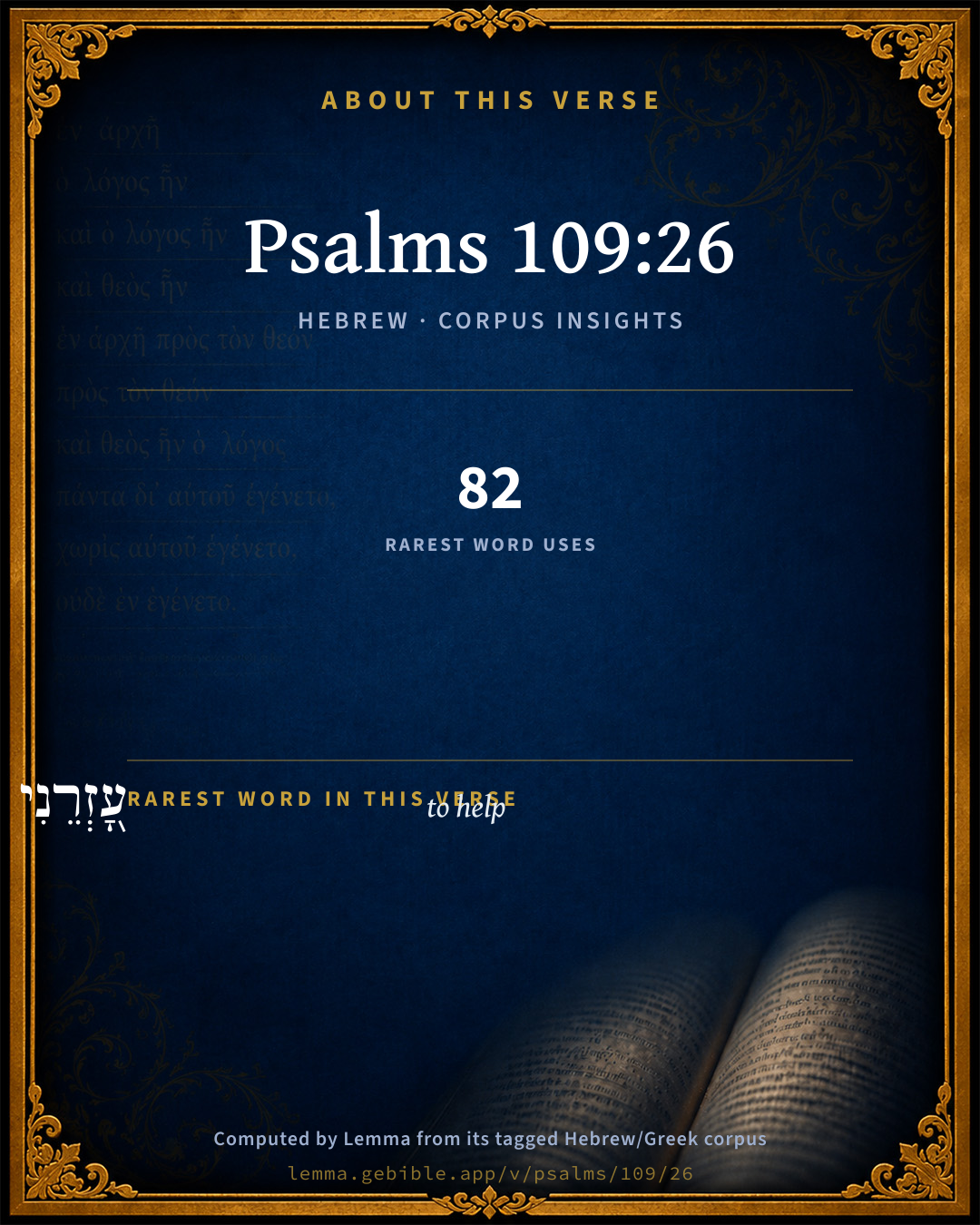
Psalms, in the Wisdom, opens this verse with 5 words (5 distinct Hebrew lemmas). Its most distinctive word is ʻâzar (“to help”). A historical commentator’s framing appears above. Read the whole chapter for the surrounding context.

Discussion questions

  1. The word ʻâzar carries the sense “to help.” How does it shape the verse?
  2. Psalms 119:86 shares this passage’s theme. How do the two illuminate each other?
  3. These translations render this verse differently. What is at stake in choosing one wording over another?
  4. The verb «עָ֭זְרֵנִי» is Qal Imperative. How does its form color the action?
  5. Reading how Trapp's Complete Commentary and Joseph Benson's Commentary read this verse, where do the two commentators agree and where do they part?

Things to notice

Reading settings

Reading text

Shown beneath each verse's original-language words.

Old Testament
Old Testament edition

Read the OT as the Masoretic Hebrew (MT) or the Greek Septuagint (LXX).

English shown for the Greek Septuagint (in the Hebrew ↔ Greek comparison).

Comparing translations? Open the Compare panel on any verse page to stack up to four side by side.