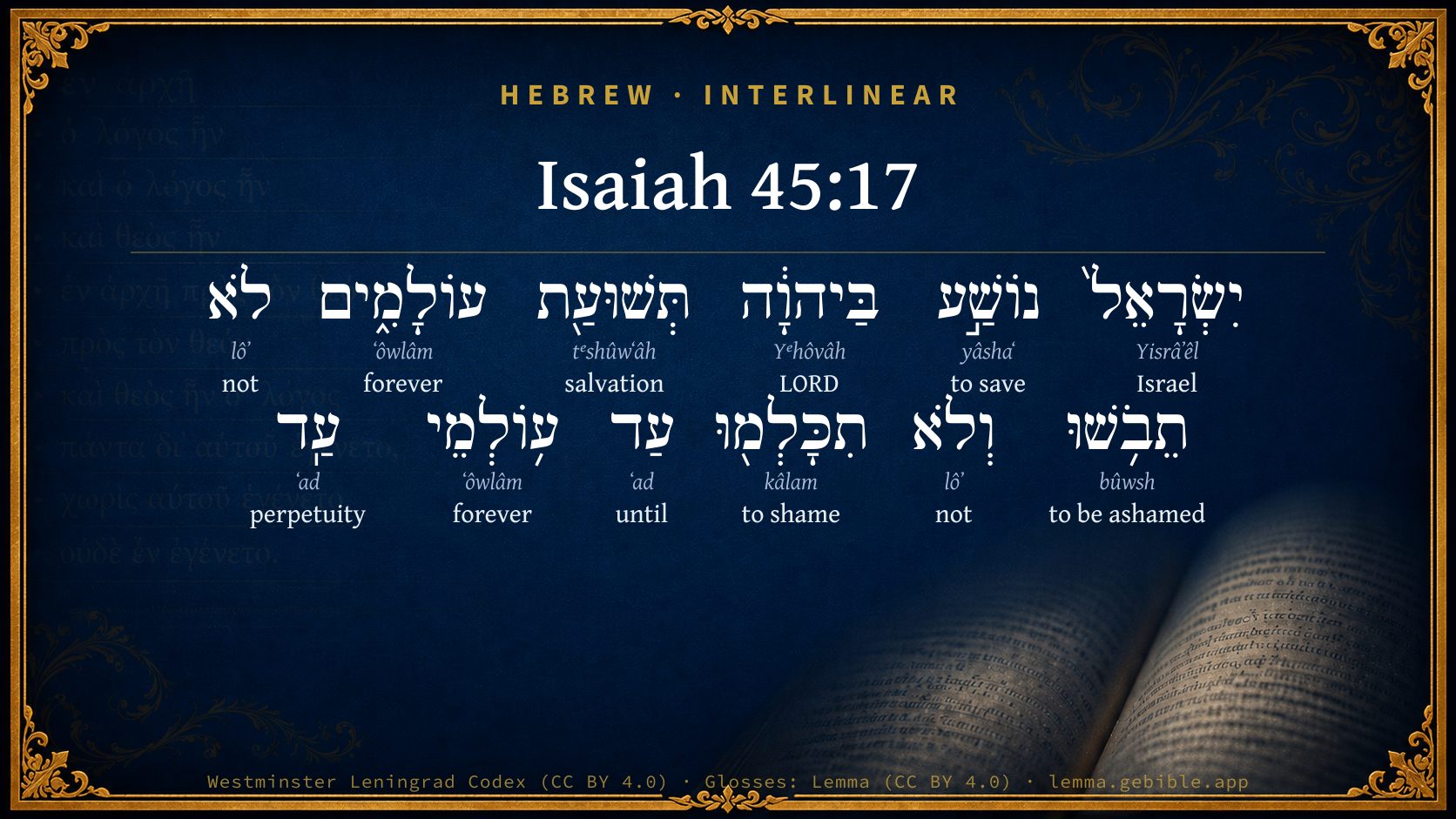
Isaiah 45:17

Hebrew (Westminster Leningrad Codex) Isaiah 45:17 appears in the Hebrew Old Testament. The text above is from the Westminster Leningrad Codex. Each word links to its Strong’s number, a concise gloss, and parsing drawn from the Open Scriptures Hebrew Bible morphology. Click any word for its full Brown-Driver-Briggs (BDB) entry.
Download image
Cite this verse

Isaiah 45:17 (World English Bible). Public Domain. Lemma interlinear Bible study tool, https://lemma.gebible.app/v/isaiah/45/17.

Show BibTeX & RIS
BibTeX
RIS
English Translation
[But] Israel shall be saved by Yahweh with an everlasting salvation: you shall not be disappointed nor confounded world without end.
World English Bible · Public Domain
Download a study sheet

One document with this verse’s original text, its word-by-word gloss line, the meaning frame, cross-references with their text, attributed commentary, and full source and license credits — printable, and it pastes into notes with its structure intact.

This verse Autodidact and up

Study sheet (.html) Plain text (.txt)

A passage Seminary Student

Up to 50 verses in one chapter. A passage sheet keeps up to 6 commentary sources and 12 cross-references per verse, in the order this page ranks them, and says so on the sheet whenever that leaves anything out. Ask for a single verse and you get the Autodidact verse sheet above.

Everything on this page stays free to read, with no account — the sheet is a download of what is already on screen, not access to it.

Want to remove ads? Support Godless Engineer
Compare translations 3

The same verse in 3 English versions, stacked beneath the original-language interlinear above. Click any original word for its lexicon entry.

Each is an independent rendering of the whole verse — the interlinear is not word-aligned to these translations.

Highlighted words mark where these versions differ — a whole-verse word diff, not a word-by-word alignment.

  • World English Bible Public Domain
    [But] Israel shall be saved by Yahweh with an everlasting salvation: you shall not be disappointed nor confounded world without end.
  • King James Version Public Domain
    But Israel shall be saved in the LORD with an everlasting salvation: ye shall not be ashamed nor confounded world without end.
  • unfoldingWord Literal Text CC BY-SA 4.0
    Israel will be saved by Yahweh a salvation of eternities. You will not have shame and you will not be disgraced to eternities of forever. q1

unfoldingWord Literal Text — © unfoldingWord, licensed CC BY-SA 4.0. Word-aligned USFM3 via Door43 (git.door43.org/unfoldingWord/en_ult).

Versions to compare (up to 4)

3 of 4 selected

Show all 18 translations

Every available English version of this verse, each an independent rendering of the whole verse.

  • World English Bible Public Domain
    [But] Israel shall be saved by Yahweh with an everlasting salvation: you shall not be disappointed nor confounded world without end.
  • Berean Standard Bible Public Domain
    But Israel will be saved by the LORD with an everlasting salvation; you will not be put to shame or humiliated, to ages everlasting.
  • Majority Standard Bible Public Domain
    But Israel will be saved by the LORD with an everlasting salvation; you will not be put to shame or humiliated, to ages everlasting.
  • King James Version Public Domain
    But Israel shall be saved in the LORD with an everlasting salvation: ye shall not be ashamed nor confounded world without end.
  • American Standard Version (1901) Public Domain
    `But' Israel shall be saved by Jehovah with an everlasting salvation: ye shall not be put to shame nor confounded world without end.
  • Revised Version (1885) Public Domain
    But Israel shall be saved by the LORD with an everlasting salvation: ye shall not be ashamed nor confounded world without end.
  • Geneva Bible (1599) Public Domain
    But Israel shall be saued in the Lord, with an euerlasting saluation: ye shall not be ashamed nor confounded worlde without ende.
  • Douay-Rheims (1899) Public Domain
    Israel is saved in the Lord with as eternal salvation: you shall not be con- founded, and you shall not be ashamed for ever and ever.
  • Young's Literal Translation Public Domain
    Israel hath been saved in Jehovah, A salvation age-during! Ye are not ashamed nor confounded Unto the ages of eternity!
  • Literal Standard Version CC BY-SA 4.0
    Israel has been saved in YHWH, || A perpetual salvation! You are not ashamed nor confounded || For all ages of eternity!
  • Unlocked Literal Bible CC BY-SA 4.0
    But Israel will be saved by Yahweh with an everlasting salvation; you will never again be ashamed or humiliated.
  • unfoldingWord Literal Text CC BY-SA 4.0
    Israel will be saved by Yahweh a salvation of eternities. You will not have shame and you will not be disgraced to eternities of forever. q1
  • Darby Bible Public Domain
    Israel shall be saved by Jehovah with an everlasting salvation: ye shall not be ashamed nor confounded, unto the ages of ages.
  • World Messianic Bible Public Domain
    Israel will be saved by the LORD with an everlasting salvation. You will not be disappointed nor confounded to ages everlasting.
  • Webster's Bible Public Domain
    But Israel shall be saved in the LORD with an everlasting salvation: ye shall not be ashamed nor confounded world without end.
  • Free Bible Version CC BY-SA 4.0
    But Israel will be saved by the Lord with a salvation that lasts forever. You will never be ashamed or disgraced for all eternity.
  • Bible in Basic English Public Domain
    But the Lord will make Israel free with an eternal salvation: you will not be put to shame or made low for ever and ever.
  • JPS Tanakh (1917) Public Domain
    O Israel, that art saved by the LORD with an everlasting salvation; ye shall not be ashamed nor confounded world without end.

Literal Standard Version (2020), Covenant Press — licensed CC BY-SA 4.0. Text via the HelloAO Bible API (eBible.org). Unlocked Literal Bible (unfoldingWord) — licensed CC BY-SA 4.0. Text via the HelloAO Bible API (eBible.org). unfoldingWord Literal Text — © unfoldingWord, licensed CC BY-SA 4.0. Word-aligned USFM3 via Door43 (git.door43.org/unfoldingWord/en_ult). Free Bible Version, Dr. Jonathan Gallagher — licensed CC BY-SA 4.0. Text via the HelloAO Bible API (eBible.org).

Word by word

More ways to search: Search by grammar → Find every occurrence → Compare this word →

Practice this passage: Drill this verse → Learn its vocabulary →

תְּשׁוּעַ֖ת
tᵉshûwʻâh
H8668
“salvation of”
Noun, Common, Feminine, Singular, Construct
Part of Speech
Noun
Type
Common
Gender
Feminine
Number
Singular
State
Construct
Full BDB Definition

Origin: from H7768 in the sense of H3467

TWOT: 929e

salvation, deliverance - deliverance (usually by God through human agency) - salvation (spiritual in sense)
  1. יִשְׂרָאֵל֙ Yisrâʼêl H3478 “Israel” Noun, Proper
  2. נוֹשַׁ֣ע yâshaʻ H3467 “to save” Verb, Niphal, Perfect, 3rd Person, Masculine, Singular
  3. בַּיהוָ֔ה Yᵉhôvâh H3068 “in/at · LORD” Preposition + Noun, Proper
  4. עוֹלָמִ֑ים ʻôwlâm H5769 “ages” Noun, Common, Masculine, Plural, Absolute
  5. לֹא lôʼ H3808 “not” Particle, Negative
  6. תֵבֹ֥שׁוּ bûwsh H954 “to be ashamed” Verb, Qal, Imperfect, 2nd Person, Masculine, Plural
  7. וְלֹא lôʼ H3808 “and · not” Conjunction + Particle, Negative
  8. תִכָּלְמ֖וּ kâlam H3637 “to shame” Verb, Niphal, Imperfect, 2nd Person, Masculine, Plural
  9. עַד ʻad H5704 “until” Preposition
  10. ע֥וֹלְמֵי ʻôwlâm H5769 “ages of” Noun, Common, Masculine, Plural, Construct
  11. עַֽד ʻad H5703 “perpetuity” Noun, Common, Masculine, Singular, Absolute

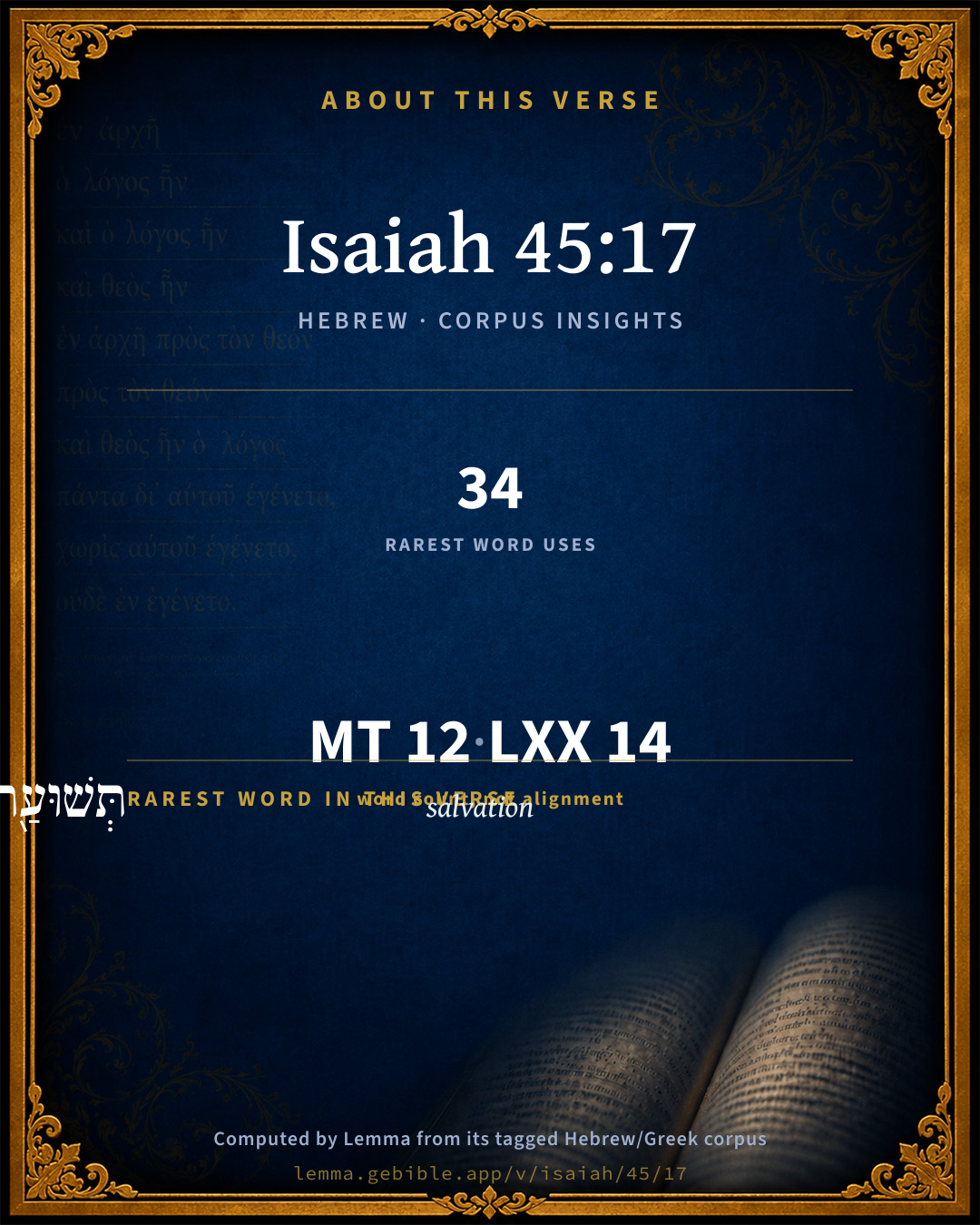
About this verse

These counts appear in no published source. They are computed here, from the morphology-tagged text and Lemma’s own curated glosses. What Lemma adds →

12
words
10
distinct lemmas
Prophets
section

Shared distinctive vocabulary

תְּשׁוּעַ֖ת salvation H8668 occurs in 32 verses of the Hebrew Bible. Also found in:

Grammatical profile

  • 3 verbs
  • 6 nouns
  • 1 preposition
  • 2 particles

Verb forms

  • נוֹשַׁ֣ע Niphal · Perfect
  • תֵבֹ֥שׁוּ Qal · Imperfect
  • תִכָּלְמ֖וּ Niphal · Imperfect

Repetition

Words recur within this verse — often emphatic in Hebrew:

  • עוֹלָמִ֑ים forever H5769 ×2
  • לֹא not H3808 ×2

Hebrew & Septuagint length

In English translation the verse runs 21 words from the Hebrew and 19 from the Septuagint (LXX English) — closely comparable.

A rough comparison of the two English renderings, which tokenize alike — not a word-level alignment.

Word counts can differ between the Hebrew and the Greek without any difference in meaning — e.g. the Hebrew direct-object marker אֵת has no separate Greek word, and Greek often adds the article ὁ.

In the original languages it is 12 Hebrew tokens and 14 Greek tokens — but the two are counted differently (Hebrew bundles its prefixes and suffixes into one token; the Greek is in lemma form), so that isn’t a like-for-like length.

Cross-references

32

Topical passages linked to Isaiah 45:17 in the Treasury of Scripture Knowledge — connected by theme and wording, ordered by reader-vote popularity; previews shown in the World English Bible.

  • Romans 10:11 For the Scripture says, "Whoever believes in him will not be disappointed."
  • Psalms 25:3 Yes, no one who waits for you shall be shamed. They shall be shamed who deal treacherously without cause.
  • Isaiah 54:4 Don't be afraid; for you shall not be ashamed: neither be confounded; for you shall not be disappointed: for you shall forget the shame of your youth; and the reproach of your widowhood shall you remember no more.
  • 1 Peter 2:6 Because it is contained in Scripture, "Behold, I lay in Zion a chief cornerstone, chosen, and precious: He who believes in him will not be disappointed."
  • Joel 2:26–27 You will have plenty to eat, and be satisfied, And will praise the name of Yahweh, your God, Who has dealt wondrously with you; And my people will never again be disappointed.
  • Isaiah 49:23 Kings shall be your nursing fathers, and their queens your nursing mothers: they shall bow down to you with their faces to the earth, and lick the dust of your feet; and you shall know that I am Yahweh; and those who wait for me shall not be disappointed.
  • Romans 9:33 even as it is written, "Behold, I lay in Zion a stumbling stone and a rock of offense; And no one who believes in him will be disappointed."
  • Isaiah 26:4 Trust in Yahweh forever; for in Yah, Yahweh, is an everlasting Rock.
  • Psalms 103:17 But Yahweh's loving kindness is from everlasting to everlasting with those who fear him, His righteousness to children's children;
  • Jeremiah 31:3 Yahweh appeared of old to me, [saying], Yes, I have loved you with an everlasting love: therefore with loving kindness have I drawn you.
  • 1 John 4:15 Whoever confesses that Jesus is the Son of God, God remains in him, and he in God.
  • John 5:24 "Most assuredly I tell you, he who hears my word, and believes him who sent me, has eternal life, and doesn't come into judgment, but has passed out of death into life.
  • Romans 8:1 There is therefore now no condemnation to those who are in Christ Jesus, who don't walk according to the flesh, but according to the Spirit.
  • Isaiah 60:19 The sun shall be no more your light by day; neither for brightness shall the moon give light to you: but Yahweh will be to you an everlasting light, and your God your glory.
  • Hebrews 5:9 Having been made perfect, he became to all of those who obey him the author of eternal salvation,
  • John 10:28 I give eternal life to them. They will never perish, and no one will snatch them out of my hand.
  • 2 Thessalonians 2:16 Now our Lord Jesus Christ himself, and God our Father, who loved us and gave us eternal comfort and good hope through grace,
  • Isaiah 29:22 Therefore thus says Yahweh, who redeemed Abraham, concerning the house of Jacob: Jacob shall not now be ashamed, neither shall his face now wax pale.
  • Romans 11:26 and so all Israel will be saved. Even as it is written, "There will come out of Zion the Deliverer, And he will turn away ungodliness from Jacob.
  • John 6:40 This is the will of the one who sent me, that everyone who sees the Son, and believes in him, should have eternal life; and I will raise him up at the last day."
  • Isaiah 54:8 In overflowing wrath I hid my face from you for a moment; but with everlasting loving kindness will I have mercy on you, says Yahweh your Redeemer.
  • Isaiah 45:25 In Yahweh shall all the seed of Israel be justified, and shall glory.
  • Philippians 3:8–9 Yes most assuredly, and I count all things to be loss for the excellency of the knowledge of Christ Jesus, my Lord, for whom I suffered the loss of all things, and count them nothing but refuse, that I may gain Christ
  • 1 John 5:11–13 The testimony is this, that God gave to us eternal life, and this life is in his Son.
  • Zephaniah 3:11 In that day you will not be disappointed for all your doings, in which you have transgressed against me; for then I will take away out of the midst of you your proudly exulting ones, and you will no more be haughty in my holy mountain.
  • 1 Corinthians 1:30–31 But of him, you are in Christ Jesus, who was made to us wisdom from God, and righteousness and sanctification, and redemption:
  • Isaiah 51:8 For the moth shall eat them up like a garment, and the worm shall eat them like wool; but my righteousness shall be forever, and my salvation to all generations.
  • Hosea 1:7 But I will have mercy on the house of Judah, and will save them by Yahweh their God, and will not save them by bow, nor by sword, nor by battle, by horses, nor by horsemen."
  • Isaiah 51:6 Lift up your eyes to the heavens, and look on the earth beneath; for the heavens shall vanish away like smoke, and the earth shall wax old like a garment; and those who dwell therein shall die in like manner: but my salvation shall be forever, and my righteousness shall not be abolished.
  • 2 Thessalonians 2:13–14 But we are bound to always give thanks to God for you, brothers loved by the Lord, because God chose you from the beginning for salvation through sanctification of the Spirit and belief in the truth;
  • 2 Corinthians 5:17–21 Therefore if anyone is in Christ, he is a new creation. The old things have passed away. Behold, all things have become new.
  • Romans 2:28–29 For he is not a Jew who is one outwardly, neither is that circumcision which is outward in the flesh;

Cross-references courtesy of OpenBible.info (CC BY 4.0).

Hebrew and Greek witnesses Masoretic Hebrew ↔ Greek Septuagint

The same verse in the two great witnesses to the Old Testament, shown verse-for-verse.

These are two independent witnesses, not word-aligned to each other, and the Septuagint is shown in lemma (dictionary) form.

Hebrew Isaiah 45:17 Masoretic · Westminster Leningrad Codex

יִשְׂרָאֵל֙ נוֹשַׁ֣ע בַּיהוָ֔ה תְּשׁוּעַ֖ת עוֹלָמִ֑ים לֹא תֵבֹ֥שׁוּ וְלֹא תִכָּלְמ֖וּ עַד ע֥וֹלְמֵי עַֽד

[But] Israel shall be saved by Yahweh with an everlasting salvation: you shall not be disappointed nor confounded world without end.

World English Bible · Public Domain

Greek LXX Isaiah 45:17 Septuagint · lemma form

ἰσραήλ σώζω ὑπό κύριος σωτηρία αἰώνιος οὐ αἰσχύνω οὐδέ μή ἐντρέπω ἕως ὁ αἰών

Israel is saved by the Lord with an everlasting salvation: they shall not be ashamed nor confounded for evermore.

LXX2012 (modern English Septuagint) · Public Domain

On this verse, Albert Barnes' Notes on the Bible discusses the Septuagint’s reading. Read the note in Commentary ↓

Hebrew: Westminster Leningrad Codex (CC BY 4.0). Greek: Septuagint (public domain); English from LXX2012 (modern English Septuagint) (Public Domain). How the Septuagint differs from the Hebrew →

Targum (Aramaic paraphrase)

1

The Targum is the ancient Jewish Aramaic paraphrase of the Hebrew Scriptures — an interpretive translation, not the Hebrew text itself. Onkelos (literal) and Pseudo-Jonathan (expansive) render the Torah, and Jonathan the Prophets. Coverage is partial: where no permissively-licensed English translation exists for a verse, only the Aramaic is shown. This is verse-level text, not a word-by-word alignment to the Hebrew.

  1. Targum Jonathan Prophets (Joshua–Malachi)
    יִשְׂרָאֵל יִתְפְּרִיק בְּמֵימְרָא דַייָ פּוּרְקָן עָלְמַיָא לָא תִבְהֲתוּן וְלָא תִתְכַּנְעוּן לַעֲלַם וּלְעַלְמֵי עָלְמַיָא:

    Israel shall be saved by the WORD of the Lord with an everlasting salvation: ye shall not be ashamed nor confounded for ever, yea, for ages after ages.

    Targum Jonathan — Aramaic: “Mikraot Gedolot” (public domain). English: “Sefaria Community Translation” (CC0 1.0 (public-domain dedication)); “London "Chaldee Paraphrase," 1871” (public domain). Text via Sefaria.

Commentary

Notes on Isaiah 45:17 from classic Christian and Jewish commentators (each source and its license shown beneath its notes). The classic Christian expositions comment on the surrounding passage and are grouped to its opening verse, so a note may address several verses; the Jewish commentaries on the Tanakh (Rashi and others) are per-verse, so they appear only where the commentator wrote on this verse.

Lemma curates 59 commentaries, every one of them public domain or Creative Commons licensed, each selected and text-cleaned for this edition rather than reprinted as found. About our sources →

Trapp's Complete Commentary

John Trapp

Isa 45:17 [But] Israel shall be saved in the LORD with an everlasting salvation: ye shall not be ashamed nor confounded world without end.

Ver. 17. But Israel … with an everlasting salvation.] By Cyrus they were not so, for not long after, Antiochus afflicted them, Herod got the sceptre from them, the Romans came and took away both them and their nation; but the Israel of God were, and are still, saved by Jesus, with an everlasting salvation.

John Trapp, A Commentary or Exposition upon All the Books of the Old and New Testament (1647–1656) — public domain. Text from a community e-Sword module.

The Biblical Illustrator

Joseph S. Exell

Isa_45:17

But Israel shall be saved in the Lord

A forecast of the Messianic age

As is usual in the prophets, the perfect dispensation, or what is called the Messianic age, is conceived as issuing immediately from the historical crisis which is the subject of the prophecy--in this case, the deliverance from Babylon.

(Prof. J. Skinner, D. D.)

Israel saved in the Lord

I. THE GLORIOUS OBJECT. Everlasting salvation in the Lord.

1. Includes deliverance from ignorance, guilt, &c., and the possession of light, peace, &c.; and this state continued and increased for ever. It is grace consummated in eternal glory.

2. This salvation is in the Lord--the Lord Messiah.

(1) As a possession, purchased by His own blood, in whose right only we can obtain it.

(2) As an inheritance, kept in trust, and to be conveyed by Him to the appointed heirs of it.

(3) As in a grand exemplar, in His human nature, of the complete and final happiness of the saints (Rom_8:29; Php_3:21). It is in Him both as a beatific object and a perpetual medium, through which the blessed will see and enjoy God for ever.

II. THE CHARACTER OF THE PERSONS TO WHOM EVERLASTING SALVATION IS PROMISED. Israel.

1. A name of great distinction in Scripture The Israelites, to whom everlasting salvation is promised, are such as are so in a spiritual sense.

2. True Israelites are such as have given their unfeigned consent to be Gods people, subjects, and servants; such as have joined themselves to the Lord in a perpetual covenant.

3. True Israelites are such as live in an unreserved subjection to the laws and government of God and the Redeemer (Rom_7:22). Through faith in Christ they are vitally united to Him, and from Him receive those hourly supplies of grace that qualify men for every good word and work.

III. THE GROUNDS OF THE CERTAINTY OF THEIR SALVATION.

1. The possession Christ has taken of it in the name and nature of all true believers in Him (Heb_6:20; Joh_14:2-3).

2. Christs intercession, which He ever lives in heaven to make for them Heb_7:25).

3. His mighty power which is engaged for them (1Pe_1:4-5).

4. Gods promise (Tit_1:2; Heb_6:17-18). (Sketches of Sermons.)

Saved in the Lord

That is, through Him (Rom_5:9). The elect of God dispersed over the earth shall be saved through the powerful operation of His glorious excellences, and in virtue of the perfect righteousness of the great Messiah. They shall be saved--

1. Through the love of God (Joh_3:16).

2. In His infinite wisdom, which He hath wonderfully displayed in devising and executing the astonishing plan of salvation.

3. Through His almighty power.

4. In His consummate righteousness; the rectitude of His nature, the equity of His providence, and the faithfulness of His promises, being clearly demonstrated by the accomplishment of this salvation. (R. Macculloch.)

Isaiahs far-reaching glance

He foresaw the redemption of suffering Israel by the hand of Cyrus, but uses terms that it would be a misleading and inexcusable blunder to employ if they are intended to be restricted to those small bands of immigrants returning under Ezra and Nehemiah, whose descendants rejected the Christ, and went forth into the great and long-ending dispersion after the Romans had destroyed the rebuilt city. Standing once, at sunrise, on a lower height of the Himalayas--lower, though still 10,000 feet above the plains--we saw beneath us, stretching away into the blue distance, leagues upon leagues of rolling country clothed with evergreen forests of tree ferns, tree rhododendrons and magnolias, till the view was lost in cloudland. But, behold, even as we watched, the clouds broke and scattered, trooping away into the vault of heaven like hosts of white-robed angels. Between their ranks were revealed, one after another, the mighty flanks of Kinchinjunga and her sister mountains; then their snow-peaks and glaciers. Another few minutes, and the last cloud had vanished, and the glittering crest of Mount Everest, the loftiest summit in the world--we know not how many hundreds of miles afield--flashed upon the horizon. The lower and nearer landscape was not lost, it was there still, in all its beauty and verdure, but we had no longer any eyes for it because of the glory that exceeded. Something like that would have been the prospect unfolded to the rapt Isaiahs spiritual eyesight, could he have understood all that was involved in his prophecies. He must have had at least a partial understanding of their meaning, for we read that these things said Isaiah because he saw [Christs] glory, and he spake of Him. Nevertheless, it is reserved for us to see most distinctly the full extent of the prophetic landscape, because from before our eyes even the remotest clouds that linger on the horizon have been lifted by the sun-rising of New Testament teaching. (F. Sessions.)

World without end

To eternal eternities. (F. Delitzsch.)

The expression does not occur again. (J Skinner.)

The Biblical Illustrator, edited by Joseph S. Exell (c. 1880s–1900s) — public domain. Text from a community e-Sword module.

The Preacher's Complete Homiletical Commentary

Joseph S. Exell (gen. ed.)

ISRAEL SAVED IN THE LORD

Isa_45:17. But Israel shall be saved in the Lord, &c.

The text contains a promise of “everlasting salvation” to the pious just, and is brought forward among the promises of their temporal deliverance from the Babylonish captivity; and there is a better, greater, and more lasting salvation that affects the soul, preserving it from endless misery, and securing its everlasting happiness, in and through the Lord Messiah.

I. THE GLORIOUS OBJECT—“Everlasting salvation,” in the Lord.

1. Everlasting salvation includes a deliverance from ignorance, guilt, &c.; and the possession of light, peace, &c.; and this state continued and increased for ever. It is grace consummated in endless glory (Rev_7:9, &c.)

2. This everlasting salvation is “in the Lord”—the Lord Messiah, Jesus Christ. It is in Him as a possession, purchased by His own blood, in whose right only we can obtain it. It is in Him as an inheritance, kept in trust, and to be conveyed by Him to the appointed heirs of it. It is in Him as in a grand exemplar, in His human nature, of the complete and final happiness of the saints who are predestinated, &c. (Rom_8:29; Php_3:21). It is in Him both as a beatific object and a perpetual medium, through which the blessed will see and enjoy God for ever.

II. THE CHARACTER OF THE PERSONS TO WHOM EVERLASTING SALVATION IS PROMISED—“Israel.”

1. Israel is a name of great distinction in Scripture. God Himself gave it to the patriarch Jacob, and in very peculiar circumstances (Gen_32:28). His posterity bore that name; as we are now called Christians, from Christ. But these were Israelites only by carnal generation—not in spirit and temper imitating the faith and treading in the steps of their progenitors, Abraham, &c. (Rom_9:6). The Israelites to whom everlasting salvation is promised, are such as are so in a spiritual sense: and under the name of Israel, in the sense of it, all true believers in Christ are comprehended.

2. True Israelites are such as have given their unfeigned consent to be God’s people, subjects and servants—such as have “joined themselves to the Lord in a perpetual covenant.”

3. In consequence of this, true Israelites are such as live in an unreserved subjection to the laws and government of God and the Redeemer (Rom_8:22). Through faith in Christ they are virtually united to Him, and from Him receive those hourly supplies of grace that qualify men for every good word and work.

III. THE GROUNDS OF THE CERTAINTY OF THEIR SALVATION.

1. The possession Christ has taken of it, in the name and nature of all true believers in Him (Heb_6:20; Joh_14:2-3).

2. Christ’s intercession, which He ever lives in heaven to make for them (Heb_7:25).

3. His mighty power which is engaged for them (1Pe_1:4-5).

4. God’s promise (Joh_5:2; Tit_1:2; Heb_6:17-18).

Application.

1. How precious should Christ be to believers!

2. The Lord’s people have good reason to love Christ’s appearance (2Ti_4:8; Heb_9:28).

3. What an encouragement to diligence and perseverance in appointed duty, seeing everlasting salvation will be the consequence of it! (1Co_15:58).—Sketches of Sermons, vol. iv. pp. 289–294).

The Preacher's Complete Homiletical Commentary (gen. ed. Joseph S. Exell; Funk & Wagnalls, c. 1892) — public domain (pre-1929). A full-Bible homiletical/sermon-outline anthology covering 65 of 66 books (2 John is absent from the source module). Text from a community e-Sword module.

Tyndale Open Study Notes

Tyndale Open Resources

45:17 Israel would never again be humiliated and disgraced, oppressed, harassed, or abused. The finality of these declarations suggests that this promise will be fulfilled at the end of time.

Tyndale Open Study Notes — © Tyndale Open Resources, licensed CC BY-SA 4.0. Text via the HelloAO Bible API.

Jamieson, Fausset & Brown

Robert Jamieson, A. R. Fausset & David Brown

in the Lord-- (Isa 45:24-25), contrasted with the idols which cannot give even temporary help (Isa 45:16); in Jehovah there is everlasting salvation (Isa 26:4).

not . . . ashamed--opposed to the doom of the idolaters, who, in the hour of need, shall be "ashamed" (see on Isa 45:16).

Jamieson, Fausset & Brown — Commentary Critical and Explanatory on the Whole Bible (1871) — public domain (CC PDM 1.0). Text via the HelloAO Bible API.

Ellicott's Commentary for English Readers

(17) World without end.—Literally, for the ages, or œons on œons in Psa_77:5.

A Bible Commentary for English Readers, edited by Charles John Ellicott (1878–1897) — public domain. Text from a community e-Sword module.

The Cambridge Bible for Schools and Colleges

gen. ed. J. J. S. Perowne

17. But Israel shall be saved in the Lord] Israel is saved by Jehovah.

with an everlasting salvation] which shall never be turned into confusion. The state of things introduced by the deliverance is final, including the manifestation of Jehovah as He is, and such a union between Him and His people as can never be dissolved. As is usual in the prophets, the perfect dispensation, or what is called the Messianic age, is conceived as issuing immediately from the historical crisis which is the subject of the prophecy, in this case the deliverance from Babylon.

world without end] More literally: to all eternity. The exact expression does not occur again.

The Cambridge Bible for Schools and Colleges (gen. ed. J. J. S. Perowne; Cambridge University Press, 1878–1918) — public domain. Text from a community e-Sword module.

John Gill's Exposition

But Israel shall be saved in the Lord,.... Not the carnal seed of Israel, or the natural posterity of Jacob, for only a remnant of them were saved; indeed, in the latter day, when there will be a general conversion of them, there will be a general salvation of them,

all Israel shall be saved; but here the spiritual Israel of God are meant, such as God has appointed unto salvation; who are taken into the covenant of his grace, in which their salvation is secured; who are his spiritual people, whom Christ saves from their sins; who are redeemed by the blood of Christ, and are called by his grace; who believe in him, and hope in the Lord: these "shall be saved": there is a certainty of their salvation, and not a mere probability and possibility of it only. It is not they "may be", but they "shall be" saved; it is the will of God they should, whose will cannot be resisted; they are the purchase of Christ, which he will never lose, and the Spirit is the earnest and pledge of salvation to them: and it is "in" and "by the Lord" they are saved, not in of themselves; their destruction is of themselves, but their salvation is of the Lord; and they are saved as they are in him, and owing to their being in him; they are chosen in him, and hence spring all the blessings of grace and salvation to them; they are representatively in him, as their federal Head; they are openly in him, in effectual calling; and they are justified in him, and by his righteousness, and so saved; and being in him, there is no condemnation to them, nor can they ever come into it. They are saved "by" the Lord; by the Word of the Lord, as the Targum; by Jesus Christ, the incarnate Word; by his obedience, sufferings, and death; by his blood, righteousness, and sacrifice; and by his interceding life, and that "with an everlasting salvation"; which is distinguished, by this epithet, from a temporal one, and is opposed to eternal damnation, the desert of sin; it is the salvation of the immortal soul, and includes in it grace and glory, which are perpetual and everlasting; and the duration of it is owing to the perpetuity of Christ's person, office, and grace: or, "with a salvation of ages", or "worlds" (a):

ye shall not be ashamed, nor confounded, world without end; or, "unto the ages of eternity" (b); that is, such who believe in Christ, and are saved by him, they shall not be ashamed, though the makers and worshippers of idols will; they shall not be confounded, neither in this world, nor in the other; they shall not be ashamed of Christ, his word, and ordinances, nor of their faith and hope in him, or of their sufferings for him; they shall not be ashamed in the resurrection morn, their vile bodies being fashioned like to the glorious body of Christ, when others shall rise to shame and everlasting contempt; nor shall they be ashamed at the coming of Christ, and when they stand before him, being clothed with white robes, and having on the wedding garment; when they shall be introduced into his own and his Father's kingdom and glory, into the world of happiness, which will know no end.

(a) "salute Seculorum", Pagninus, Montanus, Vatublus; "salvatione seculorum", Cocceius. So Ben Melcch interprets it, this world and the world to come; everlasting salvation takes in both. (b) "in secula perpetuitatis", Montanus, Vatablus.

John Gill's Exposition of the Whole Bible (1746–1763) — public domain (CC PDM 1.0). Text via the HelloAO Bible API.

Albert Barnes' Notes on the Bible

But Israel shall be saved - Referring primarily to the Jews in Babylon, but affirming the universal truth that the true Israel (compare Rom 2:28-29), that is, the people of God, shall be saved from all their trials, and shall be brought to his everlasting kingdom.

In the Lord - By Jehovah - ביהוה bayohvâh; Septuagint, Ἀπὸ κυρίου Apo kuriou. It shall be done by the power of Yahweh, and shall be traced to him alone. No more human power could have saved them from their captivity in Babylon; no human power can save the soul from hell.

With an everlasting salvation - It shall not be a temporary deliverance; but it shall be perpetual. In heaven his people shall meet no more foes; they shall suffer no more calamity: they shall be driven into no exile; they shall never die.

Ye shall not be ashamed nor confounded - This means:

1. That they should never find God to fail, that is, to be either unable or unwilling to befriend and rescue them Psa 46:1.

2. That they should never be ashamed, that is, have cause to regret that they had put their trust in him.

The idea is, that they who become his friends never regret it; never are ashamed of it. The time never can come, when anyone who has become a true friend of God will regret it. In prosperity or adversity; in sickness or health; at home or abroad; in safety or in danger; in life or in death: there will be no situation in which they will be ashamed that they gave their hearts to God. There never have been any true Christians who regretted that they became the friends of the Redeemer. Their religion may have exposed them to persecution; their names may have been east out as evil; they may have been stripped of their property; they may have been thrown into dungeons, laid on the rack, or led to the stake; but they have not regretted that they became the friends of God. Nor will they ever regret it. No man on a dying bed regrets that he is a friend of God. No man at the judgment bar will be ashamed to be a Christian. And in all the interminable duration of the world to come, the period never will, never can arrive, when anyone will ever be ashamed that he gave his heart early, and entirely to the Redeemer. Why then should not all become his friends? Why will not people pursue that course which they know they never can regret, rather than the ways of sin and folly, which they know must cover them with shame and confusion hereafter?

Albert Barnes' Notes on the Bible (1834–1885) — public domain. Text from a community e-Sword/MySword module.

Matthew Poole's English Annotations

With an everlasting salvation; not for a short time, as it was in the days of the judges and of the kings, under whom their dangers and calamities did frequently return upon them; but unto all ages, as it follows; whence it appears that he speaks not only nor chiefly of their deliverance out of Babylon, which was far from being complete or perpetual, as appears both from Scripture, as Ezr 9:8, and elsewhere, and from other authors; but of their redemption by Christ, by which this was truly and fully verified unto a great number of Israelites after the flesh, and especially unto the mystical, God’s church and people, who are frequently called in Scripture by that name; as the ordinances and privileges of the gospel are commonly described in the Old Testament by expressions borrowed from the Levitical dispensation. And that this is the meaning of the place is evident from Isa 45:22, wherein all the ends of the earth are said to be sharers in this salvation.

Matthew Poole's English Annotations on the Holy Bible (1683–1685) — public domain. Text from a community e-Sword/MySword module.

The Pulpit Commentary

Israel shall be saved... with an everlasting salvation; literally, a salvation of ages; i.e. one which will continue age after age. As Mr. Cheyne remarks, for this to be so, the redemption required to be spiritual as well as temporal. Otherwise it would ere long have been forfeited.

The Pulpit Commentary (1880–1919), ed. H.D.M. Spence-Jones & Joseph S. Exell — public domain. Text from a community e-Sword module.

J. A. Alexander on Isaiah

Joseph Addison Alexander

“Israel is saved in Jehovah (with) an everlasting salvation (literally, salvation, of ages or eternities); ye shall not be ashamed, and ye shall not be confounded forever” (literally, until the ages of eternity), or as the English Version has it, world without end. This is the counterpart and contrast to the threatening in the verse preceding, upon which it throws some light by showing that the shame and confusion which awaits the idolater is not mere wounded pride or sense of disappointment, but the loss and opposite of that salvation which is promised to God’s people, or in other words, eternal perdition. Israel is saved already, (i.e., his salvation is secured), not merely through the Lord but in Him, (i.e., by virtue of an intimate and vital union with Him), as genuine and living members of His body. The general form of this solemn declaration, and the eternity again and again predicted of the salvation promised, seems to show that the Israel of this text and of others like it, is not the Jewish people, considered simply as an ancient nation, but the Jewish people considered as the church of God, a body which has never ceased and never will cease to exist and claim the promises.

Joseph Addison Alexander, The Prophecies of Isaiah (1846–1847; New York: Scribner, 1870–1878) — public domain. Text from a community e-Sword module.

Ibn Ezra

Rabbi Abraham ibn Ezra

Israel is saved by the Lord. Therefore they will not be ashamed, as those men have been put to shame, that made vain things which cannot help in times of trouble.

עד Innumerable.

Ibn Ezra on the Tanakh — English translations: “Sefaria Community Translation” (CC0 1.0 (public-domain dedication)); “Yalkut, Sifsei Chachomim Chumash, Metsudah Publications, 2009” (CC BY 4.0); and “Commentary of Ibn Ezra on Isaiah - trans. by M. Friedlander, 1873” (public domain). Text via Sefaria.

Lesson kit

Teaching starters — assembled from the data on this page, not authored interpretation. Every prompt links to the verse data it draws on. Edit before teaching.

Isaiah, in the Prophets, opens this verse with 12 words (10 distinct Hebrew lemmas). Its most distinctive word is tᵉshûwʻâh (“salvation”). A historical commentator’s framing appears above. Read the whole chapter for the surrounding context.

Discussion questions

  1. What does “salvation” (tᵉshûwʻâh) contribute to the verse as a whole?
  2. Judges 15:18 shares the word «salvation» with this verse. How do the two illuminate each other?
  3. “forever” occurs 2× in this one verse. What is the effect of the repetition?
  4. The translations on this page render this verse differently — a whole-verse word diff, not a word-by-word alignment. What might account for the different wordings?
  5. The verb «נוֹשַׁ֣ע» is Niphal Perfect. How does its form color the action?
  6. Reading how Trapp's Complete Commentary and The Biblical Illustrator read this verse, where do the two commentators agree and where do they part?

Things to notice

Reading settings

Reading text

Shown beneath each verse's original-language words.

Old Testament
Old Testament edition

Read the OT as the Masoretic Hebrew (MT) or the Greek Septuagint (LXX).

English shown for the Greek Septuagint (in the Hebrew ↔ Greek comparison).

Comparing translations? Open the Compare panel on any verse page to stack up to four side by side.