
Isaiah 63:8

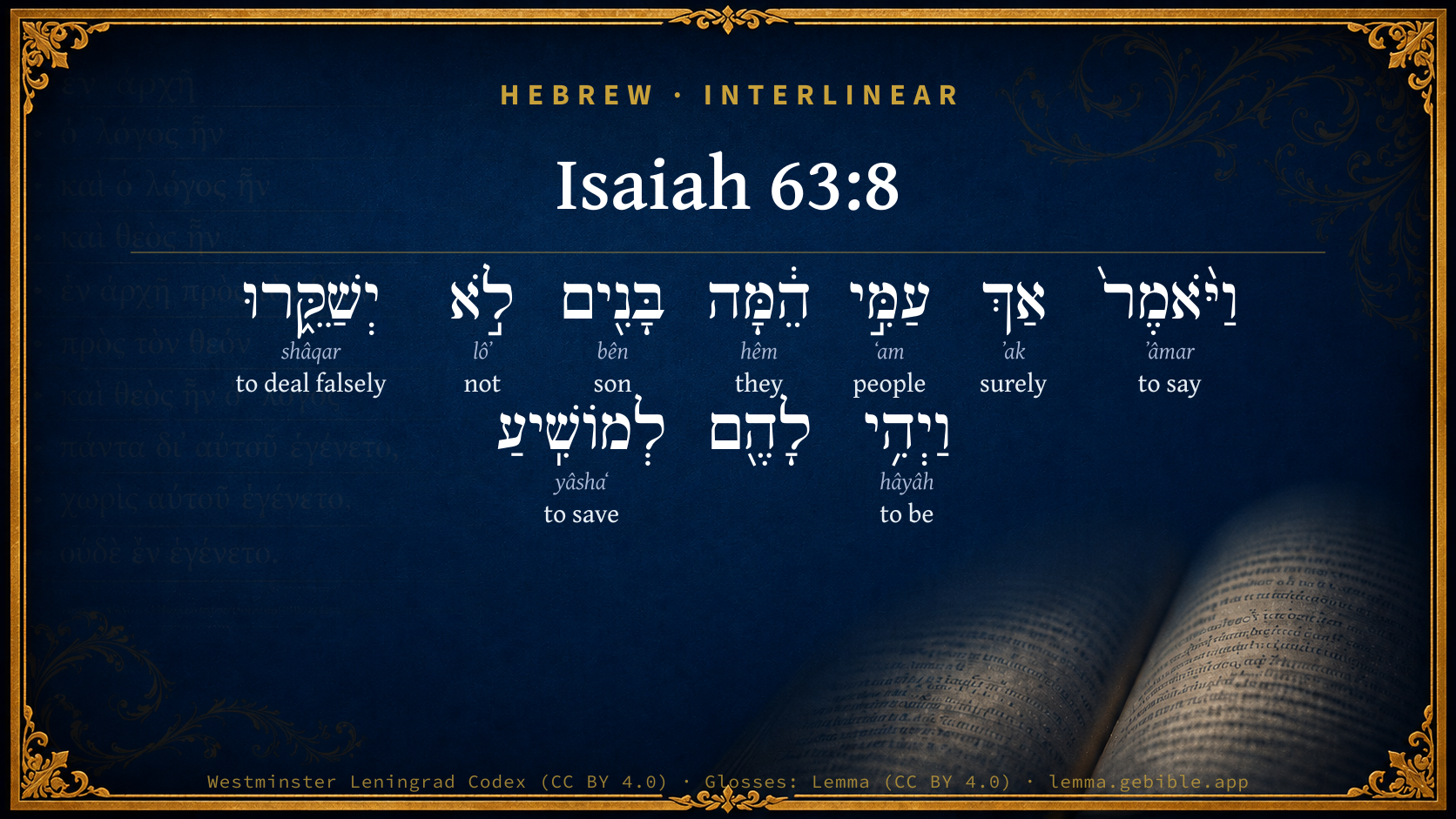
Hebrew (Westminster Leningrad Codex) Isaiah 63:8 appears in the Hebrew Old Testament. The text above is from the Westminster Leningrad Codex. Each word links to its Strong’s number, a concise gloss, and parsing drawn from the Open Scriptures Hebrew Bible morphology. Click any word for its full Brown-Driver-Briggs (BDB) entry.
Download image
Cite this verse

Isaiah 63:8 (World English Bible). Public Domain. Lemma interlinear Bible study tool, https://lemma.gebible.app/v/isaiah/63/8.

Show BibTeX & RIS
BibTeX
RIS
English Translation
For he said, Surely, they are my people, children who will not deal falsely: so he was their Savior.
World English Bible · Public Domain
Download a study sheet

One document with this verse’s original text, its word-by-word gloss line, the meaning frame, cross-references with their text, attributed commentary, and full source and license credits — printable, and it pastes into notes with its structure intact.

This verse Autodidact and up

Study sheet (.html) Plain text (.txt)

A passage Seminary Student

Up to 50 verses in one chapter. A passage sheet keeps up to 6 commentary sources and 12 cross-references per verse, in the order this page ranks them, and says so on the sheet whenever that leaves anything out. Ask for a single verse and you get the Autodidact verse sheet above.

Everything on this page stays free to read, with no account — the sheet is a download of what is already on screen, not access to it.

Want to remove ads? Support Godless Engineer
Compare translations 3

The same verse in 3 English versions, stacked beneath the original-language interlinear above. Click any original word for its lexicon entry.

Each is an independent rendering of the whole verse — the interlinear is not word-aligned to these translations.

Highlighted words mark where these versions differ — a whole-verse word diff, not a word-by-word alignment.

  • World English Bible Public Domain
    For he said, Surely, they are my people, children who will not deal falsely: so he was their Savior.
  • King James Version Public Domain
    For he said, Surely they are my people, children that will not lie: so he was their Saviour.
  • unfoldingWord Literal Text CC BY-SA 4.0
    And he said, “Surely they my people, sons will not deal falsely.” And he became a savior for them.

unfoldingWord Literal Text — © unfoldingWord, licensed CC BY-SA 4.0. Word-aligned USFM3 via Door43 (git.door43.org/unfoldingWord/en_ult).

Versions to compare (up to 4)

3 of 4 selected

Show all 18 translations

Every available English version of this verse, each an independent rendering of the whole verse.

  • World English Bible Public Domain
    For he said, Surely, they are my people, children who will not deal falsely: so he was their Savior.
  • Berean Standard Bible Public Domain
    For He said, “They are surely My people, sons who will not be disloyal.” So He became their Savior.
  • Majority Standard Bible Public Domain
    For He said, “They are surely My people, sons who will not be disloyal.” So He became their Savior.
  • King James Version Public Domain
    For he said, Surely they are my people, children that will not lie: so he was their Saviour.
  • American Standard Version (1901) Public Domain
    For he said, Surely, they are my people, children that will not deal falsely: so he was their Saviour.
  • Revised Version (1885) Public Domain
    For he said, Surely, they are my people, children that will not deal falsely: so he was their saviour.
  • Geneva Bible (1599) Public Domain
    For he saide, Surely they are my people, children that wil not lie: so he was their Sauiour.
  • Douay-Rheims (1899) Public Domain
    And he said: Surely they are my people, children that will not deny: so he became their saviour.
  • Young's Literal Translation Public Domain
    And He saith, Only My people they `are', Sons -- they lie not, and He is to them for a saviour.
  • Literal Standard Version CC BY-SA 4.0
    And He says, “Surely they [are] My people, || Sons—they do not lie,” and He is to them for a Savior.
  • Unlocked Literal Bible CC BY-SA 4.0
    For he said, “For certain they are my people, children who are not disloyal.” He became their Savior.
  • unfoldingWord Literal Text CC BY-SA 4.0
    And he said, “Surely they my people, sons will not deal falsely.” And he became a savior for them.
  • Darby Bible Public Domain
    And he said, They are indeed my people, children that will not lie; and he became their Saviour.
  • World Messianic Bible Public Domain
    For he said, “Surely, they are my people, children who will not deal falsely;” so he became their Savior.
  • Webster's Bible Public Domain
    For he said, Surely they are my people, children that will not lie: so he was their Savior.
  • Free Bible Version CC BY-SA 4.0
    He said, “Aren't they my people, children who wouldn't lie to me?” So he became their Savior.
  • Bible in Basic English Public Domain
    For he said, Truly they are my people, children who will not be false: so he was their saviour out of all their trouble.
  • JPS Tanakh (1917) Public Domain
    For He said: 'Surely, they are My people, children that will not deal falsely'; so He was their Saviour.

Literal Standard Version (2020), Covenant Press — licensed CC BY-SA 4.0. Text via the HelloAO Bible API (eBible.org). Unlocked Literal Bible (unfoldingWord) — licensed CC BY-SA 4.0. Text via the HelloAO Bible API (eBible.org). unfoldingWord Literal Text — © unfoldingWord, licensed CC BY-SA 4.0. Word-aligned USFM3 via Door43 (git.door43.org/unfoldingWord/en_ult). Free Bible Version, Dr. Jonathan Gallagher — licensed CC BY-SA 4.0. Text via the HelloAO Bible API (eBible.org).

Word by word

More ways to search: Search by grammar → Find every occurrence → Compare this word →

Practice this passage: Drill this verse → Learn its vocabulary →

יְשַׁקֵּ֑רוּ
shâqar
H8266
“to deal falsely”
Verb, Piel, Imperfect, 3rd Person, Masculine, Plural
Part of Speech
Verb
Stem
Piel
Form
Imperfect
Person
3rd Person
Gender
Masculine
Number
Plural
Full BDB Definition

Origin: a primitive root

TWOT: 2461

to do or deal falsely, be false, trick, cheat - (Piel) to deal falsely - (Qal) to deal falsely
  1. וַיֹּ֨אמֶר֙ ʼâmar H559 “and · to say” Conjunction + Verb, Qal, Sequential Imperfect, 3rd Person, Masculine, Singular
  2. אַךְ ʼak H389 “surely” Particle, Accusative
  3. עַמִּ֣י ʻam H5971 “people · my” Noun, Common, Masculine, Singular, Construct + Suffix, Personal, 1st Person, Common, Singular
  4. הֵ֔מָּה hêm H1992 “they” Pronoun, Personal, 3rd Person, Masculine, Plural
  5. בָּנִ֖ים bên H1121 “sons” Noun, Common, Masculine, Plural, Absolute
  6. לֹ֣א lôʼ H3808 “not” Particle, Negative
  7. וַיְהִ֥י hâyâh H1961 “and · to be” Conjunction + Verb, Qal, Sequential Imperfect, 3rd Person, Masculine, Singular
  8. לְמוֹשִֽׁיעַ yâshaʻ H3467 “to/for · saving” Preposition + Verb, Hiphil, Participle Active, Masculine, Singular, Absolute

About this verse

These counts appear in no published source. They are computed here, from the morphology-tagged text and Lemma’s own curated glosses. What Lemma adds →

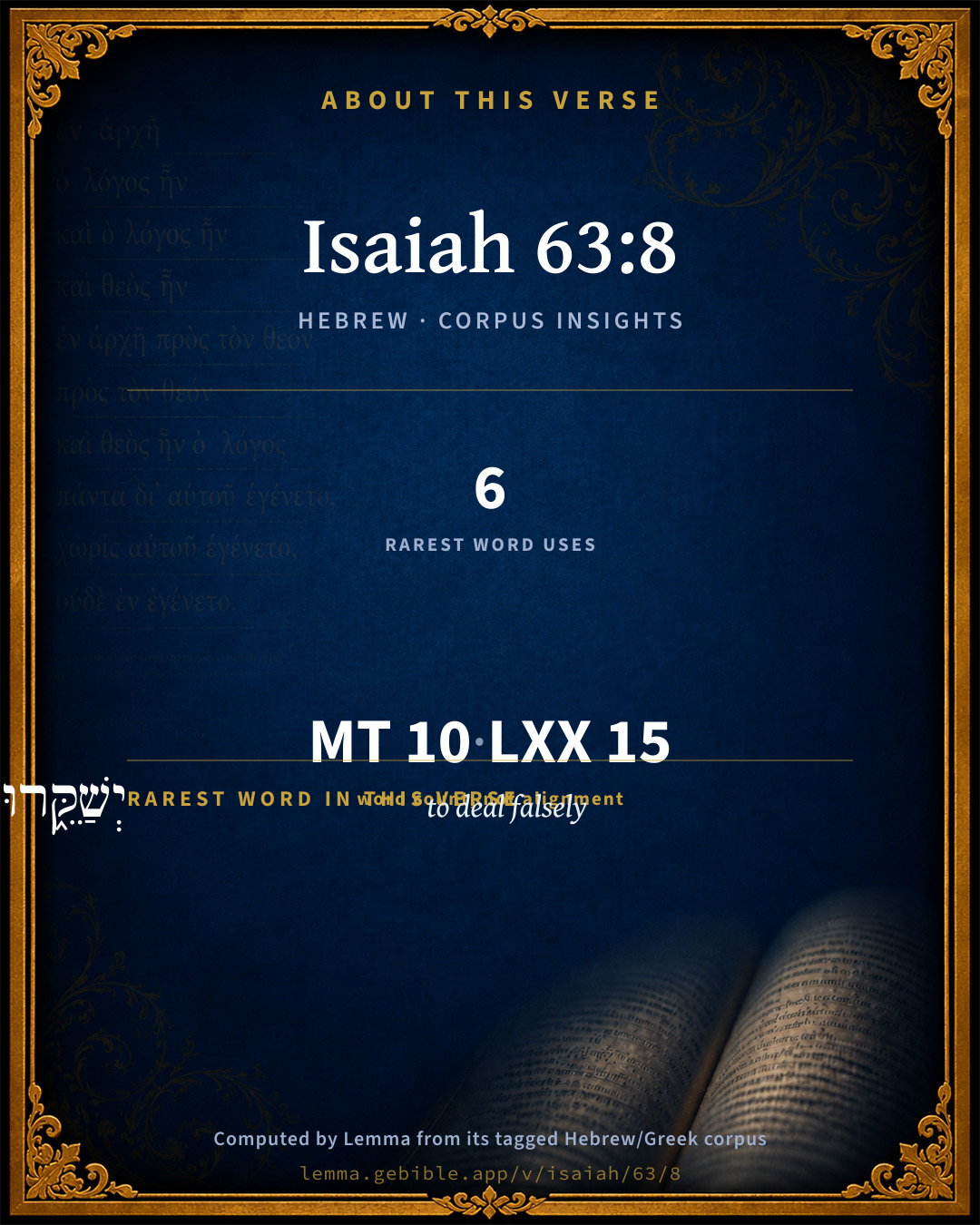
10
words
9
distinct lemmas
Prophets
section

Notable vocabulary

The rarest word here is יְשַׁקֵּ֑רוּ to deal falsely H8266 — appearing just 6 times in the whole Hebrew Bible.

Shared distinctive vocabulary

יְשַׁקֵּ֑רוּ to deal falsely H8266 occurs in 6 verses of the Hebrew Bible. Also found in:

Grammatical profile

  • 4 verbs
  • 2 nouns
  • 1 pronoun
  • 1 preposition
  • 2 particles

Verb forms

  • וַיֹּ֨אמֶר֙ Qal · Sequential Imperfect
  • יְשַׁקֵּ֑רוּ Piel · Imperfect
  • וַיְהִ֥י Qal · Sequential Imperfect
  • לְמוֹשִֽׁיעַ Hiphil · Participle Active

Hebrew & Septuagint length

In English translation the verse runs 19 words from the Hebrew and 21 from the Septuagint (LXX English) — closely comparable.

A rough comparison of the two English renderings, which tokenize alike — not a word-level alignment.

Word counts can differ between the Hebrew and the Greek without any difference in meaning — e.g. the Hebrew direct-object marker אֵת has no separate Greek word, and Greek often adds the article ὁ.

In the original languages it is 10 Hebrew tokens and 15 Greek tokens — but the two are counted differently (Hebrew bundles its prefixes and suffixes into one token; the Greek is in lemma form), so that isn’t a like-for-like length.

Cross-references

25

Topical passages linked to Isaiah 63:8 in the Treasury of Scripture Knowledge — connected by theme and wording, ordered by reader-vote popularity; previews shown in the World English Bible.

  • Genesis 17:7 I will establish my covenant between me and you and your seed after you throughout their generations for an everlasting covenant, to be a God to you and to your seed after you.
  • Exodus 6:7 and I will take you to me for a people, and I will be to you a God; and you shall know that I am Yahweh your God, who brings you out from under the burdens of the Egyptians.
  • Isaiah 12:2 Behold, God is my salvation. I will trust, and will not be afraid; for Yah, Yahweh, is my strength and song; and he has become my salvation."
  • Exodus 3:7 Yahweh said, "I have surely seen the affliction of my people who are in Egypt, and have heard their cry because of their taskmasters, for I know their sorrows.
  • Exodus 4:22–23 You shall tell Pharaoh, 'Thus says Yahweh, Israel is my son, my firstborn,
  • Exodus 19:5–6 Now therefore, if you will indeed obey my voice, and keep my covenant, then you shall be my own possession from among all peoples; for all the earth is mine;
  • Exodus 24:7 He took the book of the covenant and read it in the hearing of the people, and they said, "All that Yahweh has spoken will we do, and be obedient."
  • Deuteronomy 33:29 Happy are you, Israel: Who is like you, a people saved by Yahweh, The shield of your help, The sword of your excellency! Your enemies shall submit themselves to you; You shall tread on their high places.
  • Psalms 78:36–37 But they flattered him with their mouth, And lied to him with their tongue.
  • Psalms 106:21 They forgot God, their Savior, Who had done great things in Egypt,
  • Isaiah 41:8 But you, Israel, my servant, Jacob whom I have chosen, the seed of Abraham my friend,
  • Isaiah 43:3 For I am Yahweh your God, the Holy One of Israel, your Savior; I have given Egypt as your ransom, Ethiopia and Seba in your place.
  • Isaiah 43:11 I, even I, am Yahweh; and besides me there is no savior.
  • Isaiah 51:4 Attend to me, my people; and give ear to me, my nation: for a law shall go forth from me, and I will establish my justice for a light of the peoples.
  • Isaiah 57:11 Of whom have you been afraid and in fear, that you lie, and have not remembered me, nor laid it to your heart? Haven't I held my peace even of long time, and you don't fear me?
  • Jeremiah 14:8 You hope of Israel, the Savior of it in the time of trouble, why should you be as a foreigner in the land, and as a wayfaring man who turns aside to stay for a night?
  • Hosea 13:4 "Yet I am Yahweh your God from the land of Egypt; And you will know no god but me, And besides me there is no savior.
  • Zephaniah 3:7 I said, "Just fear me. Receive correction, so that her dwelling won't be cut off, according to all that I have appointed concerning her." But they rose early and corrupted all their doings.
  • John 1:47 Jesus saw Nathanael coming to him, and said about him, "Behold, an Israelite indeed, in whom is no deceit!"
  • Romans 11:1–2 I ask then, Did God reject his people? May it never be! For I also am an Israelite, a descendant of Abraham, of the tribe of Benjamin.
  • Romans 11:28 Concerning the Gospel, they are enemies for your sake. But concerning the election, they are beloved for the fathers' sake.
  • Ephesians 4:25 Therefore, putting away falsehood, speak truth each one with his neighbor. For we are members one of another.
  • Colossians 3:9 Don't lie to one another, seeing that you have put off the old man with his doings,
  • 1 John 4:14 We have seen and testify that the Father has sent the Son as the Savior of the world.
  • Jude 1:25 to God our Savior, who alone is wise, be glory and majesty, dominion and power, both now and forever. Amen.

Cross-references courtesy of OpenBible.info (CC BY 4.0).

Hebrew and Greek witnesses Masoretic Hebrew ↔ Greek Septuagint

The same verse in the two great witnesses to the Old Testament, shown verse-for-verse.

These are two independent witnesses, not word-aligned to each other, and the Septuagint is shown in lemma (dictionary) form.

Hebrew Isaiah 63:8 Masoretic · Westminster Leningrad Codex

וַיֹּ֨אמֶר֙ אַךְ עַמִּ֣י הֵ֔מָּה בָּנִ֖ים לֹ֣א יְשַׁקֵּ֑רוּ וַיְהִ֥י לָהֶ֖ם לְמוֹשִֽׁיעַ

For he said, Surely, they are my people, children who will not deal falsely: so he was their Savior.

World English Bible · Public Domain

Greek LXX Isaiah 63:8 Septuagint · lemma form

καί εἶπον οὐ ὁ λαός ἐγώ τέκνον οὐ μή ἀθετέω καί γίγνομαι αὐτός εἰς σωτηρία

And he said, Is it not my people? the children surely will not be rebellious: and he became to them deliverance

LXX2012 (modern English Septuagint) · Public Domain

On this verse, Adam Clarke's Commentary discusses the Septuagint’s reading. Read the note in Commentary ↓

Hebrew: Westminster Leningrad Codex (CC BY 4.0). Greek: Septuagint (public domain); English from LXX2012 (modern English Septuagint) (Public Domain). How the Septuagint differs from the Hebrew →

Targum (Aramaic paraphrase)

1

The Targum is the ancient Jewish Aramaic paraphrase of the Hebrew Scriptures — an interpretive translation, not the Hebrew text itself. Onkelos (literal) and Pseudo-Jonathan (expansive) render the Torah, and Jonathan the Prophets. Coverage is partial: where no permissively-licensed English translation exists for a verse, only the Aramaic is shown. This is verse-level text, not a word-by-word alignment to the Hebrew.

  1. Targum Jonathan Prophets (Joshua–Malachi)
    וַאֲמַר בְּרַם עַמִי אִינוּן בְּנַיָא דְלָא יְשַׁקְרוּן וַהֲוָה מֵימְרֵהּ לְהוֹן פָּרִיק:

    And He said, Surely, they are my people, children that will not lie: and His WORD became their salvation.

    Targum Jonathan — Aramaic: “Mikraot Gedolot” (public domain). English: “Sefaria Community Translation” (CC0 1.0 (public-domain dedication)); “London "Chaldee Paraphrase," 1871” (public domain). Text via Sefaria.

Commentary

Notes on Isaiah 63:8 from classic Christian and Jewish commentators (each source and its license shown beneath its notes). The classic Christian expositions comment on the surrounding passage and are grouped to its opening verse, so a note may address several verses; the Jewish commentaries on the Tanakh (Rashi and others) are per-verse, so they appear only where the commentator wrote on this verse.

Lemma curates 59 commentaries, every one of them public domain or Creative Commons licensed, each selected and text-cleaned for this edition rather than reprinted as found. About our sources →

Trapp's Complete Commentary

John Trapp

Isa 63:8 For he said, Surely they [are] my people, children [that] will not lie: so he was their Saviour.

Ver. 8. For he said, Surely they are my people, children that will not lie,] q.d., I presume they will not; it were a foul shame for them if they should deceive my expectation, deal disloyally, show themselves deceitful in the covenant. The officers of Merindol, in France, answered the Popish bishop that moved them to abjure, that they marvelled much that he would offer to persuade them to lie to God and the world. And albeit that all men by nature are liars; yet they had learned by the Word of God that they ought diligently to take heed of lying in any matter, be it never so small. Also that they ought diligently to take heed that their children did not accustom or use themselves to lie, and therefore punish them very sharply when they took them with any lie, even as if they had committed a robbery; for the devil is a liar, &c. Here the bishop rose up in a great anger, and so departed. {a}

{a} Acts and Mon., 866.

John Trapp, A Commentary or Exposition upon All the Books of the Old and New Testament (1647–1656) — public domain. Text from a community e-Sword module.

The Biblical Illustrator

Joseph S. Exell

Isa_63:8

Children that will not lie

Sincerity toward God

The Christian exemplifying the power of truth in his renewed nature, and in all the engagements and relations of life, is a phenomenon--a miracle of grace.

A Christian Church, consisting of believers adorning, in all things, the doctrine of God our Saviour, are men wondered at. Yet, peculiar or eccentric as the course of such men may be deemed in the world, it is evident, from Scripture, that the people of God are expected to render practical homage to the truth no less habitual and profound.

I. THEIR REGARD FOR TRUTH. Children that will not lie.

1. They estimate truth at its proper value. Buy the truth, but sell it not. Divine truth--the truth as it is in Jesus--is the greatest treasure our world contains. The full possession of this treasure cannot be secured with diligence and care. Search the Scriptures. Prove all things. So that thou incline thine ear unto wisdom, and apply thine heart to understanding. Yea, if thou criest after knowledge, and liftest up thy voice for understanding; if thou seekest her as silver, and searchest for her as for hid treasures, then shalt thou understand the fear of the Lord, and find the knowledge of God. Yet no man ever reached a full and abiding conviction of Divine truth by a mere process of investigation. No one will ever come to the light until he feels that he is walking in darkness. No one will ever find the truth until he feels that he has everything to learn in order to life and salvation, and that Christ alone can teach him. All Thy children shall be taught of the Lord.

2. When truth is sought from this Divine source it will be cordially welcomed.

3. They are concerned for the preservation of the truth in themselves. Not in the letter only, but in its spirit and power. The truth may be held in unrighteousness. The Gospel itself may become the savour of death unto death. What solemn words are those of Christ, If, therefore, the light that is in thee be darkness, how great is that darkness!

4. They bear a distinct and consistent testimony for the truth. What we feel deeply we shall speak freely. We believe, said the apostle, and therefore speak.

5. If the truth be so valued, received, obeyed, and testified, it will exert a practical influence in all the relative duties and circumstances of life.

II. HOW FAR IS THIS THOROUGH TRUTHFULNESS DISTINCTIVE OF THE PEOPLE OF GOD?

1. Sincerity toward God--faith unfeigned--brings with it the conviction that the subjects of it are His people. They have the witness within themselves. They are the children of light. They that have known the truth in its power can say, The truth dwelleth in us, and shall be in us for ever.

2. Their relation to God is made manifest to others.

3. Such sincere and faithful men have the strength of the people of God. If you would find the strongest men in the worlds history you must not look for them in camps, in senates, or in palaces, but in dungeons, in exile, or at the stake. It was not Caesar, Alexander, Napoleon, or Wellington that affected the greatest changes in the world, but men who were made witnesses for the truth. Ye are strong, for the Word of God abideth in you; and ye have overcome the wicked one. The spirit of faith alone is invincible.

4. Those who are faithful to the truth have the freedom of Gods people. I will walk at liberty, for I seek Thy precepts.

5. They have the peace of the people of God and the honour sure to arise from fidelity. (J. Waddington, D. D.)

Fidelity between God and His people

God deals fairly and faithfully with them, and therefore expects they should deal so with Him. (M. Henry.)

Children that will not lie

Gods people are children that will not lie, for those that will are not His children, but the devil s. (M. Henry.)

The Biblical Illustrator, edited by Joseph S. Exell (c. 1880s–1900s) — public domain. Text from a community e-Sword module.

Joseph Benson's Commentary

Isa 63:8-9. For he said — Namely, within himself, of old, when he made a covenant with our fathers, and brought them out of Egypt; Surely they are my people — In covenant with me: though they are unworthy of me, yet I cannot but look upon them as my people. Children that will not lie — That will keep my covenant; that will not deal falsely with me, to whom they are under such unspeakable obligations. This is spoken by God, after the manner of men, who are always apt to hope the best concerning their children, even though, in times past, they may have been refractory and disobedient. So he was their Saviour — Namely, on these hopes and conditions he undertook to be their Saviour: or, he alone was their Saviour. When there was none to save, none to uphold, then he saved them. In all their affliction he was afflicted — When there was a necessity of correcting them, in order to their amendment, he had a compassionate sense of the evils which they suffered: see Deu 32:36; Jdg 10:16; Psa 106:44-45. And the angel of his presence saved them — From the house of bondage, through the Red sea, and in the wilderness. The same angel that conducted them in all their journeys, and brought them into Canaan, as Captain of the Lord’s host, (Jos 5:15,) even the Lord Jesus Christ, who appeared to Moses in the bush, (Exo 3:2-6, compared with Act 7:35,) in whom God’s name was, Exo 23:20-21. Whom the Jews tempted in the wilderness, for they tempted Christ, 1Co 10:9; and who was the spiritual rock that followed them, typified by the natural rock cleft to afford them water: who was before Abraham, Joh 8:58, and before all things, Col 1:17 : see note on Exo 23:20-21 : called the angel, messenger, or mediator of the covenant, Mal 3:1; and here the angel of his presence; and his presence, Exo 33:14, as appearing continually before his face to intercede for his church. In his love and in his pity he redeemed them — This shows the ground of his kindness: they were a stubborn, superstitious, idolatrous people, yet Christ’s love and pity saved them notwithstanding. And he bore them, and carried them — As a father his child, or an eagle her young ones; he carried them in the arms of his power, and on the wings of his providence: see notes on Deu 1:31; and Deu 32:10-12; and Isa 46:4. And this he did all the days of old, for many ages past; from the days of Abraham or Moses; from their bondage in Egypt to their settlement in Canaan, and through their succeeding generations. And this his ancient kindness is thus mentioned to induce him to continue it, and still to uphold, protect, and preserve his church till he should bring her to his Father.

Joseph Benson's Commentary on the Old and New Testaments (1811–1818) — public domain. Text from a community e-Sword module.

Tyndale Open Study Notes

Tyndale Open Resources

63:8 They are my very own people: God’s possession of and commitment to his people was central to the covenant (see 43:1). • they will not betray me: The Lord expected his own people to honor their relationship with him, unlike the nations, whose story is a history of treachery (Gen 3–11). But Israel, too, betrayed their God (Isa 63:10). • their Savior: God rescued and protected his people (see 43:3).

Tyndale Open Study Notes — © Tyndale Open Resources, licensed CC BY-SA 4.0. Text via the HelloAO Bible API.

Geneva Bible (1599)

Geneva Bible translators

For I did choose them to be mine, that they should be holy, and not deceive mine expectation.

Geneva Bible (1599) marginal notes — public domain. Text via Bolls.life.

Jamieson, Fausset & Brown

Robert Jamieson, A. R. Fausset & David Brown

he--Jehovah "said," that is, thought, in choosing them as His covenant-people; so "said" (Psa 95:10). Not that God was ignorant that the Jews would not keep faith with Him; but God is here said, according to human modes of thought to say within Himself what He might naturally have expected, as the result of His goodness to the Jews; thus the enormity of their unnatural perversity is the more vividly set forth.

lie--prove false to Me (compare Psa 44:17).

so--in virtue of His having chosen them, He became their Saviour. So the "therefore" (Jer 31:33). His eternal choice is the ground of His actually saving men (Eph 1:3-4).

Jamieson, Fausset & Brown — Commentary Critical and Explanatory on the Whole Bible (1871) — public domain (CC PDM 1.0). Text via the HelloAO Bible API.

Adam Clarke's Commentary

Verse 8. - 9. So he was their Saviour. In all their affliction - "And he became their Saviour in all their distress"] I have followed the translation of the Septuagint in the latter part of the eighth, and the former part of the ninth verse; which agrees with the present text, a little differently divided as to thee members of the sentence. They read מכל miccol, out of all, instead of בכל bechol, in all, which makes no difference in the sense; and צר tsar they understand as ציר tsir. Και εγενετο αυτοις εις σωτηριαν εκ πασης θλιψεως αυτων· ου πρεσβυς, ουδε αγγελος· "And he was salvation to them in all their tribulation; neither an ambassador nor an angel, but himself saved them." An angel of his presence means an angel of superior order, in immediate attendance upon God. So the angel of the Lord says to Zacharias, "I am Gabriel, that stand in the presence of God," Lu 1:19. The presence of JEHOVAH, Ex 33:14-15, and the angel, Ex 33:20-21, is JEHOVAH himself; here an angel of his presence is opposed to JEHOVAH himself, as an angel is in the following passages of the same book of Exodus. After their idolatrous worshipping of the golden calf, "when God had said to Moses, I will send an angel before thee - I will not go up in the midst of thee - the people mourned," Ex 33:2-4. God afterwards comforts Moses, by saying, "My presence (that is I myself in person, and not by an angel) will go with thee," Ex 33:14. Αυτος προπορευσομαι σου, "I myself will go before thee," as the Septuagint render it.

The MSS. and editions are much divided between the two readings of the text and margin in the common copies, לא lo, not, and לו lo, to him. All the ancient Versions express the chetib reading, lo, not.

And he bare them and carried them all the days of old - "And he took them up, and he bore them, all the days of old."] See Clarke on Isa 46:3. - L.

Adam Clarke's Commentary on the Bible (1810–1826) — public domain. Text from a community e-Sword/MySword module.

Ellicott's Commentary for English Readers

(8) For he said . . .—The words throw us back to the starting-point of God’s covenant with His people, based, so to speak, on the assumption that they would not fail utterly in the fulfilment of their promises. (Comp. Exo_19:3-6.)

A Bible Commentary for English Readers, edited by Charles John Ellicott (1878–1897) — public domain. Text from a community e-Sword module.

The Cambridge Bible for Schools and Colleges

gen. ed. J. J. S. Perowne

8. The retrospect goes back to the beginning of the nation’s history, when Jehovah’s affection for His people was still unimpaired. Cf. Hos_11:1, “When Israel was a child then I loved him.”

children (sons) that will not lie] Contrast ch. Isa_1:2, Isa_30:9.

so he was their Saviour] and he became to them a saviour. LXX. adds from the following verse: in all their distress. On metrical grounds the addition is an obvious improvement; and it leads to an interesting explanation of the first part of Isa_63:9 (see below).

The Cambridge Bible for Schools and Colleges (gen. ed. J. J. S. Perowne; Cambridge University Press, 1878–1918) — public domain. Text from a community e-Sword module.

John Gill's Exposition

For he said, surely they are my people,.... Not in common with the rest of mankind, being his creatures, and the care of his providence; but his special people, whom he had chosen to be such, and had made a covenant with; he had avouched them for his people, and they had avouched him to be the Lord their God; and this covenant interest was the ground and foundation of the actual donation and application of all the blessings of grace and goodness to them before mentioned. These are the words of Jehovah himself, related by the prophet; and are applicable to all the elect of God, whom he has chosen in Christ; taken into the covenant of grace made with him; and who appear manifestly to be his peculiar people by their effectual calling; when it is a sure and certain thing, that they, who were not known by themselves or others to be the people of God, are evidently so; and the Lord himself makes no scruple of acknowledging them as such, even though their conduct and behaviour towards him is not altogether as it should be, and which was the case of the people of Israel; however, he is willing to hope well of them, as parents do of their children, speaking after the manner of men, and that they will behave better for the future, being by fresh mercies laid under obligation to him, as he did of Israel of old:

children that will not lie; not the children of Satan, as liars are, who was a liar from the beginning, and the father of lies; as wicked men are, who go astray from the womb, speaking lies; but children of God by adopting grace, and through faith in Christ; and therefore should not lie to God, nor to men, nor to one another, as being unbecoming their relation as children: this opinion the Lord entertains of his children, speaking after the manner of men, that they will not deal deceitfully and hypocritically with him, but serve him in sincerity, and worship him in spirit and in truth; that their hearts will be right with him, and they steadfast in his covenant: thus he hoped well of Israel of old, and so he does of all his spiritual Israel, his special people, and dear children:

so he was their Saviour; in this view and expectation of things, as he is of all men in a providential way, and especially of them that believe; he was the Saviour of literal Israel in a temporal manner, in Egypt, the Red sea, and wilderness; and of his chosen people among them, in a spiritual manner, as he is of all his elect in Christ Jesus; and even though they do not entirely answer the just expectations expressed concerning them.

John Gill's Exposition of the Whole Bible (1746–1763) — public domain (CC PDM 1.0). Text via the HelloAO Bible API.

Albert Barnes' Notes on the Bible

For he said - Yahweh had said. That is, he said this when he chose them as his unique people, and entered into solemn covenant with them.

Surely they are my people - The reference here is to the fact that he entered into covenant with them to be their God.

Children that will not lie - That will not prove false to me - indicating the reasonable expectation which Yahweh might have, when he chose them, that they would be faithful to him.

So he was their Saviour - Lowth renders this, ‘And he became their Saviour in all their distress;’ connecting this with the first member of the following verse, and translating that, ‘it was not an envoy, nor an angel of his presence that saved them.’ So the Septuagint renders it, ‘And he was to them for salvation εἰς σωτηρίαν eis sōtērian) from all their affliction.’ The Chaldee render it, ‘And his word was redemption (פריק pâriyq) unto them.’ But the true idea probably is, that he chose them, and in virtue of his thus choosing them he became their deliverer.

Albert Barnes' Notes on the Bible (1834–1885) — public domain. Text from a community e-Sword/MySword module.

Haydock's Catholic Bible Commentary

Deny, or prove degenerate. (Calmet) --- God approves the conduct of the Machabees. (Haydock)

George Leo Haydock (1774–1849), Haydock's Catholic Family Bible and Commentary, 1859 edition — public domain. Excludes Psalms (Douay-Rheims chapter numbering differs from Protestant) and Deuterocanonical books (Catholic canon only).

Matthew Poole's English Annotations

For he said, viz. within himself of old, when he made a covenant with our fathers, and brought them out of Egypt,

Surely they are my people, in covenant; though they are unworthy of me, yet I cannot but look upon them as my people. Their enemies would persuade themselves, O they are not God’s people, but cast-outs, that none cared for or looked after; but God will own them.

Children that will not lie; that will keep my covenant; they will not deal falsely with me, that are under such obligations: or, I presume they will not; though they did go after their idols, and prove unfaithful to me in serving Baal and Ashteroth, &c., now I presume they will do so no more. Thus parents are apt tenderly to think of those children that they have been indulgent to, that they will not offer to abuse their kindness; thus God thinks the best of them. Or, he intimates here what they are obliged to do, though he knew they would do otherwise. Or, they will not degenerate after I have renewed them.

So he was their Saviour, viz. on these hopes and on these conditions he undertook the charge of them, Exo 19:5,6; Psa 81:8-10; or, he; so he alone was their Saviour; when none to save, none to uphold, then he saved them; not Cyrus, Zerubbabel, Nehemiah, &c., but Christ himself.

Matthew Poole's English Annotations on the Holy Bible (1683–1685) — public domain. Text from a community e-Sword/MySword module.

Whedon's Commentary on the Bible

Daniel D. Whedon

8. He said — Jehovah said, in the exercise of his great mercy.

Surely — Without possible ground for doubt.

They are my people — They only are the people.

That will not lie — That is, that are true to the covenant with me. The body of Israel had not so proved: but these are they whose characters have been proved.

He was their Saviour — Namely, of the few who, out of severe trial, proved genuine, and deserving to be saved.

Daniel D. Whedon (gen. ed.), Commentary on the Old and New Testaments (1874–1909) — public domain. Text from a community e-Sword module.

The Pulpit Commentary

He said, Surely they are my people. Israel was first recognized as "a people" in Egypt, when the creel Pharaoh, probably Sethos I, said, "The people of the children of Israel are more and mightier than we". (Exo_1:9) Soon afterwards God acknowledged them as his people". (Exo_3:7) The exiles probably go back in their thoughts to this time. Children that will not lie; or, deal falsely, as the same word is translated in Psa_44:17. The meaning is, that surely they will be faithful to God, and not fall away from him into idolatry or irreligion.

God the Saviour.

The Apostle Paul, writing to Timothy, uses this figure for God, but expresses it more comprehensively and suggestively. "The living God, who is the Saviour of all men, specially of those that believe". (1Ti_4:10)

I WHAT IS IT TO SAVE A MAN? What does the word "save" mean when we apply it to a man? A while ago five heavy boat-loads of saved ones from midnight wreck were landed at Dover. The poor, ragged city waif is taken from the streets into the kindly refuge, and saved from vice and degradation. The man who has embezzled money, and is in peril of the judgment, finds a friend who pays the claim, and he is saved from prison. But these are cases of saving men in only an imperfect and limited sense. What is it to save a moral being; one who has will and affections; the sense of right and wrong, and the possibility of gracious relations with God? That depends upon what disabilities and perils men may have fallen into. If we may read other men by ourselves, then they are wrong in life-principle heart-wrong; wrong in conduct bodily wrong; wrong in relations socially wrong; and wrong in life-issues under Divine penalties. To save a man must be to save him from all this. Too often salvation is represented as saving from hell. That is but a part of it. It is saving me, and saving me now. To change the ruling principle of the life is the hopeful beginning of salvation; but the work must be carried on. There must be the regeneration of the life and conduct, the purifying of all motive, and sanctifying of all thought, and touching of all the relationships with tender grace. So to save a man is a very large and comprehensive thing. A bit of it is saving man from overhanging penalty; most of it is saving him from sin and from self.

Self-willed men arc only saved when they are brought to God in trust and love.

II WHAT IS IT FOR GOD TO SAVE A MAN? Three points.

1. God"s salvation must go to the central necessity of man, cleansing hisheart-wrong.

2. God"s salvation must be a gracious persuasion of man"s mind and willand heart.

3. In this gracious persuasion the Trinity is now engaged. God"s salvationfor man is God the Father, God the Son, and God the Holy Ghost, gaining entrance with regenerating power into a man"s heart and life.

III WHAT IS IT FOR GOD TO SAVE ALL MEN? The full and final salvation of all men seems to be declared in Scripture to be the Divine purpose. All men were placed under disability by Adam"s sin; no man has any standing before God. Now, in the second Adam"s righteousness and acceptance, that state of disability is removed for the whole race, and all men stand in restored relations. Humanity is relieved from its curse by Christ"s perfect obedience, and all men are in that sense saved. But this is only such a salvation as there can be apart from man"s will, and it is but the beginning of God"s salvation. A nation may be pardoned for its rebellion as a nation, but the king may very properly require the oath of allegiance to be taken by each individual.

IV WHAT IS IT FOR GOD SPECIALLY TO SAVE SOME? It is to have some coming voluntarily into gracious relations with him; and to make such his agents for the winning and persuasion of others. We may all of us be sons, but some of us may be sons at home, in the full joy of accepted and gracious relations. And sons at home are ever ready, waiting to do their Father"s will. R.T.

The Pulpit Commentary (1880–1919), ed. H.D.M. Spence-Jones & Joseph S. Exell — public domain. Text from a community e-Sword module.

John Wesley's Explanatory Notes

He said - When he made a covenant with our fathers, and brought them out of Egypt. Not lie - That will keep my covenant. So he - Not Cyrus, Zerubbabel, or Nehemiah, but Christ himself.

John Wesley, Explanatory Notes Upon the Whole Bible (1754–1765) — public domain. Text via the GEBible commentary corpus.

J. A. Alexander on Isaiah

Joseph Addison Alexander

“And He said, Only they are my people, (my) children shall not lie (or deceive); and He became a savior for them.” To the general acknowledgment of God’s goodness to His people, there is now added a specification of His favors, beginning with the great distinguishing favor by which they became what they were. This verse is commonly explained as an expression of unfounded confidence and hope on God’s part, ‘surely they are my people, children that will not lie.’ This must then be accounted for as anthropopathy; but although the occurrence of this figure in the Scriptures is indisputable, it is comparatively rare, and not to be assumed without necessity. Besides, the explanation just referred to rests almost entirely on the sense attached to ’ach as a mere particle of asseveration. Now in every other case where Isaiah uses it, the restrictive sense of only is not admissible merely, but necessary to the full force of the sentence. It is surely not the true mode of interpretation, to assume a doubtful definition for the sake of obtaining an unsatisfactory and offensive sense. Another advantage of the strict translation is, that it makes the Prophet go back to the beginning of their course, and instead of setting out from the hopes which God expressed after the choice of Israel, records the choice itself. Thus understood, the first clause is a solemn declaration of His having chosen Israel, to the exclusion of all other nations. ‘Only they (and no others) are my people.’ The second clause may possibly mean, ‘(their) sons shall not deal falsely’ (i.e., degenerate from their fathers’ faith). In either case, the future is the future of command, as in the Decalogue, not that of mere prediction. The English Version, so He was their savior, is a needless departure from the simplicity of the original, and aggravates the misinterpretation of the first clause, by suggesting that He was their savior because He believed they would be faithful. The verse in Hebrew simply states two facts, without intimating any causal relation between them. He chose them and He saved them.

Joseph Addison Alexander, The Prophecies of Isaiah (1846–1847; New York: Scribner, 1870–1878) — public domain. Text from a community e-Sword module.

Rashi

Rabbi Shlomo Yitzchaki (Rashi)

They are but My people Although it is revealed before Me that they would betray Me, they are, nevertheless, My people, and they are to Me like children who will not deal falsely.

Rashi on the Tanakh — English translations: “The Judaica Press complete Tanach with Rashi, translated by A. J. Rosenberg” (CC BY 4.0); “Pentateuch with Rashi's commentary by M. Rosenbaum and A.M. Silbermann, 1929-1934” (public domain); “The Metsudah Tanach series, Lakewood, N.J” (CC BY 4.0); and “The Book of Joshua, Metsudah Publications, 1997” (CC BY 4.0). Text via Sefaria.

Ibn Ezra

Rabbi Abraham ibn Ezra

For he said. This is an anthropomorphism. He thought they would become faithful children, and therefore he helped them.

Ibn Ezra on the Tanakh — English translations: “Sefaria Community Translation” (CC0 1.0 (public-domain dedication)); “Yalkut, Sifsei Chachomim Chumash, Metsudah Publications, 2009” (CC BY 4.0); and “Commentary of Ibn Ezra on Isaiah - trans. by M. Friedlander, 1873” (public domain). Text via Sefaria.

Lesson kit

Teaching starters — assembled from the data on this page, not authored interpretation. Every prompt links to the verse data it draws on. Edit before teaching.

Isaiah, in the Prophets, opens this verse with 10 words (9 distinct Hebrew lemmas). Its most distinctive word is shâqar (“to deal falsely”). A historical commentator’s framing appears above. Read the whole chapter for the surrounding context.

Discussion questions

  1. The word shâqar carries the sense “to deal falsely.” How does it shape the verse?
  2. Genesis 21:23 shares the word «to deal falsely» with this verse. How do the two illuminate each other?
  3. These translations render this verse differently; the difference is in the English rendering, not the original. What questions does that raise?
  4. The verb «וַיֹּ֨אמֶר֙» is Qal Sequential Imperfect. How does its form color the action?
  5. Reading how Trapp's Complete Commentary and The Biblical Illustrator read this verse, where do the two commentators agree and where do they part?

Things to notice

Reading settings

Reading text

Shown beneath each verse's original-language words.

Old Testament
Old Testament edition

Read the OT as the Masoretic Hebrew (MT) or the Greek Septuagint (LXX).

English shown for the Greek Septuagint (in the Hebrew ↔ Greek comparison).

Comparing translations? Open the Compare panel on any verse page to stack up to four side by side.