

Zephaniah 3:19

Hebrew (Westminster Leningrad Codex) Zephaniah 3:19 appears in the Hebrew Old Testament. The text above is from the Westminster Leningrad Codex. Each word links to its Strong’s number, a concise gloss, and parsing drawn from the Open Scriptures Hebrew Bible morphology. Click any word for its full Brown-Driver-Briggs (BDB) entry.
Download image
Cite this verse

Zephaniah 3:19 (World English Bible). Public Domain. Lemma interlinear Bible study tool, https://lemma.gebible.app/v/zephaniah/3/19.

Show BibTeX & RIS
BibTeX
RIS
English Translation
Behold, at that time I will deal with all those who afflict you, and I will save those who are lame, and gather those who were driven away. I will give them praise and honor, whose shame has been in all the earth.
World English Bible · Public Domain
Download a study sheet

One document with this verse’s original text, its word-by-word gloss line, the meaning frame, cross-references with their text, attributed commentary, and full source and license credits — printable, and it pastes into notes with its structure intact.

This verse Autodidact and up

Study sheet (.html) Plain text (.txt)

A passage Seminary Student

Up to 50 verses in one chapter. A passage sheet keeps up to 6 commentary sources and 12 cross-references per verse, in the order this page ranks them, and says so on the sheet whenever that leaves anything out. Ask for a single verse and you get the Autodidact verse sheet above.

Everything on this page stays free to read, with no account — the sheet is a download of what is already on screen, not access to it.

Want to remove ads? Support Godless Engineer
Compare translations 3

The same verse in 3 English versions, stacked beneath the original-language interlinear above. Click any original word for its lexicon entry.

Each is an independent rendering of the whole verse — the interlinear is not word-aligned to these translations.

Highlighted words mark where these versions differ — a whole-verse word diff, not a word-by-word alignment.

  • World English Bible Public Domain
    Behold, at that time I will deal with all those who afflict you, and I will save those who are lame, and gather those who were driven away. I will give them praise and honor, whose shame has been in all the earth.
  • King James Version Public Domain
    Behold, at that time I will undo all that afflict thee: and I will save her that halteth, and gather her that was driven out; and I will get them praise and fame in every land where they have been put to shame.
  • unfoldingWord Literal Text CC BY-SA 4.0
    Behold, I will be dealing with all of your oppressors at that time. And I will save the lame and gather the cast-out one. And I will turn them into praise, and their shame into a name in all of the earth.

unfoldingWord Literal Text — © unfoldingWord, licensed CC BY-SA 4.0. Word-aligned USFM3 via Door43 (git.door43.org/unfoldingWord/en_ult).

Versions to compare (up to 4)

3 of 4 selected

Show all 18 translations

Every available English version of this verse, each an independent rendering of the whole verse.

  • World English Bible Public Domain
    Behold, at that time I will deal with all those who afflict you, and I will save those who are lame, and gather those who were driven away. I will give them praise and honor, whose shame has been in all the earth.
  • Berean Standard Bible Public Domain
    Behold, at that time, I will deal with all who afflict you. I will save the lame and gather the scattered; and I will appoint praise and fame for the disgraced throughout the earth.
  • Majority Standard Bible Public Domain
    Behold, at that time, I will deal with all who afflict you. I will save the lame and gather the scattered; and I will appoint praise and fame for the disgraced throughout the earth.
  • King James Version Public Domain
    Behold, at that time I will undo all that afflict thee: and I will save her that halteth, and gather her that was driven out; and I will get them praise and fame in every land where they have been put to shame.
  • American Standard Version (1901) Public Domain
    Behold, at that time I will deal with all them that afflict thee; and I will save that which is lame, and gather that which was driven away; and I will make them a praise and a name, whose shame hath been in all the earth.
  • Revised Version (1885) Public Domain
    Behold, at that time I will deal with all them that afflict thee: and I will save her that halteth, and gather her that was driven away; and I will make them a praise and a name, whose shame hath been in all the earth.
  • Geneva Bible (1599) Public Domain
    Beholde, at that time I will bruise all that afflict thee, and I will saue her that halteth, and gather her that was cast out, and I will get them praise and fame in all the landes of their shame.
  • Douay-Rheims (1899) Public Domain
    Behold I will cut off all that have afflicted thee at that time: and I will save her that halteth, and will gather her that was cast out: and I will get them praise, and a name, in all the land where they had been put to confusion.
  • Young's Literal Translation Public Domain
    Lo, I am dealing with all afflicting thee at that time, And I have saved the halting one, And the driven out ones I do gather, And have set them for a praise and for a name, In all the land of their shame.
  • Literal Standard Version CC BY-SA 4.0
    Behold, I am dealing with all afflicting you at that time, || And I have saved the halting one, || And I gather the ones driven out, || And have set them for a praise and for a name, || In all the land of their shame.
  • Unlocked Literal Bible CC BY-SA 4.0
    Behold, I am about to deal with all your oppressors. At that time, I will rescue the lame and gather up the outcast. I will make them as praise, and I will change their shame into renown in all the earth.
  • unfoldingWord Literal Text CC BY-SA 4.0
    Behold, I will be dealing with all of your oppressors at that time. And I will save the lame and gather the cast-out one. And I will turn them into praise, and their shame into a name in all of the earth.
  • Darby Bible Public Domain
    Behold, at that time I will deal with all them that afflict thee; and I will save her that halted, and gather her that was driven out; and I will make them a praise and a name in all the lands where they have been put to shame.
  • World Messianic Bible Public Domain
    Behold, at that time I will deal with all those who afflict you; and I will save those who are lame and gather those who were driven away. I will give them praise and honor, whose shame has been in all the earth.
  • Webster's Bible Public Domain
    Behold, at that time I will undo all that afflict thee: and I will save her that halteth, and gather her that was driven out; and I will get them praise and fame in every land where they have been put to shame.
  • Free Bible Version CC BY-SA 4.0
    Look at what I am going to do! At that time I am going to deal with all those who have oppressed you. I will save those who are helpless and bring back those who were scattered, and I will turn their shame into praise, and all the world will respect them.
  • Bible in Basic English Public Domain
    See, at that time I will put an end to all who have been troubling you: I will give salvation to her whose steps are uncertain, and get together her who has been sent in flight; and I will make them a cause of praise and an honoured name in all the earth, when I let their fate be changed.
  • JPS Tanakh (1917) Public Domain
    Behold, at that time I will deal with all them that afflict thee; and I will save her that is lame, and gather her that was driven away; and I will make them to be a praise and a name, whose shame hath been in all the earth.

Literal Standard Version (2020), Covenant Press — licensed CC BY-SA 4.0. Text via the HelloAO Bible API (eBible.org). Unlocked Literal Bible (unfoldingWord) — licensed CC BY-SA 4.0. Text via the HelloAO Bible API (eBible.org). unfoldingWord Literal Text — © unfoldingWord, licensed CC BY-SA 4.0. Word-aligned USFM3 via Door43 (git.door43.org/unfoldingWord/en_ult). Free Bible Version, Dr. Jonathan Gallagher — licensed CC BY-SA 4.0. Text via the HelloAO Bible API (eBible.org).

Word by word

More ways to search: Search by grammar → Find every occurrence → Compare this word →

Practice this passage: Drill this verse → Learn its vocabulary →

הַצֹּלֵעָ֗ה
tsâlaʻ
H6760
“the · limping”
Particle, Definite Article + Verb, Qal, Participle Active, Feminine, Singular, Absolute
Part of Speech
Particle + Verb
Stem
Qal
Form
Participle Active
Gender
Feminine
Number
Singular
State
Absolute
Full BDB Definition

Origin: a primitive root: probably to curve

TWOT: 1925

to limp, be lame - (Qal) - to limp - to be lame
  1. הִנְנִ֥י hên H2005 “behold · me” Particle, Demonstrative + Suffix, Personal, 1st Person, Common, Singular
  2. עֹשֶׂ֛ה ʻâsâh H6213 “doing” Verb, Qal, Participle Active, Masculine, Singular, Absolute
  3. אֶת ʼêth H853 “-” Particle, Direct Object
  4. כָּל kôl H3605 “all of” Noun, Common, Masculine, Singular, Construct
  5. מְעַנַּ֖יִךְ ʻânâh H6031 “afflicting · you” Verb, Piel, Participle Active, Masculine, Plural, Construct + Suffix, Personal, 2nd Person, Feminine, Singular
  6. בָּעֵ֣ת ʻêth H6256 “in/at the · time” Preposition, Determined + Noun, Common, Both, Singular, Absolute
  7. הַהִ֑יא hûwʼ H1931 “the · he” Particle, Definite Article + Pronoun, Personal, 3rd Person, Feminine, Singular
  8. וְהוֹשַׁעְתִּ֣י yâshaʻ H3467 “and · to save” Conjunction + Verb, Hiphil, Sequential Perfect, 1st Person, Common, Singular
  9. אֶת ʼêth H853 “-” Particle, Direct Object
  10. וְהַנִּדָּחָה֙ nâdach H5080 “and · the · thrust” Conjunction + Particle, Definite Article + Verb, Niphal, Participle Passive, Feminine, Singular, Absolute
  11. אֲקַבֵּ֔ץ qâbats H6908 “to gather” Verb, Piel, Imperfect, 1st Person, Common, Singular
  12. וְשַׂמְתִּים֙ sûwm H7760 “and · to put · them” Conjunction + Verb, Qal, Sequential Perfect, 1st Person, Common, Singular + Suffix, Personal, 3rd Person, Masculine, Plural
  13. לִתְהִלָּ֣ה tᵉhillâh H8416 “to/for · praise” Preposition + Noun, Common, Feminine, Singular, Absolute
  14. וּלְשֵׁ֔ם shêm H8034 “and · to/for · name” Conjunction + Preposition + Noun, Common, Masculine, Singular, Absolute
  15. בְּכָל kôl H3605 “in/at · all of” Preposition + Noun, Common, Masculine, Singular, Construct
  16. הָאָ֖רֶץ ʼerets H776 “the · land” Particle, Definite Article + Noun, Common, Both, Singular, Absolute
  17. בָּשְׁתָּֽם bôsheth H1322 “shame · their” Noun, Common, Feminine, Singular, Construct + Suffix, Personal, 3rd Person, Masculine, Plural

About this verse

These counts appear in no published source. They are computed here, from the morphology-tagged text and Lemma’s own curated glosses. What Lemma adds →

18
words
16
distinct lemmas
Prophets
section

Notable vocabulary

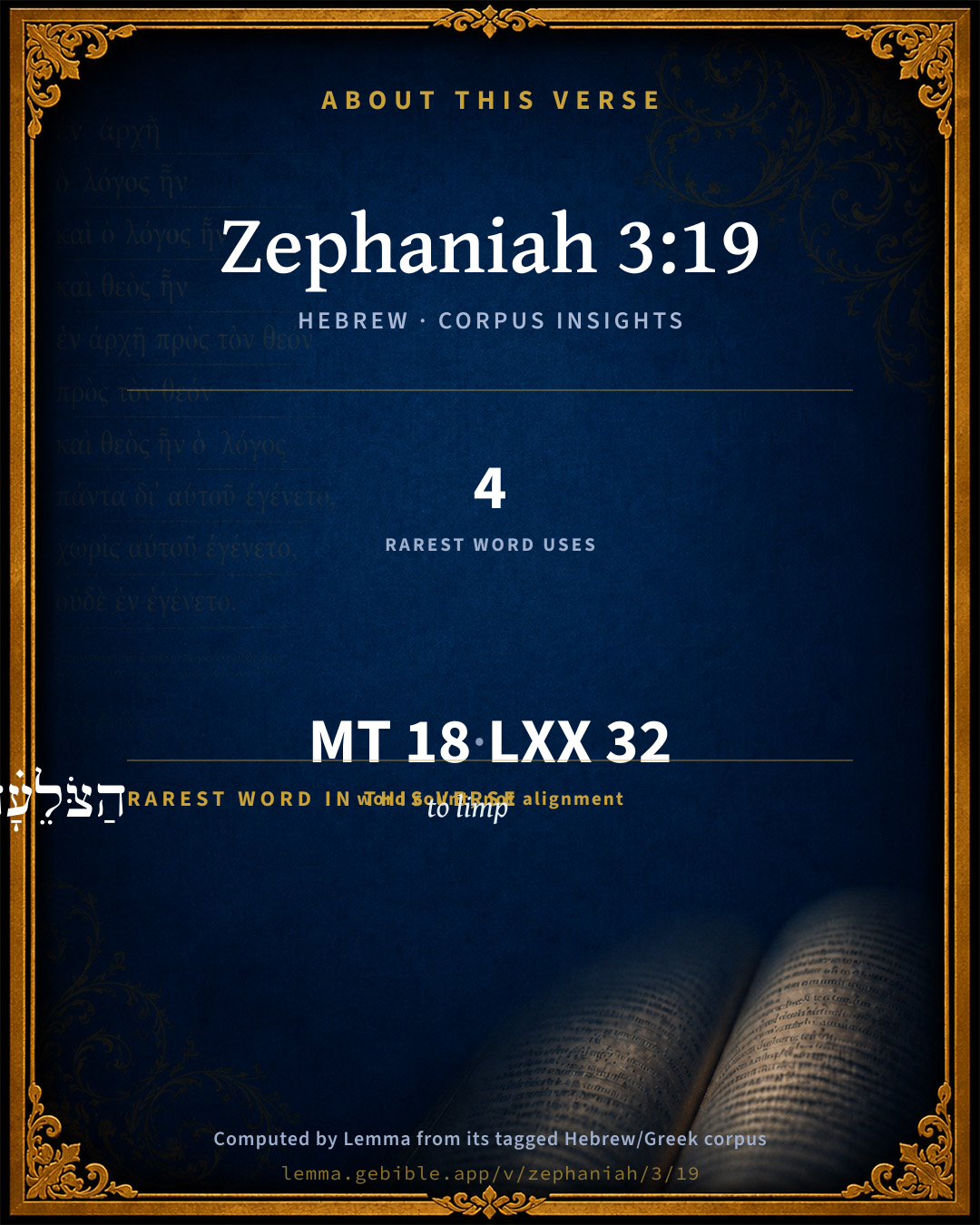
The rarest word here is הַצֹּלֵעָ֗ה to limp H6760 — appearing just 4 times in the whole Hebrew Bible.

Shared distinctive vocabulary

הַצֹּלֵעָ֗ה to limp H6760 occurs in 4 verses of the Hebrew Bible. Also found in:

Grammatical profile

  • 7 verbs
  • 7 nouns
  • 1 pronoun
  • 3 particles

Verb forms

  • עֹשֶׂ֛ה Qal · Participle Active
  • מְעַנַּ֖יִךְ Piel · Participle Active
  • וְהוֹשַׁעְתִּ֣י Hiphil · Sequential Perfect
  • הַצֹּלֵעָ֗ה Qal · Participle Active
  • וְהַנִּדָּחָה֙ Niphal · Participle Passive
  • אֲקַבֵּ֔ץ Piel · Imperfect
  • וְשַׂמְתִּים֙ Qal · Sequential Perfect

Repetition

A word recurs within this verse — often emphatic in Hebrew:

Hebrew & Septuagint length

In English translation the verse runs 43 words from the Hebrew and 42 from the Septuagint (LXX English) — closely comparable.

A rough comparison of the two English renderings, which tokenize alike — not a word-level alignment.

Word counts can differ between the Hebrew and the Greek without any difference in meaning — e.g. the Hebrew direct-object marker אֵת has no separate Greek word, and Greek often adds the article ὁ.

In the original languages it is 18 Hebrew tokens and 32 Greek tokens — but the two are counted differently (Hebrew bundles its prefixes and suffixes into one token; the Greek is in lemma form), so that isn’t a like-for-like length.

Cross-references

30

Topical passages linked to Zephaniah 3:19 in the Treasury of Scripture Knowledge — connected by theme and wording, ordered by reader-vote popularity; previews shown in the World English Bible.

  • Isaiah 49:25–26 But thus says Yahweh, Even the captives of the mighty shall be taken away, and the prey of the terrible shall be delivered; for I will contend with him who contends with you, and I will save your children.
  • Isaiah 60:14 The sons of those who afflicted you shall come bending to you; and all those who despised you shall bow themselves down at the soles of your feet; and they shall call you The city of Yahweh, The Zion of the Holy One of Israel.
  • Jeremiah 30:16 Therefore all those who devour you shall be devoured; and all your adversaries, everyone of them, shall go into captivity; and those who despoil you shall be a spoil, and all who prey on you will I give for a prey.
  • Zephaniah 3:15 Yahweh has taken away your judgments. He has thrown out your enemy. The King of Israel, Yahweh, is in the midst of you. You will not be afraid of evil any more.
  • Micah 7:10 Then my enemy will see it, And shame will cover her who said to me, Where is Yahweh your God? Then my enemy will see me and will cover her shame. Now she will be trodden down like the mire of the streets.
  • Isaiah 61:7 Instead of your shame [you shall have] double; and instead of dishonor they shall rejoice in their portion: therefore in their land they shall possess double; everlasting joy shall be to them.
  • Ezekiel 34:16 I will seek that which was lost, and will bring back that which was driven away, and will bind up that which was broken, and will strengthen that which was sick: but the fat and the strong I will destroy; I will feed them in justice.
  • Jeremiah 33:9 [This city] shall be to me for a name of joy, for a praise and for a glory, before all the nations of the earth, which shall hear all the good that I do to them, and shall fear and tremble for all the good and for all the peace that I procure to it.
  • Micah 4:6–7 "In that day," says Yahweh, "I will assemble that which is lame, And I will gather that which is driven away, And that which I have afflicted;
  • Zechariah 2:8–9 For thus says Yahweh of hosts: 'For honor he has sent me to the nations which plundered you; for he who touches you touches the apple of his eye.
  • Isaiah 51:22–23 Thus says your Lord Yahweh, and your God who pleads the cause of his people, Behold, I have taken out of your hand the cup of staggering, even the bowl of the cup of my wrath; you shall no more drink it again:
  • Hebrews 12:13 and make straight paths for your feet, so that which is lame may not be dislocated, but rather be healed.
  • Isaiah 60:18 Violence shall no more be heard in your land, desolation nor destruction within your borders; but you shall call your walls Salvation, and your gates Praise.
  • Isaiah 41:11–16 Behold, all those who are incensed against you shall be disappointed and confounded: those who strive with you shall be as nothing, and shall perish.
  • Zechariah 12:3–4 It will happen in that day, that I will make Jerusalem a burdensome stone for all the peoples. All who burden themselves with it will be severely wounded, and all the nations of the earth will be gathered together against it.
  • Ezekiel 39:26 They shall bear their shame, and all their trespasses by which they have trespassed against me, when they shall dwell securely in their land, and none shall make them afraid;
  • Jeremiah 46:28 Don't be afraid you, O Jacob my servant, says Yahweh; for I am with you: for I will make a full end of all the nations where I have driven you; but I will not make a full end of you, but I will correct you in measure, and will in no way leave you unpunished.
  • Revelation 20:9 They went up over the breadth of the earth, and surrounded the camp of the saints, and the beloved city. Fire came down out of heaven from God, and devoured them.
  • Isaiah 62:7 and give him no rest, until he establish, and until he make Jerusalem a praise in the earth.
  • Isaiah 43:14–17 Thus says Yahweh, your Redeemer, the Holy One of Israel: For your sake I have sent to Babylon, and I will bring down all of them as fugitives, even the Chaldeans, in the ships of their rejoicing.
  • Jeremiah 51:35–36 The violence done to me and to my flesh be on Babylon, shall the inhabitant of Zion say; and, My blood be on the inhabitants of Chaldea, shall Jerusalem say.
  • Ezekiel 39:17–22 You, son of man, thus says the Lord Yahweh: Speak to the birds of every sort, and to every animal of the field, Assemble yourselves, and come; gather yourselves on every side to my sacrifice that I do sacrifice for you, even a great sacrifice on the mountains of Israel, that you may eat flesh and drink blood.
  • Isaiah 26:11 Yahweh, your hand is lifted up, yet they don't see: but they shall see [your] zeal for the people, and be disappointed; yes, fire shall devour your adversaries.
  • Isaiah 25:9–12 It shall be said in that day, Behold, this is our God; we have waited for him, and he will save us: this is Yahweh; we have waited for him, we will be glad and rejoice in his salvation.
  • Jeremiah 31:8 Behold, I will bring them from the north country, and gather them from the uttermost parts of the earth, [and] with them the blind and the lame, the woman with child and her who travails with child together: a great company shall they return here.
  • Joel 3:2–9 I will gather all nations, And will bring them down into the valley of Jehoshaphat; And I will execute judgment on them there for my people, And for my heritage, Israel, whom they have scattered among the nations. They have divided my land,
  • Nahum 1:11–14 There is one gone forth out of you, who devises evil against Yahweh, who counsels wickedness.
  • Revelation 19:17–21 I saw an angel standing in the sun. He cried with a loud voice, saying to all the birds that fly in the sky, "Come! Be gathered together to the great supper of God,
  • Isaiah 66:14–16 You shall see [it], and your heart shall rejoice, and your bones shall flourish like the tender grass: and the hand of Yahweh shall be known toward his servants; and he will have indignation against his enemies.
  • Zechariah 14:2–3 For I will gather all nations against Jerusalem to battle; and the city will be taken, the houses rifled, and the women ravished. half of the city will go out into captivity, and the rest of the people will not be cut off from the city.

Cross-references courtesy of OpenBible.info (CC BY 4.0).

Hebrew and Greek witnesses Masoretic Hebrew ↔ Greek Septuagint

The same verse in the two great witnesses to the Old Testament, shown verse-for-verse.

These are two independent witnesses, not word-aligned to each other, and the Septuagint is shown in lemma (dictionary) form.

Hebrew Zephaniah 3:19 Masoretic · Westminster Leningrad Codex

הִנְנִ֥י עֹשֶׂ֛ה אֶת כָּל מְעַנַּ֖יִךְ בָּעֵ֣ת הַהִ֑יא וְהוֹשַׁעְתִּ֣י אֶת הַצֹּלֵעָ֗ה וְהַנִּדָּחָה֙ אֲקַבֵּ֔ץ וְשַׂמְתִּים֙ לִתְהִלָּ֣ה וּלְשֵׁ֔ם בְּכָל הָאָ֖רֶץ בָּשְׁתָּֽם

Behold, at that time I will deal with all those who afflict you, and I will save those who are lame, and gather those who were driven away. I will give them praise and honor, whose shame has been in all the earth.

World English Bible · Public Domain

Greek LXX Zephaniah 3:19 Septuagint · lemma form

ἰδού ἐγώ ποιέω ἐν σύ ἕνεκεν σύ ἐν ὁ καιρός ἐκεῖνος λέγω κύριος καί σώζω ὁ ἐκπιέζω καί ὁ ἀποὠθέω εἰςδέχομαι καί τίθημι αὐτός εἰς καύχημα καί ὀνομαστός ἐν πᾶς ὁ γῆ

Behold, I will work in you for your sake at that time, says the Lord: and I will save her that was oppressed, and receive her that was rejected; and I will make them a praise, and honored in all the earth.

LXX2012 (modern English Septuagint) · Public Domain

On this verse, Haydock's Catholic Bible Commentary discusses the Septuagint’s reading. Read the note in Commentary ↓

Hebrew: Westminster Leningrad Codex (CC BY 4.0). Greek: Septuagint (public domain); English from LXX2012 (modern English Septuagint) (Public Domain). How the Septuagint differs from the Hebrew →

Targum (Aramaic paraphrase)

1

The Targum is the ancient Jewish Aramaic paraphrase of the Hebrew Scriptures — an interpretive translation, not the Hebrew text itself. Onkelos (literal) and Pseudo-Jonathan (expansive) render the Torah, and Jonathan the Prophets. Coverage is partial: where no permissively-licensed English translation exists for a verse, only the Aramaic is shown. This is verse-level text, not a word-by-word alignment to the Hebrew.

  1. Targum Jonathan Prophets (Joshua–Malachi)
    הָא אֲנָא עָבֵיד גְמִירָא עִם כָּל מְשַׁעְבְּדַיִךְ בְּעִדָנָא הַהִיא וְאֶפְרוֹק יַת מְטַלְטְלַיָא וּמְבַדְרַיָא אֲקַרֵיב וַאֲשַׁוִינוּן לְתוּשְׁבְּחָא וּלְשׁוּם בְּכָל אַרְעָא בַּהֲתָתְהוֹן:

    (no public-domain English translation for this verse)

    Targum Jonathan — Aramaic: “Mikraot Gedolot” (public domain). English: “Sefaria Community Translation” (CC0 1.0 (public-domain dedication)); “London "Chaldee Paraphrase," 1871” (public domain). Text via Sefaria.

Commentary

Notes on Zephaniah 3:19 from classic Christian and Jewish commentators (each source and its license shown beneath its notes). The classic Christian expositions comment on the surrounding passage and are grouped to its opening verse, so a note may address several verses; the Jewish commentaries on the Tanakh (Rashi and others) are per-verse, so they appear only where the commentator wrote on this verse.

Lemma curates 59 commentaries, every one of them public domain or Creative Commons licensed, each selected and text-cleaned for this edition rather than reprinted as found. About our sources →

Trapp's Complete Commentary

John Trapp

Zep 3:19 Behold, at that time I will undo all that afflict thee: and I will save her that halteth, and gather her that was driven out; and I will get them praise and fame in every land where they have been put to shame.

Ver. 19. Behold, at that time I will undo all that afflict thee] Heb. Behold me; look not to thyself as unworthy or unlikely to inherit such precious promises; for, "not for your sakes do this, saith the Lord God, be it known unto you; but for mine own holy name’s sake," Eze 36:22; Eze 36:32 : your unworthiness shall serve for a foil to set forth the freeness of my love; your unlikeliness the greatness of my power; "my grace is sufficient for thee, my strength is perfected in thy weakness," 2Co 12:9. Again, look not to thine enemies, how many and mighty they are, how witty and wealthy, how active and combined ( loricatus incedit Satan et cataphractus, saith Luther), let thine eyes be upon me, as Jehoshaphat’s were, when he knew not whither else to look, 2Ch 20:12; let thine heart be lift up in my ways, as his was, 2Ch 17:6; behold me, behold me, Isa 65:1. Look not downward on the rushing and roaring streams of miseries and troubles which run so swiftly under thee, for then thou wilt be giddy; but look upward, and steadfastly fasten on my power and promise; believe in the Lord thy God, so shalt thou be established; believe his prophets, so shalt thou prosper, 2Ch 20:20; thine enemies also shall be found liars unto thee, and thou shalt tread upon their high places, Deu 33:29. I will undo them, saith God here; Heb. I will do them ( per antiphrasin); or, I will bruise them and break them in pieces, as R. David rendereth it, by comparing Eze 23:3; Eze 23:21. I will not only repress them, but root them out. Those that offer violence to the Church, like blind Samson, they lay hands upon their pillars, to pluck the house upon their own heads.

And I will save her that halteth] As enemies shall not hinder the Church’s happiness, so neither shall her own infirmities. Grant she be lame and luxated, maimed and disjointed, so that she goeth sidling and halteth downright, Psa 38:17; say she be driven out of her country as an exile, out of all companies, as an outcast (whom no man seeketh after, Jer 30:17), and out of all good conceit of herself, as an abject, vile in her own eyes not fit for the communion of saints or kingdom of heaven; yet I will save her, I will gather her, like as the gathering host in the wilderness {see Jos 6:9} took up the lame, feeble and those that were left behind, see Mic 4:6, {See Trapp on "Mic 4:6"} and Eze 32:16; I will seek that which was lost and reduce that which was driven away.

And I will get them praise and fame in every land, &c.] So that glorious things shall be spoken of thee, O city of God; as thy sin shall be remitted, so thy name shall be healed thy fame spread, per ora hominum volitabis I will fashion men’s opinions of thee, so that those that formerly shamed and shunned thee shall highly esteem thee, and stand for thee.

John Trapp, A Commentary or Exposition upon All the Books of the Old and New Testament (1647–1656) — public domain. Text from a community e-Sword module.

Tyndale Open Study Notes

Tyndale Open Resources

3:19 God will turn his people’s former shame into glory and fame (see Deut 26:19; Isa 62:7; Mic 4:6-8; cp. 1 Pet 5:4).

Tyndale Open Study Notes — © Tyndale Open Resources, licensed CC BY-SA 4.0. Text via the HelloAO Bible API.

unfoldingWord translationNotes

Door43 World Missions Community

General Information:

In verses Zep 3:19-20, Yahweh speaks directly to the remnant of Israel who survived the judgment and tells them that they should rejoice.

Behold

This tells the reader to pay special attention to what follows. AT: "Look" or "Pay attention"

I am about to deal with all your oppressors

It is understood that "deal with" means to punish the oppressors. This can be stated explicitly. AT: "I will severely punish all those who oppressed you" (See: Assumed Knowledge and Implicit Information)

I will rescue the lame and gather up the outcast

Here the Israelites who suffered in exile are spoken of as if they were lame and outcast sheep. This can be stated as a simile. AT: "I will rescue and bring together the remnant of Israel who are like lame and outcast sheep" (See: Metaphor and Simile)

the lame

This refers to people or animals that cannot walk.

I will make them as praise

The full thought here is, "I will make them to be objects of praise," that is, "I will make them to be praised by others." (See: Simile)

I will change their shame into renown

The abstract nouns "shame" and "renown" can be stated as actions. AT: "I will cause them to no longer be ashamed, but for people to respect them" (See: Abstract Nouns)

At that time I will lead you; at that time I will gather you together

These two lines mean basically the same thing and imply that Yahweh will bring the exiled people back to their homeland. AT: "At that time I will gather you together and lead you home" (See: Parallelism)

translationWords

earth

unfoldingWord translationNotes — © Distant Shores Media and the Door43 World Missions Community, licensed CC BY-SA 4.0. Source: git.door43.org/Door43/en_tn.

Geneva Bible (1599)

Geneva Bible translators

I will deliver the Church, which now is afflicted, as Mic. 4:6.

As among the Assyrians and Chaldeans which did mock them and put them to shame.

Geneva Bible (1599) marginal notes — public domain. Text via Bolls.life.

Jamieson, Fausset & Brown

Robert Jamieson, A. R. Fausset & David Brown

undo--MAURER translates, "I will deal with," that is, as they deserve. Compare Eze 23:25, where the Hebrew is similarly translated. The destruction of Israel's foes precedes Israel's restoration (Isa 66:15-16).

her that halteth--all that are helpless. Their weakness will be no barrier in the way of My restoring them. So in Psa 35:15, Margin, "halting" is used for adversity. Also Eze 34:16; Mic 4:6-7.

I will get them praise, &c.--literally, "I will make them (to become) a praise and a name," &c.

shame-- (Eze 34:29).

Jamieson, Fausset & Brown — Commentary Critical and Explanatory on the Whole Bible (1871) — public domain (CC PDM 1.0). Text via the HelloAO Bible API.

Adam Clarke's Commentary

Verse 19. I will undo all that afflict thee] They who have persecuted you shall be punished for it. It shows much malignity and baseness of mind, to afflict or reproach those who are lying under the chastising hand of God. This was the conduct of the Edomites, Moabites, and Ammonites, when the Jews were in adversity; and how severely did the Lord punish them for it! And he gave this as the reason for the severity of the punishment.

The first clause here is translated thus by Abp. Newcome: "Behold I will work with thee for thy sake at that time." The original is obscure; and it may bear the above sense.

I will save her that halteth] See Mic 4:6, where there is a parallel place.

And gather her that was driven out] By captivity. The reference may be to renewing the covenant with the Jews, who were considered as an unfaithful spouse divorced by her husband. I will bring her back to my house.

I will get them praise and fame in every land] They shall become a great, a good, and a useful people. And as they are now a proverb of reproach, full of base wiles and degrading selfishness, they shall lose this character, and be totally changed; and they shall be as eminent for excellence, as they were before for baseness, in those countries where they had sojourned.

Adam Clarke's Commentary on the Bible (1810–1826) — public domain. Text from a community e-Sword/MySword module.

John Calvin's Commentaries

He confirms here what I have referred to in the last verse that God would overcome all obstacles, when his purpose was to restore his people. On this the Prophet, as we have said, dwells, that the Jews might in their exile sustain themselves with the hope of deliverance. As, then, they could not instantly conceive what was so incredible according to the perceptions of the flesh, he testifies that there is sufficient power in God to subdue all enemies.

At that time, he says, he repeats what had been stated before—that his people must wait as long as God pleases to exercise them under the cross; for if their option had been given to the Jews, they would have willingly continued at their ease; and we know how men are wont to exempt themselves from every trouble, fear, and sorrow. As therefore men naturally desire rest and immunity from all evil, the Prophet here exhorts the faithful to patience, and shows, that it cannot be that God will become their deliverer, except they submit to his chastisement; at that time then. It is ever to be observed, that the Prophet condemns that extreme haste which usually takes hold of men when God chastises them. However slowly then and gradually God proceeds in the work of delivering his own, the Prophet shows here, that there was no reason for them to despair, or to be broken down in their spirits.

He then subjoins, that he would save the halting, and restore the driven away. By these words he means, that though the Church would be maimed and torn, there would yet be nothing that could hinder God to restore her: for by the halting and the driven away he understands none other than one so stripped of power as wholly to fail in himself. He therefore compares the Church of God to a person, who, with relaxed limbs, is nearly dead. Hence, when we are useless as to any work, what else is our life but a languor like to death? But the Prophet declares here, that the seasonable time would come when God would relieve his own people: though they were to become prostrate and fallen, though they were to be scattered here and there, like a torn body of man, an arm here and a leg there, every limb separated; yet he declares that nothing could possibly prevent God to gather his Church and restore it to its full vigor and strength. In short, he means that the restoration of the Church would be a kind of resurrection; for the Lord would humble his people until they became almost lifeless, so as not to be able to breathe: but he would at length gather them, and so gather them that they would not only breathe but be replenished with such new vigor as though they had received no loss. I cannot finish the whole today.

John Calvin's Commentaries (1540-1563) — public domain. Text from the Calvin Translation Society English edition (1840s-50s) via the Christian Classics Ethereal Library (ccel.org). Calvin's coverage is partial (roughly two-thirds of the Bible); uncommented books and verses are honest gaps, never fabricated. The 19th-century editor's footnotes and remarks are omitted so the notes are faithfully Calvin's own voice.

Ellicott's Commentary for English Readers

(19) I will undo.—Better, I will deal with, as in Eze_23:25. The clauses following are based on Mic_4:6; Deu_26:19.

A Bible Commentary for English Readers, edited by Charles John Ellicott (1878–1897) — public domain. Text from a community e-Sword module.

The Cambridge Bible for Schools and Colleges

gen. ed. J. J. S. Perowne

19. I will undo all that afflict thee] As R.V., I will deal with all.

I will save her that halteth] The people are spoken of under the metaphor of a flock, in which are some that are lame, and to which belong some that have been driven away. Hence the use of the fem. gender. Comp. Eze_34:16, “I will seek that which was lost, and will bring back again that which was driven away.” Mic_4:6-7.

I will get them praise] As R.V., I will make them (to be) a praise and a name. Jer_33:9, “and this city shall be to me for a name of joy, for a praise and for a glory before all the nations of the earth, which shall hear all the good that I do unto them.” Cf. Jer_13:11. The precise sense is not clear. In the passages in Jer. the people, being righteous and blessed, are the source of praise and renown to Jehovah, whose people they are. But the meaning might be that the people themselves are the object of praise by the nations; Isa_61:9; Isa_62:7. Both ideas are elsewhere expressed; Jehovah bestows His glory on Israel (Isa_60:2), and this glory is reflected back upon Him, and He is glorified in Israel (Isa_44:23; Isa_49:3; Isa_60:21; Isa_61:3).

In every land … put to shame] A.V. marg., Heb. (every land) of their shame. R.V. renders: whose shame hath been in all the earth. Both renderings are possible, but both are unnatural. R.V. lays an unnatural emphasis upon the pronoun: “I will make them a praise and a name, whose shame,” &c., whereas “them” seems rather to refer back to “her that halteth” and “her that was driven away,” or, to the people generally. On the other hand, the construction assumed by A.V. is ungrammatical, although occasional instances of it appear. The Sept. rightly felt that the natural sense of the passage was: and I will make them a praise and a name in all the earth (Zep_3:20), and so rendered. The Heb. word their shame, still remaining undisposed of in this rendering, the Sept. attached to the next verse: and they shall be ashamed at that time. This is quite unsatisfactory. But the analogy of Zep_3:20, a name and a praise among all the peoples of the earth, suggests that the expression their shame is not original.

The Cambridge Bible for Schools and Colleges (gen. ed. J. J. S. Perowne; Cambridge University Press, 1878–1918) — public domain. Text from a community e-Sword module.

John Gill's Exposition

Behold, at that time I will undo all that afflict thee Or, "I will do" F23; their business for them; "slay" them, as the Vulgate Latin version; and make an entire destruction of them, as the Targum; bring them to utter ruin. This must be understood of antichrist, both eastern and western, the Turk and Pope, and all the antichristian states that have afflicted the Jews, or shall attempt to distress them at the time of their conversion; and will be fulfilled at the time of the pouring out of the seven vials of God's wrath upon them, which will issue in the entire undoing and ruin of them, especially the seventh and last of them; which, when poured out, will clear the world of all the enemies of Christ, his church and people; and because this will be a wonderful event, and of great moment and importance, hence the word "behold" is prefixed to it, as exciting attention, as well as a note of admiration and asseveration: "and I will save her that halteth", that has sinned, and is weak in faith, and cannot walk, at least but haltingly; which is like a lame and maimed sheep, of which there is danger of its being left behind and lost; but the Lord here promises he will take care of such, and save them from all their sins, and out of the hands of all their enemies; and bring them through all difficulties and discouragements into his church, and to their own land; they shall none of them be lost, even the meanest and weakest of them, any more than the healthful and strong: and gather her that was driven out; even everyone that was scattered abroad in each of the nations of the world; (See Gill on Micah 4:6) (See Gill on Micah 4:7): and I will get them praise and fame in every land, where they have been put to shame; being converted, they shall be spoke well of everywhere; they shall be praised for their ingenuous acknowledgment of their sins; for their sincere repentance of them; and for their faith in Christ, and for their ready submission to his Gospel and ordinances; and the fame of their conversion shall be spread everywhere; and they shall be in great credit and esteem in all Christian countries, where their name has been used for a taunt and a proverb; and so, "instead of their shame", as R. Moses interprets it, they shall have glory and honour in all places. FOOTNOTES: F23 (hvwe) "agam", Tigurine version; "conficiam", Castalio; "ego conficiens", Calvin; "ego faciens, [vel] facio", Burkius.

John Gill's Exposition of the Whole Bible (1746–1763) — public domain (CC PDM 1.0). Text via the HelloAO Bible API.

Albert Barnes' Notes on the Bible

Behold, at that time I will undo - (Literally, I deal with . While God punisheth not, He seemeth to sit still Isa 18:4, be silent Hab 1:13, asleep Psa 44:23. Then He shall act, He shall “deal” according to their deserts with “all,” evil men or devils, “that afflict thee,” His Church. The prophecy looked for a larger fulfillment than the destruction of Jerusalem, since the Romans who, in God’s Hands, avenged the blood of His saints, themselves were among those who “afflicted her.” “And will save her,” the flock or sheep “that halteth” (see Mic 4:6-7), Dionysius: “imperfect in virtue and with trembling faith,” “and gather,” like a good and tender shepherd, “her that was driven out” (see Isa 40:11); scattered and dispersed through persecutions. All infirmities within shall be healed; all troubles without, removed.

And I will get them praise and fame - (Literally, I will make them a praise and a name) “in every land where they have been put to shame.” . Throughout the whole world have they been “the offscourings of all things” 1Co 4:13; throughout the whole world should their praise be, as it is said, “Thou shalt make them princes in all lands” Psa 45:16. One of themselves saith, “Ye see your calling, brethren, how that not many wise men after the flesh, not many mighty, not many noble, are called. But God hath chosen the foolish things of the world to confound the wise; and God hath chosen the weak things of the world to confound the things which are mighty; and base things of this world, and things which are despised, hath God chosen, yea, and things which are not, to bring to nought things that are” 1Co 1:26-28. Rup.: “These He maketh a praise and a name there, where they were without name and dispraised, confounding by them and bringing to nought those wise and strong and mighty, in whose sight they were contemptible.”

Albert Barnes' Notes on the Bible (1834–1885) — public domain. Text from a community e-Sword/MySword module.

Haydock's Catholic Bible Commentary

Cut. Septuagint, "do in thee, for thy sake at," &c. (Haydock) --- Halteth, and have no children, (Micheas iv. 7.) denoting the Gentiles. (Calmet) --- Septuagint, "squeezed out," like grapes, being in distress. (St. Jerome) --- Where. Septuagint, "and they shall be ashamed at," &c.

George Leo Haydock (1774–1849), Haydock's Catholic Family Bible and Commentary, 1859 edition — public domain. Excludes Psalms (Douay-Rheims chapter numbering differs from Protestant) and Deuterocanonical books (Catholic canon only).

Matthew Poole's English Annotations

Behold; mark well.

I will undo; I will deal with them, do their work for them, as we say, I will break their power and dissolve their kingdom.

All that afflict thee; Babylonians who afflicted the Jews. and who were undone by Cyrus and his Persians.

I will save her that halteth; who is in great trouble and ready to fall, as Psa 38:16,17; who is under greatest distress, and hath least strength to bear, or get out.

Driven out; by force of the enemy, carried away captives, and scattered into far remote countries.

Get them praise and fame; vindicate them, as a people that are not rejected of their God, as the people of the great God of heaven and earth, as Psa 121:2.

In every land; among all people with whom they dwelt as strangers.

Where they have been put to shame; were scorned and reproached as slaves and abjects, whose God could not, or would not, help them, or had cast them off, and none other would take care of them. But now, gathered together by the Lord, they shall appear to be still his peculiar people and his delight.

Matthew Poole's English Annotations on the Holy Bible (1683–1685) — public domain. Text from a community e-Sword/MySword module.

The Pulpit Commentary

I will undo all that afflict thee; I will deal with in punishment; (Jer_18:23) Vulgate, "I will slay." The restoration of Israel is preceded by the destruction of the enemies of God and the Church. Septuagint, Poiw en soi eneken sou en tw kairw ekeinw legei Kuriov , "Dominus dicet ad Sion, Ecce, ego faciam in te propter te, id est, faciam ultionem tuam" (St. Jerome). Her that halteth. (Mic_4:6) The afflicted of Israel, here compared to a lame and footsore flock of sheep. Septuagint, thnhn , "pressed," like grapes or olives, to extract the juice. Her that was driven out. The exiled and dispersed. I will get them praise and fame; I will make them to be a praise and a name. This is in accordance with the promise in Deu_26:19. In every land where they have been put to shame; literally, in every land of their shame. The scene of their shame should be the scene of their glorification. The prophet does not consider that the restored theocracy shall be confined to the geographical limits of the Holy Land; he looks to its dissemination throughout the world. Wide as the dispersion itself shall be the diffusion of the knowledge of Goal and the admiration of his doings towards Israel. (comp. Zep_2:11 Zep_3:9 Eze_20:41 Eze_28:25 Zec_8:23)

The Pulpit Commentary (1880–1919), ed. H.D.M. Spence-Jones & Joseph S. Exell — public domain. Text from a community e-Sword module.

John Wesley's Explanatory Notes

Undo - I will break their power and dissolve their kingdom. That halteth - Who is in trouble and ready to fall. Driven out - Into remote countries.

John Wesley, Explanatory Notes Upon the Whole Bible (1754–1765) — public domain. Text via the GEBible commentary corpus.

Rashi

Rabbi Shlomo Yitzchaki (Rashi)

Behold, I wreak destruction Jonathan rendered: Behold I wreak destruction. It may also be interpreted as an expression of crushing, as in (Mal. 3:21): “And you shall crush the wicked.”

throughout all the land where they suffered shame Every place where they were for their shame, there I will make them to be a praise and a name.

Rashi on the Tanakh — English translations: “The Judaica Press complete Tanach with Rashi, translated by A. J. Rosenberg” (CC BY 4.0); “Pentateuch with Rashi's commentary by M. Rosenbaum and A.M. Silbermann, 1929-1934” (public domain); “The Metsudah Tanach series, Lakewood, N.J” (CC BY 4.0); and “The Book of Joshua, Metsudah Publications, 1997” (CC BY 4.0). Text via Sefaria.

Lesson kit

Teaching starters — assembled from the data on this page, not authored interpretation. Every prompt links to the verse data it draws on. Edit before teaching.

Zephaniah, in the Prophets, opens this verse with 18 words (16 distinct Hebrew lemmas). Its most distinctive word is tsâlaʻ (“to limp”). A historical commentator’s framing appears above. Read the whole chapter for the surrounding context.

Discussion questions

  1. How does “to limp” (tsâlaʻ) shape what this verse is saying?
  2. How does Genesis 32:31, which shares the word «to limp», read alongside this verse?
  3. What does the repetition of “all” (2× in this one verse) do in this verse?
  4. The translations on this page render this verse differently — a whole-verse word diff, not a word-by-word alignment. What might account for the different wordings?
  5. «עֹשֶׂ֛ה» is a Qal Participle Active verb. How does that grammatical form shape the action described?
  6. Compare how Trapp's Complete Commentary and Tyndale Open Study Notes read this verse. Where do they agree or differ?

Things to notice

Reading settings

Reading text

Shown beneath each verse's original-language words.

Old Testament
Old Testament edition

Read the OT as the Masoretic Hebrew (MT) or the Greek Septuagint (LXX).

English shown for the Greek Septuagint (in the Hebrew ↔ Greek comparison).

Comparing translations? Open the Compare panel on any verse page to stack up to four side by side.