Psalms 36:6

Hebrew (Westminster Leningrad Codex) Psalms 36:6 appears in the Hebrew Old Testament. The text above is from the Westminster Leningrad Codex. Each word links to its Strong’s number, a concise gloss, and parsing drawn from the Open Scriptures Hebrew Bible morphology. Click any word for its full Brown-Driver-Briggs (BDB) entry.
Download image
Cite this verse

Psalms 36:6 (World English Bible). Public Domain. Lemma interlinear Bible study tool, https://lemma.gebible.app/v/psalms/36/6.

Show BibTeX & RIS
BibTeX
RIS
English Translation
Your righteousness is like the mountains of God. Your judgments are like a great deep. Yahweh, you preserve man and animal.
World English Bible · Public Domain
Download a study sheet

One document with this verse’s original text, its word-by-word gloss line, the meaning frame, cross-references with their text, attributed commentary, and full source and license credits — printable, and it pastes into notes with its structure intact.

This verse Autodidact and up

Study sheet (.html) Plain text (.txt)

A passage Seminary Student

Up to 50 verses in one chapter. A passage sheet keeps up to 6 commentary sources and 12 cross-references per verse, in the order this page ranks them, and says so on the sheet whenever that leaves anything out. Ask for a single verse and you get the Autodidact verse sheet above.

Everything on this page stays free to read, with no account — the sheet is a download of what is already on screen, not access to it.

Want to remove ads? Support Godless Engineer
Compare translations 3

The same verse in 3 English versions, stacked beneath the original-language interlinear above. Click any original word for its lexicon entry.

Each is an independent rendering of the whole verse — the interlinear is not word-aligned to these translations.

Highlighted words mark where these versions differ — a whole-verse word diff, not a word-by-word alignment.

  • World English Bible Public Domain
    Your righteousness is like the mountains of God. Your judgments are like a great deep. Yahweh, you preserve man and animal.
  • King James Version Public Domain
    Thy righteousness is like the great mountains; thy judgments are a great deep: O LORD, thou preservest man and beast.
  • unfoldingWord Literal Text CC BY-SA 4.0
    Your righteousness like the mountains of God; your judgments the great deep. You save man and beast, Yahweh.

unfoldingWord Literal Text — © unfoldingWord, licensed CC BY-SA 4.0. Word-aligned USFM3 via Door43 (git.door43.org/unfoldingWord/en_ult).

Versions to compare (up to 4)

3 of 4 selected

Show all 18 translations

Every available English version of this verse, each an independent rendering of the whole verse.

  • World English Bible Public Domain
    Your righteousness is like the mountains of God. Your judgments are like a great deep. Yahweh, you preserve man and animal.
  • Berean Standard Bible Public Domain
    Your righteousness is like the highest mountains; Your judgments are like the deepest sea. O LORD, You preserve man and beast.
  • Majority Standard Bible Public Domain
    Your righteousness is like the highest mountains; Your judgments are like the deepest sea. O LORD, You preserve man and beast.
  • King James Version Public Domain
    Thy righteousness is like the great mountains; thy judgments are a great deep: O LORD, thou preservest man and beast.
  • American Standard Version (1901) Public Domain
    Thy righteousness is like the mountains of God; Thy judgments are a great deep: O Jehovah, thou preservest man and beast.
  • Revised Version (1885) Public Domain
    Thy righteousness is like the mountains of God; thy judgments are a great deep: O LORD, thou preservest man and beast.
  • Geneva Bible (1599) Public Domain
    Thy righteousnesse is like the mightie moutaines: thy iudgements are like a great deepe: thou, Lord, doest saue man and beast.
  • Douay-Rheims (1899) Public Domain
    O Lord, thy mercy is in heaven, and thy truth reacheth, even to the clouds.
  • Young's Literal Translation Public Domain
    Thy righteousness `is' as mountains of God, Thy judgments `are' a great deep. Man and beast Thou savest, O Jehovah.
  • Literal Standard Version CC BY-SA 4.0
    Your righteousness [is] as mountains of God, || Your judgments [are] a great deep. You save man and beast, O YHWH.
  • Unlocked Literal Bible CC BY-SA 4.0
    Your righteousness is like the mountains of God; your judgments are like the great deep. Yahweh, you preserve both mankind and the animals.
  • unfoldingWord Literal Text CC BY-SA 4.0
    Your righteousness like the mountains of God; your judgments the great deep. You save man and beast, Yahweh.
  • Darby Bible Public Domain
    Thy righteousness is like the high mountains; thy judgments are a great deep: thou, Jehovah, preservest man and beast.
  • World Messianic Bible Public Domain
    Your righteousness is like the mountains of God. Your judgments are like a great deep. LORD, you preserve man and animal.
  • Webster's Bible Public Domain
    \\36:5\\Thy mercy, O LORD, is in the heavens; and thy faithfulness reacheth to the clouds.
  • Free Bible Version CC BY-SA 4.0
    Your goodness is like the highest mountains, your fairness is like the deepest oceans. Lord, you save both the people and the animals.
  • Bible in Basic English Public Domain
    Your righteousness is like the mountains of God; your judging is like the great deep; O Lord, you give life to man and beast.
  • JPS Tanakh (1917) Public Domain
    (36-7) Thy righteousness is like the mighty mountains; Thy judgments are like the great deep; man and beast Thou preservest, O LORD.

Literal Standard Version (2020), Covenant Press — licensed CC BY-SA 4.0. Text via the HelloAO Bible API (eBible.org). Unlocked Literal Bible (unfoldingWord) — licensed CC BY-SA 4.0. Text via the HelloAO Bible API (eBible.org). unfoldingWord Literal Text — © unfoldingWord, licensed CC BY-SA 4.0. Word-aligned USFM3 via Door43 (git.door43.org/unfoldingWord/en_ult). Free Bible Version, Dr. Jonathan Gallagher — licensed CC BY-SA 4.0. Text via the HelloAO Bible API (eBible.org).

Word by word

More ways to search: Search by grammar → Find every occurrence → Compare this word →

Practice this passage: Drill this verse → Learn its vocabulary →

כְּֽהַרְרֵי
hârâr
H2042
“like/as · mountains of”
Preposition + Noun, Common, Masculine, Plural, Construct
Part of Speech
Preposition + Noun
Type
Common
Gender
Masculine
Number
Plural
State
Construct
Full BDB Definition

Origin: from an unused root meaning to loom up

TWOT: 517

mountain, hill, hill country, mount
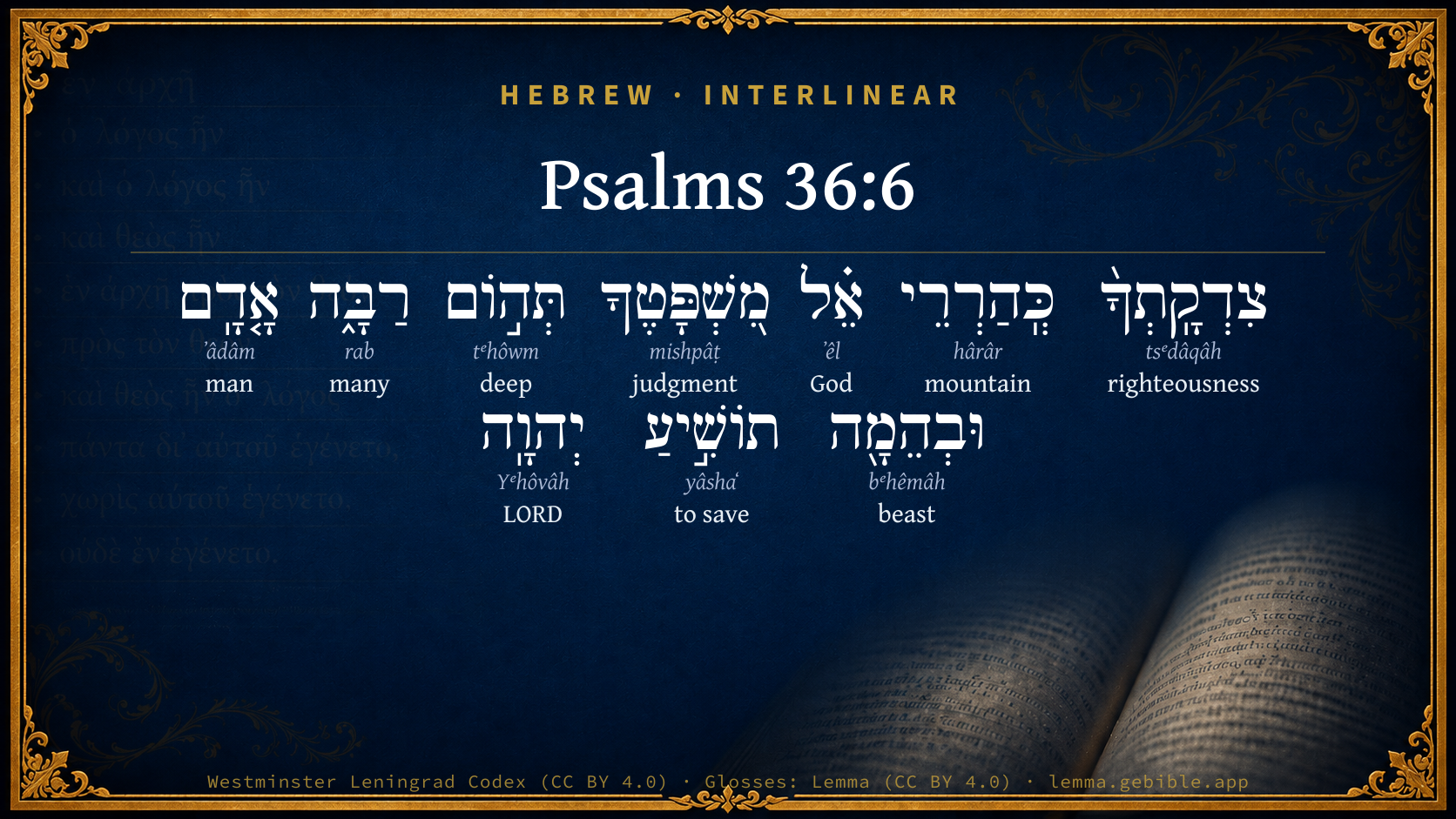
  1. צִדְקָֽתְךָ֨ tsᵉdâqâh H6666 “righteousness · your” Noun, Common, Feminine, Singular, Construct + Suffix, Personal, 2nd Person, Masculine, Singular
  2. אֵ֗ל ʼêl H410 “God” Noun, Common, Masculine, Singular, Absolute
  3. מִ֭שְׁפָּטֶךָ mishpâṭ H4941 “judgment · your” Noun, Common, Masculine, Singular, Construct + Suffix, Personal, 2nd Person, Masculine, Singular
  4. תְּה֣וֹם tᵉhôwm H8415 “deep” Noun, Common, Both, Singular, Absolute
  5. רַבָּ֑ה rab H7227 “many” Adjective, Adjective, Feminine, Singular, Absolute
  6. אָ֤דָֽם ʼâdâm H120 “man” Noun, Common, Masculine, Singular, Absolute
  7. וּבְהֵמָ֖ה bᵉhêmâh H929 “and · beast” Conjunction + Noun, Common, Feminine, Singular, Absolute
  8. תוֹשִׁ֣יעַ yâshaʻ H3467 “to save” Verb, Hiphil, Imperfect, 2nd Person, Masculine, Singular
  9. יְהוָֽה Yᵉhôvâh H3068 “LORD” Noun, Proper

About this verse

These counts appear in no published source. They are computed here, from the morphology-tagged text and Lemma’s own curated glosses. What Lemma adds →

10
words
10
distinct lemmas
Wisdom
section

Notable vocabulary

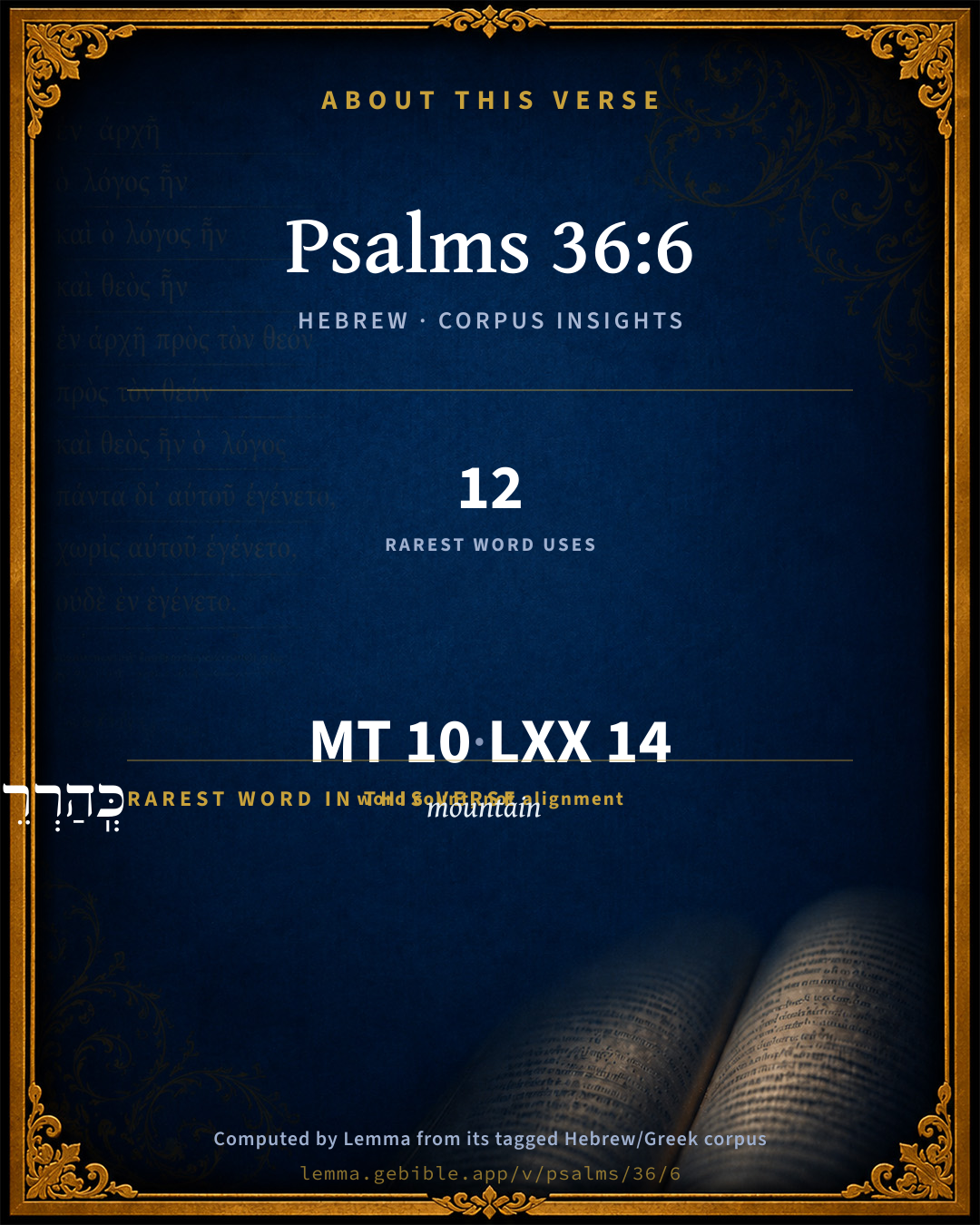
The rarest word here is כְּֽהַרְרֵי mountain H2042 — appearing just 12 times in the whole Hebrew Bible.

Shared distinctive vocabulary

כְּֽהַרְרֵי mountain H2042 occurs in 12 verses of the Hebrew Bible. Also found in:

Grammatical profile

  • 1 verb
  • 8 nouns
  • 1 adjective

Verb forms

  • תוֹשִׁ֣יעַ Hiphil · Imperfect

Hebrew & Septuagint length

In English translation the verse runs 21 words from the Hebrew and 23 from the Septuagint (LXX English) — closely comparable.

A rough comparison of the two English renderings, which tokenize alike — not a word-level alignment.

Word counts can differ between the Hebrew and the Greek without any difference in meaning — e.g. the Hebrew direct-object marker אֵת has no separate Greek word, and Greek often adds the article ὁ.

In the original languages it is 10 Hebrew tokens and 14 Greek tokens — but the two are counted differently (Hebrew bundles its prefixes and suffixes into one token; the Greek is in lemma form), so that isn’t a like-for-like length.

Cross-references

25

Topical passages linked to Psalms 36:6 in the Treasury of Scripture Knowledge — connected by theme and wording, ordered by reader-vote popularity; previews shown in the World English Bible.

  • Romans 11:33 Oh the depth of the riches both of the wisdom and the knowledge of God! How unsearchable are his judgments, and his ways past tracing out!
  • Psalms 77:19 Your way was through the sea; Your paths through the great waters. Your footsteps were not known.
  • Isaiah 40:28 Have you not known? have you not heard? The everlasting God, Yahweh, the Creator of the ends of the earth, doesn't faint, neither is weary; there is no searching of his understanding.
  • Deuteronomy 32:4 The Rock, his work is perfect; For all his ways are justice: A God of faithfulness and without iniquity, Just and right is he.
  • Nehemiah 9:6 You are Yahweh, even you alone; you have made heaven, the heaven of heavens, with all their host, the earth and all things that are thereon, the seas and all that is in them, and you preserve them all; and the host of heaven worships you.
  • Job 37:23 We can't reach the Almighty, He is exalted in power; In justice and great righteousness he will not oppress.
  • Psalms 71:19 Your righteousness also, God, reaches to the heavens; You have done great things. God, who is like you?
  • 1 Timothy 4:10 For to this end we both labor and suffer reproach, because we have set our trust in the living God, who is the Savior of all men, especially of those who believe.
  • Psalms 92:5 How great are your works, Yahweh! Your thoughts are very deep.
  • Psalms 97:2 Clouds and darkness are around him. Righteousness and justice are the foundation of his throne.
  • Psalms 104:14–35 He causes the grass to grow for the cattle, And plants for man to cultivate, That he may bring forth food out of the earth:
  • Psalms 145:9 Yahweh is good to all. His tender mercies are over all his works.
  • Isaiah 45:19 I have not spoken in secret, in a place of the land of darkness; I didn't say to the seed of Jacob, Seek you me in vain: I, Yahweh, speak righteousness, I declare things that are right.
  • Matthew 11:25–26 At that time, Jesus answered, "I thank you, Father, Lord of heaven and earth, that you hid these things from the wise and understanding, and revealed them to infants.
  • Genesis 18:25 Be it far from you to do things like that, to kill the righteous with the wicked, that so the righteous should be as the wicked. May that be far from you. Shouldn't the Judge of all the earth do right?"
  • Exodus 9:28 Pray to Yahweh; for there has been enough of mighty thunderings and hail. I will let you go, and you shall stay no longer."
  • 1 Samuel 14:15 There was a trembling in the camp, in the field, and among all the people; the garrison, and the spoilers, they also trembled; and the earth quaked: so there was an exceeding great trembling.
  • Job 7:20 If I have sinned, what do I do to you, you watcher of men? Why have you set me as a mark for you, So that I am a burden to myself?
  • Job 11:7–9 "Can you fathom the mystery of God? Or can you probe the limits of the Almighty?
  • Psalms 145:16–17 You open your hand, And satisfy the desire of every living thing.
  • Psalms 147:9 He provides food for the cattle, And for the young ravens when they call.
  • Isaiah 45:21–24 Declare you, and bring [it] forth; yes, let them take counsel together: who has shown this from ancient time? who has declared it of old? Haven't I, Yahweh? and there is no God else besides me, a just God and a Savior; there is no one besides me.
  • Jonah 4:11 Shouldn't I be concerned for Nineveh, that great city, in which are more than one hundred twenty thousand persons who can't discern between their right hand and their left hand; and also much cattle?"
  • Matthew 10:29–30 "Aren't two sparrows sold for an assarion? Not one of them falls on the ground apart from your Father's will,
  • Romans 3:25 whom God set forth to be an atoning sacrifice, through faith in his blood, for a demonstration of his righteousness through the passing over of prior sins, in God's forbearance;

Cross-references courtesy of OpenBible.info (CC BY 4.0).

Hebrew and Greek witnesses Masoretic Hebrew ↔ Greek Septuagint

The same verse in the two great witnesses to the Old Testament, shown verse-for-verse.

You’re reading Greek Psalm 35 (Hebrew Psalm 36). The Septuagint counts the superscription, so verse numbers can differ from the Hebrew — chapter-level alignment, not verse-by-verse. Numbering follows Rahlfs.

These are two independent witnesses, not word-aligned to each other, and the Septuagint is shown in lemma (dictionary) form.

Hebrew Psalms 36:6 Masoretic · Westminster Leningrad Codex

צִדְקָֽתְךָ֨ כְּֽהַרְרֵי אֵ֗ל מִ֭שְׁפָּטֶךָ תְּה֣וֹם רַבָּ֑ה אָ֤דָֽם וּבְהֵמָ֖ה תוֹשִׁ֣יעַ יְהוָֽה

Your righteousness is like the mountains of God. Your judgments are like a great deep. Yahweh, you preserve man and animal.

World English Bible · Public Domain

Greek LXX Greek Psalm 35:6 Septuagint · lemma form

κύριος ἐν ὁ οὐρανός ὁ ἔλεος σύ καί ὁ ἀλήθεια σύ ἕως ὁ νεφέλη

Your righteousness is as the mountains of God, your judgments are as a great deep: O Lord, you will preserve men and beasts.

LXX2012 (modern English Septuagint) · Public Domain

Hebrew: Westminster Leningrad Codex (CC BY 4.0). Greek: Septuagint (public domain); English from LXX2012 (modern English Septuagint) (Public Domain). How the Septuagint differs from the Hebrew →

Commentary

Notes on Psalms 36:6 from classic Christian and Jewish commentators (each source and its license shown beneath its notes). The classic Christian expositions comment on the surrounding passage and are grouped to its opening verse, so a note may address several verses; the Jewish commentaries on the Tanakh (Rashi and others) are per-verse, so they appear only where the commentator wrote on this verse.

Lemma curates 59 commentaries, every one of them public domain or Creative Commons licensed, each selected and text-cleaned for this edition rather than reprinted as found. About our sources →

Trapp's Complete Commentary

John Trapp

Psa 36:6 Thy righteousness [is] like the great mountains; thy judgments [are] a great deep: O LORD, thou preservest man and beast.

Ver. 6. Thy righteousness is like the great mountains] Heb. mountains of God, pro more linguae, quae quando magnificat aliquid, addit nomen Dei, ut Jon 3:3 Gen 30:5 Rev 15:2 Psa 68:16; Psa 80:11, saith R. David, that is, after the manner of the Hebrew tongue, which, when it would magnify anything, addeth the name of God; because as anything is nearer to God the more excellent it is ( Sic Dιος σταλαγμους, Arat. in Diosem, αντι του μεγαλους). The like is to be found also in heathen authors. David meaneth that as God’s mercy is matchless, so his justice is unmoveable; and we are to give him the glory of the one as well as the other, since they are both alike in him; for whatsoever is in God is God.

Thy judgments are a great deep] A fathomless abyss, in quam deiecis impios, et nunquam evadunt, saith Kimchi, wherein the wicked sink irrecoverably. Thy providential dispensations also are past finding out, Rom 11:33. They are to reason as the sea is to shallows; and therefore we must do by them as the Romans did by a certain lake of unknown depth, they dedicated it to Victory.

O Lord, thou preservest man and beast] Such is thy beneficence, answerable to thy patience before celebrated. Thou not only bearest with men’s evil manners, even to admiration; but abundantly providest for their being and wellbeing; of such, I mean, as walk about the world with hearts as full as hell of all kind of wickedness. Howbeit, bonitas tua ad atheum est sicut illa ad bestiam, saith Kimchi, here thou dost but for the atheist as thou dost for the beast, and by that course of common preservation and kindness which runneth toward all, that none need doubt a providence.

John Trapp, A Commentary or Exposition upon All the Books of the Old and New Testament (1647–1656) — public domain. Text from a community e-Sword module.

The Biblical Illustrator

Joseph S. Exell

Psa_36:6

O Lord, Thou preservest man and beast.

The providence of God in the preservation of His living creatures

As He made all living creatures, they are the objects of His continual care. As He made the world with astonishing magnificence; he presides over and governs it for the purposes for which it was made: His hand supports the fabric His power hath raised. As the production of the meanest living creatures is the work of Divine power and wisdom, so their preservation in life is the effect of His providence: and it results from the perfection of the Divine nature and providence, that notwithstanding the immense grandeur and multiplicity of His works, and the superior dignity and importance of some creatures in comparison of others, no part, though ever so minute, is overlooked. Vulgar minds are most apt to be affected with a sense of Divine providence, when they see something extraordinary and wonderful, and, as they imagine, beyond, or contrary to, the usual course of nature. But this is the effect of their weakness and ignorance. The constant operations and uniform course of nature are to be considered as the great proof and effect of a Divine providence, much more than any seeming deviations. Every one who reflects will be sensible of his own insufficiency to uphold his own being, or supply his own wants. We feel our dependence upon something above us, and are as it wore conscious of a superior power which sustains and preserves us. From the whole we may observe--

1. Gods right of dominion over His creatures; which is founded not only on His creative power, but on His governing wisdom and preserving providence.

2. Entertain admiring and grateful thoughts of the Divine care and goodness in our preservation.

3. Imitate, according to our capacity, the Divine providence and goodness, by extending our care and contributing our part to the support and welfare of our fellow-creatures.

4. Rely upon the Divine protection for the future. Timid and anxious cares about our own preservation are inconsistent with true piety or a just confidence in the Divine care and goodness. (S. Bourn.)

The Biblical Illustrator, edited by Joseph S. Exell (c. 1880s–1900s) — public domain. Text from a community e-Sword module.

J. A. Alexander on Psalms

Joseph Addison Alexander

7. (Psa 36:6). Thy righteousness (is) like the hills of the Almighty; thy judgments (are) a great deep; man and beast thou wilt save, (O) Jehovah! Righteousness here means rectitude in its widest sense, including the veracity and faithfulness mentioned in the foregoing verse. Judgments is an idiomatic synonyme, thee plural being either used to give it an abstract meaning, as in life, or to denote particular acts of righteousness. This attribute is here described as infinite, by a comparison with natural emblems of immeosity. The first mentioned are the mountains of God, or of the mighty (God), the divine name here used being that which properly denotes omnipotence. See above, on Psa 5:5 (4). By explaining this word as an abstract, we obtain the sense, mountains of strength, i.e. strong mountains; but the constant usage of the term as a divine name seems decisive in favour of the sense, hills produced by the almighty power of God and therefore proving it.—The great deep, the ocean, as in Gen 7:11. (Compare Gen 1:2). The idea conveyed is not so much that of depth and mystery as that of vastness and immensity. The comprehensiveness of God's protecting care is further indicated by the combination man and beast (or brute). To save includes the acts of helping, protecting and providing.

Joseph Addison Alexander, The Psalms Translated and Explained (1850) — public domain. Text from a community e-Sword module.

Tyndale Open Study Notes

Tyndale Open Resources

36:6-9 All creatures live by God’s grace (1 Tim 4:10).

Tyndale Open Study Notes — © Tyndale Open Resources, licensed CC BY-SA 4.0. Text via the HelloAO Bible API.

Geneva Bible (1599)

Geneva Bible translators

Hebrew, the mountains of God: for whatsoever is excellent, is thus called.

The depth of thy providence governeth all things, and disposeth them, albeit the wicked seem to overwhelm the world.

Geneva Bible (1599) marginal notes — public domain. Text via Bolls.life.

Jamieson, Fausset & Brown

Robert Jamieson, A. R. Fausset & David Brown

righteousness [and] judgments--qualities of a good government (Psa 5:8; Psa 31:1). These all are set forth, by the figures used, as unbounded.

Jamieson, Fausset & Brown — Commentary Critical and Explanatory on the Whole Bible (1871) — public domain (CC PDM 1.0). Text via the HelloAO Bible API.

Adam Clarke's Commentary

Verse 6. Thy righteousness is like the great mountains.] כהררי אל keharerey El, like the mountains of God; exceeding high mountains; what, in the present language of geology, would be called primitive mountains, those that were formed at the beginning; and are not the effects of earthquakes or inundations, as secondary and alluvial mountains are supposed to be.

Thy judgments are a great deep] תהום רבה tehom rabbah, the great abyss; as incomprehensible as the great chaos, or first matter of all things which God created in the beginning, and which is mentioned Ge 1:2, and darkness was on the face, תהום tehom, of the deep, the vast profound, or what is below all conjecturable profundity. How astonishing are the thoughts in these two verses! What an idea do they give us of the mercy, truth, righteousness, and judgments of God!

The old Psalter, in paraphrasing mountains of God, says, Thi ryghtwisnes, that es, ryghtwis men, er gastly hilles of God; for that er hee in contemplacioun, and soner resayves the lyght of Crist. Here is a metaphor taken from the tops of mountains and high hills first catching the rays of the rising sun. "Righteous men are spiritual hills of God; for they are high in contemplation, and sooner receive the light of Christ." It is really a very fine thought; and much beyond the rudeness of the times in which this Psalter was written.

Man and beast.] Doth God take care of cattle? Yes, he appoints the lions their food, and hears the cry of the young ravens; and will he not provide for the poor, especially the poor of his people? He will. So infinitely and intensely good is the nature of God, that it is his delight to make all his creatures happy. He preserves the man, and he preserves the beast; and it is his providence which supplies the man, when his propensities and actions level him with the beasts that perish.

Adam Clarke's Commentary on the Bible (1810–1826) — public domain. Text from a community e-Sword/MySword module.

John Calvin's Commentaries

6. Thy righteousness is as the mountains of God In this verse there is a commendation of God’s righteousness, which the sacred writer compares to the high mountains, (this being the manner of the expression — “the mountains of God,” for we know that the Hebrews were accustomed to distinguish by the appellation divine, or of God, whatever is excellent,) because his glory shines forth more clearly there. In the last place, it is said, that his judgments are like a great and bottomless abyss. By these words he teaches us, that to whatever side we turn our eyes, and whether we look upward or downward, all things are disposed and ordered by the just judgment of God. This passage is usually quoted in a sense quite different, namely, that the judgments of God far exceed our limited capacity, and are too mysterious for our being able to comprehend them; and, indeed, in this sense the similitude of an abyss is not inappropriate. It is, however, obvious from the context, that the language of the Psalmist is to be understood in a much more extensive sense, and as meaning, that however great the depth of wickedness which there is among men, and though it seems like a flood which breaks forth and overflows the whole earth, yet still greater is the depth of God’s providence, by which he righteously disposes and governs all things. Whenever, therefore, our faith may be shaken by the confusion and disorder of human affairs, and when we are unable to explain the reasons of this disorder and confusion, let us remember that the judgments of God in the government of the world are with the highest propriety compared to a great depth which fills heaven and earth, that the consideration of its infinite greatness may ravish our minds with admiration, swallow up all our cares, and dispel all our sorrows. When it is added in the end of the verse, O Jehovah! thou preservest man and beast, the meaning is to this effect, that since God vouchsafes to extend his providential care even to the irrational creation, much more does he provide for the wants of men. And, indeed, whenever any doubt may arise in our minds regarding the providence of God, we should fortify and encourage ourselves by setting before us this consideration, that God, who provides food for the beasts of the field, and maintains them in their present state, can never cease to take care of the human race. The explanation which some have given of the term beasts, interpreting it allegorically of beastly men, I regard as too forced, and reject it.

John Calvin's Commentaries (1540-1563) — public domain. Text from the Calvin Translation Society English edition (1840s-50s) via the Christian Classics Ethereal Library (ccel.org). Calvin's coverage is partial (roughly two-thirds of the Bible); uncommented books and verses are honest gaps, never fabricated. The 19th-century editor's footnotes and remarks are omitted so the notes are faithfully Calvin's own voice.

Ellicott's Commentary for English Readers

(6) Great mountains.—See margin, and compare Psa_80:10, “cedars of God.” So too the rain is called “God’s brook.” The epithet not only implies greatness and dignity, but also has reference to God as Creator.

A great deep.—The reference, as usual, with the words deep, depth, is to the great abyss of waters, of which the seas were regarded as the surface.

The twofold comparison in this verse recalls Wordsworth’s lines—

“Two voices are there: one is of the sea.

One of the mountains—each a mighty voice.”

but while to the modern poet the voice is Liberty, to the ancient Hebrew it is Righteousness. The majesty of the hills has often suggested the supremacy of right over wrong—

“Thou hast a voice, great mountain, to repeal

Large codes of fraud and woe.”

The calm of the infinite sea has often soothed agitated souls. Hebrew poetry connected both immediately with God. the uplifted strength of the hills became an emblem of His eternal truth; the depth and expanse of the infinite sea of His outspread goodness and inexhaustible justice.

A Bible Commentary for English Readers, edited by Charles John Ellicott (1878–1897) — public domain. Text from a community e-Sword module.

The Cambridge Bible for Schools and Colleges

gen. ed. J. J. S. Perowne

6. Jehovah’s righteousness—His faithfulness to His character and covenant (Psa_5:8), manifested alike in mercy and in judgement—is like the mountains of God (El), immovably firm (Psa_111:3), eternally unchanged, majestically conspicuous. God’s works proclaim their Author, and reflect His attributes. Cp. Psa_104:16; Psa_65:9; Psa_80:10. The great mountains is a paraphrase which obscures the meaning.

a great deep] Mysterious, unfathomable, inexhaustible, as the vast subterranean abyss of waters (Psa_33:7; Gen_7:11; Job_28:14; Job_38:16). Cp. Rom_11:33.

preservest] Or, savest. The lower animals are the objects of God’s care as well as man. See Psa_104:14; Psa_104:27-28; Psa_147:9; Jon_4:11; Mat_6:26 ff; Mat_10:29 ff.

The Cambridge Bible for Schools and Colleges (gen. ed. J. J. S. Perowne; Cambridge University Press, 1878–1918) — public domain. Text from a community e-Sword module.

John Gill's Exposition

Thy righteousness is like the great mountains,.... Or, "the mountains of God"; so called for their excellency, as the cedars of God, Psa 80:10; or, as Gussetius (e) observes, the greatest and highest mountains, which are here meant, reaching above the clouds and the region of the air, are the pillars of the palace of God, and a part of it; and therefore called his mountains with great propriety, to which his righteousness is compared: that is, either the righteousness of God in the government of the world, which is sometimes like the high mountains, not to be reached and accounted for in the present state of things, though always is, and is immovable as they are; or the righteousness of God, by which he justifies sinners, which may be said to be as the mountains of God, because of the dignity of his person, who has wrought it out; and because of the clear manifestation of it, the Gospel, and so visible, as high mountains; and because of the immovableness and duration of it;

thy judgments are a great deep; both in a way of providence, many of them being at present not to be traced, though before long they will be made manifest; and in a way of grace, such as the choice of some, and the leaving of others, the rejection of the Jews, and the call of the Gentiles; see Rom 11:33;

O Lord, thou preservest man and beast; in a providential way, upholding each in their being, and supplying them with the necessaries of life: some understand this figuratively, of God's saving Jews and Gentiles, wise and unwise, and particularly those who, through humility and modesty, as Jarchi says, compare themselves to beasts, because of their ignorance and stupidity, Pro 30:2.

(e) Ebr. Comment. p. 66.

John Gill's Exposition of the Whole Bible (1746–1763) — public domain (CC PDM 1.0). Text via the HelloAO Bible API.

Albert Barnes' Notes on the Bible

Thy righteousness - Thy justice; that is, the justice of God considered as residing in his own nature; his justice in his laws; his justice in his providential dealings; his justice in his plan of delivering man from sin; his justice to the universe in administering the rewards and penalties of the law.

Is like the great mountains - Margin, as in Hebrew: “the mountains of God.” The name “God” is thus, in the Scriptures, often given to that which is great or exalted, as God is the greatest Being that the mind can form any conception of. So in Psa 80:10 : “The boughs thereof were like the goodly cedars,” in the Hebrew, “cedars of God.” Connecting his name with “mountains” or “cedars,” we have the idea of “strength” or “greatness,” as being especially the work of the Almighty. The idea here is, that as the mountains are the most stable of all the objects with which we are acquainted, so it is with the justice of God. It is as fixed as the everlasting hills.

Thy judgments - The acts and records which are expressive of thy judgment in regard to what is right and best; that judgment as it is expressed in thy law, and in thy dealings with mankind. The “judgment” of God in any matter may be expressed either by a declaration or by his acts. The latter is the idea now most commonly attached to the word, and it has come to be used almost exclusively to denote “afflictive” dispensations of His Providence, or expressions of His displeasure against sin. The word is not used in that exclusive sense in the Scriptures. It refers to any divine adjudication as to what is right, whether expressed by declaration or by act, and would include his adjudications in favor of that which is right as well as those against that which is wrong.

Are a great deep - The word rendered “deep” here means properly wave, billow, surge; then, a mass of waters, a flood, a deep; and the phrase “great deep” would properly refer to the ocean, its “depth” being one of the most remarkable things in regard to it. The “idea” here is, that as we cannot fathom the ocean or penetrate to its bottom, so it is with the judgments of God. They are beyond our comprehension, and after all our efforts to understand them, we are constrained, as in measuring the depths of the ocean, to confess that we cannot reach to the bottom of them. This is true in regard to his law, in regard to the principles of his government as he has declared them, and in regard to his actual dealings with mankind. It could not be otherwise than that in the administration of an infinite God there must be much that man, in his present state, could not comprehend. Compare Job 11:7-9; Isa 55:8-9.

O Lord, “thou preservest man and beast - literally, thou wilt “save;” that is, thou savest them from destruction. The idea is, that he keeps them alive; or that life, where it is continued, is always continued by his agency. The psalmist evidently sees in the fact here stated an illustration of what he had just said about the “greatness” of God in His providential agency and his general government. He was struck with His greatness, and with the incomprehensible nature of His power and agency, in the fact that he kept alive continually so many myriads of creatures upon the earth - so many hundred millions of human beings - so many thousand millions of wild beasts, reptiles, fish, birds, and insects - all dependent upon Him; that He provided for their needs, and that He protected them in the dangers to which they were exposed. And who can comprehend the extent of His law, and the wonderfulness of His Providence, in thus watching over and providing for the multitudes of animated beings that swarm in the waters, in the air, and on the earth?

Albert Barnes' Notes on the Bible (1834–1885) — public domain. Text from a community e-Sword/MySword module.

Matthew Poole's English Annotations

Thy righteousness, in all thy counsels and ways in the government of the world, is like the great mountains; either,

1. Stedfast and unmovable. Or,

2. Eminent and conspicuous to all men. Or rather,

3. Very high and out of our reach; for so it agrees best with the foregoing and following expressions.

Thy judgments, i.e. thy executions of thy counsels, or thy administrations of the affairs of the world, and of thy church,

are a great deep, i.e. unsearchable. as the ocean is in some parts. The worst of men, yea, lad the brute beasts, have experience of thy care and kindness, and therefore I have no reason to doubt of it.

Matthew Poole's English Annotations on the Holy Bible (1683–1685) — public domain. Text from a community e-Sword/MySword module.

The Treasury of David

Charles H. Spurgeon

Ver. 6. Thy righteousness is like the great mountains. Firm and unmoved, lofty and sublime. As winds and hurricanes shake not an Alp, so the righteousness of God is never in any degree affected by circumstances; he is always just. Who can bribe the Judge of all the earth, or who can, by threatening, compel him to pervert judgment? Not even to save his elect would the Lord suffer his righteousness to be set aside. No awe inspired by mountain scenery can equal that which fills the soul when it beholds the Son of God slain as a victim to vindicate the justice of the Inflexible Lawgiver. Right across the path of every unholy man who dreams of heaven stand the towering Andes of divine righteousness, which no unregenerate sinner can ever climb. Among great mountains lie slumbering avalanches, and there the young lightnings try their callow wings until the storm rushes down amain from the awful peaks; so against the great day of the Lord's wrath the Lord has laid up in the mountains of his righteousness dreadful ammunition of war with which to overwhelm his adversaries. Thy judgments are a great deep. God's dealings with men are not to be fathomed by every boaster who demands to see a why for every wherefore. The Lord is not to be questioned by us as to why this and why that. He has reasons, but he does not choose to submit them to our foolish consideration. Far and wide, terrible and irresistible like the ocean are the providential dispensations of God: at one time they appear as peaceful as the unrippled sea of glass; at another tossed with tempest and whirlwind, but evermore most glorious and full of mystery. Who shall discover the springs of the sea? He who shall do this may hope to comprehend the providence of the Eternal.

"Undiscovered sea!

Into thy dark, unknown, mysterious caves,

And secret haunts unfathomably deep,

Beneath all visible retired, none went

And came again to tell the wonders there."

Yet as the deep mirrors the sky, so the mercy of the Lord is to be seen reflected in all the arrangements of his government on earth, and over the profound depth the covenant rainbow casts its arch of comfort, for the Lord is faithful in all that he doeth. O Lord, thou preservest man and beast. All the myriads of creatures, rational and irrational, are fed by Jehovah's hand. The countless beasts, the innumerable birds, the inconceivable abundance of fishes, the all but infinite armies of insects, all owe their continuance of life to the unceasing outgoings of the divine power. What a view of God this presents to us! What a debased creature must he be who sees no trace of such a God, and feels no awe of him!

Ver. 6. Thy righteousness is like the great mountains. Literally mountains of God, which men have not planted, and which men cannot move. Christopher Wordsworth.

Ver. 6. Thy judgments are a great deep. Men's sins are a great deep, and Satan's ways are called a depth; but God's judgments, his ways in the wheels, are the greatest deep of all, they are unsearchable. William Greenhill.

Ver. 6. God's word and works mysterious. C. Simeon.

Ver. 6. (second clause). God's judgments are

1. Often unfathomablewe cannot discover the foundation or cause, and spring of them.

2. They are safe sailing. Ships never strike on rocks out in the great deeps.

3. They conceal great treasure.

4. They work much goodthe great deep, though ignorance thinks it to be all waste, a salt and barren wilderness, is one of the greatest blessings to this round world.

5. They become a highway of communion with God. The sea is today the great highway of the world.

Ver. 6. (last clause). Kindness of God to the lower animals, as well as man.

Psalms 36:7*

Charles H. Spurgeon's The Treasury of David (1869–1885) — public domain. Psalms only. Text from a community e-Sword/MySword module.

Whedon's Commentary on the Bible

Daniel D. Whedon

6. Righteousness— “Righteousness” allies with the holiness of God, and is manifested as well in punishing sin as in upholding the just. It is the guard of law.

Great mountains—Hebrew, mountains of God, a Hebraism for greatness, strength, firmness.

Judgments—Administrations, God’s pronounced sentences of justice and right.

Deep—Same word as in Gen_1:2. The abyss of the ocean: here meaning depths of wisdom and mystery.

Preservest man and beast—God’s protective care, in connexion with his righteousness and judgments, is exhibited in his government over rational and irrational beings. There would thus seem to be an impressive moral in his treatment of the inferior orders. Cruelty to animals is a sin against God.

Daniel D. Whedon (gen. ed.), Commentary on the Old and New Testaments (1874–1909) — public domain. Text from a community e-Sword module.

The Pulpit Commentary

Thy righteousness is like the great mountains; literally, like the mountains of God; and so Luther, Rosenmuller, Hengstenberg, Kay, Cheyne, and the Revised Version. According to the Hebrew idiom, this means "the very greatest mountains those which seem to stand the strongest and the firmest. Thy judgments are a great deep; i.e. such as man cannot fathom unsearchable past finding out. O Lord, thou preservest man and beast. The providential care of God for his creatures is another of his leading characteristics, and one especially deserving man"s attention and gratitude. It is a form of his loving-kindness.

Vers. 6, 7. Righteousness; judgment; loving-kindness.

There are three great sayings here which deserve our deepest study. First, God"s "righteousness," that perfection of his character which secures perfect justice in all his doings. It is like "the mountains," so high that it is always above us, so fixed and stable that it cannot be moved. Then God"s "judgments his ways, his dealings with men are called a "great deep," as being in many respects beyond our sounding or measuring, unfathomable and full of mystery. (Psa_77:19) Last, there is God"s providential care. It is said, "How excellent is thy loving-kindness, O God!" (vers. 6, 7). But while these sayings are very striking and beautiful, looked at by themselves, they become vastly more significant and consolatory when we regard them in their relationship. Suppose we take the second, and place it in the light of the first and then of the third. In the "great deep" there is much that is awful and perplexing. But if there be mystery, this should not surprise us. We are but children. How can the finite comprehend the Infinite! But this mystery has its uses: it teaches us humility; it inspires us with reverence; it prepares the way for faith and hope and love. But much depends on our standpoint. See how different things become when we look at "the great deep" from the sure ground of the everlasting hills. It is significant that the psalmist speaks of the "mountains" before the "great deep," of the "righteousness" of God before his "judgments." Here is a lesson for us. Let us first make sure as to God"s righteousness. Then when our hearts are established in this truth, we can look abroad without fear of the great deep of God"s judgments. Even if, like Paul, tossed up and down "in Adria," the assurance of God"s righteousness will give us peace, and sustain our hopes; and when we reach the shore again, we can look back, as from Melita, with thankful love and praise to God"s ways and wonders in the deep. Then, further, when we take up the third great saying here, the light increases, and the sense of God"s gracious presence and care becomes stronger and stronger. How often is it so in God"s Word and works! Side by side with some grand manifestation of his greatness and majesty, we have some tender touch that speaks of his fatherly love and care. Whensoever, then, we are oppressed and appalled by the sight of the "great deep," let us call to mind, on the one hand, God"s "righteousness;" and, on the other, God"s love that we may be comforted. Before us is the "great deep," with many things that are terrible and distressing the shipwreck of dear hopes, the burying out of sight of beloved ones, the mystery of trial and of death but, standing on the sure ground of God"s righteousness, we may possess our souls in patience; and, contemplating the manifold and increasing proofs of God"s love and goodness in our daily life, we may take heart, and say, "He cannot will me aught but good; I trust him utterly." Let us learn to take the right order in considering God"s works. We should begin with what is plain and certain. We should study the dark things in the light of what is clear, the mysteries by what is revealed. Further, mark the importance of making much of common mercies, that we may be the better prepared for uncommon emergencies. God is educating us. When we know him as caring for us in little things, we can trust him to care for us in greater things. (Mat_6:30-34) If we have learned to run with the footmen without being weary, we can better contend with horses. If we do our duty and serve God in the land of peace, then we shall be the fitter to face the swelling of Jordan. (Jer_12:5) Above all, let us remember that only in God can we find a sure Refuge from all trouble (ver. 7). Though griefs unnumbered throng thee round, Still in thy God confide; Whose finger marks the seas their bound, And curbs the headlong tide. W.F.

The Pulpit Commentary (1880–1919), ed. H.D.M. Spence-Jones & Joseph S. Exell — public domain. Text from a community e-Sword module.

John Wesley's Explanatory Notes

Mountains - Stedfast and unmoveable: eminent and conspicuous to all men. Judgments - The executions of thy counsels. Deep - Unsearchable, as the ocean. Man - The worst of men; yea, the brute-beasts have experience of thy care and kindness.

John Wesley, Explanatory Notes Upon the Whole Bible (1754–1765) — public domain. Text via the GEBible commentary corpus.

Rashi

Rabbi Shlomo Yitzchaki (Rashi)

O Lord, Your kindness is in the heavens Because of these wicked men, You remove [Your] kindness from the earth creatures and raise up Your faith until the sky to remove it from the sons of men.

Rashi on the Tanakh — English translations: “The Judaica Press complete Tanach with Rashi, translated by A. J. Rosenberg” (CC BY 4.0); “Pentateuch with Rashi's commentary by M. Rosenbaum and A.M. Silbermann, 1929-1934” (public domain); “The Metsudah Tanach series, Lakewood, N.J” (CC BY 4.0); and “The Book of Joshua, Metsudah Publications, 1997” (CC BY 4.0). Text via Sefaria.

Lesson kit

Teaching starters — assembled from the data on this page, not authored interpretation. Every prompt links to the verse data it draws on. Edit before teaching.

Psalms, in the Wisdom, opens this verse with 10 words (10 distinct Hebrew lemmas). Its most distinctive word is hârâr (“mountain”). A historical commentator’s framing appears above. Read the whole chapter for the surrounding context.

Discussion questions

  1. How does “mountain” (hârâr) shape what this verse is saying?
  2. How does Numbers 23:7, which shares the word «mountain», read alongside this verse?
  3. These translations render this verse differently. What is at stake in choosing one wording over another?
  4. «תוֹשִׁ֣יעַ» is a Hiphil Imperfect verb. How does that grammatical form shape the action described?
  5. Compare how Trapp's Complete Commentary and The Biblical Illustrator read this verse. Where do they agree or differ?

Things to notice

Reading settings

Reading text

Shown beneath each verse's original-language words.

Old Testament
Old Testament edition

Read the OT as the Masoretic Hebrew (MT) or the Greek Septuagint (LXX).

English shown for the Greek Septuagint (in the Hebrew ↔ Greek comparison).

Comparing translations? Open the Compare panel on any verse page to stack up to four side by side.