
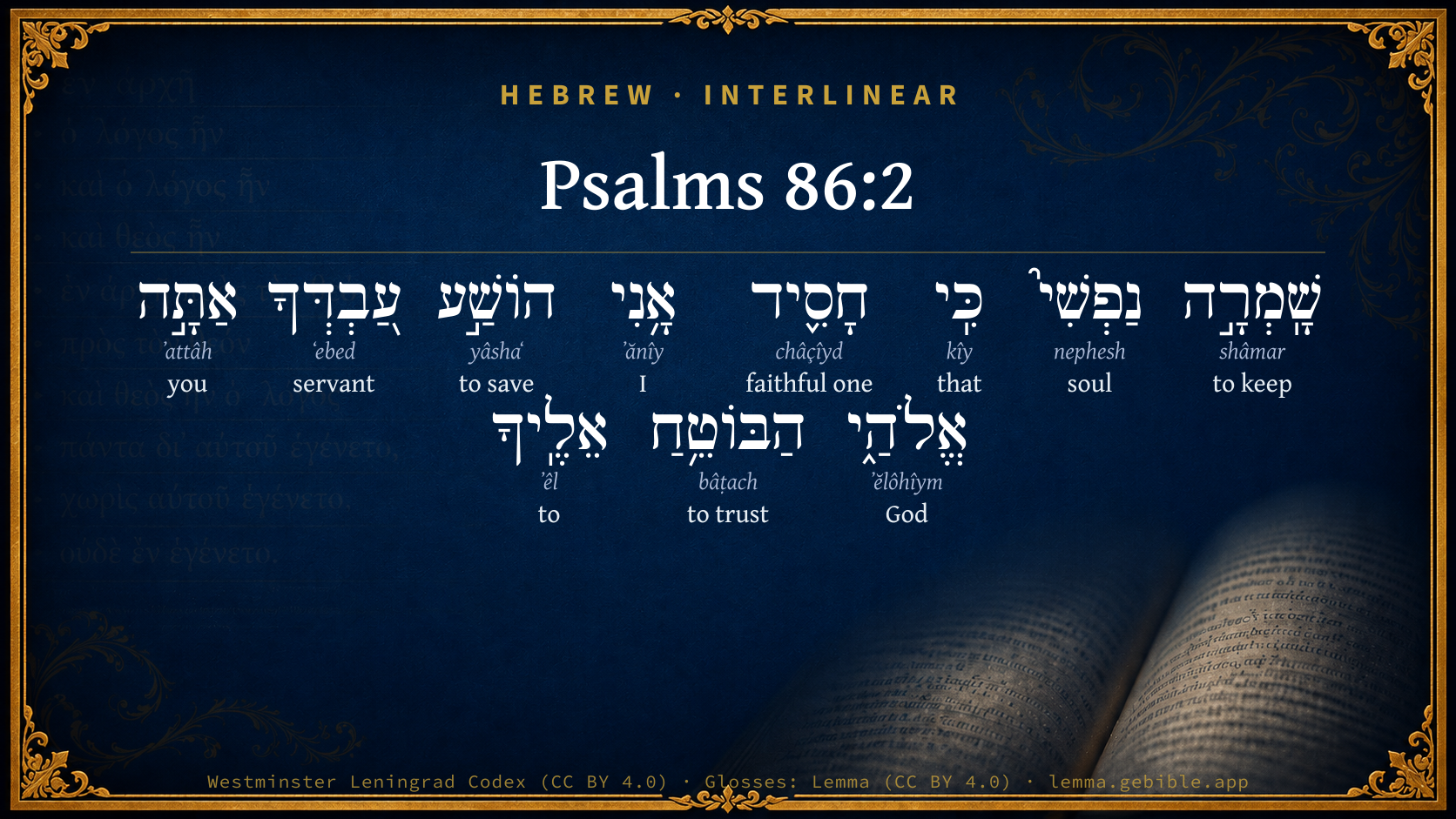
Psalms 86:2

Hebrew (Westminster Leningrad Codex) Psalms 86:2 appears in the Hebrew Old Testament. The text above is from the Westminster Leningrad Codex. Each word links to its Strong’s number, a concise gloss, and parsing drawn from the Open Scriptures Hebrew Bible morphology. Click any word for its full Brown-Driver-Briggs (BDB) entry.
Download image
Cite this verse

Psalms 86:2 (World English Bible). Public Domain. Lemma interlinear Bible study tool, https://lemma.gebible.app/v/psalms/86/2.

Show BibTeX & RIS
BibTeX
RIS
English Translation
Preserve my soul, for I am godly. You, my God, save your servant who trusts in you.
World English Bible · Public Domain
Download a study sheet

One document with this verse’s original text, its word-by-word gloss line, the meaning frame, cross-references with their text, attributed commentary, and full source and license credits — printable, and it pastes into notes with its structure intact.

This verse Autodidact and up

Study sheet (.html) Plain text (.txt)

A passage Seminary Student

Up to 50 verses in one chapter. A passage sheet keeps up to 6 commentary sources and 12 cross-references per verse, in the order this page ranks them, and says so on the sheet whenever that leaves anything out. Ask for a single verse and you get the Autodidact verse sheet above.

Everything on this page stays free to read, with no account — the sheet is a download of what is already on screen, not access to it.

Want to remove ads? Support Godless Engineer
Compare translations 3

The same verse in 3 English versions, stacked beneath the original-language interlinear above. Click any original word for its lexicon entry.

Each is an independent rendering of the whole verse — the interlinear is not word-aligned to these translations.

Highlighted words mark where these versions differ — a whole-verse word diff, not a word-by-word alignment.

  • World English Bible Public Domain
    Preserve my soul, for I am godly. You, my God, save your servant who trusts in you.
  • King James Version Public Domain
    Preserve my soul; for I am holy: O thou my God, save thy servant that trusteth in thee.
  • unfoldingWord Literal Text CC BY-SA 4.0
    Guard my soul, for I faithful. You, my God, save your servant, the one trusting in you.

unfoldingWord Literal Text — © unfoldingWord, licensed CC BY-SA 4.0. Word-aligned USFM3 via Door43 (git.door43.org/unfoldingWord/en_ult).

Versions to compare (up to 4)

3 of 4 selected

Show all 18 translations

Every available English version of this verse, each an independent rendering of the whole verse.

  • World English Bible Public Domain
    Preserve my soul, for I am godly. You, my God, save your servant who trusts in you.
  • Berean Standard Bible Public Domain
    Preserve my soul, for I am godly. You are my God; save Your servant who trusts in You.
  • Majority Standard Bible Public Domain
    Preserve my soul, for I am godly. You are my God; save Your servant who trusts in You.
  • King James Version Public Domain
    Preserve my soul; for I am holy: O thou my God, save thy servant that trusteth in thee.
  • American Standard Version (1901) Public Domain
    Preserve my soul; for I am godly: O thou my God, save thy servant that trusteth in thee.
  • Revised Version (1885) Public Domain
    Preserve my soul; for I am godly: O thou my God, save thy servant that trusteth in thee.
  • Geneva Bible (1599) Public Domain
    Preserue thou my soule, for I am mercifull: my God, saue thou thy seruant, that trusteth in thee.
  • Douay-Rheims (1899) Public Domain
    Preserve my soul, for I am holy: save thy servant, O my God, that trusteth in thee.
  • Young's Literal Translation Public Domain
    Keep my soul, for I `am' pious, Save Thy servant -- who is trusting to Thee, O Thou, my God.
  • Literal Standard Version CC BY-SA 4.0
    Keep my soul, for I [am] pious, || Save Your servant who is trusting to You, O You, my God.
  • Unlocked Literal Bible CC BY-SA 4.0
    Protect me, for I am loyal; my God, save your servant who trusts in you.
  • unfoldingWord Literal Text CC BY-SA 4.0
    Guard my soul, for I faithful. You, my God, save your servant, the one trusting in you.
  • Darby Bible Public Domain
    Keep my soul, for I am godly; O thou my God, save thy servant who confideth in thee.
  • World Messianic Bible Public Domain
    Preserve my soul, for I am godly. You, my God, save your servant who trusts in you.
  • Webster's Bible Public Domain
    Preserve my soul; for I am holy: O thou my God, save thy servant that trusteth in thee.
  • Free Bible Version CC BY-SA 4.0
    Don't let me die, for I am faithful to you. Save me, for I am your servant and I trust in you. You are my God.
  • Bible in Basic English Public Domain
    Keep my soul, for I am true to you; O my God, give salvation to your servant, whose hope is in you.
  • JPS Tanakh (1917) Public Domain
    Keep my soul, for I am godly; O Thou my God, save Thy servant that trusteth in Thee.

Literal Standard Version (2020), Covenant Press — licensed CC BY-SA 4.0. Text via the HelloAO Bible API (eBible.org). Unlocked Literal Bible (unfoldingWord) — licensed CC BY-SA 4.0. Text via the HelloAO Bible API (eBible.org). unfoldingWord Literal Text — © unfoldingWord, licensed CC BY-SA 4.0. Word-aligned USFM3 via Door43 (git.door43.org/unfoldingWord/en_ult). Free Bible Version, Dr. Jonathan Gallagher — licensed CC BY-SA 4.0. Text via the HelloAO Bible API (eBible.org).

Word by word

More ways to search: Search by grammar → Find every occurrence → Compare this word →

Practice this passage: Drill this verse → Learn its vocabulary →

חָסִ֪יד
châçîyd
H2623
“faithful one”
Adjective, Adjective, Masculine, Singular, Absolute
Part of Speech
Adjective
Type
Adjective
Gender
Masculine
Number
Singular
State
Absolute
Full BDB Definition

Origin: from H2616

TWOT: 698b

faithful, kind, godly, holy one, saint, pious - kind - pious, godly - faithful ones (substantive)
  1. שָֽׁמְרָ֣ה shâmar H8104 “keep” Verb, Qal, Imperative, 2nd Person, Masculine, Singular + Suffix, h
  2. נַפְשִׁי֮ nephesh H5315 “soul · my” Noun, Common, Both, Singular, Construct + Suffix, Personal, 1st Person, Common, Singular
  3. כִּֽי kîy H3588 “that” Conjunction
  4. אָ֥נִי ʼănîy H589 “I” Pronoun, Personal, 1st Person, Common, Singular
  5. הוֹשַׁ֣ע yâshaʻ H3467 “save” Verb, Hiphil, Imperative, 2nd Person, Masculine, Singular
  6. עַ֭בְדְּךָ ʻebed H5650 “servant · your” Noun, Common, Masculine, Singular, Construct + Suffix, Personal, 2nd Person, Masculine, Singular
  7. אַתָּ֣ה ʼattâh H859 “you” Pronoun, Personal, 2nd Person, Masculine, Singular
  8. אֱלֹהַ֑י ʼĕlôhîym H430 “God(s) · my” Noun, Common, Masculine, Plural, Construct + Suffix, Personal, 1st Person, Common, Singular
  9. הַבּוֹטֵ֥חַ bâṭach H982 “the · trusting” Particle, Definite Article + Verb, Qal, Participle Active, Masculine, Singular, Absolute
  10. אֵלֶֽיךָ ʼêl H413 “to · you” Preposition + Suffix, Personal, 2nd Person, Masculine, Singular

About this verse

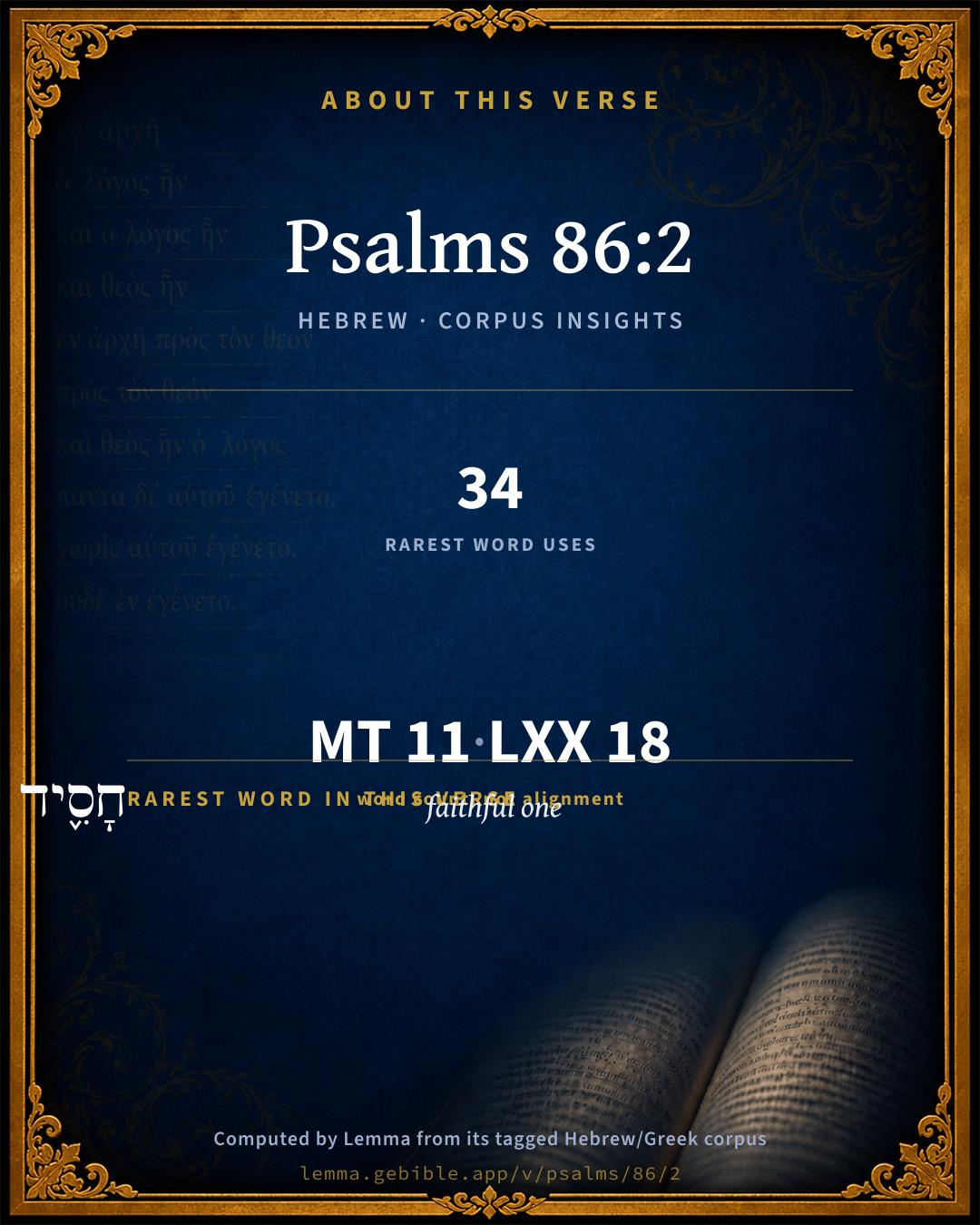
These counts appear in no published source. They are computed here, from the morphology-tagged text and Lemma’s own curated glosses. What Lemma adds →

11
words
11
distinct lemmas
Wisdom
section

Shared distinctive vocabulary

חָסִ֪יד faithful one H2623 occurs in 32 verses of the Hebrew Bible. Also found in:

Grammatical profile

  • 3 verbs
  • 3 nouns
  • 1 adjective
  • 2 pronouns
  • 1 preposition
  • 1 conjunction

Verb forms

  • שָֽׁמְרָ֣ה Qal · Imperative
  • הוֹשַׁ֣ע Hiphil · Imperative
  • הַבּוֹטֵ֥חַ Qal · Participle Active

Hebrew & Septuagint length

In English translation the verse runs 17 words from the Hebrew and 16 from the Septuagint (LXX English) — closely comparable.

A rough comparison of the two English renderings, which tokenize alike — not a word-level alignment.

Word counts can differ between the Hebrew and the Greek without any difference in meaning — e.g. the Hebrew direct-object marker אֵת has no separate Greek word, and Greek often adds the article ὁ.

In the original languages it is 11 Hebrew tokens and 18 Greek tokens — but the two are counted differently (Hebrew bundles its prefixes and suffixes into one token; the Greek is in lemma form), so that isn’t a like-for-like length.

Cross-references

23

Topical passages linked to Psalms 86:2 in the Treasury of Scripture Knowledge — connected by theme and wording, ordered by reader-vote popularity; previews shown in the World English Bible.

  • Psalms 4:3 But know that Yahweh has set apart for himself him who is godly: Yahweh will hear when I call to him.
  • Psalms 25:2 My God, I have trusted in you, Don't let me be shamed. Don't let my enemies triumph over me.
  • Psalms 13:5 But I trust in your loving kindness. My heart rejoices in your salvation.
  • Psalms 18:19 He brought me forth also into a large place. He delivered me, because he delighted in me.
  • Psalms 31:1 In you, Yahweh, I take refuge. Let me never be disappointed: Deliver me in your righteousness.
  • Psalms 119:94 I am yours. Save me, for I have sought your precepts.
  • Isaiah 26:3–4 You will keep [him] in perfect peace, [whose] mind [is] stayed [on you]; because he trusts in you.
  • John 17:11 I am no more in the world, but these are in the world, and I am coming to you. Holy Father, keep them through your name which you have given me, that they may be one, even as we are.
  • Psalms 16:1 Preserve me, God, for in you do I take refuge.
  • Deuteronomy 7:7–8 Yahweh didn't set his love on you, nor choose you, because you were more in number than any people; for you were the fewest of all peoples:
  • 1 Samuel 2:9 He will keep the feet of his holy ones; But the wicked shall be put to silence in darkness; For by strength shall no man prevail.
  • Psalms 31:14 But I trust in you, Yahweh. I said, "You are my God."
  • Psalms 37:28 For Yahweh loves justice, And doesn't forsake his saints. They are preserved forever, But the children of the wicked shall be cut off.
  • Psalms 50:5 "Gather my saints together to me, Those who have made a covenant with me by sacrifice."
  • Psalms 119:124–125 Deal with your servant according to your loving kindness. Teach me your statutes.
  • Psalms 143:12 In your loving kindness, cut off my enemies, And destroy all those who afflict my soul, For I am your servant.
  • John 10:27–29 My sheep hear my voice, and I know them, and they follow me.
  • John 12:26 If anyone serves me, let him follow me. Where I am, there will my servant also be. If anyone serves me, the Father will honor him.
  • Romans 9:18 So then, he has mercy on whom he desires, and he hardens whom he desires.
  • Romans 9:23–24 and that he might make known the riches of his glory on vessels of mercy, which he prepared beforehand for glory,
  • Romans 15:12–13 Again, Isaiah says, "There will be the root of Jesse, He who arises to rule over the Gentiles; On him will the Gentiles hope."
  • Ephesians 1:12–13 to the end that we should be to the praise of his glory, we who had before hoped in Christ:
  • 1 Peter 5:3–5 neither as lording it over the charge allotted to you, but making yourselves examples to the flock.

Cross-references courtesy of OpenBible.info (CC BY 4.0).

Hebrew and Greek witnesses Masoretic Hebrew ↔ Greek Septuagint

The same verse in the two great witnesses to the Old Testament, shown verse-for-verse.

You’re reading Greek Psalm 85 (Hebrew Psalm 86). The Septuagint counts the superscription, so verse numbers can differ from the Hebrew — chapter-level alignment, not verse-by-verse. Numbering follows Rahlfs.

These are two independent witnesses, not word-aligned to each other, and the Septuagint is shown in lemma (dictionary) form.

Hebrew Psalms 86:2 Masoretic · Westminster Leningrad Codex

שָֽׁמְרָ֣ה נַפְשִׁי֮ כִּֽי חָסִ֪יד אָ֥נִי הוֹשַׁ֣ע עַ֭בְדְּךָ אַתָּ֣ה אֱלֹהַ֑י הַבּוֹטֵ֥חַ אֵלֶֽיךָ

Preserve my soul, for I am godly. You, my God, save your servant who trusts in you.

World English Bible · Public Domain

Greek LXX Greek Psalm 85:2 Septuagint · lemma form

φυλάσσω ὁ ψυχή ἐγώ ὅτι ὅσιος εἰμί σώζω ὁ δοῦλος σύ ὁ θεός ἐγώ ὁ ἐλπίζω ἐπί σύ

Preserve my soul, for I am holy; save your servant, O God, who hopes in you.

LXX2012 (modern English Septuagint) · Public Domain

Hebrew: Westminster Leningrad Codex (CC BY 4.0). Greek: Septuagint (public domain); English from LXX2012 (modern English Septuagint) (Public Domain). How the Septuagint differs from the Hebrew →

Commentary

Notes on Psalms 86:2 from classic Christian and Jewish commentators (each source and its license shown beneath its notes). The classic Christian expositions comment on the surrounding passage and are grouped to its opening verse, so a note may address several verses; the Jewish commentaries on the Tanakh (Rashi and others) are per-verse, so they appear only where the commentator wrote on this verse.

Lemma curates 59 commentaries, every one of them public domain or Creative Commons licensed, each selected and text-cleaned for this edition rather than reprinted as found. About our sources →

Trapp's Complete Commentary

John Trapp

Psa 86:2 Preserve my soul; for I [am] holy: O thou my God, save thy servant that trusteth in thee.

Ver. 2. Preserve my soul, for I am holy] Or, a favourite, a saint, merciful, such a one as upon whose heart the tender mercies of the Almighty, shed forth abundantly, do leave a compassionate frame. David had the Divine nature transfused into him; he was holy as God is holy; and merciful as God is merciful (in quality though not in equality), but all of free grace; and this he pleadeth for his own safety.

Save thy servant] Serva servum tuum, thy devoted servant, and not thy beneficiary only.

John Trapp, A Commentary or Exposition upon All the Books of the Old and New Testament (1647–1656) — public domain. Text from a community e-Sword module.

The Treasury of David

Charles H. Spurgeon

Ver. 2. Preserve my soul. Let my life be safe from my enemies, and my spiritual nature be secure from their temptations. He feels himself unsafe except he be covered by the divine protection.

For I am holy. I am set apart for holy uses, therefore do not let thine enemies commit a sacrilege by injuring or defiling me: I am clear of the crimes laid to my charge, and in that sense innocent; therefore, I beseech thee, do not allow me to suffer from unjust charges: and I am inoffensive, meek, and gentle towards others, therefore deal mercifully with me as I have dealt with my fellow men. Any of these renderings may explain the text, perhaps all together will expound it best. It is not self righteous in good men to plead their innocence as a reason for escaping from the results of sins wrongfully ascribed to them; penitents do not bedaub themselves with mire for the love of it, or make themselves out to be worse than they are out of compliment to heaven. No, the humblest saint is not a fool, and he is as well aware of the matters wherein he is clear as of those wherein he must cry "peccavi." To plead guilty to offences we have never committed is as great a lie as the denial of our real faults.

O thou my God, save thy servant that trusteth in thee. Lest any man should suppose that David trusted in his own holiness he immediately declared his trust in the Lord, and begged to be saved as one who was not holy in the sense of being perfect, but was even yet in need of the very clements of salvation. How sweet is that title, "my God", when joined to the other, "thy servant"; and how sweet is the hope that on this ground we shall be saved; seeing that our God is not like the Amalekitish master who left his poor sick servant to perish. Note how David's poor I am (or rather the I repeated without the am) appeals to the great I AM with that sacred boldness engendered by the necessity which breaks through stone walls, aided by the faith which removes mountains.

Ver 2. Holy. The word has been variously translated: Godly, De Muis, Ainsworth and others; charitable, or beneficent, Piscator; merciful or tenderhearted, Mariana; diligently or earnestly compassionate, Vatablus; meek, Calvin; a beloved one, Version of American Bible Union; one whom thou lovest, Perowne; a devoted or dedicated man, Weiss.

Ver. 2. For I am Holy. Some have objected to David's pleading his own good character; but if he did not go beyond the truth, and the occasion called for it, there was nothing wrong in his so doing. Job, David, Peter, John and Paul all did it, Job 27:5 Ps 116:16 Joh 21:15-17 Re 1:10 1Co 9:1. Nor is it presumptuous to ask God to show mercy to us for we show it to others; or to forgive us for we forgive others, Mt 5:7 6: 14-15. William S. Plumer.

Ver. 2. I am holy...thy servant which trusteth in thee. They that are holy, yet must not trust in themselves, or in their own righteousness, but only in God and his grace. Matthew Henry.

Ver. 2. Save thy servant that trusteth in thee. When God saves his servant, he saves what belongs to himself; and, when he saves him that trusts in him, he shows himself to be just and faithful, in carrying out what he promised. Bellarmine.

Ver. 2-5. The aspirations after holiness which are found in this Psalm, coupled with its earnest invocation of mercy from the God with whom there is forgiveness, render it peculiarly applicable to those whose daily access is to a throne of needed grace. Christians know that while their standing is the blameless perfection of the Lord their righteouness, they are in many things offenders still. Nor do we ever fully prove the preciousness of Jesus as our portion, except we are drawn to him by that Spirit which reveals to us a nakedness and poverty within ourselves, which his blessed fulness can alone redress.

There is a consciousness of personal sanctification through faith (Ps 86:2) associated with an acutely sensitive perception of intrinsic worthlessness, such as only finds relief in the remembrance of unaltered grace (Ps 86:5), which, to the exercised spirit of one really growing in the knowledge of God, will address itself with an especial acceptance. Arthur Pridham.

Ver. 2.

1. The blessing sought is present, spiritual, complete and final preservation.

2. Our reasons for expecting it are

(a) Our belonging to God"I am holy."

(b) God's belonging to us"my God."

(c) Our faith, which has the promise.

(d) Our fruits, which prove our faith"thy servant"

Psalms 86:3*

Charles H. Spurgeon's The Treasury of David (1869–1885) — public domain. Psalms only. Text from a community e-Sword/MySword module.

Joseph Benson's Commentary

Psa 86:2. Preserve my soul, for I am holy — Sanctified in some measure by thy grace, and sincerely devoted to thy service. Hebrew, אני חסיד, ani chasid, I am good, merciful, or pious. Show that mercy to me which I am willing and ready to show to others. This David mentions, not in a way of vain ostentation, but as an argument to move God to answer his prayers, because he was one of that sort of men whose prayers God had engaged himself, by his promise and covenant, to hear; and partly by way of just and necessary vindication of himself from the censures of his enemies, who represented him to the world as a dissembler, and secretly a very wicked man; concerning which he here makes a solemn appeal to God, desiring audience and help from him upon no other condition than that he was truly upright and righteous before him. Which, by the way, manifests no more arrogance than when he elsewhere professes his great love to, and longing after, God; his sincere obedience to all God’s commands, and his hatred of every false way, and the like.

Joseph Benson's Commentary on the Old and New Testaments (1811–1818) — public domain. Text from a community e-Sword module.

J. A. Alexander on Psalms

Joseph Addison Alexander

2. (Psa 86:2) Keep my soul, for a gracious one (am) I; save thy servant, even. thou, my God, the (servant) trusting in thee. He prays for the safe keeping of his soul or life, because it was this that the enemy threatened. See below, Psa 86:14. The grounds assigned are two, or rather one exhibited in two forms. The first is, that he is a saint or gracious one, a merciful object of God's mercy. See above, on Psa 85:7. The other is that, as a servant of Jehovah, he believes and trusts in him alone. The original expression is not in but to or towards thee, as if implying that the believer turns or looks away from every other ground of confidence to God alone. The same construction occurs twice above, in Psa 4:5; Psa 31:6.

Joseph Addison Alexander, The Psalms Translated and Explained (1850) — public domain. Text from a community e-Sword module.

Geneva Bible (1599)

Geneva Bible translators

I am not enemy to them, but pity them though they be cruel toward me.

Geneva Bible (1599) marginal notes — public domain. Text via Bolls.life.

Adam Clarke's Commentary

Verse 2. Preserve my soul] Keep it as in a strong place.

For I am holy] כי חשיד אני ki chasid ani, for I am merciful. The spirit of this prayer is,

"The mercy I to others show,

That mercy show to me!"

Save thy servant] I have long taken thee as my Master and Lord; I receive the word from thy mouth, and obey thee.

Adam Clarke's Commentary on the Bible (1810–1826) — public domain. Text from a community e-Sword/MySword module.

John Calvin's Commentaries

2. Preserve my soul, for I am meek. Here the Psalmist adduces two other arguments by which to stir up God to grant him succor, — his own gentleness towards his neighbors, and the trust which he reposed in God. In the first clause he may seem at first sight to make some pretensions to personal worth; yet he plainly shows that nothing was farther from his intention than to insinuate that by any merits of his own he had brought God under obligations to preserve him. But the particular mention made of his clemency or meekness tends to exhibit in a more odious light the wickedness of his enemies, who had treated so shamefully, and with such inhumanity, a man against whom they could bring no well-founded charge, and who had even endeavored to the utmost of his power to please them. Since God then has avowed himself to be the defender both of good causes and of those who follow after righteousness, David, not without good reason, testifies that he had endeavored to exercise kindness and gentleness; that from this it may appear that he was basely requited by his enemies, when they gratuitously acted with cruelty towards a merciful man. But as it would not be enough for our lives to be characterised by kindness and righteousness, an additional qualification is subjoined — that of trust or confidence in God, which is the mother of all true religion. Some, we are aware, have been endued with so high a degree of integrity, as to have obtained among men the praise of being perfectly just, even as Aristides gloried in having never given any man cause of sorrow. But as those men, with all the excellence of their virtues, were either filled with ambition, or inflated with pride, which made them trust more to themselves than to God, it is not surprising to find them suffering the punishment of their vanity. In reading profane history, we are disposed to marvel how it came to pass that God abandoned the honest, the grave, and the temperate, to the enraged passions of a wicked multitude; but there is no reason for wondering at this when we reflect that such persons, relying on their own strength and virtue, despised the grace of God with all the superciliousness of impiety. Making an idol of their own virtue they disdained to lift up their eyes to Him. Although, therefore, we may have the testimony of an approving conscience, and although He may be the best witness of our innocence, yet if we are desirous of obtaining his assistance, it is necessary for us to commit our hopes and anxieties to him. If it is objected, that in this way the gate is shut against sinners, I answer, that when God invites to himself those who are blameless and upright in their deportment, this does not imply that he forthwith repels all who are punished on account of their sins; for they have an opportunity given them, if they will improve it, for prayer and the acknowledgement of their guilt. , But if those whom we have never offended unrighteously assail us, we have ground for double confidence before God.

John Calvin's Commentaries (1540-1563) — public domain. Text from the Calvin Translation Society English edition (1840s-50s) via the Christian Classics Ethereal Library (ccel.org). Calvin's coverage is partial (roughly two-thirds of the Bible); uncommented books and verses are honest gaps, never fabricated. The 19th-century editor's footnotes and remarks are omitted so the notes are faithfully Calvin's own voice.

Ellicott's Commentary for English Readers

(2) For I am holy.—Rather, in order to reproduce the feeling, for I am one of the chosen ones; one of Thy saints, &c. He pleads the covenant relation as a claim to the blessing. (See, on chasid, Note, Psa_1:5.)

A Bible Commentary for English Readers, edited by Charles John Ellicott (1878–1897) — public domain. Text from a community e-Sword module.

The Cambridge Bible for Schools and Colleges

gen. ed. J. J. S. Perowne

2. Preserve my soul] = Psa_25:20.

for I am holy] R.V. godly fails to bring out the connexion of the word with chesed, ‘lovingkindness’ (Psa_86:5; Psa_86:13; Psa_86:15). Cheyne gives duteous in love. But the passive sense beloved, ‘the object of thy loving-kindness,’ is far more suitable. He pleads not his own merits, but the covenant relation into which God has brought him as an Israelite. See on Psa_50:5; Psa_85:8.

The Cambridge Bible for Schools and Colleges (gen. ed. J. J. S. Perowne; Cambridge University Press, 1878–1918) — public domain. Text from a community e-Sword module.

John Gill's Exposition

Preserve my soul,.... Or life, which Saul sought after; and this prayer was heard: David was often remarkably preserved by the Lord from his attempts upon him; and so was the soul or life of Christ preserved in his infancy from Herod's malice; in the wilderness from wild beasts, and from perishing with hunger; and often from the designs of the Jews, to take away his life before his time; and he was supported in death, preserved from corruption in the grave, and raised from thence: instances there are of his praying for the preservation of his life, with submission to the will of God, in which he was heard, Mat 26:39. The Lord is not only the preserver of the lives of men in a temporal sense, but he is the preserver of the souls of his people, their more noble part, whose redemption is precious; he keeps them from the evil of sin, and preserves them safe to his kingdom and glory; yea, their whole soul, body, and spirit, are preserved by him blameless, unto the coming of Christ:

for I am holy; quite innocent, as to the crime that was laid to his charge by Saul and his courtiers; or was kind, beneficent, and merciful, to others, and to such God shows himself merciful, they obtain mercy: or was favoured of God, to whom he had been bountiful, on whom he had bestowed many mercies and blessings; and therefore desires and hopes that, to the rest of favours, this of preservation might be added; or, as he was a sanctified person, and God had begun his work of grace in him, he therefore entreats the Lord would preserve him, and perfect his own work in him: some, as Aben Ezra observes, would have the sense to be,

"keep my soul until I am holy:''

so Arama interprets it,

"keep me unto the world to come, where all are holy:''

the character of an Holy One eminently and perfectly agrees with Christ, as well as the petition; see Psa 16:1.

O thou, my God, save thy servant that trusteth in thee; both temporally and spiritually: the arguments are taken from covenant interest in God, which is a strong one; from relation to him as a servant, not by nature only, but by grace; and from his trust and confidence in him; all which, as well as the petition, agree with Christ; see Psa 22:1.

John Gill's Exposition of the Whole Bible (1746–1763) — public domain (CC PDM 1.0). Text via the HelloAO Bible API.

Albert Barnes' Notes on the Bible

Preserve my soul - Preserve, or keep, my life; for so the word rendered soul means in this place, as it does commonly in the Scriptures.

For I am holy - Margin, “One whom thou favorest.” The Hebrew word - חסיד châsı̂yd - means properly, benevolent, kind; then, good, merciful, gracious; and then pious, godly. Psa 30:4; Psa 31:23; Psa 37:28. The ground of the plea here is, that he was a friend of God; and that it was proper on that account to look to him for protection. He does not say that he was holy in such a sense that he had a claim on that account to the favor of God, or that his personal holiness was a ground of salvation; but the idea is, that he had devoted himself to God, and that it was, therefore, proper to look to him for his protection in the time of danger. A child looks to a parent for protection, because he is a child; a citizen looks to the protection of the laws, because he is a citizen; and so the people of God may look to him for protection, because they are his people. In all this there is no plea of merit, but there is the recognition of what is proper in the case, and what may he expected and hoped for.

Save thy servant - Save him from threatening danger and from death.

That trusteth in thee - Because I trust or confide in thee. I go nowhere else for protection; I rely on no one else. I look to thee alone, and I do this with entire confidence. A man who does this has a right to look to God for protection, and to expect that God will interpose in his behalf.

Albert Barnes' Notes on the Bible (1834–1885) — public domain. Text from a community e-Sword/MySword module.

Matthew Poole's English Annotations

I am holy; sanctified in some measure by thy grace, and sincerely devoted to thy service. This David speaks, not in a way of vain ostentation, but partly as a powerful argument to move God to hear his prayers, because he was one of that sort of men to whom God had engaged himself by his promise and covenant; and partly by way of just and necessary vindication of himself from the censures of his enemies, who represented him to the world as a gross dissembler, and secretly a very wicked man; concerning which he here makes a solemn appeal to God, desiring audience and help from God upon no other terms than upon this supposition, that he was a holy man; which, by the way, savoureth of no more arrogancy than when he elsewhere professeth his great love to and longing after God, his sincere obedience to all God’s commands, and his hatred of every false way, and the like.

My God, by thy covenant and my own choice.

That trusteth in thee; whereby thou seemest obliged in honour and by promise to help me.

Matthew Poole's English Annotations on the Holy Bible (1683–1685) — public domain. Text from a community e-Sword/MySword module.

Whedon's Commentary on the Bible

Daniel D. Whedon

2. Preserve—David’s prayer for protection points to his danger. (Psa_86:14; Psa_86:17.)

For I am holy—Dedicated to God, a God-worshipper. But the word חסידis as often used in the sense of merciful. “Keep my soul, for I am merciful;” as in Psa_97:10, “He preserveth the souls of his saints”—better, of his merciful ones. This suits the connexion and scope. The issue between David and his enemies was, not that he was irreligious, but that he had been unjust to man by superseding the house of Saul in the dynasty, and the tribe of Ephraim in the supremacy, to which slander had added many other false accusations. See 2Sa_15:2-6. The word in question is often used to cover the great principle of the second table of the decalogue— “Thou shall love thy neighbour as thyself.” David pleads that he had been merciful to men as a reason for now obtaining mercy of God. See Mat_5:7; Jas_2:13, and notes on Psa_4:3; Psa_12:1.כי, (kee,) “for,” because, in the text, as a causal particle, does not assign as a reason for acceptance good works as a ground of merit, as the papists hold, but as a proof of moral fitness, the promise being to such. He appeals to his works as evidence of the purity and sincerity of his intentions and heart.

Trusteth in thee—Another reason of fitness.

Daniel D. Whedon (gen. ed.), Commentary on the Old and New Testaments (1874–1909) — public domain. Text from a community e-Sword module.

The Pulpit Commentary

Preserve my soul. It is one of the special offices of God to "preserve the souls of his saints". (Psa_97:10) He is not only man"s Creator, but his "Preserver". (Job_7:20 Job_10:12) For I am holy. The psalmist does not mean to claim for himself perfect holiness, but only that sincerity in religion which God"s servants may rightly vindicate to themselves. O thou my God, save thy servant that trusteth in thee . (comp. Psa_34:22 Psa_37:40)

Man"s soul a sphere of Divine influence.

"Preserve my soul." In the Old Testament the term "soul" is often used as we use the term "life." But there always seems within the term more or less perfect apprehension of the truth that the soul is the man. The commonly received division of man"s being is into "body "and "soul;" but a more scientific analysis divides into body which includes animal soul, or life and spirit. The "tripartite division" is body, soul, spirit. As a moral redemption, the work of Christ has brought prominently before us that man is a spiritual being. As Dr. George Macdonald expresses it, "We are accustomed to say that we are bodies, and have souls; whereas we should say We are souls, and have bodies.

I MAN"S SOUL IS THE SPHERE OF GOD"S MORAL TRAINING. We may see God in history; but his supreme interest is in characters, not in events. We may see God in providence; but we fail to see him aright, unless we trace the influence of incidents on our principles and on our spirit. Everything has a moral side and a moral mission. God is ever moulding disposition and character, which are the shapings of the soul. This is true of every man. Humanity to God is a collection of spirits, or spiritual beings, set for their moral training in varied bodily forms and relations.

II MAN"S SOUL IS THE SPHERE OF GOD"S REDEMPTIONS. The mistake made about Christ the Saviour in the days of his flesh was quite a representative mistake. Men thought he came to deliver a nation from foreign dominion; whereas he came to save souls from sin. The body redemptions follow on as the natural consequences of the spiritual redemptions. God"s great work is saving souls from death. Therefore it is that before we can hope that Christ and his work will ever be appreciated, we are compelled to awaken soul anxiety; or, in other words, seek to produce conviction of sin. When our Lord"s saving work is fully studied as a moral redemption, a quickening of souls with a Divine life rather than an adjustment of broken external relations, the full mystery of it will be revealed and realized.

III MAN"S SOUL IS THE SPHERE OF THE DIVINE SANCTIFYINGS. The present work of the living Christ, realized by us as the inworking of the Holy Ghost, is not the change of the things with which we have to do, but a change of the relations in which we stand to the things; a change wrought in us wrought in the souls that we are. This change, in effect, changes the character of the things with which we have to do. R.T.

The Pulpit Commentary (1880–1919), ed. H.D.M. Spence-Jones & Joseph S. Exell — public domain. Text from a community e-Sword module.

John Wesley's Explanatory Notes

Holy - Sincerely devoted to thy service.

John Wesley, Explanatory Notes Upon the Whole Bible (1754–1765) — public domain. Text via the GEBible commentary corpus.

Scofield Reference Notes

C. I. Scofield

trusteth

(See Scofield "Psa 2:12").

The Scofield Reference Bible (1917 edition), notes by C. I. Scofield — public domain. Text from a community e-Sword module.

Rashi

Rabbi Shlomo Yitzchaki (Rashi)

for I am a pious man that I hear my insults and my disgraces, and I am able to wreak vengeance; yet I remain silent. So it is in Aggadath Tehillim (Mid. Ps. 86:1). Another explanation: Our Sages explained in Berachoth (4a): [David said,] “Am I not a pious man, when all the kings of the Orient and the Occident sit in their glory, and my hands are sullied with blood, with the sac, and with the afterbirth?”

Rashi on the Tanakh — English translations: “The Judaica Press complete Tanach with Rashi, translated by A. J. Rosenberg” (CC BY 4.0); “Pentateuch with Rashi's commentary by M. Rosenbaum and A.M. Silbermann, 1929-1934” (public domain); “The Metsudah Tanach series, Lakewood, N.J” (CC BY 4.0); and “The Book of Joshua, Metsudah Publications, 1997” (CC BY 4.0). Text via Sefaria.

Lesson kit

Teaching starters — assembled from the data on this page, not authored interpretation. Every prompt links to the verse data it draws on. Edit before teaching.

Psalms, in the Wisdom, opens this verse with 11 words (11 distinct Hebrew lemmas). Its most distinctive word is châçîyd (“faithful one”). A historical commentator’s framing appears above. Read the whole chapter for the surrounding context.

Discussion questions

  1. What does “faithful one” (châçîyd) contribute to the verse as a whole?
  2. Deuteronomy 33:8 shares the word «faithful one» with this verse. How do the two illuminate each other?
  3. These translations render this verse differently; the difference is in the English rendering, not the original. What questions does that raise?
  4. The verb «שָֽׁמְרָ֣ה» is Qal Imperative. How does its form color the action?
  5. Reading how Trapp's Complete Commentary and The Treasury of David read this verse, where do the two commentators agree and where do they part?

Things to notice

Reading settings

Reading text

Shown beneath each verse's original-language words.

Old Testament
Old Testament edition

Read the OT as the Masoretic Hebrew (MT) or the Greek Septuagint (LXX).

English shown for the Greek Septuagint (in the Hebrew ↔ Greek comparison).

Comparing translations? Open the Compare panel on any verse page to stack up to four side by side.