Judges 10:12

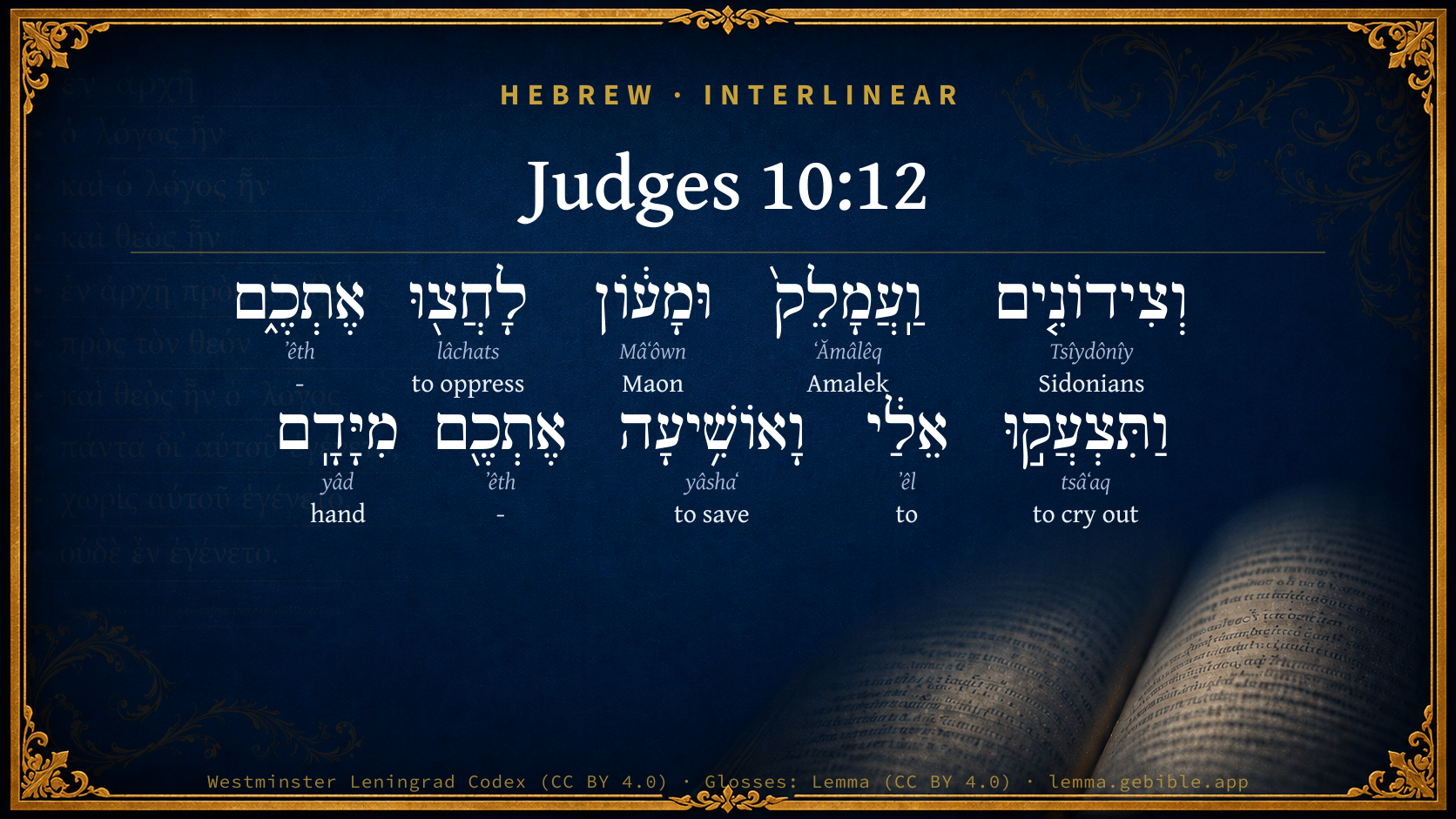
Hebrew (Westminster Leningrad Codex) Judges 10:12 appears in the Hebrew Old Testament. The text above is from the Westminster Leningrad Codex. Each word links to its Strong’s number, a concise gloss, and parsing drawn from the Open Scriptures Hebrew Bible morphology. Click any word for its full Brown-Driver-Briggs (BDB) entry.
Download image
Cite this verse

Judges 10:12 (World English Bible). Public Domain. Lemma interlinear Bible study tool, https://lemma.gebible.app/v/judges/10/12.

Show BibTeX & RIS
BibTeX
RIS
English Translation
The Sidonians also, and the Amalekites, and the Maonites, did oppress you; and you cried to me, and I saved you out of their hand.
World English Bible · Public Domain
Download a study sheet

One document with this verse’s original text, its word-by-word gloss line, the meaning frame, cross-references with their text, attributed commentary, and full source and license credits — printable, and it pastes into notes with its structure intact.

This verse Autodidact and up

Study sheet (.html) Plain text (.txt)

A passage Seminary Student

Up to 50 verses in one chapter. A passage sheet keeps up to 6 commentary sources and 12 cross-references per verse, in the order this page ranks them, and says so on the sheet whenever that leaves anything out. Ask for a single verse and you get the Autodidact verse sheet above.

Everything on this page stays free to read, with no account — the sheet is a download of what is already on screen, not access to it.

Want to remove ads? Support Godless Engineer
Compare translations 3

The same verse in 3 English versions, stacked beneath the original-language interlinear above. Click any original word for its lexicon entry.

Each is an independent rendering of the whole verse — the interlinear is not word-aligned to these translations.

Highlighted words mark where these versions differ — a whole-verse word diff, not a word-by-word alignment.

  • World English Bible Public Domain
    The Sidonians also, and the Amalekites, and the Maonites, did oppress you; and you cried to me, and I saved you out of their hand.
  • King James Version Public Domain
    The Zidonians also, and the Amalekites, and the Maonites, did oppress you; and ye cried to me, and I delivered you out of their hand.
  • unfoldingWord Literal Text CC BY-SA 4.0
    and the Sidonians and Amalek and Maon, they oppressed you, that you cried out to me and I saved you from their hand?

unfoldingWord Literal Text — © unfoldingWord, licensed CC BY-SA 4.0. Word-aligned USFM3 via Door43 (git.door43.org/unfoldingWord/en_ult).

Versions to compare (up to 4)

3 of 4 selected

Show all 18 translations

Every available English version of this verse, each an independent rendering of the whole verse.

  • World English Bible Public Domain
    The Sidonians also, and the Amalekites, and the Maonites, did oppress you; and you cried to me, and I saved you out of their hand.
  • Berean Standard Bible Public Domain
    Sidonians, Amalekites, and Maonites oppressed you and you cried out to Me, did I not save you from their hands?
  • Majority Standard Bible Public Domain
    Sidonians, Amalekites, and Maonites oppressed you and you cried out to Me, did I not save you from their hands?
  • King James Version Public Domain
    The Zidonians also, and the Amalekites, and the Maonites, did oppress you; and ye cried to me, and I delivered you out of their hand.
  • American Standard Version (1901) Public Domain
    The Sidonians also, and the Amalekites, and the Maonites, did oppress you; and ye cried unto me, and I saved you out of their hand.
  • Revised Version (1885) Public Domain
    The Zidonians also, and the Amalekites, and the Maonites, did oppress you; and ye cried unto me, and I saved you out of their hand.
  • Geneva Bible (1599) Public Domain
    The Zidonians also, and the Amalekites, and the Maonites did oppresse you, and ye cryed to me and I saued you out of their hands.
  • Douay-Rheims (1899) Public Domain
    The Sidonians also and Amalec and Chanaan oppress you, and you cried to me, and I delivered you out of their hand?
  • Young's Literal Translation Public Domain
    And the Zidonians, and Amalek, and Maon have oppressed you, and ye cry unto Me, and I save you out of their hand;
  • Literal Standard Version CC BY-SA 4.0
    And the Zidonians, and Amalek, and Maon have oppressed you, and you cry to Me, and I save you out of their hand;
  • Unlocked Literal Bible CC BY-SA 4.0
    and also from the Sidonians? The Amalekites and the Maonites oppressed you; you called out to me, and I delivered you from their power.
  • unfoldingWord Literal Text CC BY-SA 4.0
    and the Sidonians and Amalek and Maon, they oppressed you, that you cried out to me and I saved you from their hand?
  • Darby Bible Public Domain
    The Sido'nians also, and the Amal'ekites, and the Ma'onites, oppressed you; and you cried to me, and I delivered you out of their hand.
  • World Messianic Bible Public Domain
    The Sidonians also, and the Amalekites, and the Maonites, oppressed you; and you cried to me, and I saved you out of their hand.
  • Webster's Bible Public Domain
    The Zidonians also, and the Amalekites, and the Maonites oppressed you; and ye cried to me, and I delivered you out of their hand.
  • Free Bible Version CC BY-SA 4.0
    the Sidonians, the Amalekites, and the Maonites? When they attacked you, and you cried out to me for help, didn't I save you from them?
  • Bible in Basic English Public Domain
    And the Zidonians and Amalek and Midian crushing you down, and in answer to your cry did I not give you salvation from their hands?
  • JPS Tanakh (1917) Public Domain
    The Zidonians also, and the Amalekites, and the Maonites, did oppress you; and ye cried unto Me, and I saved you out of their hand.

Literal Standard Version (2020), Covenant Press — licensed CC BY-SA 4.0. Text via the HelloAO Bible API (eBible.org). Unlocked Literal Bible (unfoldingWord) — licensed CC BY-SA 4.0. Text via the HelloAO Bible API (eBible.org). unfoldingWord Literal Text — © unfoldingWord, licensed CC BY-SA 4.0. Word-aligned USFM3 via Door43 (git.door43.org/unfoldingWord/en_ult). Free Bible Version, Dr. Jonathan Gallagher — licensed CC BY-SA 4.0. Text via the HelloAO Bible API (eBible.org).

Word by word

More ways to search: Search by grammar → Find every occurrence → Compare this word →

Practice this passage: Drill this verse → Learn its vocabulary →

וּמָע֔וֹן
Mâʻôwn
H4584
“and · Maon”
Conjunction + Noun, Proper
Part of Speech
Conjunction + Noun
Type
Proper
Full BDB Definition

Origin: the same as H4583

TWOT: None

Maon or Maonites = "habitation" - a man of Judah (noun proper masculine) - the inhabitants of the city of Maon (noun proper masculine) - a city of Judah located 8 miles south of Hebron (noun proper locative)
  1. וְצִידוֹנִ֤ים Tsîydônîy H6722 “and · Sidonians” Conjunction + Noun, Gentilic, Masculine, Plural, Absolute
  2. וַֽעֲמָלֵק֙ ʻĂmâlêq H6002 “and · Amalek” Conjunction + Noun, Proper
  3. לָחֲצ֖וּ lâchats H3905 “to oppress” Verb, Qal, Perfect, 3rd Person, Common, Plural
  4. אֶתְכֶ֑ם ʼêth H853 “- · you” Particle, Direct Object + Suffix, Personal, 2nd Person, Masculine, Plural
  5. וַתִּצְעֲק֣וּ tsâʻaq H6817 “and · to cry out” Conjunction + Verb, Qal, Sequential Imperfect, 2nd Person, Masculine, Plural
  6. אֵלַ֔י ʼêl H413 “to · me” Preposition + Suffix, Personal, 1st Person, Common, Singular
  7. וָאוֹשִׁ֥יעָה yâshaʻ H3467 “and · to save” Conjunction + Verb, Hiphil, Sequential Imperfect, 1st Person, Common, Singular + Suffix, h
  8. אֶתְכֶ֖ם ʼêth H853 “- · you” Particle, Direct Object + Suffix, Personal, 2nd Person, Masculine, Plural
  9. מִיָּדָֽם yâd H3027 “from · hand · their” Preposition + Noun, Common, Both, Singular, Construct + Suffix, Personal, 3rd Person, Masculine, Plural

About this verse

These counts appear in no published source. They are computed here, from the morphology-tagged text and Lemma’s own curated glosses. What Lemma adds →

10
words
9
distinct lemmas
Historical
section

Notable vocabulary

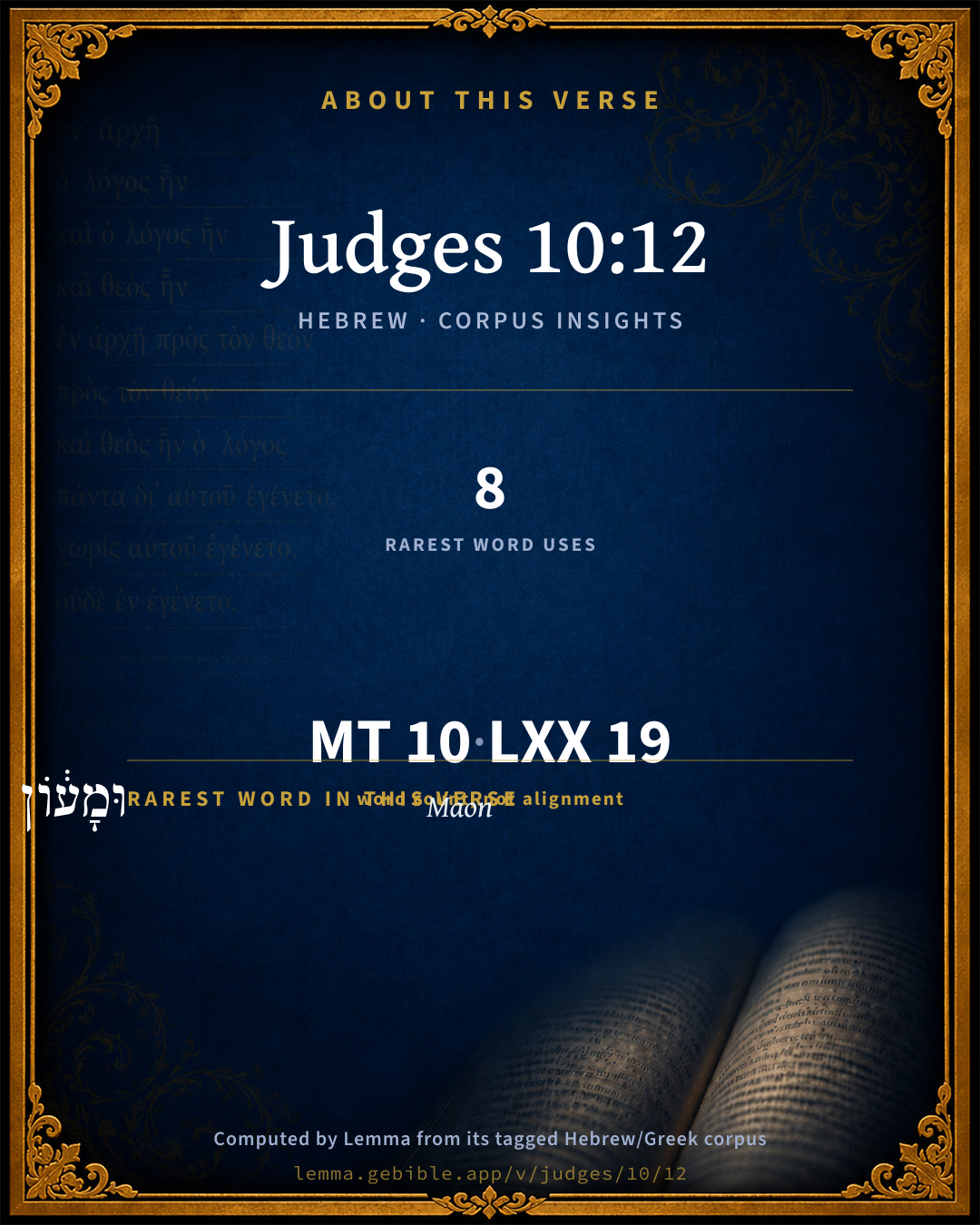
The rarest word here is וּמָע֔וֹן Maon H4584 — appearing just 8 times in the whole Hebrew Bible.

Shared distinctive vocabulary

וּמָע֔וֹן Maon H4584 occurs in 6 verses of the Hebrew Bible. Also found in:

Grammatical profile

  • 3 verbs
  • 4 nouns
  • 1 preposition
  • 2 particles

Verb forms

  • לָחֲצ֖וּ Qal · Perfect
  • וַתִּצְעֲק֣וּ Qal · Sequential Imperfect
  • וָאוֹשִׁ֥יעָה Hiphil · Sequential Imperfect

Hebrew & Septuagint length

In English translation the verse runs 25 words from the Hebrew and 24 from the Septuagint (LXX English) — closely comparable.

A rough comparison of the two English renderings, which tokenize alike — not a word-level alignment.

Word counts can differ between the Hebrew and the Greek without any difference in meaning — e.g. the Hebrew direct-object marker אֵת has no separate Greek word, and Greek often adds the article ὁ.

In the original languages it is 10 Hebrew tokens and 19 Greek tokens — but the two are counted differently (Hebrew bundles its prefixes and suffixes into one token; the Greek is in lemma form), so that isn’t a like-for-like length.

Cross-references

4

Topical passages linked to Judges 10:12 in the Treasury of Scripture Knowledge — connected by theme and wording, ordered by reader-vote popularity; previews shown in the World English Bible.

  • Judges 6:3 So it was, when Israel had sown, that the Midianites came up, and the Amalekites, and the children of the east; they came up against them;
  • Judges 5:19–31 The kings came and fought; Then fought the kings of Canaan. In Taanach by the waters of Megiddo: They took no gain of money.
  • 2 Chronicles 26:6–7 He went forth and warred against the Philistines, and broke down the wall of Gath, and the wall of Jabneh, and the wall of Ashdod; and he built cities in [the country of] Ashdod, and among the Philistines.
  • Psalms 106:42–43 Their enemies also oppressed them. They were brought into subjection under their hand.

Cross-references courtesy of OpenBible.info (CC BY 4.0).

Hebrew and Greek witnesses Masoretic Hebrew ↔ Greek Septuagint

The same verse in the two great witnesses to the Old Testament, shown verse-for-verse.

These are two independent witnesses, not word-aligned to each other, and the Septuagint is shown in lemma (dictionary) form.

Hebrew Judges 10:12 Masoretic · Westminster Leningrad Codex

וְצִידוֹנִ֤ים וַֽעֲמָלֵק֙ וּמָע֔וֹן לָחֲצ֖וּ אֶתְכֶ֑ם וַתִּצְעֲק֣וּ אֵלַ֔י וָאוֹשִׁ֥יעָה אֶתְכֶ֖ם מִיָּדָֽם

The Sidonians also, and the Amalekites, and the Maonites, did oppress you; and you cried to me, and I saved you out of their hand.

World English Bible · Public Domain

Greek LXX Judges 10:12 Septuagint · lemma form

καί σιδώνιος καί αμαληκ καί μαδιαμ ὅς θλίβω σύ καί βοάω πρός ἐγώ καί σώζω σύ ἐκ χείρ αὐτός

and from the Sidonians, and Amalec, and Madiam, who afflicted you? and you⌃ cried to me, and I saved you out of their hand?

LXX2012 (modern English Septuagint) · Public Domain

On this verse, Ellicott's Commentary for English Readers discusses the Septuagint’s reading. Read the note in Commentary ↓

Hebrew: Westminster Leningrad Codex (CC BY 4.0). Greek: Septuagint (public domain); English from LXX2012 (modern English Septuagint) (Public Domain). How the Septuagint differs from the Hebrew →

Targum (Aramaic paraphrase)

1

The Targum is the ancient Jewish Aramaic paraphrase of the Hebrew Scriptures — an interpretive translation, not the Hebrew text itself. Onkelos (literal) and Pseudo-Jonathan (expansive) render the Torah, and Jonathan the Prophets. Coverage is partial: where no permissively-licensed English translation exists for a verse, only the Aramaic is shown. This is verse-level text, not a word-by-word alignment to the Hebrew.

  1. Targum Jonathan Prophets (Joshua–Malachi)
    וְצִידוֹנָאֵי וַעֲמַלְקָאֵי וֶאֱנָשֵׁי מָעוֹן דָחֲקוּ יַתְכוֹן וּבָעִיתוּן קֳדָמַי וּפַרְקֵית יַתְכוֹן מִידֵיהוֹן:

    (no public-domain English translation for this verse)

    Targum Jonathan — Aramaic: “Mikraot Gedolot” (public domain). English: “Sefaria Community Translation” (CC0 1.0 (public-domain dedication)); “London "Chaldee Paraphrase," 1871” (public domain). Text via Sefaria.

Commentary

Notes on Judges 10:12 from classic Christian and Jewish commentators (each source and its license shown beneath its notes). The classic Christian expositions comment on the surrounding passage and are grouped to its opening verse, so a note may address several verses; the Jewish commentaries on the Tanakh (Rashi and others) are per-verse, so they appear only where the commentator wrote on this verse.

Lemma curates 59 commentaries, every one of them public domain or Creative Commons licensed, each selected and text-cleaned for this edition rather than reprinted as found. About our sources →

Trapp's Complete Commentary

John Trapp

Jdg 10:12 The Zidonians also, and the Amalekites, and the Maonites, did oppress you; and ye cried to me, and I delivered you out of their hand.

Ver. 12. The Zidonians also, … and the Maonites.] Hereby it appeareth that God had done more for this people than hitherto had been recorded. He keepeth count; should not we much more?

John Trapp, A Commentary or Exposition upon All the Books of the Old and New Testament (1647–1656) — public domain. Text from a community e-Sword module.

Joseph Benson's Commentary

Jdg 10:12. The Zidonians — We do not read of any oppression of Israel, particularly, by the Zidonians. But many things were done which are not recorded. The Maonites — Either, first, those who lived in or near the wilderness of Maon, in the south of Judah, 1Sa 23:25; 1Sa 25:2; whether Edomites or others. Or, secondly, the Mehunims, a people living near the Arabians, of whom see 2Ch 26:7. For in the Hebrew, the letters of both names are the same, only the one is the singular, the other the plural number.

Joseph Benson's Commentary on the Old and New Testaments (1811–1818) — public domain. Text from a community e-Sword module.

Jamieson, Fausset & Brown

Robert Jamieson, A. R. Fausset & David Brown

Maonites--that is, "Midianites."

Jamieson, Fausset & Brown — Commentary Critical and Explanatory on the Whole Bible (1871) — public domain (CC PDM 1.0). Text via the HelloAO Bible API.

Ellicott's Commentary for English Readers

(12) The Sidonians.—Jdg_3:3; Jdg_18:7-28. Nothing very definite is recorded of deliverance from the Sidonians; but (as we have seen) the narrative of the book is typical rather than exhaustive. (Comp. Psa_106:42-43.)

The Amalekites.—Exo_17:8, Exod. 6:33, Exo_3:13.

The Maonites.—As the LXX. here read Madian (and in some MSS. Canaan; Vulg., Chanaan), it seems probable that there has been an early corruption of the text. In the Arabic version we have “Moabites.” There was a town Maon in the desert of Judah (Jos_15:55; 1Sa_23:24; 1Sa_25:2), but this cannot be meant. There is also a Beth Meon in the tribe of Reuben (Num_22:38; Baal Meon, Jer_48:23), and a Meon in Arabia Petræa. Mehunims are also mentioned in 2Ch_26:7, and Meonim in 1Ch_4:41. If this is an allusion to some disaster of which we have no record given we must suppose that Meon was once the capital of some tribe which subsequently dwindled into insignificance.

A Bible Commentary for English Readers, edited by Charles John Ellicott (1878–1897) — public domain. Text from a community e-Sword module.

The Cambridge Bible for Schools and Colleges

gen. ed. J. J. S. Perowne

12. The Zidonians … Amalekites … Maonites] The generalizing list of oppressors is continued. The Zidonians, i.e. Phoenicians (Jdg_3:3 n.), do not appear elsewhere in this character; perhaps the name was suggested by Jdg_10:6. The Amalekites are mentioned as allies of Moab in Jdg_3:13, and of Midian in Jdg_6:3 (see note); cf. Exo_17:8-16 E. The Maonites (Maon is the form here) probably = the Meunim, 1Ch_4:41, 2Ch_20:1 (RVm.), 2Ch_26:7—all late passages; the Meunim, who are referred to as hostile to Israel, were an Arab race inhabiting the Edomite country; their name survives in Ma‘ân, 6 hours S.E. of Petra. Perhaps the post-exilic editor included Maon in this list as being an enemy familiar to later times. On the supposed connexion between the Maonites (Meunim) and the Minaeans see HDB. s.v. The LXX reads Midian here, and many scholars adopt the correction; but it is suspiciously obvious.

The Cambridge Bible for Schools and Colleges (gen. ed. J. J. S. Perowne; Cambridge University Press, 1878–1918) — public domain. Text from a community e-Sword module.

John Gill's Exposition

The Zidonians also,.... Who were left in the land to distress them, though there is no particular mention of them, and of the distress they gave them, and of their deliverance from it, which yet is not at all to be questioned:

and the Amalekites; both quickly after they came out of Egypt, Exo 17:13 and when they were come into the land of Canaan, joining the Moabites and the Midianites against them, Jdg 3:13.

and the Maonites did oppress you; meaning either the old inhabitants of Maon, a city in the mountains of Judah, near to which was a wilderness of this name, Jos 15:55 or rather a people of Arabia, called by Strabo (z), and Diodorus Siculus (a), Minaeans, the same with Mehunim, mentioned with the Arabians, Ch2 26:7 and who perhaps came along with the Midianites, when they oppressed Israel; though some have thought of the old inhabitants of Bethmeon and Baalmeon, Num 32:38.

and ye cried unto me, and I delivered you out of their hands; all those mercies and deliverances are mentioned to aggravate their sins, that notwithstanding the Lord hath so often and eminently appeared for them, yet they deserted him and his worship, and fell into idolatry. Jarchi observes, that here are seven salvations or deliverances mentioned in opposition to the seven sorts of false gods or idols they had served, Jdg 10:6.

(z) Geograph. l. 16. p. 528. (a) Bibliothec. l. 3. p. 176.

John Gill's Exposition of the Whole Bible (1746–1763) — public domain (CC PDM 1.0). Text via the HelloAO Bible API.

Albert Barnes' Notes on the Bible

The Zidonians - An allusion to the time of Barak, when the Zidonians doubtless formed part of the great confederacy of Canaanites under Jabin king of Hazor. See Jos 11:8.

The Amalekites - In the time of Gideon (marginal reference).

The Maonites - Probably one of the tribes of the “children of the East,” who came with the Midianites and Amalekites in the time of Gideon, and may have been conspicuous for their hostility to Israel, and for the greatness of their discomfiture, though the record has not been preserved. The name is “Mehununs” in 2Ch 26:7.

Albert Barnes' Notes on the Bible (1834–1885) — public domain. Text from a community e-Sword/MySword module.

Haydock's Catholic Bible Commentary

Chanaan. Hebrew, "Maon." Septuagint (Roman and Alexandrian), "Madian." The Maonites are styled Mineans by the Septuagint (1 Paralipomenon iv. 40,) and these inhabited Arabia, (Diodorus iii. 42,) and might join themselves to Madian and Amalec, in their attacks upon the Israelites. As for Chanaan, which other editions of the Septuagint retain, we know that they were domestic enemies, like thorns in the sides of Israel, Josue xxiii. 13. All the persecutions, which the Hebrews had to undergo, are not particularized in this book. (Calmet) --- They were grievously tormented in Egypt, they had to contend with the Amorrhites at their first entrance into the land. (Haydock) --- The Ammonites and Amalecites had assisted Eglon before, and the Philistines had attacked Samgar. The Sidonians, it seems, had also greatly molested those who lived near them, and probably were the auxiliaries of Jabin. (Calmet) --- But the Chanaanites were ready to fall upon every weak spot, living in various parts of the country, (Haydock) and continually tempted the people of Israel to abandon the service of God. (Calmet)

George Leo Haydock (1774–1849), Haydock's Catholic Family Bible and Commentary, 1859 edition — public domain. Excludes Psalms (Douay-Rheims chapter numbering differs from Protestant) and Deuterocanonical books (Catholic canon only).

Matthew Poole's English Annotations

The Zidonians also; for though we do not read of any oppression of Israel, particularly, by the Zidonians, yet there might be such a thing; as many things were said and done, both in the Old and New Testament, which are not recorded there; or they might join their forces with the king of Mesopotamia, Jdg 3:8, or with some other of their oppressors; for it is certain these were left among others to prove Israel, Jdg 3:1-3. Of

the Amalekites, see Jdg 3:13; 6:3.

Maonites; either, first, Those who lived in or near the wilderness of Maon, in the south of Judah, 1Sa 23:25; 25:2, whether Edomites or other. Or, secondly, The Mehunims, a people living near the Arabians, of whom 2Ch 26:7. For in the Hebrew the letters of both names are the same, only the one is the singular, the other the plural number. Or, thirdly, The Midianites, whose oppression he would not omit; it being usual for one and the same person or persons to have two names; although the Midianites may be comprehended under the Amalekites, with whom they were joined, Jdg 6:3,33. Or, fourthly, Some other people now unknown, and not expressed elsewhere in Scripture.

Matthew Poole's English Annotations on the Holy Bible (1683–1685) — public domain. Text from a community e-Sword/MySword module.

Whedon's Commentary on the Bible

Daniel D. Whedon

12. The Zidonians — Who probably joined with Jabin and other northern Canaanites against Israel, but were defeated by Barak. Jdg_5:19.

Amalekites — From these ancient foes they had been repeatedly delivered in the days of Moses, and Ehud, and Gideon. Compare Exo_17:13; Jdg_3:13; Jdg_6:3.

Maonites — The Hebrew is Maon, but, like Amalek, it here denotes a people, not a place. We have no record elsewhere of any oppressors of Israel bearing this name; hence the Septuagint reads Midian, and this reading Ewald and Keil follow. It is urged that unless we adopt this reading no mention at all is made of the terrible oppression of Midian. But it may be replied, No mention is made of the Moabite oppression, which lasted eighteen years. Jdg_3:14. The sacred writer does not profess to give an exhaustive history; but, true to the spirit of the Old Testament theocratic history, he selects just seven deliverances of Israel, in apparent allusion to the seven classes of false gods mentioned in Jdg_10:6, where see note. In such an instance it is not ours to say what he ought to have written, and what omitted.

The Maonites may be included under “the children of the East,” chap. Jdg_6:3. “Traces of the name Maon are found in several localities. It is given to a town in the south of Judah, (Jos_15:55,) now identified with the ruins of Tell Main. It is given to the bleak and hilly pasture lands which extend away to the southward of the town of Maon. 1Sa_23:25. Jeremiah (Jer_48:23) mentions Beth-meon, which may be the same as Beth-baal-meon of Jos_13:17, and Baal-meon of Num_32:38, and would thus be identical with the ruins of Main, three miles south of Heshbon. Still another Maon is mentioned. 2Ch_26:7. It is probable that all these names indicate the presence of an ancient and powerful nomad tribe, whose earliest settlements were in the vale of Sodom, and with the Amalekites who dwelt in the wilderness south of Palestine.”-Porter.

Daniel D. Whedon (gen. ed.), Commentary on the Old and New Testaments (1874–1909) — public domain. Text from a community e-Sword module.

The Pulpit Commentary

The Zidonians also. This allusion is not clear; it may mean the subjects of Jabin king of Canaan, as the northern Canaanites are called Zidonians in Jud_1:18:7; and this agrees with the order in which the deliverance from the Zidonians is here mentioned, next to that from the Philistines, and would be strengthened by the conjecture that has been made, that Harosheth (Jud_1:4:2) was the great workshop in whichthe tributary Israelites wrought in cutting down timber, etc. for the Phoenician ships; or it may allude to some unrecorded oppression. The Amalekites, who were in alliance with the Midianites, (Jud_1:6:3, 33) as previously with the Moabites (Jud_1:3:13) and with the Canaanites, (Jud_1:4:14) and whose signal defeat seems to have given the name to the mount of the Amalekites. (Jud_1:12:15) The Maonites. It is thought by many that the true reading is that preserved in the Septuagint, viz., the Midianites, which, being the greatest of all the foes of Israel, could scarcely be omitted here (see chs. 6., 7., 8.). If Maonites or Maon is the true reading, they would be the same people as the Mehunim, mentioned 2Ch_26:7 (Maon, sing., and Meunim, plur.).

The Pulpit Commentary (1880–1919), ed. H.D.M. Spence-Jones & Joseph S. Exell — public domain. Text from a community e-Sword module.

John Wesley's Explanatory Notes

The Zidonians - We do not read of any oppression of Israel, particularly, by the Zidonians. But many things were done, which are not recorded. The Maonites - Either first, those who lived in, or near the wilderness of Maon, in the south of Judah, 1 Sam. xxiii, 25; xxv, 2, whether Edomites or others. Or, secondly, the Mehunims, a people living near the Arabians, of whom, 2 Chron. xxvi, 7. For in the Hebrew, the letters of both names are the same, only the one is the singular, the other the plural number.

John Wesley, Explanatory Notes Upon the Whole Bible (1754–1765) — public domain. Text via the GEBible commentary corpus.

Rashi

Rabbi Shlomo Yitzchaki (Rashi)

And Maon. The name of a nation.

Rashi on the Tanakh — English translations: “The Judaica Press complete Tanach with Rashi, translated by A. J. Rosenberg” (CC BY 4.0); “Pentateuch with Rashi's commentary by M. Rosenbaum and A.M. Silbermann, 1929-1934” (public domain); “The Metsudah Tanach series, Lakewood, N.J” (CC BY 4.0); and “The Book of Joshua, Metsudah Publications, 1997” (CC BY 4.0). Text via Sefaria.

Lesson kit

Teaching starters — assembled from the data on this page, not authored interpretation. Every prompt links to the verse data it draws on. Edit before teaching.

Judges, in the Historical, opens this verse with 10 words (9 distinct Hebrew lemmas). Its most distinctive word is Mâʻôwn (“Maon”). A historical commentator’s framing appears above. Read the whole chapter for the surrounding context.

Discussion questions

  1. How does “Maon” (Mâʻôwn) shape what this verse is saying?
  2. Joshua 15:55 shares the word «Maon» with this verse. How do the two illuminate each other?
  3. The translations on this page render this verse differently — a whole-verse word diff, not a word-by-word alignment. What might account for the different wordings?
  4. The verb «לָחֲצ֖וּ» is Qal Perfect. How does its form color the action?
  5. Reading how Trapp's Complete Commentary and Joseph Benson's Commentary read this verse, where do the two commentators agree and where do they part?

Things to notice

Reading settings

Reading text

Shown beneath each verse's original-language words.

Old Testament
Old Testament edition

Read the OT as the Masoretic Hebrew (MT) or the Greek Septuagint (LXX).

English shown for the Greek Septuagint (in the Hebrew ↔ Greek comparison).

Comparing translations? Open the Compare panel on any verse page to stack up to four side by side.