
1 Samuel 10:19

Hebrew (Westminster Leningrad Codex) 1 Samuel 10:19 appears in the Hebrew Old Testament. The text above is from the Westminster Leningrad Codex. Each word links to its Strong’s number, a concise gloss, and parsing drawn from the Open Scriptures Hebrew Bible morphology. Click any word for its full Brown-Driver-Briggs (BDB) entry.
Download image
Cite this verse

1 Samuel 10:19 (World English Bible). Public Domain. Lemma interlinear Bible study tool, https://lemma.gebible.app/v/1-samuel/10/19.

Show BibTeX & RIS
BibTeX
RIS
English Translation
but you have this day rejected your God, who himself saves you out of all your calamities and your distresses; and you have said to him, [No], but set a king over us. Now therefore present yourselves before Yahweh by your tribes, and by your thousands.
World English Bible · Public Domain
Download a study sheet

One document with this verse’s original text, its word-by-word gloss line, the meaning frame, cross-references with their text, attributed commentary, and full source and license credits — printable, and it pastes into notes with its structure intact.

This verse Autodidact and up

Study sheet (.html) Plain text (.txt)

A passage Seminary Student

Up to 50 verses in one chapter. A passage sheet keeps up to 6 commentary sources and 12 cross-references per verse, in the order this page ranks them, and says so on the sheet whenever that leaves anything out. Ask for a single verse and you get the Autodidact verse sheet above.

Everything on this page stays free to read, with no account — the sheet is a download of what is already on screen, not access to it.

Want to remove ads? Support Godless Engineer
Compare translations 3

The same verse in 3 English versions, stacked beneath the original-language interlinear above. Click any original word for its lexicon entry.

Each is an independent rendering of the whole verse — the interlinear is not word-aligned to these translations.

Highlighted words mark where these versions differ — a whole-verse word diff, not a word-by-word alignment.

  • World English Bible Public Domain
    but you have this day rejected your God, who himself saves you out of all your calamities and your distresses; and you have said to him, [No], but set a king over us. Now therefore present yourselves before Yahweh by your tribes, and by your thousands.
  • King James Version Public Domain
    And ye have this day rejected your God, who himself saved you out of all your adversities and your tribulations; and ye have said unto him, Nay, but set a king over us. Now therefore present yourselves before the LORD by your tribes, and by your thousands.
  • unfoldingWord Literal Text CC BY-SA 4.0
    But you today have rejected your God, him who is saving you from all of your calamities and your distresses. And you have said to him that ‘you shall set a king over us.’ And now, station yourselves to the face of Yahweh according to your tribes and according to your thousands.”

unfoldingWord Literal Text — © unfoldingWord, licensed CC BY-SA 4.0. Word-aligned USFM3 via Door43 (git.door43.org/unfoldingWord/en_ult).

Versions to compare (up to 4)

3 of 4 selected

Show all 18 translations

Every available English version of this verse, each an independent rendering of the whole verse.

  • World English Bible Public Domain
    but you have this day rejected your God, who himself saves you out of all your calamities and your distresses; and you have said to him, [No], but set a king over us. Now therefore present yourselves before Yahweh by your tribes, and by your thousands.
  • Berean Standard Bible Public Domain
    But today you have rejected your God, who saves you from all your troubles and afflictions, and you have said to Him, ‘No, set a king over us.’ Now therefore present yourselves before the LORD by your tribes and clans.”
  • Majority Standard Bible Public Domain
    But today you have rejected your God, who saves you from all your troubles and afflictions, and you have said to Him, ‘No, set a king over us.’ Now therefore present yourselves before the LORD by your tribes and clans.”
  • King James Version Public Domain
    And ye have this day rejected your God, who himself saved you out of all your adversities and your tribulations; and ye have said unto him, Nay, but set a king over us. Now therefore present yourselves before the LORD by your tribes, and by your thousands.
  • American Standard Version (1901) Public Domain
    but ye have this day rejected your God, who himself saveth you out of all your calamities and your distresses; and ye have said unto him, `Nay', but set a king over us. Now therefore present yourselves before Jehovah by your tribes, and by your thousands.
  • Revised Version (1885) Public Domain
    but ye have this day rejected your God, who himself saveth you out of all your calamities and your distresses; and ye have said unto him, Nay, but set a king over us. Now therefore present yourselves before the LORD by your tribes, and by your thousands.
  • Geneva Bible (1599) Public Domain
    But ye haue this day cast away your God, who onely deliuereth you out of all your aduersities and tribulations: and ye said vnto him, No, but appoint a King ouer vs. Nowe therefore stand ye before the Lord according to your tribes, and according to your thousands.
  • Douay-Rheims (1899) Public Domain
    But you this day have rejected your God, who only hath saved you out of all your evils and your tribulations: and you have said: Nay: but set a king over us. Now therefore stand before the Lord by your tribes, and by your families.
  • Young's Literal Translation Public Domain
    and ye to-day have rejected your God, who `is' Himself your saviour out of all your evils and your distresses, and ye say, `Nay, but -- a king thou dost set over us; and now, station yourselves before Jehovah, by your tribes, and by your thousands.'
  • Literal Standard Version CC BY-SA 4.0
    and you have rejected your God today, who [is] Himself your Savior out of all your evils and your distresses, and you say, No, but you set a king over us; and now, station yourselves before YHWH, by your tribes, and by your thousands.”
  • Unlocked Literal Bible CC BY-SA 4.0
    But today you have rejected your God, who saves you from all of your calamities and your distresses; and you have said to him, 'Set a king over us.' Now present yourselves before Yahweh by your tribes and by your clans.”
  • unfoldingWord Literal Text CC BY-SA 4.0
    But you today have rejected your God, him who is saving you from all of your calamities and your distresses. And you have said to him that ‘you shall set a king over us.’ And now, station yourselves to the face of Yahweh according to your tribes and according to your thousands.”
  • Darby Bible Public Domain
    but *ye* have this day rejected your God, who himself saved you out of all your adversities and your troubles, and have said unto him, [Nay,] but a king shalt thou set over us. Now therefore present yourselves before Jehovah by your tribes, and by your thousands.
  • World Messianic Bible Public Domain
    But you have today rejected your God, who himself saves you out of all your calamities and your distresses; and you have said to him, ‘No! Set a king over us!’ Now therefore present yourselves before the LORD by your tribes and by your thousands.”
  • Webster's Bible Public Domain
    And ye have this day rejected your God, who himself saved you out of all your adversities, and your tribulations; and ye have said to him, No, but set a king over us. Now therefore present yourselves before the LORD by your tribes, and by your thousands.
  • Free Bible Version CC BY-SA 4.0
    But now you have rejected your God, the one who saves you from all your troubles and disasters. You told him, ‘You must appoint a king to rule us.’ So now present yourselves before the Lord by your tribes and family groups.”
  • Bible in Basic English Public Domain
    But today you are turned away from your God, who himself has been your saviour from all your troubles and sorrows; and you have said to him, Put a king over us. So now, take your places before the Lord by your tribes and by your thousands.
  • JPS Tanakh (1917) Public Domain
    But ye have this day rejected your God, who Himself saveth you out of all your calamities and your distresses; and ye have said unto Him: Nay, but set a king over us. Now therefore present yourselves before the LORD by your tribes, and by your thousands.'

Literal Standard Version (2020), Covenant Press — licensed CC BY-SA 4.0. Text via the HelloAO Bible API (eBible.org). Unlocked Literal Bible (unfoldingWord) — licensed CC BY-SA 4.0. Text via the HelloAO Bible API (eBible.org). unfoldingWord Literal Text — © unfoldingWord, licensed CC BY-SA 4.0. Word-aligned USFM3 via Door43 (git.door43.org/unfoldingWord/en_ult). Free Bible Version, Dr. Jonathan Gallagher — licensed CC BY-SA 4.0. Text via the HelloAO Bible API (eBible.org).

Word by word

More ways to search: Search by grammar → Find every occurrence → Compare this word →

Practice this passage: Drill this verse → Learn its vocabulary →

הִֽתְיַצְּבוּ֙
yâtsab
H3320
“stand”
Verb, Hithpael, Imperative, 2nd Person, Masculine, Plural
Part of Speech
Verb
Stem
Hithpael
Form
Imperative
Person
2nd Person
Gender
Masculine
Number
Plural
Full BDB Definition

Origin: a primitive root

TWOT: 894

to place, set, stand, set or station oneself, present oneself - (Hithpael) to station oneself, take one's stand, stand, present oneself, stand with someone
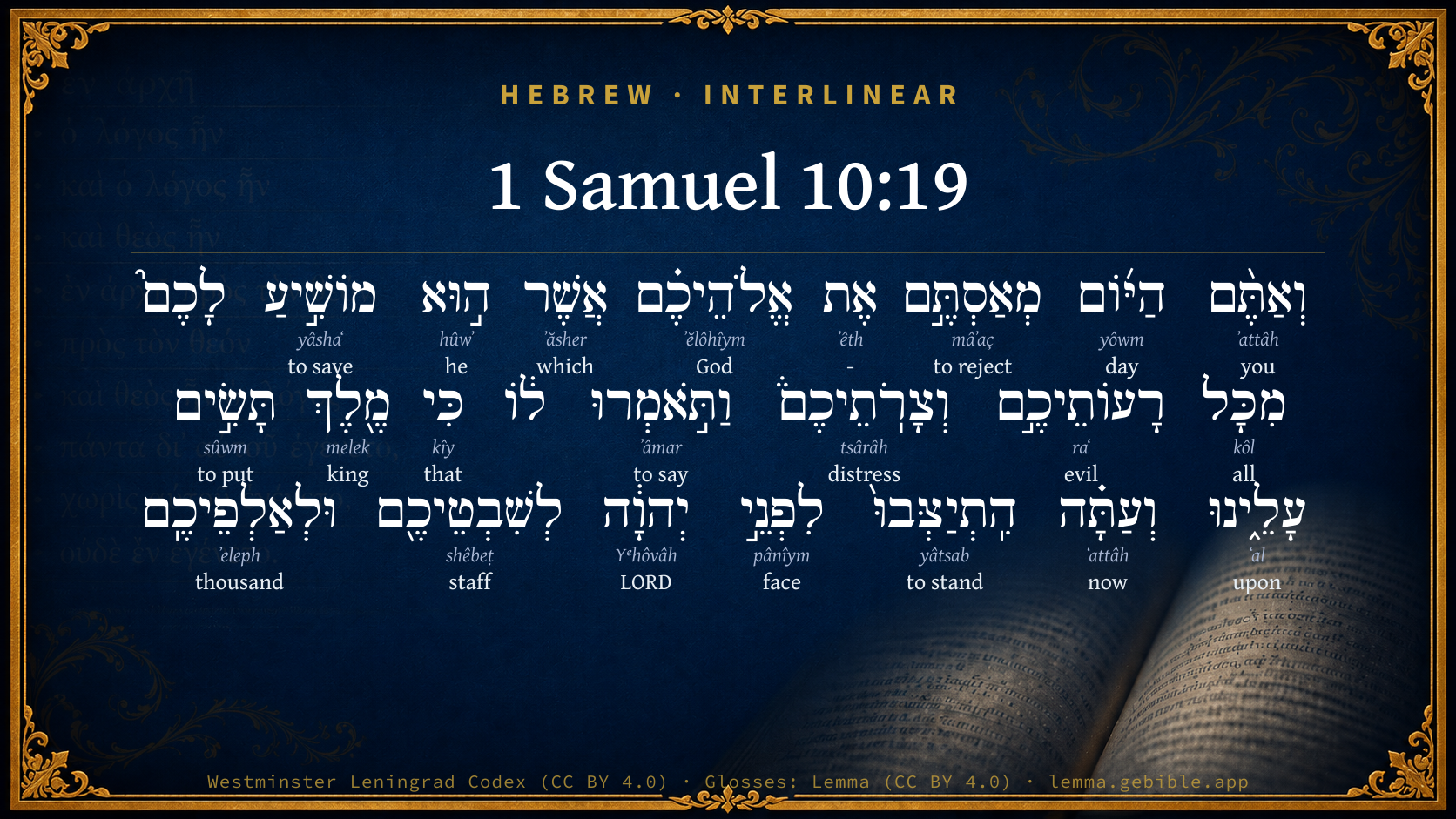
  1. וְאַתֶּ֨ם ʼattâh H859 “and · you” Conjunction + Pronoun, Personal, 2nd Person, Masculine, Plural
  2. הַיּ֜וֹם yôwm H3117 “the · day” Particle, Definite Article + Noun, Common, Masculine, Singular, Absolute
  3. מְאַסְתֶּ֣ם mâʼaç H3988 “to reject” Verb, Qal, Perfect, 2nd Person, Masculine, Plural
  4. אֶת ʼêth H853 “-” Particle, Direct Object
  5. אֱלֹהֵיכֶ֗ם ʼĕlôhîym H430 “God(s) · your” Noun, Common, Masculine, Plural, Construct + Suffix, Personal, 2nd Person, Masculine, Plural
  6. אֲשֶׁר ʼăsher H834 “which” Particle, Relative
  7. ה֣וּא hûwʼ H1931 “he” Pronoun, Personal, 3rd Person, Masculine, Singular
  8. מוֹשִׁ֣יעַ yâshaʻ H3467 “saving” Verb, Hiphil, Participle Active, Masculine, Singular, Absolute
  9. מִכָּל kôl H3605 “from · all of” Preposition + Noun, Common, Masculine, Singular, Construct
  10. רָעוֹתֵיכֶ֣ם raʻ H7451 “evils · your” Noun, Common, Feminine, Plural, Construct + Suffix, Personal, 2nd Person, Masculine, Plural
  11. וְצָרֹֽתֵיכֶם֒ tsârâh H6869 “and · distresses · your” Conjunction + Noun, Common, Feminine, Plural, Construct + Suffix, Personal, 2nd Person, Masculine, Plural
  12. וַתֹּ֣אמְרוּ ʼâmar H559 “and · to say” Conjunction + Verb, Qal, Sequential Imperfect, 2nd Person, Masculine, Plural
  13. כִּי kîy H3588 “that” Conjunction
  14. מֶ֖לֶךְ melek H4428 “king” Noun, Common, Masculine, Singular, Absolute
  15. תָּשִׂ֣ים sûwm H7760 “to put” Verb, Qal, Imperfect, 2nd Person, Masculine, Singular
  16. עָלֵ֑ינוּ ʻal H5921 “upon · us” Preposition + Suffix, Personal, 1st Person, Common, Plural
  17. וְעַתָּ֗ה ʻattâh H6258 “and · now” Conjunction + Adverb
  18. לִפְנֵ֣י pânîym H6440 “to/for · face(s) of” Preposition + Noun, Common, Both, Plural, Construct
  19. יְהוָ֔ה Yᵉhôvâh H3068 “LORD” Noun, Proper
  20. לְשִׁבְטֵיכֶ֖ם shêbeṭ H7626 “to/for · staffs · your” Preposition + Noun, Common, Masculine, Plural, Construct + Suffix, Personal, 2nd Person, Masculine, Plural
  21. וּלְאַלְפֵיכֶֽם ʼeleph H505 “and · to/for · thousand · your” Conjunction + Preposition + Adjective, Cardinal number, Both, Plural, Construct + Suffix, Personal, 2nd Person, Masculine, Plural

About this verse

These counts appear in no published source. They are computed here, from the morphology-tagged text and Lemma’s own curated glosses. What Lemma adds →

24
words
22
distinct lemmas
Historical
section

Shared distinctive vocabulary

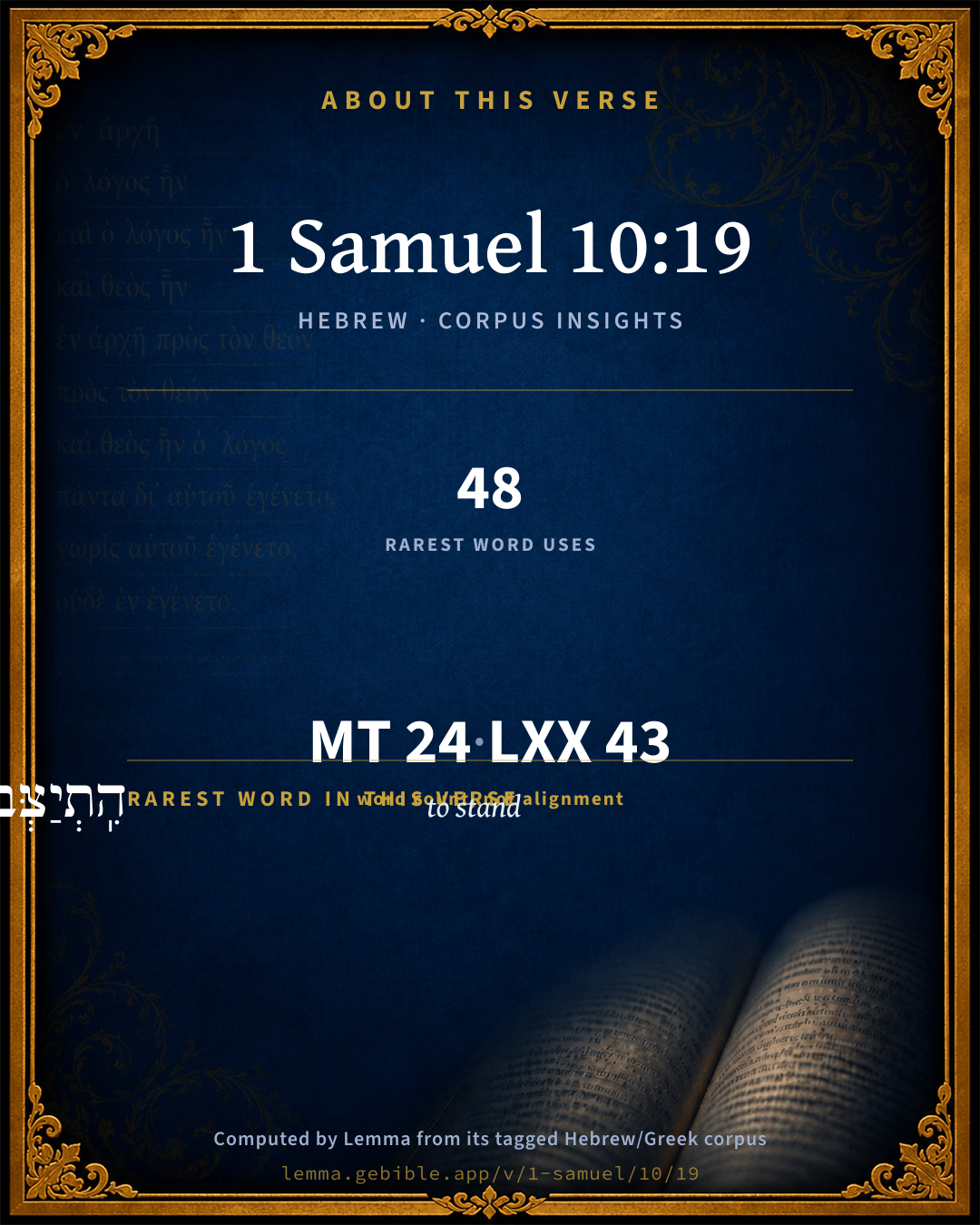
הִֽתְיַצְּבוּ֙ to stand H3320 occurs in 45 verses of the Hebrew Bible. Also found in:

Grammatical profile

  • 5 verbs
  • 9 nouns
  • 1 adjective
  • 2 pronouns
  • 3 prepositions
  • 1 conjunction
  • 1 adverb
  • 2 particles

Verb forms

  • מְאַסְתֶּ֣ם Qal · Perfect
  • מוֹשִׁ֣יעַ Hiphil · Participle Active
  • וַתֹּ֣אמְרוּ Qal · Sequential Imperfect
  • תָּשִׂ֣ים Qal · Imperfect
  • הִֽתְיַצְּבוּ֙ Hithpael · Imperative

Hebrew & Septuagint length

In English translation the verse runs 46 words from the Hebrew and 46 from the Septuagint (LXX English) — the same length.

A rough comparison of the two English renderings, which tokenize alike — not a word-level alignment.

Word counts can differ between the Hebrew and the Greek without any difference in meaning — e.g. the Hebrew direct-object marker אֵת has no separate Greek word, and Greek often adds the article ὁ.

In the original languages it is 24 Hebrew tokens and 43 Greek tokens — but the two are counted differently (Hebrew bundles its prefixes and suffixes into one token; the Greek is in lemma form), so that isn’t a like-for-like length.

Cross-references

8

Topical passages linked to 1 Samuel 10:19 in the Treasury of Scripture Knowledge — connected by theme and wording, ordered by reader-vote popularity; previews shown in the World English Bible.

  • 1 Samuel 12:12 When you saw that Nahash the king of the children of Ammon came against you, you said to me, No, but a king shall reign over us; when Yahweh your God was your king.
  • Joshua 24:1 Joshua gathered all the tribes of Israel to Shechem, and called for the elders of Israel, and for their heads, and for their judges, and for their officers; and they presented themselves before God.
  • 1 Samuel 8:19 But the people refused to listen to the voice of Samuel; and they said, No: but we will have a king over us,
  • Numbers 17:2 Speak to the children of Israel, and take of them rods, one for each fathers' house, of all their princes according to their fathers' houses, twelve rods: write you every man's name on his rod.
  • Joshua 7:14–26 In the morning therefore you shall be brought near by your tribes: and it shall be, that the tribe which Yahweh takes shall come near by families; and the family which Yahweh shall take shall come near by households; and the household which Yahweh shall take shall come near man by man.
  • 1 Samuel 8:6–9 But the thing displeased Samuel, when they said, Give us a king to judge us. Samuel prayed to Yahweh.
  • 1 Samuel 12:17–19 Isn't it wheat harvest today? I will call to Yahweh, that he may send thunder and rain; and you shall know and see that your wickedness is great, which you have done in the sight of Yahweh, in asking you a king.
  • Micah 5:2 But you, Bethlehem Ephrathah, Being small among the clans of Judah, Out of you one will come forth to me that is to be ruler in Israel; Whose goings forth are from of old, from everlasting.

Cross-references courtesy of OpenBible.info (CC BY 4.0).

Hebrew and Greek witnesses Masoretic Hebrew ↔ Greek Septuagint

The same verse in the two great witnesses to the Old Testament, shown verse-for-verse.

These are two independent witnesses, not word-aligned to each other, and the Septuagint is shown in lemma (dictionary) form.

Hebrew 1 Samuel 10:19 Masoretic · Westminster Leningrad Codex

וְאַתֶּ֨ם הַיּ֜וֹם מְאַסְתֶּ֣ם אֶת אֱלֹהֵיכֶ֗ם אֲשֶׁר ה֣וּא מוֹשִׁ֣יעַ לָכֶם֮ מִכָּל רָעוֹתֵיכֶ֣ם וְצָרֹֽתֵיכֶם֒ וַתֹּ֣אמְרוּ ל֔וֹ כִּי מֶ֖לֶךְ תָּשִׂ֣ים עָלֵ֑ינוּ וְעַתָּ֗ה הִֽתְיַצְּבוּ֙ לִפְנֵ֣י יְהוָ֔ה לְשִׁבְטֵיכֶ֖ם וּלְאַלְפֵיכֶֽם

but you have this day rejected your God, who himself saves you out of all your calamities and your distresses; and you have said to him, [No], but set a king over us. Now therefore present yourselves before Yahweh by your tribes, and by your thousands.

World English Bible · Public Domain

Greek LXX 1 Samuel 10:19 Septuagint · lemma form

καί σύ σήμερον ἐκοὐθενέω ὁ θεός ὅς αὐτός εἰμί σύ σωτήρ ἐκ πᾶς ὁ κακός σύ καί θλῖψις σύ καί εἶπον οὐ ἀλλά ἤ ὅτι βασιλεύς ἵστημι ἐπί ἐγώ καί νῦν καταἵστημι ἐνώπιον κύριος κατά ὁ σκῆπτρον σύ καί κατά ὁ φυλή σύ

And you⌃ have this day rejected God, who is himself your Deliverer out of all your evils and afflictions; and you⌃ said, Nay, but you shall set a king over us: and now stand before the Lord according to your tribes, and according to your families.

LXX2012 (modern English Septuagint) · Public Domain

Hebrew: Westminster Leningrad Codex (CC BY 4.0). Greek: Septuagint (public domain); English from LXX2012 (modern English Septuagint) (Public Domain). How the Septuagint differs from the Hebrew →

Targum (Aramaic paraphrase)

1

The Targum is the ancient Jewish Aramaic paraphrase of the Hebrew Scriptures — an interpretive translation, not the Hebrew text itself. Onkelos (literal) and Pseudo-Jonathan (expansive) render the Torah, and Jonathan the Prophets. Coverage is partial: where no permissively-licensed English translation exists for a verse, only the Aramaic is shown. This is verse-level text, not a word-by-word alignment to the Hebrew.

  1. Targum Jonathan Prophets (Joshua–Malachi)
    וְאַתּוּן יוֹמָא דֵין קַצְתּוּן בְּפוּלְחָנָא דֶאֱלָהָכוֹן דְהוּא פָרִיק לְכוֹן מִכָּל בִּישָׁתֵיכוֹן וַעֲקַתְכוֹן וַאֲמַרְתּוּן קֳדָמוֹהִי לֵית אֲנַחְנָא מִתְפָּרְקִין אֱלָהֵין מַלְכָּא תְּמַנֵי עֲלָנָא וּכְעַן אִתְעַתָּדִי קֳדָם יְיָ לְשִׁבְטֵיכוֹן וּלְאַלְפֵיכוֹן:

    (no public-domain English translation for this verse)

    Targum Jonathan — Aramaic: “Mikraot Gedolot” (public domain). English: “Sefaria Community Translation” (CC0 1.0 (public-domain dedication)); “London "Chaldee Paraphrase," 1871” (public domain). Text via Sefaria.

Commentary

Notes on 1 Samuel 10:19 from classic Christian and Jewish commentators (each source and its license shown beneath its notes). The classic Christian expositions comment on the surrounding passage and are grouped to its opening verse, so a note may address several verses; the Jewish commentaries on the Tanakh (Rashi and others) are per-verse, so they appear only where the commentator wrote on this verse.

Lemma curates 59 commentaries, every one of them public domain or Creative Commons licensed, each selected and text-cleaned for this edition rather than reprinted as found. About our sources →

Trapp's Complete Commentary

John Trapp

1Sa 10:19 And ye have this day rejected your God, who himself saved you out of all your adversities and your tribulations; and ye have said unto him, [Nay], but set a king over us. Now therefore present yourselves before the LORD by your tribes, and by your thousands.

Ver. 19. And ye have said unto him.] Because to me.

Nay, but set a king over us.] Here he taxeth them with singular ingratitude, incredulity, and folly, in that they would rather trust in a man whom they knew not how he would prove, than in God, whose power and goodness they had so often experienced. And this they persisted to do, refusing to be ruled by any reason, Regiumque, nomen, cunctis fere liberis gentibus semper invisum, efflictim desiderantes, {a} and still calling for a king upon any conditions.

{a} Sulp. Sever.

John Trapp, A Commentary or Exposition upon All the Books of the Old and New Testament (1647–1656) — public domain. Text from a community e-Sword module.

Joseph Benson's Commentary

1Sa 10:19. Your God, who himself saved you, &c. — By raising up judges whenever you cried to him for help, who never failed to conquer your enemies. Ye have said unto him, Nay, &c. — When he desired you to continue under his government you refused, and would not be denied in what you asked. Now, therefore, &c. — He puts them upon choosing their king by lot, that all might know God had chosen Saul, (for the disposal of the lot is of the Lord,) and to prevent all dispute and exception.

Joseph Benson's Commentary on the Old and New Testaments (1811–1818) — public domain. Text from a community e-Sword module.

Tyndale Open Study Notes

Tyndale Open Resources

10:19 rejected your God: See also 8:7. Israel was rejecting God’s ability to protect and save them. • Clans are subdivisions of tribes.

Tyndale Open Study Notes — © Tyndale Open Resources, licensed CC BY-SA 4.0. Text via the HelloAO Bible API.

Adam Clarke's Commentary

Verse 19. Present yourselves - by your tribes] It appears that, in order to find out the proper person who should be made their king, they must determine by lot:

1. The tribe.

2. The thousands or grand divisions by families.

3. The smaller divisions by families. And,

4. The individual.

When the lot was cast for the tribe, Benjamin was taken; when for the thousand, the division of Matri was taken; when for the family, the family of Kish was taken; when for the individual, Saul, the son of Kish, was taken.

Adam Clarke's Commentary on the Bible (1810–1826) — public domain. Text from a community e-Sword/MySword module.

The Cambridge Bible for Schools and Colleges

gen. ed. J. J. S. Perowne

19. And ye have this day rejected your God] Once more the prophet is directed to rebuke the people for their ingratitude and unbelief. See above on 1Sa_8:6.

ye have said unto him] The request made to Samuel was virtually addressed to God.

by your tribes, and by your thousands] The natural subdivision of the nation into tribes: of the tribes into families or clans: of the families into houses: of the houses into men (Jos_7:14): was supplemented by Moses with an artificial organization of thousands, hundreds, fifties, and tens (Exo_18:25). The thousand corresponded to the family, and the terms appear to be used here as synonymous, Cp. ch. 1Sa_23:23; Jdg_6:15; Jos_22:14.

The Cambridge Bible for Schools and Colleges (gen. ed. J. J. S. Perowne; Cambridge University Press, 1878–1918) — public domain. Text from a community e-Sword module.

John Gill's Exposition

And when Samuel had caused all the tribes to come near,.... The heads and representatives of them, to the place where the lots were cast:

the tribe of Benjamin was taken; the lot fell upon that tribe for the choice of a king out of it; not the tribe of, Reuben, who was the firstborn, nor the tribe of Judah, to whom the kingdom was promised, but the tribe of Benjamin, the least of all the tribes, and which sprung from the youngest son of Jacob, contrary, as it were probable, to the expectation of all.

John Gill's Exposition of the Whole Bible (1746–1763) — public domain (CC PDM 1.0). Text via the HelloAO Bible API.

Albert Barnes' Notes on the Bible

For the use of “thousand” as equivalent to “family,” see 1Sa 23:23; Jdg 6:15 margin. In Num 1:16 it may mean whole tribes.

Albert Barnes' Notes on the Bible (1834–1885) — public domain. Text from a community e-Sword/MySword module.

Haydock's Catholic Bible Commentary

Families. Lots were first drawn to determine the tribe, then to find out which of the great families, and which house, was to give a king to Israel. (Haydock) --- See Josue vii. 14. (Menochius) --- God was pleased thus to convince them that the election proceeded from him. (St. Gregory) (Worthington)

George Leo Haydock (1774–1849), Haydock's Catholic Family Bible and Commentary, 1859 edition — public domain. Excludes Psalms (Douay-Rheims chapter numbering differs from Protestant) and Deuterocanonical books (Catholic canon only).

Matthew Poole's English Annotations

Ye have this day rejected your God; you this day declare that you persist in your former act of rejecting God’s government: See Poole "1Sa 8:7".

Who himself saved you; who by his own special providence took care to raise up judges and saviours for you, and to deliver you at all times, when you needed his help, and did not by your sins obstruct it.

Ye have said unto him, i.e. unto me his prophet and ambassador; and consequently unto the Lord, whom I represented, and in whose name I spake and acted.

By your tribes, and by your thousands; for each tribe was divided into thousands, Num 10:36; Deu 33:17; Jos 22:14,21; Mic 5:2, as in England counties are into hundreds.

Matthew Poole's English Annotations on the Holy Bible (1683–1685) — public domain. Text from a community e-Sword/MySword module.

The Pulpit Commentary

Samuel, therefore, protests unto them, Ye have this day rejected your God, because what you want is a divorce of your national well being from religion. Nevertheless, God granted their request, it being a law of his providence to leave men free to choose. The king was, however, to be appointed by him, the selection being by lot. By your thousands. The natural subdivision of a tribe is into families; but when Moses distributed the people into thousands, hundreds, fifties, and tens, (Exo_18:25) the numerical arrangement was probably made to yield as far as possible to the natural, so that about a thousand men more or less of the same kin should be classed as a family. Hence the terms are synonymous here, and in Num_1:16 Num_10:4; Jos_22:14, etc.

The Pulpit Commentary (1880–1919), ed. H.D.M. Spence-Jones & Joseph S. Exell — public domain. Text from a community e-Sword module.

John Wesley's Explanatory Notes

Now therefore, &c. - He puts them upon chusing their king by lot, that all might know God had chosen Saul (for the disposal of the lot is of the Lord) and to prevent all dispute and exception.

John Wesley, Explanatory Notes Upon the Whole Bible (1754–1765) — public domain. Text via the GEBible commentary corpus.

Lesson kit

Teaching starters — assembled from the data on this page, not authored interpretation. Every prompt links to the verse data it draws on. Edit before teaching.

1 Samuel, in the Historical, opens this verse with 24 words (22 distinct Hebrew lemmas). Its most distinctive word is yâtsab (“to stand”). A historical commentator’s framing appears above. Read the whole chapter for the surrounding context.

Discussion questions

  1. The word yâtsab carries the sense “to stand.” How does it shape the verse?
  2. How does Exodus 2:4, which shares the word «to stand», read alongside this verse?
  3. These translations render this verse differently. What is at stake in choosing one wording over another?
  4. «מְאַסְתֶּ֣ם» is a Qal Perfect verb. How does that grammatical form shape the action described?
  5. Compare how Trapp's Complete Commentary and Joseph Benson's Commentary read this verse. Where do they agree or differ?

Things to notice

Reading settings

Reading text

Shown beneath each verse's original-language words.

Old Testament
Old Testament edition

Read the OT as the Masoretic Hebrew (MT) or the Greek Septuagint (LXX).

English shown for the Greek Septuagint (in the Hebrew ↔ Greek comparison).

Comparing translations? Open the Compare panel on any verse page to stack up to four side by side.