
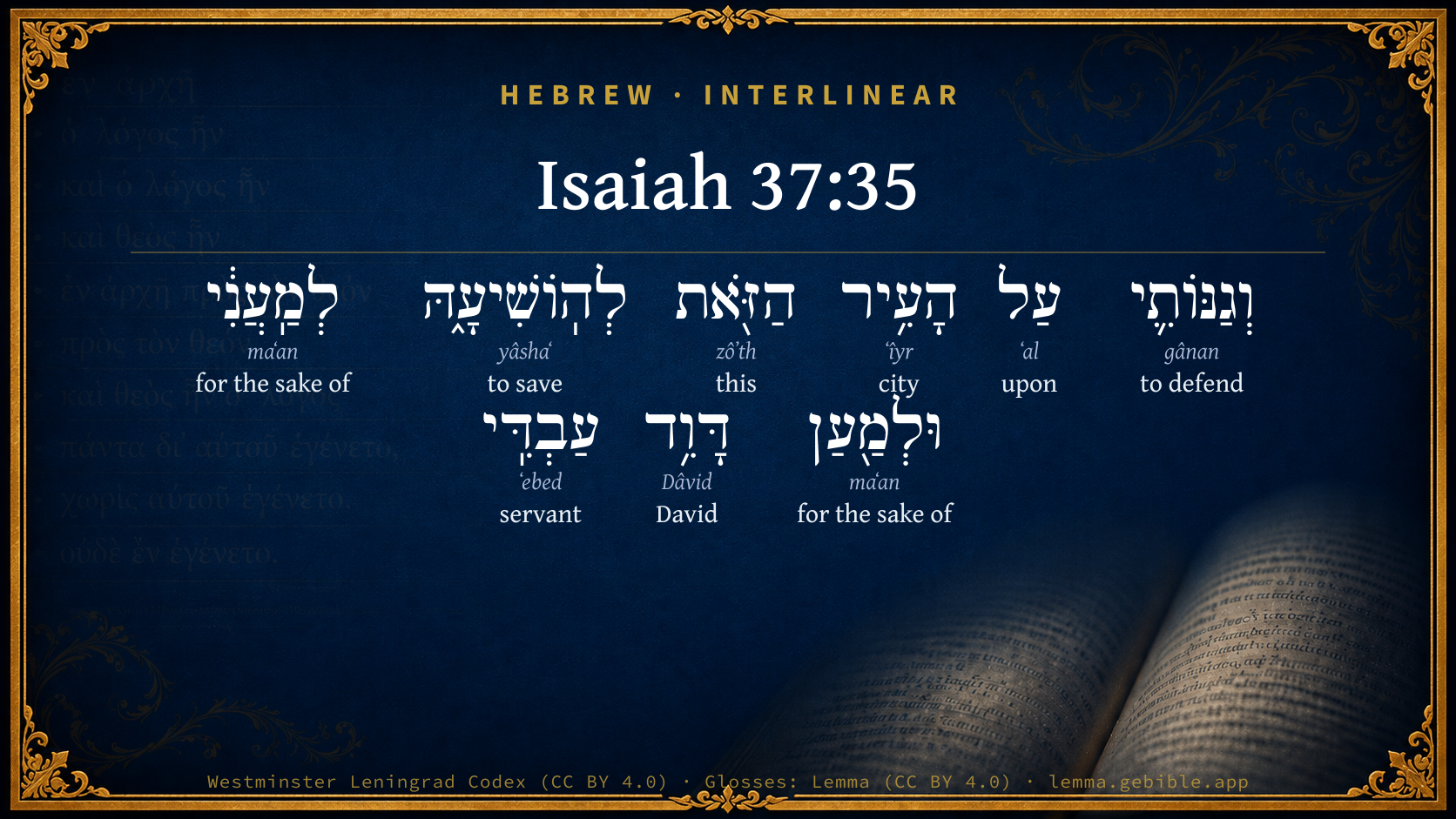
Isaiah 37:35

Hebrew (Westminster Leningrad Codex) Isaiah 37:35 appears in the Hebrew Old Testament. The text above is from the Westminster Leningrad Codex. Each word links to its Strong’s number, a concise gloss, and parsing drawn from the Open Scriptures Hebrew Bible morphology. Click any word for its full Brown-Driver-Briggs (BDB) entry.
Download image
Cite this verse

Isaiah 37:35 (World English Bible). Public Domain. Lemma interlinear Bible study tool, https://lemma.gebible.app/v/isaiah/37/35.

Show BibTeX & RIS
BibTeX
RIS
English Translation
For I will defend this city to save it, for my own sake, and for my servant David's sake.
World English Bible · Public Domain
Download a study sheet

One document with this verse’s original text, its word-by-word gloss line, the meaning frame, cross-references with their text, attributed commentary, and full source and license credits — printable, and it pastes into notes with its structure intact.

This verse Autodidact and up

Study sheet (.html) Plain text (.txt)

A passage Seminary Student

Up to 50 verses in one chapter. A passage sheet keeps up to 6 commentary sources and 12 cross-references per verse, in the order this page ranks them, and says so on the sheet whenever that leaves anything out. Ask for a single verse and you get the Autodidact verse sheet above.

Everything on this page stays free to read, with no account — the sheet is a download of what is already on screen, not access to it.

Want to remove ads? Support Godless Engineer
Compare translations 3

The same verse in 3 English versions, stacked beneath the original-language interlinear above. Click any original word for its lexicon entry.

Each is an independent rendering of the whole verse — the interlinear is not word-aligned to these translations.

Highlighted words mark where these versions differ — a whole-verse word diff, not a word-by-word alignment.

  • World English Bible Public Domain
    For I will defend this city to save it, for my own sake, and for my servant David's sake.
  • King James Version Public Domain
    For I will defend this city to save it for mine own sake, and for my servant David's sake.
  • unfoldingWord Literal Text CC BY-SA 4.0
    ‘for I will cover over this city to save it, for my sake and for the sake of David my servant.’”

unfoldingWord Literal Text — © unfoldingWord, licensed CC BY-SA 4.0. Word-aligned USFM3 via Door43 (git.door43.org/unfoldingWord/en_ult).

Versions to compare (up to 4)

3 of 4 selected

Show all 18 translations

Every available English version of this verse, each an independent rendering of the whole verse.

  • World English Bible Public Domain
    For I will defend this city to save it, for my own sake, and for my servant David's sake.
  • Berean Standard Bible Public Domain
    ‘I will defend this city and save it for My own sake and for the sake of My servant David.’”
  • Majority Standard Bible Public Domain
    ‘I will defend this city and save it for My own sake and for the sake of My servant David.’”
  • King James Version Public Domain
    For I will defend this city to save it for mine own sake, and for my servant David's sake.
  • American Standard Version (1901) Public Domain
    For I will defend this city to save it, for mine own sake, and for my servant David's sake.
  • Revised Version (1885) Public Domain
    For I will defend this city to save it, for mine own sake, and for my servant David’s sake.
  • Geneva Bible (1599) Public Domain
    For I will defend this citie to saue it, for mine owne sake, and for my seruant Dauids sake.
  • Douay-Rheims (1899) Public Domain
    And I will protect this city, and will save it for my own sake, and for the sake of David my servant.
  • Young's Literal Translation Public Domain
    And I have covered over this city, To save it, for Mine own sake, And for the sake of David My servant.'
  • Literal Standard Version CC BY-SA 4.0
    And I have covered over this city, || To save it, for My own sake, || And for the sake of My servant David.”
  • Unlocked Literal Bible CC BY-SA 4.0
    For I will defend this city and rescue it, for my own sake and for David my servant's sake.”
  • unfoldingWord Literal Text CC BY-SA 4.0
    ‘for I will cover over this city to save it, for my sake and for the sake of David my servant.’”
  • Darby Bible Public Domain
    And I will defend this city, to save it, for mine own sake, and for my servant David's sake.
  • World Messianic Bible Public Domain
    ‘For I will defend this city to save it, for my own sake, and for my servant David’s sake.’”
  • Webster's Bible Public Domain
    For I will defend this city, to save it for my own sake, and for my servant David's sake.
  • Free Bible Version CC BY-SA 4.0
    I will defend this city and save it, for my own sake and for the sake of my servant David.”
  • Bible in Basic English Public Domain
    For I will keep this town safe, for my honour, and for the honour of my servant David.
  • JPS Tanakh (1917) Public Domain
    For I will defend this city to save it, for Mine own sake, and for My servant David's sake.'

Literal Standard Version (2020), Covenant Press — licensed CC BY-SA 4.0. Text via the HelloAO Bible API (eBible.org). Unlocked Literal Bible (unfoldingWord) — licensed CC BY-SA 4.0. Text via the HelloAO Bible API (eBible.org). unfoldingWord Literal Text — © unfoldingWord, licensed CC BY-SA 4.0. Word-aligned USFM3 via Door43 (git.door43.org/unfoldingWord/en_ult). Free Bible Version, Dr. Jonathan Gallagher — licensed CC BY-SA 4.0. Text via the HelloAO Bible API (eBible.org).

Word by word

More ways to search: Search by grammar → Find every occurrence → Compare this word →

Practice this passage: Drill this verse → Learn its vocabulary →

וְגַנּוֹתִ֛י
gânan
H1598
“and · to defend”
Conjunction + Verb, Qal, Sequential Perfect, 1st Person, Common, Singular
Part of Speech
Conjunction + Verb
Stem
Qal
Form
Sequential Perfect
Person
1st Person
Gender
Common
Number
Singular
Full BDB Definition

Origin: a primitive root

TWOT: 367

to defend, cover, surround - (Qal) to defend - (Hiphil) to defend
  1. עַל ʻal H5921 “upon” Preposition
  2. הָעִ֥יר ʻîyr H5892 “the · city” Particle, Definite Article + Noun, Common, Feminine, Singular, Absolute
  3. הַזֹּ֖את zôʼth H2063 “the · this” Particle, Definite Article + Pronoun, Demonstrative, Feminine, Singular
  4. לְהֽוֹשִׁיעָ֑הּ yâshaʻ H3467 “to save · her” Preposition + Verb, Hiphil, Infinitive Construct + Suffix, Personal, 3rd Person, Feminine, Singular
  5. לְמַֽעֲנִ֔י maʻan H4616 “for the sake of · me” Preposition + Suffix, Personal, 1st Person, Common, Singular
  6. וּלְמַ֖עַן maʻan H4616 “and · for the sake of” Conjunction + Preposition
  7. דָּוִ֥ד Dâvid H1732 “David” Noun, Proper
  8. עַבְדִּֽי ʻebed H5650 “servant · my” Noun, Common, Masculine, Singular, Construct + Suffix, Personal, 1st Person, Common, Singular

About this verse

These counts appear in no published source. They are computed here, from the morphology-tagged text and Lemma’s own curated glosses. What Lemma adds →

9
words
8
distinct lemmas
Prophets
section

Notable vocabulary

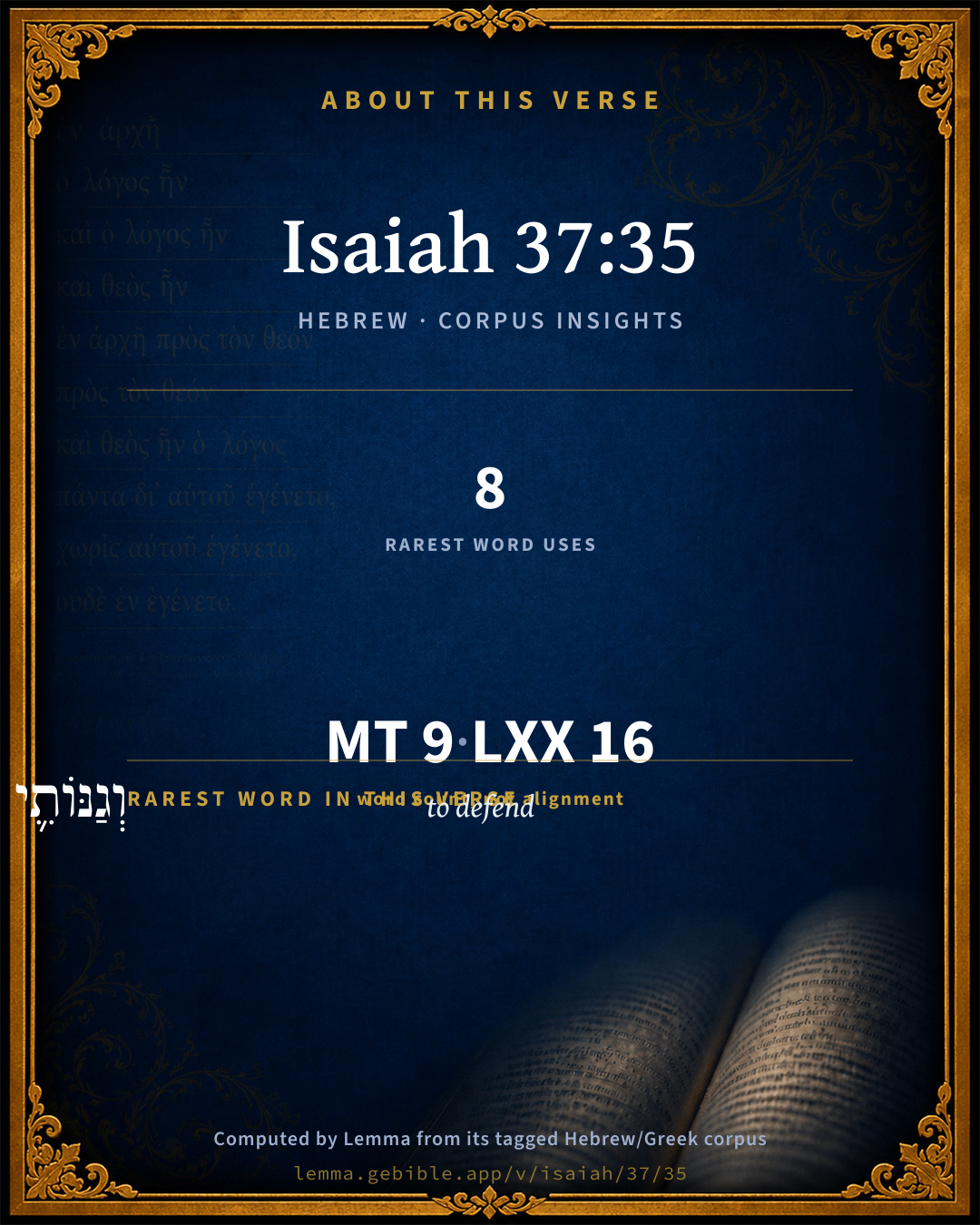
The rarest word here is וְגַנּוֹתִ֛י to defend H1598 — appearing just 8 times in the whole Hebrew Bible.

Shared distinctive vocabulary

וְגַנּוֹתִ֛י to defend H1598 occurs in 7 verses of the Hebrew Bible. Also found in:

Grammatical profile

  • 2 verbs
  • 3 nouns
  • 1 pronoun
  • 3 prepositions

Verb forms

  • וְגַנּוֹתִ֛י Qal · Sequential Perfect
  • לְהֽוֹשִׁיעָ֑הּ Hiphil · Infinitive Construct

Repetition

A word recurs within this verse — often emphatic in Hebrew:

  • לְמַֽעֲנִ֔י for the sake of H4616 ×2

Hebrew & Septuagint length

In English translation the verse runs 19 words from the Hebrew and 18 from the Septuagint (LXX English) — closely comparable.

A rough comparison of the two English renderings, which tokenize alike — not a word-level alignment.

Word counts can differ between the Hebrew and the Greek without any difference in meaning — e.g. the Hebrew direct-object marker אֵת has no separate Greek word, and Greek often adds the article ὁ.

In the original languages it is 9 Hebrew tokens and 16 Greek tokens — but the two are counted differently (Hebrew bundles its prefixes and suffixes into one token; the Greek is in lemma form), so that isn’t a like-for-like length.

Cross-references

17

Topical passages linked to Isaiah 37:35 in the Treasury of Scripture Knowledge — connected by theme and wording, ordered by reader-vote popularity; previews shown in the World English Bible.

  • 2 Kings 20:6 I will add to your days fifteen years; and I will deliver you and this city out of the hand of the king of Assyria; and I will defend this city for my own sake, and for my servant David's sake.
  • Isaiah 38:6 I will deliver you and this city out of the hand of the king of Assyria; and I will defend this city.
  • Isaiah 31:5 As birds hovering, so will Yahweh of Hosts protect Jerusalem; he will protect and deliver [it], he will pass over and preserve [it].
  • Isaiah 43:25 I, even I, am he who blots out your transgressions for my own sake; and I will not remember your sins.
  • Jeremiah 23:5–6 Behold, the days come, says Yahweh, that I will raise to David a righteous Branch, and he shall reign as king and deal wisely, and shall execute justice and righteousness in the land.
  • Jeremiah 33:15–16 In those days, and at that time, will I cause a Branch of righteousness to grow up to David; and he shall execute justice and righteousness in the land.
  • Ephesians 1:14 who is a pledge of our inheritance, to the redemption of God's own possession, to the praise of his glory.
  • Jeremiah 30:9 but they shall serve Yahweh their God, and David their king, whom I will raise up to them.
  • Ezekiel 37:24–25 My servant David shall be king over them; and they all shall have one shepherd: they shall also walk in my ordinances, and observe my statutes, and do them.
  • Deuteronomy 32:27 Were it not that I feared the provocation of the enemy, Lest their adversaries should judge wrongly, Lest they should say, Our hand is exalted, Yahweh has not done all this.
  • 1 Kings 11:36 To his son will I give one tribe, that David my servant may have a lamp always before me in Jerusalem, the city which I have chosen me to put my name there.
  • 1 Kings 15:4 Nevertheless for David's sake did Yahweh his God give him a lamp in Jerusalem, to set up his son after him, and to establish Jerusalem;
  • Isaiah 48:9–11 For my name's sake will I defer my anger, and for my praise will I refrain for you, that I not cut you off.
  • Ezekiel 20:9 But I worked for my name's sake, that it should not be profaned in the sight of the nations, among which they were, in whose sight I made myself known to them, in bringing them forth out of the land of Egypt.
  • Ezekiel 36:22 Therefore tell the house of Israel, Thus says the Lord Yahweh: I don't do [this] for your sake, house of Israel, but for my holy name, which you have profaned among the nations, where you went.
  • Ephesians 1:6 to the praise of the glory of his grace, by which he freely bestowed favor on us in the Beloved,
  • 1 Kings 11:12–13 Notwithstanding in your days I will not do it, for David your father's sake: but I will tear it out of the hand of your son.

Cross-references courtesy of OpenBible.info (CC BY 4.0).

Hebrew and Greek witnesses Masoretic Hebrew ↔ Greek Septuagint

The same verse in the two great witnesses to the Old Testament, shown verse-for-verse.

These are two independent witnesses, not word-aligned to each other, and the Septuagint is shown in lemma (dictionary) form.

Hebrew Isaiah 37:35 Masoretic · Westminster Leningrad Codex

וְגַנּוֹתִ֛י עַל הָעִ֥יר הַזֹּ֖את לְהֽוֹשִׁיעָ֑הּ לְמַֽעֲנִ֔י וּלְמַ֖עַן דָּוִ֥ד עַבְדִּֽי

For I will defend this city to save it, for my own sake, and for my servant David's sake.

World English Bible · Public Domain

Greek LXX Isaiah 37:35 Septuagint · lemma form

ὑπερἀσπίζω ὑπέρ ὁ πόλις οὗτος ὁ σώζω αὐτός διά ἐγώ καί διά δαυίδ ὁ παῖς ἐγώ

I will protect this city to save it for my own sake, and for my servant David's sake.

LXX2012 (modern English Septuagint) · Public Domain

Hebrew: Westminster Leningrad Codex (CC BY 4.0). Greek: Septuagint (public domain); English from LXX2012 (modern English Septuagint) (Public Domain). How the Septuagint differs from the Hebrew →

Targum (Aramaic paraphrase)

1

The Targum is the ancient Jewish Aramaic paraphrase of the Hebrew Scriptures — an interpretive translation, not the Hebrew text itself. Onkelos (literal) and Pseudo-Jonathan (expansive) render the Torah, and Jonathan the Prophets. Coverage is partial: where no permissively-licensed English translation exists for a verse, only the Aramaic is shown. This is verse-level text, not a word-by-word alignment to the Hebrew.

  1. Targum Jonathan Prophets (Joshua–Malachi)
    וְאַגֵין עַל קַרְתָּא הָדָא לְמִפְרְקָהּ בְּדִיל מֵימְרִי וּבְדִיל דָוִד עַבְדִי:

    For I will defend this city to save it, for the sake of my WORD, and for the sake of David my servant.

    Targum Jonathan — Aramaic: “Mikraot Gedolot” (public domain). English: “Sefaria Community Translation” (CC0 1.0 (public-domain dedication)); “London "Chaldee Paraphrase," 1871” (public domain). Text via Sefaria.

Commentary

Notes on Isaiah 37:35 from classic Christian and Jewish commentators (each source and its license shown beneath its notes). The classic Christian expositions comment on the surrounding passage and are grouped to its opening verse, so a note may address several verses; the Jewish commentaries on the Tanakh (Rashi and others) are per-verse, so they appear only where the commentator wrote on this verse.

Lemma curates 59 commentaries, every one of them public domain or Creative Commons licensed, each selected and text-cleaned for this edition rather than reprinted as found. About our sources →

Tyndale Open Study Notes

Tyndale Open Resources

37:35 for the sake of my servant David: God had promised David a perpetual dynasty (see 9:6-7; 2 Sam 7:8-17).

Tyndale Open Study Notes — © Tyndale Open Resources, licensed CC BY-SA 4.0. Text via the HelloAO Bible API.

Geneva Bible (1599)

Geneva Bible translators

For my promise sake made to David.

Geneva Bible (1599) marginal notes — public domain. Text via Bolls.life.

Jamieson, Fausset & Brown

Robert Jamieson, A. R. Fausset & David Brown

I will defend--Notwithstanding Hezekiah's measures of defense (Ch2 32:3-5), Jehovah was its true defender.

mine own sake--since Jehovah's name was blasphemed by Sennacherib (Isa 37:23).

David's sake--on account of His promise to David (Psa 132:17-18), and to Messiah, the heir of David's throne (Isa 9:7; Isa 11:1).

Jamieson, Fausset & Brown — Commentary Critical and Explanatory on the Whole Bible (1871) — public domain (CC PDM 1.0). Text via the HelloAO Bible API.

Ellicott's Commentary for English Readers

(35) For mine own sake . . .—The words set forth, as it were, the two motives of Jehovah’s action: “for His own sake,” as asserting His majesty against the blasphemy of the Assyrians; for “David’s sake,” as mindful of the promise made to him, showing, in the spirit of the second commandment, that the good as well as the evil influences of men survive, and that a later generation may profit by the good that was in its predecessor, as well as suffer for its guilt.

A Bible Commentary for English Readers, edited by Charles John Ellicott (1878–1897) — public domain. Text from a community e-Sword module.

The Cambridge Bible for Schools and Colleges

gen. ed. J. J. S. Perowne

35. I will defend this city] Cf. ch. Isa_31:5, where the same verb is used.

for my servant David’s sake] An expression of frequent occurrence in the books of Kings. See 1Ki_11:13; 1Ki_11:34; 1Ki_15:4; 2Ki_8:19.

The Cambridge Bible for Schools and Colleges (gen. ed. J. J. S. Perowne; Cambridge University Press, 1878–1918) — public domain. Text from a community e-Sword module.

John Gill's Exposition

So Sennacherib king of Assyria departed, and went, and returned,.... Being informed of the destruction of his army in this miraculous manner, he departed from the place where he was in all haste, fearing lest he himself should be destroyed in like manner; and having no forces to pursue his designs, or wherewith to make an attempt elsewhere, he made the best of his way at once into his own country, whither he returned with great shame and confusion:

and dwelt at Nineveh; the metropolis of his kingdom; see Gen 10:11.

John Gill's Exposition of the Whole Bible (1746–1763) — public domain (CC PDM 1.0). Text via the HelloAO Bible API.

Albert Barnes' Notes on the Bible

For I will defend this city - Notwithstanding all that Hezekiah had done to put it in a posture of defense (2Ch 32:1, following) still it was Yahweh alone who could preserve it.

For mine own sake - God had been reproached and blasphemed by Sennacherib. As his name and power had been thus blasphemed, he says that he would vindicate himself, and for the honor of his own insulted majesty would save the city.

And for my servant David’s sake - On account of the promise which he had made to him that there should not fail a man to sit on his throne, and that the city and nation should not be destroyed until the Messiah should appear (see Psa 132:10-18).

Albert Barnes' Notes on the Bible (1834–1885) — public domain. Text from a community e-Sword/MySword module.

Haydock's Catholic Bible Commentary

Servant. Hence it plainly appears that God protects the living for the sake of the saints departed. To evade this proof, Protestants (Bible 1603) explain, "for God’s promise sake made to David." But God never made any such promise to him; otherwise the city would never have been destroyed. (Worthington)

George Leo Haydock (1774–1849), Haydock's Catholic Family Bible and Commentary, 1859 edition — public domain. Excludes Psalms (Douay-Rheims chapter numbering differs from Protestant) and Deuterocanonical books (Catholic canon only).

The Pulpit Commentary

I will defend this city... for mine own sake; literally, I will cover over this city, as a bird covers its young with its wings. (comp. Isa_31:5 Mat_23:37) God would do this "for his own sake;" i.e. because his own honour was concerned in the defence of his people. He would also do it for his servant David"s sake; i.e. because of the promises made to David, that his children should sit upon his throne, (2Sa_7:16 Psa_89:29-37 Psa_132:11-14, etc.) which involved the continued independence of Judaea and Jerusalem.

The Pulpit Commentary (1880–1919), ed. H.D.M. Spence-Jones & Joseph S. Exell — public domain. Text from a community e-Sword module.

J. A. Alexander on Isaiah

Joseph Addison Alexander

“And I will cover over (or protect) this city, (so as) to save it, for my own sake, and for the sake of David my servant.” This does not mean that the faith or piety of David, as an individual, should be rewarded in his descendants, but that the promise made to him, respecting his successors, and especially the last and greatest of them, should be faithfully performed. (See 2Sa 7:12-13).

Joseph Addison Alexander, The Prophecies of Isaiah (1846–1847; New York: Scribner, 1870–1878) — public domain. Text from a community e-Sword module.

unfoldingWord translationNotes

Door43 World Missions Community

General Information:

Yahweh continues speaking.

for my own sake and for David my servant's sake

"so that things will be better for me and for my servant David"

translationWords

David

servant

unfoldingWord translationNotes — © Distant Shores Media and the Door43 World Missions Community, licensed CC BY-SA 4.0. Source: git.door43.org/Door43/en_tn.

Lesson kit

Teaching starters — assembled from the data on this page, not authored interpretation. Every prompt links to the verse data it draws on. Edit before teaching.

Isaiah, in the Prophets, opens this verse with 9 words (8 distinct Hebrew lemmas). Its most distinctive word is gânan (“to defend”). A historical commentator’s framing appears above. Read the whole chapter for the surrounding context.

Discussion questions

  1. What does “to defend” (gânan) contribute to the verse as a whole?
  2. How does 2 Kings 19:34, which shares the word «to defend», read alongside this verse?
  3. What does the repetition of “for the sake of” (2× in this one verse) do in this verse?
  4. The translations on this page render this verse differently — a whole-verse word diff, not a word-by-word alignment. What might account for the different wordings?
  5. «וְגַנּוֹתִ֛י» is a Qal Sequential Perfect verb. How does that grammatical form shape the action described?
  6. Compare how Tyndale Open Study Notes and Geneva Bible (1599) read this verse. Where do they agree or differ?

Things to notice

Reading settings

Reading text

Shown beneath each verse's original-language words.

Old Testament
Old Testament edition

Read the OT as the Masoretic Hebrew (MT) or the Greek Septuagint (LXX).

English shown for the Greek Septuagint (in the Hebrew ↔ Greek comparison).

Comparing translations? Open the Compare panel on any verse page to stack up to four side by side.