
Psalms 18:41

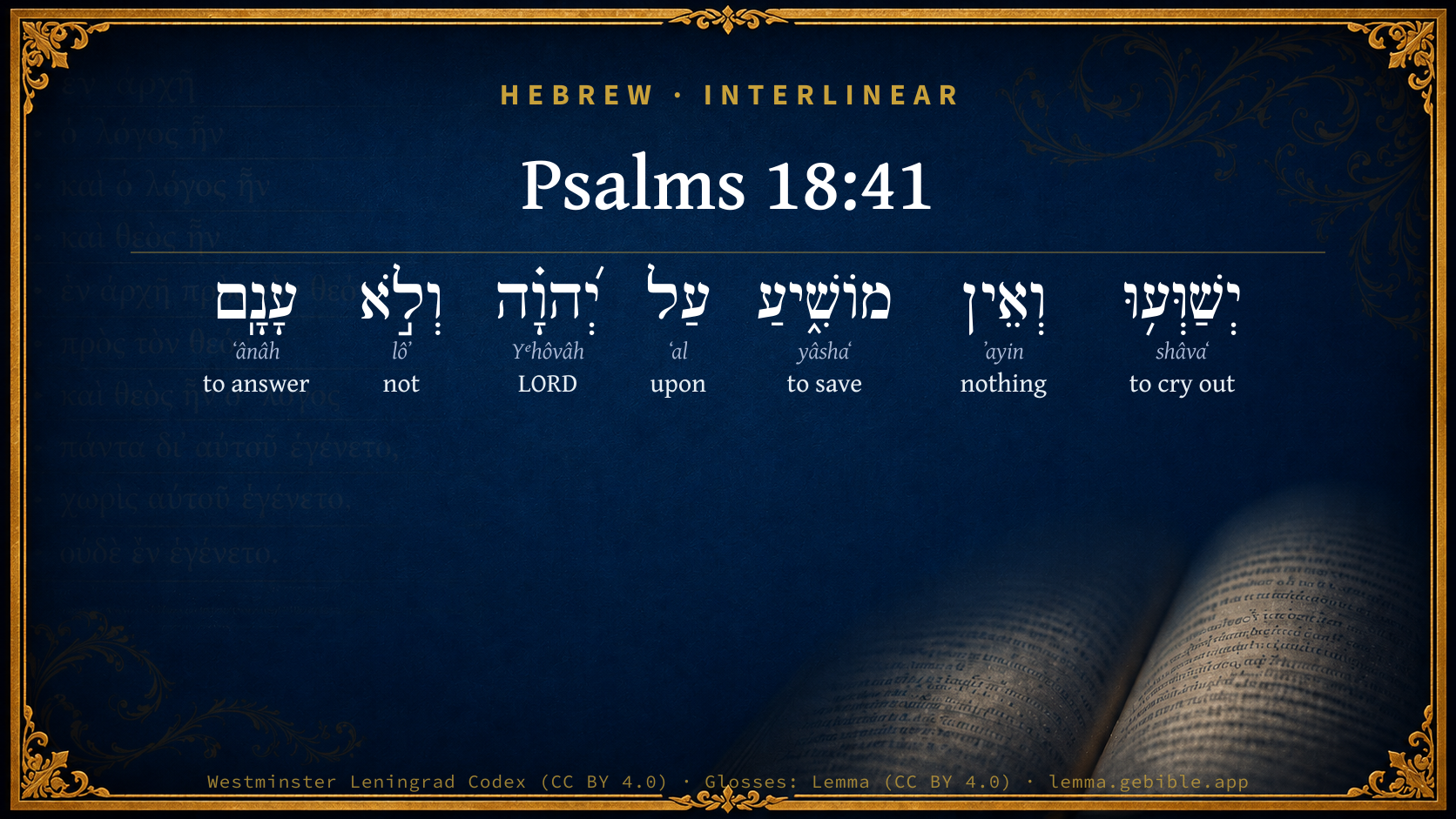
Hebrew (Westminster Leningrad Codex) Psalms 18:41 appears in the Hebrew Old Testament. The text above is from the Westminster Leningrad Codex. Each word links to its Strong’s number, a concise gloss, and parsing drawn from the Open Scriptures Hebrew Bible morphology. Click any word for its full Brown-Driver-Briggs (BDB) entry.
Download image
Cite this verse

Psalms 18:41 (World English Bible). Public Domain. Lemma interlinear Bible study tool, https://lemma.gebible.app/v/psalms/18/41.

Show BibTeX & RIS
BibTeX
RIS
English Translation
They cried, but there was none to save; Even to Yahweh, but he didn't answer them.
World English Bible · Public Domain
Download a study sheet

One document with this verse’s original text, its word-by-word gloss line, the meaning frame, cross-references with their text, attributed commentary, and full source and license credits — printable, and it pastes into notes with its structure intact.

This verse Autodidact and up

Study sheet (.html) Plain text (.txt)

A passage Seminary Student

Up to 50 verses in one chapter. A passage sheet keeps up to 6 commentary sources and 12 cross-references per verse, in the order this page ranks them, and says so on the sheet whenever that leaves anything out. Ask for a single verse and you get the Autodidact verse sheet above.

Everything on this page stays free to read, with no account — the sheet is a download of what is already on screen, not access to it.

Want to remove ads? Support Godless Engineer
Compare translations 3

The same verse in 3 English versions, stacked beneath the original-language interlinear above. Click any original word for its lexicon entry.

Each is an independent rendering of the whole verse — the interlinear is not word-aligned to these translations.

Highlighted words mark where these versions differ — a whole-verse word diff, not a word-by-word alignment.

  • World English Bible Public Domain
    They cried, but there was none to save; Even to Yahweh, but he didn't answer them.
  • King James Version Public Domain
    They cried, but there was none to save them: even unto the LORD, but he answered them not.
  • unfoldingWord Literal Text CC BY-SA 4.0
    They called out for help, but there was none saving; to Yahweh, but he did not answer them.

unfoldingWord Literal Text — © unfoldingWord, licensed CC BY-SA 4.0. Word-aligned USFM3 via Door43 (git.door43.org/unfoldingWord/en_ult).

Versions to compare (up to 4)

3 of 4 selected

Show all 18 translations

Every available English version of this verse, each an independent rendering of the whole verse.

  • World English Bible Public Domain
    They cried, but there was none to save; Even to Yahweh, but he didn't answer them.
  • Berean Standard Bible Public Domain
    They cried for help, but there was no one to save them—to the LORD, but He did not answer.
  • Majority Standard Bible Public Domain
    They cried for help, but there was no one to save them—to the LORD, but He did not answer.
  • King James Version Public Domain
    They cried, but there was none to save them: even unto the LORD, but he answered them not.
  • American Standard Version (1901) Public Domain
    They cried, but there was none to save; Even unto Jehovah, but he answered them not.
  • Revised Version (1885) Public Domain
    They cried, but there was none to save: even unto the LORD, but he answered them not.
  • Geneva Bible (1599) Public Domain
    They cryed but there was none to saue them, euen vnto the Lord, but hee answered them not.
  • Douay-Rheims (1899) Public Domain
    And thou hast made my enemies turn their back upon me, and hast destroyed them that hated me.
  • Young's Literal Translation Public Domain
    They cry, and there is no saviour, On Jehovah, and He doth not answer them.
  • Literal Standard Version CC BY-SA 4.0
    They cry, and there is no savior, || On YHWH, and He does not answer them.
  • Unlocked Literal Bible CC BY-SA 4.0
    They called for help, but no one saved them; they called out to Yahweh, but he did not answer them.
  • unfoldingWord Literal Text CC BY-SA 4.0
    They called out for help, but there was none saving; to Yahweh, but he did not answer them.
  • Darby Bible Public Domain
    They cried, and there was none to save; -- unto Jehovah, and he answered them not.
  • World Messianic Bible Public Domain
    They cried, but there was no one to save; even to the LORD, but he didn’t answer them.
  • Webster's Bible Public Domain
    \\18:40\\Thou hast also given me the necks of my enemies; that I might destroy them that hate me.
  • Free Bible Version CC BY-SA 4.0
    They cried out for help, but no one came to rescue them. They even called out to the Lord, but he did not answer them.
  • Bible in Basic English Public Domain
    They were crying out, but there was no one to come to their help: even to the Lord, but he gave them no answer.
  • JPS Tanakh (1917) Public Domain
    (18-42) They cried, but there was none to save; even unto the LORD, but He answered them not.

Literal Standard Version (2020), Covenant Press — licensed CC BY-SA 4.0. Text via the HelloAO Bible API (eBible.org). Unlocked Literal Bible (unfoldingWord) — licensed CC BY-SA 4.0. Text via the HelloAO Bible API (eBible.org). unfoldingWord Literal Text — © unfoldingWord, licensed CC BY-SA 4.0. Word-aligned USFM3 via Door43 (git.door43.org/unfoldingWord/en_ult). Free Bible Version, Dr. Jonathan Gallagher — licensed CC BY-SA 4.0. Text via the HelloAO Bible API (eBible.org).

Word by word

More ways to search: Search by grammar → Find every occurrence → Compare this word →

Practice this passage: Drill this verse → Learn its vocabulary →

About this verse

These counts appear in no published source. They are computed here, from the morphology-tagged text and Lemma’s own curated glosses. What Lemma adds →

7
words
7
distinct lemmas
Wisdom
section

Notable vocabulary

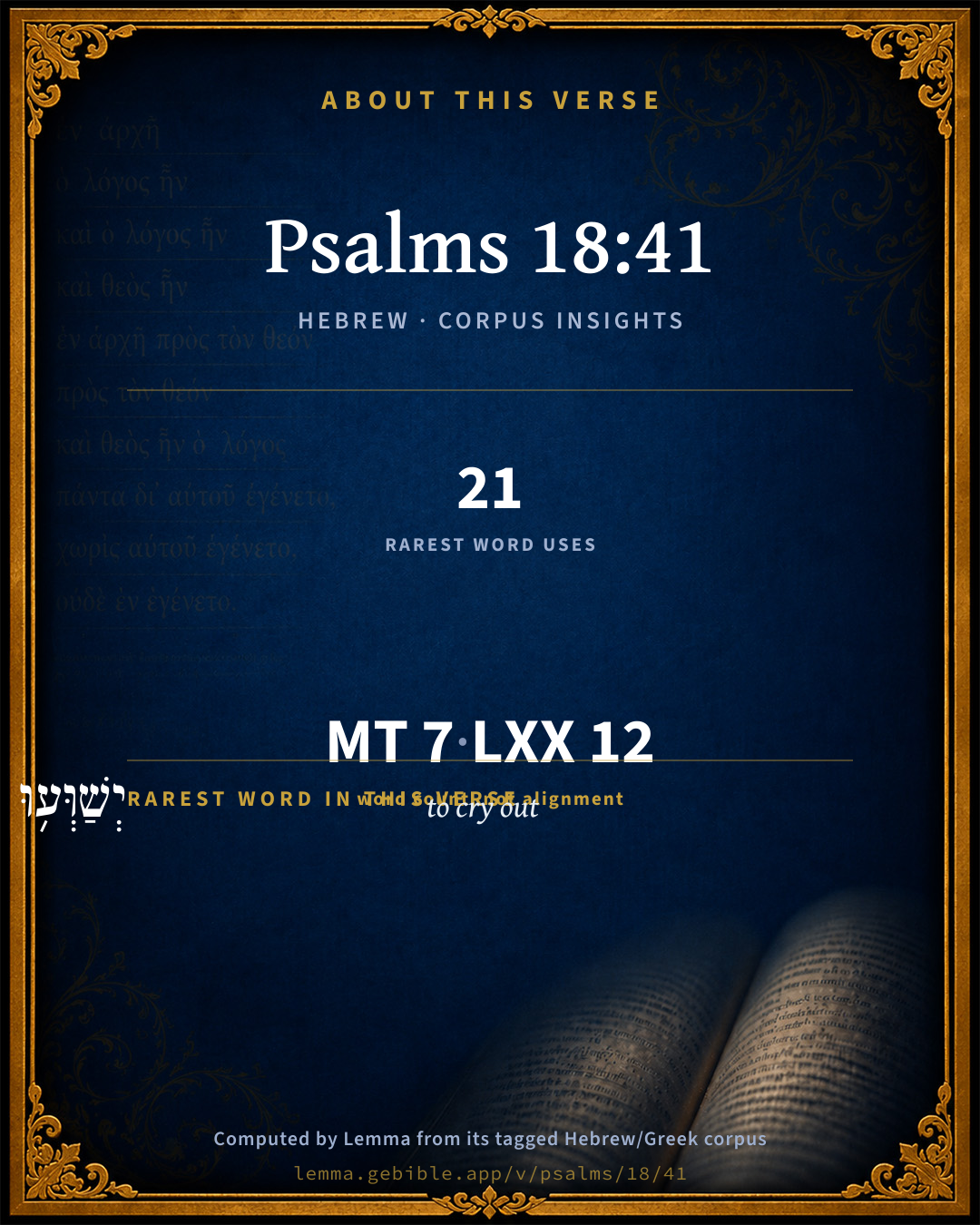
The rarest word here is יְשַׁוְּע֥וּ to cry out H7768 — appearing just 21 times in the whole Hebrew Bible.

Shared distinctive vocabulary

יְשַׁוְּע֥וּ to cry out H7768 occurs in 21 verses of the Hebrew Bible. Also found in:

Grammatical profile

  • 3 verbs
  • 1 noun
  • 1 preposition
  • 2 particles

Verb forms

  • יְשַׁוְּע֥וּ Piel · Imperfect
  • מוֹשִׁ֑יעַ Hiphil · Participle Active
  • עָנָֽם Qal · Perfect

Hebrew & Septuagint length

In English translation the verse runs 16 words from the Hebrew and 17 from the Septuagint (LXX English) — closely comparable.

A rough comparison of the two English renderings, which tokenize alike — not a word-level alignment.

Word counts can differ between the Hebrew and the Greek without any difference in meaning — e.g. the Hebrew direct-object marker אֵת has no separate Greek word, and Greek often adds the article ὁ.

In the original languages it is 7 Hebrew tokens and 12 Greek tokens — but the two are counted differently (Hebrew bundles its prefixes and suffixes into one token; the Greek is in lemma form), so that isn’t a like-for-like length.

Cross-references

14

Topical passages linked to Psalms 18:41 in the Treasury of Scripture Knowledge — connected by theme and wording, ordered by reader-vote popularity; previews shown in the World English Bible.

  • Proverbs 1:28 Then will they call on me, but I will not answer. They will seek me diligently, but they will not find me;
  • Job 27:9 Will God hear his cry, When trouble comes on him?
  • 2 Samuel 22:42–43 They looked, but there was none to save; Even to Yahweh, but he didn't answer them.
  • Job 35:12–13 There they cry, but none gives answer, Because of the pride of evil men.
  • Psalms 50:22 "Now consider this, you who forget God, Lest I tear you into pieces, and there be none to deliver.
  • Isaiah 1:15 When you spread forth your hands, I will hide my eyes from you; Yes, when you make many prayers, I will not hear. Your hands are full of blood.
  • Isaiah 59:1–2 Behold, Yahweh's hand is not shortened, that it can't save; neither his ear heavy, that it can't hear:
  • Jeremiah 11:11 Therefore thus says Yahweh, Behold, I will bring evil on them, which they shall not be able to escape; and they shall cry to me, but I will not listen to them.
  • Jeremiah 14:12 When they fast, I will not hear their cry; and when they offer burnt offering and meal-offering, I will not accept them; but I will consume them by the sword, and by the famine, and by the pestilence.
  • Ezekiel 8:18 Therefore will I also deal in wrath; my eye shall not spare, neither will I have pity; and though they cry in my ears with a loud voice, yet will I not hear them.
  • Hosea 7:14 They haven't cried to me with their heart, But they howl on their beds. They assemble themselves for grain and new wine. They turn away from me.
  • Micah 3:4 Then they will cry to Yahweh, But he will not answer them. Yes, he will hide his face from them at that time, Because they made their deeds evil."
  • Zechariah 7:13 It has come to pass that, as he called, and they refused to listen, so they will call, and I will not listen," said Yahweh of Hosts;
  • Luke 13:25 When once the master of the house has risen up, and has shut the door, and you begin to stand outside, and to knock at the door, saying, 'Lord, Lord, open to us!' then he will answer and tell you, 'I don't know you or where you come from.'

Cross-references courtesy of OpenBible.info (CC BY 4.0).

Hebrew and Greek witnesses Masoretic Hebrew ↔ Greek Septuagint

The same verse in the two great witnesses to the Old Testament, shown verse-for-verse.

You’re reading Greek Psalm 17 (Hebrew Psalm 18). The Septuagint counts the superscription, so verse numbers can differ from the Hebrew — chapter-level alignment, not verse-by-verse. Numbering follows Rahlfs.

These are two independent witnesses, not word-aligned to each other, and the Septuagint is shown in lemma (dictionary) form.

Hebrew Psalms 18:41 Masoretic · Westminster Leningrad Codex

יְשַׁוְּע֥וּ וְאֵין מוֹשִׁ֑יעַ עַל יְ֝הוָ֗ה וְלֹ֣א עָנָֽם

They cried, but there was none to save; Even to Yahweh, but he didn't answer them.

World English Bible · Public Domain

Greek LXX Greek Psalm 17:41 Septuagint · lemma form

καί ὁ ἐχθρός ἐγώ δίδωμι ἐγώ νῶτον καί ὁ μισέω ἐγώ ἐκὀλεθρεύω

They cried, but there was no deliverer: even to the Lord, but he listened not to them.

LXX2012 (modern English Septuagint) · Public Domain

On this verse, The Cambridge Bible for Schools and Colleges discusses the Septuagint’s reading. Read the note in Commentary ↓

Hebrew: Westminster Leningrad Codex (CC BY 4.0). Greek: Septuagint (public domain); English from LXX2012 (modern English Septuagint) (Public Domain). How the Septuagint differs from the Hebrew →

Commentary

Notes on Psalms 18:41 from classic Christian and Jewish commentators (each source and its license shown beneath its notes). The classic Christian expositions comment on the surrounding passage and are grouped to its opening verse, so a note may address several verses; the Jewish commentaries on the Tanakh (Rashi and others) are per-verse, so they appear only where the commentator wrote on this verse.

Lemma curates 59 commentaries, every one of them public domain or Creative Commons licensed, each selected and text-cleaned for this edition rather than reprinted as found. About our sources →

Trapp's Complete Commentary

John Trapp

Psa 18:41 They cried, but [there was] none to save [them: even] unto the LORD, but he answered them not.

Ver. 41. They cried] Through grief and impatience, clamore incondito, as beasts when in durance fill the air with loud outcries.

Even unto the Lord] As nature prompteth men in an extremity to look up for help; but because it is but the prayer of the flesh for ease, and not of the spirit for grace, and a good use of calamities, and not but in extreme despair of help elsewhere, therefore God hears them not. In Samuel it is, They looked, but there was none to save them; q.d. If they could have made any other shift God should never have heard of them. Therefore Sero, inquit Nero.

John Trapp, A Commentary or Exposition upon All the Books of the Old and New Testament (1647–1656) — public domain. Text from a community e-Sword module.

J. A. Alexander on Psalms

Joseph Addison Alexander

42. (Psa 18:41), They shall call for help, and there is no deliverer—upon Jehovah, and he hears them not. Because they have no covenant relation to him, as the Psalmist had. Their calling on Jehovah does not exclude all reference to heathen foes, as appears from Jon 1:14. —Hear, in the pregnant sense of hearing favourably, granting, answering a prayer. See above, on Psa 3:5 (4).

Joseph Addison Alexander, The Psalms Translated and Explained (1850) — public domain. Text from a community e-Sword module.

Geneva Bible (1599)

Geneva Bible translators

They that reject the cry of the afflicted, God will also reject them, when they cry for help: for either pain or fear cause those hypocrites to cry.

Geneva Bible (1599) marginal notes — public domain. Text via Bolls.life.

Adam Clarke's Commentary

Verse 41. They cried] The Philistines called upon their gods, but there was none to save them.

Even unto the Lord] Such as Saul, Ishbosheth, Absalom, c., who, professing to worship the true God, called on him while in their opposition to David but God no more heard them than their idols heard the Philistines.

Adam Clarke's Commentary on the Bible (1810–1826) — public domain. Text from a community e-Sword/MySword module.

John Calvin's Commentaries

41. They shall cry, etc. The change of the tense in the verb from the past to the future does not break the continuity of the narration; and, therefore, the words should be explained thus: Although they cried to God, yet their prayers were rejected by him. He pursues the same subject which it was his object to illustrate before, namely, that it was at length manifest from the issue that his enemies falsely boasted of having the support and countenance of God, who showed that he had turned away from them. It is true, that when their affairs continued to go on prosperously, they sometimes received such applause and commendation, that it was commonly believed that God was favorable to them, while, at the same time he seemed to be opposed to David, who although he cried night and day to him, found it of no avail. But after God had sufficiently tried the patience of his servant, he cast them down, and disappointed them of their vain hope; yea, rather he would not deign to hear their prayers. We now perceive the design of David in these words. As the ungodly had long wickedly abused the name of God, by pretending that he favored their unjust proceedings, the Psalmist derides their vain boasting, in which they were completely disappointed. It is to be observed, that he here speaks of hypocrites, who never call upon God in sincerity and truth. For this promise shall never fail,

“The Lord is nigh unto all them that call upon him, to all that call upon him in truth,” (Psalm 145:18.)

David does not, therefore, say that his enemies were repulsed when they had recourse to God with sincere affection of heart, but only when, with their accustomed effrontery, they thought that God was, so to speak, bound to conduct and advance their wicked enterprises. When the ungodly, in the extremity of their distress, pour forth prayers, and when, cast down with fear, and trembling with the dread of impending evils, they show an appearance of humility, they, notwithstanding, do not change their purpose so as truly to repent and amend the evil of their ways. Besides, instead of being influenced by faith, they are actuated by presumption and hardness of heart, or they pour forth their complaints in doubt, rather for the purpose of murmuring against God, than of familiarly and confidently placing their trust in him. from this passage we may gather a profitable warning, namely, that all who treat the afflicted poor with cruel mockery, and who proudly thrust back those who come to them as humble suppliants, will experience that God is deaf to their prayers. We are farther taught by the following verse, that after God has cast off the ungodly, he leaves them to be treated with every kind of indignity, and gives them up to be trampled under foot, as the mire of the streets. He not only declares, that when the proud and the cruel cry to him in their affliction, he will shut his ears against their cry; but he also threatens, that, in the course of his retributive providence, they shall be treated in the same manner in which they treat others.

John Calvin's Commentaries (1540-1563) — public domain. Text from the Calvin Translation Society English edition (1840s-50s) via the Christian Classics Ethereal Library (ccel.org). Calvin's coverage is partial (roughly two-thirds of the Bible); uncommented books and verses are honest gaps, never fabricated. The 19th-century editor's footnotes and remarks are omitted so the notes are faithfully Calvin's own voice.

Ellicott's Commentary for English Readers

(41) Cried.—Sam. 22 has “looked.”

A Bible Commentary for English Readers, edited by Charles John Ellicott (1878–1897) — public domain. Text from a community e-Sword module.

The Cambridge Bible for Schools and Colleges

gen. ed. J. J. S. Perowne

41. They cried] Cp. Psa_18:6. The Heb. text in 2 Sam. has they looked for help (Isa_17:7-8), but the LXX supports the reading cried, which is certainly right. There is only the difference of one letter in the consonants of the two words (ישועו—ישעו).

Even unto the Lord] At first sight this might seem to indicate that the foes referred to were Israelites. But it is better to understand it of the heathen. After vainly seeking help from their own gods, in the extremity of their despair they cry to Jehovah. Cp. 1Sa_5:12; Jon_3:7 ff.

The Cambridge Bible for Schools and Colleges (gen. ed. J. J. S. Perowne; Cambridge University Press, 1878–1918) — public domain. Text from a community e-Sword module.

John Gill's Exposition

Then did I beat them small, as the dust before the wind,.... They being given up by God, and he not answering to their cries; the phrase denotes the utter ruin and destruction of them, and represents their case as desperate and irrecoverable; being, as it were, pounded to dust, and that driven away with the wind: just as the destruction of the four monarchies is signified by the iron, clay, brass, silver, and gold, being broken to pieces, and made like the chaff of the summer threshing floor, and carried away with the wind, so that no place is found for them any more, Dan 2:35;

I did cast them out as the dirt of the streets; expressing indignation and contempt: in Sa2 22:43; it is, "I did stamp them as the mire of the street, and did, spread them abroad"; which also denotes the low and miserable condition to which they were reduced, and the entire conquest made of them, and triumph over them; see Isa 10:6; compare with this Sa2 12:31.

John Gill's Exposition of the Whole Bible (1746–1763) — public domain (CC PDM 1.0). Text via the HelloAO Bible API.

Albert Barnes' Notes on the Bible

They cried - They cried out for help, for mercy, for life. In modern language, “they begged for quarter.” They acknowledged that they were vanquished, and entreated that their lives might be spared.

But there was none to save them - To preserve their lives. No help appeared from their own countrymen; they found no mercy in me or my followers; and God did not interpose to deliver them.

Even unto the Lord - As a last resort. People appeal to everything else for help before they will appeal to God; often when they come to Him it is by constraint, and not willingly; if the danger should leave them, they would cease to call upon Him. Hence, since there is no real sincerity in their calling upon God - no real regard for his honor or his commands - their cries are not heard, and they perish. The course of things with a sinner, however, is often such that, despairing of salvation in any other way, and seeing that this is the only true way, he comes with a heart broken, contrite, penitent, and then God never turns away from the cry. No sinner, though as a last resort, who comes to God in real sincerity, will ever be rejected.

But he answered them not - He did not put forth his power to save them from my sword; to keep them alive when they were thus vanquished. Had they cried unto him to save their souls, he would undoubtedly have done it; but their cry was for life - for the divine help to save them from the sword of the conqueror. There might have been many reasons why God should not interpose to save them from the regular consequences of valor when they had been in the wrong and had begun the war; but there would have been no reason why he should not interpose if they had called upon him to save them from their sins. There may be many reasons why God should not save sinners from the temporal judgments due to their sins - the intemperate from the diseases, the poverty, and the wretchedness consequent on that vice - or the licentious from the woes and sorrows caused by such a course of life; but there is no reason, in any case, why God should not save from the eternal consequences of sin, if the sinner cries sincerely and earnestly for mercy.

Albert Barnes' Notes on the Bible (1834–1885) — public domain. Text from a community e-Sword/MySword module.

Matthew Poole's English Annotations

He speaks of his Israelitish enemies, who in their distresses prayed to God for help against him.

Matthew Poole's English Annotations on the Holy Bible (1683–1685) — public domain. Text from a community e-Sword/MySword module.

Whedon's Commentary on the Bible

Daniel D. Whedon

41. They cried… even unto the Lord—They first cried to their gods, but, getting no answer, they called upon Jehovah, as even the heathen sometimes did in their distress, (Jon_1:5-14;) but, as they were insincere, he did not answer them.

Daniel D. Whedon (gen. ed.), Commentary on the Old and New Testaments (1874–1909) — public domain. Text from a community e-Sword module.

The Pulpit Commentary

They cried, but there was none to save them: even unto the Lord, but he answered them not. It seems strange, at first sight, that the heathen enemies of David should "cry unto the Lord," i.e. to Jehovah; and hence some have been driven to suppose that a victory over domestic enemies is here interpolated into the series of foreign victories. But it seems better to explain, with Hengstenberg and the "Speaker"s Commentary," that the heathen did sometimes, as a last resort, pray to a foreign god, whom they seemed to find by experience to be more powerful than their own. (see Jon_1:14) Jehovah was known by name, as the God of the Israelites, to the surrounding nations. Mesha mentions him upon the Moabite Stone; and Sennacherib declared, by the mouth of Rabshakeh, "Am I come up without the Lord against this place to destroy it? The Lord (Jehovah) said to me, Go up against this land, and destroy it". (2Ki_18:25)

The Pulpit Commentary (1880–1919), ed. H.D.M. Spence-Jones & Joseph S. Exell — public domain. Text from a community e-Sword module.

Keil & Delitzsch

C. F. Keil & F. Delitzsch

(Heb.: 18:42-43) Their prayer to their gods, wrung from them by their distress, and even to Jahve, was in vain, because it was for their cause, and too late put up to Him. על = על; in Psa 42:2 the two prepositions are interchanged. Since we do not pulverize dust but to dust, כּעפר is to be taken as describing the result: so that they became as dust (cf. Job 38:30, כּאכן, so that it is become like stone, and the extreme of such pregnant brevity of expression in Isa 41:2) before the wind (על־פּני as in Ch2 3:17, before the front). The second figure is to be explained differently: I emptied them out (אריקם from הריק) like the dirt of the streets, i.e., not merely: so that they became such, but as one empties it out, - thus contemptuously, ignominiously and completely (cf. Isa 10:6; Zac 10:5). The lxx renders it λεανῶ from הרק (root רק to stretch, make thin, cf. tendo tenius, dehnen dnn); and the text of 2 Sam 22 present the same idea in אדיקם.

Keil & Delitzsch — Biblical Commentary on the Old Testament (1861–1891) — public domain (CC PDM 1.0). Text via the HelloAO Bible API. (Old Testament only.)

Rashi

Rabbi Shlomo Yitzchaki (Rashi)

You have given me the back of their necks They would turn the back of their necks to me and flee.

Rashi on the Tanakh — English translations: “The Judaica Press complete Tanach with Rashi, translated by A. J. Rosenberg” (CC BY 4.0); “Pentateuch with Rashi's commentary by M. Rosenbaum and A.M. Silbermann, 1929-1934” (public domain); “The Metsudah Tanach series, Lakewood, N.J” (CC BY 4.0); and “The Book of Joshua, Metsudah Publications, 1997” (CC BY 4.0). Text via Sefaria.

Lesson kit

Teaching starters — assembled from the data on this page, not authored interpretation. Every prompt links to the verse data it draws on. Edit before teaching.

Psalms, in the Wisdom, opens this verse with 7 words (7 distinct Hebrew lemmas). Its most distinctive word is shâvaʻ (“to cry out”). A historical commentator’s framing appears above. Read the whole chapter for the surrounding context.

Discussion questions

  1. How does “to cry out” (shâvaʻ) shape what this verse is saying?
  2. Job 19:7 shares the word «to cry out» with this verse. How do the two illuminate each other?
  3. These translations render this verse differently. What is at stake in choosing one wording over another?
  4. The verb «יְשַׁוְּע֥וּ» is Piel Imperfect. How does its form color the action?
  5. Reading how Trapp's Complete Commentary and J. A. Alexander on Psalms read this verse, where do the two commentators agree and where do they part?

Things to notice

Reading settings

Reading text

Shown beneath each verse's original-language words.

Old Testament
Old Testament edition

Read the OT as the Masoretic Hebrew (MT) or the Greek Septuagint (LXX).

English shown for the Greek Septuagint (in the Hebrew ↔ Greek comparison).

Comparing translations? Open the Compare panel on any verse page to stack up to four side by side.