
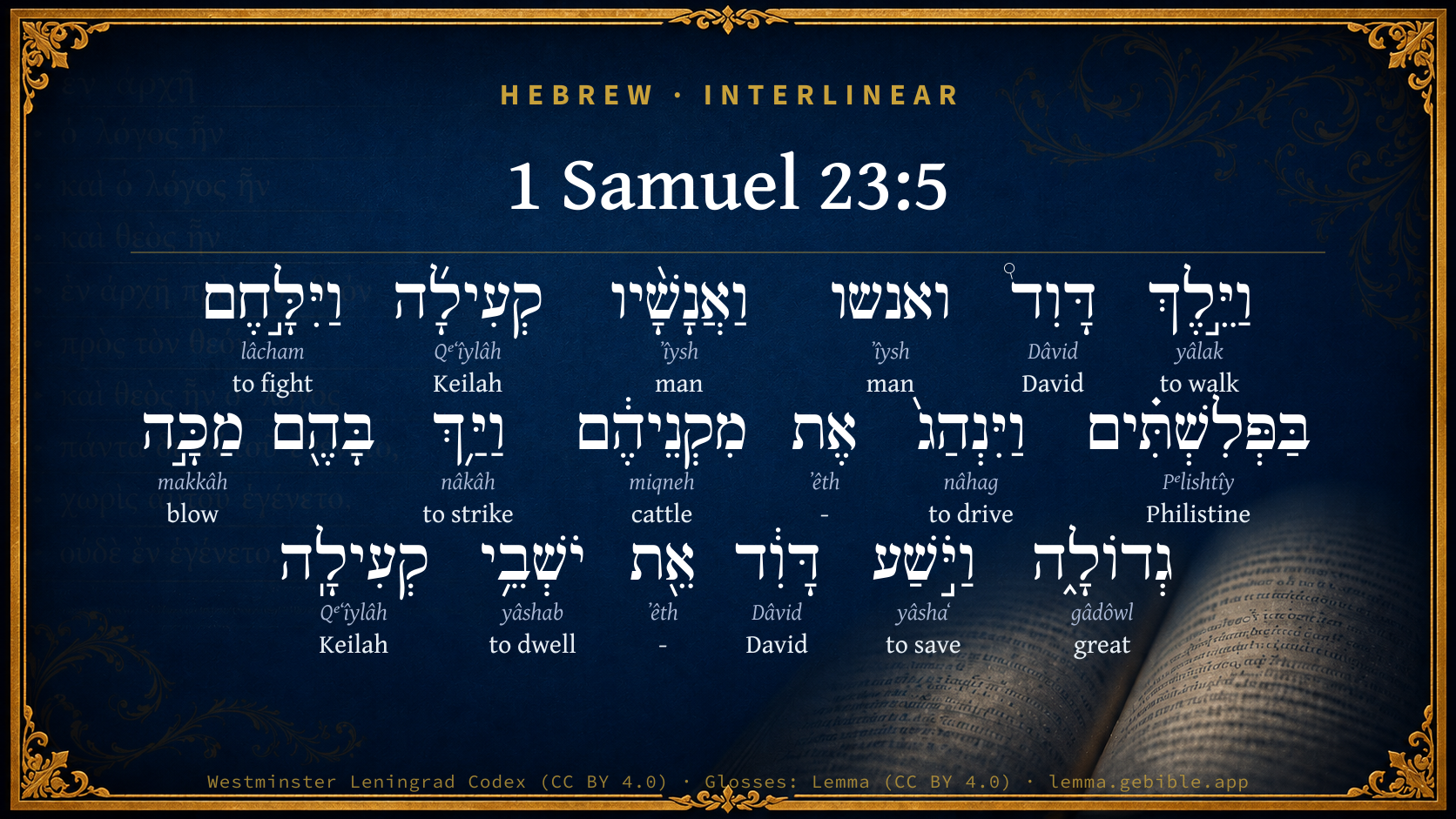
1 Samuel 23:5

Hebrew (Westminster Leningrad Codex) 1 Samuel 23:5 appears in the Hebrew Old Testament. The text above is from the Westminster Leningrad Codex. Each word links to its Strong’s number, a concise gloss, and parsing drawn from the Open Scriptures Hebrew Bible morphology. Click any word for its full Brown-Driver-Briggs (BDB) entry.
Download image
Cite this verse

1 Samuel 23:5 (World English Bible). Public Domain. Lemma interlinear Bible study tool, https://lemma.gebible.app/v/1-samuel/23/5.

Show BibTeX & RIS
BibTeX
RIS
English Translation
David and his men went to Keilah, and fought with the Philistines, and brought away their cattle, and killed them with a great slaughter. So David saved the inhabitants of Keilah.
World English Bible · Public Domain
Download a study sheet

One document with this verse’s original text, its word-by-word gloss line, the meaning frame, cross-references with their text, attributed commentary, and full source and license credits — printable, and it pastes into notes with its structure intact.

This verse Autodidact and up

Study sheet (.html) Plain text (.txt)

A passage Seminary Student

Up to 50 verses in one chapter. A passage sheet keeps up to 6 commentary sources and 12 cross-references per verse, in the order this page ranks them, and says so on the sheet whenever that leaves anything out. Ask for a single verse and you get the Autodidact verse sheet above.

Everything on this page stays free to read, with no account — the sheet is a download of what is already on screen, not access to it.

Want to remove ads? Support Godless Engineer
Compare translations 3

The same verse in 3 English versions, stacked beneath the original-language interlinear above. Click any original word for its lexicon entry.

Each is an independent rendering of the whole verse — the interlinear is not word-aligned to these translations.

Highlighted words mark where these versions differ — a whole-verse word diff, not a word-by-word alignment.

  • World English Bible Public Domain
    David and his men went to Keilah, and fought with the Philistines, and brought away their cattle, and killed them with a great slaughter. So David saved the inhabitants of Keilah.
  • King James Version Public Domain
    So David and his men went to Keilah, and fought with the Philistines, and brought away their cattle, and smote them with a great slaughter. So David saved the inhabitants of Keilah.
  • unfoldingWord Literal Text CC BY-SA 4.0
    And David and his men went to Keilah and fought with the Philistines. And he drove off their livestock and struck a great striking against them. And David saved the dwellers of Keilah.

unfoldingWord Literal Text — © unfoldingWord, licensed CC BY-SA 4.0. Word-aligned USFM3 via Door43 (git.door43.org/unfoldingWord/en_ult).

Versions to compare (up to 4)

3 of 4 selected

Show all 18 translations

Every available English version of this verse, each an independent rendering of the whole verse.

  • World English Bible Public Domain
    David and his men went to Keilah, and fought with the Philistines, and brought away their cattle, and killed them with a great slaughter. So David saved the inhabitants of Keilah.
  • Berean Standard Bible Public Domain
    Then David and his men went to Keilah, fought against the Philistines, and carried off their livestock, striking them with a mighty blow. So David saved the people of Keilah.
  • Majority Standard Bible Public Domain
    Then David and his men went to Keilah, fought against the Philistines, and carried off their livestock, striking them with a mighty blow. So David saved the people of Keilah.
  • King James Version Public Domain
    So David and his men went to Keilah, and fought with the Philistines, and brought away their cattle, and smote them with a great slaughter. So David saved the inhabitants of Keilah.
  • American Standard Version (1901) Public Domain
    And David and his men went to Keilah, and fought with the Philistines, and brought away their cattle, and slew them with a great slaughter. So David save the inhabitants of Keilah.
  • Revised Version (1885) Public Domain
    And David and his men went to Keilah, and fought with the Philistines, and brought away their cattle, and slew therewith a great slaughter. So David saved the inhabitants of Keilah.
  • Geneva Bible (1599) Public Domain
    So Dauid and his men went to Keilah, and fought with the Philistims, and brought away their cattel, and smote them with a great slaughter: thus Dauid saued the inhabitants of Keilah.
  • Douay-Rheims (1899) Public Domain
    David therefore, and his men, went to Ceila, and fought against the Philistines, and brought away their cattle, and made a great slaughter of them: and David saved the inhabitants of Ceila.
  • Young's Literal Translation Public Domain
    And David goeth, and his men, to Keilah, and fighteth with the Philistines, and leadeth away their cattle, and smiteth among them -- a great smiting, and David saveth the inhabitants of Keilah.
  • Literal Standard Version CC BY-SA 4.0
    And David goes, and his men, to Keilah, and fights with the Philistines, and leads away their livestock, and strikes among them [with] a great striking, and David saves the inhabitants of Keilah.
  • Unlocked Literal Bible CC BY-SA 4.0
    David and his men went to Keilah and fought with the Philistines. He led away their cattle and struck them with a great slaughter. So David saved the inhabitants of Keilah.
  • unfoldingWord Literal Text CC BY-SA 4.0
    And David and his men went to Keilah and fought with the Philistines. And he drove off their livestock and struck a great striking against them. And David saved the dwellers of Keilah.
  • Darby Bible Public Domain
    And David and his men went to Keilah, and fought against the Philistines, and brought away their cattle, and smote them with a great slaughter. So David saved the inhabitants of Keilah.
  • World Messianic Bible Public Domain
    David and his men went to Keilah and fought with the Philistines, and brought away their livestock, and killed them with a great slaughter. So David saved the inhabitants of Keilah.
  • Webster's Bible Public Domain
    So David and his men went to Keilah, and fought with the Philistines, and brought away their cattle, and smote them with a great slaughter. So David saved the inhabitants of Keilah.
  • Free Bible Version CC BY-SA 4.0
    Then David and his men went to Keilah and fought the Philistines. They slaughtered them and drove off their livestock. By doing this David saved the people of Keilah.
  • Bible in Basic English Public Domain
    So David and his men went to Keilah, and had a fight with the Philistines, and took away their cattle, and put them to the sword with great destruction. So David was the saviour of the people of Keilah.
  • JPS Tanakh (1917) Public Domain
    And David and his men went to Keilah, and fought with the Philistines, and brought away their cattle, and slew them with a great slaughter. So David saved the inhabitants of Keilah.

Literal Standard Version (2020), Covenant Press — licensed CC BY-SA 4.0. Text via the HelloAO Bible API (eBible.org). Unlocked Literal Bible (unfoldingWord) — licensed CC BY-SA 4.0. Text via the HelloAO Bible API (eBible.org). unfoldingWord Literal Text — © unfoldingWord, licensed CC BY-SA 4.0. Word-aligned USFM3 via Door43 (git.door43.org/unfoldingWord/en_ult). Free Bible Version, Dr. Jonathan Gallagher — licensed CC BY-SA 4.0. Text via the HelloAO Bible API (eBible.org).

Word by word

More ways to search: Search by grammar → Find every occurrence → Compare this word →

Practice this passage: Drill this verse → Learn its vocabulary →

קְעִילָ֜ה
Qᵉʻîylâh
H7084
“Keilah”
Noun, Proper
Part of Speech
Noun
Type
Proper
Full BDB Definition

Origin: perhaps from H7049 in the sense of inclosing

TWOT: None

Keilah = "fortress" - a city in the lowlands of Judah northwest of Hebron
  1. וַיֵּ֣לֶךְ yâlak H3212 “and · to walk” Conjunction + Verb, Qal, Sequential Imperfect, 3rd Person, Masculine, Singular
  2. דָּוִד֩ Dâvid H1732 “David” Noun, Proper
  3. ואנשו ʼîysh H376 “and · men · his” Conjunction + Noun, Common, Masculine, Plural, Construct + Suffix, Personal, 3rd Person, Masculine, Singular
  4. וַאֲנָשָׁ֨יו ʼîysh H376 “and · men · his” Conjunction + Noun, Common, Masculine, Plural, Construct + Suffix, Personal, 3rd Person, Masculine, Singular
  5. וַיִּלָּ֣חֶם lâcham H3898 “and · to fight” Conjunction + Verb, Niphal, Sequential Imperfect, 3rd Person, Masculine, Singular
  6. בַּפְּלִשְׁתִּ֗ים Pᵉlishtîy H6430 “in/at the · Philistines” Preposition, Determined + Noun, Gentilic, Masculine, Plural, Absolute
  7. וַיִּנְהַג֙ nâhag H5090 “and · to drive” Conjunction + Verb, Qal, Sequential Imperfect, 3rd Person, Masculine, Singular
  8. אֶת ʼêth H853 “-” Particle, Direct Object
  9. מִקְנֵיהֶ֔ם miqneh H4735 “cattle · their” Noun, Common, Masculine, Singular, Construct + Suffix, Personal, 3rd Person, Masculine, Plural
  10. וַיַּ֥ךְ nâkâh H5221 “and · to strike” Conjunction + Verb, Hiphil, Sequential Imperfect, 3rd Person, Masculine, Singular
  11. מַכָּ֣ה makkâh H4347 “blow” Noun, Common, Feminine, Singular, Absolute
  12. גְדוֹלָ֑ה gâdôwl H1419 “great” Adjective, Adjective, Feminine, Singular, Absolute
  13. וַיֹּ֣שַׁע yâshaʻ H3467 “and · to save” Conjunction + Verb, Hiphil, Sequential Imperfect, 3rd Person, Masculine, Singular
  14. דָּוִ֔ד Dâvid H1732 “David” Noun, Proper
  15. אֵ֖ת ʼêth H853 “-” Particle, Direct Object
  16. יֹשְׁבֵ֥י yâshab H3427 “dwelling” Verb, Qal, Participle Active, Masculine, Plural, Construct
  17. קְעִילָֽה Qᵉʻîylâh H7084 “Keilah” Noun, Proper

About this verse

These counts appear in no published source. They are computed here, from the morphology-tagged text and Lemma’s own curated glosses. What Lemma adds →

19
words
14
distinct lemmas
Historical
section

Notable vocabulary

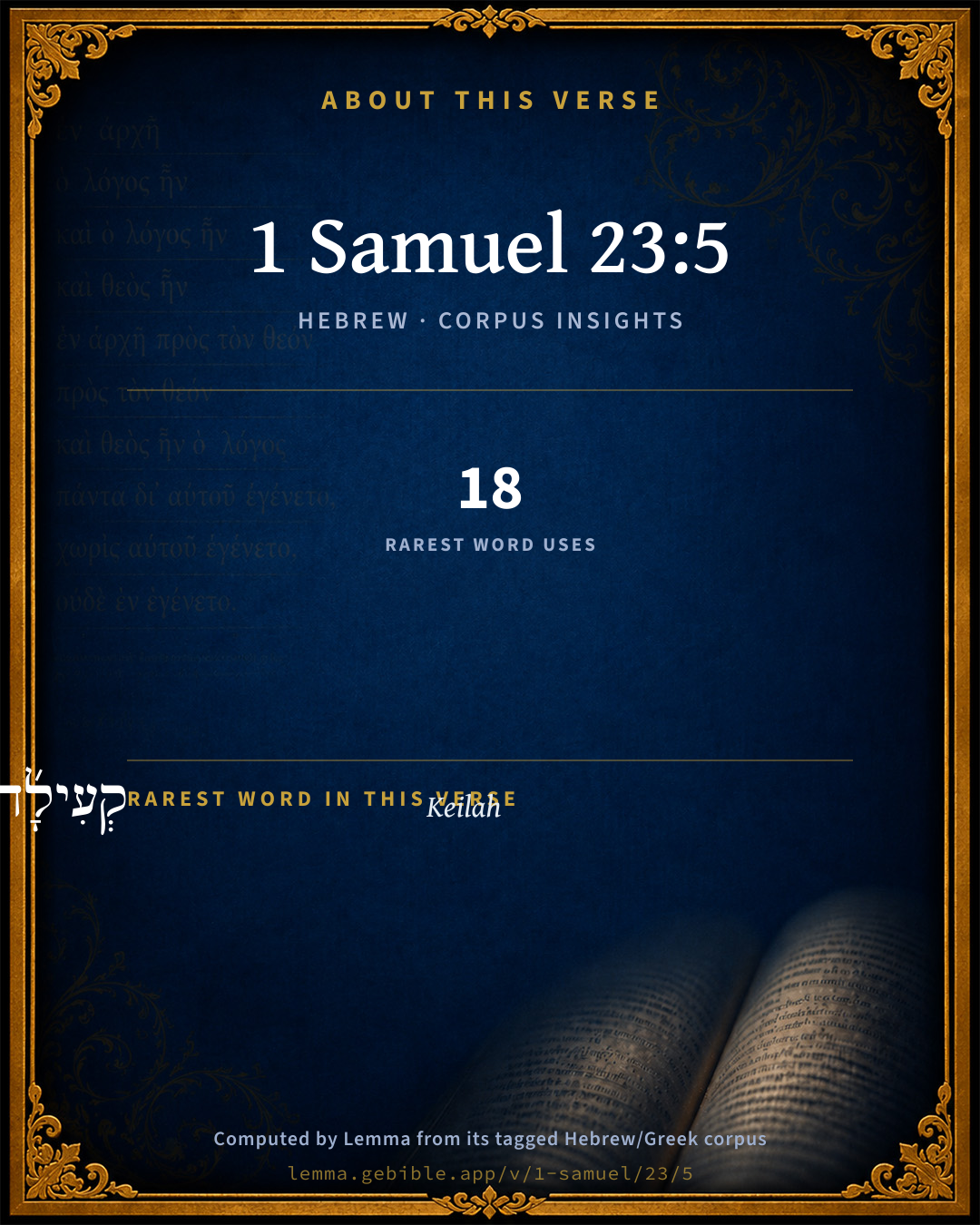
The rarest word here is קְעִילָ֜ה Keilah H7084 — appearing just 18 times in the whole Hebrew Bible.

Shared distinctive vocabulary

קְעִילָ֜ה Keilah H7084 occurs in 16 verses of the Hebrew Bible. Also found in:

Grammatical profile

  • 6 verbs
  • 9 nouns
  • 1 adjective
  • 1 preposition
  • 2 particles

Verb forms

  • וַיֵּ֣לֶךְ Qal · Sequential Imperfect
  • וַיִּלָּ֣חֶם Niphal · Sequential Imperfect
  • וַיִּנְהַג֙ Qal · Sequential Imperfect
  • וַיַּ֥ךְ Hiphil · Sequential Imperfect
  • וַיֹּ֣שַׁע Hiphil · Sequential Imperfect
  • יֹשְׁבֵ֥י Qal · Participle Active

Repetition

Words recur within this verse — often emphatic in Hebrew:

  • דָּוִד֩ David H1732 ×2
  • ואנשו man H376 ×2
  • קְעִילָ֜ה Keilah H7084 ×2

Hebrew & Septuagint length

In English translation the verse runs 31 words from the Hebrew and 41 from the Septuagint (LXX English) — closely comparable.

A rough comparison of the two English renderings, which tokenize alike — not a word-level alignment.

Word counts can differ between the Hebrew and the Greek without any difference in meaning — e.g. the Hebrew direct-object marker אֵת has no separate Greek word, and Greek often adds the article ὁ.

Hebrew and Greek witnesses Masoretic Hebrew ↔ Greek Septuagint

The same verse in the two great witnesses to the Old Testament, shown verse-for-verse.

These are two independent witnesses, not word-aligned to each other, and the Septuagint is shown in lemma (dictionary) form.

Hebrew 1 Samuel 23:5 Masoretic · Westminster Leningrad Codex

וַיֵּ֣לֶךְ דָּוִד֩ ואנשו וַאֲנָשָׁ֨יו קְעִילָ֜ה וַיִּלָּ֣חֶם בַּפְּלִשְׁתִּ֗ים וַיִּנְהַג֙ אֶת מִקְנֵיהֶ֔ם וַיַּ֥ךְ בָּהֶ֖ם מַכָּ֣ה גְדוֹלָ֑ה וַיֹּ֣שַׁע דָּוִ֔ד אֵ֖ת יֹשְׁבֵ֥י קְעִילָֽה

David and his men went to Keilah, and fought with the Philistines, and brought away their cattle, and killed them with a great slaughter. So David saved the inhabitants of Keilah.

World English Bible · Public Domain

Greek LXX 1 Samuel 23:5 Septuagint · lemma form

καί πορεύομαι δαυίδ καί ὁ ἀνήρ ὁ μετά αὐτός εἰς κεϊλα καί πολεμέω ἐν ὁ ἀλλόφυλος καί φεύγω ἐκ πρόσωπον αὐτός καί ἀποἄγω ὁ κτῆνος αὐτός καί πατάσσω ἐν αὐτός πληγή μέγας καί σώζω δαυίδ ὁ καταοἰκέω κεϊλα

So David and his men with him went to Keila, and fought with the Philistines; and they fled from before him, and he carried off their cattle, and struck them with a great slaughter, and David rescued the inhabitants of Keila.

LXX2012 (modern English Septuagint) · Public Domain

Hebrew: Westminster Leningrad Codex (CC BY 4.0). Greek: Septuagint (public domain); English from LXX2012 (modern English Septuagint) (Public Domain). How the Septuagint differs from the Hebrew →

Targum (Aramaic paraphrase)

1

The Targum is the ancient Jewish Aramaic paraphrase of the Hebrew Scriptures — an interpretive translation, not the Hebrew text itself. Onkelos (literal) and Pseudo-Jonathan (expansive) render the Torah, and Jonathan the Prophets. Coverage is partial: where no permissively-licensed English translation exists for a verse, only the Aramaic is shown. This is verse-level text, not a word-by-word alignment to the Hebrew.

  1. Targum Jonathan Prophets (Joshua–Malachi)
    וַאֲזַל דָוִד וְגַבְרוֹהִי לִקְעִילָה וְאַגִיחַ קְרָבָא בִּפְלִשְׁתָּאֵי וּדְבַר יַת גֵיתֵיהוֹן וּמְחָא בְהוֹן מְחָא סַגִיאָה וּפְרַק דָוִד יַת יַתְבֵי קְעִילָה:

    (no public-domain English translation for this verse)

    Targum Jonathan — Aramaic: “Mikraot Gedolot” (public domain). English: “Sefaria Community Translation” (CC0 1.0 (public-domain dedication)); “London "Chaldee Paraphrase," 1871” (public domain). Text via Sefaria.

Commentary

Notes on 1 Samuel 23:5 from classic Christian and Jewish commentators (each source and its license shown beneath its notes). The classic Christian expositions comment on the surrounding passage and are grouped to its opening verse, so a note may address several verses; the Jewish commentaries on the Tanakh (Rashi and others) are per-verse, so they appear only where the commentator wrote on this verse.

Lemma curates 59 commentaries, every one of them public domain or Creative Commons licensed, each selected and text-cleaned for this edition rather than reprinted as found. About our sources →

Trapp's Complete Commentary

John Trapp

1Sa 23:5 So David and his men went to Keilah, and fought with the Philistines, and brought away their cattle, and smote them with a great slaughter. So David saved the inhabitants of Keilah.

Ver. 5. And brought away their cattle.] Which either they found about their camp, or fetched out of their country.

So David saved the inhabitants of Keilah.] And therefore deserved a corona civica of them, but met with ill measure. {1Sa 23:12}

John Trapp, A Commentary or Exposition upon All the Books of the Old and New Testament (1647–1656) — public domain. Text from a community e-Sword module.

Joseph Benson's Commentary

1Sa 23:5. So David and his men went to Keilah, &c. — “His success on this occasion was very extraordinary; he saved the city and the inhabitants; he delivered the country all around from the ravages of the enemy; he smote the Philistines with great slaughter, and brought away their cattle, by which means he was enabled to subsist himself and his forces, without being a burden to his country. One would have imagined that this extraordinary success and deliverance of so great a city might have secured David a safe retreat among the men of Keilah; but it was not so; such is the nature of man, present dangers quickly obliterate past obligations! Gratitude is, without question, a most lovely virtue, but seldom lives in the extremes either of adversity or success! It is like those fine colours which storms and sunshine equally deface.” — Delaney.

Joseph Benson's Commentary on the Old and New Testaments (1811–1818) — public domain. Text from a community e-Sword module.

Adam Clarke's Commentary

Verse 5. Brought away their cattle] The forage and spoil which the Philistines had taken, driving the country before them round about Keilah.

Adam Clarke's Commentary on the Bible (1810–1826) — public domain. Text from a community e-Sword/MySword module.

John Gill's Exposition

So David and his men went to Keilah,.... Animated by a commission from God, and a promise of success by him:

and fought with the Philistines; encamped before Keilah:

and brought away their cattle; which they had brought with them for the support of their army; or having routed them, they pursued them into their own country, and brought off their cattle from thence:

and smote them with a great slaughter; killed great numbers of them, and put the rest to flight:

so David saved the inhabitants of Keilah; from falling into the hands of the Philistines, by timely raising the siege of the city.

John Gill's Exposition of the Whole Bible (1746–1763) — public domain (CC PDM 1.0). Text via the HelloAO Bible API.

Matthew Poole's English Annotations

The Philistines had either brought

their cattle out of their land, or had taken from the Israelites in their march, for the sustenance of their army.

Matthew Poole's English Annotations on the Holy Bible (1683–1685) — public domain. Text from a community e-Sword/MySword module.

unfoldingWord translationNotes

Door43 World Missions Community

went ... fought ... led ... struck ... saved

The writer pays the most attention to David, so these words are all singular, though David's men helped him do all these things. (See: Synecdoche)

Ahimelech

This is the name of a man. See how you translated this in 1 Samuel 21:1. (See: How to Translate Names)

translationWords

David

Philistines

cow

slaughter

Abiathar

ephod

unfoldingWord translationNotes — © Distant Shores Media and the Door43 World Missions Community, licensed CC BY-SA 4.0. Source: git.door43.org/Door43/en_tn.

Lesson kit

Teaching starters — assembled from the data on this page, not authored interpretation. Every prompt links to the verse data it draws on. Edit before teaching.

1 Samuel, in the Historical, opens this verse with 19 words (14 distinct Hebrew lemmas). Its most distinctive word is Qᵉʻîylâh (“Keilah”). A historical commentator’s framing appears above. Read the whole chapter for the surrounding context.

Discussion questions

  1. How does “Keilah” (Qᵉʻîylâh) shape what this verse is saying?
  2. Joshua 15:44 shares the word «Keilah» with this verse. How do the two illuminate each other?
  3. “David” occurs 2× in this one verse. What is the effect of the repetition?
  4. These translations render this verse differently. What is at stake in choosing one wording over another?
  5. The verb «וַיֵּ֣לֶךְ» is Qal Sequential Imperfect. How does its form color the action?
  6. Reading how Trapp's Complete Commentary and Joseph Benson's Commentary read this verse, where do the two commentators agree and where do they part?

Things to notice

Reading settings

Reading text

Shown beneath each verse's original-language words.

Old Testament
Old Testament edition

Read the OT as the Masoretic Hebrew (MT) or the Greek Septuagint (LXX).

English shown for the Greek Septuagint (in the Hebrew ↔ Greek comparison).

Comparing translations? Open the Compare panel on any verse page to stack up to four side by side.