
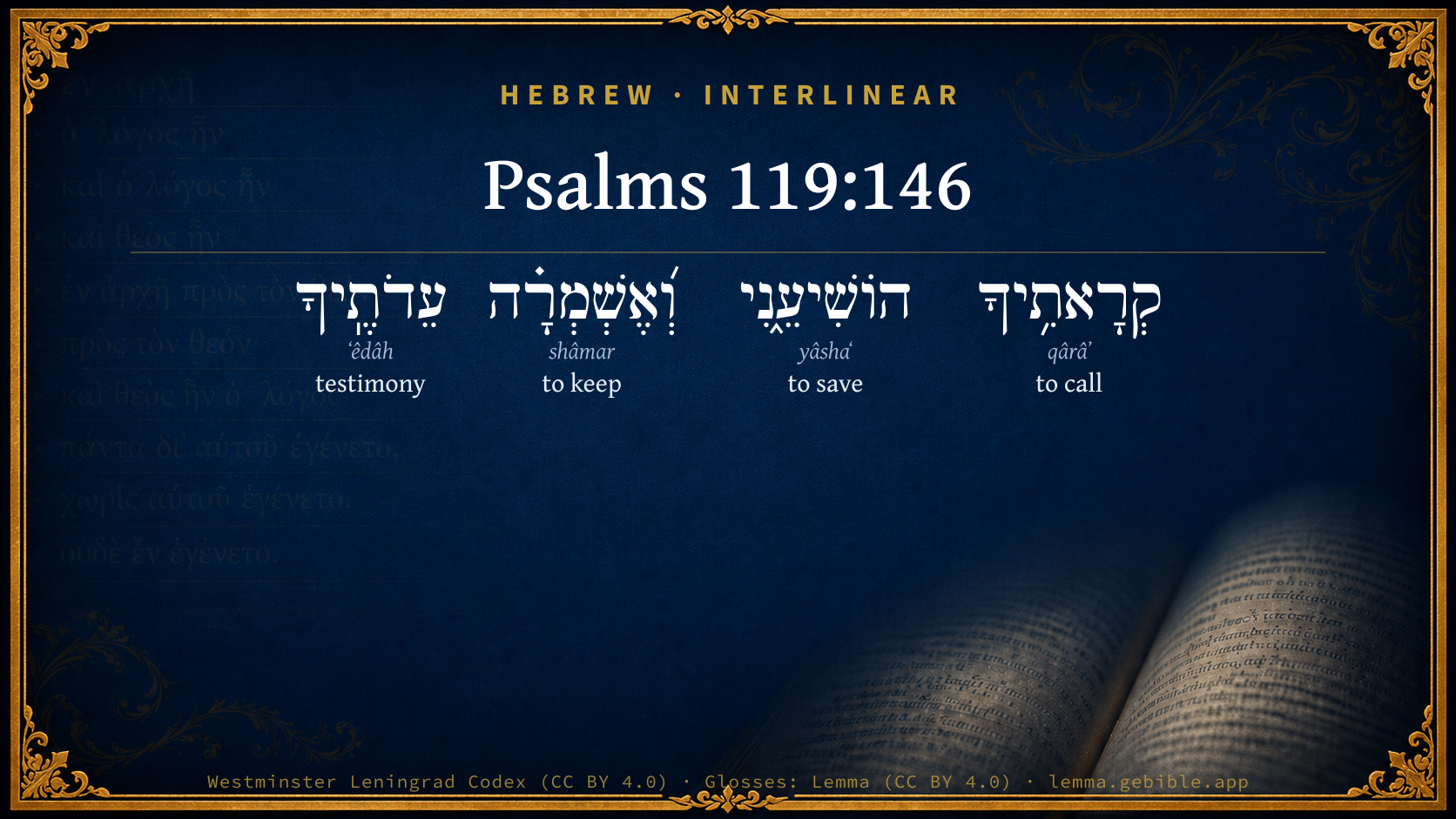
Psalms 119:146

Hebrew (Westminster Leningrad Codex) Psalms 119:146 appears in the Hebrew Old Testament. The text above is from the Westminster Leningrad Codex. Each word links to its Strong’s number, a concise gloss, and parsing drawn from the Open Scriptures Hebrew Bible morphology. Click any word for its full Brown-Driver-Briggs (BDB) entry.
Download image
Cite this verse

Psalms 119:146 (World English Bible). Public Domain. Lemma interlinear Bible study tool, https://lemma.gebible.app/v/psalms/119/146.

Show BibTeX & RIS
BibTeX
RIS
English Translation
I have called to you. Save me! I will obey your statutes.
World English Bible · Public Domain
Download a study sheet

One document with this verse’s original text, its word-by-word gloss line, the meaning frame, cross-references with their text, attributed commentary, and full source and license credits — printable, and it pastes into notes with its structure intact.

This verse Autodidact and up

Study sheet (.html) Plain text (.txt)

A passage Seminary Student

Up to 50 verses in one chapter. A passage sheet keeps up to 6 commentary sources and 12 cross-references per verse, in the order this page ranks them, and says so on the sheet whenever that leaves anything out. Ask for a single verse and you get the Autodidact verse sheet above.

Everything on this page stays free to read, with no account — the sheet is a download of what is already on screen, not access to it.

Want to remove ads? Support Godless Engineer
Compare translations 3

The same verse in 3 English versions, stacked beneath the original-language interlinear above. Click any original word for its lexicon entry.

Each is an independent rendering of the whole verse — the interlinear is not word-aligned to these translations.

Highlighted words mark where these versions differ — a whole-verse word diff, not a word-by-word alignment.

  • World English Bible Public Domain
    I have called to you. Save me! I will obey your statutes.
  • King James Version Public Domain
    I cried unto thee; save me, and I shall keep thy testimonies.
  • unfoldingWord Literal Text CC BY-SA 4.0
    I call out to you; save me, so that I may keep your testimonies.

unfoldingWord Literal Text — © unfoldingWord, licensed CC BY-SA 4.0. Word-aligned USFM3 via Door43 (git.door43.org/unfoldingWord/en_ult).

Versions to compare (up to 4)

3 of 4 selected

Show all 17 translations

Every available English version of this verse, each an independent rendering of the whole verse.

  • World English Bible Public Domain
    I have called to you. Save me! I will obey your statutes.
  • Berean Standard Bible Public Domain
    I call to You; save me, that I may keep Your testimonies.
  • Majority Standard Bible Public Domain
    I call to You; save me, that I may keep Your testimonies.
  • King James Version Public Domain
    I cried unto thee; save me, and I shall keep thy testimonies.
  • American Standard Version (1901) Public Domain
    I have called unto thee; save me, And I shall observe thy testimonies.
  • Revised Version (1885) Public Domain
    I have called unto thee; save me, and I shall observe thy testimonies.
  • Geneva Bible (1599) Public Domain
    I called vpon thee: saue mee, and I will keepe thy testimonies.
  • Young's Literal Translation Public Domain
    I have called Thee, save Thou me, And I do keep Thy testimonies.
  • Literal Standard Version CC BY-SA 4.0
    I have called You, save me, || And I keep Your testimonies.
  • Unlocked Literal Bible CC BY-SA 4.0
    I call to you; save me, and I will observe your covenant decrees.”
  • unfoldingWord Literal Text CC BY-SA 4.0
    I call out to you; save me, so that I may keep your testimonies.
  • Darby Bible Public Domain
    I call upon thee; save me, and I will keep thy testimonies.
  • World Messianic Bible Public Domain
    I have called to you. Save me! I will obey your statutes.
  • Webster's Bible Public Domain
    I cried to thee; save me, and I shall keep thy testimonies.
  • Free Bible Version CC BY-SA 4.0
    I pray to you, asking, “Please save me!” so I can do what you say.
  • Bible in Basic English Public Domain
    My cry has gone up to you; take me out of trouble, and I will be guided by your unchanging word.
  • JPS Tanakh (1917) Public Domain
    I have called Thee, save me, and I will observe Thy testimonies.

Literal Standard Version (2020), Covenant Press — licensed CC BY-SA 4.0. Text via the HelloAO Bible API (eBible.org). Unlocked Literal Bible (unfoldingWord) — licensed CC BY-SA 4.0. Text via the HelloAO Bible API (eBible.org). unfoldingWord Literal Text — © unfoldingWord, licensed CC BY-SA 4.0. Word-aligned USFM3 via Door43 (git.door43.org/unfoldingWord/en_ult). Free Bible Version, Dr. Jonathan Gallagher — licensed CC BY-SA 4.0. Text via the HelloAO Bible API (eBible.org).

Word by word

More ways to search: Search by grammar → Find every occurrence → Compare this word →

Practice this passage: Drill this verse → Learn its vocabulary →

About this verse

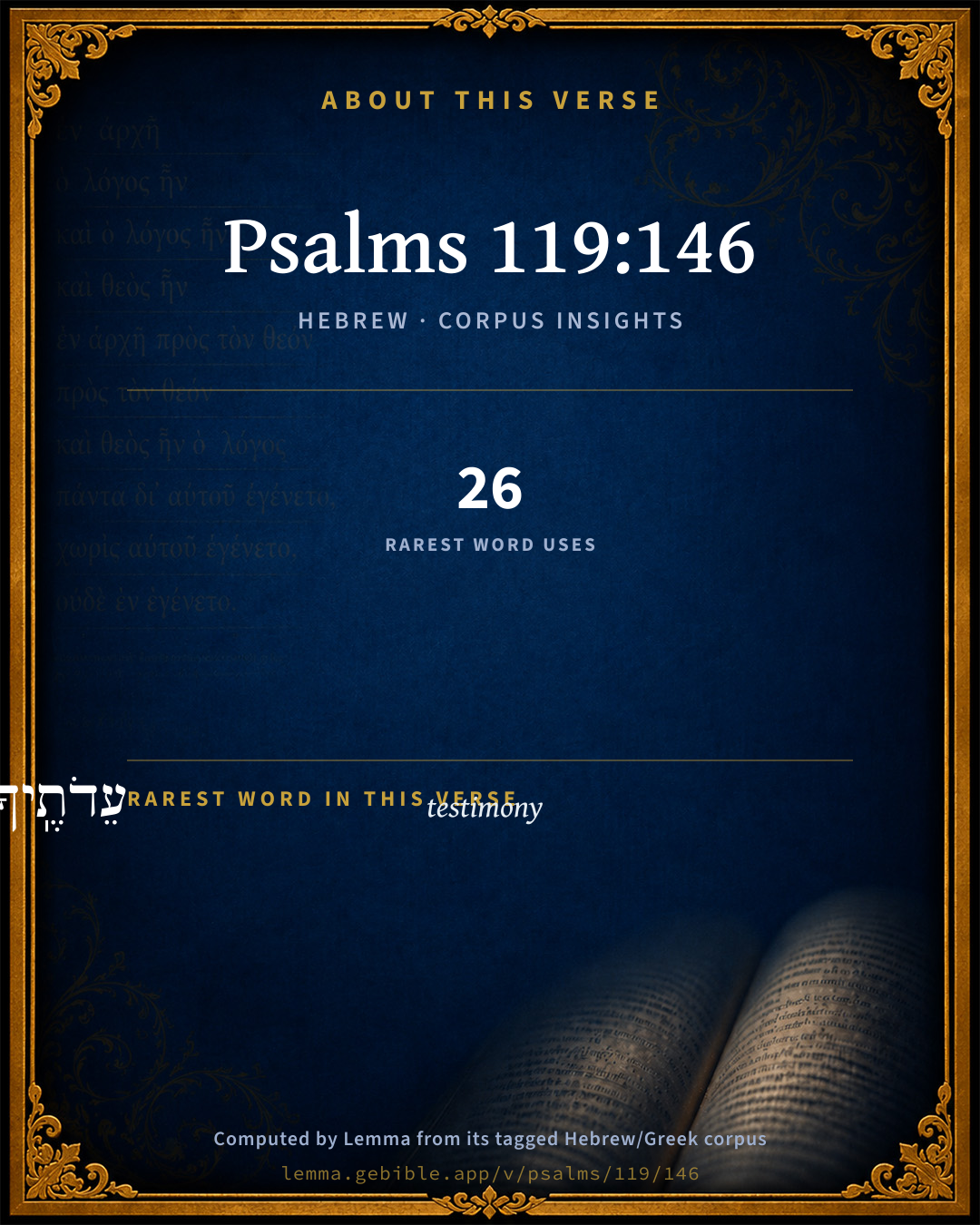
These counts appear in no published source. They are computed here, from the morphology-tagged text and Lemma’s own curated glosses. What Lemma adds →

4
words
4
distinct lemmas
Wisdom
section

Shared distinctive vocabulary

עֵדֹתֶֽיךָ testimony H5713 occurs in 25 verses of the Hebrew Bible. Also found in:

Grammatical profile

  • 3 verbs
  • 1 noun

Verb forms

  • קְרָאתִ֥יךָ Qal · Perfect
  • הוֹשִׁיעֵ֑נִי Hiphil · Imperative
  • וְ֝אֶשְׁמְרָ֗ה Qal · Cohortative

Hebrew & Septuagint length

In English translation the verse runs 12 words from the Hebrew and 12 from the Septuagint (LXX English) — the same length.

A rough comparison of the two English renderings, which tokenize alike — not a word-level alignment.

Word counts can differ between the Hebrew and the Greek without any difference in meaning — e.g. the Hebrew direct-object marker אֵת has no separate Greek word, and Greek often adds the article ὁ.

Cross-references

5

Topical passages linked to Psalms 119:146 in the Treasury of Scripture Knowledge — connected by theme and wording, ordered by reader-vote popularity; previews shown in the World English Bible.

  • Psalms 119:134 Redeem me from the oppression of man, So I will observe your precepts.
  • Titus 2:14 who gave himself for us, that he might redeem us from all iniquity, and purify for himself a people for his own possession, zealous for good works.
  • Judges 10:15–16 The children of Israel said to Yahweh, We have sinned: do you to us whatever seems good to you; only deliver us, we pray you, this day.
  • Matthew 1:21 She shall bring forth a son. You shall call his name Jesus, for it is he who shall save his people from their sins."
  • Titus 3:4–8 But when the kindness of God our Savior and his love toward mankind appeared,

Cross-references courtesy of OpenBible.info (CC BY 4.0).

Hebrew and Greek witnesses Masoretic Hebrew ↔ Greek Septuagint

The same verse in the two great witnesses to the Old Testament, shown verse-for-verse.

You’re reading Greek Psalm 118 (Hebrew Psalm 119). The Septuagint counts the superscription, so verse numbers can differ from the Hebrew — chapter-level alignment, not verse-by-verse. Numbering follows Rahlfs.

These are two independent witnesses, not word-aligned to each other, and the Septuagint is shown in lemma (dictionary) form.

Hebrew Psalms 119:146 Masoretic · Westminster Leningrad Codex

קְרָאתִ֥יךָ הוֹשִׁיעֵ֑נִי וְ֝אֶשְׁמְרָ֗ה עֵדֹתֶֽיךָ

I have called to you. Save me! I will obey your statutes.

World English Bible · Public Domain

Greek LXX Greek Psalm 118:146 Septuagint · lemma form

κράζω σύ σώζω ἐγώ καί φυλάσσω ὁ μαρτύριον σύ

I cried to you; save me, and I will keep your testimonies.

LXX2012 (modern English Septuagint) · Public Domain

Hebrew: Westminster Leningrad Codex (CC BY 4.0). Greek: Septuagint (public domain); English from LXX2012 (modern English Septuagint) (Public Domain). How the Septuagint differs from the Hebrew →

Commentary

Notes on Psalms 119:146 from classic Christian and Jewish commentators (each source and its license shown beneath its notes). The classic Christian expositions comment on the surrounding passage and are grouped to its opening verse, so a note may address several verses; the Jewish commentaries on the Tanakh (Rashi and others) are per-verse, so they appear only where the commentator wrote on this verse.

Lemma curates 59 commentaries, every one of them public domain or Creative Commons licensed, each selected and text-cleaned for this edition rather than reprinted as found. About our sources →

Trapp's Complete Commentary

John Trapp

Psa 119:146 I cried unto thee; save me, and I shall keep thy testimonies.

Ver. 146. I cried unto thee; save me] Salvation properly denoteth the privative part of a man’s felicity, but iucludeth the positive part also: this must be got by prayer.

John Trapp, A Commentary or Exposition upon All the Books of the Old and New Testament (1647–1656) — public domain. Text from a community e-Sword module.

J. A. Alexander on Psalms

Joseph Addison Alexander

146. (Psa 119:146) I invoke thee—save me—and I will observe thy testimonies. The pronoun implied in the preceding verse is here expressed. The augmented form of the last verb is emphatic or intensive. I WILL observe thy testi monies, i.e. obey thy precepts and believe thy promises.

Joseph Addison Alexander, The Psalms Translated and Explained (1850) — public domain. Text from a community e-Sword module.

The Cambridge Bible for Schools and Colleges

gen. ed. J. J. S. Perowne

146. I have called unto thee; save me,

That I may observe thy testimonies.

The Cambridge Bible for Schools and Colleges (gen. ed. J. J. S. Perowne; Cambridge University Press, 1878–1918) — public domain. Text from a community e-Sword module.

John Gill's Exposition

They draw nigh that follow after mischief,.... Or "evil" (c); that which is sinful in itself, and injurious to others. Some cannot sleep unless they do mischief; they are bent upon it, and proceed from evil to evil: they are eager in their pursuit of it, as the huntsman after his sport, to which the allusion is; though it is to their ruin, even to their death, Pro 11:19; These the psalmist says "draw nigh"; not unto God, unless feignedly and with their mouths only; but to him they drew nigh, to David, in an hostile way they pursued after him, in order to take away his life, and they had very nearly overtaken him, and were just ready to seize him; his life drew nigh to those destroyers, and those destroyers drew nigh to that, so that he was in great danger; and the more as these were abandoned creatures, that neither feared God nor regarded man, as follows:

they are far from thy law; from the knowledge of it, of its equity and purity; and especially of its spirituality, and of its power and influence upon their minds; and so far from subjection and obedience to it; so far from it, that they treat it with the utmost contempt, cast it away from them and despise it, Rom 8:7.

(c) "iniquitati", V. L. "scelus", Tigurine version; so Junius & Tremellius, Piscator, Michaelis.

John Gill's Exposition of the Whole Bible (1746–1763) — public domain (CC PDM 1.0). Text via the HelloAO Bible API.

Albert Barnes' Notes on the Bible

I cried unto thee - I called upon thee in trouble.

Save me, and I shall keep thy testimonies - Margin, “That I may keep.” The correct rendering is, “I will keep.” The idea is, that if God would interpose and save him, he “would” henceforward faithfully keep the law of God: It is one of the designs of affliction to lead people to make such vows as this. They are commonly made on beds of sickness, alike by the religious and the irreligious; the saint and the sinner. How often, alas, are they forgotten even by the friends of God! How seldom are they remembered at all by the sinner when he is raised up from the verge of the grave, and restored again to health!

Albert Barnes' Notes on the Bible (1834–1885) — public domain. Text from a community e-Sword/MySword module.

The Treasury of David

Charles H. Spurgeon

Ver. 146. I cried unto thee. Again he mentions that his prayer was unto God alone. The sentence imports that he prayed vehemently, and very often; and that it had become one of the greatest facts of his life that he cried unto God. "Save me." This was his prayer; very short, but very full. He needed saving, none but the Lord could save him, to him he cried, "Save me" from the dangers which surround me, from the enemies that pursue me, from the temptations which beset me, from the sins which accuse me. He did not multiply words, and men never do so when they are in downright earnest. He did not multiply objects, and men seldom do so when they are intent upon the one thing needful: "save me" was his one and only prayer.

And I shall keep thy testimonies. This was his great object in desiring salvation, that he might be able to continue in a blameless life of obedience to God, that he might be able to believe the witness of God, and also to become himself a witness for God. It is a great thing when men seek salvation for so high an end. He did not ask to be delivered that he might sin with impunity; his cry was to be delivered from sin itself. He had vowed to keep the statutes or laws, here he resolves to keep the testimonies or doctrines, and so to be sound of head as well as clean of hand. Salvation brings all these good things in its train. David had no idea of a salvation which would allow him to live in sin, or abide in error: he knew right well that there is no saving a man while he abides in disobedience and ignorance.

Ver. 146. I cried unto thee. The distressed soul expresses itself in strong cries and tears. Of old they cried unto the Lord, and he heard them in their distress. So Israel at the Red Sea. The men of the Reformation thus expressed themselves in earnest prayer, and found relief. Luther at the Diet of Worms, when remanded for another day, spent the long night in the loud utterance of prayer, that he might appear for his Lord before an august earthly assembly. Our reading of the covenanting times will remind us of many instances of the same. We may think of John Welch, going into his garden night after night, in a night covering, and crying to the Lord to grant him Scotland. The expression of prayer, however, is manifold as the frame of the spirit. Intense feeling will beget strong cries in prayer; but prayer that is uttered under realizing views of our gracious God will be mild, and often delivered as it were in whispers. So was Alexander Peden accustomed to pray, as if he had been engaged in calm converse with a friend... But when the feeling is intense, when wrath lies heavy upon us, when danger is apprehended as near, when the Lord is conceived to be at a distance, or when there is eager desire after immediate attainment in all these cases there will be the strong cries. Such seems to have been the state of the Psalmist's mind when he poured forth the expressive utterance of this part. John Stephen.

Ver. 146. Brief as are the petitions, the whole compass of language could not make them more comprehensive. "Hear me." The soul is in earnest, the whole heart is engaged in the "cry." "Save me" includes a sinner's whole need pardon, acceptance, access, holiness, strength, comfort, heaven, all in one word Christ. The way of access is not indeed mentioned in these short ejaculations. But it is always implied in every moment's approach and address to the throne of grace. "Hear me" in the name of my all prevailing Advocate. "Save me" through him, whose name is Jesus the Saviour. Charles Bridges.

Ver. 146. I cried unto thee. A crying prayer pierces the depths of heaven. We read not a word that Moses spake, but God was moved by his cry. Ex 14:15. It means not an obstreperous noise, but melting moans of heart. Yet sometimes the sore and pinching necessities and distresses of spirit extort even vocal cries not unpleasant to the inclined ears of God. "I cried unto God with my voice, "says David, "and he heard me out of his holy hill": Ps 3:4. And this encourages to a fresh onset: "Hearken unto the voice of my cry, my King, and my God": Ps 5:2. "Give ear unto my cry: hold not thy peace at my tears": Ps 39:12. Another time he makes the cave echo with his cries. "I cried, I cried. Attend unto my cry, for I am brought very low." Samuel Lee (1625-1691), in "The Morning Exercises."

Ver. 146. I cried unto thee; save me. In our troubles, we must have recourse to God, and sue to him by prayer and supplication for help and deliverance in due time; because he is the author of our trouble. In mercies and afflictions, our business lieth not with men, but God; by humble dealing with him we stop wrath at the fountain head: he that bindeth us must loose us; he is at the upper end of causes, and whoever be the instruments of our trouble, and how malicious soever, God is the party with whom we are to make our peace; for he hath the absolute disposal of all creatures, and will have us to acknowledge the dominion of his providence and our dependence upon him. In treaties of peace between two warring parties, the address is not made to private soldiers, but to their chief: "The Lord hath taken away, "saith Job; "When he giveth quietness, who then can make trouble?" Job 34:29. Thomas Manton.

Ver. 146. Save me, and I shall keep the testimonies. The servants of God regard life itself as chiefly desirable on account of the opportunity which it affords for serving God: "Save me, that I may keep thy testimonies, "is the prayer of the believer in the day of trouble and conflict. "To me to live, "says he, "is Christ, and to die is gain." How unlike is this to the wicked! Their whole desire in the day of trouble is expended on the wish to escape calamity; they have no desire to be delivered from sin, no wish to be conformed to God! John Morison.

Ver. 146. Save me. From my sins, my corruptions, my temptations, all the hindrances that lie in my way, that I may "keep thy testimonies." We must cry for salvation, not that we may have the case and comfort of it, but that we may have an opportunity of serving God the more cheerfully. Matthew Henry.

Ver. 146. God hears us, that we should hear him. Thomas Manton.

Ver. 146.

1. Prayer remembered.

2. Prayer continued: "Save me."

3. Prayer yielding fruit: "I shall keep, "etc.

Ver. 146. Salvation.

1. A likely path to it prayer: cry on.

2. The proper place for it: "unto thee"; not man, not the heart.

3. A sound view of it: "keep thy testimonies." Not to escape hell, or gain heaven, but to please and love God. W.B.H.

Psalms 119:147*

Charles H. Spurgeon's The Treasury of David (1869–1885) — public domain. Psalms only. Text from a community e-Sword/MySword module.

The Pulpit Commentary

I cried unto thee; save me, and I shall keep thy testimonies. The thought of ver. 145 is repeated in other words.

The Pulpit Commentary (1880–1919), ed. H.D.M. Spence-Jones & Joseph S. Exell — public domain. Text from a community e-Sword module.

Rashi

Rabbi Shlomo Yitzchaki (Rashi)

and I shall keep (The acronym of, עֵדְוֹתֶיךָ is דמה בן פֶרֶץ; the “vav” is vowelized with a “holam,” but in the other instances, it is עֵדֹתֶיךָ; the “daleth” is vowelized with a “holam.”)

Rashi on the Tanakh — English translations: “The Judaica Press complete Tanach with Rashi, translated by A. J. Rosenberg” (CC BY 4.0); “Pentateuch with Rashi's commentary by M. Rosenbaum and A.M. Silbermann, 1929-1934” (public domain); “The Metsudah Tanach series, Lakewood, N.J” (CC BY 4.0); and “The Book of Joshua, Metsudah Publications, 1997” (CC BY 4.0). Text via Sefaria.

Lesson kit

Teaching starters — assembled from the data on this page, not authored interpretation. Every prompt links to the verse data it draws on. Edit before teaching.

Psalms, in the Wisdom, opens this verse with 4 words (4 distinct Hebrew lemmas). Its most distinctive word is ʻêdâh (“testimony”). A historical commentator’s framing appears above. Read the whole chapter for the surrounding context.

Discussion questions

  1. How does “testimony” (ʻêdâh) shape what this verse is saying?
  2. Genesis 21:30 shares the word «testimony» with this verse. How do the two illuminate each other?
  3. These translations render this verse differently; the difference is in the English rendering, not the original. What questions does that raise?
  4. The verb «קְרָאתִ֥יךָ» is Qal Perfect. How does its form color the action?
  5. Reading how Trapp's Complete Commentary and J. A. Alexander on Psalms read this verse, where do the two commentators agree and where do they part?

Things to notice

Reading settings

Reading text

Shown beneath each verse's original-language words.

Old Testament
Old Testament edition

Read the OT as the Masoretic Hebrew (MT) or the Greek Septuagint (LXX).

English shown for the Greek Septuagint (in the Hebrew ↔ Greek comparison).

Comparing translations? Open the Compare panel on any verse page to stack up to four side by side.