
Psalms 106:21

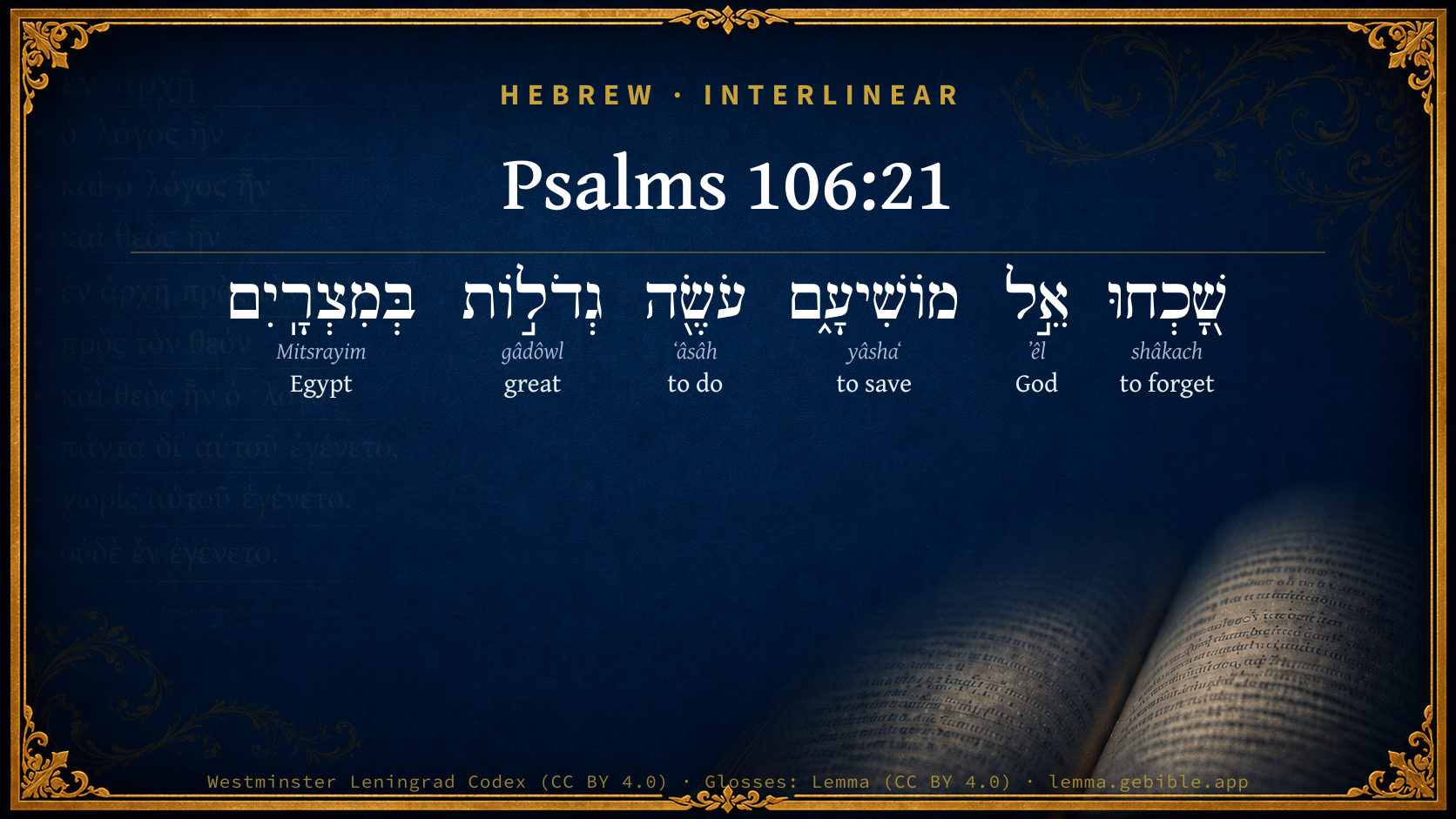
Hebrew (Westminster Leningrad Codex) Psalms 106:21 appears in the Hebrew Old Testament. The text above is from the Westminster Leningrad Codex. Each word links to its Strong’s number, a concise gloss, and parsing drawn from the Open Scriptures Hebrew Bible morphology. Click any word for its full Brown-Driver-Briggs (BDB) entry.
Download image
Cite this verse

Psalms 106:21 (World English Bible). Public Domain. Lemma interlinear Bible study tool, https://lemma.gebible.app/v/psalms/106/21.

Show BibTeX & RIS
BibTeX
RIS
English Translation
They forgot God, their Savior, Who had done great things in Egypt,
World English Bible · Public Domain
Download a study sheet

One document with this verse’s original text, its word-by-word gloss line, the meaning frame, cross-references with their text, attributed commentary, and full source and license credits — printable, and it pastes into notes with its structure intact.

This verse Autodidact and up

Study sheet (.html) Plain text (.txt)

A passage Seminary Student

Up to 50 verses in one chapter. A passage sheet keeps up to 6 commentary sources and 12 cross-references per verse, in the order this page ranks them, and says so on the sheet whenever that leaves anything out. Ask for a single verse and you get the Autodidact verse sheet above.

Everything on this page stays free to read, with no account — the sheet is a download of what is already on screen, not access to it.

Want to remove ads? Support Godless Engineer
Compare translations 3

The same verse in 3 English versions, stacked beneath the original-language interlinear above. Click any original word for its lexicon entry.

Each is an independent rendering of the whole verse — the interlinear is not word-aligned to these translations.

Highlighted words mark where these versions differ — a whole-verse word diff, not a word-by-word alignment.

  • World English Bible Public Domain
    They forgot God, their Savior, Who had done great things in Egypt,
  • King James Version Public Domain
    They forgat God their saviour, which had done great things in Egypt;
  • unfoldingWord Literal Text CC BY-SA 4.0
    They forgot God their Savior, the doer of great in Egypt:

unfoldingWord Literal Text — © unfoldingWord, licensed CC BY-SA 4.0. Word-aligned USFM3 via Door43 (git.door43.org/unfoldingWord/en_ult).

Versions to compare (up to 4)

3 of 4 selected

Show all 18 translations

Every available English version of this verse, each an independent rendering of the whole verse.

  • World English Bible Public Domain
    They forgot God, their Savior, Who had done great things in Egypt,
  • Berean Standard Bible Public Domain
    They forgot God their Savior, who did great things in Egypt,
  • Majority Standard Bible Public Domain
    They forgot God their Savior, who did great things in Egypt,
  • King James Version Public Domain
    They forgat God their saviour, which had done great things in Egypt;
  • American Standard Version (1901) Public Domain
    They forgat God their Saviour, Who had done great things in Egypt,
  • Revised Version (1885) Public Domain
    They forgat God their saviour, which had done great things in Egypt;
  • Geneva Bible (1599) Public Domain
    They forgate God their Sauiour, which had done great things in Egypt,
  • Douay-Rheims (1899) Public Domain
    They forgot God, who saved them, who had done great things in Egypt,
  • Young's Literal Translation Public Domain
    They have forgotten God their saviour, The doer of great things in Egypt,
  • Literal Standard Version CC BY-SA 4.0
    They have forgotten God their Savior, || The doer of great things in Egypt,
  • Unlocked Literal Bible CC BY-SA 4.0
    They forgot God their Savior, who had done great deeds in Egypt.
  • unfoldingWord Literal Text CC BY-SA 4.0
    They forgot God their Savior, the doer of great in Egypt:
  • Darby Bible Public Domain
    They forgot ùGod their Saviour, who had done great things in Egypt,
  • World Messianic Bible Public Domain
    They forgot God, their Savior, who had done great things in Egypt,
  • Webster's Bible Public Domain
    They forgot God their savior, who had done great things in Egypt;
  • Free Bible Version CC BY-SA 4.0
    They forgot God, their Savior, who had done marvelous things in Egypt;
  • Bible in Basic English Public Domain
    They had no memory of God their saviour, who had done great things in Egypt;
  • JPS Tanakh (1917) Public Domain
    They forgot God their saviour, who had done great things in Egypt;

Literal Standard Version (2020), Covenant Press — licensed CC BY-SA 4.0. Text via the HelloAO Bible API (eBible.org). Unlocked Literal Bible (unfoldingWord) — licensed CC BY-SA 4.0. Text via the HelloAO Bible API (eBible.org). unfoldingWord Literal Text — © unfoldingWord, licensed CC BY-SA 4.0. Word-aligned USFM3 via Door43 (git.door43.org/unfoldingWord/en_ult). Free Bible Version, Dr. Jonathan Gallagher — licensed CC BY-SA 4.0. Text via the HelloAO Bible API (eBible.org).

Word by word

More ways to search: Search by grammar → Find every occurrence → Compare this word →

Practice this passage: Drill this verse → Learn its vocabulary →

About this verse

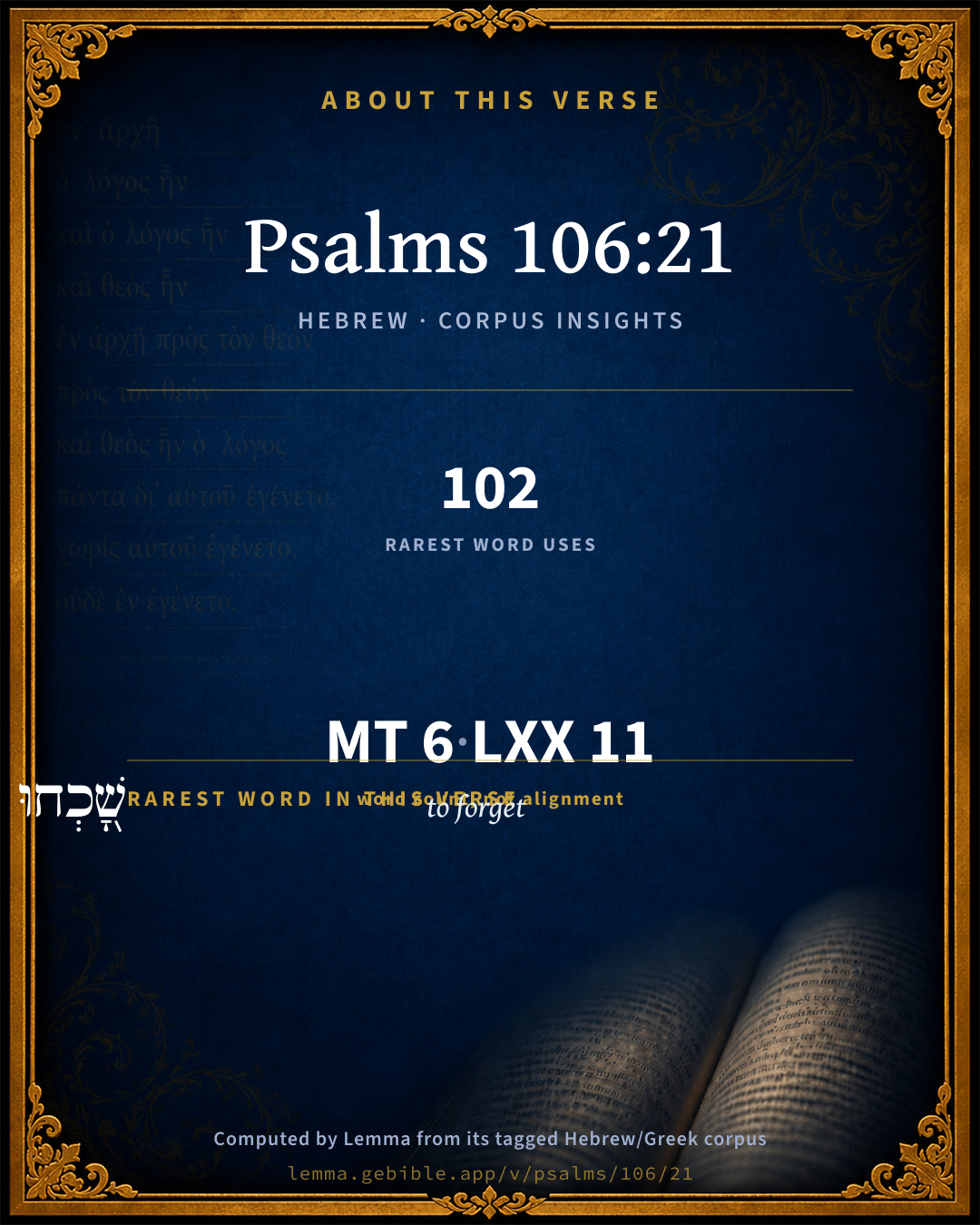
These counts appear in no published source. They are computed here, from the morphology-tagged text and Lemma’s own curated glosses. What Lemma adds →

6
words
6
distinct lemmas
Wisdom
section

Grammatical profile

  • 3 verbs
  • 2 nouns
  • 1 adjective

Verb forms

  • שָׁ֭כְחוּ Qal · Perfect
  • מוֹשִׁיעָ֑ם Hiphil · Participle Active
  • עֹשֶׂ֖ה Qal · Participle Active

Hebrew & Septuagint length

In English translation the verse runs 12 words from the Hebrew and 13 from the Septuagint (LXX English) — closely comparable.

A rough comparison of the two English renderings, which tokenize alike — not a word-level alignment.

Word counts can differ between the Hebrew and the Greek without any difference in meaning — e.g. the Hebrew direct-object marker אֵת has no separate Greek word, and Greek often adds the article ὁ.

In the original languages it is 6 Hebrew tokens and 11 Greek tokens — but the two are counted differently (Hebrew bundles its prefixes and suffixes into one token; the Greek is in lemma form), so that isn’t a like-for-like length.

Cross-references

20

Topical passages linked to Psalms 106:21 in the Treasury of Scripture Knowledge — connected by theme and wording, ordered by reader-vote popularity; previews shown in the World English Bible.

  • Psalms 78:42–51 They didn't remember his hand, Nor the day when he redeemed them from the adversary;
  • Deuteronomy 32:17–18 They sacrificed to demons, [which were] no God, To gods that they didn't know, To new [gods] that came up of late, Which your fathers didn't dread.
  • Psalms 78:11–12 They forgot his doings, His wondrous works that he had shown them.
  • Psalms 106:13 They soon forgot his works. They didn't wait for his counsel,
  • Jeremiah 2:32 Can a virgin forget her ornaments, or a bride her attire? yet my people have forgotten me days without number.
  • Deuteronomy 4:34 Or has God tried to go and take him a nation from the midst of [another] nation, by trials, by signs, and by wonders, and by war, and by a mighty hand, and by an outstretched arm, and by great terrors, according to all that Yahweh your God did for you in Egypt before your eyes?
  • Deuteronomy 10:21 He is your praise, and he is your God, who has done for you these great and awesome things, which your eyes have seen.
  • Psalms 135:9 Who sent signs and wonders into the midst of you, Egypt, On Pharaoh, and on all his servants;
  • Titus 3:4–6 But when the kindness of God our Savior and his love toward mankind appeared,
  • Deuteronomy 6:22 and Yahweh shown signs and wonders, great and sore, on Egypt, on Pharaoh, and on all his house, before our eyes;
  • Deuteronomy 7:18–19 you shall not be afraid of them: you shall well remember what Yahweh your God did to Pharaoh, and to all Egypt;
  • Nehemiah 9:10–11 and shown signs and wonders on Pharaoh, and on all his servants, and on all the people of his land; for you knew that they dealt proudly against them, and did get you a name, as it is this day.
  • Psalms 74:13–14 You divided the sea by your strength. You broke the heads of the sea monsters in the waters.
  • Isaiah 12:2 Behold, God is my salvation. I will trust, and will not be afraid; for Yah, Yahweh, is my strength and song; and he has become my salvation."
  • Isaiah 45:21 Declare you, and bring [it] forth; yes, let them take counsel together: who has shown this from ancient time? who has declared it of old? Haven't I, Yahweh? and there is no God else besides me, a just God and a Savior; there is no one besides me.
  • Isaiah 63:8 For he said, Surely, they are my people, children who will not deal falsely: so he was their Savior.
  • Hosea 1:7 But I will have mercy on the house of Judah, and will save them by Yahweh their God, and will not save them by bow, nor by sword, nor by battle, by horses, nor by horsemen."
  • Titus 1:3 but in his own time revealed his word in the message with which I was entrusted according to the commandment of God our Savior;
  • Titus 2:10 not stealing, but showing all good fidelity; that they may adorn the doctrine of God, our Savior, in all things.
  • Luke 1:47 My spirit has rejoiced in God my Savior,

Cross-references courtesy of OpenBible.info (CC BY 4.0).

Hebrew and Greek witnesses Masoretic Hebrew ↔ Greek Septuagint

The same verse in the two great witnesses to the Old Testament, shown verse-for-verse.

You’re reading Greek Psalm 105 (Hebrew Psalm 106). The Septuagint counts the superscription, so verse numbers can differ from the Hebrew — chapter-level alignment, not verse-by-verse. Numbering follows Rahlfs.

These are two independent witnesses, not word-aligned to each other, and the Septuagint is shown in lemma (dictionary) form.

Hebrew Psalms 106:21 Masoretic · Westminster Leningrad Codex

שָׁ֭כְחוּ אֵ֣ל מוֹשִׁיעָ֑ם עֹשֶׂ֖ה גְדֹל֣וֹת בְּמִצְרָֽיִם

They forgot God, their Savior, Who had done great things in Egypt,

World English Bible · Public Domain

Greek LXX Greek Psalm 105:21 Septuagint · lemma form

ἐπιλανθάνω ὁ θεός ὁ σώζω αὐτός ὁ ποιέω μέγας ἐν αἴγυπτος

They forgot God that saved them, who had wrought great deeds in Egypt;

LXX2012 (modern English Septuagint) · Public Domain

Hebrew: Westminster Leningrad Codex (CC BY 4.0). Greek: Septuagint (public domain); English from LXX2012 (modern English Septuagint) (Public Domain). How the Septuagint differs from the Hebrew →

Commentary

Notes on Psalms 106:21 from classic Christian and Jewish commentators (each source and its license shown beneath its notes). The classic Christian expositions comment on the surrounding passage and are grouped to its opening verse, so a note may address several verses; the Jewish commentaries on the Tanakh (Rashi and others) are per-verse, so they appear only where the commentator wrote on this verse.

Lemma curates 59 commentaries, every one of them public domain or Creative Commons licensed, each selected and text-cleaned for this edition rather than reprinted as found. About our sources →

Trapp's Complete Commentary

John Trapp

Psa 106:21 They forgat God their saviour, which had done great things in Egypt;

Ver. 21. They forgat God their saviour] This is often mentioned as the mother of all the misrule among them.

John Trapp, A Commentary or Exposition upon All the Books of the Old and New Testament (1647–1656) — public domain. Text from a community e-Sword module.

The Treasury of David

Charles H. Spurgeon

Ver. 21. They forgat God their saviour. Remembering the calf involved forgetting God. He had commanded them to make no image, and in daring to disobey they forgot his commands. Moreover, it is clear that they must altogether have forgotten the nature and character of Jehovah, or they could never have likened him to a grass eating animal. Some men hope to keep their sins and their God toothe fact being that he who sins is already so far departed from the Lord that he has actually forgotten him.

Which had done great things in Egypt. God in Egypt had overcome all the idols, and yet they so far forgot him as to liken him to them. Could an ox work miracles? Could a golden calf cast plagues upon Israel's enemies? They were brutish to set up such a wretched mockery of deity, after having seen what the true God could really achieve. "Wondrous works in the land of Ham, and terrible things by the Red sea". They saw several ranges of miracles, the Lord did not stint them as to the evidences of his eternal power and godhead, and yet they could not rest content with worshipping him in his own appointed way, but must needs have a Directory of their own invention, an elaborate ritual after the old Egyptian fashion, and a manifest object of worship to assist them in adoring Jehovah. This was enough to provoke the Lord, and it did so; how much he is angered every day in our own land no tongue can tell.

Ver. 21. They forgat God. To devise images and pictures to put, us in the mind of God, is a very forgetting both of God's nature and of his authority, which prohibits such devices, for so doth the Lord expound it: "They forgat God their saviour." David Dickson.

Ver. 21. Let us observe in this place that Israel is now for the third time accused of forgetting God; above in Ps 106:7, afterwards in Ps 106:13, and now in Ps 106:21. And that he might shew the greatness of this forgetfulness he does not simply say they forgat God, but adds, their Saviour: not the Saviour of their fathers in former times, but their own Saviour. Musculus.

Psalms 106:22*

Charles H. Spurgeon's The Treasury of David (1869–1885) — public domain. Psalms only. Text from a community e-Sword/MySword module.

J. A. Alexander on Psalms

Joseph Addison Alexander

21. (Psa 106:21) They forgot God that saved them, that did great (things) in Egypt. That saved, that did, literally saving, doing.

Joseph Addison Alexander, The Psalms Translated and Explained (1850) — public domain. Text from a community e-Sword module.

John Calvin's Commentaries

21. They forgot God The prophet again repeats that the people had sinned not simply through ignorance, but also wilfully, inasmuch as God had already given a very palpable manifestation of his power and glory. And as he makes himself known in the creation of the heavens and of the earth, the blindness of men is totally inexcusable. But far more aggravating is the sin of the children of Israel, who, after God had made himself known to them, in the most condescending manner, cast him off altogether, and gave themselves up to the practice of brutish idolatry. And God having from heaven put forth his Almighty power for their salvation, there must surely be no little importance attached to such displays of his power as proclaim the praise and honor of his great name. Had he merely given an ordinary token of his power, even that ought to have attracted so much consideration as should have kept the people in the fear and worship of God. Now, that these miracles were so very notable, or rather terrible and rare, the people acted a very base part to shut their eyes upon them, and give themselves over to idolatry. For as the darkness is dispelled by the beamy lustre of the sun, so all inventions and perverse errors should vanish before such knowledge of God.

John Calvin's Commentaries (1540-1563) — public domain. Text from the Calvin Translation Society English edition (1840s-50s) via the Christian Classics Ethereal Library (ccel.org). Calvin's coverage is partial (roughly two-thirds of the Bible); uncommented books and verses are honest gaps, never fabricated. The 19th-century editor's footnotes and remarks are omitted so the notes are faithfully Calvin's own voice.

Ellicott's Commentary for English Readers

(21) Forgot God their saviour.—With evident allusion to Deu_6:12.

A Bible Commentary for English Readers, edited by Charles John Ellicott (1878–1897) — public domain. Text from a community e-Sword module.

The Cambridge Bible for Schools and Colleges

gen. ed. J. J. S. Perowne

21, 22. These verses emphasise the ingratitude of the Israelites. The land of Ham as in Psa_105:23; Psa_105:27 from Psa_78:51.

The Cambridge Bible for Schools and Colleges (gen. ed. J. J. S. Perowne; Cambridge University Press, 1878–1918) — public domain. Text from a community e-Sword module.

John Gill's Exposition

They forgat God their Saviour,.... Not only forgat the works of God, Psa 106:13, but forgat God that did those mighty works; forgat that there was a God; or however forgat him that is the only true and living God, when they said of the molten image, "these are thy gods, O Israel"; and what aggravated their crime was, they forgot that God that had saved them in so wonderful a manner out of the hand of their enemies, for his own name's sake; and had led them safely through the Red sea as on dry land, and destroyed those that hated them.

Which had done great things in Egypt: meaning the ten plagues on the Egyptians, and the deliverance of the Israelites from them.

John Gill's Exposition of the Whole Bible (1746–1763) — public domain (CC PDM 1.0). Text via the HelloAO Bible API.

Albert Barnes' Notes on the Bible

They forgat God their Saviour ... - The God who had saved, or delivered them, out of Egypt. The sentiment here is the same as in Psa 78:11-12. See the notes at that place.

Albert Barnes' Notes on the Bible (1834–1885) — public domain. Text from a community e-Sword/MySword module.

Whedon's Commentary on the Bible

Daniel D. Whedon

21. They forgat God—This was the source of all their sin. See Psa_78:11. The original passage is Deu_32:18

Daniel D. Whedon (gen. ed.), Commentary on the Old and New Testaments (1874–1909) — public domain. Text from a community e-Sword module.

The Pulpit Commentary

They forgat God their Saviour (comp. ver. 13). "God their Saviour" is "God who had so recently saved them out of the hands of Pharaoh." Which had done great things in Egypt. The allusion is principally to the long series of "plagues."

The Pulpit Commentary (1880–1919), ed. H.D.M. Spence-Jones & Joseph S. Exell — public domain. Text from a community e-Sword module.

Lesson kit

Teaching starters — assembled from the data on this page, not authored interpretation. Every prompt links to the verse data it draws on. Edit before teaching.

Psalms, in the Wisdom, opens this verse with 6 words (6 distinct Hebrew lemmas). Its most distinctive word is shâkach (“to forget”). A historical commentator’s framing appears above. Read the whole chapter for the surrounding context.

Discussion questions

  1. What does “to forget” (shâkach) contribute to the verse as a whole?
  2. Psalms 78:42–51 shares this passage’s theme. How do the two illuminate each other?
  3. These translations render this verse differently; the difference is in the English rendering, not the original. What questions does that raise?
  4. The verb «שָׁ֭כְחוּ» is Qal Perfect. How does its form color the action?
  5. Reading how Trapp's Complete Commentary and The Treasury of David read this verse, where do the two commentators agree and where do they part?

Things to notice

Reading settings

Reading text

Shown beneath each verse's original-language words.

Old Testament
Old Testament edition

Read the OT as the Masoretic Hebrew (MT) or the Greek Septuagint (LXX).

English shown for the Greek Septuagint (in the Hebrew ↔ Greek comparison).

Comparing translations? Open the Compare panel on any verse page to stack up to four side by side.