1 Samuel 10:27

Hebrew (Westminster Leningrad Codex) 1 Samuel 10:27 appears in the Hebrew Old Testament. The text above is from the Westminster Leningrad Codex. Each word links to its Strong’s number, a concise gloss, and parsing drawn from the Open Scriptures Hebrew Bible morphology. Click any word for its full Brown-Driver-Briggs (BDB) entry.
Download image
Cite this verse

1 Samuel 10:27 (World English Bible). Public Domain. Lemma interlinear Bible study tool, https://lemma.gebible.app/v/1-samuel/10/27.

Show BibTeX & RIS
BibTeX
RIS
English Translation
But certain worthless fellows said, How shall this man save us? They despised him, and brought him no present. But he held his peace.
World English Bible · Public Domain
Download a study sheet

One document with this verse’s original text, its word-by-word gloss line, the meaning frame, cross-references with their text, attributed commentary, and full source and license credits — printable, and it pastes into notes with its structure intact.

This verse Autodidact and up

Study sheet (.html) Plain text (.txt)

A passage Seminary Student

Up to 50 verses in one chapter. A passage sheet keeps up to 6 commentary sources and 12 cross-references per verse, in the order this page ranks them, and says so on the sheet whenever that leaves anything out. Ask for a single verse and you get the Autodidact verse sheet above.

Everything on this page stays free to read, with no account — the sheet is a download of what is already on screen, not access to it.

Want to remove ads? Support Godless Engineer
Compare translations 3

The same verse in 3 English versions, stacked beneath the original-language interlinear above. Click any original word for its lexicon entry.

Each is an independent rendering of the whole verse — the interlinear is not word-aligned to these translations.

Highlighted words mark where these versions differ — a whole-verse word diff, not a word-by-word alignment.

  • World English Bible Public Domain
    But certain worthless fellows said, How shall this man save us? They despised him, and brought him no present. But he held his peace.
  • King James Version Public Domain
    But the children of Belial said, How shall this man save us? And they despised him, and brought no presents. But he held his peace.
  • unfoldingWord Literal Text CC BY-SA 4.0
    But some sons of wickedness said, “How shall this save us?” And they despised him, and they did not bring a gift to him. But he was like one being silent.

unfoldingWord Literal Text — © unfoldingWord, licensed CC BY-SA 4.0. Word-aligned USFM3 via Door43 (git.door43.org/unfoldingWord/en_ult).

Versions to compare (up to 4)

3 of 4 selected

Show all 18 translations

Every available English version of this verse, each an independent rendering of the whole verse.

  • World English Bible Public Domain
    But certain worthless fellows said, How shall this man save us? They despised him, and brought him no present. But he held his peace.
  • Berean Standard Bible Public Domain
    But some worthless men said, “How can this man save us?” So they despised him and brought him no gifts; but Saul remained silent about it.
  • Majority Standard Bible Public Domain
    But some worthless men said, “How can this man save us?” So they despised him and brought him no gifts; but Saul remained silent about it.
  • King James Version Public Domain
    But the children of Belial said, How shall this man save us? And they despised him, and brought no presents. But he held his peace.
  • American Standard Version (1901) Public Domain
    But certain worthless fellows said, How shall this man save us? And they despised him, and brought him no present. But he held his peace.
  • Revised Version (1885) Public Domain
    But certain sons of Belial said, How shall this man save us? And they despised him, and brought him no present. But he held his peace.
  • Geneva Bible (1599) Public Domain
    But the wicked men saide, Howe shall hee saue vs? So they despised him, and brought him no presents: but he held his tongue.
  • Douay-Rheims (1899) Public Domain
    But the children of Belial said: Shall this fellow be able to save us? And they despised him, and brought him no presents, but he dissembled as though he heard not.
  • Young's Literal Translation Public Domain
    and the sons of worthlessness have said, `What! this one doth save us!' and they despise him, and have not brought to him a present; and he is as one deaf.
  • Literal Standard Version CC BY-SA 4.0
    and the sons of worthlessness have said, “How can this one save us?” And they despise him, and have not brought a present to him; and he is as one being deaf.
  • Unlocked Literal Bible CC BY-SA 4.0
    But some worthless men said, “How can this man save us?” These people despised Saul and did not bring him any gifts. But Saul kept silent.
  • unfoldingWord Literal Text CC BY-SA 4.0
    But some sons of wickedness said, “How shall this save us?” And they despised him, and they did not bring a gift to him. But he was like one being silent.
  • Darby Bible Public Domain
    But the children of Belial said, How should this man save us? And they despised him, and brought him no gifts. But he was as one deaf.
  • World Messianic Bible Public Domain
    But certain worthless fellows said, “How could this man save us?” They despised him, and brought him no tribute. But he held his peace.
  • Webster's Bible Public Domain
    But the children of Belial said, How shall this man save us? And they despised him, and brought him no presents. But he held his peace.
  • Free Bible Version CC BY-SA 4.0
    But some obnoxious men asked, “How could this man save us?” They hated him and didn't bring him any gifts; but Saul did not retaliate.
  • Bible in Basic English Public Domain
    But certain good-for-nothing persons said, How is this man to be our saviour? And having no respect for him, they gave him no offering.
  • JPS Tanakh (1917) Public Domain
    But certain base fellows said: 'How shall this man save us?' And they despised him, and brought him no present. But he was as one that held his peace.

Literal Standard Version (2020), Covenant Press — licensed CC BY-SA 4.0. Text via the HelloAO Bible API (eBible.org). Unlocked Literal Bible (unfoldingWord) — licensed CC BY-SA 4.0. Text via the HelloAO Bible API (eBible.org). unfoldingWord Literal Text — © unfoldingWord, licensed CC BY-SA 4.0. Word-aligned USFM3 via Door43 (git.door43.org/unfoldingWord/en_ult). Free Bible Version, Dr. Jonathan Gallagher — licensed CC BY-SA 4.0. Text via the HelloAO Bible API (eBible.org).

Word by word

More ways to search: Search by grammar → Find every occurrence → Compare this word →

Practice this passage: Drill this verse → Learn its vocabulary →

בְלִיַּ֣עַל
bᵉlîyaʻal
H1100
“worthlessness”
Noun, Common, Masculine, Singular, Absolute
Part of Speech
Noun
Type
Common
Gender
Masculine
Number
Singular
State
Absolute
Full BDB Definition

Origin: from H1097 and H3276

TWOT: 246g

worthlessness - worthless, good for nothing, unprofitable, base fellow - wicked - ruin, destruction (construct)
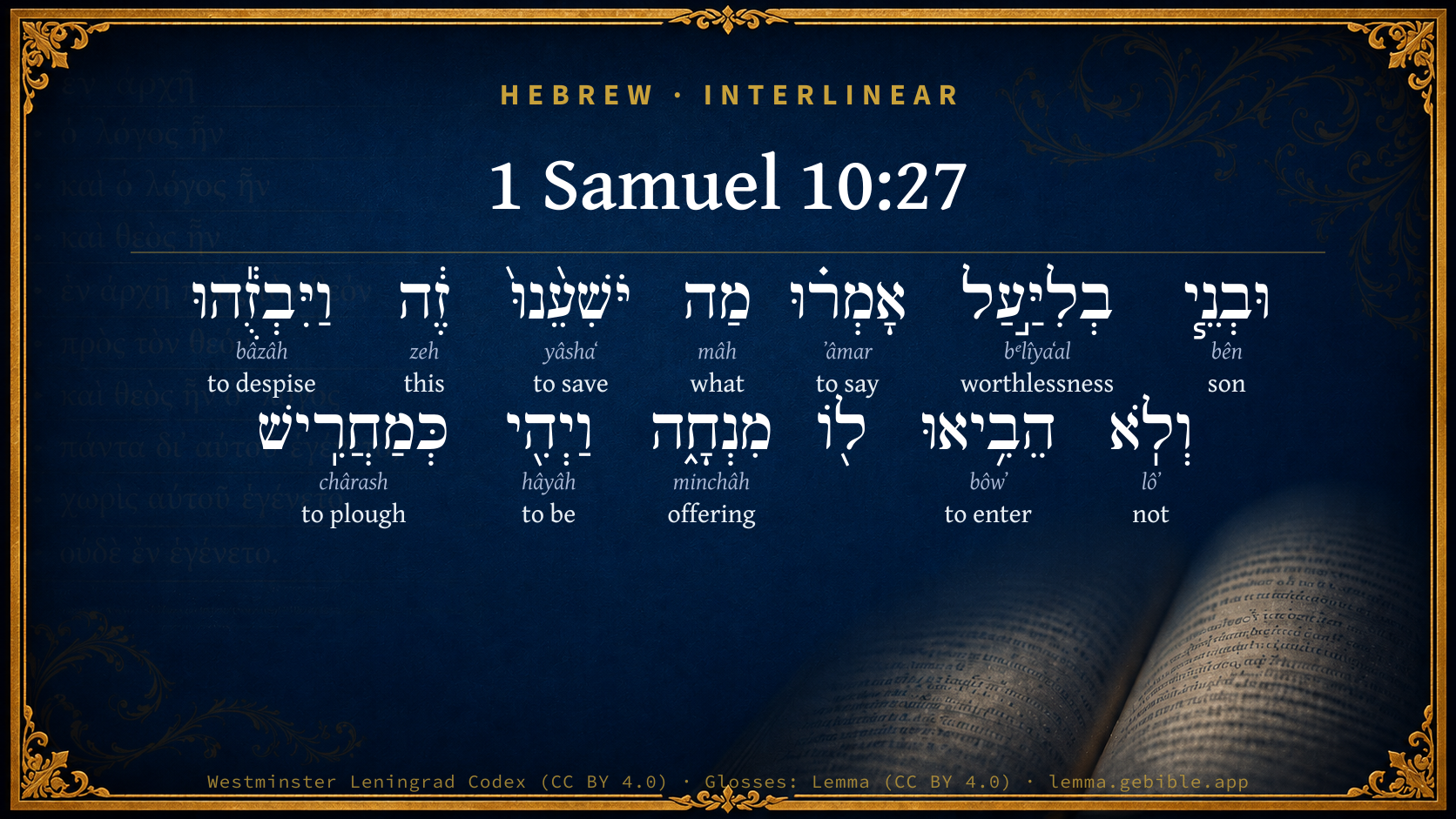
  1. וּבְנֵ֧י bên H1121 “and · sons of” Conjunction + Noun, Common, Masculine, Plural, Construct
  2. אָמְר֗וּ ʼâmar H559 “to say” Verb, Qal, Perfect, 3rd Person, Common, Plural
  3. מַה mâh H4100 “what” Particle, Interrogative
  4. יֹּשִׁעֵ֨נוּ֙ yâshaʻ H3467 “to save · us” Verb, Hiphil, Imperfect, 3rd Person, Masculine, Singular + Suffix, Personal, 1st Person, Common, Plural
  5. זֶ֔ה zeh H2088 “this” Pronoun, Demonstrative, Masculine, Singular
  6. וַיִּבְזֻ֕הוּ bâzâh H959 “and · to despise · him” Conjunction + Verb, Qal, Sequential Imperfect, 3rd Person, Masculine, Plural + Suffix, Personal, 3rd Person, Masculine, Singular
  7. וְלֹֽא lôʼ H3808 “and · not” Conjunction + Particle, Negative
  8. הֵבִ֥יאוּ bôwʼ H935 “to enter” Verb, Hiphil, Perfect, 3rd Person, Common, Plural
  9. מִנְחָ֑ה minchâh H4503 “offering” Noun, Common, Feminine, Singular, Absolute
  10. וַיְהִ֖י hâyâh H1961 “and · to be” Conjunction + Verb, Qal, Sequential Imperfect, 3rd Person, Masculine, Singular
  11. כְּמַחֲרִֽישׁ chârash H2790 “like/as · ploughing” Preposition + Verb, Hiphil, Participle Active, Masculine, Singular, Absolute

About this verse

These counts appear in no published source. They are computed here, from the morphology-tagged text and Lemma’s own curated glosses. What Lemma adds →

13
words
12
distinct lemmas
Historical
section

Shared distinctive vocabulary

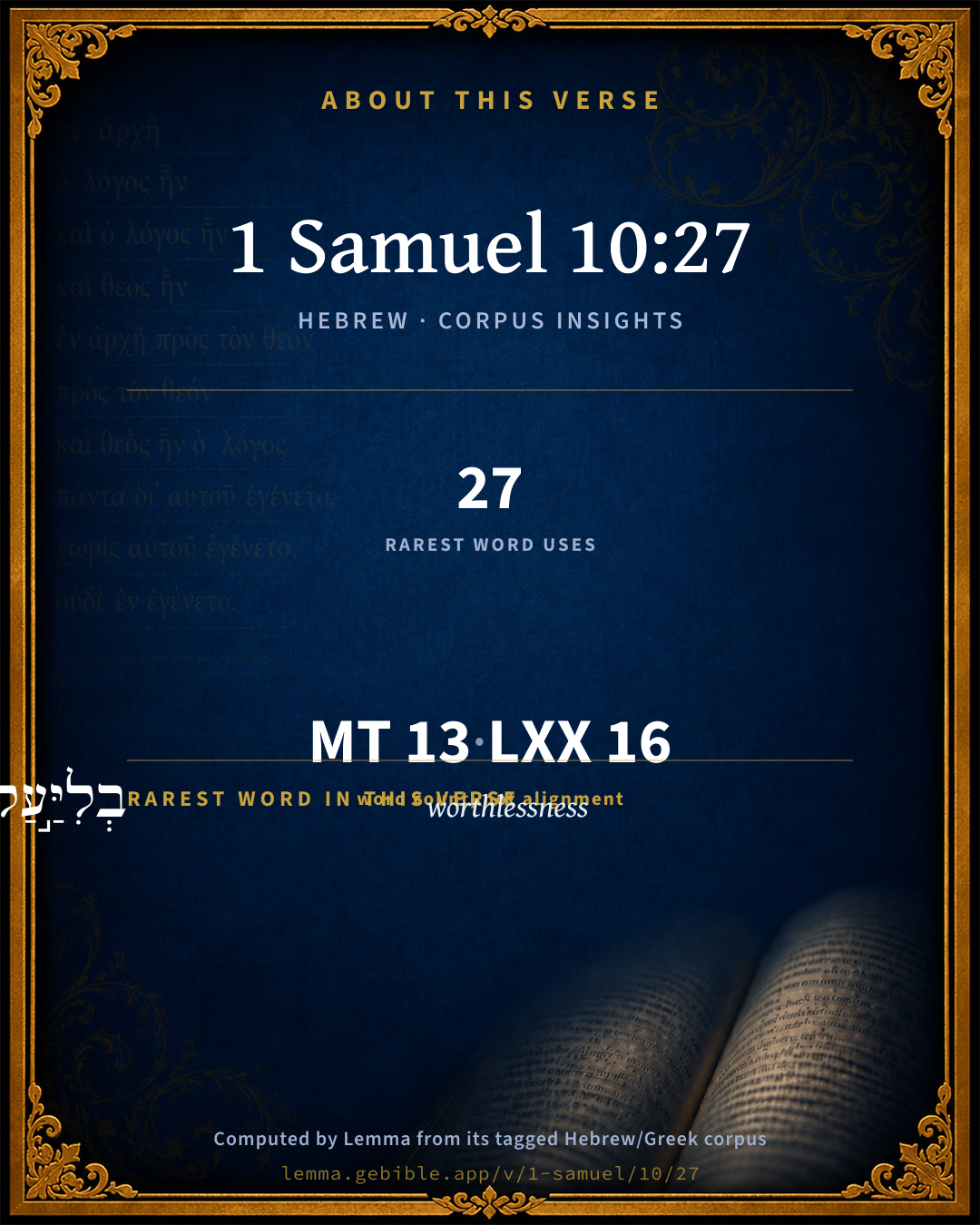
בְלִיַּ֣עַל worthlessness H1100 occurs in 26 verses of the Hebrew Bible. Also found in:

Grammatical profile

  • 6 verbs
  • 3 nouns
  • 1 pronoun
  • 1 preposition
  • 2 particles

Verb forms

  • אָמְר֗וּ Qal · Perfect
  • יֹּשִׁעֵ֨נוּ֙ Hiphil · Imperfect
  • וַיִּבְזֻ֕הוּ Qal · Sequential Imperfect
  • הֵבִ֥יאוּ Hiphil · Perfect
  • וַיְהִ֖י Qal · Sequential Imperfect
  • כְּמַחֲרִֽישׁ Hiphil · Participle Active

Hebrew & Septuagint length

In English translation the verse runs 24 words from the Hebrew and 21 from the Septuagint (LXX English) — closely comparable.

A rough comparison of the two English renderings, which tokenize alike — not a word-level alignment.

Word counts can differ between the Hebrew and the Greek without any difference in meaning — e.g. the Hebrew direct-object marker אֵת has no separate Greek word, and Greek often adds the article ὁ.

In the original languages it is 13 Hebrew tokens and 16 Greek tokens — but the two are counted differently (Hebrew bundles its prefixes and suffixes into one token; the Greek is in lemma form), so that isn’t a like-for-like length.

Cross-references

16

Topical passages linked to 1 Samuel 10:27 in the Treasury of Scripture Knowledge — connected by theme and wording, ordered by reader-vote popularity; previews shown in the World English Bible.

  • Deuteronomy 13:13 Certain base fellows are gone out from the midst of you, and have drawn away the inhabitants of their city, saying, Let us go and serve other gods, which you have not known;
  • 1 Kings 10:25 They brought every man his tribute, vessels of silver, and vessels of gold, and clothing, and armor, and spices, horses, and mules, a rate year by year.
  • 2 Chronicles 17:5 Therefore Yahweh established the kingdom in his hand; and all Judah brought to Jehoshaphat tribute; and he had riches and honor in abundance.
  • 1 Samuel 2:12 Now the sons of Eli were base men; they didn't know Yahweh.
  • 1 Kings 4:21 Solomon ruled over all the kingdoms from the River to the land of the Philistines, and to the border of Egypt: they brought tribute, and served Solomon all the days of his life.
  • 2 Chronicles 13:7 There were gathered to him worthless men, base fellows, who strengthened themselves against Rehoboam the son of Solomon, when Rehoboam was young and tender-hearted, and could not withstand them.
  • Matthew 27:12–14 When he was accused by the chief priests and elders, he answered nothing.
  • Acts 7:35 "This Moses, whom they refused, saying, 'Who made you a ruler and a judge?'--God has sent him as both a ruler and a deliverer by the hand of the angel who appeared to him in the bush.
  • 2 Samuel 8:2 He struck Moab, and measured them with the line, making them to lie down on the ground; and he measured two lines to put to death, and one full line to keep alive. The Moabites became servants to David, and brought tribute.
  • 2 Samuel 20:1 There happened to be there a base fellow, whose name was Sheba, the son of Bichri, a Benjamite: and he blew the trumpet, and said, We have no portion in David, neither have we inheritance in the son of Jesse: every man to his tents, Israel.
  • Psalms 72:10 The kings of Tarshish and of the isles will bring tribute. The kings of Sheba and Seba shall offer gifts.
  • Isaiah 36:21 But they held their peace, and answered him not a word; for the king's commandment was, saying, Don't answer him.
  • 1 Samuel 11:12 The people said to Samuel, Who is he who said, Shall Saul reign over us? bring the men, that we may put them to death.
  • Matthew 2:11 They came into the house and saw the young child with Mary, his mother, and they fell down and worshiped him. Opening their treasures, they offered to him gifts: gold, frankincense, and myrrh.
  • Acts 7:51–52 "You stiff-necked and uncircumcised in heart and ears, you always resist the Holy Spirit! As your fathers did, so you do.
  • Psalms 38:13 But I, as a deaf man, don't hear. I am as a mute man who doesn't open his mouth.

Cross-references courtesy of OpenBible.info (CC BY 4.0).

Hebrew and Greek witnesses Masoretic Hebrew ↔ Greek Septuagint

The same verse in the two great witnesses to the Old Testament, shown verse-for-verse.

These are two independent witnesses, not word-aligned to each other, and the Septuagint is shown in lemma (dictionary) form.

Hebrew 1 Samuel 10:27 Masoretic · Westminster Leningrad Codex

וּבְנֵ֧י בְלִיַּ֣עַל אָמְר֗וּ מַה יֹּשִׁעֵ֨נוּ֙ זֶ֔ה וַיִּבְזֻ֕הוּ וְלֹֽא הֵבִ֥יאוּ ל֖וֹ מִנְחָ֑ה וַיְהִ֖י כְּמַחֲרִֽישׁ

But certain worthless fellows said, How shall this man save us? They despised him, and brought him no present. But he held his peace.

World English Bible · Public Domain

Greek LXX 1 Samuel 10:27 Septuagint · lemma form

καί υἱός λοιμός εἶπον τίς σώζω ἐγώ οὗτος καί ἀτιμάζω αὐτός καί οὐ φέρω αὐτός δῶρον

But evil men said, Who is this man that shall save us? and they despised him, and brought him no gifts.

LXX2012 (modern English Septuagint) · Public Domain

Hebrew: Westminster Leningrad Codex (CC BY 4.0). Greek: Septuagint (public domain); English from LXX2012 (modern English Septuagint) (Public Domain). How the Septuagint differs from the Hebrew →

Targum (Aramaic paraphrase)

1

The Targum is the ancient Jewish Aramaic paraphrase of the Hebrew Scriptures — an interpretive translation, not the Hebrew text itself. Onkelos (literal) and Pseudo-Jonathan (expansive) render the Torah, and Jonathan the Prophets. Coverage is partial: where no permissively-licensed English translation exists for a verse, only the Aramaic is shown. This is verse-level text, not a word-by-word alignment to the Hebrew.

  1. Targum Jonathan Prophets (Joshua–Malachi)
    וּבְנֵי רִשְׁעָא אֲמַרוּ בְּמָה יִפְרְקִינָנָא דֵין וְשָׁטוֹהִי וְלָא אָתוֹ לְמִשְׁאַל בִּשְׁלָמֵיהּ וַהֲוָה כְּשָׁתֵיק:

    (no public-domain English translation for this verse)

    Targum Jonathan — Aramaic: “Mikraot Gedolot” (public domain). English: “Sefaria Community Translation” (CC0 1.0 (public-domain dedication)); “London "Chaldee Paraphrase," 1871” (public domain). Text via Sefaria.

Commentary

Notes on 1 Samuel 10:27 from classic Christian and Jewish commentators (each source and its license shown beneath its notes). The classic Christian expositions comment on the surrounding passage and are grouped to its opening verse, so a note may address several verses; the Jewish commentaries on the Tanakh (Rashi and others) are per-verse, so they appear only where the commentator wrote on this verse.

Lemma curates 59 commentaries, every one of them public domain or Creative Commons licensed, each selected and text-cleaned for this edition rather than reprinted as found. About our sources →

Trapp's Complete Commentary

John Trapp

1Sa 10:27 But the children of Belial said, How shall this man save us? And they despised him, and brought him no presents. But he held his peace.

Ver. 27. But the children of Belial.] Aweless, lawless, yokeless.

Despised him.] Vilified and nullified him, as a king of clouts. {a} So they were never content. Thus they slighted manna and the Messiah.

But he held his peace.] Or, He heard them not. This was kingly indeed. What could great Alexander have done more? or Augustus Caesar? or Queen Elizabeth? whose motto was, Video, Taceo, I see and say nothing.

“ Qui nescit dissimulare, nescit imperare. ”

{a} Quid faciet hic longolius? Quid praestabit turris haec carnea? Non est in tanto corpore mica salis.

John Trapp, A Commentary or Exposition upon All the Books of the Old and New Testament (1647–1656) — public domain. Text from a community e-Sword module.

The Biblical Illustrator

Joseph S. Exell

1Sa_10:27

But the children of Belial said.

The sons of Belial

The word Belial is found but once in the New Testament (2Co_6:15). In the Hebrew of the Old Testament it is found twenty-seven times. It is several times translated wicked (Deu_15:9; Job_34:18; Psa_101:3; Neh_1:11; Neh_1:15). It is also rendered ungodly (Pro_16:17; Pro_19:28). It is twice rendered ungodly men (2Sa_22:5; Psa_18:4). In Psa_12:8, it is rendered evil, and in Pro_6:12, naughty. In all other places it is simply transferred from the original to the common version; and so we read of a man of Belial, men of Belial, a son of Belial, the sons of Belial, and children of Belial. As a designation of character the word always points to the vile--those who draw iniquity with a cart rope. Indeed, the word Belial itself seems to mean worthlessness, nothingness, or destruction. That vile men are worthless, and can at last be put to no good purpose, but to be burned, is argued at length in Eze_15:1-8. See Pro_10:20; Mat_25:30; Rom_3:12; Rom_3:16. A man of Belial is one who destroys much good, but he restores nothing; scatters much wretchedness, but makes no one happy, and is dead while he lives, because he lives to himself. He is a vain, naughty, worthless, wretched being. The Anakims are an extinct race; but the sons of Belial live on, and are many. This is strange, for but few of them live out half their days. Their vices are very wasting. But still they are numerous. David speaks of floods of them in his time. Where wicked laws prevail and wicked men are in power, they are spawned by the thousand. When Ahab and Jezebel have sway the dogs will be licking up the blood of innocent men. (W. L. Plumer, D. D.)

The importance of self-command in a leader

Said Napoleon concerning his success as a military leader: My extreme youth when I took command of the army of Italy made it necessary for me to evince great reserve of manner, and the utmost severity of morals. This was indispensable to enable me to sustain authority over men so greatly superior in age and experience. I pursued a line of conduct in the highest degree irreproachable and exemplary. In spotless morality I was a Cato, and must have appeared such to all. I was a philosopher and a sage. My supremacy could be retained only by proving myself a better man than any other in the army. Had I yielded to human weaknesses, I should have lost my power.

The Biblical Illustrator, edited by Joseph S. Exell (c. 1880s–1900s) — public domain. Text from a community e-Sword module.

Joseph Benson's Commentary

1Sa 10:27. But the children of Belial said, &c. — Some wicked men, who hated all government, and being, it is probable, men of some rank and quality, were proud, and despised a person of such a mean family. How shall this man save us? — They would not vouchsafe so much as to call him by his name, but insolently contemned him, as a person of no note, who had no power to deliver them. They brought him no presents — As subjects in those times, and in the eastern countries, used to do to their kings when they first tendered their service to them. But he held his peace — Which was an evidence both of his great humility, and of the mercifulness of his disposition. At the same time, to dissemble his knowledge of the scorn they put upon him was an act of great prudence; for if he had taken notice of it, he must have punished it, and it would not have been safe to have begun his reign with an act of severity. Thus Christ held his peace in the day of his patience, but there is a day of recompense coming.

Joseph Benson's Commentary on the Old and New Testaments (1811–1818) — public domain. Text from a community e-Sword module.

Tyndale Open Study Notes

Tyndale Open Resources

10:27 These men were scoundrels (cp. 2:12) because they scorned God’s chosen king. • Gifts were given to show homage (Gen 32:13, 18, 20), political friendship (2 Kgs 20:12), or submission (Judg 3:15, 17). • ignored them: Saul’s self-restraint while being insulted was a sign of maturity. In contrast, Proverbs 16:14 speaks of a king’s potentially explosive rage when somebody crosses him. See also 1 Sam 11:12-13. • [Nahash . . . Jabesh-gilead]: See NLT note. Whether this paragraph was part of the original text is uncertain, but it provides historical context for 11:1-15 (e.g., 11:2).

Tyndale Open Study Notes — © Tyndale Open Resources, licensed CC BY-SA 4.0. Text via the HelloAO Bible API.

Geneva Bible (1599)

Geneva Bible translators

Both to avoid sedition, and also to win them by patience.

Geneva Bible (1599) marginal notes — public domain. Text via Bolls.life.

Jamieson, Fausset & Brown

Robert Jamieson, A. R. Fausset & David Brown

the children of Belial said, How shall this man save us? And they despised him, and brought him no presents--In Eastern countries, the honor of the sovereign and the splendor of the royal household are upheld, not by a fixed rate of taxation, but by presents brought at certain seasons by officials, and men of wealth, from all parts of the kingdom, according to the means of the individual, and of a customary registered value. Such was the tribute which Saul's opponents withheld, and for want of which he was unable to set up a kingly establishment for a while. But "biding his time," he bore the insult with a prudence and magnanimity which were of great use in the beginning of his government.

Next: 1 Samuel Chapter 11

Jamieson, Fausset & Brown — Commentary Critical and Explanatory on the Whole Bible (1871) — public domain (CC PDM 1.0). Text via the HelloAO Bible API.

Adam Clarke's Commentary

Verse 27. Brought him no presents] They gave him no proofs that they acknowledged either the Divine appointment or his authority. The Arab chiefs are, to this day, when on a march or excursion of any kind, supplied with every necessary by the free-will offerings or presents of the people in the villages or places where they encamp. Saul was now a public character, and had a right to support from the public. These sons of Belial refused to bear their part; they brought him no presents. He marked it, but at present held his peace; he was as if he were deaf: so says the text. He was prudent, and did not immediately assume all the consequence to which his office entitled him. It is probable, however, that tribute is meant by the word present. The people in general finding they had now a king, took it for granted that they must pay tribute or taxes to him. This was a part of the manner of the king which Samuel had shown them; the great majority had done so, but certain refractory people refused to pay any thing, on the pretence that such a person as Saul could not be a deliverer of Israel. How, say they, shall this man save us?

Adam Clarke's Commentary on the Bible (1810–1826) — public domain. Text from a community e-Sword/MySword module.

Ellicott's Commentary for English Readers

(27) The children of Belial.—More accurately, worthless men. (See Note on 1Sa_2:12.)

And they despised him.—As above suggested, these malcontents were probably princes and leading men of the great tribes of Judah and Ephraim, displeased that the new king should be selected from the small unimportant tribe of Benjamin. It will be remembered that the tribe of Benjamin had been almost entirely destroyed in the civil war related in the concluding chapters of Judges. “They despised him,” because in no way had he made his mark, either in the arts of war or peace. From what has gone before (see 1Sa_10:11-12 of this 1Sam) it is evident that Saul was a man of no special culture; his early years had been spent in agriculture and work on his father’s lands in the neighbourhood of Gibeah.

And brought him no presents.—These gifts were, in the East, the token of submission and homage; not to offer them to Saul was almost the same thing as to ignore his authority. Although not stated, it is clear that these malcontents were among the chiefs of the greater tribes who had assisted at the election.

But he held his peace.—Literally, he was a deaf man, acting as though he had not heard the murmurs. This prudent conduct showed great self-control and self-denial on the part of the new king and his counsellors.

A Bible Commentary for English Readers, edited by Charles John Ellicott (1878–1897) — public domain. Text from a community e-Sword module.

The Cambridge Bible for Schools and Colleges

gen. ed. J. J. S. Perowne

27. the children of Belial said] Certain worthless fellows (see note on 1Sa_1:16) spoke disparagingly of him, and despised him.

and brought him no presents] Cp. 1Ki_10:25; 2Ch_17:5. The refusal of the customary offerings of homage was tantamount to a deliberate and contemptuous rejection of his authority.

But he held his peace] Or, And he was as one deaf, refusing to take notice of this studied insult. See however the note on 1Sa_11:1.

The Cambridge Bible for Schools and Colleges (gen. ed. J. J. S. Perowne; Cambridge University Press, 1878–1918) — public domain. Text from a community e-Sword module.

Albert Barnes' Notes on the Bible

Presents - The מנחה mı̂nchāh was the token of homage and acknowledgment from the subject to the sovereign, and from the tributary nation to their suzerain. (See 2Sa 8:2, 2Sa 8:6; Jdg 3:17-18; 1Ki 4:21; 2Ki 17:4, etc.; Psa 72:10; Isa 16:1.) Saul dissembled his resentment, and waited for the favorable tide which soon came with the invasion of Nahash.

Albert Barnes' Notes on the Bible (1834–1885) — public domain. Text from a community e-Sword/MySword module.

Haydock's Catholic Bible Commentary

CHAPTER X.

Belial; seditious men, perhaps of the tribe of Ephraim, (Judges xii.) or of Juda, to whom the regal power seemed to belong, Genesis xlix. (Salien) --- Presents, in testimony of their submission. See Judges iii. 15., and 3 Kings iv. 21. The eastern kings still expect that ambassadors should bring noble presents, otherwise they deem themselves insulted. (P. Martyr.) --- Subjects dare not appear before their king, in Thrace, without some such offering. (Xenophon, Anab. vii., &c.) (Calmet) --- Not. He knew that the throne is established by mercy, Proverbs xx. 28. Hence he chose to pardon these discontented people after he had obtained the victory, and was even solicited to make an example of them. (Salien, the year of the world 2962) --- Severity might have alienated the minds of many, as he was hardly yet confirmed in his dignity, and the war against Ammon was threatening. (Menochius)

George Leo Haydock (1774–1849), Haydock's Catholic Family Bible and Commentary, 1859 edition — public domain. Excludes Psalms (Douay-Rheims chapter numbering differs from Protestant) and Deuterocanonical books (Catholic canon only).

Matthew Poole's English Annotations

This man; so mean a person, and of the weakest of all the tribes.

Brought him no presents; as subjects in those times and places used to do to their kings; see 1Ki 10:25; 2Ch 17:5; Mat 2:11; and as Saul’s mean condition, herewith they upbraided him, required.

He held his peace; thereby manifesting his prudence and clemency, which was of great use in the beginning of his government.

Matthew Poole's English Annotations on the Holy Bible (1683–1685) — public domain. Text from a community e-Sword/MySword module.

Whedon's Commentary on the Bible

Daniel D. Whedon

27. Children of Belial — Worthless, envious persons. See on chap. 1Sa_1:16.

Brought him no presents — The marginal references here show how uniform a custom it was for persons to show their obedience or respect to one of high position, particularly to a king, by bringing him a present. To neglect such token of honour would be to treat a monarch with contempt.

He held his peace — Literally, he was as being deaf. He maintained a prudent reserve, deeming it inexpedient and unwise to begin his reign by using his royal power to crush a few worthless fellows, who were unworthy, at present, of so much attention. But while, perhaps, only a few were outspoken in their disloyalty, it seems from what followed that there was quite a widespread disaffection; and Saul’s public inauguration and solemn consecration as the Lord’s anointed were reserved for a more suitable occasion. See on 1Sa_11:14.

Daniel D. Whedon (gen. ed.), Commentary on the Old and New Testaments (1874–1909) — public domain. Text from a community e-Sword module.

John Wesley's Explanatory Notes

No presents - As subjects in those times used to do to their kings. This was an evidence both of his humility, and the mercifulness of his disposition. So Christ held his peace, in the day of his patience. But there is a day of recompense coming.

John Wesley, Explanatory Notes Upon the Whole Bible (1754–1765) — public domain. Text via the GEBible commentary corpus.

Lesson kit

Teaching starters — assembled from the data on this page, not authored interpretation. Every prompt links to the verse data it draws on. Edit before teaching.

1 Samuel, in the Historical, opens this verse with 13 words (12 distinct Hebrew lemmas). Its most distinctive word is bᵉlîyaʻal (“worthlessness”). A historical commentator’s framing appears above. Read the whole chapter for the surrounding context.

Discussion questions

  1. What does “worthlessness” (bᵉlîyaʻal) contribute to the verse as a whole?
  2. Deuteronomy 13:13 shares the word «worthlessness» with this verse. How do the two illuminate each other?
  3. These translations render this verse differently. What is at stake in choosing one wording over another?
  4. The verb «אָמְר֗וּ» is Qal Perfect. How does its form color the action?
  5. Reading how Trapp's Complete Commentary and The Biblical Illustrator read this verse, where do the two commentators agree and where do they part?

Things to notice

Reading settings

Reading text

Shown beneath each verse's original-language words.

Old Testament
Old Testament edition

Read the OT as the Masoretic Hebrew (MT) or the Greek Septuagint (LXX).

English shown for the Greek Septuagint (in the Hebrew ↔ Greek comparison).

Comparing translations? Open the Compare panel on any verse page to stack up to four side by side.