Isaiah 63:5

Hebrew (Westminster Leningrad Codex) Isaiah 63:5 appears in the Hebrew Old Testament. The text above is from the Westminster Leningrad Codex. Each word links to its Strong’s number, a concise gloss, and parsing drawn from the Open Scriptures Hebrew Bible morphology. Click any word for its full Brown-Driver-Briggs (BDB) entry.
Download image
Cite this verse

Isaiah 63:5 (World English Bible). Public Domain. Lemma interlinear Bible study tool, https://lemma.gebible.app/v/isaiah/63/5.

Show BibTeX & RIS
BibTeX
RIS
English Translation
I looked, and there was none to help; and I wondered that there was none to uphold: therefore my own arm brought salvation to me; and my wrath, it upheld me.
World English Bible · Public Domain
Download a study sheet

One document with this verse’s original text, its word-by-word gloss line, the meaning frame, cross-references with their text, attributed commentary, and full source and license credits — printable, and it pastes into notes with its structure intact.

This verse Autodidact and up

Study sheet (.html) Plain text (.txt)

A passage Seminary Student

Up to 50 verses in one chapter. A passage sheet keeps up to 6 commentary sources and 12 cross-references per verse, in the order this page ranks them, and says so on the sheet whenever that leaves anything out. Ask for a single verse and you get the Autodidact verse sheet above.

Everything on this page stays free to read, with no account — the sheet is a download of what is already on screen, not access to it.

Want to remove ads? Support Godless Engineer
Compare translations 3

The same verse in 3 English versions, stacked beneath the original-language interlinear above. Click any original word for its lexicon entry.

Each is an independent rendering of the whole verse — the interlinear is not word-aligned to these translations.

Highlighted words mark where these versions differ — a whole-verse word diff, not a word-by-word alignment.

  • World English Bible Public Domain
    I looked, and there was none to help; and I wondered that there was none to uphold: therefore my own arm brought salvation to me; and my wrath, it upheld me.
  • King James Version Public Domain
    And I looked, and there was none to help; and I wondered that there was none to uphold: therefore mine own arm brought salvation unto me; and my fury, it upheld me.
  • unfoldingWord Literal Text CC BY-SA 4.0
    And I looked, and there was no helper, and I was desolated that no one was supporting. So my arm saved for me, and my heat, it, it supported me.

unfoldingWord Literal Text — © unfoldingWord, licensed CC BY-SA 4.0. Word-aligned USFM3 via Door43 (git.door43.org/unfoldingWord/en_ult).

Versions to compare (up to 4)

3 of 4 selected

Show all 18 translations

Every available English version of this verse, each an independent rendering of the whole verse.

  • World English Bible Public Domain
    I looked, and there was none to help; and I wondered that there was none to uphold: therefore my own arm brought salvation to me; and my wrath, it upheld me.
  • Berean Standard Bible Public Domain
    I looked, but there was no one to help; I was appalled that no one assisted. So My arm brought Me salvation, and My own wrath upheld Me.
  • Majority Standard Bible Public Domain
    I looked, but there was no one to help; I was appalled that no one assisted. So My arm brought Me salvation, and My own wrath upheld Me.
  • King James Version Public Domain
    And I looked, and there was none to help; and I wondered that there was none to uphold: therefore mine own arm brought salvation unto me; and my fury, it upheld me.
  • American Standard Version (1901) Public Domain
    And I looked, and there was none to help; and I wondered that there was none to uphold: therefore mine own arm brought salvation unto me; and my wrath, it upheld me.
  • Revised Version (1885) Public Domain
    And I looked, and there was none to help; and I wondered that there was none to uphold: therefore mine own arm brought salvation unto me; and my fury, it upheld me.
  • Geneva Bible (1599) Public Domain
    And I looked, and there was none to helpe, and I wondered that there was none to vpholde: therefore mine owne arme helped me, and my wrath it selfe sustained me.
  • Douay-Rheims (1899) Public Domain
    I looked about, and there was none to help: I sought, and there was none to give aid: and my own arm hath saved for me, and my indignation itself hath helped me.
  • Young's Literal Translation Public Domain
    And I look attentively, and there is none helping, And I am astonished that there is none supporting, And give salvation to me doth mine own arm. And my wrath -- it hath supported me.
  • Literal Standard Version CC BY-SA 4.0
    And I look attentively, and there is none helping, || And I am astonished that there is none supporting, || And My own arm gives salvation to Me. And My wrath—it has supported Me.
  • Unlocked Literal Bible CC BY-SA 4.0
    I looked, and there was no one to help. I wondered that there was none to help, but my own arm brought victory for me, and my strong anger drove me on.
  • unfoldingWord Literal Text CC BY-SA 4.0
    And I looked, and there was no helper, and I was desolated that no one was supporting. So my arm saved for me, and my heat, it, it supported me.
  • Darby Bible Public Domain
    And I looked, and there was none to help; and I wondered that there was none to uphold: and mine own arm brought salvation unto me; and my fury, it upheld me.
  • World Messianic Bible Public Domain
    I looked, and there was no one to help; and I wondered that there was no one to uphold. Therefore my own arm brought salvation to me. My own wrath upheld me.
  • Webster's Bible Public Domain
    And I looked, and there was none to help; and I wondered that there was none to uphold: therefore my own arm brought salvation to me; and my fury, it upheld me.
  • Free Bible Version CC BY-SA 4.0
    I looked around, but no one came to help; I was shocked that there was no one to assist me. So I saved them through my own strength alone, and my own anger kept me going.
  • Bible in Basic English Public Domain
    And I saw that there was no helper, and I was wondering that no one gave them support: so my arm did the work of salvation, and my wrath was my support.
  • JPS Tanakh (1917) Public Domain
    And I looked, and there was none to help, and I beheld in astonishment, and there was none to uphold; therefore Mine own arm brought salvation unto Me, and My fury, it upheld Me.

Literal Standard Version (2020), Covenant Press — licensed CC BY-SA 4.0. Text via the HelloAO Bible API (eBible.org). Unlocked Literal Bible (unfoldingWord) — licensed CC BY-SA 4.0. Text via the HelloAO Bible API (eBible.org). unfoldingWord Literal Text — © unfoldingWord, licensed CC BY-SA 4.0. Word-aligned USFM3 via Door43 (git.door43.org/unfoldingWord/en_ult). Free Bible Version, Dr. Jonathan Gallagher — licensed CC BY-SA 4.0. Text via the HelloAO Bible API (eBible.org).

Word by word

More ways to search: Search by grammar → Find every occurrence → Compare this word →

Practice this passage: Drill this verse → Learn its vocabulary →

סוֹמֵ֑ךְ
çâmak
H5564
“leaning”
Verb, Qal, Participle Active, Masculine, Singular, Absolute
Part of Speech
Verb
Stem
Qal
Form
Participle Active
Gender
Masculine
Number
Singular
State
Absolute
Full BDB Definition

Origin: a primitive root

TWOT: 1514

to lean, lay, rest, support, put, uphold, lean upon - (Qal) - to lean or lay upon, rest upon, lean against - to support, uphold, sustain - (Niphal) to support or brace oneself - (Piel) to sustain, refresh, revive
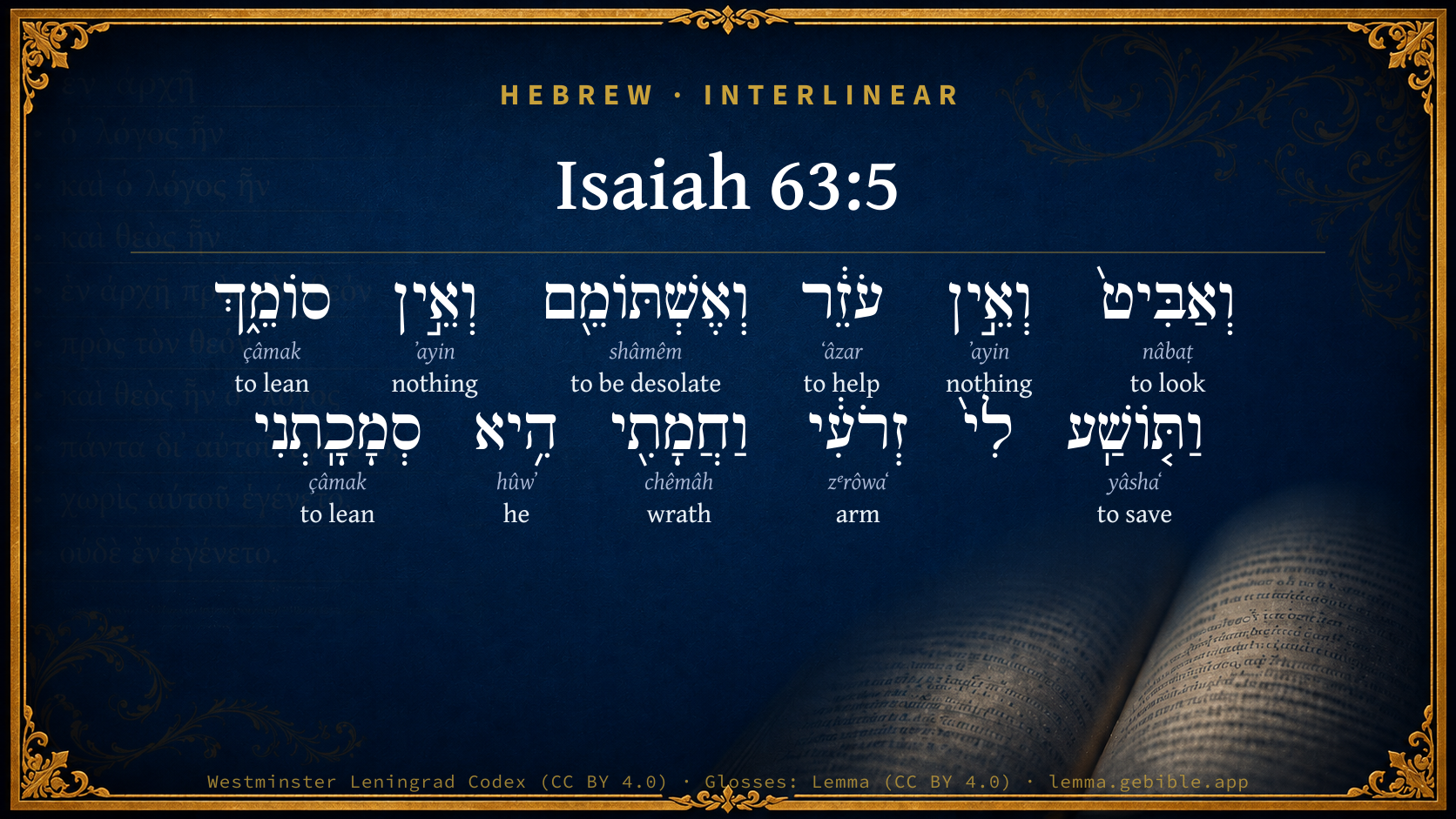
  1. וְאַבִּיט֙ nâbaṭ H5027 “and · to look” Conjunction + Verb, Hiphil, Imperfect, 1st Person, Common, Singular
  2. וְאֵ֣ין ʼayin H369 “and · nothing” Conjunction + Particle, Negative
  3. עֹזֵ֔ר ʻâzar H5826 “helping” Verb, Qal, Participle Active, Masculine, Singular, Absolute
  4. וְאֶשְׁתּוֹמֵ֖ם shâmêm H8074 “and · to be desolate” Conjunction + Verb, Hithpolel, Imperfect, 1st Person, Common, Singular
  5. וְאֵ֣ין ʼayin H369 “and · nothing” Conjunction + Particle, Negative
  6. וַתּ֤וֹשַֽׁע yâshaʻ H3467 “and · to save” Conjunction + Verb, Hiphil, Sequential Imperfect, 3rd Person, Feminine, Singular
  7. זְרֹעִ֔י zᵉrôwaʻ H2220 “arm · my” Noun, Common, Both, Singular, Construct + Suffix, Personal, 1st Person, Common, Singular
  8. וַחֲמָתִ֖י chêmâh H2534 “and · wrath · my” Conjunction + Noun, Common, Feminine, Singular, Construct + Suffix, Personal, 1st Person, Common, Singular
  9. הִ֥יא hûwʼ H1931 “he” Pronoun, Personal, 3rd Person, Feminine, Singular
  10. סְמָכָֽתְנִי çâmak H5564 “to lean · me” Verb, Qal, Perfect, 3rd Person, Feminine, Singular + Suffix, Personal, 1st Person, Common, Singular

About this verse

These counts appear in no published source. They are computed here, from the morphology-tagged text and Lemma’s own curated glosses. What Lemma adds →

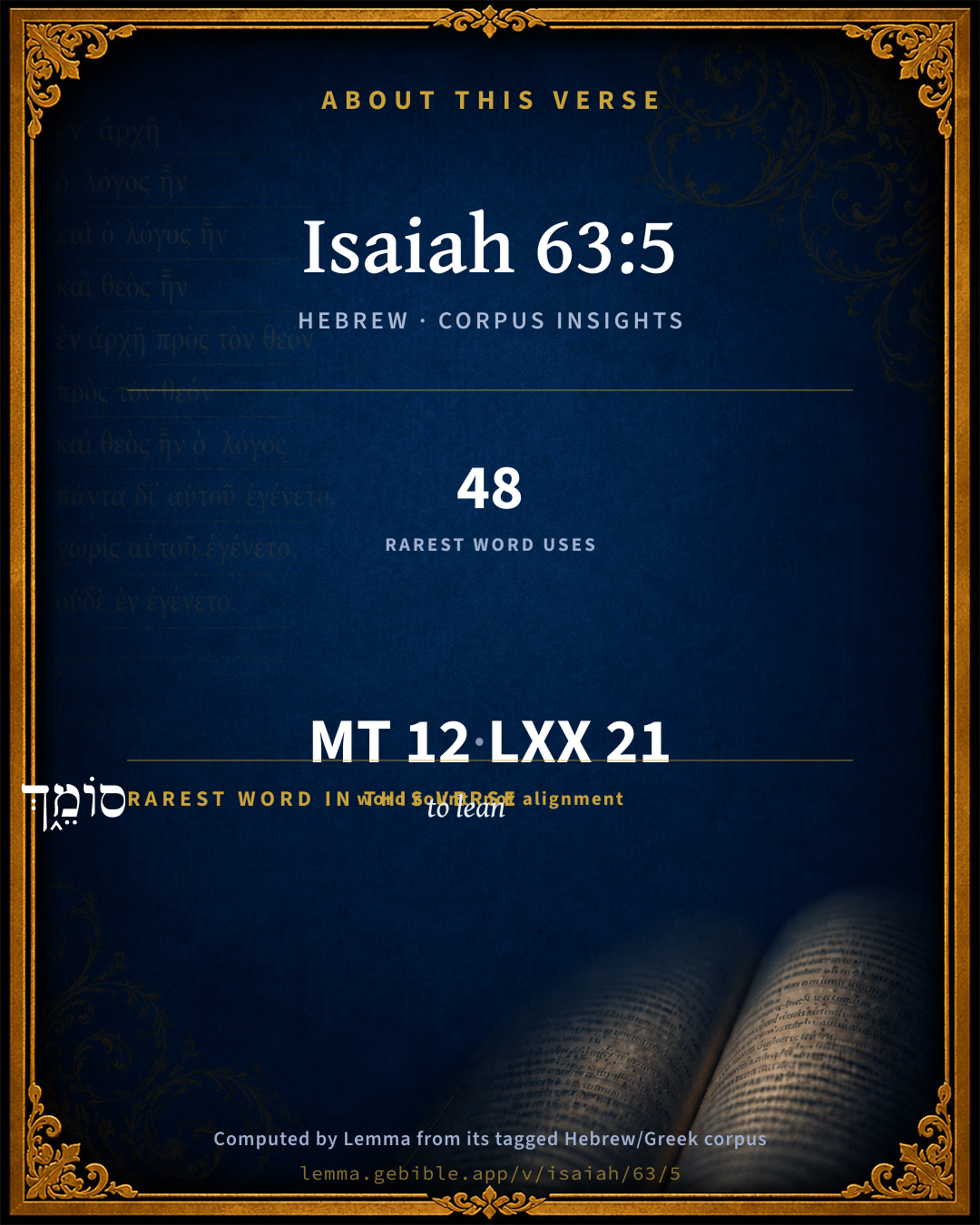
12
words
9
distinct lemmas
Prophets
section

Shared distinctive vocabulary

סוֹמֵ֑ךְ to lean H5564 occurs in 47 verses of the Hebrew Bible. Also found in:

Grammatical profile

  • 6 verbs
  • 2 nouns
  • 1 pronoun
  • 1 preposition
  • 2 particles

Verb forms

  • וְאַבִּיט֙ Hiphil · Imperfect
  • עֹזֵ֔ר Qal · Participle Active
  • וְאֶשְׁתּוֹמֵ֖ם Hithpolel · Imperfect
  • סוֹמֵ֑ךְ Qal · Participle Active
  • וַתּ֤וֹשַֽׁע Hiphil · Sequential Imperfect
  • סְמָכָֽתְנִי Qal · Perfect

Repetition

Words recur within this verse — often emphatic in Hebrew:

  • וְאֵ֣ין nothing H369 ×2
  • סוֹמֵ֑ךְ to lean H5564 ×2

Hebrew & Septuagint length

In English translation the verse runs 31 words from the Hebrew and 24 from the Septuagint (LXX English) — closely comparable.

A rough comparison of the two English renderings, which tokenize alike — not a word-level alignment.

Word counts can differ between the Hebrew and the Greek without any difference in meaning — e.g. the Hebrew direct-object marker אֵת has no separate Greek word, and Greek often adds the article ὁ.

In the original languages it is 12 Hebrew tokens and 21 Greek tokens — but the two are counted differently (Hebrew bundles its prefixes and suffixes into one token; the Greek is in lemma form), so that isn’t a like-for-like length.

Cross-references

13

Topical passages linked to Isaiah 63:5 in the Treasury of Scripture Knowledge — connected by theme and wording, ordered by reader-vote popularity; previews shown in the World English Bible.

  • Psalms 44:3 For they didn't get the land in possession by their own sword, Neither did their own arm save them; But your right hand, and your arm, and the light of your face, Because you were favorable to them.
  • Psalms 98:1 Sing to Yahweh a new song, For he has done marvelous things! His right hand, and his holy arm, have worked salvation for him.
  • Isaiah 40:10 Behold, the Lord Yahweh will come as a mighty one, and his arm will rule for him: Behold, his reward is with him, and his recompense before him.
  • Isaiah 41:28 When I look, there is no man: even among them there is no counselor who, when I ask of them, can answer a word.
  • Isaiah 50:2 Why, when I came, was there no man? when I called, was there none to answer? Is my hand shortened at all, that it can't redeem? or have I no power to deliver? Behold, at my rebuke I dry up the sea, I make the rivers a wilderness: their fish stink, because there is no water, and die for thirst.
  • Isaiah 52:10 Yahweh has made bare his holy arm in the eyes of all the nations; and all the ends of the earth have seen the salvation of our God.
  • Isaiah 59:16–18 He saw that there was no man, and wondered that there was no intercessor: therefore his own arm brought salvation to him; and his righteousness, it upheld him.
  • Hosea 1:7 But I will have mercy on the house of Judah, and will save them by Yahweh their God, and will not save them by bow, nor by sword, nor by battle, by horses, nor by horsemen."
  • Isaiah 63:3 I have trodden the winepress alone; and of the peoples there was no man with me: yes, I trod them in my anger, and trampled them in my wrath; and their lifeblood is sprinkled on my garments, and I have stained all my clothing.
  • John 16:32 Behold, the time is coming, yes, and has now come, that you will be scattered, everyone to his own place, and you will leave me alone. Yet I am not alone, because the Father is with me.
  • 1 Corinthians 1:24 but to those who are called, both Jews and Greeks, Christ is the power of God and the wisdom of God.
  • Hebrews 2:14–15 Since then the children have shared in flesh and blood, he also himself in like manner partook of the same, that through death he might bring to nothing him who had the power of death, that is, the devil,
  • Isaiah 51:9 Awake, awake, put on strength, arm of Yahweh; awake, as in the days of old, the generations of ancient times. Isn't it you who did cut Rahab in pieces, who pierced the monster?

Cross-references courtesy of OpenBible.info (CC BY 4.0).

Hebrew and Greek witnesses Masoretic Hebrew ↔ Greek Septuagint

The same verse in the two great witnesses to the Old Testament, shown verse-for-verse.

These are two independent witnesses, not word-aligned to each other, and the Septuagint is shown in lemma (dictionary) form.

Hebrew Isaiah 63:5 Masoretic · Westminster Leningrad Codex

וְאַבִּיט֙ וְאֵ֣ין עֹזֵ֔ר וְאֶשְׁתּוֹמֵ֖ם וְאֵ֣ין סוֹמֵ֑ךְ וַתּ֤וֹשַֽׁע לִי֙ זְרֹעִ֔י וַחֲמָתִ֖י הִ֥יא סְמָכָֽתְנִי

I looked, and there was none to help; and I wondered that there was none to uphold: therefore my own arm brought salvation to me; and my wrath, it upheld me.

World English Bible · Public Domain

Greek LXX Isaiah 63:5 Septuagint · lemma form

καί ἐπιβλέπω καί οὐδείς βοηθός καί προςνοέω καί οὐδείς ἀντιλαμβάνω καί ῥύομαι αὐτός ὁ βραχίων ἐγώ καί ὁ θυμός ἐγώ ἐπιἵστημι

And I looked, and there was no helper; and I observed, and none upheld: therefore my arm delivered them, and my anger drew near.

LXX2012 (modern English Septuagint) · Public Domain

On this verse, Joseph Benson's Commentary discusses the Septuagint’s reading. Read the note in Commentary ↓

Hebrew: Westminster Leningrad Codex (CC BY 4.0). Greek: Septuagint (public domain); English from LXX2012 (modern English Septuagint) (Public Domain). How the Septuagint differs from the Hebrew →

Targum (Aramaic paraphrase)

1

The Targum is the ancient Jewish Aramaic paraphrase of the Hebrew Scriptures — an interpretive translation, not the Hebrew text itself. Onkelos (literal) and Pseudo-Jonathan (expansive) render the Torah, and Jonathan the Prophets. Coverage is partial: where no permissively-licensed English translation exists for a verse, only the Aramaic is shown. This is verse-level text, not a word-by-word alignment to the Hebrew.

  1. Targum Jonathan Prophets (Joshua–Malachi)
    וּגְלֵי קֳדָמַי וְלֵית גְבַר דְלֵיהּ עוֹבָדִין טָבִין וִידִיַע קֳדָמַי וְלֵית אֱנַשׁ דִיקוּם וְיִבְעֵי עֲלֵיהוֹן וּפְרַקְתִּינוּן בִּדְרַע תּוּקְפִי וּבְמֵימַר רְעוּתִי סְעַדְתִּינוּן:

    And it is revealed before me, that there is no man whose works are good, and it is known to me, that there is no man who will stand up and pray in behalf of them; yea, I will redeem them by the arm of my strength, and by the WORD of my delight I will help them.

    Targum Jonathan — Aramaic: “Mikraot Gedolot” (public domain). English: “Sefaria Community Translation” (CC0 1.0 (public-domain dedication)); “London "Chaldee Paraphrase," 1871” (public domain). Text via Sefaria.

Commentary

Notes on Isaiah 63:5 from classic Christian and Jewish commentators (each source and its license shown beneath its notes). The classic Christian expositions comment on the surrounding passage and are grouped to its opening verse, so a note may address several verses; the Jewish commentaries on the Tanakh (Rashi and others) are per-verse, so they appear only where the commentator wrote on this verse.

Lemma curates 59 commentaries, every one of them public domain or Creative Commons licensed, each selected and text-cleaned for this edition rather than reprinted as found. About our sources →

Trapp's Complete Commentary

John Trapp

Isa 63:5 And I looked, and [there was] none to help; and I wondered that [there was] none to uphold: therefore mine own arm brought salvation unto me; and my fury, it upheld me.

Ver. 5. And I looked, and there was none to help.] See on Isa 59:16.

John Trapp, A Commentary or Exposition upon All the Books of the Old and New Testament (1647–1656) — public domain. Text from a community e-Sword module.

The Biblical Illustrator

Joseph S. Exell

Isa_63:5

And I looked, and there was none to help

Mans extremity the Divine opportunity

The doctrine of the text is, that salvation, of every kind and every degree, is from the Lord.

I. THIS POINTS OUT TO US THAT ALL MEN ARE IN A MISERABLE CONDITION. Why should man need salvation? He is lost.

II. THE TEXT IMPLIES THE INTERPOSITION OF GOD. The Speaker is the great Messiah, and He speaks in righteousness. There are difficulties in the way of a sinners recovery which none can remove but God. The righteousness by faith is accompanied by the power of God, and this alone can save the soul.

1. This shows Gods knowledge of the dreadful condition of the sinner. He lays help on One mighty to save.

2. It bespeaks His forbearance (Rom_3:25-26).

3. It implies the impossibility of mans being saved but by a Divine arm; and the all-sufficiency of God to save sinners, however deeply sunk in sin, misery, and guilt.

4. Here is the language of,, triumph, as though God delighted in this work of saving sinners: Mine own arm, etc. He had a sufficiency of wisdom to devise the plan; a fulness of merit to justify, of the Spirit to sanctify, of mercy to pity, and of grace that should abound, in the sinners pardon, and in the purity and peace of his conscience.

III. THE ADVANTAGES OF THIS SALVATION.

1. The full character of God is displayed. Here I see God to be just and wise in pardoning the sin He punishes, and showing His abhor fence of the sin He forgives.

2. Salvation is secured to every believer.

3. This secures all the glory to God.

4. It is the most encouraging that could have been devised.

5. It binds the strongest obligation on us. If saved without any power or merit of my own, what shall I render for such a salvation to such a sinner (J. Cooke.)

The Biblical Illustrator, edited by Joseph S. Exell (c. 1880s–1900s) — public domain. Text from a community e-Sword module.

Joseph Benson's Commentary

Isa 63:5-6. I looked, and there was none to help — “Things were come to that extremity, that there was no appearance of succour by any human means. Those who, by their office and character, ought to have stood up in defence of oppressed truth and righteousness, even they, contrary to what might have been justly expected, betrayed so good a cause, or had not the courage to defend it. So that it was time for God to interpose, and to appear in defence of his own honour and people.” Therefore my own arm, &c. — See note on Isa 59:16. And my fury, it upheld me — Or, my zeal rather, namely, against the adversaries of my church, and for the deliverance of my people: I was resolved to vindicate my own honour, and my concern for my people made me go through with the undertaking in spite of all opposition. Thus God says, Zec 8:2, I was jealous for Zion with great fury. God’s arm signifies his strength and power, and his zeal sets his power on work. And I will tread down — The LXX. render it, κατεπατησα, I have trodden down the people in mine anger. So also the vulgar Latin, which translation agrees better with the context where Christ is described as having his garments already stained with the blood of his enemies. And made them drunk in my fury — “God’s judgments are often represented by a cup of intoxicating liquor, because they astonish men, and bereave them of their usual discretion.” See the note on Isa 51:17.

Joseph Benson's Commentary on the Old and New Testaments (1811–1818) — public domain. Text from a community e-Sword module.

Geneva Bible (1599)

Geneva Bible translators

God showeth that he hath no need of man’s help for the deliverance of his, and though men refuse to do their duty through negligence and ingratitude, yet he himself will deliver his Church, and punish the enemies, read Isa. 59:16.

Geneva Bible (1599) marginal notes — public domain. Text via Bolls.life.

Jamieson, Fausset & Brown

Robert Jamieson, A. R. Fausset & David Brown

The same words as in Isa 59:16, except that there it is His "righteousness," here it is His "fury," which is said to have upheld Him.

Jamieson, Fausset & Brown — Commentary Critical and Explanatory on the Whole Bible (1871) — public domain (CC PDM 1.0). Text via the HelloAO Bible API.

Adam Clarke's Commentary

Verse 5. And my fury - "And mine indignation"] For וחמתי vachamathi, nineteen MSS. (three ancient) of Kennicott's, nine of De Rossi's, and one of mine, and four editions, have וצדקתי vetsidkathi, and my righteousness; from Isa 59:16, which I suppose the transcriber retained in his memory. It is true that the Versions are in favour of the common reading; but that noticed above seems to stand on good authority, and is a reading both pleasing and impressive. Opposite, in the margin, my MS. has the common reading by a later hand.

Adam Clarke's Commentary on the Bible (1810–1826) — public domain. Text from a community e-Sword/MySword module.

Ellicott's Commentary for English Readers

(5) I looked . . .—As in Isa_1:2, the absolute isolation of the avenger and redeemer is emphasised again and again. Nothing but his own indomitable and righteous zeal against evil had sustained him.

A Bible Commentary for English Readers, edited by Charles John Ellicott (1878–1897) — public domain. Text from a community e-Sword module.

The Cambridge Bible for Schools and Colleges

gen. ed. J. J. S. Perowne

5. Comp. ch. Isa_59:16. The verse explains why it is that Jehovah treads the winepress “alone” (Isa_63:3). The expectation that some human helper would appear on the side of Jehovah is more remarkable here than in ch. Isa_59:16, where the judgement was on Israel itself, and the complaint might be that even within the chosen nation no champion of righteousness could be found. The idea that such a champion might have been found amongst heathen nations is of course much less easily explained; unless, with Duhm, we suppose that the prophet is sadly contrasting his own age with the more hopeful time of the Second Isaiah, when the faith of Israel was directed to Cyrus as the agent of Jehovah’s purposes on earth.

The Cambridge Bible for Schools and Colleges (gen. ed. J. J. S. Perowne; Cambridge University Press, 1878–1918) — public domain. Text from a community e-Sword module.

John Gill's Exposition

And I looked, and there was none to help,.... As, in the first redemption and salvation by Christ here on earth, there were none among the angels, nor any of the sons of men, to help him and assist him therein, none but Jehovah the Father; so, in this latter salvation, the church and people of God will be reduced to such a low, helpless, and forlorn condition, that there will be none to lend an assisting hand; their deliverance will appear most manifestly to be the sole work of almighty power:

and I wondered that there was none to uphold; not the Saviour and Redeemer, he needed none; but his people under their sufferings, trials, and exercises, and his sinking, dying, cause and interest: this is spoken after the manner of men, and to make the salvation appear the more remarkable, distinguishing, and great, and solely his own work; for otherwise expectation and disappointment, consternation and amazement, as the word (r) signifies, cannot be properly ascribed to this great Redeemer:

therefore mine own arm brought salvation unto me; to himself, his mystical self, his church and people, and for his own glory; a salvation which his own omnipotent arm could only effect; See Gill on Isa 59:16,

and my fury it upheld me; his zeal for his church and people, and his indignation against their enemies, excited his almighty power on their behalf, and carried him through the work of their deliverance and salvation he engaged in; see Isa 9:7.

(r) "et obstupui, Musculus; stupefactus sum", Vatablus; "et obstupesceban", Cocceius; "stupebam", Vitringa.

John Gill's Exposition of the Whole Bible (1746–1763) — public domain (CC PDM 1.0). Text via the HelloAO Bible API.

Albert Barnes' Notes on the Bible

And I looked and there was none to help - The same sentiment is expressed in Isa 59:16 (see the note at that verse).

None to uphold - None to sustain or assist. The design is to express the fact that he was entirely alone in this work: that none were disposed or able to assist him. Though this has no direct reference to the plan of salvation, or to the work of the Messiah as a Redeemer, yet it is true of him also that in that work he stood alone. No one did aid him or could aid him; but alone he ‘bore the burden of the world’s atonement.’

My fury, it upheld me - My determined purpose to inflict punishment on my foes sustained me. There is a reference doubtless to the fact that courage nerves the arm and sustains a man in deadly conflict; that a purpose to take vengeance, or to inflict deserved punishment, animates one to make efforts which he could not otherwise perform. In Isa 59:16, the sentiment is, ‘his righteousness sustained him;’ here it is that his fury did it. There the purpose was to bring salvation; here it was to destroy his foes.

Albert Barnes' Notes on the Bible (1834–1885) — public domain. Text from a community e-Sword/MySword module.

Haydock's Catholic Bible Commentary

Me. I depended on the goodness of my cause, and on God’s aid, chap. lix. 15. (Calmet)

George Leo Haydock (1774–1849), Haydock's Catholic Family Bible and Commentary, 1859 edition — public domain. Excludes Psalms (Douay-Rheims chapter numbering differs from Protestant) and Deuterocanonical books (Catholic canon only).

Matthew Poole's English Annotations

There was none to help; not that he needed it, for help implies a defect of power, or wisdom, or wealth, or opportunity, &c.; but to see what men would do, in regard his people needed it; therefore the standing or not standing by his people is the same thing with standing or not standing by him, Jdg 5:23; Mat 25:35,40,42,45.

None to uphold; a metaphor taken from a staff, that is a help to one that leans on it.

My fury, or zeal, viz. against the adversaries of the church. God’s arm notes his strength and power, and his zeal sets this power on work, Isa 9:7; but See Poole "Isa 59:16", See Poole "Isa 59:17".

Matthew Poole's English Annotations on the Holy Bible (1683–1685) — public domain. Text from a community e-Sword/MySword module.

Whedon's Commentary on the Bible

Daniel D. Whedon

5, 6. I looked… there was none to help — These opening words do but repeat Isa_59:16, with one change only, that of the person, which, in the latter is Jehovah, while in the former it is Messiah, or the Lord’s Anointed — the Servant of Jehovah.

I wondered — Amid rank rebellion there ought, in the nature of things, to be some exceptions; some might, perchance, have conscience enough left to have taken sides with him. But not even one appeared.

Therefore mine own arm brought salvation — Namely, to his sorely oppressed spiritual Israel. Opposers shall not escape. Hostile nations and individual souls alike shall drink the cup of retribution to the dregs. Full justice shall be done to his righteous cause. It shall be shown that no incorrigible foe can stand. Thus ends this obscure and dramatic scene, in which some moderns see little or nothing of Christ, as Calvin, Grotius, Alexander, Barnes, and others; while earlier commentators, and not a few modern, see much of him, displaying the righteousness of his cause, and the peril of opposition to it.

Daniel D. Whedon (gen. ed.), Commentary on the Old and New Testaments (1874–1909) — public domain. Text from a community e-Sword module.

The Pulpit Commentary

And I looked, and there was none to help. (comp. Isa_5:2, "He looked that it should bring forth grapes, and it brought forth wild grapes:" also Isa_41:28, "I beheld, and there was no man By an anthropomorphism God is represented as looking for and expecting what might reasonably have been expected, and even as surprised when he does not find it. (comp. Isa_59:16) Out of all the many nations it was reasonable to suppose that some would have chosen the better part and have been on the Lord"s side. But the fact was otherwise (comp. ver. 3). Mine own arm brought salvation unto me; or, mine own arm helped me. (Isa_59:16) Nothing more is needed. If God arises, his enemies at once are scattered". (Psa_68:1) "His own right hand, and his holy arm, get him the victory". (Psa_98:1)

The Pulpit Commentary (1880–1919), ed. H.D.M. Spence-Jones & Joseph S. Exell — public domain. Text from a community e-Sword module.

John Wesley's Explanatory Notes

None to help - Not that he needed it, but to see what men would do, in regard his people needed it; therefore the standing, or not standing by his people, is the same thing with standing, or not standing by him. Uphold - A metaphor, taken from a staff, that is an help to one that leans on it.

John Wesley, Explanatory Notes Upon the Whole Bible (1754–1765) — public domain. Text via the GEBible commentary corpus.

J. A. Alexander on Isaiah

Joseph Addison Alexander

“And I look, and there is none helping; and I stand aghast, and there is none sustaining; and my own arm saves for me, and my fury it sustains me.” These expressions have already been explained in Isa 59:16. Fury here takes the place of righteousness not as a synonym but as an equivalent. God’s wrath is but the executioner and agent of His justice. Upon either He might therefore be described as exclusively relying. The present form is used in the translation, on account of the uncertainty in which the use of the tenses is involved, and which may arise in part from an intentional confusion of the past and future in the mind of one who had begun a great work, and was yet to finish it.

Joseph Addison Alexander, The Prophecies of Isaiah (1846–1847; New York: Scribner, 1870–1878) — public domain. Text from a community e-Sword module.

unfoldingWord translationNotes

Door43 World Missions Community

General Information:

Yahweh continues speaking.

but my own arm

Here "arm" represents power. (See: Metonymy)

made them drunk in my wrath

This means Yahweh made them stunned and senseless by his full wrath and punishment. (See: Metaphor)

I poured out their blood

Here "blood" represents the life of Yahweh's enemies that was gushing out so they would die. (See: Metaphor)

translationWords

wrath

blood

unfoldingWord translationNotes — © Distant Shores Media and the Door43 World Missions Community, licensed CC BY-SA 4.0. Source: git.door43.org/Door43/en_tn.

Rashi

Rabbi Shlomo Yitzchaki (Rashi)

And I looked, and there was no one helping Israel.

and I was astounded An expression of keeping silent, and I have already explained it above (57:16): “And He was astounded for there was no intercessor.”

and My fury that supported Me My fury that I have against the heathens (the nations [mss. and K’li Paz]), for I was a little wrath with My people, and they helped to harm them. That strengthened My hand and aroused My heart to mete recompense upon them although Israel is not fit and worthy of redemption.

Rashi on the Tanakh — English translations: “The Judaica Press complete Tanach with Rashi, translated by A. J. Rosenberg” (CC BY 4.0); “Pentateuch with Rashi's commentary by M. Rosenbaum and A.M. Silbermann, 1929-1934” (public domain); “The Metsudah Tanach series, Lakewood, N.J” (CC BY 4.0); and “The Book of Joshua, Metsudah Publications, 1997” (CC BY 4.0). Text via Sefaria.

Ibn Ezra

Rabbi Abraham ibn Ezra

And I looked, etc. This is a figurative expression; for in fact God does not need that.

ואשתומם And I wondered. Compare my explanation of וישתומם (59:16)

Ibn Ezra on the Tanakh — English translations: “Sefaria Community Translation” (CC0 1.0 (public-domain dedication)); “Yalkut, Sifsei Chachomim Chumash, Metsudah Publications, 2009” (CC BY 4.0); and “Commentary of Ibn Ezra on Isaiah - trans. by M. Friedlander, 1873” (public domain). Text via Sefaria.

Lesson kit

Teaching starters — assembled from the data on this page, not authored interpretation. Every prompt links to the verse data it draws on. Edit before teaching.

Isaiah, in the Prophets, opens this verse with 12 words (9 distinct Hebrew lemmas). Its most distinctive word is çâmak (“to lean”). A historical commentator’s framing appears above. Read the whole chapter for the surrounding context.

Discussion questions

  1. The word çâmak carries the sense “to lean.” How does it shape the verse?
  2. How does Genesis 27:37, which shares the word «to lean», read alongside this verse?
  3. What does the repetition of “nothing” (2× in this one verse) do in this verse?
  4. These translations render this verse differently; the difference is in the English rendering, not the original. What questions does that raise?
  5. «וְאַבִּיט֙» is a Hiphil Imperfect verb. How does that grammatical form shape the action described?
  6. Compare how Trapp's Complete Commentary and The Biblical Illustrator read this verse. Where do they agree or differ?

Things to notice

Reading settings

Reading text

Shown beneath each verse's original-language words.

Old Testament
Old Testament edition

Read the OT as the Masoretic Hebrew (MT) or the Greek Septuagint (LXX).

English shown for the Greek Septuagint (in the Hebrew ↔ Greek comparison).

Comparing translations? Open the Compare panel on any verse page to stack up to four side by side.