
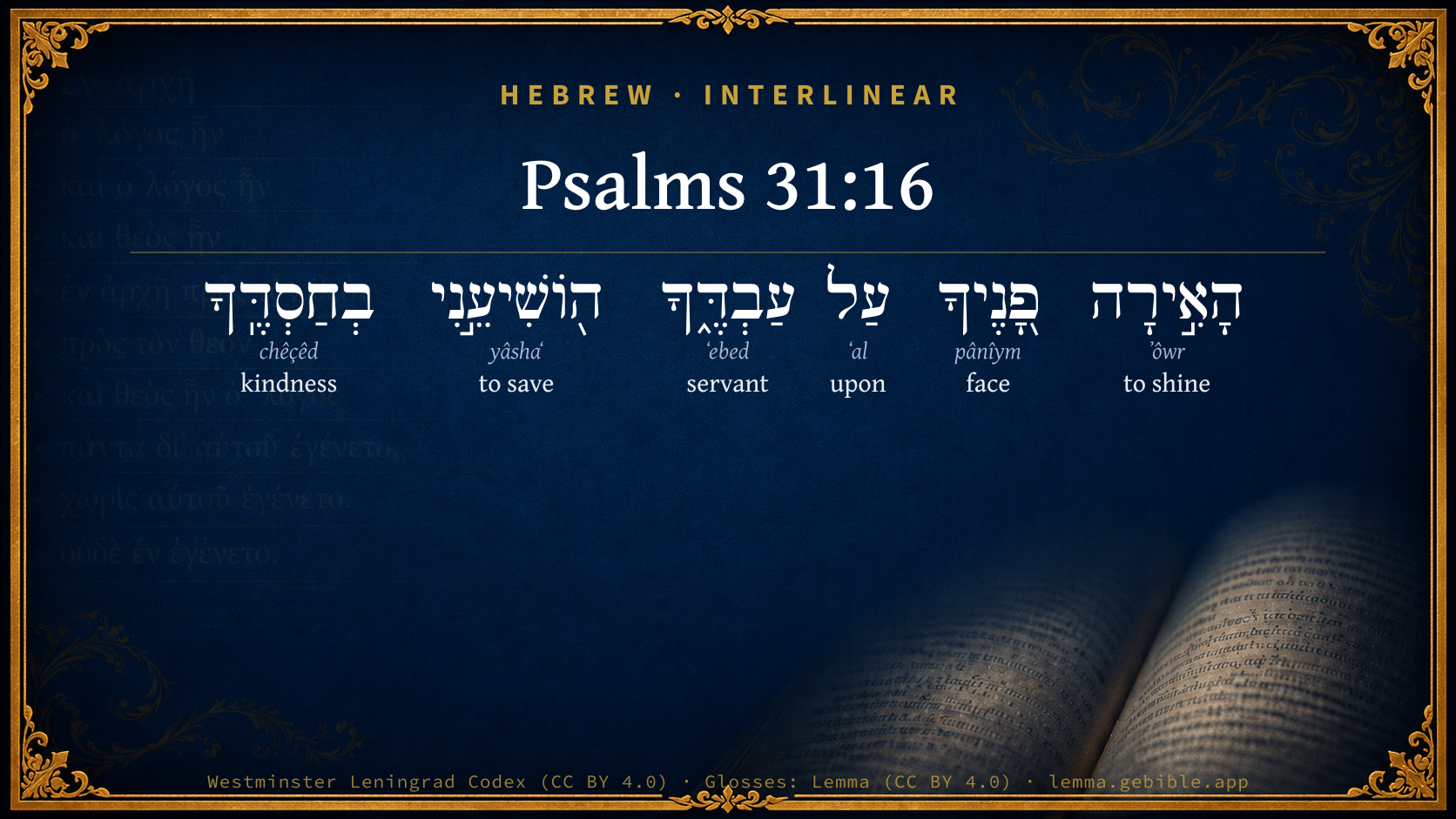
Psalms 31:16

Hebrew (Westminster Leningrad Codex) Psalms 31:16 appears in the Hebrew Old Testament. The text above is from the Westminster Leningrad Codex. Each word links to its Strong’s number, a concise gloss, and parsing drawn from the Open Scriptures Hebrew Bible morphology. Click any word for its full Brown-Driver-Briggs (BDB) entry.
Download image
Cite this verse

Psalms 31:16 (World English Bible). Public Domain. Lemma interlinear Bible study tool, https://lemma.gebible.app/v/psalms/31/16.

Show BibTeX & RIS
BibTeX
RIS
English Translation
Make your face to shine on your servant. Save me in your loving kindness.
World English Bible · Public Domain
Download a study sheet

One document with this verse’s original text, its word-by-word gloss line, the meaning frame, cross-references with their text, attributed commentary, and full source and license credits — printable, and it pastes into notes with its structure intact.

This verse Autodidact and up

Study sheet (.html) Plain text (.txt)

A passage Seminary Student

Up to 50 verses in one chapter. A passage sheet keeps up to 6 commentary sources and 12 cross-references per verse, in the order this page ranks them, and says so on the sheet whenever that leaves anything out. Ask for a single verse and you get the Autodidact verse sheet above.

Everything on this page stays free to read, with no account — the sheet is a download of what is already on screen, not access to it.

Want to remove ads? Support Godless Engineer
Compare translations 3

The same verse in 3 English versions, stacked beneath the original-language interlinear above. Click any original word for its lexicon entry.

Each is an independent rendering of the whole verse — the interlinear is not word-aligned to these translations.

Highlighted words mark where these versions differ — a whole-verse word diff, not a word-by-word alignment.

  • World English Bible Public Domain
    Make your face to shine on your servant. Save me in your loving kindness.
  • King James Version Public Domain
    Make thy face to shine upon thy servant: save me for thy mercies' sake.
  • unfoldingWord Literal Text CC BY-SA 4.0
    Make your face shine upon your servant; save me in your covenant faithfulness.

unfoldingWord Literal Text — © unfoldingWord, licensed CC BY-SA 4.0. Word-aligned USFM3 via Door43 (git.door43.org/unfoldingWord/en_ult).

Versions to compare (up to 4)

3 of 4 selected

Show all 18 translations

Every available English version of this verse, each an independent rendering of the whole verse.

  • World English Bible Public Domain
    Make your face to shine on your servant. Save me in your loving kindness.
  • Berean Standard Bible Public Domain
    Make Your face shine on Your servant; save me by Your loving devotion.
  • Majority Standard Bible Public Domain
    Make Your face shine on Your servant; save me by Your loving devotion.
  • King James Version Public Domain
    Make thy face to shine upon thy servant: save me for thy mercies' sake.
  • American Standard Version (1901) Public Domain
    Make thy face to shine upon thy servant: Save me in thy lovingkindness.
  • Revised Version (1885) Public Domain
    Make thy face to shine upon thy servant: save me in thy lovingkindness.
  • Geneva Bible (1599) Public Domain
    Make thy face to shine vpon thy seruant, and saue me through thy mercie.
  • Douay-Rheims (1899) Public Domain
    My lots are in thy hands. Deliver me out of the hands of my enemies; and from them that persecute me.
  • Young's Literal Translation Public Domain
    Cause Thy face to shine on Thy servant, Save me in Thy kindness.
  • Literal Standard Version CC BY-SA 4.0
    Cause Your face to shine on Your servant, || Save me in Your kindness.
  • Unlocked Literal Bible CC BY-SA 4.0
    Make your face shine on your servant; save me in your covenant faithfulness.
  • unfoldingWord Literal Text CC BY-SA 4.0
    Make your face shine upon your servant; save me in your covenant faithfulness.
  • Darby Bible Public Domain
    Make thy face to shine upon thy servant; save me in thy loving-kindness.
  • World Messianic Bible Public Domain
    Make your face to shine on your servant. Save me in your loving kindness.
  • Webster's Bible Public Domain
    \\31:15\\My times are in thy hand: deliver me from the hand of my enemies, and from them that persecute me.
  • Free Bible Version CC BY-SA 4.0
    May you look kindly on me, your servant. Save me because of your trustworthy love.
  • Bible in Basic English Public Domain
    Let your servant see the light of your face; in your mercy be my saviour.
  • JPS Tanakh (1917) Public Domain
    (31-17) Make Thy face to shine upon Thy servant; save me in Thy lovingkindness.

Literal Standard Version (2020), Covenant Press — licensed CC BY-SA 4.0. Text via the HelloAO Bible API (eBible.org). Unlocked Literal Bible (unfoldingWord) — licensed CC BY-SA 4.0. Text via the HelloAO Bible API (eBible.org). unfoldingWord Literal Text — © unfoldingWord, licensed CC BY-SA 4.0. Word-aligned USFM3 via Door43 (git.door43.org/unfoldingWord/en_ult). Free Bible Version, Dr. Jonathan Gallagher — licensed CC BY-SA 4.0. Text via the HelloAO Bible API (eBible.org).

Word by word

More ways to search: Search by grammar → Find every occurrence → Compare this word →

Practice this passage: Drill this verse → Learn its vocabulary →

הָאִ֣ירָה
ʼôwr
H215
“shine”
Verb, Hiphil, Imperative, 2nd Person, Masculine, Singular + Suffix, h
Part of Speech
Verb
Stem
Hiphil
Form
Imperative
Person
2nd Person
Gender
Masculine
Number
Singular
Full BDB Definition

Origin: a primitive root

TWOT: 52

to be or become light, shine - (Qal) - to become light (day) - to shine (of the sun) - to become bright - (Niphal) - to be illuminated - to become lighted up - (Hiphil) - to give light, shine (of sun, moon, and stars) - to illumine, light up, cause to shine, shine - to kindle, light (candle, wood) - lighten (of the eyes, his law, etc) - to make shine (of the face)
  1. פָ֭נֶיךָ pânîym H6440 “face(s) · your” Noun, Common, Both, Plural, Construct + Suffix, Personal, 2nd Person, Masculine, Singular
  2. עַל ʻal H5921 “upon” Preposition
  3. עַבְדֶּ֑ךָ ʻebed H5650 “servant · your” Noun, Common, Masculine, Singular, Construct + Suffix, Personal, 2nd Person, Masculine, Singular
  4. ה֖וֹשִׁיעֵ֣נִי yâshaʻ H3467 “save · me” Verb, Hiphil, Imperative, 2nd Person, Masculine, Singular + Suffix, Personal, 1st Person, Common, Singular
  5. בְחַסְדֶּֽךָ chêçêd H2617 “in/at · kindness · your” Preposition + Noun, Common, Masculine, Singular, Construct + Suffix, Personal, 2nd Person, Masculine, Singular

About this verse

These counts appear in no published source. They are computed here, from the morphology-tagged text and Lemma’s own curated glosses. What Lemma adds →

6
words
6
distinct lemmas
Wisdom
section

Shared distinctive vocabulary

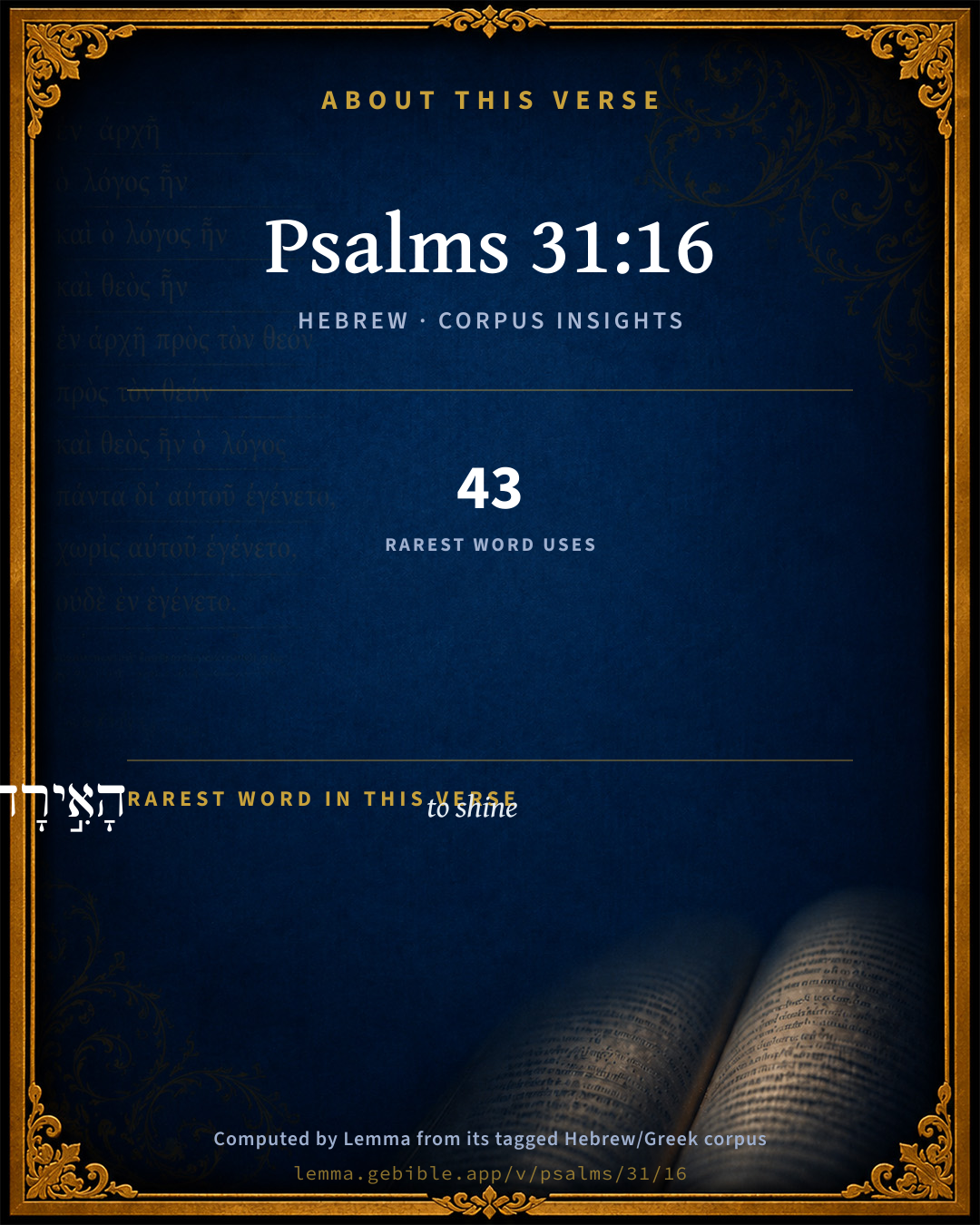
הָאִ֣ירָה to shine H215 occurs in 43 verses of the Hebrew Bible. Also found in:

Grammatical profile

  • 2 verbs
  • 3 nouns
  • 1 preposition

Verb forms

  • הָאִ֣ירָה Hiphil · Imperative
  • ה֖וֹשִׁיעֵ֣נִי Hiphil · Imperative

Hebrew & Septuagint length

In English translation the verse runs 14 words from the Hebrew and 19 from the Septuagint (LXX English) — closely comparable.

A rough comparison of the two English renderings, which tokenize alike — not a word-level alignment.

Word counts can differ between the Hebrew and the Greek without any difference in meaning — e.g. the Hebrew direct-object marker אֵת has no separate Greek word, and Greek often adds the article ὁ.

Cross-references

16

Topical passages linked to Psalms 31:16 in the Treasury of Scripture Knowledge — connected by theme and wording, ordered by reader-vote popularity; previews shown in the World English Bible.

  • Psalms 4:6 Many say, "Who will show us any good?" Yahweh, let the light of your face shine on us.
  • Psalms 6:4 Return, Yahweh. Deliver my soul, And save me for your loving kindness' sake.
  • Psalms 80:3 Turn us again, God. Cause your face to shine, And we will be saved.
  • Daniel 9:9 To the Lord our God belong mercies and forgiveness; for we have rebelled against him;
  • Romans 9:15 For he said to Moses, "I will have mercy on whom I have mercy, and I will have compassion on whom I have compassion."
  • Numbers 6:25–26 Yahweh make his face to shine on you, And be gracious to you.
  • Psalms 67:1 May God be merciful to us, bless us, And cause his face to shine on us. Selah.
  • Daniel 9:17–18 Now therefore, our God, listen to the prayer of your servant, and to his petitions, and cause your face to shine on your sanctuary that is desolate, for the Lord's sake.
  • Ephesians 1:6–7 to the praise of the glory of his grace, by which he freely bestowed favor on us in the Beloved,
  • Ephesians 2:4–7 But God, being rich in mercy, for his great love with which he loved us,
  • Psalms 30:7 You, Yahweh, when you favored me, made my mountain to stand strong. But when you hid your face, I was troubled.
  • Psalms 51:1 Have mercy on me, God, according to your loving kindness. According to the multitude of your tender mercies, blot out my transgressions.
  • Psalms 80:7 Turn us again, God of hosts. Cause your face to shine, And we will be saved.
  • Psalms 80:19 Turn us again, Yahweh God of hosts. Cause your face to shine, and we will be saved.
  • Psalms 106:45 He remembered for them his covenant, And repented according to the multitude of his loving kindnesses.
  • Romans 9:23 and that he might make known the riches of his glory on vessels of mercy, which he prepared beforehand for glory,

Cross-references courtesy of OpenBible.info (CC BY 4.0).

Hebrew and Greek witnesses Masoretic Hebrew ↔ Greek Septuagint

The same verse in the two great witnesses to the Old Testament, shown verse-for-verse.

You’re reading Greek Psalm 30 (Hebrew Psalm 31). The Septuagint counts the superscription, so verse numbers can differ from the Hebrew — chapter-level alignment, not verse-by-verse. Numbering follows Rahlfs.

These are two independent witnesses, not word-aligned to each other, and the Septuagint is shown in lemma (dictionary) form.

Hebrew Psalms 31:16 Masoretic · Westminster Leningrad Codex

הָאִ֣ירָה פָ֭נֶיךָ עַל עַבְדֶּ֑ךָ ה֖וֹשִׁיעֵ֣נִי בְחַסְדֶּֽךָ

Make your face to shine on your servant. Save me in your loving kindness.

World English Bible · Public Domain

Greek LXX Greek Psalm 30:16 Septuagint · lemma form

ἐν ὁ χείρ σύ ὁ καιρός ἐγώ ῥύομαι ἐγώ ἐκ χείρ ἐχθρός ἐγώ καί ἐκ ὁ καταδιώκω ἐγώ

and from them that persecute me. Make your face to shine upon your servant: save me in your mercy.

LXX2012 (modern English Septuagint) · Public Domain

Hebrew: Westminster Leningrad Codex (CC BY 4.0). Greek: Septuagint (public domain); English from LXX2012 (modern English Septuagint) (Public Domain). How the Septuagint differs from the Hebrew →

Commentary

Notes on Psalms 31:16 from classic Christian and Jewish commentators (each source and its license shown beneath its notes). The classic Christian expositions comment on the surrounding passage and are grouped to its opening verse, so a note may address several verses; the Jewish commentaries on the Tanakh (Rashi and others) are per-verse, so they appear only where the commentator wrote on this verse.

Lemma curates 59 commentaries, every one of them public domain or Creative Commons licensed, each selected and text-cleaned for this edition rather than reprinted as found. About our sources →

Trapp's Complete Commentary

John Trapp

Psa 31:16 Make thy face to shine upon thy servant: save me for thy mercies’ sake.

Ver. 16. Make thy face to shine, &c.] Which by reason of the clouds of affliction clustering about me, I cannot for present perceive. {See Trapp on "Psa 4:6"} {See Trapp on "Psa 30:7"}

Save me, &c.] i.e. Deliver me out of these dangers.

John Trapp, A Commentary or Exposition upon All the Books of the Old and New Testament (1647–1656) — public domain. Text from a community e-Sword module.

J. A. Alexander on Psalms

Joseph Addison Alexander

17. (Psa 31:16). Let thy face shine on thy servant; save me in thy mercy. The first clause contains an allusion to the sacerdotal benediction recorded in Num 6:25. See above, on Psa 4:7 (6), where we have a similar allusion to that passage. "Grant me a sensible assurance of thy favour." This he asks because he is his servant, a relation implying the necessity of God's interposition in his favour. While God is God, he cannot leave his faithful servants to perish. Even here, however, his appeal is to God's mercy, as, the only source or means of safety.

Joseph Addison Alexander, The Psalms Translated and Explained (1850) — public domain. Text from a community e-Sword module.

Jamieson, Fausset & Brown

Robert Jamieson, A. R. Fausset & David Brown

Make . . . shine--(Compare Num 6:25; Psa 4:6). Deprecating from himself, he imprecates on the wicked God's displeasure, and prays that their virulent persecution of him may be stopped.

Jamieson, Fausset & Brown — Commentary Critical and Explanatory on the Whole Bible (1871) — public domain (CC PDM 1.0). Text via the HelloAO Bible API.

Adam Clarke's Commentary

Verse 16. Make thy face to shine upon thy servant] Only let me know that thou art reconciled to and pleased with me, and then, come what will, all must be well.

Save me for thy mercies' sake.] Literally, Save me in thy mercy.

Adam Clarke's Commentary on the Bible (1810–1826) — public domain. Text from a community e-Sword/MySword module.

John Calvin's Commentaries

16. Make thy face to shine upon thy servant. We have said formerly, and we shall see in many instances hereafter, that this form of speech is taken from the common apprehension of men, who think that God regards them not, unless he really show his care of them by its effects. According to the judgment of sense, afflictions hide his countenance, just as clouds obscure the brightness of the sun. David therefore supplicates that God, by affording him immediate assistance, would make it evident to him that he enjoyed his grace and favor, which it is not very easy to discern amidst the darkness of afflictions. Now, God is said to lift the light of his countenance upon us in two ways; either when he opens his eyes to take care of our affairs, or when he shows to us his favor. These two things are indeed inseparable, or rather, the one depends upon the other. But by the first mode of speech, we, according to our carnal conceptions, attribute to God a mutability which, properly speaking, does not belong to him: whereas the second form of speech indicates, that our own eyes, rather than the eyes of God, are shut or heavy when he seems to have no regard to our afflictions. By the word preserve David explains what he meant by the former expression; but as there was at that time no way of safety apparent to him, he encourages himself to hope for it by setting before him the goodness of God.

John Calvin's Commentaries (1540-1563) — public domain. Text from the Calvin Translation Society English edition (1840s-50s) via the Christian Classics Ethereal Library (ccel.org). Calvin's coverage is partial (roughly two-thirds of the Bible); uncommented books and verses are honest gaps, never fabricated. The 19th-century editor's footnotes and remarks are omitted so the notes are faithfully Calvin's own voice.

Ellicott's Commentary for English Readers

(16) Make thy face to shine.—As in Psa_4:6, an echo of the priestly blessing. (Num_6:24-26.)

A Bible Commentary for English Readers, edited by Charles John Ellicott (1878–1897) — public domain. Text from a community e-Sword module.

The Cambridge Bible for Schools and Colleges

gen. ed. J. J. S. Perowne

16. Comp. the paraphrase in P.B.V., Shew thy servant the light of thy countenance: and see note on Psa_4:6.

for thy mercy’s sake] R.V. in thy lovingkindness, as in Psa_31:7; Psa_31:21.

The Cambridge Bible for Schools and Colleges (gen. ed. J. J. S. Perowne; Cambridge University Press, 1878–1918) — public domain. Text from a community e-Sword module.

John Gill's Exposition

Make thy face to shine upon thy servant,.... In which he prays for the gracious presence of God, the manifestations of himself unto him, the discoveries of his love, the enjoyment of him in Christ, communion with him, the comforts of his Spirit, and joys of his salvation; see Num 6:25;

save me for thy mercies' sake; not for any merit and righteousness of his own, but for the sake of the grace and goodness of the Lord; which is putting salvation, whether temporal or spiritual, upon its right foot and foundation; which is never wrought out by, or is for works of righteousness done by men, but according to the grace and mercy of God.

John Gill's Exposition of the Whole Bible (1746–1763) — public domain (CC PDM 1.0). Text via the HelloAO Bible API.

Albert Barnes' Notes on the Bible

Make thy face to shine upon thy servant - That is, show me thy favor, or be kind and merciful to me. See the notes at Psa 4:6.

Save me for thy mercies’ sake - On account of thy mercy; or that thy mercy may be manifested. This is always a just ground of appeal to God by a sinner or a sufferer, that God would make our sins and trials an “occasion” for displaying his own character. There are, indeed, other grounds of appeal; but there is no one that is more pure or exalted than this.

Albert Barnes' Notes on the Bible (1834–1885) — public domain. Text from a community e-Sword/MySword module.

Matthew Poole's English Annotations

Manifest thy love and favour to me, by answering my prayers, and saving me from all mine enemies.

Matthew Poole's English Annotations on the Holy Bible (1683–1685) — public domain. Text from a community e-Sword/MySword module.

The Treasury of David

Charles H. Spurgeon

Ver. 16. Make thy face to shine upon thy servant. Give me the sunshine of heaven in my soul, and I will defy the tempests of earth. Permit me to enjoy a sense of thy favour, O Lord, and a consciousness that thou art pleased with my manner of life, and all men may frown and slander as they will. It is always enough for a servant if he pleases his master; others may be dissatisfied, but he is not their servant, they do not pay him his wages, and their opinions have no weight with him. Save me for thy mercies' sake. The good man knows no plea but mercy; whoever might urge legal pleas David never dreamed of it.

Ver. 16. Make thy face to shine upon thy servant. When the cloud of trouble hideth the Lord's favour, faith knoweth it may shine again, and therefore prayeth through the cloud for the dissolving of it. Make thy face to shine upon thy servant. David Dickson.

Ver. 16. A sense of divine favour.

1. Its value.

2. How to lose it.

3. How to obtain a renewal of it.

4. How to retain it.

The heavenly servant's best reward.

Ver. 16. (last clause). A prayer for saints in all stages. Note its object, save me; and its plea, Thy mercies' sake. Suitable to the penitent, the sick, the doubting, the tried, the advanced believer, the dying saint.

Psalms 31:17*

Charles H. Spurgeon's The Treasury of David (1869–1885) — public domain. Psalms only. Text from a community e-Sword/MySword module.

Whedon's Commentary on the Bible

Daniel D. Whedon

16. Make thy face to shine—A part of the Levitical benediction.

Num_6:25. See note on Psa_4:7

Daniel D. Whedon (gen. ed.), Commentary on the Old and New Testaments (1874–1909) — public domain. Text from a community e-Sword module.

The Pulpit Commentary

Make thy face to shine upon thy servant. This expression is first used in the blessing of Moses. (Num_6:25) Its intrinsic beauty and poetry recommended it to the psalmists, with whom it recurs frequently. (comp. Psa_4:6 Psa_67:1 Psa_80:5, Psa_80:7, 19 119:135) It may be regarded as equivalent to "Be thou favourable and gracious unto thy servant." Save me for thy mercies" sake; literally, save me in thy mercy.

The Pulpit Commentary (1880–1919), ed. H.D.M. Spence-Jones & Joseph S. Exell — public domain. Text from a community e-Sword module.

Rashi

Rabbi Shlomo Yitzchaki (Rashi)

My times are in Your hands The times that pass over me are through Your orders and by Your decrees.

Rashi on the Tanakh — English translations: “The Judaica Press complete Tanach with Rashi, translated by A. J. Rosenberg” (CC BY 4.0); “Pentateuch with Rashi's commentary by M. Rosenbaum and A.M. Silbermann, 1929-1934” (public domain); “The Metsudah Tanach series, Lakewood, N.J” (CC BY 4.0); and “The Book of Joshua, Metsudah Publications, 1997” (CC BY 4.0). Text via Sefaria.

Lesson kit

Teaching starters — assembled from the data on this page, not authored interpretation. Every prompt links to the verse data it draws on. Edit before teaching.

Psalms, in the Wisdom, opens this verse with 6 words (6 distinct Hebrew lemmas). Its most distinctive word is ʼôwr (“to shine”). A historical commentator’s framing appears above. Read the whole chapter for the surrounding context.

Discussion questions

  1. How does “to shine” (ʼôwr) shape what this verse is saying?
  2. How does Genesis 1:15, which shares the word «to shine», read alongside this verse?
  3. These translations render this verse differently. What is at stake in choosing one wording over another?
  4. «הָאִ֣ירָה» is a Hiphil Imperative verb. How does that grammatical form shape the action described?
  5. Compare how Trapp's Complete Commentary and J. A. Alexander on Psalms read this verse. Where do they agree or differ?

Things to notice

Reading settings

Reading text

Shown beneath each verse's original-language words.

Old Testament
Old Testament edition

Read the OT as the Masoretic Hebrew (MT) or the Greek Septuagint (LXX).

English shown for the Greek Septuagint (in the Hebrew ↔ Greek comparison).

Comparing translations? Open the Compare panel on any verse page to stack up to four side by side.