
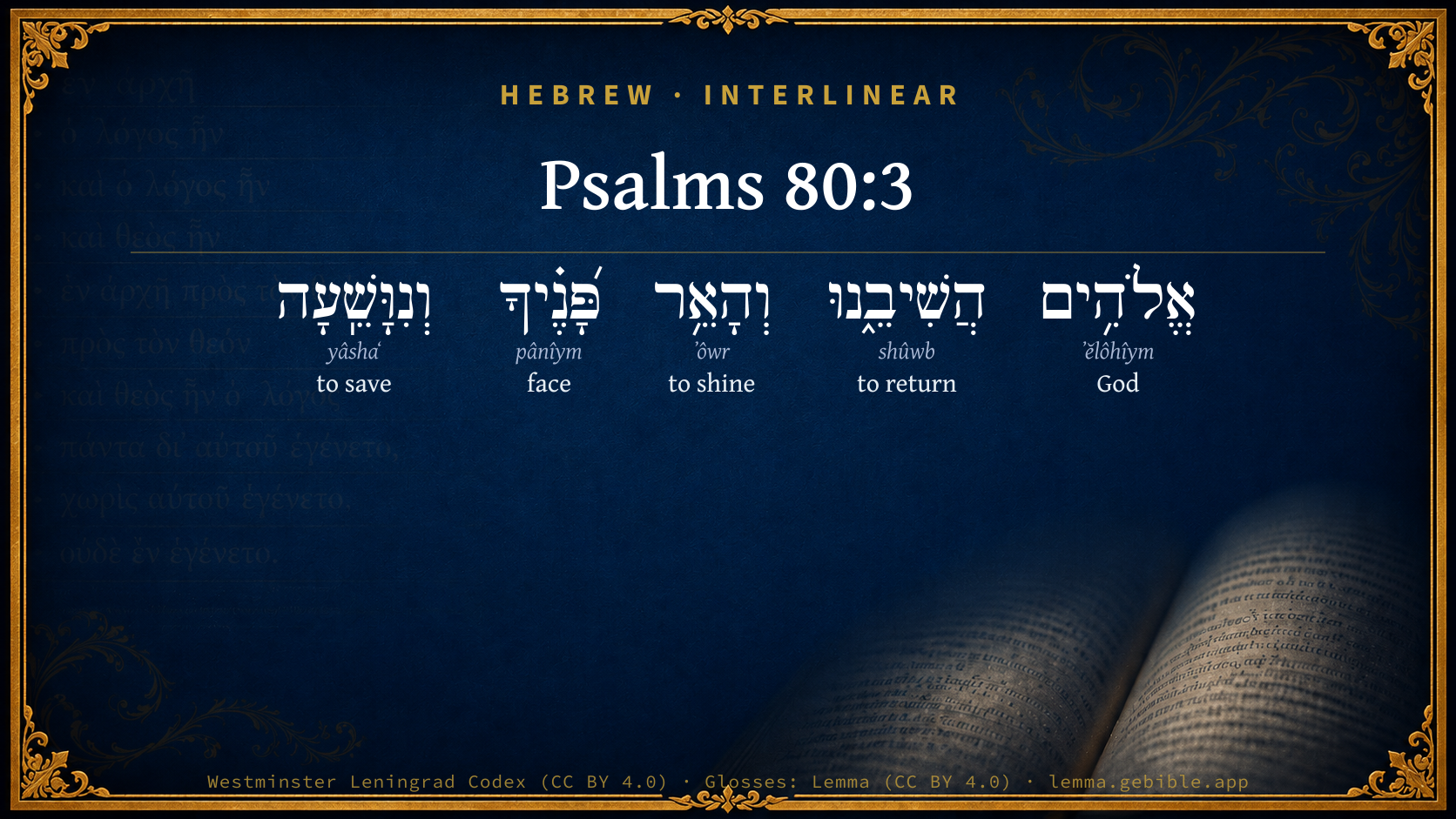
Psalms 80:3

Hebrew (Westminster Leningrad Codex) Psalms 80:3 appears in the Hebrew Old Testament. The text above is from the Westminster Leningrad Codex. Each word links to its Strong’s number, a concise gloss, and parsing drawn from the Open Scriptures Hebrew Bible morphology. Click any word for its full Brown-Driver-Briggs (BDB) entry.
Download image
Cite this verse

Psalms 80:3 (World English Bible). Public Domain. Lemma interlinear Bible study tool, https://lemma.gebible.app/v/psalms/80/3.

Show BibTeX & RIS
BibTeX
RIS
English Translation
Turn us again, God. Cause your face to shine, And we will be saved.
World English Bible · Public Domain
Download a study sheet

One document with this verse’s original text, its word-by-word gloss line, the meaning frame, cross-references with their text, attributed commentary, and full source and license credits — printable, and it pastes into notes with its structure intact.

This verse Autodidact and up

Study sheet (.html) Plain text (.txt)

A passage Seminary Student

Up to 50 verses in one chapter. A passage sheet keeps up to 6 commentary sources and 12 cross-references per verse, in the order this page ranks them, and says so on the sheet whenever that leaves anything out. Ask for a single verse and you get the Autodidact verse sheet above.

Everything on this page stays free to read, with no account — the sheet is a download of what is already on screen, not access to it.

Want to remove ads? Support Godless Engineer
Compare translations 3

The same verse in 3 English versions, stacked beneath the original-language interlinear above. Click any original word for its lexicon entry.

Each is an independent rendering of the whole verse — the interlinear is not word-aligned to these translations.

Highlighted words mark where these versions differ — a whole-verse word diff, not a word-by-word alignment.

  • World English Bible Public Domain
    Turn us again, God. Cause your face to shine, And we will be saved.
  • King James Version Public Domain
    Turn us again, O God, and cause thy face to shine; and we shall be saved.
  • unfoldingWord Literal Text CC BY-SA 4.0
    God, restore us, and make your face shine and let us be saved.

unfoldingWord Literal Text — © unfoldingWord, licensed CC BY-SA 4.0. Word-aligned USFM3 via Door43 (git.door43.org/unfoldingWord/en_ult).

Versions to compare (up to 4)

3 of 4 selected

Show all 18 translations

Every available English version of this verse, each an independent rendering of the whole verse.

  • World English Bible Public Domain
    Turn us again, God. Cause your face to shine, And we will be saved.
  • Berean Standard Bible Public Domain
    Restore us, O God, and cause Your face to shine upon us, that we may be saved.
  • Majority Standard Bible Public Domain
    Restore us, O God, and cause Your face to shine upon us, that we may be saved.
  • King James Version Public Domain
    Turn us again, O God, and cause thy face to shine; and we shall be saved.
  • American Standard Version (1901) Public Domain
    Turn us again, O God; And cause thy face to shine, and we shall be saved.
  • Revised Version (1885) Public Domain
    Turn us again, O God; and cause thy face to shine, and we shall be saved.
  • Geneva Bible (1599) Public Domain
    Turne vs againe, O God, and cause thy face to shine that we may be saued.
  • Douay-Rheims (1899) Public Domain
    before Ephraim, Benjamin, and Manasses. Stir up thy might, and come to save us.
  • Young's Literal Translation Public Domain
    O God, cause us to turn back, And cause Thy face to shine, and we are saved.
  • Literal Standard Version CC BY-SA 4.0
    O God, cause us to turn back, || And cause Your face to shine, and we are saved.
  • Unlocked Literal Bible CC BY-SA 4.0
    God, restore us; make your face shine on us, and we will be saved.
  • unfoldingWord Literal Text CC BY-SA 4.0
    God, restore us, and make your face shine and let us be saved.
  • Darby Bible Public Domain
    O God, restore us; and cause thy face to shine, and we shall be saved.
  • World Messianic Bible Public Domain
    Turn us again, God. Cause your face to shine, and we will be saved.
  • Webster's Bible Public Domain
    \\80:2\\Before Ephraim and Benjamin and Manasseh stir up thy strength, and come and save us.
  • Free Bible Version CC BY-SA 4.0
    God, please restore us! Let your face shine on us so we can be saved.
  • Bible in Basic English Public Domain
    Take us back again, O God; let us see the shining of your face, and let us be safe.
  • JPS Tanakh (1917) Public Domain
    (80-4) O God, restore us; and cause Thy face to shine, and we shall be saved.

Literal Standard Version (2020), Covenant Press — licensed CC BY-SA 4.0. Text via the HelloAO Bible API (eBible.org). Unlocked Literal Bible (unfoldingWord) — licensed CC BY-SA 4.0. Text via the HelloAO Bible API (eBible.org). unfoldingWord Literal Text — © unfoldingWord, licensed CC BY-SA 4.0. Word-aligned USFM3 via Door43 (git.door43.org/unfoldingWord/en_ult). Free Bible Version, Dr. Jonathan Gallagher — licensed CC BY-SA 4.0. Text via the HelloAO Bible API (eBible.org).

Word by word

More ways to search: Search by grammar → Find every occurrence → Compare this word →

Practice this passage: Drill this verse → Learn its vocabulary →

וְהָאֵ֥ר
ʼôwr
H215
“and · shine”
Conjunction + Verb, Hiphil, Imperative, 2nd Person, Masculine, Singular
Part of Speech
Conjunction + Verb
Stem
Hiphil
Form
Imperative
Person
2nd Person
Gender
Masculine
Number
Singular
Full BDB Definition

Origin: a primitive root

TWOT: 52

to be or become light, shine - (Qal) - to become light (day) - to shine (of the sun) - to become bright - (Niphal) - to be illuminated - to become lighted up - (Hiphil) - to give light, shine (of sun, moon, and stars) - to illumine, light up, cause to shine, shine - to kindle, light (candle, wood) - lighten (of the eyes, his law, etc) - to make shine (of the face)
  1. אֱלֹהִ֥ים ʼĕlôhîym H430 “God(s)” Noun, Common, Masculine, Plural, Absolute
  2. הֲשִׁיבֵ֑נוּ shûwb H7725 “return · us” Verb, Hiphil, Imperative, 2nd Person, Masculine, Singular + Suffix, Personal, 1st Person, Common, Plural
  3. פָּ֝נֶ֗יךָ pânîym H6440 “face(s) · your” Noun, Common, Both, Plural, Construct + Suffix, Personal, 2nd Person, Masculine, Singular
  4. וְנִוָּשֵֽׁעָה yâshaʻ H3467 “and · to save” Conjunction + Verb, Niphal, Cohortative, 1st Person, Common, Plural

About this verse

These counts appear in no published source. They are computed here, from the morphology-tagged text and Lemma’s own curated glosses. What Lemma adds →

5
words
5
distinct lemmas
Wisdom
section

Shared distinctive vocabulary

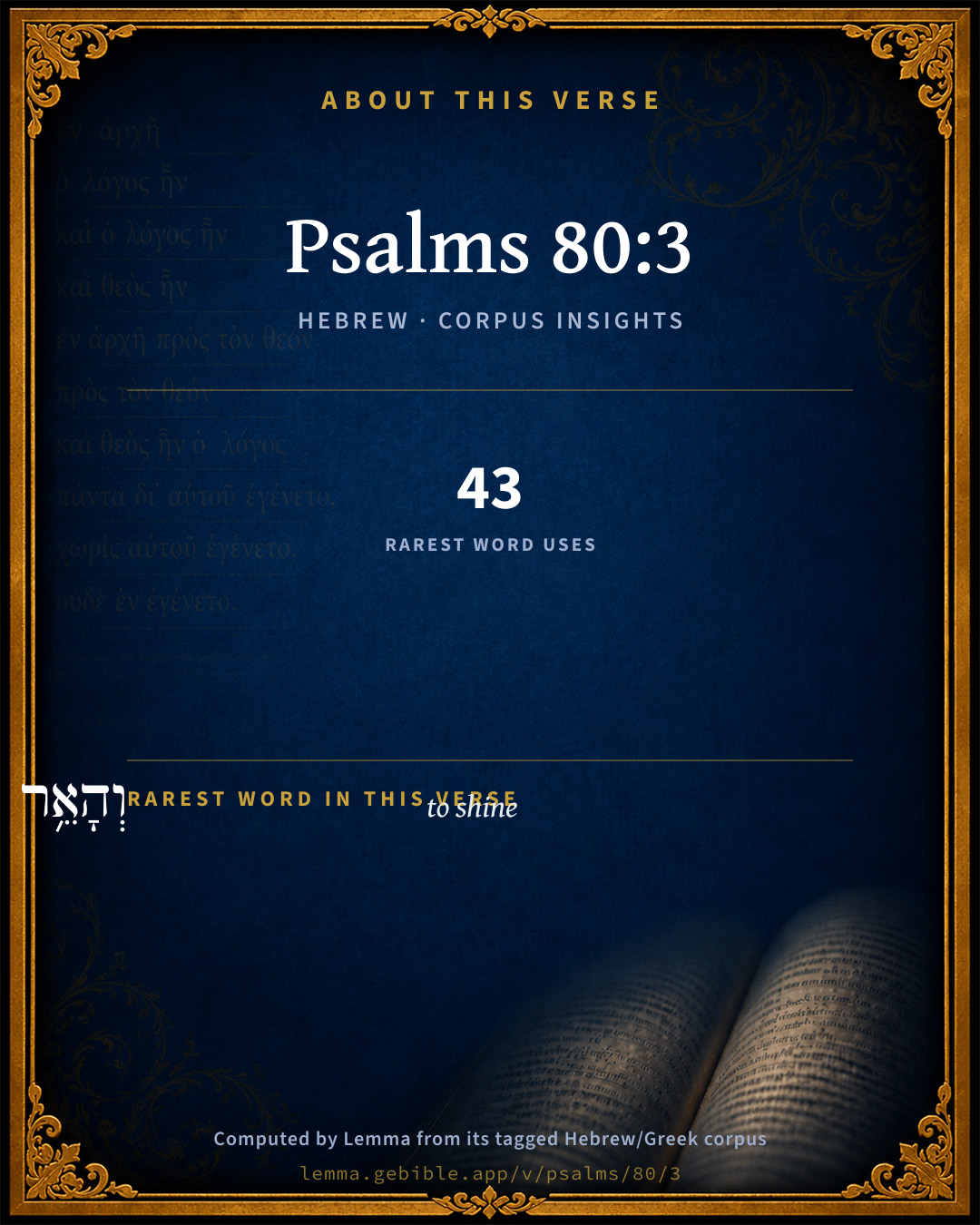
וְהָאֵ֥ר to shine H215 occurs in 43 verses of the Hebrew Bible. Also found in:

Grammatical profile

  • 3 verbs
  • 2 nouns

Verb forms

  • הֲשִׁיבֵ֑נוּ Hiphil · Imperative
  • וְהָאֵ֥ר Hiphil · Imperative
  • וְנִוָּשֵֽׁעָה Niphal · Cohortative

Hebrew & Septuagint length

In English translation the verse runs 14 words from the Hebrew and 15 from the Septuagint (LXX English) — closely comparable.

A rough comparison of the two English renderings, which tokenize alike — not a word-level alignment.

Word counts can differ between the Hebrew and the Greek without any difference in meaning — e.g. the Hebrew direct-object marker אֵת has no separate Greek word, and Greek often adds the article ὁ.

Cross-references

12

Topical passages linked to Psalms 80:3 in the Treasury of Scripture Knowledge — connected by theme and wording, ordered by reader-vote popularity; previews shown in the World English Bible.

  • Lamentations 5:21 Turn you us to you, Yahweh, and we shall be turned; Renew our days as of old.
  • Numbers 6:25–26 Yahweh make his face to shine on you, And be gracious to you.
  • Psalms 85:4 Turn us, God of our salvation, And cause your indignation toward us to cease.
  • Psalms 4:6 Many say, "Who will show us any good?" Yahweh, let the light of your face shine on us.
  • Psalms 80:7 Turn us again, God of hosts. Cause your face to shine, And we will be saved.
  • Psalms 80:19 Turn us again, Yahweh God of hosts. Cause your face to shine, and we will be saved.
  • 1 Kings 18:37 Hear me, Yahweh, hear me, that this people may know that you, Yahweh, are God, and [that] you have turned their heart back again.
  • Psalms 67:1 May God be merciful to us, bless us, And cause his face to shine on us. Selah.
  • Psalms 80:1 Hear us, Shepherd of Israel, You who lead Joseph like a flock, You who sit above the cherubim, shine forth.
  • Psalms 119:135 Make your face shine on your servant. Teach me your statutes.
  • Psalms 60:1 God, you have rejected us. You have broken us down. You have been angry. Restore us, again.
  • Jeremiah 31:18–19 I have surely heard Ephraim bemoaning himself [thus], You have chastised me, and I was chastised, as a calf unaccustomed [to the yoke]: turn you me, and I shall be turned; for you are Yahweh my God.

Cross-references courtesy of OpenBible.info (CC BY 4.0).

Hebrew and Greek witnesses Masoretic Hebrew ↔ Greek Septuagint

The same verse in the two great witnesses to the Old Testament, shown verse-for-verse.

You’re reading Greek Psalm 79 (Hebrew Psalm 80). The Septuagint counts the superscription, so verse numbers can differ from the Hebrew — chapter-level alignment, not verse-by-verse. Numbering follows Rahlfs.

These are two independent witnesses, not word-aligned to each other, and the Septuagint is shown in lemma (dictionary) form.

Hebrew Psalms 80:3 Masoretic · Westminster Leningrad Codex

אֱלֹהִ֥ים הֲשִׁיבֵ֑נוּ וְהָאֵ֥ר פָּ֝נֶ֗יךָ וְנִוָּשֵֽׁעָה

Turn us again, God. Cause your face to shine, And we will be saved.

World English Bible · Public Domain

Greek LXX Greek Psalm 79:3 Septuagint · lemma form

ἐναντίον εφράιμ καί βενιαμίν καί μανασσή ἐκἐγείρω ὁ δυναστεία σύ καί ἔρχομαι εἰς ὁ σώζω ἐγώ

Turn us, O God, and cause your face to shine; and we shall be delivered.

LXX2012 (modern English Septuagint) · Public Domain

Hebrew: Westminster Leningrad Codex (CC BY 4.0). Greek: Septuagint (public domain); English from LXX2012 (modern English Septuagint) (Public Domain). How the Septuagint differs from the Hebrew →

Commentary

Notes on Psalms 80:3 from classic Christian and Jewish commentators (each source and its license shown beneath its notes). The classic Christian expositions comment on the surrounding passage and are grouped to its opening verse, so a note may address several verses; the Jewish commentaries on the Tanakh (Rashi and others) are per-verse, so they appear only where the commentator wrote on this verse.

Lemma curates 59 commentaries, every one of them public domain or Creative Commons licensed, each selected and text-cleaned for this edition rather than reprinted as found. About our sources →

Trapp's Complete Commentary

John Trapp

Psa 80:3 Turn us again, O God, and cause thy face to shine; and we shall be saved.

Ver. 3. Turn us again] Turn again our captivity, or show thyself reconciled unto us in Christ, who is here called the face of God, as some conceive.

John Trapp, A Commentary or Exposition upon All the Books of the Old and New Testament (1647–1656) — public domain. Text from a community e-Sword module.

Joseph Benson's Commentary

Psa 80:3. Turn us again — He means, either to our former quiet and flourishing state; or, to thyself, from whom Ephraim and Manasseh, with the rest of the ten tribes, have apostatized. See a similar prayer of Elijah for them, 1Ki 18:37. Instead of, Turn us, Mudge reads, Restore us, which is equally agreeable to the original word, השׁיבנו, hashibenu. “There are evidently four parts in this Psalm; all of which conclude with this verse, or with one varying very little from it. In the first, the psalmist entreats God to assist them, as he formerly did their forefathers. In the second, he beseeches him to have compassion upon their miserable condition. In the third, not to forsake those now for whom he had already done so much; and in the fourth, concludes with a prayer for their king, and a promise of future obedience, as a grateful return for God’s favours.” — Dodd.

Joseph Benson's Commentary on the Old and New Testaments (1811–1818) — public domain. Text from a community e-Sword module.

J. A. Alexander on Psalms

Joseph Addison Alexander

4. (Psa 80:3) O God, restore us, and let thy face shine; and let us be saved! The verb in the first clause would suggest two ideas to a Hebrew reader, both of which are here appropriate. The first is that of a literal bringing back from exile or captivity; the other that of restoration to a former state, without regard to change of place or other local circumstances. In the case before us, the general and figurative sense of restoration includes that of literal return. The church prays to be restored to her integrity and normal state, by the redemption of the part which had gone into captivity. This prayer was substantially fulfilled in the return of many members of the ten tribes with Judah from the Babylonish exile, while the tribes themselves, as organised bodies, and the apostate kingdom which they constituted, ceased to exist. The petition, cause thy face to shine, i. e. look upon us with a favourable countenance, is borrowed from the sacerdotal blessing, Num 6:25. See above, on Psa 4:6; Psa 31:16. The last verb in the verse may also be explained as an expression of strong confidence, we shall be saved, which really involves the subjunctive sense preferred by some interpreters, that we may be saved. This sentence, which is solemnly repeated at the close of Psa 80:3; Psa 80:19, is thereby marked as the theme or keynote of the whole composition.

Joseph Addison Alexander, The Psalms Translated and Explained (1850) — public domain. Text from a community e-Sword module.

Tyndale Open Study Notes

Tyndale Open Resources

80:3 This verse is repeated (with an increasing crescendo) in 80:7, 19.

Tyndale Open Study Notes — © Tyndale Open Resources, licensed CC BY-SA 4.0. Text via the HelloAO Bible API.

Geneva Bible (1599)

Geneva Bible translators

Join thy whole people, and all thy tribes together again.

Geneva Bible (1599) marginal notes — public domain. Text via Bolls.life.

Adam Clarke's Commentary

Verse 3. Turn us again] השיבנו hashibenu, convert or restore us. There are four parts in this Psalm, three of which end with the above words; see the third, seventh, and nineteenth verses; and one with words similar, Ps 80:14.

Adam Clarke's Commentary on the Bible (1810–1826) — public domain. Text from a community e-Sword/MySword module.

John Calvin's Commentaries

3 Turn us again, O God! The meaning of this prayer is, Restore us to our former state. They had petitioned, in the preceding verse, that God would stir up his strength in the sight of Ephraim and Manasseh; and now they complain that they are but castaways until God succor them, and remedy their miserable dispersion. Some understand the words, turn us again, in a different way; namely, as a prayer that God would bestow upon them the spirit of regeneration. But this interpretation being too refined, it will be better, adhering to the former sense, to view the expression as meaning that the faithful, under the adversity with which they were afflicted, betake themselves to God, whose peculiar work it is to restore life to the dead. They acknowledge, on the one hand, that all their miseries were to be traced to this as their cause, that God, being angry on account of their sins, hid his face from them; and, on the other hand, they expect to obtain complete salvation solely through the Divine favor. It will be to us, they say, a resurrection indeed, if once thy countenance shine upon us. Their language implies, that provided God extended his mercy and favor to them, they would be happy, and all their affairs would prosper.

John Calvin's Commentaries (1540-1563) — public domain. Text from the Calvin Translation Society English edition (1840s-50s) via the Christian Classics Ethereal Library (ccel.org). Calvin's coverage is partial (roughly two-thirds of the Bible); uncommented books and verses are honest gaps, never fabricated. The 19th-century editor's footnotes and remarks are omitted so the notes are faithfully Calvin's own voice.

Ellicott's Commentary for English Readers

(3) Turn us again—i.e., “restore us,” not necessarily with reference to the Captivity, but generally, restore us to our pristine prosperity.

Cause thy face to shine.—The desert encampment and march is still in the poet’s thought. As in Psa_67:1 (see Note) we have here a reminiscence of the priestly benediction.

Saved.—Or, helped. This verse constitutes the refrain.

A Bible Commentary for English Readers, edited by Charles John Ellicott (1878–1897) — public domain. Text from a community e-Sword module.

The Cambridge Bible for Schools and Colleges

gen. ed. J. J. S. Perowne

3. Turn us again] Usually taken to mean bring us back from exile, or more generally, restore us: repair our broken fortunes. Cp. Psa_60:1. But is it not rather an allusion to Ephraim’s prayer in Jer_31:18, interpreted in Lam_5:21 in a spiritual sense? National repentance is the condition of national restoration; and it must be God’s own work. Make us return to Thee, and return to us (Psa_80:14) with Thy favour as of old; then and not till then shall we be saved.

cause thy face to shine] Shew us Thy favour as of old: words borrowed from the great Aaronic benediction, Num_6:25. Cp. Psa_4:6.

The Cambridge Bible for Schools and Colleges (gen. ed. J. J. S. Perowne; Cambridge University Press, 1878–1918) — public domain. Text from a community e-Sword module.

John Gill's Exposition

Turn us again, O God,.... From our captivity, as the Targum, into our own land; or return us backsliding sinners to thyself by repentance; turn us, and we shall be turned; for the prayer shows it was not in their power, but must be effected by the grace of God; or restore our souls, which have been wandering, and them to their former flourishing and comfortable condition:

and cause thy face to shine; grant thy gracious presence, lift up the light of thy countenance; favour with the manifestations of thyself, the enjoyment of thee, and communion with thee through Christ; indulge us with the discoveries of thy love, the joys of salvation, the comforts of the Spirit, and larger measures of grace:

and we shall be saved; be in a very happy and comfortable condition; see Psa 4:6.

John Gill's Exposition of the Whole Bible (1746–1763) — public domain (CC PDM 1.0). Text via the HelloAO Bible API.

Albert Barnes' Notes on the Bible

Turn us again - This phrase in our translation would seem to mean, “Turn us again from our sins,” or, “Bring us back to our duty, and to thy love;” and this idea is commonly attached to the phrase probably by the readers of the Bible. But this, though in itself an appropriate prayer, is not the idea here. It is simply, Bring us back; cause us to return; restore us. The idea thus suggested would be either

(a) restore us to our former state of prosperity; that is, Cause these desolations to cease; or

(b) bring us back, as from captivity, to our own land; restore us to our country and our homes, from which we have been driven out.

Thus understood, it would be properly the language of those who were in captivity or exile, praying that they might be restored again to their own land.

And cause thy face to shine - Be favorable or propitious to us. Let the frown on thy countenance disappear. See the notes at Psa 4:6.

And we shall be saved - Saved from our dangers; saved from our troubles. It is also true that when God causes his face to shine upon us, we shall be saved from our sins; saved from ruin. It is only by his smile and favor that we can be saved in any sense, or from any danger.

Albert Barnes' Notes on the Bible (1834–1885) — public domain. Text from a community e-Sword/MySword module.

Matthew Poole's English Annotations

Turn us again; either,

l. To our former quiet and flourishing estate; or,

2. To thyself, from whom Ephraim and Manasseh with the rest of the ten tribes have apostatized. See the like prayer of Elijah for them, 1Ki 18:37.

Matthew Poole's English Annotations on the Holy Bible (1683–1685) — public domain. Text from a community e-Sword/MySword module.

The Treasury of David

Charles H. Spurgeon

Ver. 3. "Turn us again, O God." It is not so much said, "turn our captivity, "but "turn us." All will come right if we are right. The best turn is not that of circumstances but of character. When the Lord turns his people he will soon turn their condition. It needs the Lord himself to do this, for conversion is as divine a work as creation; and those who have been once turned unto God, if they at any time backslide, as much need the Lord to turn them again as to turn them at the first. The word may be read, "restore us; "verily, it is a choice mercy that "he restoreth my soul."

"And cause thy face to shine." Be favourable to us, smile upon us. This was the high priest's blessing upon Israel: what the Lord has already given us by our High Priest and Mediator we may right confidently ask of him.

"And we shall be saved." All that is wanted for salvation is the Lord's favour. One glance of his gracious eye would transform Tophet into Paradise. No matter how fierce the foe, or dire the captivity, the shining face of God ensures both victory and liberty. This verse is a very useful prayer. Since we too often turn aside, let us often with our lips and heart cry, "Turn us again, O God, and cause thy face to shine, and we shall be saved."

Ver. 3. "Turn us, and cause thy face to shine." To thyself convert us, from the earthly to the heavenly; convert our rebellious wills to thee, and when we are converted, show thy countenance that we may know thee; show thy power that we may fear thee; show thy wisdom that we may reverence thee; show thy goodness that we may love thee; show them once, show them a second time, show them always, that through tribulation we may pass with a happy face, and be saved. When thou dost save, we shall be saved; when thou withdrawest thy hand, we cannot be saved. Savonarola.

Ver. 3. The double work in salvation, (1) Turn us; (2) Turn to us.

Psalms 80:4*

Charles H. Spurgeon's The Treasury of David (1869–1885) — public domain. Psalms only. Text from a community e-Sword/MySword module.

Whedon's Commentary on the Bible

Daniel D. Whedon

3. Turn us again—Bring us back, or, cause us to return. Here, again, is the office of the “Shepherd of Israel.” In Psa_80:1, he “leads Joseph like a flock;” now he is called to bring back the strayed ones. Thus the same word Psa_23:3, “He restoreth [bringeth back] my soul.” It was the first want of the nation, and the first specified act of that saving strength invoked in the previous verse. Unquestionably the word שׁוב, (shoobh,) “turn,” is to be taken in the fullest sense of restoration, politically and spiritually. Nothing less than this would be equal to the national want or the impassioned language of the psalm. The word is often used spiritually in the sense of convert, as Psa_19:7; Psa_51:13; Isaiah 4:7; Eze_18:21; Eze_18:28; Mal_2:6

Daniel D. Whedon (gen. ed.), Commentary on the Old and New Testaments (1874–1909) — public domain. Text from a community e-Sword module.

The Pulpit Commentary

Turn us again, O God; or, restore us us back i.e. bring those of us who are in exile (2Ki_15:29) back to our country. And cause thy face to shine. (comp. Num_6:25 Psa_31:16 Psa_67:1) The metaphor scarcely needs explanation. And we shall be saved. If thou lookest upon us with favour, our salvation is assured.

Vers. 3, 7, 18. A cry of weakness, a prayer of faith.

"Turn us... we shall be turned." The life of the individual, of the Church, of the nation, depends not on means, methods, forms, institutions. With God is the fountain of life. These words are a cry of weakness, helplessness, humiliation; but also a prayer of faith, hope, joyful expectancy.

I A CONFESSION OF WEAKNESS, DANGER, SIN.

1. In ordinary affairs a sense of weakness, helplessness, despondency, is the forerunner of failure, often its cause. Rash over boldness, conceit of ability and good luck, though dangerous, are more apt to ensure success than timid self-distrust. Strange, then, that the "glad tidings," calling us to the grandest, most hopeful of all enterprises, begins by bidding us despair of ourselves! for true repentance is nothing less. The reason is precisely the grandeur of the mark set before us. In undertakings and tasks within our reach, calm self-reliance is the winning temper; but when the task is altogether too vast, the aim too high, for our strength and wisdom, self-confidence becomes folly, humility our safety. Further, the reason lies in the original greatness of mans nature, and his undestroyed capacity. The height measures the fall. If a temple or a pyramid be overthrown, what hands have built, hands can rebuild; but if a landslip carries down half a mountain, God"s hand alone can rebuild.

2. A confession, not only of weakness, but of sin. The soul has turned away from God, and in so doing destroyed itself. (Hos_13:9) No sense of helplessness more absolute than conscious guilt. The past is irrevocable. Tears cannot wash the memory. Prayer cannot undo the deed ("Macbeth," act 2. sc. 2, "Wake, Duncan," etc.!). I cannot sever today from yesterday, my present self from my past. This is the sting and burden of remorse ("Macbeth," act 5. sc. 1, "Here"s the smell of the blood"). He whom we have forsaken alone can restore us. (Lam_5:21)

II A PRAYER FOR FORGIVENESS AND FULL FAVOUR. "Cause thy face to shine," etc. Salvation can be nothing less than full restoration to God"s favour, childlike trust; no middle ground between condemnation and acceptance. (Rom_5:1) When the storm cloud is blown away, what comes in its place is not mere daylight, but sunshine. Our sins are the cloud that hides God"s face. (Isa_59:1) The sort of half-and-half condition in which many seem contented to live between hope that they shall be saved, and fear that they shall be lost has no warrant in Scripture. "We shall be saved," not "We hope we may be." Salvation is God"s free, full gift in Christ, if not rejected or neglected, to be accepted fully, and wrought out with all our might. (Php_2:12, 13 Eph_2:10) "He that hath the Son hath life". (1Jn_5:12) The true Christian temper, therefore, is the perfect, habitual union of these two profound humility because of our sin and sinfulness; joyful trust and thankfulness because of "the salvation which is in Christ Jesus". (2Ti_2:10)

Real salvation.

1. Three times is this prayer repeated, but with slight, though noticeable, difference. Here, in its first utterance, it is addressed only to God. But the second time (ver. 7) it calls on God as "God of hosts." The eye of faith saw the ministers of God"s power around him, the hosts of the holy angels who waited to do his will. Then the third time (ver. 19) it is the "Lord God of hosts" on whom he calls, making mention of the covenant name by which God was known in Israel as especially their God. Hence our argument for faith. If God be our God, then he will help us. Thus "Faith"s clay grows brighter as the hours roll on; and her prayers grow more full and mighty." Prayer warms to its work, and in it. Often we begin with but scant store of trust, but as we pray on our hope and confidence grow. Therefore be instant in prayer.

2. Note the opening words of this prayer. It is "turn us," not our circumstances and conditions. Many people think that if these were right they would be right; but the truth is far more often just the other way: it is toe who want changing; if the Lord turn us, then all the rest will be of small import, and will be turned as much as will be for our good. And it is not a mere improvement, a patch on the old. garment, that is wanted just a partial reformation here and there, but a complete change. "Ye must be born again." God must "turn us." An old sea captain replied to a faithful minister who, in seeking to lead him to God, told him that he had better sail from henceforth under another flag, "No," said the sailor, "that won"t do; I mean to scuttle the ship, and get a new one altogether; there"s nothing else to be done. I"ve tried to mend the other often enough." He was right. No partial amendment will save any soul. And God must turn us. There is a human side in man"s salvation, but there is still more a Divine side, and the first work is of God. He ever seeks us before we seek him. And when he fully saves a man, it is along the lines suggested by our text. There are three stages in the work.

I GOD TURNS US. And he does this:

1. By giving us repentance. Too many keep calling on men to "only believe." Christ and his apostles never bade men "only believe," when they sought salvation. But Christ commanded that "repentance and faith" should be preached, not faith only. Where, as with the Philippian gaoler, the apostle said, "Believe on the Lord Jesus Christ," etc., it was because repentance had already taken place, the man was really repentant at that moment. And whenever God turns a soul to himself, it is by way of repentance. This means that the soul sees its sin, feels and grieves over it, renounces it before God and man.

2. My leading us to faith. Not the mere belief of any doctrine about Christ, but more than that the actual committal of himself to Christ for salvation; actually trusting him to pardon, accept, and save. Now, this is the complete spiritual change which the word "turn" implies. It is the first great step in the soul"s salvation. Then

II GOD TURNS US AGAIN. The prayer is, "Turn us again. " Now, what does this mean?

1. It may be the prayer of a penitent backslider. This psalm contemplates Israel as such. And unless the backslider is turned again, he cannot be saved. He must come back to God. But:

2. It is the prayer of one who seeks full salvation. After repentance and faith, which constituted the great first step in salvation, and which do save a man if he abide therein, there is given a higher gift to him who heartily desires it. It is called in Ac 8 Ac 18 Ac 19, speaking of the Samaritan converts, of Apollos, and of the twelve disciples of John at Ephesus, "the receiving of the Holy Ghost" It is a distinct and further and most blessed gift, qualifying for service, and uplifting the soul to a stage of experience which it has not known as yet. It separates the soul from sin, secures the clean heart, and wins the fulfilment of that glorious promise in Eze_36:25, and the many others like unto it. The believer is made "pure in heart," and the blood of Jesus Christ cleanses him from all sin. This comes from the receiving of the Holy Ghost. We are delivered from that miserable round of sinning and repenting, which the mass of professing Christians wearily travel, and, instead thereof, a life is lived in which the "whole spirit, soul, and body is preserved blameless." It is the "abundant life" which our Lord came to give.

III GOD CAUSES HIS FACE TO SHINE. This tells of "the joy" of God"s salvation, that walking in the light which ensures that here and now the days of our mourning are ended. It is that holy, happy, joyful, winsome religion which is what our God intended us to have, which not a few have enjoyed, and which waits for all those who truly seek it. Then, when all this is, then "we shall be saved." God will be glorified, we ourselves filled with the love of God, and our fellow men will be blessed through us as otherwise they cannot be. Then will our religious life answer to the beautiful description given in vers. 8-11. "Amen, even so, come, Lord Jesus. S.C.

The turnings and returnings of God.

"Turn us again, O God, and cause thy face to shine." The expression, "turn us," seems to have been used in the prayers of the captives in Babylon; they are represented as saying, "Turn again our captivity, O Lord, as the streams in the south!" The exiles are not praying for repentance, but for a change in their circumstances a change in the evident relations of God to them. Their captivity seemed to them God"s turning them away from him. What they asked was a gracious returning to them. Putting the sentence in modern form, it would read, "Turn to us again, O God, and cause thy face to shine, and we shall be saved." Some render, "O God, restore us!" which conveys the same idea.

I GOD"S TURNING AWAY DECLARES THE NEED FOR DIVINE JUDGMENTS. If we estimated life aright, we should think more of the presence and working of God in our life, as the Overruler, Restrainer, Guide, who is ever moulding and moderating our impulse, ever putting straight what we bend awry. And then we should regard aright God"s holding aloof, turning away, "drawing up into a cloud," and leaving us to the miseries of our own self-ordering; which miseries would become his correcting judgments. This point may be effectively illustrated by God"s word to Moses when Moses was interceding in the matter of the golden calf. God proposed to withdraw his own Presence as Guide, Restrainer, and Overruler; and Moses knew well that would prove the severest of judgments. The same thing may be shown in the case of King Saul. It is figured as the withdrawal of God"s Spirit from him. Left without Divine restrainings and overrulings, Saul runs down into woes that are Divine judgments. So with Israel in captivity. They had so grieved God that he had "turned away," and left them to follow their own political devices. They sought Assyria, or they sought Egypt, and they would not seek Jehovah. They must come under Divine judgments, and learn through them; but they brought the judgments on themselves. And God"s turning and leaving them alone was at once the necessary thing, and the most merciful thing. When men are wilful, Divine severities are Divinest mercies.

II GOD"S TURNING TOWARDS SHOWS THE TIME HAS COME FOR DIVINE RESTORINGS. It is the sign that men have learned the lesson of their judgments and calamities, and have come to a better mind. They have began to realize what God turned away means and involves; they have begun to want the sight of God"s face again, and the cheer of the shine or smile on his face. And when that is mans mood, God can turn round, and can enter again on those guiding, overruling, and restraining relations, which then are rightly esteemed. Bunyan illustrates, in his "Holy War," very effectively the turning away of Emmanuel, the consequent misery of Mansoul, the awakening desire for Emmanuel, and his gracious return. R.T.

The Pulpit Commentary (1880–1919), ed. H.D.M. Spence-Jones & Joseph S. Exell — public domain. Text from a community e-Sword module.

John Wesley's Explanatory Notes

Turn us - To thy self.

John Wesley, Explanatory Notes Upon the Whole Bible (1754–1765) — public domain. Text via the GEBible commentary corpus.

Rashi

Rabbi Shlomo Yitzchaki (Rashi)

Before Ephraim, Benjamin, and Manasseh when they need Your salvation. Although they are wicked and undeserving, arouse Your might for them. But why? Because it is for You to save us. It is fitting for You and it is incumbent upon You to save, whether guilty or innocent, as it was said to Moses in Egypt (Exod. 3:7): “I have seen the affliction of My people.” Why is the word for seeing repeated? I see that they are destined to provoke Me. Nevertheless, I have seen their affliction, because of the oath that I swore to Abraham, Isaac, and Jacob.

Ephraim in the war with Aram, when he besieged Samaria and sent emissaries to Ahab (I Kings 20:3): “Your silver and gold are mine; your beautiful wives and children are mine.”

Manasseh in the days of Jehoash the son of Jehoahaz, as it is said (II Kings 13:4, 7): “for He saw Israel’s oppression, etc., for the king of Aram had destroyed them and made them like dust to trample.” And he beat him in war three times, as it is said (II Kings 13: 25): “Joash overcame him three times and recovered the cities of Israel.”

Benjamin in the time of Ahasuerus, when Mordechai and Esther were in danger, and all Israel depended on them.

and it is for You to save us Heb. ולכה. This is not an expression of going, but is like לְךָ, and so it is in the Masorah of (Gen. 27:37): “and for you (ולכה) then,” of Jacob; (II Sam. 18:22) “since for you (ולכה) there is no [reward] given for news”; (Isa. 3:6), “You have (לכה) a garment; be an officer to us, etc.”

Rashi on the Tanakh — English translations: “The Judaica Press complete Tanach with Rashi, translated by A. J. Rosenberg” (CC BY 4.0); “Pentateuch with Rashi's commentary by M. Rosenbaum and A.M. Silbermann, 1929-1934” (public domain); “The Metsudah Tanach series, Lakewood, N.J” (CC BY 4.0); and “The Book of Joshua, Metsudah Publications, 1997” (CC BY 4.0). Text via Sefaria.

Lesson kit

Teaching starters — assembled from the data on this page, not authored interpretation. Every prompt links to the verse data it draws on. Edit before teaching.

Psalms, in the Wisdom, opens this verse with 5 words (5 distinct Hebrew lemmas). Its most distinctive word is ʼôwr (“to shine”). A historical commentator’s framing appears above. Read the whole chapter for the surrounding context.

Discussion questions

  1. What does “to shine” (ʼôwr) contribute to the verse as a whole?
  2. How does Genesis 1:15, which shares the word «to shine», read alongside this verse?
  3. These translations render this verse differently; the difference is in the English rendering, not the original. What questions does that raise?
  4. «הֲשִׁיבֵ֑נוּ» is a Hiphil Imperative verb. How does that grammatical form shape the action described?
  5. Compare how Trapp's Complete Commentary and Joseph Benson's Commentary read this verse. Where do they agree or differ?

Things to notice

Reading settings

Reading text

Shown beneath each verse's original-language words.

Old Testament
Old Testament edition

Read the OT as the Masoretic Hebrew (MT) or the Greek Septuagint (LXX).

English shown for the Greek Septuagint (in the Hebrew ↔ Greek comparison).

Comparing translations? Open the Compare panel on any verse page to stack up to four side by side.