Zechariah 9:16

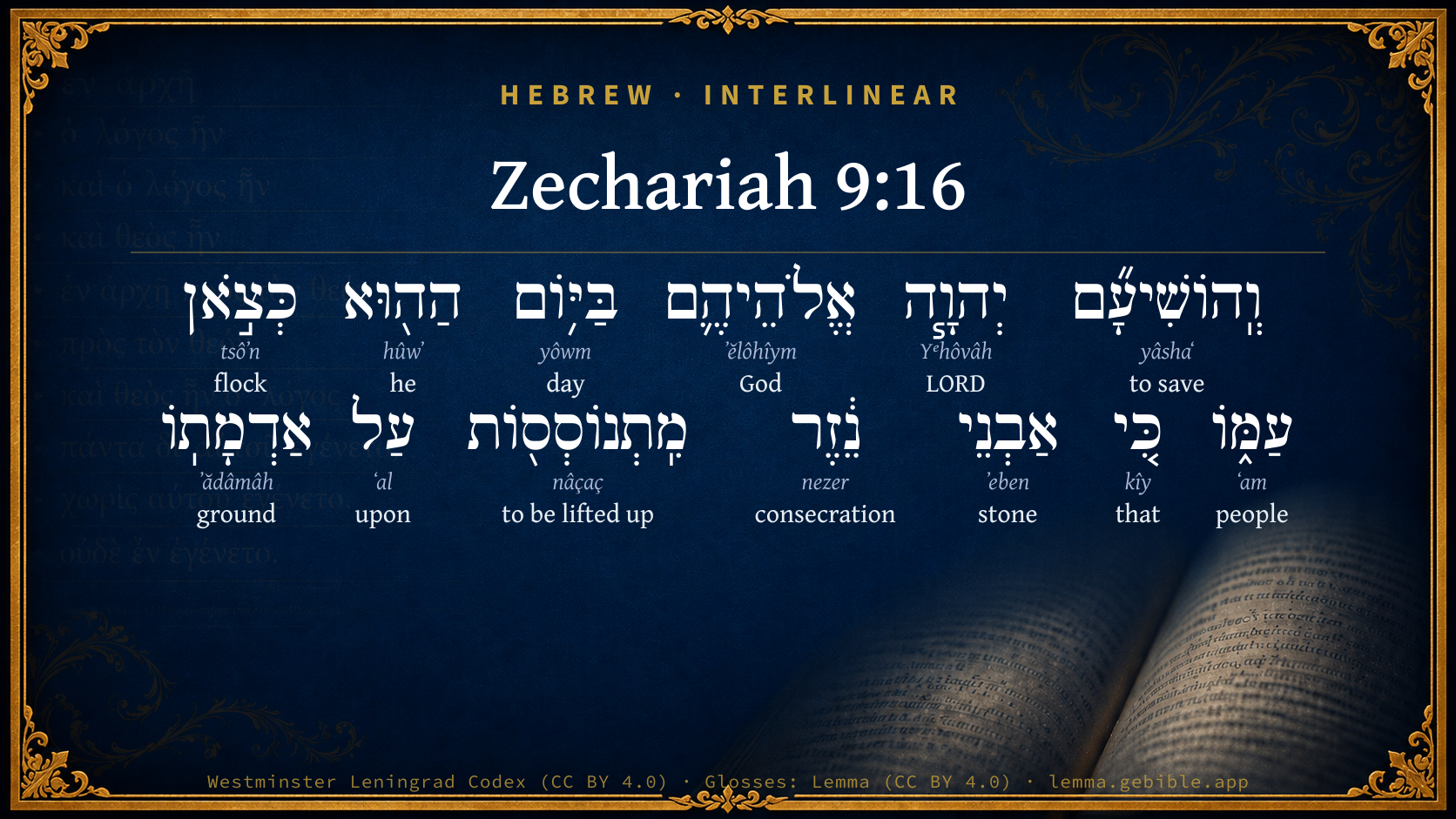
Hebrew (Westminster Leningrad Codex) Zechariah 9:16 appears in the Hebrew Old Testament. The text above is from the Westminster Leningrad Codex. Each word links to its Strong’s number, a concise gloss, and parsing drawn from the Open Scriptures Hebrew Bible morphology. Click any word for its full Brown-Driver-Briggs (BDB) entry.
Download image
Cite this verse

Zechariah 9:16 (World English Bible). Public Domain. Lemma interlinear Bible study tool, https://lemma.gebible.app/v/zechariah/9/16.

Show BibTeX & RIS
BibTeX
RIS
English Translation
Yahweh their God will save them in that day as the flock of his people; For they are like the jewels of a crown, Lifted on high over his land.
World English Bible · Public Domain
Highlights
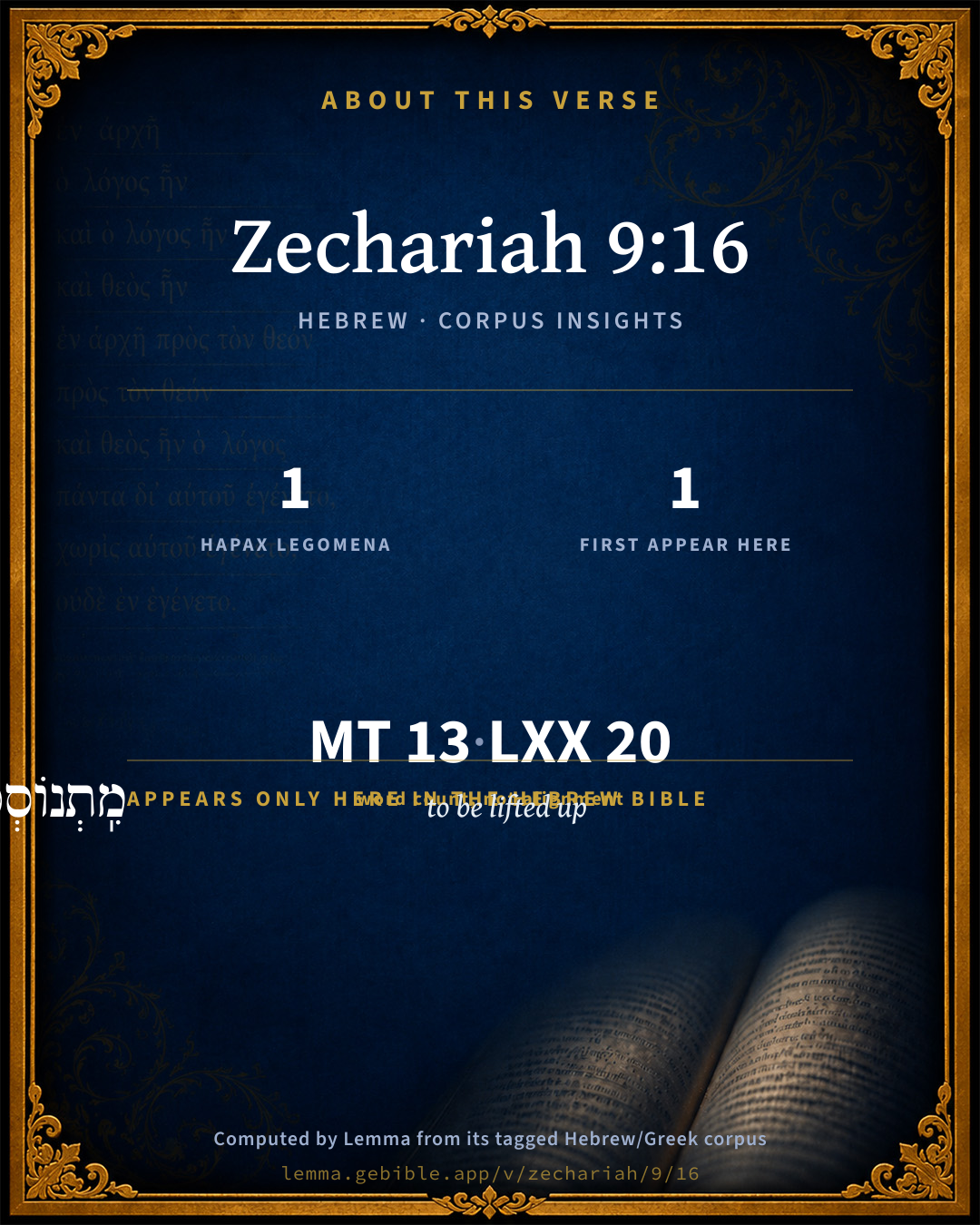
  • 1 hapax legomenon — only here in the Hebrew Bible
  • 1 first appearance in the Hebrew Bible
Full analysis ↓
Download a study sheet

One document with this verse’s original text, its word-by-word gloss line, the meaning frame, cross-references with their text, attributed commentary, and full source and license credits — printable, and it pastes into notes with its structure intact.

This verse Autodidact and up

Study sheet (.html) Plain text (.txt)

A passage Seminary Student

Up to 50 verses in one chapter. A passage sheet keeps up to 6 commentary sources and 12 cross-references per verse, in the order this page ranks them, and says so on the sheet whenever that leaves anything out. Ask for a single verse and you get the Autodidact verse sheet above.

Everything on this page stays free to read, with no account — the sheet is a download of what is already on screen, not access to it.

Want to remove ads? Support Godless Engineer
Compare translations 3

The same verse in 3 English versions, stacked beneath the original-language interlinear above. Click any original word for its lexicon entry.

Each is an independent rendering of the whole verse — the interlinear is not word-aligned to these translations.

Highlighted words mark where these versions differ — a whole-verse word diff, not a word-by-word alignment.

  • World English Bible Public Domain
    Yahweh their God will save them in that day as the flock of his people; For they are like the jewels of a crown, Lifted on high over his land.
  • King James Version Public Domain
    And the LORD their God shall save them in that day as the flock of his people: for they shall be as the stones of a crown, lifted up as an ensign upon his land.
  • unfoldingWord Literal Text CC BY-SA 4.0
    So Yahweh their God will rescue them on that day, as the flock of his people. They are the jewels of a crown that will shine on his land.

unfoldingWord Literal Text — © unfoldingWord, licensed CC BY-SA 4.0. Word-aligned USFM3 via Door43 (git.door43.org/unfoldingWord/en_ult).

Versions to compare (up to 4)

3 of 4 selected

Show all 18 translations

Every available English version of this verse, each an independent rendering of the whole verse.

  • World English Bible Public Domain
    Yahweh their God will save them in that day as the flock of his people; For they are like the jewels of a crown, Lifted on high over his land.
  • Berean Standard Bible Public Domain
    On that day the LORD their God will save them as the flock of His people; for like jewels in a crown they will sparkle over His land.
  • Majority Standard Bible Public Domain
    On that day the LORD their God will save them as the flock of His people; for like jewels in a crown they will sparkle over His land.
  • King James Version Public Domain
    And the LORD their God shall save them in that day as the flock of his people: for they shall be as the stones of a crown, lifted up as an ensign upon his land.
  • American Standard Version (1901) Public Domain
    And Jehovah their God will save them in that day as the flock of his people; for `they shall be as' the stones of a crown, lifted on high over his land.
  • Revised Version (1885) Public Domain
    And the LORD their God shall save them in that day as the flock of his people: for they shall be as the stones of a crown, lifted on high over his land.
  • Geneva Bible (1599) Public Domain
    And the Lord their God shall deliuer them in that day as the flocke of his people: for they shall be as the stones of the crowne lifted up upon his land.
  • Douay-Rheims (1899) Public Domain
    And the Lord their God will save them in that day, as the dock of his people: for holy stones shall be lifted up over his land.
  • Young's Literal Translation Public Domain
    And saved them hath Jehovah their God In that day, as a flock of His people, For stones of a crown are displaying themselves over His ground.
  • Literal Standard Version CC BY-SA 4.0
    And their God YHWH has saved them in that day, || As a flock of His people, || For stones of a crown are displaying themselves over His ground.
  • Unlocked Literal Bible CC BY-SA 4.0
    So Yahweh their God will rescue them on that day, as the flock of his people. They are the jewels of a crown that will shine on his land.
  • unfoldingWord Literal Text CC BY-SA 4.0
    So Yahweh their God will rescue them on that day, as the flock of his people. They are the jewels of a crown that will shine on his land.
  • Darby Bible Public Domain
    And Jehovah their God shall save them in that day as the flock of his people; for [they shall be as] the stones of a crown, lifted up upon his land.
  • World Messianic Bible Public Domain
    The LORD their God will save them in that day as the flock of his people; for they are like the jewels of a crown, lifted on high over his land.
  • Webster's Bible Public Domain
    And the LORD their God will save them in that day as the flock of his people: for they shall be as the stones of a crown, lifted up as an ensign upon his land.
  • Free Bible Version CC BY-SA 4.0
    On that day the Lord their God will save them—his people that are his flock—for they will glitter as crown jewels in his land.
  • Bible in Basic English Public Domain
    And the Lord their God will be their saviour in that day, giving them food like the flock of his people: for they will be like the jewels of a crown shining over his land.
  • JPS Tanakh (1917) Public Domain
    And the LORD their God shall save them in that day as the flock of His people; for they shall be as the stones of a crown, glittering over His land.

Literal Standard Version (2020), Covenant Press — licensed CC BY-SA 4.0. Text via the HelloAO Bible API (eBible.org). Unlocked Literal Bible (unfoldingWord) — licensed CC BY-SA 4.0. Text via the HelloAO Bible API (eBible.org). unfoldingWord Literal Text — © unfoldingWord, licensed CC BY-SA 4.0. Word-aligned USFM3 via Door43 (git.door43.org/unfoldingWord/en_ult). Free Bible Version, Dr. Jonathan Gallagher — licensed CC BY-SA 4.0. Text via the HelloAO Bible API (eBible.org).

Word by word

More ways to search: Search by grammar → Find every occurrence → Compare this word →

Practice this passage: Drill this verse → Learn its vocabulary →

מִֽתְנוֹסְס֖וֹת
nâçaç
H5264
“being lifted up”
Verb, Hithpolel, Participle Active, Feminine, Plural, Absolute
Part of Speech
Verb
Stem
Hithpolel
Form
Participle Active
Gender
Feminine
Number
Plural
State
Absolute
Full BDB Definition

Origin: a primitive root

TWOT: 1379

to be lifted up (meaning dubious) - (Hithpoel) to be lifted up, be displayed
  1. וְֽהוֹשִׁיעָ֞ם yâshaʻ H3467 “and · to save · them” Conjunction + Verb, Hiphil, Perfect, 3rd Person, Masculine, Singular + Suffix, Personal, 3rd Person, Masculine, Plural
  2. יְהוָ֧ה Yᵉhôvâh H3068 “LORD” Noun, Proper
  3. אֱלֹהֵיהֶ֛ם ʼĕlôhîym H430 “God(s) · their” Noun, Common, Masculine, Plural, Construct + Suffix, Personal, 3rd Person, Masculine, Plural
  4. בַּיּ֥וֹם yôwm H3117 “in/at the · day” Preposition, Determined + Noun, Common, Masculine, Singular, Absolute
  5. הַה֖וּא hûwʼ H1931 “the · he” Particle, Definite Article + Pronoun, Personal, 3rd Person, Masculine, Singular
  6. כְּצֹ֣אן tsôʼn H6629 “like/as · flock of” Preposition + Noun, Common, Both, Singular, Construct
  7. עַמּ֑וֹ ʻam H5971 “people · his” Noun, Common, Masculine, Singular, Construct + Suffix, Personal, 3rd Person, Masculine, Singular
  8. כִּ֚י kîy H3588 “that” Conjunction
  9. אַבְנֵי ʼeben H68 “stones of” Noun, Common, Feminine, Plural, Construct
  10. נֵ֔זֶר nezer H5145 “consecration” Noun, Common, Masculine, Singular, Absolute
  11. עַל ʻal H5921 “upon” Preposition
  12. אַדְמָתֽוֹ ʼădâmâh H127 “ground · his” Noun, Common, Feminine, Singular, Construct + Suffix, Personal, 3rd Person, Masculine, Singular

About this verse

These counts appear in no published source. They are computed here, from the morphology-tagged text and Lemma’s own curated glosses. What Lemma adds →

13
words
13
distinct lemmas
Prophets
section

Notable vocabulary

1 hapax legomenon — a word that appears only here in the entire Hebrew Bible:

  • מִֽתְנוֹסְס֖וֹת to be lifted up H5264

First appearance in Scripture

This word makes its first canonical appearance in the Hebrew Bible here:

  • מִֽתְנוֹסְס֖וֹת to be lifted up H5264

Shared distinctive vocabulary

נֵ֔זֶר consecration H5145 occurs in 22 verses of the Hebrew Bible. Also found in:

Grammatical profile

  • 2 verbs
  • 8 nouns
  • 1 pronoun
  • 1 preposition
  • 1 conjunction

Verb forms

  • וְֽהוֹשִׁיעָ֞ם Hiphil · Perfect
  • מִֽתְנוֹסְס֖וֹת Hithpolel · Participle Active

Hebrew & Septuagint length

In English translation the verse runs 30 words from the Hebrew and 25 from the Septuagint (LXX English) — closely comparable.

A rough comparison of the two English renderings, which tokenize alike — not a word-level alignment.

Word counts can differ between the Hebrew and the Greek without any difference in meaning — e.g. the Hebrew direct-object marker אֵת has no separate Greek word, and Greek often adds the article ὁ.

In the original languages it is 13 Hebrew tokens and 20 Greek tokens — but the two are counted differently (Hebrew bundles its prefixes and suffixes into one token; the Greek is in lemma form), so that isn’t a like-for-like length.

Cross-references

18

Topical passages linked to Zechariah 9:16 in the Treasury of Scripture Knowledge — connected by theme and wording, ordered by reader-vote popularity; previews shown in the World English Bible.

  • Isaiah 62:3 You shall also be a crown of beauty in the hand of Yahweh, and a royal diadem in the hand of your God.
  • Haggai 2:23 In that day, says Yahweh of Hosts, will I take you, Zerubbabel, my servant, the son of Shealtiel,' says Yahweh, 'and will make you as a signet, for I have chosen you,' says Yahweh of Hosts."
  • Luke 12:32 Don't be afraid, little flock, for it is your Father's good pleasure to give you the Kingdom.
  • John 10:27 My sheep hear my voice, and I know them, and they follow me.
  • Psalms 100:3 Know that Yahweh, he is God. It is he who has made us, and we are his. We are his people, and the sheep of his pasture.
  • Ezekiel 34:22–26 therefore will I save my flock, and they shall no more be a prey; and I will judge between sheep and sheep.
  • Ezekiel 34:31 You my sheep, the sheep of my pasture, are men, and I am your God, says the Lord Yahweh.
  • Isaiah 40:10 Behold, the Lord Yahweh will come as a mighty one, and his arm will rule for him: Behold, his reward is with him, and his recompense before him.
  • Isaiah 60:3 Nations shall come to your light, and kings to the brightness of your rising.
  • Isaiah 60:14 The sons of those who afflicted you shall come bending to you; and all those who despised you shall bow themselves down at the soles of your feet; and they shall call you The city of Yahweh, The Zion of the Holy One of Israel.
  • Jeremiah 31:11 For Yahweh has ransomed Jacob, and redeemed him from the hand of him who was stronger than he.
  • 1 Peter 5:2–4 Shepherd the flock of God which is among you, exercising the oversight, not under compulsion, but voluntarily, not for dishonest gain, but willingly;
  • Zechariah 8:23 Thus says Yahweh of Hosts: "In those days, ten men will take hold, out of all the languages of the nations, they will take hold of the skirt of him who is a Jew, saying, 'We will go with you, for we have heard that God is with you.'"
  • Isaiah 11:10–12 It shall happen in that day, that the root of Jesse, who stands for an ensign of the peoples, to him shall the nations seek; and his resting-place shall be glorious.
  • Jeremiah 23:3 I will gather the remnant of my flock out of all the countries where I have driven them, and will bring them again to their folds; and they shall be fruitful and multiply.
  • Micah 7:14 Shepherd your people with your staff, The flock of your heritage, Who dwell by themselves in a forest, In the midst of fertile pasture land, let them feed; In Bashan and Gilead, as in the days of old.
  • Zephaniah 3:20 At that time will I bring you in, and at that time will I gather you; for I will give you honor and praise among all the peoples of the earth, when I bring back your captivity before your eyes, says Yahweh.
  • Micah 5:4 He shall stand, and shall shepherd in the strength of Yahweh, In the majesty of the name of Yahweh his God: And they will live, for then he will be great to the ends of the earth.

Cross-references courtesy of OpenBible.info (CC BY 4.0).

Hebrew and Greek witnesses Masoretic Hebrew ↔ Greek Septuagint

The same verse in the two great witnesses to the Old Testament, shown verse-for-verse.

These are two independent witnesses, not word-aligned to each other, and the Septuagint is shown in lemma (dictionary) form.

Hebrew Zechariah 9:16 Masoretic · Westminster Leningrad Codex

וְֽהוֹשִׁיעָ֞ם יְהוָ֧ה אֱלֹהֵיהֶ֛ם בַּיּ֥וֹם הַה֖וּא כְּצֹ֣אן עַמּ֑וֹ כִּ֚י אַבְנֵי נֵ֔זֶר מִֽתְנוֹסְס֖וֹת עַל אַדְמָתֽוֹ

Yahweh their God will save them in that day as the flock of his people; For they are like the jewels of a crown, Lifted on high over his land.

World English Bible · Public Domain

Greek LXX Zechariah 9:16 Septuagint · lemma form

καί σώζω αὐτός κύριος ἐν ὁ ἡμέρα ἐκεῖνος ὡς πρόβατον λαός αὐτός διότι λίθος ἅγιος κυλίω ἐπί ὁ γῆ αὐτός

And the Lord their God shall save them in that day, even his people as a flock; for holy stones are rolled upon his land.

LXX2012 (modern English Septuagint) · Public Domain

On this verse, The Pulpit Commentary discusses the Septuagint’s reading. Read the note in Commentary ↓

Hebrew: Westminster Leningrad Codex (CC BY 4.0). Greek: Septuagint (public domain); English from LXX2012 (modern English Septuagint) (Public Domain). How the Septuagint differs from the Hebrew →

Targum (Aramaic paraphrase)

1

The Targum is the ancient Jewish Aramaic paraphrase of the Hebrew Scriptures — an interpretive translation, not the Hebrew text itself. Onkelos (literal) and Pseudo-Jonathan (expansive) render the Torah, and Jonathan the Prophets. Coverage is partial: where no permissively-licensed English translation exists for a verse, only the Aramaic is shown. This is verse-level text, not a word-by-word alignment to the Hebrew.

  1. Targum Jonathan Prophets (Joshua–Malachi)
    וְיִפְרְקוּנוּן יְיָ אֱלָהָהוֹן בְּעִדָנָא הַהִיא עַל דְאִתְבַּדָרוּ כְּעָנָא עַמֵיהּ אֲרֵי יִבְחֲרִינוּן כְּאַבְנֵי אֵיפוֹדָא וִיקָרְבִינוּן לְאַרְעֲהוֹן:

    (no public-domain English translation for this verse)

    Targum Jonathan — Aramaic: “Mikraot Gedolot” (public domain). English: “Sefaria Community Translation” (CC0 1.0 (public-domain dedication)); “London "Chaldee Paraphrase," 1871” (public domain). Text via Sefaria.

Commentary

Notes on Zechariah 9:16 from classic Christian and Jewish commentators (each source and its license shown beneath its notes). The classic Christian expositions comment on the surrounding passage and are grouped to its opening verse, so a note may address several verses; the Jewish commentaries on the Tanakh (Rashi and others) are per-verse, so they appear only where the commentator wrote on this verse.

Lemma curates 59 commentaries, every one of them public domain or Creative Commons licensed, each selected and text-cleaned for this edition rather than reprinted as found. About our sources →

Trapp's Complete Commentary

John Trapp

Zec 9:16 And the LORD their God shall save them in that day as the flock of his people: for they [shall be as] the stones of a crown, lifted up as an ensign upon his land.

Ver. 16. And the Lord their God shall save them] Not defend them only, as Lord of hosts, Zec 9:15, but as a further favour, save them as their God in covenant with them.

As the flock of his people] Rescuing them, as David did his lamb from the lion and bear, and tending them continually.

As the stones of a crown] Costly and precious, or monumental stones, with crowns on the top, and set up for trophies.

John Trapp, A Commentary or Exposition upon All the Books of the Old and New Testament (1647–1656) — public domain. Text from a community e-Sword module.

The Biblical Illustrator

Joseph S. Exell

Zec_9:16

They shall be as the stones of a crown, lifted up as an ensign upon his land

The Lords people

Here we see--

I.

The dignity of the lords people. They are stones, precious stones, set in the crown of the King of kings. God not only spares, but pardons and justifies them. In His righteousness they are exalted; they are not only saved, but ennobled. With kings are they upon the throne.

II. Here is also them exhibition. These stones of a crown are lifted up. They are not to be concealed. Our Saviour compares them to a city set, not in a valley, but on a hill which cannot be hid; and to a candle, placed, not under a bushel, but on a candlestick, that it may give light to all that are in the house. Christians need not be concealed--everything in their religion will bear examination, and challenges the eyes of all, whether infidels or philosophers or politicians or moralists. They ought not to be concealed--everything in their religion is adapted to do good; but for this purpose it must be known. They cannot be concealed,--their principles must operate; the sun cannot shine without showing itself.

III. Here is also their utility,--these stones of a crown are to be lifted up as an ensign upon His land. An oriflamme suspended over the royal tent, and designed to attract and aggregate followers to the cause in which he is engaged. Their calling, to hold forth the Word of Life. They are placed and displaced; to reprove, to convince, to excite and encourage others, to seek and serve God. They are witnesses for Him; trophies of the power and greatness and riches of His grace. They proclaim what He is able and willing to do. (William Jay.)

The Biblical Illustrator, edited by Joseph S. Exell (c. 1880s–1900s) — public domain. Text from a community e-Sword module.

Keil & Delitzsch

C. F. Keil & F. Delitzsch

Through this victory over the world-power Israel will attain to glory. Zac 9:16. "And Jehovah their God will endow them with salvation in that day, like a flock His people; for stones of a crown are they, sparkling in His land. Zac 9:17. For how great is its goodness, and how great its beauty! Corn will make youths to sprout, and new wine maidens." הושׁיע does not mean to help or deliver here; for this would affirm much too little, after what has gone before. When Israel has trodden down its foes, it no longer needs deliverance. It denotes the granting of positive salvation, which the explanatory clause that follows also requires. The motive for this is indicated in the clause, "like a flock His people." Because Israel is His (Jehovah's) people, the Lord will tend it as a shepherd tends his flock. The blessings which Jehovah bestows upon His people are described by David in Psa 23:1-6. The Lord will do this also, because they (the Israelites) are crown-stones, namely as the chosen people, which Jehovah will make a praise and glory for all nations (Zep 3:19-20). To the predicate אבני נזר the subject המּה may easily be supplied from the context, as for example in מגּיד in Zac 9:12. To this subject מתנוססות וגו attaches itself. This verb is connected with nēs, a banner, in Psa 60:6, the only other passage in which it occurs; but here it is used in the sense of nâtsats, to glitter or sparkle. The meaning, to lift up, which is given by the lexicons, has no foundation, and is quite unsuitable here. For crown-stones do not lift themselves up, but sparkle; and the figure of precious stones, which sparkle upon the land, denotes the highest possible glory to which Israel can attain. The suffix attached to אדמתו refers to Jehovah, only we must not identify the land of Jehovah with Palestine. The application of this honourable epithet to Israel is justified in Zac 9:17, by an allusion to the excellence and beauty to which it will attain. The suffixes in טוּבו and יפיו cannot refer to Jehovah, as Ewald and Hengstenberg suppose, but refer to עמּו, the people of Jehovah. יפי is quite irreconcilable with an allusion to Jehovah, since this word only occurs in connection with men and the Messianic King (Psa 45:3; Isa 33:17); and even if it were used of Jehovah, it would still be unsuitable here. For though the vigorous prosperity of the nation is indeed a proof of the goodness of God, it is not a proof of the beauty of God. Mâh is an exclamation of Amazement: "how great!" (Ewald, 330, a). טוּב, when affirmed of the nation, is not moral goodness, but a good appearance, and is synonymous with יפי, beauty, as in Hos 10:11. This prosperity proceeds from the blessings of grace, which the Lord causes to flow down to His people. Corn and new wine are mentioned as such blessings, for the purpose of individualizing, as indeed they frequently are (e.g., Deu 33:28; Psa 72:16), and are distributed rhetorically between the youths and the maidens.

Keil & Delitzsch — Biblical Commentary on the Old Testament (1861–1891) — public domain (CC PDM 1.0). Text via the HelloAO Bible API. (Old Testament only.)

Tyndale Open Study Notes

Tyndale Open Resources

9:16 On that day: See study note on 3:10. • The Old Testament prophets portrayed the Messiah as a king and as a faithful shepherd (see Ezek 34:12, 16, 23; 37:24; John 10:1; Heb 13:20; 1 Pet 5:4).

Tyndale Open Study Notes — © Tyndale Open Resources, licensed CC BY-SA 4.0. Text via the HelloAO Bible API.

Geneva Bible (1599)

Geneva Bible translators

The faithful shall be preserved, and reverenced of all, that the very enemies shall be compelled to esteem them: for God’s glory shall shine in them, as Josephus declareth of Alexander the great when he met Jadi the high Priest.

Geneva Bible (1599) marginal notes — public domain. Text via Bolls.life.

Jamieson, Fausset & Brown

Robert Jamieson, A. R. Fausset & David Brown

save them . . . as the flock of his people--as the flock of His people ought to be saved (Psa 77:20). Here the image of war and bloodshed (Zac 9:15) is exchanged for the shepherd and flock, as God will give not only victory, but afterwards safe and lasting peace. In contrast to the worthless sling-stones trodden under foot stand the (gems) "stones of the crown (Isa 62:3; Mal 3:17), lifted up as an ensign," that all may flock to the Jewish Church (Isa 11:10, Isa 11:12; Isa 62:10).

Jamieson, Fausset & Brown — Commentary Critical and Explanatory on the Whole Bible (1871) — public domain (CC PDM 1.0). Text via the HelloAO Bible API.

Adam Clarke's Commentary

Verse 16. Shall save them in that day] They are his flock, and he is their Shepherd; and, as his own, he shall save and defend them.

As the stones of a crown] אבני נזר מתנוססות abney nezer mithnosesoth, "crowned stones erecting themselves;" i.e., being set up by themselves, as monuments of some deliverance, they seem to be lifting themselves up; offering themselves to the attention of every passenger. It may however refer to stones anointed with oil; a sort of temporary altars set up to the Lord for a victory gained. The same word is used, Le 21:12: "Because the crown, נזר nezer, of the anointing oil of his God is upon him." Perhaps most of those upright stones, standing in circles, which pass for druidical monuments, were erected to commemorate victories, or to grace the tomb of an illustrious chief. These verses may refer to some final victory over the enemies of God's people.

Adam Clarke's Commentary on the Bible (1810–1826) — public domain. Text from a community e-Sword/MySword module.

John Calvin's Commentaries

He continues the same subject, but uses various figures, that he might more fully confirm what then was incredible. He indeed reminds them that God would not save his people in an ordinary way, such as is common to men. He compares them to sheep, that they might know, as I have said already, that their salvation would come from heaven, as they were themselves weak, and had no strength and no power; for to show this was the object of this comparison. He declares then that the Jews would be saved, because God would supply them with every thing necessary to conquer their enemies; but that he would in a wonderful manner help their weakness, even like a shepherd when he rescues his sheep from the jaws of a wolf. For the sheep, which escapes death by the coming of the shepherd, have no reason to boast of victory, but all the praise is due to the shepherd. So also God says, that it will be his work to deliver the Jews from their enemies.

By saying, his own people, he seems to confine to his elect what appeared too general; for he had said save then will God. It is however certain that the people who were then small, had been cut off, so that the greater part had perished; but at the same time it was true that God was a faithful guardian of his people, for there were then many Israelites, naturally descended from their common father Abraham, who were only in name Israelites.

He then adds another similitude, — that they would be elevated high, like precious stones in a crown, which are borne on the head of a king, as though he had said, that they would be a royal priesthood according to what is said in the law. He had said before, They shall subdue the stones, or, with the stones, of a sling. More correct seems to be the opinion of those who read with the stones of a sling, that is, that the Jews would conquer their enemies, not with swords, nor with arrows, but only with stones, in the same manner as Goliath was slain by David. Though not given to warlike arts, nor exercised in the use of arms, they would yet, as the Prophet shows, be conquerors; for their slings would be sufficient for the purpose of slaying their enemies. But some think that heathens and the unbelieving are compared to the stones of the sling, because they are worthless and of no account; which at the first sight seems ingenious, but it is a strained view. It is not at the same time improper to consider that there is here an implied contrast between the stones of the sling, and the stones of a crown; the Jews would cast stones from their slings to destroy their enemies, and they themselves would be precious stones. The Prophet seems here to represent the holy land as the chief part of the whole world. Elevated, he says, shall be the stones of crown over the land of God. Had he said over Egypt or over Assyria, the connection of the clauses would not have been so appropriate; but he names Judea, as the head of the world, and that the Jews, when prosperous and happy in it, would be like the stones of a crown, all the parts set in due order. In short, he shows, that the favor of God alone and his blessing, would be sufficient to render the Jews happy, as they would then excel in honor, enjoy the abundance of all good things, and possess invisible courage to resist all their adversaries.

Let us now enquire when all these things were fulfilled. We have said that Zechariah, by promising fullness to the Jews, gave them no unbridled license to indulge themselves in eating and drinking, but only expressed and extolled, in hyperbolical terms, the immense kindness and bounty of God to them. This is one thing.

But at the same time we must by the way consider another question: He says, that they would be like arrows and swords. Now as they were too much inclined to shed blood, he seems here to excite them in a manner to take vengeance fully on their enemies, which was by no means reasonable. The answer to this is plain — that the Jews were not to forget what God prescribed in his law: for as when God promised large abundance of wine, and a plentiful provision, he did not recall what he had already commanded — that they were to practice temperance in eating and drinking; so now when he promises victory over their enemies, he is not inconsistent with himself, nor does he condemn what he had once approved, nor abrogate the precept by which he commanded them, not to exercise cruelty towards their enemies, but to restrain themselves, and to show mercy and kindness. We hence see that we are not to judge from these words what is right for us to do, or how far we may go in taking revenge on enemies; nor to determine what liberty we have in eating and drinking. Such things are not to be learnt from this passage, or from similar passages; for the Prophet here does only set forth the power of God and his bounty towards his people.

Now again it may be asked, when has God fulfilled this, when has he made the Jews far and wide victorious and the destroyers of their enemies? All Christian expositors give us an allegorical explanation, — that God sent forth his armies when he sent forth Apostles into all parts of the world, who pierced the hearts of men, — and that he slew with his sword the wicked whom he destroyed. All this is true; but a simpler meaning must in the first place be drawn from the words of the Prophet, and that is, — that God will render his Church victorious against the whole world. And most true is this; for though the faithful are not furnished with swords or with any military weapons, yet we see that they are kept safe in a wonderful manner under the shadow of God’s hand. When adversaries exercise cruelty towards them, we see how God returns their wicked devices on their own heads. In this way is really fulfilled what we read here, — even that the children of God are like arrows and swords, and that they are also preserved as a flock; for they are too weak to stand their ground, were not the Lord to put forth his power, when he sees them violently assailed by the wicked. There is then no need to turn the Prophet’s words to an allegorical meaning, when this fact is evident that God’s Church has been kept safe, because God has ever blunted all the weapons of enemies; yea, he has often by a strong hand discharged his arrows and vibrated his sword. For when Alexander the Great had passed over the sea, when he had marched through the whole circuit of the Mediterranean sea, when he had filled all the country with blood, he came at length to Judea; how was it that he left it without committing any slaughter, without exercising any cruelty, except that God restrained him? It will not weary you, if I relate what we read in Josephus; and it is true I have no doubt. He says, that when Alexander came, he was full of wrath, and breathing threats against those Jews by whom he had not been assisted, and who seemed to have despised his authority: after having thus given vent to his rage, he at length came into the presence of Jadeus the high-priest, and seeing him adorned with a mitre, he fell down and humbly asked pardon; and while all were amazed his answer was — that God had appeared to him in that form while he was yet in Greece, and encouraged him to undertake that expedition. When therefore he saw the image or figure of the God of heaven in that sacerdotal dress, he was constrained to give glory to God. Thus far Josephus, whose testimony in this instance has never been suspected.

There is then no reason for any one to weary himself in finding out the meaning of the Prophet, since this fact is clear enough — that God’s elect have been victorious, because God has ever sent forth his arrows and vibrated his sword. At the same time there is another view of this victory; for alien and remote people were subdued by the sword of the Spirit, even by the truth of the gospel: but this is a sense deduced from the other; for when we apprehend the literal meaning of the Prophet, an easy passage is then open to us, by which we may come to the kingdom of Christ. These remarks refer to the abundance of provisions, as well as to the victory over enemies. It now follows —

John Calvin's Commentaries (1540-1563) — public domain. Text from the Calvin Translation Society English edition (1840s-50s) via the Christian Classics Ethereal Library (ccel.org). Calvin's coverage is partial (roughly two-thirds of the Bible); uncommented books and verses are honest gaps, never fabricated. The 19th-century editor's footnotes and remarks are omitted so the notes are faithfully Calvin's own voice.

Ellicott's Commentary for English Readers

(16) Flock.—Observe here the first introduction of the word and idea of “flock,” which plays such a prominent part in the next three (four?) chapters.

A Bible Commentary for English Readers, edited by Charles John Ellicott (1878–1897) — public domain. Text from a community e-Sword module.

The Cambridge Bible for Schools and Colleges

gen. ed. J. J. S. Perowne

16. lifted up as an ensign upon] Rather, raised aloft over, or perhaps, shining, or glittering. So R. V. lifted on high over. Margin, glittering upon.

The Cambridge Bible for Schools and Colleges (gen. ed. J. J. S. Perowne; Cambridge University Press, 1878–1918) — public domain. Text from a community e-Sword module.

John Gill's Exposition

And the Lord their God shall save them in that day,.... In the times of the Gospel, and the dispensation of it; meaning either the apostles, before said to be protected and defended, Zac 9:15 or rather the persons converted, conquered, and subdued by them, who are not killed, but saved by the Lord their God, their glorious Redeemer, from sin, Satan, the law, wrath to come, and out of the hands of all their enemies:

as the flock of his people; they being his special people, by choice, by covenant grace, and by redemption, and like to a flock of sheep; to sheep, for harmlessness, meekness, weakness, and timorousness, for being prone to go astray, and for their being clean, profitable, and sociable; and to a flock, being a distinct society of men, and but one, and a small one too, though a flock beautiful and holy:

for they shall be as the stones of a crown; like the gems and precious stones which are on a king's crown; they being Christ's jewels, highly valued and esteemed of by him; and comparable to them, for their richness through the grace of God, and for their purity, brightness, and glory in themselves, as owing to that; and for the glory they give to Christ, and for the durableness of them. The Targum renders it, "the stones of the ephod"; they may be translated, "the stones of separation" (x); set for boundaries to distinguish places; those being separated by the grace of God, in effectual calling, from the rest of mankind, and laid as lively stones upon the foundation Christ:

lifted up as an ensign upon his land; the land of Judea, as trophies of victorious grace; as monuments of praise and thankfulness; and as means of encouraging others to seek to Christ, and believe in him. The allusion seems to be to trophies erected on account of victories obtained by valiant men, to perpetuate their memories; which were sometimes of brass, and sometimes of marble, with inscriptions and titles on them, that they might endure forever; and where sufficiency of such materials could not be got, a vast heap of stones used to be laid together; or large trees, and their branches cut down, and the spoils of the enemy laid upon them; and these were raised up as trophies to perpetuate the memory of mighty men to posterity. So Germanicus, having conquered the nations between the Rhine and the Elbe, piled up a vast heap of marble stones, and dedicated them to Tiberius (y); and Fabius Aemilianus, having, with an army not amounting to 30,000 men, defeated an army of the Gauls near the river Rhosne, consisting of 200,000 men, set up a trophy of white stone, as well as built two temples, one to Mars, and another to Hercules (z); and Domitius Aenobarbus, and Fabius Maximus, having got the victory over the Allobroges, the people of Savoy and Piedmont, erected stone towers on the spot, and fixed trophies adorned with hostile arms, which before had been unusual (a); and it was an ancient custom with the Goths and Swedes, in the camps and fields where battles were fought, to fix stones like the Egyptian pyramids, on which they engraved, in a brief manner, the famous exploits performed, thereby to perpetuate the memory of the names and actions of great men (b); and these pillars of stone set up for trophies, the chapiters of them might be made in the form of crowns, and may be here referred to; and so some render the words to this sense (c).

(x) "lapides separationis", Sanctius; so Aquila in Drusius. (y) Vid. Alex. ab Alex. Genial. Dier. l. 1. c. 22. (z) Strabo. Geograph. l. 4. p. 128. (a) Flori Roman. Gest. l. 3. c. 2. (b) Olai Magni de Ritu Gent. Septentrional. Epitome, l. 1. c. 16. (c) "Lapides coronarii", Junius & Tremellius; "lapides coronati", i. e. "epistyliis ornati trophaeis", Piscator.

John Gill's Exposition of the Whole Bible (1746–1763) — public domain (CC PDM 1.0). Text via the HelloAO Bible API.

Albert Barnes' Notes on the Bible

And the Lord their God shall save them in that day - Still all should be God’s doing; they themselves were but as a flock, as sheep among wolves, ready for the slaughter; but they were “the flock, His people,” as He says, “I will increase them like the flock, men, as the flock of holy things, as the flock of Jerusalem in her solemn feasts; so shall the waste cities be filled with flocks, men” Eze 36:37-38. “As a man saves his flock with all his strength, so He will save His people; for they are His flock.” As in, “Thou leddest Thy people like sheep by the hand of Moses and Aaron” Psa 77:20.

They shall be as the stones of a crown - While God’s enemies shall be trampled under foot, as a common thing which has failed its end, these shall be precious stones; a consecrated diadem of king or priest, “raised aloft,” so that all can see. “On His land.” It was laid down, as the title-deed to its whole tenure, “the land is Mine” Lev 25:23, and much more our Christian land, bought and purified by the blood of Christ.

Albert Barnes' Notes on the Bible (1834–1885) — public domain. Text from a community e-Sword/MySword module.

Haydock's Catholic Bible Commentary

Holy stones; the apostles, who shall be as pillars and monuments in the Church. (Challoner) --- The Machabees are like a wall. They restore the altar of holocausts, built of fresh stones, 1 Machabees iv. (Calmet)

George Leo Haydock (1774–1849), Haydock's Catholic Family Bible and Commentary, 1859 edition — public domain. Excludes Psalms (Douay-Rheims chapter numbering differs from Protestant) and Deuterocanonical books (Catholic canon only).

Matthew Poole's English Annotations

The Lord their God, as in covenant with them, not only as Lord of hosts by his power, but as their God in mercy and faithfulness,

shall save them, fully deliver them, i.e. the sons of Zion, in that day, in the day of their contest and wars with the sons of Javan,

as the flock of his people; as a shepherd saves his flock, as David saved his.

For they shall be as the stones of a crown; or, seeing that they are precious, and of value with me, as the stones of a royal crown, or as the stones of trophy set up in memory of some noble achievement;

lifted up as an ensign upon his land; which are as an ensign lifted up, to which whoso repair may give thanks and rejoice in their deliverance; a form of which, for aught I know, may follow.

Matthew Poole's English Annotations on the Holy Bible (1683–1685) — public domain. Text from a community e-Sword/MySword module.

Whedon's Commentary on the Bible

Daniel D. Whedon

16. Save — Victory will come, because Jehovah will be the deliverer of his people.

In that day — The day of battle described in Zec_9:13-15.

As the flock of his people — Better, like a flock his people. His people is the object of the verb to be supplied from the preceding; the thought of the whole being, “He will deliver his people as a shepherd delivers his flock from the ravages of wild beasts.”

As the stones of a crown — The Israelites will trample under foot the stones hurled by the enemies (Zec_9:15), and the enemies themselves will suffer a similar fate, but Israel will be guarded and cared for tenderly, like a precious stone in the royal diadem (compare Hag_2:23).

Lifted up as an ensign — R.V., “lifted on high.” The meaning of the Hebrew verb nasas is not quite certain; of the two meanings suggested the context favors the one in margin R.V., “glittering.” Israel shall sparkle or glitter like a precious stone. A picture of the glory to which the Jews will be exalted.

His land — The land of Jehovah. Some of the constructions in this verse are very peculiar. To remove these peculiarities various emendations, involving alterations, omissions, and additions, have been suggested. Nowack, for example, reads, “And Jehovah their God will save them in that day; like a flock he will pasture his people upon his land.”

Zec_9:17 describes further the glories to be showered upon the restored nation.

His — Not Jehovah’s, but the people’s.

Goodness — Not moral goodness, but goodly appearance, equivalent to prosperity (so margin R.V.).

Beauty — Expresses practically the same idea as the preceding. In the restoration the land will be pleasant to look upon.

Corn… wine — Though the prophet has in mind general prosperity, he mentions specifically two of the chief products of Palestine (see on Joe_1:10); and though all the inhabitants will be benefited by the new prosperity, he singles out two classes who would show in the most marked manner the renewal of energy and vigor, the young men and the young women. Between these two he distributes rhetorically the two blessings specified.

New wine — See on Joe_1:10. In making temporal prosperity a part of the Messianic promise this prophet agrees with many of his predecessors (see on Hos_2:21-22; Amo_9:13; Isa_4:2).

Daniel D. Whedon (gen. ed.), Commentary on the Old and New Testaments (1874–1909) — public domain. Text from a community e-Sword module.

The Pulpit Commentary

Shall save them. He shall give them a positive blessing beyond mere deliverance from enemies. Keil, "Shall endow them with salvation." As the flock of his people; so the Vulgate; literally, as a flock, his people; Septuagint, wv probata, lao . He will tend his people as a shepherd tends his flock, (Psa_77:20 Psa_100:3 Jer_23:1 Eze_34:2, Eze_34:8, etc.) So Christ calls himself the "good Shepherd," and his followers "little flock". (Joh_10:11 Luk_12:32) Stones of a crown. The valuable gems set in crowns and diadems, or in the high priest"s official dress. The people shall be in God"s sight as precious as these in the eyes of men, and shall be highly exalted. The Septuagint and Vulgate render, "sacred stones;" and Knabenbauer thinks that by the term is meant the temple of God, which shall arise or shine in the Holy Laud, as a reward for its faithful defence. But the sense given above is satisfactory and simpler. Lifted up as an ensign upon his land; better, as the Revised Version margin, glittering upon his land. "His" may refer to Jehovah, or Israel; probably the latter is meant. The "land" is the crown or diadem in which the precious stones, the redeemed people, are set. They shall be raised to the highest possible glory and honour. If the words be taken in the sense of "raised on high over his land," they must be considered to indicate that the crown which contained the gems shall be raised aloft in victorious triumph.

The Pulpit Commentary (1880–1919), ed. H.D.M. Spence-Jones & Joseph S. Exell — public domain. Text from a community e-Sword module.

John Wesley's Explanatory Notes

As the flock - As a shepherd saves his flock. As the stones of a crown - Precious in my sight. As an ensign - Or trophy.

John Wesley, Explanatory Notes Upon the Whole Bible (1754–1765) — public domain. Text via the GEBible commentary corpus.

unfoldingWord translationNotes

Door43 World Missions Community

General Information:

In verses 14-16, Zechariah describes how Yahweh will rescue Israel from their enemies.

God will rescue them ... as the flock of his people

The people of Israel are spoken of as if they are God's sheep that he cares for and protects. (See: Simile)

They are the jewels of a crown

The people of Israel are spoken of as if they were the expensive jewels in the crown of a king that show how glorious he is. AT: "They will be like beautiful stones in a crown" (See: Metaphor)

How good and how beautiful they will be!

This is an exclamation, and not a question. AT: "They will be very good and beautiful!" (See: Exclamations)

The young men will flourish on grain and the virgins on sweet wine!

This sentence uses a parallel structure to express that everyone will have plenty to eat and drink. If your readers might think that only the men ate and only the women drank, you may want to adjust the wording. AT: "All of the people, both men and women, will have plenty of grain to eat and sweet wine to drink!" (See: Parallelism)

The young men ... the virgins

These two phrases are parallel and together represent the entire population of Israel. (See: Parallelism and Synecdoche)

grain ... sweet wine

These two phrases are parallel and together represent all of the different kinds of the food and drink. (See: Parallelism and Synecdoche)

translationWords

flocks

people group

crown

grain

virgin

wine

unfoldingWord translationNotes — © Distant Shores Media and the Door43 World Missions Community, licensed CC BY-SA 4.0. Source: git.door43.org/Door43/en_tn.

Rashi

Rabbi Shlomo Yitzchaki (Rashi)

like the flocks of His people Like the flocks that He caused to travel from Egypt to become His people.

for crown stones are exalted on His land For the priests, the sons of the Hasmoneans, who boast of the crown stones in the rows of the breast-plate and the ephod, will be exalted with miracles on their land.

Rashi on the Tanakh — English translations: “The Judaica Press complete Tanach with Rashi, translated by A. J. Rosenberg” (CC BY 4.0); “Pentateuch with Rashi's commentary by M. Rosenbaum and A.M. Silbermann, 1929-1934” (public domain); “The Metsudah Tanach series, Lakewood, N.J” (CC BY 4.0); and “The Book of Joshua, Metsudah Publications, 1997” (CC BY 4.0). Text via Sefaria.

Lesson kit

Teaching starters — assembled from the data on this page, not authored interpretation. Every prompt links to the verse data it draws on. Edit before teaching.

Zechariah, in the Prophets, opens this verse with 13 words (13 distinct Hebrew lemmas). Its most distinctive word is nâçaç (“to be lifted up”). A historical commentator’s framing appears above. Read the whole chapter for the surrounding context.

Discussion questions

  1. What does “to be lifted up” (nâçaç) contribute to the verse as a whole?
  2. 1 word here appears nowhere else in the Hebrew Bible. Why might the author reach for such rare wording?
  3. This is the first place “to be lifted up” appears in Scripture (first appears here). What does its debut here establish?
  4. How does Exodus 29:6, which shares the word «consecration», read alongside this verse?
  5. The translations on this page render this verse differently — a whole-verse word diff, not a word-by-word alignment. What might account for the different wordings?
  6. «וְֽהוֹשִׁיעָ֞ם» is a Hiphil Perfect verb. How does that grammatical form shape the action described?
  7. Compare how Trapp's Complete Commentary and The Biblical Illustrator read this verse. Where do they agree or differ?

Things to notice

Reading settings

Reading text

Shown beneath each verse's original-language words.

Old Testament
Old Testament edition

Read the OT as the Masoretic Hebrew (MT) or the Greek Septuagint (LXX).

English shown for the Greek Septuagint (in the Hebrew ↔ Greek comparison).

Comparing translations? Open the Compare panel on any verse page to stack up to four side by side.