
Psalms 145:19

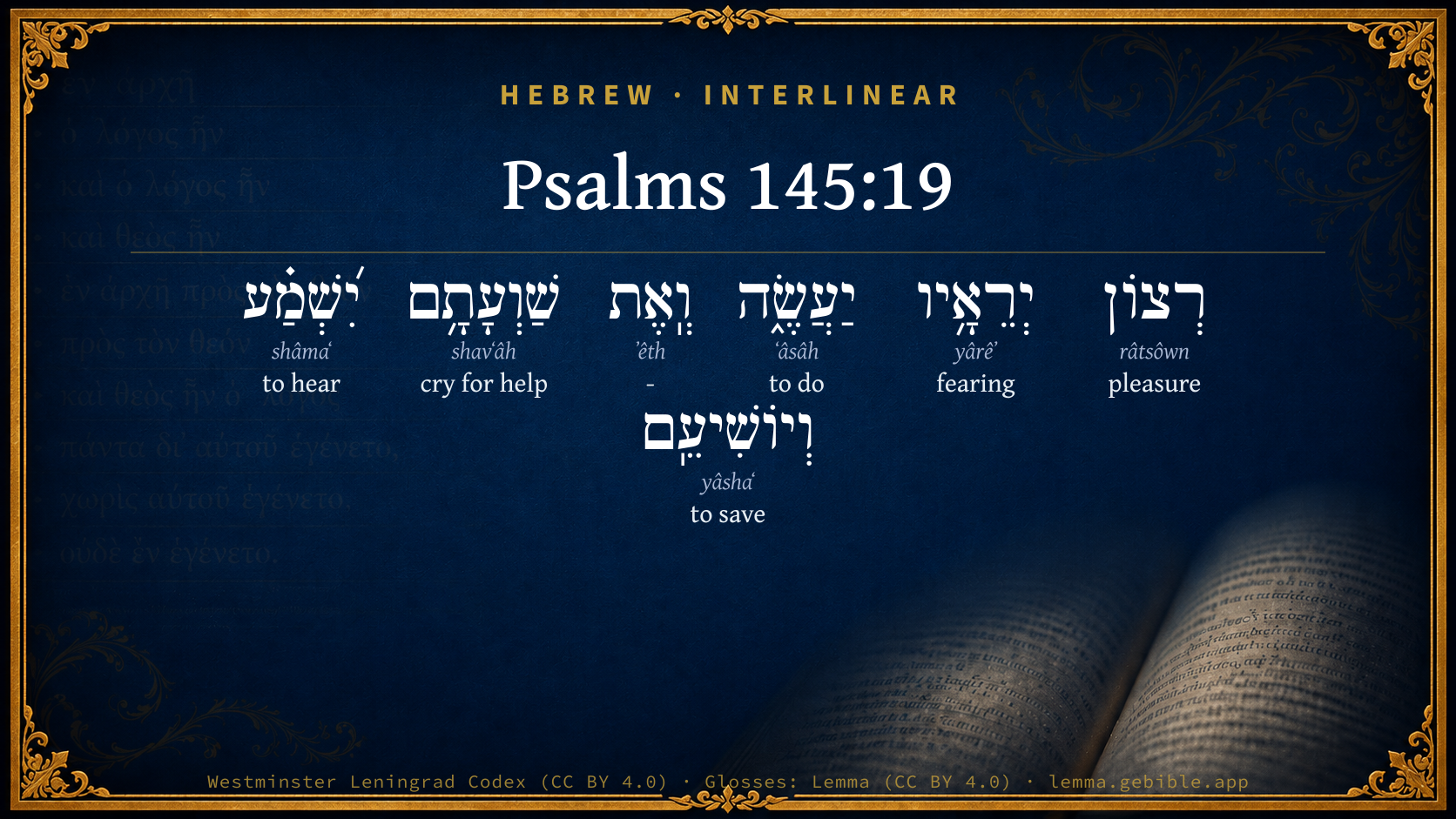
Hebrew (Westminster Leningrad Codex) Psalms 145:19 appears in the Hebrew Old Testament. The text above is from the Westminster Leningrad Codex. Each word links to its Strong’s number, a concise gloss, and parsing drawn from the Open Scriptures Hebrew Bible morphology. Click any word for its full Brown-Driver-Briggs (BDB) entry.
Download image
Cite this verse

Psalms 145:19 (World English Bible). Public Domain. Lemma interlinear Bible study tool, https://lemma.gebible.app/v/psalms/145/19.

Show BibTeX & RIS
BibTeX
RIS
English Translation
He will fulfill the desire of those who fear him. He also will hear their cry, and will save them.
World English Bible · Public Domain
Download a study sheet

One document with this verse’s original text, its word-by-word gloss line, the meaning frame, cross-references with their text, attributed commentary, and full source and license credits — printable, and it pastes into notes with its structure intact.

This verse Autodidact and up

Study sheet (.html) Plain text (.txt)

A passage Seminary Student

Up to 50 verses in one chapter. A passage sheet keeps up to 6 commentary sources and 12 cross-references per verse, in the order this page ranks them, and says so on the sheet whenever that leaves anything out. Ask for a single verse and you get the Autodidact verse sheet above.

Everything on this page stays free to read, with no account — the sheet is a download of what is already on screen, not access to it.

Want to remove ads? Support Godless Engineer
Compare translations 3

The same verse in 3 English versions, stacked beneath the original-language interlinear above. Click any original word for its lexicon entry.

Each is an independent rendering of the whole verse — the interlinear is not word-aligned to these translations.

Highlighted words mark where these versions differ — a whole-verse word diff, not a word-by-word alignment.

  • World English Bible Public Domain
    He will fulfill the desire of those who fear him. He also will hear their cry, and will save them.
  • King James Version Public Domain
    He will fulfil the desire of them that fear him: he also will hear their cry, and will save them.
  • unfoldingWord Literal Text CC BY-SA 4.0
    He does the desire of the ones fearing him, and he hears their cry, and he saves them.

unfoldingWord Literal Text — © unfoldingWord, licensed CC BY-SA 4.0. Word-aligned USFM3 via Door43 (git.door43.org/unfoldingWord/en_ult).

Versions to compare (up to 4)

3 of 4 selected

Show all 17 translations

Every available English version of this verse, each an independent rendering of the whole verse.

  • World English Bible Public Domain
    He will fulfill the desire of those who fear him. He also will hear their cry, and will save them.
  • Berean Standard Bible Public Domain
    He fulfills the desires of those who fear Him; He hears their cry and saves them.
  • Majority Standard Bible Public Domain
    He fulfills the desires of those who fear Him; He hears their cry and saves them.
  • King James Version Public Domain
    He will fulfil the desire of them that fear him: he also will hear their cry, and will save them.
  • American Standard Version (1901) Public Domain
    He will fulfil the desire of them that fear him; He also will hear their cry and will save them.
  • Revised Version (1885) Public Domain
    He will fulfill the desire of them that fear him; he also will hear their cry, and will save them.
  • Geneva Bible (1599) Public Domain
    He wil fulfill the desire of them that feare him: he also wil heare their cry, and wil saue them.
  • Young's Literal Translation Public Domain
    The desire of those fearing Him He doth, And their cry He heareth, and saveth them.
  • Literal Standard Version CC BY-SA 4.0
    He does the desire of those fearing Him, || And He hears their cry, and saves them.
  • Unlocked Literal Bible CC BY-SA 4.0
    He fulfills the desire of those who honor him; he hears their cry and saves them.
  • unfoldingWord Literal Text CC BY-SA 4.0
    He does the desire of the ones fearing him, and he hears their cry, and he saves them.
  • Darby Bible Public Domain
    He fulfilleth the desire of them that fear him; he heareth their cry, and saveth them.
  • World Messianic Bible Public Domain
    He will fulfill the desire of those who fear him. He also will hear their cry, and will save them.
  • Webster's Bible Public Domain
    He will fulfill the desire of them that fear him: he also will hear their cry, and will save them.
  • Free Bible Version CC BY-SA 4.0
    He satisfies the needs of those who follow him. He hears their cries for help and he saves them.
  • Bible in Basic English Public Domain
    To his worshippers, he will give their desire; their cry comes to his ears, and he gives them salvation.
  • JPS Tanakh (1917) Public Domain
    He will fulfil the desire of them that fear Him; He also will hear their cry, and will save them.

Literal Standard Version (2020), Covenant Press — licensed CC BY-SA 4.0. Text via the HelloAO Bible API (eBible.org). Unlocked Literal Bible (unfoldingWord) — licensed CC BY-SA 4.0. Text via the HelloAO Bible API (eBible.org). unfoldingWord Literal Text — © unfoldingWord, licensed CC BY-SA 4.0. Word-aligned USFM3 via Door43 (git.door43.org/unfoldingWord/en_ult). Free Bible Version, Dr. Jonathan Gallagher — licensed CC BY-SA 4.0. Text via the HelloAO Bible API (eBible.org).

Word by word

More ways to search: Search by grammar → Find every occurrence → Compare this word →

Practice this passage: Drill this verse → Learn its vocabulary →

About this verse

These counts appear in no published source. They are computed here, from the morphology-tagged text and Lemma’s own curated glosses. What Lemma adds →

7
words
7
distinct lemmas
Wisdom
section

Notable vocabulary

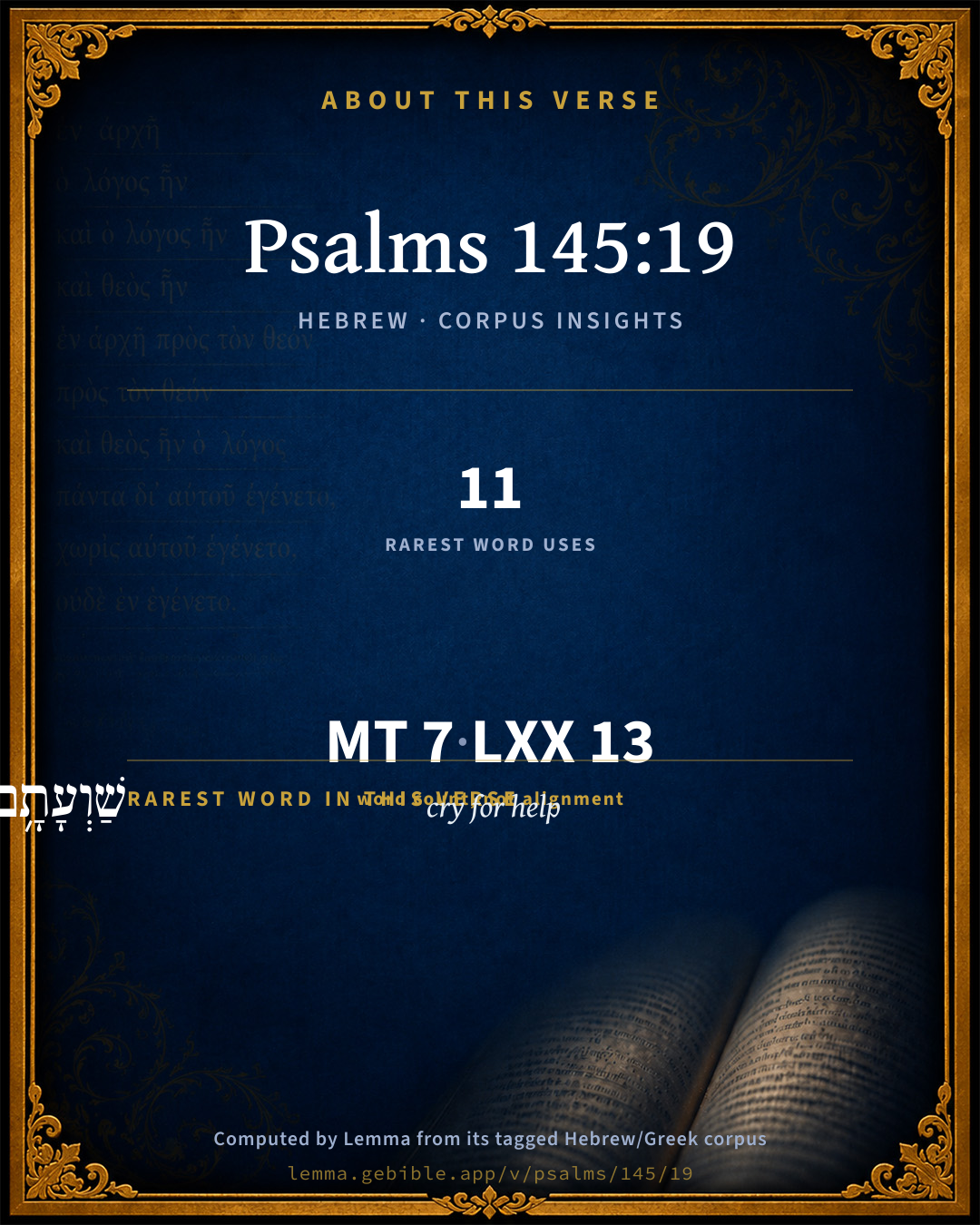
The rarest word here is שַׁוְעָתָ֥ם cry for help H7775 — appearing just 11 times in the whole Hebrew Bible.

Shared distinctive vocabulary

שַׁוְעָתָ֥ם cry for help H7775 occurs in 11 verses of the Hebrew Bible. Also found in:

Grammatical profile

  • 3 verbs
  • 2 nouns
  • 1 adjective
  • 1 particle

Verb forms

  • יַעֲשֶׂ֑ה Qal · Imperfect
  • יִ֝שְׁמַ֗ע Qal · Imperfect
  • וְיוֹשִׁיעֵֽם Hiphil · Imperfect

Hebrew & Septuagint length

In English translation the verse runs 20 words from the Hebrew and 19 from the Septuagint (LXX English) — closely comparable.

A rough comparison of the two English renderings, which tokenize alike — not a word-level alignment.

Word counts can differ between the Hebrew and the Greek without any difference in meaning — e.g. the Hebrew direct-object marker אֵת has no separate Greek word, and Greek often adds the article ὁ.

In the original languages it is 7 Hebrew tokens and 13 Greek tokens — but the two are counted differently (Hebrew bundles its prefixes and suffixes into one token; the Greek is in lemma form), so that isn’t a like-for-like length.

Cross-references

16

Topical passages linked to Psalms 145:19 in the Treasury of Scripture Knowledge — connected by theme and wording, ordered by reader-vote popularity; previews shown in the World English Bible.

  • Psalms 37:4 Also delight yourself in Yahweh, And he will give you the desires of your heart.
  • Ephesians 3:16–20 that he would grant you, according to the riches of his glory, that you may be strengthened with power through his Spirit in the inward man;
  • John 15:7 If you remain in me, and my words remain in you, you will ask whatever you desire, and it will be done for you.
  • Matthew 5:6 Blessed are those who hunger and thirst after righteousness, For they shall be filled.
  • 1 John 5:15 And if we know that he listens to us, whatever we ask, we know that we have the petitions which we have asked of him.
  • Psalms 91:15 He will call on me, and I will answer him. I will be with him in trouble. I will deliver him, and honor him.
  • John 16:24 Until now, you have asked nothing in my name. Ask, and you will receive, that your joy may be made full.
  • John 15:16 You didn't choose me, but I chose you, and appointed you, that you should go and bear fruit, and that your fruit should remain; that whatever you will ask of the Father in my name, he may give it to you.
  • Psalms 20:4 May He grant you your heart's desire, And fulfill all your counsel.
  • Psalms 34:17 The righteous cry, and Yahweh hears, And delivers them out of all their troubles.
  • Psalms 34:9 Oh fear Yahweh, you his saints, For there is no lack with those who fear him.
  • Psalms 37:19 They shall not be disappointed in the time of evil. In the days of famine they shall be satisfied.
  • Proverbs 15:29 Yahweh is far from the wicked, But he hears the prayer of the righteous.
  • Psalms 36:7–8 How precious is your loving kindness, God! The children of men take refuge under the shadow of your wings.
  • Psalms 37:39–40 But the salvation of the righteous is from Yahweh. He is their stronghold in the time of trouble.
  • Luke 1:53 He has filled the hungry with good things. He has sent the rich away empty.

Cross-references courtesy of OpenBible.info (CC BY 4.0).

Hebrew and Greek witnesses Masoretic Hebrew ↔ Greek Septuagint

The same verse in the two great witnesses to the Old Testament, shown verse-for-verse.

You’re reading Greek Psalm 144 (Hebrew Psalm 145). The Septuagint counts the superscription, so verse numbers can differ from the Hebrew — chapter-level alignment, not verse-by-verse. Numbering follows Rahlfs.

These are two independent witnesses, not word-aligned to each other, and the Septuagint is shown in lemma (dictionary) form.

Hebrew Psalms 145:19 Masoretic · Westminster Leningrad Codex

רְצוֹן יְרֵאָ֥יו יַעֲשֶׂ֑ה וְֽאֶת שַׁוְעָתָ֥ם יִ֝שְׁמַ֗ע וְיוֹשִׁיעֵֽם

He will fulfill the desire of those who fear him. He also will hear their cry, and will save them.

World English Bible · Public Domain

Greek LXX Greek Psalm 144:19 Septuagint · lemma form

θέλημα ὁ φοβέω αὐτός ποιέω καί ὁ δέησις αὐτός ἐπιἀκούω καί σώζω αὐτός

He will perform the desire of them that fear him: and he will hear their supplication, and save them.

LXX2012 (modern English Septuagint) · Public Domain

Hebrew: Westminster Leningrad Codex (CC BY 4.0). Greek: Septuagint (public domain); English from LXX2012 (modern English Septuagint) (Public Domain). How the Septuagint differs from the Hebrew →

Commentary

Notes on Psalms 145:19 from classic Christian and Jewish commentators (each source and its license shown beneath its notes). The classic Christian expositions comment on the surrounding passage and are grouped to its opening verse, so a note may address several verses; the Jewish commentaries on the Tanakh (Rashi and others) are per-verse, so they appear only where the commentator wrote on this verse.

Lemma curates 59 commentaries, every one of them public domain or Creative Commons licensed, each selected and text-cleaned for this edition rather than reprinted as found. About our sources →

Trapp's Complete Commentary

John Trapp

Psa 145:19 He will fulfil the desire of them that fear him: he also will hear their cry, and will save them.

Ver. 19. He will fulfil the desire, &c.] Or, the will, the pleasure, Beneplacitum. Hence that bold request of Luther, Fiat voluntas mea, let my will be done. But then he addeth, Mea, Domine, quia tua, My will, because thine, and no otherwise. They that do the will of God shall have their own will of God. See 1Jn 3:22. The king can deny you nothing.

John Trapp, A Commentary or Exposition upon All the Books of the Old and New Testament (1647–1656) — public domain. Text from a community e-Sword module.

J. A. Alexander on Psalms

Joseph Addison Alexander

19. (Psa 145:19) The will of his fearers he will do, and their cry he will hear, and will save them. He will do what they desire, or grant their prayer, especially their prayer for help in time of danger and distress, as intimated in the last clause. Compare Psa 34:9; Psa 34:15.

Joseph Addison Alexander, The Psalms Translated and Explained (1850) — public domain. Text from a community e-Sword module.

MacLaren's Expositions of Holy Scripture

Alexander MacLaren

Psalms

THE SATISFIER OF ALL DESIRES

Psa 145:16, Psa 145:19.

You observe the recurrence, in these two verses, of the one emphatic word ‘desire.’ Its repetition evidently shows that the Psalmist wishes to run a parallel between God’s dealings in two regions. The same beneficence works in both. Here is the true extension of natural law to the spiritual world. It is the same teaching to which our Lord has given immortal and inimitable utterance, when He says, ‘Your heavenly Father feedeth them.’ And so we are entitled to look on all the wonders of creation, and to find in them buttresses which may support the edifice of our faith, and to believe that wherever there is a mouth God sends food to fill it. ‘Thou openest Thine hand’-that is all-’and satisfiest the desire of every living thing.’ But to fulfil the desires of them who are not only ‘living things,’ but ‘who fear’ Him, is it such a simple task? Sometimes more is wanted than an open hand before that can be accomplished. So, looking not only at the words I have read, but at the whole of their setting, which is influenced by the thought of this parallelism, we see here two sets of pensioners, two kinds of wants, two forms of appeal, two processes of satisfaction.

I. Two kinds of pensioners.

‘Every living thing-’ life makes a claim on God, and whatever desires arise in the living creature by reason of its life, God would be untrue to Himself, a cruel Parent, an unnatural Father, if He did not satisfy them. We do not half enough realise the fact that the condescension of creation lies not only in the act of creating, but in the willing acceptance by the Creator of the bonds under which He thereby lays Himself; obliging Himself to see to the creatures that He has chosen to make. And so, as one of the New Testament writers puts it, in his simple way, with a profound truth, ‘He is a faithful Creator’; and wherever there is a creature that He has made to need anything, He has thereby said, ‘As I live, that creature shall have what it needs.’

Then, take the other class, ‘them that fear Him’; or as they are described in the context-by contrast with ‘the wicked who are destroyed’-’the righteous.’ That is to say, whilst, because we are living things, like the bee and the worm, we have a claim on God precisely parallel with theirs for what we may need by reason of His gift, which we never asked for, His gift of life, we shall have a similar but higher claim on Him if we are ‘they that fear Him’ with that loving reverence which has no torment in it, and that love Him with that reverential affection which has no presumption in it, and whose love and fear coalesce in making them long to be righteous like the Object of their love, to be holy like the Object of their fear. And just as the fact of physical life binds God to care for it, and to give all that is needed for its health, growth, blessedness, so the fact of man’s having in his heart the faintest tremor of reverential dread, the feeblest aspiration of outgoing affection, the most faltering desire after purity of life and conduct, binds God to answer these according to the man’s need. Of all incredibilities in the world, there is nothing more incredible, because there is nothing more contrary to the very depths of the divine nature, than that desires, longings, expectations, which are the direct result of the love and fear of God, and the hunger and thirst after righteousness, should not be answered.

Now that is a very wide principle, and I do not believe that it is trusted enough by many. It comes to this-wherever you find in people a confidence which grows with their love of God, be sure that there is, somewhere or other in the universe of things, that which answers it.

Take a case. If there was not a word in the New Testament about Jesus Christ’s resurrection, the fact that just in proportion as men grow in devotion, in love of God, in fear of Him, in longing to be good and to appear like Him, in that same proportion does their conviction that there must be a life beyond the grave become firm and certain-that fact would be enough to make any one who believed in God sure that the hope thus rooted in love to Him, and fed by everything that draws us nearer to Him, could not be a delusion, nor be destined to be left unfulfilled.

And we might go round the whole circle of dim religious aspirations and desires, and find in all of them illustrations of the principle so profoundly and so simply put in our psalm, that the same Love which, in the realm of the physical world, binds itself to satisfy the life which it imparts, is at work in the higher regions, and will ‘fulfil the desires of them that fear Him.’

II. Again, there are two sets of needs.

The first of them is very easily disposed of. ‘The eyes of all wait upon Thee, and Thou givest them their meat.’ That is all. Feed the beast, and give it the other things necessary for its physical existence, and there is no more to be done. But there is more wanted for the desires of the men that love and fear God. These are glanced at in the context, ‘He also will hear their cry, and will save them’; ‘the Lord preserveth all them that love Him.’ That is to say, there are deeper needs in our hearts and lives than any that are known amongst the lower creatures. Evils, dangers inward and outward, sorrows, disappointments, losses of all sorts shadow our lives, in a fashion which the happy, careless life of field and forest knows nothing about. Give them their meat, and they curl themselves up and lie down to sleep, satisfied. Man longs for something more and needs something more.

‘He will save them.’ Now, I do not suppose that ‘save’ here is employed in its full New Testament sense, but it approximates to that sense. And, further, there are other aspects of our needs set forth in the context, on which I briefly touch. Do not let us vulgarise such a saying as this of my text, ‘He will fulfil the desire of them that fear Him,’ as if it only meant that if a man fears God he may set his longing upon any outward thing, and be sure to get it. There is nothing so poor, so unworthy as that promised in Scripture. For one thing, it is not true; for another, it would not be good if it were. The way to spoil children is not the way to perfect saints; and to give them what they want because they want it, is the sure way to spoil children of all ages. We may be quite certain that our heavenly Father is not going to do that. The promise here means something far nobler and loftier. The fact of creation binds God to supply all the wants which spring from life. The fact of our loving and fearing Him binds Him to supply all the wants which spring from our love and fear. And it is these desires which the Psalmist is thinking of.

What is the object of desire to a man who loves God? God. What is the object of desire to a man who fears Him? God. What is the object of desire to a righteous man? Righteousness. And these are the desires which God is sure to fulfil to us. Therefore, there is only one region in which it is safe and wise to cherish longings, and it is the region of the spiritual life where God imparts Himself. Everywhere else there will be disappointments-thank Him for them. Nowhere else is it absolutely true that He will ‘fulfil the desires of them that fear Him.’ But in this region it is. Whatever any of us desire to have of God, we are sure to get. We open our mouths and He fills them. In the Christian life desire is the measure of possession, and to long is to have. And there is nowhere else where it is absolutely, unconditionally, and universally true that to wish is to possess, and to ask is to have.

Oh! then, is it not a foolish thing for us to worry and torture and sweat, in order to win for ourselves for a little while the uncertain possession of incomplete bliss? Would it not be wiser, instead of letting the current of our desires dribble itself away through a thousand channels in the sand and get lost, to gather it all into one great stream which is sure to find its way to the broad ocean? ‘Delight thyself in the Lord, and He shall give thee the desires of thine heart,’ for these will then be after Himself, and Himself only.

III. Further, there are here two forms of appeal.

‘The eyes of all wait upon Thee.’ That is beautiful! The dumb look of the unconscious creature, like that of a dog looking up in its master’s face for a crust, makes appeal to God, and He answers that. But a dumb, unconscious look is not for us. ‘He also will hear their cry.’ Put your wish into words if you want it answered; not for His information, but for your strengthening. ‘Your heavenly Father knoweth that ye have need of these things before ye ask Him.’ What then? Why should I ask Him? Because the asking will clear your thoughts about your desires. It will be a very good test of them. There are many things that we all wish, which I am afraid we should not much like to put into our prayers, not because of any foolish notion that they are too small to find a place there, but because of an uncomfortable suspicion that perhaps they are not the kind of things that we ought to wish. And if we cannot make the desire into a cry, the sooner we make it dead as well as dumb the better for ourselves. The cry will serve, too, as a stimulus to the wishes which are put into words. Silent prayer is well, but there is a wonderful power on ourselves-it may be due to our weakness, but still it exists-in the articulate and audible utterance of our petitions to God. I would fain that all of us were more in the habit of putting into distinct words that we ourselves can hear, the wishes that we cherish. I am sure our prayers would be more sincere, less wandering, more earnest and real, if they were spoken, as well as felt, prayers.

Let us remember, dear brethren! that the condition of our getting the higher gifts is not only that we should love and fear, and in the silence of our own hearts should wish for, but that we should definitely ask for, them. Not only desire, but ‘their cry,’ brings the answer.

IV. And now one last word. Note the two processes of satisfying.

‘Thou openest Thine hand.’ That is enough. But God cannot satisfy our deepest desires by any such short and easy method. There is a great deal more to be done by Him before the aspirations of love and fear and longing for righteousness can be fulfilled. He has to breathe Himself into us. Lower creatures have enough when they have the meat that drops from His hand. They know and care nothing for the hand that feeds. But God’s best gifts cannot be separated from Himself. They are Himself, and in order to ‘satisfy the desires of them that fear Him’ there is no way possible, even to Him, but the impartation of Himself to the waiting heart.

That is a mystery deep and blessed. Oh, that we may all know, by our own living experience, what it is to have not only the gifts which drop from His hands, but the gifts which cannot be parted from Him, the Giver! He has to discipline us for His highest gifts, in order that we may receive them. And sometimes He has to do that, as I have no doubt He has done it with many of us, by withholding or withdrawing the satisfaction of some of our lower desires, and so emptying our hearts and turning the current of our wishes from earth to heaven. If you are going to pour precious wine into a chalice, you begin by emptying out the less valuable liquid that may be in it. So God often empties us, in order that He may fill us, and takes away the creatures in order that we may long for the Creator.

Not only has He to give us Himself, and to discipline us in order to receive Him, but He has to put all His gifts which meet our deepest desires into a great storehouse. He does not open His hand and give us peace and righteousness, and growing knowledge of Himself, and closer union, and the other blessings of the Christian life, but He gives us Jesus Christ. We are to find all these blessings in Him, and it depends upon us whether we find them or not, and how much of them we find. You will always find as much in Christ as you want, but you may not find nearly as much in Him as you could; and you will never find as much in Him as there is. God sends His Son, and in that one gift, like a box ‘wherein sweets compacted lie,’ are all the gifts that even His hand can bestow, or our desires require. So be sure that you have what you have, and that you suck out of the Rose of Sharon all the honey that lies deep in its calyx. Expand your desires to the width of Christ’s great mercies; for the measure of our wishes is the limit of our possession. He has laid up the supply of all our need in the storehouse, which is Christ; and He has given us the key. Let us see to it that we enter in. ‘Ye have not because ye ask not.’ ‘To him that hath shall be given, and he shall have abundance.’

END OF VOL. II.

Alexander MacLaren, Expositions of Holy Scripture (1904–1910) — public domain. Text from a community e-Sword module.

Geneva Bible (1599)

Geneva Bible translators

For they will ask or wish for nothing, but according to his will, 1 John 5:14.

Geneva Bible (1599) marginal notes — public domain. Text via Bolls.life.

John Calvin's Commentaries

To throw the door still more open, the Holy Spirit, by the mouth of David, tells us, that God will accommodate himself to the desires of all who fear him. This is a mode of expression of which it is difficult to say how much it ought to impress our minds. Who is man, that God should show complaisance to his will, when rather it is ours to look up to his exalted greatness, and humbly submit to his authority? Yet he voluntarily condescends to these terms, to obtemper our desires. At the same time, there is a check to be put upon this liberty, and we have not a license of universal appetency, as if his people might forwardly clamor for whatever their corrupt desires listed, but before God says that he will hear their prayers, he enjoins the law of moderation and submission upon their affections, as we learn from John, —

“We know that he will deny us nothing, if we seek it according to his will.” (1 John 5:14.)

For the same reason, Christ dictated that form of prayer, “Thy will be done,” setting limits round us, that we should not preposterously prefer our desires to those of God, nor ask without deliberation what first comes into our mouth. David, in making express mention of them that fear God, enjoins fear, reverence, and obedience upon them before holding out the favorable indulgence of God, that they might not think themselves warranted to ask more than his word grants and approves. When he speaks of their cry, this is a kind of qualification of what he had said. For God’s willingness to grant our prayers is not always so apparent that he answers them at the very moment they are made. We have, therefore, need of perseverance in this trial of our faith, and our desires must be confirmed by crying. The last clause — he will save them — is also added by way of correction, to make us aware how far, and for what end God answers the prayers of his people, namely, to evidence in a practical manner that he is the faithful guardian of their welfare.

John Calvin's Commentaries (1540-1563) — public domain. Text from the Calvin Translation Society English edition (1840s-50s) via the Christian Classics Ethereal Library (ccel.org). Calvin's coverage is partial (roughly two-thirds of the Bible); uncommented books and verses are honest gaps, never fabricated. The 19th-century editor's footnotes and remarks are omitted so the notes are faithfully Calvin's own voice.

The Cambridge Bible for Schools and Colleges

gen. ed. J. J. S. Perowne

19, 20. Fear and love are the inseparable elements of true religion. Fear preserves love from degenerating into presumptuous familiarity: love prevents fear from becoming a servile and cringing dread.

The Cambridge Bible for Schools and Colleges (gen. ed. J. J. S. Perowne; Cambridge University Press, 1878–1918) — public domain. Text from a community e-Sword module.

John Gill's Exposition

He will fulfil the desire of them that fear him,.... That have the true fear of God put into their hearts; that fear him not with a servile, but godly fear; that fear the Lord and his goodness, and are true worshippers of him in a spiritual and evangelic manner; for the fear of God includes the whole worship of him, private and public: and the Lord grants to such whatever they desire of him, in his fear, under the direction of his spirit, according to his will, and in submission to it. Do they desire good things of him, temporal or spiritual? there is no want of any good thing to them that fear him; how should there, when such great goodness is laid up for them? Do they desire his presence, and the discoveries of his love? the sun of righteousness arises on them that fear his name, and his secrets are with them, and his mercy is upon them from everlasting to everlasting. Do they desire his protection from enemies? the Angel of the Lord encamps round about them, and the Lord himself is their, help and their shield;

he also will hear their cry, and will save them; that is, he will hear and answer their prayer, which they put up to him in their distress: they cry to him either mentally or vocally, in their troubles, and his ears are open to their cries, and they enter into them; and he regards them, and saves them out of them; out of their temporal and out of their spiritual troubles; he saves them with a temporal and with an eternal salvation.

John Gill's Exposition of the Whole Bible (1746–1763) — public domain (CC PDM 1.0). Text via the HelloAO Bible API.

Albert Barnes' Notes on the Bible

He will fulfil the desire of them that fear him - Of those who worship him with reverence - those who are his true friends. See the notes at Mat 7:7-8; notes at Joh 14:13; notes at 1Jo 5:14; notes at Psa 34:15.

He also will hear their cry, and will save them - He will regard their expressed desire - their earnest prayer.

Albert Barnes' Notes on the Bible (1834–1885) — public domain. Text from a community e-Sword/MySword module.

Matthew Poole's English Annotations

Fulfil the desire, so far as it is agreeable to his own will, and convenient for their good; not inordinate desires, which God commonly denies to his people in mercy, and granteth to his enemies in anger.

Matthew Poole's English Annotations on the Holy Bible (1683–1685) — public domain. Text from a community e-Sword/MySword module.

The Treasury of David

Charles H. Spurgeon

Ver. 19. He will fulfil the desire of them that fear him: that is, those who reverence his name and his law. Inasmuch as they have respect unto his will, he will have respect unto their will. They shall have their way for they have his way in their hearts. A holy heart only desires what a holy God can give, and so its desire is filled full out of the fullness of the Lord. He also will hear their cry, and will save them. Divinely practical shall his nearness be, for he will work their deliverance. He will listen to their piteous cry, and then will send salvation from every ill. This he will do himself personally; he will not trust them to angels or saints.

Ver. 19. He will fulfil the desire of them that fear him. This is for comfort for all poor broken hearts in whom God hath engendered the true desire of grace. Let such know that the first step to grace is to see they have no grace; and the first degree of grace is the desire of grace. It is not with the body as with the soul, if you will be healed you shall be healed. A man may desire to be healed corporally, and yet his disease continue upon him; but it is not so with the soul: if thou wilt say, "Christ heal me", thou shalt be made whole. If a man have but the true desire of grace it shall be given him: "Lord, thou hast heard the desire of the humble" (Ps 10:17): when the poor soul is humbled before God in the sense of the want of grace, and breathes and desires after it, the Lord will grant such desires: "He will fulfil the desire of them that fear him: he also will hear their cry, and will save them." One said, "the greatest part of Christianity is to desire to be a Christian." And another said, "The total sum of a man's religion in this life consists in the true desires of saving grace." This was the perfection Saint Paul attained unto (Ro 7:18): "To will is present with me; but how to perform that which is good I find not." Saint Paul we know was the child of God, and one dearly beloved of God; yet that was the pitch of his godliness; it consisted more in desire than accomplishment. Canst thou approve by evident and sound arguments that thou hast the true desires of grace? Then know for thy comfort that the Lord's spirit of grace hath been moving and stirring in thee: "It is God that worketh in you both the will and the deed" (Php 2:13), and that of his good pleasure, not only of his bounty, from whence he hath bestowed many graces, even upon such as he will damn afterwards for their accursed abuse of them, with the neglect of the power thereof. But if God hath set thy will, and the stream of thy affections and desires, to himself and to grace, it is an evidence of God's good pleasure from which he did at first elect thee, and gave his Son to redeem thee. William Fenner (1560-1640), in "The Riches of Grace."

Ver. 19. He will fulfil the desire of them that fear him. God will not grant us every desire, that is our mercy; for, 1. Some of them are sinful. David desired to be revenged on Nabal and his innocent family. Jonah desired Nineveh's ruin. 2. Others would not be for our good. David desired the life of the child he had by Bathsheba; David also desired the life of Jonathan; neither of which would have been for his good. Nay, not every righteous desire. It is a righteous desire for a minister to desire the salvation of those that hear him. So Paul declared, "I would to God that all that are here present were altogether such as I am": Ac 26:29. So again, "I could wish that myself were accursed from Christ for my brethren, my kinsmen according to the flesh": Ro 9:1. David desired to build a house for God, and it was a righteous desire, for God took it well at his hands; yet he did not grant it. Kings and prophets desired to see the Lord Messiah, and yet did not see him. How then are we to understand it? Answer. The sum or substance of their desires shall be fulfilled. What is the main desire of a seaman? that he may arrive at the haven. So saints will be brought to their desired haven. What of a pilgrim? See Heb 11:16. So all the desires of a Christian are summed up in this, That he may eternally enjoy God and be like him. Doubtless there is great mystery in these things. However, I think it is certain that, when God raises a spiritual desire in a person, it is often, though not always, with an intention to bestow the object desired. Andrew Fuller.

Ver. 19. (first clause.) God will fulfil the will of those who fear to disobey his will. Simon de Muis.

Ver. 19. Desire is the largest and most comprehensive word that can be used; it contains all things in it...Nothing good, nothing necessary: nothing profitable, but comes under this word "desire." When God promises to "fulfil the desires of them that fear him", he doth promise all good things; desire comprehends all that can be desired. Ralph Robinson.

Ver. 19. He will hear their cry, etc. A mark of a great king he gives willing audience to suppliants. Johannes Paulus Palanterius.

Ver. 19. He will hear and save. How true a description of Christ in his constant office. He heard Mary Magdalene and saved her. He heard the Canaanitish woman, and saved her daughter. He heard the cry of the two blind men and enlightened them. He heard the lepers and cleansed them. He heard the cry of the dying thief and promised him Paradise. Never has one yet cried to King Jesus who has not been heard and delivered. Thomas Le Blanc.

Psalms 145:20*

Charles H. Spurgeon's The Treasury of David (1869–1885) — public domain. Psalms only. Text from a community e-Sword/MySword module.

The Pulpit Commentary

He will fulfill the desire of them that fear him (comp. ver. 16). What he does for "every living thing," he will do more especially for men, if they truly" fear" him, and love him (ver. 20), and draw near to him in sincerity and truth. He also will hear their cry, and will save them; i.e. deliver them out of their troubles.

The Pulpit Commentary (1880–1919), ed. H.D.M. Spence-Jones & Joseph S. Exell — public domain. Text from a community e-Sword module.

Scofield Reference Notes

C. I. Scofield

fear

(See Scofield "Psa 19:9").

The Scofield Reference Bible (1917 edition), notes by C. I. Scofield — public domain. Text from a community e-Sword module.

Lesson kit

Teaching starters — assembled from the data on this page, not authored interpretation. Every prompt links to the verse data it draws on. Edit before teaching.

Psalms, in the Wisdom, opens this verse with 7 words (7 distinct Hebrew lemmas). Its most distinctive word is shavʻâh (“cry for help”). A historical commentator’s framing appears above. Read the whole chapter for the surrounding context.

Discussion questions

  1. What does “cry for help” (shavʻâh) contribute to the verse as a whole?
  2. Exodus 2:23 shares the word «cry for help» with this verse. How do the two illuminate each other?
  3. The translations on this page render this verse differently — a whole-verse word diff, not a word-by-word alignment. What might account for the different wordings?
  4. The verb «יַעֲשֶׂ֑ה» is Qal Imperfect. How does its form color the action?
  5. Reading how Trapp's Complete Commentary and J. A. Alexander on Psalms read this verse, where do the two commentators agree and where do they part?

Things to notice

Reading settings

Reading text

Shown beneath each verse's original-language words.

Old Testament
Old Testament edition

Read the OT as the Masoretic Hebrew (MT) or the Greek Septuagint (LXX).

English shown for the Greek Septuagint (in the Hebrew ↔ Greek comparison).

Comparing translations? Open the Compare panel on any verse page to stack up to four side by side.